






Advances in microphysical properties and detection approaches of high-altitude ice-crystal clouds
-
摘要:
冰晶进入航空发动机导致发动机结冰是危害飞行安全的重要因素。针对冰晶结冰研究过程中,影响结冰过程的关键高空云雾微物理特性参数及冰晶探测方法的系统性总结还比较少见。为了掌握国内外高空冰晶云雾微物理特性的研究情况,作者通过文献调研,总结了当前国内外对高空大气云层中的冰晶形状分类、冰晶尺寸、总水含量(TWC)及其探测方法的研究现状;并分类总结了冰晶形状和尺寸随云层类型、海拔高度、环境温度的分布特性与变化规律,以及TWC随云层海拔高度、环境温度、暴露长度等因素的变化规律。研究结果表明:冰晶形状会受到云层类型影响,冰晶的粒径(最大尺度)和冰晶的形状密切相关,云层中的TWC会随着云暴露长度、海拔高度和环境温度变化。在此基础上,结合高空冰晶探测技术的特点,归纳了高空冰晶云雾微物理特性研究和探测技术发展面临的挑战,主要表现在冰晶粒子实时观测和分类困难,环境因素影响及地理适用性限制,试验所需冰晶粒子的获取困难,探测技术手段的限制等方面。
Abstract:Engine icing arising from the entry of ice crystals into aircraft engines is a significant factor endangering flight safety. There is a scarcity of systematic summaries on the key microphysical properties of high-altitude cloud ice crystals and the methods for detecting them, which are crucial for understanding the ice formation process. To grasp the current state of research on the microphysical characteristics of ice crystals in high-altitude clouds, both domestic and international, a literature review was conducted for summarizing the current status of research on the classification of ice crystal shapes, ice crystal size, total water content (TWC), and their detection methods in high-altitude atmospheric clouds. The study also categorized and summarized the distribution characteristics and variation patterns of ice crystal shape and size with cloud type, altitude, and environmental temperature, as well as the variation patterns of TWC with cloud altitude, environmental temperature, and exposure length. Results showed that the shape of ice crystals was influenced by the type of cloud; the size (largest dimension) of ice crystals was closely related to their shape; and the TWC in clouds varied with cloud exposure length, altitude, and environmental temperature. Based on this, and in conjunction with the characteristics of high-altitude ice crystal detection technology, the challenges faced in the research and development of detection technology for the microphysical properties of high-altitude ice crystals and clouds were summarized. The primary challenges were encapsulated in the difficulties associated with real-time observation and classification of ice crystal particles, the impact of environmental factors and limitations in geographical applicability, the challenges in acquiring ice crystal particles necessary for experiments, and the constraints imposed by the detection technology itself. These issues underscored the complexity of advancing our understanding and capabilities in this field.
-
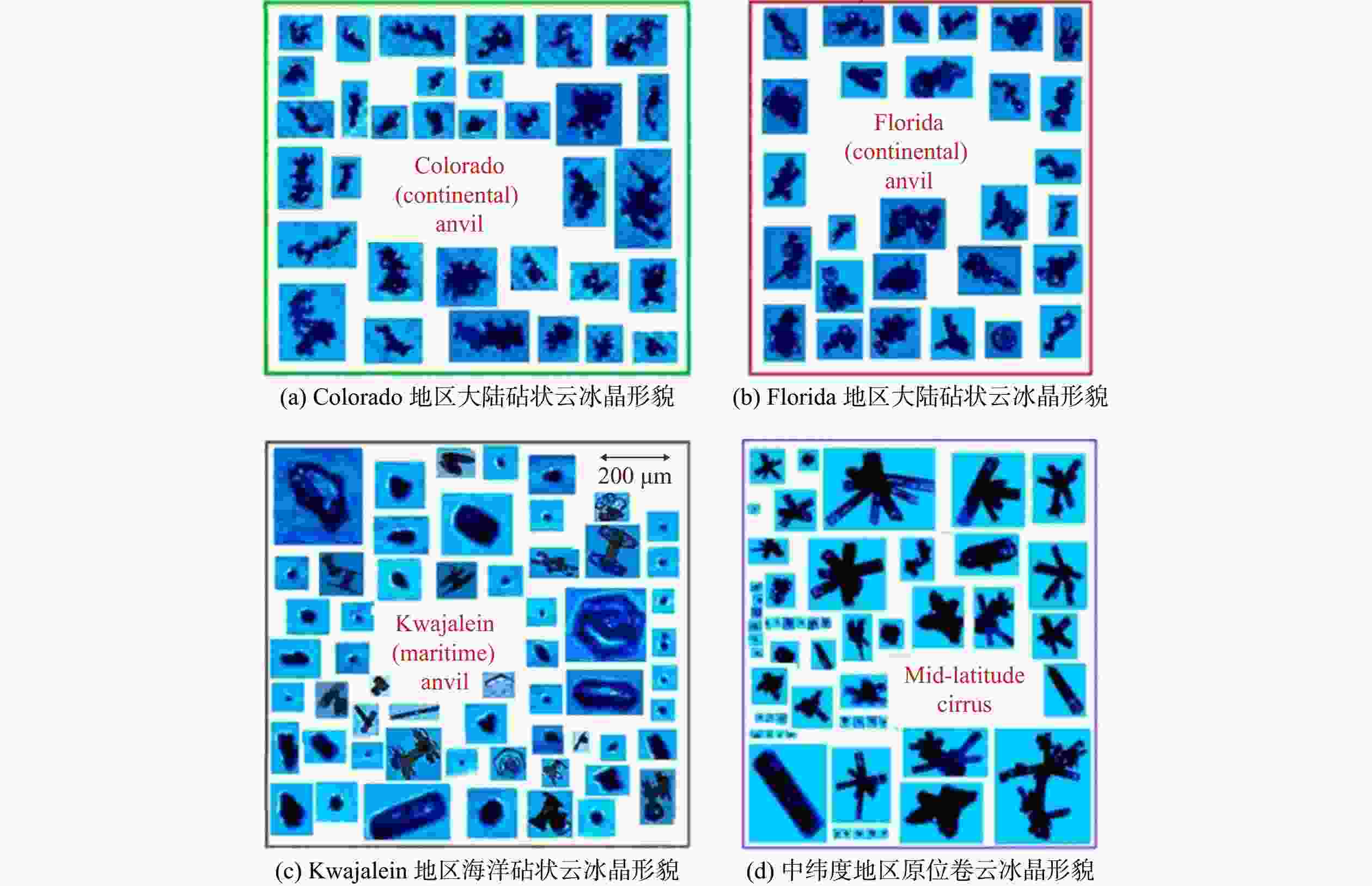
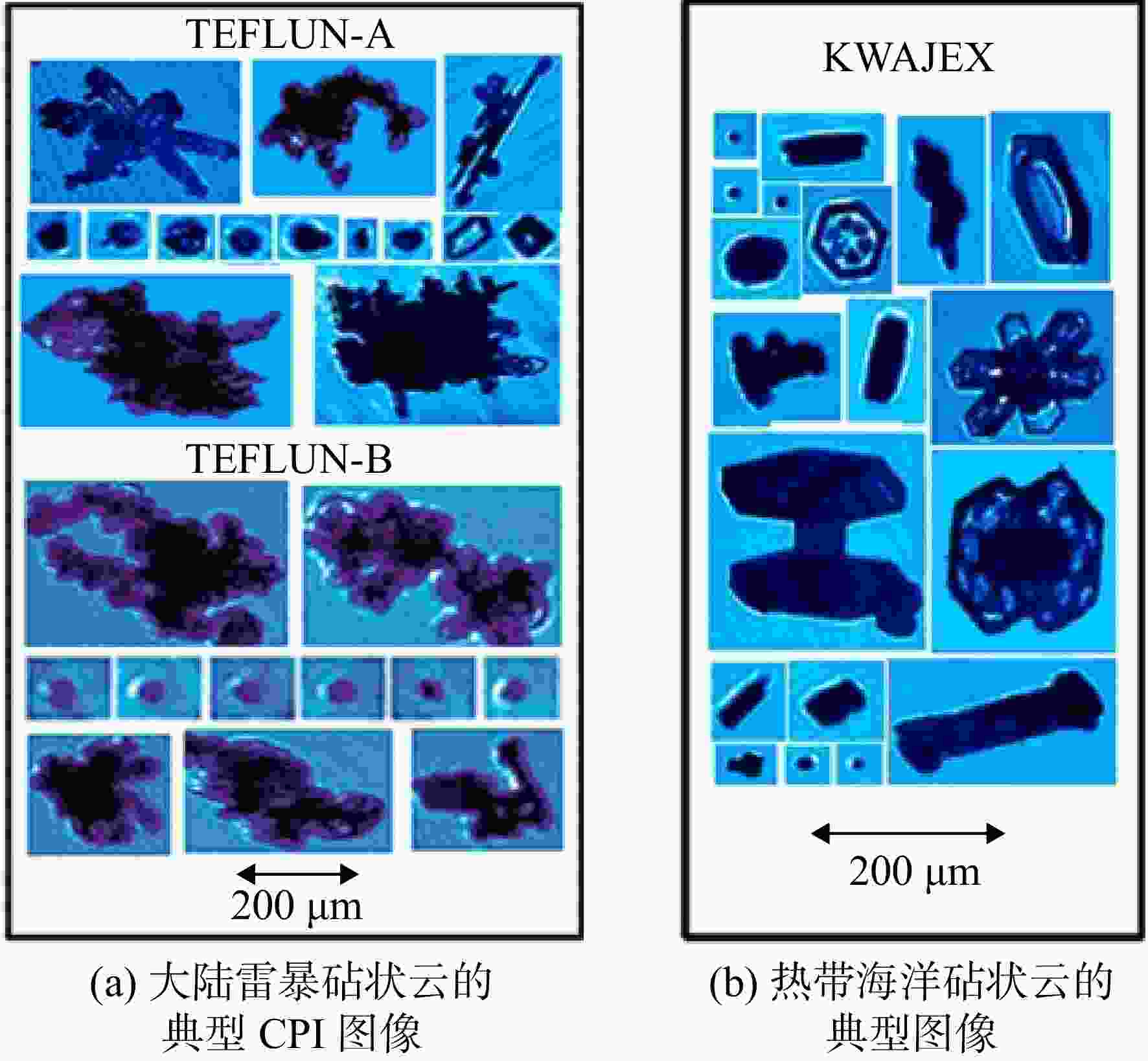
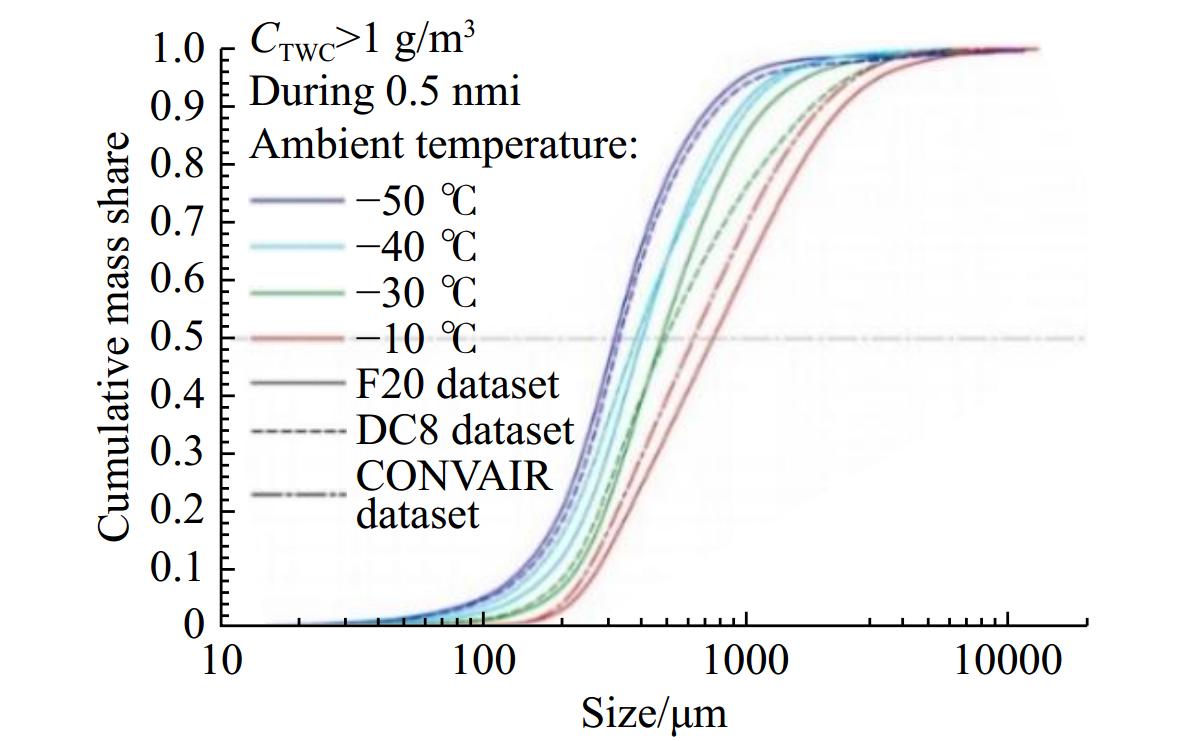
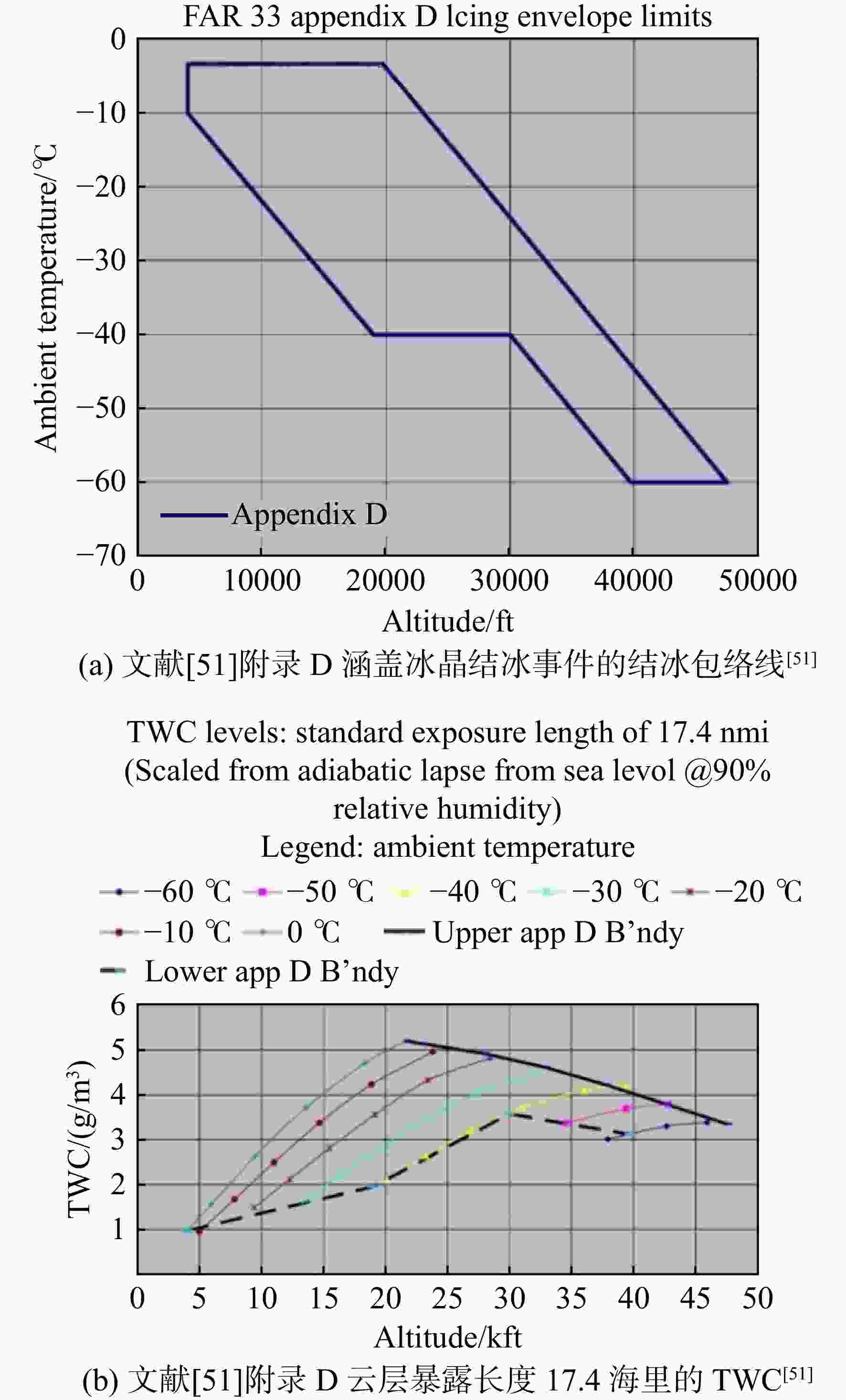
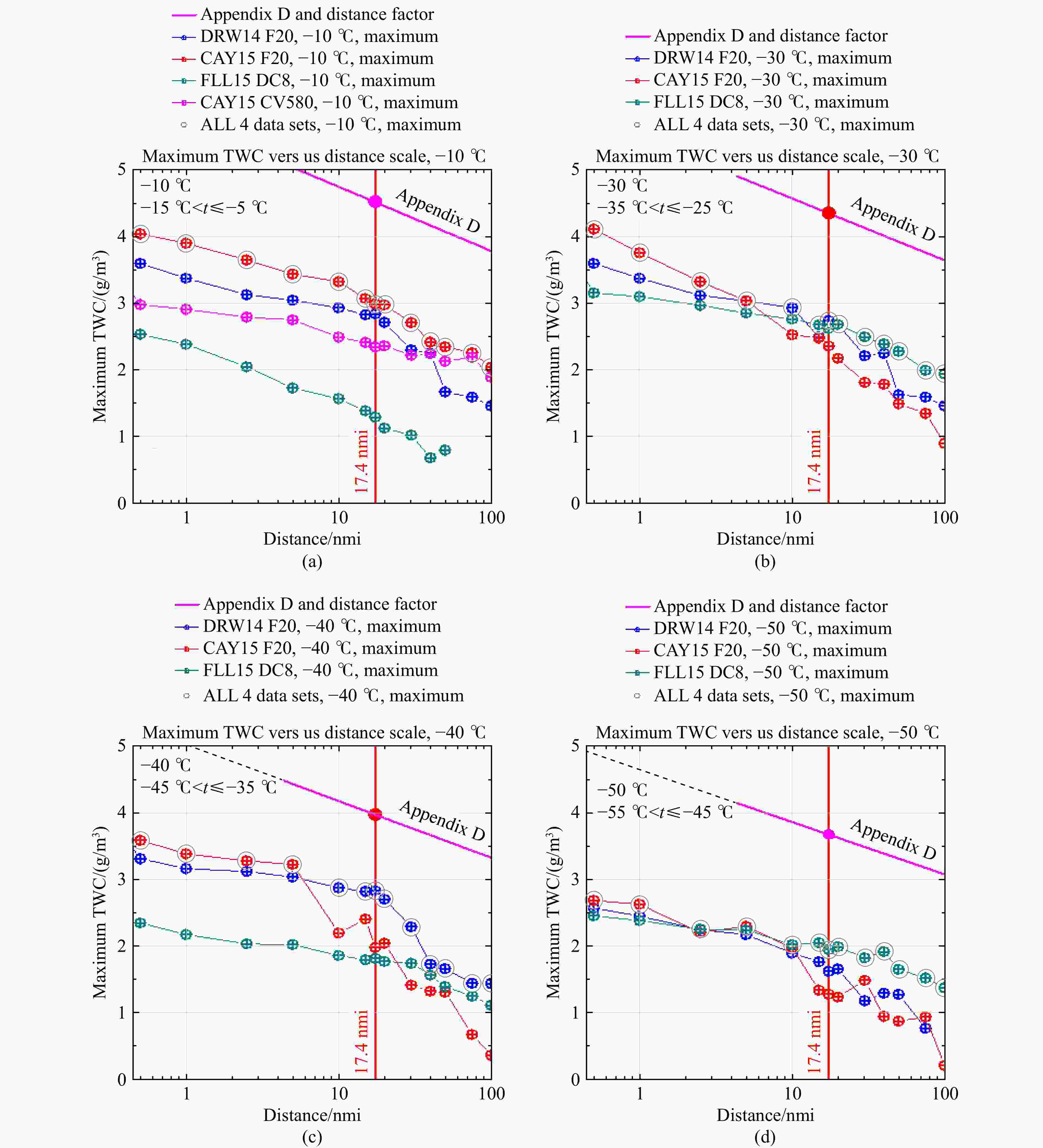
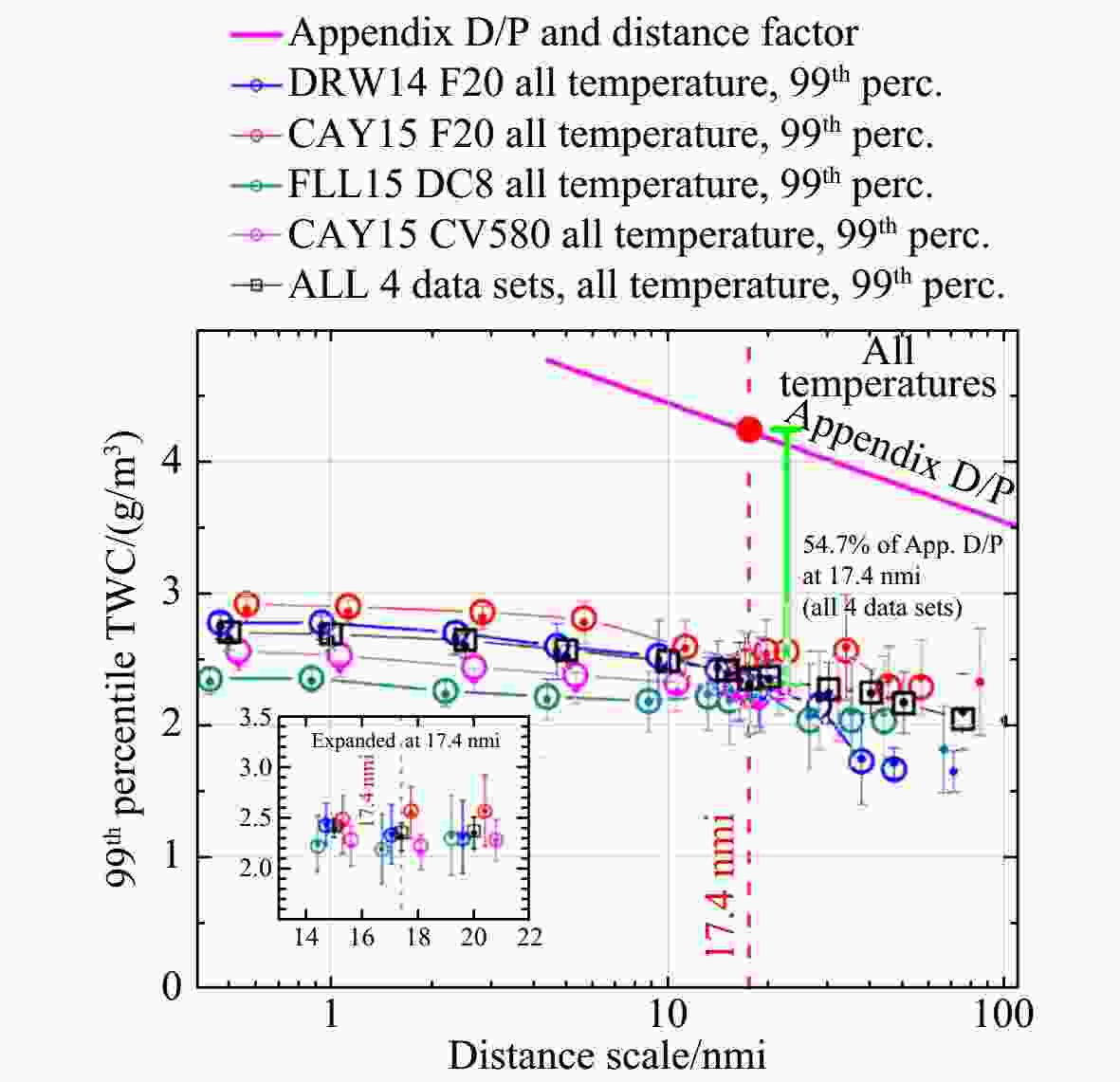
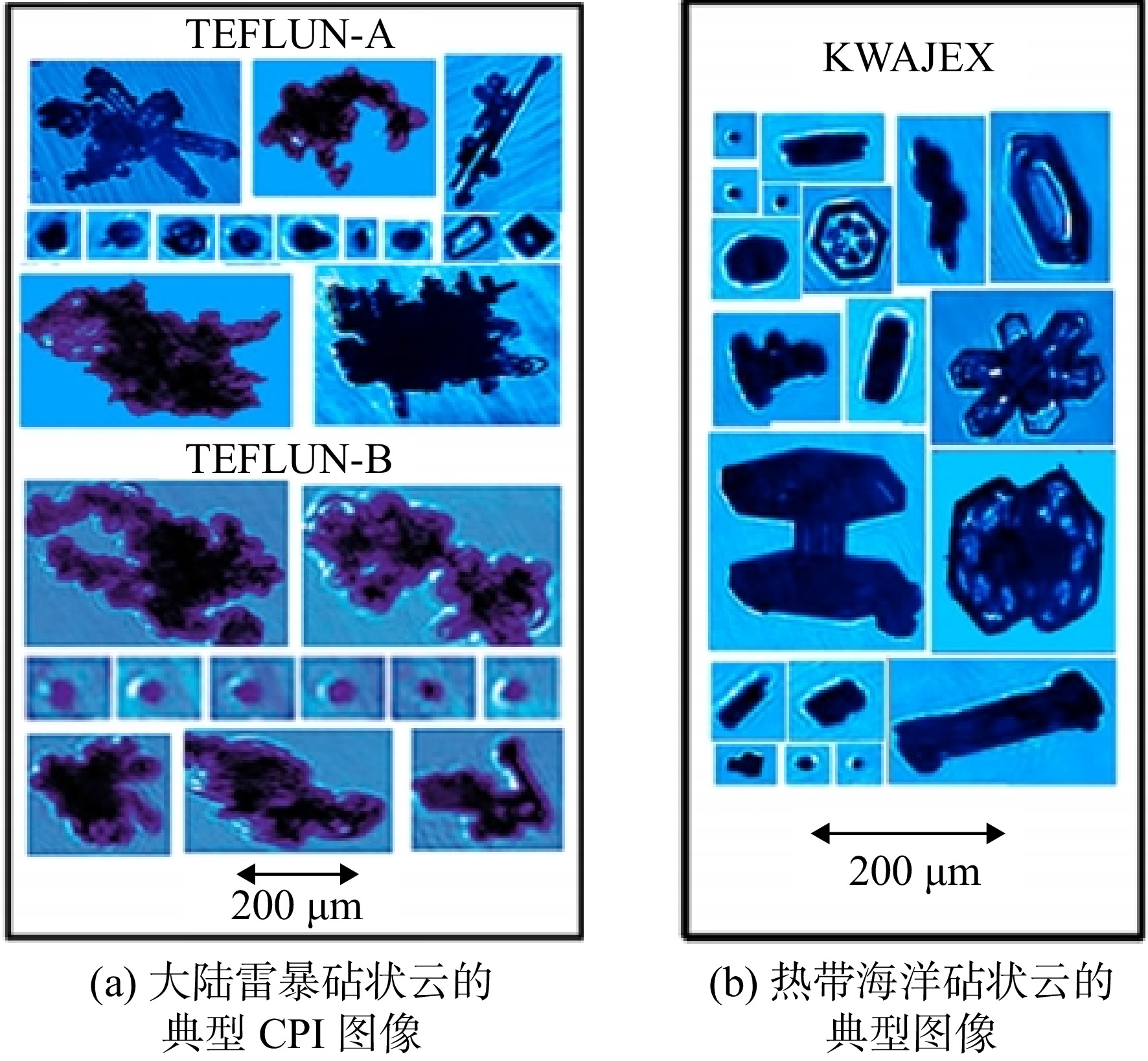
表 1 大陆和海洋地区的砧状云中聚合冰晶的占比及存在的大气环境温度[37]
Table 1. Percentage of aggregated ice crystals in anvil clouds in continental and oceanic regions and the ambient atmospheric temperature at which they are present[37]
砧状云类型 观测位置 聚合冰晶占比/% 大气温度/℃ 大陆型 Colorado 28 −47 海洋型 Kwajalein 0.5 −60~−40  下载: 导出CSV
几何形状 轴比关系 体积 
$\left\{ \begin{gathered} a = 0.35L\quad\quad (L < 100\;{\text{μm}}) \\ a = 3.48{L^{0.5}}\quad (L > 100\;{\text{μm}}) \\ \end{gathered} \right.$ $V = \dfrac{{3\sqrt 3 }}{2}{a^2}L$ 
$\left\{ \begin{gathered} L = 2a\quad\quad\quad\quad\quad\quad\quad\quad\quad\quad\quad\quad\quad \quad\quad(a \leqslant 2\;{\text{μm}}) \\ L = 2 +[ (0.248\;83{a^{0.474}} - 2) /4] (a - 1) \quad \;(2\;{\text{μm}} \leqslant a \leqslant 5\;{\text{μm}}) \\ L = 0.248\;83{a^{0.474}}\quad\quad\quad\quad\quad\quad\quad\quad\quad\quad\;(a \geqslant 5\;{\text{μm}}) \\ \end{gathered} \right.$ $V = \dfrac{{3\sqrt 3 }}{2}{a^2}L$ 
$\left\{ \begin{gathered} a = 0.35L\quad \quad\;\;\;(L < 100\;{\text{μm}}) \\ a = 0.348{L^{0.5}}\quad \; (L \geqslant 100\;{\text{μm}}) \\ h = 0.25L \\ \end{gathered} \right.$ $V = \dfrac{{3\sqrt 3 }}{2}{a^2}L - \sqrt 3 {a^2}h$ 
$ \left\{ \begin{gathered} a = 1.552{L^{0.63}} \\ t = \dfrac{{\sqrt 3 a}}{{2{\text{tan}}\;\alpha }}\quad \alpha = 28{\text{°}} \\ \end{gathered} \right. $ $V = 3\sqrt 3 {a^2} \cdot (3L + t) $ 
$\begin{gathered} {a_1} = 0.291{L_1}\quad {a_2} = 0.323{L_2} \\ {a_3} = 0.359{L_3}\quad {a_4} = 0.381{L_4} \\ {a_5} = 0.368{L_5}\quad {a_6} = 0.352{L_6} \\ {a_7} = 0.333{L_7}\quad {a_8} = 0.312{L_8} \\ D = 7.297{L_{{\text{min}}}} \\ \end{gathered} $ $V = \displaystyle\sum\limits_{i = 1}^8 {\dfrac{{3\sqrt 3 }}{2}a_i^2{L_i}} $ 
$\begin{gathered} D = 2R \\ {a_1} = R{\text{sin}}\;{\theta _1}\quad {a_2} = R{\text{sin}}\;{\theta _2} \\ {L_1} = R{\text{cos}}\;{\theta _1}\quad {L_2} = R{\text{cos}}\;{\theta _2} \\ {\theta _1} = 32.35{\text{deg }}\quad {\theta _2} = 71.8{\text{deg}} \\ \end{gathered} $ $\begin{gathered} V = \sqrt 3 [ ({L_1} + 2{L_2} + h) \cdot a_2^2 - ha_1^2] \\ h = \dfrac{{{a_1} ({L_1} - {L_2}) }}{{{a_2} - {a_1}}} \\ \end{gathered} $
下载: 导出CSV
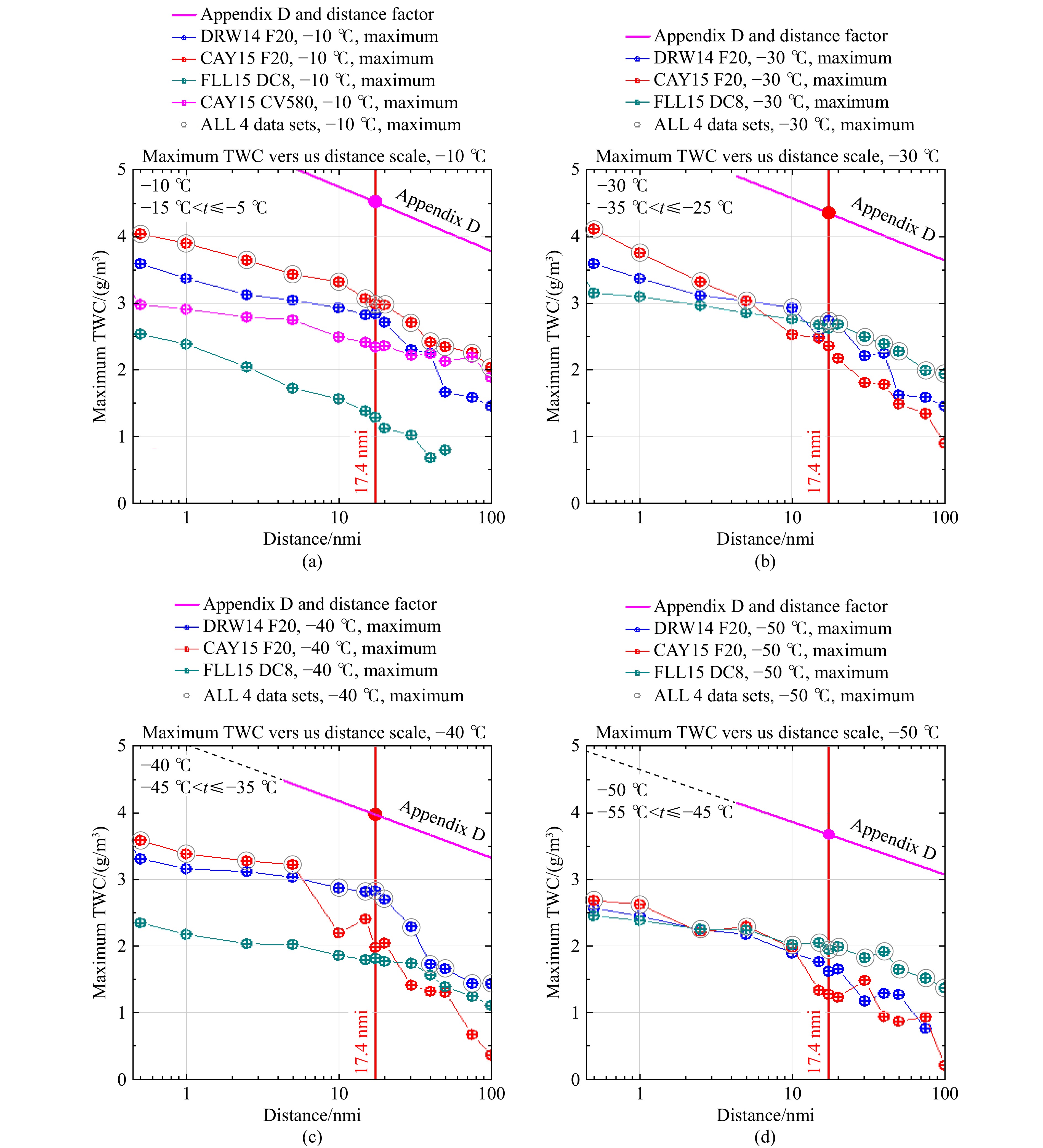
数据集 大气温度/℃ −50 −40 −30 −10 F20数据集 316 401 476 747 DC8数据集 329 381 493 Convair-580数据集 630
下载: 导出CSV
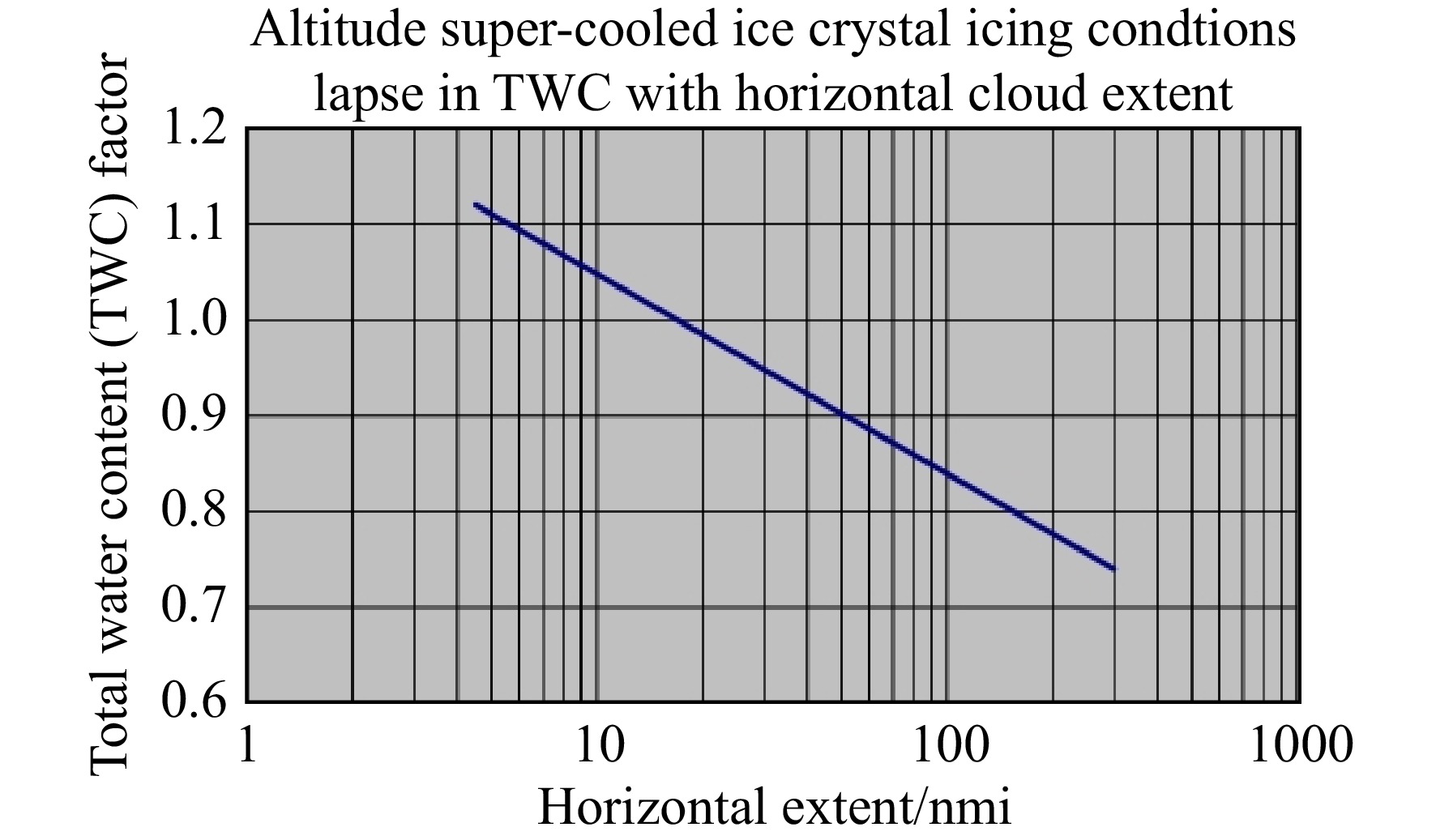
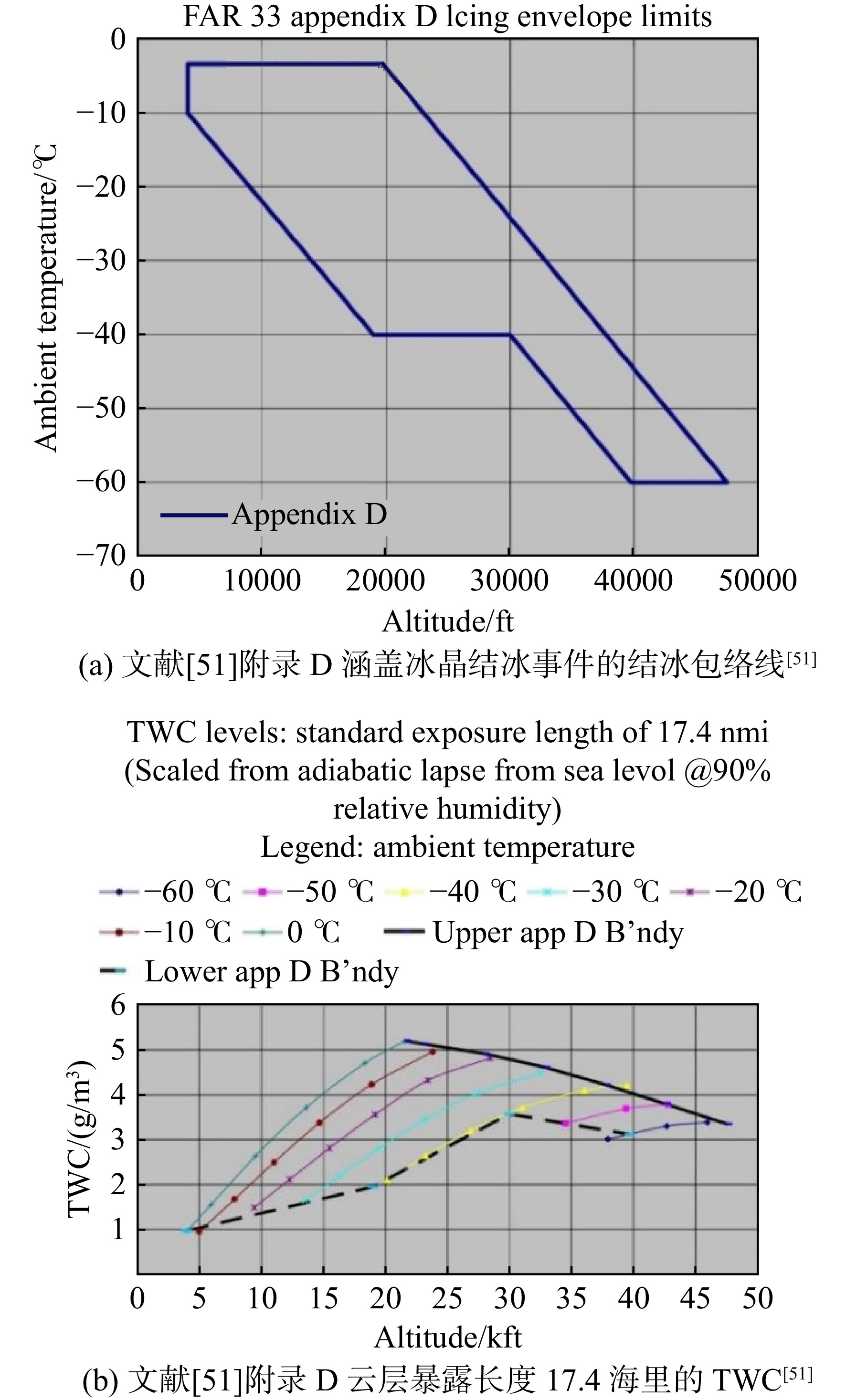
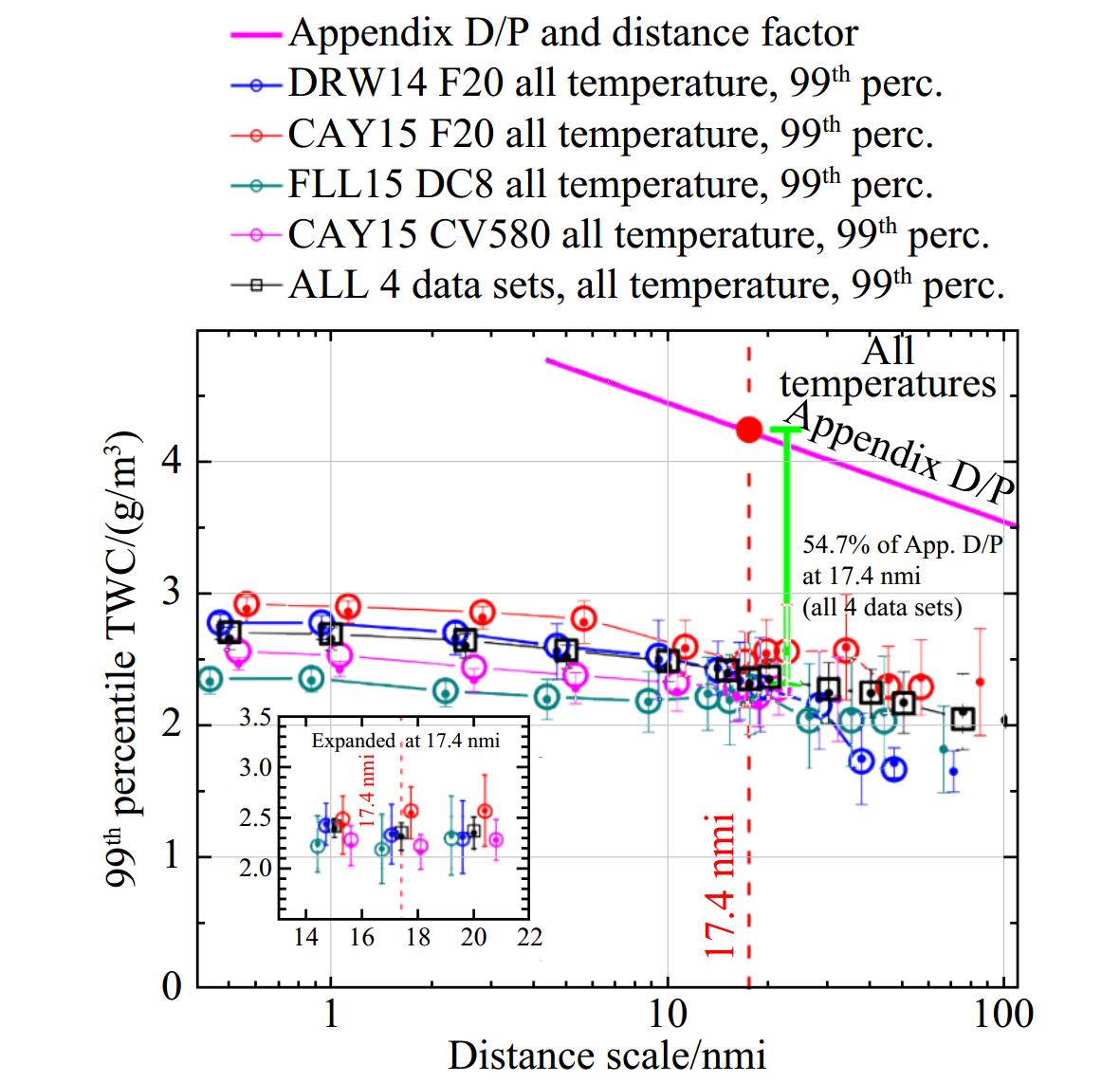
表 4 Bowden给出TWC参考值与文献[52]附录D中TWC参考值的比较[51,55]
Table 4. Comparisons of Bowden’s result of TWC and Ref.[52] appendix D TWC guidelines[51,55]
环境温度范围/℃ 海拔范围/ft 云层水平
延伸范围/nmiBowden给出的
TWC/(g/m3)Mazzawy给出的
TWC范围/(g/m3)Mazzawy给出的TWC的
中位数/(g/m3)−20 ~ 0 10000 ~30000 0.44 8 2.6 5 4.6 4.4 2.0~5.7 4.8 17.4 1.8~5.1 4.3 44 2 1.6~4.7 4.0 161 1 1.4~4.1 3.4 −40 ~ −20 15000 ~40000 2.6 5 4.6 2.0~5.5 4.5 8.7 2 1.9~5.2 4.3 17.4 1.8~4.9 4.0 44 1 1.7~4.5 3.7 161 0.5 1.4~3.9 3.2 −60 ~ −40 20000 ~45000 2.6 5 4.6 2.4~4.7 3.7 8.7 2 2.2~4.4 3.5 17.4 2.1~4.2 3.3 44 1 1.9~3.9 3.0 161 0.5 1.7~3.4 2.6 −80 ~ −60 60000 ~80000 2.6 1 4.6 8.7 0.5 161 0.1
下载: 导出CSV
表 5 不同冰晶测量传感器优缺点比较
Table 5. Comparison of advantages and disadvantages of different ice crystal measurement sensors
仪器 优点 缺点 CVI 按粒径分离粒子;便于增加粒子的粒子数浓度 小冰晶测量误差 FSSP 实时提供测量粒子数浓度;高分辨率 时间响应限制;高速时无法确定小于300 μm
粒子的形状和相态HVPS 可测量大量降水粒子;可提供粒子的详细图像 采样空间相对较小;数据量大,需要有效的数据处理和
存储解决方案OAP 能提供粒子数浓度、大小和形状数据;测量误差较小 小冰晶测量误差;数据重访需求
下载: 导出CSV
-
[1] 易贤. 飞机积冰的数值计算与积冰试验相似准则研究[D]. 四川 绵阳: 中国空气动力研究与发展中心, 2007. YI Xian. Numerical computation of aircraft icing and study on icing test scaling law[D]. Mianyang Sichuan: China Aerodynamic Research and Development Center, 2007. (in ChinseYI Xian. Numerical computation of aircraft icing and study on icing test scaling law[D]. Mianyang Sichuan: China Aerodynamic Research and Development Center, 2007. (in Chinse) [2] 易贤, 朱国林. 考虑传质传热效应的翼型积冰计算[J]. 空气动力学学报, 2004, 22(4): 490-493. YI Xian, ZHU Guolin. Computation of glaze ice accretion on airfoil[J]. Acta Aerodynamica Sinica, 2004, 22(4): 490-493. (in Chinese doi: 10.3969/j.issn.0258-1825.2004.04.023YI Xian, ZHU Guolin. Computation of glaze ice accretion on airfoil[J]. Acta Aerodynamica Sinica, 2004, 22(4): 490-493. (in Chinese) doi: 10.3969/j.issn.0258-1825.2004.04.023 [3] MASON J, STRAPP W, CHOW P. The ice particle threat to engines in flight: AIAA2006-206 [R]. Reston, US: AIAA, 2006. [4] MASON J G, CHOW P, FULEKI D M. Understanding ice crystal accretion and shedding phenomenon in jet engines using a rig test[J]. Journal of Engineering for Gas Turbines and Power, 2011, 133(4): 041201. doi: 10.1115/1.4002020 [5] BRAVIN M, STRAPP J W, MASON J. An investigation into location and convective lifecycle trends in an ice crystal icing engine event database: SAE Technical Paper 2015-01-2130 [R]. Warrendale, US: SAE, 2015. [6] 袁庆浩, 樊江, 白广忱. 航空发动机内部冰晶结冰研究 综述[J]. 推进技术, 2018, 39(12): 2641-2650. YUAN Qinghao, FAN Jiang, BAI Guangchen. Review of ice crystal icing in aero-engines[J]. Journal of Propulsion Technology, 2018, 39(12): 2641-2650. (in ChineseYUAN Qinghao, FAN Jiang, BAI Guangchen. Review of ice crystal icing in aero-engines[J]. Journal of Propulsion Technology, 2018, 39(12): 2641-2650. (in Chinese) [7] 黄平, 卜雪琴, 刘一鸣, 等. 混合相/冰晶条件下的结冰研究综述[J]. 航空学报, 2022, 43(5): 025178. HUANG Ping, BU Xueqin, LIU Yiming, et al. Mixed phase/glaciated ice accretion: review[J]. Acta Aeronautica et Astronautica Sinica, 2022, 43(5): 025178. (in ChineseHUANG Ping, BU Xueqin, LIU Yiming, et al. Mixed phase/glaciated ice accretion: review[J]. Acta Aeronautica et Astronautica Sinica, 2022, 43(5): 025178. (in Chinese) [8] 马乙楗, 柴得林, 易贤, 等. 考虑侵蚀效应的冰晶/混合相结冰计算方法[J]. 航空学报, 2023, 44(15): 528609. MA Yijian, CHAI Delin, YI Xian, et al. Calculation method for ice crystal/mixed phase icing considering ice crystal erosion[J]. Acta Aeronautica et Astronautica Sinica, 2023, 44(15): 528609. (in ChineseMA Yijian, CHAI Delin, YI Xian, et al. Calculation method for ice crystal/mixed phase icing considering ice crystal erosion[J]. Acta Aeronautica et Astronautica Sinica, 2023, 44(15): 528609. (in Chinese) [9] 沈浩, 韩冰冰, 张丽芬. 航空发动机中冰晶结冰的研究进展[J]. 实验流体力学, 2020, 34(6): 1-7. SHEN Hao, HAN Binbin, ZHANG Lifen. Research progress of the ice crystal icing in aero-engine[J]. Journal of Experiments in Fluid Mechanics, 2020, 34(6): 1-7. (in Chinese doi: 10.11729/syltlx20190124SHEN Hao, HAN Binbin, ZHANG Lifen. Research progress of the ice crystal icing in aero-engine[J]. Journal of Experiments in Fluid Mechanics, 2020, 34(6): 1-7. (in Chinese) doi: 10.11729/syltlx20190124 [10] GUO X D, HU Z W, DING L, et al. Numerical investigation of thermal and mechanical equilibrium characteristics of ice crystal in large icing wind tunnel[J]. Journal of Aerodynamics, 2022, 37(3): 478-491. [11] MA Y J, CHAI D L, WANG Q, et al. Phase change and adhesion characteristics of ice crystal movements in wing icing[J]. Acta Aeronautica et Astronautica Sinica, 2023, 44(1): 41-52. [12] VILLEDIEU P, TRONTIN P, CHAUVIN R. Glaciated and mixed phase ice accretion modeling using ONERA 2D icing suite: AIAA2014-2199 [R]. Reston, US: AIAA, 2014. [13] KRISTJÁNSSON J E, EDWARDS J M, MITCHELL D L. Impact of a new scheme for optical properties of ice crystals on climates of two GCMs[J]. Journal of Geophysical Research: Atmospheres, 2000, 105: 10063-10079. doi: 10.1029/2000JD900015 [14] HEYMSFIELD A J. Precipitation development in stratiform ice clouds: a microphysical and dynamical study[J]. Journal of the Atmospheric Sciences, 1977, 34(2): 367-381. doi: 10.1175/1520-0469(1977)034<0367:PDISIC>2.0.CO;2 [15] BAKER M B. Cloud microphysics and climate[J]. Science, 1997, 276(5315): 1072-1078. doi: 10.1126/science.276.5315.1072 [16] DEZITTER F, GRANDIN A, BRENGUIER J L, et al. HAIC: high altitude ice crystals: AIAA2013-2674. [R]. Reston, US: AIAA, 2013. [17] LAWSON R P, WOODS S, JENSEN E, et al. A Review of Ice Particle Shapes in Cirrus formed in Situ and in Anvils[J]. Journal of Geophysical Research: Atmospheres, 2019, 124(17/18): 10049-10090. [18] WOODS S, LAWSON R P, JENSEN E, et al. Microphysical properties of tropical tropopause layer cirrus[J]. Journal of Geophysical Research Atmospheres, 2018, 123(11): 6053-6069. doi: 10.1029/2017JD028068 [19] JECK R K. Snow and ice particle sizes and mass concentrations at altitudes up to 9 km (30 000 ft) [R]. [S. l. ]: PN, 1998. [20] STRAPP J W, KOROLEV A, RATVASKY T, et al. The high ice water content study of deep convective clouds: report on science and technical plan [R]. Washington DC, US: Federal Aviation Administration, 2016. [21] 段婧, 郭恒, 胡金蓉, 等. 自然冰雪晶粒子观测及形状分类研究进展[J]. 气象学报, 2023, 81(5): 685-701. DUAN Jing, GUO Heng, HU Jinrong, et al. Research progress in observation and shape classification of natural snow and ice crystals[J]. Acta Meteorologica Sinica, 2023, 81(5): 685-701. (in Chinese doi: 10.11676/qxxb2023.20220180DUAN Jing, GUO Heng, HU Jinrong, et al. Research progress in observation and shape classification of natural snow and ice crystals[J]. Acta Meteorologica Sinica, 2023, 81(5): 685-701. (in Chinese) doi: 10.11676/qxxb2023.20220180 [22] 刘思瑶, 赵传峰, 周毓荃. SPEC机载云探测系统及其云物理研究进展[J]. 暴雨 灾害, 2021, 40(3): 280-286. LIU Siyao, ZHAO Chuanfeng, ZHOU Yuquan. SPEC airborne cloud detection system and its cloud physics research progress[J]. Torrential Rain and Disasters, 2021, 40(3): 280-286. (in ChineseLIU Siyao, ZHAO Chuanfeng, ZHOU Yuquan. SPEC airborne cloud detection system and its cloud physics research progress[J]. Torrential Rain and Disasters, 2021, 40(3): 280-286. (in Chinese) [23] 郭学良, 于子平, 杨泽后, 等. 高性能机载云粒子成像仪研制及应用[J]. 气象学报, 2020, 78(6): 1050-1064. GUO Xueliang, YU Ziping, YANG Zehou, et al. Development and application of the high-performance airborne cloud particle imager[J]. Acta Meteorologica Sinica, 2020, 78(6): 1050-1064. (in Chinese doi: 10.11676/qxxb2020.059GUO Xueliang, YU Ziping, YANG Zehou, et al. Development and application of the high-performance airborne cloud particle imager[J]. Acta Meteorologica Sinica, 2020, 78(6): 1050-1064. (in Chinese) doi: 10.11676/qxxb2020.059 [24] 白锦. 基于知识辅助的高空冰晶检测技术研究[D]. 天津: 中国民航大学, 2021. BAI Jin. Research on knowledge-aided detection technology of high altitude ice crystals[D]. Tianjin: Civil Aviation University of China, 2021. (in ChineseBAI Jin. Research on knowledge-aided detection technology of high altitude ice crystals[D]. Tianjin: Civil Aviation University of China, 2021. (in Chinese) [25] NORDENSKIÖLD G. The inner structure of snow crystals[J]. Nature, 1893, 48: 592-594. doi: 10.1038/048592a0 [26] UKICHIRO N. Snow crystals.[J]. Journal of Glaciology, 1955, 2(17): 516. [27] LIOU K N. Influence of cirrus clouds on weather and climate processes: a global perspective[J]. Monthly Weather Review, 1986, 114(6): 1167-1199. doi: 10.1175/1520-0493(1986)114<1167:IOCCOW>2.0.CO;2 [28] BARAN A J. A review of the light scattering properties of cirrus[J]. Journal of Quantitative Spectroscopy and Radiative Transfer, 2009, 110(14/15/16): 1239-1260. [29] LAWSON R P, BAKER B A, PILSON B. In Situ measurements of microphysical properties of mid-latitude and anvil cirrus[R]. Honolulu, US: SPEC Incorporated, 2003. [30] CONNOLLY P J, SAUNDERS C P R, GALLAGHER M W, et al. Aircraft observations of the influence of electric fields on the aggregation of ice crystals[J]. Quarterly Journal of the Royal Meteorological Society, 2005, 131(608): 1695-1712. doi: 10.1256/qj.03.217 [31] UM J, MCFARQUHAR G M. Single-scattering properties of aggregates of plates[J]. Quarterly Journal of the Royal Meteorological Society, 2009, 135(639): 291-304. doi: 10.1002/qj.378 [32] MCFARQUHAR G M, HEYMSFIELD A J. Microphysical characteristics of three anvils sampled during the central equatorial Pacific experiment[J]. Journal of the Atmospheric Sciences, 1996, 53(17): 2401-2423. doi: 10.1175/1520-0469(1996)053<2401:MCOTAS>2.0.CO;2 [33] WHITEWAY J, COOK C, GALLAGHER M, et al. Anatomy of cirrus clouds: results from the Emerald airborne campaigns[J]. Geophysical Research Letters, 2004, 31(24): 1-4. [34] LAWSON R P, PILSON B, BAKER B, et al. Aircraft measurements of microphysical properties of subvisible cirrus in the tropical tropopause layer[J]. Atmospheric Chemistry and Physics, 2008, 8(6): 1609-1620. doi: 10.5194/acp-8-1609-2008 [35] STITH J L, AVALLONE L, BANSEMER A, et al. Ice particles in the upper anvil regions of mid-latitude continental thunderstorms: the case for frozen-drop aggregates[J]. Atmospheric Chemistry and Physics, 2013, 14: 1973-1985. [36] UM J, MCFARQUHAR G M, HONG Y P, et al. Dimensions and aspect ratios of natural ice crystals[J]. Atmospheric Chemistry and Physics, 2015, 15: 3933-3956. doi: 10.5194/acp-15-3933-2015 [37] LAWSON P, BAKER B, PILSON B. In situ measurements of microphysical and radiative properties of cirrus and anvil clouds[J]. Atmospheric Chemistry and Physics, 2006, 6: 1-16. doi: 10.5194/acp-6-1-2006 [38] BAILEY M P, HALLETT J. A comprehensive habit diagram for atmospheric ice crystals: confirmation from the laboratory, AIRS II, and other field studies[J]. Journal of the Atmospheric Sciences, 2009, 66(9): 2888. doi: 10.1175/2009JAS2883.1 [39] KOROLEV A V, ISAAC G A, HALLETT J. Ice particle habits in Arctic clouds[J]. Geophysical Research Letters, 1999, 26(9): 1299-1302. doi: 10.1029/1999GL900232 [40] HU Yachao, MCFARQUHAR G M, BRECHNER P, et al. Dependence of ice crystal size distributions in high ice water content conditions on environmental conditions: results from the HAIC-HIWC cayenne campaign[J]. Journal of the Atmospheric Sciences, 2022, 79(12): 3103-3134. doi: 10.1175/JAS-D-22-0008.1 [41] LANCE S, LAWSON P, JENSEN E, et al. SPARTICUS and MACPEX cirrus particle sizes and habits as a function of temperature and synoptic cirrus type: A33C-0242 [R]. San Francisco, US: American Geophysical Union (AGU), 2013. [42] HEYMSFIELD A J, LEWIS S, BANSEMER A, et al. A general approach for deriving the properties of cirrus and stratiform ice cloud particles[J]. Journal of the Atmospheric Sciences, 2002, 59(1): 3-29. doi: 10.1175/1520-0469(2002)059<0003:AGAFDT>2.0.CO;2 [43] KAJIKAWA M, HEYMSFIELD A J. Aggregation of ice crystals in cirrus[J]. Journal of the Atmospheric Sciences, 1989, 46(20): 3108-3121. doi: 10.1175/1520-0469(1989)046<3108:AOICIC>2.0.CO;2 [44] 杨泽鑫. 云粒子散射特性分析与测试技术研究[D]. 南京: 南京信息工程大学, 2016. YANG Zexin. Analysis and test technology of scattering characteristics of cloud particle[D]. Nanjing: Nanjing University of Information Science and Technology, 2016. (in ChineseYANG Zexin. Analysis and test technology of scattering characteristics of cloud particle[D]. Nanjing: Nanjing University of Information Science and Technology, 2016. (in Chinese) [45] HEYMSFIELD A J, SABIN R M. Cirrus crystal nucleation by homogeneous freezing of solution droplets[J]. Journal of the Atmospheric Sciences, 1989, 46(14): 2252-2264. doi: 10.1175/1520-0469(1989)046<2252:CCNBHF>2.0.CO;2 [46] DOWLING D R, RADKE L F. A summary of the physical properties of cirrus clouds[J]. Journal of Applied Meteorology, 1990, 29(9): 970-978. doi: 10.1175/1520-0450(1990)029<0970:ASOTPP>2.0.CO;2 [47] LAWSON R P, BAKER B A, ZMARZLY P, et al. Microphysical and optical properties of atmospheric ice crystals at south pole station[J]. Journal of Applied Meteorology and Climatology, 2006, 45(11): 1505-1524. doi: 10.1175/JAM2421.1 [48] PROTAT A, MCFARQUHAR G M, UM J, et al. Obtaining best estimates for the microphysical and radiative properties of tropical ice clouds from TWP-ICE in situ microphysical observations[J]. Journal of Applied Meteorology and Climatology, 2011, 50(4): 895-915. doi: 10.1175/2010JAMC2401.1 [49] STRAPP J, CHOW P, MALTBY M, et al. Cloud microphysical measurements in thunderstorm outflow regions during Allied/BAE 1997 flight trials: AIAA1999-498 [R]. Reston, US: AIAA, 1999. [50] ABRAHAM J, STRAPP J W, FOGARTY C, et al. Extratropical transition of hurricane Michael: an aircraft investigation[J]. Bulletin of the American Meteorological Society, 2004, 85(9): 1323-1340. doi: 10.1175/BAMS-85-9-1323 [51] MAZZAWY R S, STRAPP J W. Appendix D-an interim icing envelope[C]// Proceedings of SAE Aircraft and Engine Icing International Conference. Warrendale, US: SAE International, 2007: 634-642. [52] STRAPP J W, SCHWARZENBOECK A, BEDKA K, et al. An assessment of cloud total water content and particle size from flight test campaign measurements in high ice water content, mixed phase/ice crystal icing conditions: primary in-situ measurements: DOT/FAA/TC-18/1[R]. Washington DC, US: Federal Aviation Administration, 2020. [53] PRUPPACHER H R, KLETT J D. Microphysics of clouds and precipitation[M]. Dordrecht, Netherlands: Springer Netherlands, 1978. [54] LAWSON R P, ANGUS L J, HEYMSFIELD A J. Cloud particle measurement in thunderstorm anvils and possible weather threat to aviation[J]. Journal of Aircraft, 1998, 35(1): 113-121. doi: 10.2514/2.2268 [55] BOWDEN D T, GENSEMER A E, SKEEN C A. Engineering summary of airframe icing technical data[R]. Washington, DC: Federal Aviation Agency, 1964. [56] HYNDMAN R J, FAN Yanan. Sample quantiles in statistical packages[J]. The American Statistician, 1996, 50(4): 361-365. doi: 10.1080/00031305.1996.10473566 [57] CROARKIN C, TOBIAS P. NIST/SEMATECH e-handbook of statistical methods [EB/OL]. (2002-11-01)[2024-03-20]. https://www.itl.nist.gov/div898/handbook/. [58] KOROLEV A, MCFARQUHAR G, FIELD P R, et al. Mixed-phase clouds: progress and challenges[J]. Meteorological Monographs, 2017, 58: 1-50. [59] KOROLEV A V. Rates of phase transformations in mixed-phase clouds[J]. Quarterly Journal of the Royal Meteorological Society, 2008, 134(632): 595-608. doi: 10.1002/qj.230 [60] STITH J L, DYE J E, BANSEMER A, et al. Microphysical observations of tropical clouds[J]. Journal of Applied Meteorology, 2002, 41(2): 97-117. doi: 10.1175/1520-0450(2002)041<0097:MOOTC>2.0.CO;2 [61] BLACK R A, HALLETT J. Observations of the distribution of ice in hurricanes[J]. Journal of the Atmospheric Sciences, 1986, 43(8): 802-822. doi: 10.1175/1520-0469(1986)043<0802:OOTDOI>2.0.CO;2 [62] LIN Hong, HEINTZENBERG J. A theoretical study of the counterflow virtual impactor[J]. Journal of Aerosol Science, 1995, 26(6): 903-914. doi: 10.1016/0021-8502(95)00024-7 [63] SCHWARZENBO¨CK A, HEINTZENBERG J, MERTES S, et al. Cloud droplet break-up in a counterflow virtual impactor due to high sampling velocities[J]. Journal of Aerosol Science, 1998, 29: 345-346. doi: 10.1016/S0021-8502(98)00511-4 [64] SCHWARZENBÖCK A, HEINTZENBERG J, MERTES S. New minimum lower cut size for a counterflow virtual impactor complemented by the upper cut of an interstitial inlet[J]. Journal of Aerosol Science, 1997, 28: 277-278. doi: 10.1016/S0021-8502(96)00072-9 [65] BIRGITTA NOONE K, HEINTZENBERG J. On the determination of droplet size distributions with the counterflow virtual impactor[J]. Atmospheric Research, 1991, 26(5): 389-405. doi: 10.1016/0169-8095(91)90060-A [66] PIÑA A. Comparison of microphysical cloud properties from the FSSP and CDP during the CAMPS field campaign: A53B-0343[R]. Washington, DC: American Geophysical Union (AGU), 2011. [67] GLANTZ P, NOONE K J. Comparisons of cvi and fssp measurements of cloud droplet number concentrations in marine stratocumulus clouds[J]. Journal of Aerosol Science, 2001, 32: 833-834. [68] BRENGUIER J L, BOURRIANNE T, COELHO A A, et al. Improvements of droplet size distribution measurements with the fast-FSSP (forward scattering spectrometer probe)[J]. Journal of Atmospheric and Oceanic Technology, 1998, 15(5): 1077-1090. doi: 10.1175/1520-0426(1998)015<1077:IODSDM>2.0.CO;2 [69] CAMPANELLI M, JUNKERMANN W, OLIVIERI B, et al. Physical features of the atmospheric aerosol determined with an aureole meter and a FSSP probe in the Mediterranean Lampedusa Island[J]. Atmospheric Environment, 2001, 35(21): 3607-3618. doi: 10.1016/S1352-2310(00)00560-4 [70] BU Ling, TIAN Li, ZHU Ya, et al. Development of a forward scattering spectrometer probe[J]. Advanced Materials Research, 2011, 179/180: 135-140. doi: 10.4028/www.scientific.net/AMR.179-180.135 [71] GERBER H, DEMOTT P J. Response of FSSP-100 and PVM-100A to small ice crystals[J]. Journal of Atmospheric and Oceanic Technology, 2014, 31(10): 2145-2155. doi: 10.1175/JTECH-D-13-00228.1 [72] GLIENKE S, MEI F. High-Volume Precipitation Spectrometer (HVPS) Instrument Handbook: DOE/SC-ARM-TR-239[R]. Richland, US: Pacific Northwest National Laboratory, 2020. [73] KOROLEV A V, STRAPP J W, ISAAC G A. Evaluation of the accuracy of PMS optical array probes[J]. Journal of Atmospheric and Oceanic Technology, 1998, 15(3): 708-720. doi: 10.1175/1520-0426(1998)015<0708:EOTAOP>2.0.CO;2 [74] LILIE L, BOULEY D, SIVO C, et al. A new 1D2D optical array particle imaging probe for airborne and ground simulation cloud measurements[J]. SAE International Journal of Advanced and Current Practices in Mobility, 2024, 6(3): 1347-1362. [75] JAFFEUX L, SCHWARZENBÖCK A, COUTRIS P, et al. Ice crystal images from optical array probes: classification with convolutional neural networks[J]. Atmospheric Measurement Techniques, 2022, 15(17): 5141-5157. doi: 10.5194/amt-15-5141-2022 [76] SMEDLEY A R D, SAUNDERS C P R, WEBB A R. Small-particle size determination by optical array probe oversampling[J]. Journal of Atmospheric and Oceanic Technology, 2003, 20(11): 1568-1575. doi: 10.1175/1520-0426(2003)020<1568:SSDBOA>2.0.CO;2 [77] LAWSON R P, STEWART R E, STRAPP J W, et al. Aircraft observations of the origin and growth of very large snowflakes[J]. Geophysical Research Letters, 1993, 20(1): 53-56. doi: 10.1029/92GL02917 [78] KOROLEV A, HECKMAN I, WOLDE M, et al. A new look at the environmental conditions favorable to secondary ice production[J]. Atmospheric Chemistry and Physics, 2020, 20(3): 1391-1429. doi: 10.5194/acp-20-1391-2020 [79] LANCE S, SHUPE M D, FEINGOLD G, et al. Cloud condensation nuclei as a modulator of ice processes in Arctic mixed-phase clouds[J]. Atmospheric Chemistry and Physics, 2011, 11(15): 8003-8015. doi: 10.5194/acp-11-8003-2011 [80] JENSEN E J, PFISTER L, BUI T P, et al. Ice nucleation and cloud microphysical properties in tropical tropopause layer cirrus[J]. Atmospheric Chemistry and Physics, 2010, 10(3): 1369-1384. doi: 10.5194/acp-10-1369-2010 [81] CHEPFER H, MINNIS P, YOUNG D, et al. Estimation of cirrus cloud effective ice crystal shapes using visible reflectance’s from dual-satellite measurements[J]. Journal of Geophysical Research: Atmospheres, 2002, 107(23): 4616-4628. [82] CHEPFER H, GOLOUB P, RIEDI J, et al. Ice crystal shapes in cirrus clouds derived from POLDER/ADEOS-1[J]. Journal of Geophysical Research: Atmospheres, 2001, 106(8): 7955-7966. [83] MCFARLANE S A, MARCHAND R T, ACKERMAN T P. Retrieval of cloud phase and crystal habit from Multiangle Imaging Spectroradiometer (MISR) and Moderate Resolution Imaging Spectroradiometer (MODIS) data[J]. Journal of Geophysical Research: Atmospheres, 2005, 110(14): 2205-2217. [84] STEPHENS G L, VANE D G, BOAIN R J, et al. The cloudsat mission and the a-train[J]. Bulletin of the American Meteorological Society, 2002, 83(12): 1771-1790. doi: 10.1175/BAMS-83-12-1771 [85] TIAN Lin, HEYMSFIELD G M, LI Lihua, et al. A study of cirrus ice particle size distribution using TC4 observations[J]. Journal of the Atmospheric Sciences, 2010, 67(1): 195-216. doi: 10.1175/2009JAS3114.1 [86] LIAO Liang, SASSEN K. Investigation of relationships between Ka-band radar reflectivity and ice and liquid water contents[J]. Atmospheric Research, 1994, 34(1/2/3/4): 231-248. [87] BROWN P R A, ILLINGWORTH A J, HEYMSFIELD A J, et al. The role of spaceborne millimeter-wave radar in the global monitoring of ice cloud[J]. Journal of Applied Meteorology, 1995, 34(11): 2346-2366. doi: 10.1175/1520-0450(1995)034<2346:TROSMW>2.0.CO;2 [88] AUSTIN R T, STEPHENS G L. Retrieval of stratus cloud microphysical parameters using millimeter-wave radar and visible optical depth in preparation for CloudSat: 1. Algorithm formulation[J]. Journal of Geophysical Research: Atmospheres, 2001, 106(22): 28233-28242. [89] PROTAT A, DELANOË J, STRAPP J W, et al. The measured relationship between ice water content and cloud radar reflectivity in tropical convective clouds[J]. Journal of Applied Meteorology and Climatology, 2016, 55(8): 1707-1729. doi: 10.1175/JAMC-D-15-0248.1 [90] MATROSOV S Y, REINKING R F, KROPFLI R A, et al. Estimation of ice hydrometeor types and shapes from radar polarization measurements[J]. Journal of Atmospheric and Oceanic Technology, 1996, 13(1): 85-96. doi: 10.1175/1520-0426(1996)013<0085:EOIHTA>2.0.CO;2 [91] AYDIN K, TANG Chengxian. Relationships between IWC and polarimetric radar measurands at 94 and 220 GHz for hexagonal columns and plates[J]. Journal of Atmospheric and Oceanic Technology, 1997, 14(5): 1055-1063. doi: 10.1175/1520-0426(1997)014<1055:RBIAPR>2.0.CO;2 [92] RYZHKOV A V, ZRNIC D S, GORDON B A. Polarimetric method for ice water content determination[J]. Journal of Applied Meteorology, 1998, 37(2): 125-134. doi: 10.1175/1520-0450(1998)037<0125:PMFIWC>2.0.CO;2 [93] WOLDE M, VALI G. Polarimetric signatures from ice crystals observed at 95 GHz in winter clouds. part I: dependence on crystal form[J]. Journal of the Atmospheric Sciences, 2001, 58(8): 828-841. doi: 10.1175/1520-0469(2001)058<0828:PSFICO>2.0.CO;2 [94] LU Yinghui, AYDIN K, CLOTHIAUX E E, et al. Retrieving cloud ice water content using millimeter- and centimeter-wavelength radar polarimetric observables[J]. Journal of Applied Meteorology and Climatology, 2015, 54(3): 596-604. doi: 10.1175/JAMC-D-14-0169.1 [95] HOGAN R J, MITTERMAIER M P, ILLINGWORTH A J. The retrieval of ice water content from radar reflectivity factor and temperature and its use in evaluating a mesoscale model[J]. Journal of Applied Meteorology and Climatology, 2006, 45(2): 301-317. doi: 10.1175/JAM2340.1 [96] HEYMSFIELD G M, TIAN Lin, HEYMSFIELD A J, et al. Characteristics of deep tropical and subtropical convection from nadir-viewing high-altitude airborne Doppler radar[J]. Journal of the Atmospheric Sciences, 2010, 67(2): 285-308. doi: 10.1175/2009JAS3132.1 [97] 张培昌. 双线偏振多普勒天气雷达探测原理与应用[M]. 北京: 气象出版社, 2018. ZHANG Peichang. Principles and applications of dual-line polarimetric Doppler weather radar detection [M]. Beijing: China Meteorological Press, 2018. (in ChineseZHANG Peichang. Principles and applications of dual-line polarimetric Doppler weather radar detection [M]. Beijing: China Meteorological Press, 2018. (in Chinese) [98] REICHSTEIN M, CAMPS-VALLS G, STEVENS B, et al. Deep learning and process understanding for data-driven Earth system science[J]. Nature, 2019, 566: 195-204. doi: 10.1038/s41586-019-0912-1 [99] BOUKABARA S A, KRASNOPOLSKY V, STEWART J Q, et al. Leveraging modern artificial intelligence for remote sensing and NWP: benefits and challenges[J]. Bulletin of the American Meteorological Society, 2019, 100(12): 473-491. doi: 10.1175/BAMS-D-18-0324.1 [100] XU Y, JIAO R, HUANG M. Classification of ice crystal habits by deep transfer learning [EB/OL]. (2023-12-05)[2024-04-07]. https://www.researchsquare.com/article/rs-3629696/v1. -

 点击查看大图

计量
- 文章访问数: 785
- HTML浏览量: 821
- PDF量: 71
- 被引次数: 0