






Review of deep learning-based defect detection techniques for aero-engine blade
-
摘要:
对基于深度学习的航空发动机叶片缺陷检测技术进行了综述。从深度学习模型及模型评价指标、叶片类型及叶片缺陷类型和深度学习叶片缺陷检测技术共3个方面展开,聚焦于深度学习叶片缺陷检测技术。进一步地,关注模型、数据集和结果评价等内容,以数据集标签需求为依据,按有监督学习、无监督学习和半监督学习对国内外深度学习叶片缺陷检测技术进行梳理评述,指出了在不同深度学习方法下进行叶片缺陷检测的优缺点、面临的挑战及展望。认为能克服数据集相关挑战的轻量化模型可以用于搭建高性价比的工业现场叶片缺陷实时检测系统。
Abstract:A review of deep learning-based aero-engine blade defect detection technology was presented. Commencing from three core contents in total, including deep learning model and model evaluation index, blade type and blade defect type, and deep learning blade defect detection technology, it focused on deep learning blade defect detection technology. Furthermore, attention was paid to model, dataset, result evaluation, etc., and based on the dataset labeling requirements, the domestic and international deep learning blade defect detection techniques were reviewed by supervised learning, unsupervised learning and semi-supervised learning, the advantages and disadvantages, challenges and outlooks of blade defect detection under different deep learning methods were put forward. It was believed the lightweight model that can overcome dataset-related challenges could be used to build cost-effective, real-time blade defect detection systems in industrial sites.
-
Key words:
- aero-engine blade /
- deep learning /
- defect detection /
- image processing /
- literature review
-
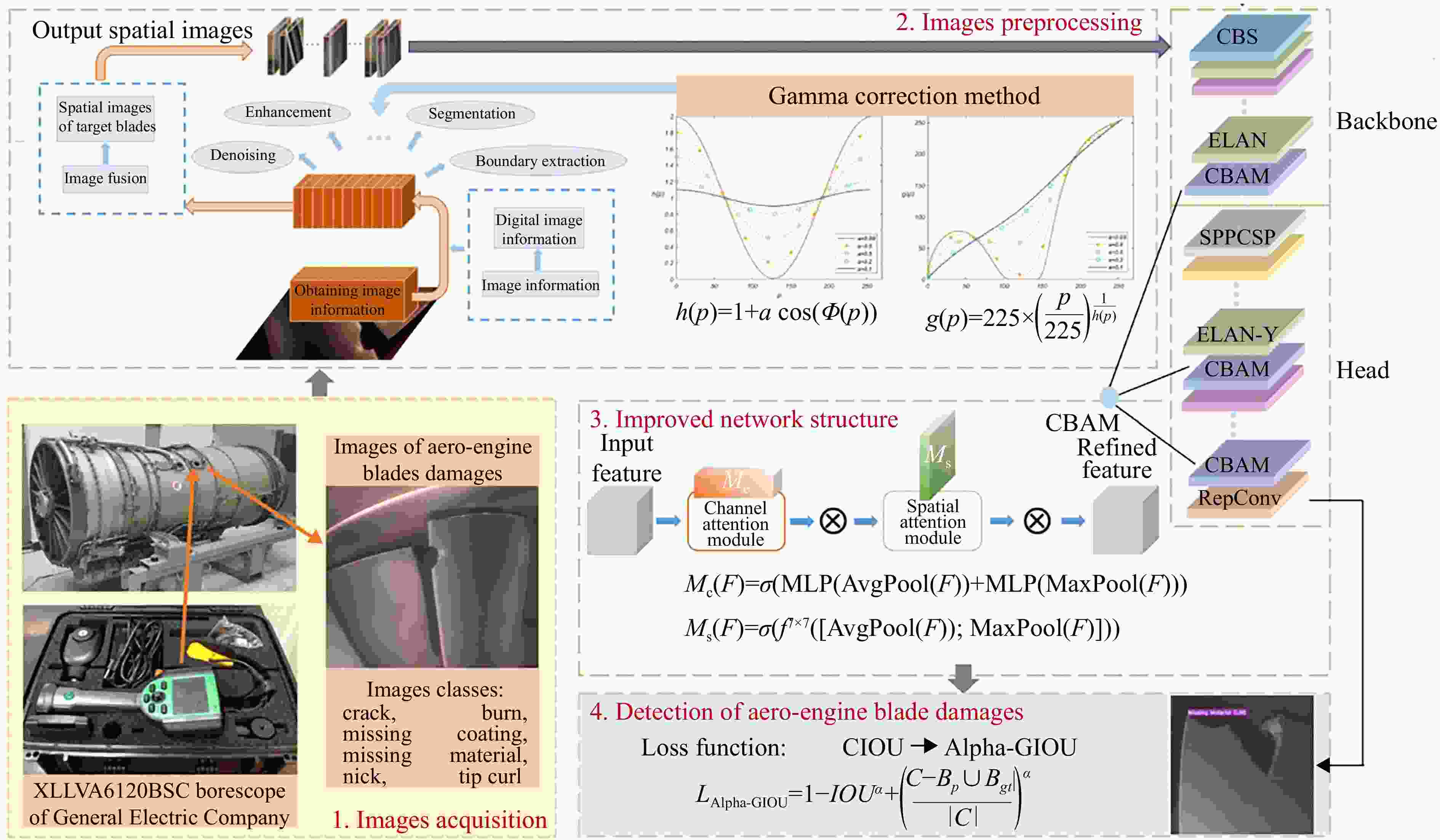
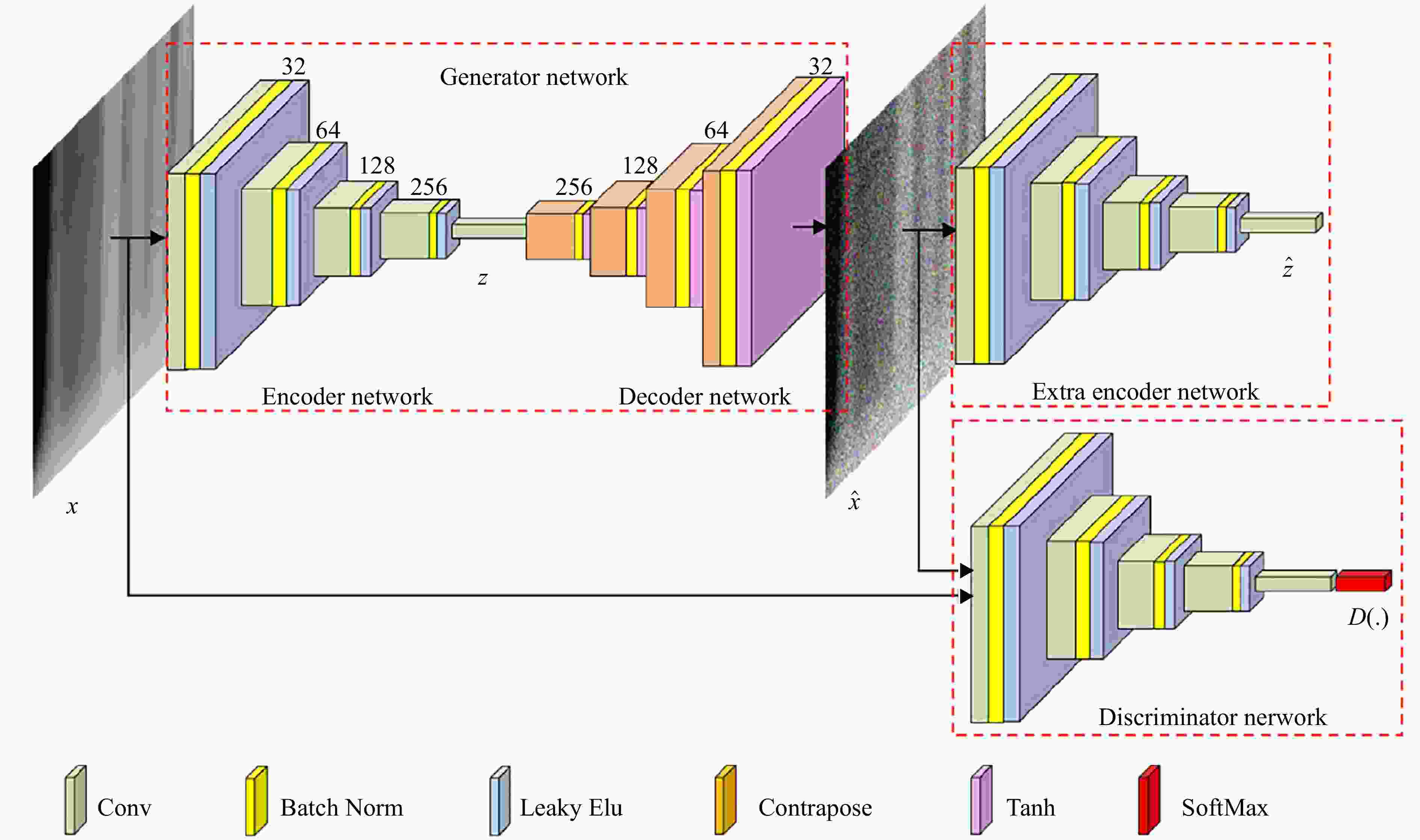
表 2 深度学习模型的评价指标
Table 2. Evaluation metrics of deep learning models
评价指标 定义及适用场景 计算方法 confusion matrix 以矩阵形式展示了分类模型在不同类别上的预测结果与实际结果
之间的对应关系,适用于深度分析模型在不同类别上的表现,帮助
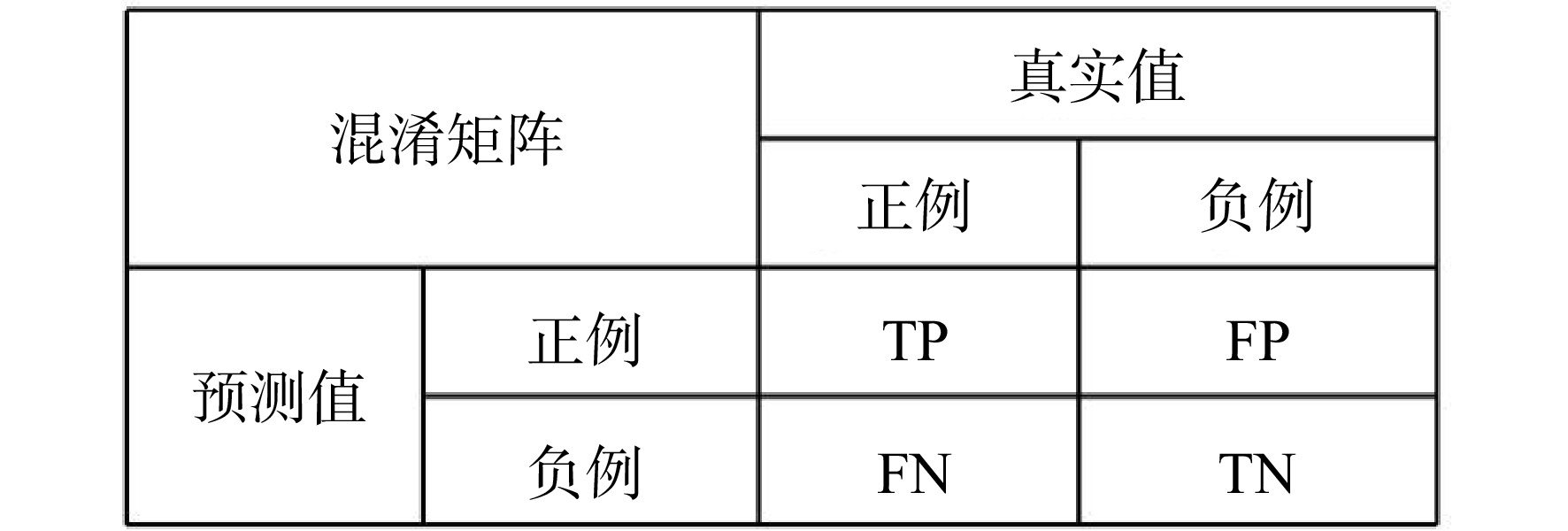
识别和纠正模型的弱点二分类问题根据图3所示混淆矩阵
进行构建,多分类问题在上述矩阵
上进行扩展accuracy 分类器正确预测样本标签的比例,适用于缺陷和无缺陷样本数量
相对均衡的情况,对于类别不平衡的问题,它可能无法有效反映
模型性能$ {S}_{\text{accuracy}}=\dfrac{{C}_{\text{TP}}+{C}_{\text{TN}}}{{C}_{\text{TP}}+{C}_{\text{TN}}+{C}_{\text{FP}}+{C}_{\text{FN}}} $ recall 所有真正的正例样本中,被模型正确预测为正例的比例。在漏检
代价较高的场景中(如安全检测),它能尽可能多地检测出所有
缺陷$ {S}_{\text{recall}}\textit{=}\dfrac{{C}_{\text{TP}}}{{C}_{\text{TP}}\textit{+}{C}_{\text{FN}}} $ precision 所有被模型预测为正例的样本中,真正为正例的比例。在误检代价
较高的场景中(如生产中的质量控制),它帮助减少不必要的误报$ {S}_{\text{precision}}\textit{=}\dfrac{{C}_{\text{TP}}}{{C}_{\text{TP}}+{C}_{\text{FP}}} $ F1-score 是精确率和召回率的调和平均值,适用于在类别不平衡情况下需要
平衡这两项指标的任务,能够提供分类器性能的综合评估$ {S}_{\text{F1-score}}=\dfrac{2{S}_{\text{precision}}{S}_{\text{recall}}}{{S}_{\text{precision}}\textit{+}{S}_{\text{recall}}} $ F2-score 是精确度和召回率的加权平均,更加注重召回率的权重。在二分类
问题中,常常用来衡量模型对正样本的识别能力$ {S}_{\text{F2-score}}=\dfrac{\text{5}{S}_{\text{precision}}{S}_{\text{recall}}}{\text{4}{S}_{\text{precision}}\textit{+}{S}_{\text{recall}}} $ FPR 在所有实际为负例的样本中,被错误地预测为正例的比例。用于
对误检率要求高的地方$ {\textit{S}}_{\text{FPR}}\textit{=}\dfrac{{C}_{\text{FP}}}{{C}_{\text{TN}}+{C}_{\text{FP}}} $ FNR 在所有实际为正例的样本中,被错误地预测为负例的比例,表示
漏掉的缺陷比例$ {\textit{S}}_{\text{FNR}}\textit{=}\dfrac{{C}_{\text{FN}}}{{C}_{\text{TP}}+{C}_{\text{FN}}} $ ROC 常用于二分类器的性能评估,ROC曲线通过显示不同阈值下真正
例率(true positive rate)与假正例率(false positive rate)的变化来
帮助选择最优阈值在坐标系中绘制FPR(x轴)与TPR(y轴)的关系图;连接所有计算
得到的TPR和FPR点,形成ROC
曲线AUC 表示ROC曲线下的面积。用于度量分类器在不同阈值下的整体性能。适合评价分类器的整体能力,尤其是在阈值选择对结果敏感时 计算ROC曲线下的面积 AP 用于衡量目标检测或物体识别模型在不同类别上的准确性。
适用于检测不同尺度和形状的缺陷首先,将模型对每个类别的检测结果
按照置信度进行排序;然后,根据置信度的顺序,计算每个位置的precision和recall值;根据precision-recall曲线下的面积即可得到该类别的AP值mAP 表示所有类别的AP的平均值。适用于多类别缺陷检测任务,
评估整体模型性能$ {S}_{\mathrm{m}\mathrm{A}\mathrm{P}}=\dfrac{{S}_{\mathrm{A}\mathrm{P}1}+{S}_{\mathrm{A}\mathrm{P}2}+\cdots +{S}_{\mathrm{A}\mathrm{P}n}}{n} $ mAR 表示不同召回率水平下的平均召回率值。适用于多标签、
多目标检测中$ {S}_{\mathrm{m}\mathrm{A}\mathrm{R}}=\dfrac{{S}_{\mathrm{r}\mathrm{e}\mathrm{c}\mathrm{a}\mathrm{l}\mathrm{l}1}\textit{+}{S}_{\mathrm{r}\mathrm{e}\mathrm{c}\mathrm{a}\mathrm{l}\mathrm{l}2}\textit{+}\cdots \textit{+}{S}_{\mathrm{r}\mathrm{e}\mathrm{c}\mathrm{a}\mathrm{l}\mathrm{l}}{}_{n}}{n} $ IoU 用于衡量目标检测算法输出框与真实框之间重叠程度的指标。适用于边界严格要求的缺陷检测任务,如精密制造中的微小瑕疵检测 $ {S}_{\mathrm{I}\mathrm{o}\mathrm{U}}=\dfrac{{C}_{\mathrm{T}\mathrm{P}}}{{C}_{\mathrm{T}\mathrm{P}}+{C}_{\mathrm{F}\mathrm{P}}+{C}_{\mathrm{F}\mathrm{N}}} $ MIoU 对于每个类别,计算其IoU值,然后取各类别IoU的平均值作为MIoU $ {S}_{\mathrm{M}\mathrm{I}\mathrm{o}\mathrm{U}}=\dfrac{{S}_{\text{IoU1}}+{S}_{\text{IoU2}}+\cdots +{S}_{\text{IoU}n}}{n} $ Dice coefficient 用于衡量相似度的指标,常用于评估图像分割的准确性 $ {S}_{\mathrm{D}\mathrm{i}\mathrm{c}\mathrm{e}}=\dfrac{\text{2}{C}_{\text{TP}}}{\text{2}{C}_{\text{TP}}+{C}_{\text{FP}}+{C}_{\text{FN}}} $  下载: 导出CSV
表 3 发动机类型及特点
Table 3. Engine types and features
发动机类型 特点 活塞式发动机 技术成熟可靠,但体积较大 空气喷气式发动机 无压气机结构 脉冲喷气 结构简单、推力大和变速响应迅速,但燃油效率相对较低 冲压式 结构简单、可靠性高和适用于高速飞行,但低速时效率较低 有压气机结构 涡喷 具有高推质比和高速性能,但结构复杂、燃油消耗较高 涡轴 具有高功率输出、结构紧凑和适应性强,适用直升机 涡桨 噪声较低和具有较好的经济性,适用于低速飞行 涡扇 具有高推力,能适应多种飞行任务和具有较好的经济性 桨扇 较好的经济性,但振动大,噪声较大
下载: 导出CSV
表 4 航空发动机叶片类型及功能
Table 4. Aero-engine blade types and functions
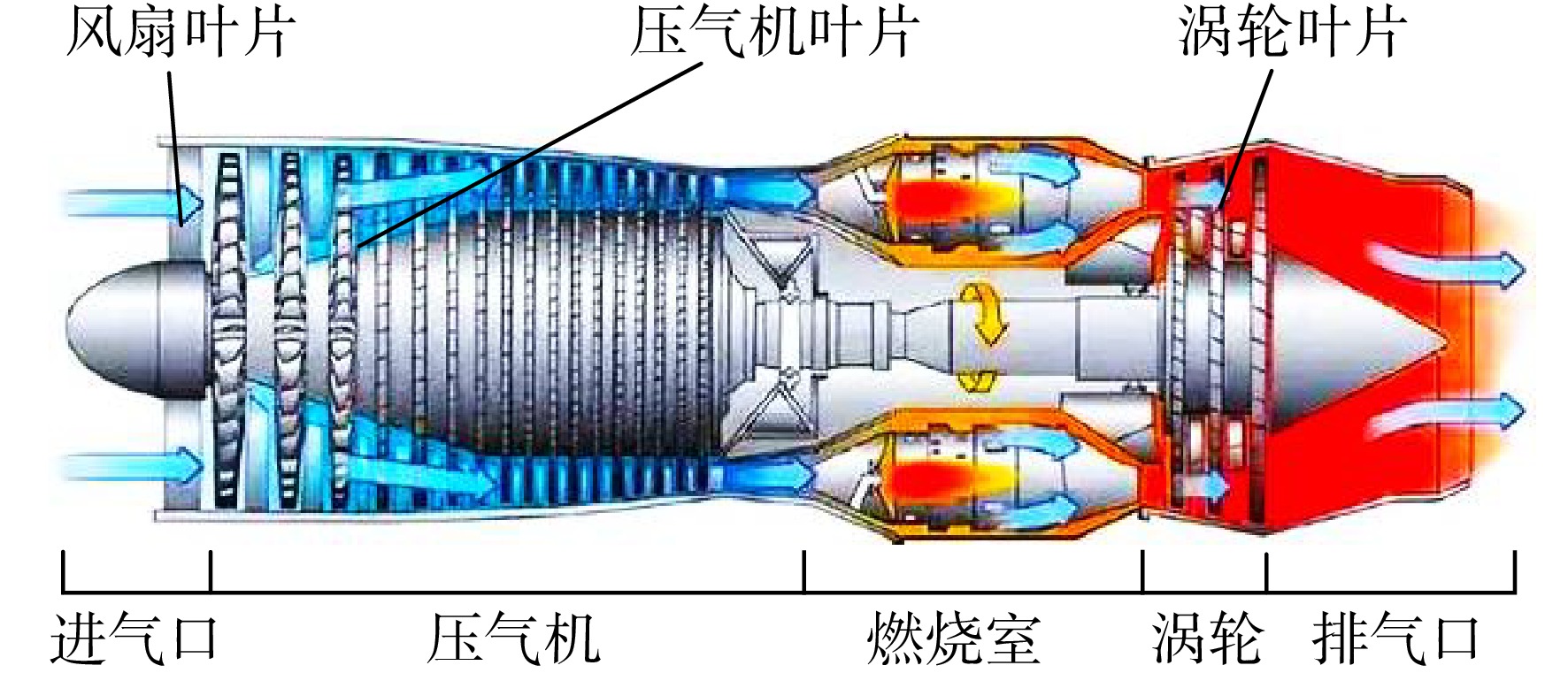
叶片名称 图例[61] 功能 风扇叶片 
对进入发动机的空气进行初步压缩 压气机叶片 静子叶片(整流叶片) 
进一步压缩空气,提高气流的压力和密度,
并将压缩的空气送入燃烧室转子叶片(工作叶片) 涡轮叶片 涡轮导向叶片 
膨胀减压,将燃气的化学能转化为涡轮的机械能 涡轮工作叶片
下载: 导出CSV
表 5 航空发动机叶片缺陷类型
Table 5. Aero-engine blade defect types
缺陷类型 图例[63] 缺陷产生原因 特点 腐蚀 
腐蚀包括点蚀、氧化和硫化。点蚀是因为大气中的氯离子与金属基体发生化学反应造成金属钝化膜
(厚度通常为1~3 nm)被破坏[64]。氧化是因为叶片与空气中的氧气在高温环境下发生氧化反应,导致叶片的材料性能下降。硫化是因为叶片与空气中的硫元素在高温的环境下反应生成硫化物,导致叶片的材料性能下降腐蚀会引起叶片表面颜色和性能的变化,
通常会导致叶片表面涂层被破坏,表面
变得粗糙凹坑 
叶片运行或制造过程中受到异物冲击造成材料
被移位但未被去除,由此形成的凹陷[65]出现在叶片表面的看起来比较小且
光滑的凹痕撕裂 
叶片表面材料分离在尖锐物体冲击下导致形成的
不规则撕裂裂缝,可用裂缝长度来描述[66]常常出现在叶片边缘,具有较长的裂缝长度 缺口 
叶片边缘被异物撞击造成的小而锋利的V形缺口 出现在叶片边缘,有明显的V形缺口或者
缺少某部分叶片材料卷曲变形 
叶片被异物冲击引起的小范围弯曲变形 常常发生在边缘及其他薄弱的部分,
叶片型面明显不规则裂纹 
叶片受到外力作用,受力超过材料的承载能力
而产生裂纹裂纹呈线状或规则的形态,可能产生沟槽或
分叉,严重时将导致叶片断裂,微小裂纹
难以察觉划痕 
在叶片制造与维修过程中,由异物或操作不当引起涂层或基体表面产生的深浅不同的刻痕 划痕时常呈现线状,也可能是沟槽或
分叉形状,弱划痕难以发现
下载: 导出CSV
表 6 航空发动机叶片缺陷检测中的深度学习技术
Table 6. Deep learning techniques in aero-engine blade defect detection
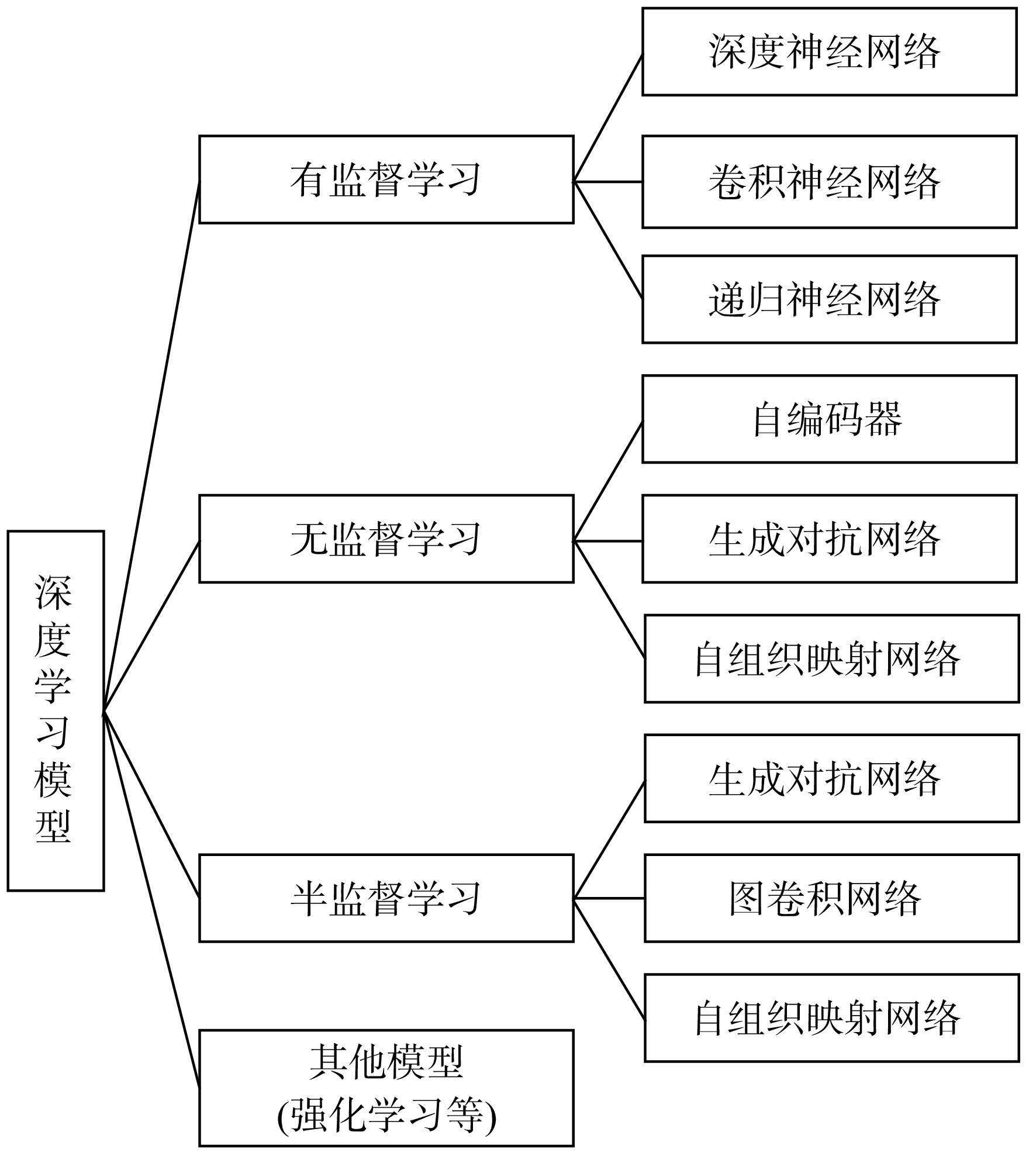
类别 定义 文献 有监督学习 检测网络 YOLO系列 YOLO模型[67]是一种将目标检测视为回归问题的端到端深度学习方法,
通过单阶段网络实现了快速、实时的物体类别和边界框预测。YOLO系列
模型是指在YOLO的基础上继续改进得到的深度学习模型[68-78] 改进Faster R-CNN Faster R-CNN是Ren等[79]在Fast R-CNN[80]基础上改进的目标检测算法,
其网络结构主要包括区域推荐网络、特征提取网络和Fast R-CNN检测
网络。改进Faster R-CNN指的是在Faster R-CNN的基础上继续改进
的深度学习模型[81-82] 有监督
学习检测网络 改进CenterNet CenterNet[83]是一种用于目标检测和关键点检测的神经网络结构。CenterNet以简单高效的方式定位和识别图像中的目标,其核心思想是将目标位置表示为图像中心点的坐标,而不是传统的边界框形式。改进CenterNet指的是在CenterNet的基础上进行改进得到的深度学习模型 [84] 改进VFNet VFNet[85]是一种用于目标检测的网络结构,是在传统金字塔特征网络(FPN)
的基础上进行改进和优化,它引入了VoVNet结构作为其主干网络,以增强
特征的表示能力和感受野的范围。改进VFNet指的是在VFNet的基础上
进行改进得到的深度学习模型[86] 新模型
(检测)新模型(检测)指的是除了上述已经定义的深度学习模型以外的应用于
目标检测的深度学习模型[87-89] 分类网络 ResNet-18 ResNet[90]是一种用于图像分类的神经网络,在网络结构中添加了跨层的
残差连接,以解决深度神经网络中的梯度消失和模型退化问题。ResNet-18
表示网络的是基本架构为ResNet,网络深度是18层。但是这里的网络深度
指的是网络的权重层,也就是包括池化、激活和线性层,而不包括批量化
归一层、池化层[91] 分割网络 增强
Mask
R-CNNMask R-CNN[92]是一种用于实例分割的神经网络模型。它可以检测出图像
中的位置,还能为每个检测到的物体生成精确的掩模,实现对物体的像素级
别分割。增强Mask R-CNN指的是在Mask R-CNN模型上进行改进得到
的深度学习模型[93] 新模型
(分割)新模型(分割)指的是除了上述已经定义的深度学习模型以外的应用于
实例分割的深度学习模型[94-97] 无监督学习 无监督缺陷检测网络 无监督深度学习模型是一种在没有标签数据的情况下进行训练的深度学习
模型。有监督学习依赖于有标签的数据来指导模型的训练,而无监督学习
则是基于未标注数据来学习数据的内在结构、特征表示或潜在模式[98] 半监督学习 半监督缺陷检测网络 半监督深度学习模型指一种结合有标签数据和无标签数据进行训练的深度
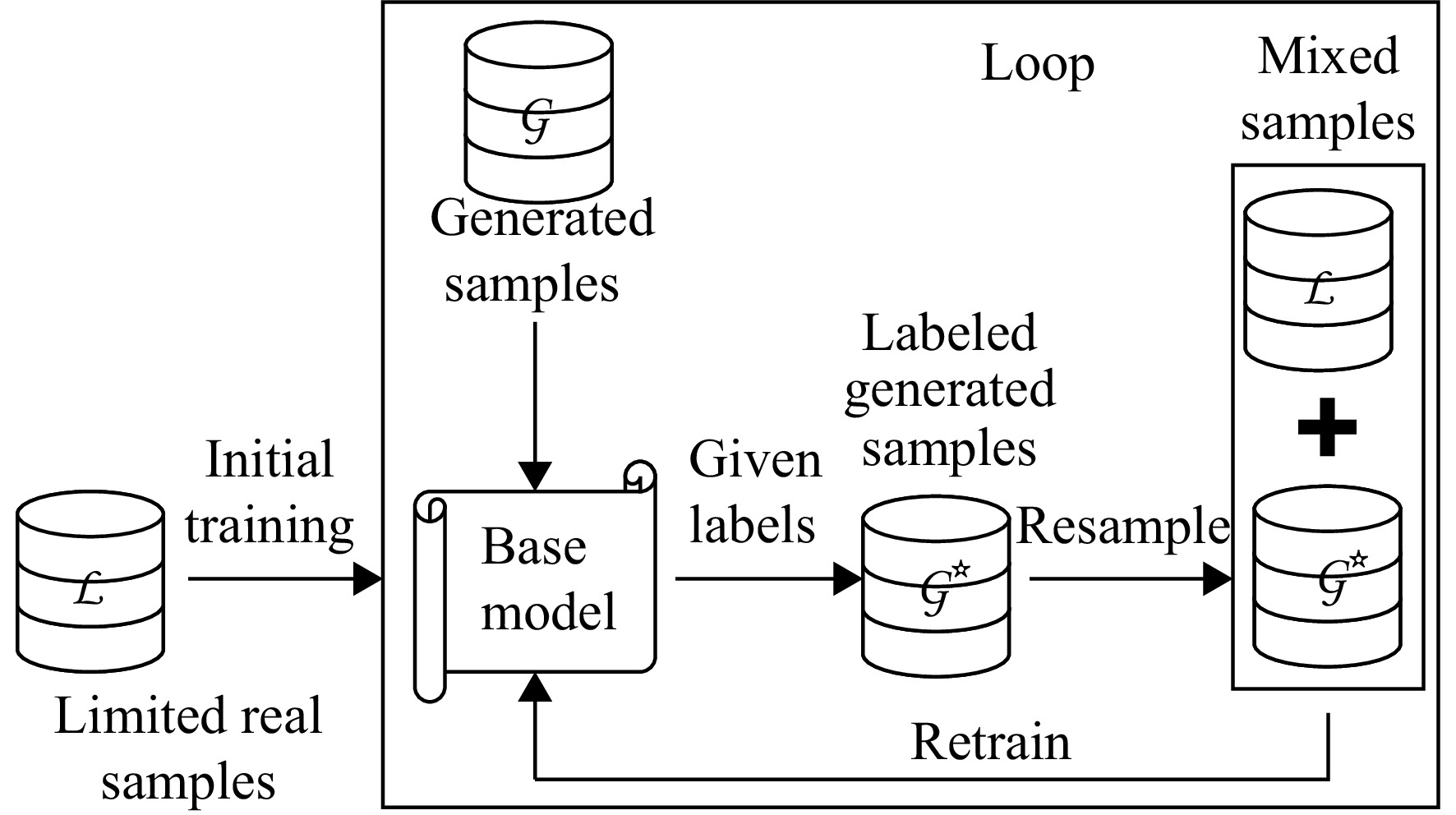
学习模型。半监督学习通过将无标签数据与有标签数据结合起来训练模型,
以提高模型的性能[99]
下载: 导出CSV
表 7 基于YOLO系列的叶片缺陷检测
Table 7. Blade defect detection based on YOLO series
文献 发表
年度提出
模型原始
模型模型特点 数据集 实验结果
(部分)模型优缺点 [68] 2020 YOLOv3 使用Darknet-53网络作为主干网络。在检测层引入了3个不同尺度的输出层 277张叶片缺陷图片
(共5种类型)0.9084
(mAP)检测速度快、满足实时检测要求和检测精度高。但是对小目标物体的检测能力相对较弱,且训练较复杂 [69] 2022 Darknet-Caffe YOLOv4 SPP和PANet作为参数聚合方法。选择SPP附加模块、CSPDarknet 53、PANet和SPP和head作为架构 6100 张风扇叶片射线缺陷图像(共8类
缺陷)0.9
(mAP)检测速度快,满足实时检测需求,检测精度高。但是模型推理成本比较高 [70] 2022 改进YOLOv5 YOLOv5 将PANet和FPN替换为BiFPN结构 5000 张叶片缺陷图片
(包含5种缺陷)0.986
(mAP);
0.974
(precision);
0.974
(recall)检测速度快,检测精度高。但是对数据集样本数量的依赖很强,需要大量样本进行训练,对小样本训练的模型的检测精度较低 [71] 2022 DDSC-YOLOv5s YOLO
v5s可变形卷积网络引入模型的结构中。使用深度可分离卷积。使用k均值聚类来优化锚框的大小 850张孔探缺陷图像
(共5类缺陷)0.838
(mAR@50);
0.513
(mAR@
50:95)检测精度较高,增强了对小缺陷的可检测性。但是检测速度
有所下降[74] 2024 DBFF-YOLOv4 YOLOv4 加入D-PANet网络 600张缺图片
(共6类缺陷)0.9958
(mAP);0.9187 (mAR,阈值T=0.5)检测精度高。但是检测速度较慢,在小尺寸和轮廓模糊的缺陷上仍然存在漏检和
误检[75] 2023 改进YOLOv5 YOLOv5 使用K-means++算法代替K-means算法聚类标记框。在C3模块中引入CBAM注意力机制。用EIoU
作为损失函数5066 张叶片缺陷图像
(共4类缺陷)0.775
(mAP)能够同时实现对叶片表面较大缺陷及微小缺陷的检测,满足实时检测需求。但是模型检测精度有待进一步提高 [76] 2023 CSGNet YOLOv6 引入CSGM模块。设计了FDCP数据增强方法 1100 张图片(共5类)0.479
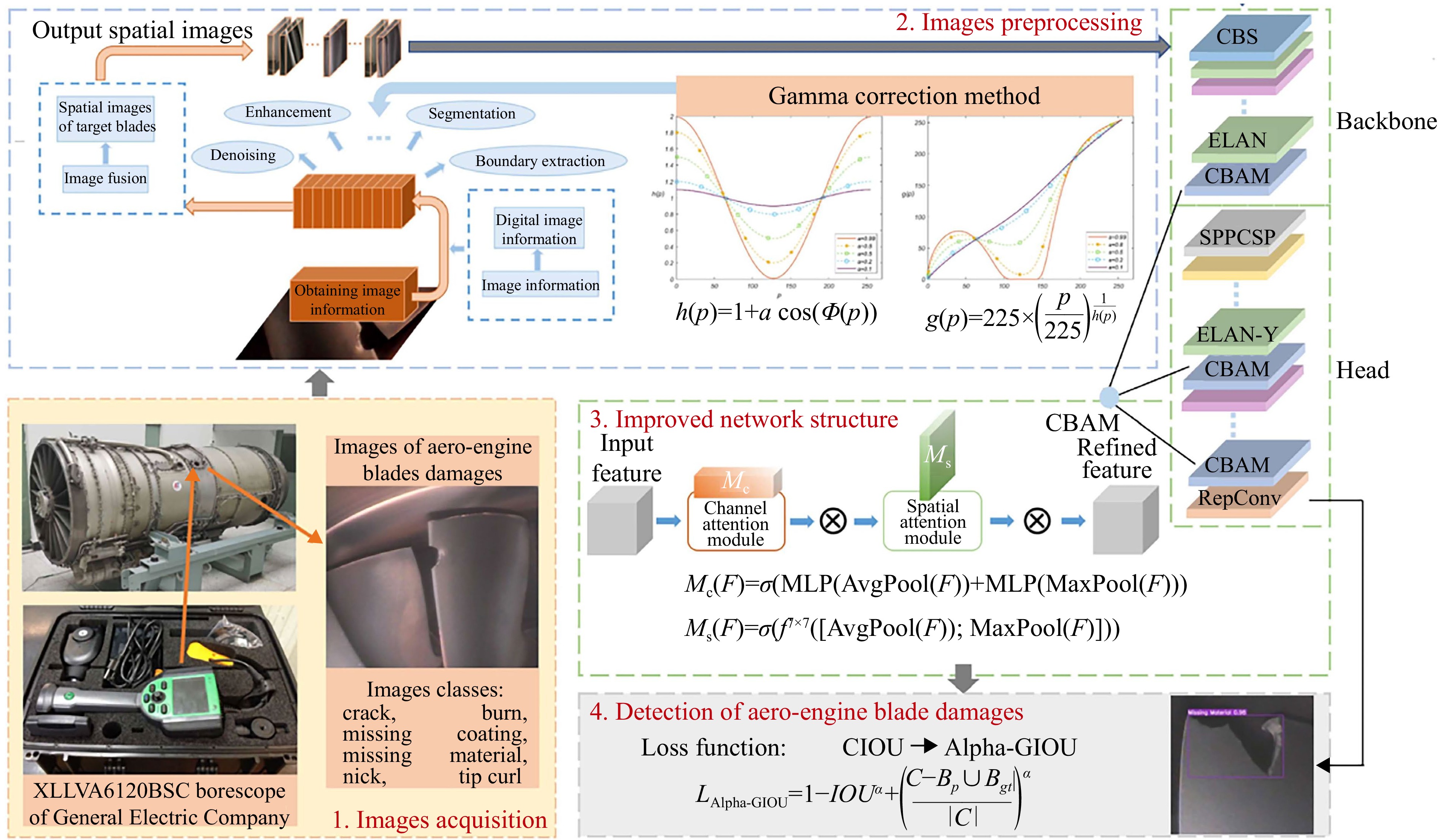
(AP)检测速度快,能对叶片的小缺陷进行检测。但是检测精度较低 [77] 2023 改进YOLOv7 YOLOv7 利用伽玛校正方法对数据集进行处理。加入优化的CBAM模块。Alpha_GIOU作为损失函数 2000张图片
(含6种缺陷)0.961
(mAP)检测精度高,检测速度快,满足实时检测要求。但是对微小缺陷的检测精度还需进一步验证 [78] 2024 SW-YOLO YOLOv5 加入注意力机制。运用
多尺度特征融合模块3000 幅孔探
缺陷图像0.858
(mAP)检测精度较高,能对微小缺陷进行检测,但检测速度有所下降
下载: 导出CSV
表 8 基于改进Faster R-CNN、CenterNet、VFNet和新模型的叶片缺陷检测
Table 8. Blade defect detection based on improved Faster R-CNN, CenterNet, VFNet and new models
文献 发表
年度提出
模型原始
模型模型特点 数据集 实验结果
(部分)模型优缺点 [81] 2022 改进Faster
R-CNNFaster
R-CNN提出Res2Net-50模块。
余弦退火衰减法对训练过程中学习率进行调整110张叶片缺陷图片
(含2种缺陷)0.83(mAP) 检测速度快,检测精度较高,小样本模型。但应增加测试图片数量验证检测效果 [82] 2023 改进Faster
R-CNNFaster RCNN 使用RoI align模块。
引入FPN模块结合
ResNet-50进行特征提取。
改进非最大值抑制算法5066 张叶片缺陷数据集(含3类缺陷)0.79(mAP) 能检测到较小的缺陷,检测精度较好,但检测速度还有待提高 [84] 2023 EF-CenterNet CenterNet EPSANet(efficient pyramid squeeze attention network)为主干网络。引入了FPN 6446 张叶轮叶片缺陷图像(5种缺陷)0.9674 (mAP)检测精度高,对较小缺陷的检测能力也不错,但是整体网络结构不够轻量化 [86] 2024 MVFNet VFNet 提出了SFPN模块。设计了提取模块SMK。优化
阳性样本筛选策略240张叶片缺陷图片
(含3类缺陷)0.735(AP) 可检测微小缺陷,但耗时较长,需在更多样本上验证效果 [87] 2021 由粗到细的缺陷检测模型 主干网络模块用于学习特征图。使用粗分类器滤除背景。使用目标精细检测器实现缺陷定位和精细
分类24848 张叶片图像
数据集(含12424 张
共5类缺陷图像)0.948
(precision);0.935
(accuracy);
0.961(recall);0.954(F1-score)检测精度高,检测速度快,但是存在小数据集和样本数量不平衡的问题 [88] 2023 GPTNet 图像特征提取采用局部窗口网络(LWTNet),标签特征提取采用全局标签图网络(GLGNet)。提供全局先验和模型标签依赖性 3000 张模拟叶片图像(5类);131张真实叶片缺陷图像(8类)0.849(mAP@
0.5,模拟叶片);
0.279(mAP,真实叶片)检测精度较高,但是存在小数据集和样本数量不平衡的问题,同时对新缺陷的检测能力不足 [89] 2025 缺陷检测模型 设计了DSC模块。设计了SE-PANet模块。设计了Focal-DIOU函数 5603 张叶片缺陷图片
(包含3类缺陷)0.957
(precision);0.946(recall);
0.963(AP)检测精度高,检测速度快,满足实时检测需求,但是模型的泛化检测能力不够
(小缺陷的检测)
下载: 导出CSV
表 9 叶片缺陷检测网络优缺点对比
Table 9. Comparison of advantages and disadvantages of blade defect detection networks
网络类别 优点 缺点 YOLO系列 检测精度高、检测速度快,能满足实时检测要求 对小目标的缺陷检测较困难 改进Faster R-CNN 对小样本数据集的缺陷检测精度较高,能检测到较小的缺陷 模型计算量大,整体网络结构不够轻量化 改进CenterNet 检测精度高,具有对较小缺陷的检测能力 卷积运算和特征提取的计算复杂度较高 改进VFNet 检测精度较高,能对小缺陷进行检测 检测速度较慢,资源和内存需求高
下载: 导出CSV
表 10 基于ResNet-18的叶片缺陷分类
Table 10. Classification of blade defects based on ResNet-18
文献 发表年度 提出
模型原始
模型模型特点 数据集 实验结果
(部分)模型优缺点 [91] 2022 ResNet-18 与其他模型做对比,效果
更好。在LIM与SIM
数据集训练。这两个
数据集的区别是图像
大小及数量不同LIM(共652张叶片图像,其中有缺陷52张);
SIM(7749 张叶片图像,其中161张有缺陷)0.6(LIM,precision);
0.62(SIM,precision);
0.6(LIM,recall);
0.6(LIM,
F2-score);
0.93(SIM,recall);
0.85(SIM,
F2-score)训练简单且不易过拟合,特征提取能力较强,但分类精度有待提升
下载: 导出CSV
表 11 基于增强Mask R-CNN和新模型的叶片缺陷分割
Table 11. Blade Defect segmentation based on enhanced mask R-CNN and new models
文献 发表年度 提出
模型原始
模型模型特点 数据集 实验结果
(部分)模型优缺点 [93] 2022 增强的Mask
R-CNNMask
R-CNN设计了TFNet,更加关注
浅层纹理信息。引入BL
模块,提升定位精度3000 张模拟叶片数据集(3D打印得到)0.604
(mAP,localization)关注浅层纹理特征提升了检测精度,但仅在模拟叶片上验证,实际叶片效果需
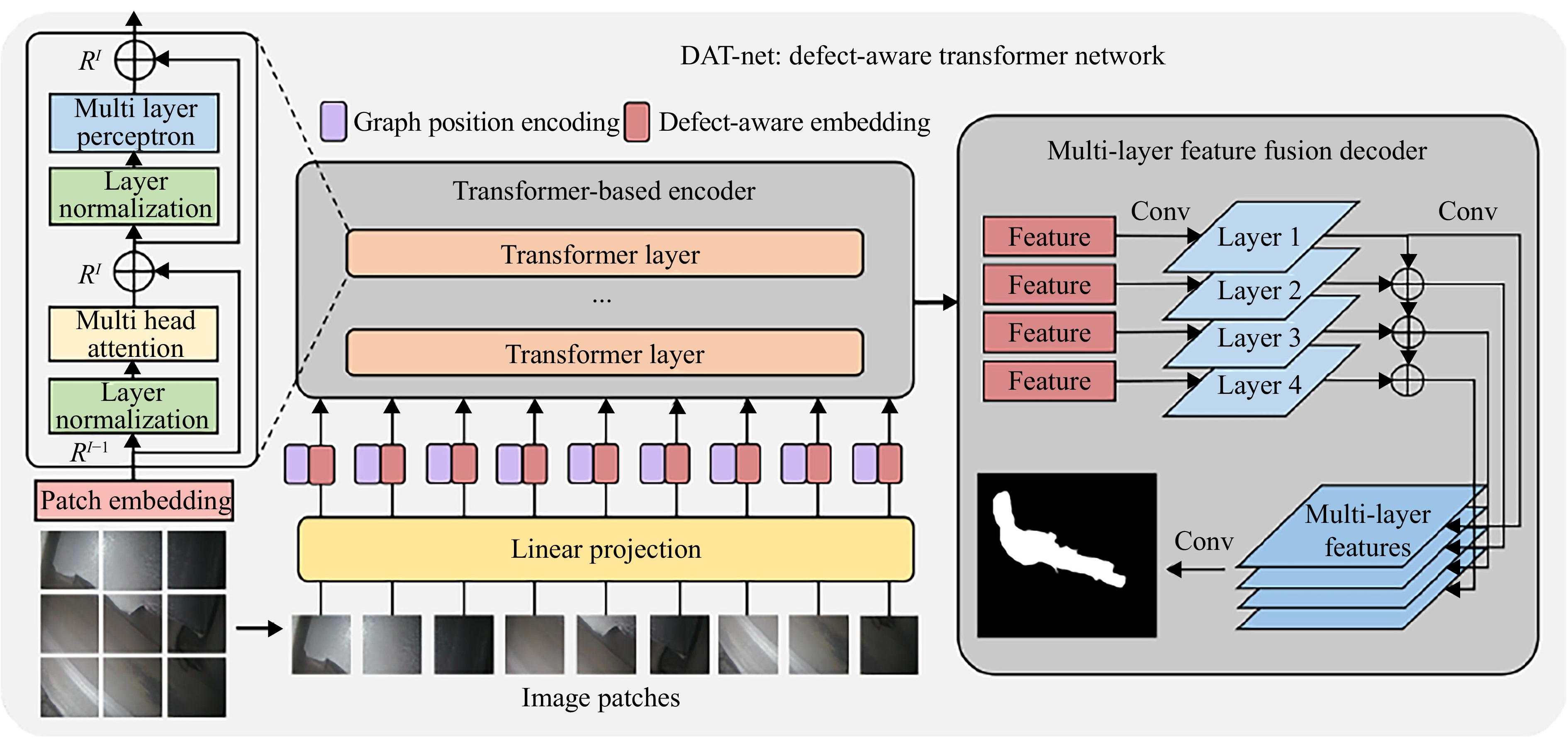
进一步测试[94] 2023 EEDN 采用低复杂度网络骨干,利用深度可分离卷积提取特征。过MFEA增强多尺度表达性和远程信道捕获 100张叶片缺陷图像 0.859(ODS,C=60) 在微小缺陷和边缘检测方面表现出色,且速度较快。但需进一步研究边缘检测结果与缺陷存在的定性和定量关系 [95] 2023 DAT-
Net用Transformer代替卷积。DAM模型感知和捕捉
缺陷。GPE提供了
位置信息1500 模拟叶片缺陷图像(3D打印得到)0.9019 (mIoU)检测精度高,能提取多尺度、多尺寸及不规则缺陷,但模型较复杂且泛化能力
需提升[96] 2023 深度学习框架 使用定制的U-Net进行缺陷分割。传统图像处理方法和GAN网络结合来对
图像进行去模糊处理高压压气机叶片图片( https://www.youtube.com/watch v=eO6GRU4RfC4 )0.976
(precision)检测精度高,满足实时检测需求,对运动导致的模糊图像具有处理功能。但是存在数据不平衡问题和对小缺陷的检测能力还不够 [97] 2025 SPDP-Net 利用SPM和DEP模块增强对缺陷的感知能力。
利用GIE模块提取缺陷的全局特征2400 张叶片图像
(1400 张正常,1000
张含4类缺陷)0.959
(precision);
0.94(recall);0.949
(F1-score)检测精度高,能有效检测微小缺陷,工业应用表现良好,但检测时间较长
下载: 导出CSV
表 12 有监督学习的叶片缺陷检测方法对比
Table 12. Comparison of blade defect detection methods with supervised learning
类别 优点 缺点 检测网络 能够同时检测和识别缺陷的位置与类型;可以对复杂的
背景和环境中的噪声干扰进行处理对数据集的需求和计算能力要求较高;对于缺陷密集
部分的缺陷检测可能存在困难,造成漏检与误检分类网络 结构简单,是其他网络的基础;可以获取全局特征信息 无法提供精确的缺陷位置信息;需要大量的训练数据来
提高分类准确性分割网络 能够精确地分割出缺陷区域,同时提供详细的位置信息;
对不规则形状的缺陷检测效果较好对数据集的标注要求更加精确,标注工作量大;计算复杂度较高,对计算机处理能力要求较高
下载: 导出CSV
表 13 无监督学习和半监督学习的叶片缺陷检测
Table 13. Unsupervised learning and semi-supervised learning for blade defect detection
文献 发表
年度提出
模型原始
模型模型特点 数据集 实验结果
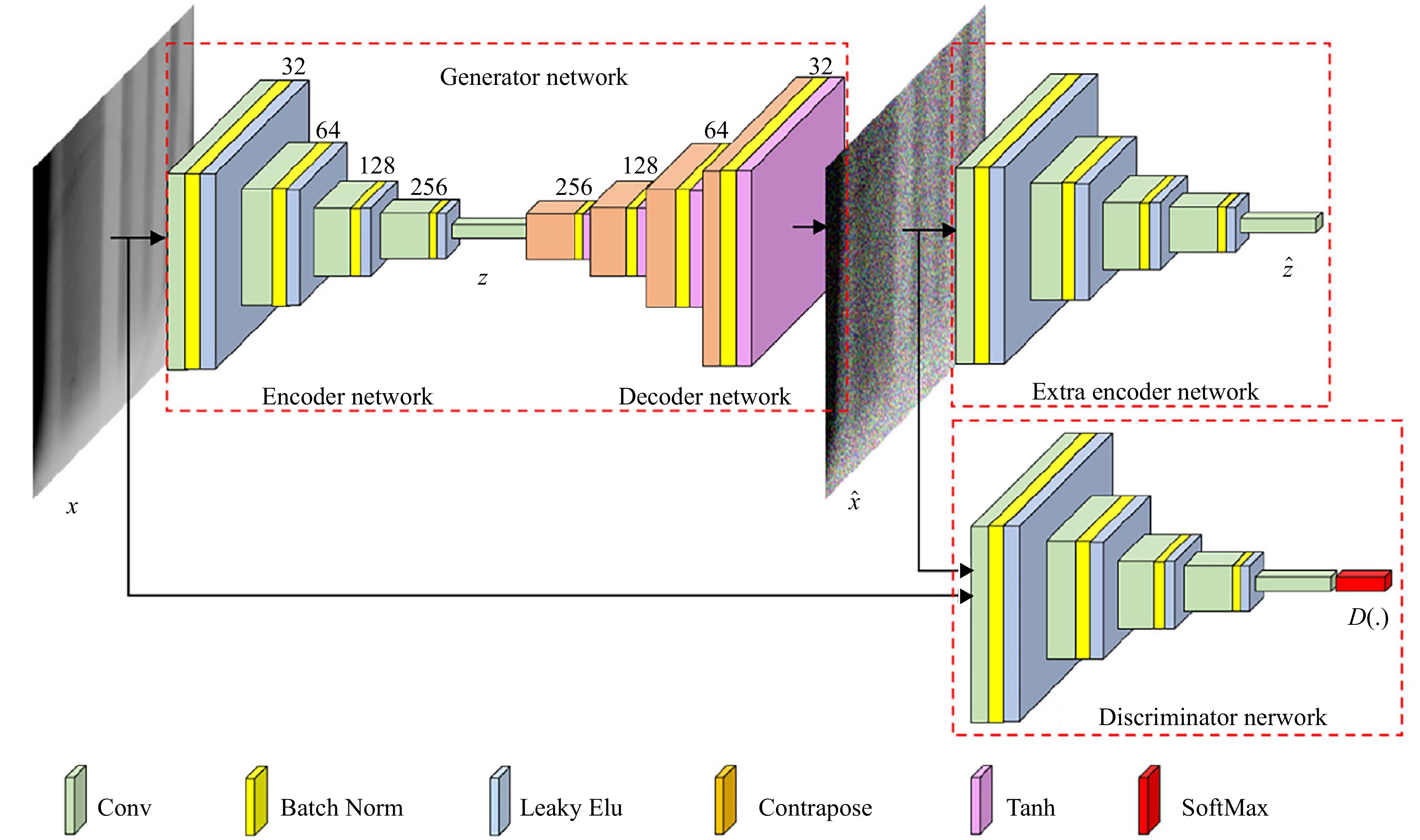
(部分)模型优缺点 [98] 2023 无监督
缺陷检测
网络该方法提出了一种基于生成对抗网络(GAN)的缺陷检测模型。GAN由生成器网络、编码器网络和额外的编码器网络组成 4个不同大小的图片训练数据集,并在2000张叶片图像测试集(含5种类型的缺陷共 1000 张和无缺陷图片1000 张)0.911
(AUC)利用无缺陷图像样本实现模型训练,检测精度高。但是无法识别伪缺陷,图像中的任何异常均视为缺陷 [99] 2023 半监督缺陷检测
网络GANs and ResNet 由cDCGAN和ResNet
构建,以克服数据大小
有限的挑战480张叶片图片(含2类共237张缺陷图片和203张正常图片) 0.9174 (accuracy);0.8852
(F1-score)能有效缓解数据集大小和数据不平衡问题,分类精度高。但是模型训练较复杂
下载: 导出CSV
表 14 模型评价指标应用策略
Table 14. Model evaluation indicator application strategy
模型网络 模型评价指标(可选) 检测网络 confusion matrix、precision、accuracy、recall、
F1-score、F2-score、FPR、FNR、ROC、AUC、
AP、mAP、mAR分类网络 confusion matrix、precision、accuracy、recall、
F1-score、F2-score、FPR、FNR、ROC、AUC、
AP、mAP、mAR分割网络 Dice coefficient、IoU、mIoU
下载: 导出CSV
表 15 基于深度学习的叶片缺陷检测技术优缺点比较
Table 15. Comparison of advantages and disadvantages of deep learning based blade defect detection techniques
模型类别 主要优点 主要缺点 有监督学习 利用已标注的数据进行训练,对叶片缺陷能够产生较高的预测准确性;可以生成可解释的决策边界,有助于理解模型如何做出预测 对数据集依赖强,需要大量标记好的数据进行训练;
对于大规模数据集,可能需要大量的计算资源来训练
模型无监督学习 不需要标注数据集,对数据集依赖性不强,可以自动发现数据中的模式和结构 可解释性弱,算法比较复杂;对叶片噪声和数据集质量很敏感 半监督学习 结合了有监督和无监督学习的特点,能够充分利用少量标注数据和大量未标注数据进行训练 模型的鲁棒性和泛化能力较弱,设计和调参相对复杂
下载: 导出CSV
-
[1] 刘大响, 陈光. 航空发动机飞机的心脏[M]. 2版. 北京: 航空工业出版社, 2015. [2] 陶春虎. 航空发动机转动部件的失效与预防[M]. 北京: 国防工业出版社, 2000. [3] ZHAO Bingfeng, XIE Liyang, LI Haiyang, et al. Reliability analysis of aero-engine compressor rotor system considering cruise characteristics[J]. IEEE Transactions on Reliability, 2020, 69(1): 245-259. doi: 10.1109/TR.2018.2885354 [4] AUST J, PONS D. Taxonomy of gas turbine blade defects[J]. Aerospace, 2019, 6(5): 58. doi: 10.3390/aerospace6050058 [5] 陈光. 航空发动机结构设计分析[M]. 2版. 北京: 北京航空航天大学出版社, 2014. [6] 马奇友, 刘可薇, 杜坚, 等. 基于深度长短期记忆网络的发动机叶片剩余寿命预测[J]. 推进技术, 2021, 42(8): 1888-1897. MA Qiyou, LIU Kewei, DU Jian, et al. Prediction of residual life of engine blades based on deep long-term and short-term memory network[J]. Journal of Propulsion Technology, 2021, 42(8): 1888-1897. (in Chinese doi: 10.13675/j.cnki.tjjs.190863MA Qiyou, LIU Kewei, DU Jian, et al. Prediction of residual life of engine blades based on deep long-term and short-term memory network[J]. Journal of Propulsion Technology, 2021, 42(8): 1888-1897. (in Chinese) doi: 10.13675/j.cnki.tjjs.190863 [7] 杨亚东, 刘鹏, 周光亮, 等. 叶片型面视觉检测系统设计与实现[J]. 仪器仪表学报, 2023, 44(6): 213-222. YANG Yadong, LIU Peng, ZHOU Guangliang, et al. Design and implementation of the blade profile detection system based on computer vision[J]. Chinese Journal of Scientific Instrument, 2023, 44(6): 213-222. (in Chinese doi: 10.19650/j.cnki.cjsi.J2311240YANG Yadong, LIU Peng, ZHOU Guangliang, et al. Design and implementation of the blade profile detection system based on computer vision[J]. Chinese Journal of Scientific Instrument, 2023, 44(6): 213-222. (in Chinese) doi: 10.19650/j.cnki.cjsi.J2311240 [8] AUST J, SHANKLAND S, PONS D, et al. Automated defect detection and decision-support in gas turbine blade inspection[J]. Aerospace, 2021, 8(2): 30. doi: 10.3390/aerospace8020030 [9] AUST J, MITROVIC A, PONS D. Assessment of the effect of cleanliness on the visual inspection of aircraft engine blades: an eye tracking study[J]. Sensors, 2021, 21(18): 6135. doi: 10.3390/s21186135 [10] MA Pengzhi, XU Chunguang, XIAO Dingguo. Robotic ultrasonic testing technology for aero-engine blades[J]. Sensors, 2023, 23(7): 3729. doi: 10.3390/s23073729 [11] WANG Pengfei, WANG Weiqiang, ZHENG Sanlong, et al. Fatigue damage evaluation of compressor blade based on nonlinear ultrasonic nondestructive testing[J]. Journal of Marine Science and Engineering, 2021, 9(12): 1358. doi: 10.3390/jmse9121358 [12] DONG Zhe, GU Feng, CHEN Ruiyuan, et al. Three-dimensional pressure field measurement on turbine guide vanes using a dynamic distortion correction endoscopic pressure-sensitive paint technique[J]. Experiments in Fluids, 2023, 64(5): 97. doi: 10.1007/s00348-023-03643-6 [13] TONG Zongfei, XIE Shejuan, LIU Haochen, et al. An efficient electromagnetic and thermal modelling of eddy current pulsed thermography for quantitative evaluation of blade fatigue cracks in heavy-duty gas turbines[J]. Mechanical Systems and Signal Processing, 2020, 142: 106781. doi: 10.1016/j.ymssp.2020.106781 [14] GUO Wei, ZHAO Yingsong, QIAO Liang, et al. High precision thickness evaluation of thermal barrier coating with high frequency eddy current testing method[J]. NDT & E International, 2023, 140: 102963. [15] WONG W K, NG S H, XU K. A statistical investigation and optimization of an industrial radiography inspection process for aero-engine components[J]. Quality and Reliability Engineering International, 2006, 22(3): 321-334. doi: 10.1002/qre.698 [16] BŁACHNIO J, CHALIMONIUK M, KUŁASZKA A, et al. Exemplification of detecting gas turbine blade structure defects using the X-ray computed tomography method[J]. Aerospace, 2021, 8(4): 119. doi: 10.3390/aerospace8040119 [17] AUST J, PONS D, MITROVIC A. Evaluation of influence factors on the visual inspection performance of aircraft engine blades[J]. Aerospace, 2022, 9(1): 18. [18] AUST J, PONS D. Comparative analysis of human operators and advanced technologies in the visual inspection of aero engine blades[J]. Applied Sciences, 2022, 12(4): 2250. doi: 10.3390/app12042250 [19] 赵宇轩, 陈子峰, 黄丞明, 等. 压气机叶片叶根轮槽物理场预测及快速优化设计[J]. 西安交通大学学报, 2024, 58(4): 96-106. ZHAO Yuxuan, CHEN Zifeng, HUANG Chengming, et al. Physical field prediction and fast optimization design of compressor blade roots and grooves[J]. Journal of Xi’an Jiaotong University, 2024, 58(4): 96-106. (in Chinese doi: 10.7652/xjtuxb202404009ZHAO Yuxuan, CHEN Zifeng, HUANG Chengming, et al. Physical field prediction and fast optimization design of compressor blade roots and grooves[J]. Journal of Xi’an Jiaotong University, 2024, 58(4): 96-106. (in Chinese) doi: 10.7652/xjtuxb202404009 [20] GOLDOBIN M A, MOROZOV A A, OKONECHNIKOV D V, et al. Intelligent quality management system for casting gas turbine engine blades[C]//2020 2nd International Conference on Control Systems, Mathematical Modeling, Automation and Energy Efficiency. Piscataway, US: IEEE, 2020: 696-700. [21] 姚明辉, 王兴志, 吴启亮, 等. 基于RBF神经网络的压气机叶片面压力场预测研究[J]. 应用数学和力学, 2023, 44(10): 1187-1199. YAO Minghui, WANG Xingzhi, WU Qiliang, et al. RBF neural network based prediction on blade surface pressure fields in compressors[J]. Applied Mathematics and Mechanics, 2023, 44(10): 1187-1199. (in Chinese doi: 10.21656/1000-0887.440054YAO Minghui, WANG Xingzhi, WU Qiliang, et al. RBF neural network based prediction on blade surface pressure fields in compressors[J]. Applied Mathematics and Mechanics, 2023, 44(10): 1187-1199. (in Chinese) doi: 10.21656/1000-0887.440054 [22] 杜周, 徐全勇, 宋振寿, 等. 基于深度学习的压气机叶型气动特性预测[J]. 航空动力学报, 2023, 38(9): 2251-2260. DU Zhou, XU Quanyong, SONG Zhenshou, et al. Prediction of aerodynamic characteristics of compressor blade profile based on deep learning[J]. Journal of Aerospace Power, 2023, 38(9): 2251-2260. (in Chinese doi: 10.13224/j.cnki.jasp.20210741DU Zhou, XU Quanyong, SONG Zhenshou, et al. Prediction of aerodynamic characteristics of compressor blade profile based on deep learning[J]. Journal of Aerospace Power, 2023, 38(9): 2251-2260. (in Chinese) doi: 10.13224/j.cnki.jasp.20210741 [23] 夏楠, 马小刚, 吴传宗, 等. 磁力研磨工艺提高叶片表面质量的试验研究[J]. 表面技术, 2023, 52(2): 67-77. XIA Nan, MA Xiaogang, WU Chuanzong, et al. Experimental investigation of magnetic finishing for improving blade surface quality[J]. Surface Technology, 2023, 52(2): 67-77. (in Chinese doi: 10.16490/j.cnki.issn.1001-3660.2023.02.007XIA Nan, MA Xiaogang, WU Chuanzong, et al. Experimental investigation of magnetic finishing for improving blade surface quality[J]. Surface Technology, 2023, 52(2): 67-77. (in Chinese) doi: 10.16490/j.cnki.issn.1001-3660.2023.02.007 [24] 刘超, 刘成, 王虎, 等. 基于深度学习的镍基高温合金叶片磨削烧伤识别研究[J]. 湖南大学学报(自然科学版), 2024, 51(4): 99-104. LIU Chao, LIU Cheng, WANG Hu, et al. Research on grinding burn identification of nickel-based superalloy blades based on deep learning[J]. Journal of Hunan University (Natural Sciences), 2024, 51(4): 99-104. (in ChineseLIU Chao, LIU Cheng, WANG Hu, et al. Research on grinding burn identification of nickel-based superalloy blades based on deep learning[J]. Journal of Hunan University (Natural Sciences), 2024, 51(4): 99-104. (in Chinese) [25] HUANG Xin, ZHANG Xiaodong, XIONG Yiwei, et al. A novel intelligent fault diagnosis approach for early cracks of turbine blades via improved deep belief network using three-dimensional blade tip clearance[J]. IEEE Access, 2021, 9: 13039-13051. doi: 10.1109/ACCESS.2021.3052217 [26] ZHANG Jingqi, CHEN Yugang, LI Ning, et al. A weak fault identification method of micro-turbine blade based on sound pressure signal with LSTM networks[J]. Aerospace Science and Technology, 2023, 136: 108226. doi: 10.1016/j.ast.2023.108226 [27] 黄鑫, 张小栋, 张英杰, 等. 基于改进DBNs的三维叶尖间隙叶片裂纹诊断方法[J]. 振动、测试与诊断, 2022, 42(2): 213-219, 402. HUANG Xin, ZHANG Xiaodong, ZHANG Yingjie, et al. Fault diagnosis for three-dimension blade tip clearance based on turbine blade crack by new improved deep belief networks[J]. Journal of Vibration, Measurement & Diagnosis, 2022, 42(2): 213-219, 402. (in ChineseHUANG Xin, ZHANG Xiaodong, ZHANG Yingjie, et al. Fault diagnosis for three-dimension blade tip clearance based on turbine blade crack by new improved deep belief networks[J]. Journal of Vibration, Measurement & Diagnosis, 2022, 42(2): 213-219, 402. (in Chinese) [28] 牛国臣, 朱通. 基于BP与SA-GA的飞机发动机风扇叶片清洗参数优化[J]. 计算机应用与软件, 2021, 38(1): 76-81, 110. NIU Guochen, ZHU Tong. Optimization of aircraft engine fan blade cleaning parameters based on bp and SA-GA[J]. Computer Applications and Software, 2021, 38(1): 76-81, 110. (in ChineseNIU Guochen, ZHU Tong. Optimization of aircraft engine fan blade cleaning parameters based on bp and SA-GA[J]. Computer Applications and Software, 2021, 38(1): 76-81, 110. (in Chinese) [29] 董慧芬, 代玉行, 王渗. 基于GA-GRNN-GA的飞机发动机风扇叶片清洗参数优化[J]. 计算机应用与软件, 2020, 37(1): 87-92, 127. DONG Huifen, DAI Yuhang, WANG Shen. Optimization of cleaning parameters for aircraft engine blades based on GA-GRNN-GA[J]. Computer Applications and Software, 2020, 37(1): 87-92, 127. (in Chinese doi: 10.3969/j.issn.1000-386x.2020.01.015DONG Huifen, DAI Yuhang, WANG Shen. Optimization of cleaning parameters for aircraft engine blades based on GA-GRNN-GA[J]. Computer Applications and Software, 2020, 37(1): 87-92, 127. (in Chinese) doi: 10.3969/j.issn.1000-386x.2020.01.015 [30] DING Peng, SONG Di, SHEN Junxian, et al. A novel graph structure data-driven crack damage identification for compressor blade based on vibro-acoustic signal[J]. Structural Health Monitoring, 2024, 23(5): 3046-3062. doi: 10.1177/14759217231222002 [31] LE Haifeng, ZHANG Lujia, LIU Yanxia. Surface defect detection of industrial parts based on YOLOv5[J]. IEEE Access, 2022, 10: 130784-130794. doi: 10.1109/ACCESS.2022.3228687 [32] ZOU F Q. Review of aero-engine defect detection technology[R]. Chongqing: 2020 IEEE 4th Information Technology, Networking, Electronic and Automation Control Conference (ITNEC), 2020. [33] 程亚茹, 李湉, 薛辉, 等. 航空发动机叶片表面损伤与检测研究进展[J]. 航空发动机, 2024, 50(2): 32-44. CHENG Yaru, LI Tian, XUE Hui, et al. Research progress on aeroengine blade surface damage and inspection[J]. Aeroengine, 2024, 50(2): 32-44. (in Chinese doi: 10.13477/j.cnki.aeroengine.2024.02.004CHENG Yaru, LI Tian, XUE Hui, et al. Research progress on aeroengine blade surface damage and inspection[J]. Aeroengine, 2024, 50(2): 32-44. (in Chinese) doi: 10.13477/j.cnki.aeroengine.2024.02.004 [34] ABDULRAHMAN Y, MOHAMMED ELTOUM M A, AYYAD A, et al. Aero-engine blade defect detection: a systematic review of deep learning models[J]. IEEE Access, 2023, 11: 53048-53061. doi: 10.1109/ACCESS.2023.3280992 [35] MCCULLOCH W S, PITTS W. A logical calculus of the ideas immanent in nervous activity[J]. Bulletin of Mathematical Biology, 1990, 52(1/2): 99-115. [36] TALAEI KHOEI T, OULD SLIMANE H, KAABOUCH N. Deep learning: systematic review, models, challenges, and research directions[J]. Neural Computing and Applications, 2023, 35(31): 23103-23124. doi: 10.1007/s00521-023-08957-4 [37] 李键, 李华, 胡翔坤, 等. 基于深度学习的表面缺陷检测技术研究进展[J]. 计算机集成制造系统, 2024, 30(3): 774-790. LI Jian, LI Hua, HU Xiangkun, et al. Research progress of surface defect detection technology based on deep learning[J]. Computer Integrated Manufacturing Systems, 2024, 30(3): 774-790. (in ChineseLI Jian, LI Hua, HU Xiangkun, et al. Research progress of surface defect detection technology based on deep learning[J]. Computer Integrated Manufacturing Systems, 2024, 30(3): 774-790. (in Chinese) [38] HINTON G E, SALAKHUTDINOV R R. Reducing the dimensionality of data with neural networks[J]. Science, 2006, 313(5786): 504-507. doi: 10.1126/science.1127647 [39] KRIZHEVSKY A, SUTSKEVER I, HINTON G E. ImageNet classification with deep convolutional neural networks[R]. Lake Tahoe, US: Annual conference on Neural Information Processing Systems, 2012. [40] HUANG Lingtao, LIU Xipeng, WANG Xuelin, et al. Deep learning methods in image matting: a survey[J]. Applied Sciences, 2023, 13(11): 6512. doi: 10.3390/app13116512 [41] LI Kai, YANG Shenghao, DONG Runting, et al. Survey of single image super-resolution reconstruction[J]. IET Image Processing, 2020, 14(11): 2273-2290. doi: 10.1049/iet-ipr.2019.1438 [42] TANVEER M, RASTOGI A, PALIWAL V, et al. Ensemble deep learning in speech signal tasks: a review[J]. Neurocomputing, 2023, 550: 126436. doi: 10.1016/j.neucom.2023.126436 [43] MOYSIS L, ILIADIS L A, SOTIROUDIS S P, et al. Music deep learning: deep learning methods for music signal processing: a review of the state-of-the-art[J]. IEEE Access, 2023, 11: 17031-17052. doi: 10.1109/ACCESS.2023.3244620 [44] WU Mingfei, LI Chen, YAO Zehuan. Deep active learning for computer vision tasks: methodologies, applications, and challenges[J]. Applied Sciences, 2022, 12(16): 8103. doi: 10.3390/app12168103 [45] VOULODIMOS A, DOULAMIS N, DOULAMIS A, et al. Deep learning for computer vision: a brief review[J]. Computational Intelligence and Neuroscience, 2018, 2018(1): 7068349. [46] SUGANYADEVI S, SEETHALAKSHMI V, BALASAMY K. A review on deep learning in medical image analysis[J]. International Journal of Multimedia Information Retrieval, 2022, 11(1): 19-38. doi: 10.1007/s13735-021-00218-1 [47] PANG Ting, LI Peigao, ZHAO Lijie. A survey on automatic generation of medical imaging reports based on deep learning[J]. BioMedical Engineering OnLine, 2023, 22(1): 48. doi: 10.1186/s12938-023-01113-y [48] DONG Shi, WANG Ping, ABBAS K. A survey on deep learning and its applications[J]. Computer Science Review, 2021, 40: 100379. doi: 10.1016/j.cosrev.2021.100379 [49] DENG Jia, DONG Wei, SOCHER R, et al. ImageNet: a large-scale hierarchical image database[C]//2009 IEEE Conference on Computer Vision and Pattern Recognition. Piscataway, US: IEEE, 2009: 248-255. [50] LIU Weibo, WANG Zidong, LIU Xiaohui, et al. A survey of deep neural network architectures and their applications[J]. Neurocomputing, 2017, 234: 11-26. doi: 10.1016/j.neucom.2016.12.038 [51] KATTENBORN T, LEITLOFF J, SCHIEFER F, et al. Review on Convolutional Neural Networks (CNN) in vegetation remote sensing[J]. ISPRS Journal of Photogrammetry and Remote Sensing, 2021, 173: 24-49. doi: 10.1016/j.isprsjprs.2020.12.010 [52] YADAV S P, ZAIDI S, MISHRA A, et al. Survey on machine learning in speech emotion recognition and vision systems using a recurrent neural network (RNN)[J]. Archives of Computational Methods in Engineering, 2022, 29(3): 1753-1770. doi: 10.1007/s11831-021-09647-x [53] KINGMA D P, WELLING M. Auto-encoding variational Bayes[EB/OL]. (2022-12-10)[2024-06-24]. https://arxiv.org/abs/1312.6114 [54] GOODFELLOW I, POUGET-ABADIE J, MIRZA M, et al. Generative adversarial networks[J]. Communications of the ACM, 2020, 63(11): 139-144. doi: 10.1145/3422622 [55] KOHONEN T. Essentials of the self-organizing map[J]. Neural Networks, 2013, 37: 52-65. doi: 10.1016/j.neunet.2012.09.018 [56] ODENA A. Semi-supervised learning with generative adversarial networks[EB/OL]. (2016-10-22)[2024-06-24]. https://arxiv.org/pdf/1606.01583. [57] KIPF T N, WELLING M. Semi-supervised classification with graph convolutional networks[EB/OL]. (2017-02-22)[2024-06-24]. https://arxiv.org/abs/1609.02907. [58] BRAGA P H M, BASSANI H F. A semi-supervised self-organizing map for clustering and classification[R]. Rio de Janeiro, Brazil: 2018 International Joint Conference on Neural Networks. 2018. [59] LECUN Y, BENGIO Y, HINTON G. Deep learning[J]. Nature, 2015, 521(7553): 436-444. doi: 10.1038/nature14539 [60] 刘玉淇, 吴一全. 基于机器视觉的太阳能电池片缺陷检测算法综述[J]. 光学精密工程, 2024, 32(6): 868-900. LIU Yuqi, WU Yiquan. Review of defect detection algorithms for solar cells based on machine vision[J]. Optics and Precision Engineering, 2024, 32(6): 868-900. (in Chinese doi: 10.37188/OPE.20243206.0868LIU Yuqi, WU Yiquan. Review of defect detection algorithms for solar cells based on machine vision[J]. Optics and Precision Engineering, 2024, 32(6): 868-900. (in Chinese) doi: 10.37188/OPE.20243206.0868 [61] GT-UNION. 图文带你详细了解航空发动机的主要零部件[EB/OL]. (2024-5-30)[2024-06-12]. https://mp.weixin.qq.com/s/rDM4ugzvW5w1prlSZnkRXg. [62] 马超, 王玉娜, 武耀罡, 等. 航空发动机风扇叶片硬物冲击损伤特征[J]. 航空动力学报, 2017, 32(5): 1105-1111. MA Chao, WANG Yuna, WU Yaogang, et al. Hard object impact damage characteristics of aero engine fan blade[J]. Journal of Aerospace Power, 2017, 32(5): 1105-1111. (in Chinese doi: 10.13224/j.cnki.jasp.2017.05.011MA Chao, WANG Yuna, WU Yaogang, et al. Hard object impact damage characteristics of aero engine fan blade[J]. Journal of Aerospace Power, 2017, 32(5): 1105-1111. (in Chinese) doi: 10.13224/j.cnki.jasp.2017.05.011 [63] AUST J, PONS D. Methodology for evaluating risk of visual inspection tasks of aircraft engine blades[J]. Aerospace, 2021, 8(4): 117. doi: 10.3390/aerospace8040117 [64] ZHANG B, MA X L. A review: Pitting corrosion initiation investigated by TEM[J]. Journal of Materials Science & Technology, 2019, 35(7): 1455-1465. [65] 舒畅, 程铭, 许煜, 等. 不同金属硬物冲击航空发动机叶片损伤研究[J]. 航空动力学报, 2020, 35(1): 18-29. SHU Chang, CHENG Ming, XU Yu, et al. Study on damage of aero-engine blades caused by different metal hard materials[J]. Journal of Aerospace Power, 2020, 35(1): 18-29. (in Chinese doi: 10.13224/j.cnki.jasp.2020.01.003SHU Chang, CHENG Ming, XU Yu, et al. Study on damage of aero-engine blades caused by different metal hard materials[J]. Journal of Aerospace Power, 2020, 35(1): 18-29. (in Chinese) doi: 10.13224/j.cnki.jasp.2020.01.003 [66] 舒畅, 程铭, 许煜, 等. 航空发动机压气机叶片外物损伤规律研究[J]. 机械工程学报, 2019, 55(13): 87-94. SHU Chang, CHENG Ming, XU Yu, et al. Study on foreign object damage regular pattern of aero engine compressor blades[J]. Journal of Mechanical Engineering, 2019, 55(13): 87-94. (in Chinese doi: 10.3901/JME.2019.13.087SHU Chang, CHENG Ming, XU Yu, et al. Study on foreign object damage regular pattern of aero engine compressor blades[J]. Journal of Mechanical Engineering, 2019, 55(13): 87-94. (in Chinese) doi: 10.3901/JME.2019.13.087 [67] REDMON J, DIVVALA S, GIRSHICK R, et al. You only look once: unified, real-time object detection[C]//2016 IEEE Conference on Computer Vision and Pattern Recognition. Piscataway, US: IEEE, 2016: 779-788. [68] ZHANG Daiwei, ZENG Nianyin, LIN Lan. Detection of blades damages in aero engine[R]. Shanghai: 2020 Chinese Automation Congress, 2020. [69] CHEN Zhihao, JUANG J C. YOLOv4 object detection model for nondestructive radiographic testing in aviation maintenance tasks[J]. AIAA Journal, 2022, 60(1): 526-531. [70] LIAO Dahai, CUI Zhihui, ZHANG Xin, et al. Surface defect detection and classification of Si3N4 turbine blades based on convolutional neural network and YOLOv5[J]. Advances in Mechanical Engineering, 2022, 14(2): 16878132221081580. [71] LI Xubo, WANG Wenqing, SUN Lihua, et al. Deep learning-based defects detection of certain aero-engine blades and vanes with DDSC-YOLOv5s[J]. Scientific Reports, 2022, 12: 13067. doi: 10.1038/s41598-022-17340-7 [72] WU Dongbo, WANG Hui, LIANG Jiawei, et al. Adaptive acquisition and recognition system of blade surface defects during machining process[J]. Measurement, 2024, 225: 114008. doi: 10.1016/j.measurement.2023.114008 [73] WANG Donghuan, XIAO Hong, HUANG Shengqin. Automatic defect recognition and localization for aeroengine turbine blades based on deep learning[J]. Aerospace, 2023, 10(2): 178. doi: 10.3390/aerospace10020178 [74] 王栋欢, 肖洪, 吴丁毅. 基于深度学习的航空发动机涡轮叶片自动射线检测技术研究[J]. 推进技术, 2024, 45(5): 2210024. WANG Donghuan, XIAO Hong, WU Dingyi. Automatic radiographic testing for aeroengine turbine blades based on deep learning[J]. Journal of Propulsion Technology, 2024, 45(5): 2210024. (in Chinese doi: 10.13675/j.cnki.tjjs.2210024WANG Donghuan, XIAO Hong, WU Dingyi. Automatic radiographic testing for aeroengine turbine blades based on deep learning[J]. Journal of Propulsion Technology, 2024, 45(5): 2210024. (in Chinese) doi: 10.13675/j.cnki.tjjs.2210024 [75] 刘宜轩, 程志江, 吴动波, 等. 基于改进YOLOv5的航空发动机叶片表面缺陷检测方法研究[J]. 激光杂志, 2023, 44(7): 57-61. LIU Yixuan, CHENG Zhijiang, WU Dongbo, et al. Research on surface defect detection method of aero-engine blade based on improved YOLOv5[J]. Laser Journal, 2023, 44(7): 57-61. (in Chinese doi: 10.14016/j.cnki.jgzz.2023.07.057LIU Yixuan, CHENG Zhijiang, WU Dongbo, et al. Research on surface defect detection method of aero-engine blade based on improved YOLOv5[J]. Laser Journal, 2023, 44(7): 57-61. (in Chinese) doi: 10.14016/j.cnki.jgzz.2023.07.057 [76] SONG Kechen, SUN Xiangkun, MA Shuai, et al. Surface defect detection of aeroengine blades based on cross-layer semantic guidance[J]. IEEE Transactions on Instrumentation and Measurement, 2023, 72: 2514411. [77] LI Shuangbao, YU Jingyi, WANG Hao. Damages detection of aeroengine blades via deep learning algorithms[J]. IEEE Transactions on Instrumentation and Measurement, 2023, 72: 5009111. [78] 何宇豪, 曹学国, 刘信良, 等. 基于SW-YOLO模型的航空发动机叶片损伤实时检测[J]. 推进技术, 2024, 45(2): 2302058. HE Yuhao, CAO Xueguo, LIU Xinliang, et al. Real time detection of aircraft engine blade damage based on SW-YOLO model[J]. Journal of Propulsion Technology, 2024, 45(2): 2302058. (in Chinese doi: 10.13675/j.cnki.tjjs.2302058HE Yuhao, CAO Xueguo, LIU Xinliang, et al. Real time detection of aircraft engine blade damage based on SW-YOLO model[J]. Journal of Propulsion Technology, 2024, 45(2): 2302058. (in Chinese) doi: 10.13675/j.cnki.tjjs.2302058 [79] REN Shaoqing, HE Kaiming, GIRSHICK R, et al. Faster R-CNN: towards real-time object detection with region proposal networks[J]. IEEE Transactions on Pattern Analysis and Machine Intelligence, 2017, 39(6): 1137-1149. doi: 10.1109/TPAMI.2016.2577031 [80] GIRSHICK R. Fast R-CNN[C]. Santiago, Chile: 2015 IEEE International Conference on Computer Vision (ICCV), 2015. [81] 张静, 农昌瑞, 张海兵, 等. 基于深度学习的发动机叶片故障检测技术[J]. 航空发动机, 2022, 48(1): 68-75. ZHANG Jing, NONG Changrui, ZHANG Haibing, et al. Fault detection technology of engine blade based on deep learning[J]. Aeroengine, 2022, 48(1): 68-75. (in Chinese doi: 10.13477/j.cnki.aeroengine.2022.01.011ZHANG Jing, NONG Changrui, ZHANG Haibing, et al. Fault detection technology of engine blade based on deep learning[J]. Aeroengine, 2022, 48(1): 68-75. (in Chinese) doi: 10.13477/j.cnki.aeroengine.2022.01.011 [82] LIU Yixuan, WU Dongbo, LIANG Jiawei, et al. Aeroengine blade surface defect detection system based on improved faster RCNN[J]. International Journal of Intelligent Systems, 2023, 2023(1): 1992415. doi: 10.1155/2023/1992415 [83] ZHOU X, WANG D, KRHENBÜHL P. Objects as points[EB/OL]. (2019-04-25)[2024-06-24]. https://arxiv.org/pdf/1904.07850. [84] 步斌, 张梦怡, 王超, 等. 融合多尺度及注意力机制的表面缺陷检测算法[J]. 空间控制技术与应用, 2023, 49(6): 94-103. BU Bin, ZHANG Mengyi, WANG Chao, et al. The surface defect detection algorithm based on multi-scale feature fusion and attention mechanism[J]. Aerospace Control and Application, 2023, 49(6): 94-103. (in Chinese doi: 10.3969/j.issn.1674-1579.2023.06.010BU Bin, ZHANG Mengyi, WANG Chao, et al. The surface defect detection algorithm based on multi-scale feature fusion and attention mechanism[J]. Aerospace Control and Application, 2023, 49(6): 94-103. (in Chinese) doi: 10.3969/j.issn.1674-1579.2023.06.010 [85] WANG Jingdong, SUN Ke, CHENG Tianheng, et al. Deep high-resolution representation learning for visual recognition[J]. IEEE Transactions on Pattern Analysis and Machine Intelligence, 2021, 43(10): 3349-3364. doi: 10.1109/TPAMI.2020.2983686 [86] LIU Peng, YUAN Xiaolong, HAN Qiang, et al. Micro-defect Varifocal Network: Channel attention and spatial feature fusion for turbine blade surface micro-defect detection[J]. Engineering Applications of Artificial Intelligence, 2024, 133: 108075. doi: 10.1016/j.engappai.2024.108075 [87] LI Dawei, LI Yida, XIE Qian, et al. Tiny defect detection in high-resolution aero-engine blade images via a coarse-to-fine framework[J]. IEEE Transactions on Instrumentation and Measurement, 2021, 70: 3512712. [88] SHANG Hongbing, WU Jingyao, SUN Chuang, et al. Global prior transformer network in intelligent borescope inspection for surface damage detection of aeroengine blade[J]. IEEE Transactions on Industrial Informatics, 2023, 19(8): 8865-8877. doi: 10.1109/TII.2022.3222300 [89] 苏宝华, 张吟龙, 张男, 等. 基于深度神经网络的航空叶片表面缺陷检测算法[J]. 光电子·激光, 2025, 36(2): 130-135. SU Baohua, ZHANG Yinlong, ZHANG Nan, et al. Aircraft blade surface defect detection based on deep neural networks[J]. Journal of Optoelectronics·Laser, 2025, 36(2): 130-135. (in Chinese doi: 10.16136/j.joel.2025.02.0586SU Baohua, ZHANG Yinlong, ZHANG Nan, et al. Aircraft blade surface defect detection based on deep neural networks[J]. Journal of Optoelectronics·Laser, 2025, 36(2): 130-135. (in Chinese) doi: 10.16136/j.joel.2025.02.0586 [90] HE Kaiming, ZHANG Xiangyu, REN Shaoqing, et al. Deep residual learning for image recognition[C]//2016 IEEE Conference on Computer Vision and Pattern Recognition. Piscataway, US: IEEE, 2016: 770-778. [91] JAEGER B E, SCHMID S, GROSSE C U, et al. Infrared thermal imaging-based turbine blade crack classification using deep learning[J]. Journal of Nondestructive Evaluation, 2022, 41(4): 74. doi: 10.1007/s10921-022-00907-9 [92] HE K, GKIOXARI G, DOLLÁR P, et al. Mask R-CNN[R]. Venice, Italy: 2017 IEEE International Conference on Computer Vision (ICCV), 2017. [93] SHANG Hongbing, SUN Chuang, LIU Jinxin, et al. Deep learning-based borescope image processing for aero-engine blade in situ damage detection[J]. Aerospace Science and Technology, 2022, 123: 107473. doi: 10.1016/j.ast.2022.107473 [94] WANG Chuhan, CHEN Haiyong. EEDN: an efficient edge detection network for aeroengine blade defect segmentation[C]//2023 42nd Chinese Control Conference. Piscataway, US: IEEE, 2023: 8594-8598. [95] SHANG Hongbing, SUN Chuang, LIU Jinxin, et al. Defect-aware transformer network for intelligent visual surface defect detection[J]. Advanced Engineering Informatics, 2023, 55: 101882. doi: 10.1016/j.aei.2023.101882 [96] UPADHYAY A, LI Jun, KING S, et al. A deep-learning-based approach for aircraft engine defect detection[J]. Machines, 2023, 11(2): 192. doi: 10.3390/machines11020192 [97] MA Yunfeng, LIU Min, ZHANG Yiqiong, et al. SPDP-net: a semantic prior guided defect perception network for automated aero-engine blades surface visual inspection[J]. IEEE Transactions on Automation Science and Engineering, 2025, 22: 2724-2733. doi: 10.1109/TASE.2024.3383451 [98] WANG Donghuan, XIAO Hong, WU Dingyi. Application of unsupervised adversarial learning in radiographic testing of aeroengine turbine blades[J]. NDT & E International, 2023, 134: 102766. [99] ZHOU Q Y, TANG J. Part surface inspection through semi-supervised learning to overcome limited data challenge[R]. New Brunswick, US: ASME 2023 18th International Manufacturing Science and Engineering Conference, 2023. [100] FLORES-CALERO M, ASTUDILLO C A, GUEVARA D, et al. Traffic sign detection and recognition using YOLO object detection algorithm: a systematic review[J]. Mathematics, 2024, 12(2): 297. doi: 10.3390/math12020297 [101] HUSSAIN M. YOLO-v1 to YOLO-v8, the rise of YOLO and its complementary nature toward digital manufacturing and industrial defect detection[J]. Machines, 2023, 11(7): 677. doi: 10.3390/machines11070677 [102] KANNADAGULI P. YOLO v4 based human detection system using aerial thermal imaging for UAV based surveillance applications[C]//2020 International Conference on Decision Aid Sciences and Application. Piscataway, US: IEEE, 2021: 1213-1219. [103] GIRSHICK R, DONAHUE J, DARRELL T, et al. Rich feature hierarchies for accurate object detection and semantic segmentation[C]//2014 IEEE Conference on Computer Vision and Pattern Recognition. Piscataway, US: IEEE, 2014: 580-587. [104] ZHANG Hu, ZU Keke, LU Jian, et al. EPSANet: an efficient pyramid squeeze attention block on convolutional neural network[C]//Computer Vision: ACCV 2022. Cham, US: Springer, 2023: 541-557. [105] HUANG Xin, ZHANG Xiaodong, XIONG Yiwei, et al. Intelligent fault diagnosis of turbine blade cracks via multiscale sparse filtering and multi-kernel support vector machine for information fusion[J]. Advanced Engineering Informatics, 2023, 56: 101979. doi: 10.1016/j.aei.2023.101979 [106] LEE H, HWANG Y M, LEE J, et al. A drone-driven X-ray image-based diagnosis of wind turbine blades for reliable operation of wind turbine[J]. IEEE Access, 2024, 12: 56141-56158. doi: 10.1109/ACCESS.2024.3388494 [107] WANG Lei, HE Yigang, SHAO Kaixuan, et al. An unsupervised approach to wind turbine blade icing detection based on beta variational graph attention autoencoder[J]. IEEE Transactions on Instrumentation and Measurement, 2024, 73: 2500912. [108] WANG Zixuan, QIN Bo, SUN Haiyue, et al. An imbalanced semi-supervised wind turbine blade icing detection method based on contrastive learning[J]. Renewable Energy, 2023, 212: 251-262. doi: 10.1016/j.renene.2023.05.026 [109] MAN Junfeng, WANG Feifan, LI Qianqian, et al. Semi-supervised blade icing detection method based on tri-XGBoost[J]. Actuators, 2023, 12(2): 58. doi: 10.3390/act12020058 [110] 丁鹏, 卢文壮, 刘杰, 等. 基于生成对抗网络的叶片表面缺陷图像数据增强[J]. 组合机床与自动化加工技术, 2022(7): 18-21. DING Peng, LU Wenzhuang, LIU Jie, et al. Image data augmentation of blade surface defects based on generative adversarial network[J]. Modular Machine Tool & Automatic Manufacturing Technique, 2022(7): 18-21. (in Chinese doi: 10.13462/j.cnki.mmtamt.2022.07.005DING Peng, LU Wenzhuang, LIU Jie, et al. Image data augmentation of blade surface defects based on generative adversarial network[J]. Modular Machine Tool & Automatic Manufacturing Technique, 2022(7): 18-21. (in Chinese) doi: 10.13462/j.cnki.mmtamt.2022.07.005 [111] SONG Di, XU Feiyun, MA Tianchi. Crack damage monitoring for compressor blades based on acoustic emission with novel feature and hybridized feature selection[J]. Structural Health Monitoring, 2022, 21(6): 2641-2656. doi: 10.1177/14759217211068107 [112] MAYR M, HOFFMANN M, MAIER A, et al. Weakly supervised segmentation of cracks on solar cells using normalized Lp norm[C]//2019 IEEE International Conference on Image Processing. Piscataway, US: IEEE, 2019: 1885-1889. [113] LU Fangfang, NIU Ran, ZHANG Zhihao, et al. A generative adversarial network-based fault detection approach for photovoltaic panel[J]. Applied Sciences, 2022, 12(4): 1789. doi: 10.3390/app12041789 [114] BALZATEGUI J, ECIOLAZA L, MAESTRO-WATSON D. Anomaly detection and automatic labeling for solar cell quality inspection based on generative adversarial network[J]. Sensors, 2021, 21(13): 4361. doi: 10.3390/s21134361 [115] TANG Wuqin, YANG Qiang, XIONG Kuixiang, et al. Deep learning based automatic defect identification of photovoltaic module using electroluminescence images[J]. Solar Energy, 2020, 201: 453-460. doi: 10.1016/j.solener.2020.03.049 [116] ABU M, AMIR A, LEAN Y H, et al. The performance analysis of transfer learning for steel defect detection by using deep learning[J]. Journal of Physics: Conference Series, 2021, 1755(1): 012041. doi: 10.1088/1742-6596/1755/1/012041 [117] GONG Yanfeng, LUO Jun, SHAO Hongliang, et al. A transfer learning object detection model for defects detection in X-ray images of spacecraft composite structures[J]. Composite Structures, 2022, 284: 115136. doi: 10.1016/j.compstruct.2021.115136 [118] MOHANTY S, SU E, HO C C. Enhancing titanium spacer defect detection through reinforcement learning-optimized digital twin and synthetic data generation[J]. Journal of Electronic Imaging, 2024, 33(1): 013021. [119] LIU Chaoyue, ZHANG Yulai, MAO Sijia. Image classification method based on multi-agent reinforcement learning for defects detection for casting[J]. Sensors, 2022, 22(14): 5143. doi: 10.3390/s22145143 [120] WU Haitao, LI Heng, CHI H L, et al. A hierarchical federated learning framework for collaborative quality defect inspection in construction[J]. Engineering Applications of Artificial Intelligence, 2024, 133: 108218. doi: 10.1016/j.engappai.2024.108218 [121] WANG Yanxin, YAN Jing, YANG Zhou, et al. A novel federated transfer learning framework for intelligent diagnosis of insulation defects in gas-insulated switchgear[J]. IEEE Transactions on Instrumentation and Measurement, 2022, 71: 3517711. -

 点击查看大图

计量
- 文章访问数: 968
- HTML浏览量: 1030
- PDF量: 113
- 被引次数: 0