






Numerical study on pure rocket mode performance characteristics of a RBCC engine
-
摘要:
为掌握火箭基组合循环(RBCC)发动机的纯火箭模态性能特性及影响因素,设计构建了中心火箭布局的全轴对称特征RBCC发动机基准流道,以及相同设计膨胀比的半轴对称斜切喷管构型RBCC发动机、连续扩张喷管构型火箭发动机流道,开展了不同推力室室压条件下纯火箭模态三维膨胀流场仿真,获得了不同喷管构型、二次流、火箭推进剂方案下纯火箭模态内流工作特性、推力比冲性能特性。结果表明:纯火箭模态时非理想连续膨胀流动状态导致比冲性能损失,比冲效率在80%以下;大突扩膨胀后产生的强激波总压损失是性能下降的主要机制,全轴对称喷管构型相对于连续扩张喷管时比冲效率下降约8%,半轴对称斜切喷管可以减小膨胀总压损失,提高比冲效率;引入二次流可以调整膨胀-压缩波系结构以减小总压损失,提高二次流总温有利于提升整体性能。
-
关键词:
- 火箭基组合循环(RBCC)发动机 /
- 纯火箭模态 /
- 斜切喷管 /
- 比冲效率 /
- 三维流场仿真
Abstract:To gain a comprehensive understanding of the performance characteristics and influencing factors of the pure rocket mode in rocket-based combined cycle (RBCC) engines, a full-axisymmetric characteristic RBCC engine benchmark flow path with a central rocket layout was designed and constructed. Additionally, a half-axisymmetric scarfed nozzle configuration RBCC engine and a continuously expanding nozzle configuration rocket engine flow path with the same designed expansion ratio were developed. Three-dimensional expansion flow field simulations were conducted under different thrust chamber pressures in the pure rocket mode, yielding the internal flow characteristics and thrust specific impulse performance characteristics under various nozzle configurations, secondary flows, and rocket propellant schemes. The results indicated that in the pure rocket mode, the non-ideal continuous expansion flow state led to a loss of specific impulse performance, with the specific impulse efficiency being below 80%. The strong shock wave after the large sudden expansion led to a total pressure loss, which was the main mechanism for performance degradation. The overall axisymmetric nozzle configuration had a specific impulse efficiency decrease of about 8% compared with the continuous expansion nozzle. The semi-axisymmetric scarfed nozzle can reduce the total pressure loss of the expansion and improve the specific impulse efficiency. Introducing a secondary flow can adjust the expansion-compression wave system structure to a certain extent to reduce the total pressure loss. Increasing the total temperature of the secondary flow can be beneficial to enhancing overall performance.
-
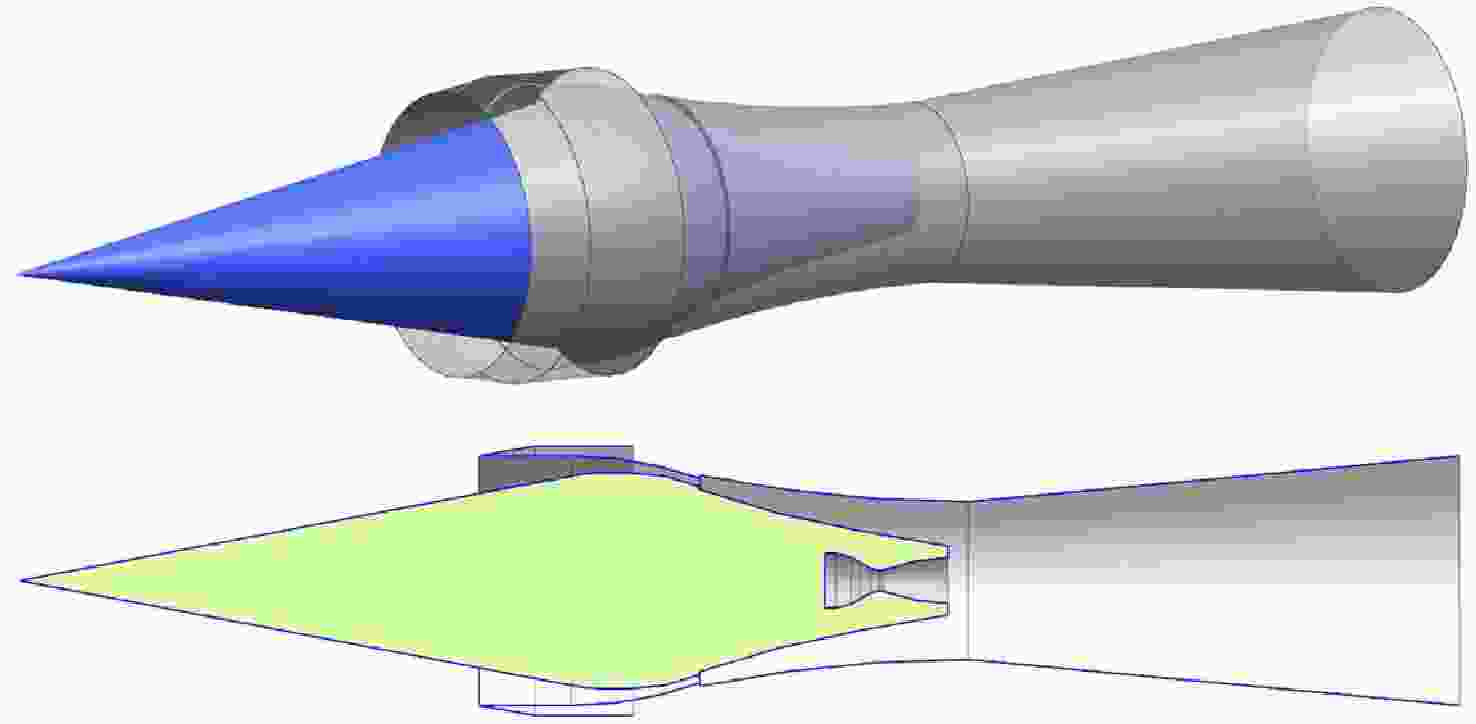
图 1 中心火箭布局的全轴对称RBCC发动机基准流道
Figure 1. Benchmark flowpath configuration of a axisymmetric RBCC engine with center rocket
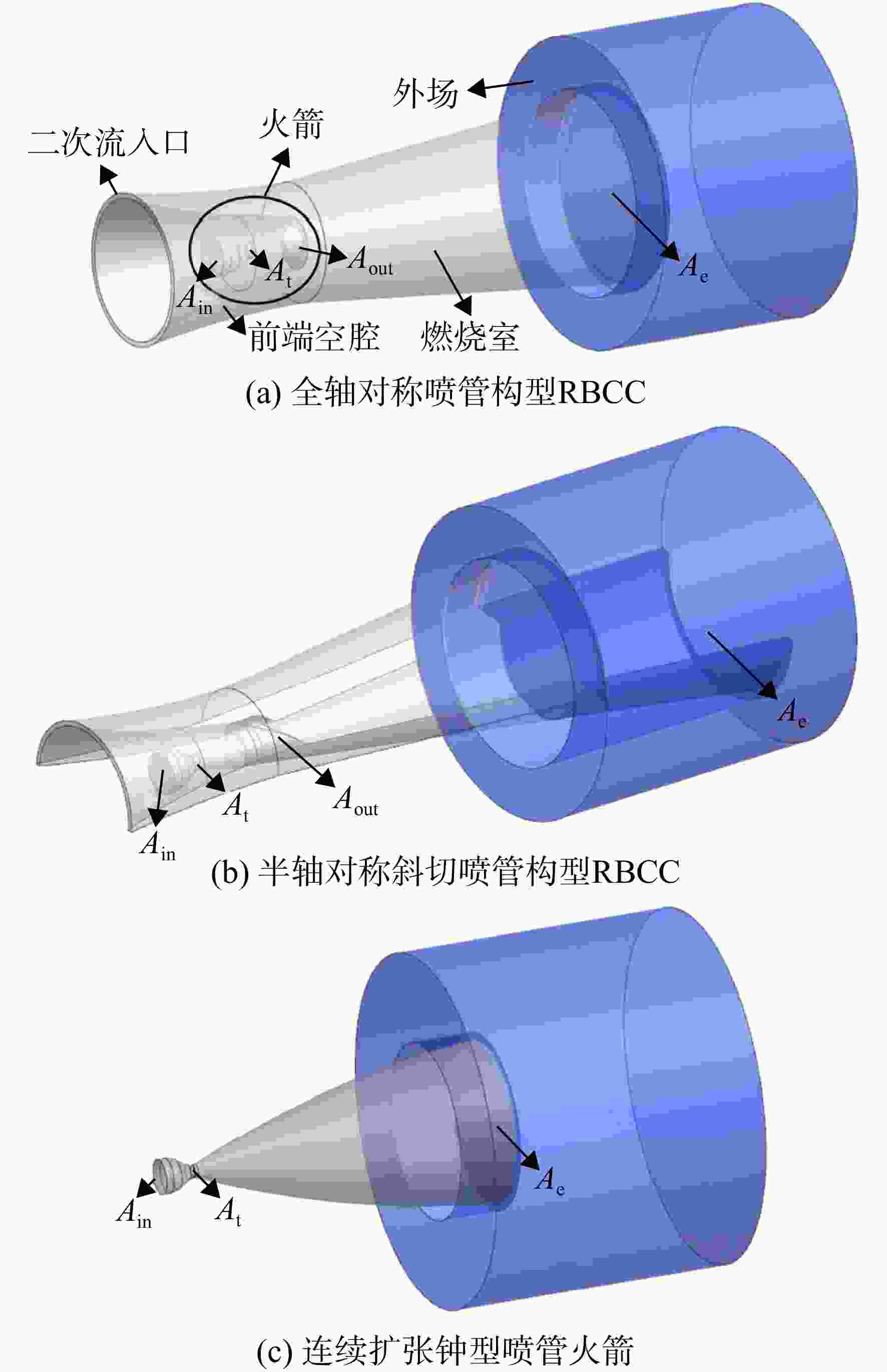
图 2 不同喷管构型RBCC发动机流道及连续扩张钟型喷管火箭发动机
Figure 2. RBCC engine flow channels with different nozzle configurations and continuously expanded bell-shaped nozzle rocket engine
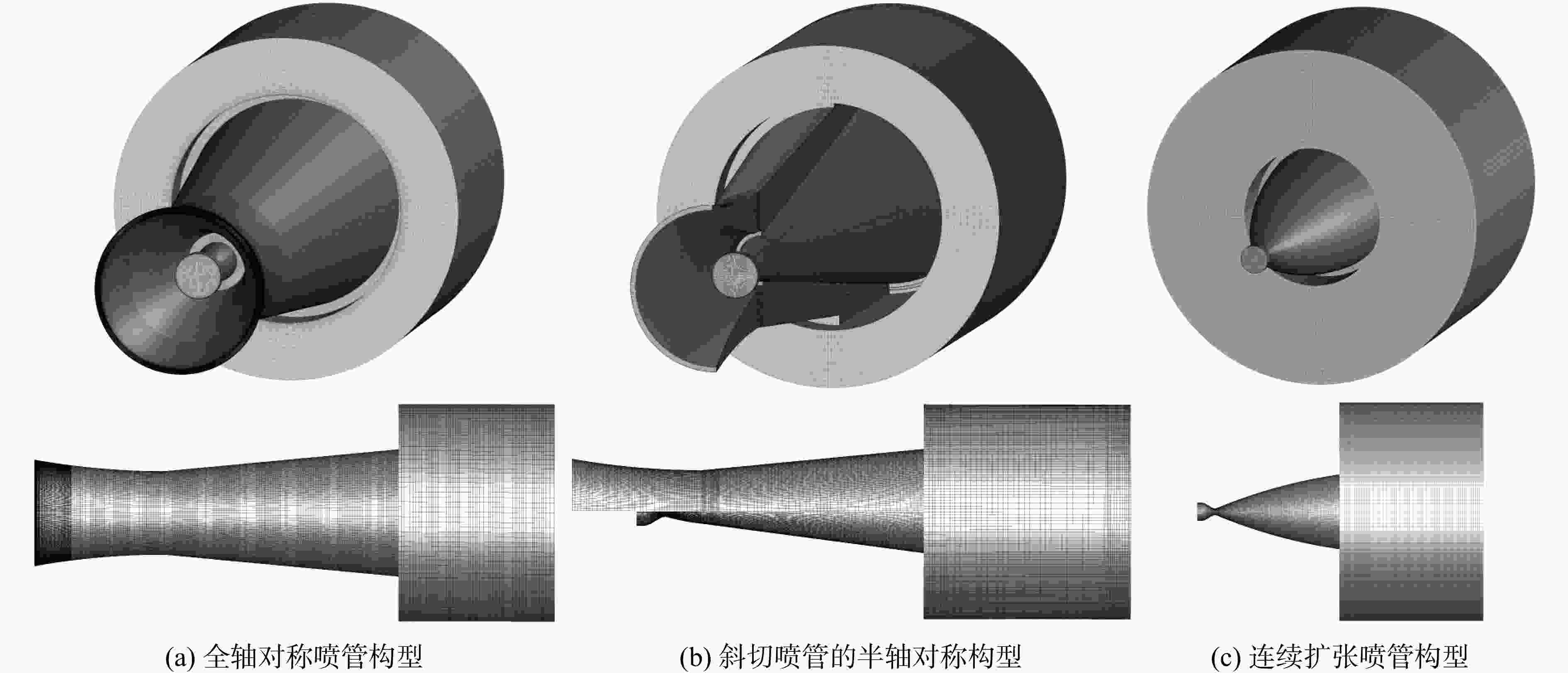
图 3 3种发动机流道构型的计算网格
Figure 3. Computational meshes of three engine flow channel configurations
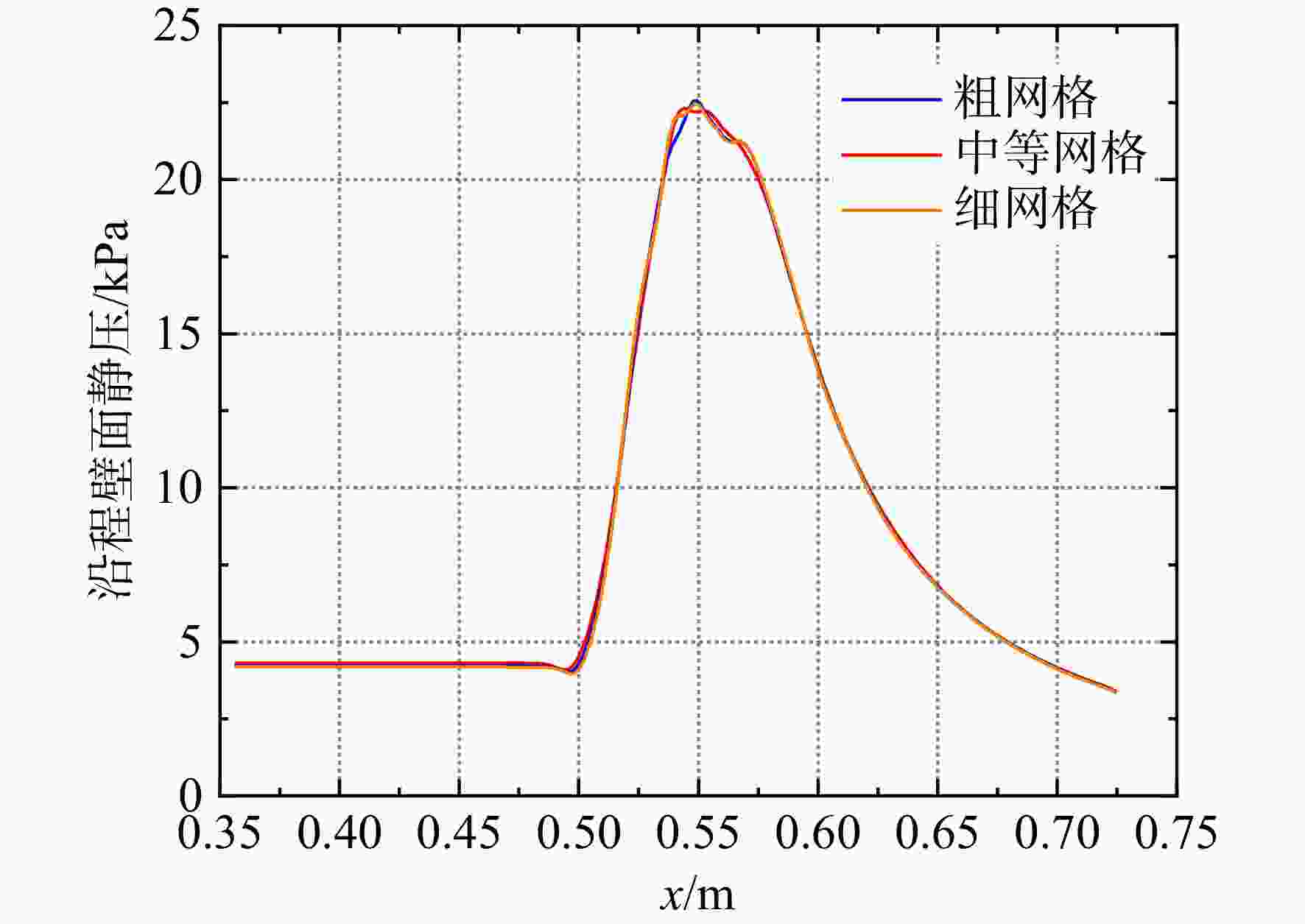
图 4 不同网格的沿程壁面静压对比
Figure 4. Comparison of longitudinal wall static pressures on different meshes
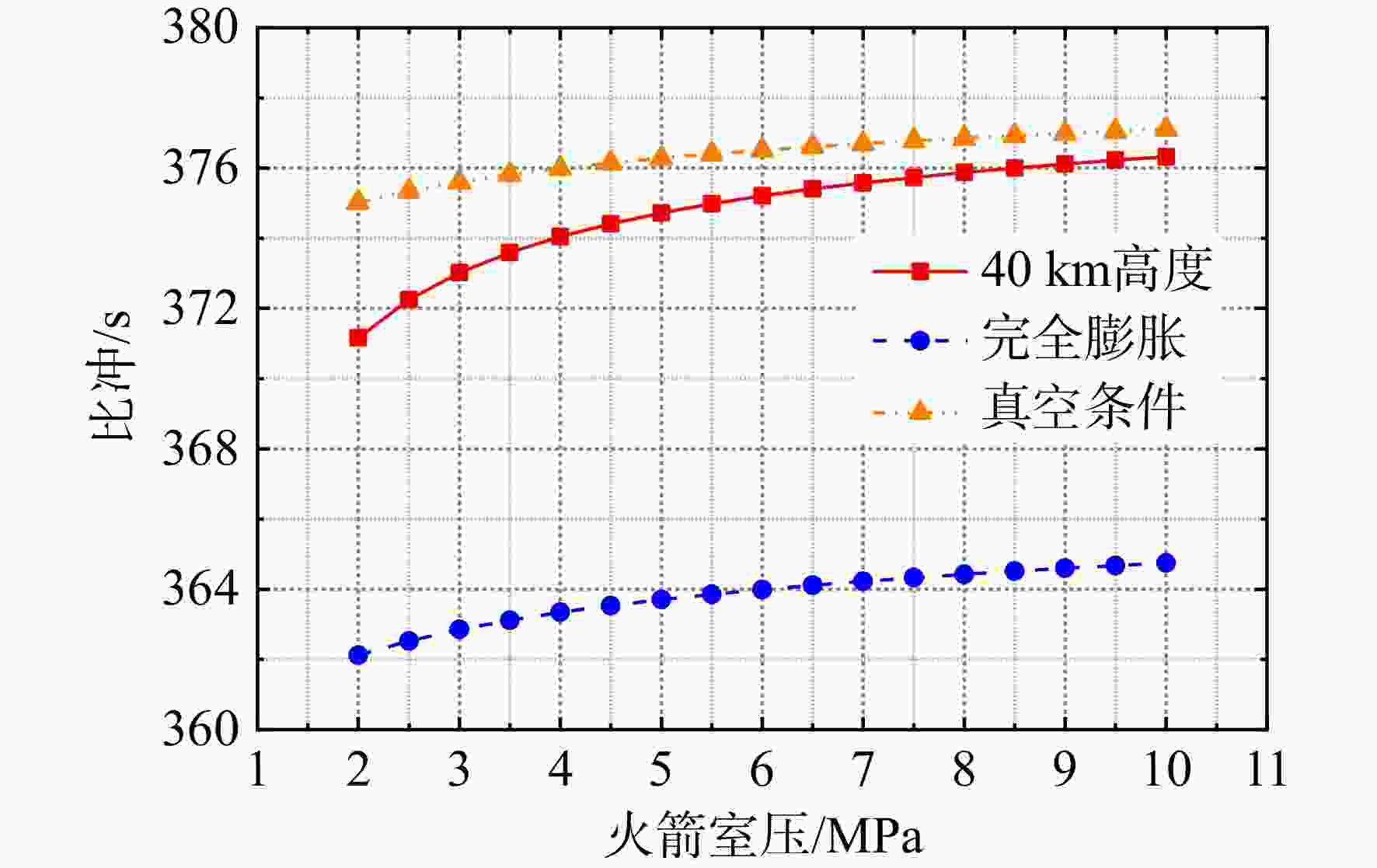
图 5 煤油/液氧火箭发动机理想比冲随室压变化特性
Figure 5. Variation of ideal specific impulse of kerosene/LO2 rocket engine with chamber pressure
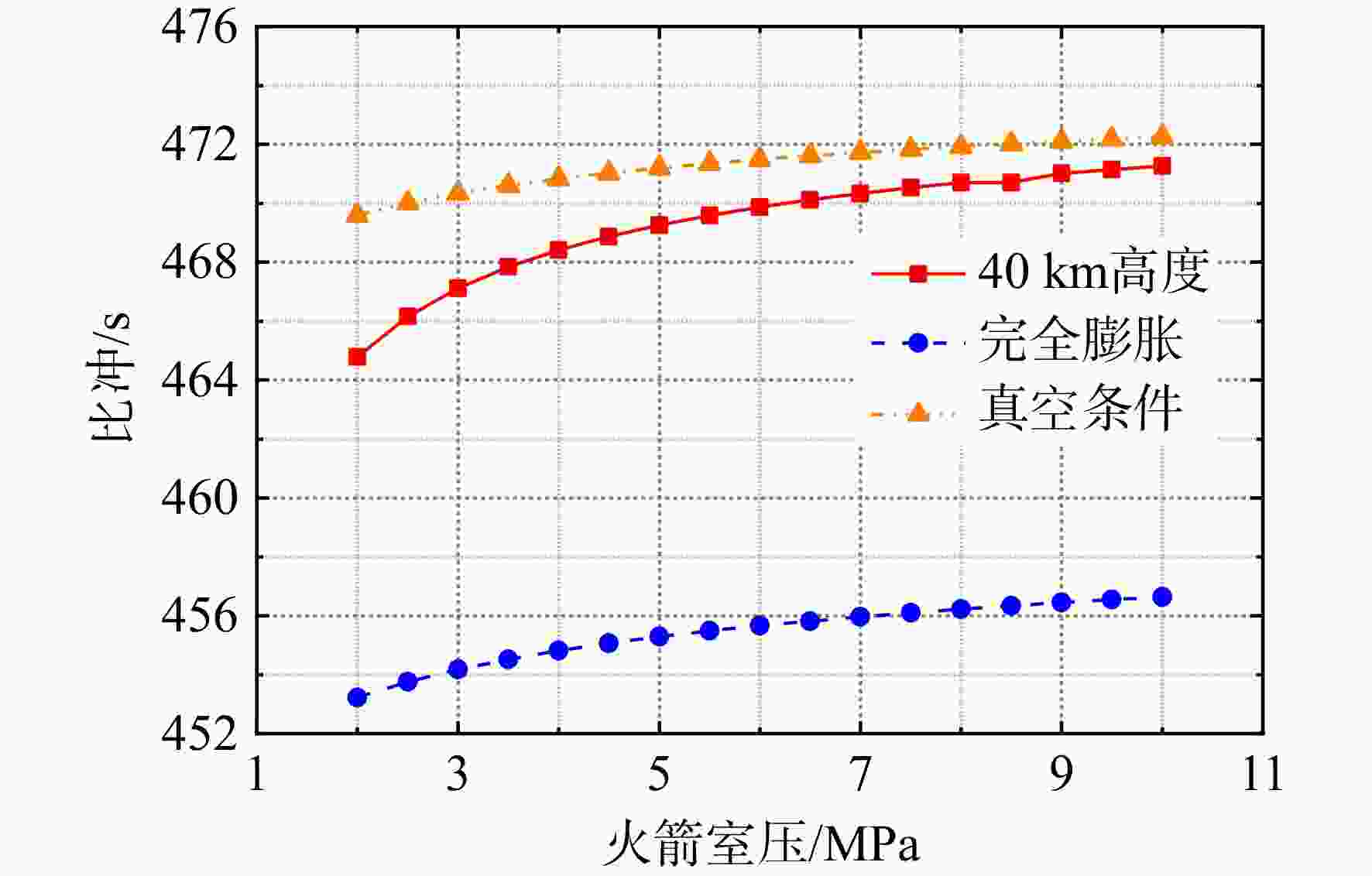
图 6 液氢/液氧火箭发动机理想比冲随室压变化特性
Figure 6. Variation of ideal specific impulse of LH2/LO2 rocket engine with chamber pressure
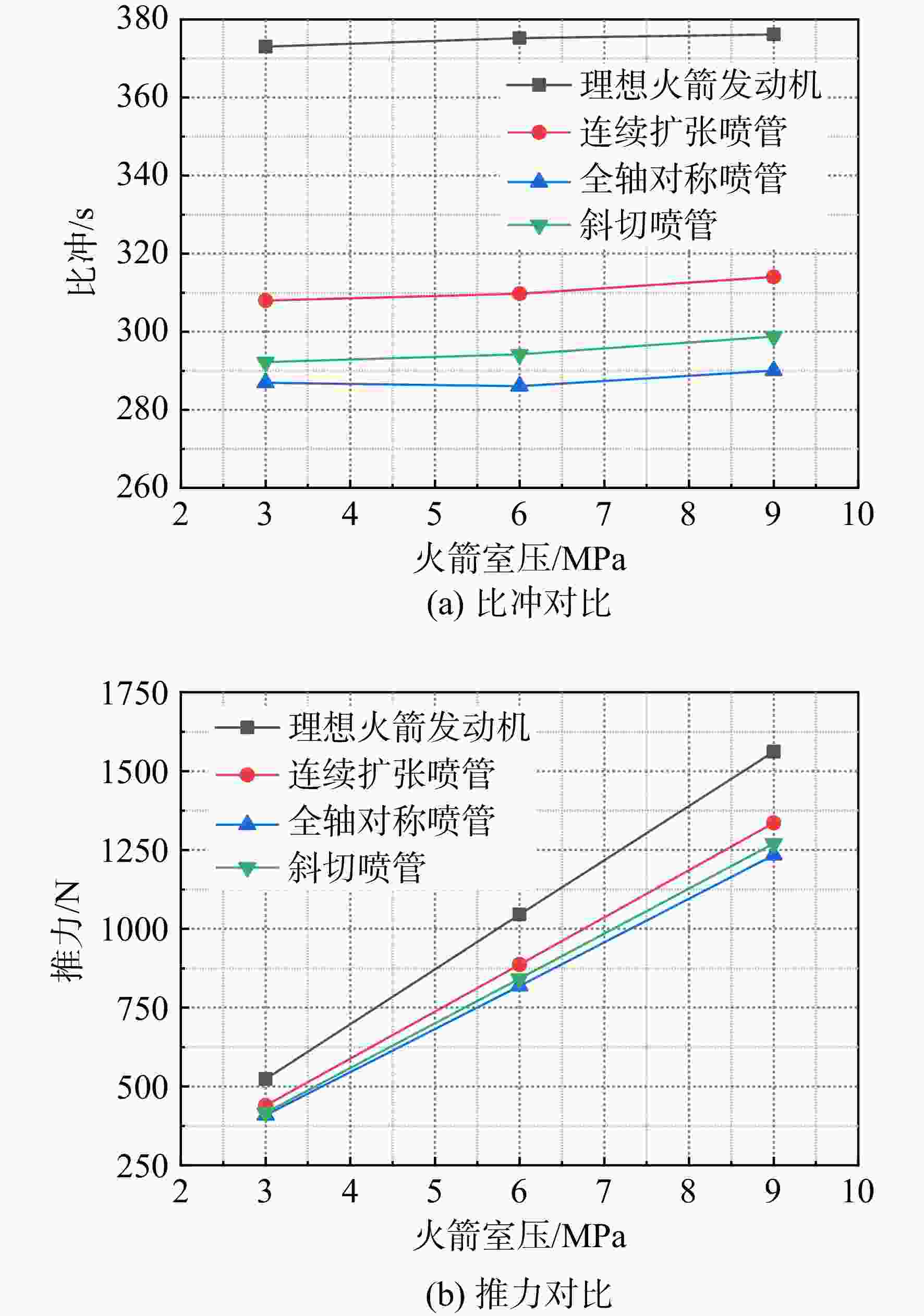
图 7 不同喷管构型的推力性能对比
Figure 7. Comparison of thrust performance of different nozzle configurations
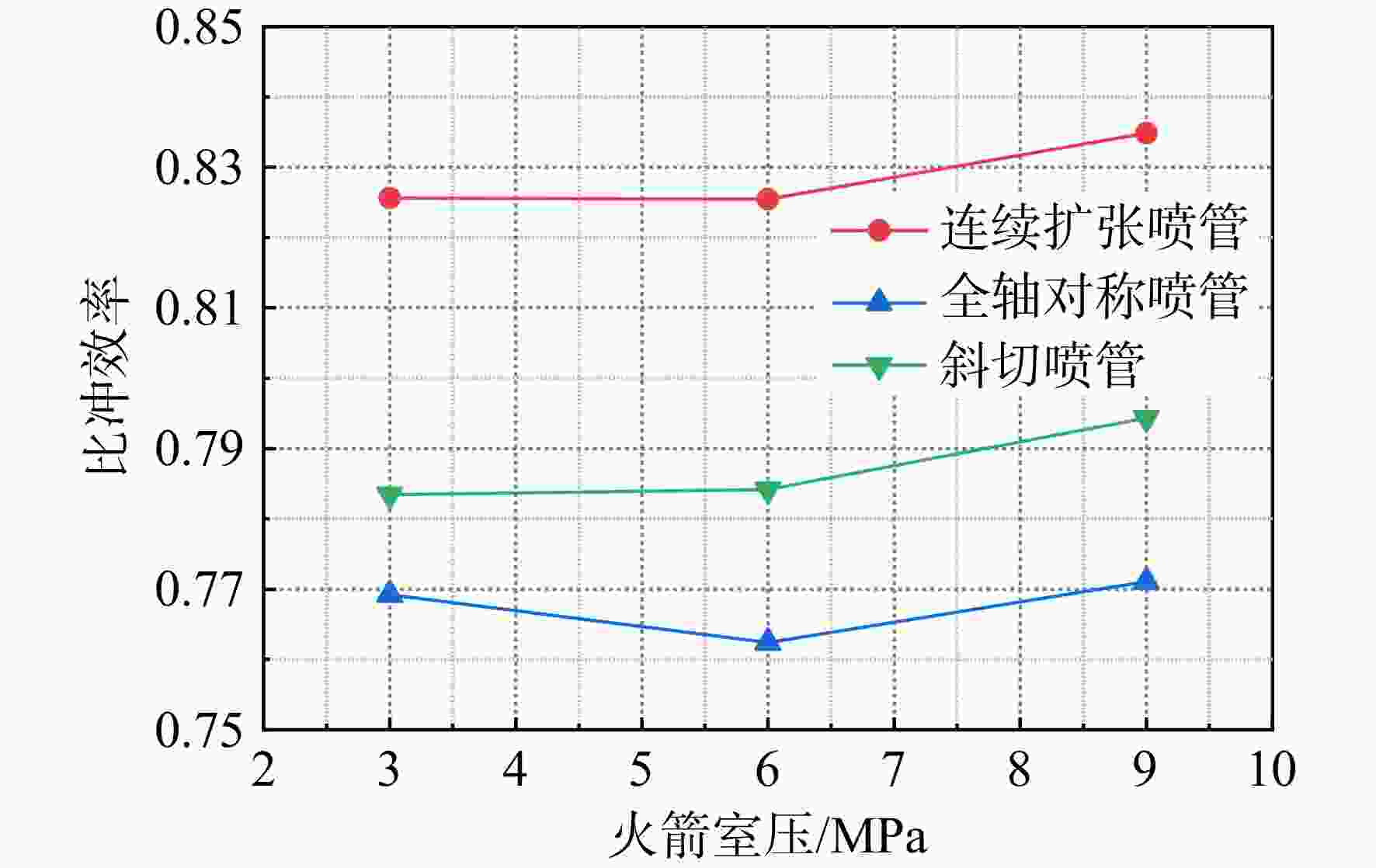
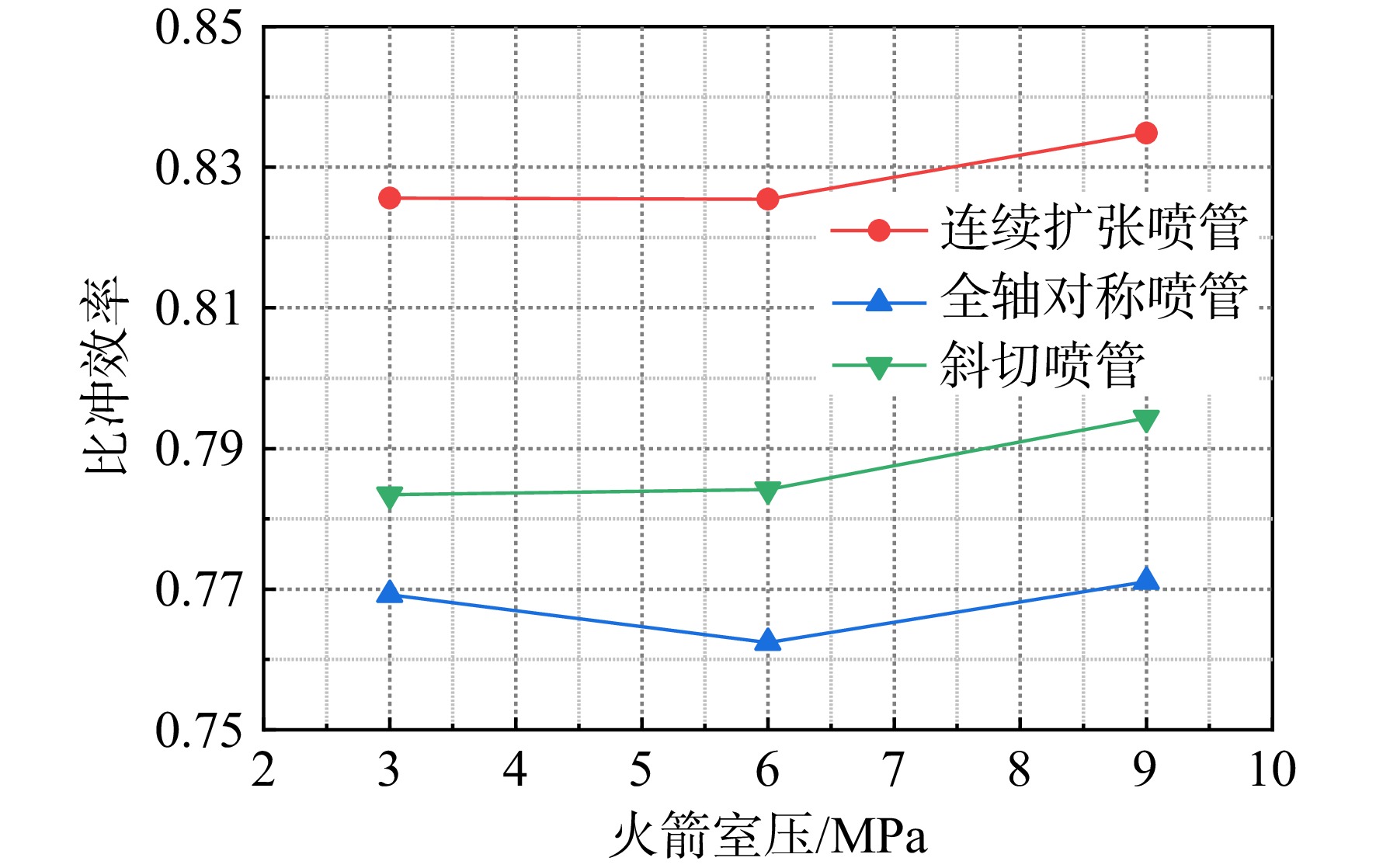
图 8 不同喷管构型的比冲效率对比
Figure 8. Comparison of specific impulse efficiency among different nozzle configurations
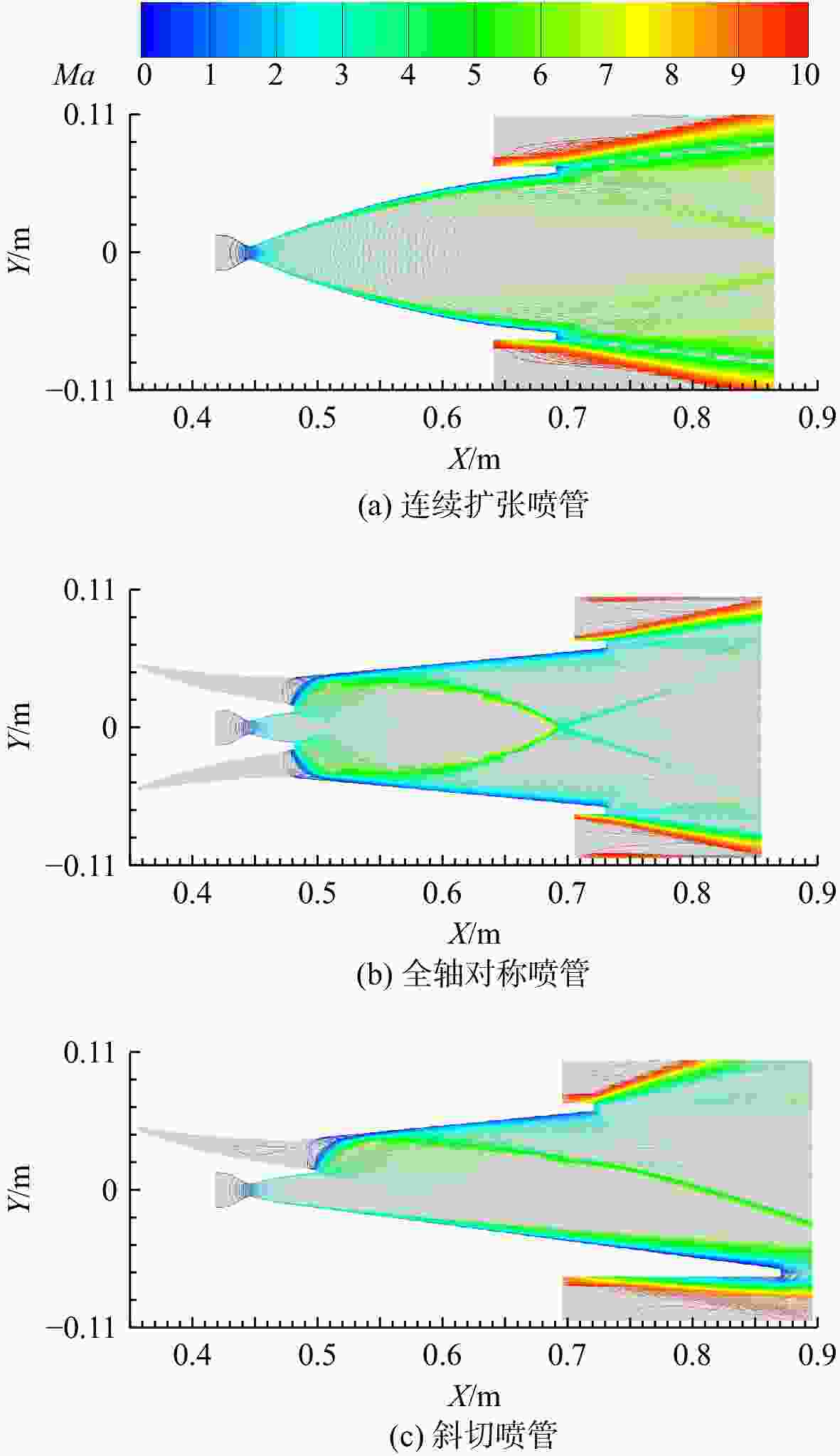
图 9 3种构型下对称面上的马赫数分布云图对比
Figure 9. Comparison of Mach number distribution contours on the symmetry plane for three configurations
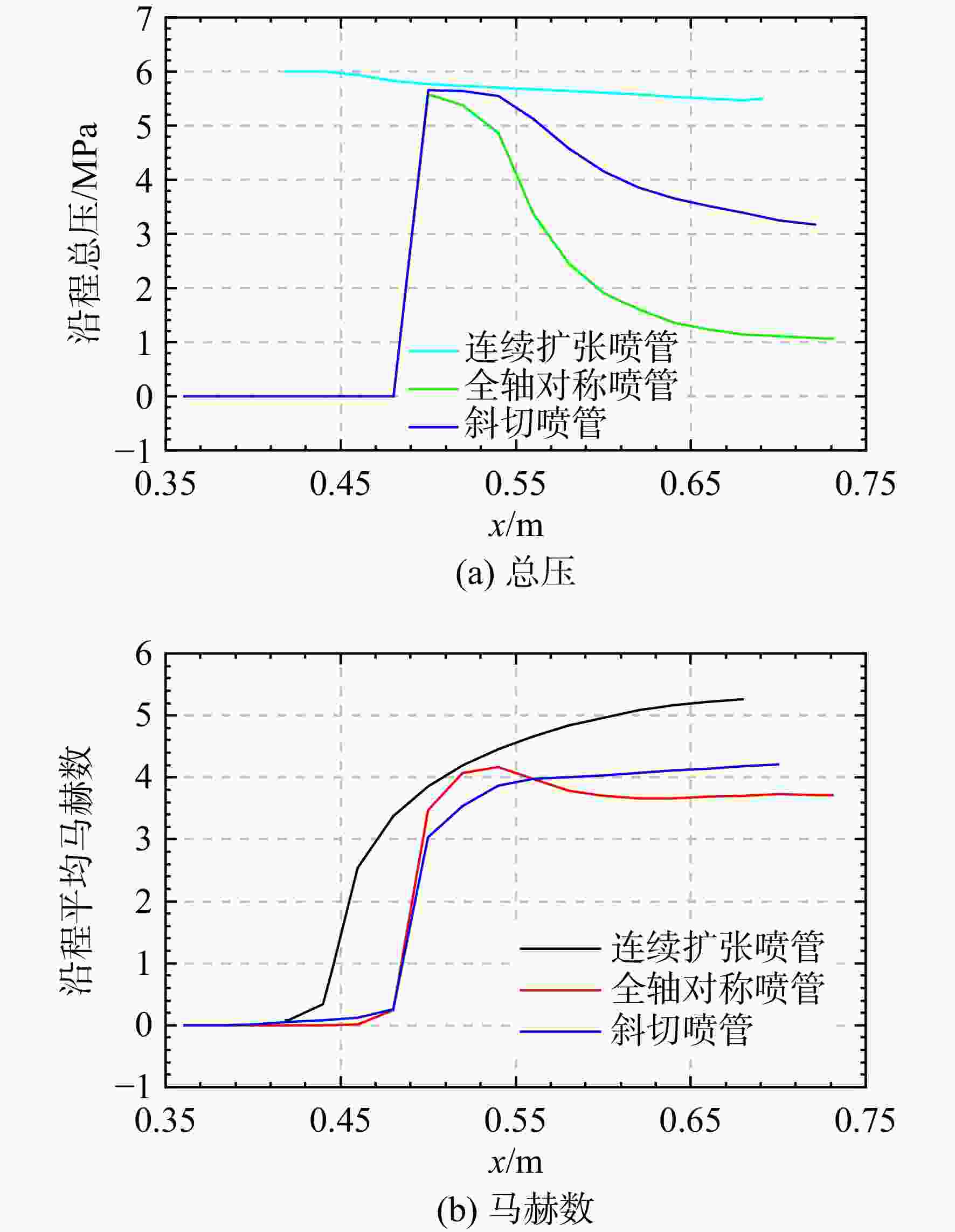
图 10 不同火箭构型的沿程总压和马赫数对比
Figure 10. Comparison of total pressure and Mach number along the path for different rocket configurations

图 11 不同火箭室压对称面上的流场结构
Figure 11. Flow field structure on the symmetry plane for different rocket chamber pressures

图 12 不同二次流流量比下对称面上参数分布
Figure 12. Parameters distribution on the symmetry plane for different secondary flow rate ratios
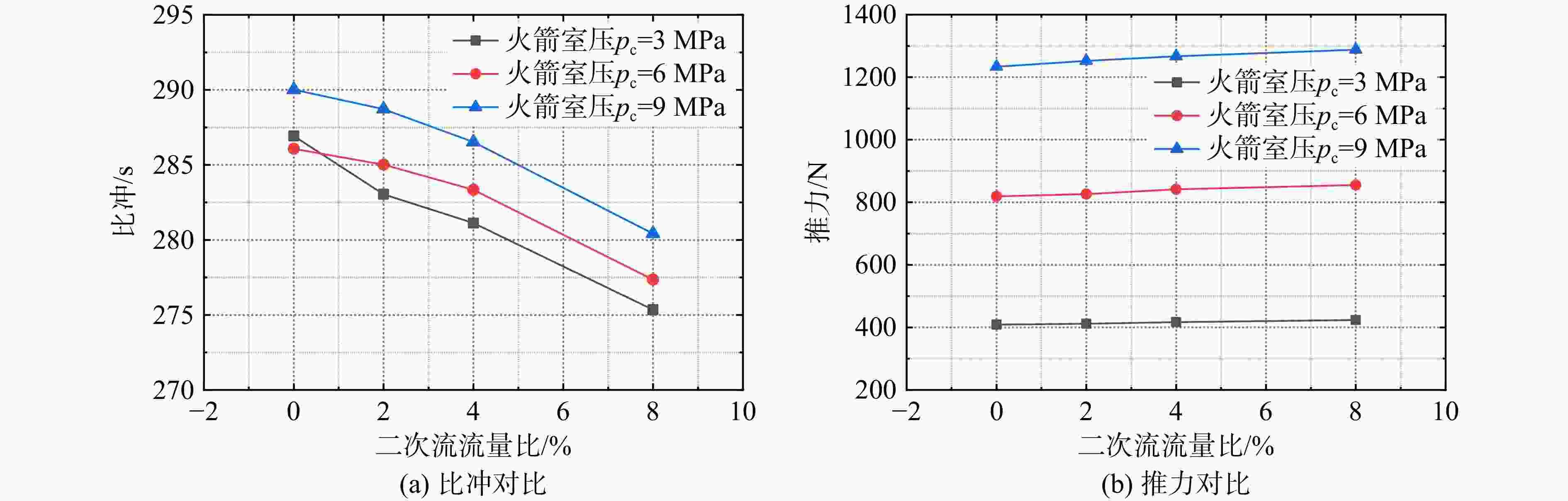
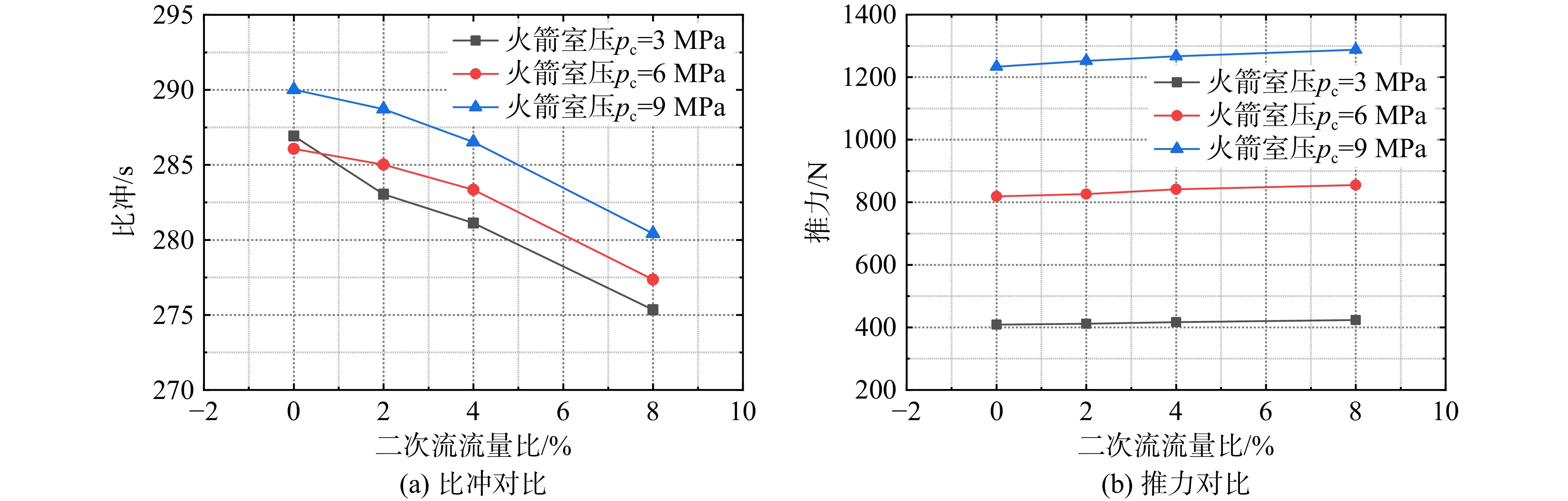
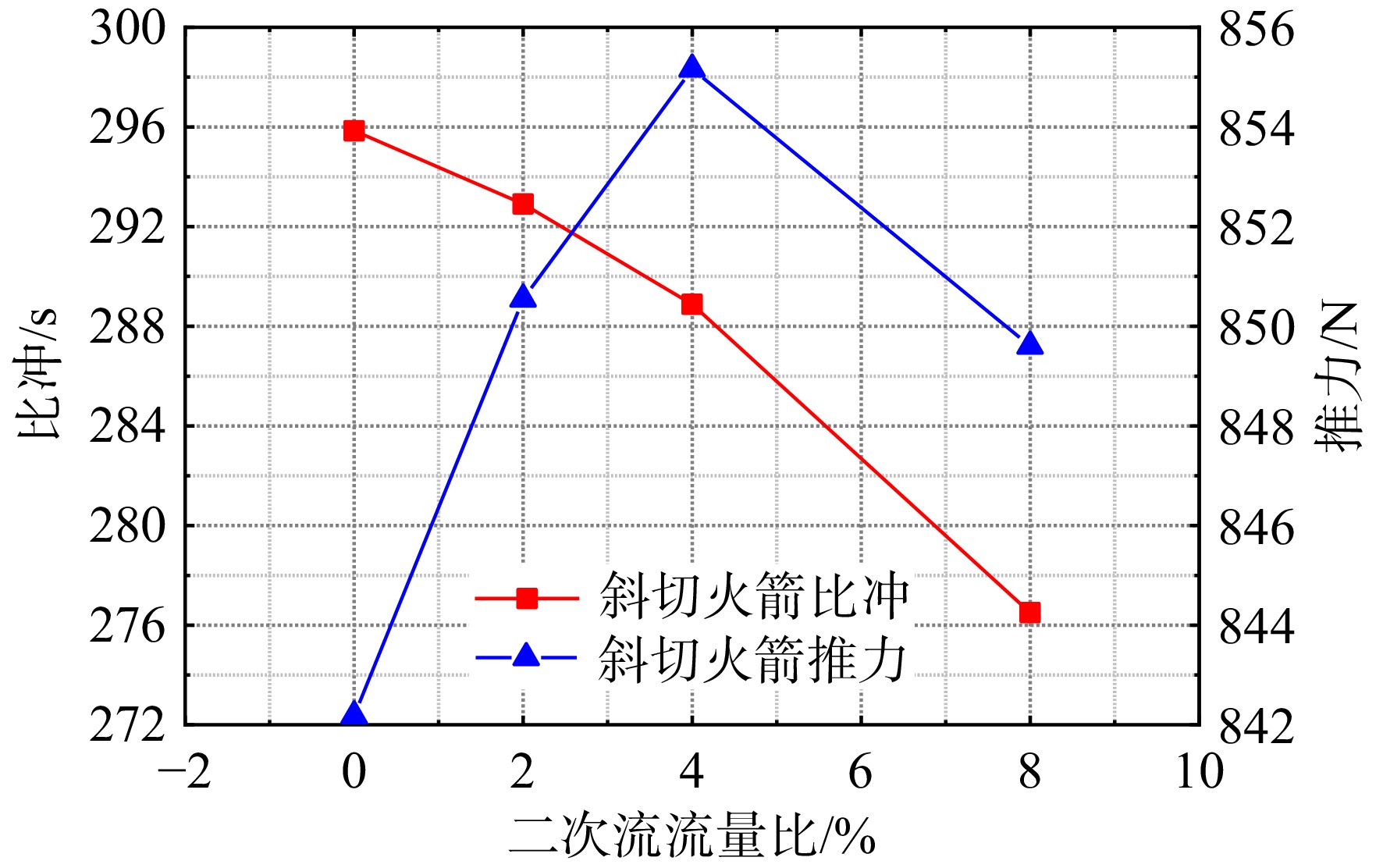
图 13 二次流流量比对发动机比冲和推力的影响
Figure 13. Impact of secondary flow rate ratio on engine specific impulse and thrust
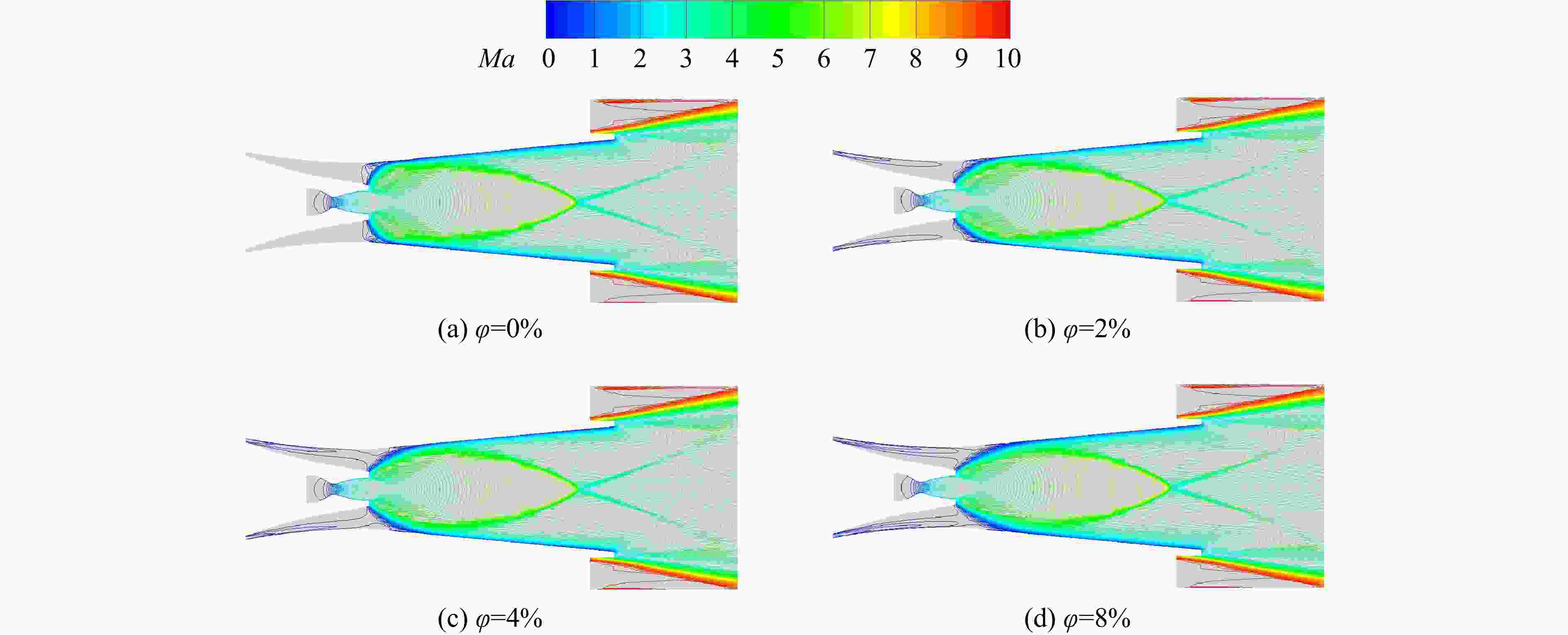
图 14 不同二次流流量比下对称面马赫数分布
Figure 14. Mach number distribution on the symmetry plane for different secondary flow rate ratios
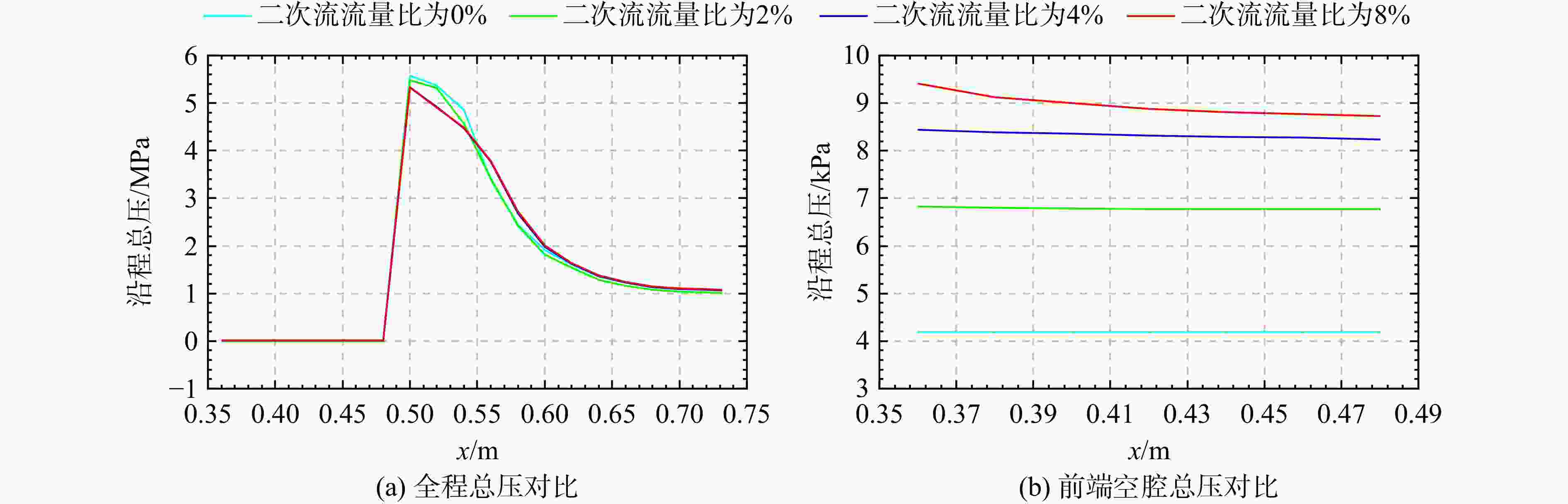
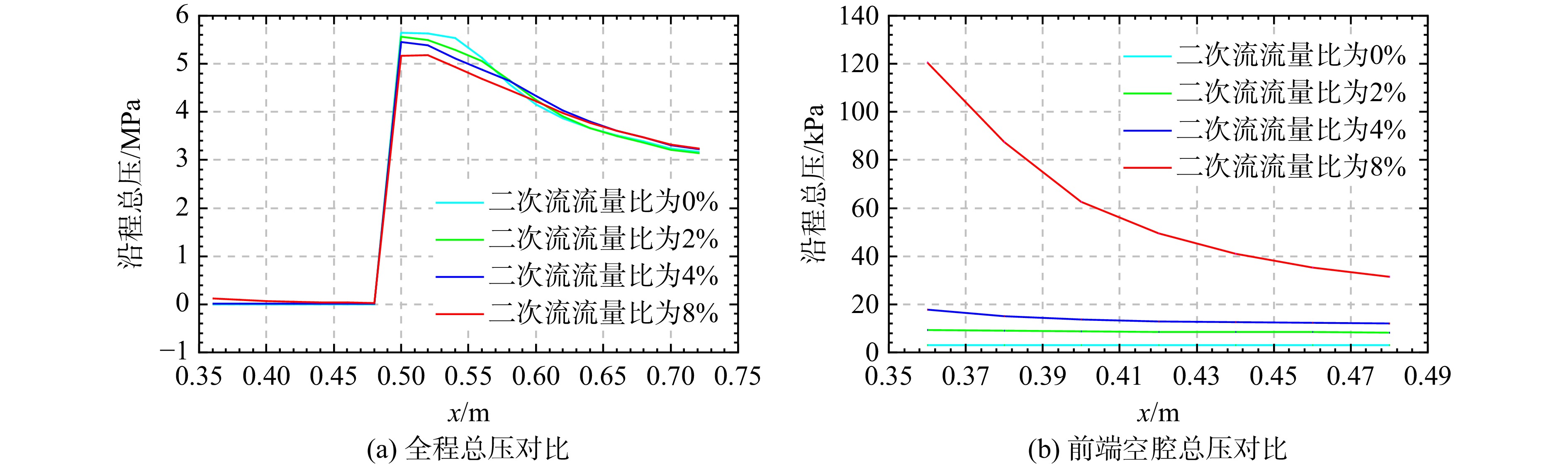
图 15 不同二次流流量比下沿程总压对比(空气)
Figure 15. Comparison of total pressure along the path for different secondary flow rate ratios (air)
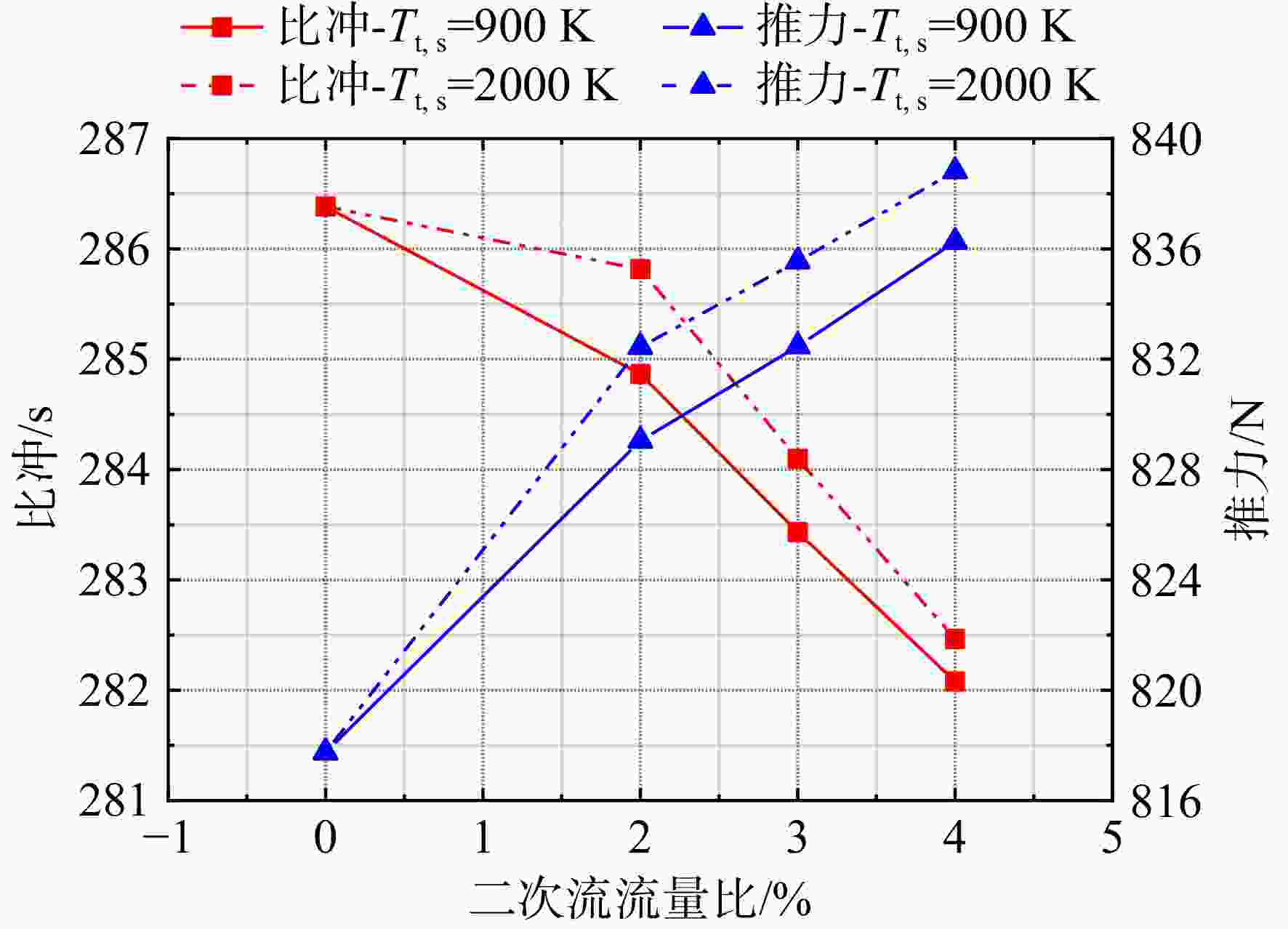
图 16 二次流流量比对比冲和推力的影响(燃气)
Figure 16. Impact of secondary flow rate ratio on engine specific impulse and thrust (gas)

图 17 不同二次流流量比下对称面上马赫数分布(燃气)
Figure 17. Mach number distribution on the symmetry plane for different secondary flow rate ratios (gas)

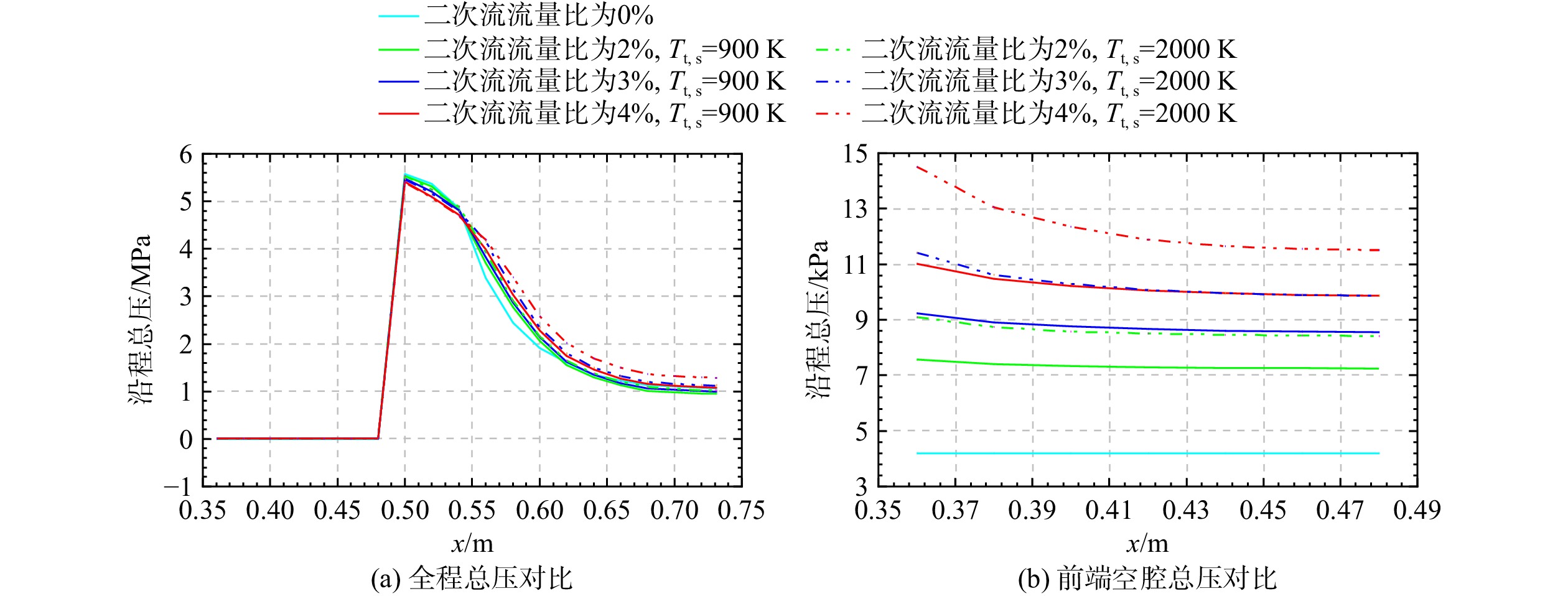
图 18 不同二次流流量比下沿程总压对比(燃气)
Figure 18. Comparison of total pressure along the path for different secondary flow rate ratios (gas)

图 19 二次流流量比对比冲和推力的影响(斜切喷管)
Figure 19. Impact of secondary flow rate ratio on engine specific impulse and thrus (scarfed nozzle)
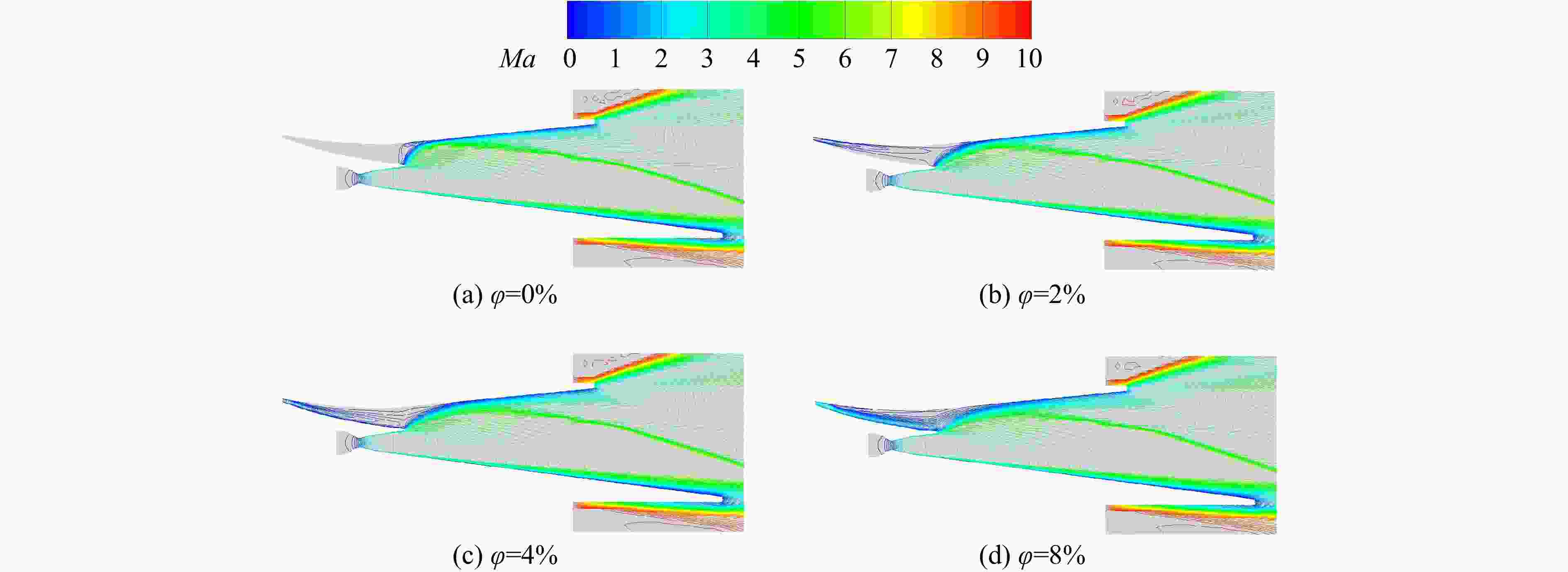
图 20 不同二次流流量比下对称面马赫数分布(斜切喷管)
Figure 20. Mach number distribution on the symmetry plane for different secondary flow rate ratios (scarfed nozzle)
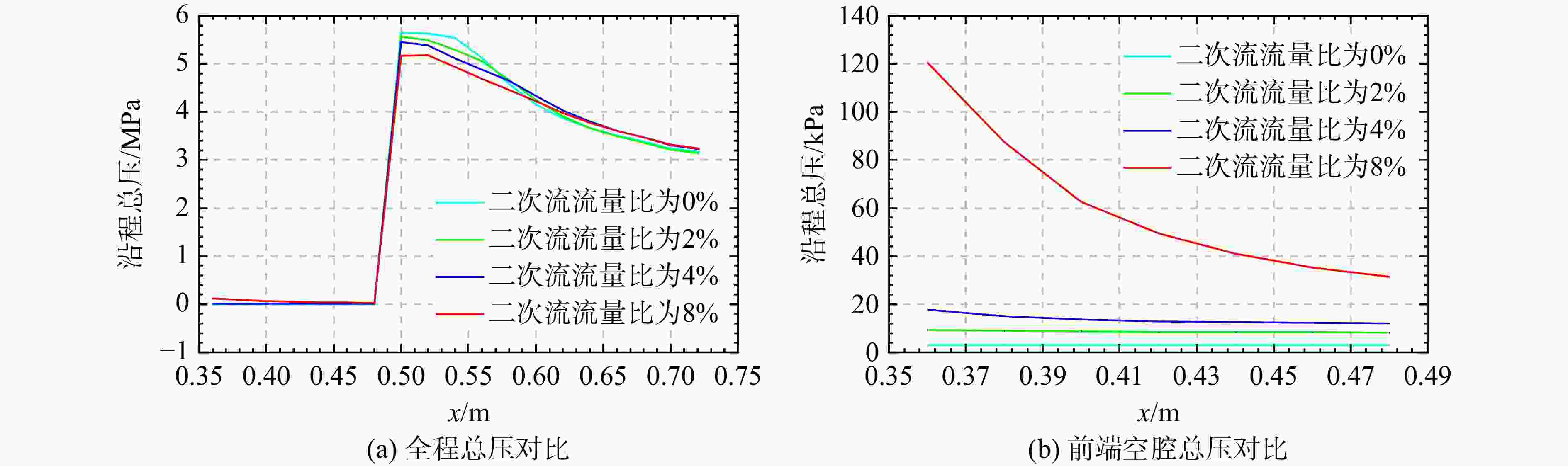
图 21 不同二次流流量比下沿程总压对比(斜切喷管)
Figure 21. Comparison of total pressure along the path for different secondary flow rate ratios (scarfed nozzle)
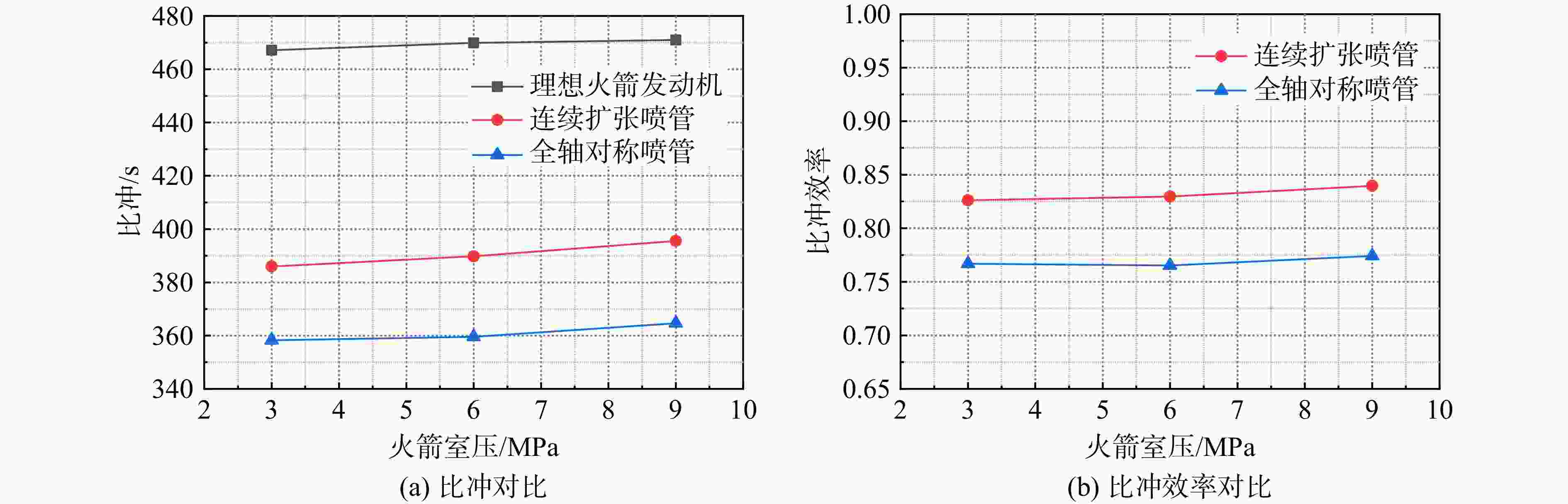
图 22 采用液氢/液氧推进剂时的不同喷管构型发动机比冲性能特性
Figure 22. Specific impulse characteristics of engines with different nozzle configurations when using LH2/LO2 propellants
表 1 不同喷管构型的发动机流道关键尺寸对比
Table 1. Comparison of key dimensions of engine flow channels with different nozzle configurations
流道构型 火箭入口
半径/mm火箭喉部
半径/mm内喷管出口
半径/mm发动机出口
半径/mm收缩比
Ain/At内部膨胀比
Aout/At总膨胀比
Ae/At全轴对称喷管火箭 14 5.207 11.684 63.5 7.229 5.035 148.72 斜切喷管火箭 14 5.207 14.004 63.5 7.229 7.233 148.72 连续扩张喷管火箭 14 5.207 63.5 7.229 148.72  下载: 导出CSV
表 2 火箭推力室的模拟工况条件
Table 2. Simulated conditions of rocket thruster
燃料 氧化剂 氧燃比 推力室室压
pc/MPa燃气总温
Tt/K煤油 液氧 2.6 3 3640 6 3640 9 3698 液氢 液氧 7.0 3 3456 6 3546 9 3615
下载: 导出CSV
表 3 仿真网格无关性验证
Table 3. Mesh independence study of simulation
网格方案 网格
数量/104燃烧室出口
总压/Pa燃烧室出口
静压/Pa粗网格 120 956472 5588 中等网格 250 961994 5543 细网格 450 962617 5536
下载: 导出CSV
表 4 基于APL-10C发动机的典型试验状态工况
Table 4. Typical test conditions for the APL-10C engine
试验工况 氧燃比 火箭室压/MPa 环境压力/MPa 燃气总温/K 工作模态 E02 11.58 3.597 0.1006 3242 纯火箭模态 E04 11.67 3.507 0.1006 3244 E05 11.05 3.362 0.0413 3207 106 11.34 3.514 0.1013 3227 单独推力室 108 10.96 3.369 0.1013 3202
下载: 导出CSV
表 5 仿真计算与试验数据的比冲对比
Table 5. Comparison of impulse between the simulation results and experiments data
工况 试验比冲/s CFD比冲/s 相对偏差/% E02 220.9 239.8 8.58 E04 220.0 238.5 8.41 E05 251.5 253.7 0.88 106 264.3 261.7 −0.99 108 265.3 261.3 −1.5
下载: 导出CSV
表 6 空气二次流入口参数
Table 6. Parameters of the secondary flow inlet (air)
火箭室压/
MPa流量比/% 二次流
温度/K入口动量/
(kg·m/s)推力
贡献/N3 2 300 0.243 2.349 3 4 300 0.702 2.741 3 8 300 2.024 1.760 6 2 300 0.601 3.637 6 4 300 1.403 5.860 6 8 300 4.039 3.883 9 2 300 0.708 7.862 9 4 300 2.071 9.009 9 8 300 5.979 6.084
下载: 导出CSV
表 7 燃气二次流入口参数
Table 7. Parameters of the secondary flow inlet (gas)
火箭室压/
MPa流量比/
%二次流
总温/K入口动量/
(kg·m/s)推力
贡献/N6 2 900 1.432 3.539 6 3 900 2.777 2.855 6 4 900 4.354 2.070 6 2 2 000 2.749 2.930 6 3 2 000 5.446 1.530 6 4 2 000 7.842 0.073
下载: 导出CSV
表 8 斜切喷管构型二次流入口参数
Table 8. Parameters of the secondary flow inlet (scarfed nozzle)
火箭室压/
MPa流量比/
%二次流
温度/K入口动量/
(kg·m/s)推力
贡献/N6 2 900 2.739 0.301 6 4 900 6.667 0.603 6 8 900 28.487 6.919
下载: 导出CSV
表 9 采用液氢/液氧推进剂时二次流入口参数
Table 9. Parameters of the secondary flow inlet(LH2/LO2 propellant)
火箭室压/
MPa流量比/% 二次流
温度/K入口动量/
(kg·m/s)推力
贡献/N6 2 300 0.291 5.935 6 4 300 0.889 7.011 6 8 300 2.534 7.440
下载: 导出CSV
表 10 液氢/液氧与煤油/液氧推力性能推进剂方案的比冲性能特性对比
Table 10. Comparison of specific impulse characteristics between LH2/LO2 and kerosene/LO2 propellants
二次流
流量比/%煤油/液氧 液氢/液氧 比冲/s 比冲效率/% 比冲/s 比冲效率/% 0 286.38 76.32 359.56 76.52 2 285.02 75.99 358.29 76.25 4 283.34 75.52 355.27 75.61 8 277.36 73.92 348.79 74.23
下载: 导出CSV
-
[1] HANK J,FRANKE M,EKLUND D. TSTO reusable launch vehicles using airbreathing propulsion: AIAA 2006-4962[R]. Sacramento: 42nd AIAA/ASME/SAE/ASEE Joint Propulsion Conference & Exhibit,2006. [2] 秦飞,吕翔,刘佩进,等. 火箭基组合推进研究现状与前景[J]. 推进技术,2010,31(6): 660-665. QIN Fei,LV Xiang,LIU Peijin,et al. Research status and perspective of rocket based combined cycle propulsion system[J]. Journal of Propulsion Technology,2010,31(6): 660-665. (in ChineseQIN Fei, LV Xiang, LIU Peijin, et al. Research status and perspective of rocket based combined cycle propulsion system[J]. Journal of Propulsion Technology, 2010, 31(6): 660-665. (in Chinese) [3] 王亚军,何国强,秦飞,等. 火箭冲压组合动力研究进展[J]. 宇航学报,2019,40(10): 1125-1133. WANG Yajun,HE Guoqiang,QIN Fei,et al. Research progress of rocket based combined cycle engines[J]. Journal of Astronautics,2019,40(10): 1125-1133. (in Chinese doi: 10.3873/j.issn.1000-1328.2019.10.003WANG Yajun, HE Guoqiang, QIN Fei, et al. Research progress of rocket based combined cycle engines[J]. Journal of Astronautics, 2019, 40(10): 1125-1133. (in Chinese) doi: 10.3873/j.issn.1000-1328.2019.10.003 [4] SHI Lei,YANG Yiyan,ZHAO Guojun,et al. Research and development on inlets for rocket based combined cycle engines[J]. Progress in Aerospace Sciences,2020,117: 100639. doi: 10.1016/j.paerosci.2020.100639 [5] DAINES R,SEGAL C. Combined rocket and airbreathing propulsion systems for space-launch applications[J]. Journal of Propulsion and Power,1998,14(5): 605-612. doi: 10.2514/2.5352 [6] SIEBENHAAR A,BULMAN M. The strutjet engine-the overlooked option for space launch: AIAA 1995-3124 [R]. San Diego: 31st Joint Propulsion Conference and Exhibit,1995. [7] 杜金峰,贾琳渊,陈玉春,等. 不同燃料RBCC发动机飞/发一体化性能对比分析[J]. 航空动力学报,2024,39(8): 20230310. DU Jinfeng,JIA Linyuan,CHEN Yuchun,et al. Comparative analysis on aircraft and engine integration performance of RBCC engines with different fuels[J]. Journal of Aerospace Power,2024,39(8): 20230310. (in ChineseDU Jinfeng, JIA Linyuan, CHEN Yuchun, et al. Comparative analysis on aircraft and engine integration performance of RBCC engines with different fuels[J]. Journal of Aerospace Power, 2024, 39(8): 20230310. (in Chinese) [8] 姚卫,张政,赵伟,等. 高超声速飞/发一体化进展与趋势[J]. 推进技术,2023,44(8): 22010002. YAO Wei,ZHANG Zheng,ZHAO Wei,et al. Advances and trends in airframe/engine integration of hypersonic vehicles[J]. Journal of Propulsion Technology,2023,44(8): 22010002. (in ChineseYAO Wei, ZHANG Zheng, ZHAO Wei, et al. Advances and trends in airframe/engine integration of hypersonic vehicles[J]. Journal of Propulsion Technology, 2023, 44(8): 22010002. (in Chinese) [9] KIM H S,OH S,CHOI J Y. Quasi-1D analysis and performance estimation of a sub-scale RBCC engine with chemical equilibrium[J]. Aerospace Science and Technology,2017,69: 39-47. doi: 10.1016/j.ast.2017.06.019 [10] REDDY D R,SREE D. Computational study of flow in a rocket-based combined cycle (RBCC) engine inlet[J]. Computers & Fluids,2006,35(7): 724-732. [11] THOMAS S R,PALAC D T,TREFNY C J,et al. Performance evaluation of the NASA GTX RBCC flowpath[C]//Fifteenth International Symposium on Airbreathing Engines. Bangalore: NASA Glenn Research Center,2001: 210953. [12] TREFNY C. An air-breathing launch vehicle concept for single-stage-to-orbit: AIAA 1999-2730[R]. Los Angeles: 35th Joint Propulsion Conference and Exhibit,1999. [13] RICE T. Rocket-based combined cycle flowpath testing for modes 1 and 4 : RTDC-TPS-425 [R]. Laurel,MD: Johns Hopkins University Applied Physics Laboratory,2002. [14] SMITH T D,CANABAL F III,RICE T,et al. Development of an integrated nozzle for a symmetric,RBCC launch vehicle configuration[C]//2000 JANNAF Propulsion and Joint Subcommittee Meetings. Monterey,US: AIAA/ASME/SAE/ASEE,2000: 117-126. [15] LILLEY J S. Experimental validation of a performance model for scarfed nozzles[J]. Journal of Spacecraft and Rockets,1987,24(5): 474-480. doi: 10.2514/3.25941 [16] LILLEY J S,HOFFMAN J D. Performance analysis of scarfed nozzles[J]. Journal of Spacecraft and Rockets,1986,23(1): 55-62. doi: 10.2514/3.25083 [17] STEFFEN C J. Response surface modeling of combined-cycle propulsion components using computational fluid dynamics: AIAA 2002-542[R]. Reno,US: 40th AIAA Aerospace Sciences Meeting & Exhibit,2002. [18] STEFFEN C J,SMITH T D,YUNGSTER S,et al. Computational analysis for rocket-based combined-cycle systems during rocket-only operation[J]. Journal of Propulsion and Power,2000,16(6): 1030-1039. doi: 10.2514/2.5673 [19] SMITH T D,STEFFEN C J,YUNGSTER S,et al. Analysis of a rocket based combined cycle engine during rocket only operation[C]//NASA Technical Memorandum. Cleveland,US: NASA Lewis Research Center,1998: 206639/REV1. [20] SMITH T D,STEFFEN C J,YUNGSTER S,et al. Performance of an axisymmetric rocket based combined cycle engine during rocket only operation using linear regression analysis: NASA/TM-1998-206632 [R]. Cleveland,US: NASA Lewis Research Center,1998. [21] 高逸夫,龚春林,王健磊,等. 中心支板参数对RBCC发动机性能影响研究[J]. 推进技术,2022,43(10): 64-77. GAO Yifu,GONG Chunlin,WANG Jianlei,et al. Effects of central-strut parameters on performance of RBCC engine[J]. Journal of Propulsion Technology,2022,43(10): 64-77. (in ChineseGAO Yifu, GONG Chunlin, WANG Jianlei, et al. Effects of central-strut parameters on performance of RBCC engine[J]. Journal of Propulsion Technology, 2022, 43(10): 64-77. (in Chinese) [22] 万冰,白菡尘,陈军. RBCC模态特征与热力循环分析样本全覆盖策略[J]. 推进技术,2024,45(4): 2211051. WAN Bing,BAI Hanchen,CHEN Jun. Characteristics of RBCC operation mode and strategy for full-sample analysis to thermodynamic cycle[J]. Journal of Propulsion Technology,2024,45(4): 2211051. (in ChineseWAN Bing, BAI Hanchen, CHEN Jun. Characteristics of RBCC operation mode and strategy for full-sample analysis to thermodynamic cycle[J]. Journal of Propulsion Technology, 2024, 45(4): 2211051. (in Chinese) [23] 罗飞腾,姚达豪,李新珂,等. 支板火箭构型对引射进气与主次流相互作用特性影响试验研究[J]. 推进技术,2024,45(12): 2401089. LUO Feiteng,YAO Dahao,LI Xinke,et al. Experimental study of primary-secondary flow ejecting and interaction characteristics with different strut-jet rocket configuration[J]. Journal of Propulsion Technology,2024,45(12): 2401089. (in ChineseLUO Feiteng, YAO Dahao, LI Xinke, et al. Experimental study of primary-secondary flow ejecting and interaction characteristics with different strut-jet rocket configuration[J]. Journal of Propulsion Technology, 2024, 45(12): 2401089. (in Chinese) [24] 张留欢,南向军,张蒙正. RBCC发动机纯火箭模态流场数值仿真研究[J]. 火箭推进,2016,42(2): 42-46. ZHANG Liuhuan,NAN Xiangjun,ZHANG Mengzheng. Numerical simulation for flow field in pure rocket modality of RBCC engine[J]. Journal of Rocket Propulsion,2016,42(2): 42-46. (in Chinese doi: 10.3969/j.issn.1672-9374.2016.02.008ZHANG Liuhuan, NAN Xiangjun, ZHANG Mengzheng. Numerical simulation for flow field in pure rocket modality of RBCC engine[J]. Journal of Rocket Propulsion, 2016, 42(2): 42-46. (in Chinese) doi: 10.3969/j.issn.1672-9374.2016.02.008 [25] SCHNEIDER S,REED B. Rocket-in-a-duct performance analysis: AIAA 1999-2101 [R]. Los Angeles: 35th Joint Propulsion Conference and Exhibit,1999. [26] FRAZ N A. Rocket mode operational analysis of a rocket based combined cycle model engine[D]. Milan: Politecnico di Milano,2018. [27] FOSTER R. Optimization of the rocket mode trajectory in a rocket based combined cycle (RBCC) engine powered SSTO vehicle: AIAA 1989-2295 [R]. Monterey,US: 25th Joint Propulsion Conference,1989. -








 点击查看大图

计量
- 文章访问数: 730
- HTML浏览量: 486
- PDF量: 81
- 被引次数: 0