






Effect of boundary layer combustion on near-wall heat and mass transport processes of hydrogen and hydrocarbon fuel films
-
摘要:
对带有边界层燃烧现象的氢与碳氢燃料气膜冷却进行大涡模拟研究,重点关注边界层燃烧对这两种燃料气膜近壁热质输运过程的影响。研究表明:边界层燃烧有效削弱了主流与燃料气膜间的质量和热量输运过程,这有利于提升气膜的隔热能力。然而氢气膜中热质输运通量的降低并不足以弥补燃烧释热和高热容氢气消耗所带来的不利影响,使得边界层燃烧下氢气膜的隔热能力大幅恶化。与此相反,碳氢燃料气膜中热质输运通量的降低与近壁裂解反应的吸热效应具有协同作用,从而大幅提升碳氢燃料气膜的隔热能力。
Abstract:Large eddy simulations of hydrogen and hydrocarbon fuel films with boundary-layer combustion were conducted, focusing on the effects of boundary-layer combustion on the near-wall heat and mass transport processes of fuel films. The results showed that boundary layer combustion effectively reduced the heat and mass transport fluxes between the mainstream and fuel film, which enhanced the heat insulating performance of the film. However, the decrease in heat flux within the hydrogen film was not adequate to offset the negative impacts of heat release and consumption of hydrogen with high heat capacity during combustion, leading to a significant deterioration of the heat insulating performance during boundary layer combustion. On the contrary, the reduction of heat flux in the hydrocarbon film had synergistic effect with the heat absorption of the near-wall pyrolysis reactions, leading to a substantial enhancement in the heat insulating performance of the hydrocarbon film.
-
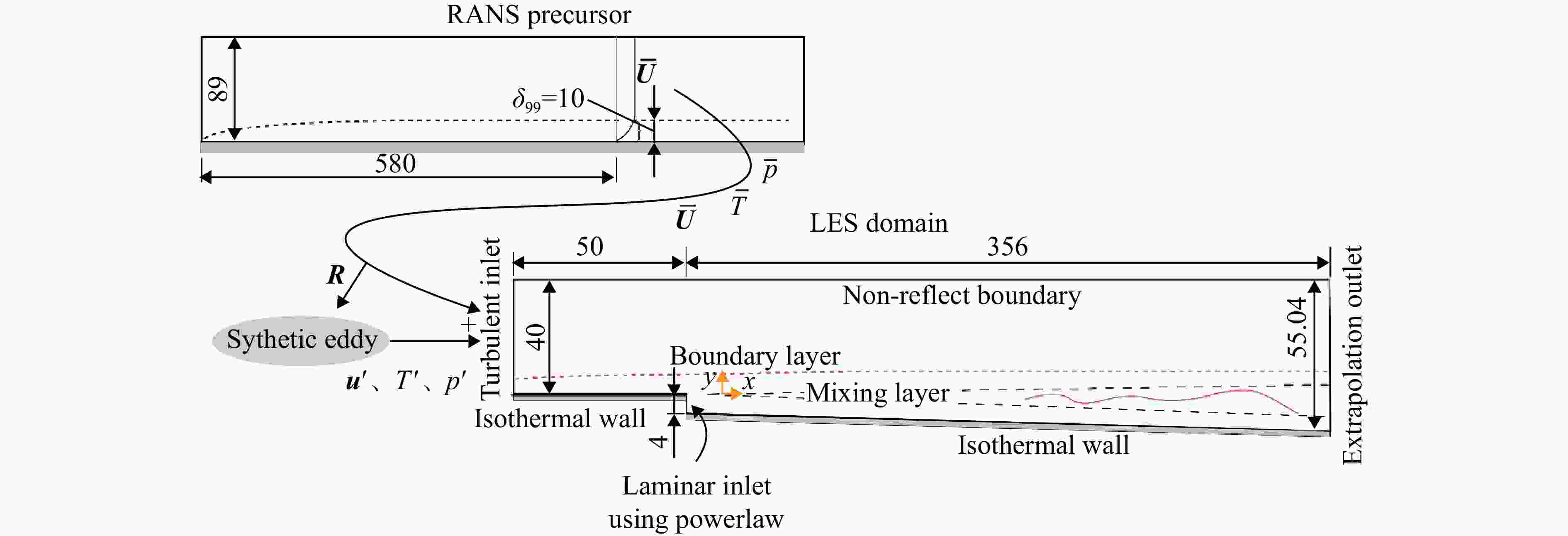
图 1 基于Burrows试验的计算域及边界条件示意图(单位:mm)
Figure 1. Computational domain and boundary condition of Burrows experiment (unit:mm)
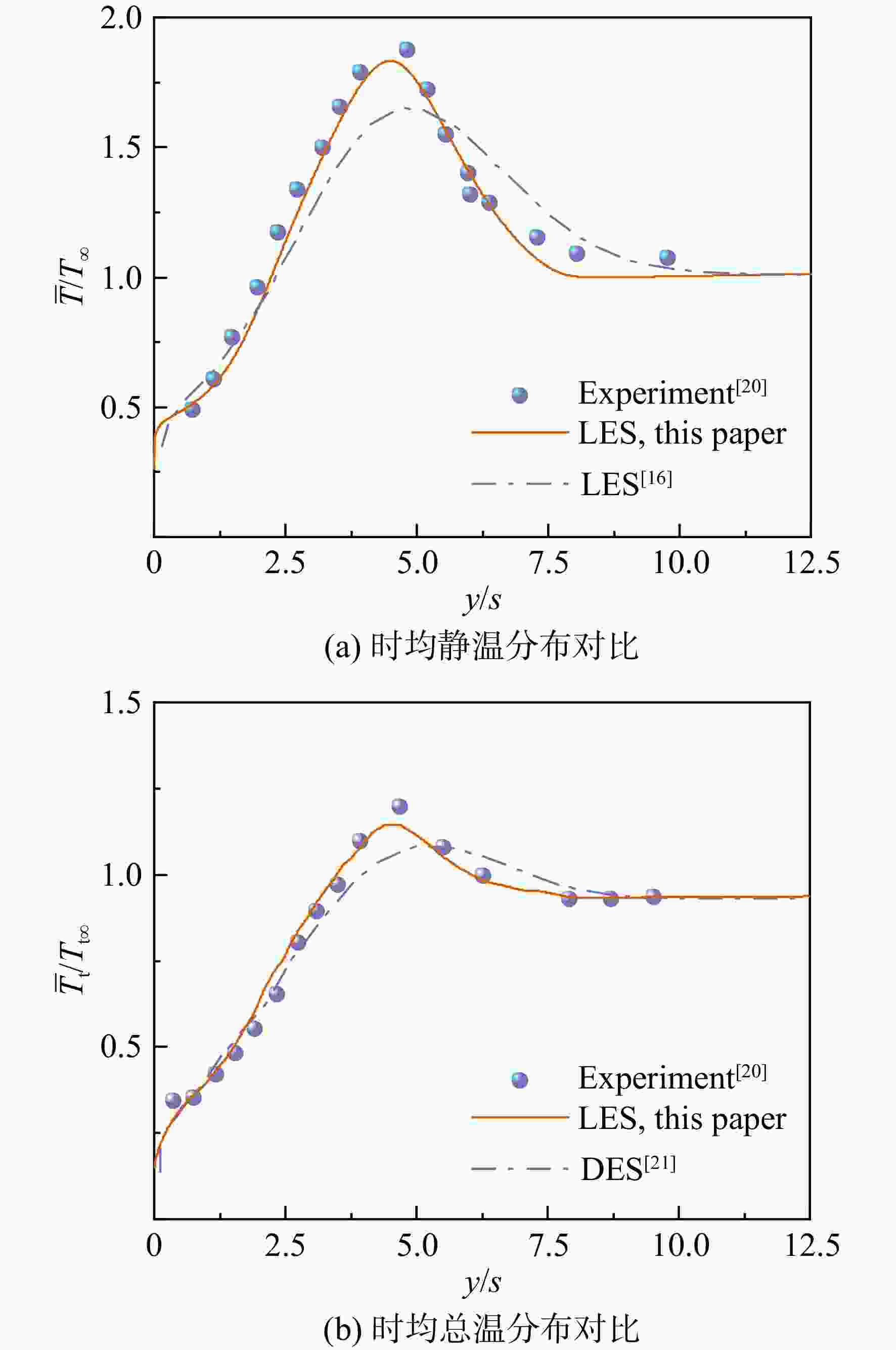
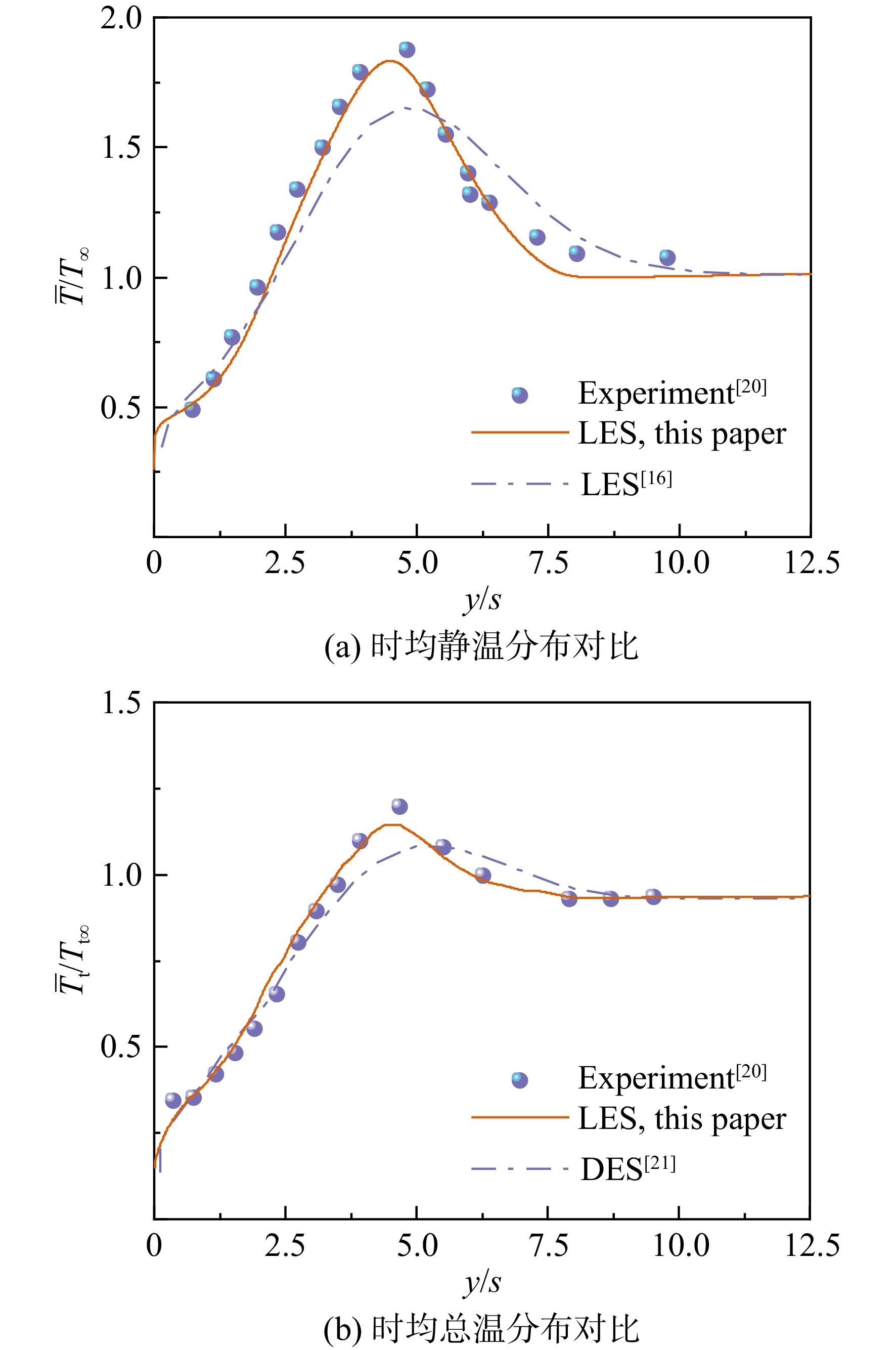
图 3 Burrows算例燃烧算例出口处时均静温和总温的试验与数值结果对比
Figure 3. Comparison of time-averaged static temperature and total temperature at outlet between numerical and experimental results of Burrows case
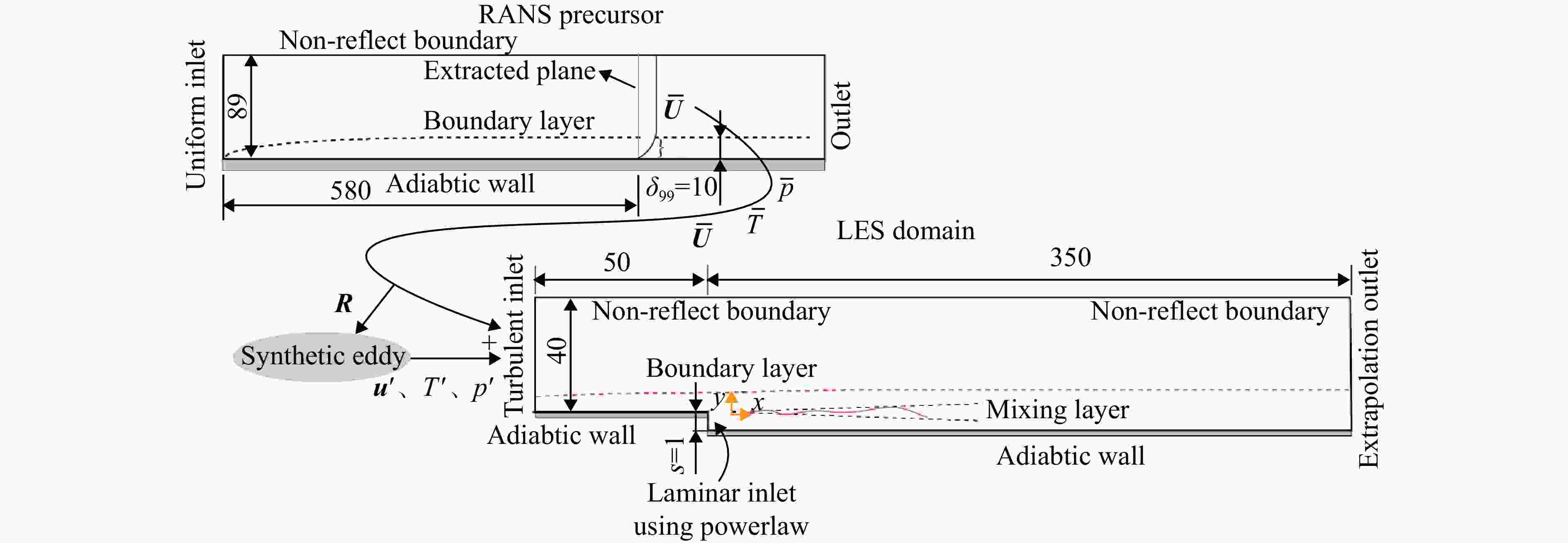
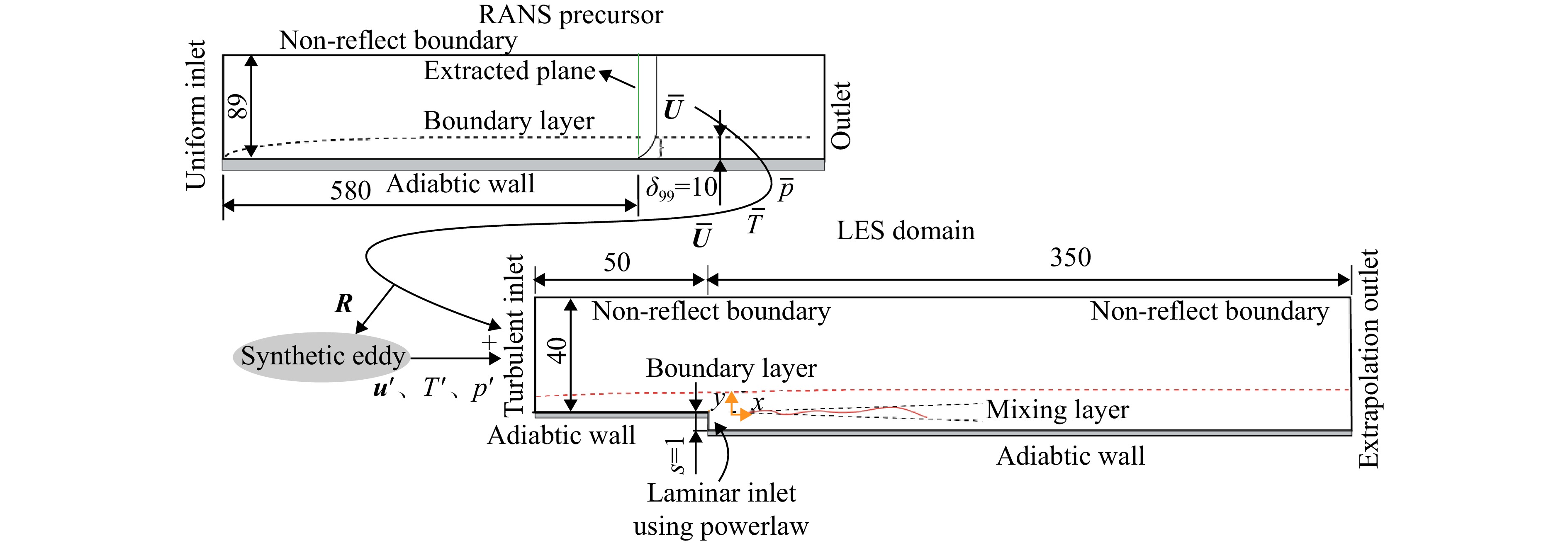
图 4 燃料气膜冷却计算域及边界条件示意图(单位:mm)
Figure 4. Computational domain and boundary conditions of fuel film cooling (unit:mm)
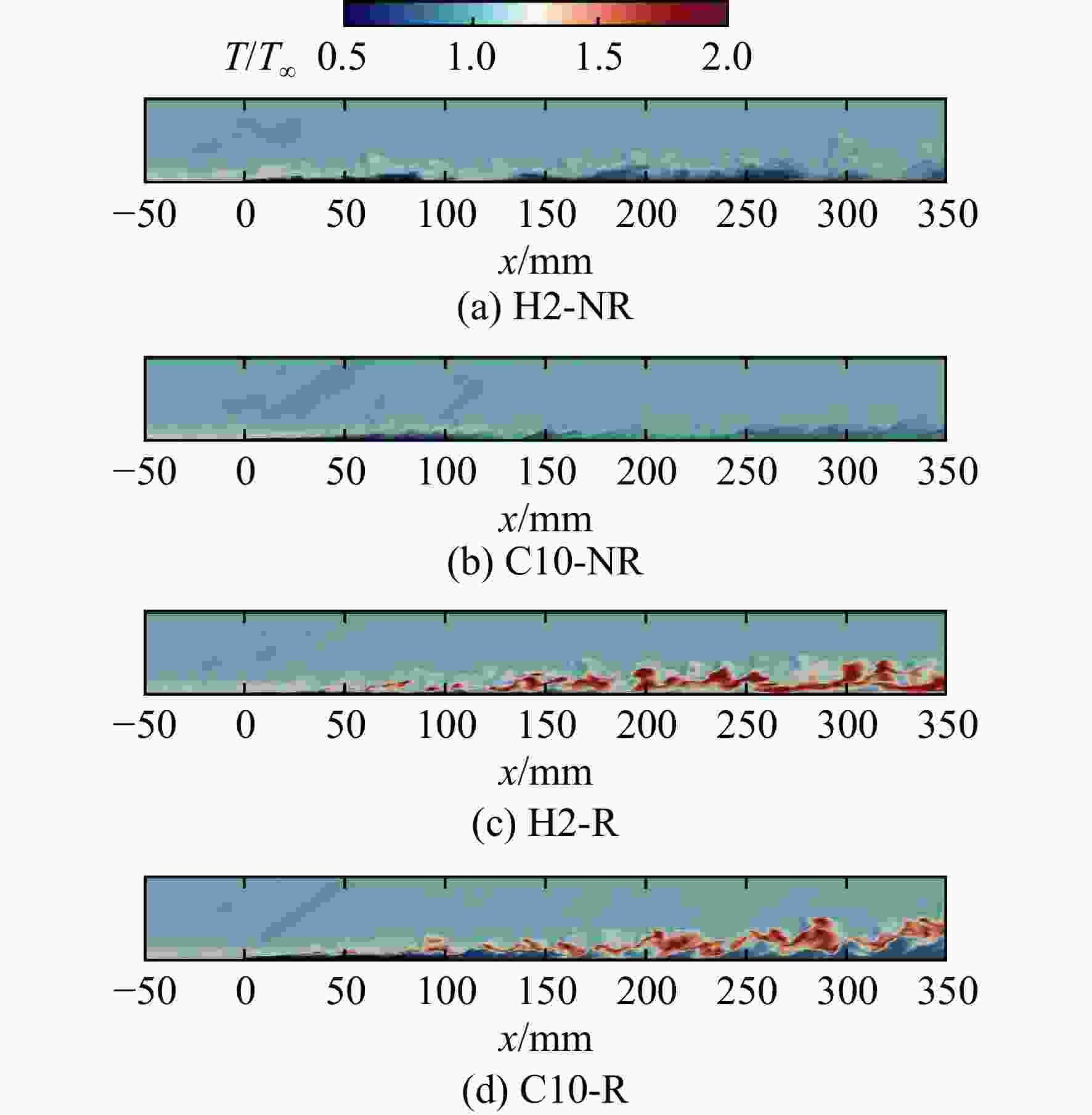
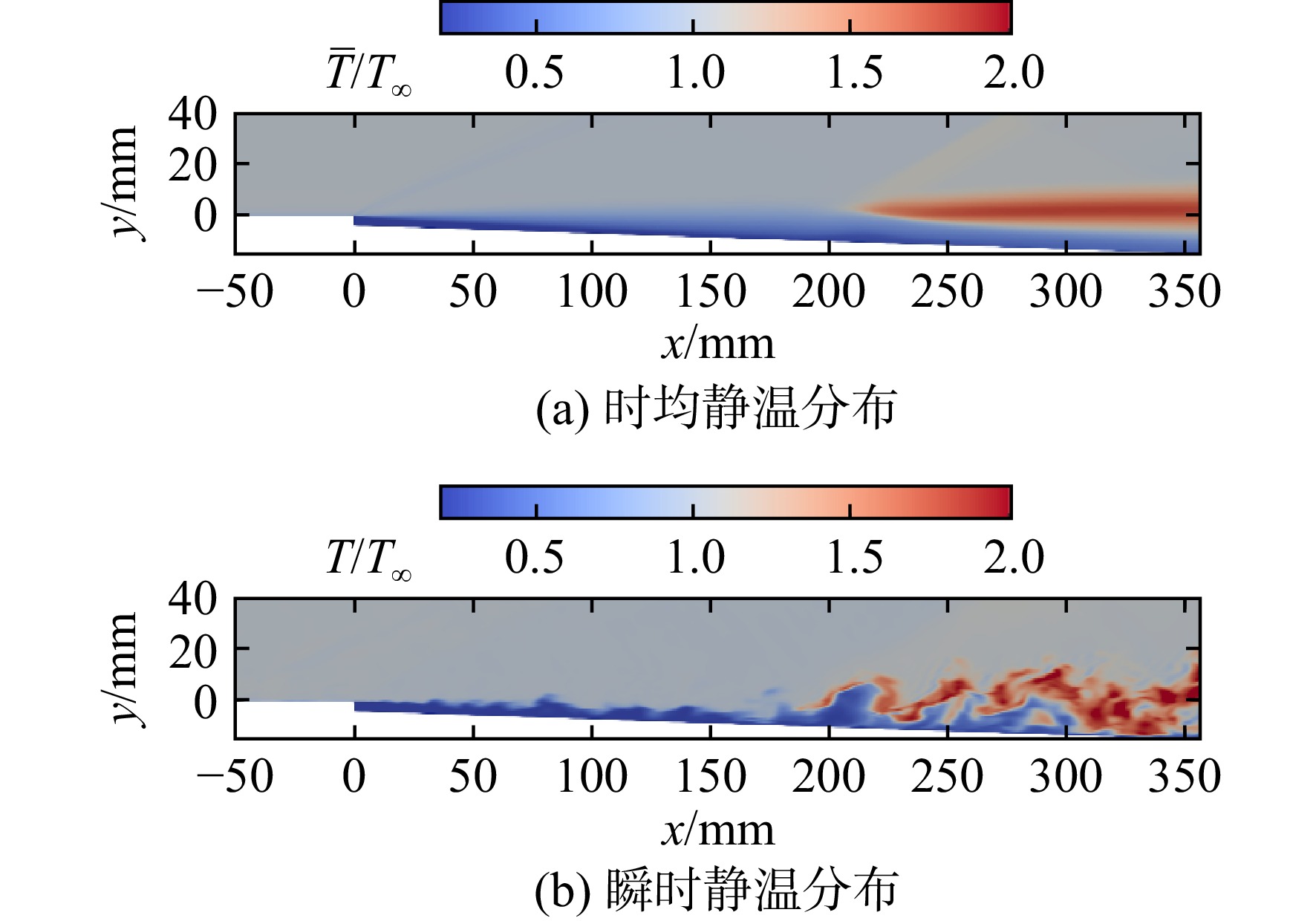
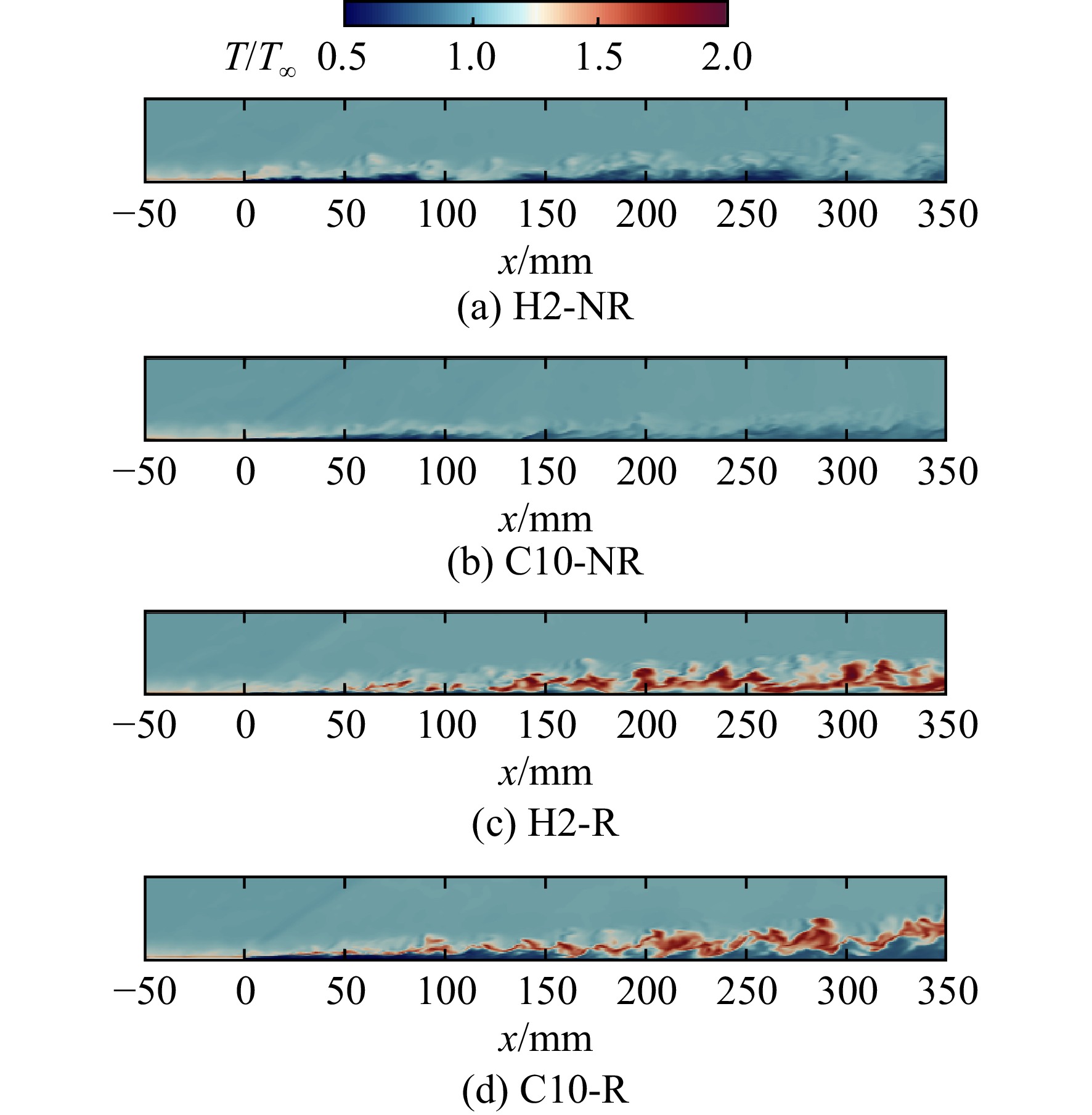
图 5 燃料气膜纵切面处瞬时温度场分布(${\textit{z}} = 0$ mm)
Figure 5. Instantaneous temperature fields of fuel film at middle slice (${\textit{z}} = 0$ mm)
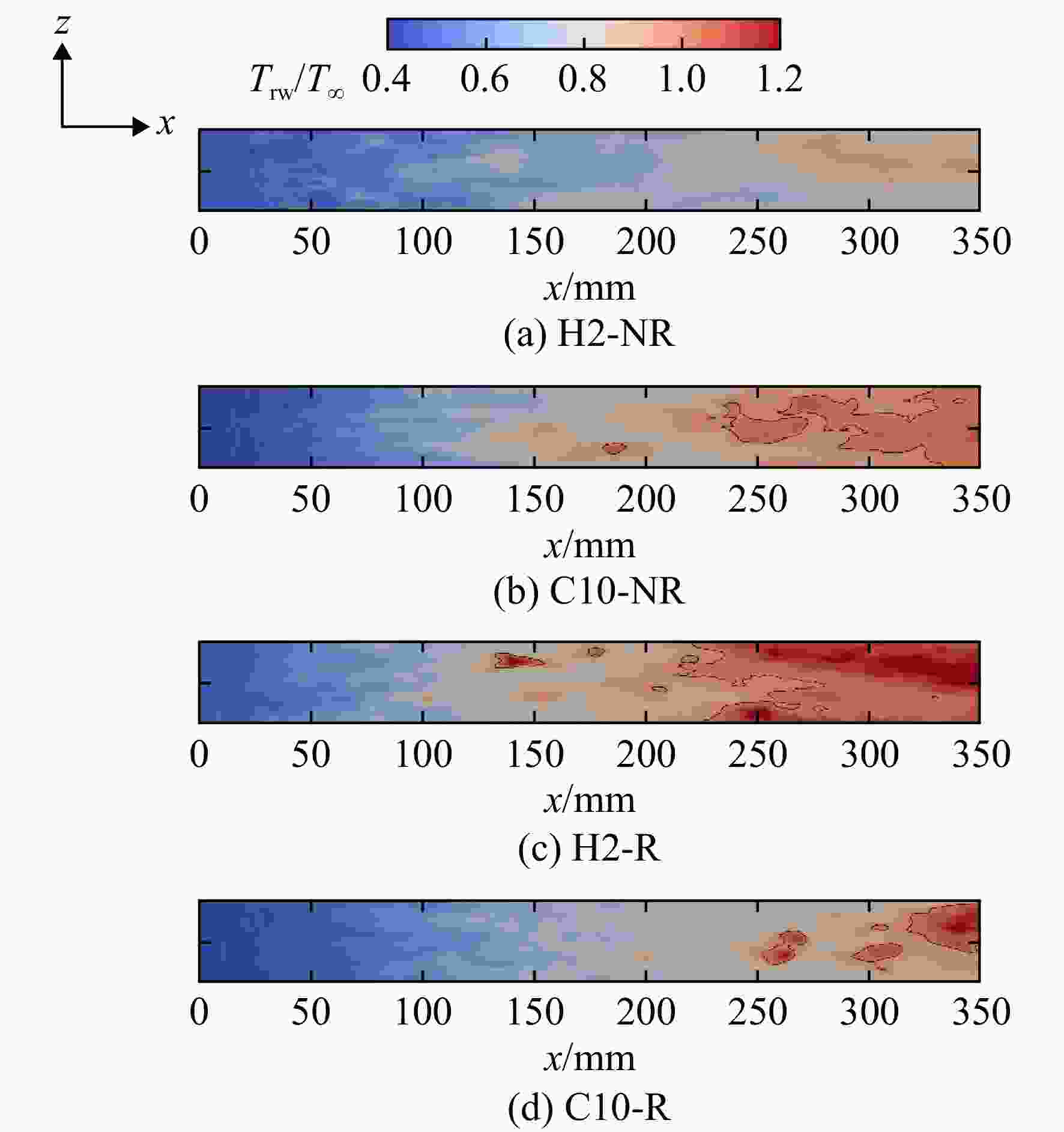
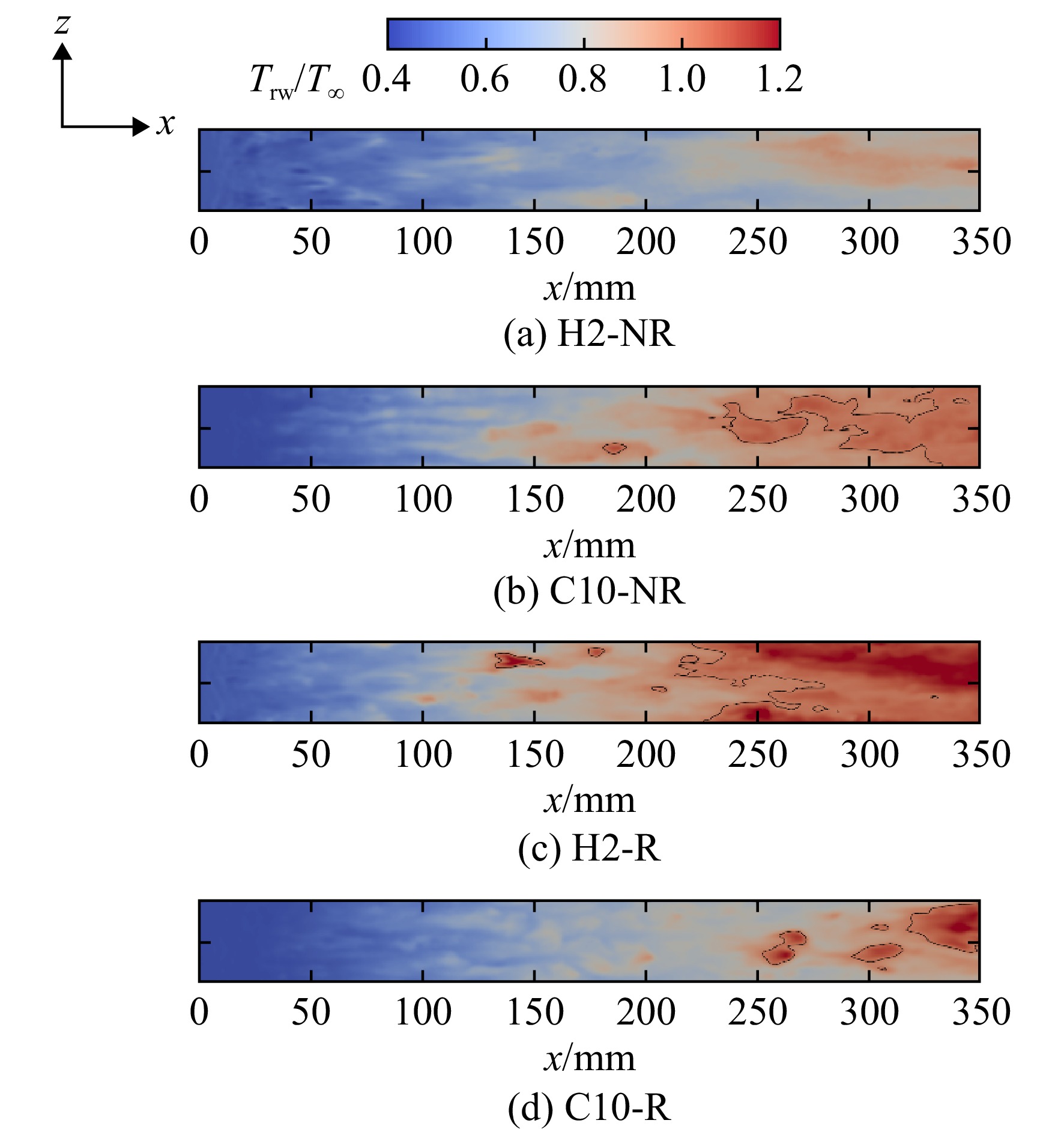
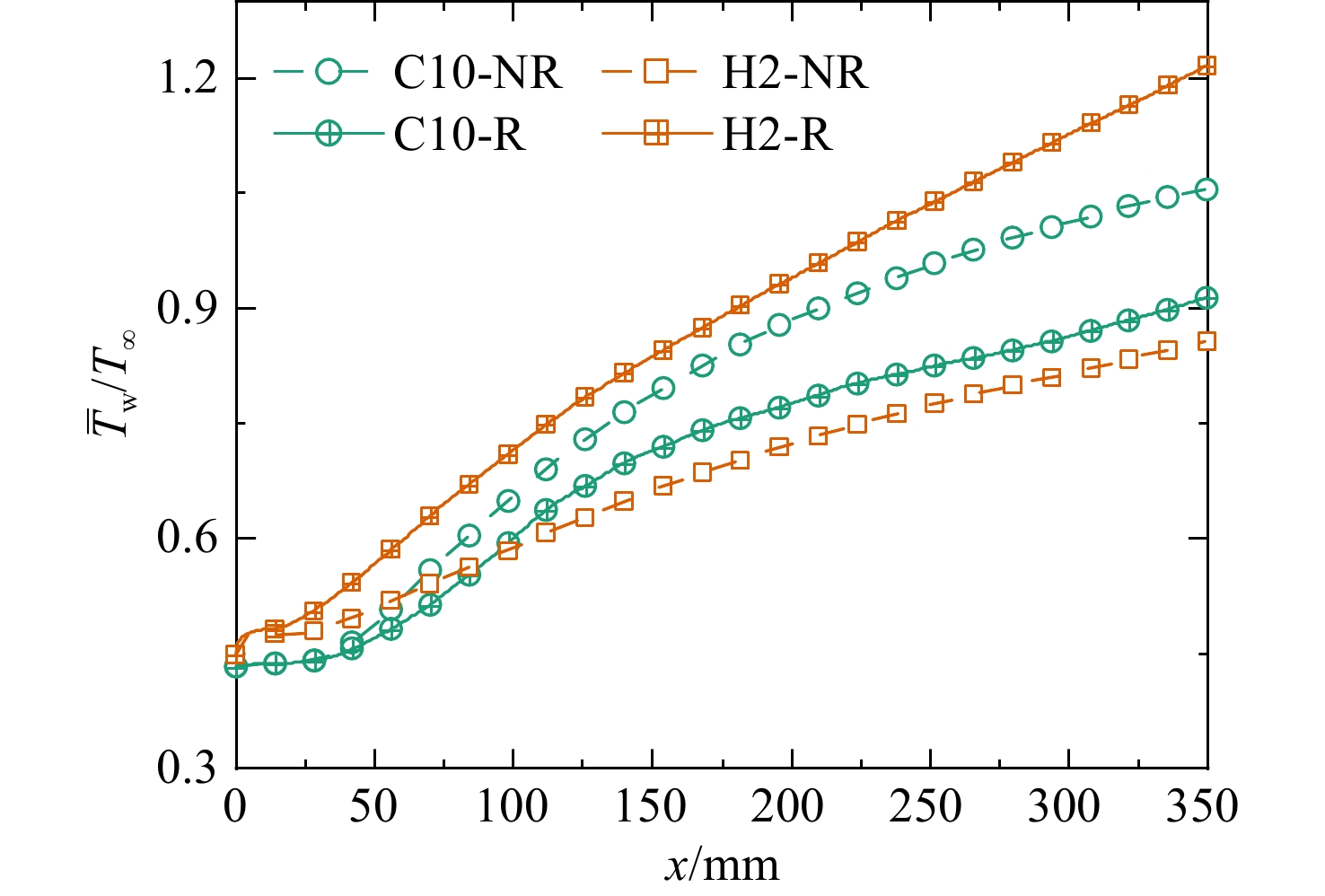
图 6 燃料气膜冷却壁面上瞬时恢复温度分布
Figure 6. Instantaneous recovery temperature of fuel film at the cooling wall
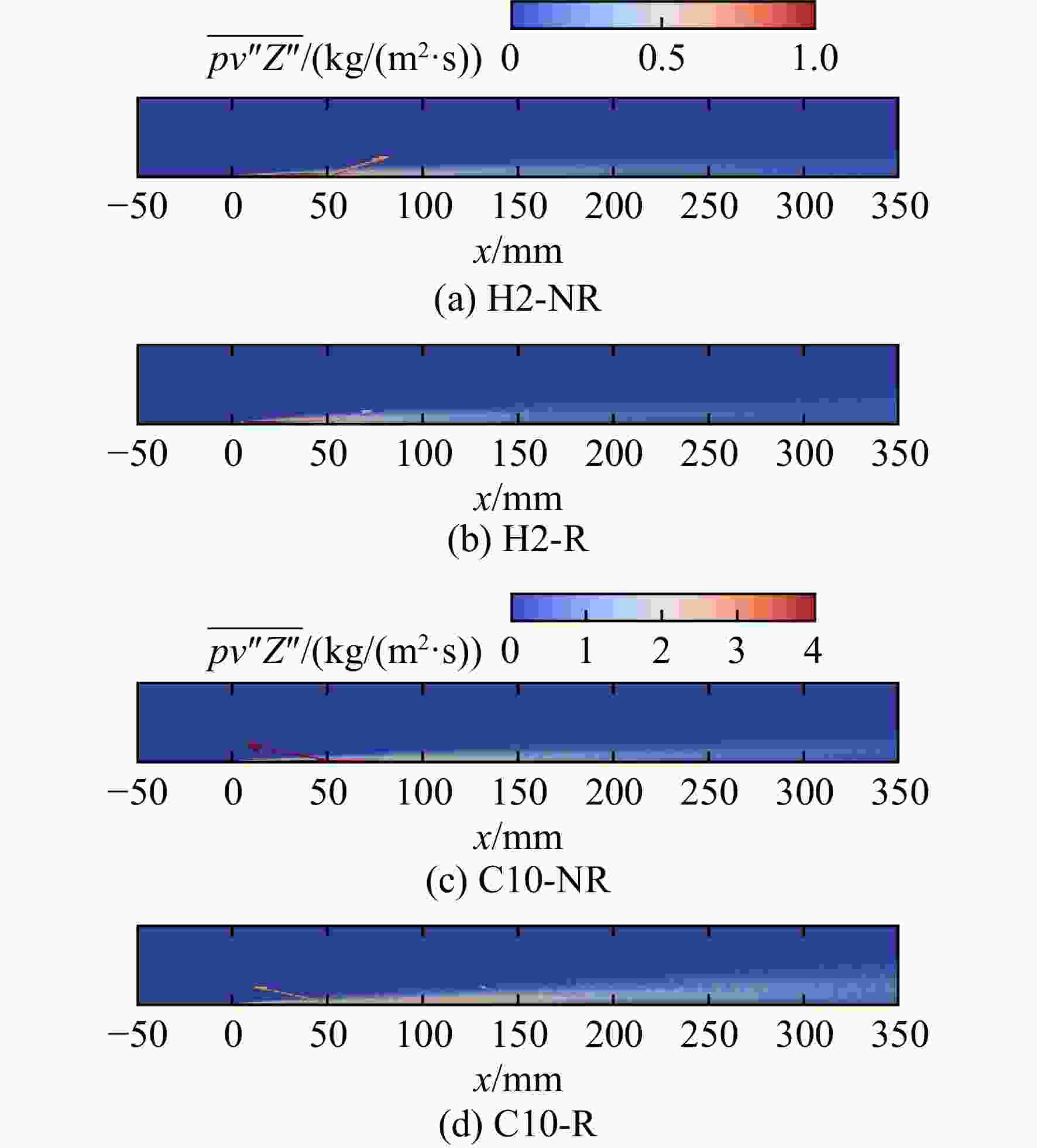
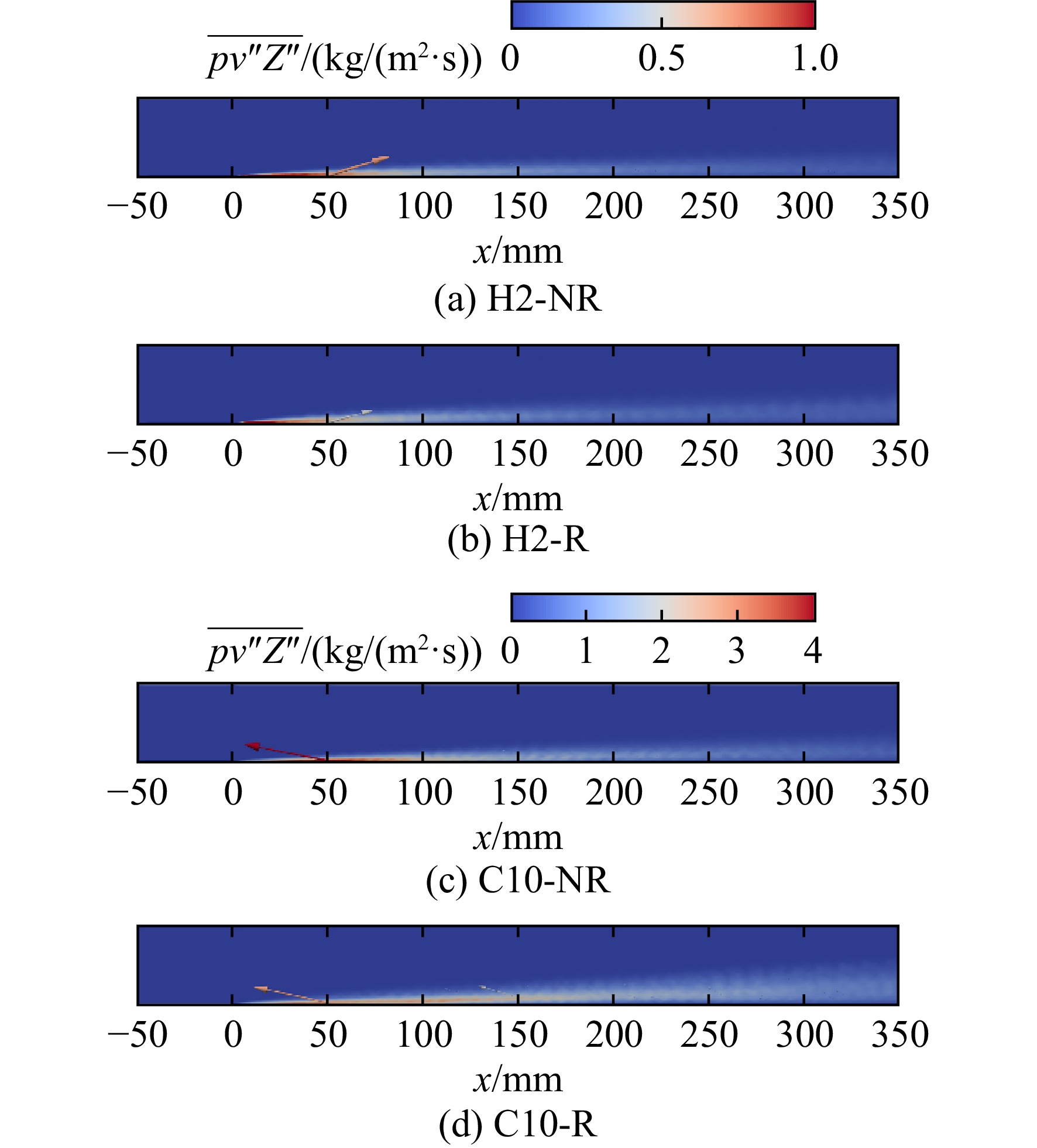
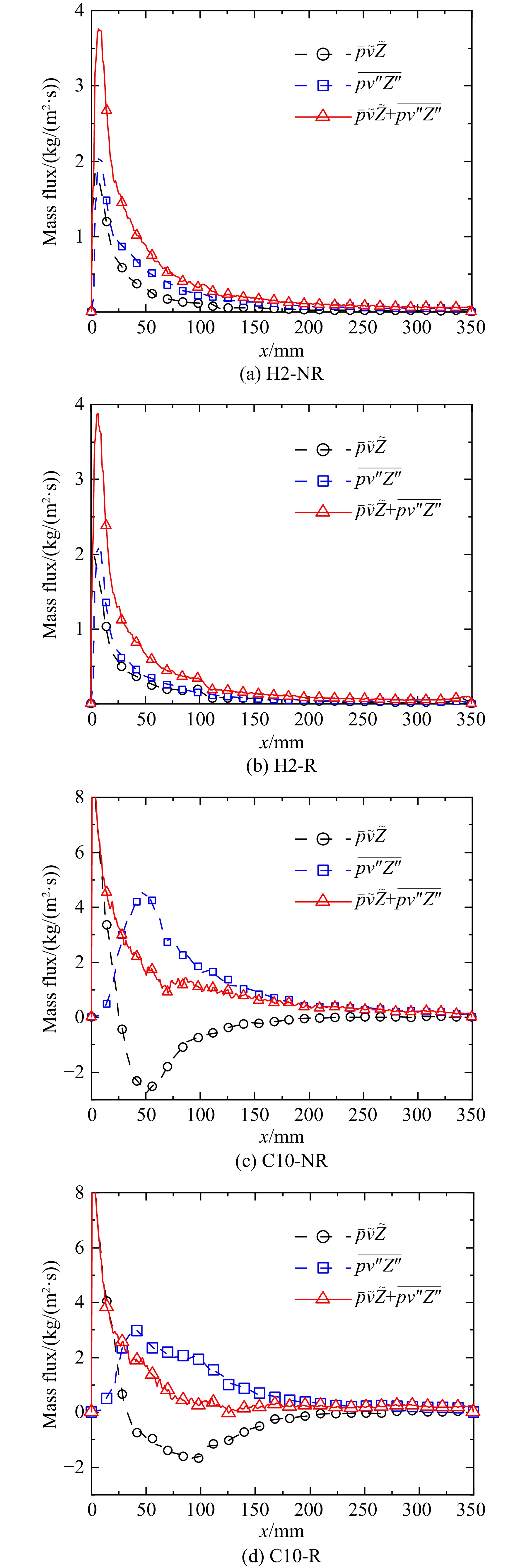
图 7 燃料气膜纵切面处湍流质量通量分布(${\textit{z}} = 0$ mm)
Figure 7. Turbulent mass flux of fuel film at the middle slice (${\textit{z}} = 0$ mm)
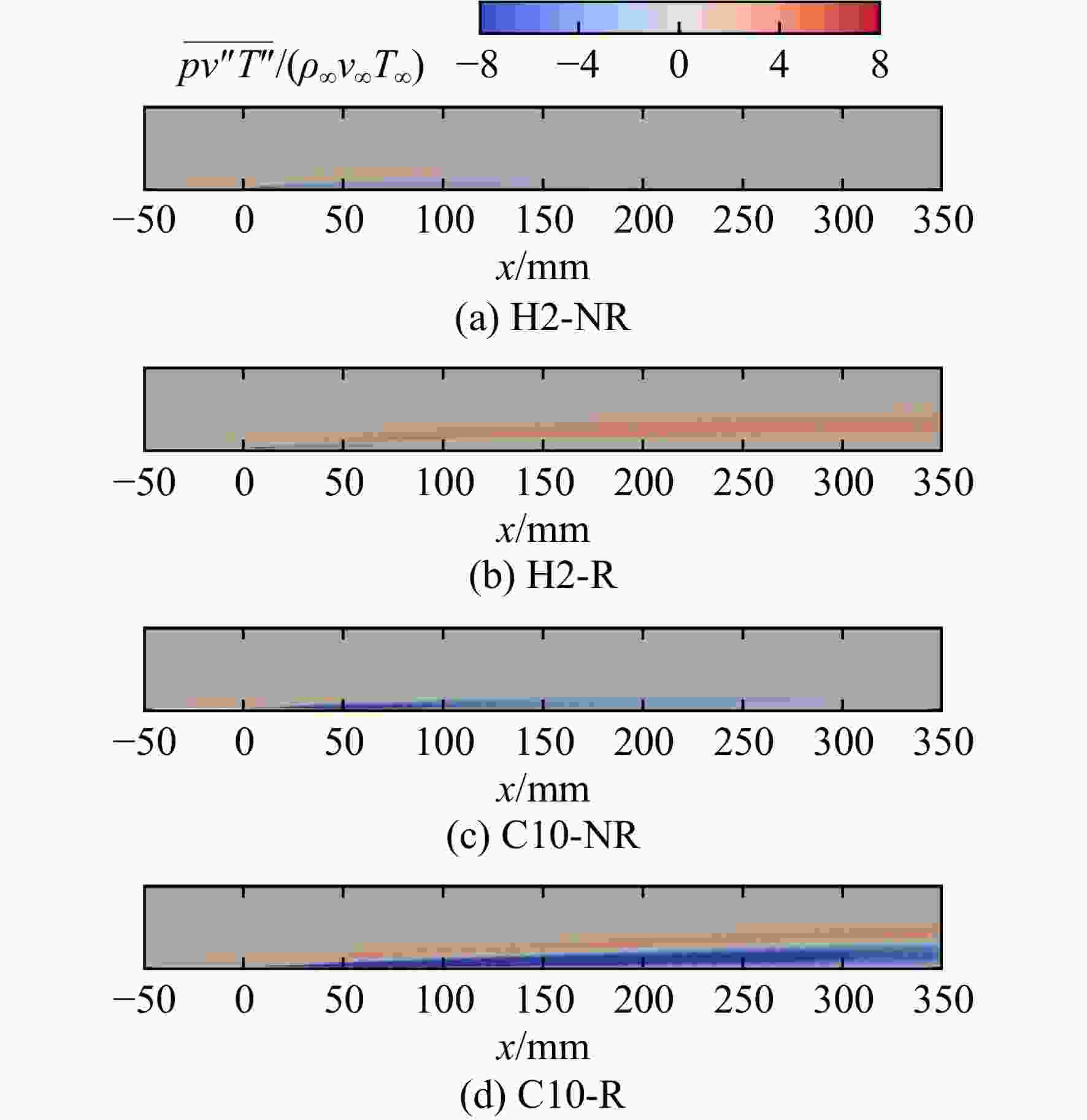
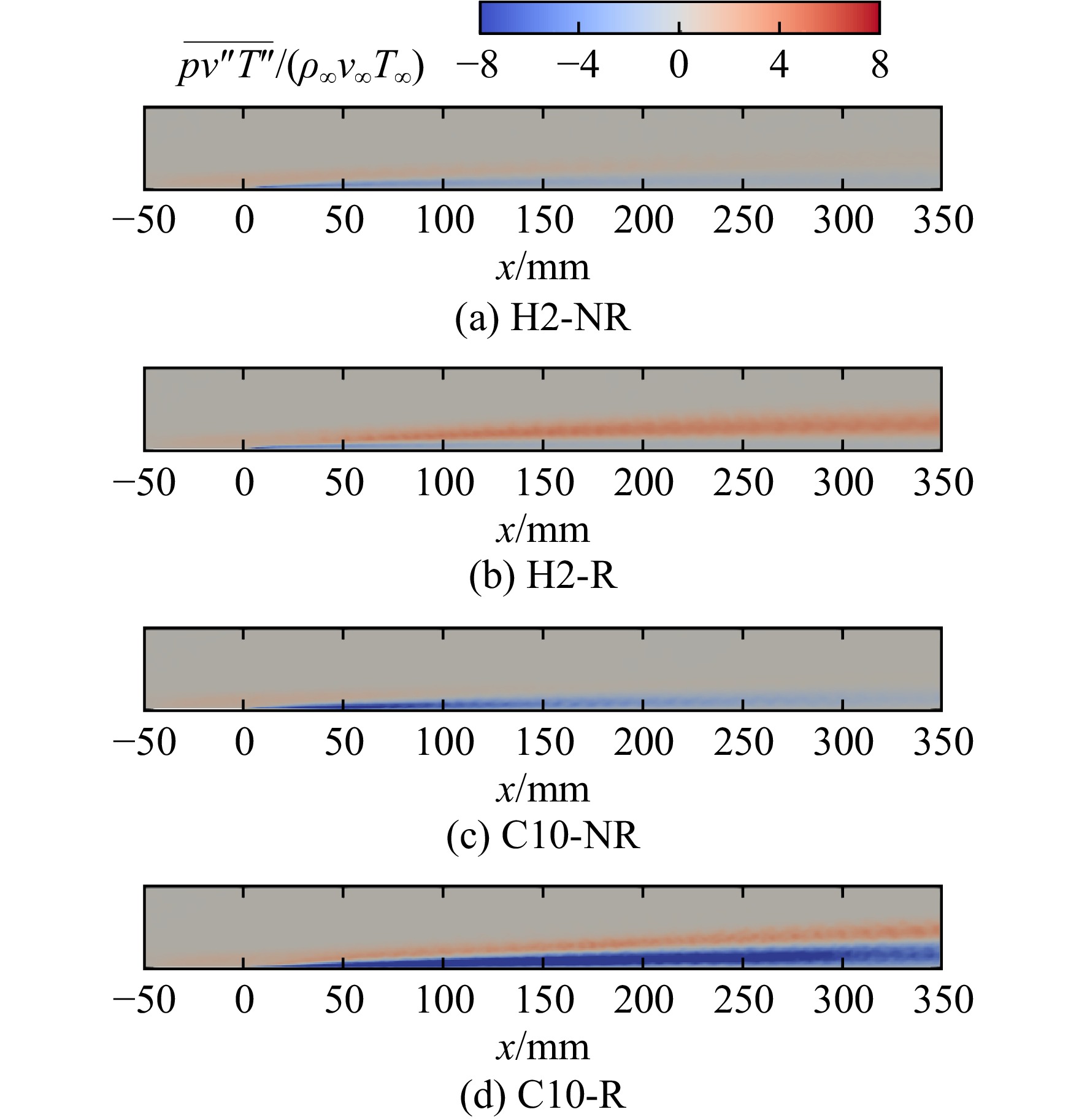
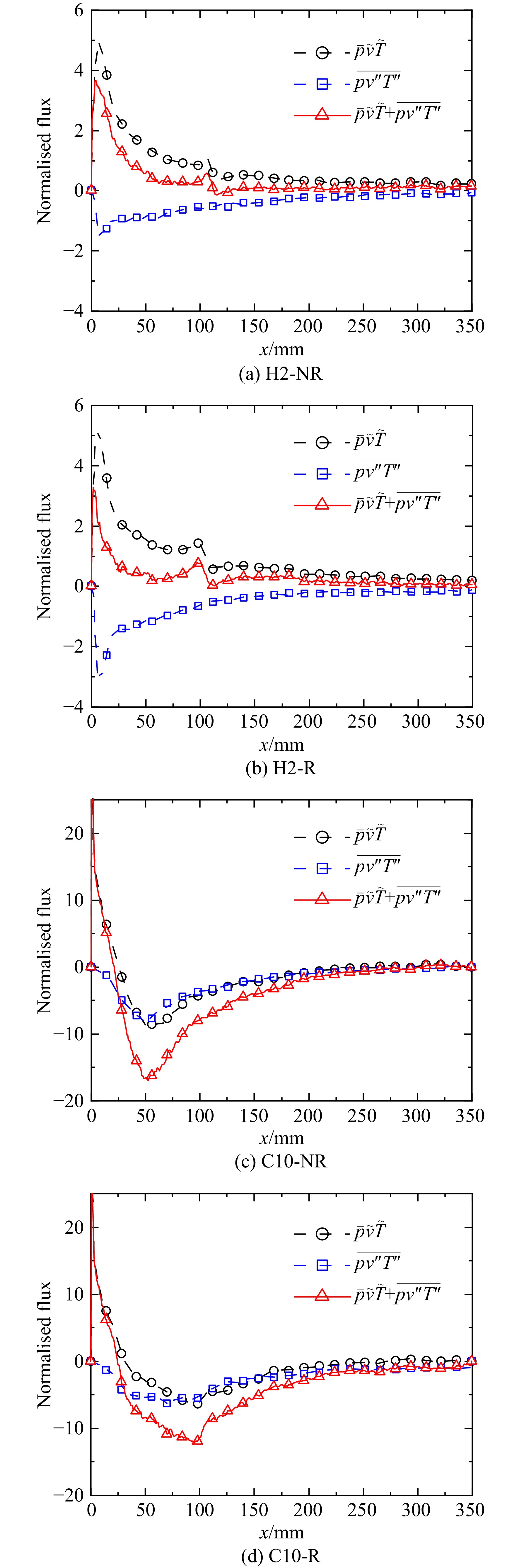
图 9 燃料气膜纵切面(${\textit{z}} = 0$ mm)处湍流热流通量分布
Figure 9. Turbulent heat flux of fuel film at the middle slice(${\textit{z}} = 0$ mm)
表 1 Burrows试验的主流和气膜入口条件
Table 1. Inlet conditions of mainstream and film for Burrows experiment
参数 $p$/MPa $T$/K $U$/(m/s) Ma $ {w_{{{\text{H}}_{\text{2}}}{\text{O}}}} $ ${w_{{{\text{O}}_{\text{2}}}}}$ ${w_{{{\text{H}}_{\text{2}}}}}$ ${w_{{{\text{N}}_{\text{2}}}}}$ 主流入口 0.1 1240 1784 2.44 0.256 0.258 0 0.486 气膜入口 0.1 254 1216 1 0 0 1 0  下载: 导出CSV
表 2 主流和燃料气膜名义入口条件
Table 2. Nominal inlet conditions of mainstream and fuel films
入口边界 $p$/MPa $T$/K $U$/(m/s) Ma ${w_{{{\mathrm{H}}_{\text{2}}}}}$ ${w_{{{\text{C}}_{{\text{10}}}}{{\text{H}}_{{\text{22}}}}}}$ ${w_{{{\text{O}}_{\text{2}}}}}$ ${w_{{{\text{N}}_{\text{2}}}}}$ 主流入口 0.16 1623 1374 1.75 0 0 0.23 0.77 氢气膜入口 0.16 700 2006 1 1 0 0 0 碳氢燃料气膜入口 0.16 700 200 1 0 1 0 0
下载: 导出CSV
表 3 算例设置
Table 3. Cases setup
算例 燃料 反应 标签 1 C10H22 关 C10-NR 2 C10H22 开 C10-R 3 H2 关 H2-NR 4 H2 开 H2-R
下载: 导出CSV
-
[1] 张灿, 王轶鹏, 叶蕾. 国外近十年高超声速飞行器技术发展综述[J]. 战术导弹技术, 2020(6): 81-86. ZHANG Can, WANG Yipeng, YE Lei. Summary of the technological development of overseas hypersonics in the past ten years[J]. Tactical Missile Technology, 2020(6): 81-86. (in ChineseZHANG Can, WANG Yipeng, YE Lei. Summary of the technological development of overseas hypersonics in the past ten years[J]. Tactical Missile Technology, 2020(6): 81-86. (in Chinese) [2] KARIMI M S, OBOODI M J. Investigation and recent developments in aerodynamic heating and drag reduction for hypersonic flows[J]. Heat and Mass Transfer, 2019, 55(2): 547-569. doi: 10.1007/s00231-018-2416-1 [3] UYANNA O, NAJAFI H. Thermal protection systems for space vehicles: a review on technology development, current challenges and future prospects[J]. Acta Astronautica, 2020, 176: 341-356. doi: 10.1016/j.actaastro.2020.06.047 [4] ZHANG Silong, LI Xin, ZUO Jingying, et al. Research progress on active thermal protection for hypersonic vehicles[J]. Progress in Aerospace Sciences, 2020, 119: 100646. doi: 10.1016/j.paerosci.2020.100646 [5] 孙冰, 王太平, 张佳. 离散孔结构超声速气膜冷却数值模拟[J]. 航空动力学报, 2017, 32(12): 2927-2933. SUN Bin, WANG Taiping, ZHANG Jia. Numerical simulation of discrete holes supersonic gaseous film cooling[J]. Journal of Aerospace Power, 2017, 32(12): 2927-2933. (in ChineseSUN Bin, WANG Taiping, ZHANG Jia. Numerical simulation of discrete holes supersonic gaseous film cooling[J]. Journal of Aerospace Power, 2017, 32(12): 2927-2933. (in Chinese) [6] 孙冰, 王太平, 张佳. 离散孔结构超声速气膜冷却数值模拟[J]. 航空动力学报, 2017, 32(12): 2927-2933. SUN Bin, WANG Taiping, ZHANG Jia. Numerical simulation of discrete holes supersonic gaseous film cooling[J]. Journal of Aerospace Power, 2017, 32(12): 2927-2933. (in ChineseSUN Bin, WANG Taiping, ZHANG Jia. Numerical simulation of discrete holes supersonic gaseous film cooling[J]. Journal of Aerospace Power, 2017, 32(12): 2927-2933. (in Chinese) [7] 商圣飞, 向树红, 姜利祥, 等. 不同孔型对高超声速逆喷流气膜冷却影响[J]. 航空动力学报, 2020, 35(8): 1612-1621. SHANG Shengfei , XIANG Shuhong , JIANG Lixiang, et al. Effect of different hole shapes on hypersonic counter-jet film cooling[J]. Journal of Aerospace Power, 2020, 35(8): 1612-1621. (in ChineseSHANG Shengfei , XIANG Shuhong , JIANG Lixiang, et al. Effect of different hole shapes on hypersonic counter-jet film cooling[J]. Journal of Aerospace Power, 2020, 35(8): 1612-1621. (in Chinese) [8] CHOUBEY G, YUVARAJAN D, HUANG Wei, et al. Hydrogen fuel in scramjet engines-a brief review[J]. International Journal of Hydrogen Energy, 2020, 45(33): 16799-16815. doi: 10.1016/j.ijhydene.2020.04.086 [9] WANG Youyin, CHENG Kunlin, TANG Jingfeng, et al. Analysis of the maximum flight Mach number of hydrocarbon-fueled scramjet engines under the flight cruising constraint and the combustor cooling requirement[J]. Aerospace Science and Technology, 2020, 98: 105594. doi: 10.1016/j.ast.2019.105594 [10] BERTIN J J, CUMMINGS R M. Critical hypersonic aerothermodynamic phenomena[J]. Annual Review of Fluid Mechanics, 2006, 38(1): 129-157. doi: 10.1146/annurev.fluid.38.050304.092041 [11] PUDSEY A S, WHEATLEY V, BOYCE R R. Supersonic boundary-layer combustion via multiporthole injector arrays[J]. AIAA Journal, 2015, 53(10): 2890-2906. doi: 10.2514/1.J053817 [12] ZHANG Pu, XU Jinglei, YU Yang, et al. Effect of adverse pressure gradient on supersonic compressible boundary layer combustion[J]. Aerospace Science and Technology, 2019, 88: 380-394. doi: 10.1016/j.ast.2019.03.013 [13] ZHANG Pu, XU Jinglei, CUI Wei. Numerical study of supersonic turbulent boundary layer combustion with pressure gradient[J]. Aerospace Science and Technology, 2020, 107: 106246. doi: 10.1016/j.ast.2020.106246 [14] XUE Rui, ZHENG Xing, YUE Lianjie, et al. Numerical study on supersonic boundary-layer transition and wall skin friction reduction induced by fuel wall-jet combustion[J]. Acta Astronautica, 2020, 174: 11-23. doi: 10.1016/j.actaastro.2020.04.031 [15] XUI Rui, ZHENG Xing, YUE Lianjie, et al. Study of shock train/flame interaction and skin-friction reduction by hydrogen combustion in compressible boundary layer[J]. International Journal of Hydrogen Energy, 2020, 45(31): 15683-15696. doi: 10.1016/j.ijhydene.2020.04.027 [16] LIU Hongpeng, GAO Zhenxun, JIANG Chongwen, et al. Studies of combustion effects on near-wall turbulence in supersonic flows by large eddy simulation[J]. Aerospace Science and Technology, 2020, 107: 106328. doi: 10.1016/j.ast.2020.106328 [17] 左婧滢. 超燃冲压发动机碳氢燃料气膜的冷却和减阻特性研究[D]. 哈尔滨: 哈尔滨工业大学, 2021. ZUO Jingying. Study on cooling and drag reduction characteristics of hydrocarbon fuel film in scramjet[D]. Harbin: Harbin Institute of Technology, 2021. (in ChineseZUO Jingying. Study on cooling and drag reduction characteristics of hydrocarbon fuel film in scramjet[D]. Harbin: Harbin Institute of Technology, 2021. (in Chinese) [18] ZUO Jingying, ZHANG Silong, WEI Jianfei, et al. Effects of inflow parameters on thermal protection and drag reduction characteristics for hydrocarbon fueled supersonic film with combustion[J]. Case Studies in Thermal Engineering, 2023, 43: 102822. doi: 10.1016/j.csite.2023.102822 [19] WEI Jianfei, ZHANG Silong, ZUO Jingying, et al. Effects of combustion on the near-wall turbulence and performance for supersonic hydrogen film cooling using large eddy simulation[J]. Physics of Fluids, 2023, 35(3): 035112. doi: 10.1063/5.0139355 [20] BURROWS M C, KURKOV A P. An analytical and experimental study of supersonic combustion of hydrogen in vitiated air stream[J]. AIAA Journal, 1973, 11(9): 1217-1218. doi: 10.2514/3.50564 [21] EDWARDS J R, BOLES J A, BAURLE R A. Large-eddy/Reynolds-averaged Navier-Stokes simulation of a supersonic reacting wall jet[J]. Combustion and Flame, 2012, 159(3): 1127-1138. doi: 10.1016/j.combustflame.2011.10.009 -

 点击查看大图

计量
- 文章访问数: 512
- HTML浏览量: 264
- PDF量: 28
- 被引次数: 0