






Research progress of water-fueled electric propulsion technology
-
摘要:
电推进技术以其高比冲、效率高和寿命长等优势,已经成为继冷气和化学推进之后的主要空间推进方式之一。以水为工质的电推进因其无毒、无污染、价格低廉的特点,逐渐引起广泛关注。本文系统总结了国内外水工质电推进技术的研究现状,根据水工质加速方式不同,将其分为电热式、电磁式和静电式三类推进方式进行总结。研究结果表明:水工质电热式推进技术在地面实验和在轨验证中取得了显著进展,已实现较高的成熟度;水工质电磁式和静电式推进技术尚处于发展阶段。水工质电推进技术的未来发展方向包括与化学推进技术的结合、多模态推进系统的设计以及在深空探测任务中的进一步应用。水作为绿色环保的推进工质,展现出其在多种推进方式中的应用潜力,有望为未来空间任务提供更加高效、灵活的推进解决方案。
Abstract:Electric propulsion, with its high specific impulse, efficiency and long lifespan, has emerged as one of the main space propulsion methods following cold gas and chemical propulsion. Water-fueled electric propulsion, thanks to its non-toxic, pollution-free and low-cost benefits, has increasingly gained attention. A comprehensive summary and evaluation of the current development status of water-fueled electric propulsion technology were conducted both domestically and internationally. Based on the method of thrust generation, it can be classified into three types: electrothermal, electromagnetic, and electrostatic. Result showed that, electrothermal propulsion achieved significant progress in ground experiments and in-orbit demonstrations, making it the most mature water-based propulsion technology. Water-based electromagnetic and electrostatic propulsion technologies are still in the developmental stage but are progressing steadily. Future advancements in water-fueled propulsion technology are expected to focus on the integration of chemical and electric propulsion systems, multimodal propulsion designs, and their application in deep space exploration. With technologies becoming more mature, water-fueled propulsion technology will develop in directions that integrate chemical and electric propulsions.
-
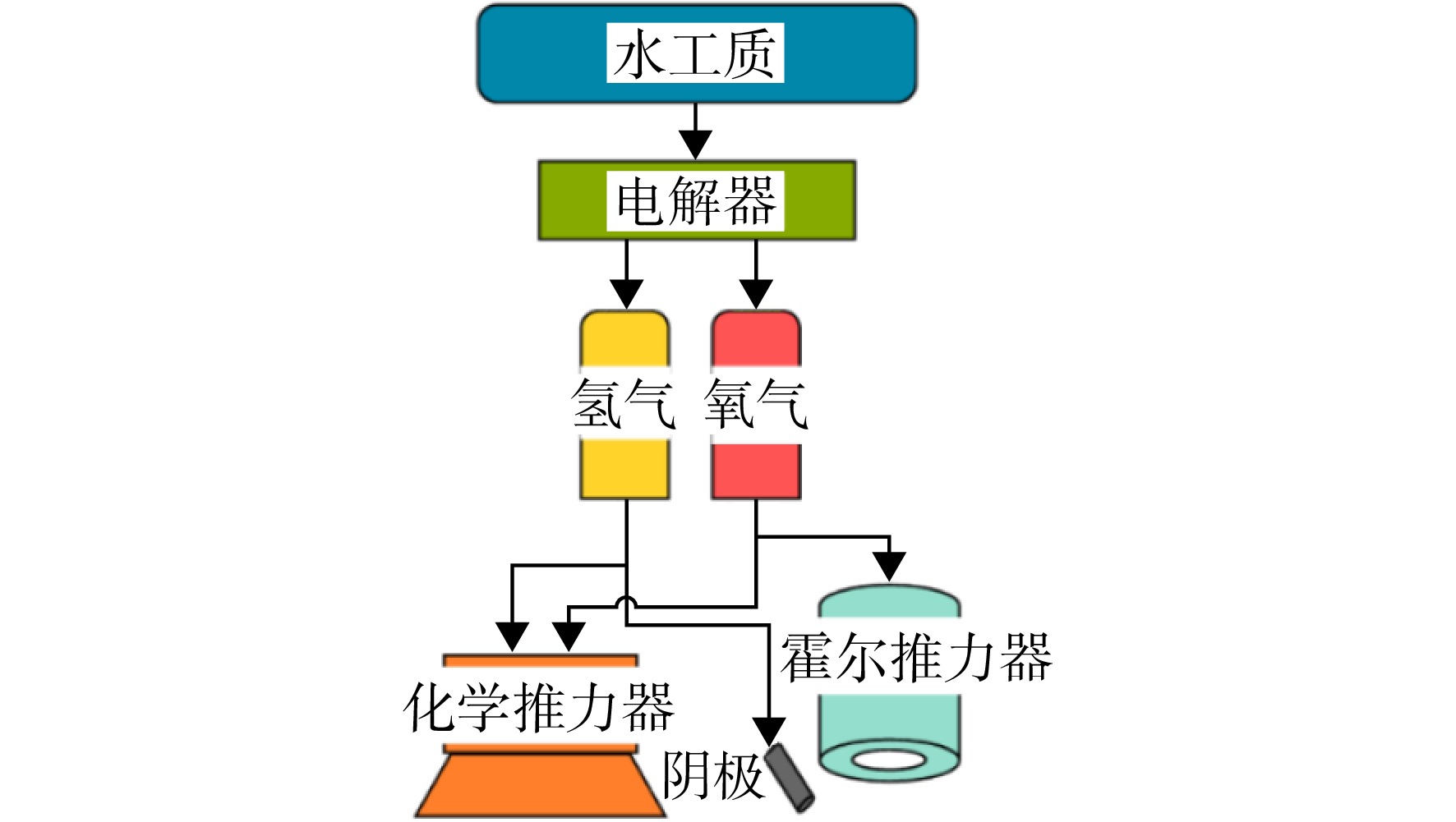
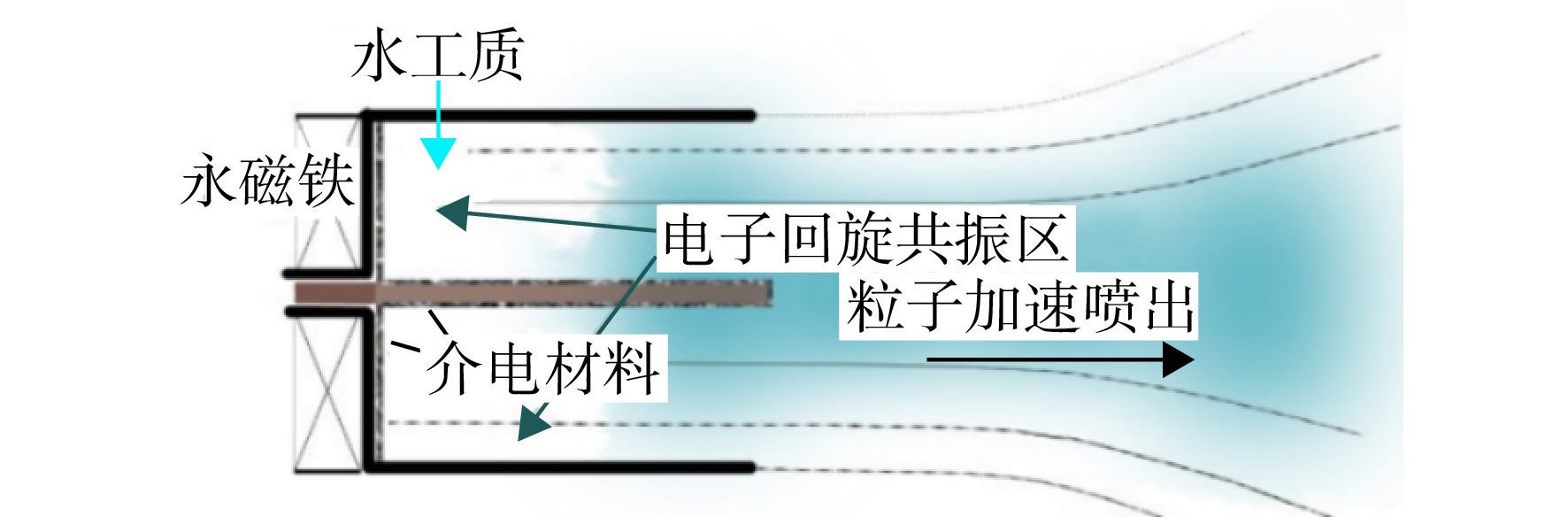
图 17 水工质霍尔推力器(多模态)原理图
Figure 17. Schematic of HET architecture with water propellant(multi-modal)
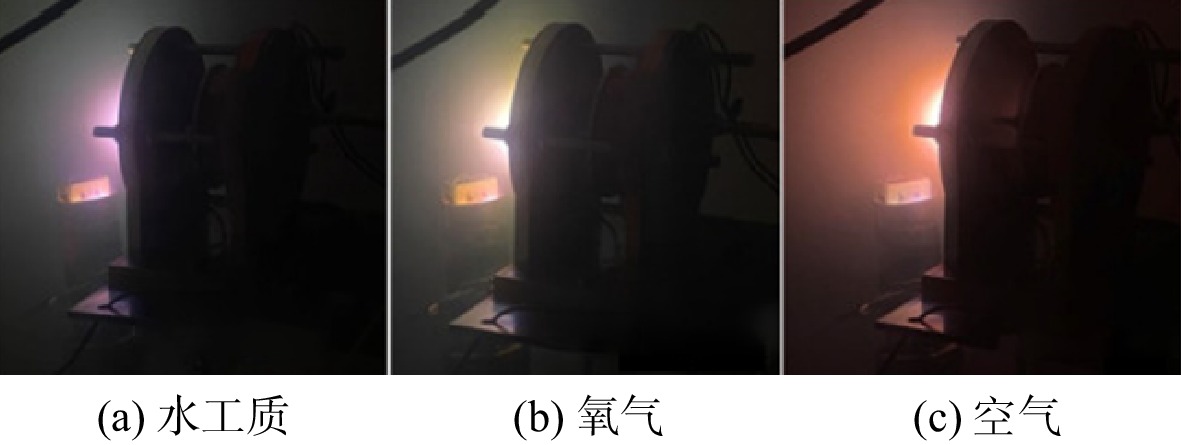
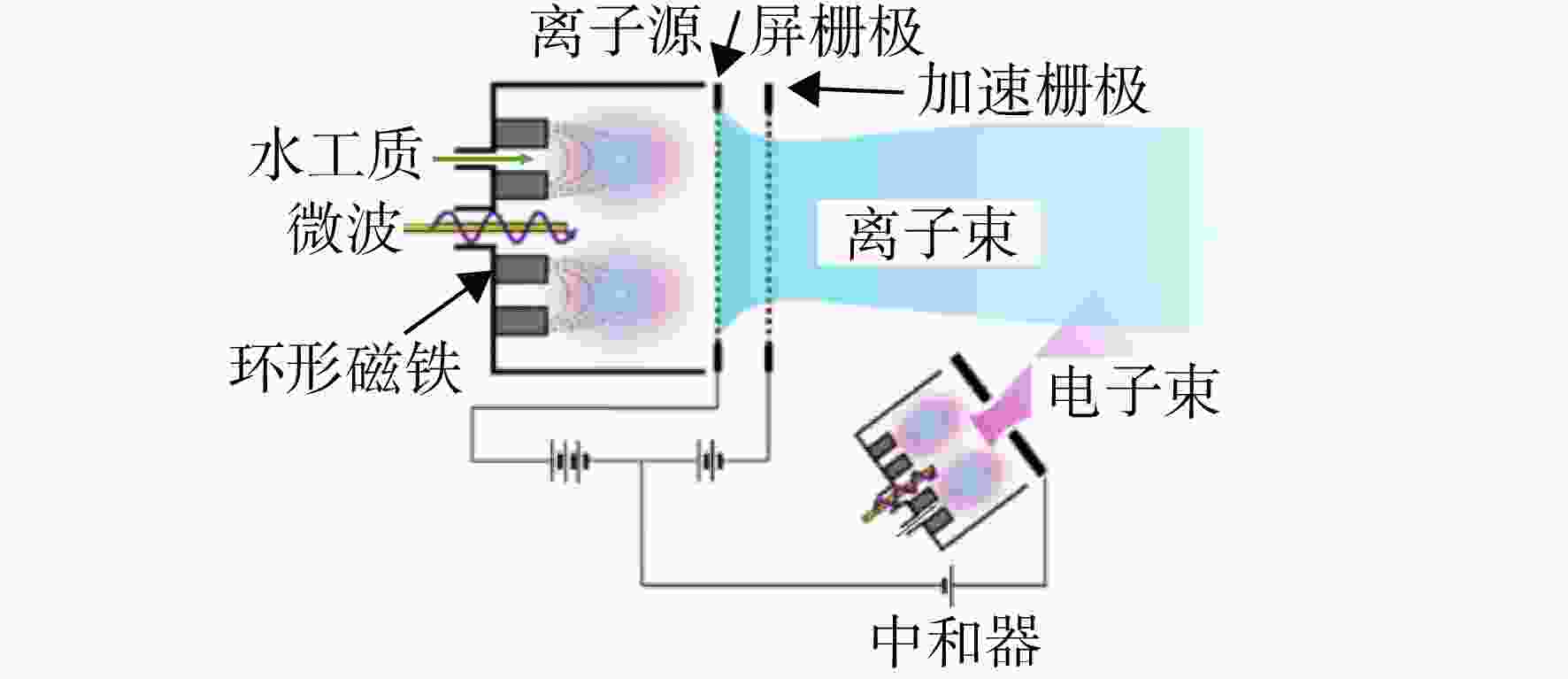
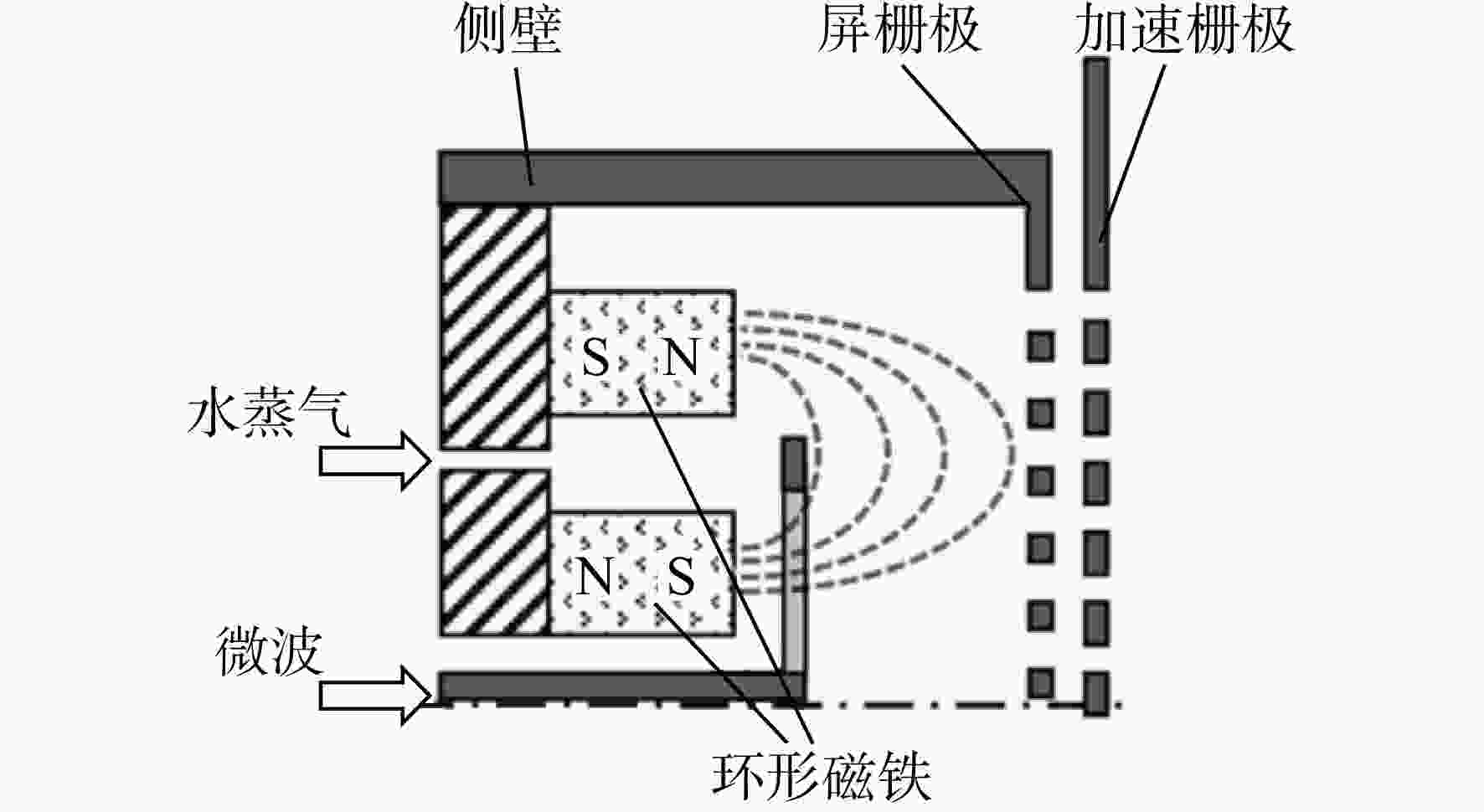
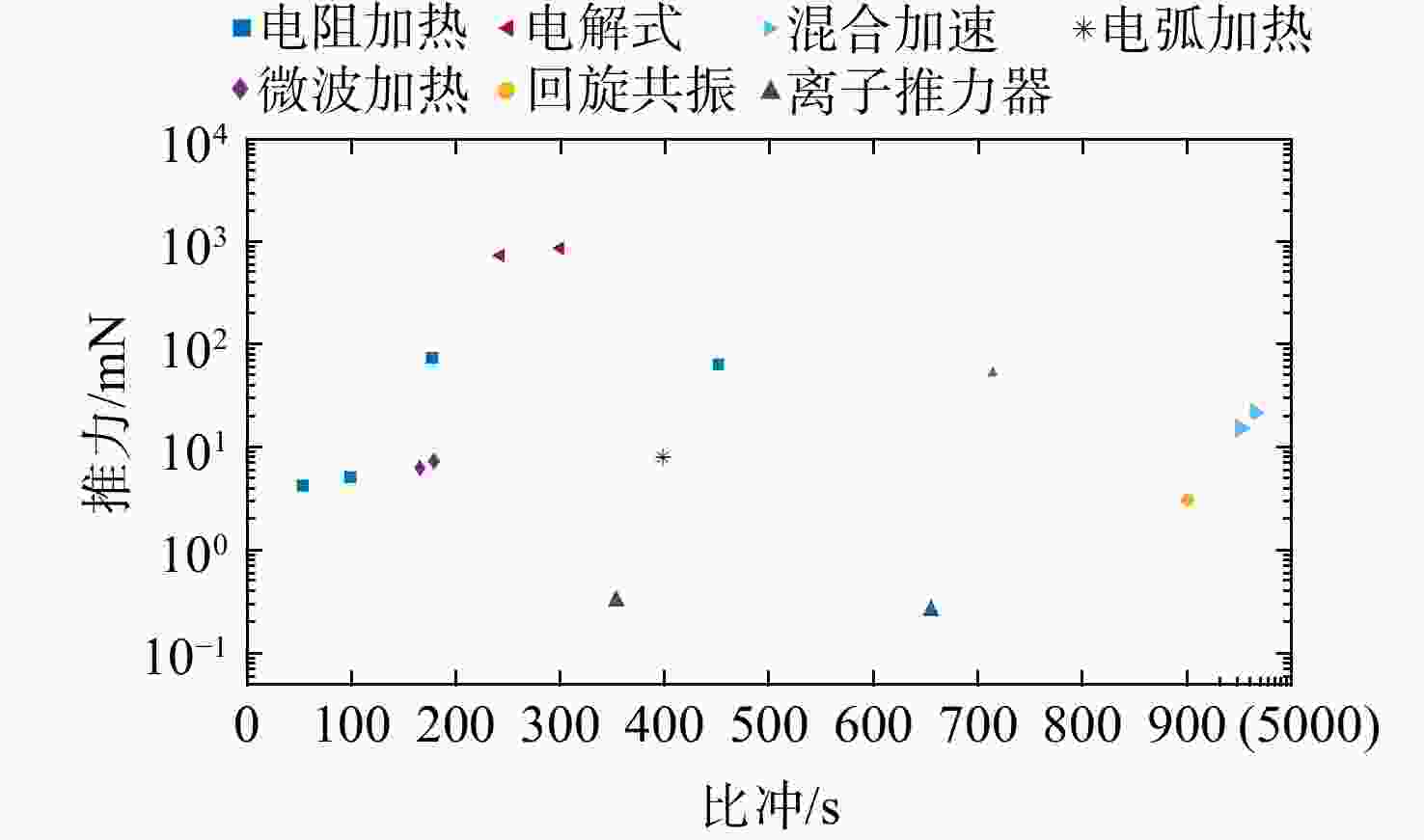
图 24 水工质电推进性能总结
Figure 24. Summary of water propellant electric propulsion performance
表 1 水工质电热式推进技术成熟度
Table 1. Maturity of water fueled electrothermal propulsion technology
推力器名称 推力器类别 发明单位 成熟度 比冲
Isp/s推力
T/mN推功比
RTPR/(mN/kW)参考
文献UKDMC 电热加热式 萨里大学 7 50 3.3 110 [16] ARO 电热加热式 极光推进公司 6 100 4 214 [18] Comet 电热加热式 布拉福德公司 8 175 17 340 [17] 3U Micropropulsion System 电热加热式 东京大学 6 450 15.45 170 [19] TuanCan 微波加热式 蒸汽喷射公司 5 172 6 120 [23] ThrusterOne 微波加热式 蒸汽喷射公司 5 180 6.1 125 [23] WEPS 电弧加热式 斯普利杰公司 6 400 8 387 [27] HYDROS 电解加热式 泰瑟斯公司 9 248 600 210 [37] HYDROS-C 电解加热式 泰瑟斯公司 9 310 900 520 [38]  下载: 导出CSV
-
[1] 国家市场监督管理总局, 国家标准化管理委员会. 微纳卫星试验要求: GB/T 38027-2019[S]. 北京: 中国标准出版社, 2019. State Administration for Market Regulation, National Standardization Administration of the People’s Republic of China. Test requirements for micro-nano satellites: GB/T 38027-2019[S]. Beijing: Standards Press of China, 2019. (in ChineseState Administration for Market Regulation, National Standardization Administration of the People’s Republic of China. Test requirements for micro-nano satellites: GB/T 38027-2019[S]. Beijing: Standards Press of China, 2019. (in Chinese) [2] 李强, 吕强. 电推进技术在通信卫星平台上的应用[J]. 国际太空, 2016(7): 46-52. LI Qiang, LYU Qiang. Application of electric propulsion on communications satellite platform[J]. Space International, 2016(7): 46-52. (in ChineseLI Qiang, LYU Qiang. Application of electric propulsion on communications satellite platform[J]. Space International, 2016(7): 46-52. (in Chinese) [3] 李云. 国外全电推进卫星发展分析[J]. 国际太空, 2014(3): 21-23. LI Yun. Development analysis of foreign all-electric propulsion satellites[J]. Space International, 2014(3): 21-23. (in ChineseLI Yun. Development analysis of foreign all-electric propulsion satellites[J]. Space International, 2014(3): 21-23. (in Chinese) [4] NIETO-PEROY C, EMAMI M R. CubeSat mission: from design to operation[J]. Applied Sciences, 2019, 9(15): 3110. doi: 10.3390/app9153110 [5] ZACNY K, METZGER P, LUCZEK K, et al. The world is not enough (WINE): harvesting local resources for eternal exploration of space: AIAA2016-5279 [R]. Reston, US: AIAA, 2016. [6] MEIRION-GRIFFITH G, LEVINE D, HOCKMAN B, et al. SPARROW: a steam propelled autonomous retrieval robot for ocean worlds: AIAA2019-3962 [R]. Reston, US: AIAA, 2019. [7] SCHWERTHEIM A, KNOLL A. In situ utilization of water as a propellant[J]. Journal of the British Interplanetary Society, 2019, 72(7): 7-11. [8] SCHWERTHEIM A, KNOLL A. Low power thrust measurements of the water electrolysis Hall effect thruster[J]. CEAS Space Journal, 2022, 14(1): 3-17. doi: 10.1007/s12567-021-00350-y [9] SCHWERTHEIM A, KNOLL A. Experimental investigation of a water electrolysis Hall effect thruster[J]. Acta Astronautica, 2022, 193: 607-618. doi: 10.1016/j.actaastro.2021.11.002 [10] SCHWERTHEIM A, KNOLL A. Performance characterization of the water electrolysis hall effect thruster (WET-HET) using direct thrust measurements[C]//Proceedings of Space Propulsion Conference. London, UK: European Space Agency, 2021: 145-155. [11] LEE J, RAJA L L. Computational study of a helium-propellant microwave electrothermal thruster[J]. Journal of Applied Physics, 2024, 135(17): 173-181. [12] MULKI R R, NTANTIS E L. Study of microwave electrothermal propulsion system[C]//Proceedings of the 8th International Conference on Research, Technology and Education of Space, H-Space. Budapest, Hungary: BME VIK, 2024: 25-26. [13] 夏广庆, 鹿畅, 孙斌, 等. 电推进加速技术现状及展望[J]. 宇航学报, 2022, 43(2): 143-157. XIA Guangqing, LU Chang, SUN Bin, et al. Review and prospect of electric propulsion acceleration technology[J]. Journal of Astronautics, 2022, 43(2): 143-157. (in ChineseXIA Guangqing, LU Chang, SUN Bin, et al. Review and prospect of electric propulsion acceleration technology[J]. Journal of Astronautics, 2022, 43(2): 143-157. (in Chinese) [14] NISHII K, ASAKAWA J, KIKUCHI K, et al. Flight model development and ground demonstration of water resistojet propulsion system for CubeSats[J]. Transactions of The Japan Society for Aeronautical and Space Sciences, 2020, 63(4): 141-150. doi: 10.2322/tjsass.63.141 [15] GONDOL N, TAJMAR M. Experimental investigation of electric propulsion systems using C12A7 electride hollow cathodes[J]. CEAS Space Journal, 2023, 15(3): 413-429. doi: 10.1007/s12567-022-00446-z [16] GIBBON D, COXHILL I, NICOLINI D, et al. The design, development and in-flight operation of a water resistojet micropropulsion system: AIAA2004-3798 [R]. Reston, US: AIAA, 2004. [17] YOST B, WESTON S, BURKHARD C, et al. A comparison of the technological maturation of SmallSat propulsion systems from 2018 to 2020[C]//Proceedings of the 2021 SmallSat Conference. Logan, US: Utah State University, 2021: 120-131. [18] ALNAQBI S, DARFILAL D, SWEI S S M. Propulsion Technologies for CubeSats[J]. Aerospace, 2024, 11(7): 502. doi: 10.3390/aerospace11070502 [19] KOIZUMI H, ASAKAWA J, NAKAGAWA Y, et al. Assessment of micro-propulsion system unifying water ion thrusters and water resist jet thrusters[J]. Journal of Spacecraft and Rockets, 2019, 56(5): 1400-1408. doi: 10.2514/1.A34407 [20] ABAIMOV M D, SINHA S, BILÉN S G, et al. CubeSat microwave electrothermal thruster (CµMET)[C]// Proceedings of the 33rd International Electric Propulsion Conference. Washington, US: The George Washington University, 2013: 6-10. [21] DOYLE S J, GIBSON A R, BOSWELL R W, et al. Control of electron, ion and neutral heating in a radio-frequency electrothermal micro thruster via dual-frequency voltage waveforms[J]. Plasma Sources Science and Technology, 2019, 28(3): 035019. doi: 10.1088/1361-6595/ab0984 [22] DOYLE S J, GIBSON A R, FLATT J, et al. Spatio-temporal plasma heating mechanisms in a radio frequency electrothermal micro thruster[J]. Plasma Sources Science and Technology, 2018, 27(8): 085011. doi: 10.1088/1361-6595/aad79a [23] CHONG D, ZHAO Q, YUAN F, et al. Research on the steam jet length with different nozzle structures[J]. Experimental Thermal and Fluid Science, 2015, 64: 134-141. doi: 10.1016/j.expthermflusci.2015.02.015 [24] 邢鹏涛, 毛根旺, 陈茂林, 等. 水工质微波等离子推力器喷管流场及推力性能研究[J]. 科学技术与工程, 2012, 12(2): 373-376, 380. XING Pengtao, MAO Genwang, CHEN Maolin, et al. Research on the flow fields and thrust performance of nozzle of water-fed microwave plasma thruster[J]. Science Technology and Engineering, 2012, 12(2): 373-376, 380. (in ChineseXING Pengtao, MAO Genwang, CHEN Maolin, et al. Research on the flow fields and thrust performance of nozzle of water-fed microwave plasma thruster[J]. Science Technology and Engineering, 2012, 12(2): 373-376, 380. (in Chinese) [25] BOCK D, AUWETER-KURTZ M, KURTZ H L, et al. Experimental investigations on thermal arcjet thruster development for a science mission to the moon[C]//Proceedings of the 57th International Astronautical Congress. Reston, US: AIAA, 2006: 4-6. [26] WOLLENHAUPT B, LE Q H, HERDRICH G. Overview of thermal arcjet thruster development[J]. Aircraft Engineering and Aerospace Technology, 2018, 90(2): 280-301. doi: 10.1108/AEAT-08-2016-0124 [27] NOGAWA Y, TAHARA H. Evolutional electrical propulsion with water propellant DC arcjet[C]// Proceedings of the 35th International Electric Propulsion Conference. Atlanta, US: Georgia Institute of Technology, 2017: 409-413. [28] HWANG M, RHO T S, LEE H J. Conceptual design and performance analysis of water electrolysis propulsion system with catalytic igniter for CubeSats[J]. Acta Astronautica, 2022, 200: 316-328. doi: 10.1016/j.actaastro.2022.08.022 [29] HARMANSA N E, HERDRICH G, FASOULAS S, et al. Development of a water electrolysis propulsion system for small satellites[C]//Proceedings of Space Propulsion Conference. Cincinnati, US: Curran Associates Incorporation, 2018: 14-18. [30] DOYLE K P, PECK M A. Water electrolysis for propulsion of a crewed Mars mission[J]. Journal of Spacecraft and Rockets, 2020, 57(6): 1103-1117. doi: 10.2514/1.A34632 [31] HARMANSA N E, HERDRICH G, FASOULAS S, et al. Development of a satellite propulsion system based on water electrolysis[J]. International Journal of Energetic Materials and Chemical Propulsion, 2019, 18(3): 185-199. doi: 10.1615/IntJEnergeticMaterialsChemProp.2019028538 [32] SHALASHOV M, FEDOROV V, VAULIN S, et al. Concept of application of water electrolysis propulsion system as a component of a universal space platform for asteroid exploration mission[J]. Aerospace Systems, 2022, 5(1): 159-165. doi: 10.1007/s42401-021-00110-0 [33] HARMANSA N E, HERDRICH G, FASOULAS S. Development of a water propulsion system for small satellites[C]// Proceedings of the 68th International Astronautical Congress. Adelaide, Australia: International Astronautical Federation, 2017: 25-29. [34] KHAN A M. Design and testing of polymer electrolyte membrane (PEM) electrolysis system for hydrogen and oxygen production for propellants in Cubesat applications[D]. Tucson, US: The University of Arizona, 2022. [35] VAN PARIDON A, PETRO E. Survey of water powered propulsion systems: AIAA2021-3566 [R]. Reston, US: AIAA, 2021. [36] DE GROOT W, ARRINGTON L, MCELROY J, et al. Electrolysis propulsion for spacecraft applications: AIAA1997-2948 [R]. Reston, US: AIAA, 1997. [37] JAMES K, MOSER T, CONLEY A, et al. Performance characterization of the HYDROS™ water electrolysis thruster[C]// Proceedings of Small Satellite Conference. Tethers, US: IEEE Xplore. 2015: 672-683. [38] PORTER A K, FREEDMAN M, GRIST R D, et al. SSC21-XI-06 flight qualification of a water electrolysis propulsion system[C]//Proceedings of the 2021 SmallSat Conference. Logan, US: Utah State University, 2021: 256-271. [39] PORTER A, FREEDMAN M, GRIST R, et al. Flight qualification of a water electrolysis propulsion system[C]// Proceedings of Small Satellite Conference. Tethers, US: IEEE Xplore. 2015: 562-589. [40] O’REILLY D, HERDRICH G, KAVANAGH D F. Electric propulsion methods for small satellites: a review[J]. Aerospace, 2021, 8(1): 22-31. doi: 10.3390/aerospace8010022 [41] WALTER C. Development and definition of a CubeSat demonstrator for a water propulsion system[D]. Stuttgart: University Stuttgart, 2021. [42] 王亚楠, 靳丽云, 任林渊, 等. 毛细管脉冲等离子体推力器等离子羽流分团现象与等效速度测量[J]. 推进技术, 2023, 44(6): 242-252. WANG Yanan, JIN Liyun, REN Linyuan, et al. Plasma plume splitting phenomena in capillary discharge based pulsed plasma thruster and equivalent velocity measurement[J]. Journal of Propulsion Technology, 2023, 44(6): 242-252. (in ChineseWANG Yanan, JIN Liyun, REN Linyuan, et al. Plasma plume splitting phenomena in capillary discharge based pulsed plasma thruster and equivalent velocity measurement[J]. Journal of Propulsion Technology, 2023, 44(6): 242-252. (in Chinese) [43] 谭胜, 赵元政, 吴建军, 等. 激光支持的脉冲等离子体推力器工作过程实验研究[J]. 推进技术, 2022, 43(8): 200762. TAN Sheng, ZHAO Yuanzheng, WU Jianjun, et al. Experimental study on operating process of laser-assisted pulsed plasma thruster[J]. Journal of Propulsion Technology, 2022, 43(8): 200762. (in ChineseTAN Sheng, ZHAO Yuanzheng, WU Jianjun, et al. Experimental study on operating process of laser-assisted pulsed plasma thruster[J]. Journal of Propulsion Technology, 2022, 43(8): 200762. (in Chinese) [44] 于达仁, 乔磊, 蒋文嘉, 等. 中国电推进技术发展及展望[J]. 推进技术, 2020, 41(1): 1-11. YU Daren, QIAO Lei, JIANG Wenjia, et al. Development and prospect of electric propulsion technology in China[J]. Journal of Propulsion Technology, 2020, 41(1): 1-11. (in ChineseYU Daren, QIAO Lei, JIANG Wenjia, et al. Development and prospect of electric propulsion technology in China[J]. Journal of Propulsion Technology, 2020, 41(1): 1-11. (in Chinese) [45] 丛云天, 李永, 汤海滨, 等. 百千瓦级大功率磁等离子体动力推进系统设计研究[J]. 固体火箭技术, 2021, 44(3): 304-310. CONG Yuntian, LI Yong, TANG Haibin, et al. Research and design considerations of 100-kilowatts high power MPD thruster[J]. Journal of Solid Rocket Technology, 2021, 44(3): 304-310. (in ChineseCONG Yuntian, LI Yong, TANG Haibin, et al. Research and design considerations of 100-kilowatts high power MPD thruster[J]. Journal of Solid Rocket Technology, 2021, 44(3): 304-310. (in Chinese) [46] 王宝军, 周成, 李永, 等. 磁等离子体动力推力器发展历程及工程应用中关键技术分析[J]. 固体火箭技术, 2021, 44(2): 223-232. WANG Baojun, ZHOU Cheng, LI Yong, et al. Development of magnetoplasmadynamic thrusters and key technologies in engineering application[J]. Journal of Solid Rocket Technology, 2021, 44(2): 223-232. (in ChineseWANG Baojun, ZHOU Cheng, LI Yong, et al. Development of magnetoplasmadynamic thrusters and key technologies in engineering application[J]. Journal of Solid Rocket Technology, 2021, 44(2): 223-232. (in Chinese) [47] 赵博强, 李永, 周成等. 磁等离子体动力推力器加速机理研究与仿真[J]. 固体火箭技术, 2021, 44(2): 233-240. ZHAO Boqiang, LI Yong, ZHOU Cheng, et al. Research and simulation on the acceleration mechanism of magneto-plasma dynamic thrusters[J]. Journal of Solid Rocket Technology, 2021, 44(2): 233-240 (in Chinese).ZHAO Boqiang, LI Yong, ZHOU Cheng, et al. Research and simulation on the acceleration mechanism of magneto-plasma dynamic thrusters[J]. Journal of Solid Rocket Technology, 2021, 44(2): 233-240 (in Chinese). [48] HALL S J, JORNS B A, CUSSON S E, et al. Performance and high-speed characterization of a 100 kW nested Hall thruster[J]. Journal of Propulsion and Power, 2022, 38(1): 40-50. doi: 10.2514/1.B38080 [49] BAPAT A, SALUNKHE P B, PATIL A V. Hall-effect thrusters for deep-space missions: a review[J]. IEEE Transactions on Plasma Science, 2022, 50(2): 189-202. doi: 10.1109/TPS.2022.3143032 [50] PERALES-DÍAZ J, DOMÍNGUEZ-VÁZQUEZ A, FAJARDO P, et al. Hybrid plasma simulations of a magnetically shielded Hall thruster[J]. Journal of Applied Physics, 2022, 131(10): 27-41. [51] MARKS T A, JORNS B A. Evaluation of algebraic models of anomalous transport in a multi-fluid Hall thruster code[J]. Journal of Applied Physics, 2023, 134(15): 14-34. [52] LEE M, KIM D, LEE J, et al. A data-driven approach for analyzing Hall thruster discharge instability leading to plasma blowoff[J]. Acta Astronautica, 2023, 206: 1-8. doi: 10.1016/j.actaastro.2023.02.017 [53] GAO Yuanyuan, WANG Weizong, LI Peiran, et al. Study on the plasma plume structures in a cylindrical Hall thruster[J]. Vacuum, 2024, 219: 112703. doi: 10.1016/j.vacuum.2023.112703 [54] LIU Xingyu, LI Hong, AN Zhongkai, et al. High-voltage discharge characteristics of a hybrid-wall Hall thruster with an aft-loaded magnetic field[J]. Acta Astronautica, 2023, 203: 214-225. doi: 10.1016/j.actaastro.2022.11.054 [55] LIU Xingyu, LI Hong, CHE Xingdong, et al. Optimizing a Hall thruster with aft-loaded magnetic field by aft-loading design of gas flow[J]. Vacuum, 2024, 222: 112987. doi: 10.1016/j.vacuum.2024.112987 [56] ZHANG Junjun, SUN Bin, LU Chang, et al. Energy coupling mechanism of electrodeless plasma thruster with rotating electric field[J]. AIAA Journal, 2023, 61(5): 1939-1953. doi: 10.2514/1.J062453 [57] PARENT B, RODRÍGUEZ FUENTES F M, LAFOLEY S. Two-electrode vs electrode-less MHD-enhanced aerocapture: AIAA2024-1649 [R]. Reston, US: AIAA, 2024. [58] SERCEL C L, GILL T M, JORNS B A. Inductive probe measurements in a rotating magnetic field thruster[J]. Plasma Sources Science Technology, 2023, 32(10): 105017. doi: 10.1088/1361-6595/acfd5a [59] CHEN Zhiyuan, WANG Yibai, LI Min, et al. Plume deflection using an asymmetrical magnetic nozzle for an applied-field magnetoplasmadynamic thruster: an experimental demonstration and numerical analysis[J]. Acta Astronautica, 2023, 209: 82-94. doi: 10.1016/j.actaastro.2023.04.042 [60] JIMÉNEZ P, ZHOU Jiewei, NAVARRO-CAVALLÉ J, et al. Analysis of a cusped Helicon plasma thruster discharge[J]. Plasma Sources Science and Technology, 2023, 32(10): 105013. doi: 10.1088/1361-6595/ad01da [61] COPPOLA G, PANELLI M, BATTISTA F. Preliminary design of Helicon plasma thruster by means of particle swarm optimization[J]. AIP Advances, 2023, 13(5): 055209. doi: 10.1063/5.0149430 [62] SUN Bin, ZHANG Yue, ZHOU Cheng, et al. Influence mechanism of magnetic field and wave modes on Helicon plasma thruster[J]. AIAA Journal, 2023: 5264-5276. [63] SHINOHARA S, NISHIDA H, TANIKAWA T, et al. Development of electrodeless plasma thrusters with high-density Helicon plasma sources[J]. IEEE Transactions on Plasma Science, 2014, 42(5): 1245-1254. doi: 10.1109/TPS.2014.2313633 [64] HAN Yajie, XIA Guangqing, SUN Bin, et al. A novel transversal-feed electron cyclotron resonance plasma thruster: design and plasma characteristics analysis[J]. Aerospace, 2023, 10(10): 865-879. doi: 10.3390/aerospace10100865 [65] MENG Shengfeng, ZHU Ximing, YU Daren. A minimized electron cyclotron resonance ion thruster for China’s space-borne gravitational wave detection missions[J]. Classical and Quantum Gravity, 2023, 40(17): 175006. doi: 10.1088/1361-6382/ace586 [66] PORTO J, ELIAS P Q, CIARDI A. Anisotropic electron heating in an electron cyclotron resonance thruster with magnetic nozzle[J]. Physics of Plasmas, 2023, 30(2): 023506. doi: 10.1063/5.0124834 [67] BARQUERO S, TABATA K, TSUKIZAKI R, et al. Performance characterization of the μ10 electron-cyclotron-resonance ion thruster using alternative propellants: krypton vs. xenon[J]. Acta Astronautica, 2023, 211: 750-754. doi: 10.1016/j.actaastro.2023.06.036 [68] THAPA R. Evolution in propellant of the rocket engine[J]. Journal of Materials Physics and Chemistry, 2023, 11(1): 8-21. doi: 10.12691/jmpc-11-1-2 [69] STAAB D, FREY A, GARBAYO A, et al. Aquajet: an electrodeless ECR water thruster[C]//Proceedings of Space Propulsion Conference Proceedings. Seville, Spain: European Space Agency, 2018: 13-38. [70] TEJEDA J M, KNOLL A. A water vapour fuelled Hall effect thruster: characterization and comparison with oxygen[J]. Acta Astronautica, 2023, 211: 702-715. doi: 10.1016/j.actaastro.2023.06.046 [71] TEJEDA J M M, SCHWERTHEIM A, KNOLL A. Water as an environmentally friendly propellant for a multi-functional spacecraft architecture[J]. International Journal of Energetic Materials and Chemical Propulsion, 2023, 22(2): 21-33. doi: 10.1615/IntJEnergeticMaterialsChemProp.v22.i2.20 [72] NAKAGAWA Y, KOIZUMI H, KAWAHARA H, et al. Performance characterization of a miniature microwave discharge ion thruster operated with water[J]. Acta Astronautica, 2019, 157: 294-299. doi: 10.1016/j.actaastro.2018.12.031 [73] ATAKA Y, NAKAGAWA Y, KOIZUMI H, et al. Improving the performance of a water ion thruster using biased electrodes[J]. Acta Astronautica, 2021, 187: 133-140. doi: 10.1016/j.actaastro.2021.06.020 [74] NAKAGAWA Y, KOIZUMI H, NAITO Y, et al. Water and xenon ECR ion thruster: comparison in global model and experiment[J]. Plasma Sources Science and Technology, 2020, 29(10): 105003. doi: 10.1088/1361-6595/aba2ac -









 点击查看大图

计量
- 文章访问数: 782
- HTML浏览量: 565
- PDF量: 79
- 被引次数: 0