






Sensitivity analysis and multi-objective optimization of design parameters for film hole with curvature
-
摘要:
针对带曲率的气膜孔结构构建了以综合冷效和最大等效热应力为响应的代理模型,研究了吹风比及结构参数(曲率半径、入射角、长径比、展向倾角)对带曲率扇形气膜孔冷却及强度特性的影响规律,并以最大化综合冷效和最小化最大等效热应力为优化目标开展了优化设计及分析。结果表明:相对于结构参数,吹风比是带曲率气膜孔面平均综合冷效的主要影响因素,当吹风比从0.5增大至1.5,综合冷效提高43%以上;曲率半径是最大等效热应力的主要影响因素,其对最大等效热应力影响率可达43.15%(凹面模型)和48.35%(凸面模型),且位于曲率半径小的一侧应力集中更显著。相对于基准模型,通过多目标优化使得曲率半径为40的凹面模型和凸面模型综合冷效分别提高10.11%和17.19%,最大等效热应力分别降低26.78%和9.62%。
Abstract:Based on the response surface method, the surrogate models with comprehensive cooling effectiveness and maximum equivalent thermal stress as responses were constructed respectively. The effects of blow ratio and structural parameters (curvature radius, incidence angle, aspect ratio, splay angle) on the cooling and strength of curved fan-shaped film holes were analyzed. The optimization design was carried out to maximize the comprehensive cooling effectiveness and minimize the maximum equivalent thermal stress. Results indicated that the blowing ratio served as the primary factor affecting the average comprehensive cooling effectiveness of curved film holes. When the blowing ratio increased from 0.5 to 1.5, the comprehensive cooling effectiveness increased by more than 43%. And the curvature radius was the main factor influencing the maximum equivalent thermal stress. Specifically, these factors can affect up to 43.15% (concave model) and 48.35% (convex model). Through multi-objective optimization, compared with the reference model, the comprehensive cooling effectiveness of the concave and convex models with the curvature radius of 40 increased by 10.11% and 17.19%, respectively, and the maximum equivalent thermal stress decreased by 26.78% and 9.62%, respectively.
-

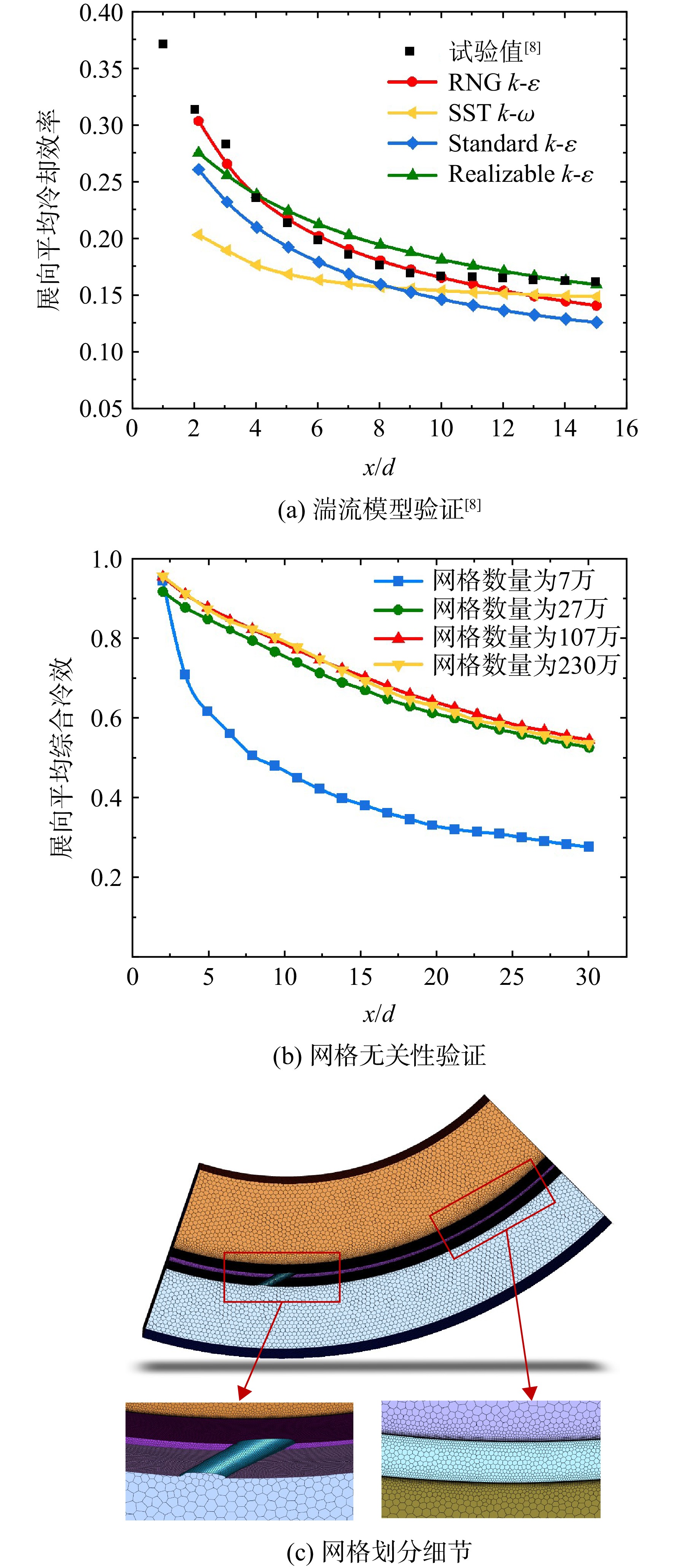
图 1 计算域参数示意图及凸凹面计算模型
Figure 1. Calculation domain parameter diagram and convex and concave surface calculation model
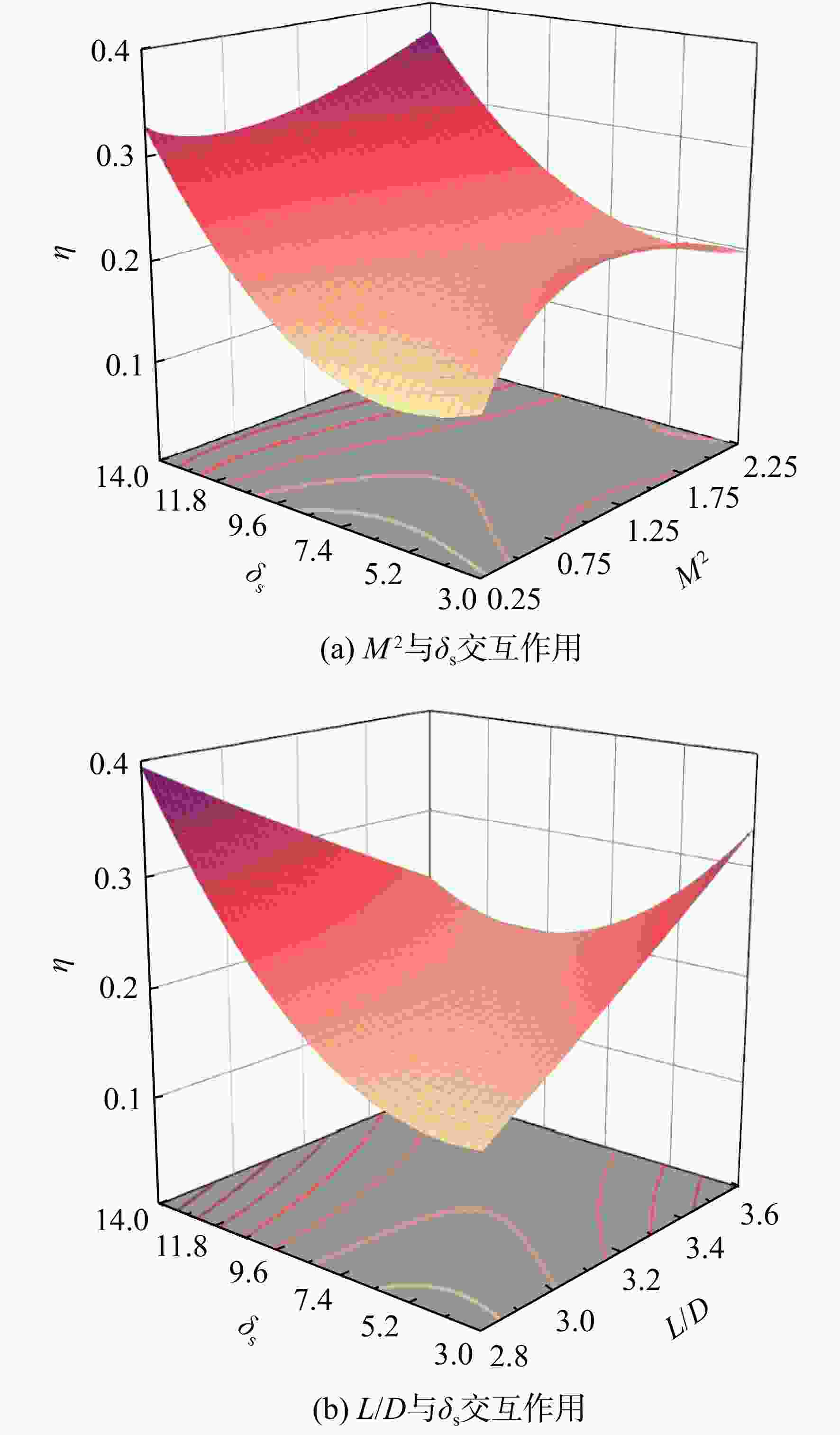
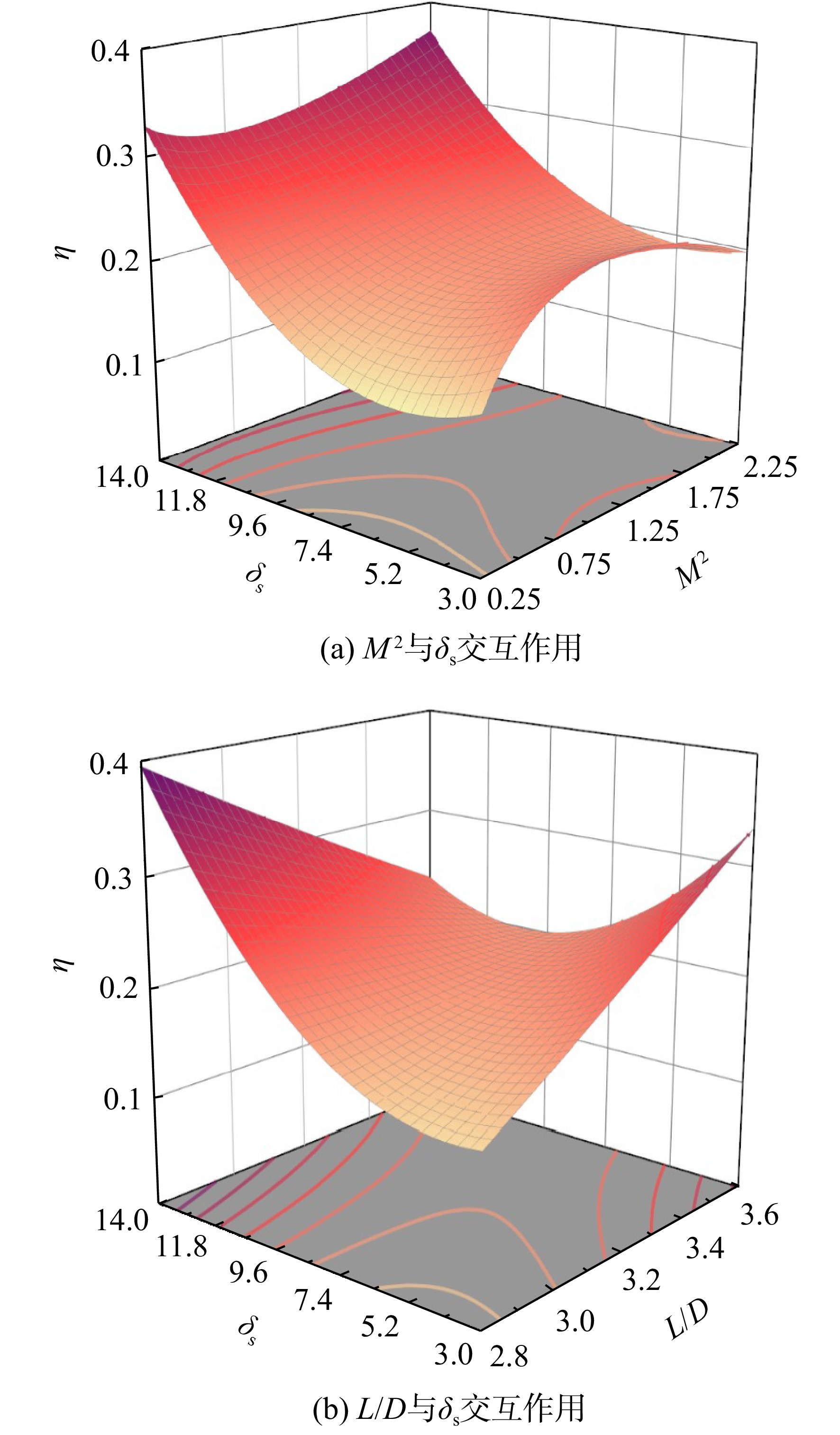
图 3 凹面综合冷效随双因素变化的三维响应面
Figure 3. 3D response surface plots of concave model on comprehensive cooling effectiveness varies with two factors
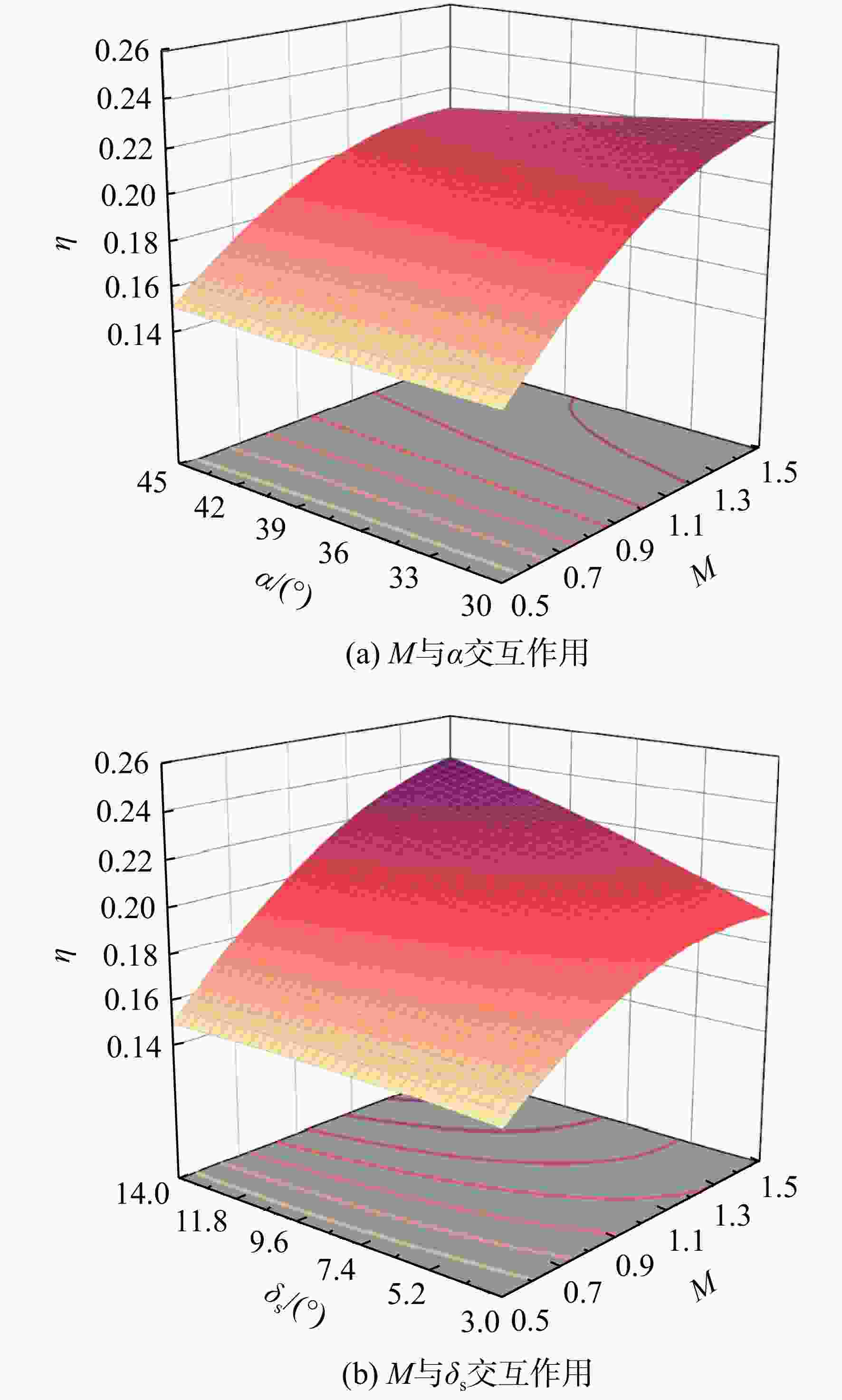
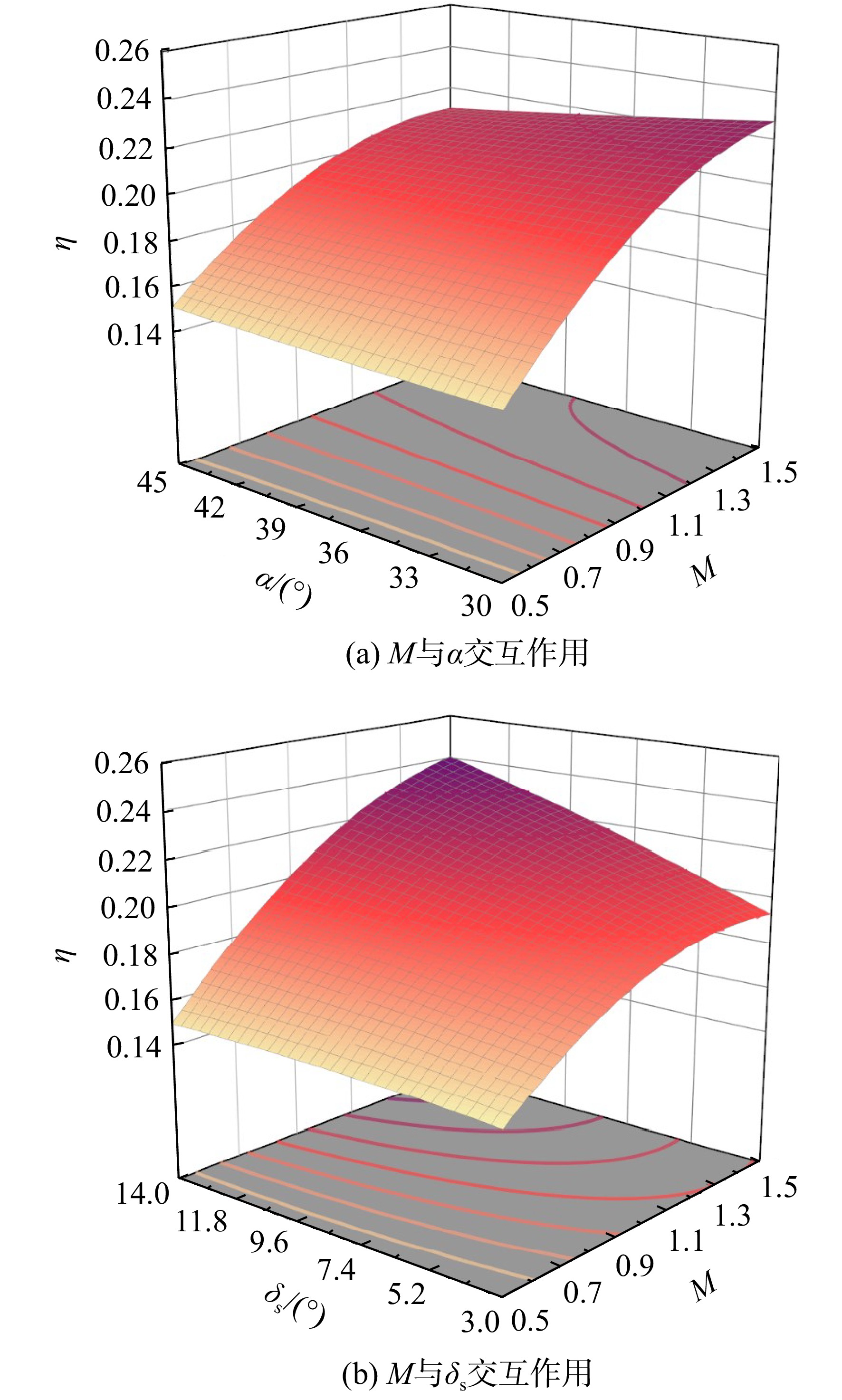
图 4 凸面综合冷效随双因素变化的三维响应面
Figure 4. 3D response surface plots of convex model on comprehensive cooling effectiveness varies with two factors
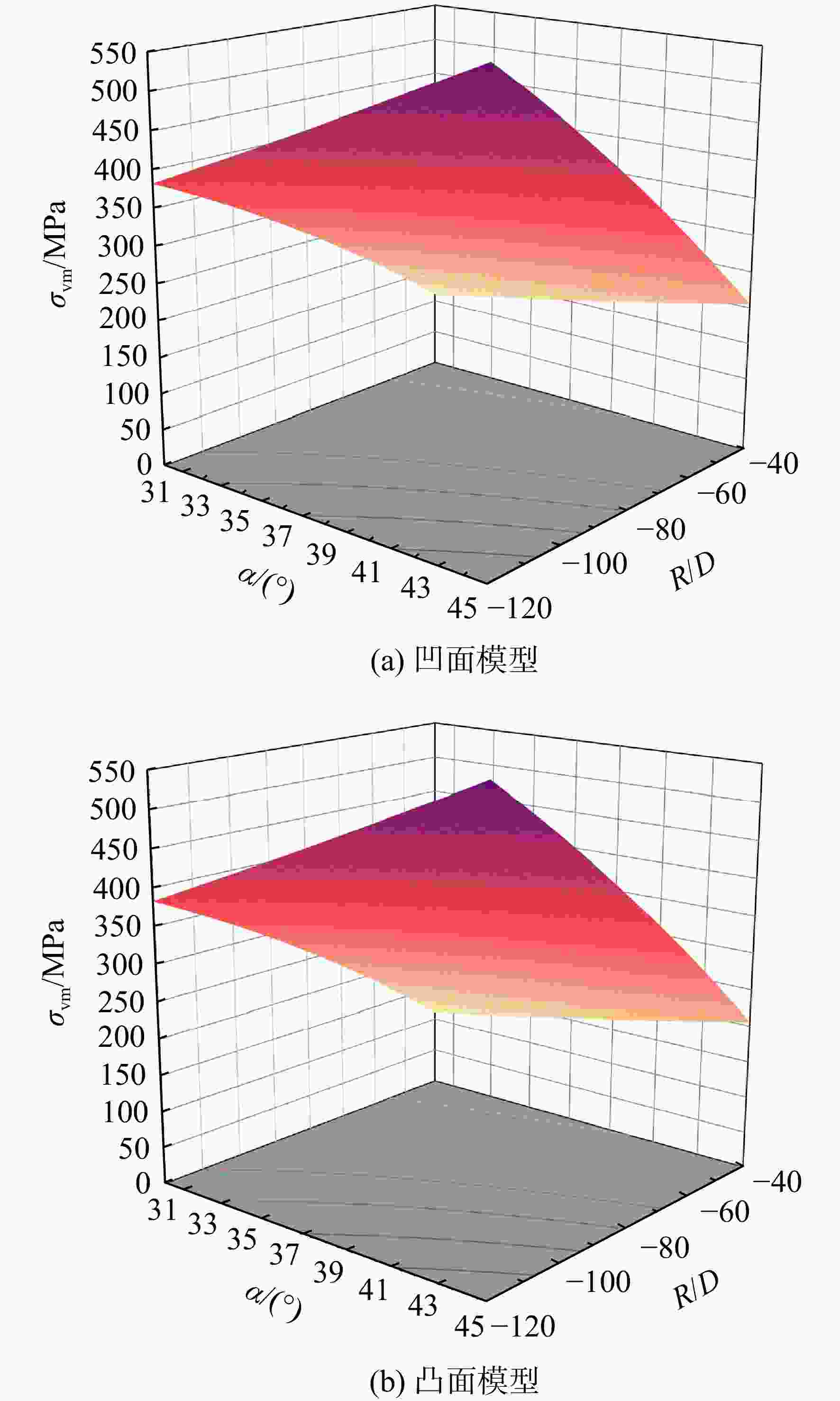
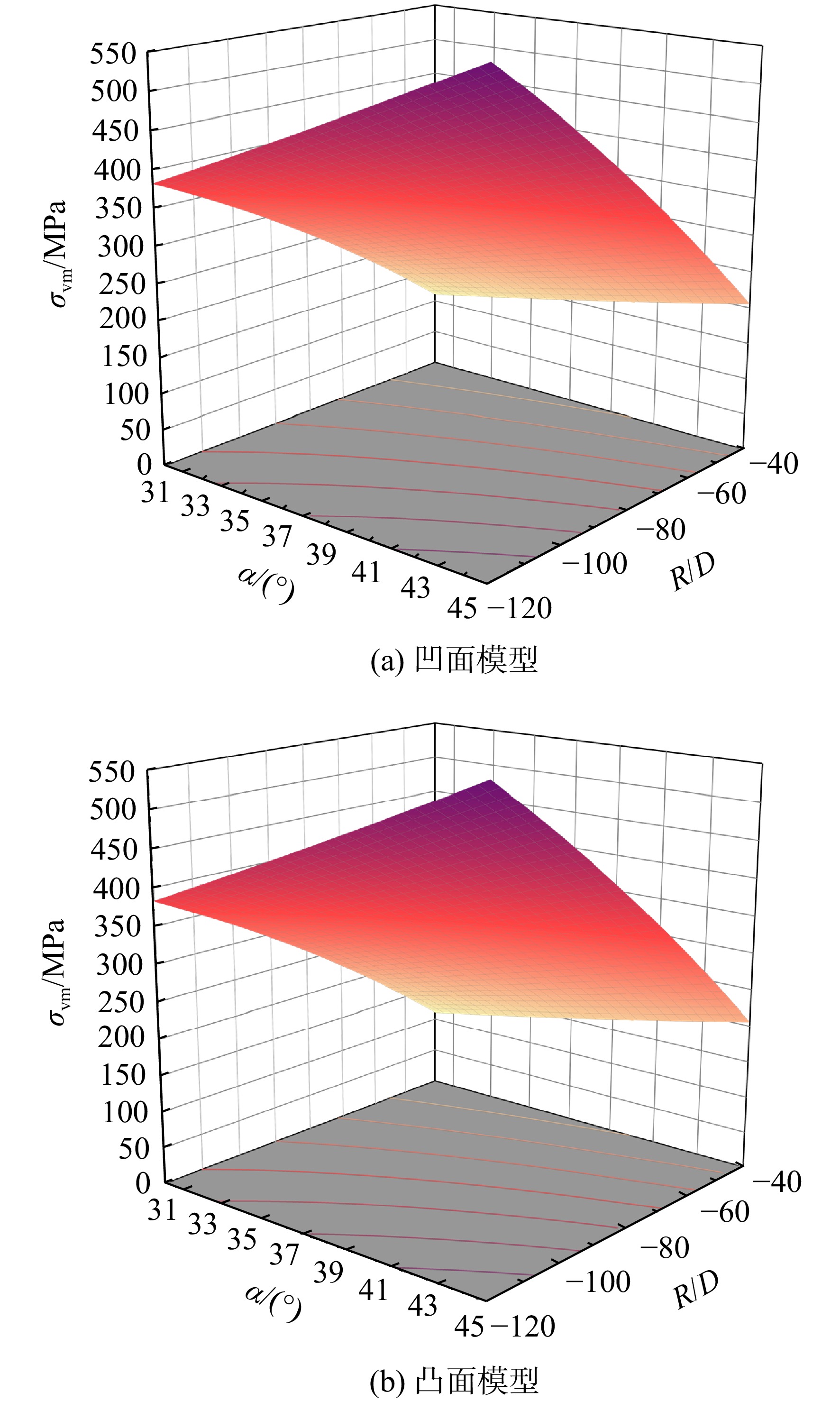
图 5 α和R/D交互作用对最大等效热应力的三维响应面
Figure 5. 3D response surface of α and R/D interaction on maximum equivalent thermal stress
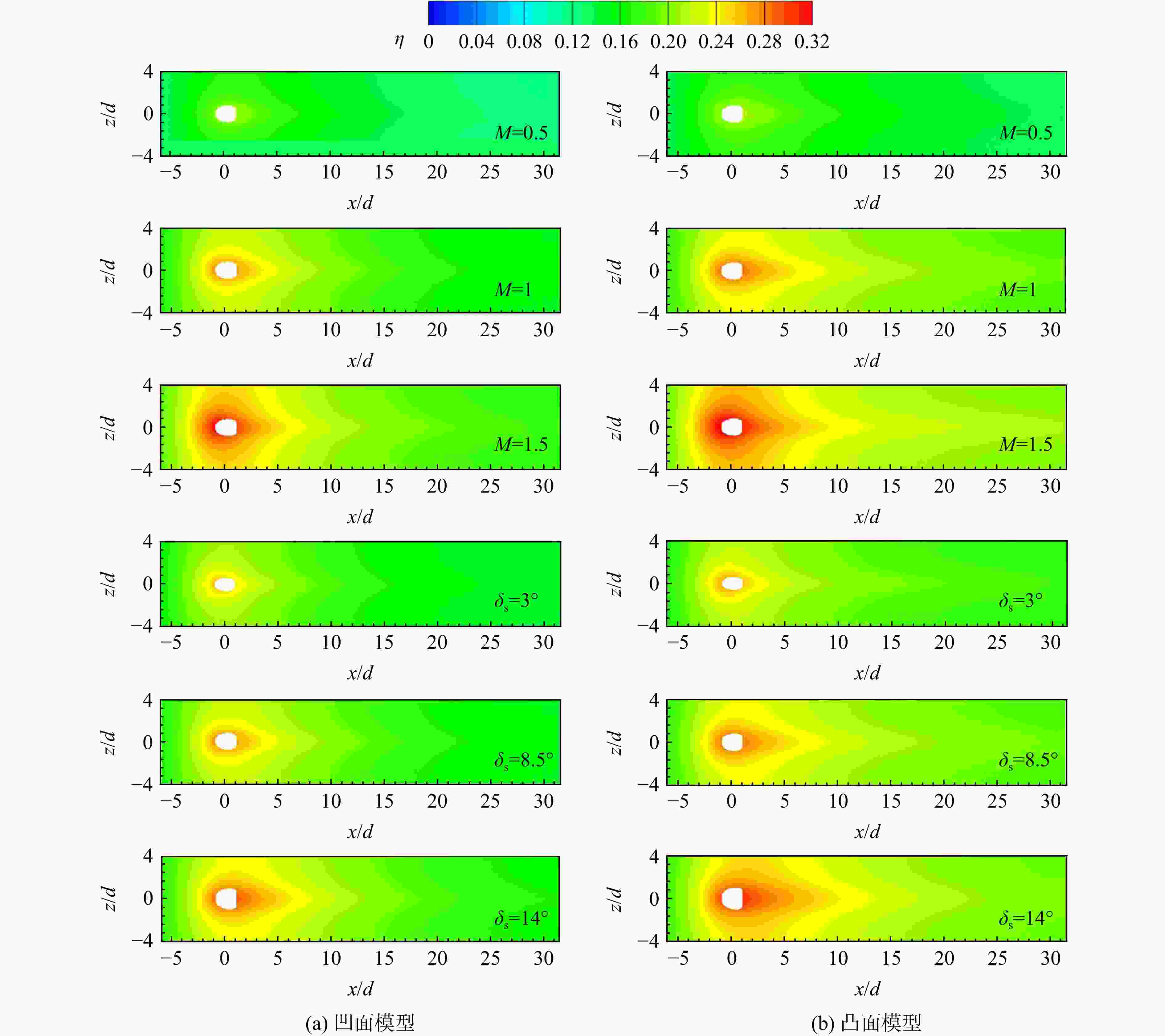
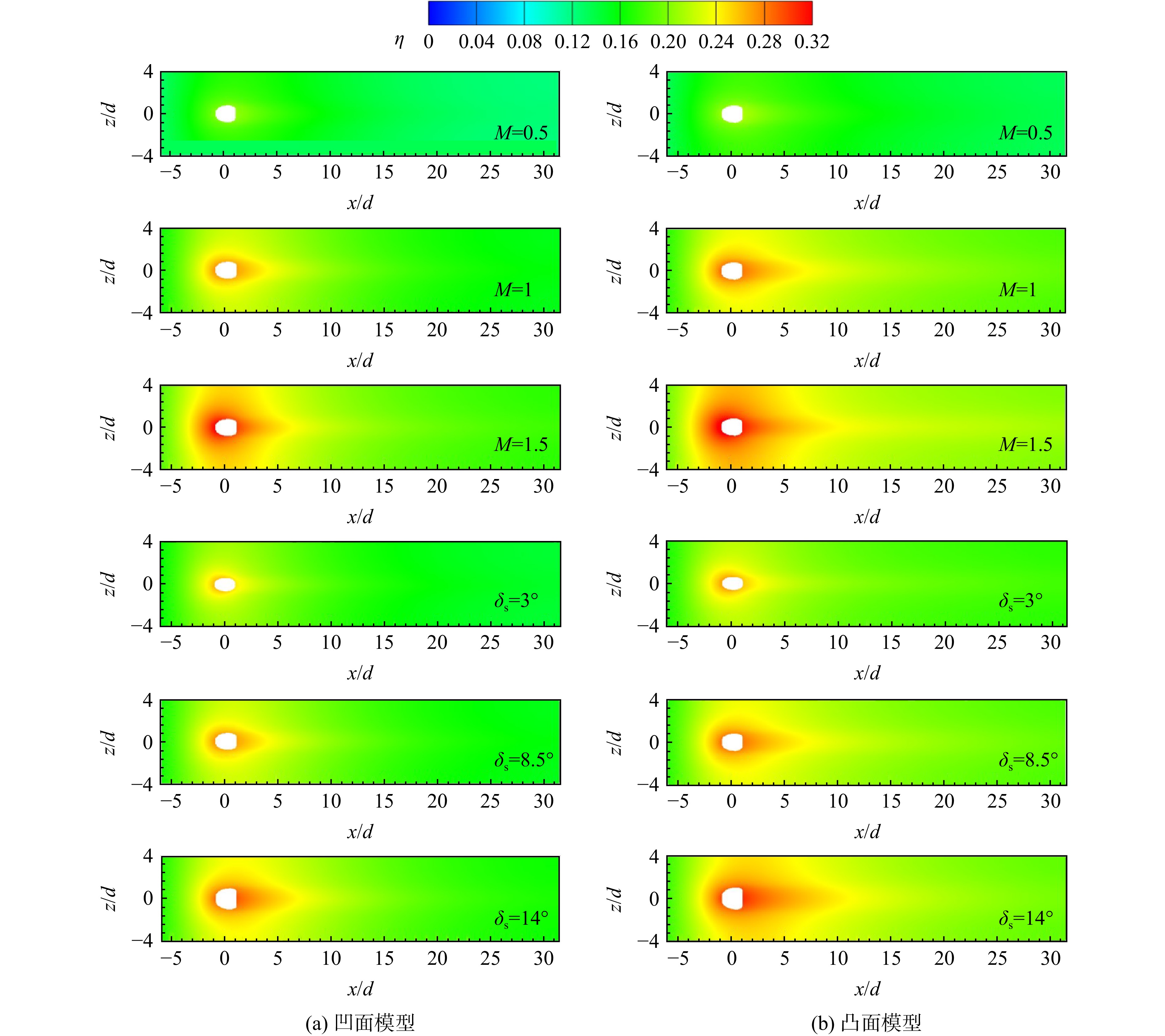
图 6 单因素变化下冷却面综合冷效分布
Figure 6. Comprehensive cooling effectiveness distribution of cooling surface under single factor variation
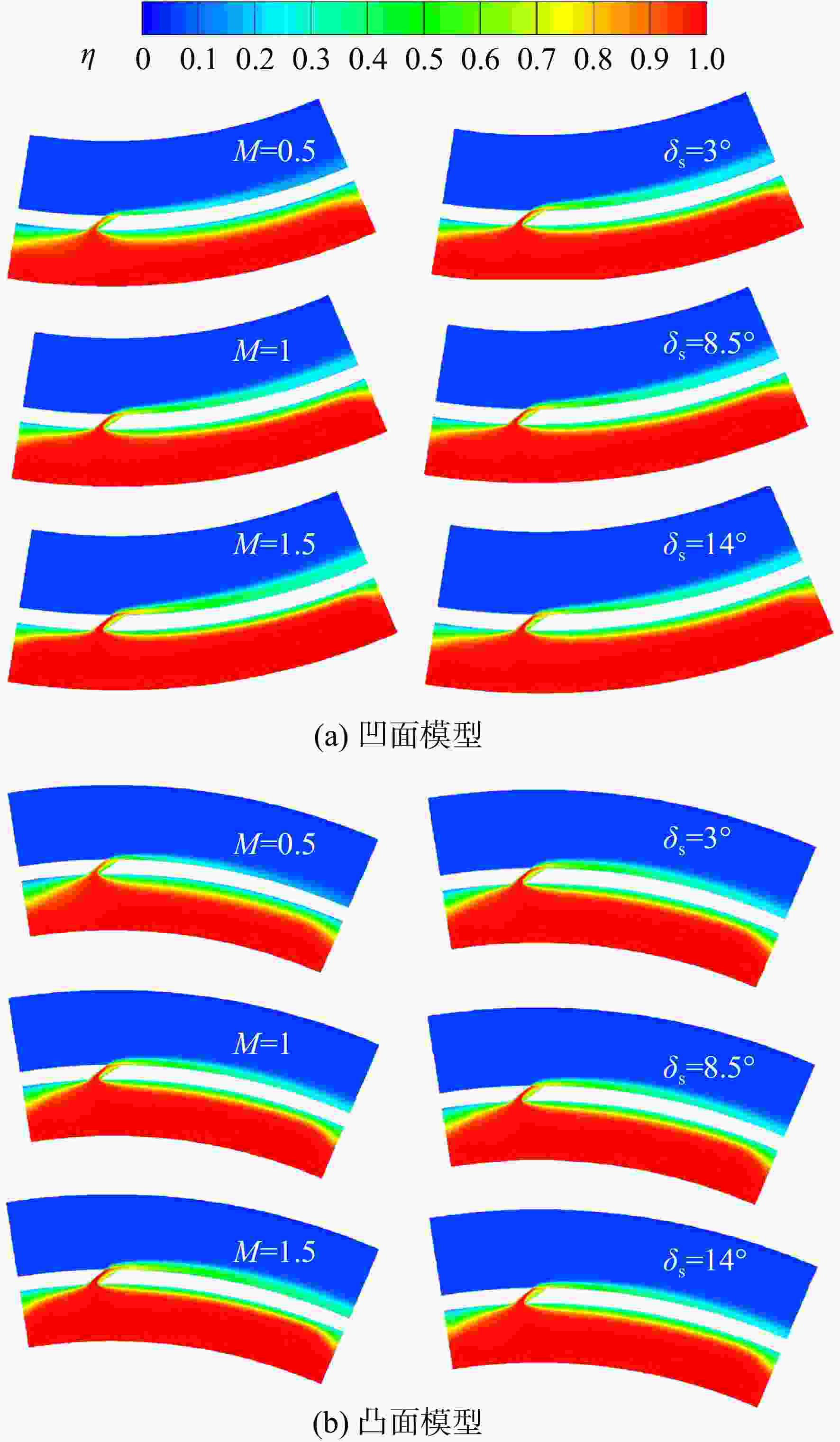
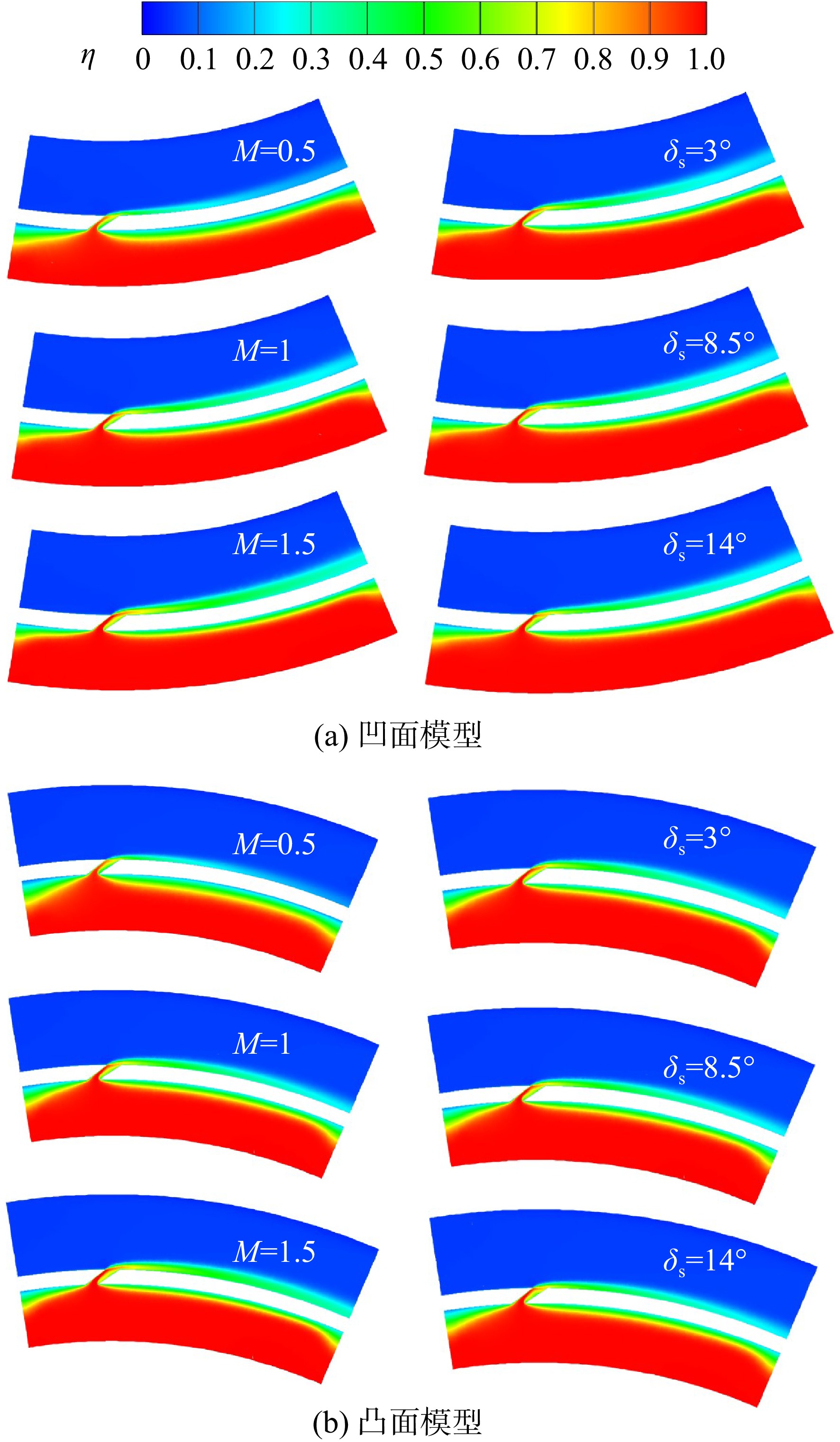
图 7 单因素变化下Z/D=0截面综合冷效分布
Figure 7. Comprehensive cooling effectiveness distribution at section Z/D=0 under single factor variation

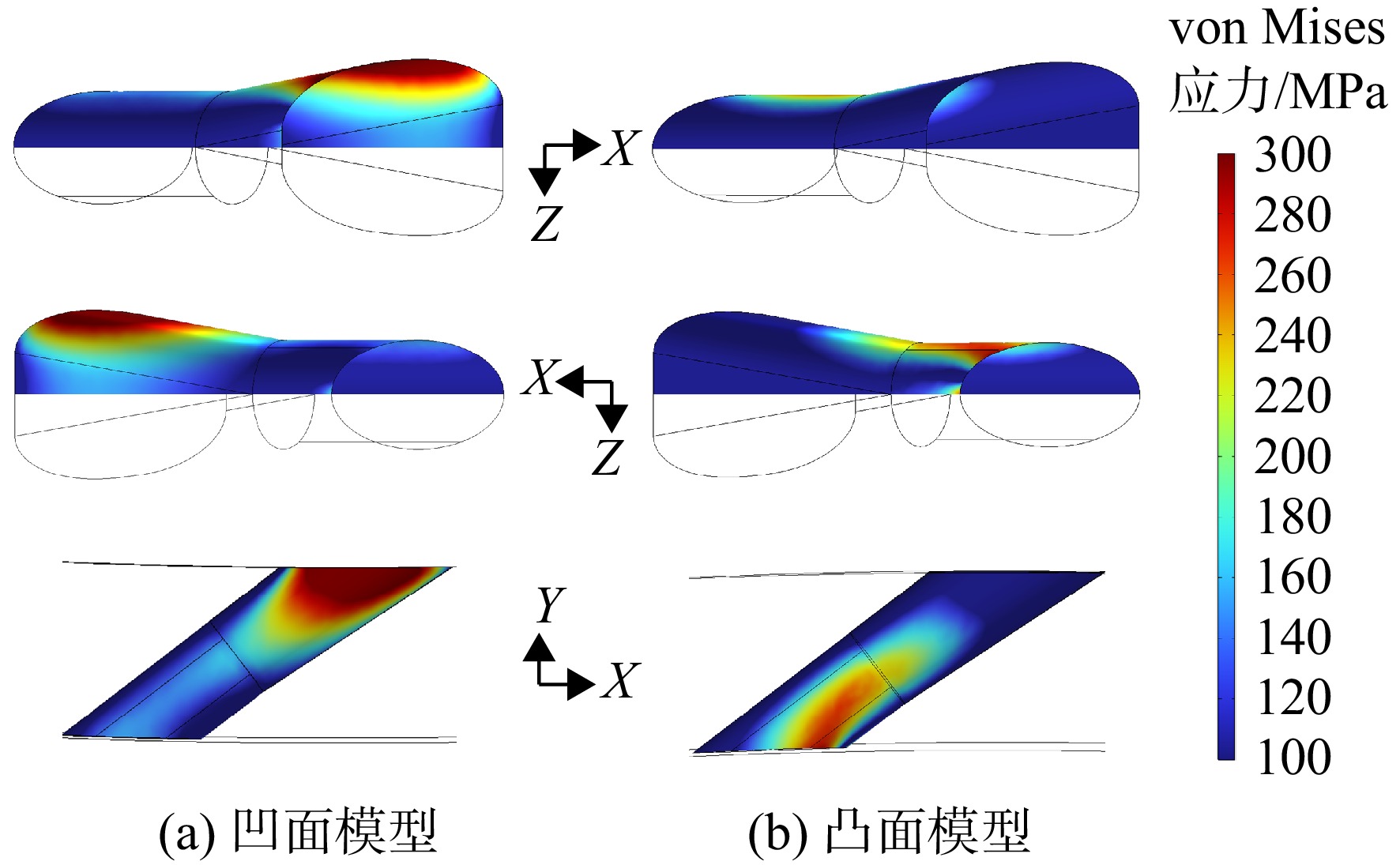
图 8 Z/D<0时扇形气膜孔von Mises应力分布
Figure 8. von Mises stress distribution of fan-shaped film hole at Z/D<0

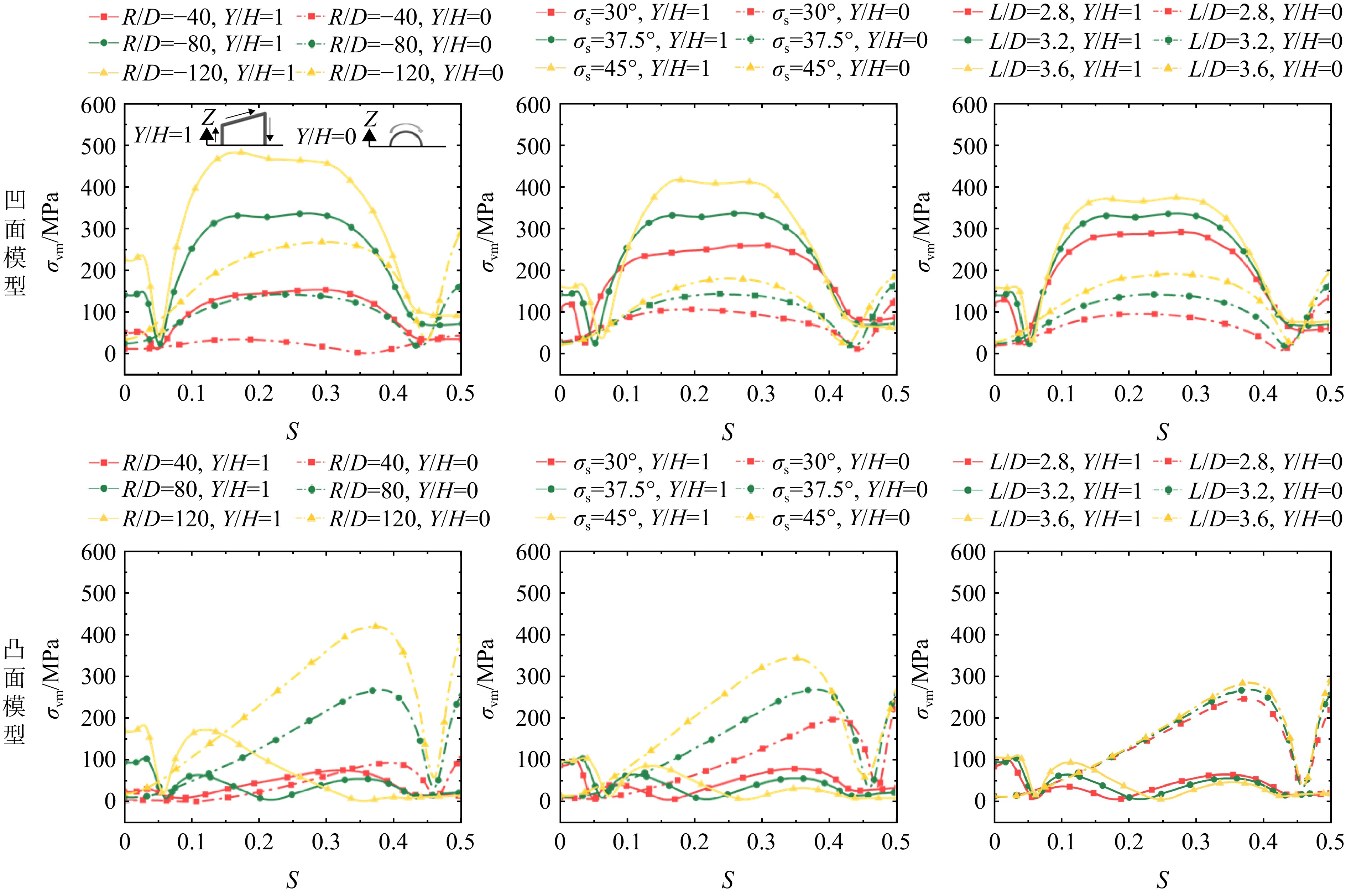
图 9 Z/D<0时扇形气膜孔孔边应力沿弧长分布情况
Figure 9. Distribution of hole edge stress along arc length of fan-shaped film hole at Z/D<0
表 1 计算边界条件
Table 1. Computational boundary condition
边界条件 数值 主流进口流量/(kg/s) 0.01 主流进口总温/K 2 000 冷却流进口总温/K 1150  下载: 导出CSV
表 2 计算参数及其水平
Table 2. Calculating parameters and levels
参数名称 水平 低 中 高 吹风比M 0.5 1.0 1.5 入射角α/(°) 30 37.5 45 长径比L/D 2.8 3.2 3.6 展向倾角δs/(°) 3 8.5 14 曲率半径(凹面)R/D −120 −80 −40 曲率半径(凸面)R/D 40 80 120
下载: 导出CSV
表 3 响应面模型系数
Table 3. Response surface model coefficients
系数 ηao σmax.ao/MPa ηtu σmax.tu/MPa β0 0.1995 337.9900 0.2000 269.8200 β1 0.0342 − 5.8200 0.0343 − 7.6300 β2 − 0.0068 78.2500 − 0.0038 51.5200 β3 0.0053 31.6100 0.0086 22.9200 β4 0.0360 − 0.0141 0.0128 0.9932 β5 − 0.0030 − 166.8800 − 0.0062 160.8500 β12 − 0.0065 − 0.0880 − 0.0050 − 3.5200 β13 0.0038 − 0.9415 0.0059 − 0.0068 β14 − 0.0024 1.3200 0.0112 − 1.9300 β15 0.0023 6.6600 − 0.0027 − 5.9200 β23 0 8.5300 0.0006 − 4.9200 β24 − 0.0824 11.7000 0 − 5.3300 β25 0 − 30.6400 0.0006 24.4700 β34 − 0.0875 − 0.9560 0.0006 2.7300 β35 0 − 11.9900 − 0.0003 4.2800 β45 0 1.4900 0.0006 − 0.2640 β11 − 0.0135 − 3.4000 0.0159 1.9500 β22 0 2.3800 0.0005 22.9800 β33 0.0031 − 7.4400 − 0.0003 − 1.6600 β44 0.0749 − 1.1000 − 0.0018 0.2922 β55 − 0.0110 − 15.5200 0.0029 − 8.4900 β114 0.0530 0 0 0 β144 − 0.0113 0 0 0
下载: 导出CSV
表 4 变量响应面方差分析
Table 4. Response surface analysis of variance
计算模型 参数 η σmax.vm/MPa F 值 p 值 F 值 p 值 凹面模型 M 6052.49 < 0.0001 2.70 0.1137 α 72.49 < 0.0001 491.15 < 0.0001 L/D 394.69 < 0.0001 80.17 < 0.0001 δs 843.84 < 0.0001 0 0.9968 R/D 196.66 < 0.0001 2234.02 < 0.0001 R/D×α 18.83 < 0.0001 M 2×δs 15.93 0.0006 δs×L/D 40.37 < 0.0001 0.02 0.8935 凸面模型 M 24.37 < 0.0001 16.26 0.0006 α 1.49 0.2345 741.10 < 0.0001 L/D 0.79 0.3821 146.67 < 0.0001 δs 23.45 < 0.0001 0.28 0.6050 R/D 0.24 0.6290 7223.72 < 0.0001 R/D×α 0.45 0.5112 41.79 < 0.0001 M×α 32.22 < 0.0001 0.52 0.4788 M×δs 160.99 < 0.0001 0.26 0.6150
下载: 导出CSV
表 5 响应面模型推荐参数及计算结果误差
Table 5. Recommended parameters of response surface model and error of calculation results
计算模型 参数 ηRSM ηNC ηerror/% σRSM/MPa σNC/MPa σerror/% 凹面模型 M=1.481 0.383 0.352 8.8 110.662 114.668 3.5 α=32.925° L/D=2.899 δs=12.368° 凸面模型 M=1.488 0.245 0.2458 0.3 84.633 91.738 7.7 α=31.296° L/D=2.956 δs=12.933°
下载: 导出CSV
-
[1] AHN J. Large eddy simulation of film cooling: a review[J]. Energies,2022,15(23): 8876. doi: 10.3390/en15238876 [2] WU P S,TSAI S T,JHUO Y H. Effect of turbulence intensity on cross-injection film cooling at a stepped or smooth endwall of a gas turbine vane passage[J]. The Scientific World Journal,2014,2014(1): 256136. [3] 杜昆,欧磊,陈麒好,等. 涡轮导叶气膜冷却特性及孔形优化实验研究[C]//第七届空天动力联合会议暨中国航天第三专业信息网第四十三届技术交流会论文集(第一册). 江苏苏州,中国科协航空发动机产学联合体2023: 29-40. Experimental study on film cooling characteristics and hole shape optimization of turbine guide vane[C]//Proceedings of the 7th Space and Space Power Joint Conference and the 43rd China Space Technology Exchange Conference (Volume 1),Suzhou,Jiangsu:CAST Alliance for Aero-Engine Industry and Academy 2023: 29-40. (in ChineseExperimental study on film cooling characteristics and hole shape optimization of turbine guide vane[C]//Proceedings of the 7th Space and Space Power Joint Conference and the 43rd China Space Technology Exchange Conference (Volume 1), Suzhou,Jiangsu:CAST Alliance for Aero-Engine Industry and Academy 2023: 29-40. (in Chinese) [4] ZAMIRI A,YOU S J,CHUNG J T. Large eddy simulation of unsteady turbulent flow structures and film-cooling effectiveness in a laidback fan-shaped hole[J]. Aerospace Science and Technology,2020,100: 105793. doi: 10.1016/j.ast.2020.105793 [5] WANG Chunhua,ZHANG Jingzhou,FENG Hongke,et al. Large eddy simulation of film cooling flow from a fanshaped hole[J]. Applied Thermal Engineering,2018,129: 855-870. doi: 10.1016/j.applthermaleng.2017.10.088 [6] HAYDT S,LYNCH S. Cooling effectiveness for a shaped film cooling hole at a range of compound angles[J]. Journal of Turbomachinery,2019,141(4): 041005.1-041005.14. [7] JIANG Yan,LI Haiwang,LIU Runzhou,et al. Film cooling comparison of shaped holes among the pressure surface,the suction surface and the leading edge of turbine vane[J]. Applied Thermal Engineering,2023,219: 119343. doi: 10.1016/j.applthermaleng.2022.119343 [8] PU Jian,ZHANG Tiao,WANG Jianhua. Experimental study of combined influences of wall curvature and compound angle on film cooling effectiveness of a fan-shaped film-hole[J]. International Communications in Heat and Mass Transfer,2022,130: 105834. doi: 10.1016/j.icheatmasstransfer.2021.105834 [9] LI Zhenwei,WEN Zhixun,MENG Li,et al. Research on low-cycle fatigue behavior of Ni-based single crystal superalloy with shaped film cooling holes at high temperature[J]. Fatigue & Fracture of Engineering Materials & Structures,2024,47(2): 532-548. [10] ZHANG Zhanfei,WANG Wenhu,JIANG R,et al. Tensile behavior of single-crystal superalloy with different structured cooling holes[J]. International Journal of Mechanical Sciences,2022,229: 107514. doi: 10.1016/j.ijmecsci.2022.107514 [11] QIAN Xiaoru,YAN Peigang,WANG Xiangfeng,et al. Numerical analysis of conjugated heat transfer and thermal stress distributions in a high-temperature Ni-based superalloy turbine rotor blade[J]. Energies,2022,15(14): 4972. doi: 10.3390/en15144972 [12] QIAN Xiaoru,YAN Peigang,WANG Xiangfeng,et al. Effect of thermal barrier coatings and integrated cooling on the conjugate heat transfer and thermal stress distribution of nickel-based superalloy turbine vanes[J]. Energy,2023,277: 127774. doi: 10.1016/j.energy.2023.127774 [13] WANG Shanyou,LI Xueying,REN Jing. Film cooling and stress concentration properties of the backward-diffusion elliptical hole[J]. Applied Thermal Engineering,2024,244: 122713. doi: 10.1016/j.applthermaleng.2024.122713 [14] SKAMNIOTIS C,COURTIS M,COCKS A C F. Multiscale analysis of thermomechanical stresses in double wall transpiration cooling systems for gas turbine blades[J]. International Journal of Mechanical Sciences,2021,207: 106657. doi: 10.1016/j.ijmecsci.2021.106657 [15] ZHANG Dongxu,YU Haobo,LV Menghui,et al. Creep behavior of different elliptical film cooling holes in complex temperature fields[J]. International Journal of Pressure Vessels and Piping,2024,207: 105099. doi: 10.1016/j.ijpvp.2023.105099 [16] QIN Runxuan,ZHOU Xun,WANG Songtao,et al. Numerical study on the effect of film cooling on blade temperature and stress[J]. Heat Transfer Research,2021,52(14): 79-99. doi: 10.1615/HeatTransRes.2021038143 [17] LI Haiwang,ZHANG Dawei,YOU Ruquan,et al. Numerical investigation of the effects of the hole inclination angle and blowing ratio on the characteristics of cooling and stress in an impingement/effusion cooling system[J]. Energies,2023,16(2): 937. doi: 10.3390/en16020937 [18] LI Shifeng,YANG Baocheng,YE Wenming. Influence of spatial characteristic parameters of film cooling holes on the strength of turbine blade[J]. Journal of Physics: Conference Series,2023,2569(1): 012034. doi: 10.1088/1742-6596/2569/1/012034 [19] 席雷,高建民,徐亮,等. 基于响应面法的X型桁架阵列通道冷却性能优化[J]. 航空动力学报,2024,39(1): 20220135. XI Lei,GAO Jianmin,XU Liang,et al. Optimization of cooling performance of X-type truss array channel based on response surface methodology[J]. Journal of Aerospace Power,2024,39(1): 20220135. (in ChineseXI Lei, GAO Jianmin, XU Liang, et al. Optimization of cooling performance of X-type truss array channel based on response surface methodology[J]. Journal of Aerospace Power, 2024, 39(1): 20220135. (in Chinese) [20] 赵振,高建民,徐亮,等. 某型高温涡轮叶片冷却性能的实验研究[J]. 西安交通大学学报,2024,58(1): 54-67. ZHAO Zhen,GAO Jianmin,XU Liang,et al. Experimental study on cooling performance of a high temperature turbine blade[J]. Journal of Xi’an Jiaotong University,2024,58(1): 54-67. (in Chinese doi: 10.7652/xjtuxb202401005ZHAO Zhen, GAO Jianmin, XU Liang, et al. Experimental study on cooling performance of a high temperature turbine blade[J]. Journal of Xi’an Jiaotong University, 2024, 58(1): 54-67. (in Chinese) doi: 10.7652/xjtuxb202401005 [21] MISHRA S,SHARMA A,KUMARI A,et al. Response surface methodology based optimization of air-film blade cooled gas turbine cycle for thermal performance prediction[J]. Applied Thermal Engineering,2020,164: 114425. doi: 10.1016/j.applthermaleng.2019.114425 [22] SEO H J,KANG Y J,LEE H C,et al. Optimization of the configuration of the laidback fan-shaped film cooling hole with a lateral expansion angle of 10 degrees[J]. Applied Thermal Engineering,2019,153: 379-389. doi: 10.1016/j.applthermaleng.2019.03.029 -

 点击查看大图

计量
- 文章访问数: 679
- HTML浏览量: 319
- PDF量: 78
- 被引次数: 0