






Combustion efficiency prediction model of upstream-injection flame stabilizer in afterburner
-
摘要:
火焰稳定器下游不同位置的燃烧效率预测是加力燃烧室长度设计中的重要问题。在来流温度600~900 K、来流速度75~170 m/s和当量比0.22~1.20的条件下,以上游喷射式U型钝体火焰稳定器为研究对象,采用数值模拟研究与理论分析相结合的方法,确定了适用于加力燃烧室的湍流火焰速度预测模型与湍流强度半经验预测公式,提出了基于化学反应速率控制的加力燃烧室上游喷射式钝体火焰稳定器的沿程燃烧效率预测模型,并对预测模型进行了验证。结果表明:与数值模拟结果相比,该模型对火焰稳定器下游不同位置处的燃烧效率预测误差,在不同来流温度和速度下不超过2.5%,不同当量比下不超过20%。
Abstract:The prediction of combustion efficiency at different downstream locations of the flame stabilizer is an important problem in the length design of afterburner. Taking the upstream-injection U-shaped bluff-body flame stabilizer as the research object, a prediction model of the combustion efficiency downstream the flame holder in the afterburner based on reaction rate controlling was proposed and verified by the combination of numerical simulation and theoretical analysis, under the conditions of incoming flow temperature of 600—900 K, incoming flow velocity of 75—170 m/s and equivalent ratio of 0.22—1.20. At the same time, the prediction model of turbulent flame velocity and the semi-empirical prediction formula of turbulent intensity for afterburner were determined. The results showed that compared with the numerical simulation results, the prediction errors of the model for the combustion efficiency at different downstream locations of the flame stabilizer were less than 2.5% at different incoming temperatures and velocities, and less than 20% at different equivalent ratios.
-
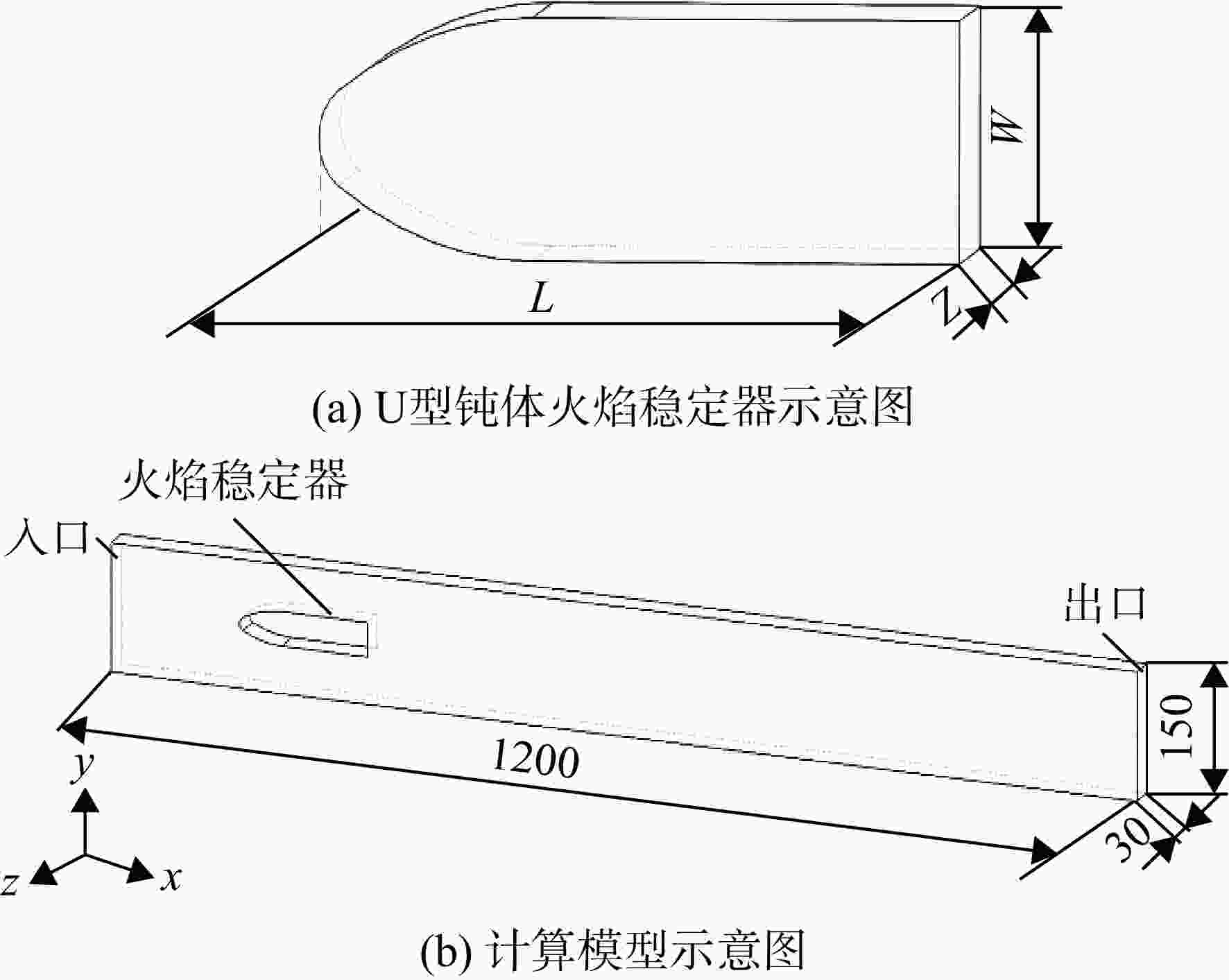
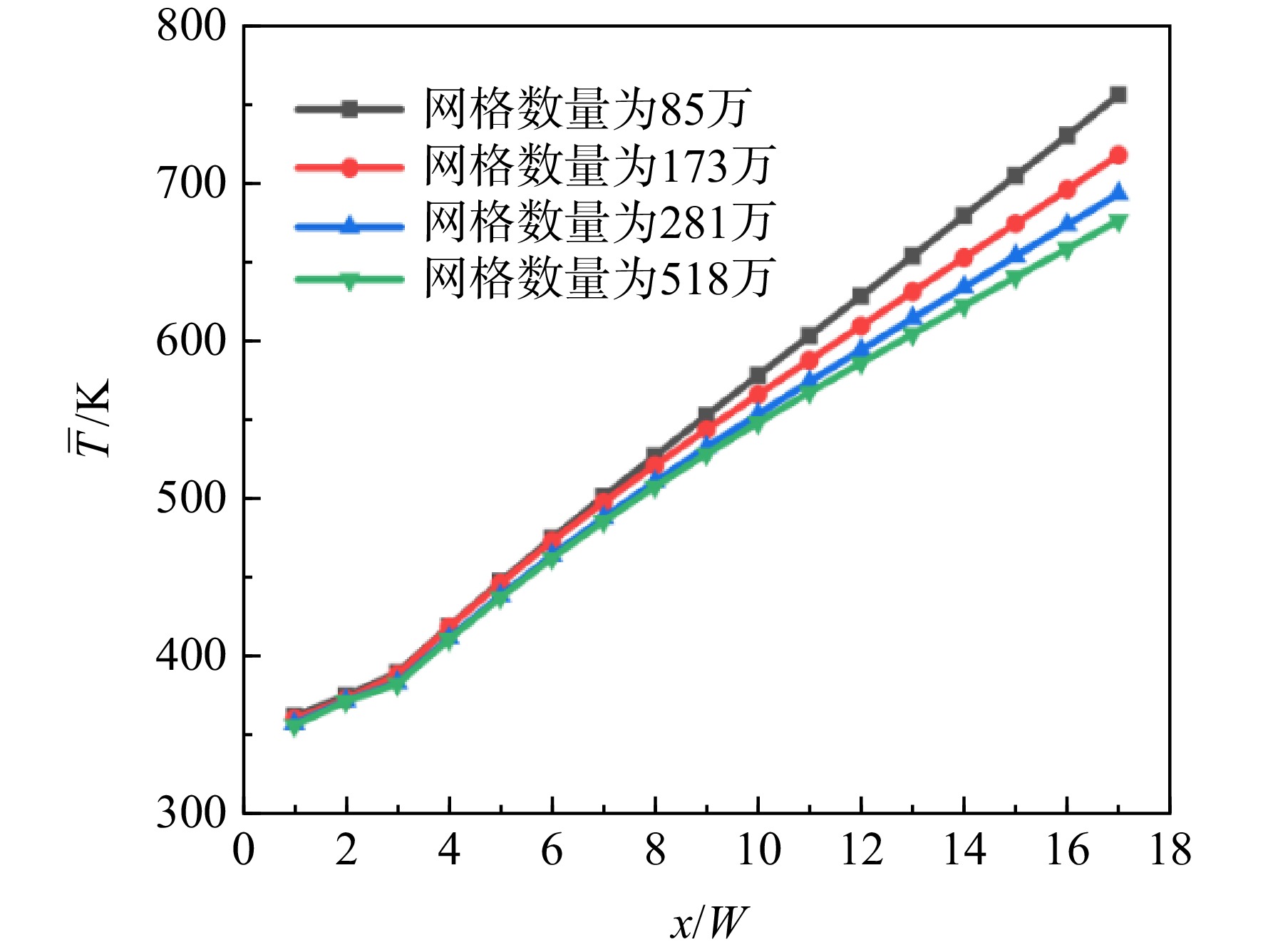
图 1 几何模型及计算域示意图(单位:mm)
Figure 1. Sketch of geometric model and computational domain (unit:mm)
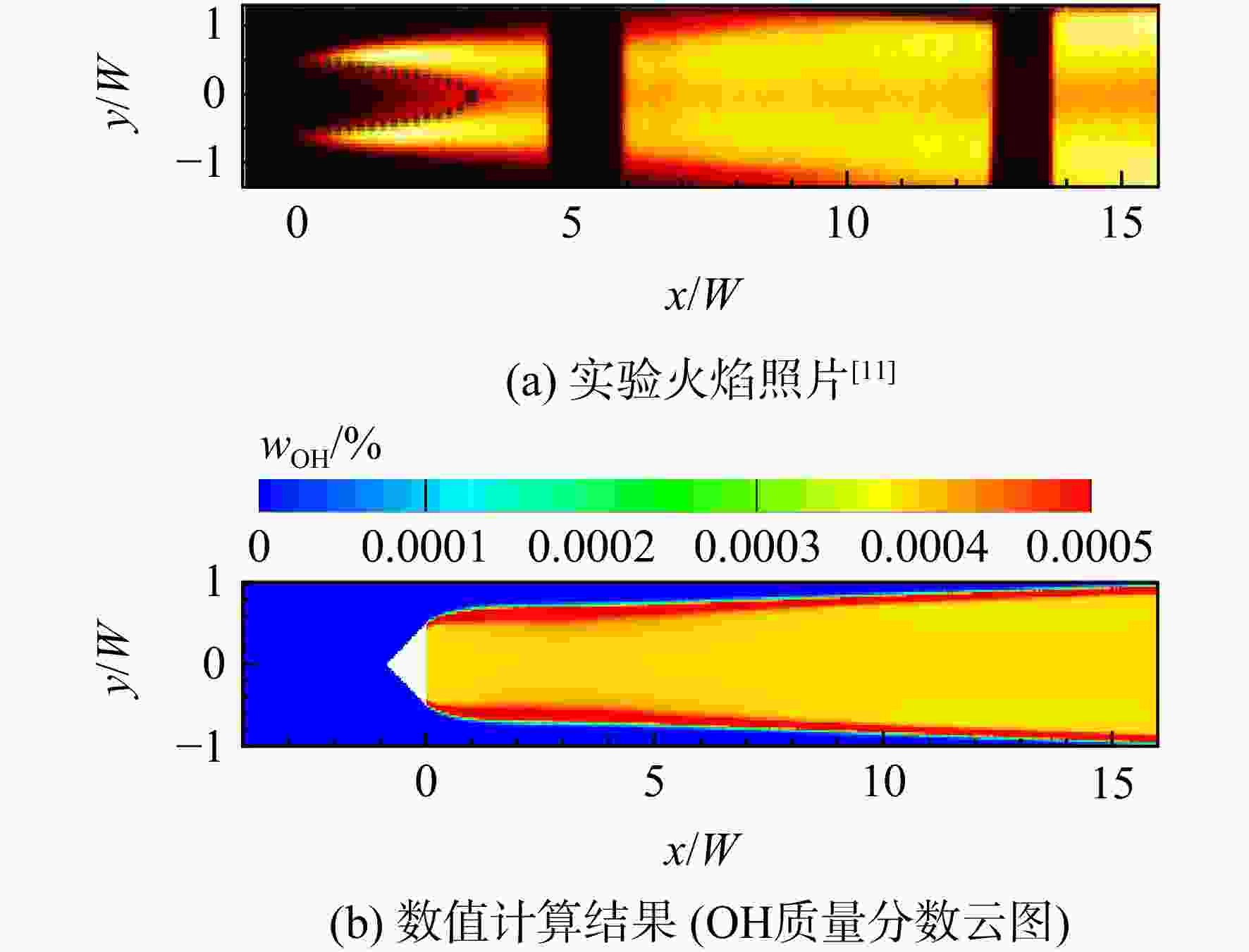
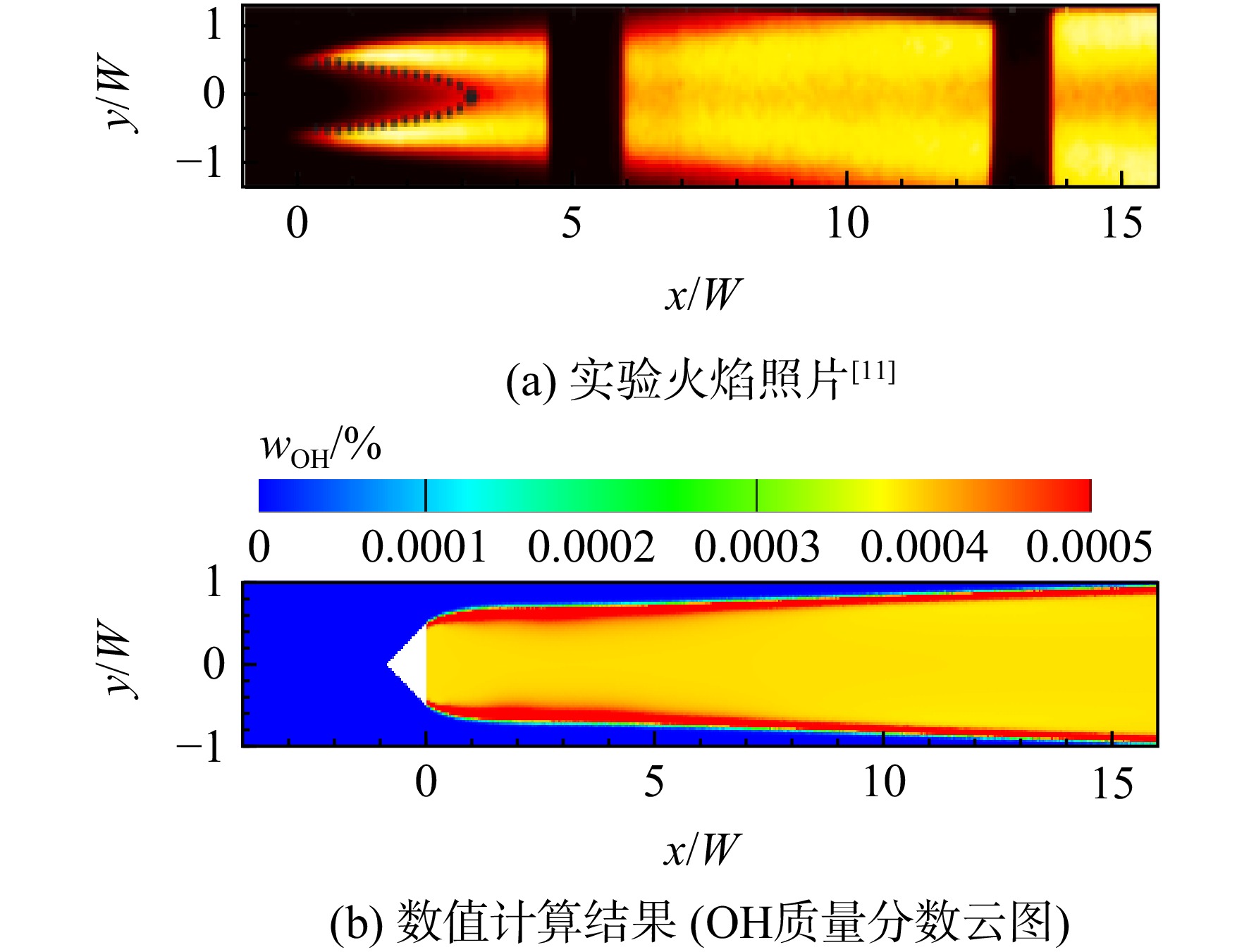
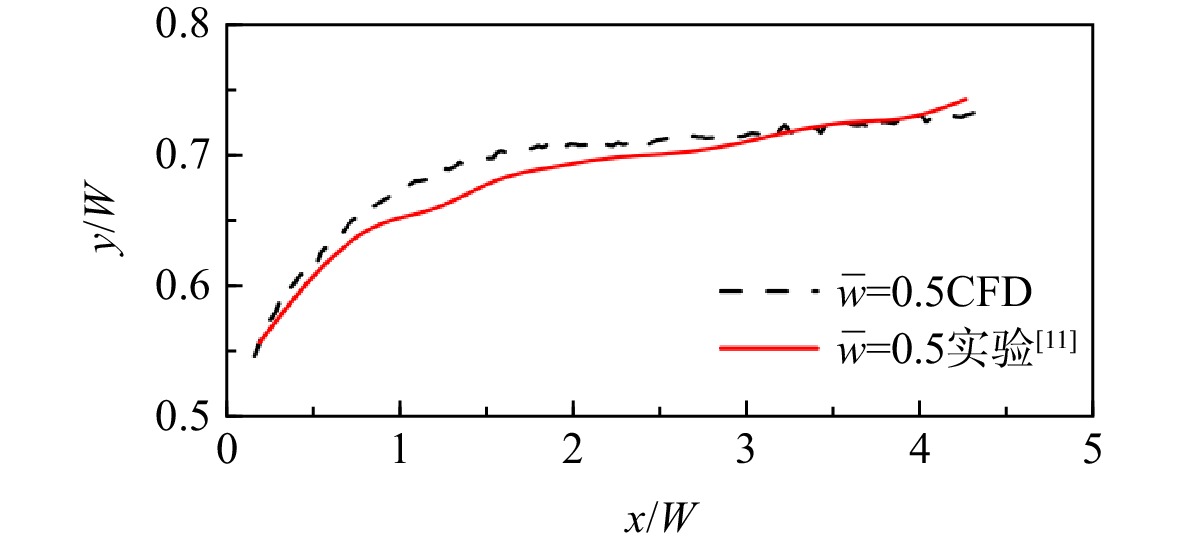
图 3 实验火焰照片及仿真OH质量分数云图
Figure 3. Test flame photo and simulated OH mass fraction cloud image

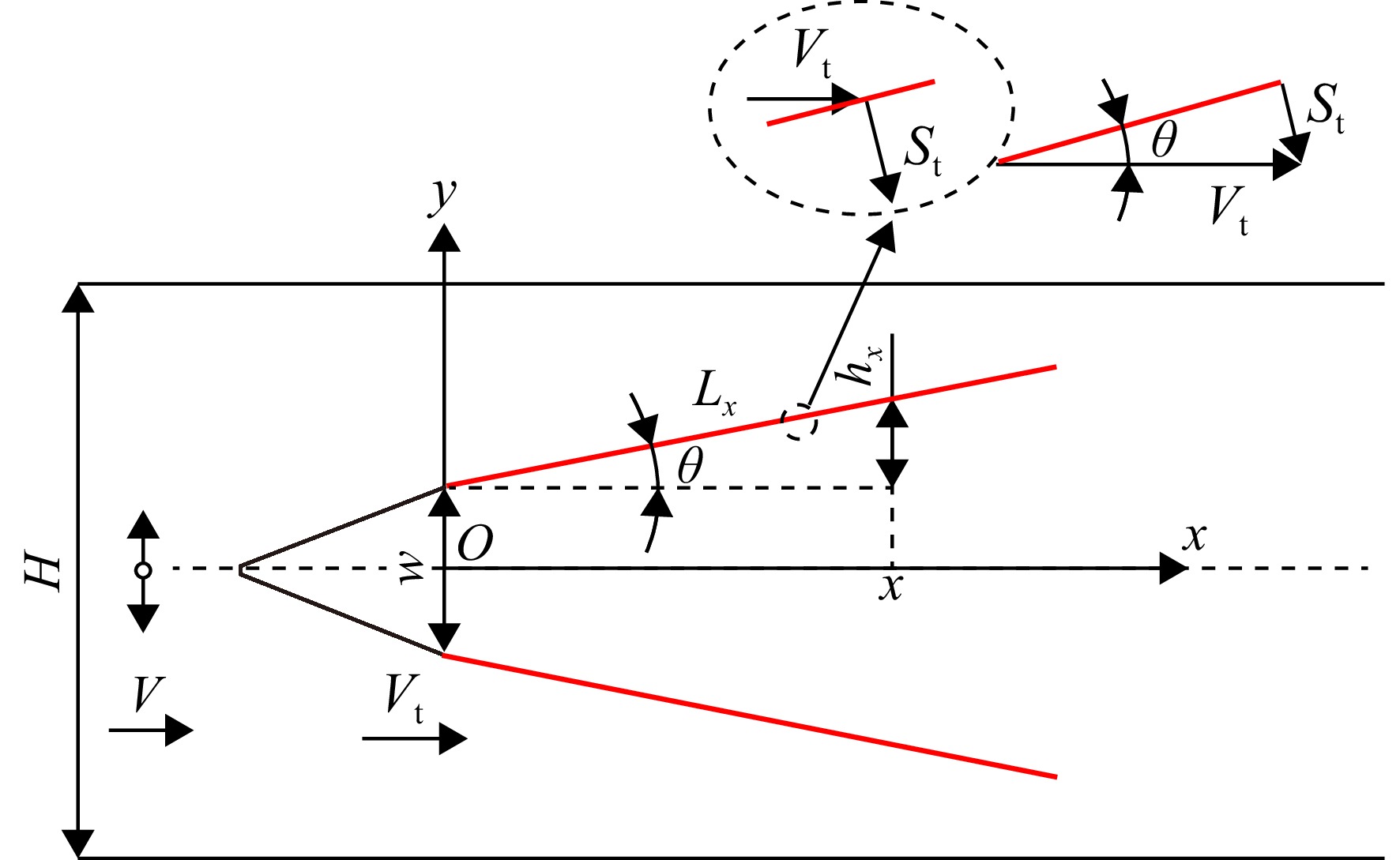
图 5 稳定器下游火焰扩张示意图
Figure 5. Schematic diagram of downstream flame expansion of the flame stabilizer
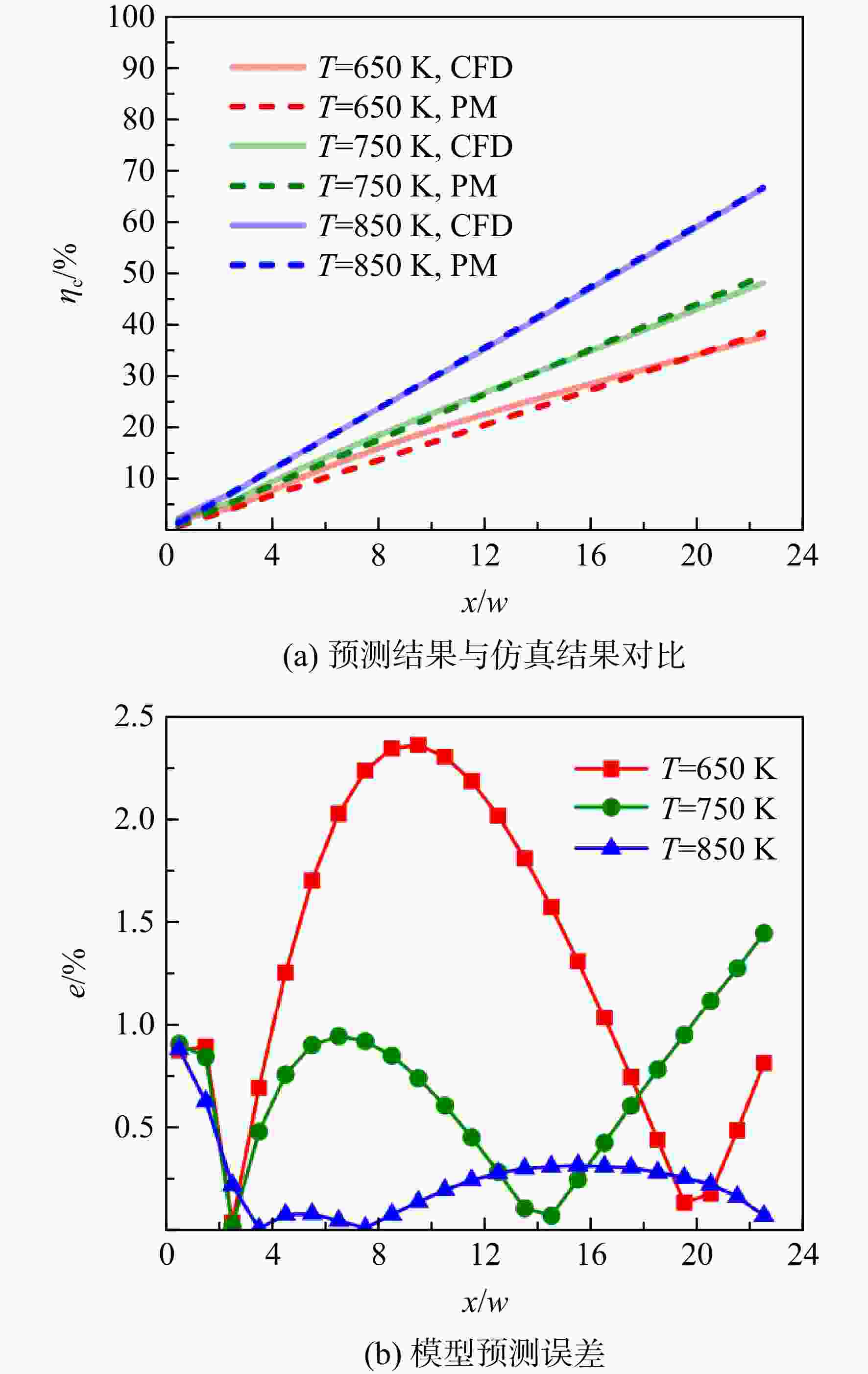
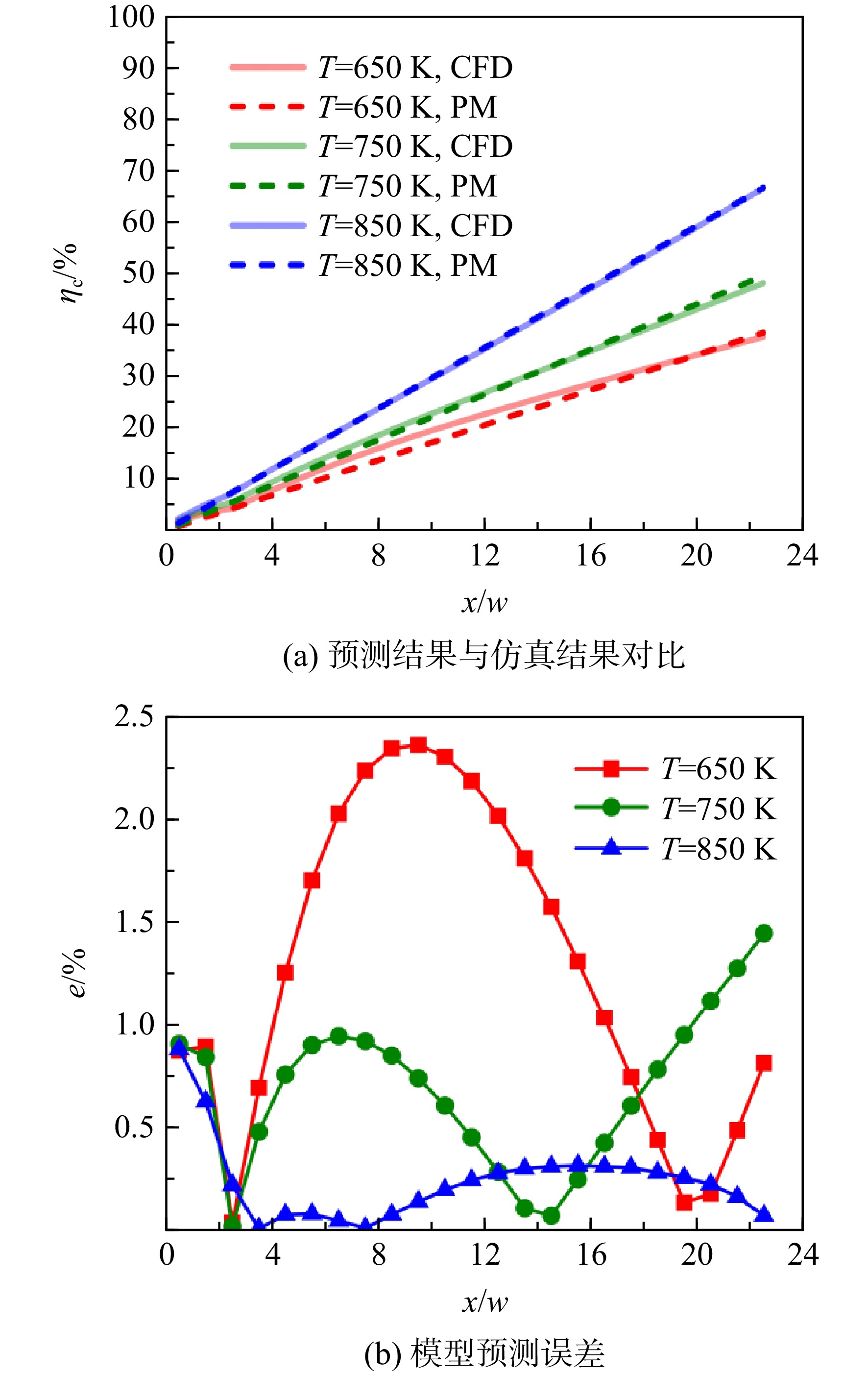
图 7 不同来流温度下预测模型精度结果
Figure 7. Prediction model accuracy results under different incoming temperatures

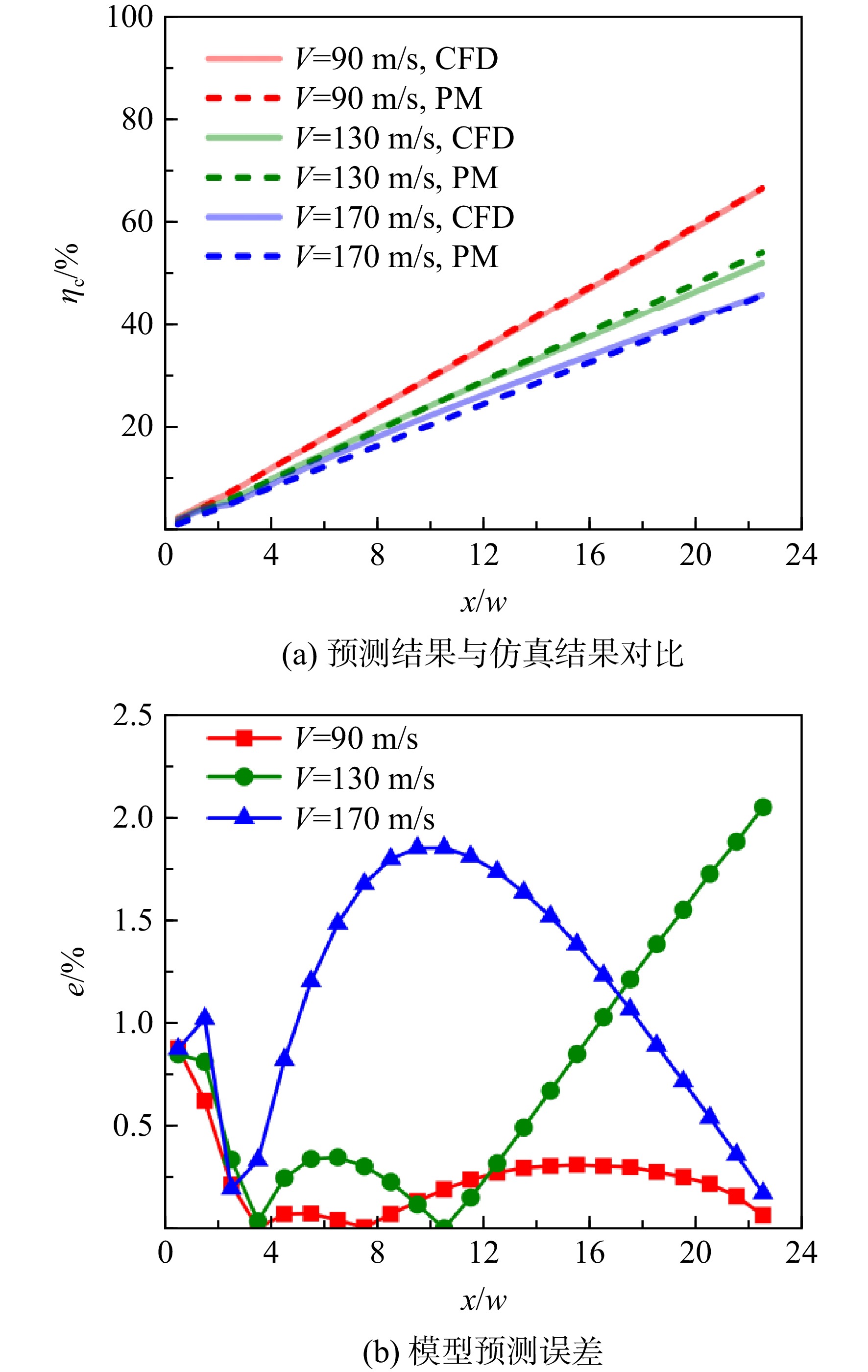
图 8 不同来流速度下预测模型精度结果
Figure 8. Prediction model accuracy results under different incoming velocities
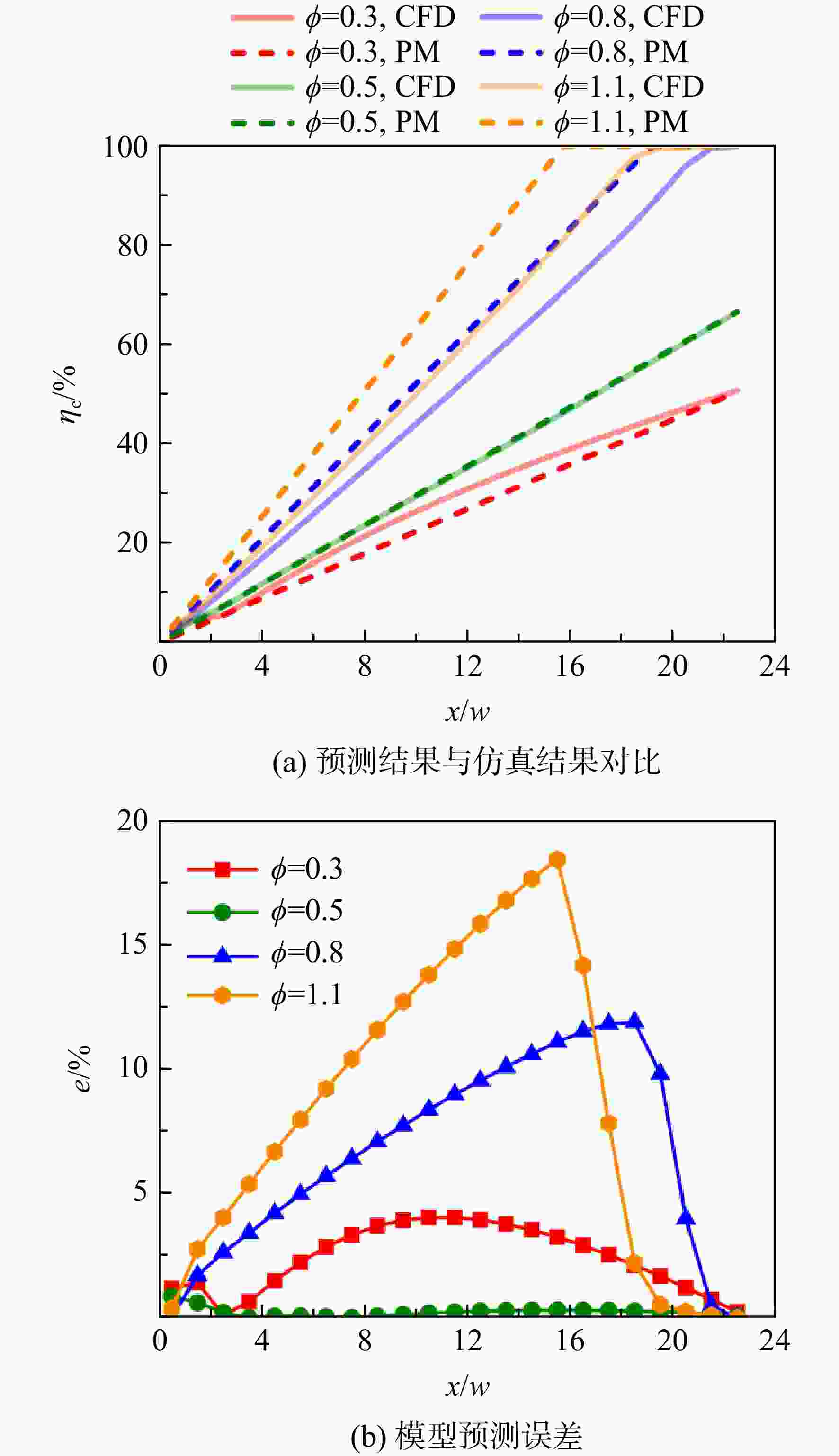
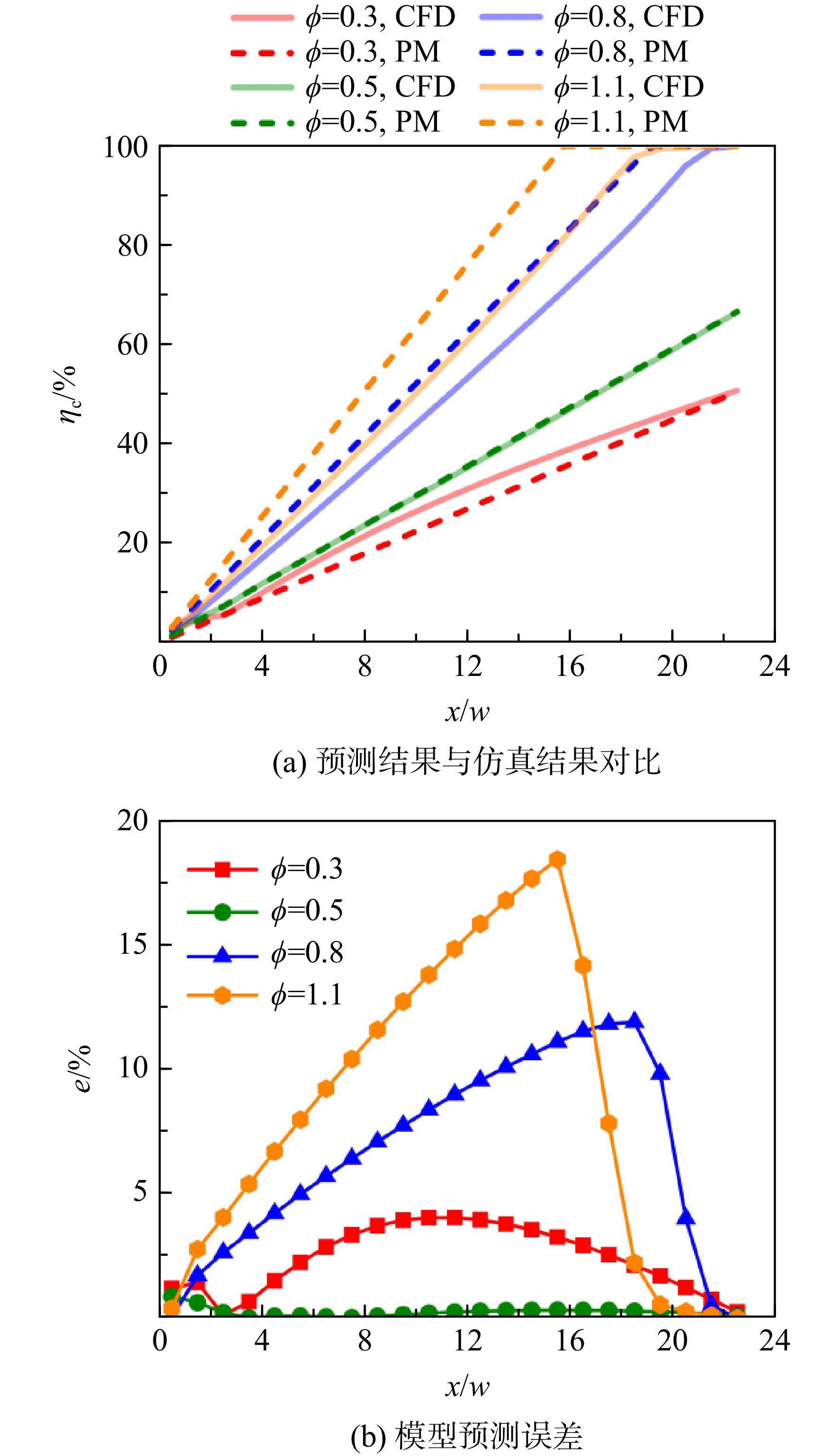
图 9 不同当量比下预测模型精度结果
Figure 9. Prediction model accuracy results under different equivalent ratios
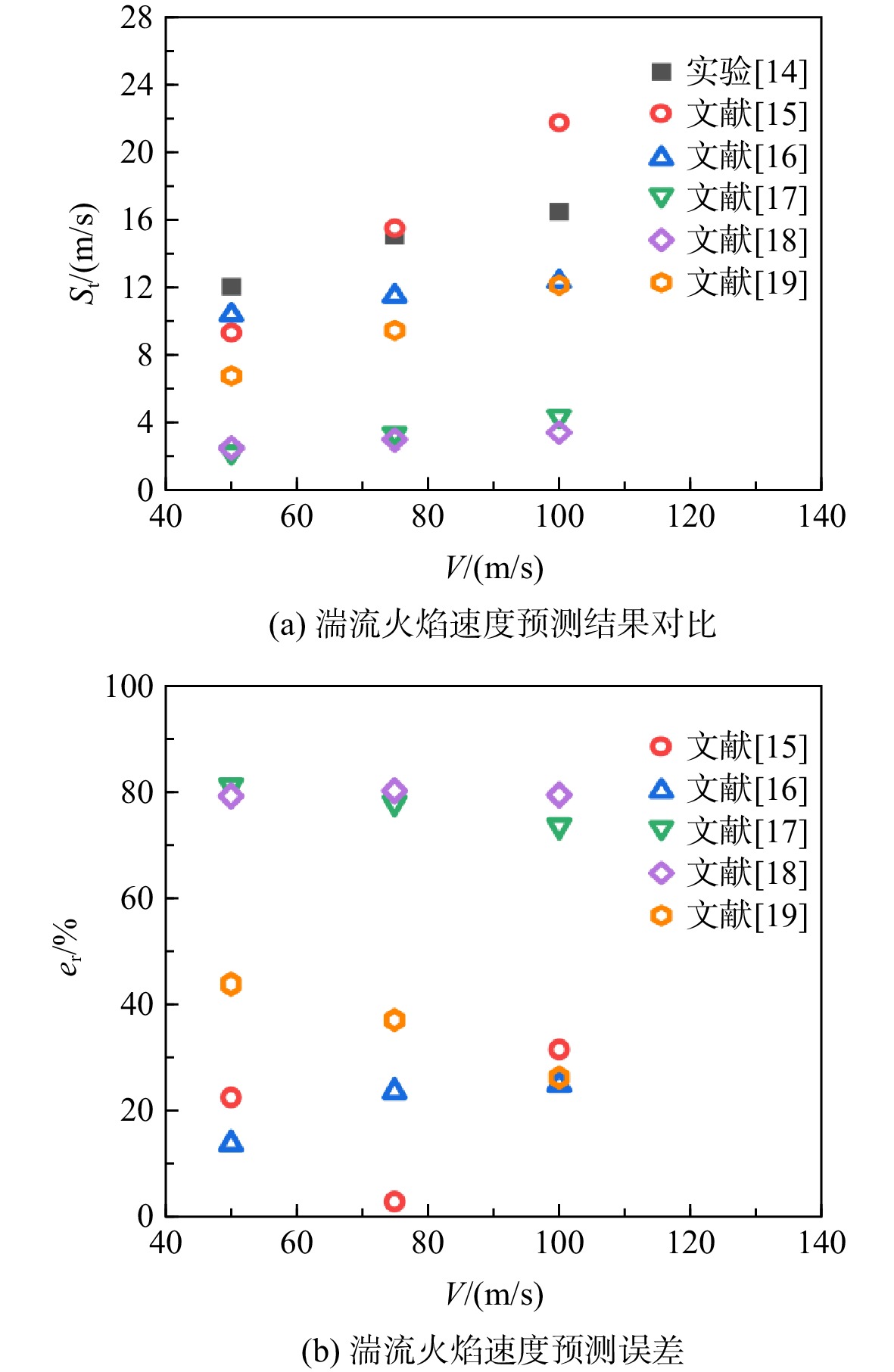
表 1 湍流火焰速度预测模型
Table 1. Prediction model of turbulent flame velocity
文献 模型 适用范围 [15] $\begin{gathered} \frac{{S}_{\rm{t}}}{{S}_{{\mathrm{l}}}^{0}}=={A}_{0}\mathrm{e}\mathrm{x}\mathrm{p}\left\{\left[\left(1.742+0.182{S}_{{\mathrm{l}}}^{0}{A}_{0}^{2}\right)+\frac{1}{2}\mathrm{ln}\left(\frac{{l}_{{\mathrm{t}}}}{{\delta }_{{\mathrm{l}}}^{0}}\right)\right]\times\right.\\\left.\left[1-\mathrm{exp}\left(-\dfrac{\dfrac{\left(1-{{\rho }_{{\mathrm{b}}}}/{{\rho }_{{\mathrm{u}}}}\right){A}_{0}\left(K=1\right)}{Le}R{e}^{-\tfrac{1}{4}}{\left({{l}_{{\mathrm{t}}}}/{{\delta }_{{\mathrm{l}}}^{0}}\right)}^{\tfrac{1}{2}}}{\left(1.742+0.182{S}_{{\mathrm{l}}}^{0}{A}_{0}^{2}\right){A}_{0}}\times \dfrac{{u}'}{{S}_{{\mathrm{l}}}^{0}}\right)\right]\right\} \end{gathered}$ 适用于平面火焰和本生灯火焰等 [16] $ \dfrac{{S}_{\rm{t}}}{{S}_{{\mathrm{l}}}^{0}}=6.4{\left(\dfrac{{u}'}{{S}_{{\mathrm{l}}}^{0}}\right)}^{\tfrac{1}{4}} $ 适用于$ \eta < 0.6{l}_{{\mathrm{f}}} $且$ Re\leqslant 3\;200 $或者$ \eta < 1.5{l}_{{\mathrm{f}}} $且$ Re > 3\;200 $ [17] $ \dfrac{{S}_{\rm{t}}}{{S}_{{\mathrm{l}}}^{0}}=0.52{\left(Pr\dfrac{{S}_{{\mathrm{l}}}^{0}{l}_{{\mathrm{t}}}}{{u}'{l}_{{\mathrm{f}}}}\right)}^{\tfrac{1}{4}}\dfrac{{u}'}{{S}_{{\mathrm{l}}}^{0}} $ 结合小尺度湍流对增强标量混合的影响和
大尺度湍流对火焰表面起皱的影响[18] $ \dfrac{{S}_{\rm{t}}}{{S}_{{\mathrm{l}}}}=\left\{0.5\left[1+\left(1+8\dfrac{{u}^{'2}}{{S}_{{\mathrm{l}}}^{2}}\right)^{0.5}\right]\right\}^{0.5} $ 适用于弱强度湍流燃烧 [19] $ \dfrac{{S}_{\rm{t}}}{{S}_{{\mathrm{l}}}^{0}}=1+0.195\dfrac{{l}_{{\mathrm{t}}}}{{l}_{{\mathrm{f}}}}\left(\sqrt{1+20.5\dfrac{{u}'{l}_{{\mathrm{f}}}}{{S}_{{\mathrm{l}}}^{0}{l}_{{\mathrm{t}}}}}-1\right) $ 适用于大尺度湍流燃烧和小尺度湍流燃烧 注:$ {S}_{{\mathrm{l}}}^{0} $为无应变一维层流火焰的层流火焰速度,$ {\delta }_{{\mathrm{l}}}^{0} $为无应变一维层流火焰的层流火焰厚度,$ {S}_{{\mathrm{l}}} $为层流火焰速度,$ {A}_{0} $为拉伸因子,$ {l}_{{\mathrm{t}}} $为湍流积分尺度,$ {\rho }_{{\mathrm{b}}} $和$ {\rho }_{{\mathrm{u}}} $分别为已燃气体和未燃气体的密度,$ Le $、$ Pr $和$ Re $分别为湍流刘易斯数、普朗特数和雷诺数,K为传递系数,$u' $为湍流脉动速度,$ {l}_{{\mathrm{f}}} $为扩散火焰厚度,$ \eta $为科尔莫戈罗夫长度尺度。  下载: 导出CSV
表 2 湍流火焰速度$ {{\boldsymbol{S}}}_{\bf{t}} $实验结果[14]
Table 2. Test results of the turbulence flame velocity $ {{\boldsymbol{S}}}_{\bf{t}} $[14]
T/K p/Pa V/(m/s) $ {S}_{\rm{t}}/ (\mathrm{m}/\mathrm{s}) $ 573 101325 50 12.06 573 101325 75 15.07 573 101325 100 16.50
下载: 导出CSV
表 3 数值模拟工况及湍流强度结果
Table 3. Numerical simulation conditions and turbulence intensity results
工况 $ T/\mathrm{K} $ $ V/ (\mathrm{m}/\mathrm{s}) $ $ \phi $ $ I $/% C 1 600 75 0.61 5.70 0.188 0 2 700 75 0.61 7.00 0.228 5 3 800 75 0.61 8.30 0.268 5 4 900 75 0.61 9.60 0.308 0 5 900 100 0.61 8.80 0.292 5 6 900 125 0.61 8.00 0.273 5 7 900 150 0.61 7.38 0.258 0 8 900 75 0.22 30.00 1.058 5 9 900 75 0.347 13.56 0.460 5 10 900 75 0.844 8.14 0.253 0 11 900 75 1.0 6.31 0.193 7 12 900 75 1.2 4.01 0.122 5
下载: 导出CSV
表 4 数值模拟工况
Table 4. Numerical simulation conditions
工况 $ T/{\mathrm{K}} $ $ V/ (\mathrm{m}/\mathrm{s}) $ $ \phi $ 13 650 90 0.5 14 750 90 0.5 15 850 90 0.5 16 850 130 0.5 17 850 170 0.5 18 850 90 0.3 19 850 90 0.8 20 850 90 1.1
下载: 导出CSV
-
[1] 黄勇,林宇震,樊未军,等. 燃烧与燃烧室[M]. 北京: 北京航空航天大学出版社,2009. HUANG Yong,LIN Yuzhen,FAN Weijun,et al. Combustion and combustion chamber[M]. Beijing: Beihang University Press,2009. (in ChineseHUANG Yong, LIN Yuzhen, FAN Weijun, et al. Combustion and combustion chamber[M]. Beijing: Beihang University Press, 2009. (in Chinese) [2] 季鹤鸣,刘玉英. 涡扇加力与多功能排气装置[M]. 上海: 上海交通大学出版社,2021. JI Heming,LIU Yuying. Afterburner and multi-function exhaust system of turbofan engine[M]. Shanghai: Shanghai Jiao Tong University Press,2021. (in ChineseJI Heming, LIU Yuying. Afterburner and multi-function exhaust system of turbofan engine[M]. Shanghai: Shanghai Jiao Tong University Press, 2021. (in Chinese) [3] 张孝春,孙雨超,刘涛. 先进加力燃烧室设计技术综述[J]. 航空发动机,2014,40(2): 24-30,60. ZHANG Xiaochun,SUN Yuchao,LIU Tao. Summary of advanced afterburner design technology[J]. Aeroengine,2014,40(2): 24-30,60. (in ChineseZHANG Xiaochun, SUN Yuchao, LIU Tao. Summary of advanced afterburner design technology[J]. Aeroengine, 2014, 40(2): 24-30, 60. (in Chinese) [4] CROSS C,LUBARSKY E,SHCHERBIK D,et al. Determination of equivalence ratio and oscillatory heat release distributions in non-premixed bluff body-stabilized flames using chemiluminescence imaging[R]. ASME Paper GT2011-45,2011. [5] KING C R. A semiempirical correlation of afterburner combustion efficiency and lean-blowout fuel-air-ratio data with several afterburner-inlet variables and afterburner lengths[R]. NACA-RM-E57F26,1957. [6] MA Zhuang,JI Tingwei,CUI Tao,et al. Access to empirical formulations of combustion efficiency for gas turbine combustors with improved generalization ability[J]. Journal of Thermal Science and Engineering Applications,2021,13(2): 021001. [7] LEFEBVRE A H. Theoretical aspects of gas turbine combustion performance[R]. Cranfield,US:College of Aeronautics Note Aero R33088,1966. [8] LEFEBVRE A H. Fuel effects on gas turbine combustion: ignition,stability,and combustion efficiency[J]. Journal of Engineering for Gas Turbines and Power,1985,107(1): 24-37. doi: 10.1115/1.3239693 [9] 冯玉桦. 射流预冷对蒸发式火焰稳定器燃烧性能的影响[D]. 北京: 北京航空航天大学,2019. FENG Yuhua. Effect of MIPCC on the combustion performance of piloted evaporation flameholder[D]. Beijing: Beihang University,2019. (in ChineseFENG Yuhua. Effect of MIPCC on the combustion performance of piloted evaporation flameholder[D]. Beijing: Beihang University, 2019. (in Chinese) [10] MA Hongan,XIE Maozhao,ZENG Wen,et al. Experimental study on combustion characteristics of Chinese RP-3 kerosene[J]. Chinese Journal of Aeronautics,2016,29(2): 375-385. [11] FUGGER C A,FORLINES R A,PAXTON B T,et al. Freestream and shear layer effects in bluff-body-stabilized turbulent premixed flames[J]. Combustion and Flame,2024,263: 113378. doi: 10.1016/j.combustflame.2024.113378 [12] OATES G C. Aerothermodynamics of aircraft engine components[M]. New York: AIAA,1985. [13] YOU Jiaping,YANG Yue. Modelling of the turbulent burning velocity based on Lagrangian statistics of propagating surfaces[J]. Journal of Fluid Mechanics,2020,887: A11. [14] 杨茂林,黄勇,顾善建,等. 燃油分布对V形稳定器后燃烧的影响[J]. 航空动力学报,1996,11(1): 48-52. YANG Maolin,HUANG Yong,GU Shanjian,et al. Influence of fuel distribution on combustion behined a V-gutter flameholder[J]. Journal of Aerospace Power,1996,11(1): 48-52. (in ChineseYANG Maolin, HUANG Yong, GU Shanjian, et al. Influence of fuel distribution on combustion behined a V-gutter flameholder[J]. Journal of Aerospace Power, 1996, 11(1): 48-52. (in Chinese) [15] LU Zhen,YANG Yue. Modeling of the turbulent burning velocity for planar and Bunsen flames over a wide range of conditions[J]. Acta Mechanica Sinica,2022,38(3): 121504. doi: 10.1007/s10409-021-09027-3 [16] GÜLDER Ö L. Turbulent premixed flame propagation models for different combustion regimes[J]. Symposium (International) on Combustion,1991,23(1): 743-750. [17] ZIMONT V L. Theory of turbulent combustion of a homogeneous fuel mixture at high Reynolds numbers[J]. Combustion,Explosion and Shock Waves,1979,15(3): 305-311. [18] CLAVIN P,WILLIAMS F A. Effects of molecular diffusion and of thermal expansion on the structure and dynamics of premixed flames in turbulent flows of large scale and low intensity[J]. Journal of Fluid Mechanics,1982,116: 251-282. [19] PETERS N. The turbulent burning velocity for large-scale and small-scale turbulence[J]. Journal of Fluid Mechanics,1999,384(1): 107-132. [20] Fluent Incorporation. ANSYS Fluent user’s guide[EB/OL]. (2020-12-01)[2024-12-18]. https://ansyshelp.ansys.com/public/account/secured?returnurl=/Views/Secured/corp/v242/en/flu_ug/flu_ug.html. [21] 刘广海,刘玉英,谢奕. 凹腔对一体化支板火焰稳定器燃烧性能的影响[J]. 航空动力学报,2018,33(8): 1838-1844. LIU Guanghai,LIU Yuying,XIE Yi. Effect of cavity on combustion characteristics of integrated strut flame stabilizer[J]. Journal of Aerospace Power,2018,33(8): 1838-1844. (in ChineseLIU Guanghai, LIU Yuying, XIE Yi. Effect of cavity on combustion characteristics of integrated strut flame stabilizer[J]. Journal of Aerospace Power, 2018, 33(8): 1838-1844. (in Chinese) -

 点击查看大图

计量
- 文章访问数: 525
- HTML浏览量: 331
- PDF量: 52
- 被引次数: 0