






Research on the fretting wear behavior of 3D non-Gaussian surfaces
-
摘要:
粗糙表面显著影响机械部件间的微动磨损行为,零部件的粗糙表面大多呈非高斯分布的特点。因此,基于三维非高斯表面建立更加符合实际工况的磨损模型对于揭示微动磨损行为的内在机理具有重要意义。基于实测表面形貌数据,利用快速傅里叶变换的数值仿真方法生成与实际表面符合的非高斯表面模型。利用ABAQUS有限元软件及二次开发的UMESHMOTION磨损子程序,建立非高斯表面有限元模型。探讨峰度、偏度和标准差值等因素对微动磨损的影响规律。结果表明:相比于光滑和高斯表面接触情况,正偏度高峰度的非高斯表面的局部应力集中最为明显,磨损深度最大。相同条件下的非高斯表面,负偏度和低峰度在接触性能上具有更均匀的应力分布和更稳定的磨损性能。随着表面标准差值的增大,三维非高斯表面的接触应力和磨损深度显著增加。
Abstract:Rough surfaces significantly affect the micromotional wear behavior among mechanical components, typically exhibiting non-Gaussian distribution characteristics. Therefore, it is of great significance to establish a wear model based on three-dimensional non-Gaussian surfaces that is more in line with the actual working conditions to reveal the intrinsic mechanism of the micromotional wear behavior. Based on the measured surface topography data, the numerical simulation method of fast Fourier transform was utilized to generate a non-Gaussian surface model that is consistent with the actual surface. The non-Gaussian surface finite element model was established by using ABAQUS finite element software and the second-developed UMESHMOTION wear subroutine. The influence patterns of factors such as kurtosis, skewness and standard deviation values on micromotion wear were explored. The results showed that the non-Gaussian surface with high kurtosis of positive skewness had the most obvious local stress concentration and the largest wear depth compared with the contact cases of smooth and Gaussian surfaces. For non-Gaussian surfaces under the same conditions, negative skewness and low kurtosis had more uniform stress distribution and more stable wear performance in terms of contact performance. The contact stress and wear depth of the 3D non-Gaussian surfaces increased significantly with the increasing values of the standard deviation of the surfaces.
-
Key words:
- fretting wear /
- 3D non-Gaussian rough surface /
- finite element analysis model /
- kurtosis /
- skewness
-
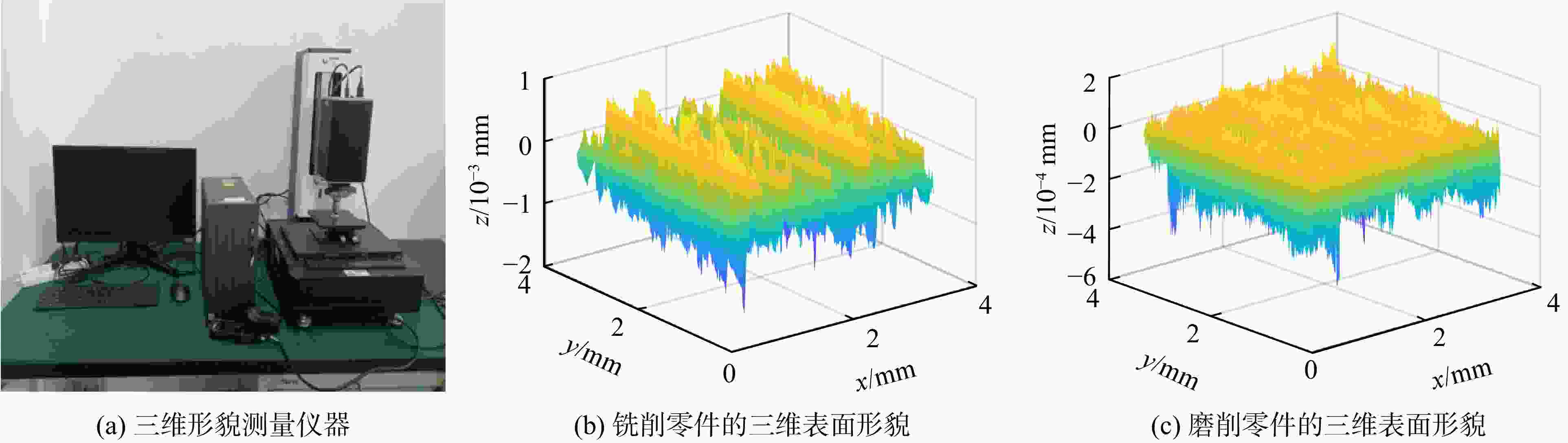
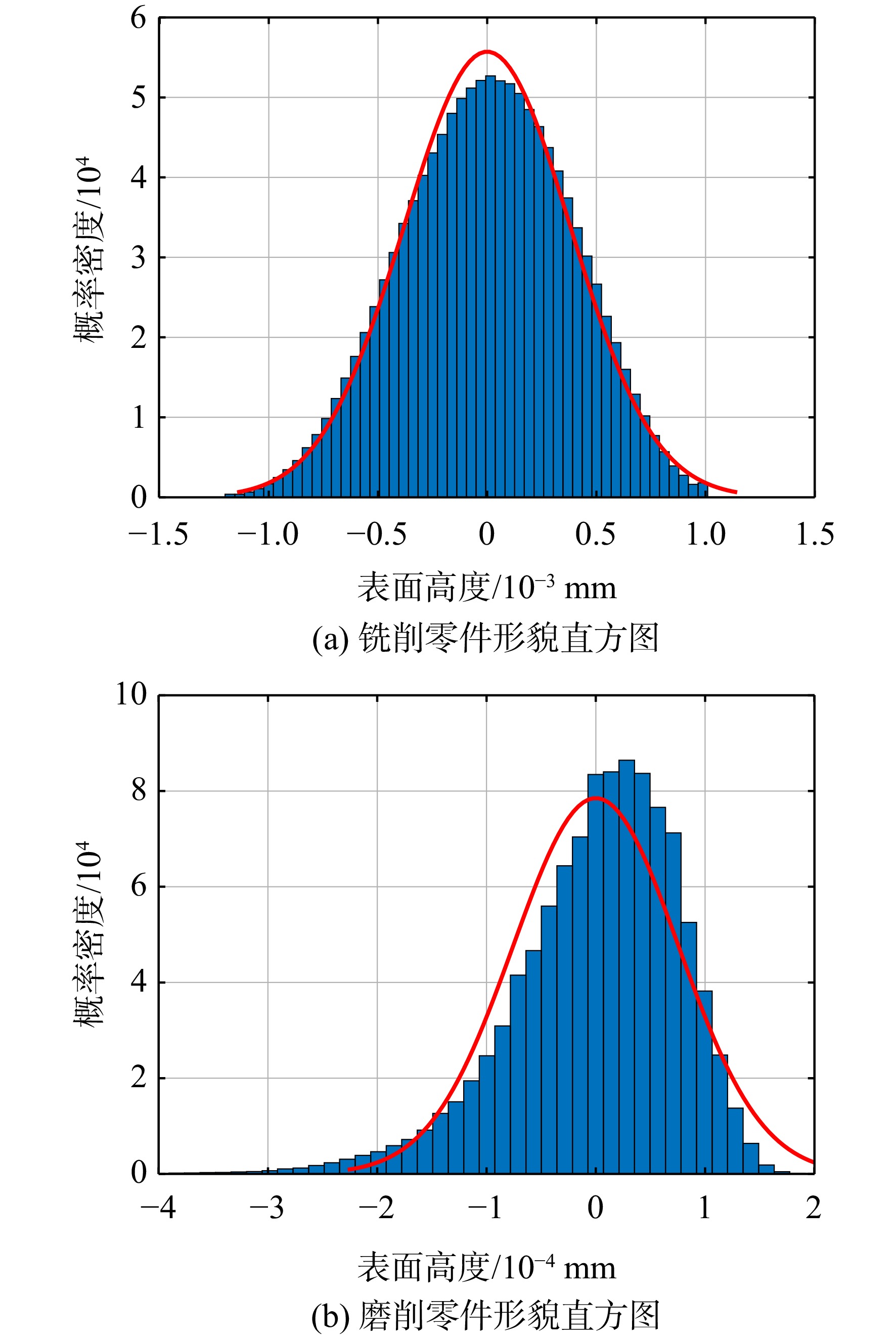
图 1 测量样品的三维表面形貌
Figure 1. Measurement of the three-dimensional surface topography of the sample
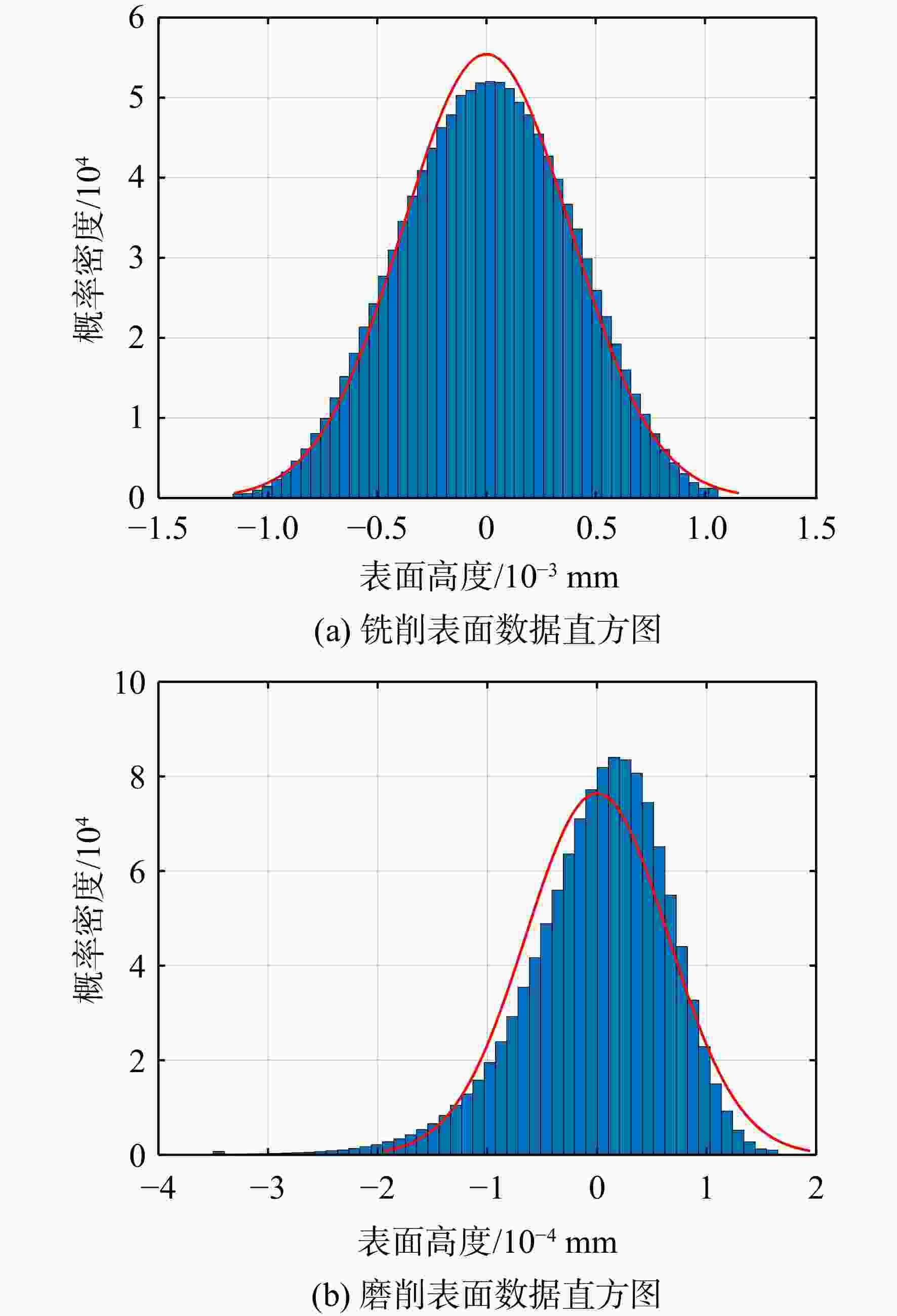
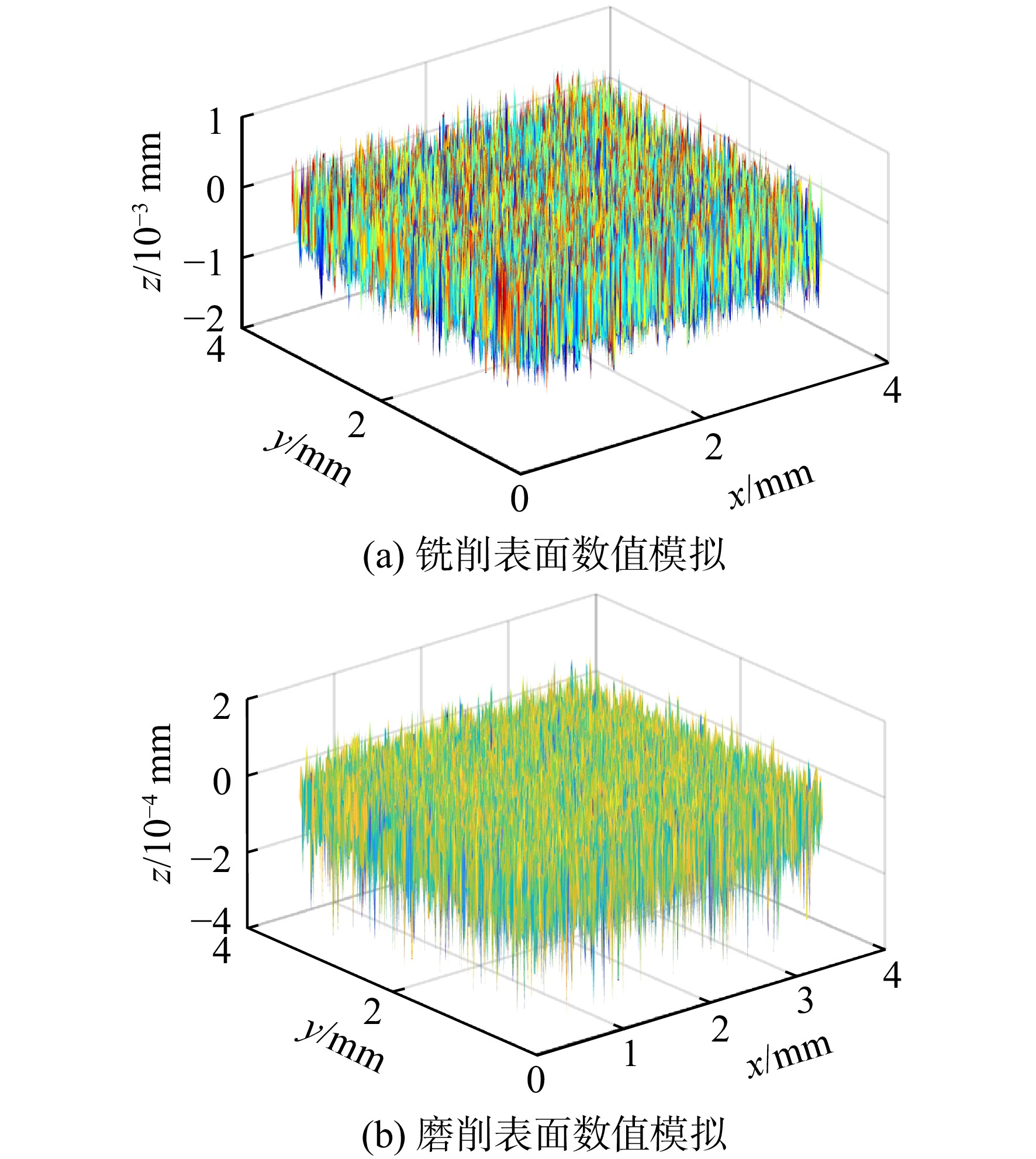
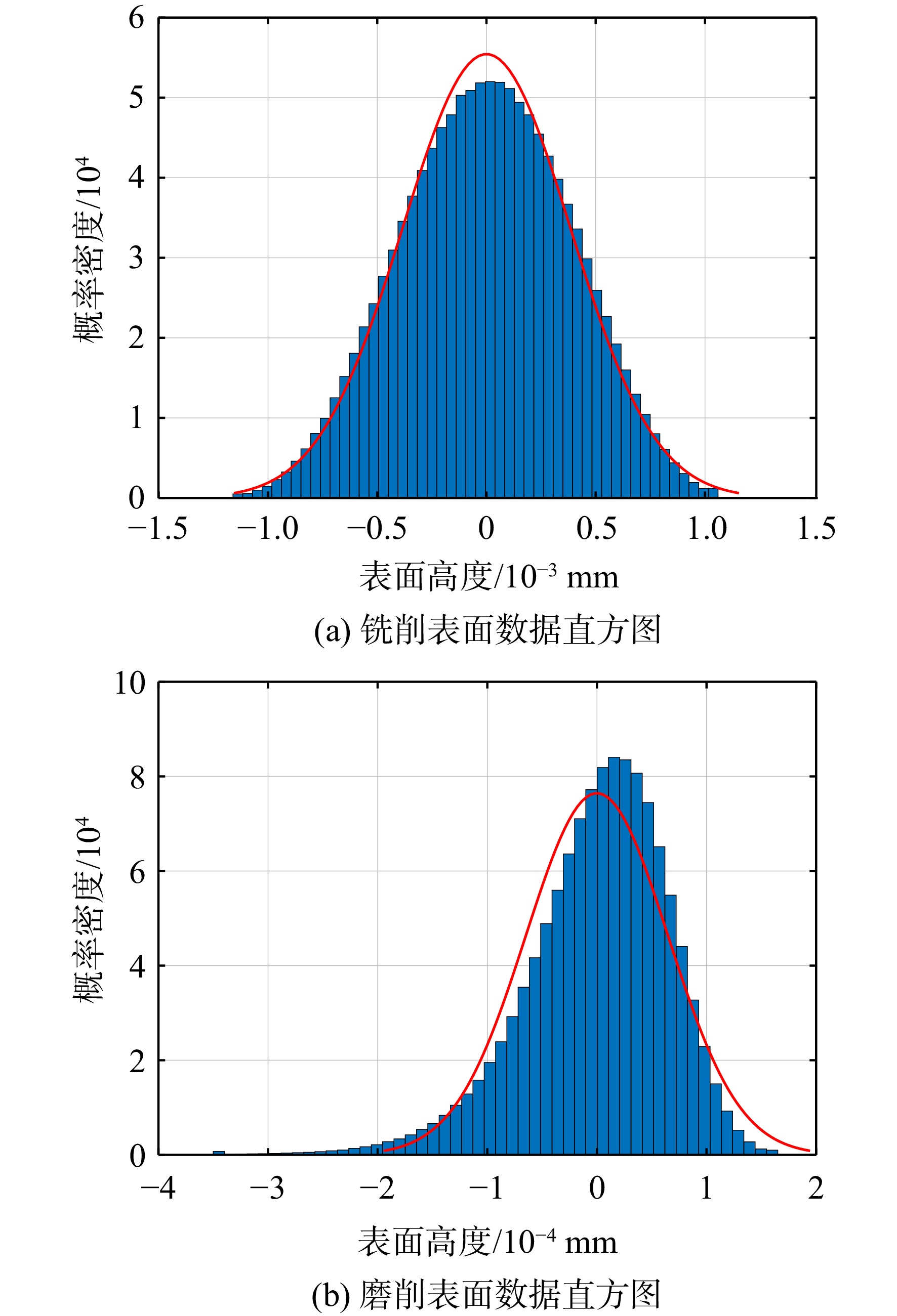
图 4 数值模拟非高斯表面的直方图
Figure 4. Histogram of numerically simulated non-Gaussian rough Surfaces
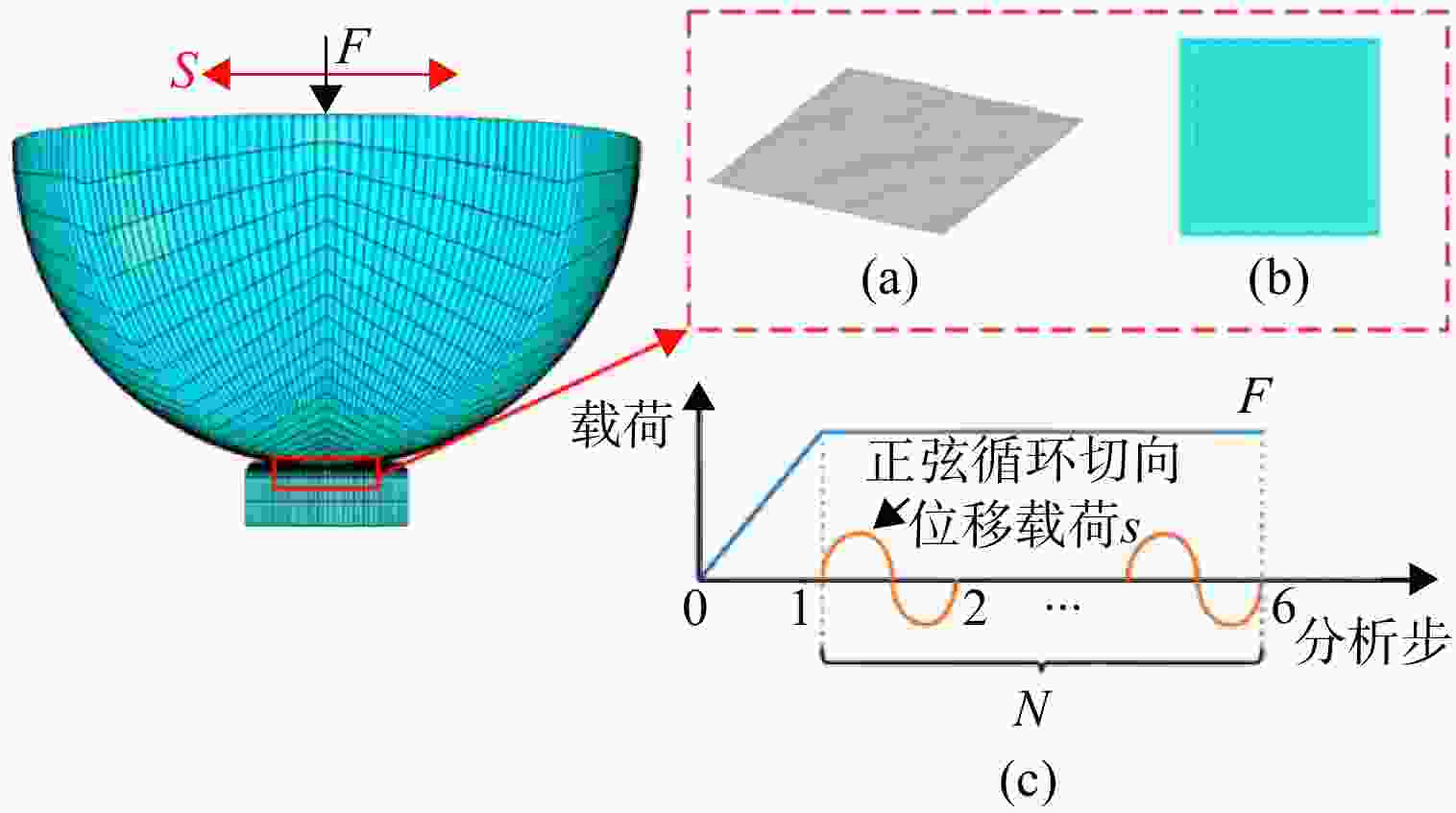
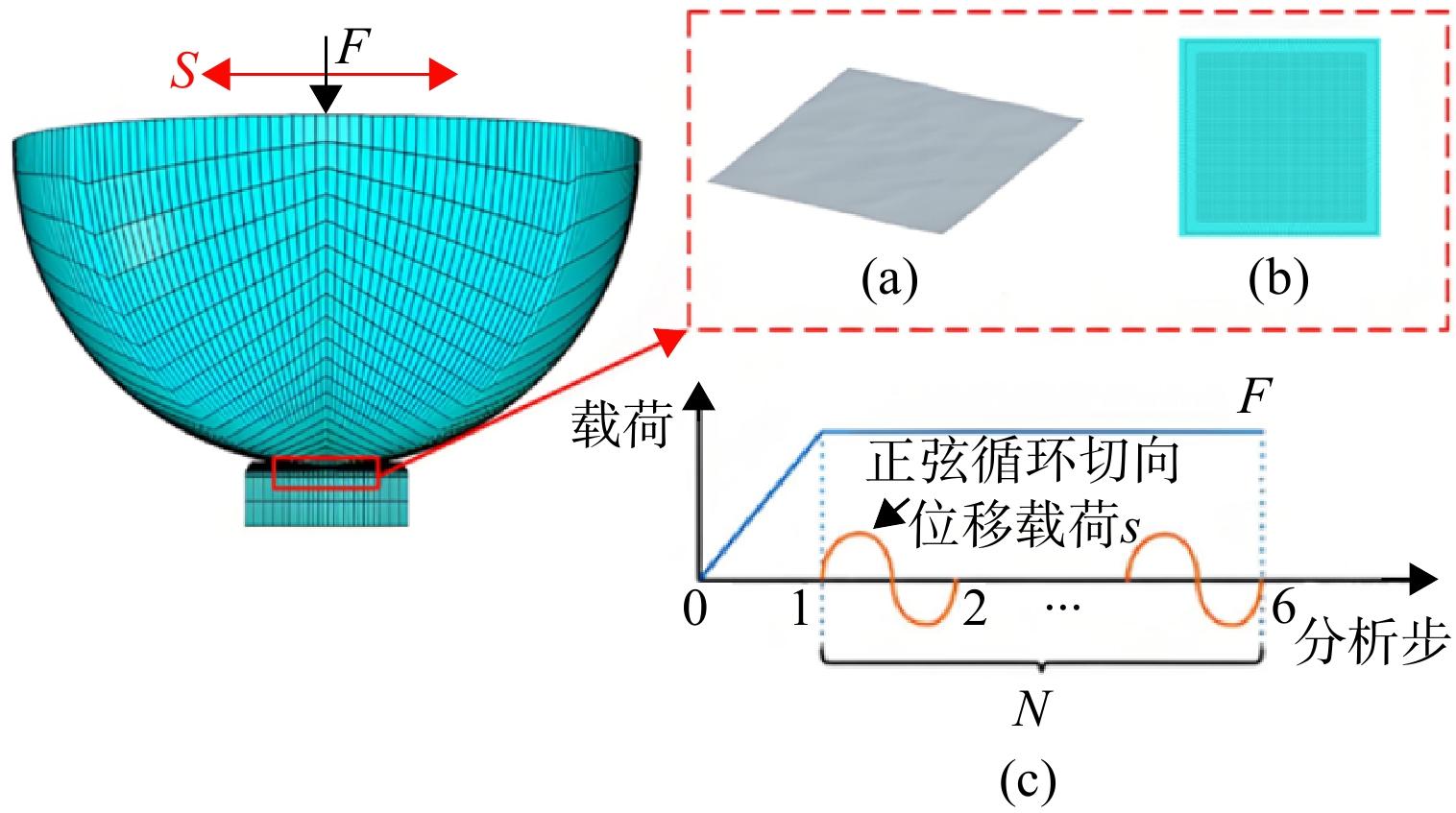
图 5 三维粗糙表面微动磨损有限元模型
Figure 5. Finite element modeling of micromotion wear on rough surfaces in three dimensions
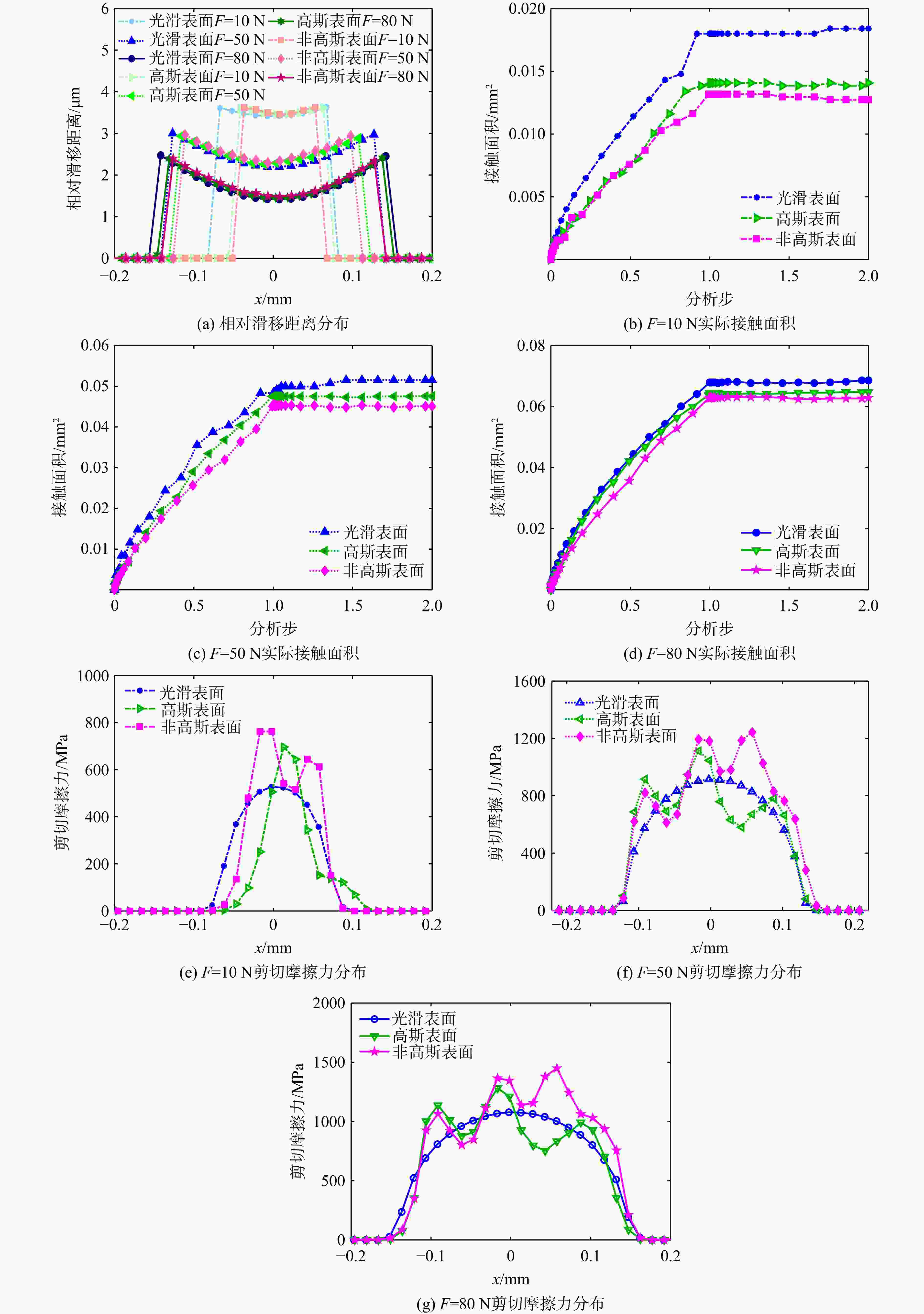
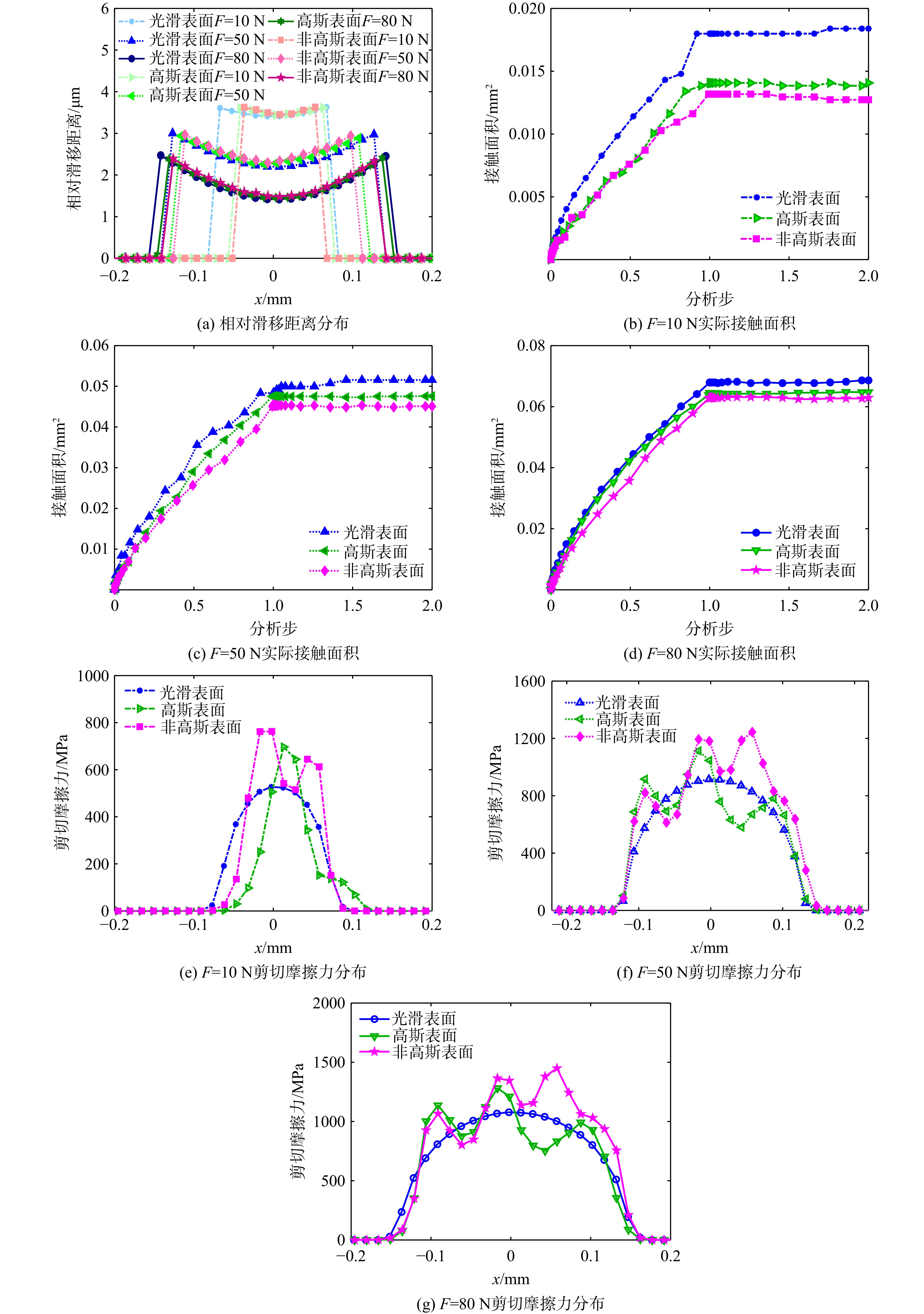
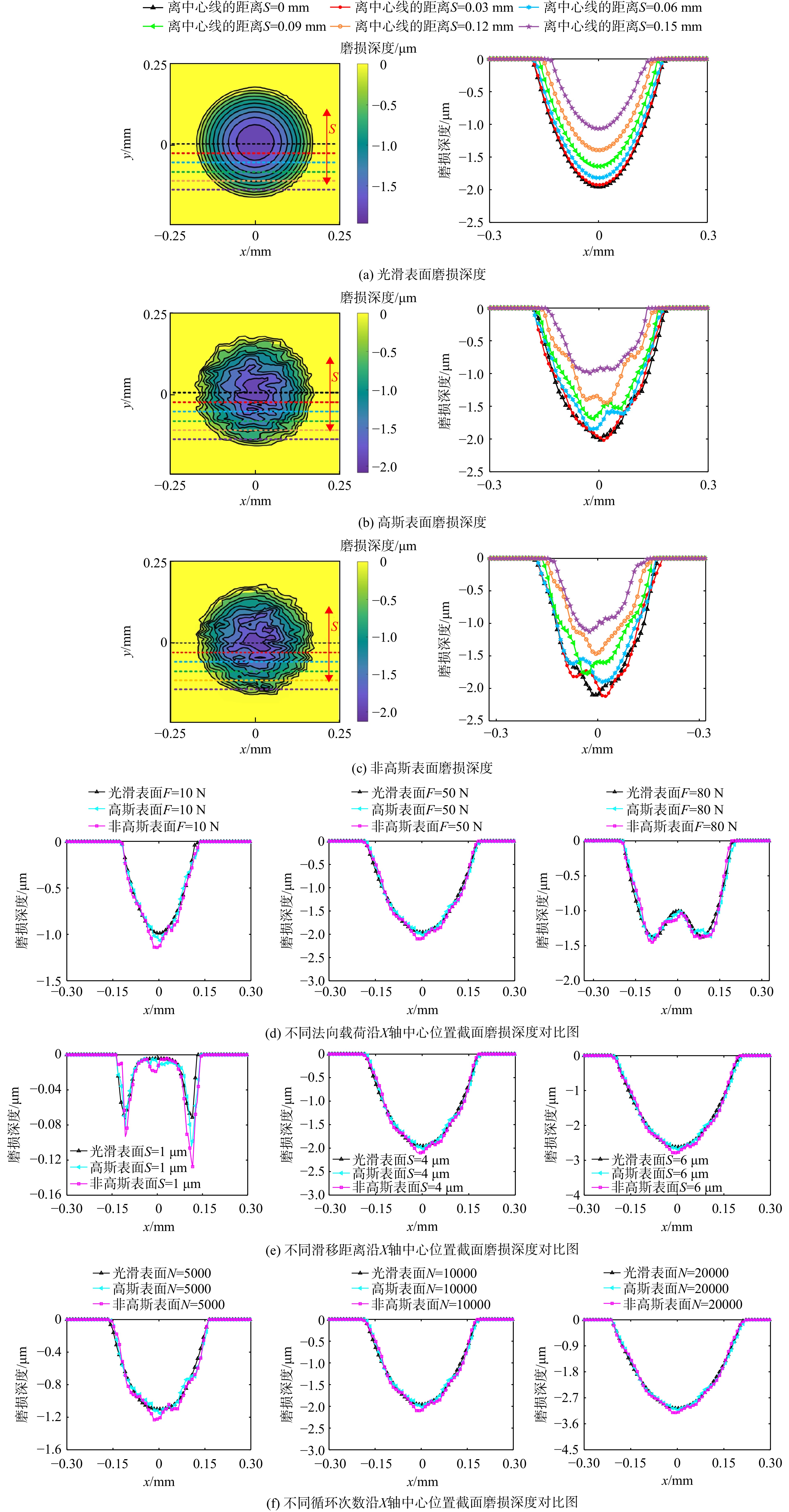
图 9 不同接触压力下相关接触量的分布
Figure 9. Distribution of relevant contact volume at different contact pressures
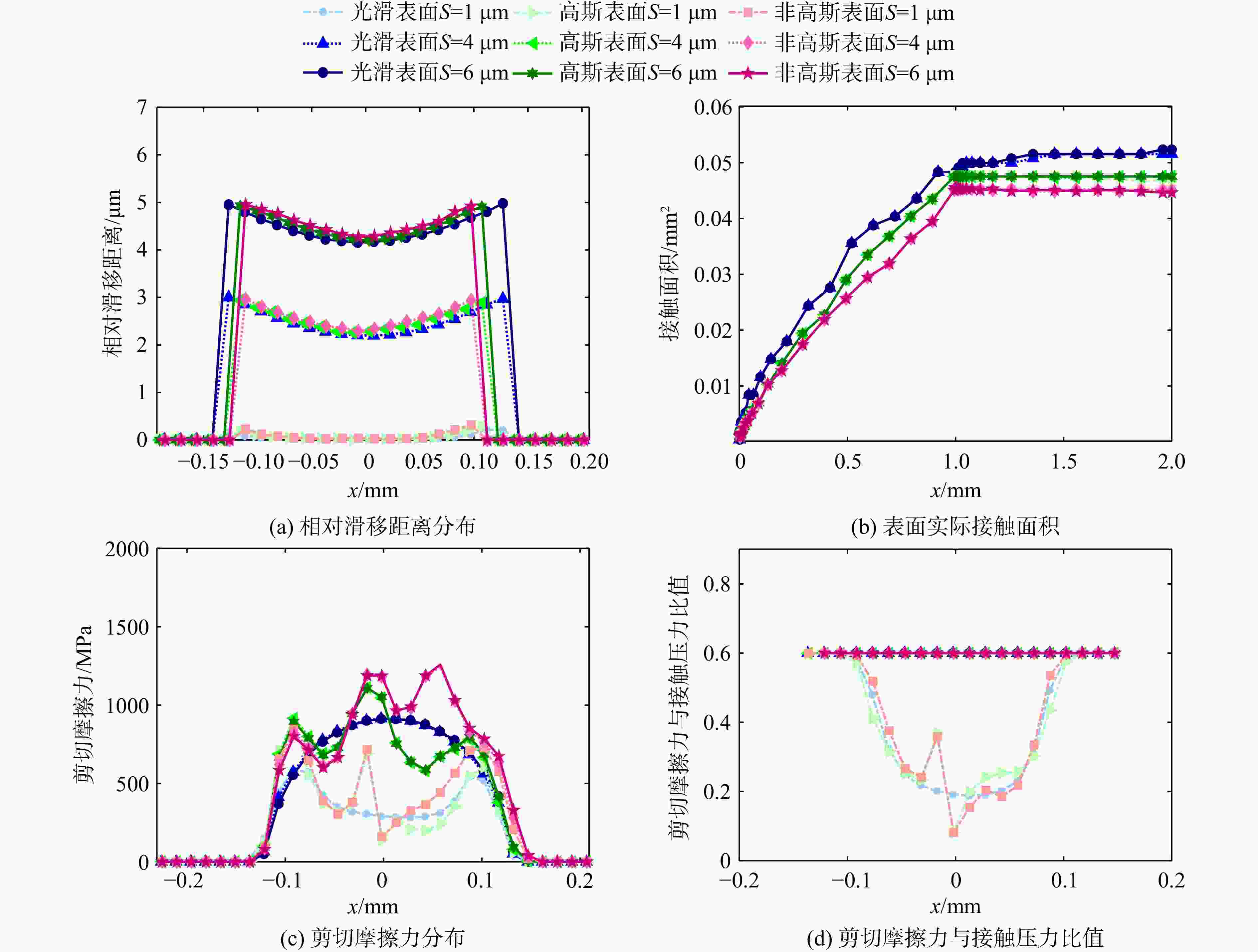
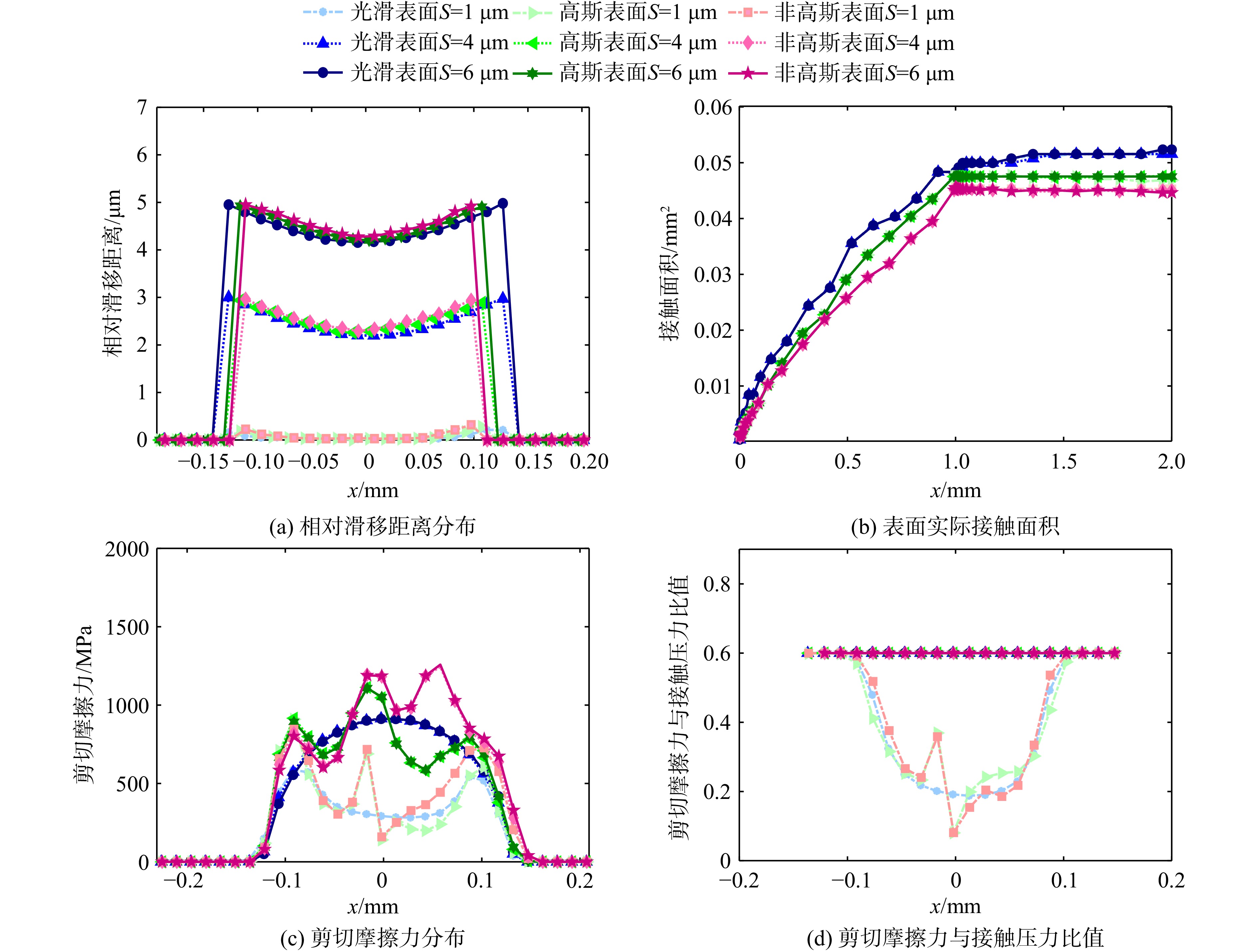
图 10 不同位移幅值下相关接触量的分布
Figure 10. Distribution of relevant contacts for different displacement amplitudes
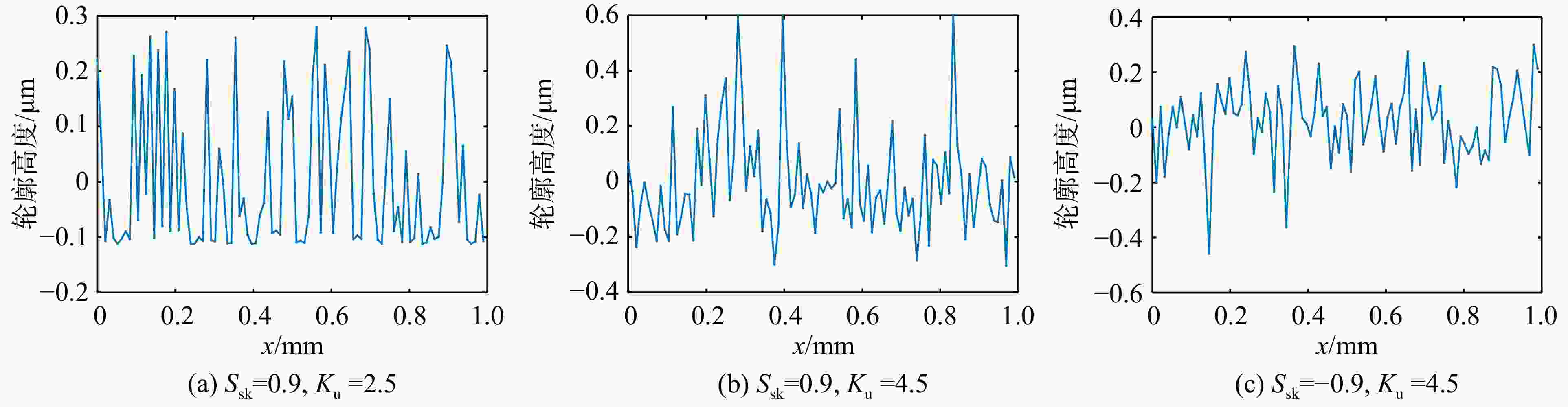
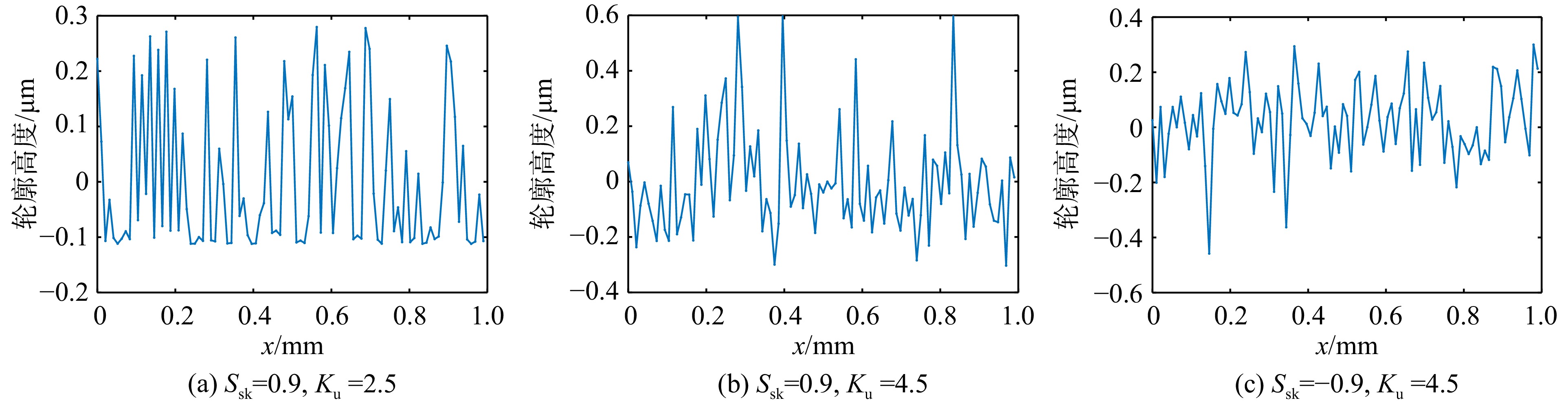
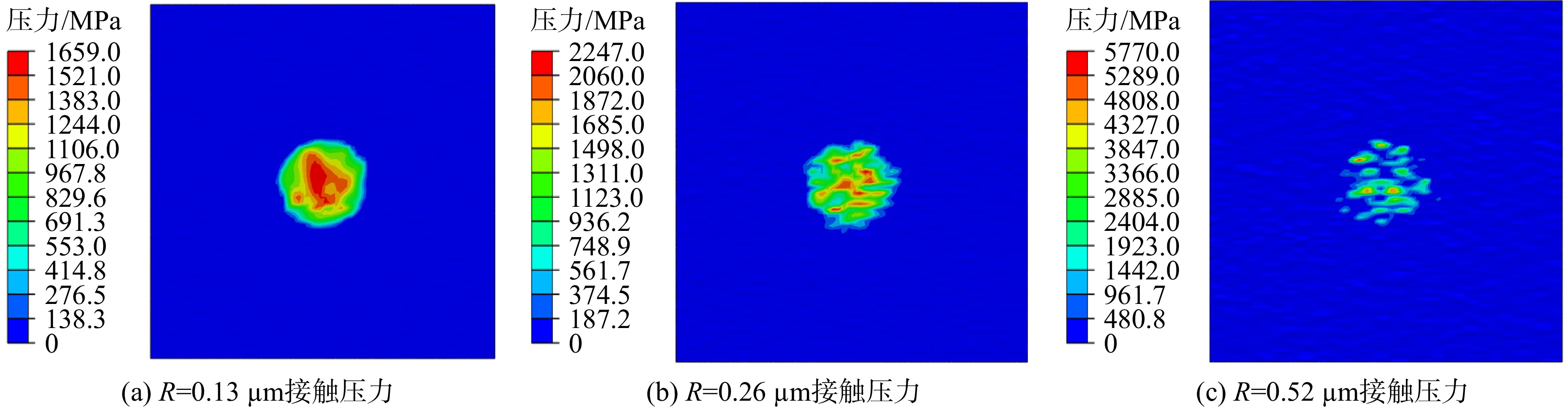
图 12 不同表面统计特性的非高斯粗糙表面二维轮廓图
Figure 12. Two-dimensional contour maps of non-Gaussian rough surfaces with different surface statistical properties
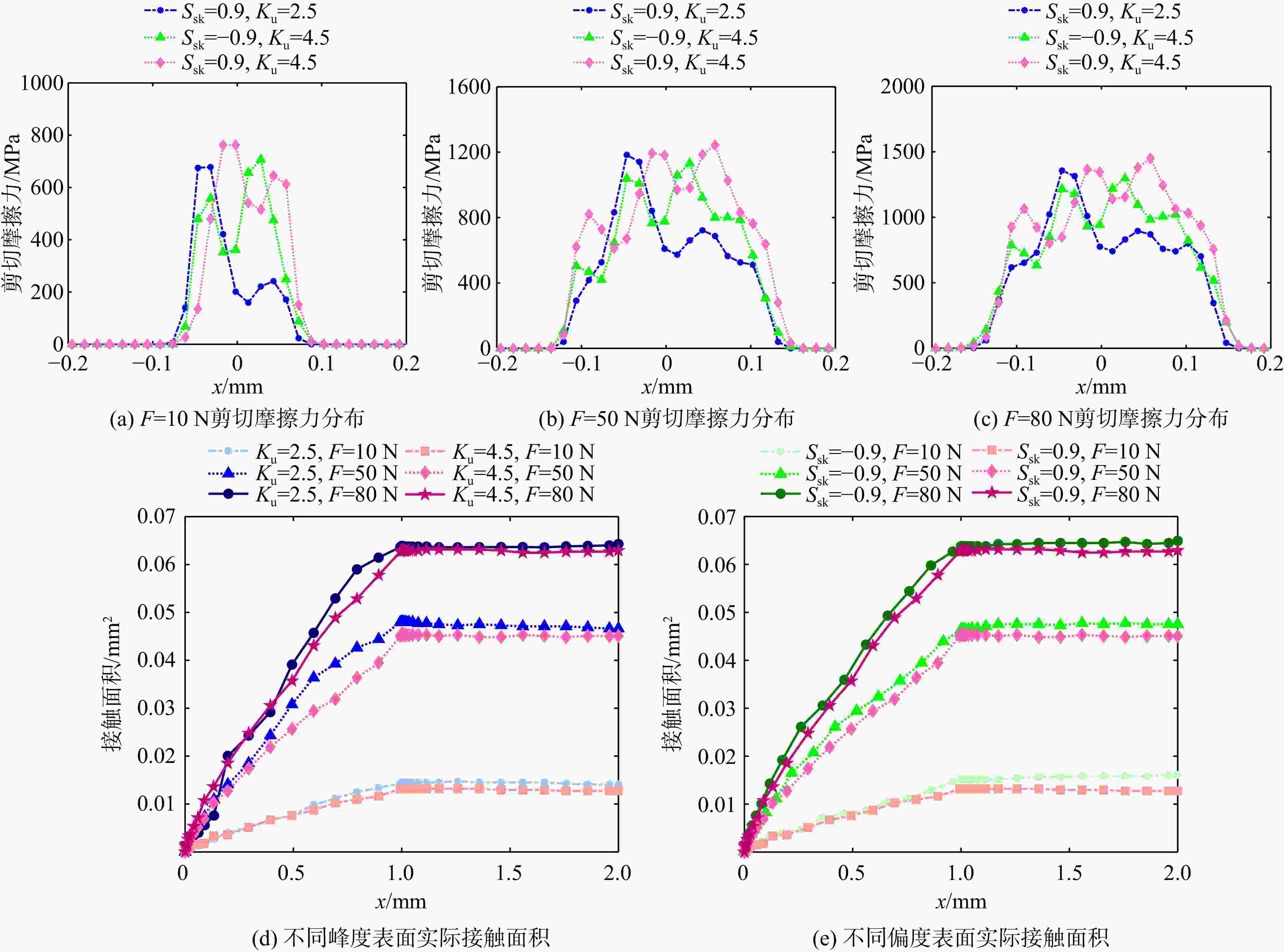
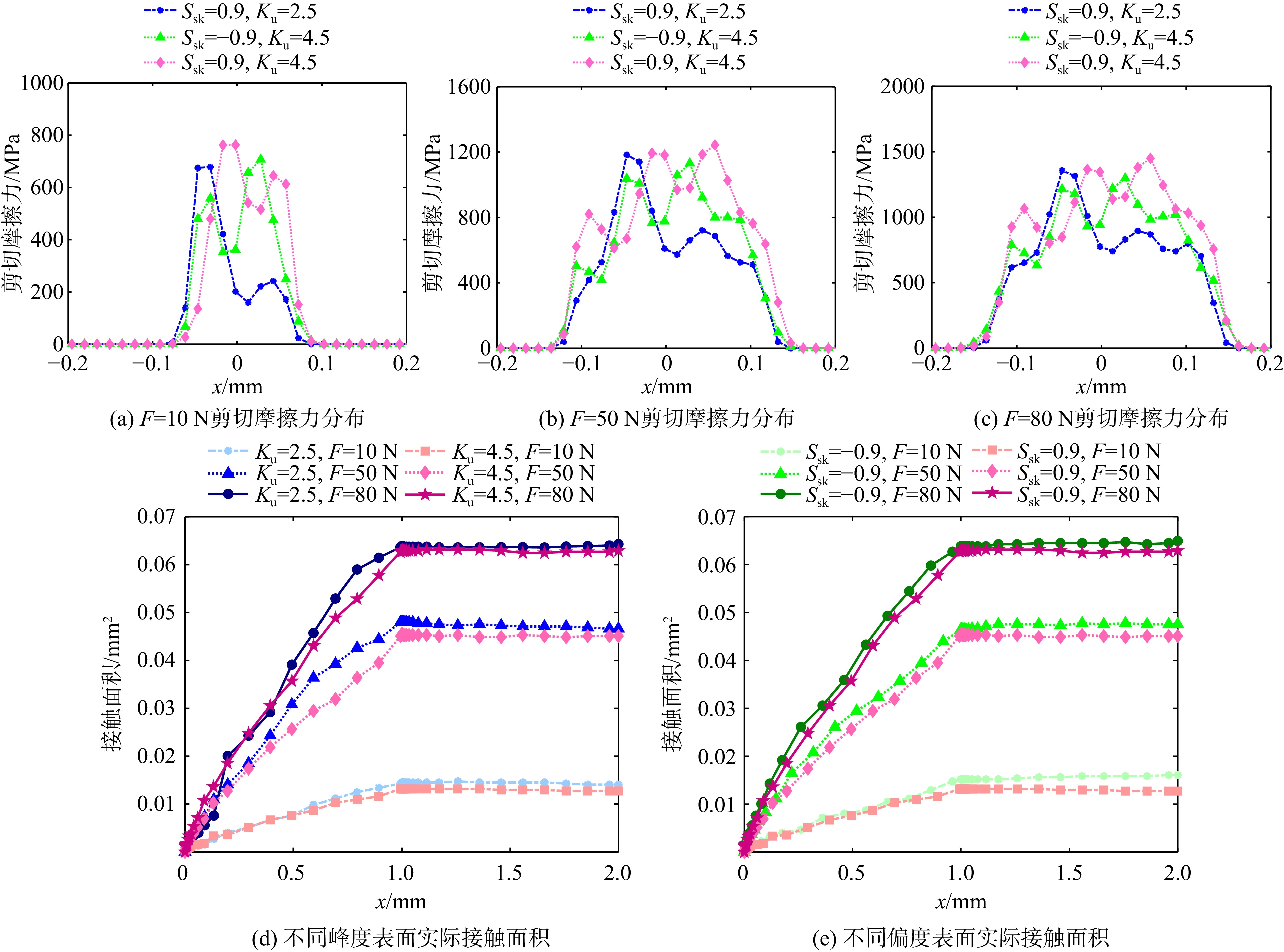
图 13 不同表面统计特性相关接触量的分布
Figure 13. Distribution of exposure associated with different surface statistical properties
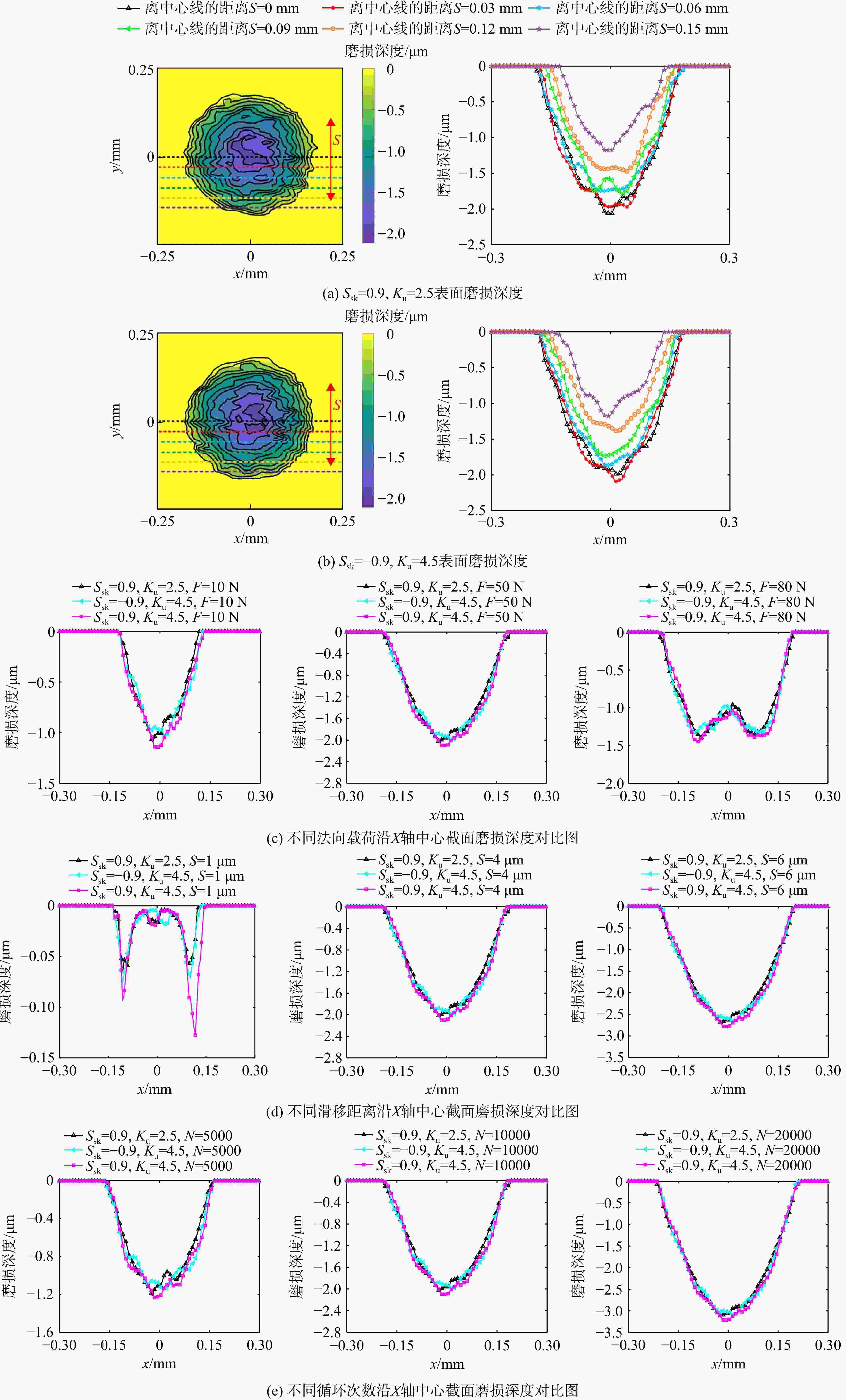
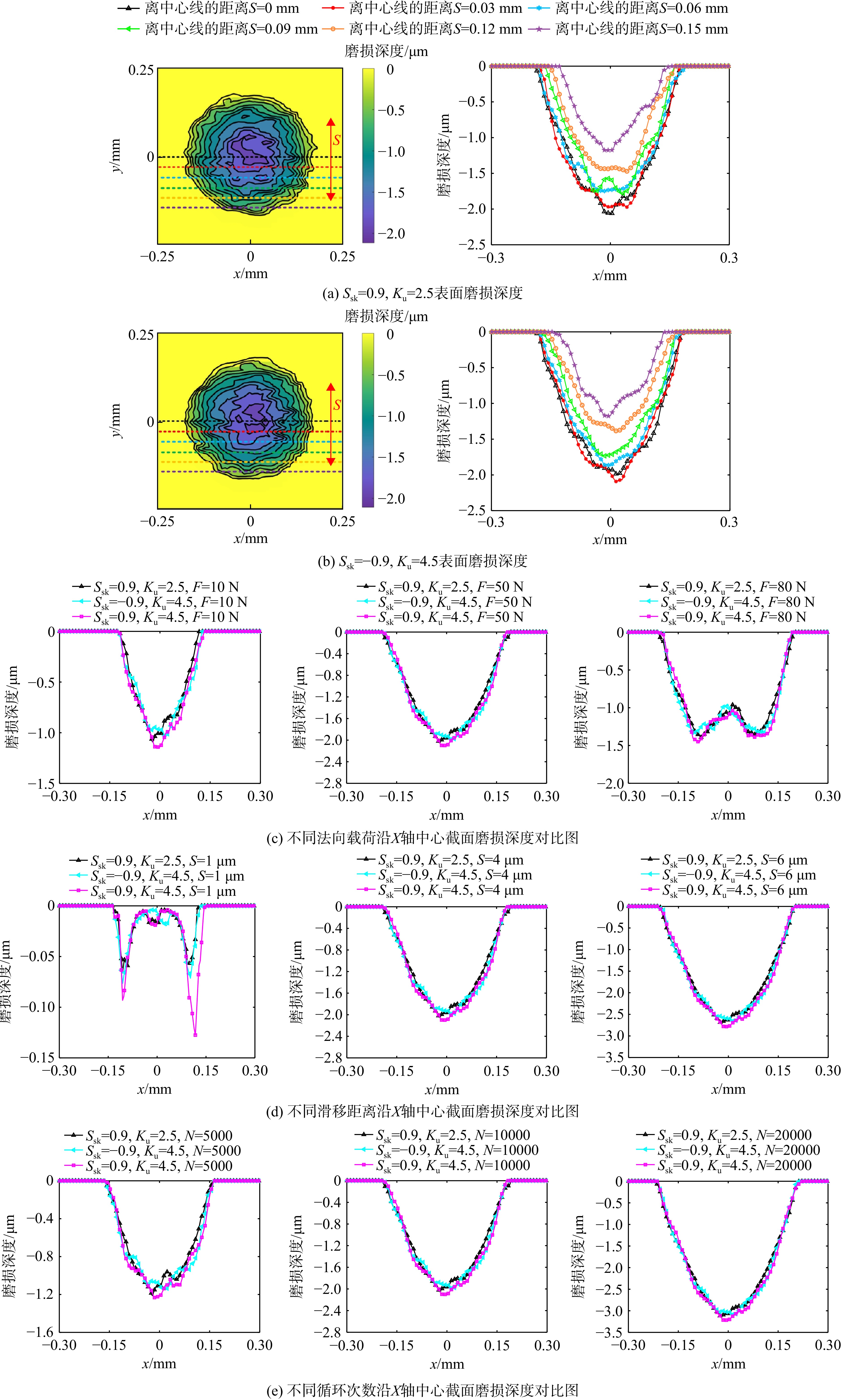
图 14 不同峰度、偏度下非高斯表面的磨损深度
Figure 14. Wear depth of non-Gaussian surfaces at different kurtosis and skewness
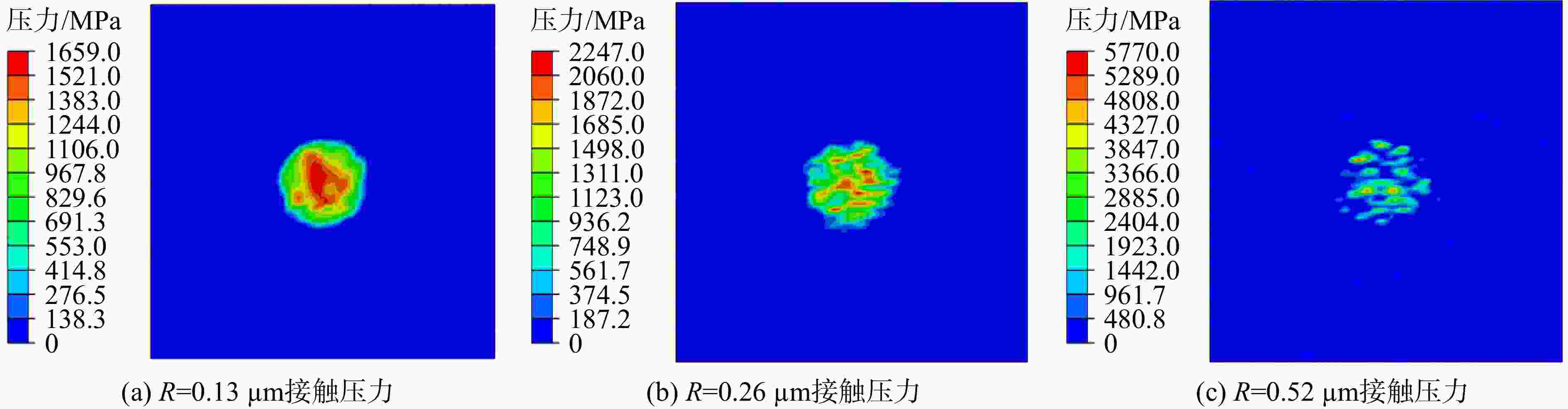
图 15 不同标准差值下非高斯表面的接触应力比较
Figure 15. Comparison of contact stresses on non-Gaussian surfaces for different values of standard deviation
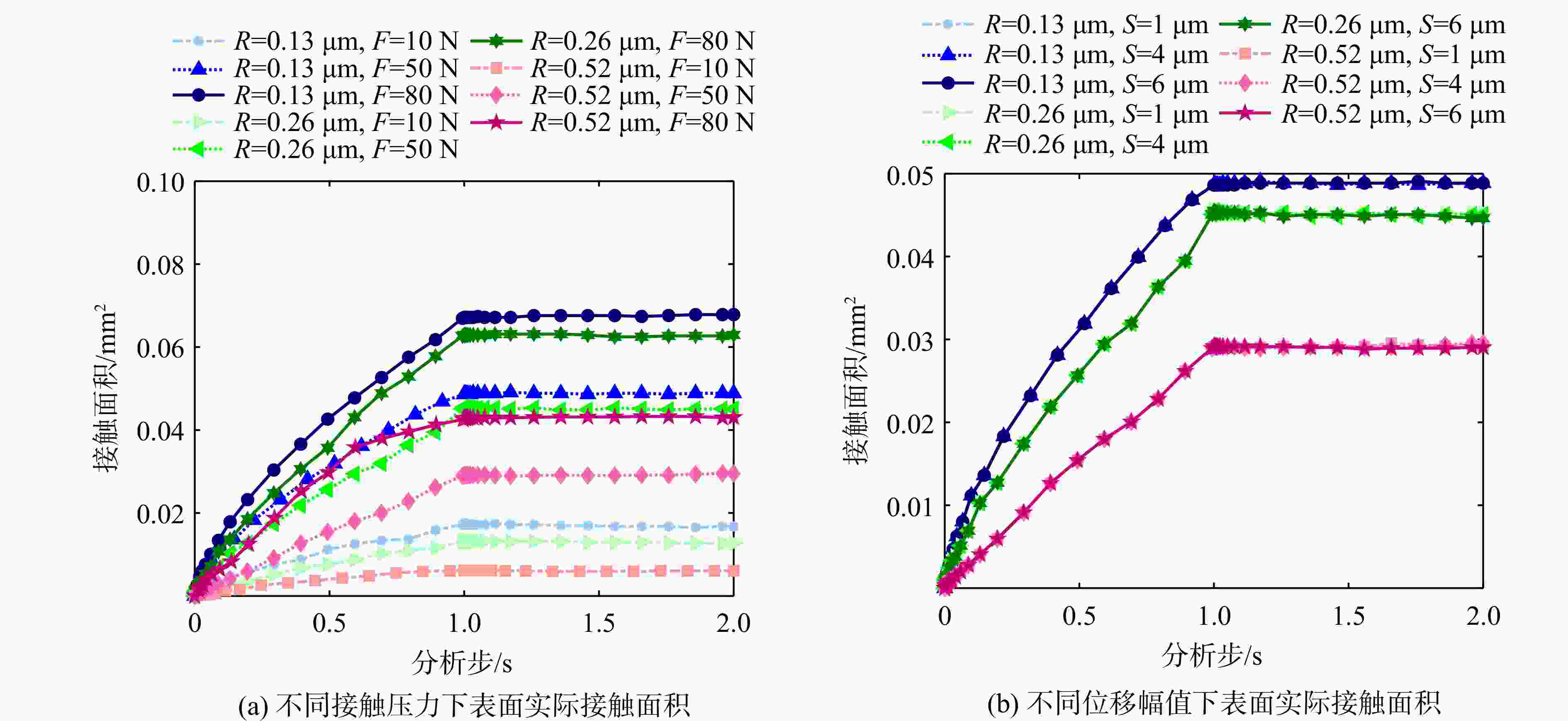
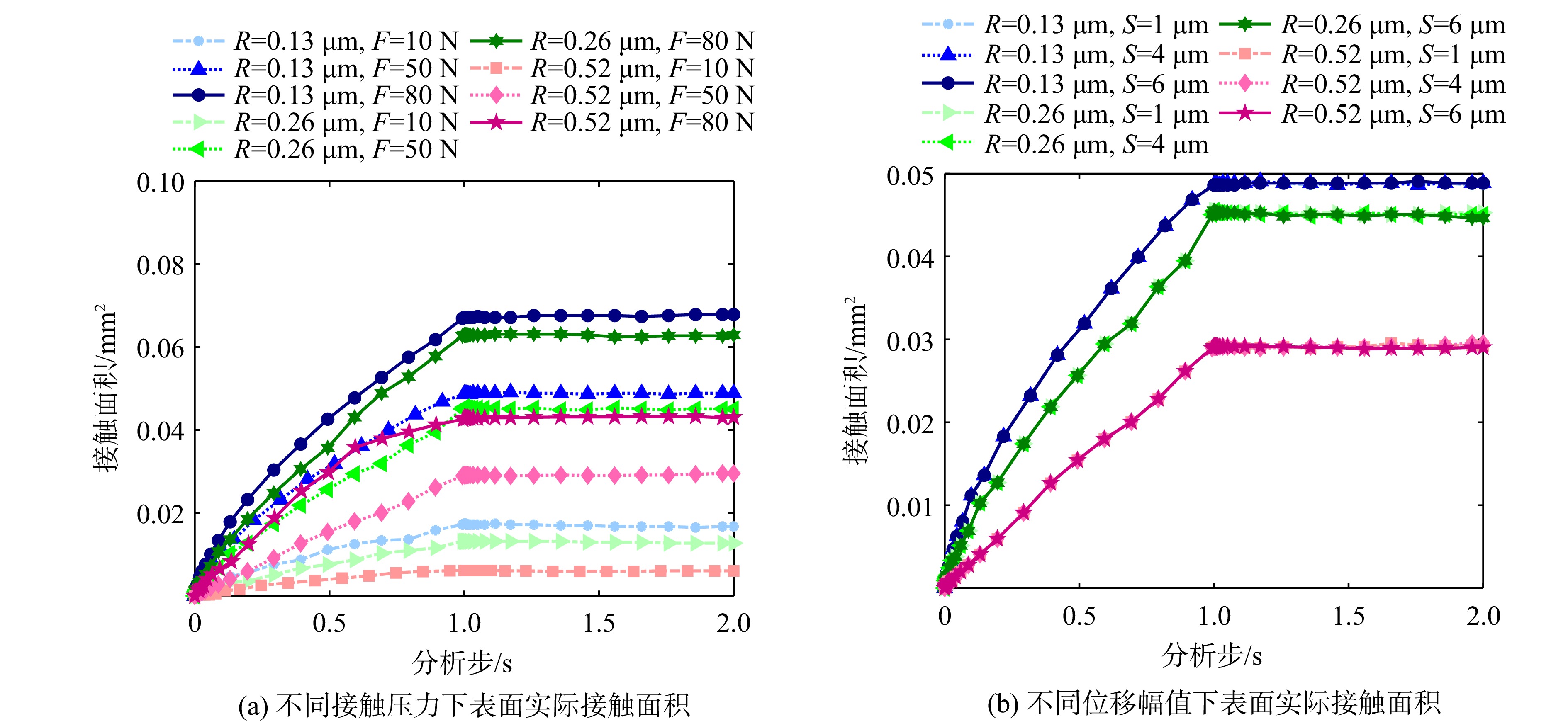
图 16 不同表面统计特性接触面积的分布
Figure 16. Distribution of contact areas with different surface statistical properties
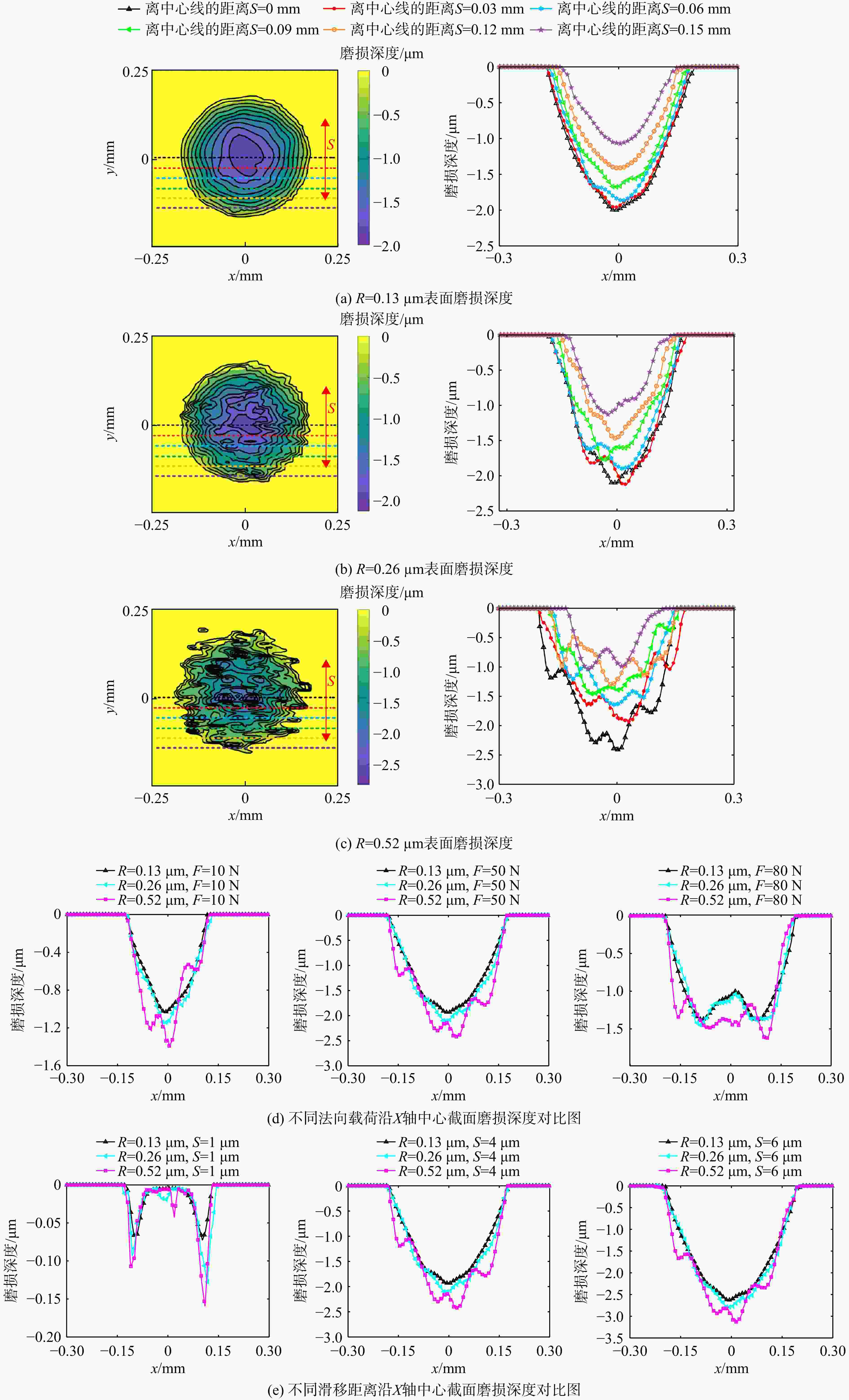
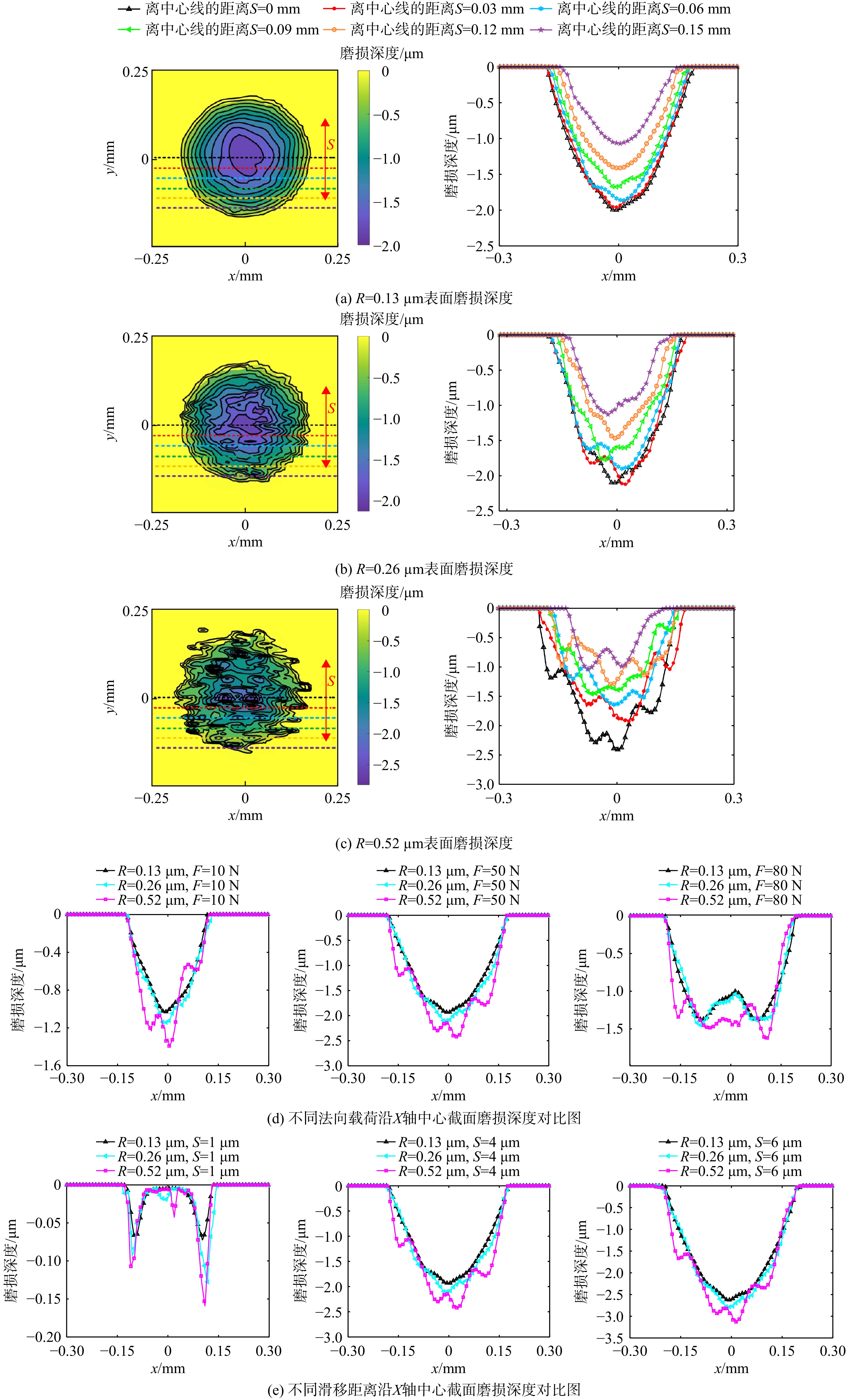
图 17 不同标准差值下非高斯表面的磨损深度
Figure 17. Wear depth on non-Gaussian surfaces for different values of standard deviation
表 1 三维表面粗糙度参数
Table 1. Three-dimensional surface roughness parameters
参数 计算参数的公式 算术平均
高度(Sa)$ {S}_{{\mathrm{a}}}=\dfrac{1}{A}\displaystyle\iint \limits_{A}\left| Z (x,y) \right| {\mathrm{d}}x{\mathrm{d}}y $ 标准偏差(R) $ R=\sqrt{\dfrac{1}{A}\displaystyle\iint \limits_{A}{Z}^{2} (x,y) {\mathrm{d}}x{\mathrm{d}}y} $ 偏度(Ssk) $ {S}_{{\mathrm{sk}}}=\dfrac{1}{S_{{\mathrm{q}}}^{3}}\left[\dfrac{1}{A}\displaystyle\iint \limits_{A}{Z}^{3} (x,y) {\mathrm{d}}x{\mathrm{d}}y\right] $ 峰度(Ku) $ {K}_{{\mathrm{u}}}=\dfrac{1}{S_{{\mathrm{q}}}^{4}}\left[\dfrac{1}{A}\displaystyle\iint \limits_{A}{Z}^{4} (x,y) {\mathrm{d}}x{\mathrm{d}}y\right] $ 轮廓均方根
偏差(Sq)$ {S}_{\text{q}}=\sqrt{\dfrac{1}{A}\displaystyle\iint \limits_{A}{ (Z-\overline{Z}) ^{2}}{\mathrm{d}}x{\mathrm{d}}y} $ 最大峰高(Sp) $ {S}_{{\mathrm{p}}}=\underset{A}{\max }\;Z (x,y) $ 最低谷深(Sv) $ {S}_{{\mathrm{v}}}=\underset{A}{\min }\;Z (x,y) $ 表面均方根
斜率(Srm)$ {S}_{{\mathrm{rm}}}=\sqrt{\dfrac{1}{A}\displaystyle\iint \limits_{A}\left[{\left(\dfrac{\partial {\textit{z}} (x,y) }{\partial x}\right)}^{2}+{\left(\dfrac{\partial {\textit{z}} (x,y) }{\partial y}\right)}^{2}\right]{\mathrm{d}}x{\mathrm{d}}y} $  下载: 导出CSV
表 2 测量表面与重构表面参数对比
Table 2. Comparison of measured and reconstructed surface parameters
名称 Sa/μm R/μm Ssk Ku Sq/μm Sp/μm Sv/μm Srm/μm 磨削表面 0.0587 0.0756 − 0.9054 4.4930 0.0757 0.1883 − 0.4118 0.0740 模拟磨削表面 0.0582 0.0755 − 0.9001 4.5043 0.0754 0.1721 − 0.4336 0.0754 相对误差-磨削/% 0.8517 0.1322 0.5853 0.2508 0.3963 8.6032 5.0276 1.8567 铣削表面 0.3005 0.3702 − 0.02758 2.6512 0.3703 0.9773 − 1.0169 0.3679 模拟铣削表面 0.3029 0.3733 − 0.02798 2.6535 0.3735 0.9863 − 1.1206 0.3743 相对误差-铣削/% 0.7923 0.8282 1.4503 0.3519 0.8567 0.9125 9.2539 1.7098
下载: 导出CSV
-
[1] Waterhouse R B. Fretting wear[J]. Wear, 1984, 100(1/2/3): 107-118. [2] 李诗卓. 材料的冲蚀磨损与微动磨损[M]. 北京: 机械工业出版社, 1987. [3] Li Shizhuo. Erosion wear and fretting wear of materials[M]. Beijing: China Machine Press, 1987. (in Chinese) [4] Li Ling, Li Ganghua, Wang Jingjing, et al. Fretting wear mechanical analysis of double rough surfaces based on energy method[J]. Proceedings of the Institution of Mechanical Engineers, Part J: Journal of Engineering Tribology, 2023, 237(2): 356-368. doi: 10.1177/13506501221113156 [5] Mu Xiaokai, Sun Qingchao, Xu Jiawen, et al. Feasibility analysis of the replacement of the actual machining surface by a 3D numerical simulation rough surface[J]. International Journal of Mechanical Sciences, 2019, 150: 135-144. doi: 10.1016/j.ijmecsci.2018.10.023 [6] Zhao Song, Meng Fanyue, Fan Bingli, et al. Evaluation of wear mechanism between TC4 titanium alloys and self-lubricating fabrics[J]. Wear, 2023, 512/513: 204532. [7] Zhang Chunzheng, Shen Fei, Ke Liaoliang. Electrical contact resistance endurance of AgNi10 alloy under fretting wear: Experiment and numerical prediction[J]. Wear, 2023, 530/531: 205009. [8] Yue Tongyan, Abdel Wahab M. Finite element analysis of stress singularity in partial slip and gross sliding regimes in fretting wear[J]. Wear, 2014, 321: 53-63. doi: 10.1016/j.wear.2014.09.008 [9] Pereira K, Yue T, Abdel Wahab M. Multiscale analysis of the effect of roughness on fretting wear[J]. Tribology International, 2017, 110: 222-231. doi: 10.1016/j.triboint.2017.02.024 [10] George G, Spiridon C. Influence of roughness and friction coefficient on thecontact wear in partial slip conditions[J]. TSEST, 2013, 2(3): 115-121. [11] 刘金生, 刘娟, 沈火明. 粗糙表面扭动微动磨损数值研究[J]. 机械强度, 2022, 44(3): 731-736. Liu Jinsheng, Liu Juan, Shen Huoming. Numerical study on torsional fretting wear of rough surface[J]. Journal of Mechanical Strength, 2022, 44(3): 731-736. (in ChineseLiu Jinsheng, Liu Juan, Shen Huoming. Numerical study on torsional fretting wear of rough surface[J]. Journal of Mechanical Strength, 2022, 44(3): 731-736. (in Chinese) [12] 黄帅宗, 刘娟, 沈火明. 初始粗糙面对切向微动行为影响数值研究[J]. 四川轻化工大学学报(自然科学版), 2020, 33(3): 13-18. Huang Shuaizong, Liu Juan, Shen Huoming. Numerical study of the effect of initial roughness on tangential fretting behavior[J]. Journal of Sichuan University of Science & Engineering (Natural Science Edition), 2020, 33(3): 13-18. (in ChineseHuang Shuaizong, Liu Juan, Shen Huoming. Numerical study of the effect of initial roughness on tangential fretting behavior[J]. Journal of Sichuan University of Science & Engineering (Natural Science Edition), 2020, 33(3): 13-18. (in Chinese) [13] 冯彦, 邱卓一, 史修江, 等. 考虑真实粗糙表面的燃机球轴承磨损与混合润滑耦合机理[J]. 机械工程学报, 2023, 59(21): 330-340. Feng Yan, Qiu Zhuoyi, Shi Xiujiang, et al. Coupling mechanism of wear and mixed lubrication for gas turbine ball bearing considering real rough surfaces[J]. Journal of Mechanical Engineering, 2023, 59(21): 330-340. (in ChineseFeng Yan, Qiu Zhuoyi, Shi Xiujiang, et al. Coupling mechanism of wear and mixed lubrication for gas turbine ball bearing considering real rough surfaces[J]. Journal of Mechanical Engineering, 2023, 59(21): 330-340. (in Chinese) [14] Cai Mingxin, Zhang Po, Xiong Qiwen, et al. Finite element simulation of fretting wear behaviors under the ball-on-flat contact configuration[J]. Tribology International, 2023, 177: 107930. doi: 10.1016/j.triboint.2022.107930 [15] Imran M, Wang Dagang, Abdel Wahab M. Three-dimensional finite element simulations of fretting wear in steel wires used in coal mine hoisting system[J]. Advances in Engineering Software, 2023, 184: 103499. doi: 10.1016/j.advengsoft.2023.103499 [16] 杨勇, 王家序, 周青华, 等. 表面粗糙度特征对齿轮接触区润滑特性的影响[J]. 摩擦学学报, 2017, 37(2): 248-256. Yang Yong, Wang Jiaxu, Zhou Qinghua, et al. Influence of surface roughnesson the mixed elastohydrodynamic lubrication performance of gear contact area[J]. Tribology, 2017, 37(2): 248-256. (in ChineseYang Yong, Wang Jiaxu, Zhou Qinghua, et al. Influence of surface roughnesson the mixed elastohydrodynamic lubrication performance of gear contact area[J]. Tribology, 2017, 37(2): 248-256. (in Chinese) [17] Feng Yan, Shi Xiu, Lu Xi, et al. Study on scuffing failure of gas turbine ball bearing based on 3D mixed lubrication and dynamics[J]. Proceedings of the Institution of Mechanical Engineers, Part J: Journal of Engineering Tribology, 2024, 238(8): 897-911. doi: 10.1177/13506501241242151 [18] Zhou Yueting, Kim T W. Role of rough surface on contact between magneto-electro-elastic materials and orthotropic solid[J]. International Journal of Mechanical Sciences, 2015, 99: 187-195. doi: 10.1016/j.ijmecsci.2015.05.017 [19] Li Tuanjie, Guo Jian, Cao Yuyan. Dynamic characteristics analysis of deployable space structures considering joint clearance[J]. Acta Astronautica, 2011, 68(7/8): 974-983. doi: 10.1016/j.actaastro.2010.08.039 [20] Sun Qingchao, Mu Xiaokai, Xu Jiawen, et al. Substitutability analysis of a numerically simulated surface and an actual rough surface[J]. AIP Advances, 2018, 8(8): 085022. doi: 10.1063/1.5040149 [21] Li Ling, Ma Shiyun, Li Zhiqiang, et al. Finite element analysis of the effects of additional load phase and amplitude on fretting wear[J]. Proceedings of the Institution of Mechanical Engineers, Part J: Journal of Engineering Tribology, 2019, 233(12): 1878-1887. doi: 10.1177/1350650119851886 [22] Bakolas V. Numerical generation of arbitrarily oriented non-Gaussian three-dimensional rough surfaces[J]. Wear, 2003, 254(5/6): 546-554. doi: 10.1016/s0043-1648(03)00133-9 [23] Li Ling, Zhang Wang, Wang Jingjing, et al. Multiscale characterization and contact performance analysis of machining surfaces[J]. Scientific Reports, 2023, 13: 9710. doi: 10.1038/s41598-023-36907-6 [24] ISO 25178-2 Surface texture: areal Part 2: terms, definitions and surface texture parameters[S]. [25] Pawlus P, Reizer R, Wieczorowski M. Functional importance of surface texture parameters[J]. Materials, 2021, 14(18): 5326. doi: 10.3390/ma14185326 [26] Li Ling, Tian Haifei, Yun Qiangqiang, et al. Study on temperature rise distribution of contact surface under cyclic load[J]. Proceedings of the Institution of Mechanical Engineers, Part J: Journal of Engineering Tribology, 2021, 235(1): 138-148. doi: 10.1177/1350650120919877 [27] Li Ling, Kang Le, Ma Shiyun, et al. Finite element analysis of fretting wear considering variable coefficient of friction[J]. Proceedings of the Institution of Mechanical Engineers, Part J: Journal of Engineering Tribology, 2019, 233(5): 758-768. doi: 10.1177/1350650118800615 [28] Zhang Mingyuan, Zeng Dongfang, Lu Liantao, et al. Finite element modelling and experimental validation of bolt loosening due to thread wear under transverse cyclic loading[J]. Engineering Failure Analysis, 2019, 104: 341-353. doi: 10.1016/j.engfailanal.2019.05.001 -

 点击查看大图

计量
- 文章访问数: 750
- HTML浏览量: 423
- PDF量: 62
- 被引次数: 0