






Aero-engine remaining life prediction model based on improved autoencoder and TFT
-
摘要:
针对航空发动机多源传感器数据在时变工况下退化特征难表征的问题,提出融合改进型卷积自编码器与temporal fusion transformer(TFT)解码器的预测模型,通过多尺度时空特征融合提升了剩余寿命单点预测精度与时变不确定性量化能力。改进的卷积自编码器利用其多尺度卷积单元(MSCU)从多维传感器时序数据中提取不同尺度下的特征信息,灵活捕获序列中信息间的局部依赖关系,同时避免了信息丢失问题。TFT解码器通过特征选择模块和多头注意力机制有效捕捉了数据中的全局依赖关系,并通过这些机制揭示了特征的重要性,从而提供了对数据特征影响程度的解释。采用公开数据集进行实验验证,与先进预测模型的比较分析表明,MS1DCAE_TFT模型在FD001与FD003数据集上的方均根误差和分数指标至少提高了0.2%和65.5%,同时分位数回归预测了其寿命区间进行了不确定性量化,可为发动机剩余寿命预测提供可靠的解决方案。
-
关键词:
- 不确定性量化 /
- 多尺度卷积单元 /
- temporal fusion transformers解码器 /
- 剩余寿命预测 /
- 分位数回归
Abstract:Considering the problem of difficult characterization of degraded features in time-varying operating conditions of aero-engine multi-source sensor data, a prediction model fusing an improved convolutional autoencoder and temporal fusion transformer (TFT) decoder was proposed to enhance the accuracy of single-point prediction of remaining life and the quantification of time-varying uncertainty through multi-scale temporal and spatial feature fusion. The improved convolutional autoencoder utilized its multi-scale convolution unit (MSCU) to extract feature information at different scales from multi-dimensional sensor time-series data, and flexibly captured local dependencies among information in the sequence while avoiding the information loss problem. The TFT decoder efficiently captured the global dependencies in the data and revealed the importance of the features through these mechanisms, thus providing an explanation for the degree of influence of the data features. Test validation using publicly available datasets and comparative analysis with state-of-the-art prediction models showed that the MS1DCAE_TFT model improved the root mean squared error and score index by at least 0.2% and 65.5% on the FD001 and FD003 datasets, while quantile regression predicted the uncertainty quantification of its life intervals, which can provide a reliable engine remaining life prediction solution.
-
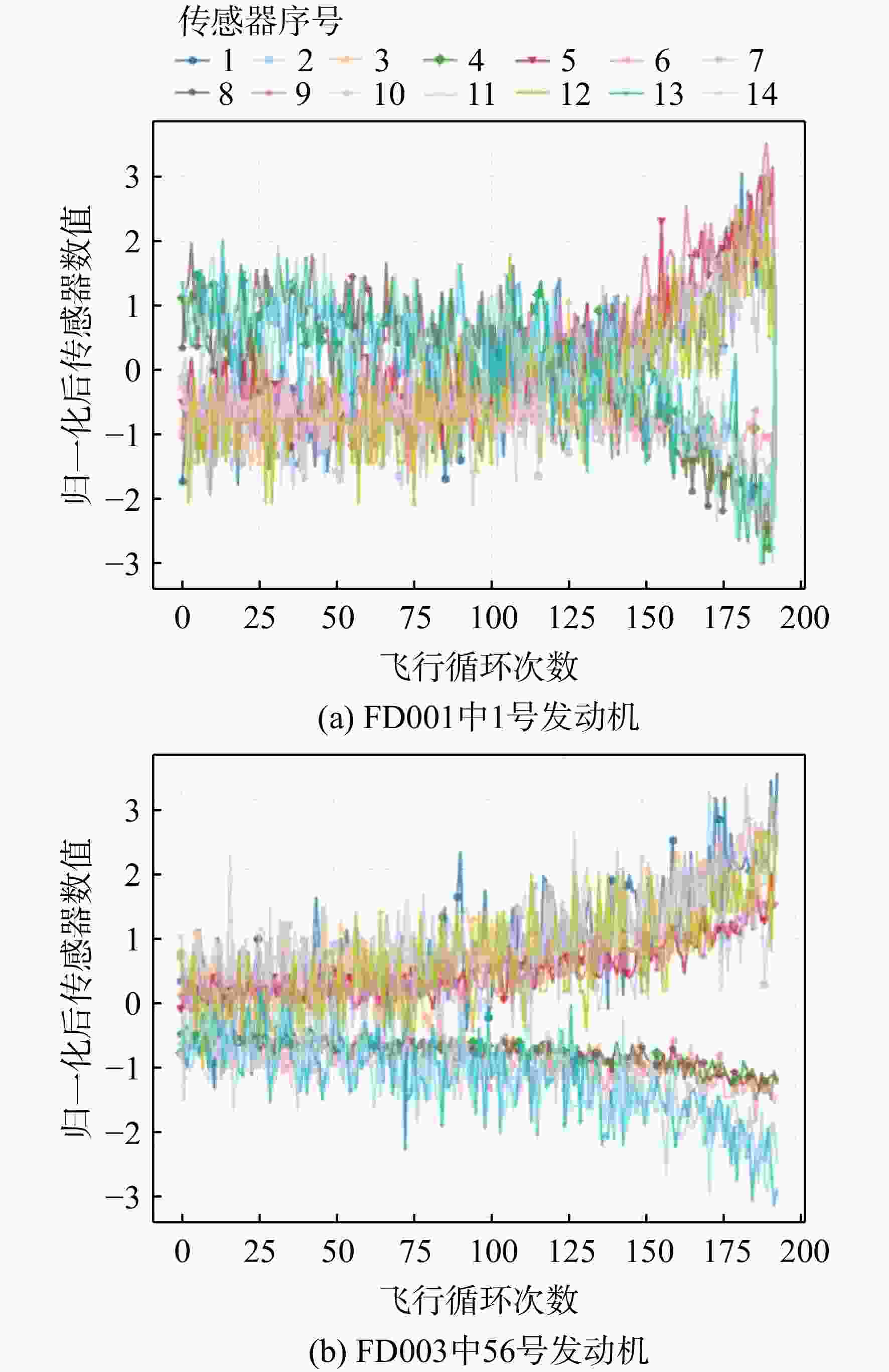
图 3 归一化后不同子数据集传感器数据图
Figure 3. Plot of sensor data for different sub-datasets after normalization
表 1 14个传感器信息及工况
Table 1. 14 sensor information and working conditions
序号 量符号 参数 1 $ h $ 飞行高度 2 $ Ma $ 马赫数 3 $ \alpha $ 油门杆角度 4 $ {T_{24}} $ 低压压气机出口温度 5 $ {T_{30}} $ 高压压气机出口温度 6 $ {T_{50}} $ 低压涡轮出口温度 7 $ {p_{30}} $ 高压压气机出口总压 8 $ {N_{\mathrm{f}}} $ 未修正的风扇转速 9 $ {N_{\mathrm{c}}} $ 未修正的核心机转速 10 $ \pi_{30} $ 高压压气机出口静压 11 $ \varphi $ 燃油油量和P30比值 12 $ N_{\mathrm{rf}} $ 风扇修正转速 13 $ N_{\mathrm{rc}} $ 核心机修正转速 14 $ \beta $ 涵道比 15 $ H_{{\mathrm{bleed}}} $ 引气焓值 16 $ {W_{31}} $ 高压涡轮冷却空气流量 17 $ {W_{32}} $ 低压涡轮冷却空气流  下载: 导出CSV
表 2 网络参数设置
Table 2. Network parameter setting
模型 配置 参数 1DCAE编码器 Conv1_1 [1,8,3,1] Conv1_2 [1,8,5,2] Conv1_3 [1,8,7,3] Cat Maxpool1 [2,2,0] Conv2 [16,8,3,1] Maxpool2 [2,2,0] Conv3 [8,1,3,1] Fc [3,1]
下载: 导出CSV
表 3 健康指标构建方法对比
Table 3. Comparison of health index construction methods
下载: 导出CSV
表 4 特征占比
Table 4. Percentage of features
参数 数据集 FD001 FD003 发动机ID 81 95 67 71 飞行高度 0.11 0.09 0.12 0.13 马赫数 0.10 0.11 0.11 0.10 油门杆角度 0.03 0.03 0.21 0.23 健康指标 0.76 0.77 0.56 0.54
下载: 导出CSV
表 5 多步预测特征占比
Table 5. Percentage of multi-step prediction features
参数 数据集 FD001 FD003 发动机ID 91 100 分位数 0.1 0.5 0.9 0.1 0.5 0.9 飞行高度 0.10 0.12 0.12 0.08 0.10 0.06 马赫数 0.06 0.11 0.03 0.07 0.11 0.03 油门杆角度 0.04 0.02 0.01 0.24 0.24 0.26 健康指标 0.80 0.75 0.84 0.61 0.55 0.65
下载: 导出CSV
-
[1] XU Jiuping, WANG Yusheng, XU Lei. PHM-oriented integrated fusion prognostics for aircraft engines based on sensor data[J]. IEEE Sensors Journal, 2013, 14(4): 1124-1132. [2] CHEN Jiaxian, HUANG Ruyi, CHEN Zhuyun, et al. Transfer learning algorithms for bearing remaining useful life prediction: a comprehensive review from an industrial application perspective[J]. Mechanical Systems and Signal Processing, 2023, 193: 110239. doi: 10.1016/j.ymssp.2023.110239 [3] WANG Dong, TSUI K L, MIAO Qiang. Prognostics and health management: a review of vibration based bearing and gear health indicators[J]. IEEE Access, 2017, 6: 665-676. [4] 王玺, 胡昌华, 任子强, 等. 基于非线性Wiener过程的航空发动机性能衰减建模与剩余寿命预测[J]. 航空学报, 2020, 41(2): 223291. WANG Xi, HU Changhua, REN Ziqiang, et al. Performance degradation modeling and remaining useful life prediction for aero-engine based on nonlinear Wiener process[J]. Acta Aeronautica et Astronautica Sinica, 2020, 41(2): 223291. (in ChineseWANG Xi, HU Changhua, REN Ziqiang, et al. Performance degradation modeling and remaining useful life prediction for aero-engine based on nonlinear Wiener process[J]. Acta Aeronautica et Astronautica Sinica, 2020, 41(2): 223291. (in Chinese) [5] 裴洪, 胡昌华, 司小胜, 等. 基于机器学习的设备剩余寿命预测方法综述[J]. 机械工程学报, 2019, 55(8): 1-13. PEI Hong, HU Changhua, SI Xiaosheng, et al. Review of machine learning based remaining useful life prediction methods for equipment[J]. Journal of Mechanical Engineering, 2019, 55(8): 1-13. (in Chinese doi: 10.3901/JME.2019.08.001PEI Hong, HU Changhua, SI Xiaosheng, et al. Review of machine learning based remaining useful life prediction methods for equipment[J]. Journal of Mechanical Engineering, 2019, 55(8): 1-13. (in Chinese) doi: 10.3901/JME.2019.08.001 [6] 刘惠, 刘振宇, 郏维强, 等. 深度学习在装备剩余使用寿命预测技术中的研究现状与挑战[J]. 计算机集成制造系统, 2021, 27(1): 34-52. LIU Hui, LIU Zhenyu, JIA Weiqiang, et al. Current research and challenges of deep learning for equipment remaining useful life prediction[J]. Computer Integrated Manufacturing Systems, 2021, 27(1): 34-52. (in ChineseLIU Hui, LIU Zhenyu, JIA Weiqiang, et al. Current research and challenges of deep learning for equipment remaining useful life prediction[J]. Computer Integrated Manufacturing Systems, 2021, 27(1): 34-52. (in Chinese) [7] ZHU Guopeng, ZHU Zening, XIANG Ling, et al. Prediction of bearing remaining useful life based on DACN-ConvLSTM model[J]. Measurement, 2023, 211: 112600. doi: 10.1016/j.measurement.2023.112600 [8] WANG Youdao, ZHAO Yifan, ADDEPALLI S. Practical options for adopting recurrent neural network and its variants on remaining useful life prediction[J]. Chinese Journal of Mechanical Engineering, 2021, 34(1): 69. doi: 10.1186/s10033-021-00588-x [9] MA Meng, WANG Zhizhen, ZHONG Zhirong. Transformer encoder enhanced by an adaptive graph convolutional neural network for prediction of aero-engines’ remaining useful life[J]. Aerospace, 2024, 11(4): 289. doi: 10.3390/aerospace11040289 [10] 严如强, 周峥, 杨远贵, 等. 可解释人工智能在工业智能诊断中的挑战和机遇: 归因解释[J]. 机械工程学报, 2024, 60(12): 21-40. YAN Ruqiang, ZHOU Zheng, YANG Yuangui, et al. Challenges and opportunities of XAI in industrial intelligent diagnosis: attribution interpretation[J]. Journal of Mechanical Engineering, 2024, 60(12): 21-40. (in ChineseYAN Ruqiang, ZHOU Zheng, YANG Yuangui, et al. Challenges and opportunities of XAI in industrial intelligent diagnosis: attribution interpretation[J]. Journal of Mechanical Engineering, 2024, 60(12): 21-40. (in Chinese) [11] 李彦夫, 韩特. 基于深度学习的工业装备PHM研究综述[J]. 振动、测试与诊断, 2022, 42(5): 835-847, 1029. LI Yanfu, HAN Te. Deep learning based industrial equipment prognostics and health management: a review[J]. Journal of Vibration, Measurement & Diagnosis, 2022, 42(5): 835-847, 1029. (in ChineseLI Yanfu, HAN Te. Deep learning based industrial equipment prognostics and health management: a review[J]. Journal of Vibration, Measurement & Diagnosis, 2022, 42(5): 835-847, 1029. (in Chinese) [12] 李天梅, 司小胜, 刘翔, 等. 大数据下数模联动的随机退化设备剩余寿命预测技术[J]. 自动化学报, 2022, 48(9): 2119-2141. LI Tianmei, SI Xiaosheng, LIU Xiang, et al. Data-model interactive remaining useful life prediction technologies for stochastic degrading devices with big data[J]. Acta Automatica Sinica, 2022, 48(9): 2119-2141. (in ChineseLI Tianmei, SI Xiaosheng, LIU Xiang, et al. Data-model interactive remaining useful life prediction technologies for stochastic degrading devices with big data[J]. Acta Automatica Sinica, 2022, 48(9): 2119-2141. (in Chinese) [13] ZHANG Yongzhi, XIONG Rui, HE Hongwen, et al. Long short-term memory recurrent neural network for remaining useful life prediction of lithium-ion batteries[J]. IEEE Transactions on Vehicular Technology, 2018, 67(7): 5695-5705. doi: 10.1109/TVT.2018.2805189 [14] HUANG Chenggeng, HUANG Hongzhong, LI Yanfeng. A bidirectional LSTM prognostics method under multiple operational conditions[J]. IEEE Transactions on Industrial Electronics, 2019, 66(11): 8792-8802. doi: 10.1109/TIE.2019.2891463 [15] XIANG Feifan, ZHANG Yiming, ZHANG Shuyou, et al. Baye-sian gated-transformer model for risk-aware prediction of aero-engine remaining useful life[J]. Expert Systems with Applications, 2024, 238: 121859. doi: 10.1016/j.eswa.2023.121859 [16] HINTON G E, SALAKHUTDINOV R R. Reducing the dimensionality of data with neural networks[J]. Science, 2006, 313(5786): 504-507. doi: 10.1126/science.1127647 [17] YE Zijian, ZHANG Qiang, SHAO Siyu, et al. Rolling bearing health indicator extraction and RUL prediction based on multi-scale convolutional autoencoder[J]. Applied Sciences, 2022, 12(11): 5747. doi: 10.3390/app12115747 [18] WANG Chenyang, JIANG Wanlu, YUE Yi, et al. Research on prediction method of gear pump remaining useful life based on DCAE and Bi-LSTM[J]. Symmetry, 2022, 14(6): 1111. doi: 10.3390/sym14061111 [19] LIM B, ARıK S Ö, LOEFF N, et al. Temporal Fusion Transformers for interpretable multi-horizon time series forecasting[J]. International Journal of Forecasting, 2021, 37(4): 1748-1764. doi: 10.1016/j.ijforecast.2021.03.012 [20] VASWANI A, SHAZEER N, PARMAR N, et al. Attention is all you need[J]. Advances in Neural Information Processing Systems, 2017, 30: 13756489. [21] SAXENA A, GOEBEL K, SIMON D, et al. Damage propagation modeling for aircraft engine run-to-failure simulation[C]//2008 International Conference on Prognostics and Health Management. Piscataway, US: IEEE, 2008: 1-9. [22] 李天梅, 司小胜, 张建勋. 多源传感监测线性退化设备数模联动的剩余寿命预测方法[J]. 航空学报, 2023, 44(8): 227190. LI Tianmei, SI Xiaosheng, ZHANG Jianxun. Data-model interactive remaining useful life prediction method for multi-sensor monitored linear stochastic degrading devices[J]. Acta Aeronautica et Astronautica Sinica, 2023, 44(8): 227190. (in ChineseLI Tianmei, SI Xiaosheng, ZHANG Jianxun. Data-model interactive remaining useful life prediction method for multi-sensor monitored linear stochastic degrading devices[J]. Acta Aeronautica et Astronautica Sinica, 2023, 44(8): 227190. (in Chinese) [23] LI Xiang, DING Qian, SUN Jianqiao. Remaining useful life estimation in prognostics using deep convolution neural networks[J]. Reliability Engineering & System Safety, 2018, 172: 1-11. [24] LIU Bidong, NOWOTARSKI J, HONG Tao, et al. Probabilistic load forecasting via quantile regression averaging on sister forecasts[J]. IEEE Transactions on Smart Grid, 2015, 8(2): 730-737. [25] ZHANG Bin, ZHANG Lijun, XU Jinwu. Degradation feature selection for remaining useful life prediction of rolling element bearings[J]. Quality and Reliability Engineering International, 2016, 32(2): 547-554. doi: 10.1002/qre.1771 [26] 牟含笑, 郑建飞, 胡昌华, 等. 基于CDBN与BiLSTM的多元退化设备剩余寿命预测[J]. 航空学报, 2022, 43(7): 325403. MU Hanxiao, ZHENG Jianfei, HU Changhua, et al. Remaining useful life prediction of multivariate degradation equipment based on CDBN and BiLSTM[J]. Acta Aeronautica et Astronautica Sinica, 2022, 43(7): 325403. (in ChineseMU Hanxiao, ZHENG Jianfei, HU Changhua, et al. Remaining useful life prediction of multivariate degradation equipment based on CDBN and BiLSTM[J]. Acta Aeronautica et Astronautica Sinica, 2022, 43(7): 325403. (in Chinese) [27] 李浩, 王卓健, 李哲, 等. 基于堆栈自编码器和DeepAR的航空发动机剩余寿命预测[J]. 推进技术, 2022, 43(11): 210645. LI Hao, WANG Zhuojian, LI Zhe, et al. Prediction of remaining useful life of aero-engine based on stacked autoencoder and DeepAR[J]. Journal of Propulsion Technology, 2022, 43(11): 210645. (in ChineseLI Hao, WANG Zhuojian, LI Zhe, et al. Prediction of remaining useful life of aero-engine based on stacked autoencoder and DeepAR[J]. Journal of Propulsion Technology, 2022, 43(11): 210645. (in Chinese) [28] LI Jie, JIA Yuanjie, NIU Mingbo, et al. Remaining useful life prediction of turbofan engines using CNN-LSTM-SAM approach[J]. IEEE Sensors Journal, 2023, 23(9): 10241-10251. doi: 10.1109/JSEN.2023.3261874 [29] ZHANG Chong, LIM P, QIN A K, et al. Multiobjective deep belief networks ensemble for remaining useful life estimation in prognostics[J]. IEEE Transactions on Neural Networks and Learning Systems, 2017, 28(10): 2306-2318. doi: 10.1109/TNNLS.2016.2582798 [30] CHEN Chuang, SHI Jiantao, LU Ningyun, et al. Data-driven predictive maintenance strategy considering the uncertainty in remaining useful life prediction[J]. Neurocomputing, 2022, 494: 79-88. doi: 10.1016/j.neucom.2022.04.055 [31] 段佳俊, 陆中, 王捷. 基于多尺度CNN和Transformer的航空发动机寿命预测方法[J/OL]. 航空动力学报, (2024-11-19)[2025-03-24]. https://link.cnki.net/doi/10.13224/j.cnki.jasp.20240311. DUAN Jiajun, LU Zhong, WANG Jie. Aero-engine life prediction method based on multi-scale CNN and transformer[J/OL]. Journal of Aerospace Power, (2024-11-19)[2025-03-24]. https://link.cnki.net/doi/10.13224/j.cnki.jasp.20240311. (in ChineseDUAN Jiajun, LU Zhong, WANG Jie. Aero-engine life prediction method based on multi-scale CNN and transformer[J/OL]. Journal of Aerospace Power, (2024-11-19)[2025-03-24]. https://link.cnki.net/doi/10.13224/j.cnki.jasp.20240311. (in Chinese) [32] BABU C N, REDDY B E. A moving-average filter based hybrid ARIMA-ANN model for forecasting time series data[J]. Applied Soft Computing, 2014, 23: 27-38. doi: 10.1016/j.asoc.2014.05.028 [33] LIU Wei, LIN Yiyuan, LIU Weijia, et al. An attention-based multiscale transformer network for remote sensing image change detection[J]. ISPRS Journal of Photogrammetry and Remote Sensing, 2023, 202: 599-609. doi: 10.1016/j.isprsjprs.2023.07.001 -


 点击查看大图

计量
- 文章访问数: 645
- HTML浏览量: 646
- PDF量: 36
- 被引次数: 0