






Model adaptation of micro turbojet engines based on hierarchical optimization
-
摘要:
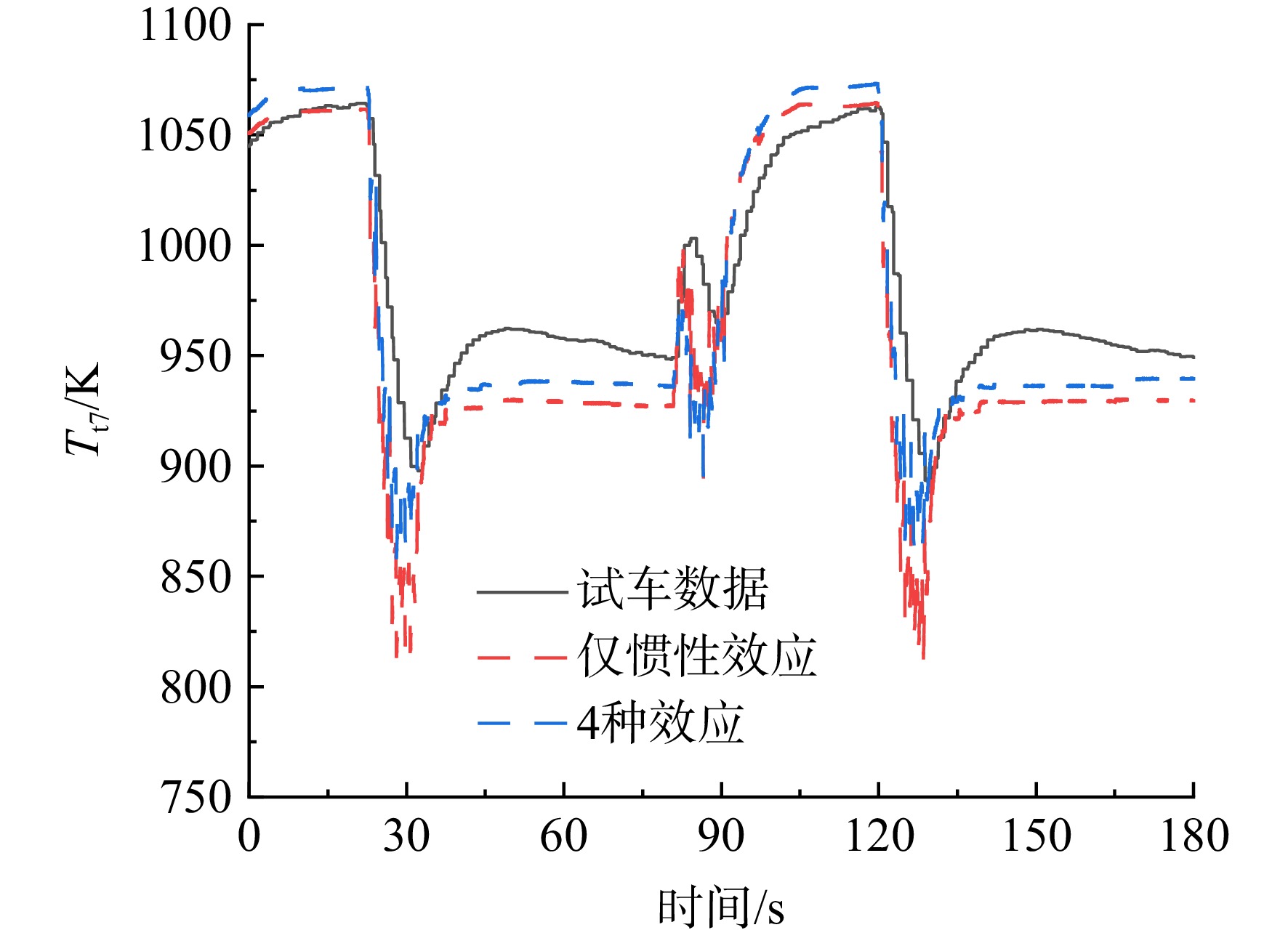
为了提高微型涡喷发动机性能模型的仿真精度,提出一种分级优化的发动机模型修正算法,首先建立了通用仿真模型并与商用软件对比验证可靠性;其次,开展微型涡喷发动机试车实验,获取发动机含慢车在内的14组非设计点稳态和过渡态实验数据;再次,设计了综合设计点参数和特性线修正的两级优化方法,实现宽工况范围的高精度稳态仿真;最后,基于动态效应修正,改善过渡态模型的仿真精度。与试车数据相比,稳态模型最大相对误差为2.4%,相较于不优化设计点参数降低了88%,考虑4种过渡态效应与仅优化转动惯量相比,过渡态模型最大相对误差为12.9%,压气机和涡轮出口总温的误差分别降低了9.2%和31.7%。因此,基于分级优化的微型涡喷发动机模型修正方法能够有效提高稳态和过渡态仿真精度。
Abstract:In order to enhance the simulation accuracy of the micro turbojet engines performance model, a model adaptation algorithm based on hierarchical optimization was proposed. Firstly, a general simulation model was established and its reliability was verified by comparison with commercial software. Secondly, engine test runs of micro turbojet engines were carried out to obtain 14 sets of engine test data for both steady-state and transient conditions at off-designed point, including idle conditions. Thirdly, a two-level optimization algorithm for design point parameters and characteristic lines was designed to achieve high-precision steady-state simulation over a wide range of working conditions. Finally, based on the correction of dynamic effects, the simulation accuracy of the transient model was improved. Compared with the test data, the maximum relative error of the steady-state model was 2.4%, which was 88% lower than that without optimizing the design point parameters. Considering four transient effects, compared with that only optimizing the moment of inertia, the maximum relative error of the transient model was 12.9%, and the errors of compressor and turbine exit total temperature were reduced by 9.2% and 31.7%, respectively. Therefore, the model adaptation method for micro turbojet engines based on hierarchical optimization can effectively improve the simulation accuracy of both steady-state and transient conditions.
-
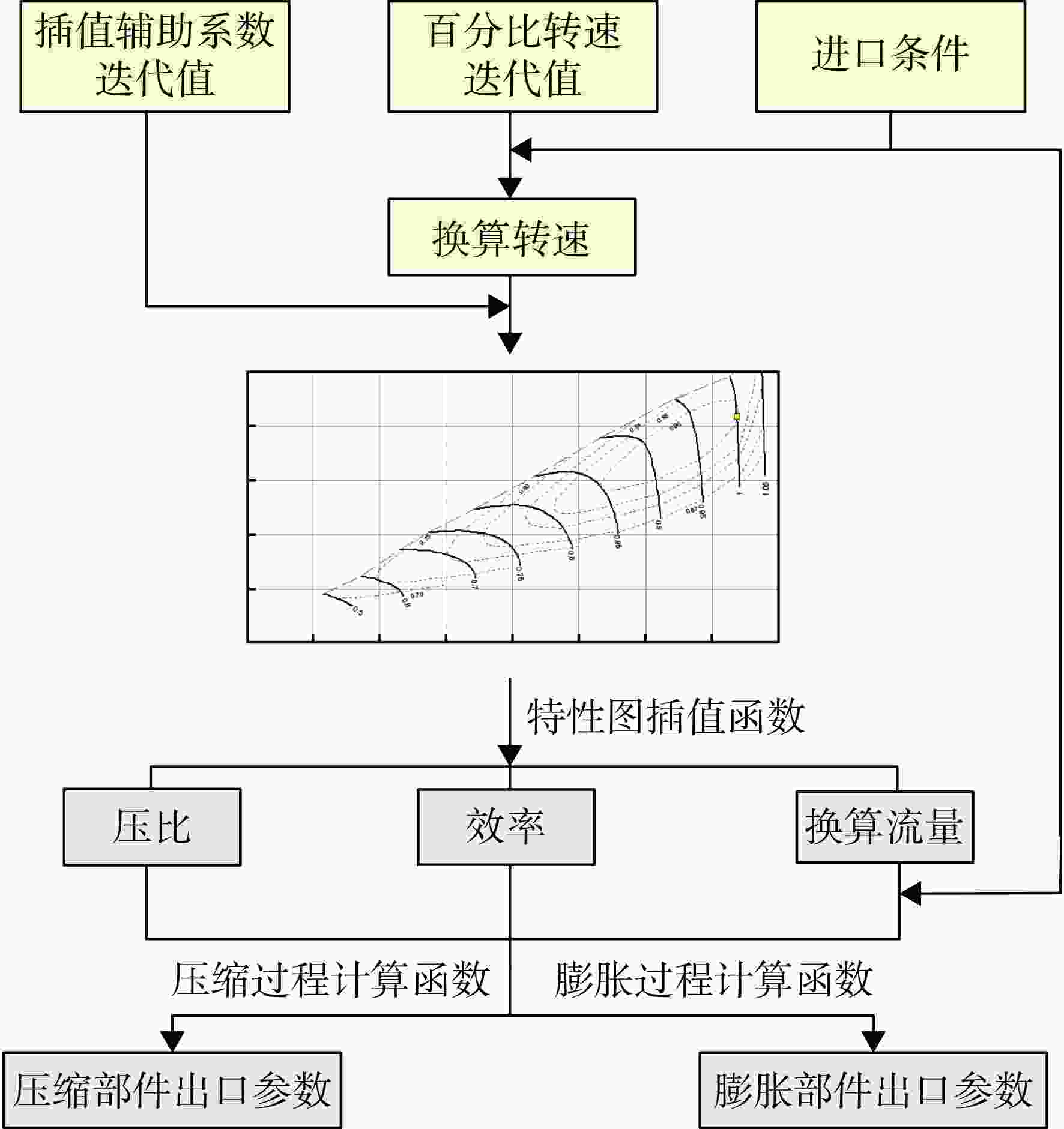
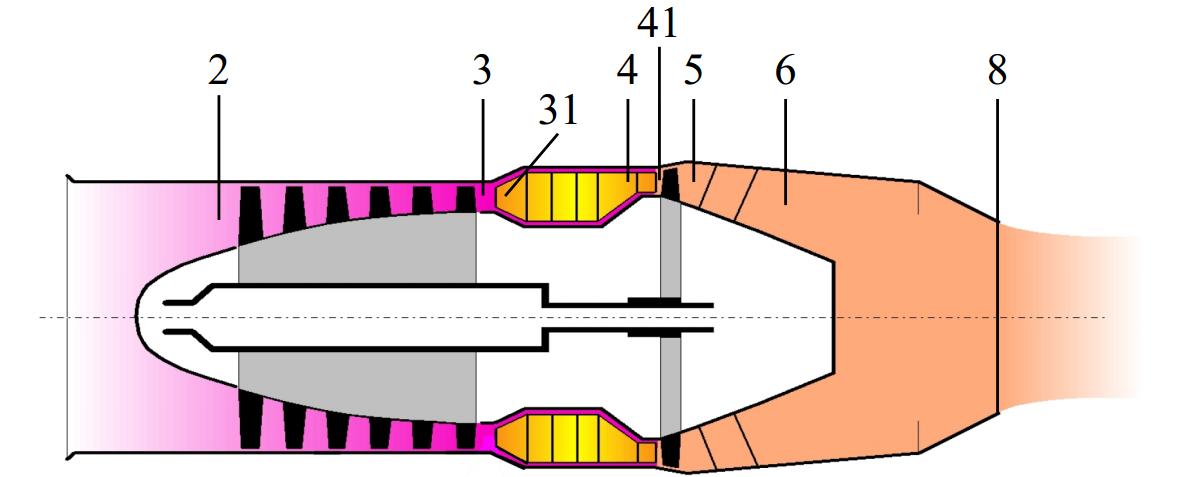
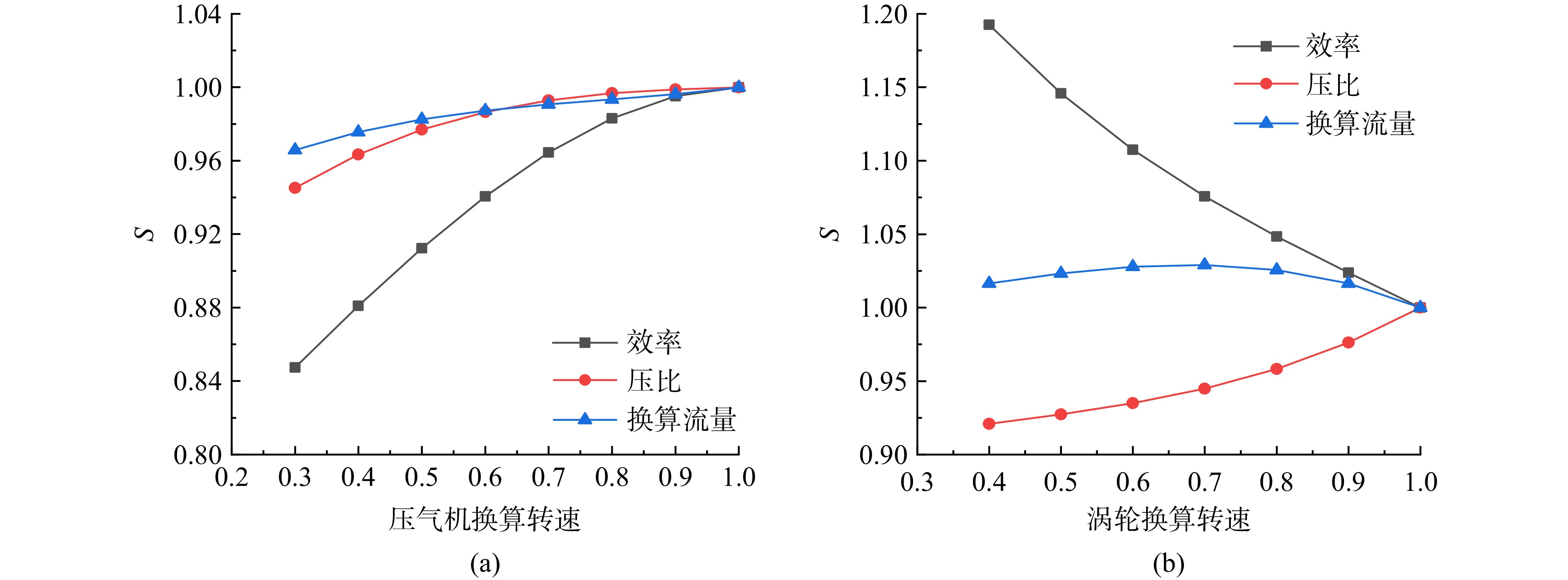
图 2 压缩部件和膨胀部件数学模型计算流程
Figure 2. Calculation process of mathematical model for compression and expansion components
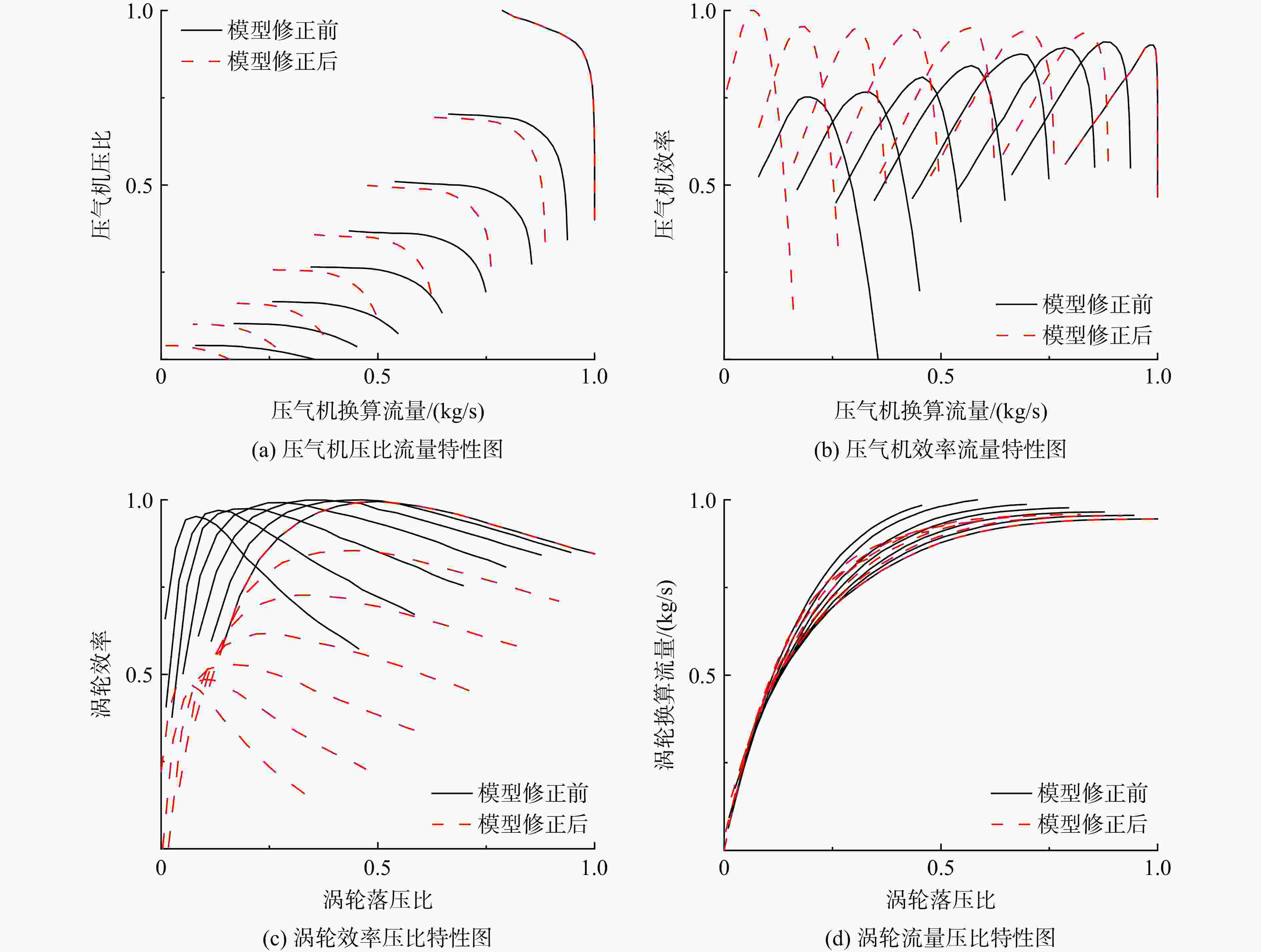
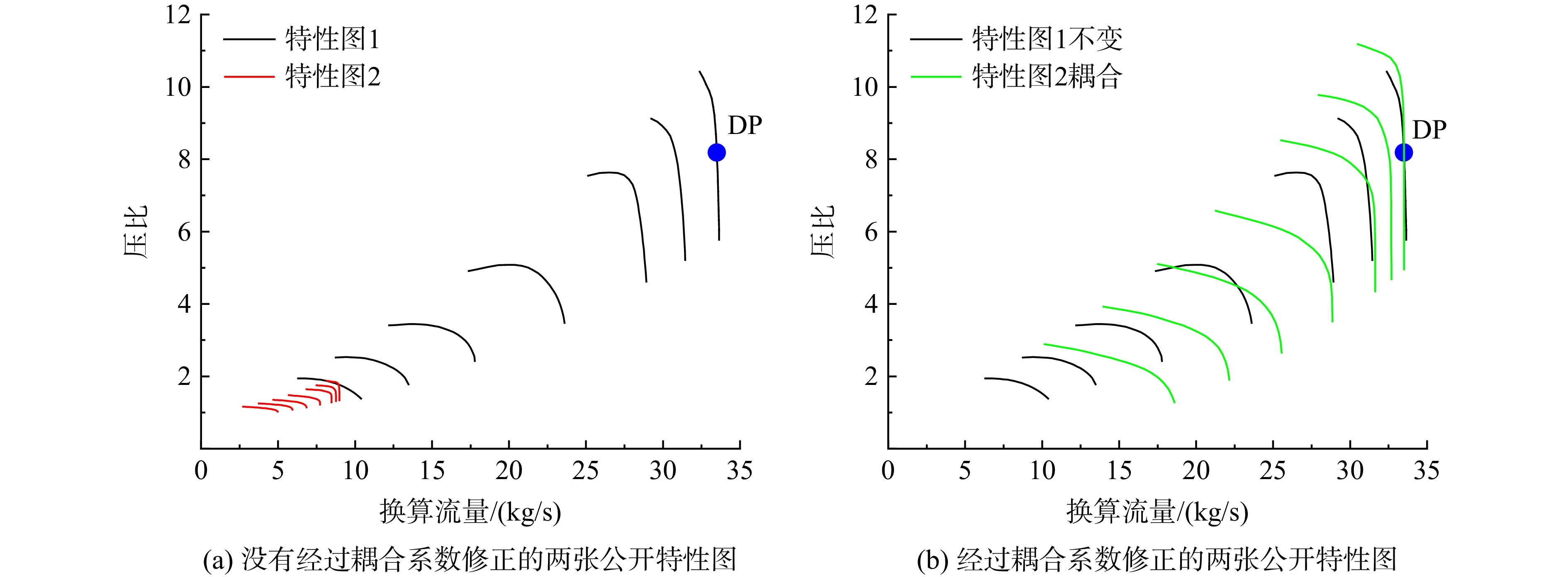
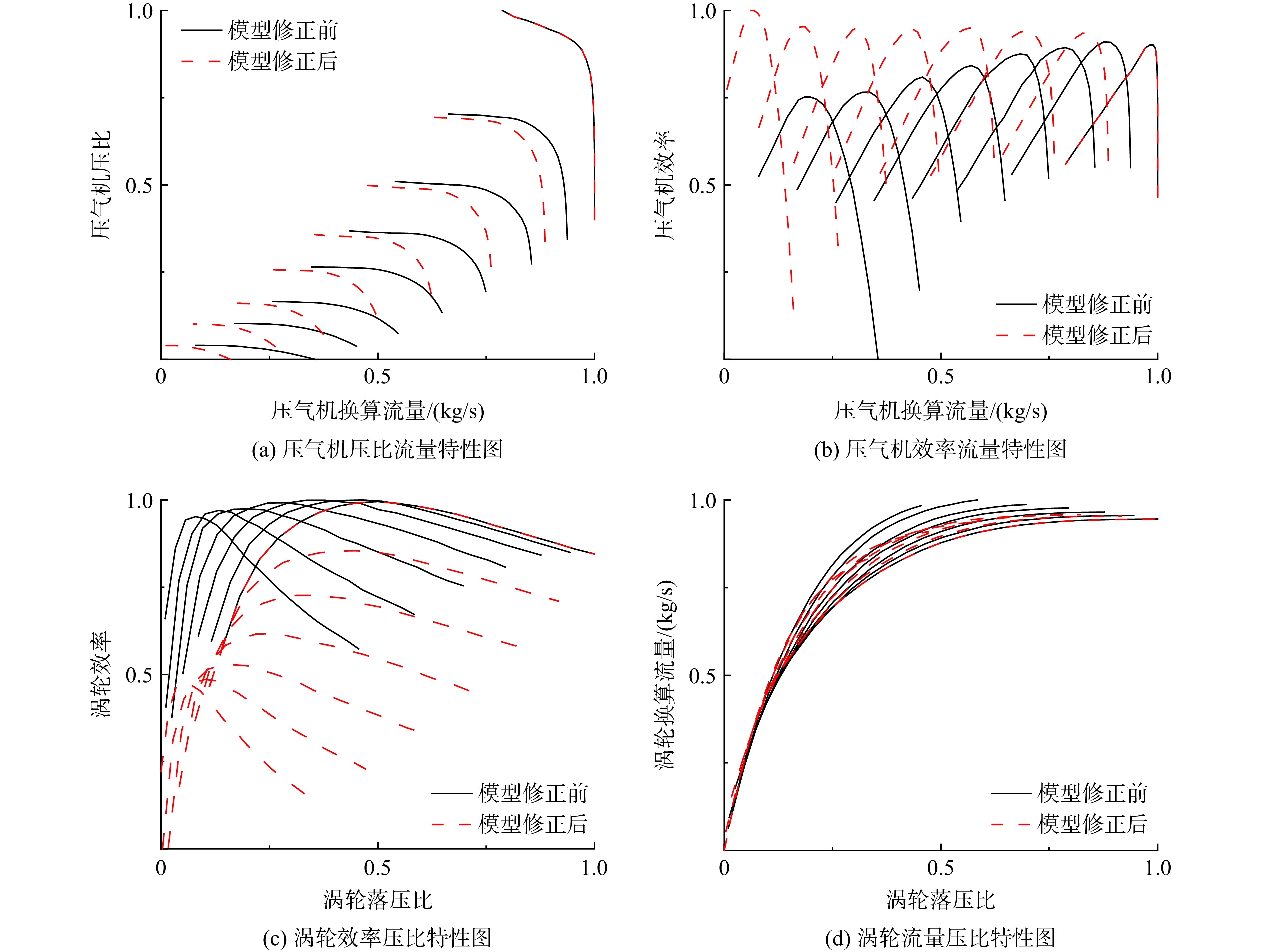
图 13 部件特性图修正前后对比
Figure 13. Component map comparison before and after model adaptation

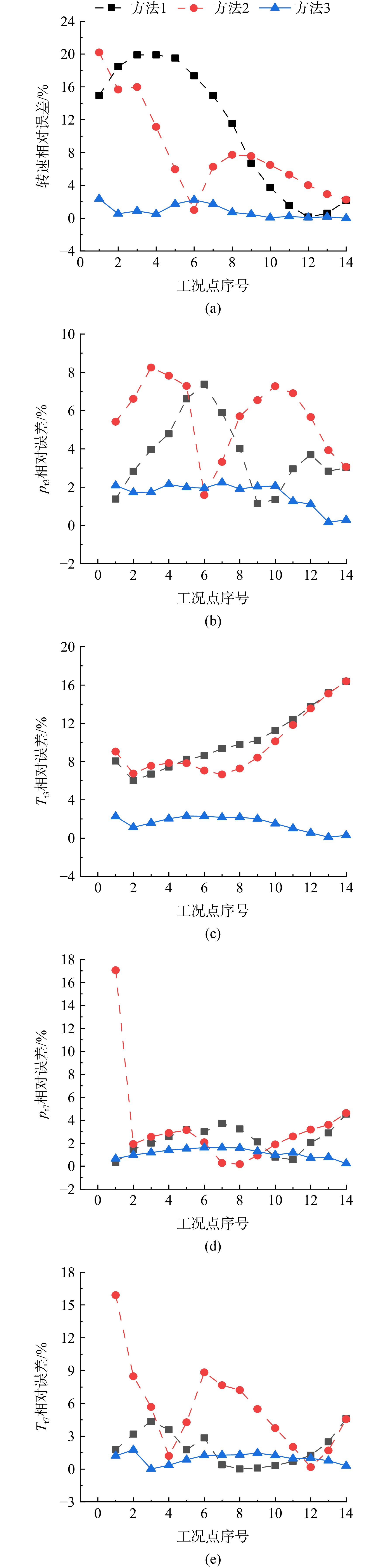
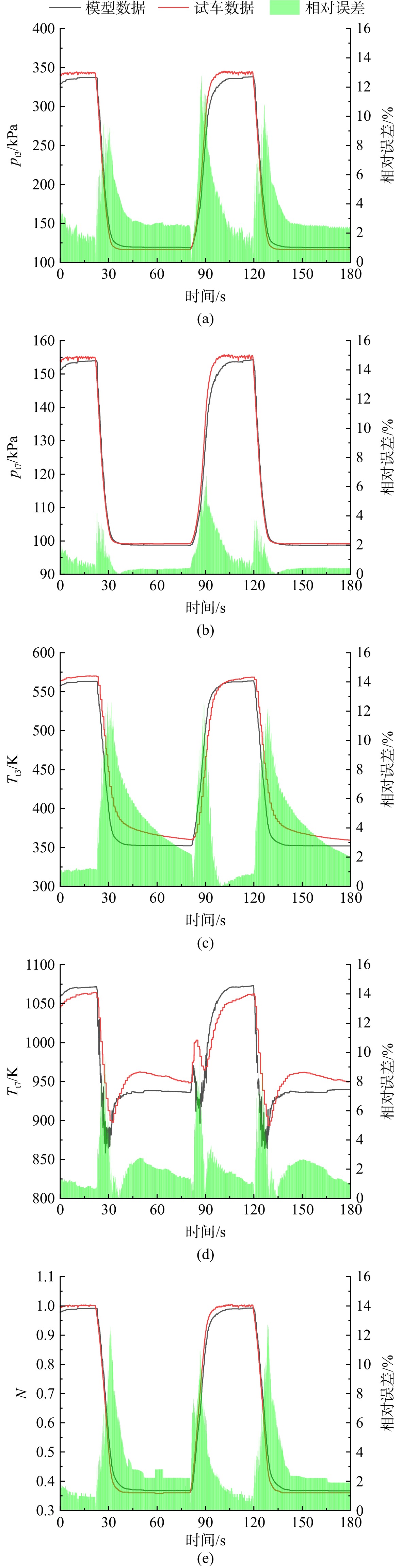
图 15 过渡态模型仿真对比及相对误差
Figure 15. Comparison and relative error of transient model simulation
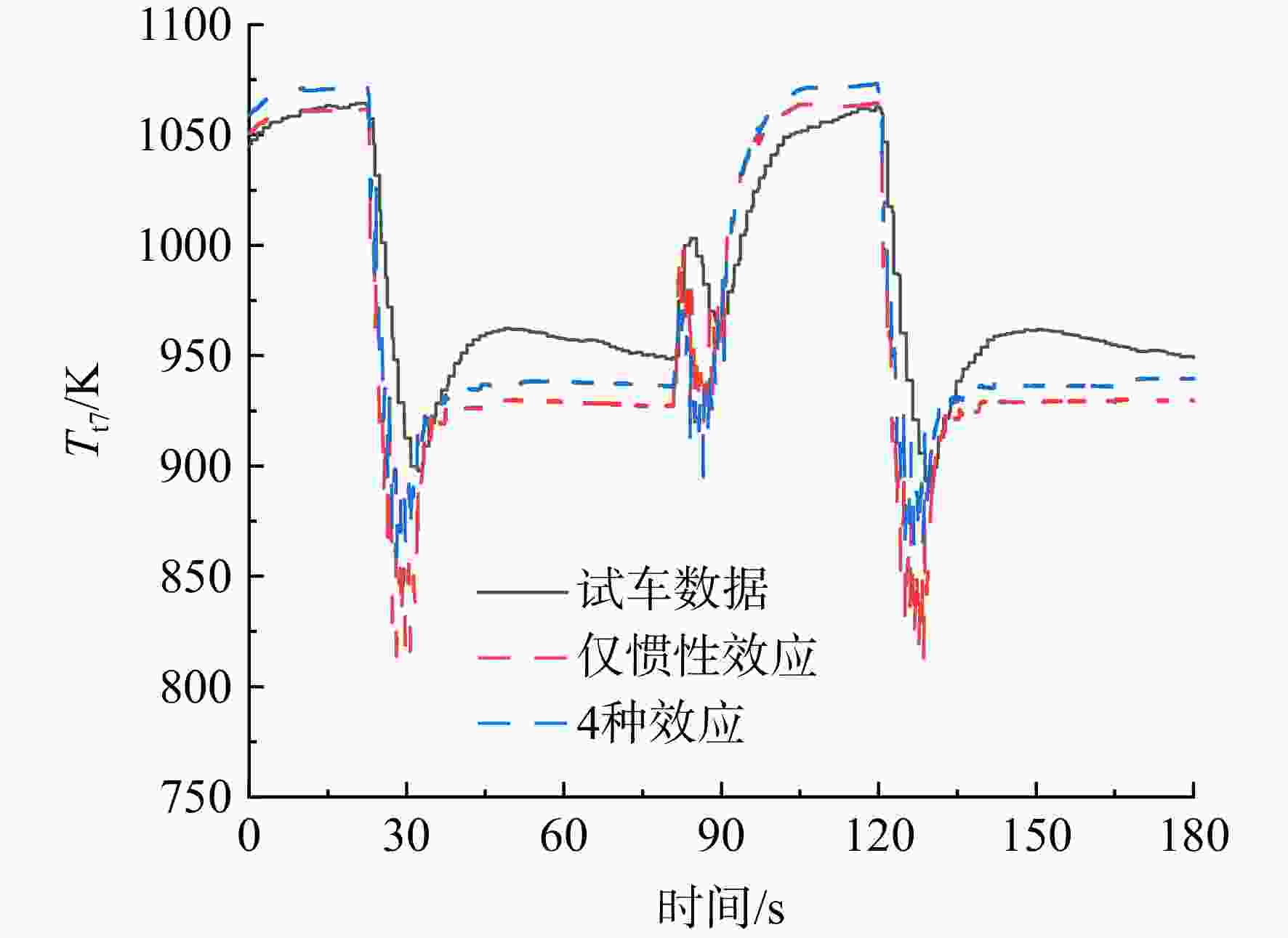
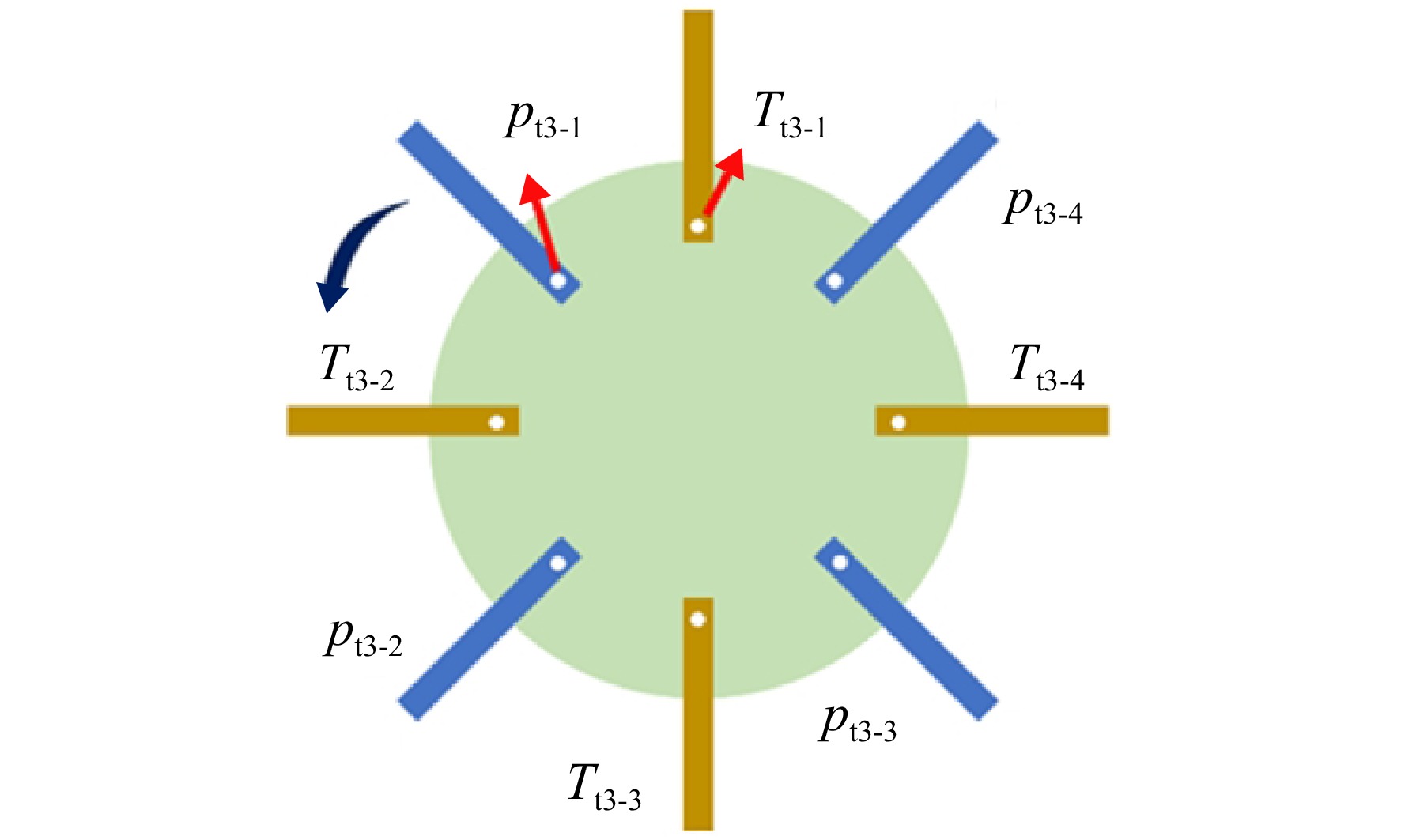
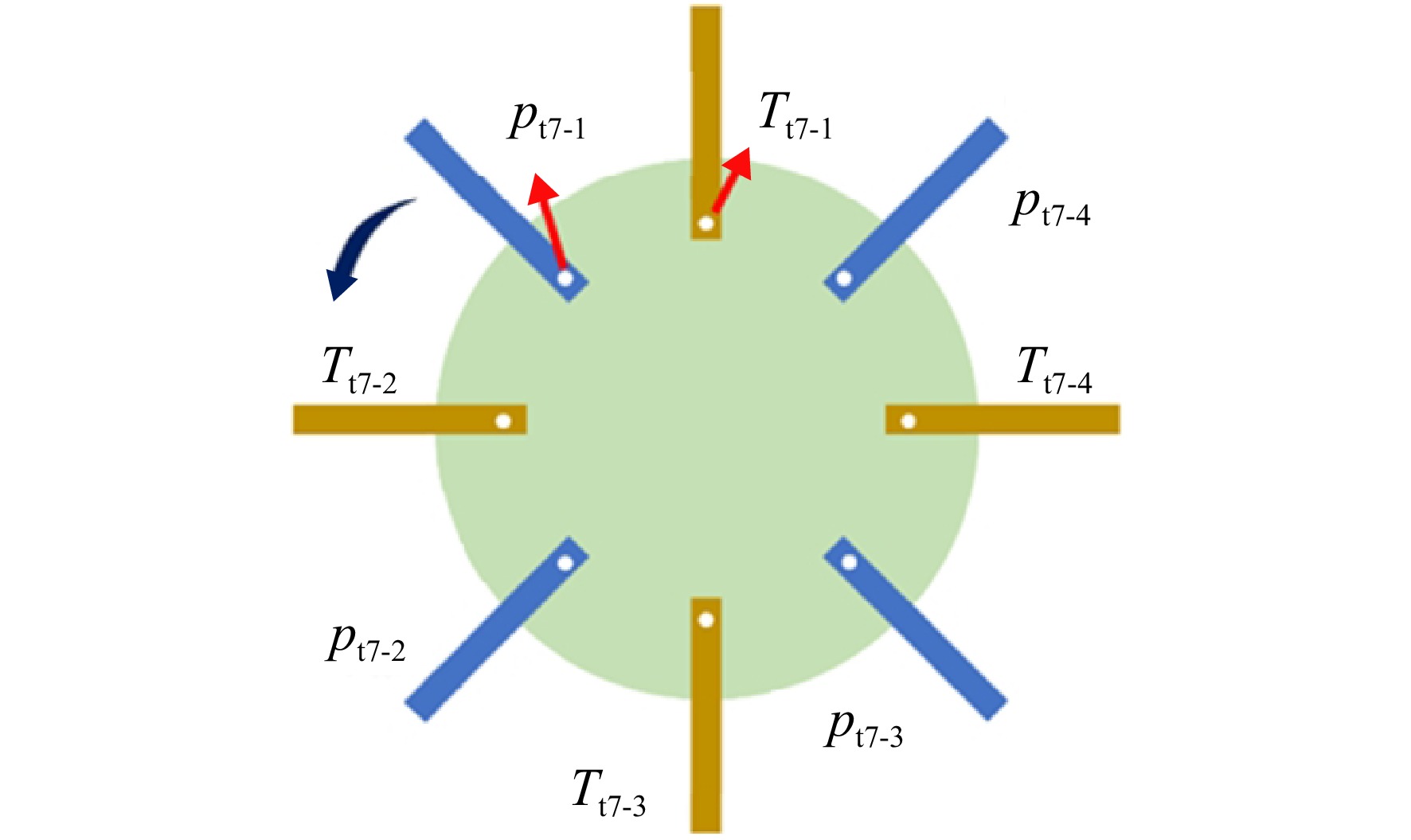
图 16 考虑热浸效应前后Tt7的对比
Figure 16. Comparison of Tt7 before and after the heat soak was considered
表 1 涡喷发动机设计点参数
Table 1. Design point specification for the turbojet engine
参数 数值 飞行马赫数 0 高度/m 0 进口空气流量/(kg/s) 31.68 物理转速/(rad/min) 14000 进气道压力损失系数 0.99 压气机压比 12 压气机效率 0.85 燃烧室出口温度/K 1450 燃烧室效率 0.999 燃烧室压力损失系数 0.97 涡轮效率 0.89 轴的机械效率 0.9999 涡轮出口压力损失系数 0.98  下载: 导出CSV
表 2 设计点模型验证
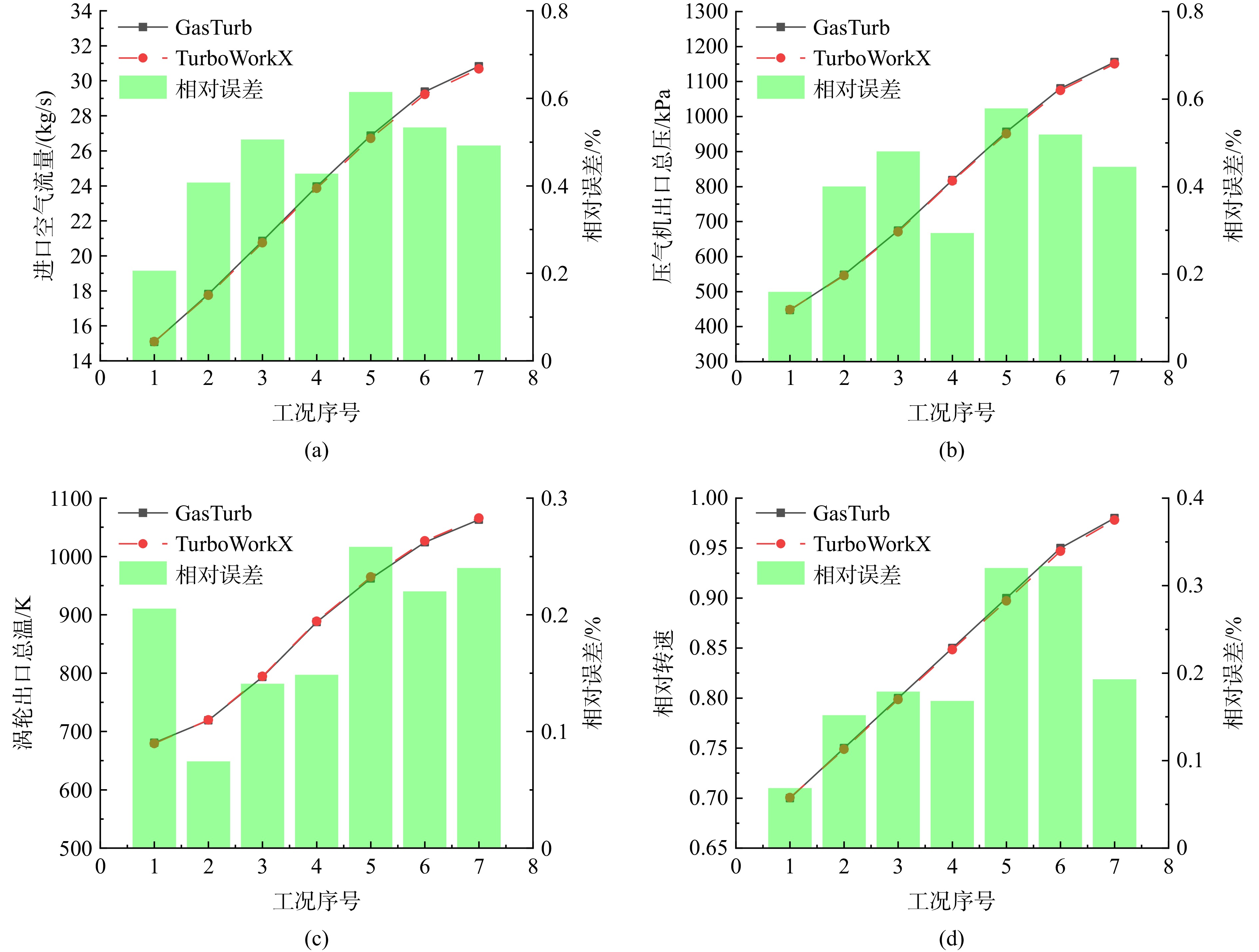
Table 2. Model validation at design point
参数 数值 相对误差/% GasTurb TurboWorkX Tt3/K 630.4 631.1 0.11 pt3/kPa 1204 1204 0 Tt4/K 1450 1450 0 pt4/kPa 1168 1168 0 Tt5/K 1091 1092 0.09 pt5/kPa 360 360.3 0.08 A8/m2 0.0742 0.0742 0 推力/kN 26.09 26.11 0.08 耗油率/(kg/(h·kN)) 91.33 91.47 0.15 注:表中Tt为总温,pt为总压,下标数值对应图3中的截面编号。
下载: 导出CSV
表 3 涡喷发动机试车实验的测量参数情况
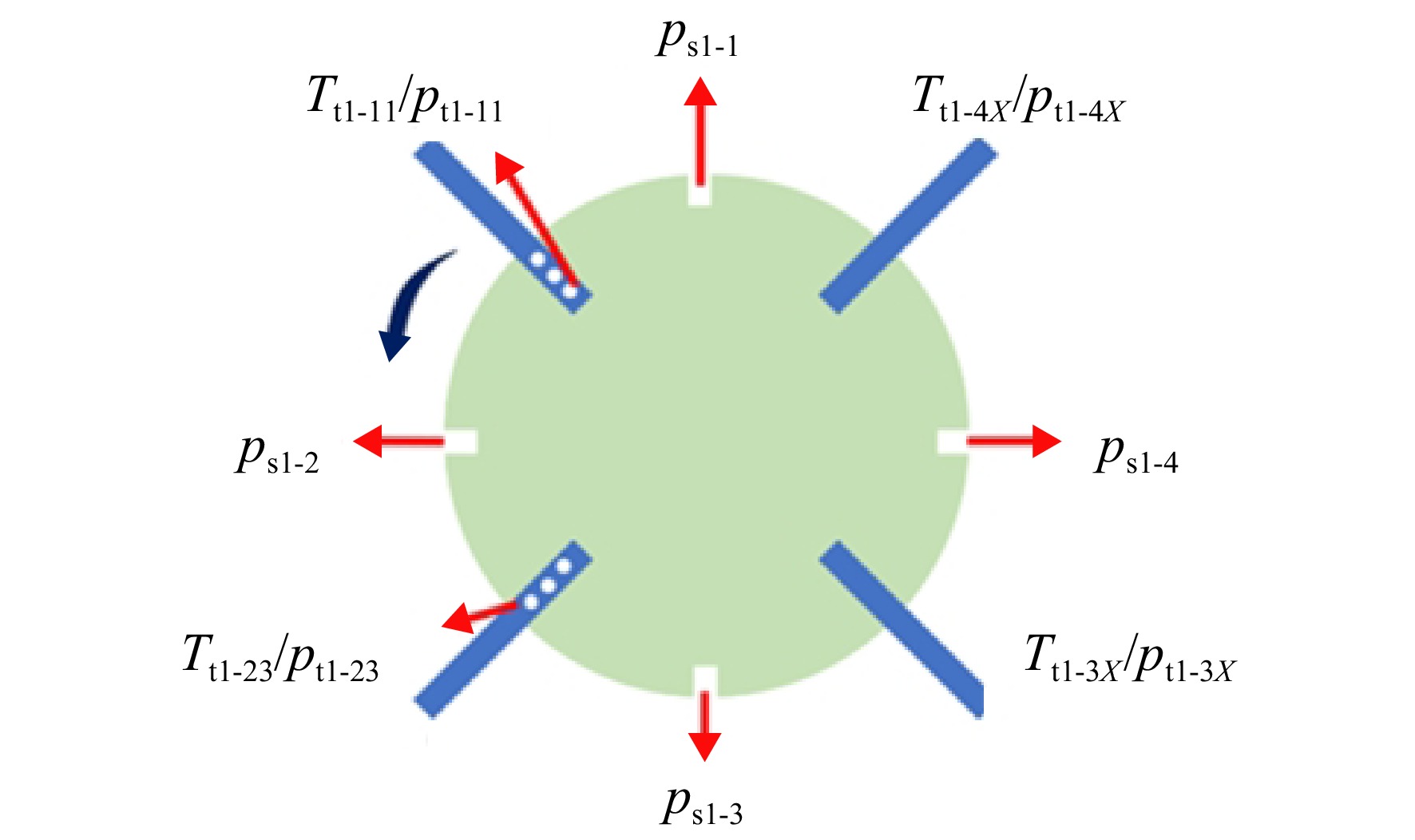
Table 3. Measurement parameter situation in the running test of the turbojet engine
参数 量符号 传感器类型 测点数 大气压力 pt0 大气压力传感器 1×1 大气温度 Tt0 T型热电偶 1×1 燃油流量 Wf 科氏流量计/齿轮流量计 2×1 转速 N 线性霍尔元件SS49E 1×1 流量管静压 ps1 硅压阻 4×1 进气总压 pt1 硅压阻 4×3 进气总温 pt1 T型热电偶 4×3 压气机后总压 pt3 硅压阻 4×1 压气机后总温 Tt3 K型热电偶 4×1 涡轮后总压 pt7 硅压阻 4×1 涡轮后总温 Tt7 K型热电偶 4×1
下载: 导出CSV
表 4 涡喷发动机稳态工况点数据
Table 4. Data of steady-state operating points for the turbojet engine
序号 Wf N pt3 Tt3 pt7 Tt7 1 32.4 0.360 116647 356.2 99222 937.9 2 36.5 0.408 123044 353.0 100412 916.2 3 41.7 0.458 131083 362.7 101855 917.8 4 47.0 0.506 139719 373.7 103559 916.0 5 52.4 0.556 150872 385.9 105567 910.7 6 58.2 0.606 163051 400.1 107938 909.7 7 64.3 0.654 176361 415.7 110688 907.8 8 71.1 0.704 193293 432.7 114102 907.9 9 78.7 0.752 211527 451.1 117936 913.3 10 87.8 0.802 232441 472.4 122801 922.3 11 98.8 0.853 256514 494.1 128957 940.0 12 111.5 0.900 282425 517.0 135843 966.8 13 127.7 0.951 312174 541.3 144528 1006.8 14 149.4 1.000 343102 567.0 567.0 1056.6
下载: 导出CSV
表 5 设计点参数优化的上下限
Table 5. Upper and lower limits for the optimization of design point parameters
参数 下限值 上限值 进口空气流量/(kg/s) 1.6 2.3 压气机效率 0.49 0.9 压气机压比 3 4 燃烧室效率 0.8 0.999 燃烧室压损 0.8 1 燃油热值/(kJ/kg) 40900 45400 燃烧室负载系数 1.5 1.7 涡轮效率 0.8 1 轴机械效率 0.98 1 涡轮出口压损 0.95 1 进气道压损 0.99 1
下载: 导出CSV
表 6 稳态修模误差
Table 6. Error of steady-state after model adaptation
方法 参数 平均误差/% 最大误差/% 1 N 10.8 19.9 pt3 3.7 7.4 pt7 10.2 16.4 Tt3 2.3 4.5 Tt7 2.0 4.6 2 N 8.0 20.2 pt3 5.7 8.3 pt7 9.7 16.4 Tt3 3.4 17.1 Tt7 5.5 15.9 3 N 0.8 2.4 pt3 1.6 2.2 pt7 1.5 2.3 Tt3 1.1 1.6 Tt7 1.0 1.8
下载: 导出CSV
表 7 过渡态模型误差
Table 7. Model error at transient state
方法 参数 最大误差/% 1 N 11.8 pt3 13.7 pt7 5.8 Tt3 14.0 Tt7 14.5 2 N 11.4 pt3 13.2 pt7 5.7 Tt3 14.2 Tt7 14.2 3 N 12.8 pt3 12.8 pt7 6.8 Tt3 12.9 Tt7 9.7
下载: 导出CSV
-
[1] 曹明, 黄金泉, 周健, 等. 民用航空发动机故障诊断与健康管理现状、挑战与机遇Ⅰ: 气路、机械和FADEC系统故障诊断与预测[J]. 航空学报, 2022, 43(9): 625573. CAO Ming, HUANG Jinquan, ZHOU Jian, et al. Current status, challenges and opportunities of civil aero-engine diagnostics & health management: Ⅰ diagnosis and prognosis of engine gas path, mechanical and FADEC[J]. Acta Aeronautica et Astronautica Sinica, 2022, 43(9): 625573. (in ChineseCAO Ming, HUANG Jinquan, ZHOU Jian, et al. Current status, challenges and opportunities of civil aero-engine diagnostics & health management: Ⅰ diagnosis and prognosis of engine gas path, mechanical and FADEC[J]. Acta Aeronautica et Astronautica Sinica, 2022, 43(9): 625573. (in Chinese) [2] 邹泽龙, 黄金泉, 周鑫, 等. VCE身份证动态模型部件特性快速自动修正方法[J]. 航空动力学报, 2024, 39(9): 20220680. ZOU Zelong, HUANG Jinquan, ZHOU Xin, et al. Fast automatic correction method for component characteristics of the identification dynamic model of VCE[J]. Journal of Aerospace Power, 2024, 39(9): 20220680. (in ChineseZOU Zelong, HUANG Jinquan, ZHOU Xin, et al. Fast automatic correction method for component characteristics of the identification dynamic model of VCE[J]. Journal of Aerospace Power, 2024, 39(9): 20220680. (in Chinese) [3] 陈铖, 郑前钢, 汪勇, 等. 基于状态感知的航空发动机变基线模型建模方法研究[J]. 推进技术, 2023, 44(9): 2206067. CHEN Cheng, ZHENG Qiangang, WANG Yong, et al. Modeling method of aeroengine variable baseline model based on state perception[J]. Journal of Propulsion Technology, 2023, 44(9): 2206067. (in ChineseCHEN Cheng, ZHENG Qiangang, WANG Yong, et al. Modeling method of aeroengine variable baseline model based on state perception[J]. Journal of Propulsion Technology, 2023, 44(9): 2206067. (in Chinese) [4] 刘渊, 余映红, 田彦云, 等. 航空发动机排气温度基线建模新方法研究[J]. 推进技术, 2022, 43(4): 200511. LIU Yuan, YU Yinghong, TIAN Yanyun, et al. Investigation on new method for baseline modelling of aeroengine exhaust gas temperature[J]. Journal of Propulsion Technology, 2022, 43(4): 200511. (in ChineseLIU Yuan, YU Yinghong, TIAN Yanyun, et al. Investigation on new method for baseline modelling of aeroengine exhaust gas temperature[J]. Journal of Propulsion Technology, 2022, 43(4): 200511. (in Chinese) [5] TSOUTSANIS E, MESKIN N, BENAMMAR M, et al. A component map tuning method for performance prediction and diagnostics of gas turbine compressors[J]. Applied Energy, 2014, 135: 572-585. doi: 10.1016/j.apenergy.2014.08.115 [6] TSOUTSANIS E, MESKIN N, BENAMMAR M, et al. Transient gas turbine performance diagnostics through nonlinear adaptation of compressor and turbine maps[J]. Journal of Engineering for Gas Turbines and Power, 2015, 137(9): 091201. doi: 10.1115/1.4029710 [7] KIAEE M, TOUSI A M, TOUDEFALLAH M. Performance adaptation of a 100 kW microturbine[J]. Applied Thermal Engineering, 2015, 87: 234-250. doi: 10.1016/j.applthermaleng.2015.04.075 [8] YANG Qingcai, LI Shuying, CAO Yunpeng. A new component map generation method for gas turbine adaptation performance simulation[J]. Journal of Mechanical Science and Technology, 2017, 31(4): 1947-1957. doi: 10.1007/s12206-017-0344-5 [9] YAN Binbin, HU Minghui, FENG Kun, et al. Enhanced component analytical solution for performance adaptation and diagnostics of gas turbines[J]. Energies, 2021, 14(14): 4356. doi: 10.3390/en14144356 [10] ZHANG Peng, FENG Kun, LIU Baoxia, et al. Operational data-based adaptive improvement method of gas turbine component characteristics for performance simulation[J]. Journal of Mechanical Science and Technology, 2023, 37(12): 6691-6709. doi: 10.1007/s12206-023-1040-2 [11] LI Y G, ABDUL GHAFIR M F, WANG L, et al. Nonlinear multiple points gas turbine off-design performance adaptation using a genetic algorithm[J]. Journal of Engineering for Gas Turbines and Power, 2011, 133(7): 071701. doi: 10.1115/1.4002620 [12] 李明洲, 嵇润民, 黄向华. 基于改进粒子群的航空发动机部件特性修正[J]. 推进技术, 2022, 43(11): 210662. LI Mingzhou, JI Runmin, HUANG Xianghua. Aeroengine component characteristic correction based on improved particle swarm optimization[J]. Journal of Propulsion Technology, 2022, 43(11): 210662. (in ChineseLI Mingzhou, JI Runmin, HUANG Xianghua. Aeroengine component characteristic correction based on improved particle swarm optimization[J]. Journal of Propulsion Technology, 2022, 43(11): 210662. (in Chinese) [13] 郭庆, 孙正日, 樊俊峰, 等. 面向健康管理的民航发动机气路基准模型建立与验证[J]. 推进技术, 2025, 46(3): 2406058. GUO Qing, SUN Zhengri, FAN Junfeng, et al. Establishment and verification of a civil aircraft engine air path benchmark model for health management[J]. Journal of Propulsion Technology, 2025, 46(3): 2406058. (in ChineseGUO Qing, SUN Zhengri, FAN Junfeng, et al. Establishment and verification of a civil aircraft engine air path benchmark model for health management[J]. Journal of Propulsion Technology, 2025, 46(3): 2406058. (in Chinese) [14] 金鹏, 鲁峰, 黄金泉. 涡扇发动机部件特性的滤波自动修正更新方法[J]. 推进技术, 2019, 40(12): 2664-2672. JIN Peng, LU Feng, HUANG Jinquan. Automatic filtering-based modification and updating of component characteristics for turbofan engine[J]. Journal of Propulsion Technology, 2019, 40(12): 2664-2672. (in ChineseJIN Peng, LU Feng, HUANG Jinquan. Automatic filtering-based modification and updating of component characteristics for turbofan engine[J]. Journal of Propulsion Technology, 2019, 40(12): 2664-2672. (in Chinese) [15] KIM S, IM J H, KIM M, et al. Diagnostics using a physics-based engine model in aero gas turbine engine verification tests[J]. Aerospace Science and Technology, 2023, 133: 108102. doi: 10.1016/j.ast.2022.108102 [16] JIANG Zhen, WANG Xi, YANG Shubo, et al. A deterministic calibration method for the thermodynamic model of gas turbines[J]. Symmetry, 2024, 16(5): 522. doi: 10.3390/sym16050522 [17] KIM S, LEE C R, YANG W, et al. Suitability of performance adaptation methods for updating the thermodynamic cycle model of a turboprop engine[J]. Applied Thermal Engineering, 2024, 242: 122408. doi: 10.1016/j.applthermaleng.2024.122408 [18] 钟文城, 汪勇, 宋劼, 等. 一种面向航空发动机数学模型的新型修正方法[J]. 航空动力学报, 2023, 38(11): 2776-2784. ZHONG Wencheng, WANG Yong, SONG Jie, et al. A new correction method for aero-engine mathematical model[J]. Journal of Aerospace Power, 2023, 38(11): 2776-2784. (in ChineseZHONG Wencheng, WANG Yong, SONG Jie, et al. A new correction method for aero-engine mathematical model[J]. Journal of Aerospace Power, 2023, 38(11): 2776-2784. (in Chinese) [19] PANG Shuwei, LI Qiuhong, FENG Hailong, et al. Joint steady state and transient performance adaptation for aero engine mathematical model[J]. IEEE Access, 2019, 7: 36772-36787. doi: 10.1109/ACCESS.2019.2905865 [20] CHEN Yuzhi, TSOUTSANIS E, WANG Chen, et al. A time-series turbofan engine successive fault diagnosis under both steady-state and dynamic conditions[J]. Energy, 2023, 263: 125848. doi: 10.1016/j.energy.2022.125848 [21] 陈敏, 张纪元, 唐海龙, 等. 自适应循环发动机总体设计技术探讨[J]. 航空动力学报, 2022, 37(10): 2046-2058. CHEN Min, ZHANG Jiyuan, TANG Hailong, et al. Discussion on overall performance design technology of adaptive cycle engine[J]. Journal of Aerospace Power, 2022, 37(10): 2046-2058. (in ChineseCHEN Min, ZHANG Jiyuan, TANG Hailong, et al. Discussion on overall performance design technology of adaptive cycle engine[J]. Journal of Aerospace Power, 2022, 37(10): 2046-2058. (in Chinese) [22] CHEN Yuzhi, TSOUTSANIS E, XIANG Hengchao, et al. A dynamic performance diagnostic method applied to hydrogen powered aero engines operating under transient conditions[J]. Applied Energy, 2022, 317: 119148. doi: 10.1016/j.apenergy.2022.119148 [23] KURZKE J. GasTurb: a program to calculate design and off-design performance of gas turbines[EB/OL]. [2024-12-12]. https://www.gasturb.com/software/gasturb.html. [24] LI Y G, PILIDIS P. GA-based design-point performance adaptation and its comparison with ICM-based approach[J]. Applied Energy, 2010, 87(1): 340-348. doi: 10.1016/j.apenergy.2009.05.034 [25] CHEN Yuzhi, FENG Guolong, XIANG Hengchao, et al. Techno-economic, environmental risk, and gas path analysis of intercooled recuperated turbofan engine[J]. Applied Thermal Engineering, 2024, 243: 122557. doi: 10.1016/j.applthermaleng.2024.122557 -

 点击查看大图

计量
- 文章访问数: 882
- HTML浏览量: 760
- PDF量: 72
- 被引次数: 0