






Study on design of transonic axial-flow fans based on time-marching throughflow inverse design method
-
摘要:
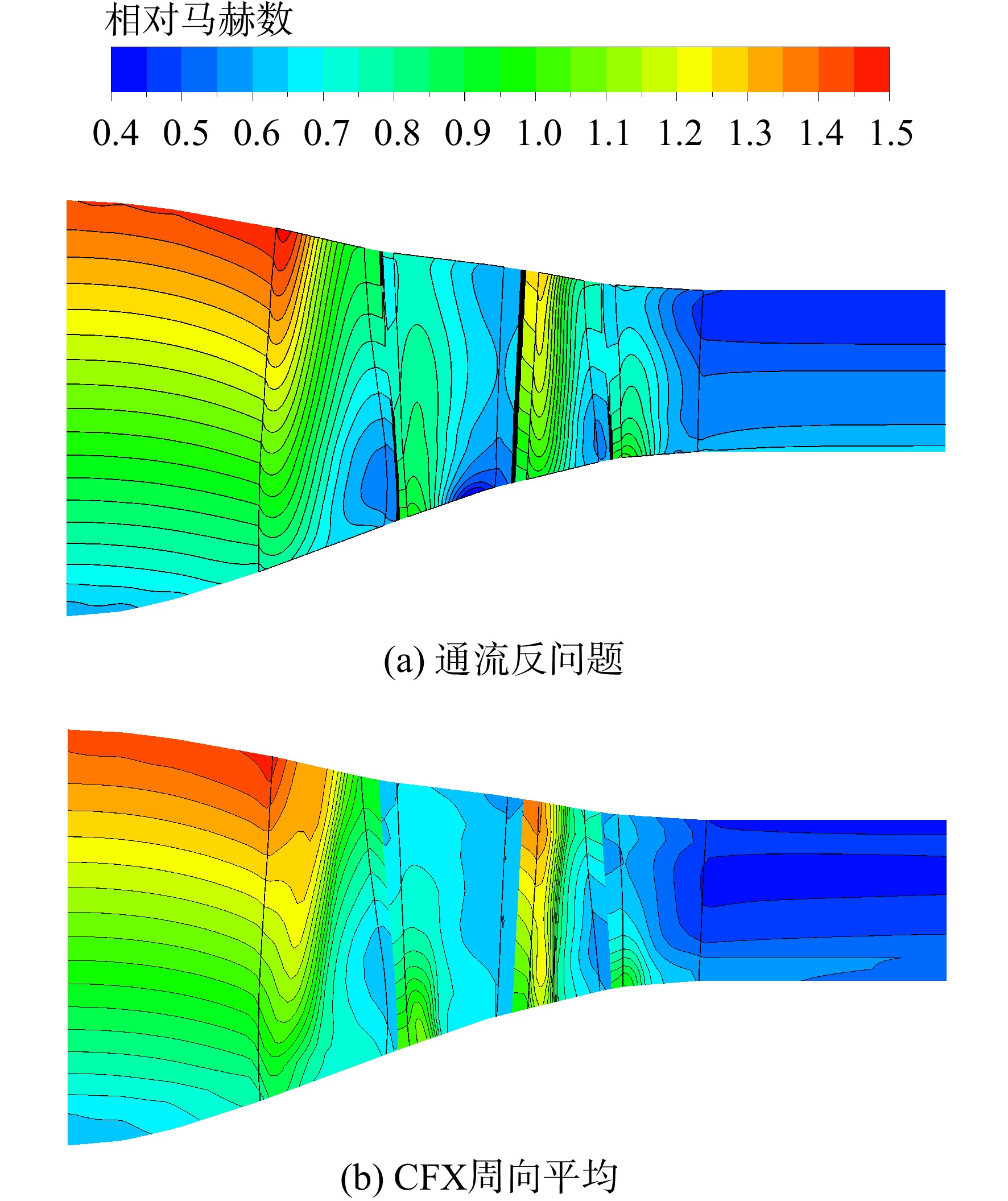
基于计算流体力学(CFD)理论,发展了一种面向多级轴流风扇的通流反设计方法。为准确加载无黏叶片力,基于近似因子分解法提出了一种鲁棒的流面几何更新数值解法。采用该方法对一款两级跨声速风扇进行了重新设计,并通过全三维数值模拟进行了验证。结果显示:程序能够稳健且高效地实现通流设计的完全收敛,且子午流场与全三维周向平均结果基本吻合。经全三维验证,设计工况的质量流量和总压比均达到设计目标;非设计工况下本设计方案与其原型性能各有优劣。非设计转速下的峰值效率虽有所降低(最大降低1.04%),但稳定裕度和失速总压比均有一定提升(最大分别提升1.7%和1.26%)。
Abstract:A throughflow inverse design method for multi-stage axial-flow fans was developed based on computational fluid dynamics (CFD) theory. A robust numerical method was proposed based on the approximate factorization method to impose the inviscid blade force on the blades accurately. The process was applied to the redesign of a two-stage transonic fan, and the design was validated through full three-dimensional numerical simulations. The results showed that the program can robustly and efficiently achieve complete convergence of the throughflow design, with the meridional flow fields in good agreement with the three-dimensional circumferentially averaged results. Through full three-dimensional simulation validations, the present design results achieved the target mass flow rate and total pressure ratio under the design point. At off-design operations, the current configuration demonstrated complementary advantages compared with the prototype: While peak efficiency experienced slight reductions at off-design rotational speeds (with a maximum reduction of 1.04%), the stability margin and stall pressure ratio showed maximum improvements of 1.7% and 1.26%, respectively.
-
Key words:
- inverse problem /
- axial-flow fans /
- time-marching /
- throughflow method /
- aerodynamic design
-
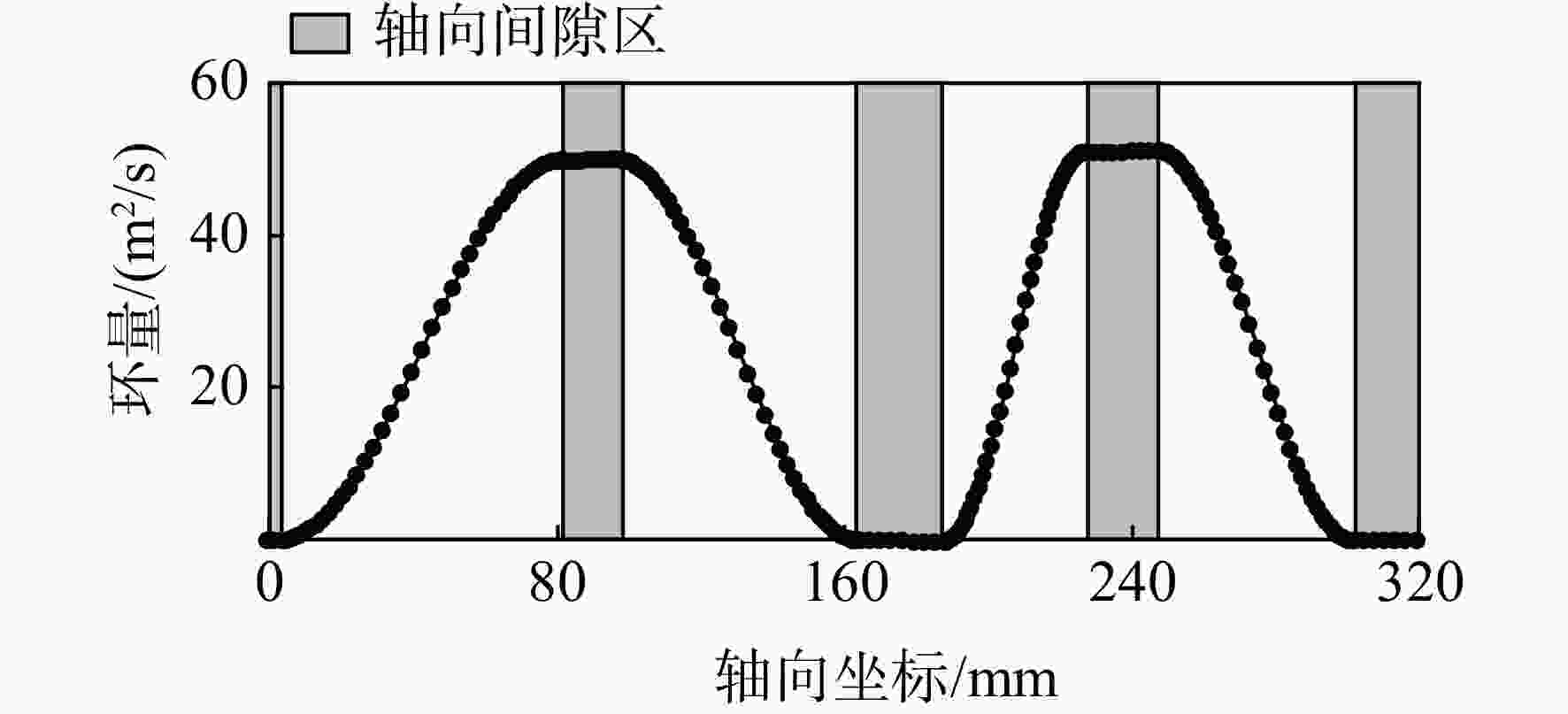
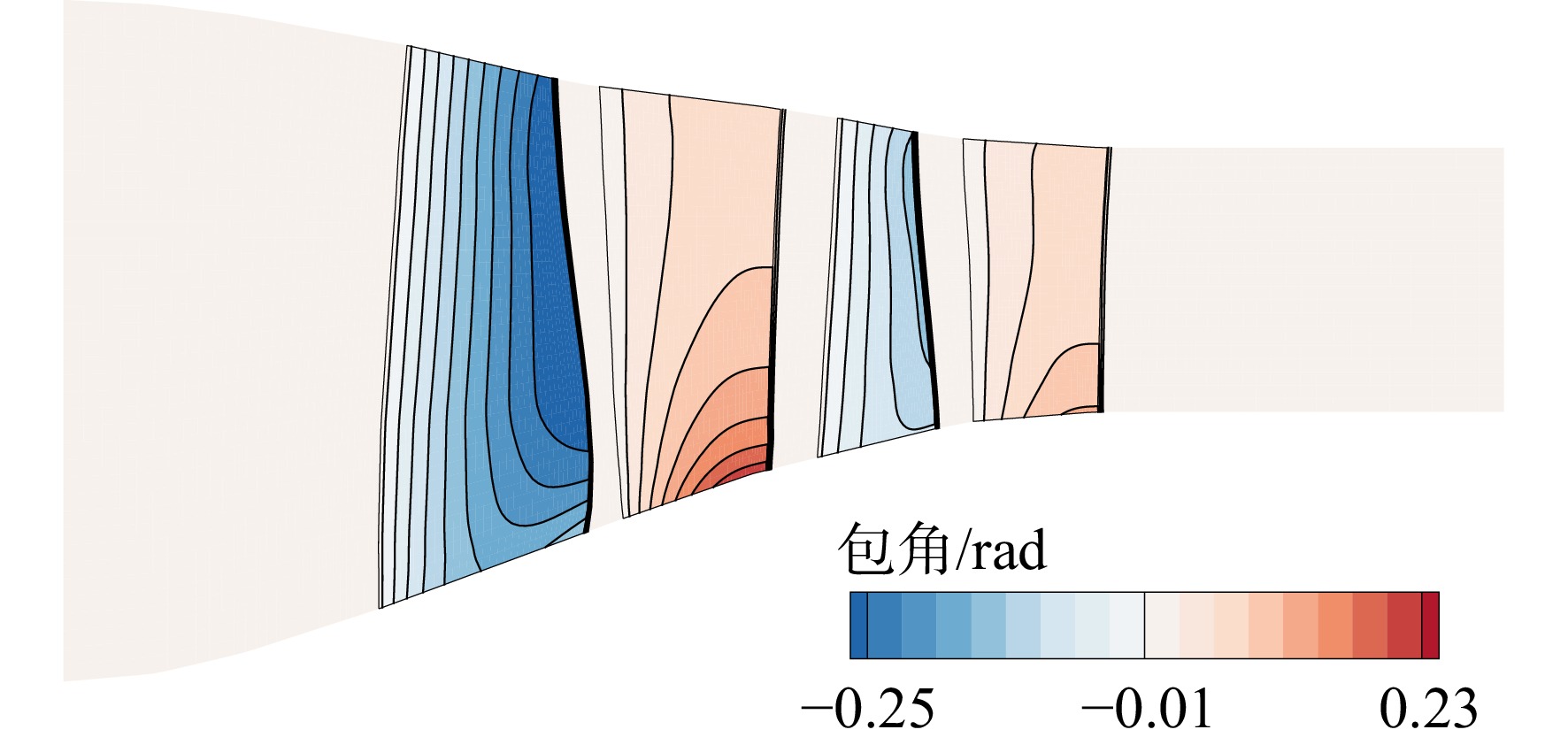
图 1 两级风扇中径处环量分布示意图
Figure 1. Schematic diagram of circulation distribution at meanline of a two-stage fan
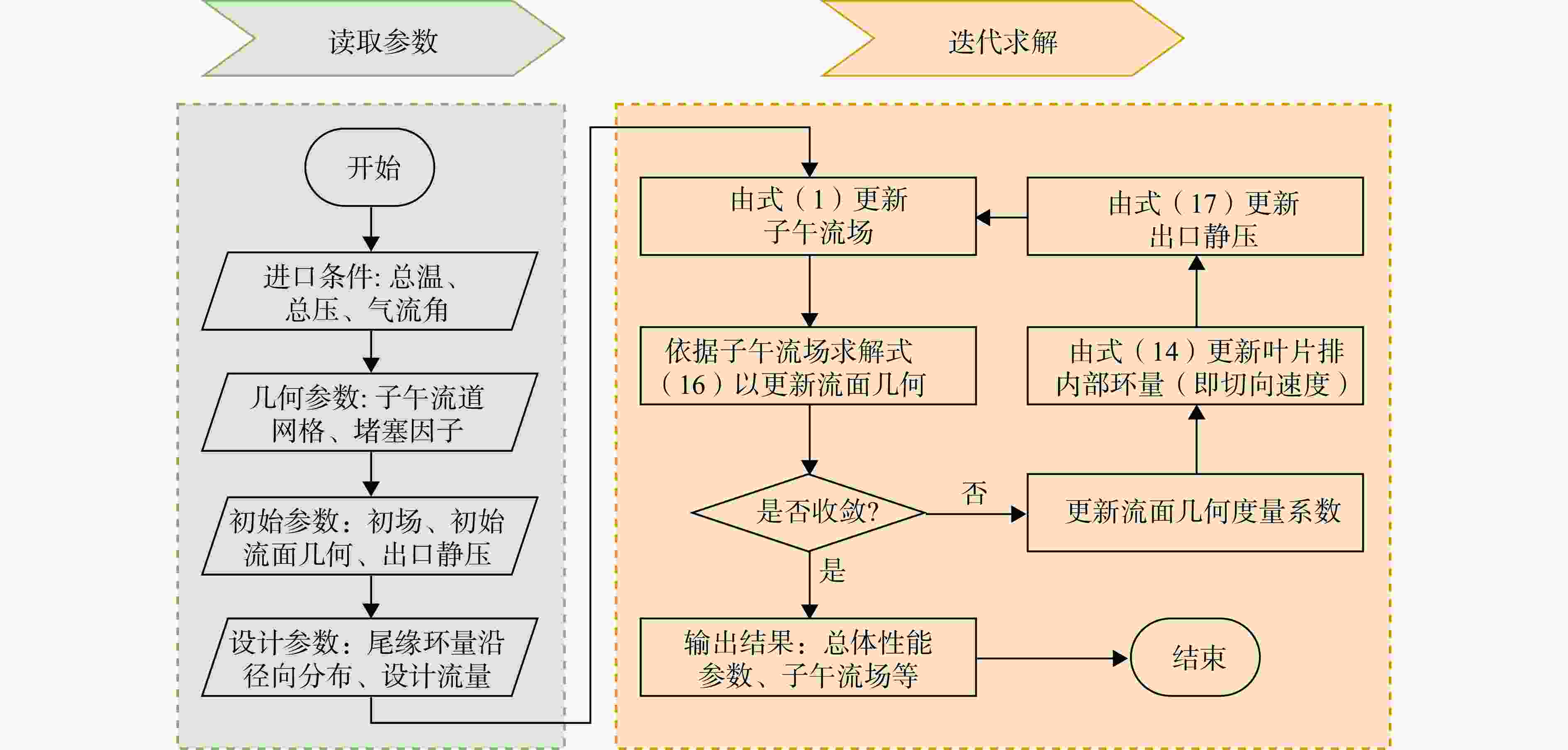
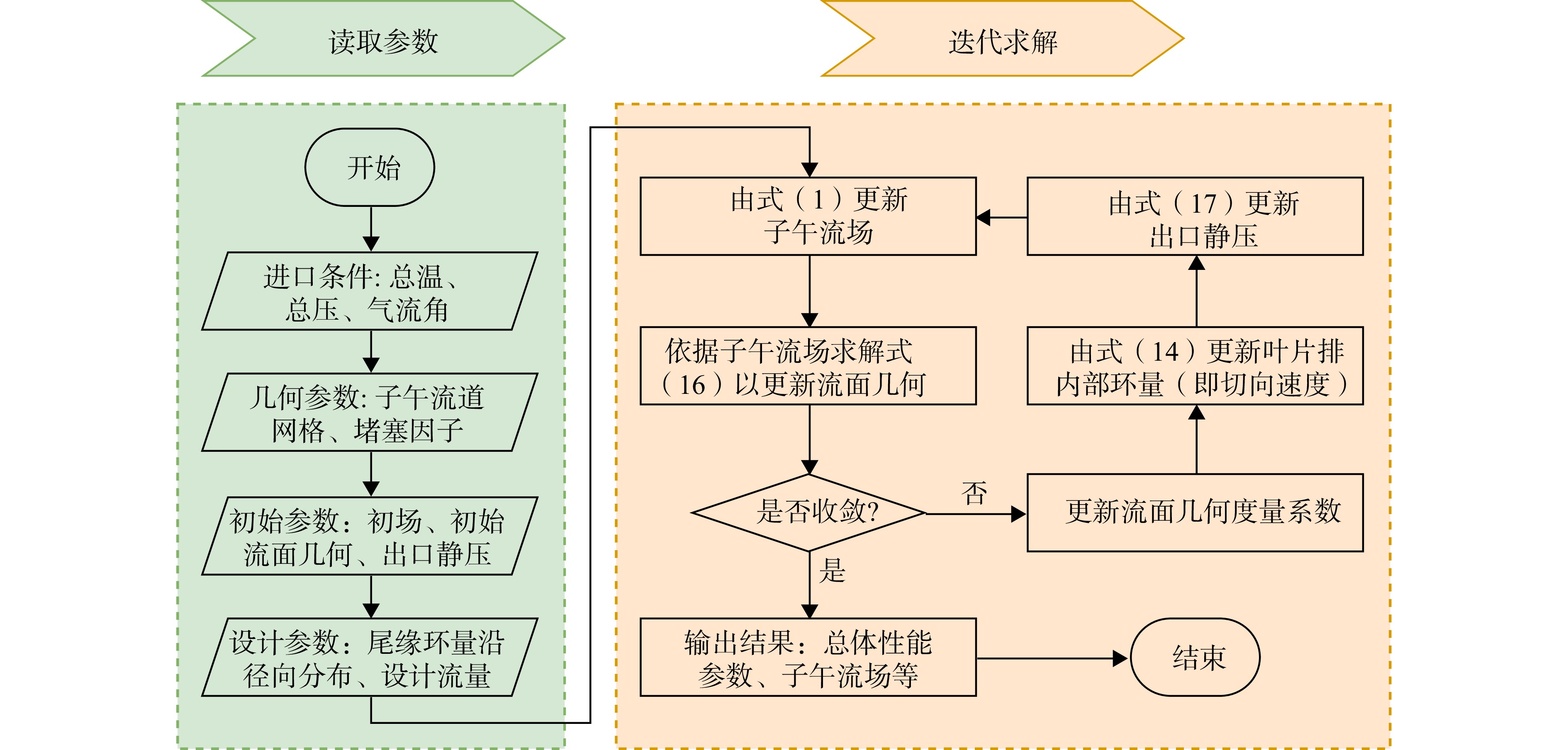
图 5 时间推进通流反问题求解流程图
Figure 5. Flowchart of time-marching throughflow inverse problem solution

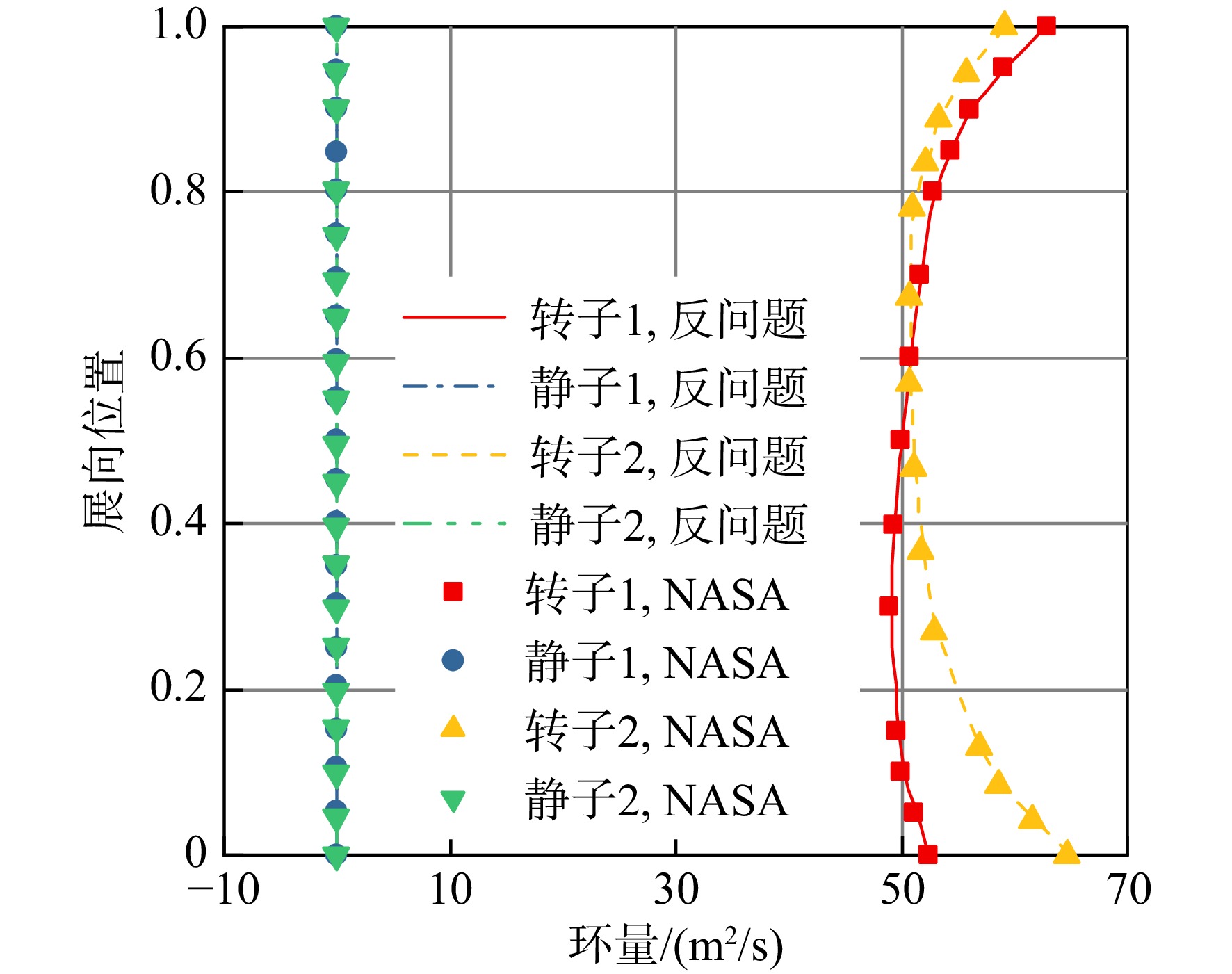
图 8 各叶片排尾缘处环量沿展向分布对比
Figure 8. Comparison of trailing-edge circulation distribution along spanwise direction for all blade rows
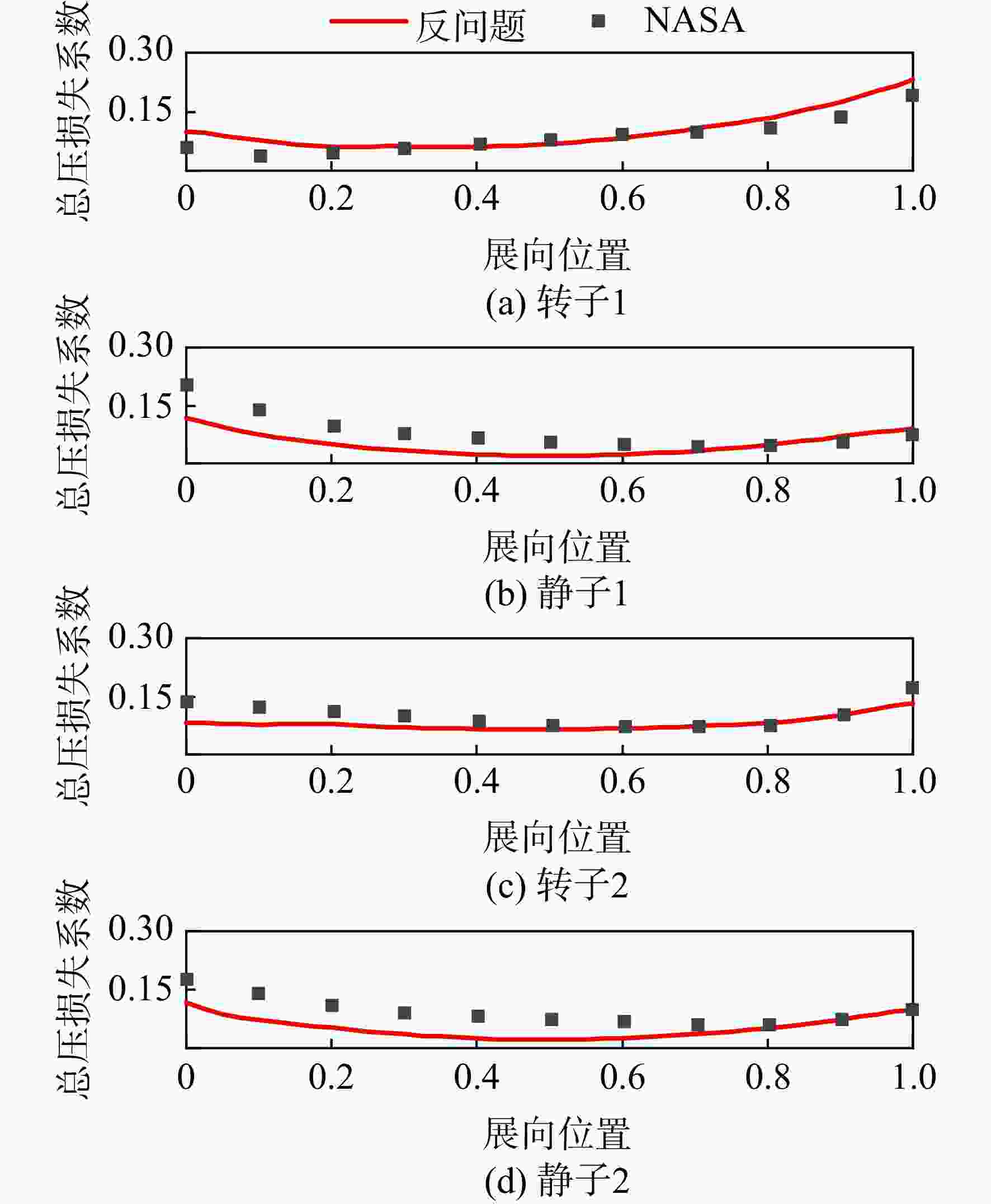
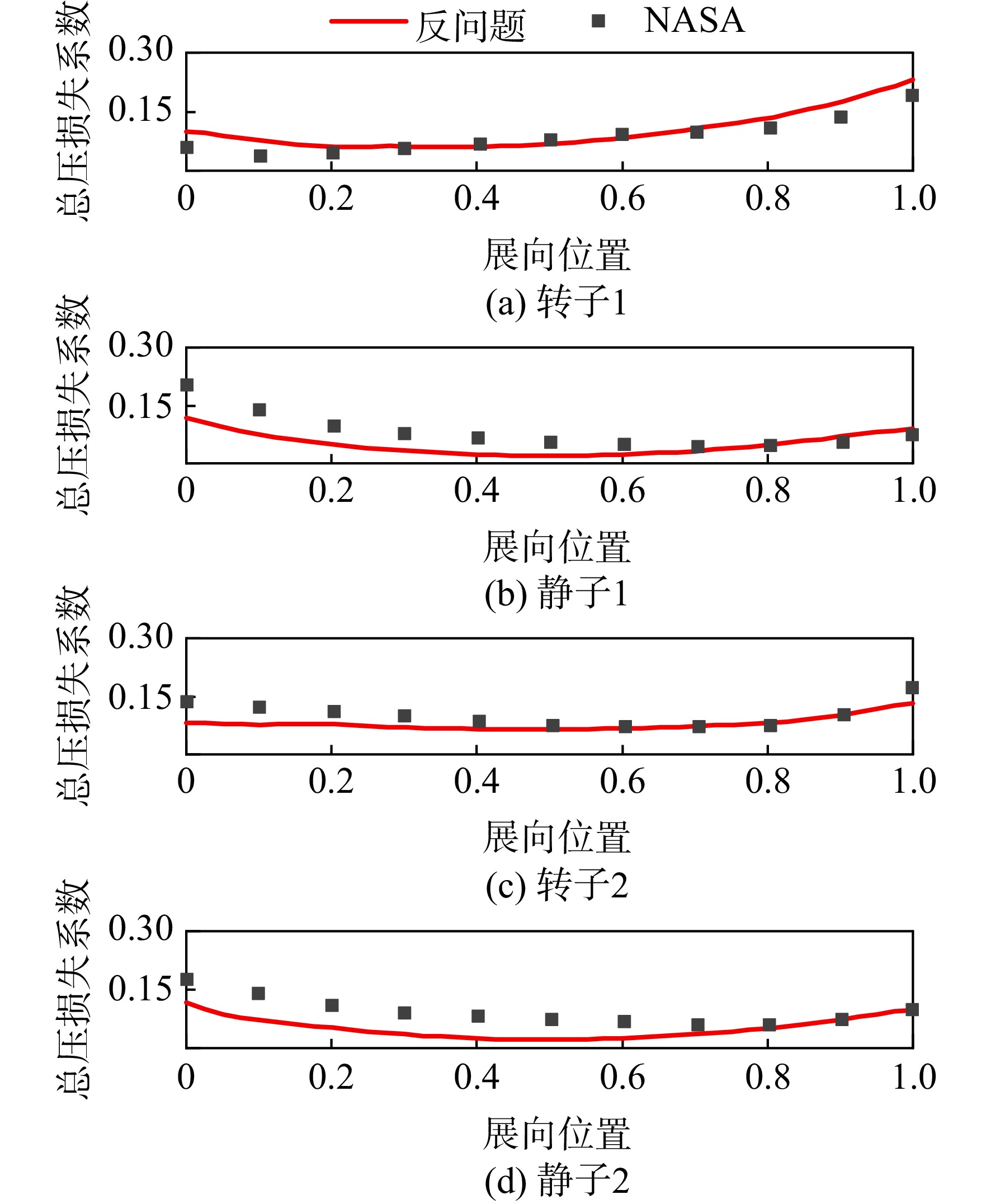
图 9 各叶片排总压损失系数沿展向分布
Figure 9. Spanwise distribution of total pressure loss coefficient for all blade rows
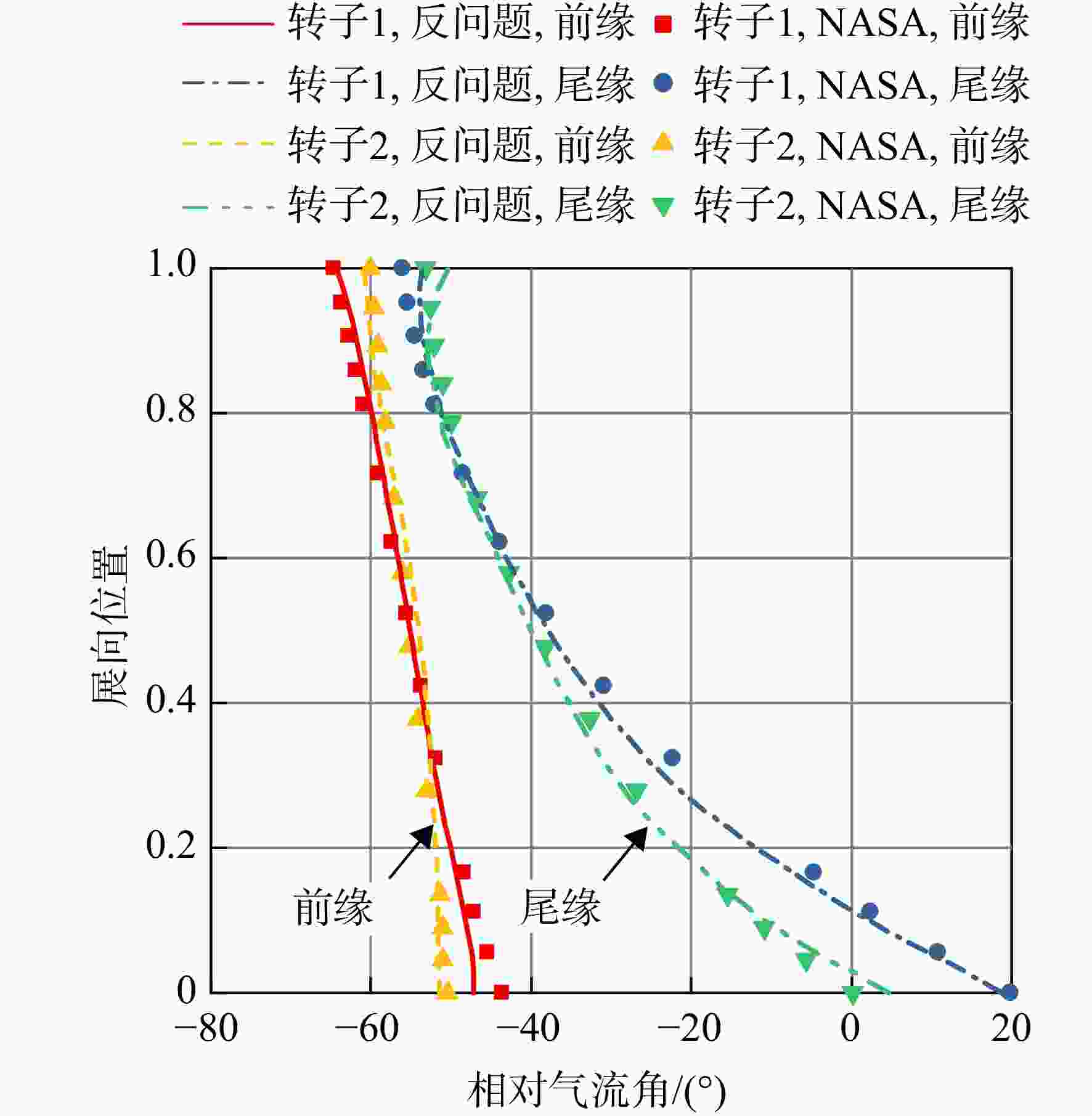
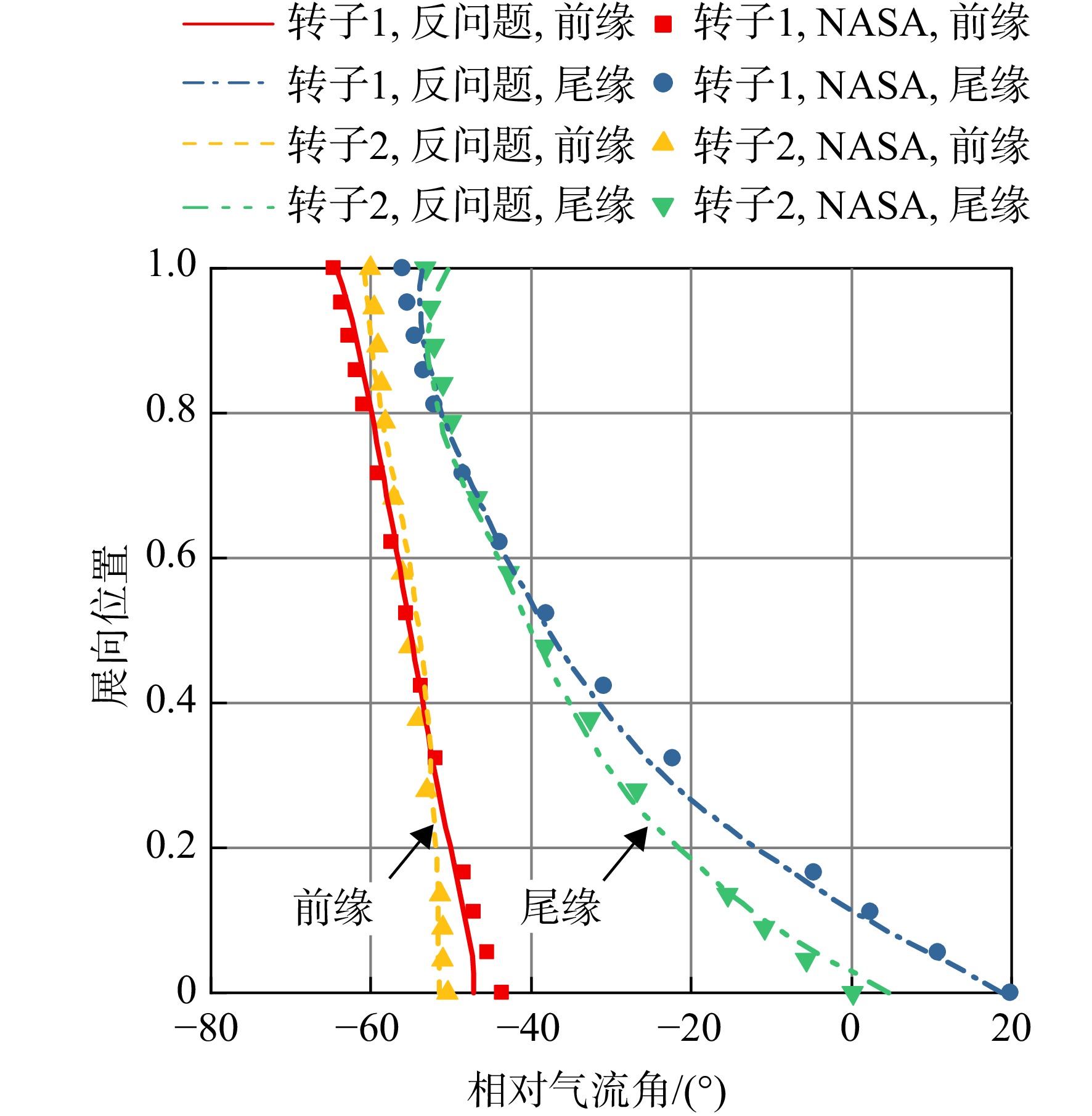
图 10 转子前、尾缘相对气流角沿展向分布
Figure 10. Spanwise distribution of relative flow angle at rotor leading edge and trailing edge
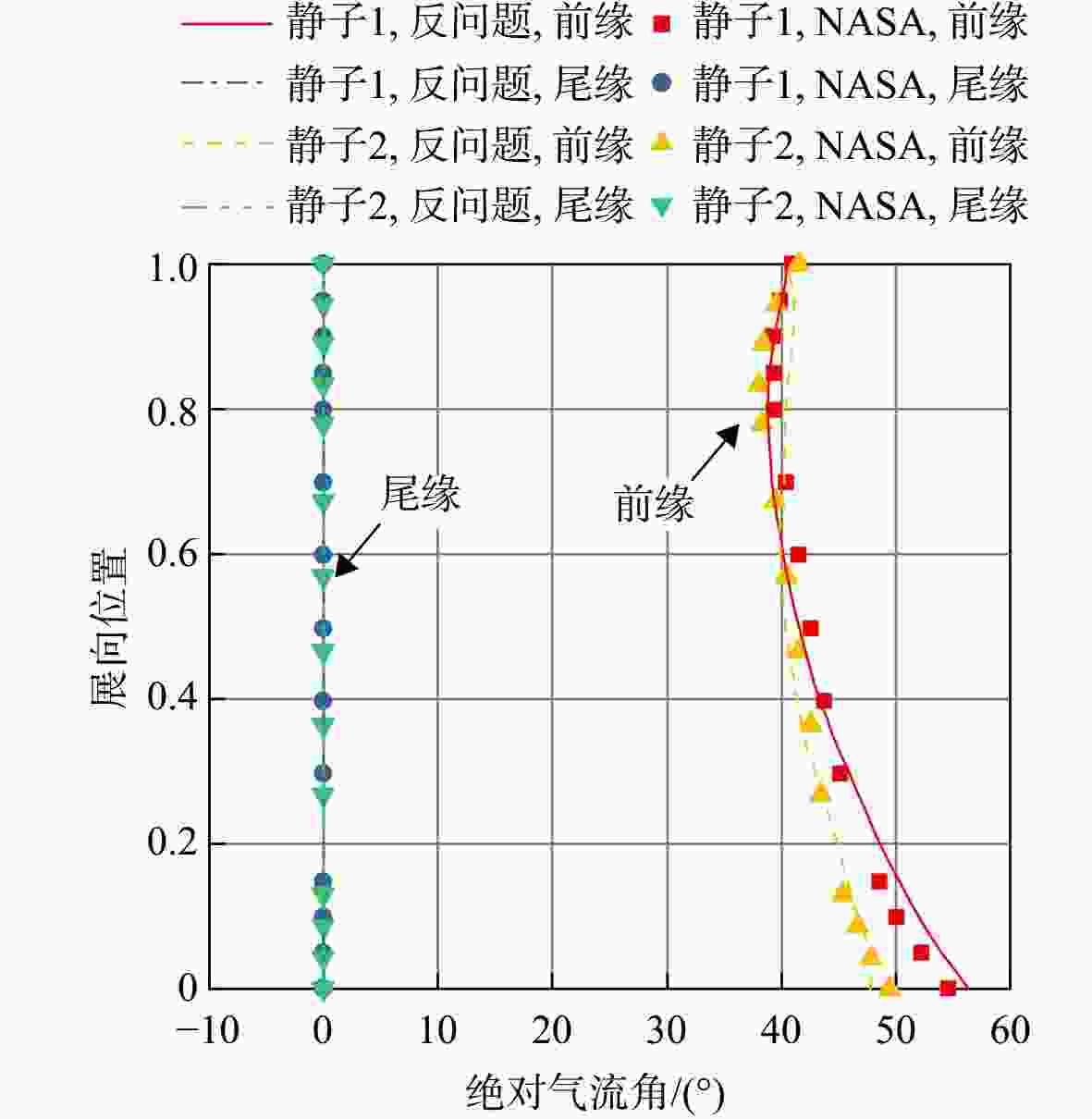
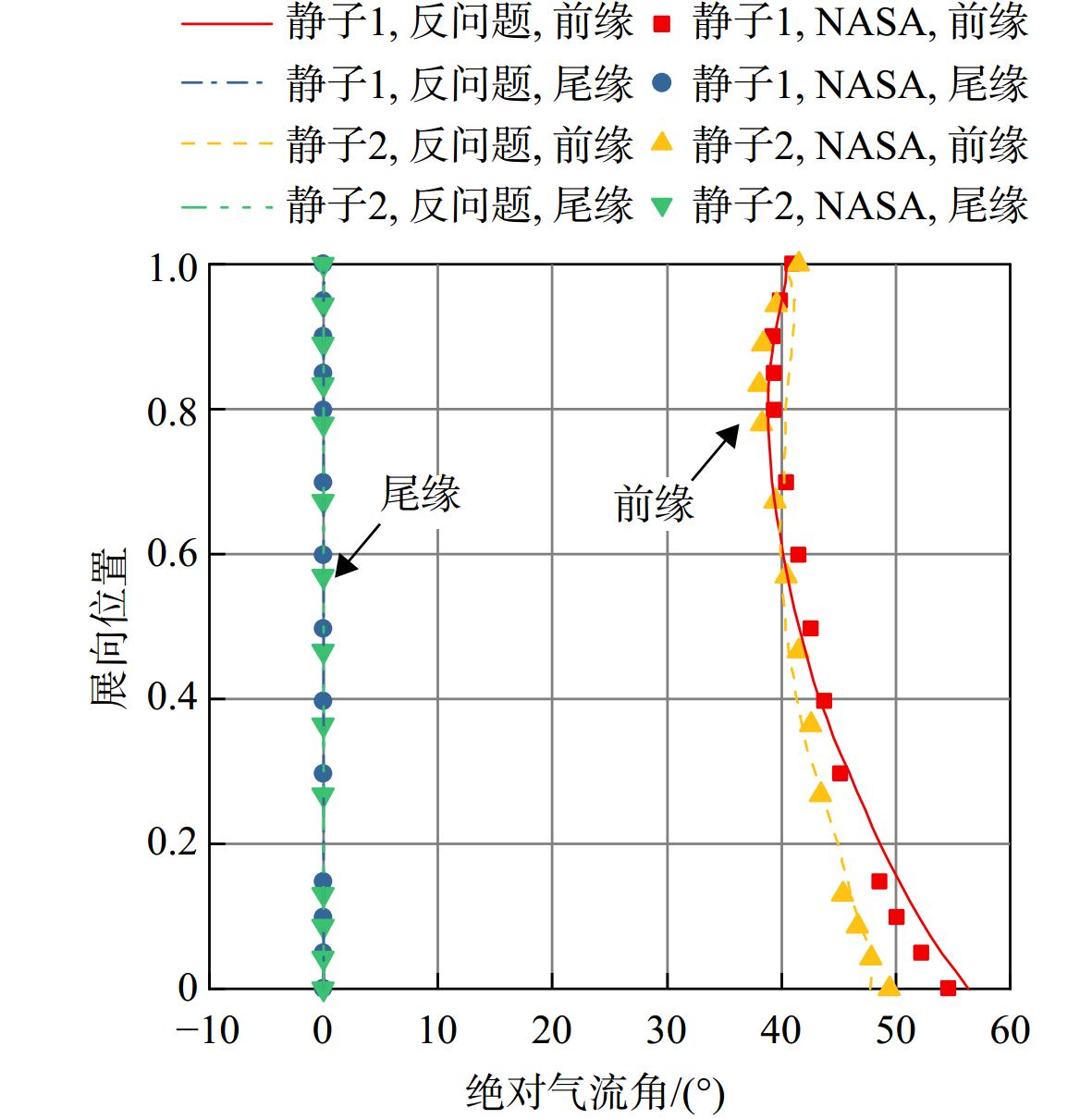
图 11 静子前、尾缘绝对气流角沿展向分布
Figure 11. Spanwise distribution of absolute flow angle at stator leading edge and trailing edge
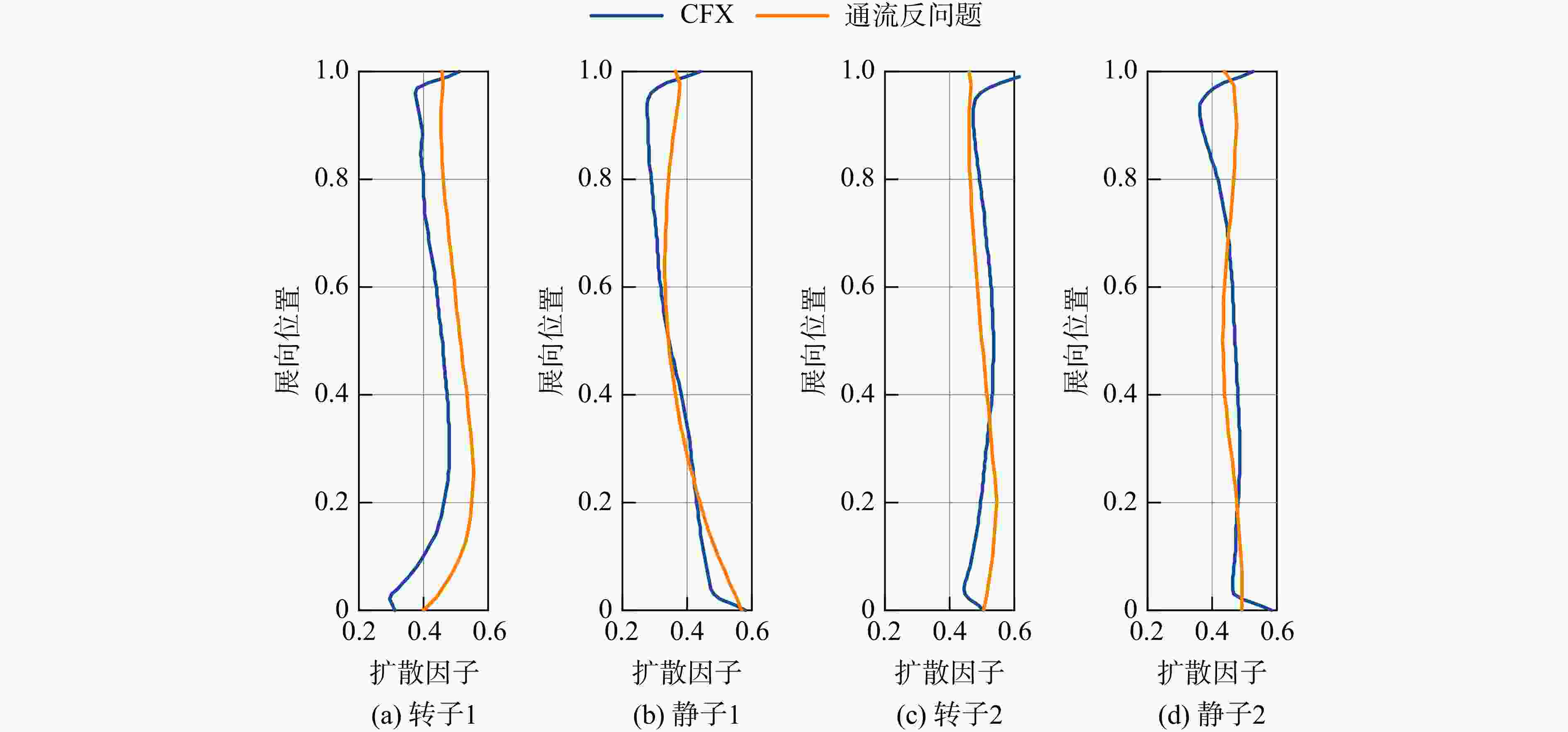
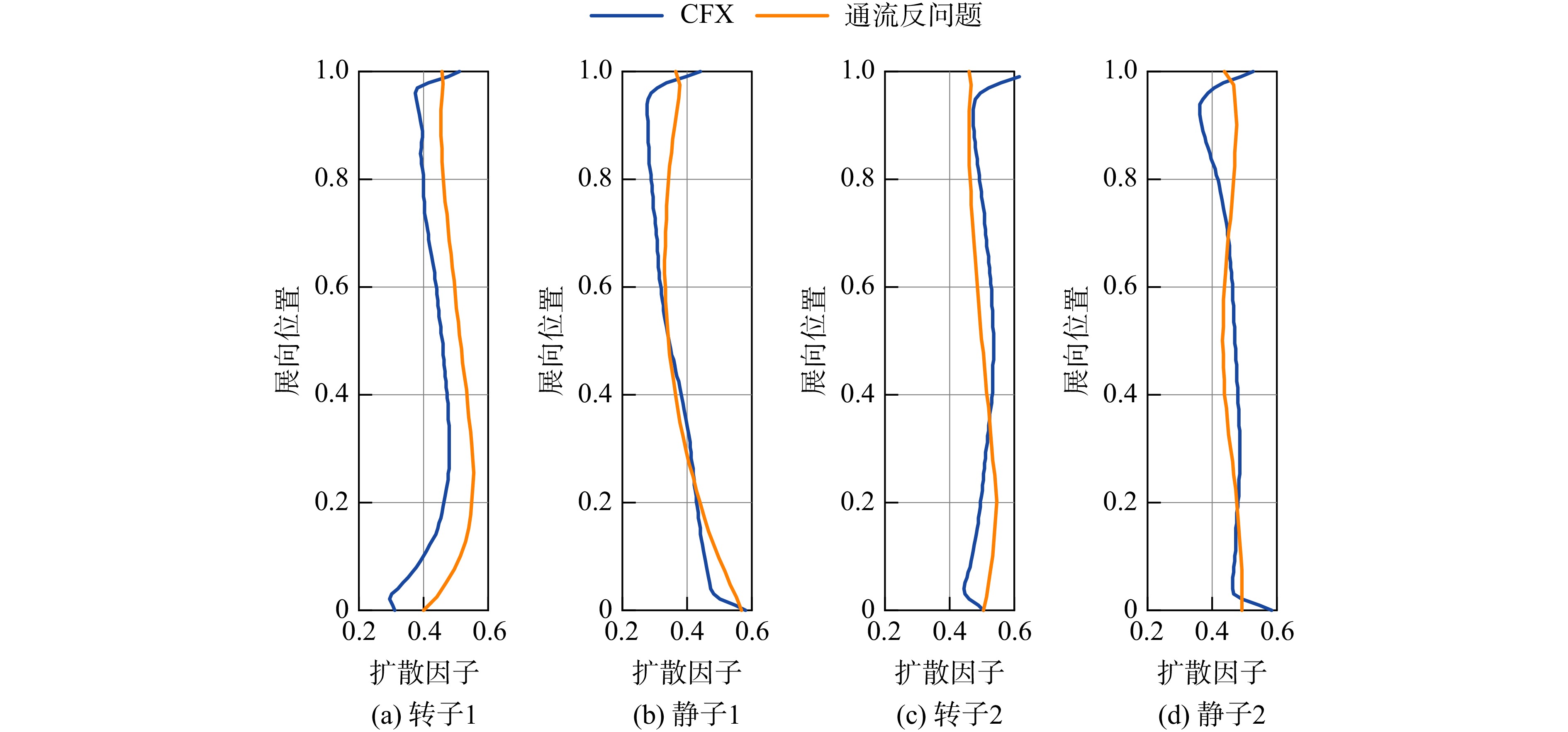
图 17 CFX与通流设计结果扩散因子对比图
Figure 17. Comparison of diffusion factor between CFX and throughflow design results
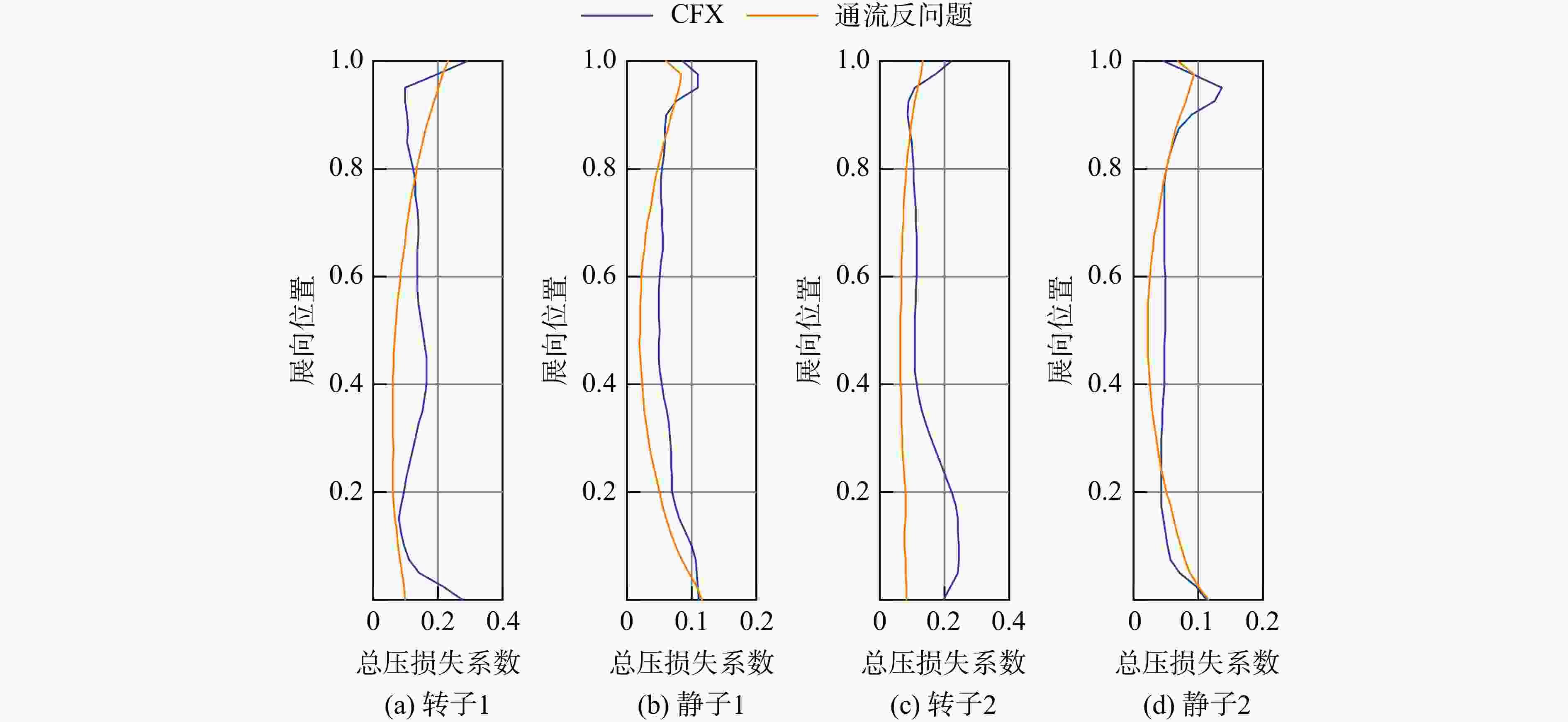
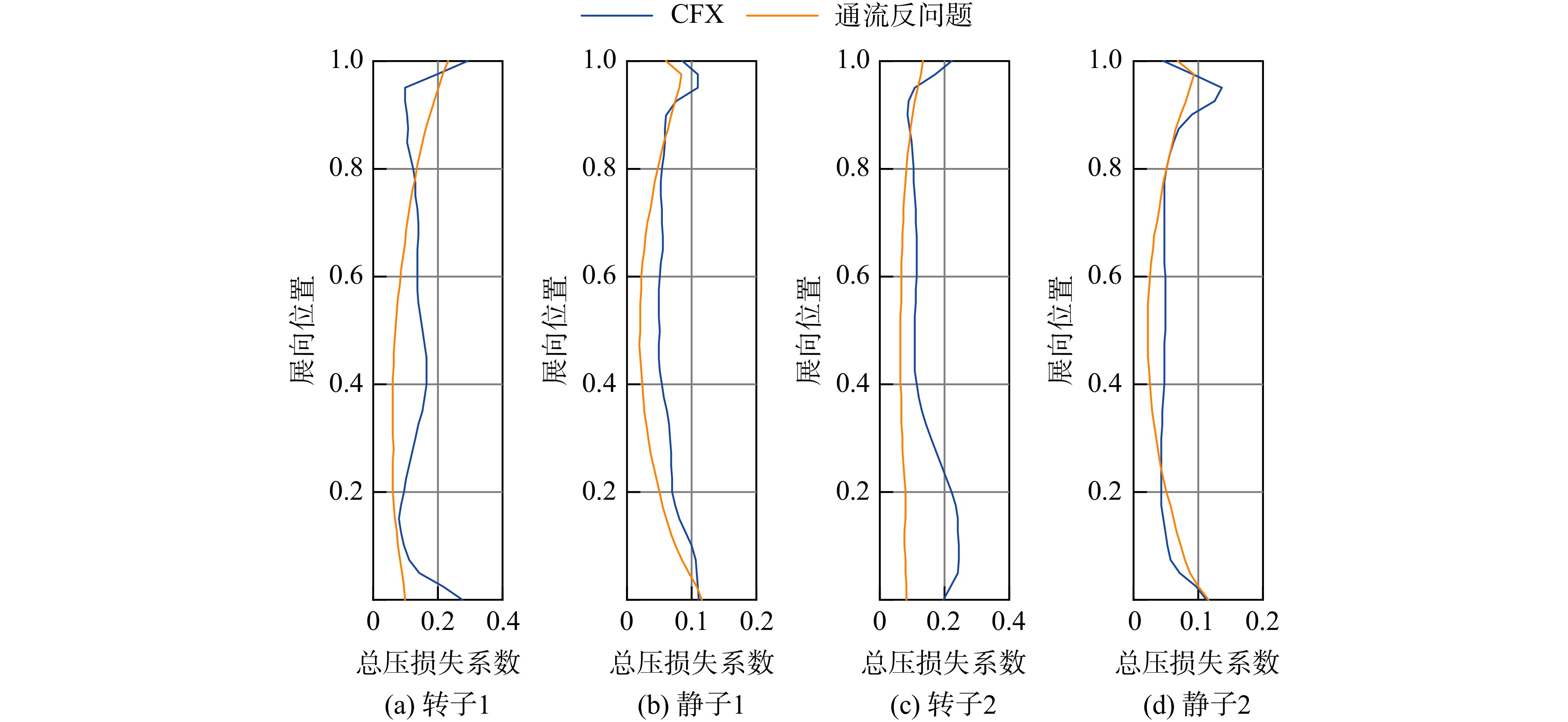
图 18 CFX与通流设计结果总压损失系数对比图
Figure 18. Comparison of total pressure loss coefficient between CFX and throughflow design results
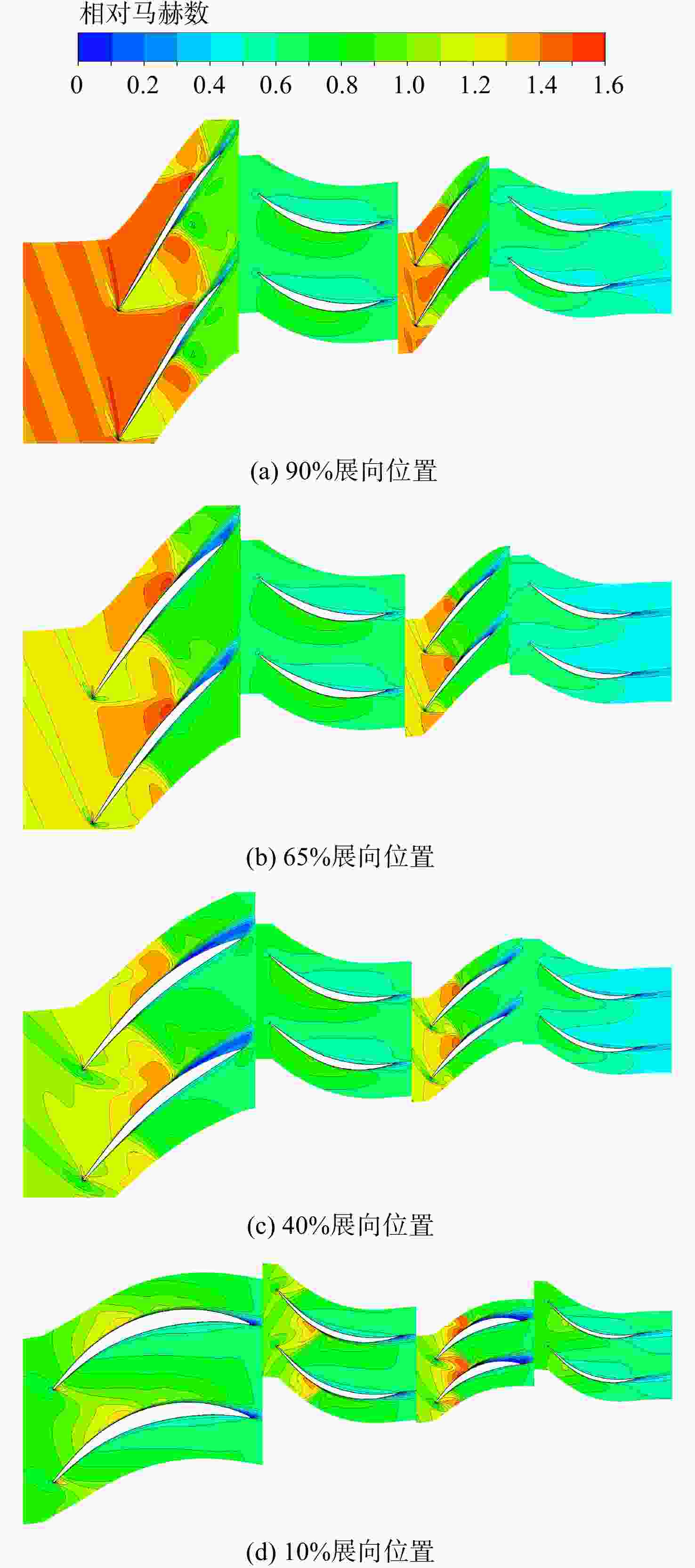
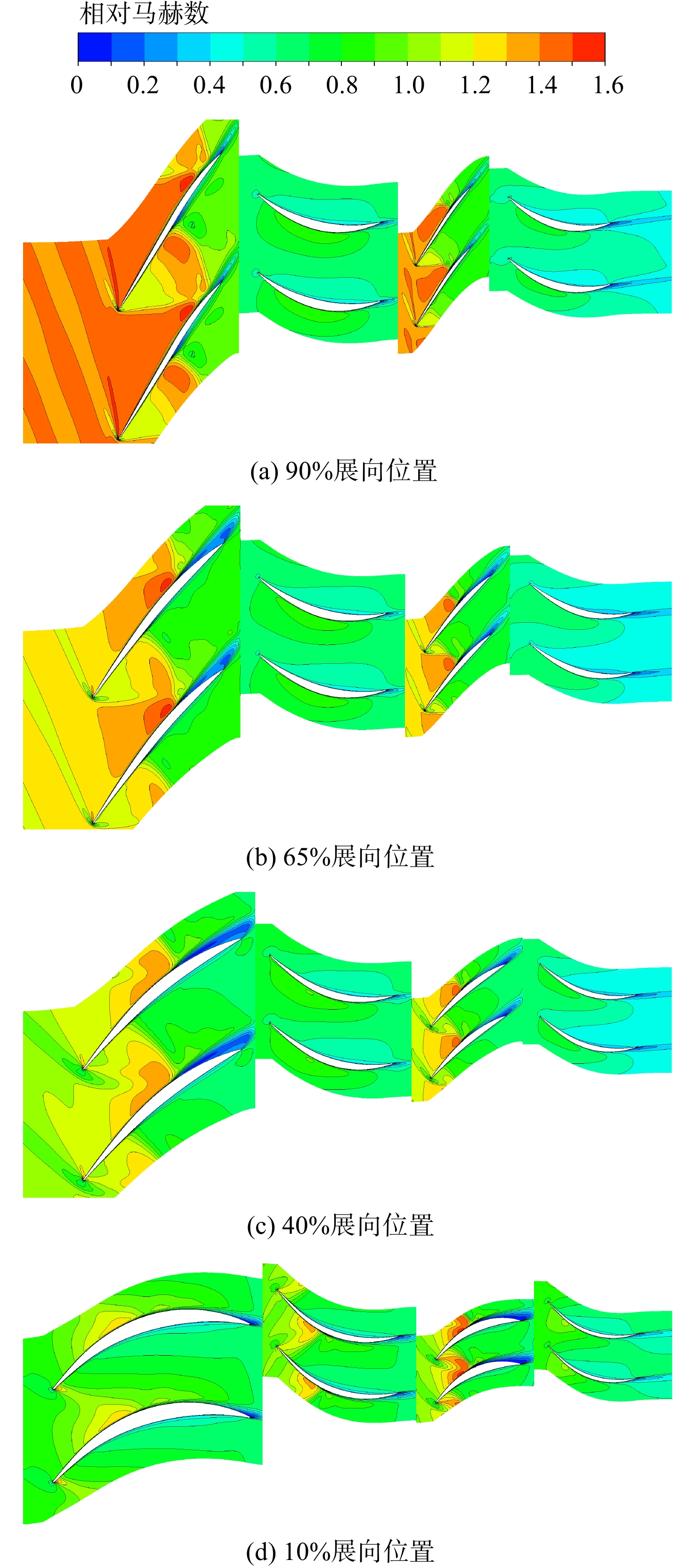
图 19 不同展向位置的相对马赫数等值线分布云图
Figure 19. Contours of relative Mach number for different spanwise locations
表 1 通流设计所采用的总压损失模型
Table 1. Total pressure loss model employed in throughflow design
 下载: 导出CSV
参数 数值 总压比 2.80 等熵效率/% 83.90 换算流量/(kg/s) 83.5 最大叶尖线速度/(m/s) 441.96 设计转速/(r/min) 10720 展弦比 2.02,2.19,2.50,1.98
下载: 导出CSV
表 3 本方法与NASA报告中的总体性能参数对比
Table 3. Comparison of overall performance parameters between present method and NASA report
参数 数值 NASA 反问题 流量/(kg/s) 83.500 83.508 等熵效率/% 83.90 86.11 总压比 2.80 2.88
下载: 导出CSV
表 4 网格参数及CFX求解器的数值格式设置
Table 4. Mesh parameters and numerical scheme configuration in CFX solver
参数 数值或说明 B2B拓扑 O4H 总网格量/104 368.2 第1层网格高度/10−6 m 5 转子叶尖间隙/mm 0.4 湍流模型 SST(shear stress transport) 对流项格式 高精度
下载: 导出CSV
表 5 CFX与通流设计结果的总体性能参数对比
Table 5. Comparison of overall performance parameters between CFX and throughflow design results
参数 数值 偏差值/% CFX 通流反问题 总压比 2.88 2.88 流量/(kg/s) 84.663 83.508 +1.38 等熵效率/% 83.58 86.11 −2.53
下载: 导出CSV
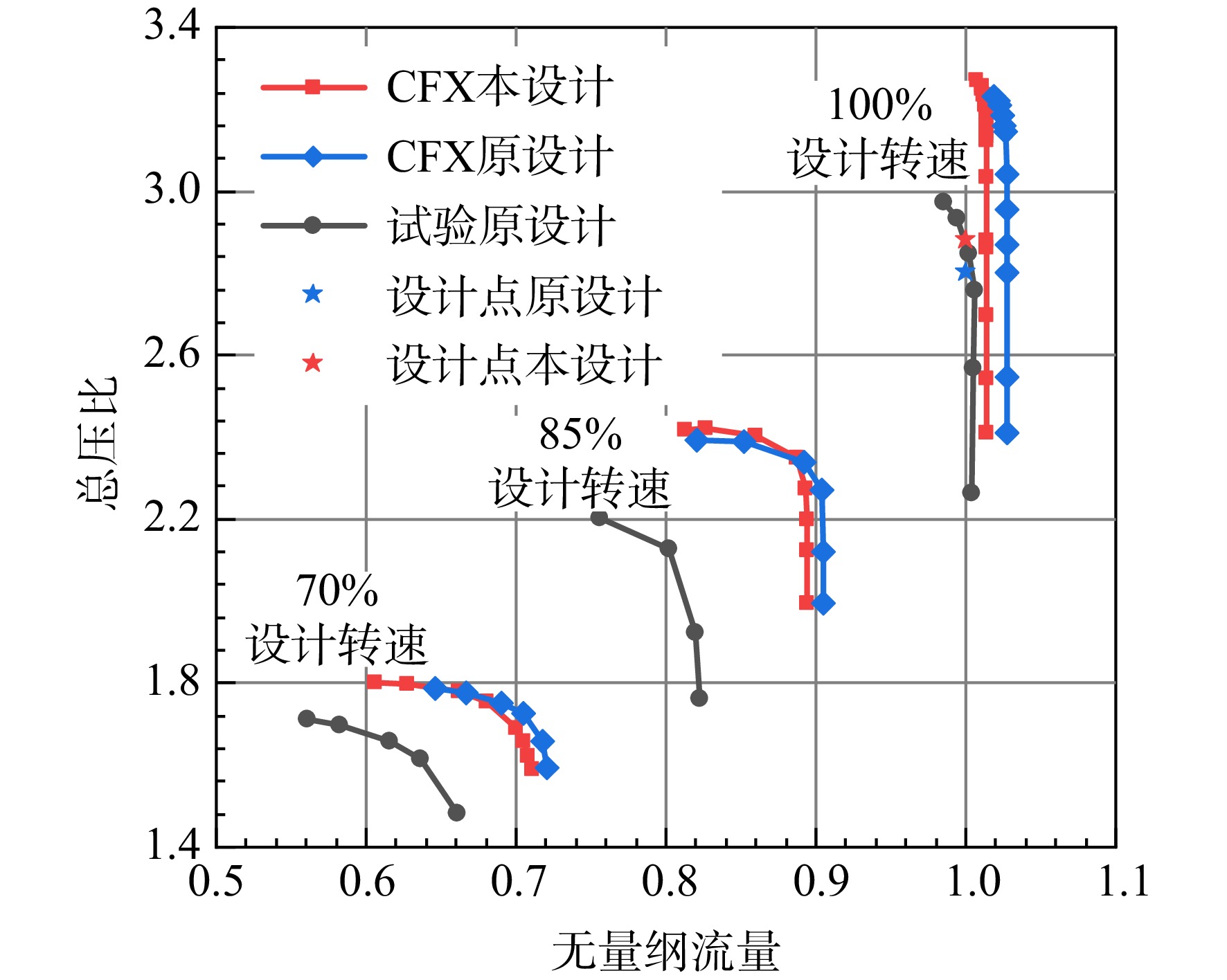
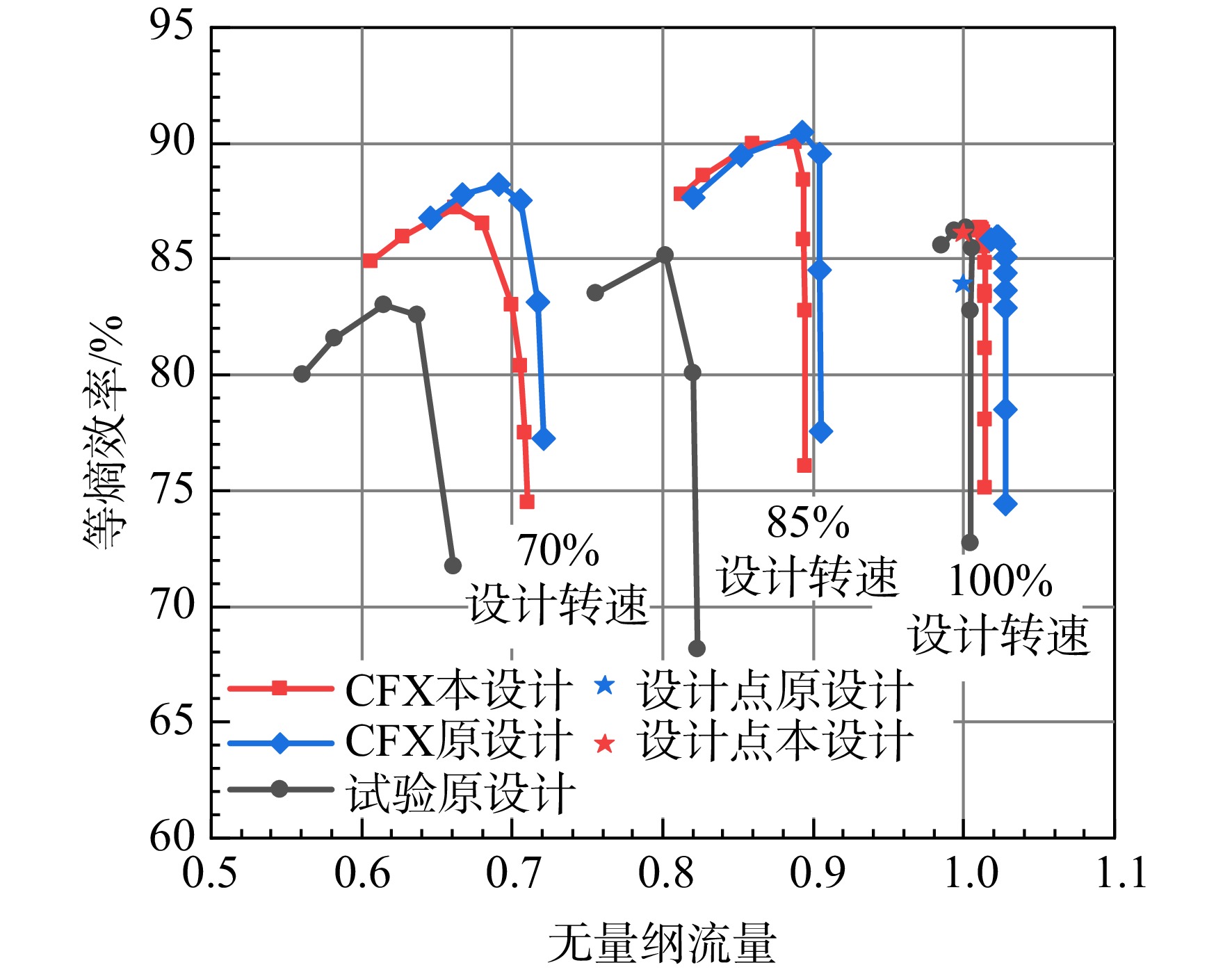
表 6 两种设计方案的稳定裕度、峰值效率和失速总压比对比
Table 6. Comparison of stability margin, peak efficiency and stall pressure ratio between two design results
转速 设计方案 稳定
裕度/%峰值
效率/%失速
总压比100%
设计转速NASA 16.4 85.96 3.23 本设计 17.7 86.37 3.27 性能增益/% +1.3 +0.41 +1.24 85%
设计转速NASA 11.3 90.51 2.39 本设计 12.5 90.02 2.42 性能增益/% +1.2 −0.49 +1.26 70%
设计转速NASA 8.9 88.24 1.79 本设计 10.6 87.20 1.80 性能增益/% +1.7 −1.04 +0.56
下载: 导出CSV
-
[1] 安利平, 罗秋生, 刘昭威, 等. 轴流压气机通流设计系统的建设与发展[J]. 航空动力, 2020(2): 53-56. AN Liping, LUO Qiusheng, LIU Zhaowei, et al. Development of aero engine axial compressor through flow design system[J]. Aerospace Power, 2020(2): 53-56. (in ChineseAN Liping, LUO Qiusheng, LIU Zhaowei, et al. Development of aero engine axial compressor through flow design system[J]. Aerospace Power, 2020(2): 53-56. (in Chinese) [2] SPURR A. The prediction of 3D transonic flow in turbomachinery using a combined throughflow and blade-to-blade time marching method[J]. International Journal of Heat and Fluid Flow, 1980, 2(4): 189-199. doi: 10.1016/0142-727X(80)90013-2 [3] 杨金广, 王春雪, 王大磊, 等. 基于时间推进的通流计算方法: 现状及展望[J]. 航空学报, 2017, 38(9): 520996. YANG Jinguang, WANG Chunxue, WANG Dalei, et al. Time marching based throughflow method: current status and future development[J]. Acta Aeronautica et Astronautica Sinica, 2017, 38(9): 520996. (in ChineseYANG Jinguang, WANG Chunxue, WANG Dalei, et al. Time marching based throughflow method: current status and future development[J]. Acta Aeronautica et Astronautica Sinica, 2017, 38(9): 520996. (in Chinese) [4] DAMLE S V, DANG T Q, REDDY D R. Throughflow method for turbomachines applicable for all flow regimes[J]. Journal of Turbomachinery, 1997, 119(2): 256-262. doi: 10.1115/1.2841108 [5] BENA C, LAROCCA F, ZANNETTI L. Design of multi-stage axial flow turbines and compressors[R]. London, UK: IMechE 3rd European Conference on Turbomachinery, 1999. [6] ROSA TADDEI S, LAROCCA F. Axisymmetric design of axial turbomachines: an inverse method introducing profile losses[J]. Proceedings of the Institution of Mechanical Engineers, Part A: Journal of Power and Energy, 2008, 222(6): 613-621. doi: 10.1243/09576509JPE644 [7] ROSA TADDEI S, LAROCCA F. On the aerodynamic design of axial flow turbines by an implicit upwind axisymmetric method[J]. Inverse Problems in Science and Engineering, 2010, 18(5): 635-654. doi: 10.1080/17415971003686735 [8] ROSA TADDEI S, LAROCCA F, BERTINI F. Euler inverse axisymmetric solution for design of axial flow multistage turbomachinery[R]. Glasgow, UK: ASME Turbo Expo 2010: Power for Land, Sea, and Air, 2010. [9] TADDEI S R, LAROCCA F. Potential of specification of swirl in axisymmetric CFD methods for turbine blade aerodesign[J]. Inverse Problems in Science and Engineering, 2012, 20(4): 533-551. doi: 10.1080/17415977.2011.639450 [10] STURMAYR A, HIRSCH C. Shock representation by Euler throughflow models and comparison with pitch-averaged Navier-Stokes solutions[J]. ISABE 99-7281, 1999. [11] STURMAYR A. Evolution of a 3D structured Navier Stokes solver towards advanced turbomachinery applications[D]. Brussels, Belgium: Free University of Brussels, 2003. [12] STURMAYR A, HIRSCH C. Throughflow model for design and analysis integrated in a three-dimensional Navier-Stokes solver[J]. Proceedings of the Institution of Mechanical Engineers, Part A: Journal of Power and Energy, 1999, 213(4): 263-273. doi: 10.1243/0957650991537608 [13] KOHR S. CFD-based throughflow analysis: bridging the gap between 1D and 3D analyses[EB/OL]. [2024-08-18]. https://www.conceptsnrec.com/blog/cfd-based-throughflow-analysis-bridging-the-gap-between-1d-and-3d-analyses. [14] 季路成, 孟庆国, 周盛. 叶轮机通流计算的时间推进方法[J]. 航空动力学报, 1999, 14(1): 23-26. JI Lucheng, MENG Qingguo, ZHOU Sheng. Time-marching method for through-flow computation of turbomachinery[J]. Journal of Aerospace Power, 1999, 14(1): 23-26. (in ChineseJI Lucheng, MENG Qingguo, ZHOU Sheng. Time-marching method for through-flow computation of turbomachinery[J]. Journal of Aerospace Power, 1999, 14(1): 23-26. (in Chinese) [15] 施鑫, 赵拥军, 周盛, 等. 时间推进通流气动设计方法的探索和分析[J]. 工程热物理学报, 2002, 23(增刊1): 50-53. SHI Xin, ZHAO Yongjun, ZHOU Sheng, et al. Explorations and analysis about time marching through-flow method[J]. Journal of Engineering Thermophysics, 2002, 23(Suppl. 1): 50-53. (in ChineseSHI Xin, ZHAO Yongjun, ZHOU Sheng, et al. Explorations and analysis about time marching through-flow method[J]. Journal of Engineering Thermophysics, 2002, 23(Suppl. 1): 50-53. (in Chinese) [16] 吴宏, 李秋实, 宋亚慧, 等. 风扇通流设计中环量分布形式的探讨[J]. 工程热物理学报, 2008, 29(1): 43-45. WU Hong, LI Qiushi, SONG Yahui, et al. Effect of swirl distribution on fan throughflow design[J]. Journal of Engineering Thermophysics, 2008, 29(1): 43-45. (in ChineseWU Hong, LI Qiushi, SONG Yahui, et al. Effect of swirl distribution on fan throughflow design[J]. Journal of Engineering Thermophysics, 2008, 29(1): 43-45. (in Chinese) [17] 赵斌, 李绍斌, 吴宏, 等. 一种考虑级间引气的压气机通流设计方法[J]. 航空动力学报, 2010, 25(9): 2097-2102. ZHAO Bin, LI Shaobin, WU Hong, et al. Throughflow design of compressor considering bleeding flow effect[J]. Journal of Aerospace Power, 2010, 25(9): 2097-2102. (in ChineseZHAO Bin, LI Shaobin, WU Hong, et al. Throughflow design of compressor considering bleeding flow effect[J]. Journal of Aerospace Power, 2010, 25(9): 2097-2102. (in Chinese) [18] NIGMATULLIN R Z, IVANOV M J. The mathematical models of flow passage for gas turbine engines and their components[R]. AGARD-LS-198, 1994. [19] YANG Chen, WU Hu, YANG Jinguang, et al. Time-marching throughflow analysis of multistage axial compressors based on a novel inviscid blade force model[J]. Proceedings of the Institution of Mechanical Engineers, Part G: Journal of Aerospace Engineering, 2019, 233(14): 5239-5252. doi: 10.1177/0954410019840588 [20] WU C H. A general through-flow theory of fluid flow with subsonic or supersonic velocity in turbomachines of arbitrary hub and casing shapes[R]. NACA TN 2302, 1951. [21] ANDERSON J D. Computational fluid dynamics: the basics with applications[M]. New York: McGraw-Hill, 1995. [22] MILLER G R, LEWIS G W Jr, HARTMANN M J. Shock losses in transonic compressor blade rows[J]. Journal of Engineering for Power, 1961, 83(3): 235-241. doi: 10.1115/1.3673182 [23] LIEBLEIN S, SCHWENK F C, BRODERICK R L. Diffusion factor for estimating losses and limiting blade loadings in axial-flow-compressor blade elements[R]. NACA RM E53DO1, 1953. [24] LIEBLEIN S. Loss and stall analysis of compressor cascades[J]. Journal of Basic Engineering, 1959, 81(3): 387-397. doi: 10.1115/1.4008481 [25] HOWELL A R. Design of axial compressors[J]. Proceedings of the Institution of Mechanical Engineers, 1945, 153(1945): 452-462. [26] CARMODY R H, CREVELING H F. Axial flow compressor design computer programs incorporating full radial equilibrium: Part 2 radial distribution of total pressure and flow path or axial velocity ratio specified /program 3/[R]. NASA-CR-54531, 1968. [27] MESSENGER H E, KENNEDY E E. Two-stage fan Ⅰ: aerodynamic and mechanical design[R]. NASA-CR-120859, 1972. [28] RUGGER R S, BENSER W A. Performance of a highly loaded two-stage axial-flow fan[R]. NASA TM K-W76, 1974. [29] LIEBLEIN S. Incidence and deviation-angle correlations for compressor cascades[J]. Journal of Basic Engineering, 1960, 82(3): 575-584. doi: 10.1115/1.3662666 [30] 钱笃元. 航空发动机设计手册: 第8册 压气机[M]. 北京: 航空工业出版社, 2000. [31] MILLER D C, WASDELL D L. Off-design prediction of compressor blade losses[M]//Turbomachinery: efficiency prediction and improvement. New York, US: Mechanical Engineering Publications, 1987. [32] KEENAN M J, MONSARRAT N T, TRAMM P C. Single-stage evaluation of highly-loaded high-Mach-number compressor stages[R]. NASA-CR-72562, 1969. -

 点击查看大图

计量
- 文章访问数: 638
- HTML浏览量: 347
- PDF量: 37
- 被引次数: 0