






Analysis of “Superheavy Starship” project: technological innovation and references for China’s aerospace
-
摘要:
聚焦美国SpaceX公司的“超重-星舰”项目,深入剖析其技术体系与发展进程。详细梳理了星舰首飞至第九飞的技术细节、试飞表现及改进路径,全面展示其在可重复使用、推进、结构材料、导航控制等多领域的创新成果,如塔架机械臂回收技术、猛禽发动机全流量分级燃烧循环等。同时探讨项目面临的技术难题与应对策略,精准展望其在商业航天、深空探测、军事应用等方面的广阔前景,研究表明:中国航天在大推力发动机工程化、复用技术成熟度、商业航天闭环生态等方面仍存差距,需从技术攻坚、成本管控、产业培育、国际竞合及人才培育等维度精准施策,走自主创新与市场化协同的航天强国建设路径。
Abstract:This research examined the technological system and development process of "Superheavy Starship" project of SpaceX in the United States. Technical details, flight-test performance and improvement paths from the first to the ninth flights of Starship were comprehensively reviewed, fully demonstrating its innovative achievements in multiple fields such as reusable technology, propulsion, structural materials, and navigation control, the launch-tower robotic arm recovery technology and the full-flow staged combustion cycle of the Raptor engine. Meanwhile, technical problems encountered and corresponding coping strategies were discussed, together with assessment of its broad prospects in commercial aerospace, deep space exploration, military applications, etc. Targeted and constructive inspirations and suggestions were put forward from technological breakthroughs, cost management, business expansion, international cooperation and talent cultivation in combination with the current situation of China's aerospace, so as to facilitate the development of China's aerospace.
-
Key words:
- SpaceX /
- superheavy-starship /
- integrated flight test /
- reusable spacecraft /
- propulsion technology
-
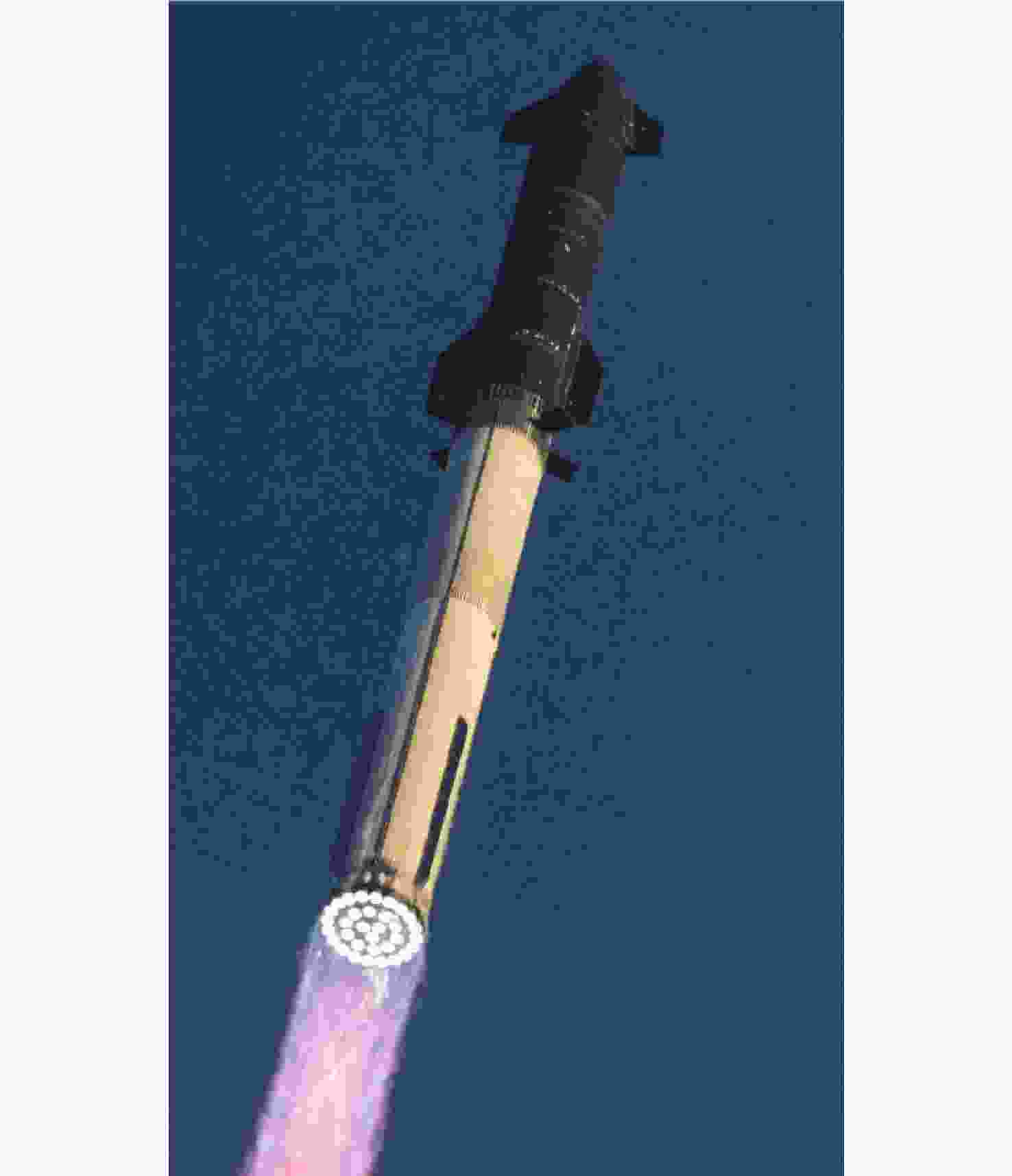
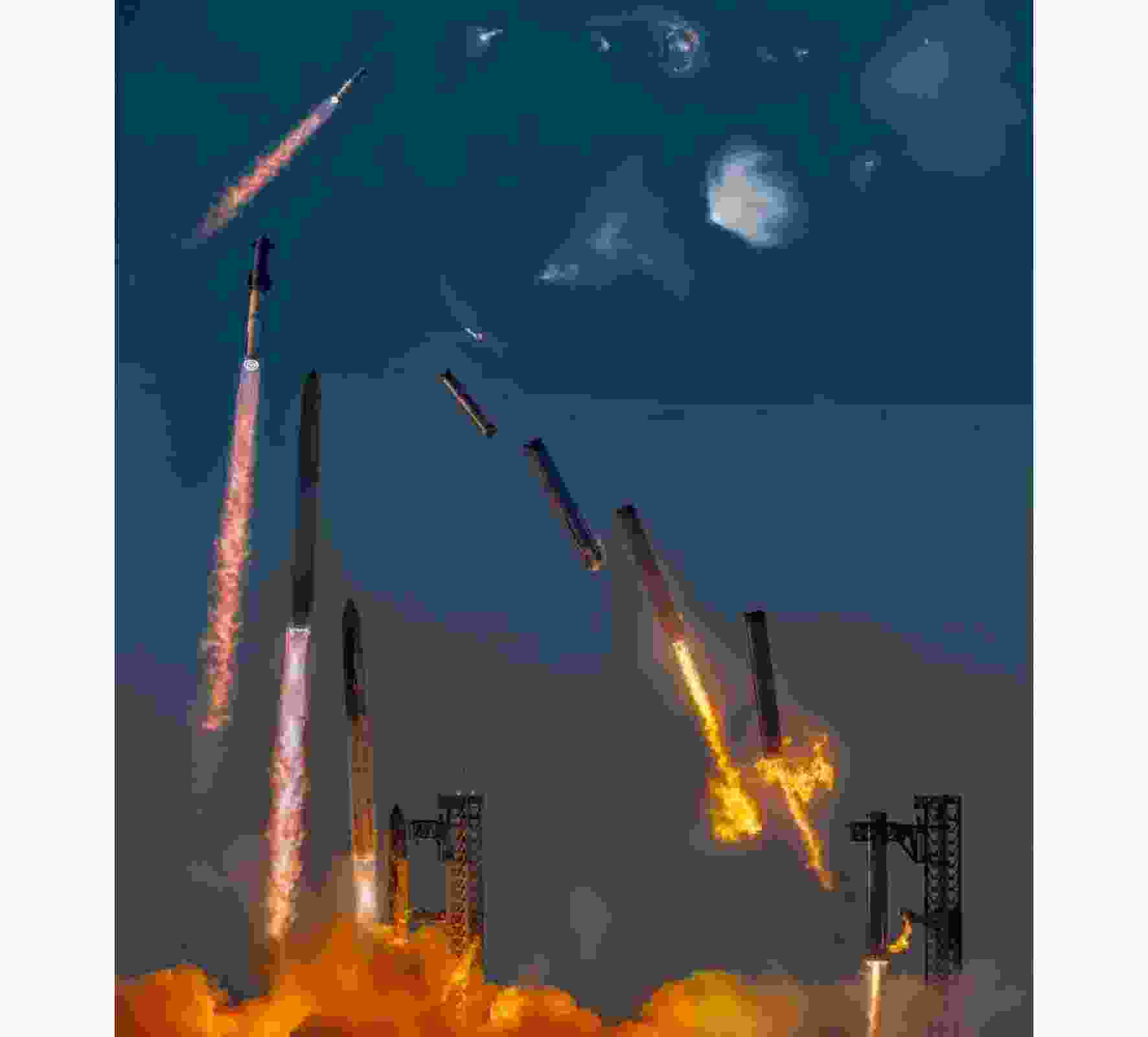
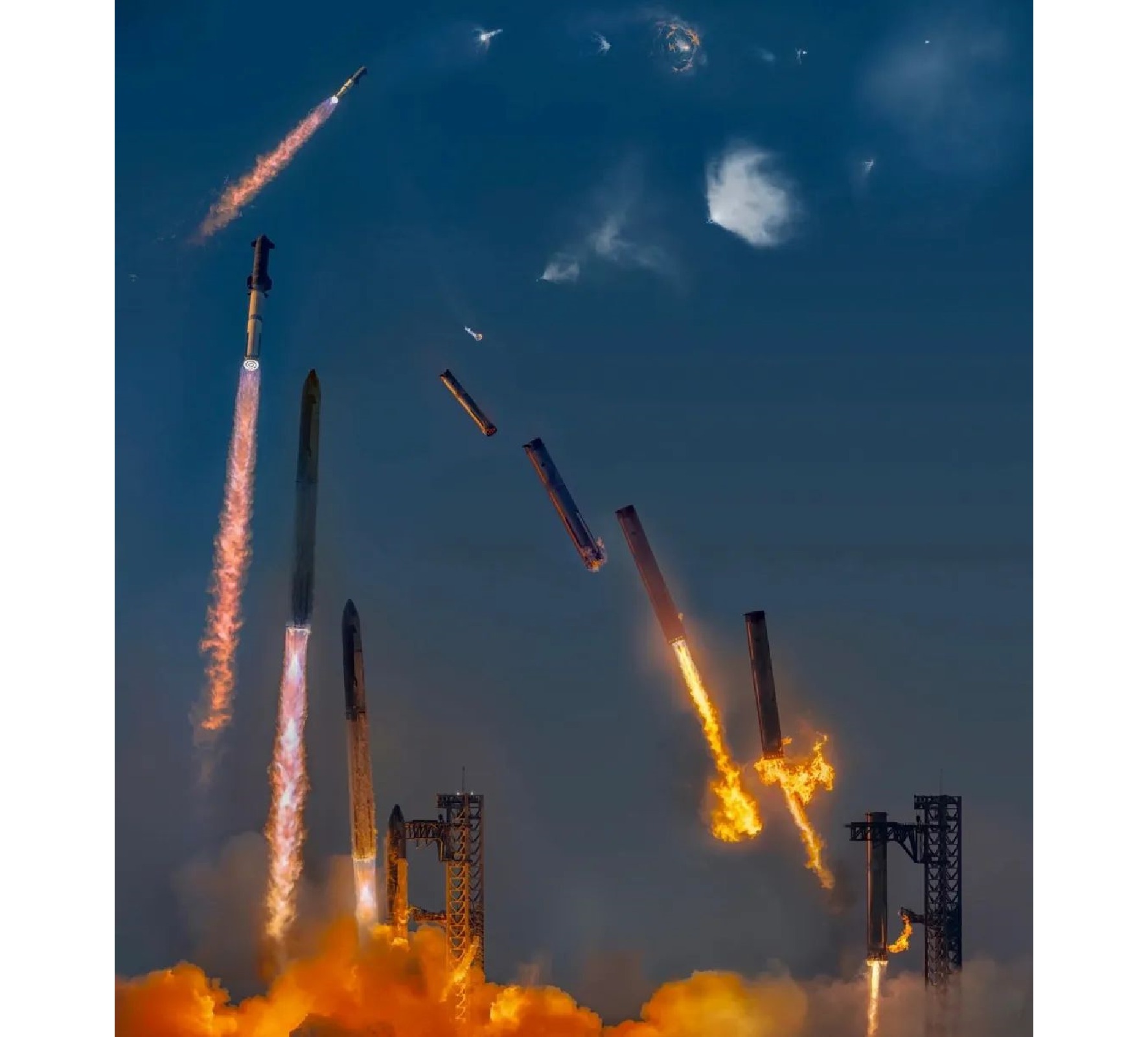
图 3 星舰第五飞使用机械臂原位捕获回收超重助推(来源:SpaceX)
Figure 3. In-situ capture and recovery of the super heavy using a robotic arm during IFT-5 (source:SpaceX)
表 1 星舰与全球主流重型火箭的参数对比表
Table 1. Comparison of Parameters between Starship and Global Mainstream Heavy Rockets
参数 星舰
(Starship)太空发射系统
(SLS Block 1)猎鹰重型
(Falcon Heavy)新格伦
(New Glenn)火神
(Vulcan Centaur)高度与构型 121.3 m(两级可重复使用) 98m(两级,
含固体助推器)70 m(两级,芯级+
2枚助推器)98 m(两级) 约61.6 m(两级,标配高度高,选配固体助推器) 直径 9 m(全箭统一直径) 8.4 m(芯级) 3.7 m(芯级),总宽12.2 m(含助推器) 7 m(全箭统一直径) 5.4 m(芯级) 起飞质量 约 5000 t约 2608 t(载人版)/
约2951 t(货运版)约 1420 t约 1500 t547~780 t
(取决于助推器数量)起飞推力 7590 t
(33台猛禽发动机)3980 t(4台RS-25 + 2枚固体助推器)2280 t
(27台梅林1D
发动机)1750 t(7台BE-4
液氧甲烷发动机)1560 t (6个助推器)LEO 运载能力 150 t(可重复使用)/
250 t(一次性)95 t(载人版)/
130 t(货运版)63.8 t 45 t(一级复用) 27.2 t(VC6S构型,含6枚助推器) GTO 运载能力 21 t(可重复使用) 27 t 约26.7 t 13.6 t(一级复用) 约14.4 t(VC6S构型,含6枚助推器) 推进剂类型 液氧/液态甲烷(LOX/CH4) 液氢/液氧(LOX/LH2)+
固体推进剂液氧/煤油
(LOX/RP-1)一级:液氧/液态甲烷(LOX/CH4);二级:液氧/液氢(LOX/LH2) 液氧/甲烷(LOX/CH4)+
固体推进剂发动机配置 一级:33×猛禽
发动机;
二级:3×猛禽发动机+3×猛禽发动机
(真空版)芯级: 4×RS-25
氢氧发动机;
助推器:2×5段式固体火箭助推器 (SRB)芯级+2枚助推器各9台梅林1D发动机,
共27台;
二级: 1×梅林发动机真空版一级: 7×BE-4液氧甲烷发动机;二级: 2×BE-3U液氢液氧发动机 一级: 2×BE-4液氧甲烷发动机;助推器: 0,2,4或6枚GEM 63XL固体助推器;
二级: 2×RL10可重复使用性 完全可重复使用
(一级超重助推和
二级星舰飞船均
垂直着陆回收)完全一次性 部分可重复使用 (两个侧助推器和中心芯级可回收,整流罩可回收) 部分可重复使用
(一级助推器设计复用25次,二级
一次性)完全一次性 发射成本
(预估)远期目标< 1000 万美元(完全复用)
初期约9000 万美元约4.1亿美元
(载人版)/
3.5亿美元(货运版)9000 万美元
(可复用)/
1.5亿美元(一次性)>7 000万美元 1.65亿美元
(VC6S构型,一次性) 下载: 导出CSV
-
[1] 郑雄, 杨勇, 姚世东, 等. 法尔肯9可重复使用火箭发展综述[J]. 导弹与航天运载技术, 2016(2): 39-46. Zheng Xiong, Yang Yong, Yao Shidong, et al. Survey and review on development of falcon 9 reusable rocket[J]. Missiles and Space Vehicles, 2016(2): 39-46. (in ChineseZheng Xiong, Yang Yong, Yao Shidong, et al. Survey and review on development of falcon 9 reusable rocket[J]. Missiles and Space Vehicles, 2016(2): 39-46. (in Chinese) [2] 余南平, 严佳杰. 国际和国家安全视角下的美国“星链”计划及其影响[J]. 国际安全研究, 2021, 39(5): 67-91, 158, 159. Yu Nanping, Yan Jiajie. The US starlink program and its implications: from the perspective of international and national security[J]. Journal of International Security Studies, 2021, 39(5): 67-91, 158, 159. (in ChineseYu Nanping, Yan Jiajie. The US starlink program and its implications: from the perspective of international and national security[J]. Journal of International Security Studies, 2021, 39(5): 67-91, 158, 159. (in Chinese) [3] 李明华. 超重-星舰演变历程及未来发展方向分析[J]. 导弹与航天运载技术(中英文), 2024(4): 1-7. Li Minghua. Analysis on the evolution course and future development of SuperHeavy starship[J]. Missiles and Space Vehicles, 2024(4): 1-7. (in Chinese doi: 10.7654/j.issn.2097-1974.20240401Li Minghua. Analysis on the evolution course and future development of SuperHeavy starship[J]. Missiles and Space Vehicles, 2024(4): 1-7. (in Chinese) doi: 10.7654/j.issn.2097-1974.20240401 [4] 杨开, 曲晶. 2023年国外重复使用运载火箭发展综述[J]. 国际太空, 2024(4): 34-39. Yang Kai, Qu Jing. Review on the development of reusable launch vehicles abroad in 2023[J]. Space International, 2024(4): 34-39. (in ChineseYang Kai, Qu Jing. Review on the development of reusable launch vehicles abroad in 2023[J]. Space International, 2024(4): 34-39. (in Chinese) [5] 孟光, 刘昶, 杨冬春, 等. 美国SpaceX超重-星舰首飞分析及对中国航天产业的启示[J]. 航空学报, 2023, 44(10): 028914. Meng Guang, Liu Chang, Yang Dongchun, et al. First flight of SpaceX heavy-lift starship: Enlightenment for aerospace industry in China[J]. Acta Aeronautica et Astronautica Sinica, 2023, 44(10): 028914. (in ChineseMeng Guang, Liu Chang, Yang Dongchun, et al. First flight of SpaceX heavy-lift starship: Enlightenment for aerospace industry in China[J]. Acta Aeronautica et Astronautica Sinica, 2023, 44(10): 028914. (in Chinese) [6] 苏浩涵, 陈亮, 于新宇, 等. SpaceX公司星舰第二次飞行异常情况初步分析[J]. 宇航学报, 2023, 44(11): 后插1-后插7. Su Haohan, Chen Liang, Yu Xinyu, et al. Initial analysis of anomalies in the second flight of SpaceX’s starship[J]. Journal of Astronautics, 2023, 44(11): 后插1-后插7. (in Chinese [7] 王博, 郝鹏, 田阔, 等. 航空航天结构轻量化设计与实验方法研究进展[J]. 宇航学报, 2023, 44(4): 596-606. Wang Bo, Hao Peng, Tian Kuo, et al. Advances in lightweight design and experimental methods for aerospace structures[J]. Journal of Astronautics, 2023, 44(4): 596-606. (in ChineseWang Bo, Hao Peng, Tian Kuo, et al. Advances in lightweight design and experimental methods for aerospace structures[J]. Journal of Astronautics, 2023, 44(4): 596-606. (in Chinese) [8] 龙雪丹. 超重-星舰运输系统及其未来影响简析[J]. 飞航导弹, 2021(8): 32-35. Long Xuedan. A brief analysis of the overweight-Starship transportation system and its future implications[J]. Aerodynamic Missile Journal, 2021(8): 32-35. (in ChineseLong Xuedan. A brief analysis of the overweight-Starship transportation system and its future implications[J]. Aerodynamic Missile Journal, 2021(8): 32-35. (in Chinese) [9] 包为民. 可重复使用运载火箭技术发展综述[J]. 航空学报, 2023, 44(23): 629555. Bao Weimin. A review of reusable launch vehicle technology development[J]. Acta Aeronautica et Astronautica Sinica, 2023, 44(23): 629555. (in ChineseBao Weimin. A review of reusable launch vehicle technology development[J]. Acta Aeronautica et Astronautica Sinica, 2023, 44(23): 629555. (in Chinese) [10] 宋征宇, 黄兵, 汪小卫, 等. 重复使用运载器回收技术现状与挑战[J]. 深空探测学报(中英文), 2022, 9(5): 457-469. Song Zhengyu, Huang Bing, Wang Xiaowei, et al. Status and challenges of reusable launch vehicle recovery technology[J]. Journal of Deep Space Exploration, 2022, 9(5): 457-469. (in ChineseSong Zhengyu, Huang Bing, Wang Xiaowei, et al. Status and challenges of reusable launch vehicle recovery technology[J]. Journal of Deep Space Exploration, 2022, 9(5): 457-469. (in Chinese) [11] 高滨. 国外载人航天器回收着陆技术的进展[J]. 航天返回与遥感, 2009, 30(2): 1-9. Gao Bin. An overview of recovery and landing systems for foreign manned spacecrafts[J]. Spacecraft Recovery & Remote Sensing, 2009, 30(2): 1-9. (in ChineseGao Bin. An overview of recovery and landing systems for foreign manned spacecrafts[J]. Spacecraft Recovery & Remote Sensing, 2009, 30(2): 1-9. (in Chinese) [12] 黄伟. 可重复使用航天器回收着陆技术综述[J]. 中国航天, 2023(8): 8-15. Huang Wei. An overview of reusable spacecraft recovery and landing technology[J]. Aerospace China, 2023(8): 8-15. (in ChineseHuang Wei. An overview of reusable spacecraft recovery and landing technology[J]. Aerospace China, 2023(8): 8-15. (in Chinese) [13] 冯国峰, 杨毅强, 胡小伟, 等. “星舰” 发射支持系统特点与分析[J]. 中国航天, 2022(11): 31-34. Feng Guofeng, Yang Yiqiang, Hu Xiaowei, et al. Characteristics and analysis of the launch support system of starship chopsticks[J]. Aerospace China, 2022(11): 31-34. (in ChineseFeng Guofeng, Yang Yiqiang, Hu Xiaowei, et al. Characteristics and analysis of the launch support system of starship chopsticks[J]. Aerospace China, 2022(11): 31-34. (in Chinese) [14] 钟文安, 吴纯治, 陈少将. 发射场航班化发射能力建设思考[J]. 宇航总体技术, 2024, 8(4): 71-78. Zhong Wenan, Wu Chunzhi, Chen Shaojiang. Insight on capacity construction for airline-flight-mode launching of spaceport[J]. Astronautical Systems Engineering Technology, 2024, 8(4): 71-78. (in ChineseZhong Wenan, Wu Chunzhi, Chen Shaojiang. Insight on capacity construction for airline-flight-mode launching of spaceport[J]. Astronautical Systems Engineering Technology, 2024, 8(4): 71-78. (in Chinese) [15] 朱平平, 周闯, 王铁岩, 等. 第三代猛禽发动机分析及全流量补燃循环发动机起动特性[J]. 宇航总体技术, 2025, 9(3): 26-32. Zhu Pingping, Zhou Chuang, Wang Tieyan, et al. Analysis of the third-generation raptor engine and the full-flow staged combustion cycle engine startup characteristics[J]. Astronautical Systems Engineering Technology, 2025, 9(3): 26-32. (in ChineseZhu Pingping, Zhou Chuang, Wang Tieyan, et al. Analysis of the third-generation raptor engine and the full-flow staged combustion cycle engine startup characteristics[J]. Astronautical Systems Engineering Technology, 2025, 9(3): 26-32. (in Chinese) [16] 谭永华. 大推力液氧甲烷火箭发动机技术研究进展[J]. 航空学报, 2024, 45(11): 529690. Tan Yonghua. Research progress in high thrust liquid oxygen methane rocket engine technology[J]. Acta Aeronautica et Astronautica Sinica, 2024, 45(11): 529690. (in ChineseTan Yonghua. Research progress in high thrust liquid oxygen methane rocket engine technology[J]. Acta Aeronautica et Astronautica Sinica, 2024, 45(11): 529690. (in Chinese) [17] 马卫华. 导弹/火箭制导、导航与控制技术发展与展望[J]. 宇航学报, 2020, 41(7): 860-867. Ma Weihua. Review and prospect of missile/launch vehicle guidance, navigation and control technologies[J]. Journal of Astronautics, 2020, 41(7): 860-867. (in ChineseMa Weihua. Review and prospect of missile/launch vehicle guidance, navigation and control technologies[J]. Journal of Astronautics, 2020, 41(7): 860-867. (in Chinese) [18] 张克明, 蔡远文, 任元. 基于生成对抗网络的航天异常事件检测方法[J]. 北京航空航天大学学报, 2019, 45(7): 1329-1336. Zhang Keming, Cai Yuanwen, Ren Yuan. Space anomaly events detection approach based on generative adversarial nets[J]. Journal of Beijing University of Aeronautics and Astronautics, 2019, 45(7): 1329-1336. (in ChineseZhang Keming, Cai Yuanwen, Ren Yuan. Space anomaly events detection approach based on generative adversarial nets[J]. Journal of Beijing University of Aeronautics and Astronautics, 2019, 45(7): 1329-1336. (in Chinese) [19] 张宇佳, 左光, 徐艺哲, 等. Starship新型舵面形式气动特性数值模拟[J]. 航空学报, 2021, 42(2): 624058. Zhang Yujia, Zuo Guang, Xu Yizhe, et al. Numerical simulation on aerodynamic characteristics of new type control surface of Starship[J]. Acta Aeronautica et Astronautica Sinica, 2021, 42(2): 624058. (in ChineseZhang Yujia, Zuo Guang, Xu Yizhe, et al. Numerical simulation on aerodynamic characteristics of new type control surface of Starship[J]. Acta Aeronautica et Astronautica Sinica, 2021, 42(2): 624058. (in Chinese) [20] 刘博龙, 卢欣, 龙雪丹, 等. NASA基于模型的任务保证研究[J]. 质量与可靠性, 2021(6): 58-62. Liu Bolong, Lu Xin, Long Xuedan, et al. Research on NASA model based mission assurance[J]. Quality and Reliability, 2021(6): 58-62. (in ChineseLiu Bolong, Lu Xin, Long Xuedan, et al. Research on NASA model based mission assurance[J]. Quality and Reliability, 2021(6): 58-62. (in Chinese) [21] 刘洋, 周建平, 张晓天. 增材制造技术在载人航天工程中的应用与展望[J]. 北京航空航天大学学报, 2023, 49(1): 83-91. Liu Yang, Zhou Jianping, Zhang Xiaotian. Application and prospect of additive manufacturing technology in manned space engineering[J]. Journal of Beijing University of Aeronautics and Astronautics, 2023, 49(1): 83-91. (in ChineseLiu Yang, Zhou Jianping, Zhang Xiaotian. Application and prospect of additive manufacturing technology in manned space engineering[J]. Journal of Beijing University of Aeronautics and Astronautics, 2023, 49(1): 83-91. (in Chinese) [22] 魏威, 刘玮, 龙雪丹, 等. 国外低轨卫星星座计划军事意义分析[J]. 飞航导弹, 2019(10): 1-4, 15. Wei Wei, Liu Wei, Long Xuedan, et al. Analysis of the military significance of foreign low-orbit satellite constellation programs[J]. Aerodynamic Missile Journal, 2019(10): 1-4, 15. (in ChineseWei Wei, Liu Wei, Long Xuedan, et al. Analysis of the military significance of foreign low-orbit satellite constellation programs[J]. Aerodynamic Missile Journal, 2019(10): 1-4, 15. (in Chinese) [23] 龙杰, 张韬. 低轨大型星座下空间交通管理的安全挑战与应对[J]. 国际安全研究, 2024, 42(3): 126-156. Long Jie, Zhang Tao. Safety and security challenges and responses to space traffic management in the context of large LEO constellations[J]. Journal of International Security Studies, 2024, 42(3): 126-156. (in ChineseLong Jie, Zhang Tao. Safety and security challenges and responses to space traffic management in the context of large LEO constellations[J]. Journal of International Security Studies, 2024, 42(3): 126-156. (in Chinese) [24] 姚照辉, 范家璇. 变推力液体火箭发动机推力调节技术研究综述及发展趋势[J]. 推进技术, 2022, 43(9): 210500. Yao Zhaohui, Fan Jiaxuan. Review and trend for thrust regulation technology of variable-thrust liquid rocket engine[J]. Journal of Propulsion Technology, 2022, 43(9): 210500. (in ChineseYao Zhaohui, Fan Jiaxuan. Review and trend for thrust regulation technology of variable-thrust liquid rocket engine[J]. Journal of Propulsion Technology, 2022, 43(9): 210500. (in Chinese) [25] 张振华, 白明生, 石泳, 等. 国外商业航天的发展及启示[J]. 中国航天, 2015(11): 31-39. Zhang Zhenhua, Bai Mingsheng, Shi Yong, et al. Development of foreign commercial aerospace and its enlightenment[J]. Aerospace China, 2015(11): 31-39. (in ChineseZhang Zhenhua, Bai Mingsheng, Shi Yong, et al. Development of foreign commercial aerospace and its enlightenment[J]. Aerospace China, 2015(11): 31-39. (in Chinese) [26] 陈猛, 刘汝盟, 王立峰, 等. 国家自然科学基金新增代码 “航空航天力学” 内涵及重要研究领域[J]. 航空学报, 2024, 45(2): 129947. Chen Meng, Liu Rumeng, Wang Lifeng, et al. Connotation and key research areas of new application code “Aerospace Mechanics” of the National Natural Science Foundation of China[J]. Acta Aeronautica et Astronautica Sinica, 2024, 45(2): 129947. (in ChineseChen Meng, Liu Rumeng, Wang Lifeng, et al. Connotation and key research areas of new application code “Aerospace Mechanics” of the National Natural Science Foundation of China[J]. Acta Aeronautica et Astronautica Sinica, 2024, 45(2): 129947. (in Chinese) -

 点击查看大图
计量
- 文章访问数: 1071
- HTML浏览量: 299
- PDF量: 59
- 被引次数: 0