






Numerical simulation of the influence of main stage swirl number on combustor NOx emissions
-
摘要:
为了研究宽工况范围内中心分级贫油预混预蒸发燃烧室主燃级旋流数对NOx排放的影响,采用三维数值模拟方法分析了基准排放着陆和起飞(LTO)循环工况下燃烧室气动热力和NO生成特征,并通过NOx排放测试结果对比验证仿真方法。此外,仿真分析了不同主燃级旋流数在不同工况下燃烧室NOx排放的影响规律。研究结果表明:在不同的工况下,主燃级旋流数对NOx排放的影响规律不同。在慢车工况下,随着主燃级旋流数的增加,促进了预燃级的油气掺混,使得预燃级燃烧温度更高,从而产生更多NOx;在大工况下,随着主燃级旋流数的增加,更多空气被卷入回流区,使得贫油的主燃区油气比进一步降低,从而降低了NOx排放。随着主燃级旋流数(0.5~0.9)增加,LTO循环NOx排放总量减少。
-
关键词:
- 贫油预混预蒸发燃烧室 /
- 主燃级旋流数 /
- 着陆和起飞(LTO)循环 /
- NOx排放 /
- 主燃区
Abstract:To investigate the influence of main stage swirl number on NOx emissions in a centrally-staged lean premixed prevaporized combustor across wide operating conditions, three-dimensional numerical simulations were used to analyze the turbulent combustion and NO formation characteristics during the reference emissions Landing and Take-Off (LTO) cycle. And the simulation methodology was validated against experimental NOx emission data. Furthermore, the influence of main stage swirl number on NOx emissions under LTO cycle conditions was simulated and analyzed. The results revealed that the influence of main swirl number on NOx emissions varied under different operating conditions. At idle conditions, an increase in main swirl number enhanced fuel-air mixing in the pilot combustion zone, leading to higher combustion temperature and elevated NOx emissions. Under high-load conditions, as the main swirl number increased, additional airflow was entrained into the re-circulation zone, further reducing the fuel-to-air ratio in the lean primary combustion zone and thereby decreasing NOx emissions. With increasing main swirl number over the range of 0.5 to 0.9, total NOx emissions during the reference emissions landing and takeoff cycle decreased.
-
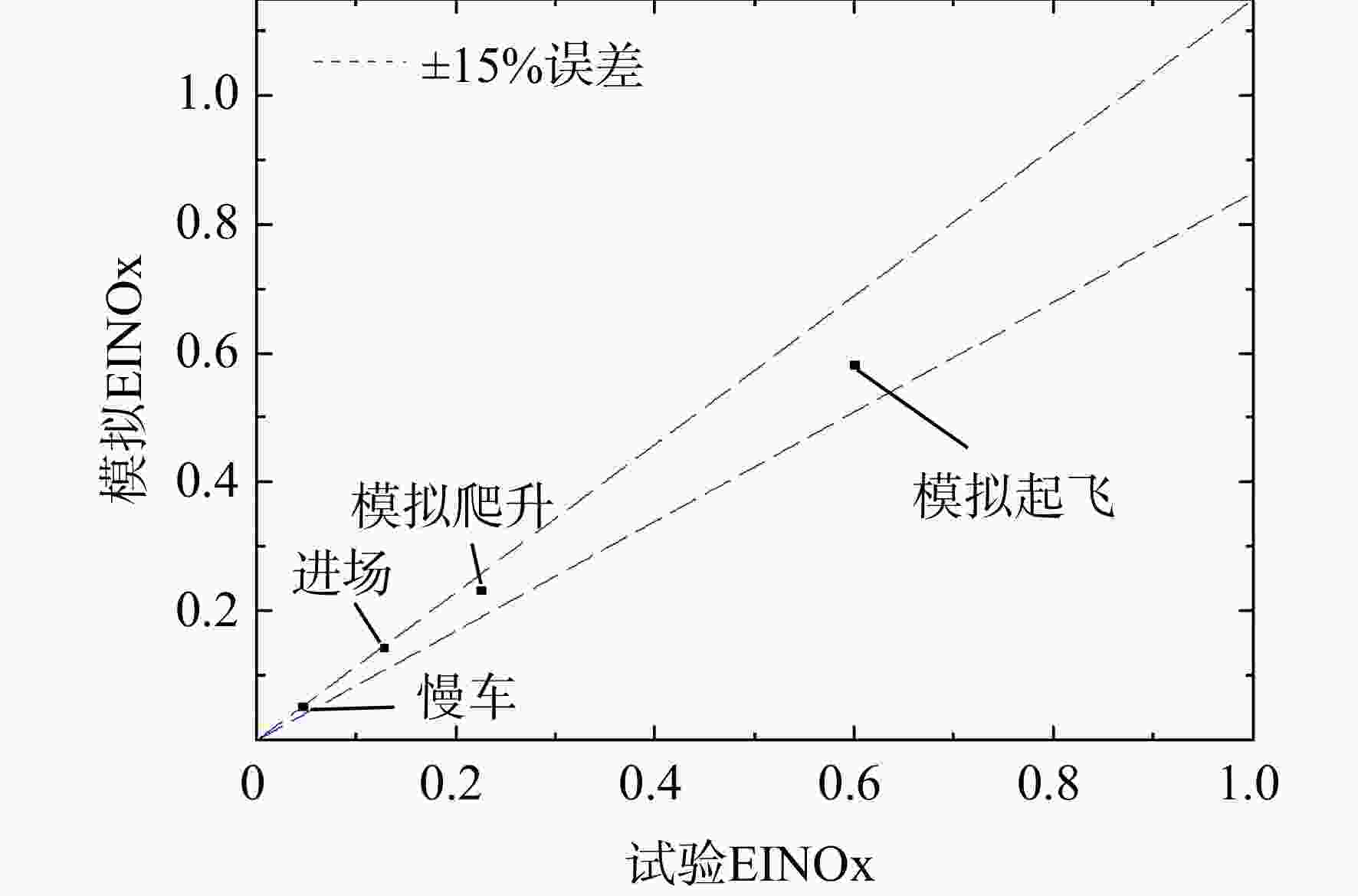
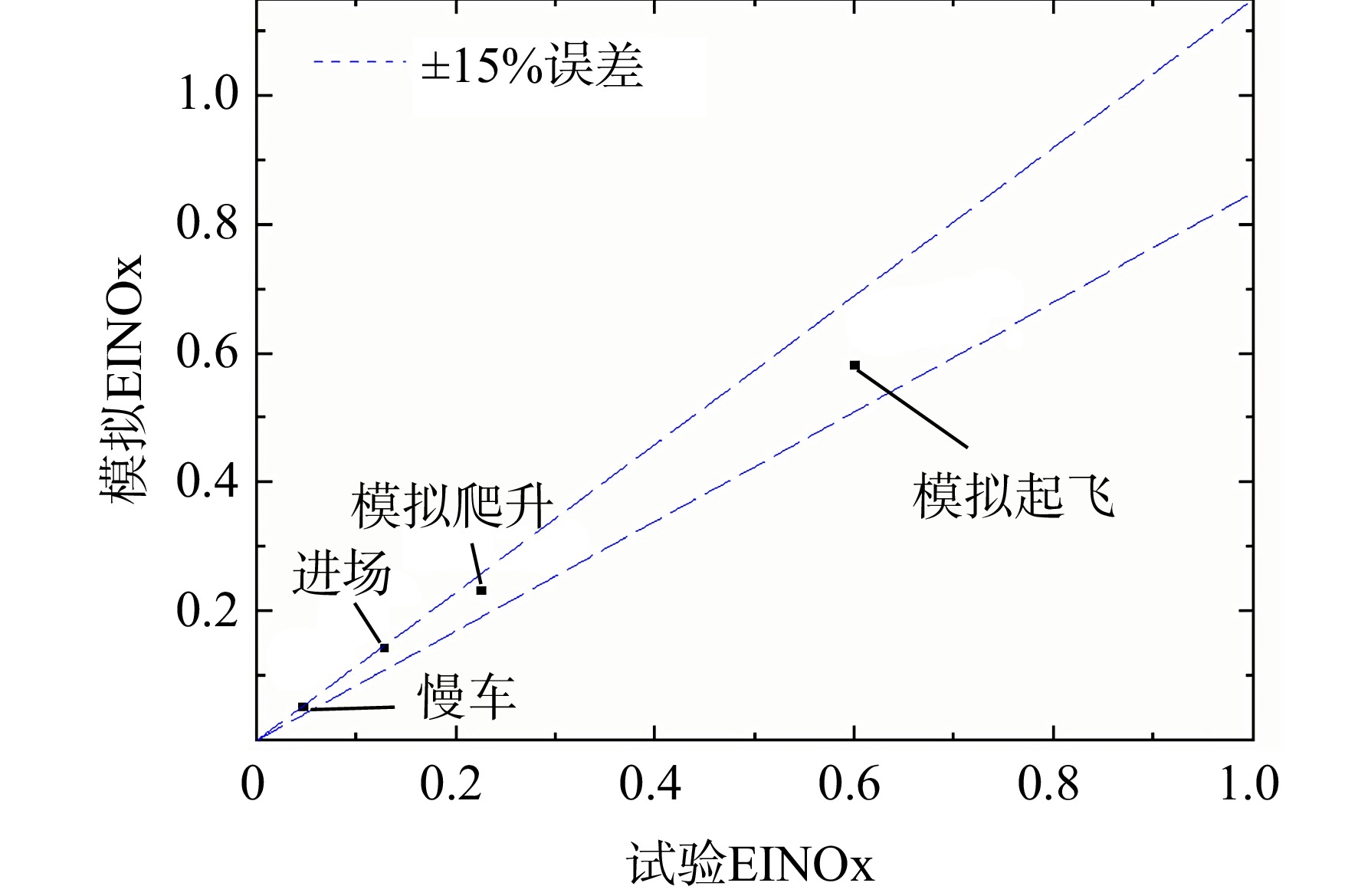
图 9 燃烧室出口EINOx模拟与试验结果对比
Figure 9. Comparison of simulation and experimental results of EINOx at combustor outlet
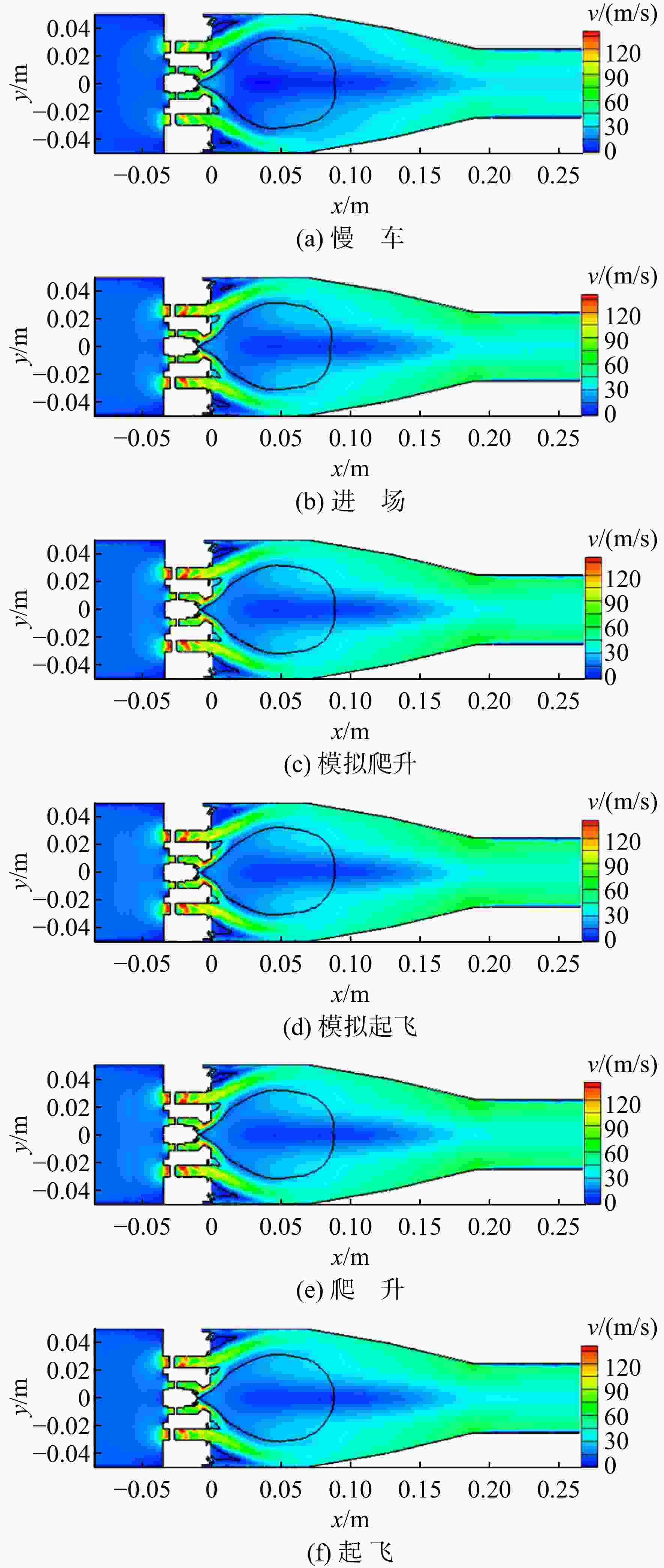
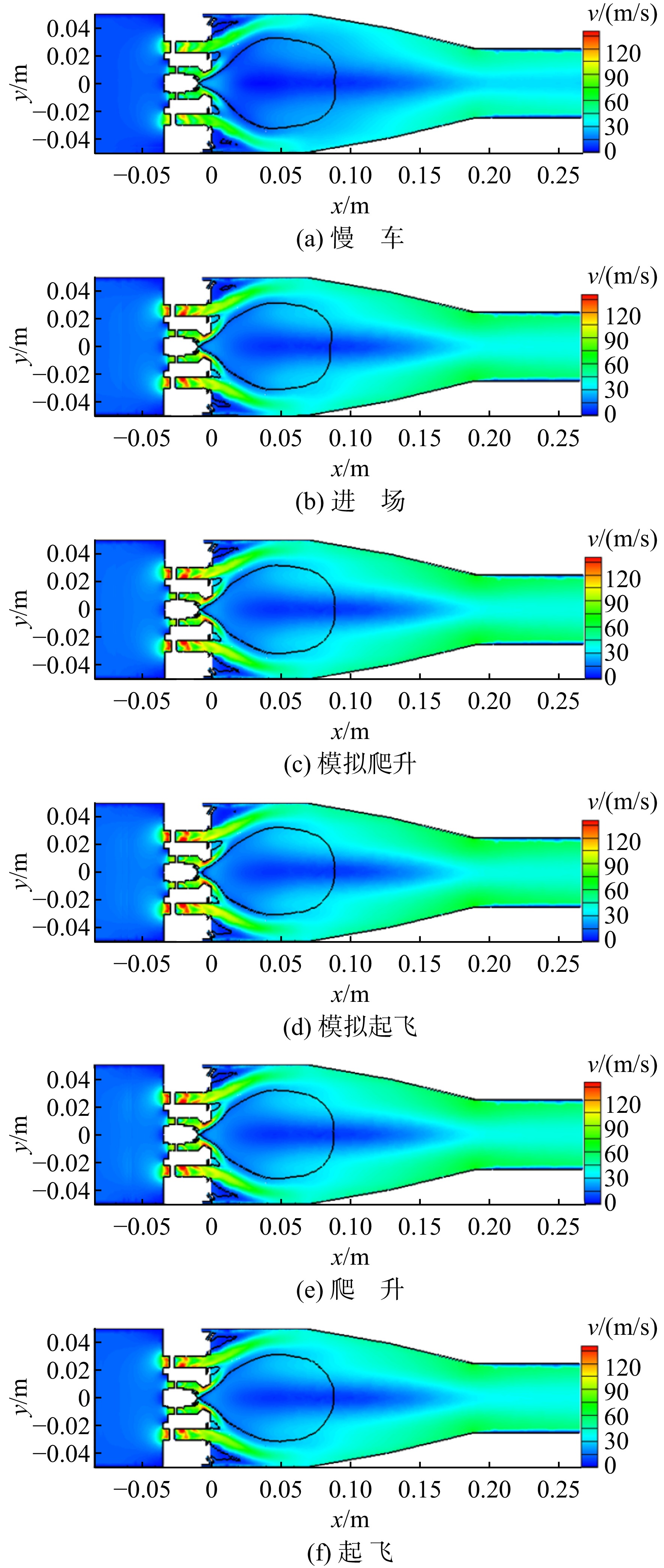
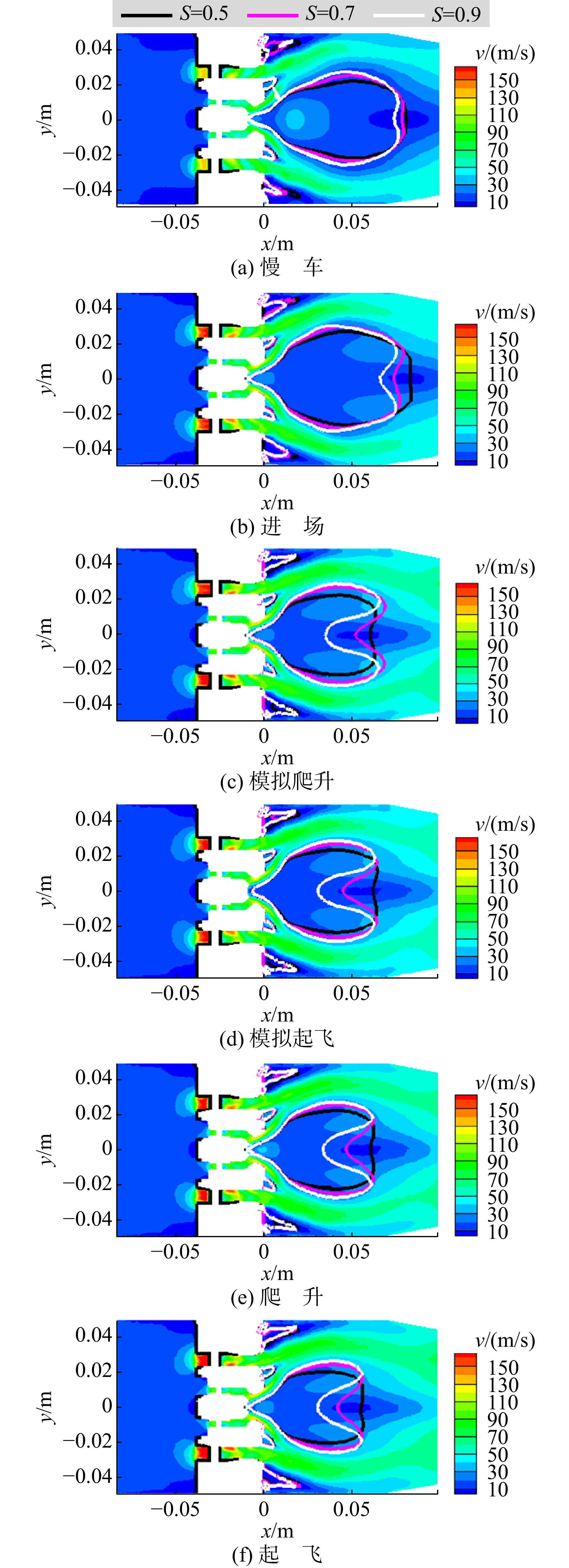
图 10 S=0.7的中心截面流动特征
Figure 10. Flow characteristics of the central cross section under S=0.7 condition
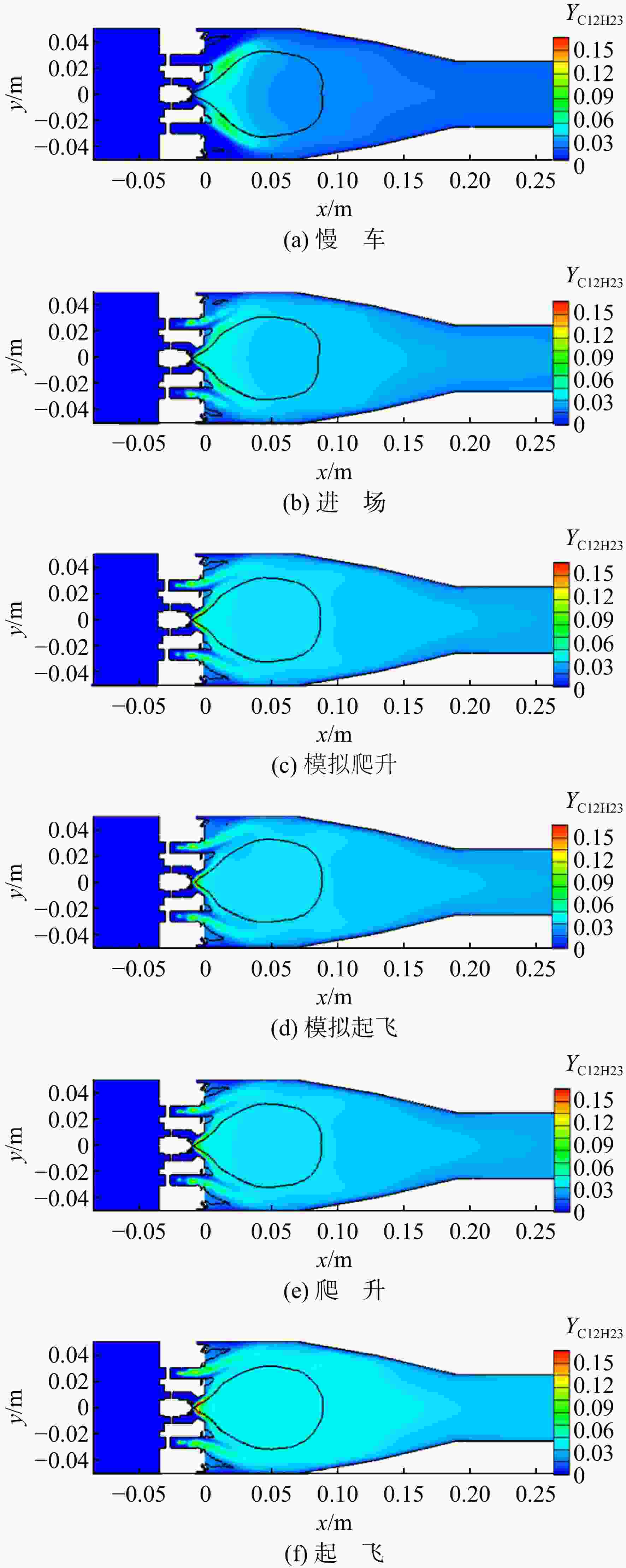
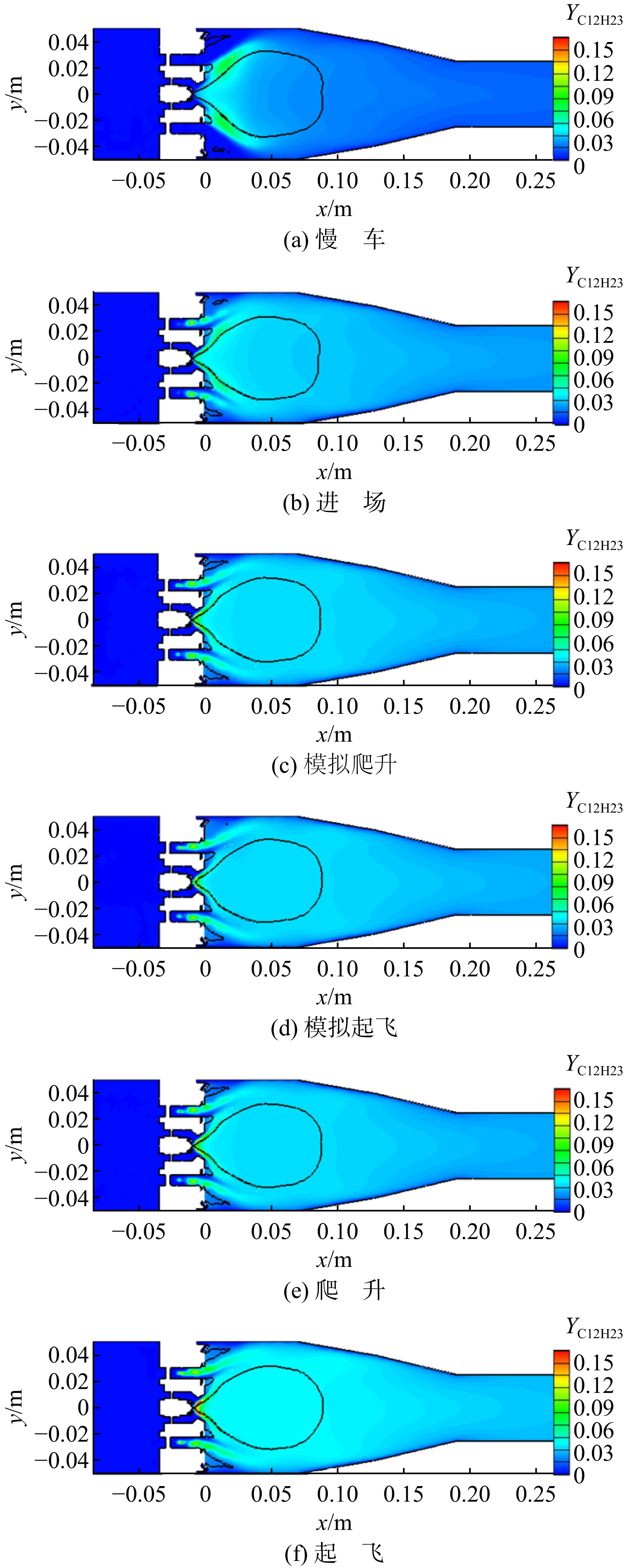
图 11 S=0.7的中心截面喷雾特征
Figure 11. Spray characteristics on central cross section under S=0.7 condition
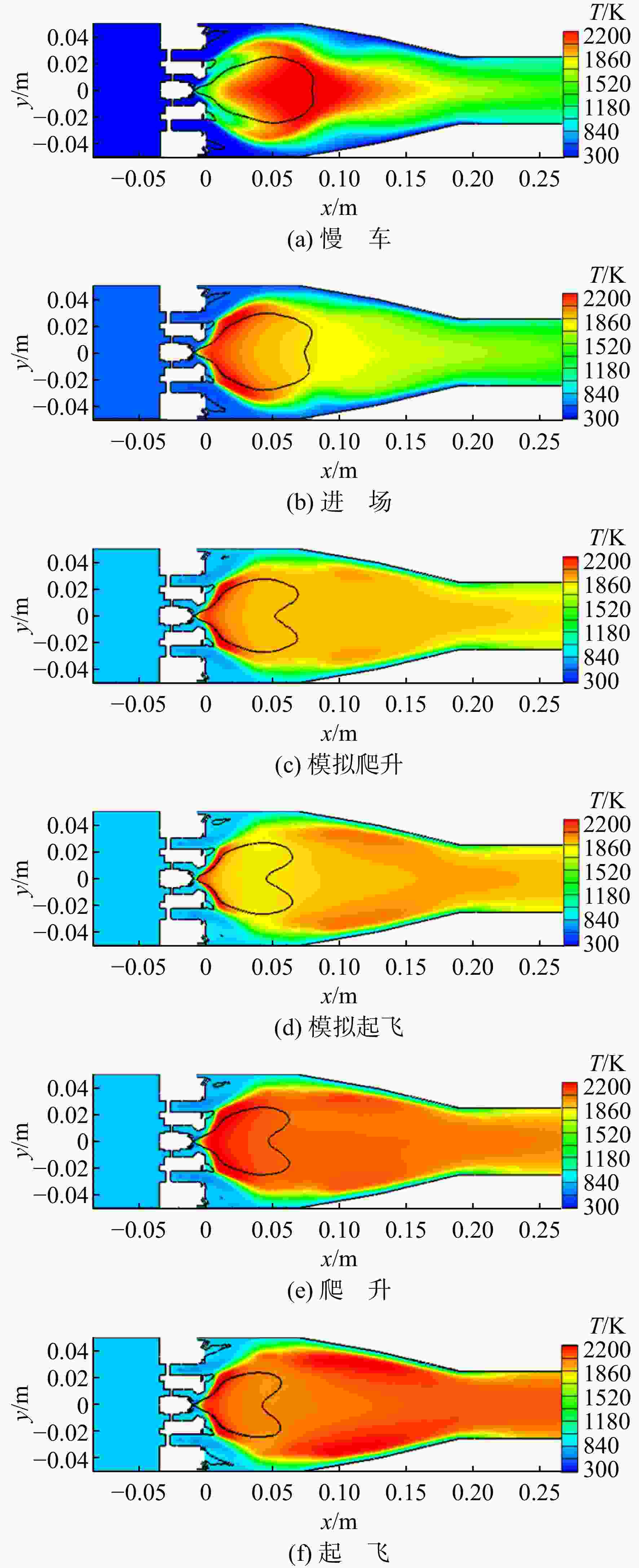
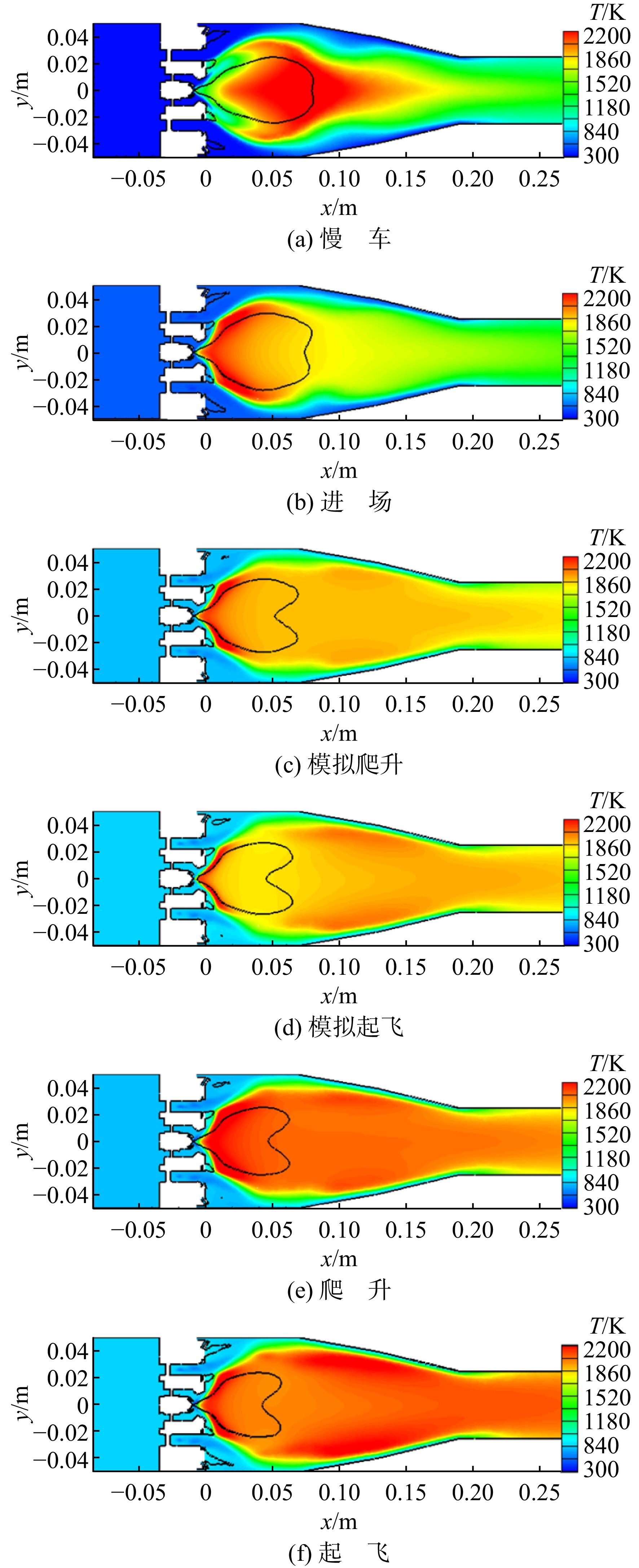
图 12 S=0.7的中心截面温度分布
Figure 12. Temperature distribution on central cross section under S=0.7 condition
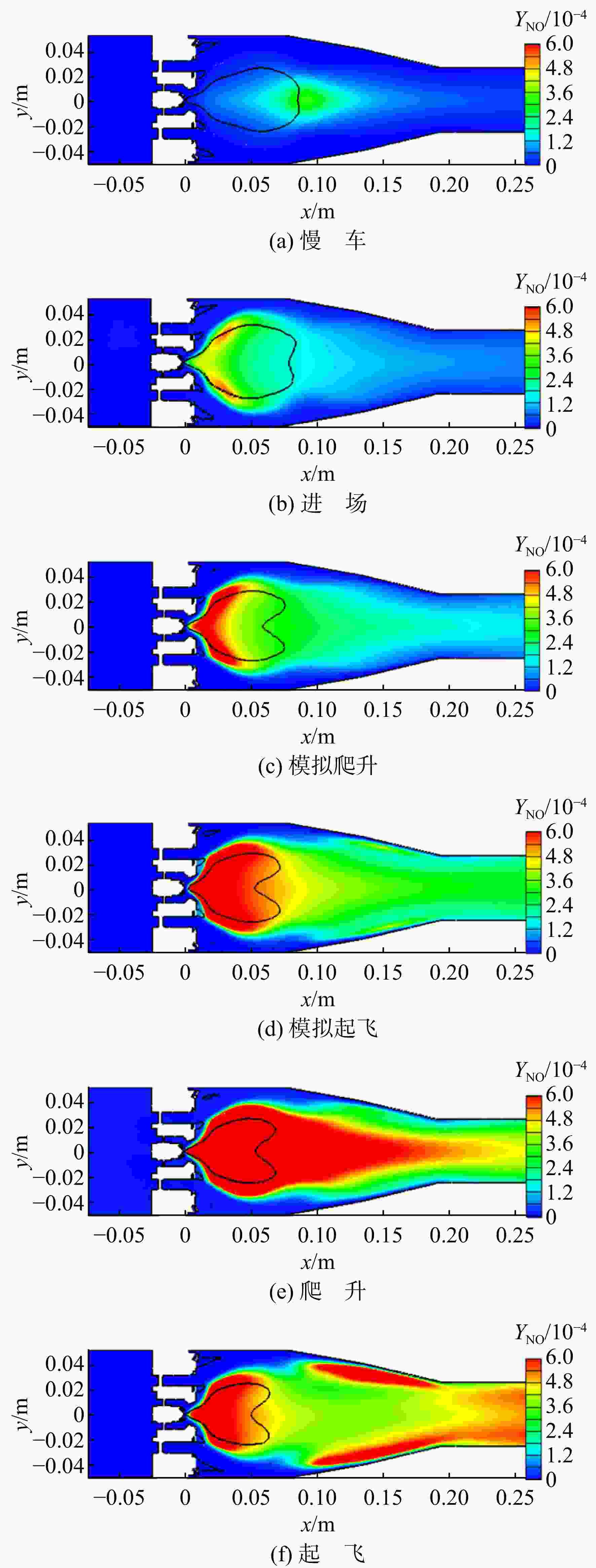
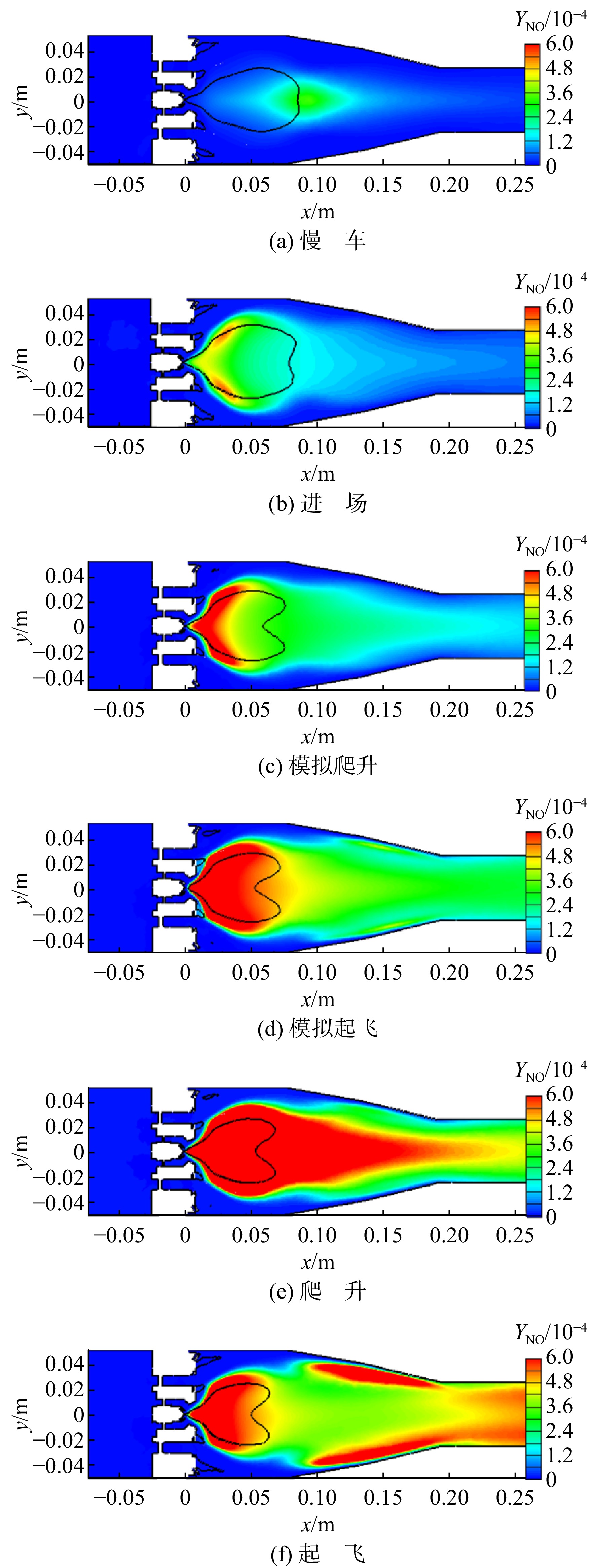
图 13 S=0.7的中心截面NO分布
Figure 13. NO distribution on central cross section under S=0.7 condition
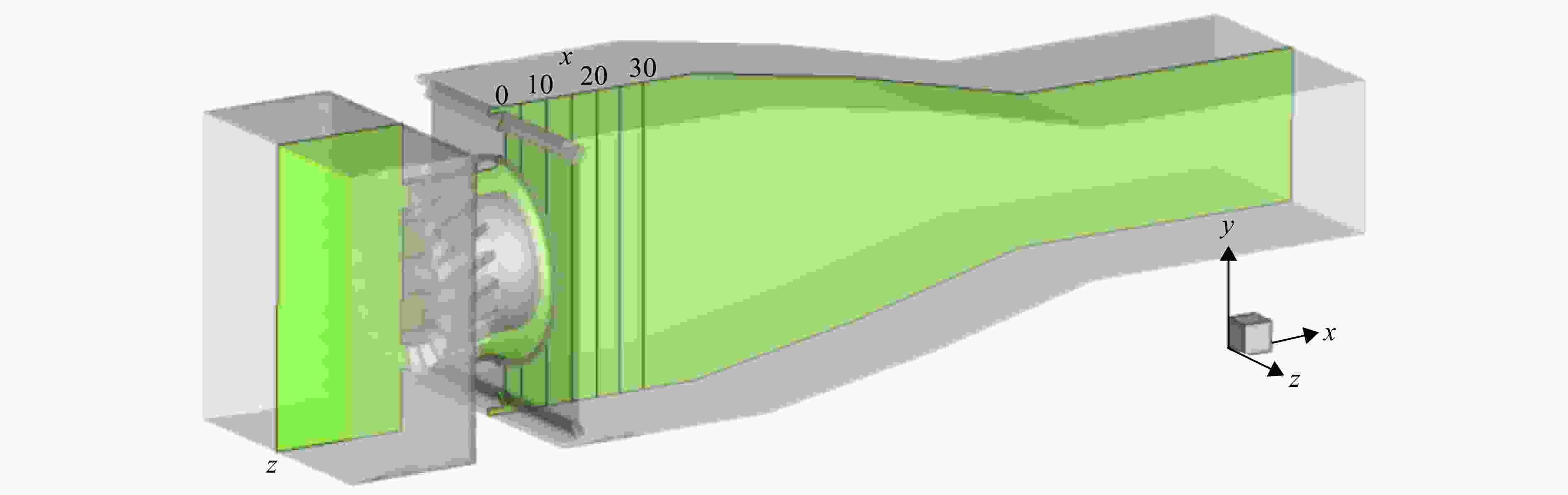
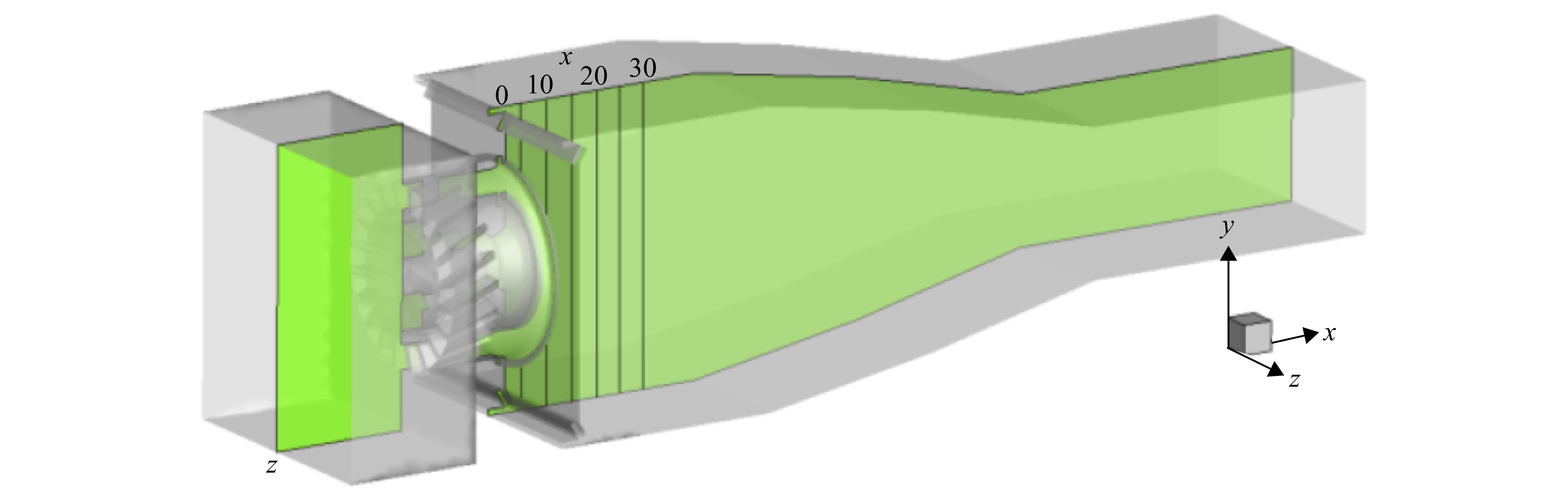
图 15 数值模拟结果后处理截面示意图
Figure 15. Post-processing section diagram of numerical simulation
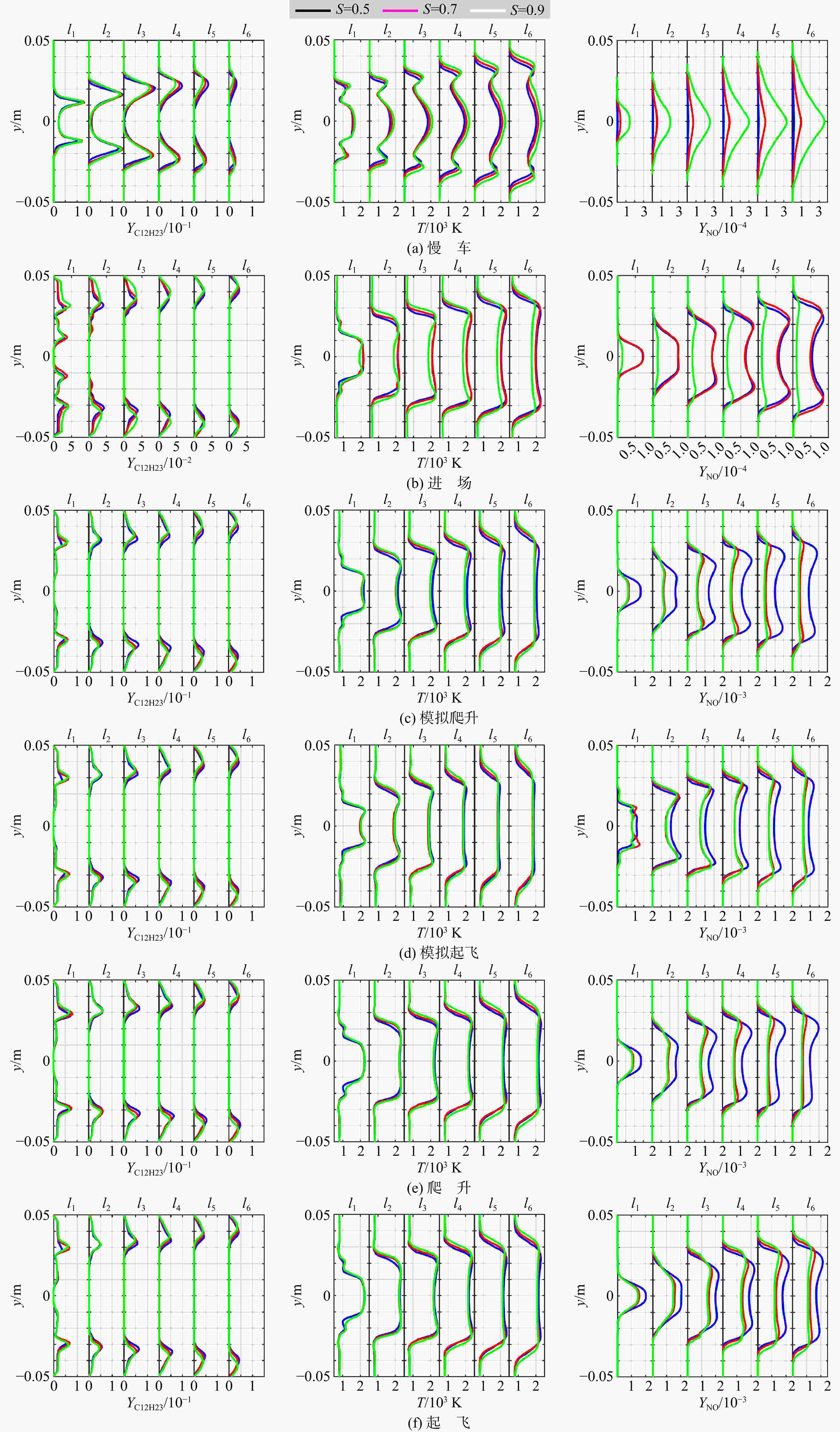
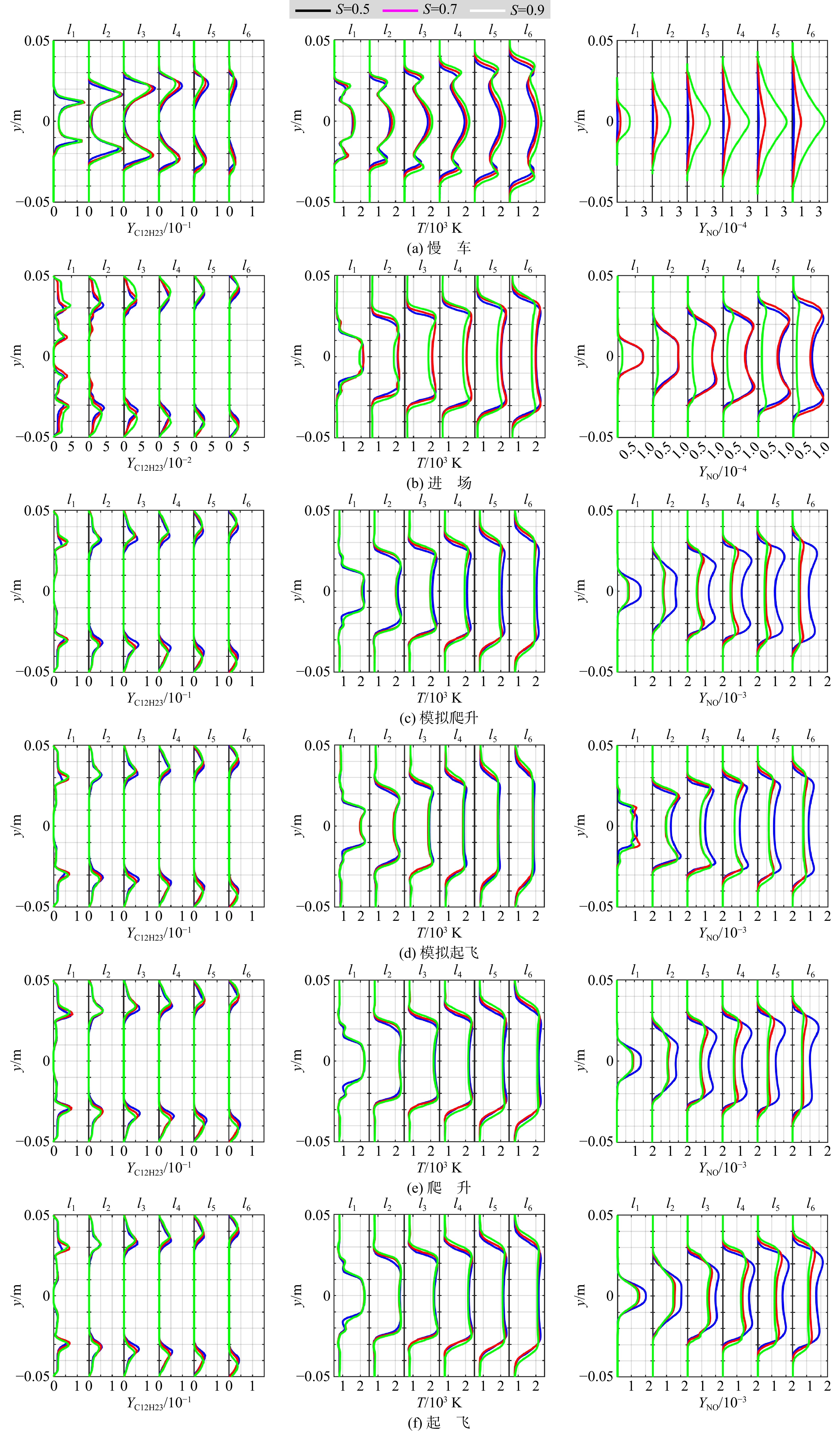
图 16 变主燃级旋流数的燃油蒸气质量分数、温度和NO质量分数对比
Figure 16. Comparison of fuel vapor mass fraction, temperature and NO mass fraction with variable main stage swirl number
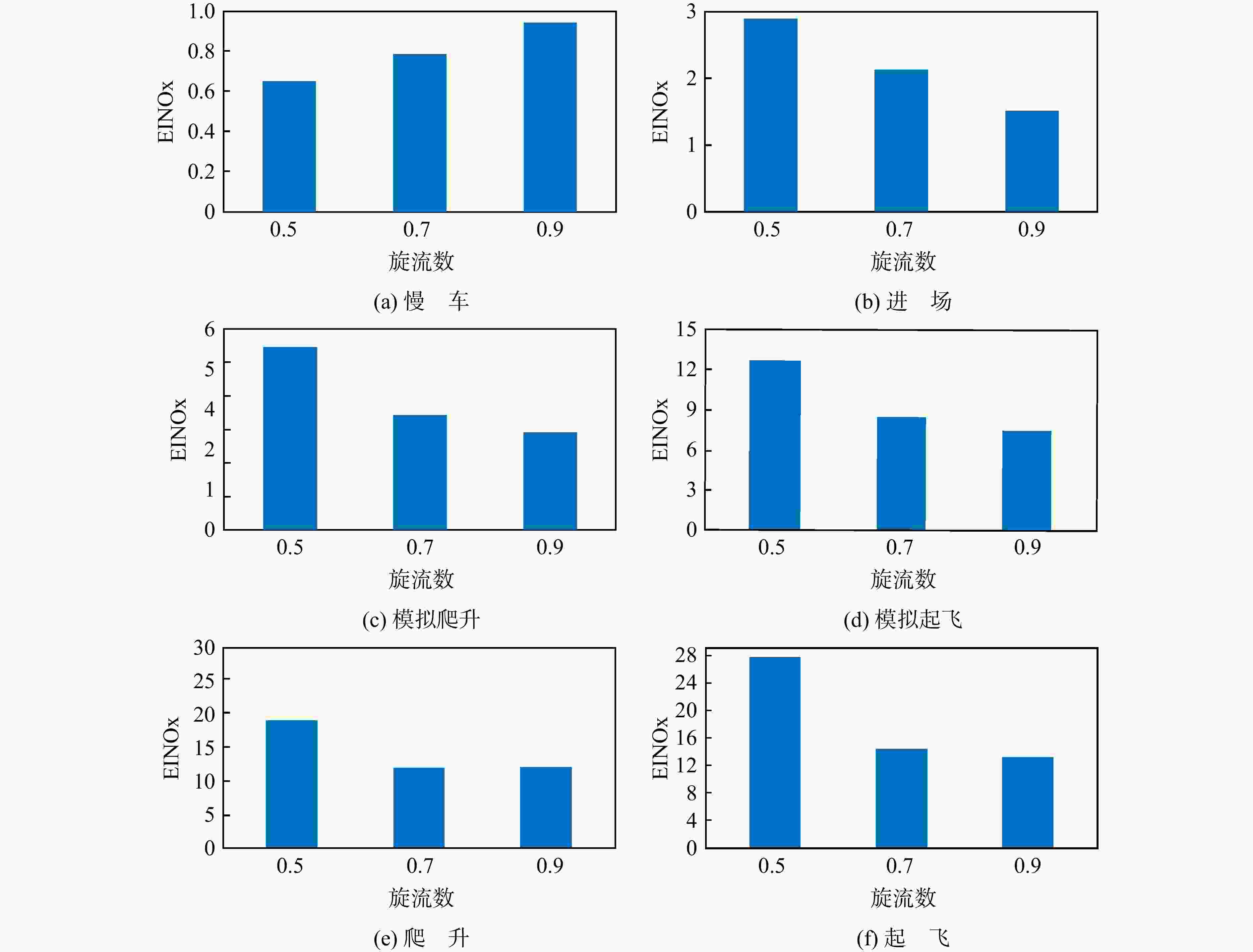
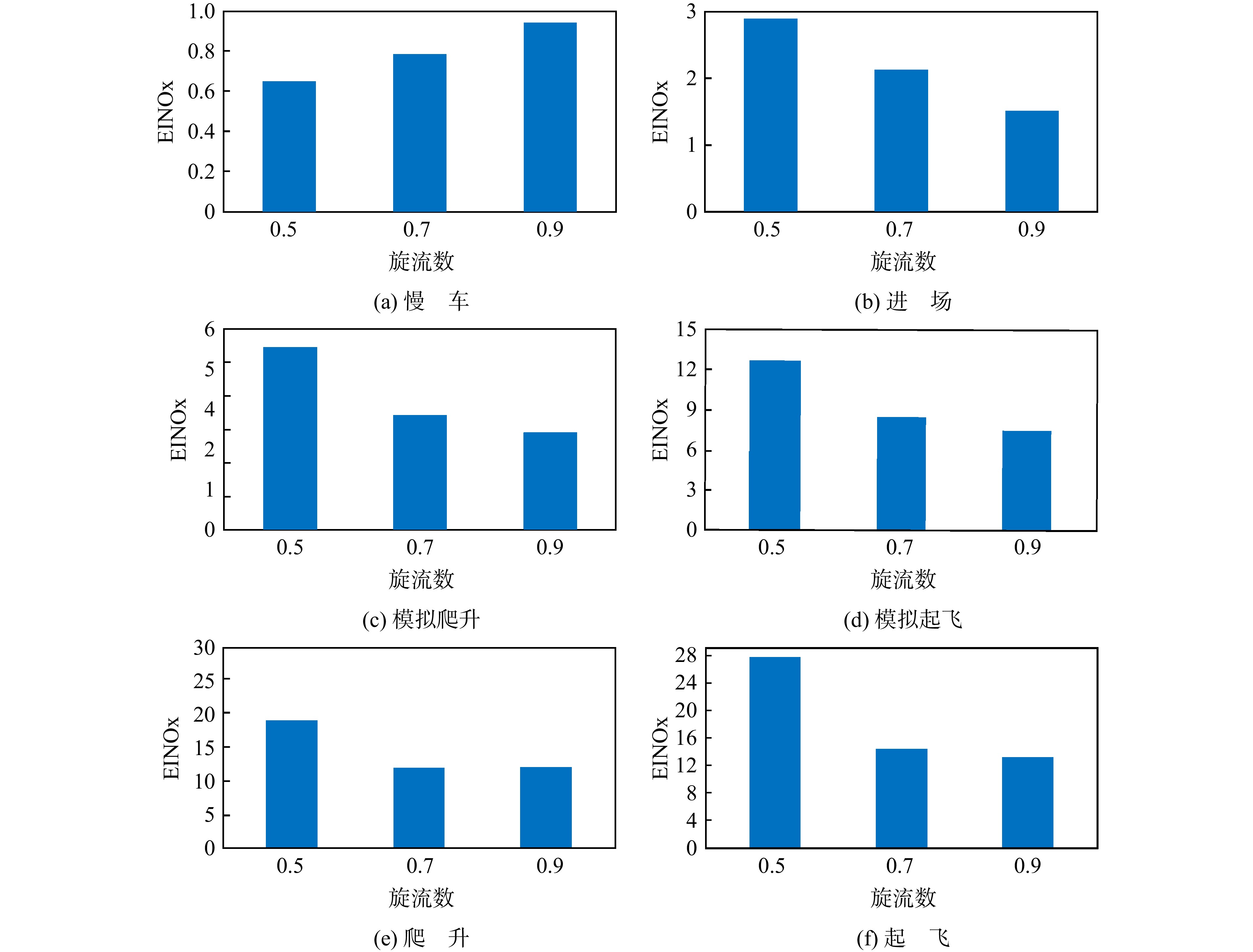
图 17 变主燃级旋流数的燃烧室出口EINOx图
Figure 17. EINOx diagram at combustor outlet with variable main stage swirl number
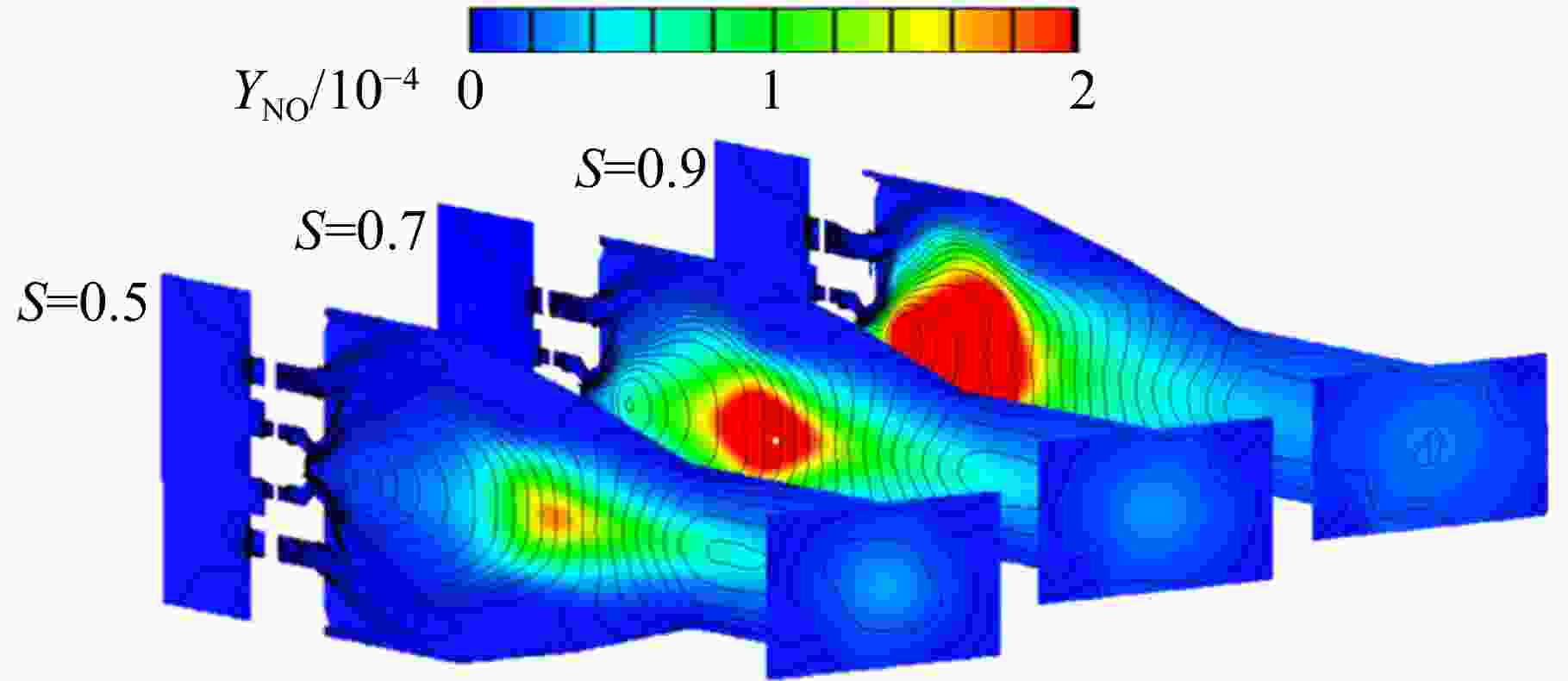
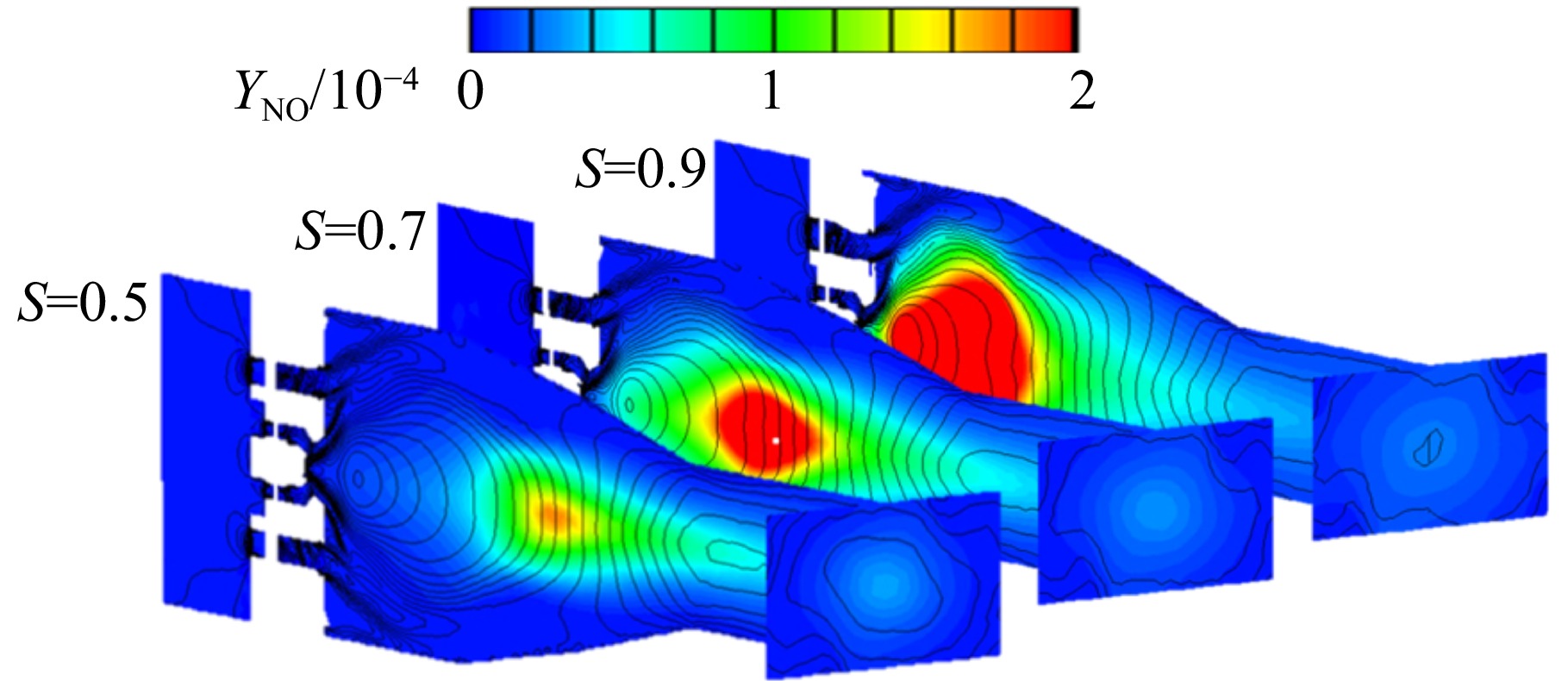
图 18 慢车工况不同旋流数的NO分布
Figure 18. NO distribution at idle condition with different swirl numbers
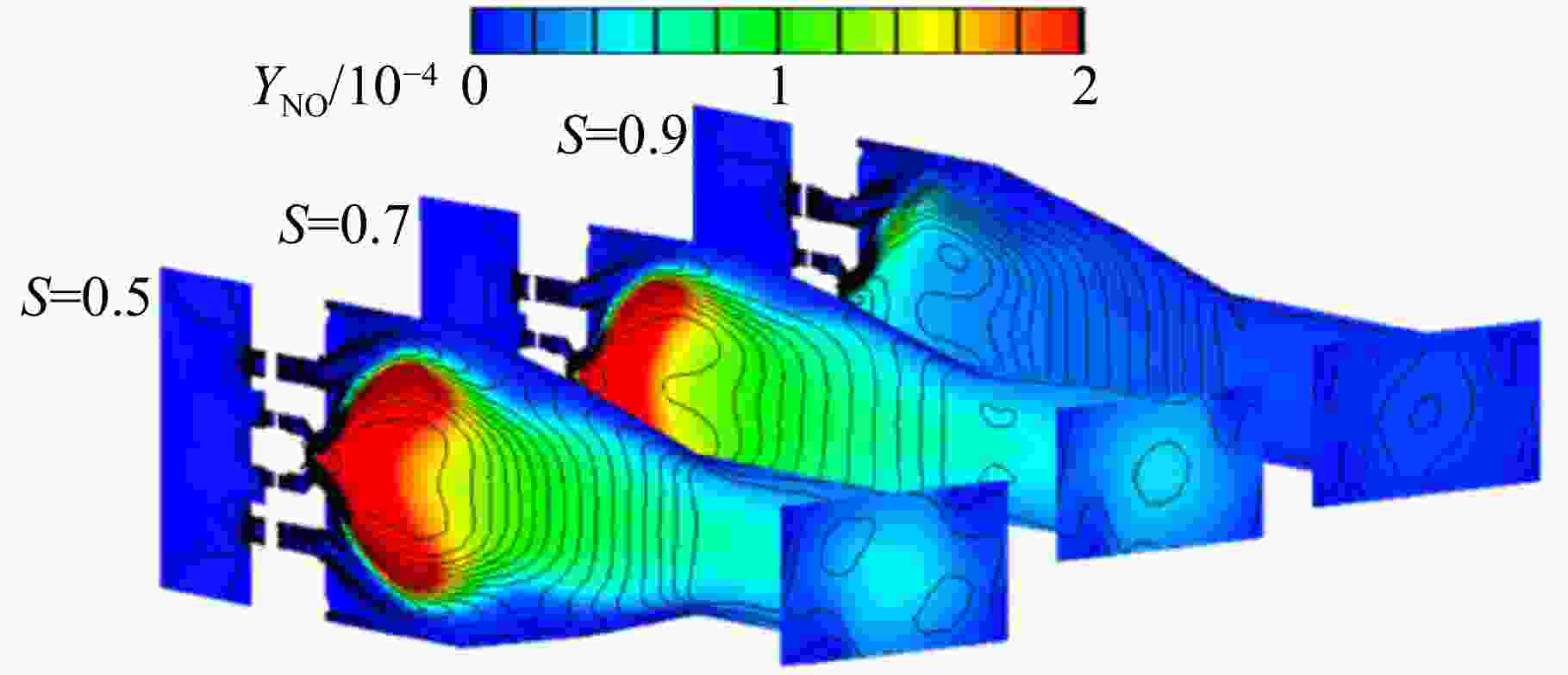
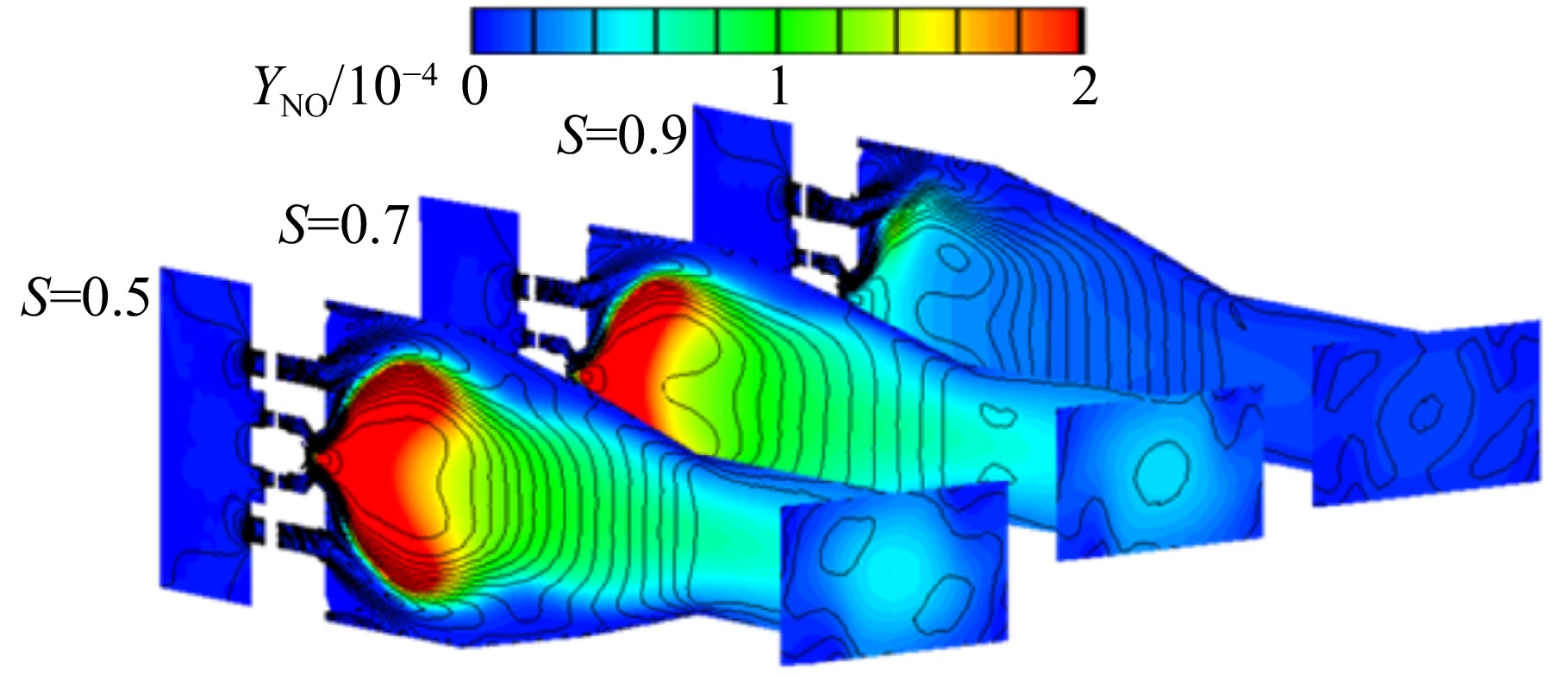
图 19 进场工况不同旋流数的NO分布
Figure 19. NO distribution at approach condition with different swirl numbers
表 1 单头部燃烧室试验工况
Table 1. Experimental conditions for single sector combustor
工况 SR Tin/K pin/MPa ma/(kg/s) FAR 慢车 1.00 507.3 0.591 0.691 0.012 进场 0.25 652.2 1.368 1.524 0.019 模拟爬升 0.14 816.1 2.197 2.056 0.023 模拟起飞 0.10 851.8 2.224 2.034 0.025  下载: 导出CSV
表 2 数值模拟工况条件
Table 2. Operating conditions for numerical simulation
工况 SR Tin/K pin/MPa ma/(kg/s) FAR 爬升 0.14 810.9 2.865 2.504 0.026 起飞 0.10 843.6 3.266 2.799 0.028
下载: 导出CSV
表 3 喷雾参数
Table 3. Spray parameters
喷口 SMD/mm θ/(°) mf/(kg/s) vf(m/s) 预燃级 0.0114 90.0 0.0070 102.87 主燃级 0.0050 12.2 0.0213 24.27
下载: 导出CSV
表 5 不同主燃级旋流数下LTO循环每千克燃油NOx排放量
Table 5. NOx emissions per kilogram of fuel under LTO cycle under different main stage swirl numbers
旋流数 排放量/g 慢车 进场 爬升 起飞 LTO(Dp) 0.5 0.65 2.88 19.31 28.11 287.36 0.7 0.77 2.13 12.09 14.56 176.67 0.9 0.94 1.54 11.18 13.54 163.63
下载: 导出CSV
-
[1] International Civil Aviation Organization. Annex 16-Environmental Protection: Volume II Aircraft Engine Emissions[R]. Montreal: International Civil Aviation Organization, 2010. [2] 赵坚行. 民用发动机污染排放及低污染燃烧技术发展趋势[J]. 航空动力学报, 2008, 23(6): 986-996. Zhao Jianxing. Pollutant emission and development of low-emission combustion technology for civil aero engine[J]. Journal of Aerospace Power, 2008, 23(6): 986-996. (in Chinese doi: 10.13224/j.cnki.jasp.2008.06.006Zhao Jianxing. Pollutant emission and development of low-emission combustion technology for civil aero engine[J]. Journal of Aerospace Power, 2008, 23(6): 986-996. (in Chinese) doi: 10.13224/j.cnki.jasp.2008.06.006 [3] 张弛, 林宇震, 徐华胜, 等. 民用航空发动机低排放燃烧室技术发展现状及水平[J]. 航空学报, 2014, 35(2): 332-350. Zhang Chi, Lin Yuzhen, Xu Huasheng, et al. Development status and level of low emissions combustor technologies for civil aero-engine[J]. Acta Aeronautica et Astronautica Sinica, 2014, 35(2): 332-350. (in Chinese doi: 10.7527/S1000-6893.2013.0358Zhang Chi, Lin Yuzhen, Xu Huasheng, et al. Development status and level of low emissions combustor technologies for civil aero-engine[J]. Acta Aeronautica et Astronautica Sinica, 2014, 35(2): 332-350. (in Chinese) doi: 10.7527/S1000-6893.2013.0358 [4] 李美烨, 程明, 林宏军, 等. 主燃级旋流数对中心分级燃烧室流场的影响[J]. 航空发动机, 2018, 44(6): 50-53. Li Meiye, Cheng Ming, Lin Hongjun, et al. Influence of swirl number of the main swirler on concentric staged combustor flow field[J]. Aeroengine, 2018, 44(6): 50-53. (in Chinese doi: 10.13477/j.cnki.aeroengine.2018.06.009Li Meiye, Cheng Ming, Lin Hongjun, et al. Influence of swirl number of the main swirler on concentric staged combustor flow field[J]. Aeroengine, 2018, 44(6): 50-53. (in Chinese) doi: 10.13477/j.cnki.aeroengine.2018.06.009 [5] 周韬, 李锋, 赵凯, 等. 两级旋流数对中心分级贫油直喷燃烧室流动特性的影响[J]. 航空动力学报, 2022, 37(11): 2488-2500. Zhou Tao, Li Feng, Zhao Kai, et al. Effect of swirl numbers on flow characteristics of a concentric staged lean direct injection combustor[J]. Journal of Aerospace Power, 2022, 37(11): 2488-2500. (in Chinese doi: 10.13224/j.cnki.jasp.20220290Zhou Tao, Li Feng, Zhao Kai, et al. Effect of swirl numbers on flow characteristics of a concentric staged lean direct injection combustor[J]. Journal of Aerospace Power, 2022, 37(11): 2488-2500. (in Chinese) doi: 10.13224/j.cnki.jasp.20220290 [6] 党新宪, 赵坚行, 徐榕, 等. 试验研究旋流数对燃烧室气动性能的影响[J]. 航空动力学报, 2011, 26(1): 21-27. Dang Xinxian, Zhao Jianxing, Xu Rong, et al. Experimental investigation on effects of swirl number on aerodynamic characteristics of combustor[J]. Journal of Aerospace Power, 2011, 26(1): 21-27. (in ChineseDang Xinxian, Zhao Jianxing, Xu Rong, et al. Experimental investigation on effects of swirl number on aerodynamic characteristics of combustor[J]. Journal of Aerospace Power, 2011, 26(1): 21-27. (in Chinese) [7] 汤朝伟, 李建中, 金武, 等. 主燃级旋流数影响三级旋流燃烧室流动与燃烧特性试验[J]. 航空动力学报, 2021, 36(3): 634-645. Tang Chaowei, Li Jianzhong, Jin Wu, et al. Experiment on effect of main swirl number on the flow and combustion characteristics of three-stage swirl combustor[J]. Journal of Aerospace Power, 2021, 36(3): 634-645. (in Chinese doi: 10.13224/j.cnki.jasp.2021.03.019Tang Chaowei, Li Jianzhong, Jin Wu, et al. Experiment on effect of main swirl number on the flow and combustion characteristics of three-stage swirl combustor[J]. Journal of Aerospace Power, 2021, 36(3): 634-645. (in Chinese) doi: 10.13224/j.cnki.jasp.2021.03.019 [8] 徐丽, 刘凯, 曾文. 旋流数对贫预混燃烧特性影响[J]. 航空动力学报, 2023, 38(6): 1292-1298. Xu Li, Liu Kai, Zeng Wen. Effect of swirl number on lean premixed combustion characteristics[J]. Journal of Aerospace Power, 2023, 38(6): 1292-1298. (in Chinese doi: 10.13224/j.cnki.jasp.20210675Xu Li, Liu Kai, Zeng Wen. Effect of swirl number on lean premixed combustion characteristics[J]. Journal of Aerospace Power, 2023, 38(6): 1292-1298. (in Chinese) doi: 10.13224/j.cnki.jasp.20210675 [9] Tang Chaowei, Li Jianzhong, Jin Wu, et al. Numerical investigation on the influence of swirl number to high-temperature zone evolution and outlet temperature distribution in multi-stage combustor[J]. Fuel, 2025, 381: 133264. doi: 10.1016/j.fuel.2024.133264 [10] Zhang L, Xue X, Yang Q, et al. Experiment study of pilot stage swirler outlet angles and swirl number on flame structures and flow field in a stratified swirl combustor[C]//ASME Turbo Expo 2022: Turbomachinery Technical Conference and Exposition. New York: ASME, 2022. [11] Xu H H, Li Z F, Pang L Y, et al. Effect of swirling number and direction on flame morphology and combustion performance in a centrally staged swirl combustor[C]//ASME Turbo Expo 2024: Turbomachinery Technical Conference and Exposition. New York: ASME, 2024. [12] 张玮杰, 李德立, 金武, 等. 旋流数对中心分级燃烧室高温区影响研究[J]. 推进技术, 2025, 46(5): 2404079. Zhang Weijie, Li Deli, Jin Wu, et al. Effects of swirl number on high-temperature zone of a centrally staged combustor[J]. Journal of Propulsion Technology, 2025, 46(5): 2404079. (in Chinese doi: 10.13675/j.cnki.tjjs.2404079Zhang Weijie, Li Deli, Jin Wu, et al. Effects of swirl number on high-temperature zone of a centrally staged combustor[J]. Journal of Propulsion Technology, 2025, 46(5): 2404079. (in Chinese) doi: 10.13675/j.cnki.tjjs.2404079 [13] 刘岩, 惠鑫, 王建臣, 等. 预燃级旋流数对中心分级燃烧室点火性能影响[J]. 航空动力学报, 2022, 37(10): 2335-2343. Liu Yan, Hui Xin, Wang Jianchen, et al. Effect of swirl number of pilot stage on ignition performance of centrally-staged combustor[J]. Journal of Aerospace Power, 2022, 37(10): 2335-2343. (in Chinese doi: 10.13224/j.cnki.jasp.20220277Liu Yan, Hui Xin, Wang Jianchen, et al. Effect of swirl number of pilot stage on ignition performance of centrally-staged combustor[J]. Journal of Aerospace Power, 2022, 37(10): 2335-2343. (in Chinese) doi: 10.13224/j.cnki.jasp.20220277 [14] Smith G P, Golden D M, Frenklach M, et al. GRI-Mech 3.0[EB/OL]. [2025-07-01]. http://combustion.berkeley.edu/gri-mech/. [15] Huang Ying, Yang V. Effect of swirl on combustion dynamics in a lean-premixed swirl-stabilized combustor[J]. Proceedings of the Combustion Institute, 2005, 30(2): 1775-1782. doi: 10.1016/j.proci.2004.08.237 [16] Gupta A K, Syred N, Beer J M. Effect of swirl on combustion characteristics in premixed flames[J]. Journal of Engineering for Gas Turbines and Power, 1998, 120(3): 488-494. doi: 10.1115/1.2818171 [17] Mongia H. Engineering aspects of complex gas turbine combustion mixers: Part Ⅰ design: AIAA 2011-105[C]//49th AIAA Aerospace Sciences Meeting. Reston: AIAA, 2011. [18] Wang Bo, Zhang Chi, Lin Yuzhen, et al. Influence of main swirler vane angle on the ignition performance of TeLESS-Ⅱ combustor[J]. Journal of Engineering for Gas Turbines and Power, 2017, 139: 011501. doi: 10.1115/1.4034154 [19] 王智勇, 王波, 韩啸, 等. TeLESSⅡ低排放燃烧室预燃级设计对排放的影响[J]. 航空动力学报, 2017, 32(7): 1561-1568. Wang Zhiyong, Wang Bo, Han Xiao, et al. Effect of pilot design in the TeLESSⅡ low emission combustor on emission[J]. Journal of Aerospace Power, 2017, 32(7): 1561-1568. (in Chinese doi: 10.13224/j.cnki.jasp.2017.07.004Wang Zhiyong, Wang Bo, Han Xiao, et al. Effect of pilot design in the TeLESSⅡ low emission combustor on emission[J]. Journal of Aerospace Power, 2017, 32(7): 1561-1568. (in Chinese) doi: 10.13224/j.cnki.jasp.2017.07.004 [20] 秦皓, 丁志磊, 李海涛, 等. LESS燃烧室非定常旋流流动[J]. 航空动力学报, 2015, 30(7): 1566-1575. Qin Hao, Ding Zhilei, Li Haitao, et al. Unsteady swirling flow in low emissions stirred swirls combustor[J]. Journal of Aerospace Power, 2015, 30(7): 1566-1575. (in Chinese doi: 10.13224/j.cnki.jasp.2015.07.005Qin Hao, Ding Zhilei, Li Haitao, et al. Unsteady swirling flow in low emissions stirred swirls combustor[J]. Journal of Aerospace Power, 2015, 30(7): 1566-1575. (in Chinese) doi: 10.13224/j.cnki.jasp.2015.07.005 [21] 李海涛, 许全宏, 付镇柏, 等. 中心分级燃烧室预燃级贫油熄火性能试验[J]. 航空动力学报, 2014, 29(9): 2188-2194. Li Haitao, Xu Quanhong, Fu Zhenbai, et al. Experiment on lean blow-out performance of pilot stage in internally-staged combustor[J]. Journal of Aerospace Power, 2014, 29(9): 2188-2194. (in Chinese doi: 10.13224/j.cnki.jasp.2014.09.024Li Haitao, Xu Quanhong, Fu Zhenbai, et al. Experiment on lean blow-out performance of pilot stage in internally-staged combustor[J]. Journal of Aerospace Power, 2014, 29(9): 2188-2194. (in Chinese) doi: 10.13224/j.cnki.jasp.2014.09.024 [22] Lefebvre A H. Atomization and sprays[M]. New York: Hemisphere Publishing Corporation, 1989. [23] Tao W J, Wang J, Mao R H, et al. Generation and migration of hot streaks within an LPP combustor[C]//ASME Turbo Expo 2019: Turbomachinery Technical Conference and Exposition. New York: ASME, 2019. [24] Kundu K, Penko P, VanOverbeke T. A practical kinetic mechanism for computing combustion in gas turbine engines[C]//AIAA 35th Joint Propulsion Conference and Exhibit. Reston: AIAA, 1999: AIAA-1999-2218. [25] 王晶, 张漫, 张弛, 等. 单头部模型燃烧室燃烧组织及NOx排放[J]. 航空动力学报, 2023, 38(1): 94-103. Wang Jing, Zhang Man, Zhang Chi, et al. Combustion organization and NOx emission in a single sector model combustor[J]. Journal of Aerospace Power, 2023, 38(1): 94-103. (in Chinese doi: 10.13224/j.cnki.jasp.20220525Wang Jing, Zhang Man, Zhang Chi, et al. Combustion organization and NOx emission in a single sector model combustor[J]. Journal of Aerospace Power, 2023, 38(1): 94-103. (in Chinese) doi: 10.13224/j.cnki.jasp.20220525 [26] Wang J, Mao R H, Tao W J, et al. Numerical simulation of combustor effusion cooling flow based on source term method[C]// ASME Turbo Expo 2019: Turbomachinery Technical Conference and Exposition, 2019. -

 点击查看大图
计量
- 文章访问数: 109
- HTML浏览量: 101
- PDF量: 9
- 被引次数: 0