






Rapid prediction of flow field in rocket engine nozzles based on U-Net
-
摘要:
针对传统计算流体力学(CFD)方法获取火箭发动机喷管内流场耗时较大的问题,提出了一种基于U-Net架构的喷管内流场预测模型。以火箭发动机喷管为研究对象,通过在一定范围内改变喷管入口来流燃气的温度、压强,基于CFD方法建立了
2816 个不同边界条件下的喷管内流场样本,作为模型训练的数据集,通过引入多条输入、输出通道,使模型可以预测火箭发动机喷管内温度、速度和压强多个流场信息。结果表明:与传统的AE(autoencoder)架构模型相比,U-Net架构模型在压力场、速度场和温度场这3个通道上的预测精度均显著提升;在使用归一化数据集后,U-Net架构模型在各通道上的绝对百分比误差分别为1.6%、4.3%和2.7%,喷管内流场预测结果与CFD仿真结果高度一致,并在100批次的仿真任务中领先CFD两个数量级;该模型可为火箭发动机喷管的设计优化提供有效技术支持。Abstract:A prediction model of the flow field in a rocket engine nozzle based on the U-net architecture was proposed to solve the problem of the time-consuming computation of the flow field in the nozzle using conventional computational fluid dynamics (CFD) methods. By changing the temperature and pressure of the nozzle inlet gas over a certain range,
2816 samples of the flow field in the nozzle under different boundary conditions were obtained based on the CFD method, which were used as a data set for model training. By introducing multiple input and output channels, the model could predict multiple flow field information of the temperature, velocity and pressure in the rocket engine nozzle. The results showed that compared with the traditional AE (Autoencoder) architecture model, the prediction accuracy of the U-net architecture model was significantly improved in three channels: pressure field, velocity field and temperature field. After using the normalized data set, the absolute percentage errors of the U-Net architecture model on each channel were 1.6%, 4.3%, and 2.7%, respectively. The predicted flow field in the nozzle was highly consistent with the CFD simulation results, and was two orders of magnitude faster than the CFD in 100 batch simulation missions; this model can provide effective technical support for the design and optimization of rocket engine nozzles.-
Key words:
- rocket engine /
- nozzle flow field /
- rapid prediction /
- deep learning /
- U-Net model
-
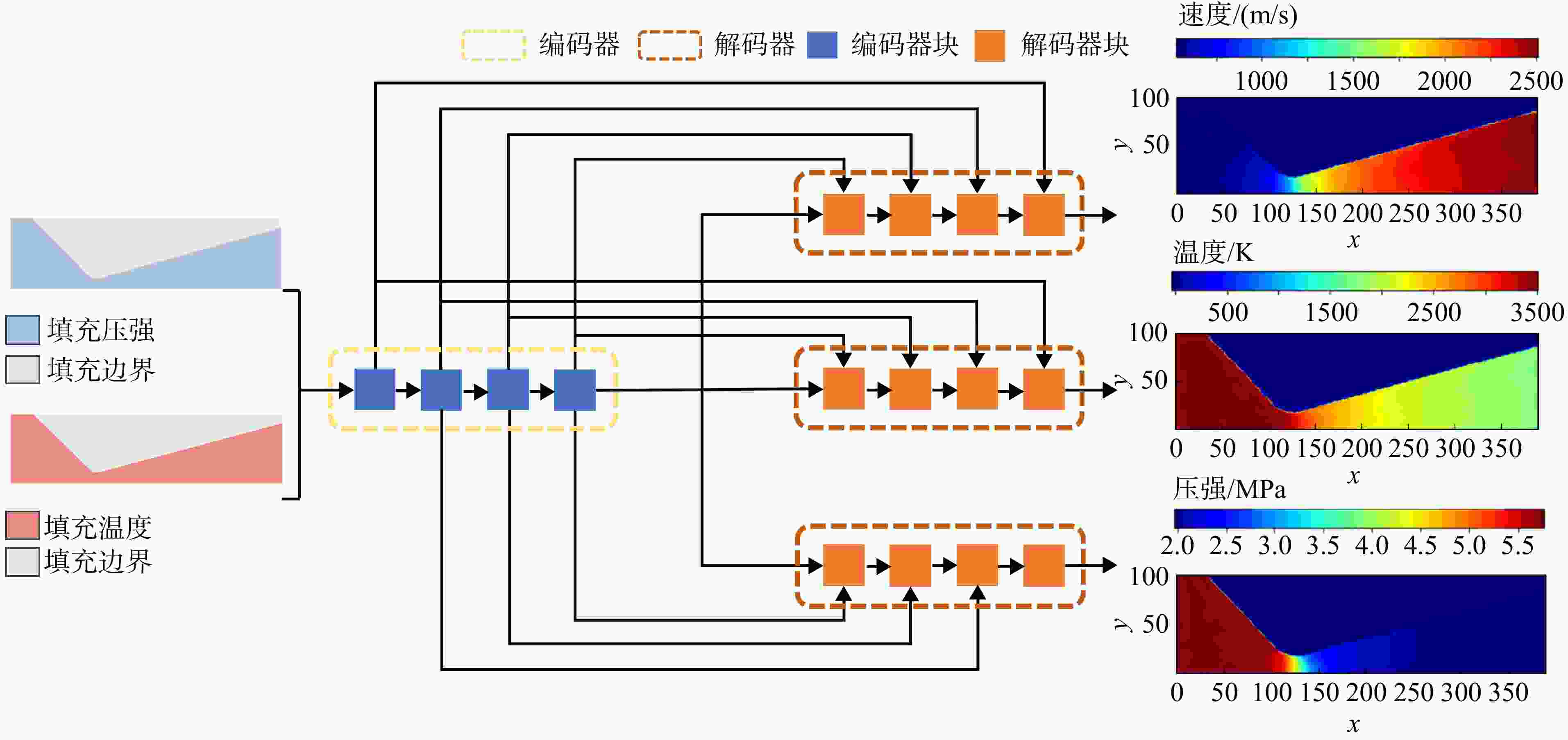
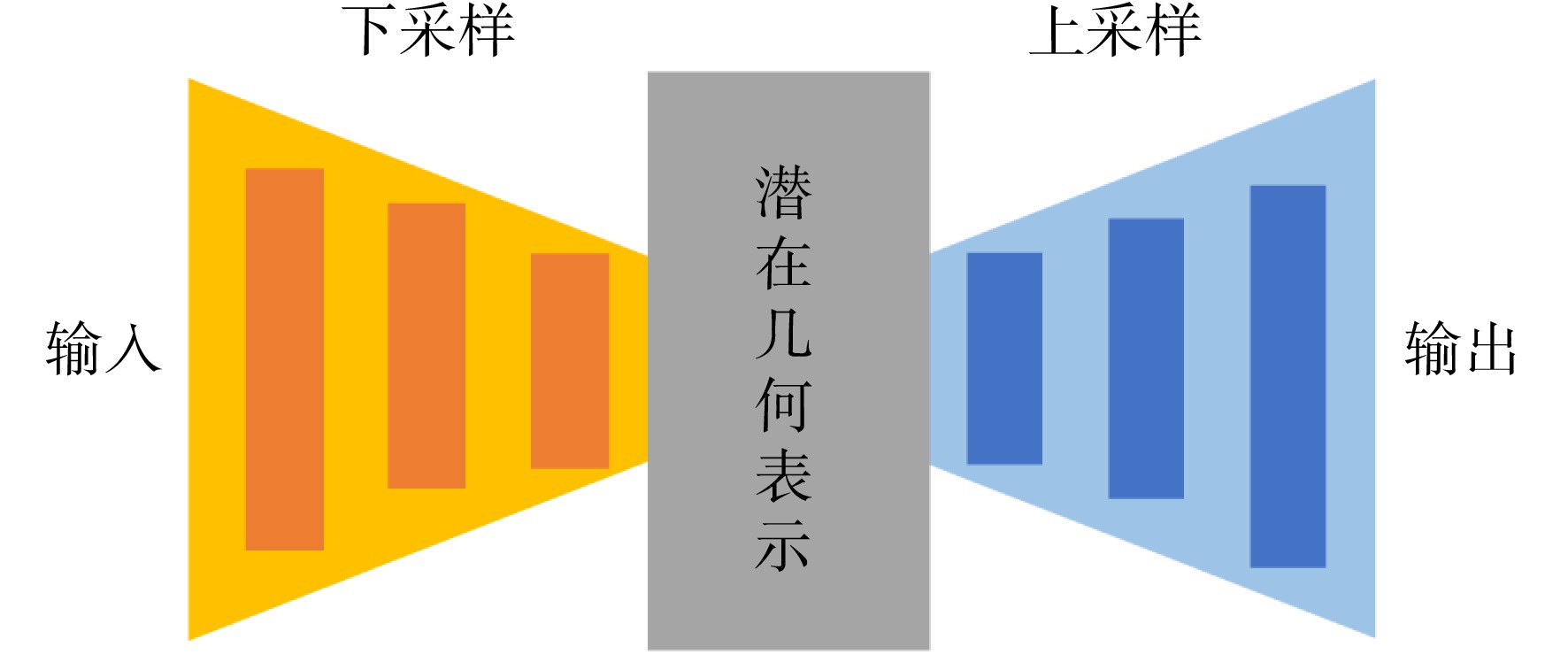
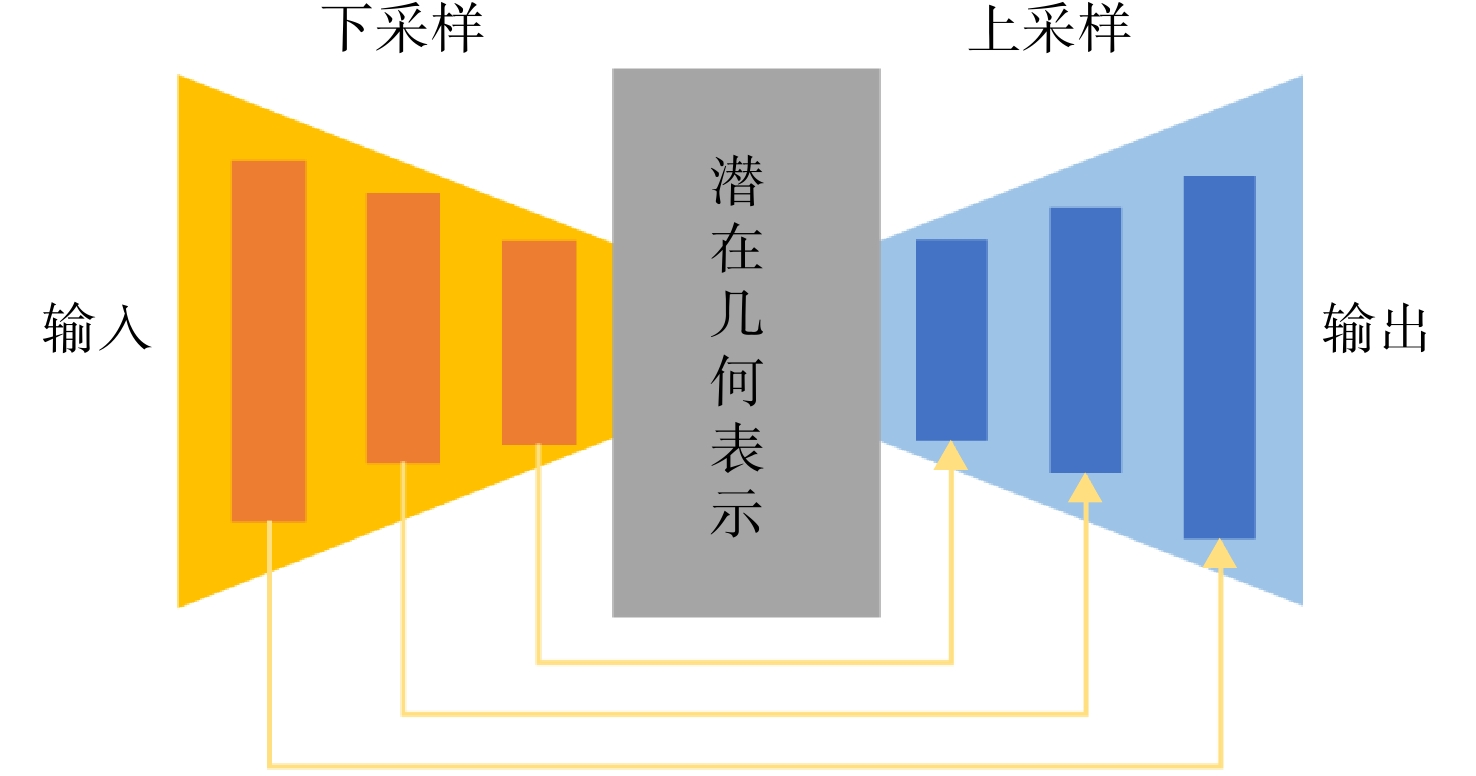
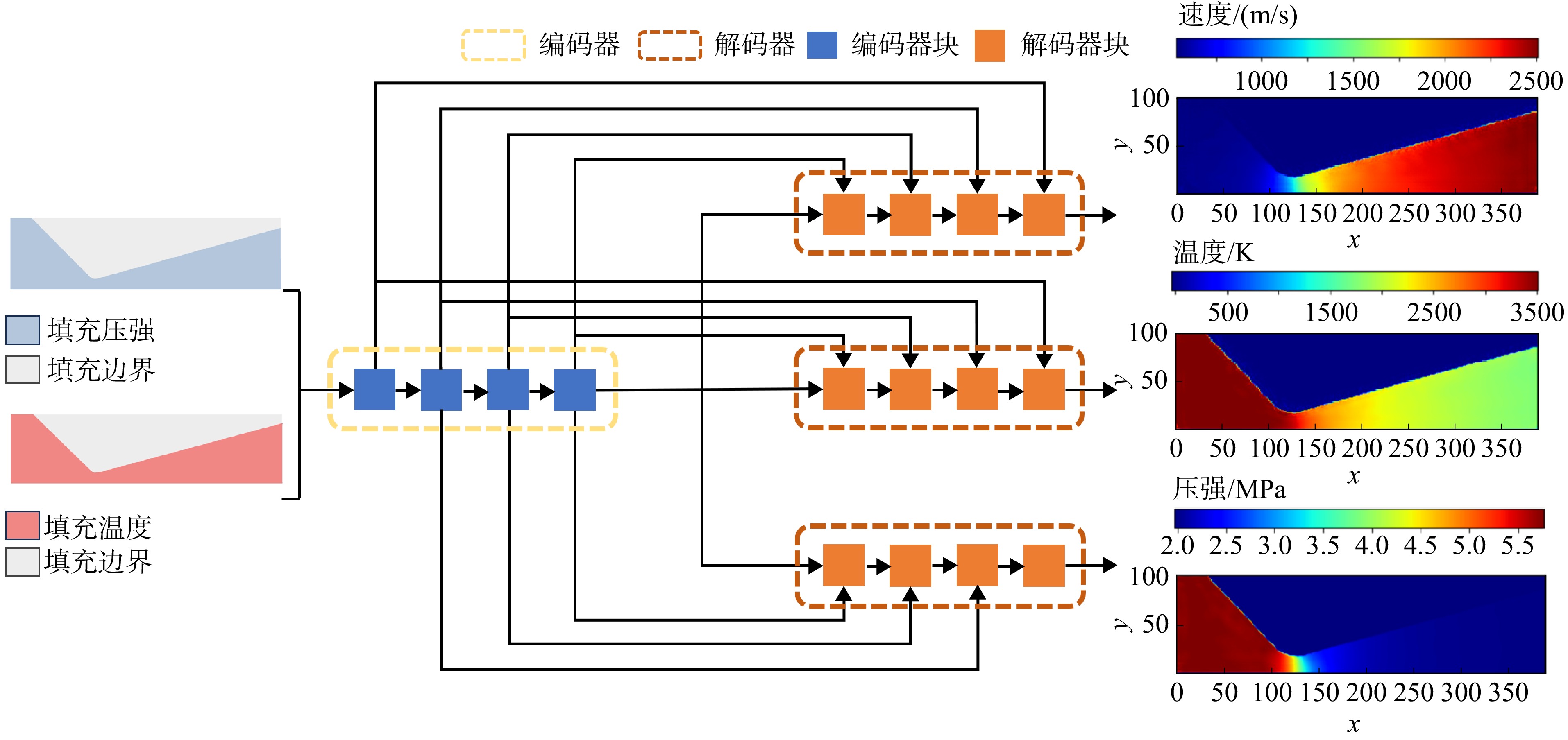
图 5 多通道U-Net架构示意图
Figure 5. Schematic diagram of the multi channels U-Net architecture
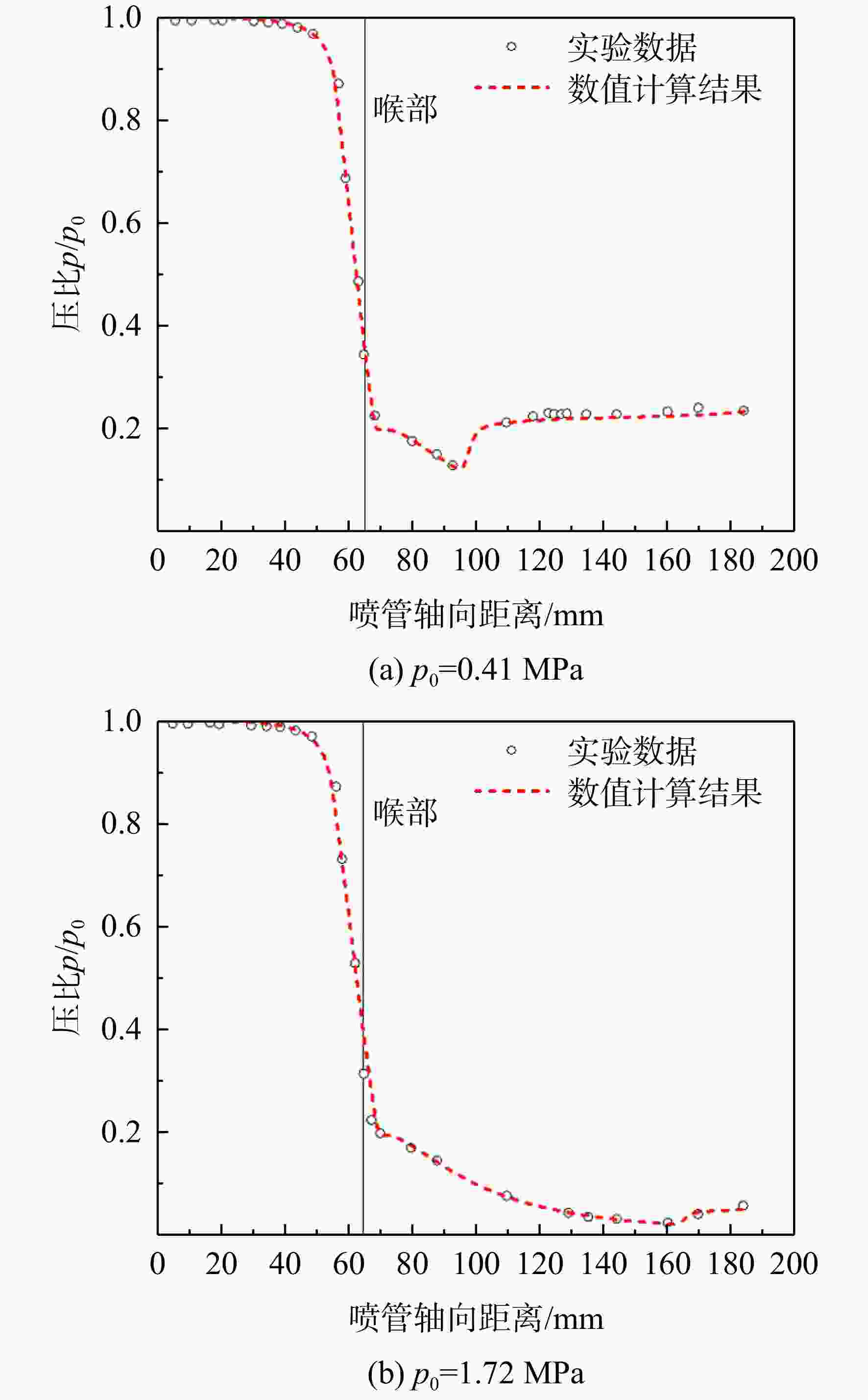
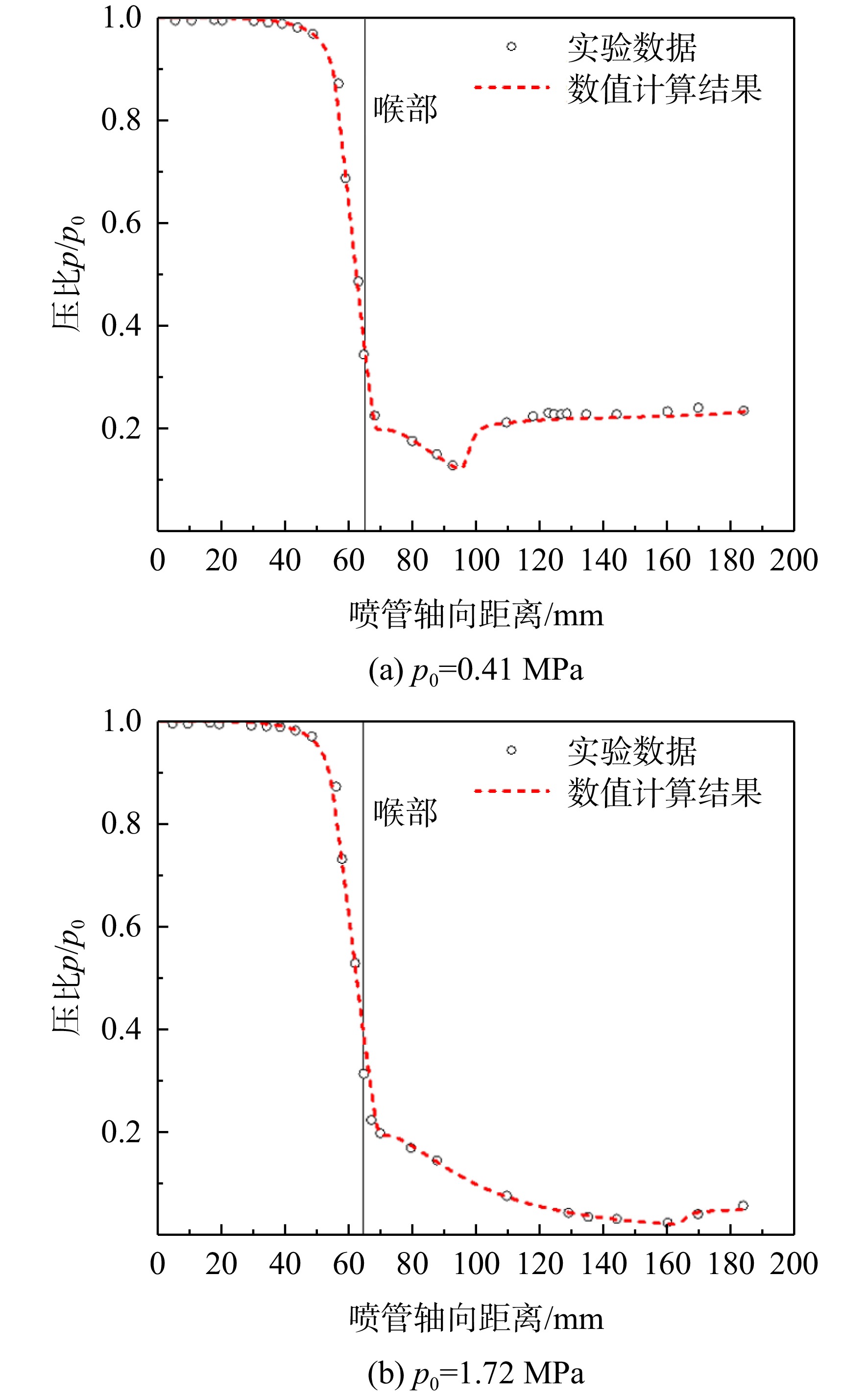
图 8 美国喷气推进实验室喷管壁面压力曲线对比
Figure 8. Comparison of nozzle wall pressure curves at the jet propulsion laboratory in the United States
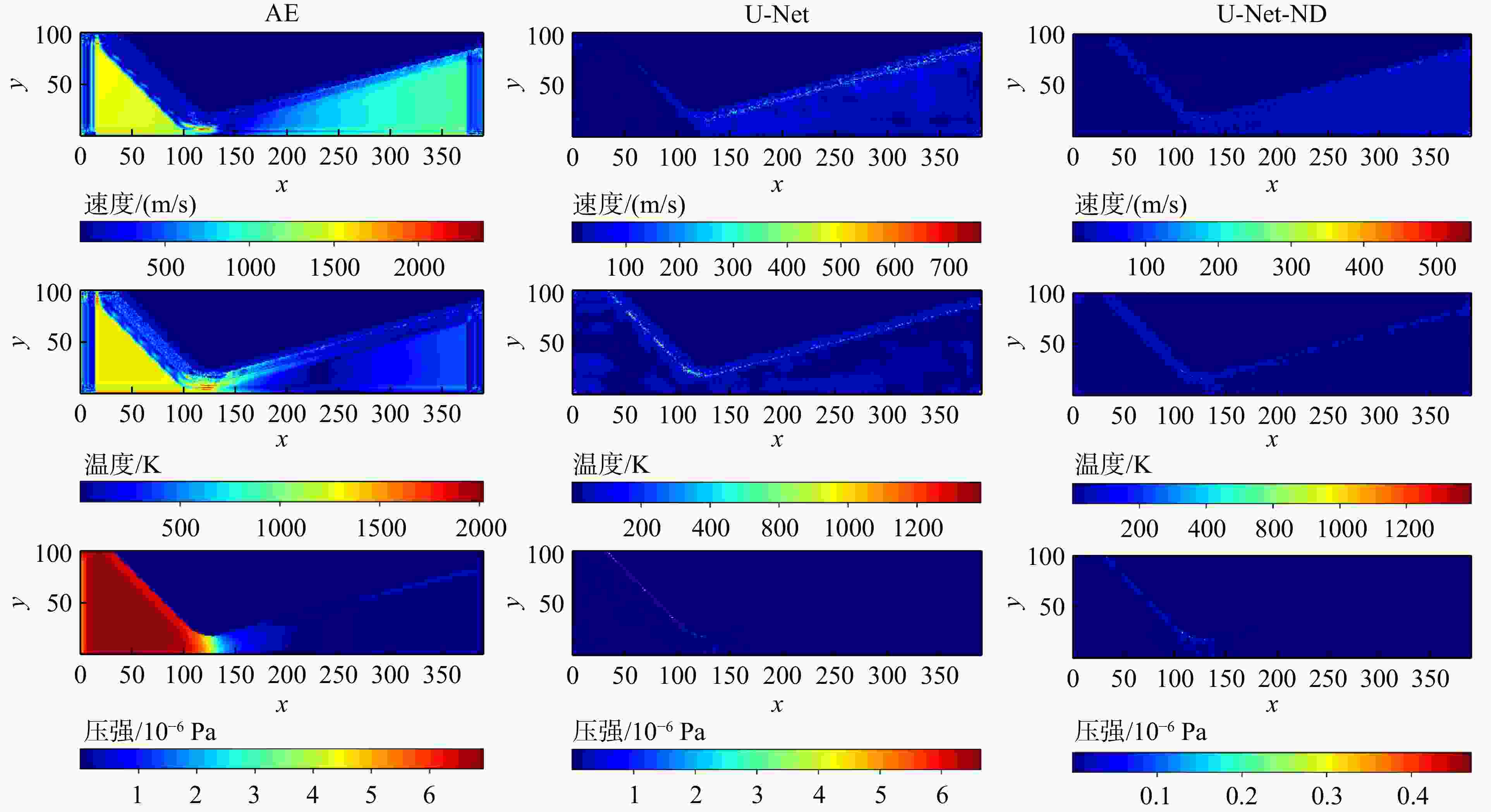
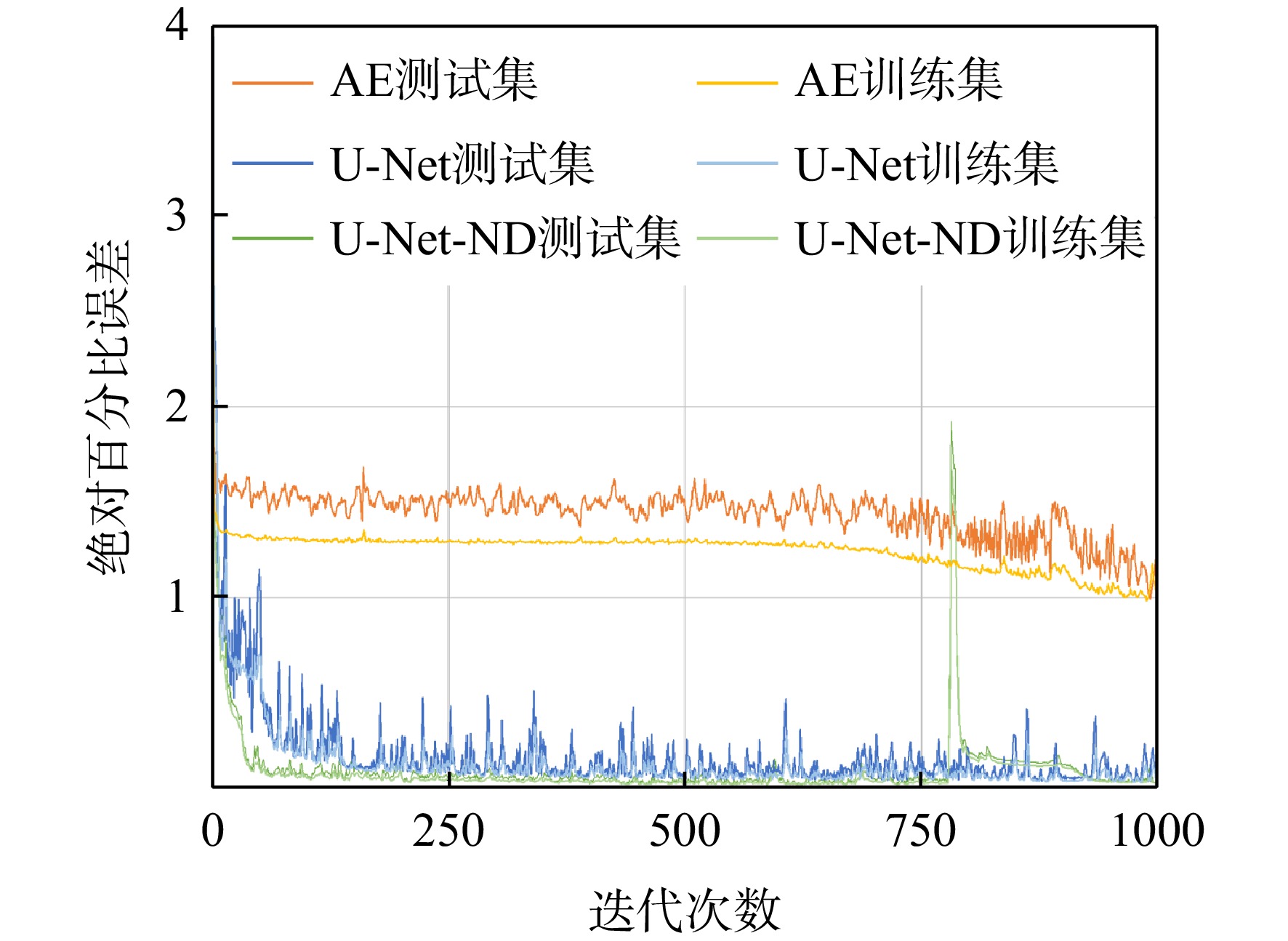
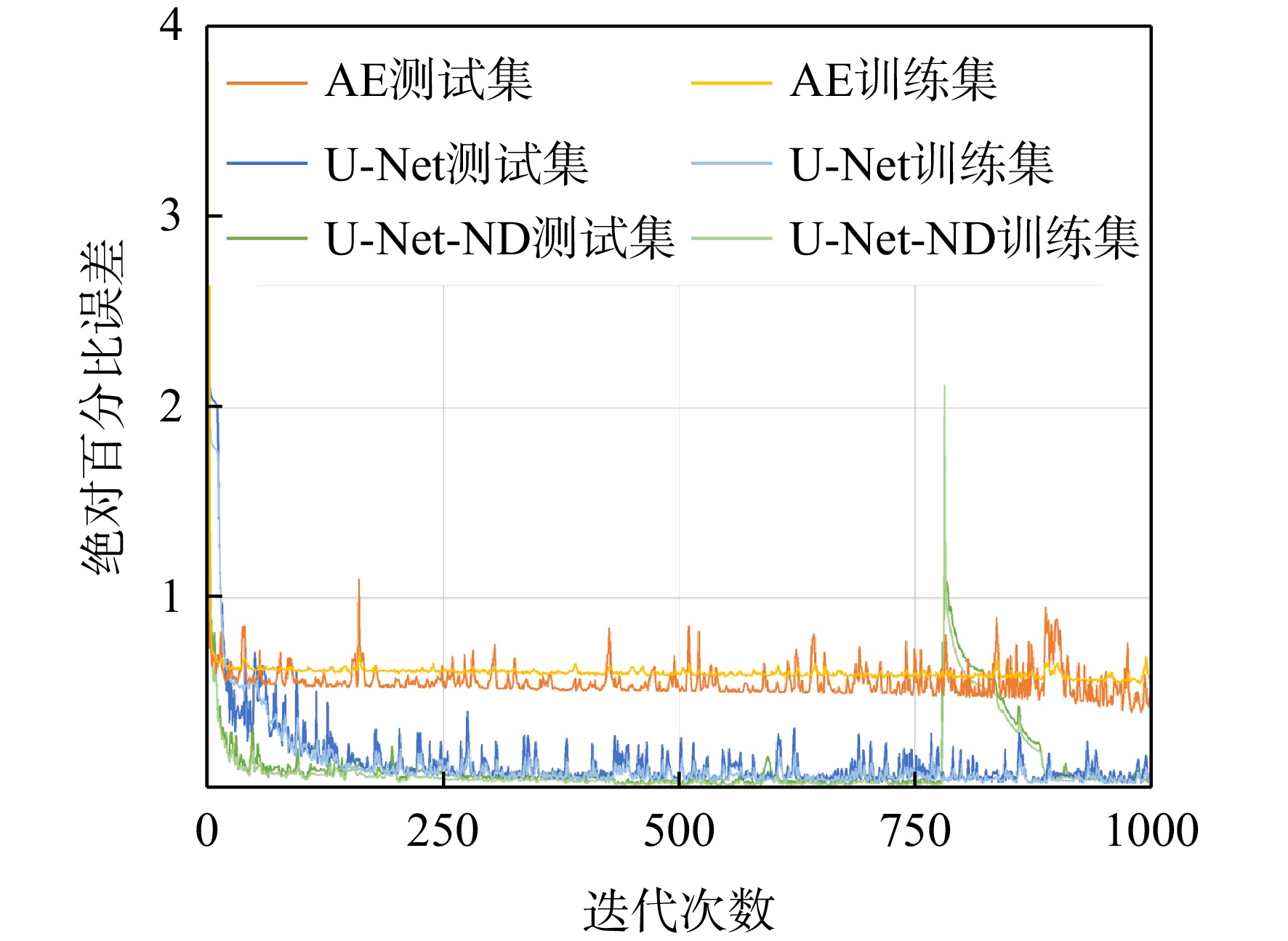
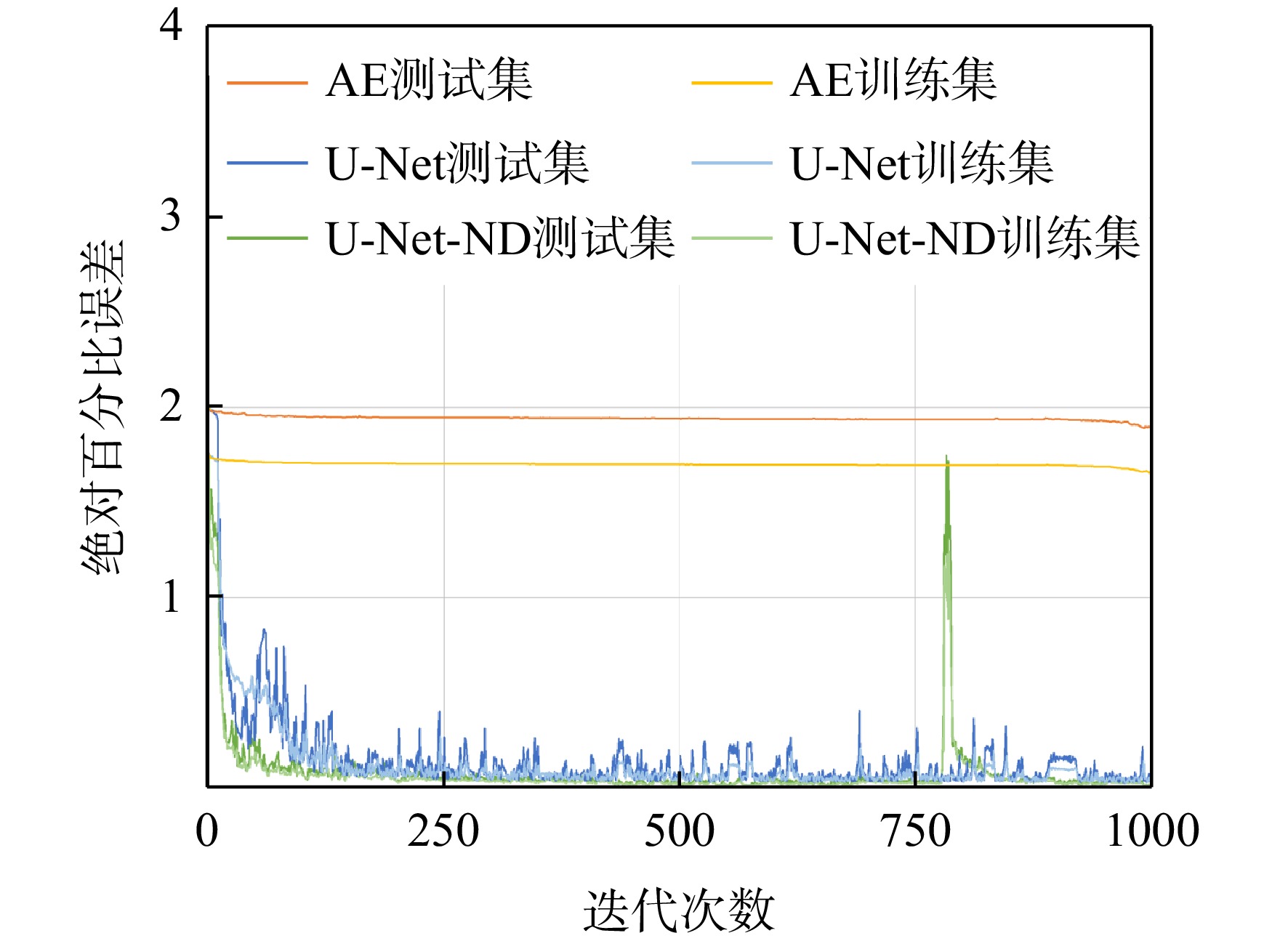
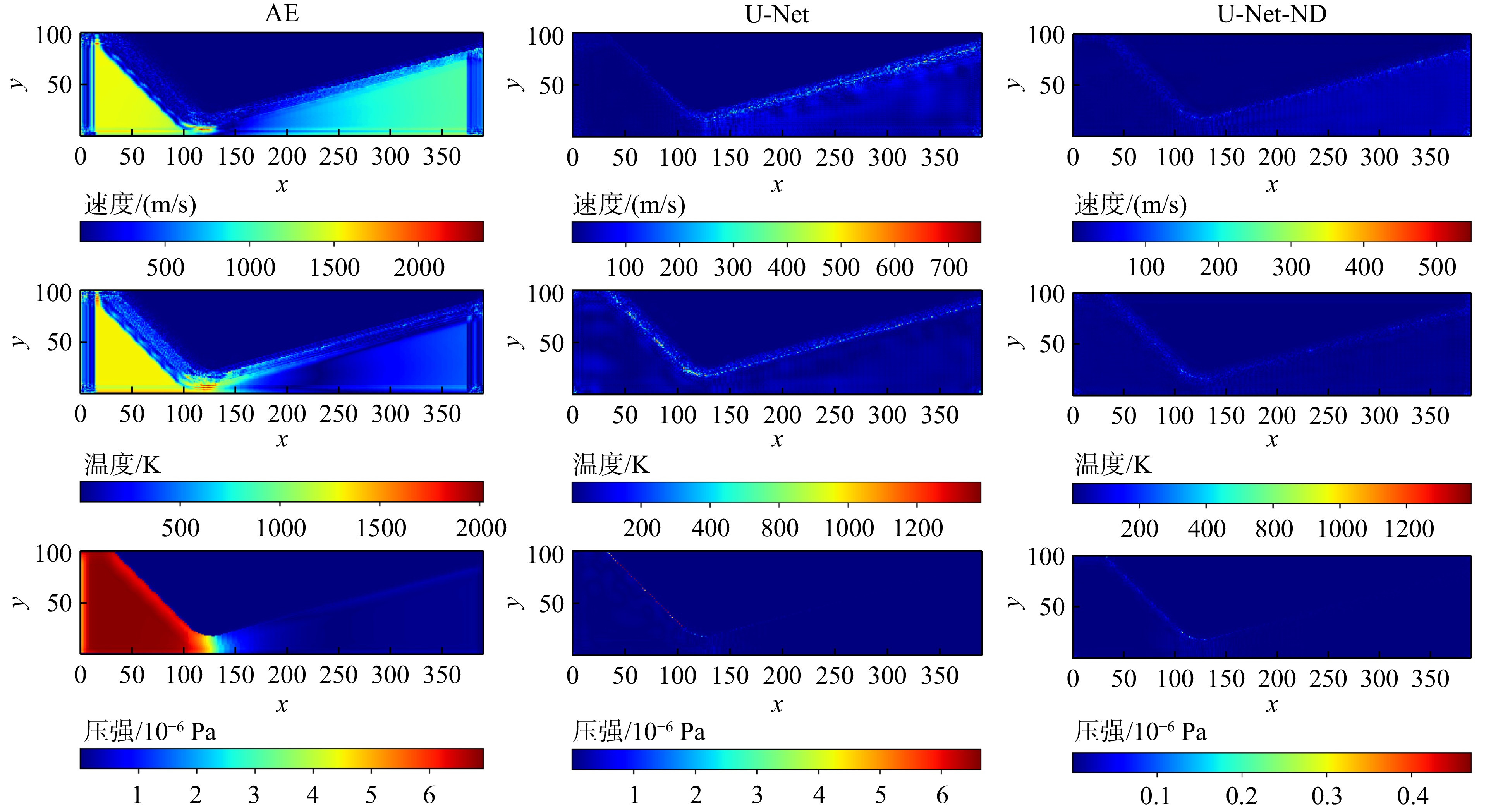
图 12 不同模型预测结果误差比较
Figure 12. Comparison of prediction results and errors of different models
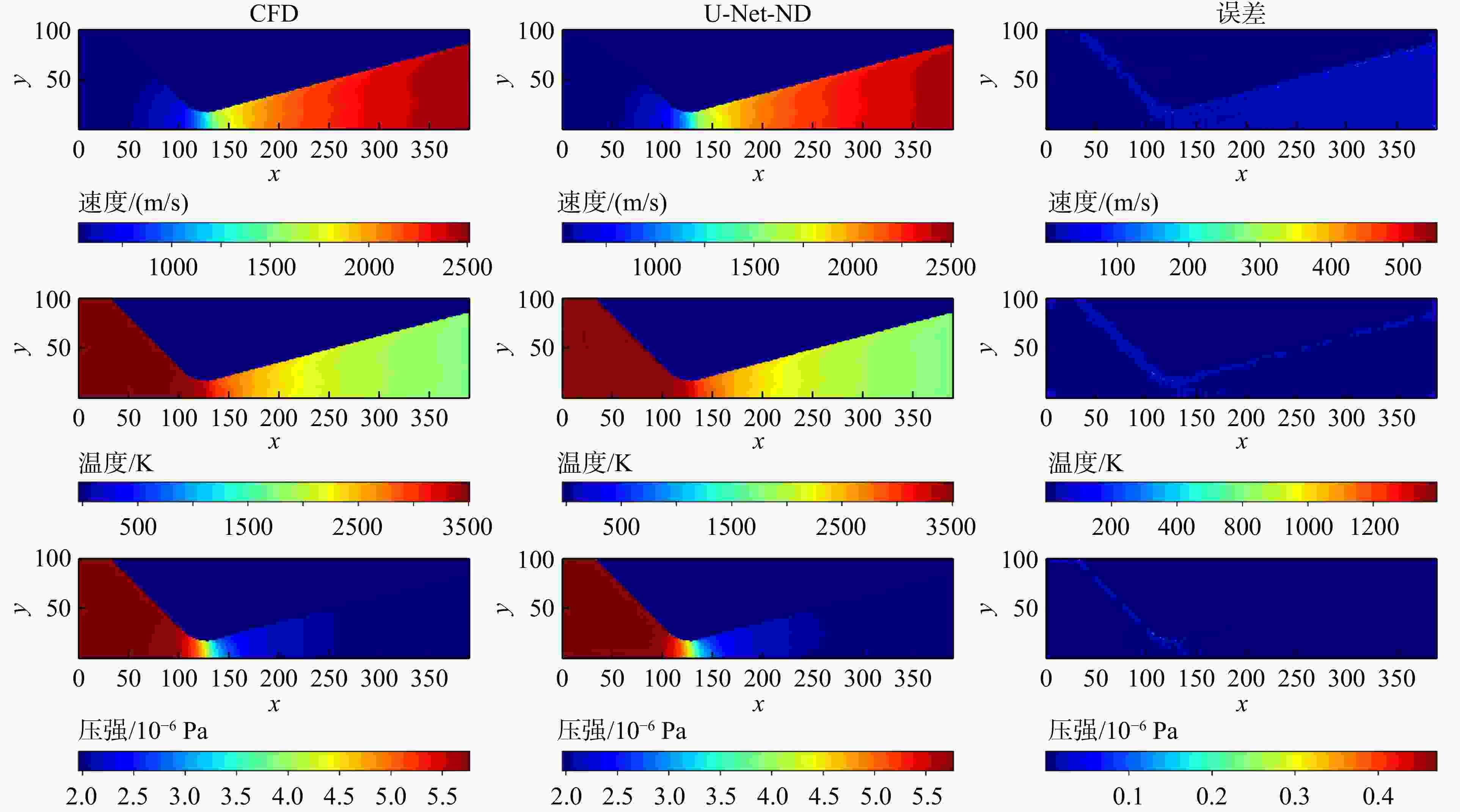
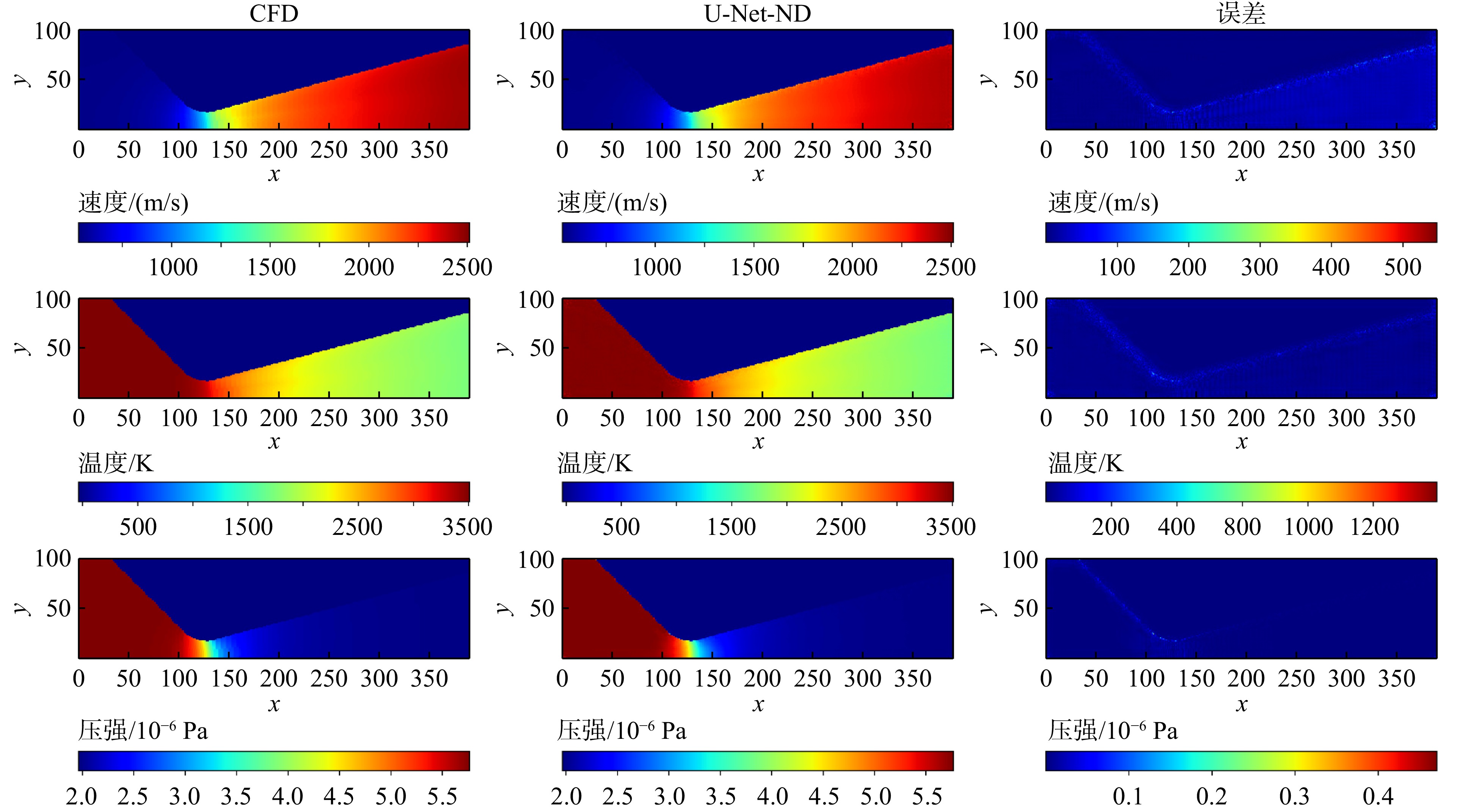
图 13 U-Net-ND预测结果和误差比较
Figure 13. Comparison of U-Net-ND flow prediction results and errors
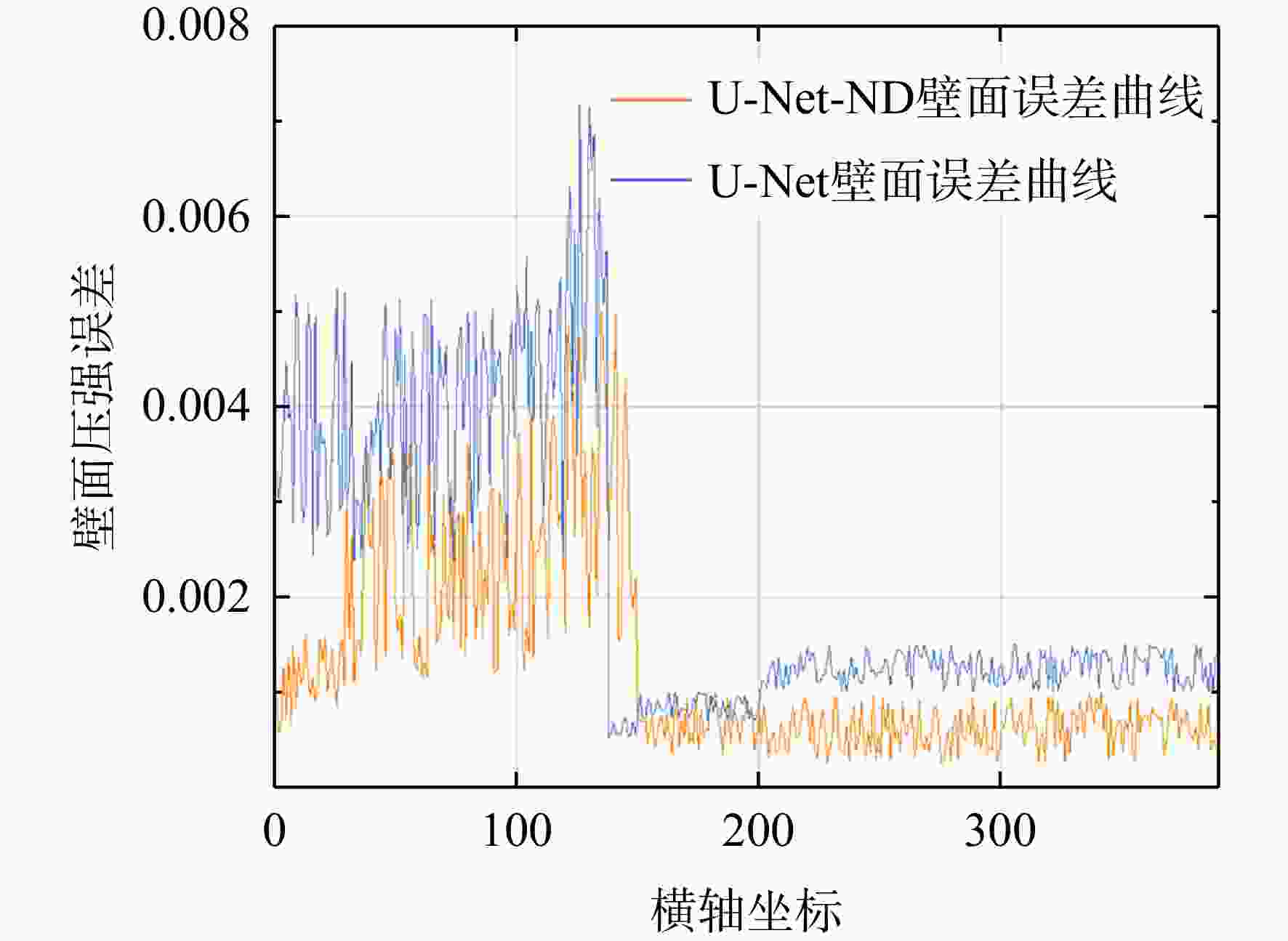
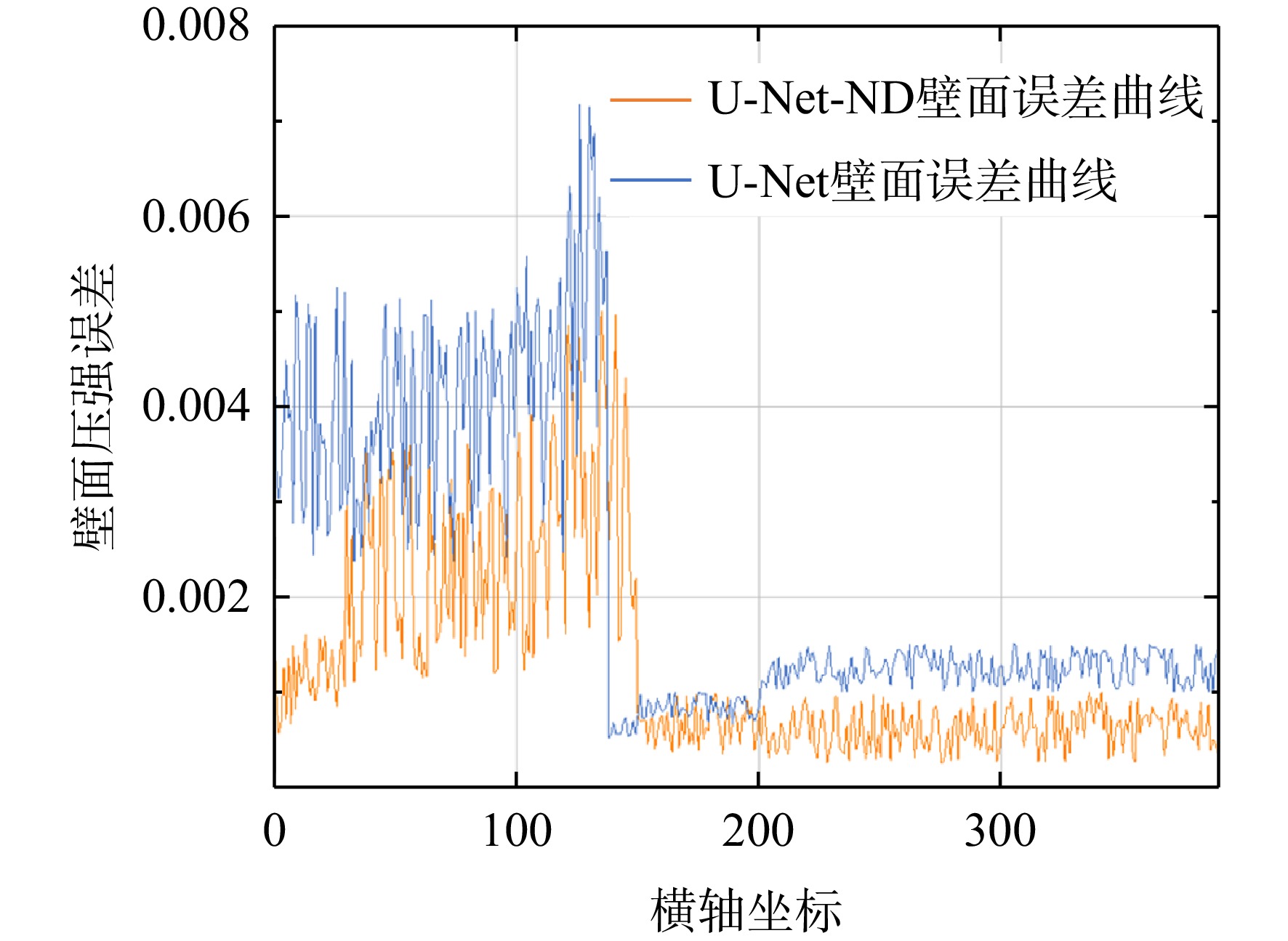
图 14 U-Net-ND和U-Net压强流场壁面预测误差对比
Figure 14. Comparison of prediction errors of U-Net-ND and U-Net pressure flow field walls
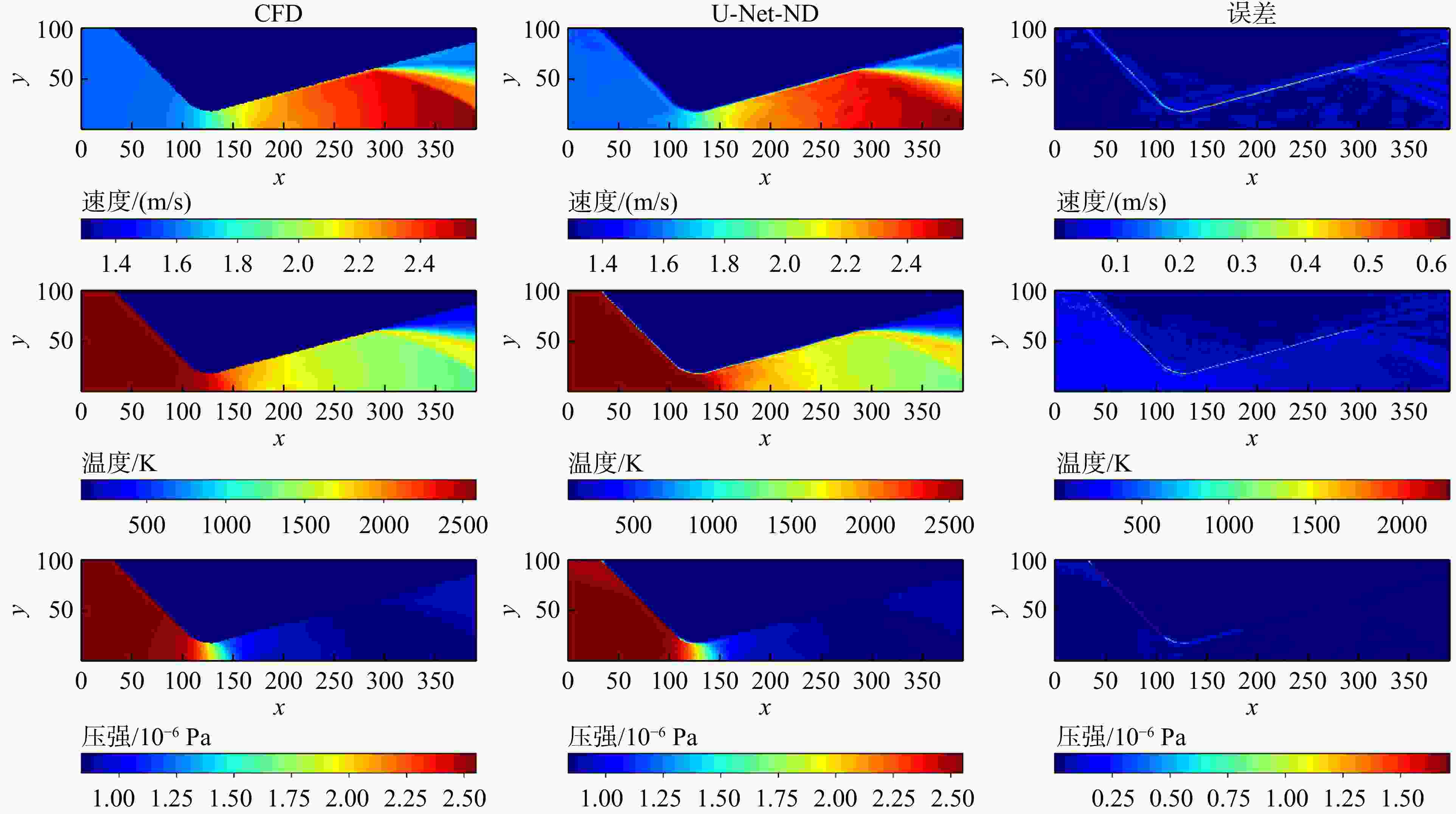
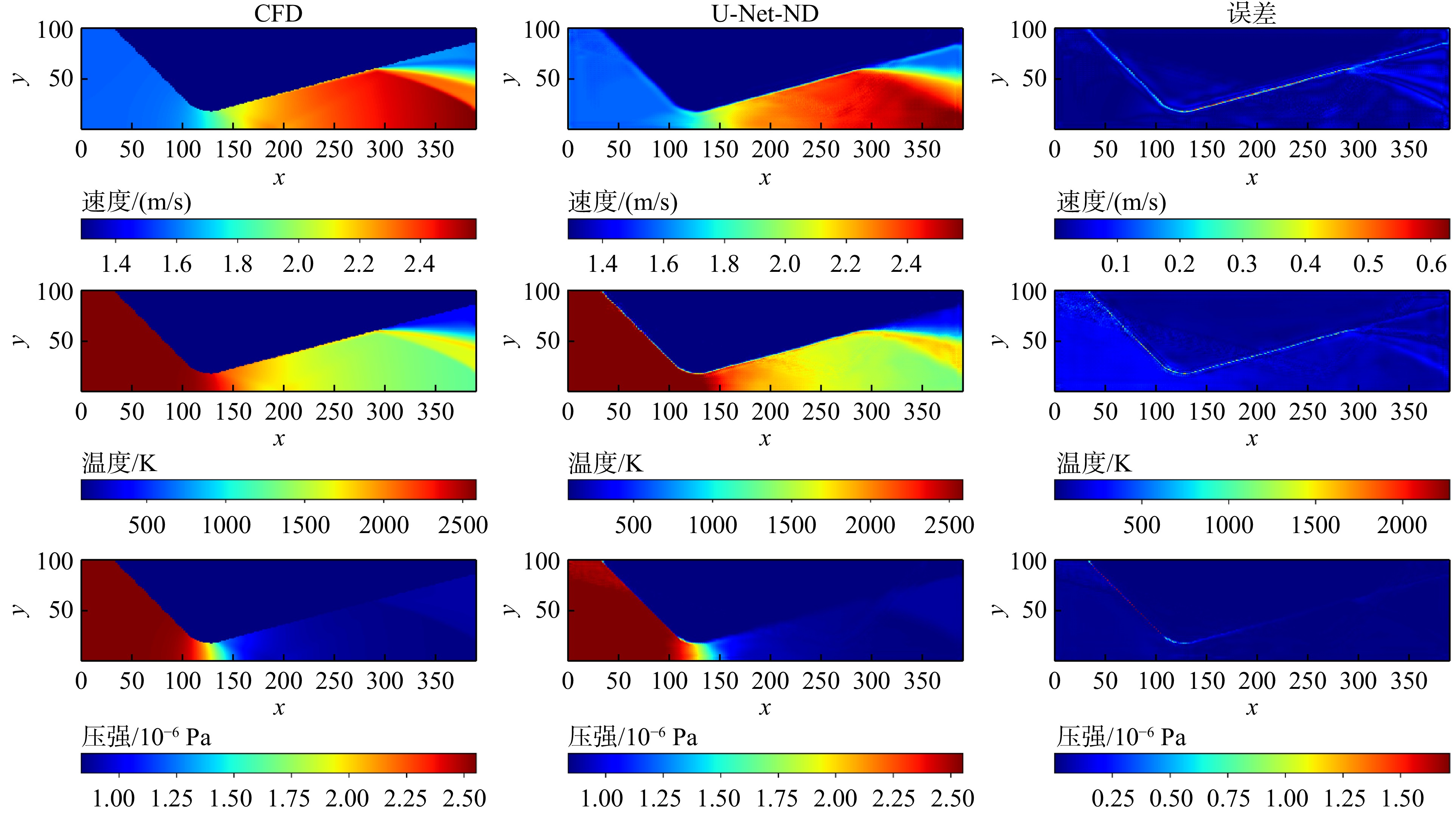
图 15 U-Net-ND流动分离预测结果和误差比较图
Figure 15. Comparison of U-Net-ND flow separation prediction results and errors
表 1 编码器参数设置
Table 1. Encoder block parameter settings
模型结构 卷积核 数量 步长 零填充 激活函数 编码器 5×5 8 1 2 ReLu 5×5 8 1 2 5×5 16 1 2 ReLu 5×5 16 1 2 5×5 32 1 2 ReLu 5×5 32 1 2 5×5 32 1 2 ReLu 5×5 32 1 2  下载: 导出CSV
表 2 解码器参数设置
Table 2. Decoder block parameter settings
模型结构 卷积核 数量 步长 零填充 激活函数 解码器 5×5 32 1 2 ReLu 5×5 32 1 2 5×5 32 1 2 ReLu 5×5 32 1 2 5×5 16 1 2 ReLu 5×5 16 1 2 5×5 8 1 2 ReLu 5×5 8 1 2
下载: 导出CSV
表 3 不同模型误差比较
Table 3. Comparison of APE among different models
% 网络模型 压力场误差 温度场误差 速度场误差 AE 34.6 37.8 31.8 U-Net 3.4 9.5 14.2 U-Net-ND 1.6 4.3 2.7
下载: 导出CSV
表 4 比冲误差表
Table 4. Specific impulse error
压强/
MPa温度/
K仿真比冲/
(N·s/kg)神经网络预测
比冲/(N·s/kg)误差/
%7.8 3500 2360.4 2337.6 0.9 9.0 3400 2284.5 2298.6 0.6 10.0 3500 2450.8 2340.9 1.2
下载: 导出CSV
表 5 批量仿真消耗时间对比
Table 5. Batch simulation time consumption comparison
仿真数量 CFD仿真
时间/s深度学习
仿真时间/s1 119 17 10 1190 69 100 11900 162
下载: 导出CSV
-
[1] 何景轩, 任全彬, 董新刚, 等. 固体动力设计中的几个主要关键基础问题[J]. 固体火箭技术, 2022(2): 181-188. He Jingxuan, Ren Quanbin, Dong Xingang, et al. Some fundamental problems on design of solid propulsion systems[J]. Journal of Solid Rocket Technology, 2022(2): 181-188. (in ChineseHe Jingxuan, Ren Quanbin, Dong Xingang, et al. Some fundamental problems on design of solid propulsion systems[J]. Journal of Solid Rocket Technology, 2022(2): 181-188. (in Chinese) [2] 代无劫, 于勇. 基于RBF代理优化的固体火箭发动机喷管型面设计[J]. 固体火箭技术, 2024, 47(2): 188-198. Dai Wujie, Yu Yong. Nozzle profile design of solid rocket motor based on RBF proxy optimization[J]. Journal of Solid Rocket Technology, 2024, 47(2): 188-198. (in Chinese doi: 10.7673/j.issn.1006-2793.2024.02.006Dai Wujie, Yu Yong. Nozzle profile design of solid rocket motor based on RBF proxy optimization[J]. Journal of Solid Rocket Technology, 2024, 47(2): 188-198. (in Chinese) doi: 10.7673/j.issn.1006-2793.2024.02.006 [3] 刘锐, 陈雄, 周长省, 等. 复合结构喷管烧蚀形貌的测定及其对流场的影响[J]. 航空学报, 2015, 36(9): 2958-2967. Liu Rui, Chen Xiong, Zhou Changsheng, et al. Measurement of erosion morphology in a composite structure nozzle and its influence on flow field[J]. Acta Aeronautica et Astronautica Sinica, 2015, 36(9): 2958-2967. (in ChineseLiu Rui, Chen Xiong, Zhou Changsheng, et al. Measurement of erosion morphology in a composite structure nozzle and its influence on flow field[J]. Acta Aeronautica et Astronautica Sinica, 2015, 36(9): 2958-2967. (in Chinese) [4] 何振川, 李映坤, 武炎, 等. 多脉冲固体火箭发动机长尾喷管多层热防护结构传热烧蚀特性[J]. 推进技术, 2025, 46(2): 2403009. He Zhenchuan, Li Yingkun, Wu Yan, et al. Heat transfer and ablation characteristics of multi-layer thermal protection structure for long tail nozzle of multi pulse solid rocket motor[J]. Journal of Propulsion Technology, 2025, 46(2): 2403009. (in Chinese doi: 10.13675/j.cnki.tjjs.2403009He Zhenchuan, Li Yingkun, Wu Yan, et al. Heat transfer and ablation characteristics of multi-layer thermal protection structure for long tail nozzle of multi pulse solid rocket motor[J]. Journal of Propulsion Technology, 2025, 46(2): 2403009. (in Chinese) doi: 10.13675/j.cnki.tjjs.2403009 [5] Nadda M, Shah S K, Roy S, et al. CFD-based deep neural networks (DNN) model for predicting the hydrodynamics of fluidized beds[J]. Digital Chemical Engineering, 2023, 8: 100113. doi: 10.1016/j.dche.2023.100113 [6] 汪淼. 面向并行CFD迭代计算的网格划分关键技术研究[D]. 长沙: 国防科技大学, 2017. Wang Miao. Mesh partitioning for parallel iterative computation in CFD simulations[D]. Changsha: National University of Defense Technology, 2017. (in ChineseWang Miao. Mesh partitioning for parallel iterative computation in CFD simulations[D]. Changsha: National University of Defense Technology, 2017. (in Chinese) [7] Fujii K. Progress and future prospects of CFD in aerospace: Wind tunnel and beyond[J]. Progress in Aerospace Sciences, 2005, 41(6): 455-470. doi: 10.1016/j.paerosci.2005.09.001 [8] Zhong Shihao, Zhang Zhishuang, Zheng Mingyuan. A review: application of machine learning in flow field prediction in aeroengine engineering[J]. Advances in Engineering Innovation, 2024, 12(1): 12-26. doi: 10.54254/2977-3903/12/2024123 [9] 谢晨月, 袁泽龙, 王建春, 等. 基于人工神经网络的湍流大涡模拟方法[J]. 力学学报, 2021, 53(1): 1-16. Xie Chenyue, Yuan Zelong, Wang Jianchun, et al. Artificial neural network-based subgrid-scale models for large-eddy simulation of turbulence[J]. Chinese Journal of Theoretical and Applied Mechanics, 2021, 53(1): 1-16. (in ChineseXie Chenyue, Yuan Zelong, Wang Jianchun, et al. Artificial neural network-based subgrid-scale models for large-eddy simulation of turbulence[J]. Chinese Journal of Theoretical and Applied Mechanics, 2021, 53(1): 1-16. (in Chinese) [10] 张帆, 张恒, 李卓越, 等. 基于深度学习方法的圆柱绕流实验缺失数据重构[J]. 物理学报, 2025, 74(7): 154-166. Zhang Fan, Zhang Heng, Li Zhuoyue, et al. Reconstruction of gappy data in cylindrical flow experiments based on deep learning method[J]. Acta Physica Sinica, 2025, 74(7): 154-166. (in ChineseZhang Fan, Zhang Heng, Li Zhuoyue, et al. Reconstruction of gappy data in cylindrical flow experiments based on deep learning method[J]. Acta Physica Sinica, 2025, 74(7): 154-166. (in Chinese) [11] 杨茂桃, 梁爽, 易淼荣, 等. 基于深度神经网络的超声速隔离段湍流涡黏性系数辨识[J]. 航空动力学报, 2023, 38(2): 312-324. Yang Maotao, Liang Shuang, Yi Miaorong, et al. Identification of turbulence eddy viscosity coefficient in supersonic isolation section based on deep neural network[J]. Journal of Aerospace Power, 2023, 38(2): 312-324. (in Chinese doi: 10.13224/j.cnki.jasp.20220168Yang Maotao, Liang Shuang, Yi Miaorong, et al. Identification of turbulence eddy viscosity coefficient in supersonic isolation section based on deep neural network[J]. Journal of Aerospace Power, 2023, 38(2): 312-324. (in Chinese) doi: 10.13224/j.cnki.jasp.20220168 [12] Sarghini F, De Felice G, Santini S. Neural networks based subgrid scale modeling in large eddy simulations[J]. Computers & Fluids, 2003, 32(1): 97-108. doi: 10.1016/S0045-7930(01)00098-6 [13] Duru C, Alemdar H, Baran Ö U. CNNFOIL: convolutional encoder decoder modeling for pressure fields around airfoils[J]. Neural Computing and Applications, 2021, 33(12): 6835-6849. doi: 10.1007/s00521-020-05461-x [14] Zhou Jianbo, Zhang Rui, Chen Lyu. Prediction of flow field over airfoils based on transformer neural network[J]. International Journal of Computational Fluid Dynamics, 2023, 37(2): 167-180. doi: 10.1080/10618562.2023.2259806 [15] Song Junyong, Wang Lei, Xin Zhiqiang, et al. Wake field prediction of a wind farm based on a physics-informed neural network with different spatiotemporal prediction performance improvement strategies[J]. Theoretical and Applied Mechanics Letters, 2025, 15(2): 100577. doi: 10.1016/j.taml.2025.100577 [16] Fukami K, Maulik R, Ramachandra N, et al. Global field reconstruction from sparse sensors with Voronoi tessellation-assisted deep learning[J]. Nature Machine Intelligence, 2021, 3(11): 945-951. doi: 10.1038/s42256-021-00402-2 [17] Wang Tongsheng, Xi Guang, Sun Zhongguo, et al. The prediction of external flow field and hydrodynamic force with limited data using deep neural network[J]. Journal of Hydrodynamics, 2023, 35(3): 549-570. doi: 10.1007/s42241-023-0042-y [18] Linese D J, Stengel R F. Identification of aerodynamic coefficients using computational neural networks[J]. Journal of Guidance, Control, and Dynamics, 1993, 16(6): 1018-1025. doi: 10.2514/6.1992-172 [19] Yang Zhishuang, Dong Yidao, Deng Xiaogang, et al. AMGNET: multi-scale graph neural networks for flow field prediction[J]. Connection Science, 2022, 34(1): 2500-2519. doi: 10.1080/09540091.2022.2131737 [20] Wu Haizhou, Liu Xuejun, An Wei, et al. A deep learning approach for efficiently and accurately evaluating the flow field of supercritical airfoils[J]. Computers & Fluids, 2020, 198: 104393. doi: 10.1016/j.compfluid.2019.104393 [21] 闫盼盼, 牛青林, 高文强, 等. 基于卷积神经网络的地面尾喷焰流场预测[J]. 力学学报, 2024, 56(4): 980-990. Yan Panpan, Niu Qinglin, Gao Wenqiang, et al. Prediction of ground rocket exhaust plume flow field based on convolutional neural network[J]. Chinese Journal of Theoretical and Applied Mechanics, 2024, 56(4): 980-990. (in ChineseYan Panpan, Niu Qinglin, Gao Wenqiang, et al. Prediction of ground rocket exhaust plume flow field based on convolutional neural network[J]. Chinese Journal of Theoretical and Applied Mechanics, 2024, 56(4): 980-990. (in Chinese) [22] 陈海昕, 邓凯文, 李润泽. 机器学习技术在气动优化中的应用[J]. 航空学报, 2019, 40(1): 522480. Chen Haixin, Deng Kaiwen, Li Runze. Utilization of machine learning technology in aerodynamic optimization[J]. Acta Aeronautica et Astronautica Sinica, 2019, 40(1): 522480. (in ChineseChen Haixin, Deng Kaiwen, Li Runze. Utilization of machine learning technology in aerodynamic optimization[J]. Acta Aeronautica et Astronautica Sinica, 2019, 40(1): 522480. (in Chinese) [23] Azad R, Aghdam E K, Rauland A, et al. Medical image segmentation review: the success of U-net[J]. IEEE Transactions on Pattern Analysis and Machine Intelligence, 2024, 46(12): 10076-10095. doi: 10.1109/TPAMI.2024.3435571 [24] Ribeiro M D, Rehman A, Ahmed S, et al. Deep CFD: efficient steady-state laminar flow approximation with deep convolutional neural networks[EB/OL]. (2020-04-19)[2026-04-14]. https://arxiv.org/abs/2004.08826 [25] 奕建苗, 邓枫, 覃宁, 等. 快速预测跨声速流场的深度学习方法[J]. 航空学报, 2022, 43(11): 526747. Yi Jianmiao, Deng Feng, Qin Ning, et al. Fast prediction of transonic flow field using deep learning method[J]. Acta Aeronautica et Astronautica Sinica, 2022, 43(11): 526747. (in ChineseYi Jianmiao, Deng Feng, Qin Ning, et al. Fast prediction of transonic flow field using deep learning method[J]. Acta Aeronautica et Astronautica Sinica, 2022, 43(11): 526747. (in Chinese) [26] Zhou Ziheng, He Bijiao, Cai Guobiao, et al. Real-time vacuum plume flow field reconstruction during lunar landings based on deep learning[J]. Physics of Fluids, 2024, 36(7): 077112. doi: 10.1063/5.0212949 [27] Hinton E G, Salakhutdinov R R. Reducing the dimensionality of data with neural networks[J]. Science, 2006, 313(5786): 504-507. doi: 10.1126/science.1127647 [28] Ronneberger O, Fischer P, Brox T. U-Net: convolutional networks for biomedical image segmentation[C]//Medical Image Computing and Computer-Assisted Intervention-MICCAI 2015. Cham: Springer, 2015: 234-241. [29] Wang Fuyong, Zai Yun. Image segmentation and flow prediction of digital rock with U-Net network[J]. Advances in Water Resources, 2023, 172: 104384. doi: 10.1016/j.advwatres.2023.104384 [30] Angsali K, Krishnamurthy V R, Hasnain Z. Generalizability of convolutional encoder-decoder networks for aerodynamic flow-field prediction across geometric and physical-fluidic variations[J]. Journal of Mechanical Design, 2021, 143(5): 051704. doi: 10.1115/1.4048221 -

 点击查看大图

计量
- 文章访问数: 601
- HTML浏览量: 411
- PDF量: 66
- 被引次数: 0