






Study on the influence of aerodynamic and working parameters on the tangential effusion cooling combustor performance
-
摘要:
为了满足高温升高热负荷燃烧室火焰筒热防护需求,建立了应用切向发散冷却技术的单管燃烧室模型,采用热流固耦合的方法,开展了进气温度、进气压力以及油气比参数变化对火焰筒壁温及冷却性能影响的数值模拟研究。结果表明:进气温度越高,冷却气膜覆盖有效性有所降低,发散小孔内和火焰筒外壁面传热强度降低,平均综合冷效下降,壁面温度和壁温梯度有所升高。本文工况下,进气压力的变化对火焰筒近壁面流动和传热的影响较小,发散冷却有效性差别不大,在冷却空气占比仅约19%,油气比达到0.042,燃烧室温升接近
1300 K的高热负荷条件下,火焰筒平均综合冷效依然在70%~90%的较高水平,证明良好的切向发散冷却设计有很大潜力满足更高温升燃烧室的热防护需求。Abstract:To address the thermal protection requirements of combustor liners under high-temperature and elevated heat loads, the single-tube combustor model incorporating tangential effusion cooling technology was developed. A conjugate heat transfer analysis was employed to numerically investigate the influence of varying inlet temperature, inlet pressure, and fuel-air ratio on liner wall temperature and cooling performance. The results show that the higher inlet temperatures reduced cooling film coverage effectiveness, weakened heat transfer intensity within effusion holes and on the outer liner wall, decreased average integrated cooling efficiency, and increased both wall temperature and thermal gradients. Under the condition of this paper, variations in inlet pressure exhibited minimal influence on near-wall flow and heat transfer, with negligible differences in effusion cooling effectiveness. Under extreme conditions that the proportion of cooling air is only about 19%, fuel-air ratio of 0.042, and combustor temperature rise approaching
1300 K), the liner maintained a high average integrated cooling efficiency of 70%—90%, demonstrating the significant potential of optimized tangential effusion cooling designs for next-generation ultra-high-temperature combustors. -
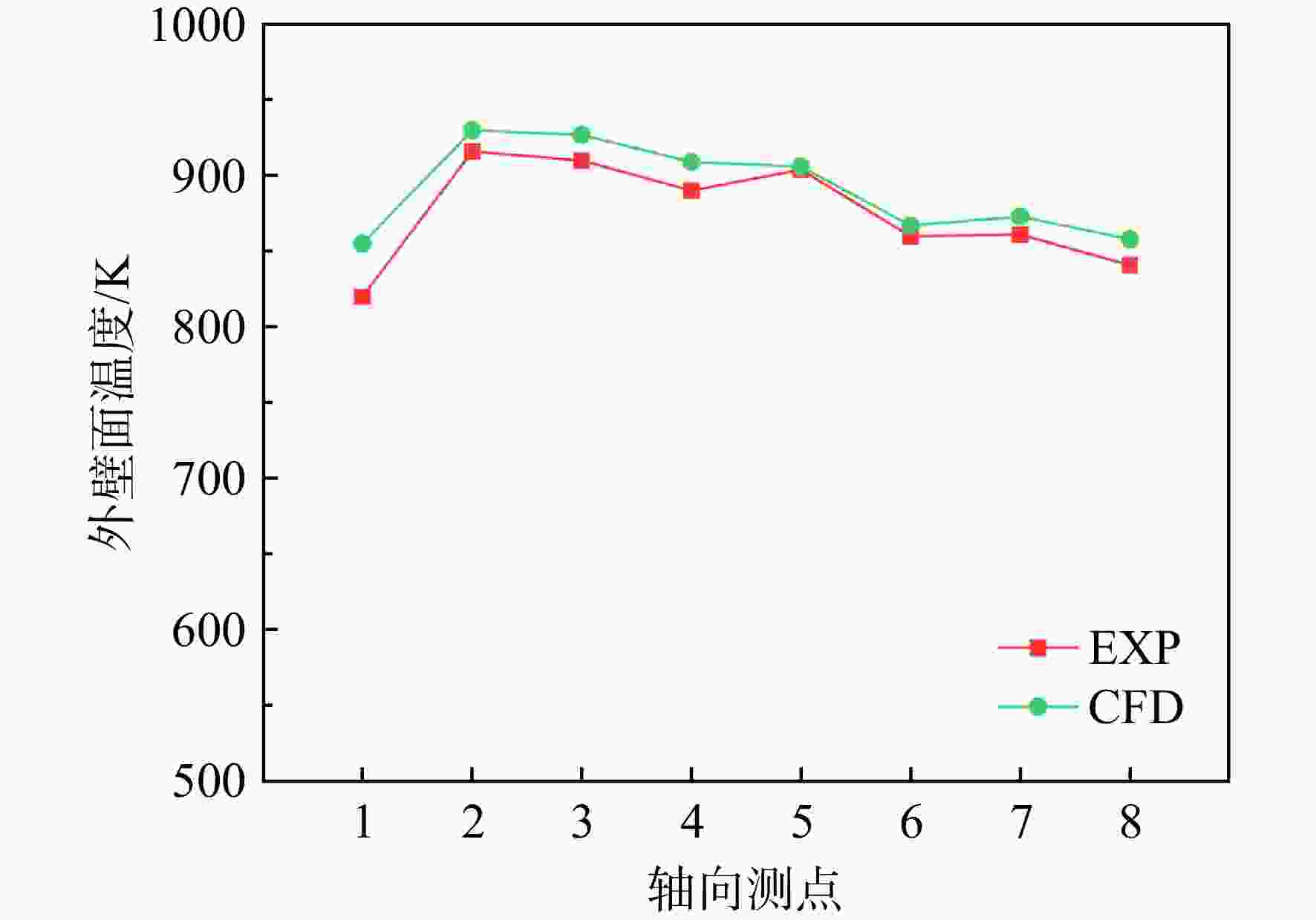
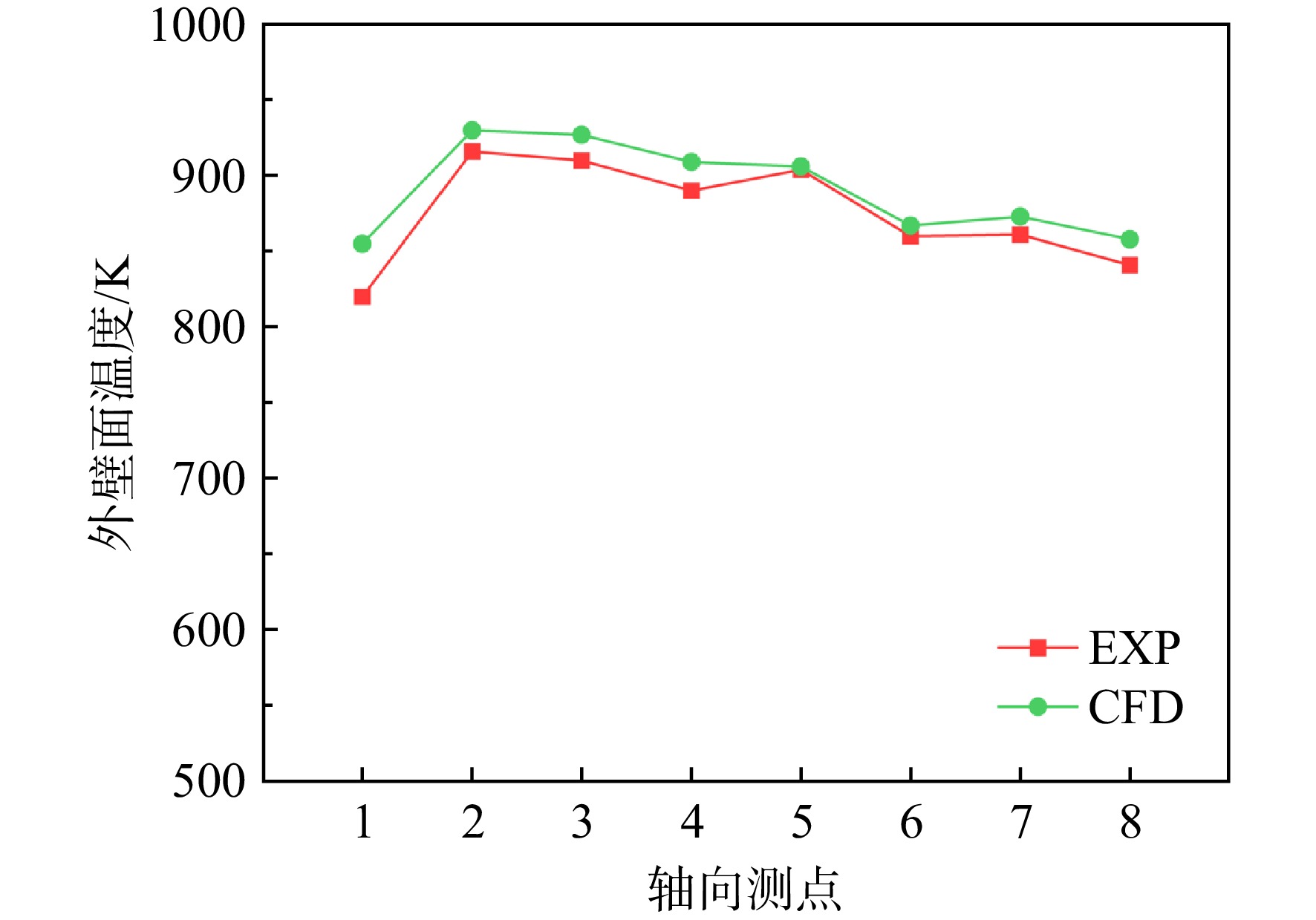
图 6 火焰筒壁温计算值与试验值对比
Figure 6. Comparison between calculated and test values of liner wall temperature
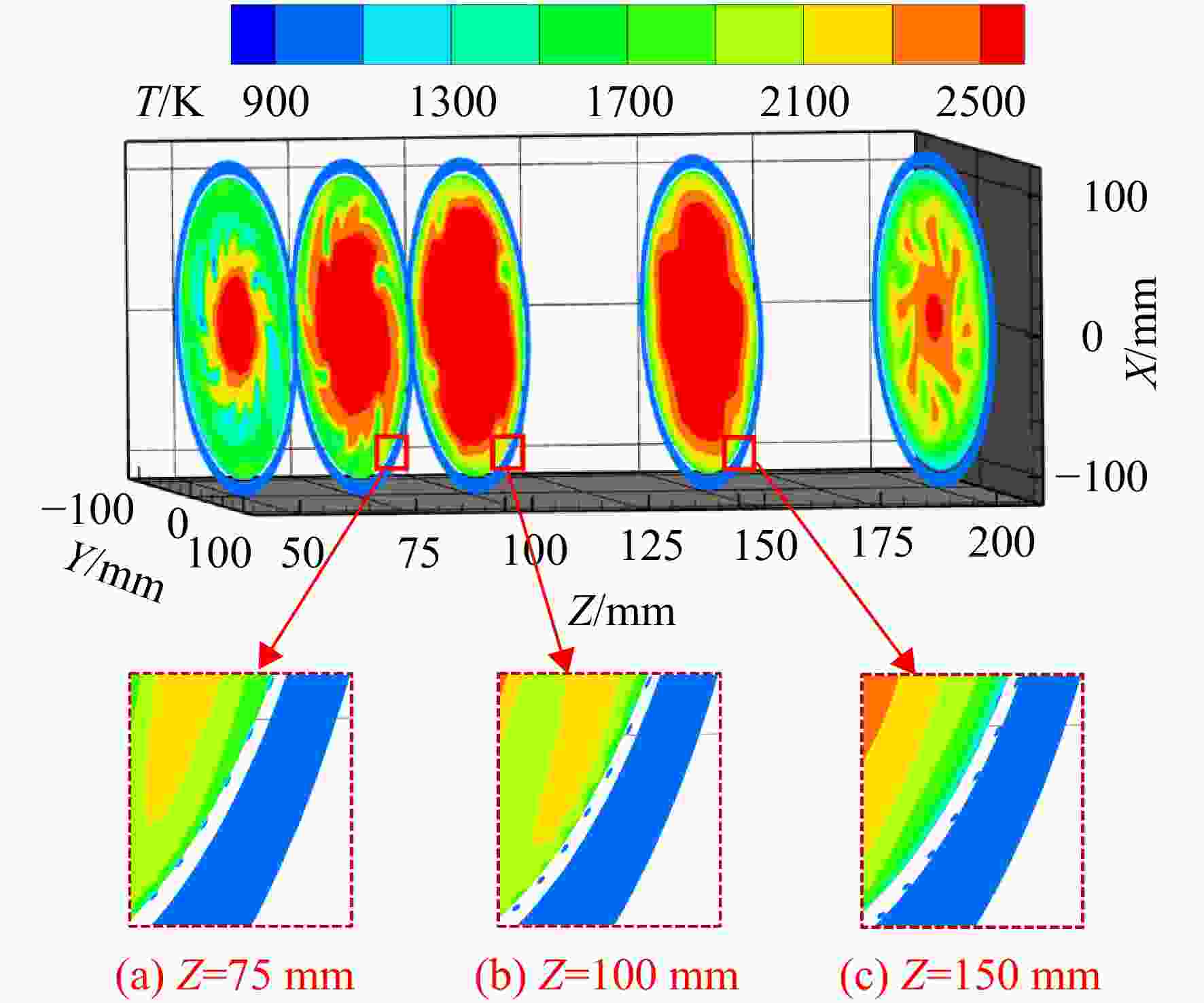
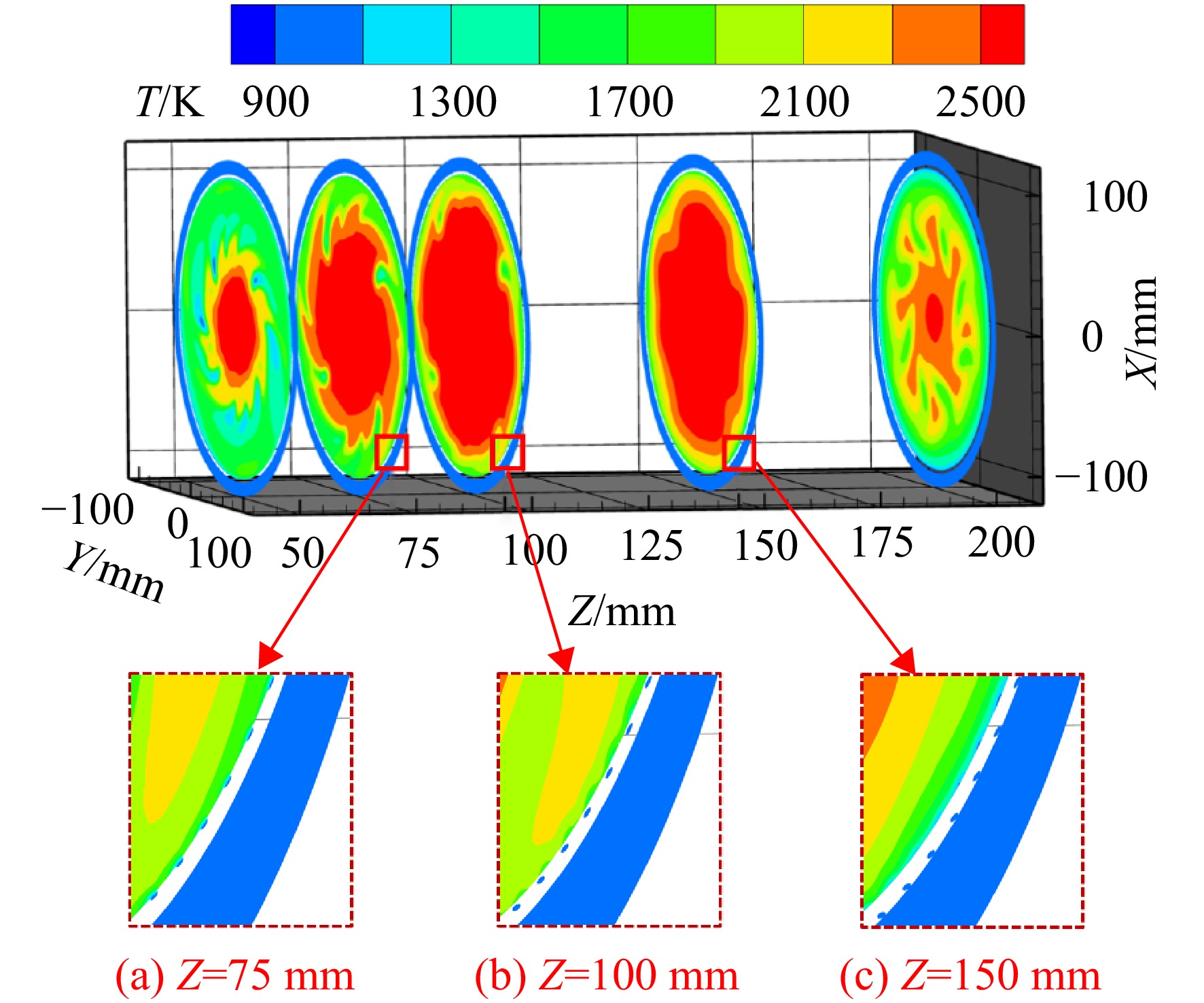
图 9 不同横截面燃烧室温度场分布
Figure 9. Temperature field distribution of combustor with different cross section
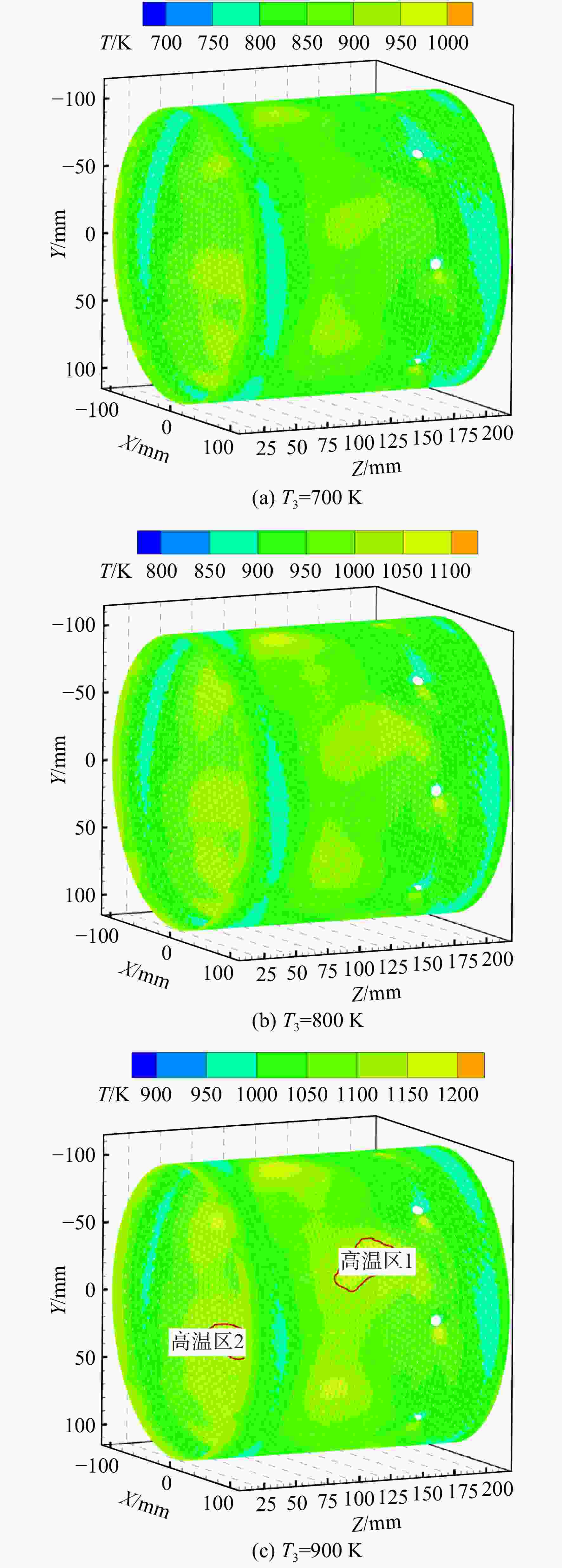
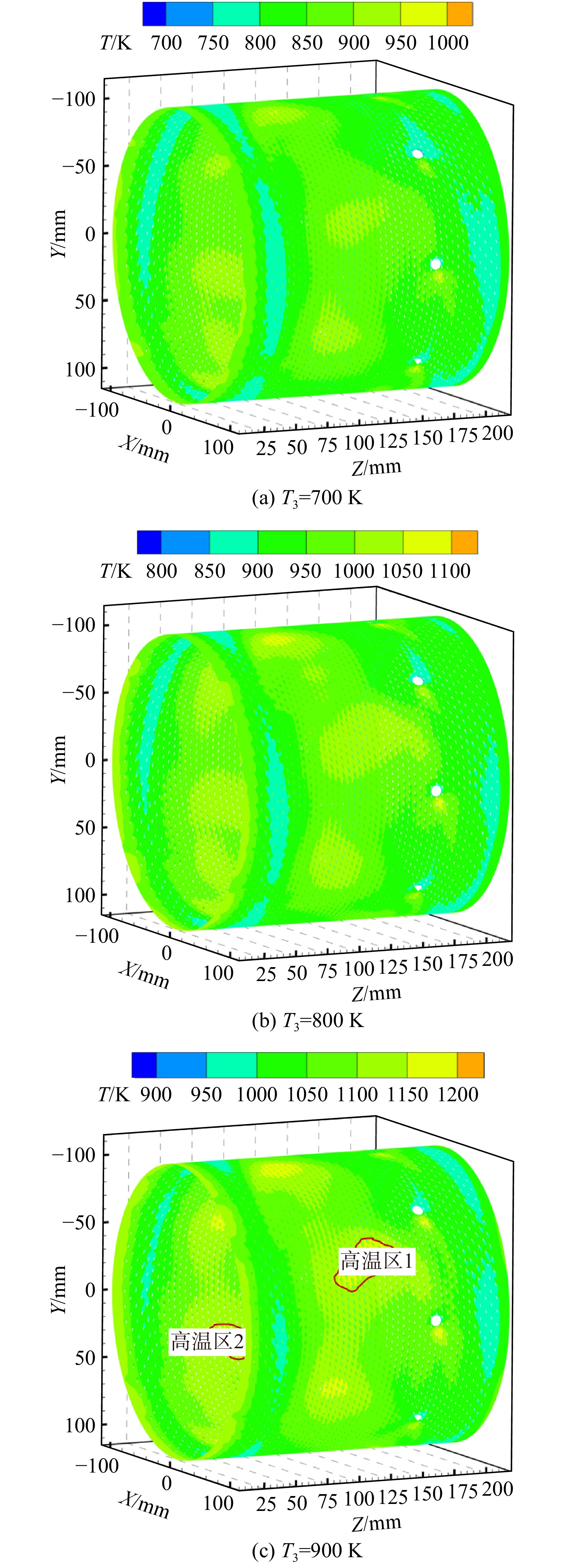
图 10 不同进气温度下火焰筒壁温分布
Figure 10. Liner wall temperature distribution of different inlet temperature cases
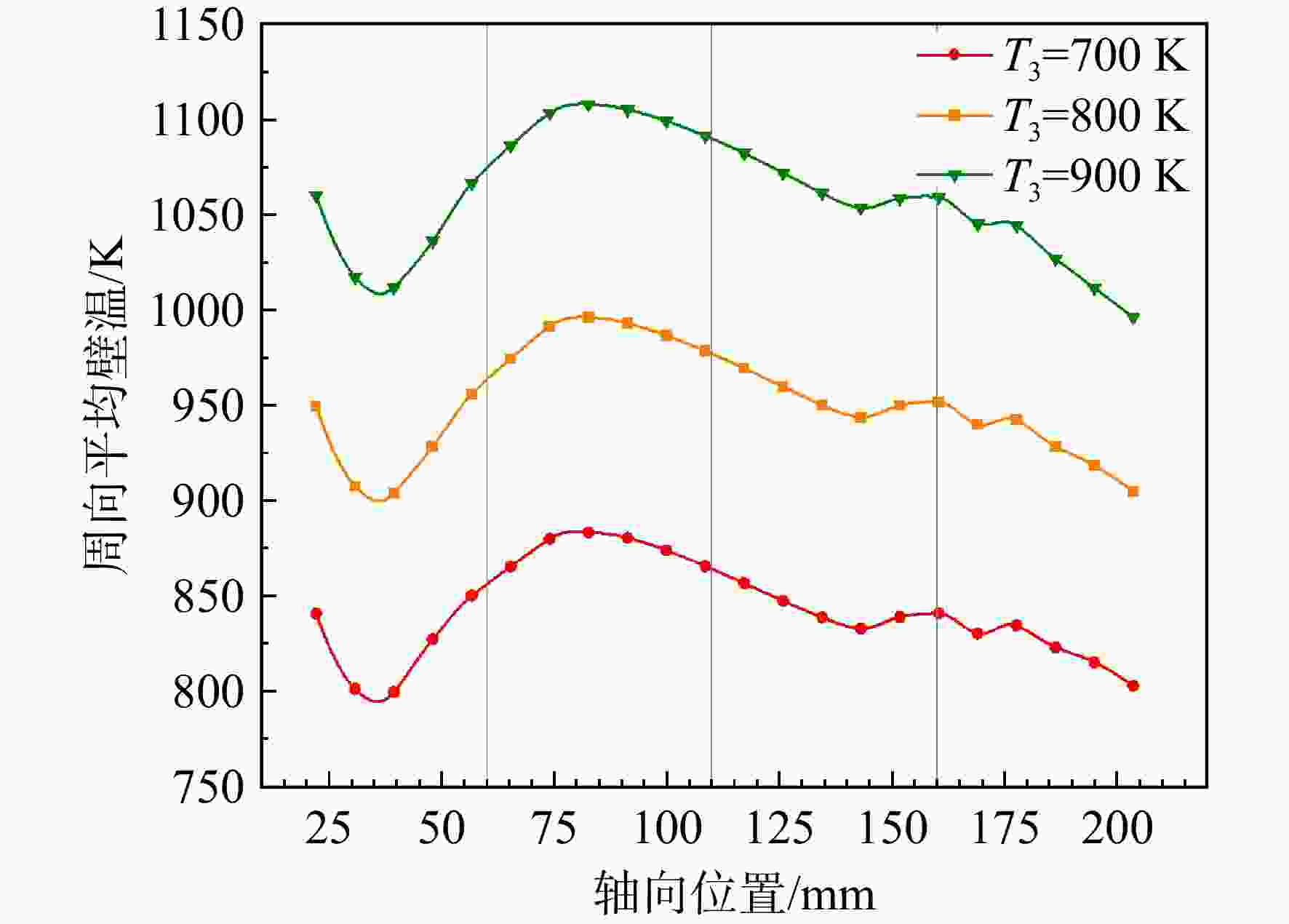
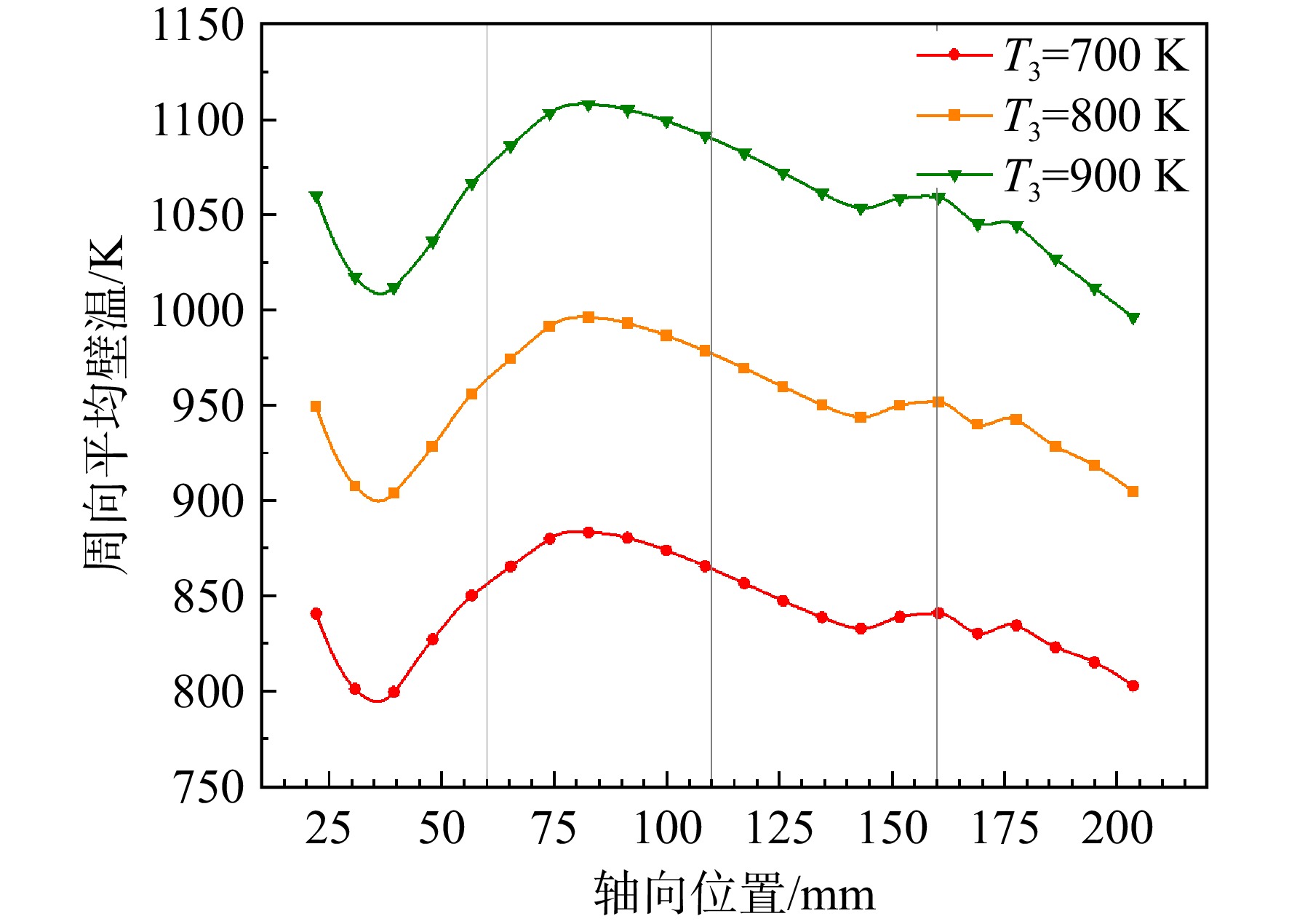
图 11 不同进气温度下沿轴向的周向平均壁温分布
Figure 11. Circumferential average wall temperature distribution along the axial direction at different inlet temperature cases
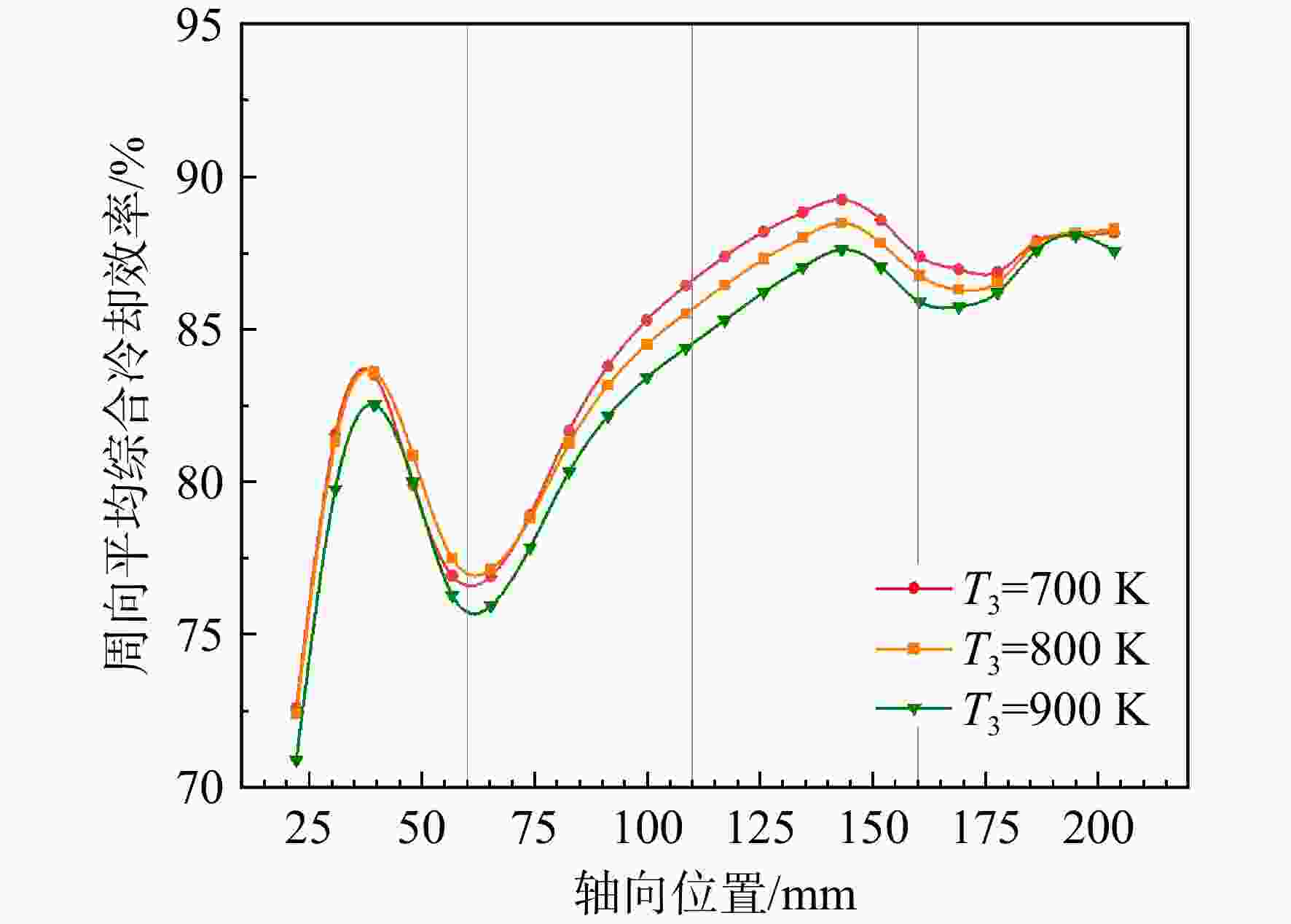
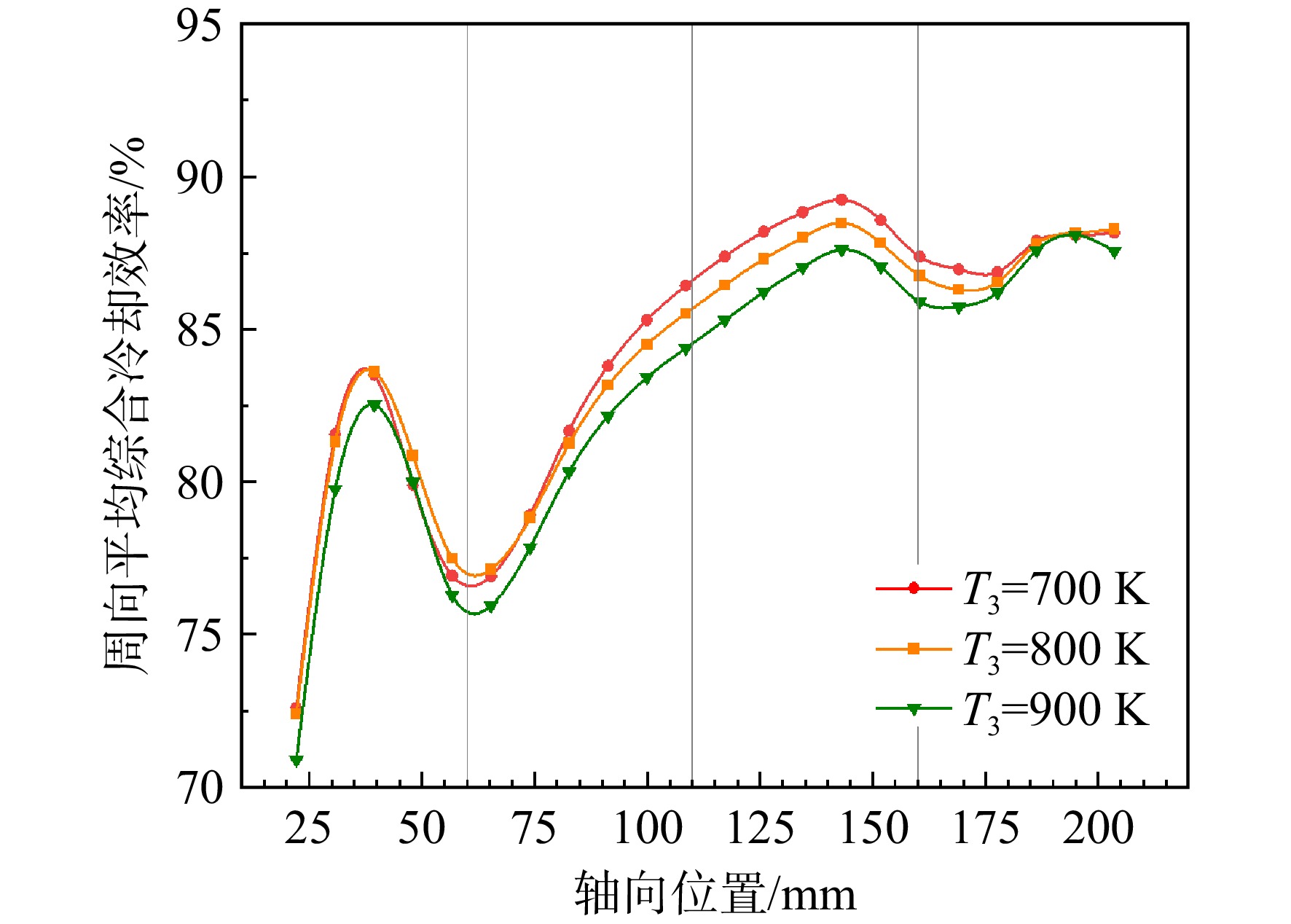
图 12 不同进气温度下火焰筒综合冷却效率对比
Figure 12. Comparison of liner overall cooling efficiency of different inlet temperature cases
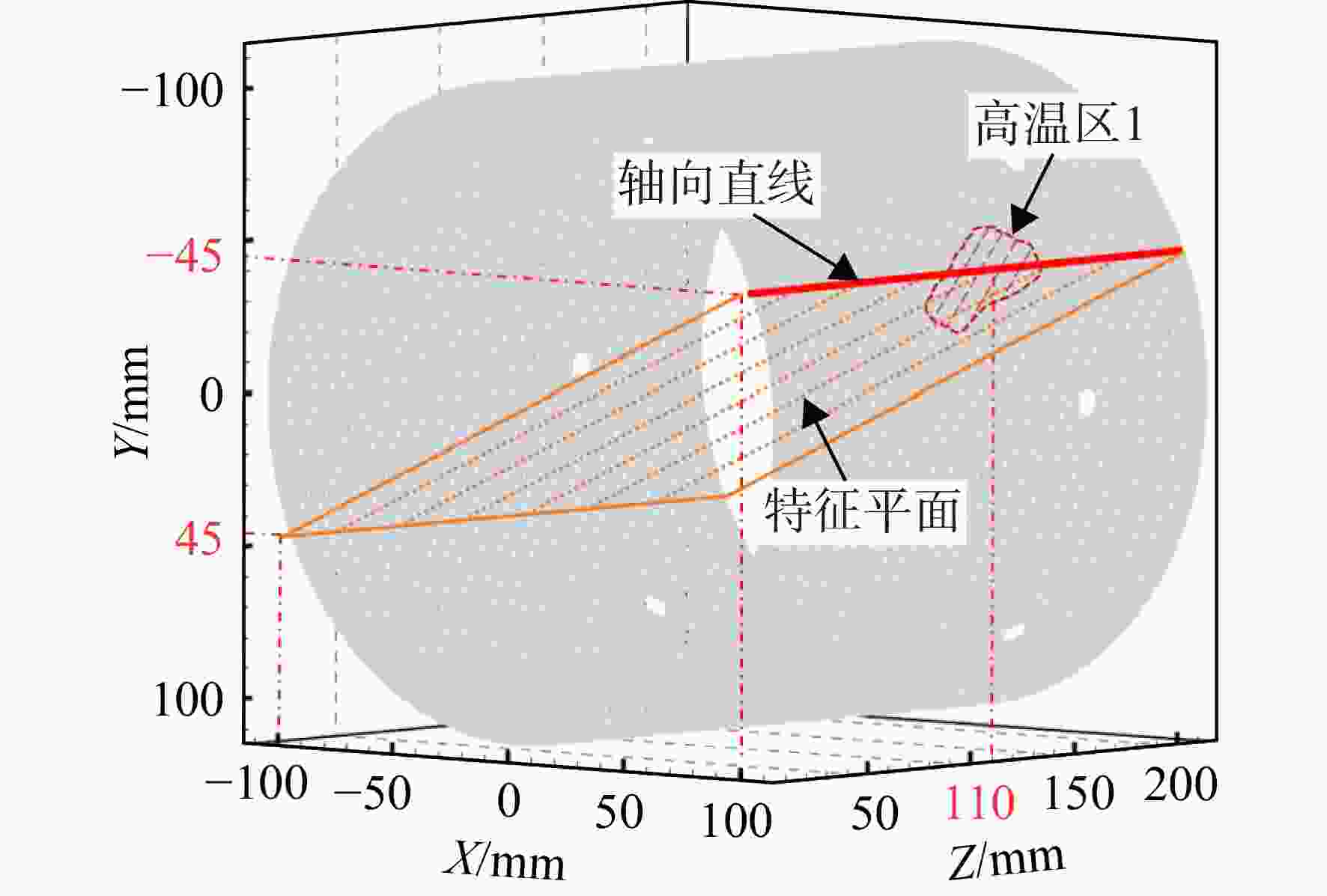
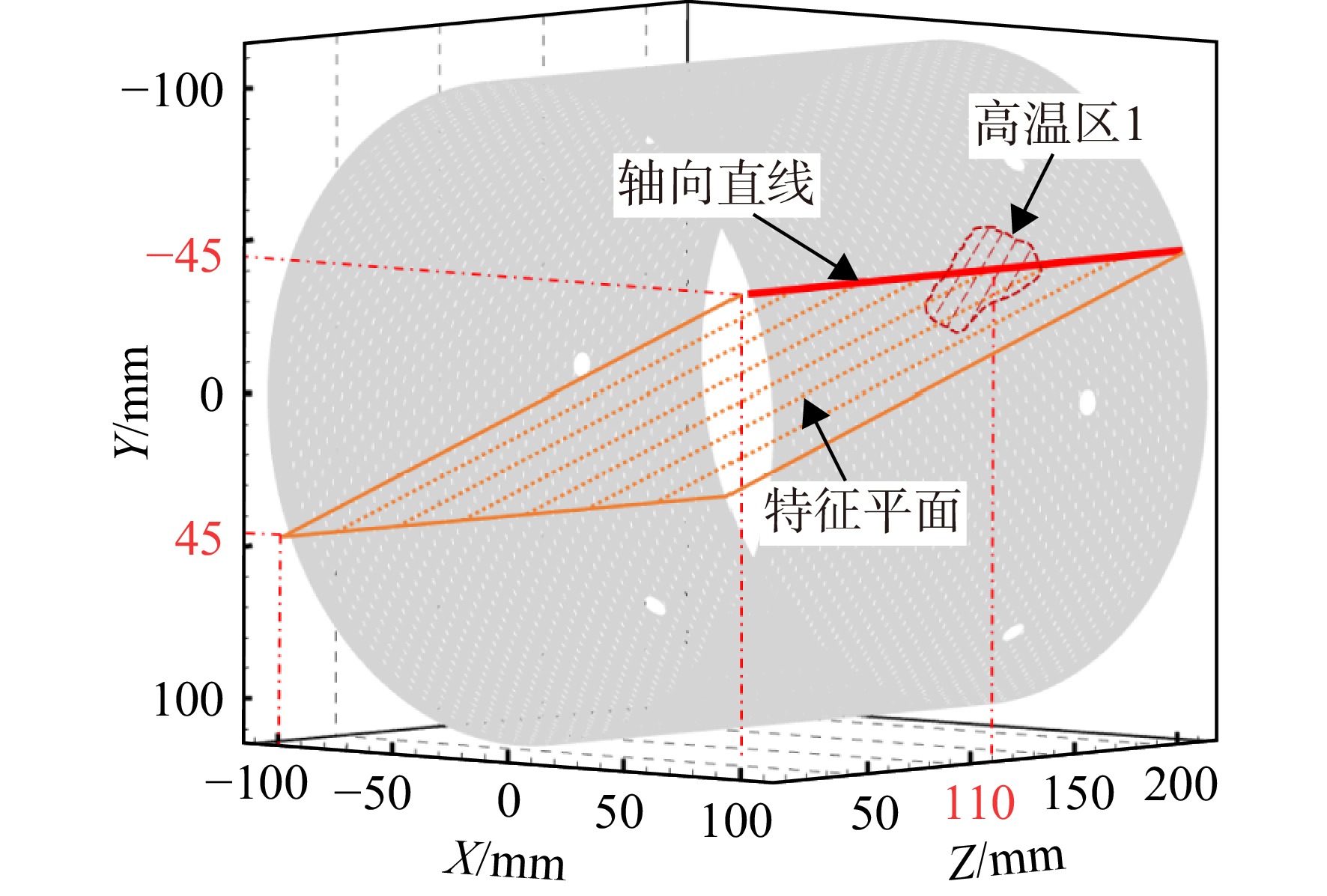
图 13 壁温梯度计算线所在位置图
Figure 13. Position diagram of wall temperature gradient calculation line
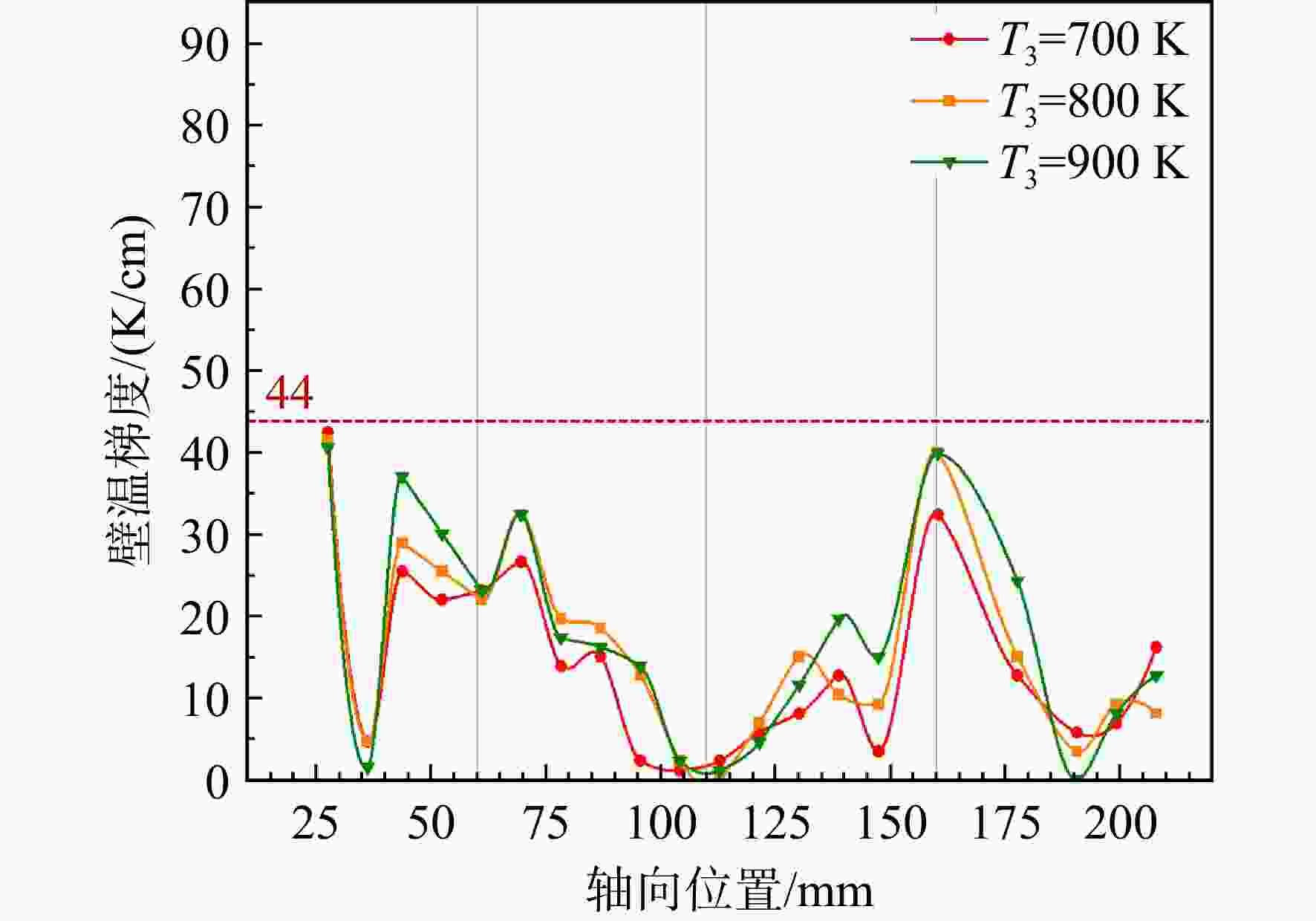
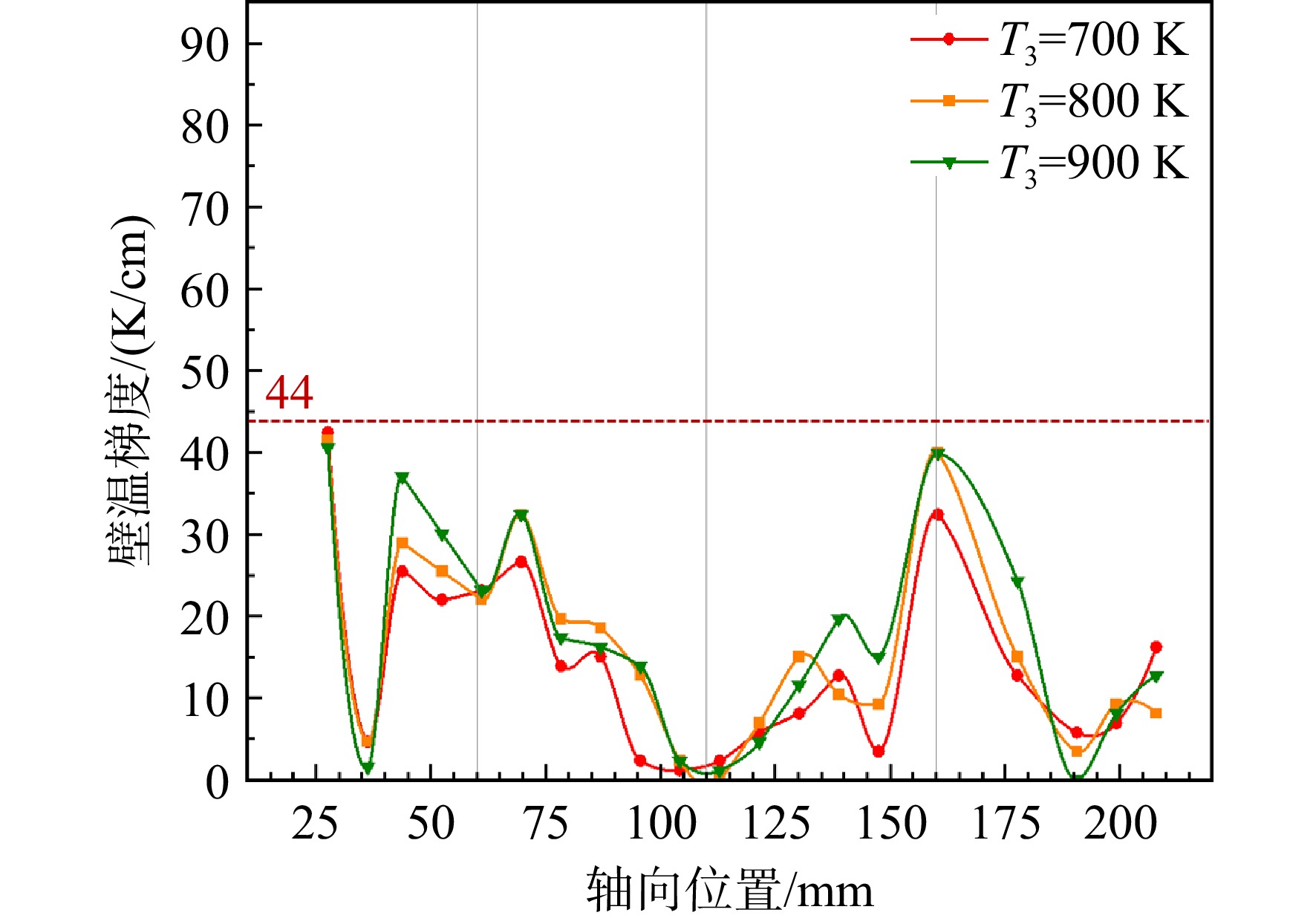
图 14 不同进气温度下壁温梯度对比
Figure 14. Wall temperature gradient of different inlet temperature cases
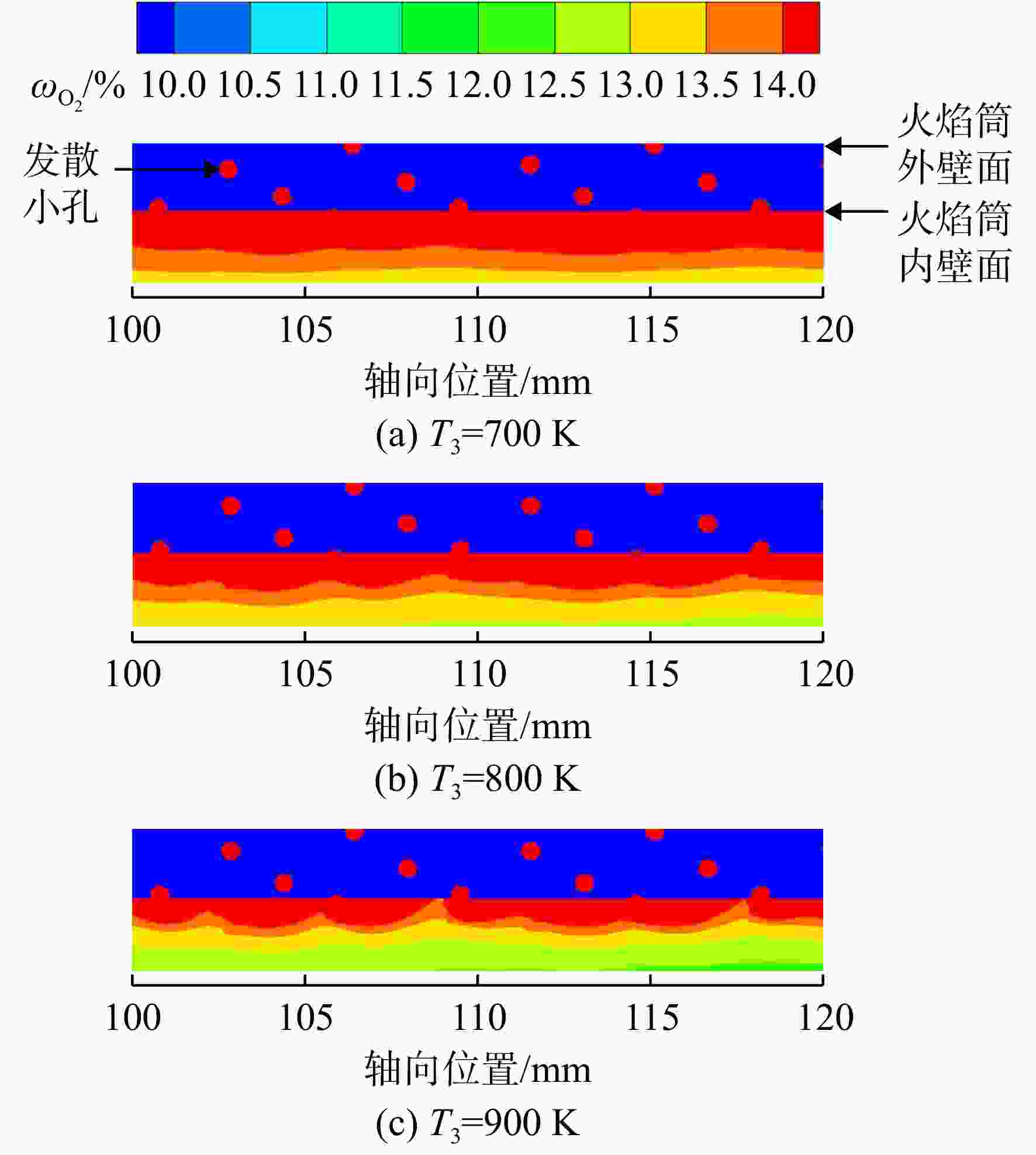
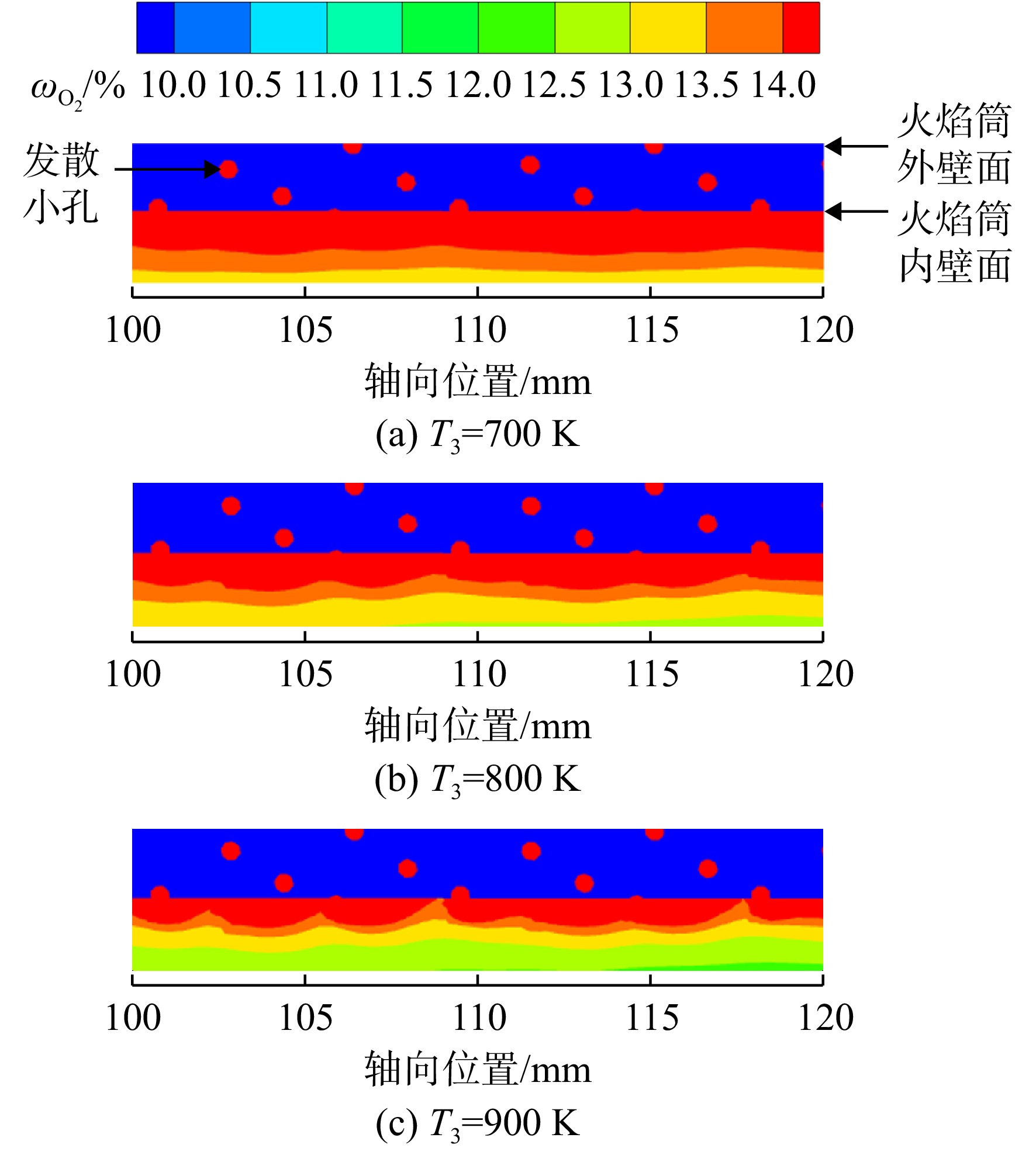
图 15 不同进气温度下近壁面氧气质量分数分布
Figure 15. Near wall oxygen mass fraction distribution of different inlet temperature cases
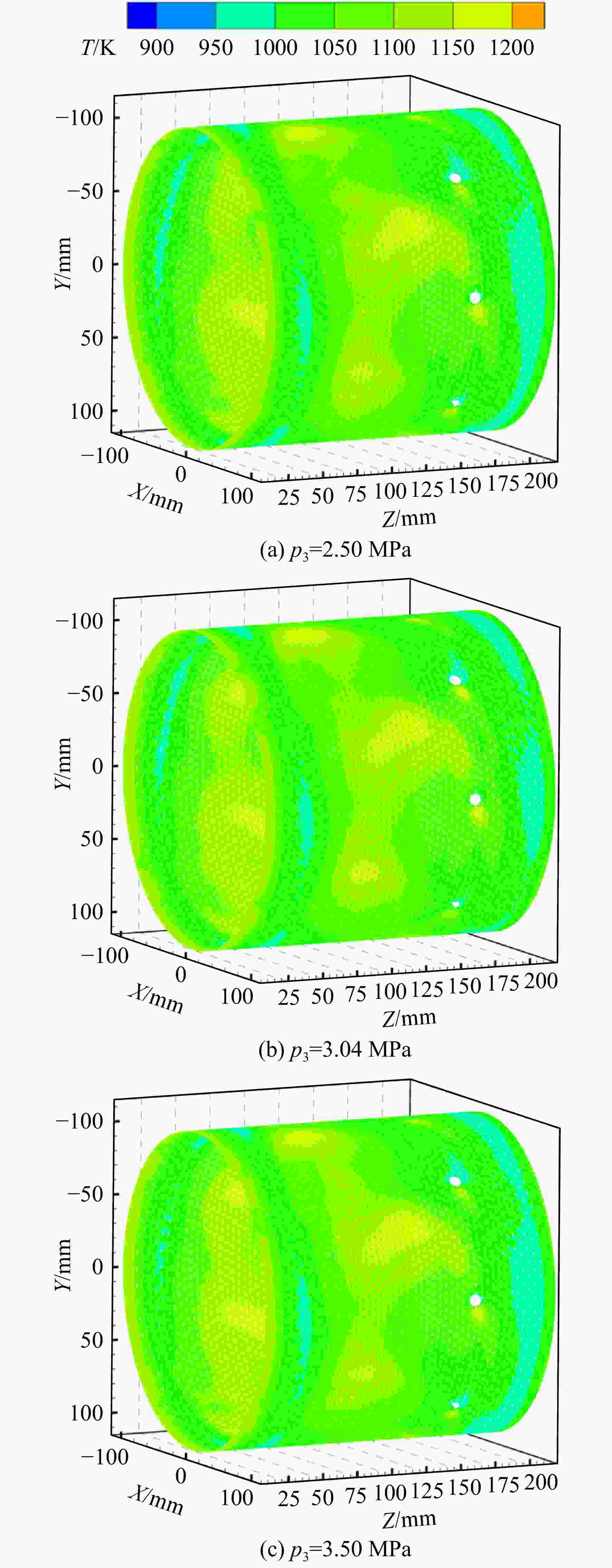
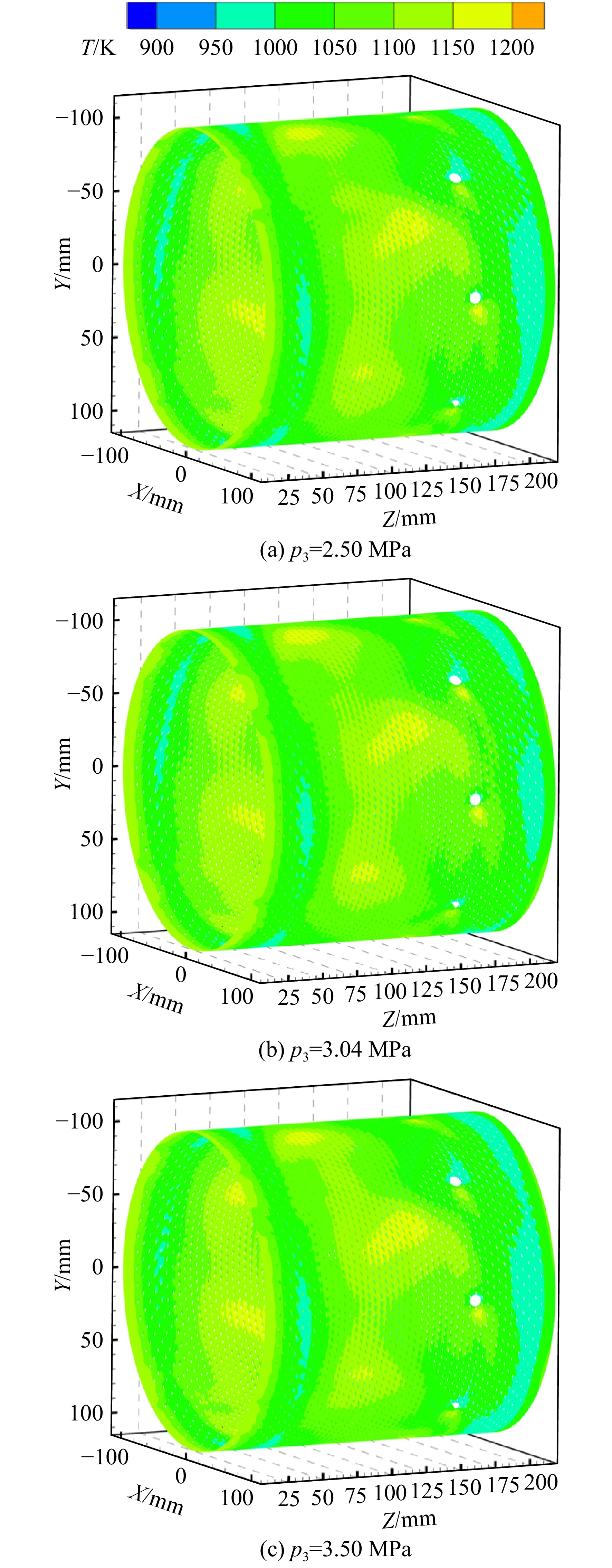
图 16 不同进气压力下火焰筒壁温分布
Figure 16. Liner wall temperature distribution of different inlet pressure cases
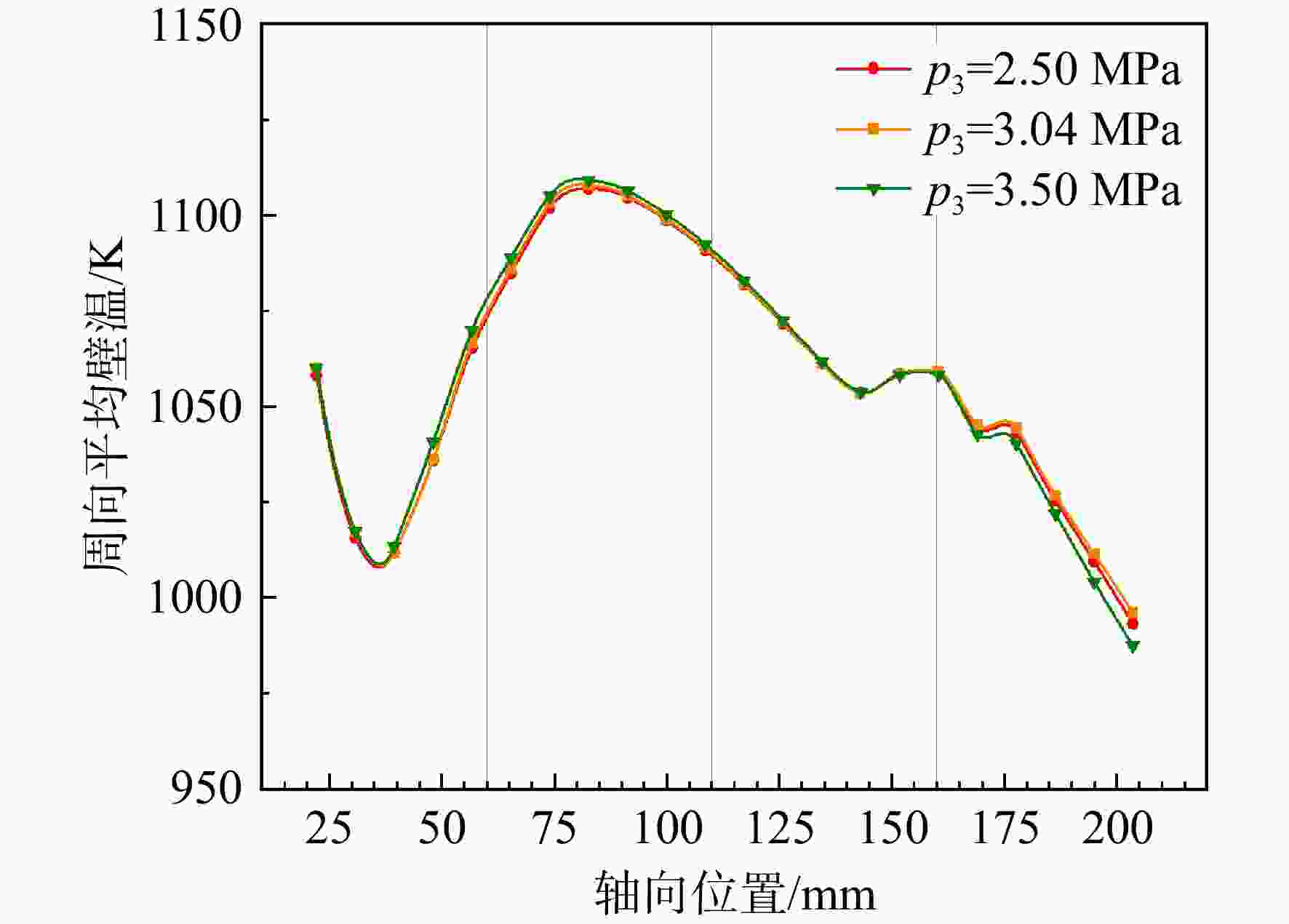
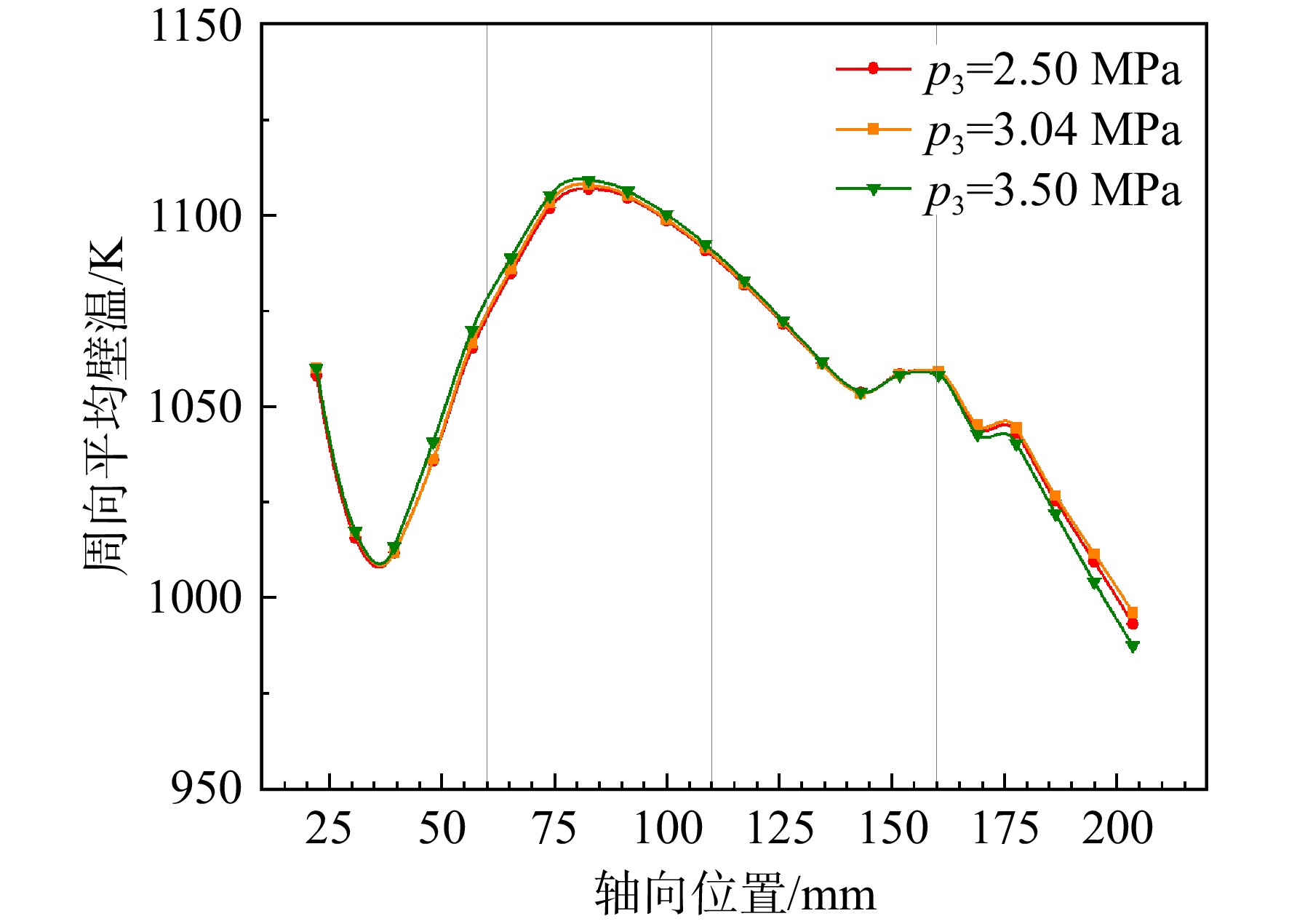
图 17 不同进气压力下沿轴向的周向平均壁温分布
Figure 17. Circumferential average wall temperature distribution along the axial direction at different inlet pressure cases
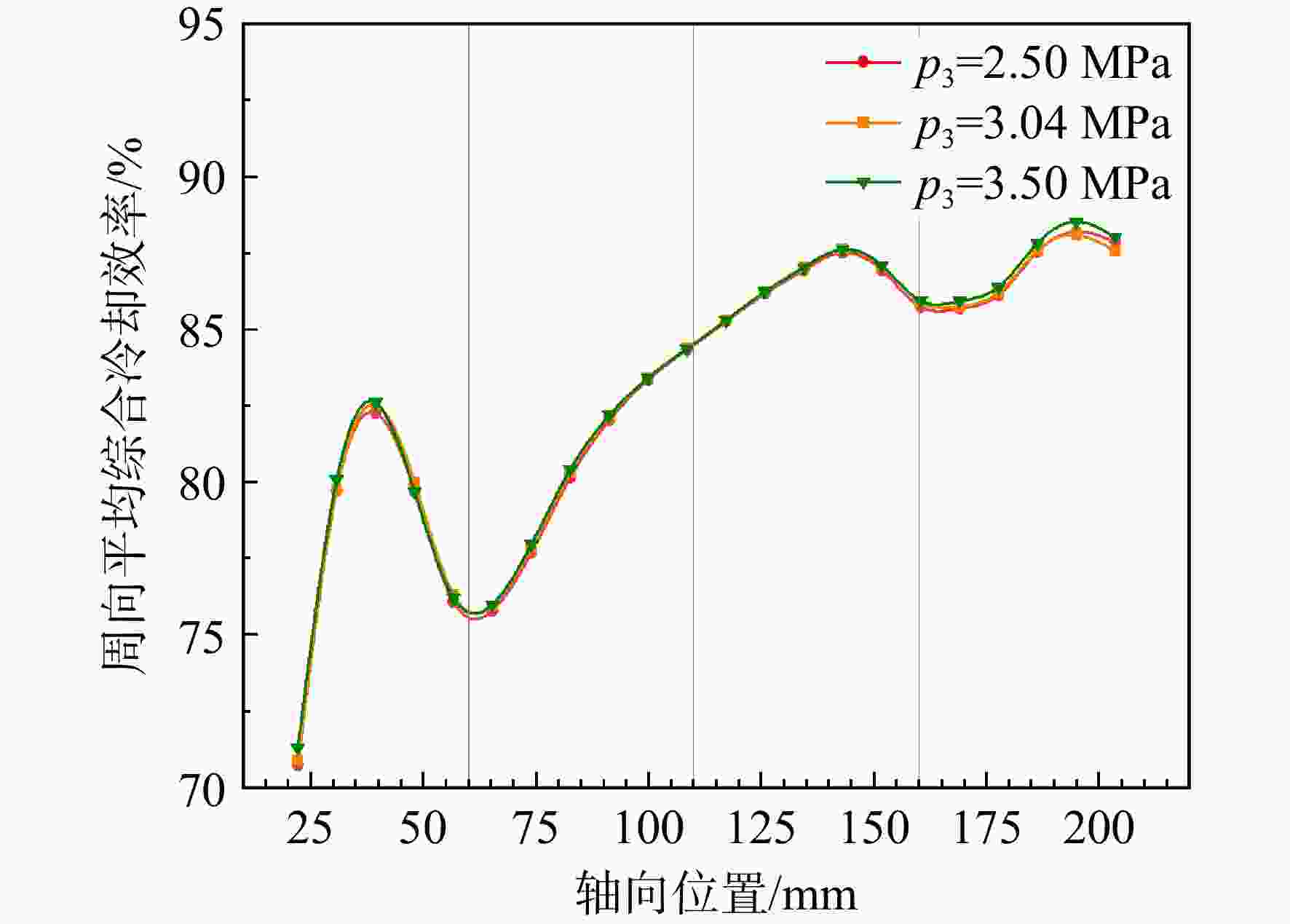
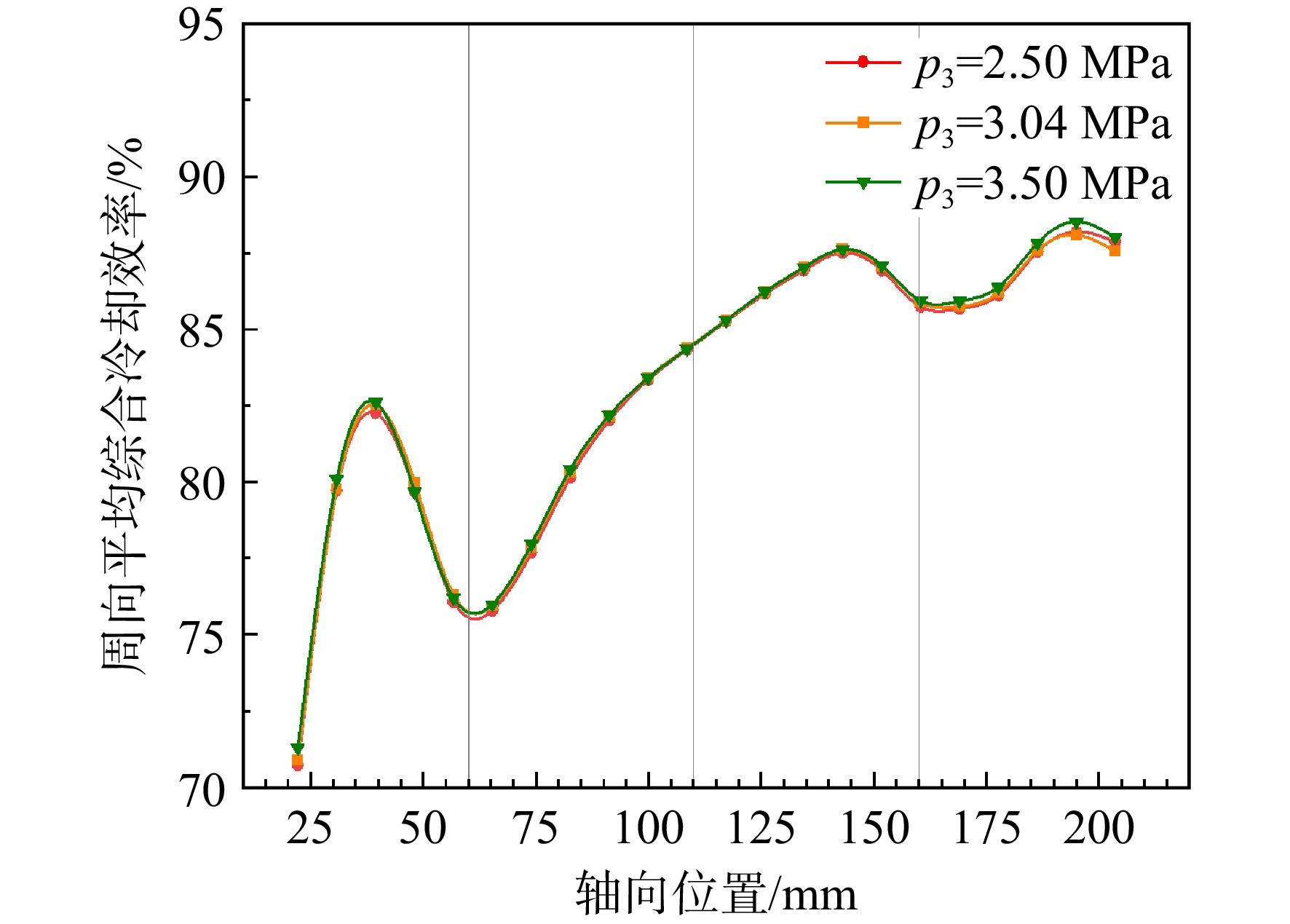
图 18 不同进气压力下综合冷却效率对比
Figure 18. Comparison of overall cooling efficiency of different inlet pressure cases
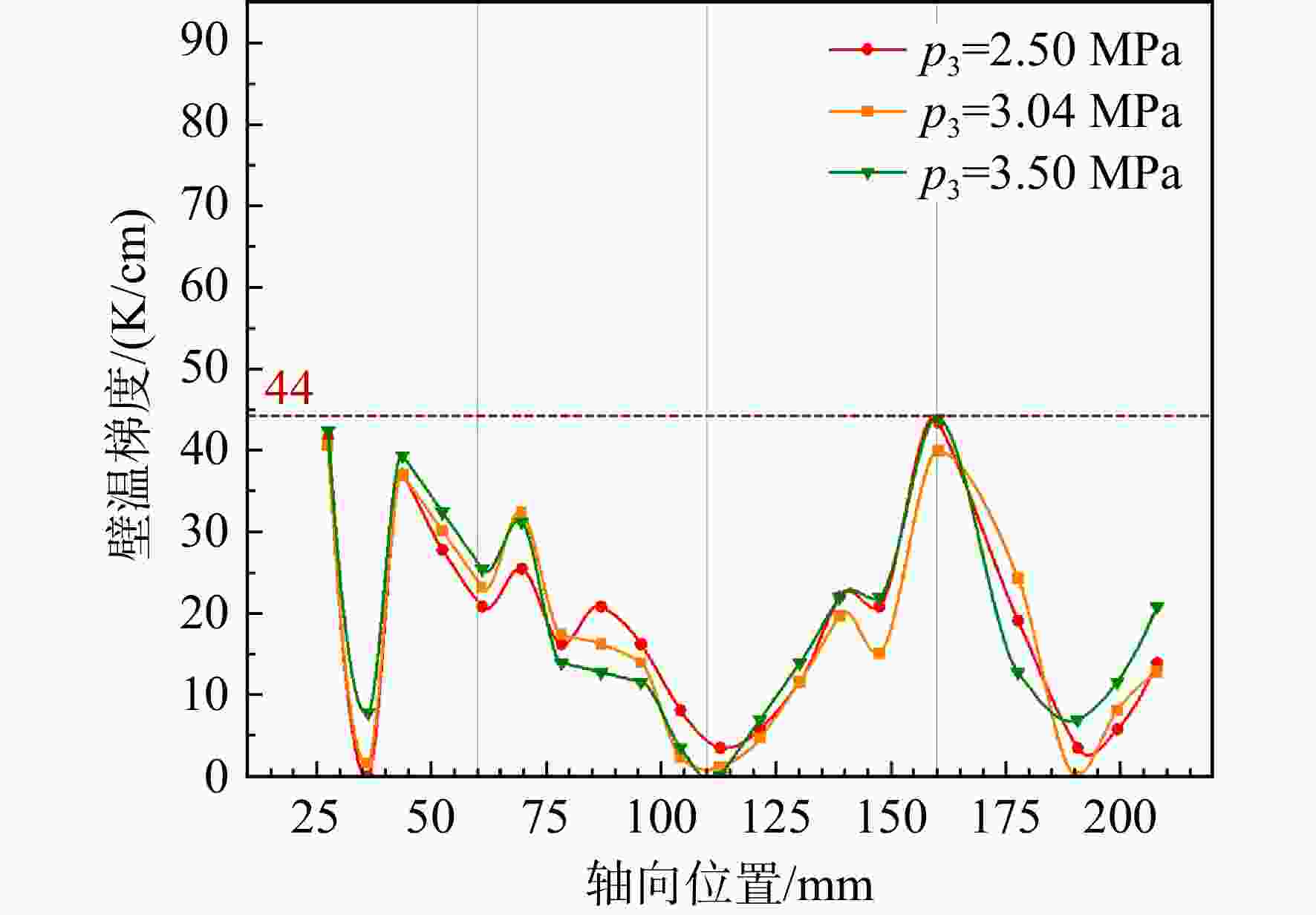
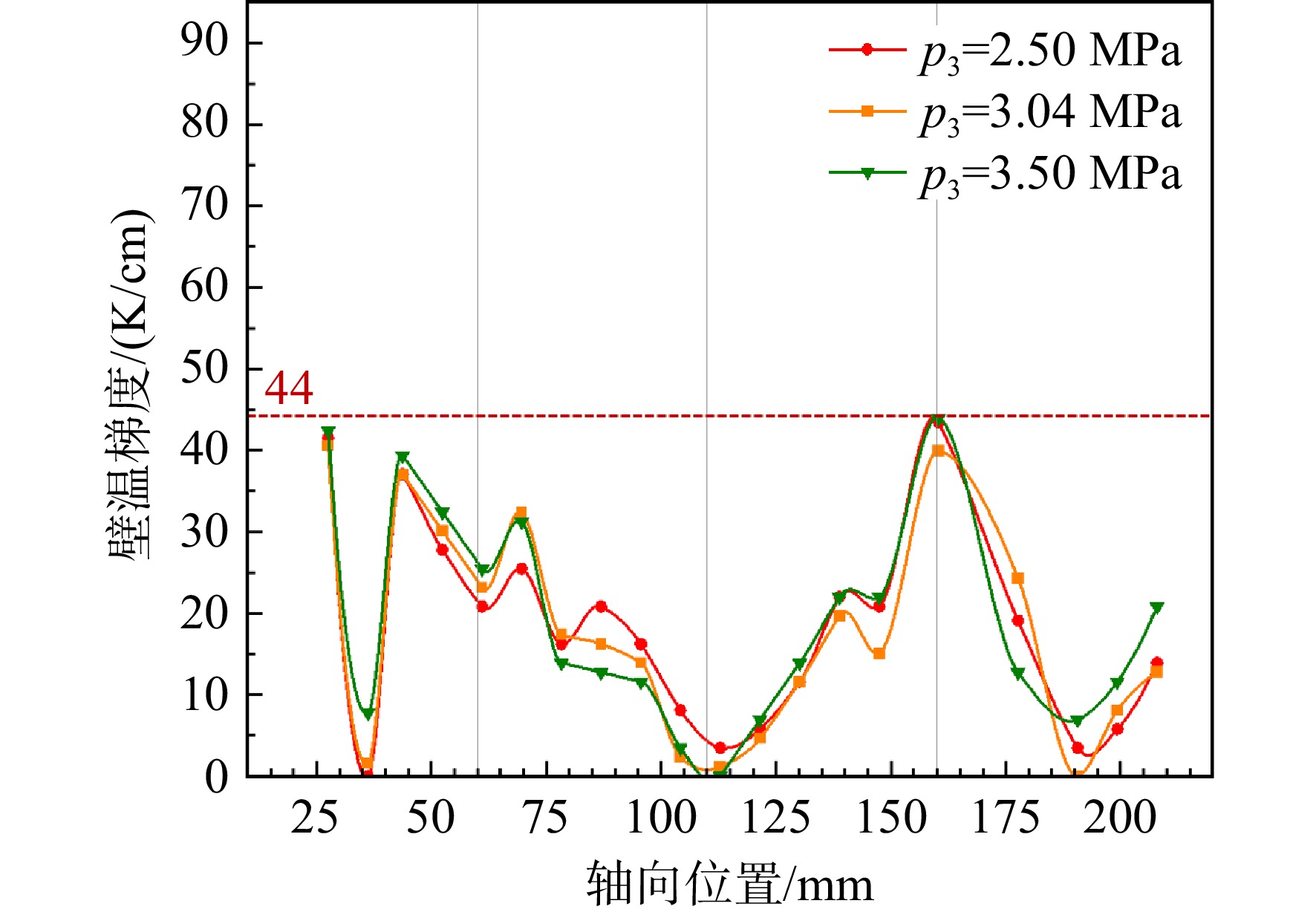
图 19 不同进气压力下壁温梯度对比
Figure 19. Wall temperature gradient of different inlet pressure cases
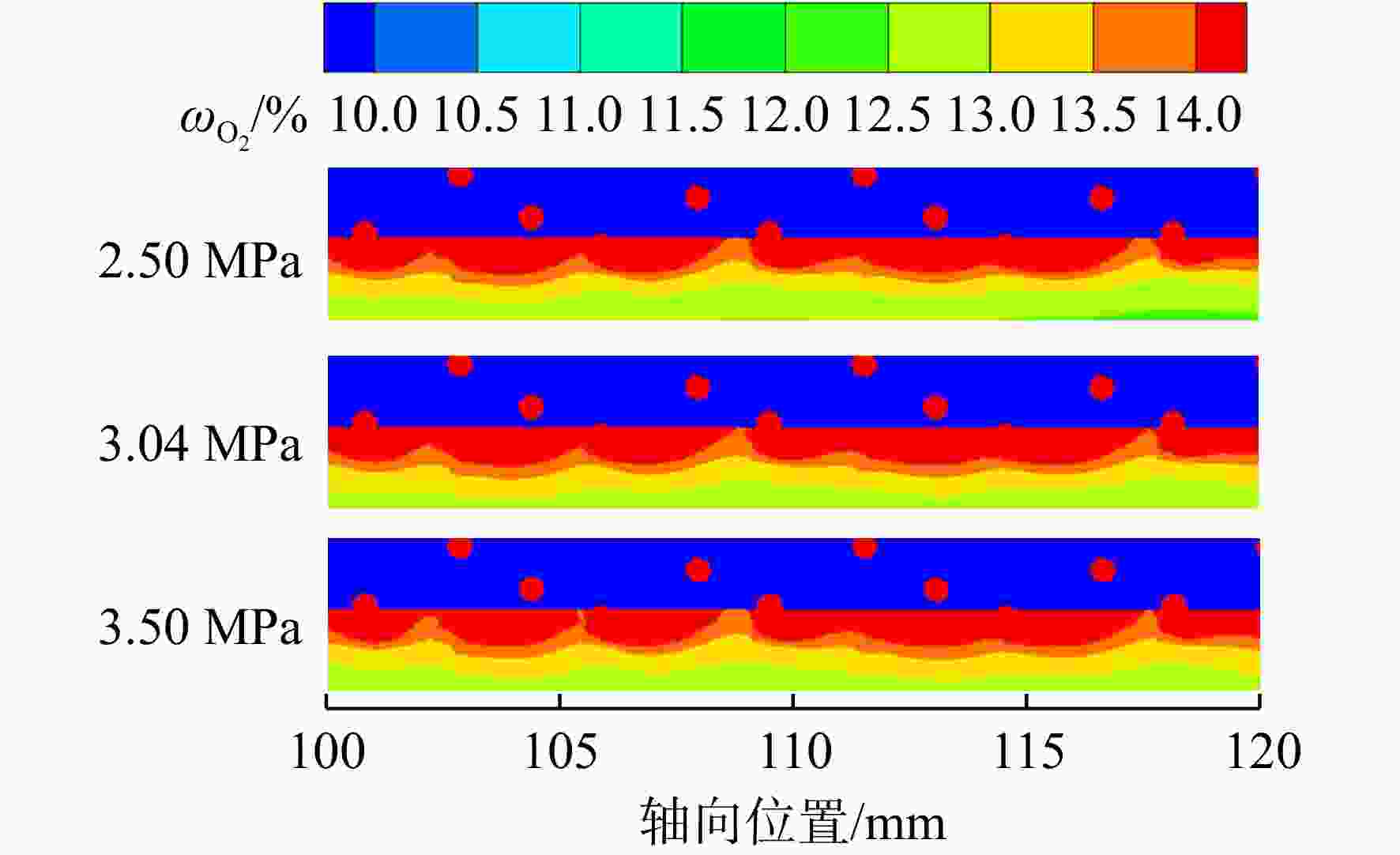
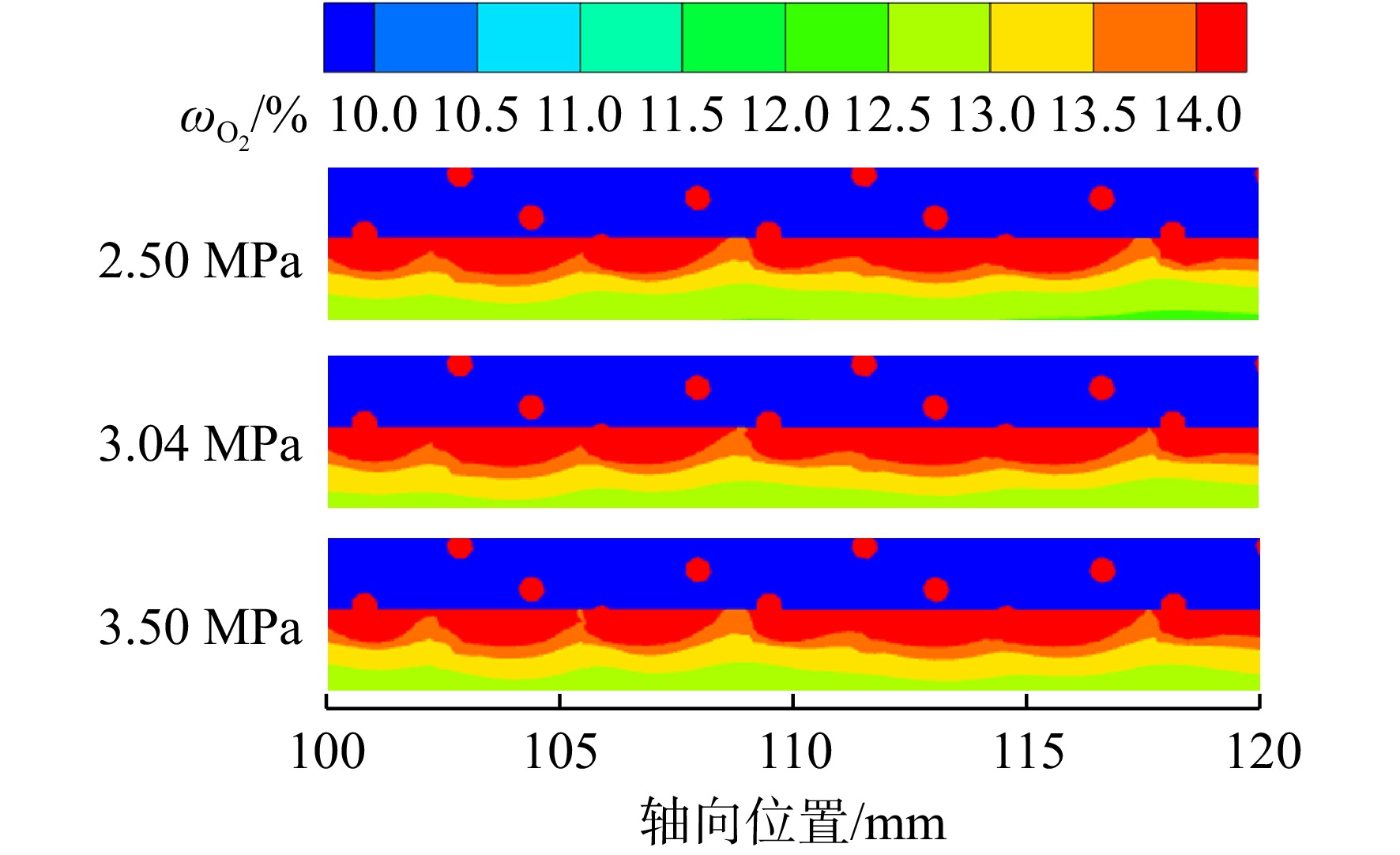
图 20 不同进气压力下近壁面氧气质量分数分布
Figure 20. Near wall oxygen mass fraction distribution of different inlet pressure cases
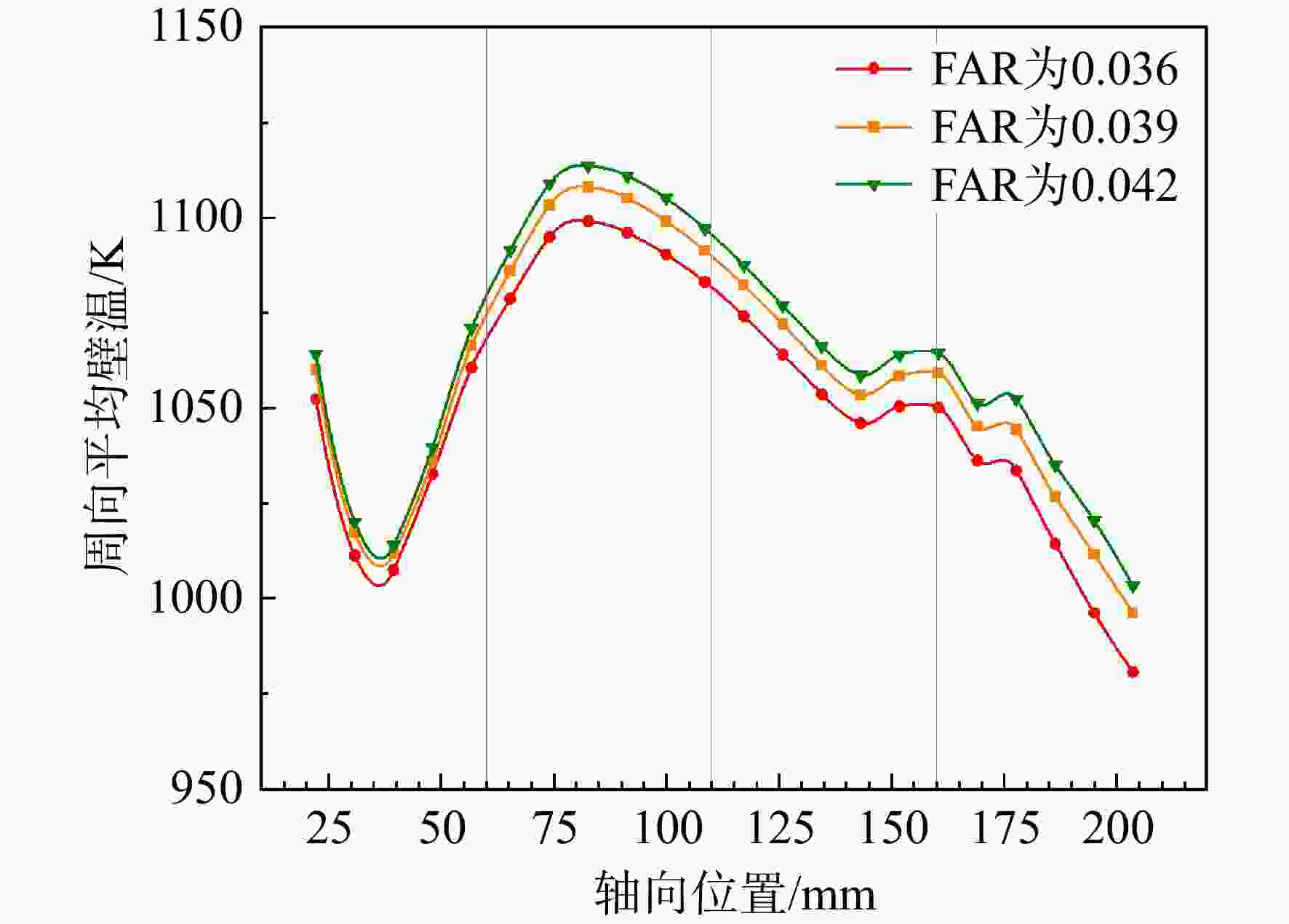
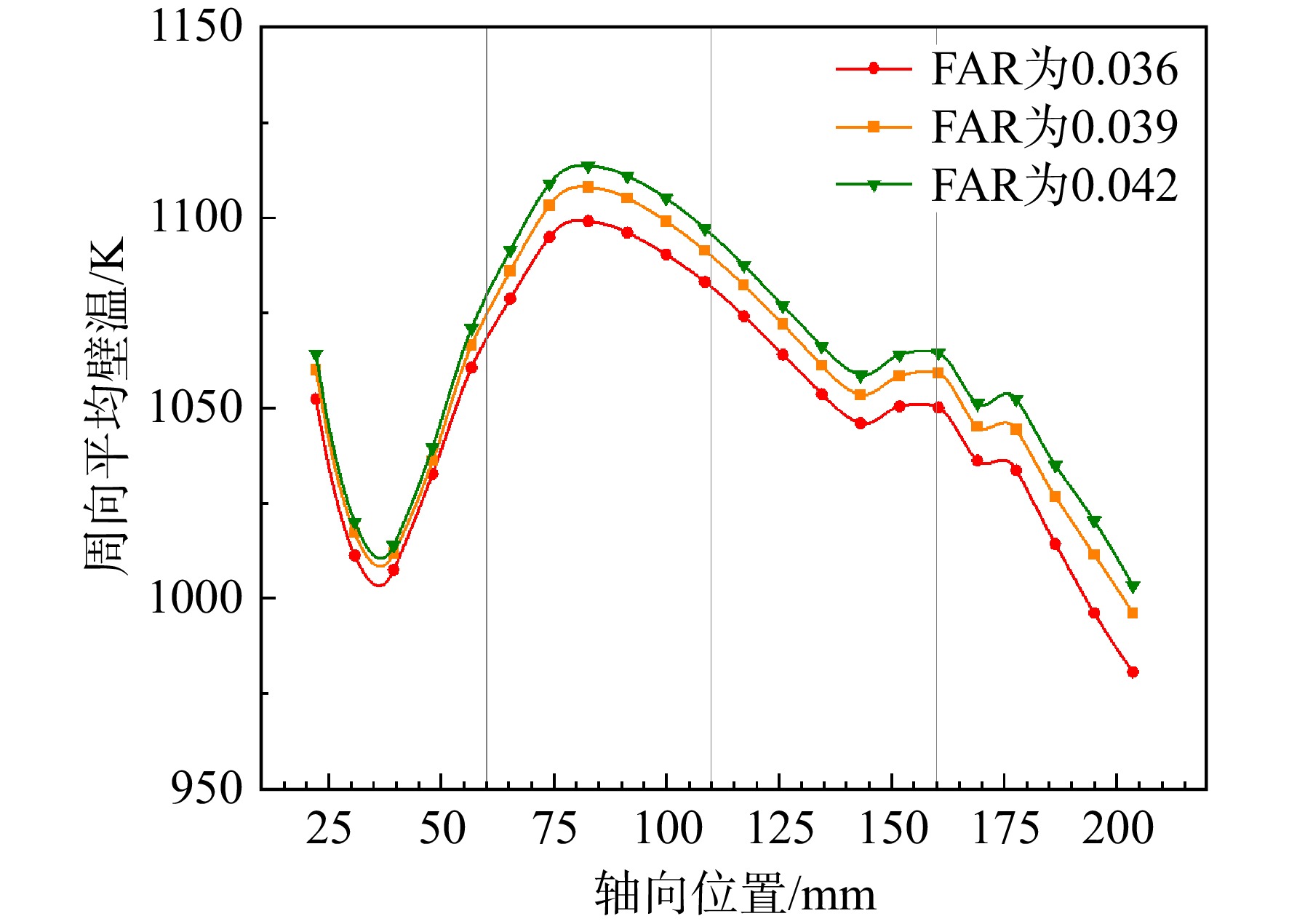
图 22 不同油气比下沿轴向的周向平均壁温分布
Figure 22. Circumferential average wall temperature distribution along the axial direction at different FAR cases
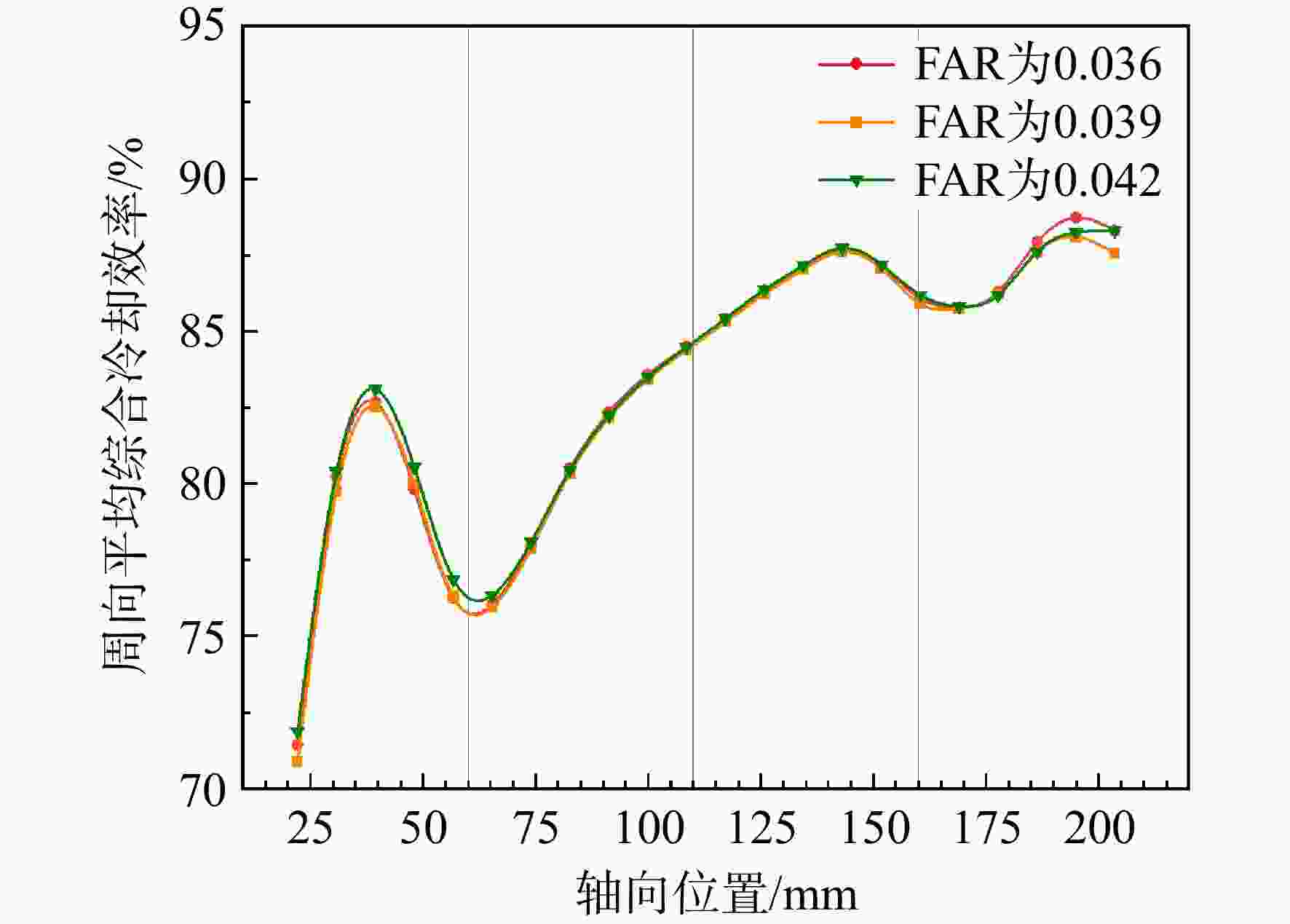
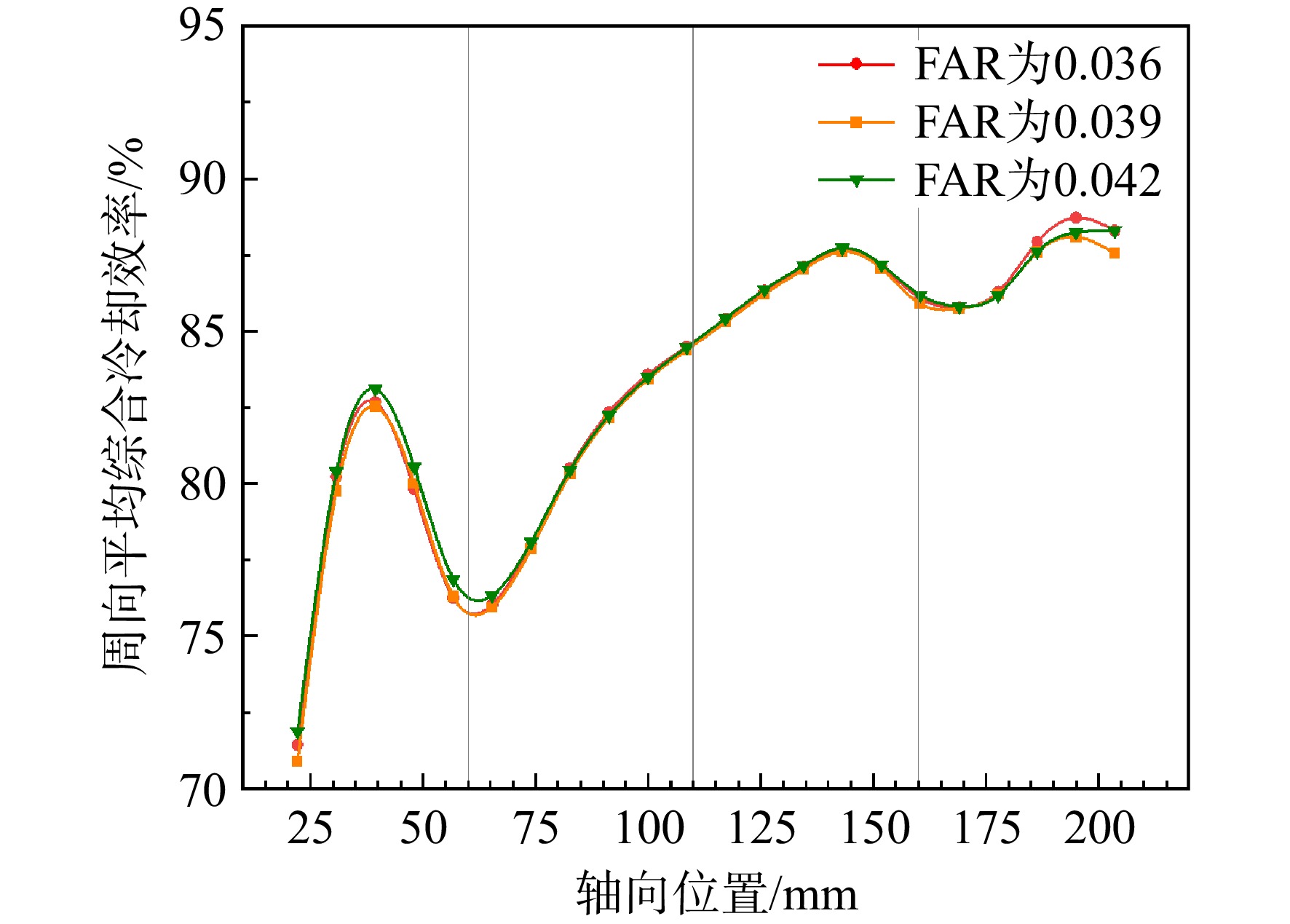
图 23 不同油气比下综合冷却效率对比
Figure 23. Comparison of overall cooling efficiency of different FAR cases
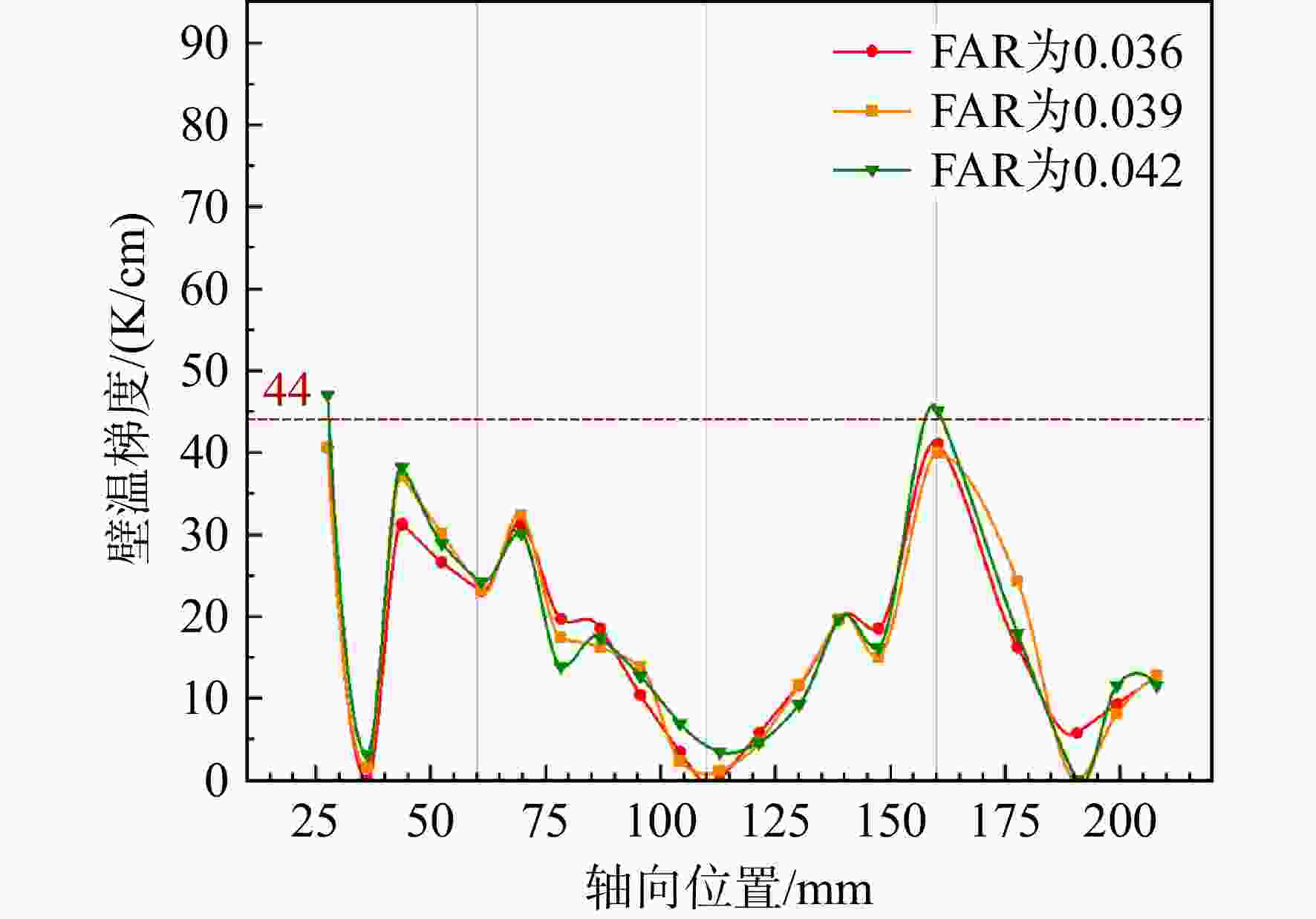
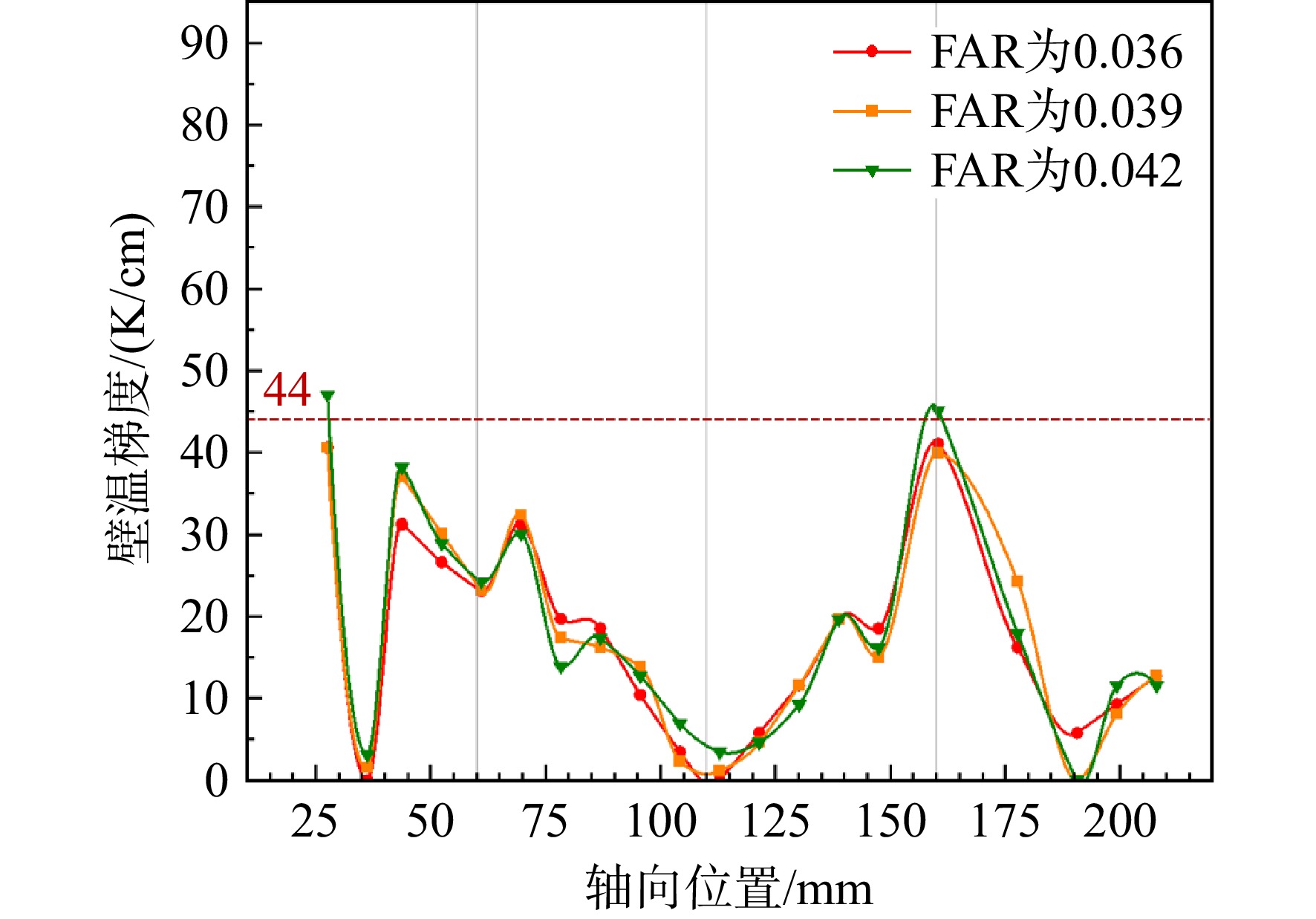
图 24 不同油气比下火焰筒壁温梯度对比
Figure 24. Liner wall temperature gradient of different FAR cases
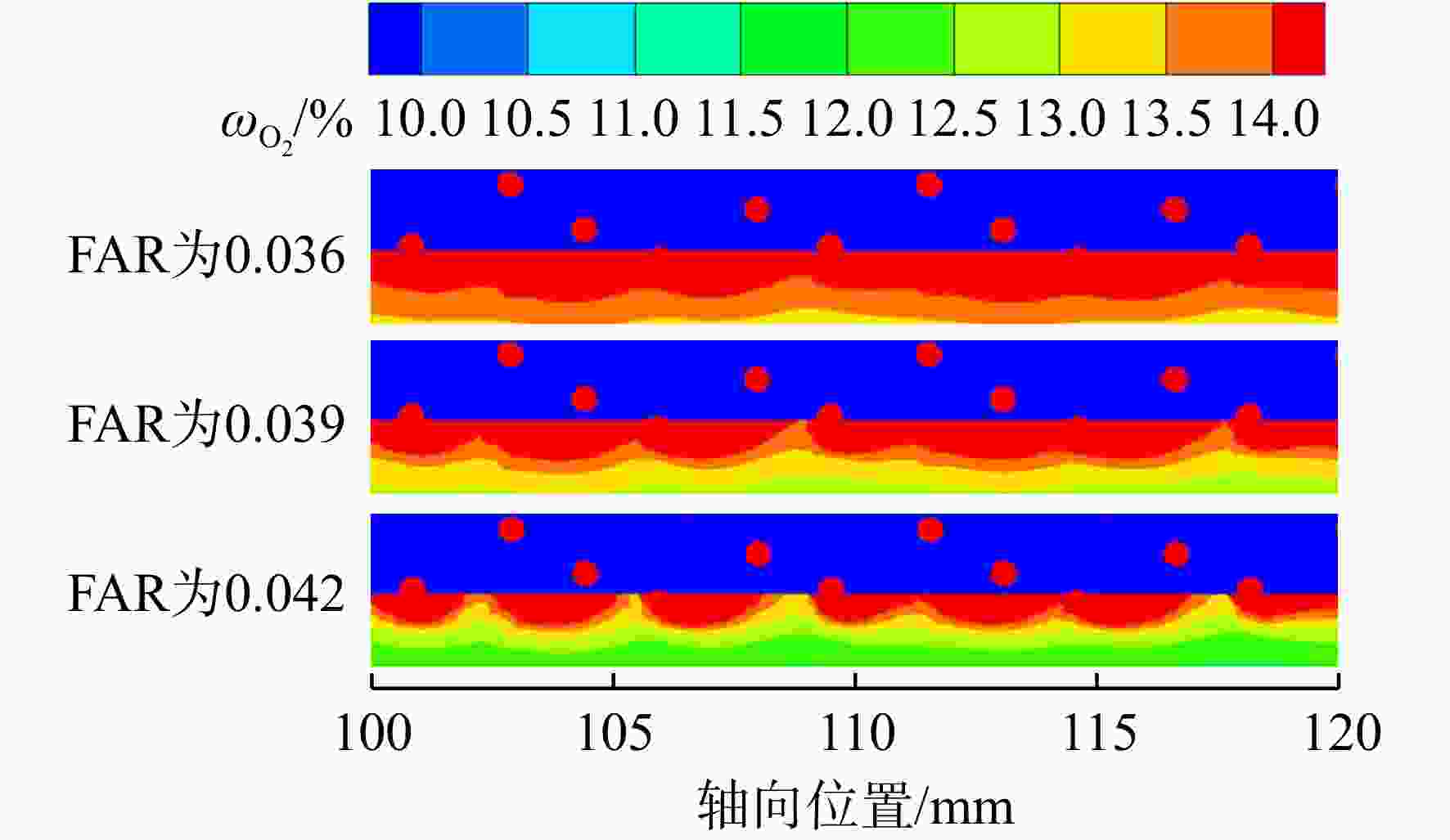
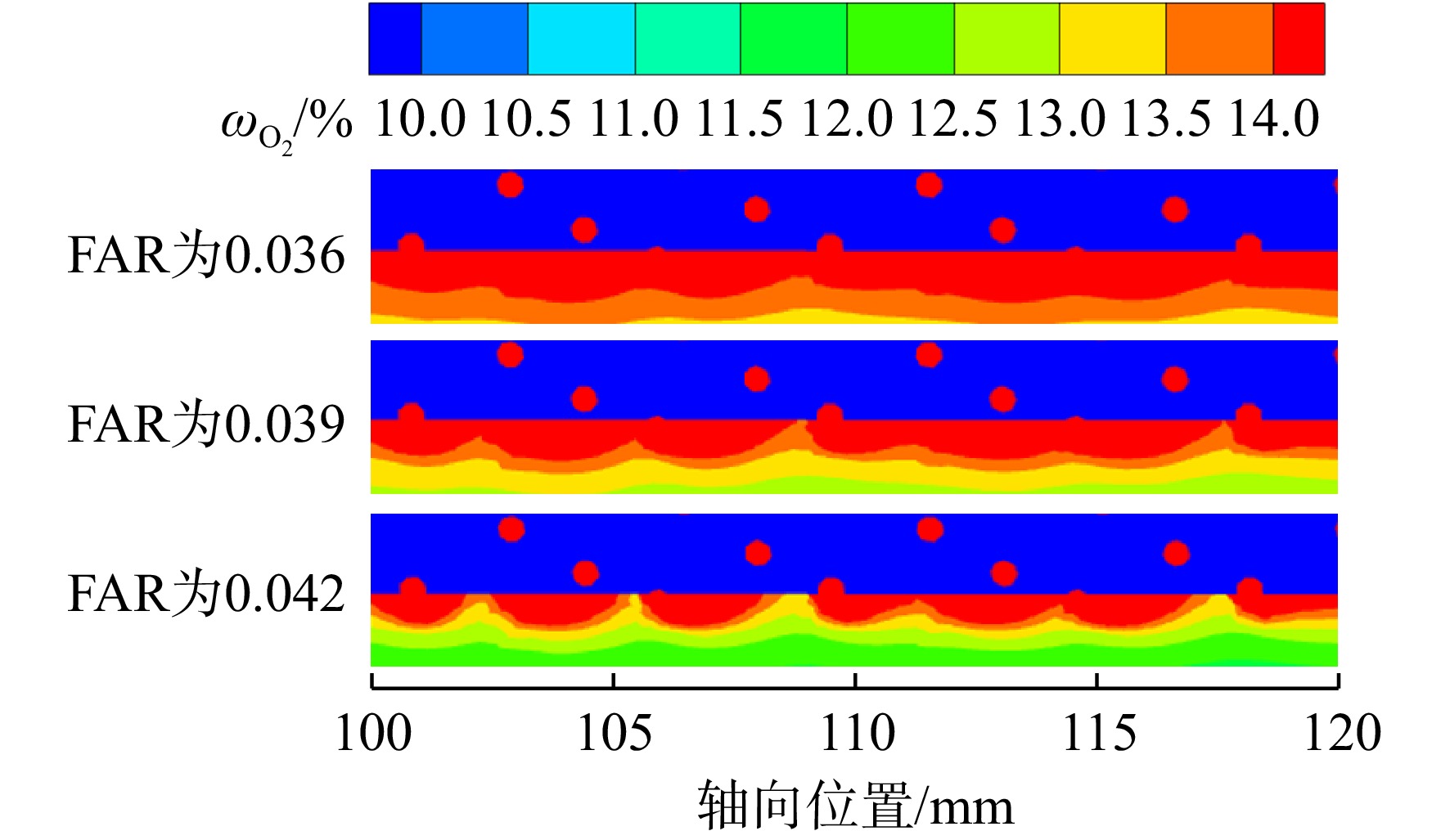
图 25 不同油气比下近壁面氧气质量分数分布
Figure 25. Near wall oxygen mass fraction distribution of different FAR cases
表 1 各排孔沿周向排布设计参数
Table 1. Circumferential arrangement design parameters of each row of holes
排数 Nc S/mm 1~5 60 11.41 6~7 75 9.13 8~9 100 6.85 10~29 120 5.70 30~33 100 6.85 34~35 130 5.27 36~40 90 7.61 41~45 70 9.78  下载: 导出CSV
表 2 基准工况参数表
Table 2. Reference operating condition parameters
参数 数值 空气流量/(kg/s) 4.8875 燃油流量/(kg/s) 0.1906 进气温度/K 900 进气压力/MPa 3.0424 主模燃油占比/% 86 副模燃油占比/% 14
下载: 导出CSV
表 3 燃烧性能参数对比
Table 3. Comparison of the combustion performance
参数 试验 数值 相对误差/% $ \xi $/% 3.92 3.84 2.04 $ {\eta }_{\text{c}} $/% 99.86 99.67 0.20 T4av/K 1794 1777 0.95
下载: 导出CSV
表 4 不同进气温度条件下冷却空气比例和壁面温度对比
Table 4. Comparison of cooling air ratio and wall temperature of different inlet temperature cases
T3/K φ/% Tw-ave/K Tw-max/K 700 18.88 840 963 800 18.83 948 1092 900 18.83 1056 1196
下载: 导出CSV
表 5 不同进气温度条件下壁面平均传热参数
Table 5. Average wall heat transfer parameters of different inlet temperature cases
参数 T3=700 K T3=800 K T3=900 K q/(W/m2) 179793 200104 218479 k/(W/(m2·K)) 1275 1321 1372
下载: 导出CSV
表 6 不同进气压力条件下冷气占比和壁面温度对比
Table 6. Comparison of cooling air ratio and wall temperature of different inlet pressure cases
p3/MPa φ/% Tw-ave/K Tw-max/K 2.50 18.79 1055 1197 3.04 18.83 1056 1196 3.50 18.81 1055 1193
下载: 导出CSV
表 7 不同油气比下冷却空气比例和壁面温度对比
Table 7. Comparison of cooling air ratio and wall temperature of different FAR cases
FAR φ/% Tw-ave/K Tw-max/K 0.036 18.82 1047 1187 0.039 18.83 1056 1196 0.042 18.81 1061 1205
下载: 导出CSV
表 8 不同油气比下壁面平均传热参数
Table 8. Average wall heat transfer parameters of different FAR cases
参数 0.036 0.039 0.042 q/(W/m2) 208228 218479 224424 k/(W/(m2·K)) 1371 1372 1376
下载: 导出CSV
-
[1] 金如山, 索建秦. 先进燃气轮机燃烧室[M]. 北京: 航空工业出版社, 2016. Jin Rushan, Suo Jianqin. Advanced gas turbine combustor[M]. Beijing: Aviation Industry Press, 2016. (in ChineseJin Rushan, Suo Jianqin. Advanced gas turbine combustor[M]. Beijing: Aviation Industry Press, 2016. (in Chinese) [2] 陈炫午, 曾青华, 甘晓华. 航空发动机高温升燃烧室技术分析[J]. 推进技术, 2023, 44(2): 2208054. Chen Xuanwu, Zeng Qinghua, Gan Xiaohua. Analysis of combustion technology of high temperature rise for aero engines[J]. Journal of Propulsion Technology, 2023, 44(2): 2208054. (in Chinese doi: 10.13675/j.cnki.tjjs.2208054Chen Xuanwu, Zeng Qinghua, Gan Xiaohua. Analysis of combustion technology of high temperature rise for aero engines[J]. Journal of Propulsion Technology, 2023, 44(2): 2208054. (in Chinese) doi: 10.13675/j.cnki.tjjs.2208054 [3] 李季. 基于某型燃烧室多种冷却方案对比分析[D]. 南京: 南京航空航天大学, 2016. Li Ji. Analysis of various cooling schemes on a combustion chamber[D]. Nanjing: Nanjing University of Aeronautics and Astronautics, 2016. (in ChineseLi Ji. Analysis of various cooling schemes on a combustion chamber[D]. Nanjing: Nanjing University of Aeronautics and Astronautics, 2016. (in Chinese) [4] 徐亮, 田秋霞, 席雷, 等. 燃气轮机火焰筒双耳孔冷却特性的分析[J]. 哈尔滨工业大学学报, 2023, 55(1): 55-63. Xu Liang, Tian Qiuxia, Xi Lei, et al. Analysis of cooling characteristics of gas turbine flame tube with binaural hole[J]. Journal of Harbin Institute of Technology, 2023, 55(1): 55-63. (in Chinese doi: 10.11918/202203003Xu Liang, Tian Qiuxia, Xi Lei, et al. Analysis of cooling characteristics of gas turbine flame tube with binaural hole[J]. Journal of Harbin Institute of Technology, 2023, 55(1): 55-63. (in Chinese) doi: 10.11918/202203003 [5] Arcangeli L, Facchini B, Surace M, et al. Correlative analysis of effusion cooling systems[J]. Journal of Turbomachinery, 2008, 130(1): 011016. doi: 10.1115/1.2749298 [6] Venkatesh V, Sriraam J, Vignesh D B, et al. Studies on effusion cooling: Impact of geometric parameters on cooling effectiveness and coolant consumption[J]. Aerospace Science and Technology, 2018, 77: 58-66. doi: 10.1016/j.ast.2017.12.044 [7] Ling J C P W, Ireland P T, Tumer L. Full coverage film cooling for combustor transition sections[C]//ASME Turbo Expo 2002: Power for Land, Sea, and Air. Amsterdam: ASME, 2002: 1011-1021. [8] 许全宏, 徐剑, 林宇震, 等. 多斜孔冷却方式气动参数对壁温梯度和冷却效率的影响[J]. 航空动力学报, 2008, 23(4): 647-650. Xu Quanhong, Xu Jian, Lin Yuzhen, et al. Influence of aerodynamic parameter on the temperature gradient and cooling efficiency for effusion wall cooling method[J]. Journal of Aerospace Power, 2008, 23(4): 647-650. (in Chinese doi: 10.13224/j.cnki.jasp.2008.04.017Xu Quanhong, Xu Jian, Lin Yuzhen, et al. Influence of aerodynamic parameter on the temperature gradient and cooling efficiency for effusion wall cooling method[J]. Journal of Aerospace Power, 2008, 23(4): 647-650. (in Chinese) doi: 10.13224/j.cnki.jasp.2008.04.017 [9] Natsui G, Claretti R, Ricklick M A, et al. Experimental evaluation of large spacing compound angle full-coverage film cooling arrays: adiabatic film cooling effectiveness[J]. Journal of Turbomachinery, 2016, 138(7): 071001. doi: 10.1115/1.4032538 [10] Paitich L C, Richer P, Jodoin B, et al. Directional effects of effusion cooling on the cooling film effectiveness[J]. AIAA Journal, 2021, 60(1): 423-434. [11] 栾芸. 发散冷却及其内冷流道的机理和结构优化设计研究[D]. 合肥: 中国科学技术大学, 2022. Luan Yun. Investigations on mechanism and structural optimization design of transpiration cooling and internal cooling passage[D]. Hefei: University of Science and Technology of China, 2022. (in ChineseLuan Yun. Investigations on mechanism and structural optimization design of transpiration cooling and internal cooling passage[D]. Hefei: University of Science and Technology of China, 2022. (in Chinese) [12] Dong Gengyi, Liu Yingjie, Wang Min, et al. Experimental and numerical investigation of swirling flow on the conjugate cooling efficiency of an effusion-cooled combustor[J]. International Journal of Thermal Sciences, 2024, 198: 108846. doi: 10.1016/j.ijthermalsci.2023.108846 [13] Ji Yongbin, Ge Bing, Zang Shusheng. Analysis of effusion cooling under realistic swirl reacting flow in gas turbine combustor[J]. Applied Thermal Engineering, 2022, 216: 119101. doi: 10.1016/j.applthermaleng.2022.119101 [14] Chin Jushan, Suo Jianqin. Design of aero engine lean direct mixing combustor[C]//54th AIAA/SAE/ASEE Joint Propulsion Conference. Cincinnati: AIAA/SAE/ASEE, 2018: 4921. [15] 金如山, 党进, 刘富强. 新一代航空发动机燃烧室[J]. 工程热物理学报, 2022, 43(2): 543-552. Jin Rushan, Dang Jin, Liu Fuqiang. New generation aero-engine combustor[J]. Journal of Engineering Thermophysics, 2022, 43(2): 543-552. (in ChineseJin Rushan, Dang Jin, Liu Fuqiang. New generation aero-engine combustor[J]. Journal of Engineering Thermophysics, 2022, 43(2): 543-552. (in Chinese) [16] Yang Guang, Shao Weiwei, Zhang Zhedian. Experimental and numerical study on heat transfer characteristics of tangential effusion cooling for a combustor liner[J]. Applied Thermal Engineering, 2023, 218: 119374. doi: 10.1016/j.applthermaleng.2022.119374 [17] 汪涛, 索建秦, 梁红侠, 等. 火焰筒切向进气发散小孔冷却数值模拟[J]. 航空动力学报, 2011, 26(5): 1052-1058. Wang Tao, Suo Jianqin, Liang Hongxia, et al. Numerical study of tangential effusion cooling for combustor liner[J]. Journal of Aerospace Power, 2011, 26(5): 1052-1058. (in Chinese doi: 10.13224/j.cnki.jasp.2011.05.028Wang Tao, Suo Jianqin, Liang Hongxia, et al. Numerical study of tangential effusion cooling for combustor liner[J]. Journal of Aerospace Power, 2011, 26(5): 1052-1058. (in Chinese) doi: 10.13224/j.cnki.jasp.2011.05.028 [18] 杨光, 邵卫卫, 张哲巅. 新型切向发散孔气膜冷却特性数值研究[J]. 推进技术, 2022, 43(11): 210579. Yang Guang, Shao Weiwei, Zhang Zhedian. Numerical investigation on film cooling performance of novel tangential effusion holes[J]. Journal of Propulsion Technology, 2022, 43(11): 210579. (in Chinese doi: 10.13675/j.cnki.tjjs.210579Yang Guang, Shao Weiwei, Zhang Zhedian. Numerical investigation on film cooling performance of novel tangential effusion holes[J]. Journal of Propulsion Technology, 2022, 43(11): 210579. (in Chinese) doi: 10.13675/j.cnki.tjjs.210579 [19] 周子鹤, 苏浩, 贺菲, 等. 发散冷却系统冷却能力的数值分析[J]. 航空动力学报, 2021, 36(11): 2363-2371. Zhou Zihe, Su Hao, He Fei, et al. Numerical analysis on cooling capacity of transpiration cooling system[J]. Journal of Aerospace Power, 2021, 36(11): 2363-2371. (in Chinese doi: 10.13224/j.cnki.jasp.20200544Zhou Zihe, Su Hao, He Fei, et al. Numerical analysis on cooling capacity of transpiration cooling system[J]. Journal of Aerospace Power, 2021, 36(11): 2363-2371. (in Chinese) doi: 10.13224/j.cnki.jasp.20200544 [20] Arjun C K, Jayakumar J S, Babu Y G, et al. Experimental and numerical investigation of effusion cooling effectiveness of combustion chamber liner plates[J]. Journal of Heat Transfer, 2018, 140(8): 082201. doi: 10.1115/1.4039684 [21] 张家祥, 蔡志斌, 翟维阔, 等. 某型回流燃烧室壁温数值研究[J]. 航空动力学报, 2025, 40(4): 20220812. Zhang Jiaxiang, Cai Zhibin, Zhai Weikuo, et al. Numerical study on wall temperature of a reverse-flow combustor[J]. Journal of Aerospace Power, 2025, 40(4): 20220812. (in Chinese doi: 10.13224/j.cnki.jasp.20220812Zhang Jiaxiang, Cai Zhibin, Zhai Weikuo, et al. Numerical study on wall temperature of a reverse-flow combustor[J]. Journal of Aerospace Power, 2025, 40(4): 20220812. (in Chinese) doi: 10.13224/j.cnki.jasp.20220812 [22] 颜鸣皋, 刘伯操, 李金桂. 中国航空材料手册[M]. 北京: 中国标准出版社, 2002. Yan Minggao, Liu Bocao, Li Jingui. China aeronautical materials handbook[M]. Beijing: Standards Press of China, 2002. (in ChineseYan Minggao, Liu Bocao, Li Jingui. China aeronautical materials handbook[M]. Beijing: Standards Press of China, 2002. (in Chinese) [23] Launder B E, Spalding D B. The numerical computation of turbulent flows[J]. Computer Methods in Applied Mechanics and Engineering, 1974, 3(2): 269-289. doi: 10.1016/0045-7825(74)90029-2 [24] Jin Yi, He Xiaomin, Jiang Bo, et al. Effect of cavity-injector/radial-strut relative position on performance of a trapped vortex combustor[J]. Aerospace Science and Technology, 2014, 32(1): 10-18. doi: 10.1016/j.ast.2013.12.014 [25] Dai Huwei, Zhang Junhong, Ren Yanyan, et al. Effect of cooling hole configurations on combustion and heat transfer in an aero-engine combustor[J]. Applied Thermal Engineering, 2021, 182: 115664. doi: 10.1016/j.applthermaleng.2020.115664 [26] 吉雍彬. 燃气轮机燃烧室发散冷却耦合传热特性研究[D]. 上海: 上海交通大学, 2019. Ji Yongbin. Conjugate heat transfer characteristics of gas turbine combustor effusion cooling[D]. Shanghai: Shanghai Jiao Tong University, 2019. (in ChineseJi Yongbin. Conjugate heat transfer characteristics of gas turbine combustor effusion cooling[D]. Shanghai: Shanghai Jiao Tong University, 2019. (in Chinese) -

 点击查看大图
计量
- 文章访问数: 155
- HTML浏览量: 82
- PDF量: 16
- 被引次数: 0