






Study on blending and combustion characteristics of hydrogen micro-mixing diffusion unit
-
摘要:
为改善纯氢火焰的燃烧不稳定现象并降低NOx排放,基于氢气横向喷注的微混扩散燃烧单元开展相关研究,通过冷态、热态的数值仿真,探究微混段长度和燃料空气的动量通量比对掺混效果、火焰形态以及NOx排放的影响规律,并通过实验测量不同工况下微混单元的实际NOx排放。研究结果表明:当氢气穿透深度的不同时,火焰呈现托举火焰、“W”形火焰和水滴形火焰3种不同形态;为实现低NOx排放,被气流托举的火焰需要更优的掺混效果以维持稳定燃烧,而“W”形和水滴形这类能附着在微混单元出口的火焰则要防止火焰过于集中,反而应该适当降低掺混;NOx排放在当量比为0.7和0.8时较高,且随着空气流量的增加排放略有降低。
Abstract:To enhance the combustion stability of hydrogen flames and reduce NOx emissions, investigation was carried out on a micro-mixing diffusion unit with hydrogen cross-injection. By means of numerical simulations for the cold and combustion states, the impacts of the length of micro-mixing section and the momentum flux ratio between fuel and air on mixing efficiency, flame morphology, and NOx emissions were analyzed. Furthermore, experimental measurements were conducted to evaluate the actual NOx emissions of the micro-mixing diffusion unit under varied operating conditions. Results indicated that three distinct combustion modes emerged: lifted flame, “W”-shaped flame, and droplet flame while the hydrogen penetration depths were changed. To achieve lower NOx emissions, the lifted flame required enhanced mixing for stable combustion. However, the excessive flame concentration should be avoided by appropriately reducing mixing for “W”-shaped and droplet flames because flame was adhered to the outlet of the micro-mixing unit. NOx emissions were relatively higher at equivalence ratios of 0.7 and 0.8 but decreased as air flow rate increased.
-
Key words:
- hydrogen /
- micro-mixing diffusion combustion /
- fuel blending /
- NOx emission /
- flame characteristics
-
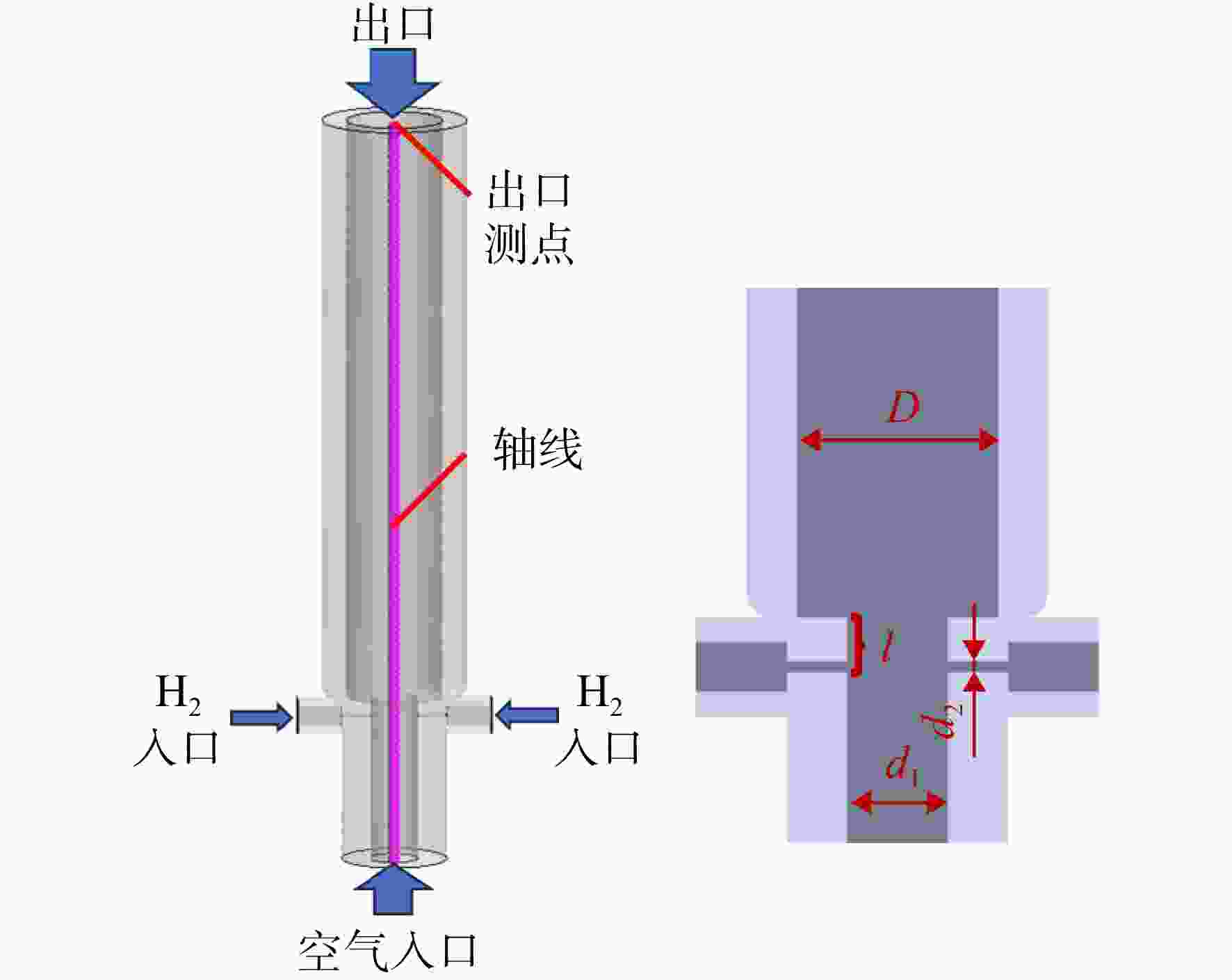
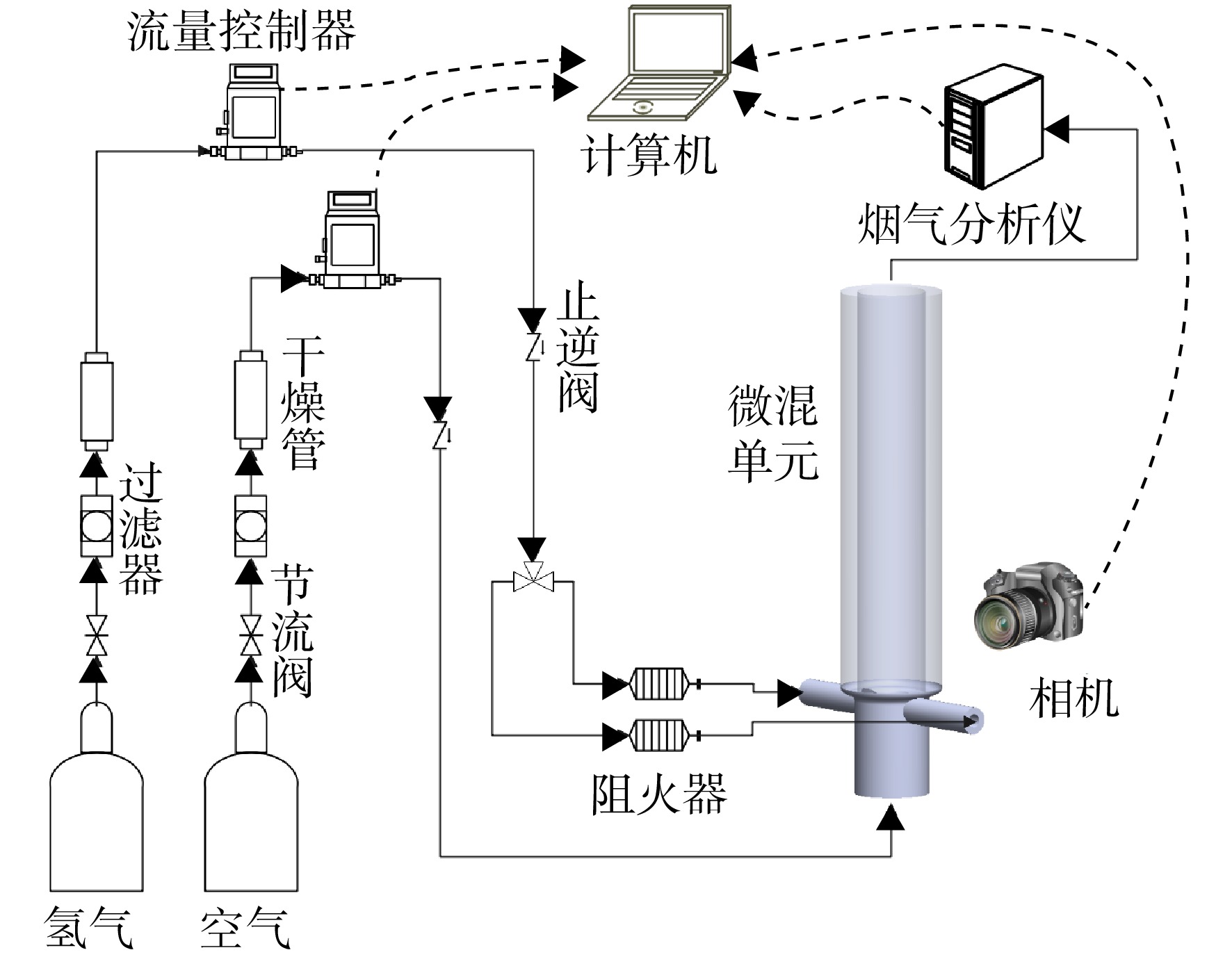
图 1 微混扩散燃烧单元几何构型
Figure 1. Geometric configuration of micro-mixing diffusion combustion unit
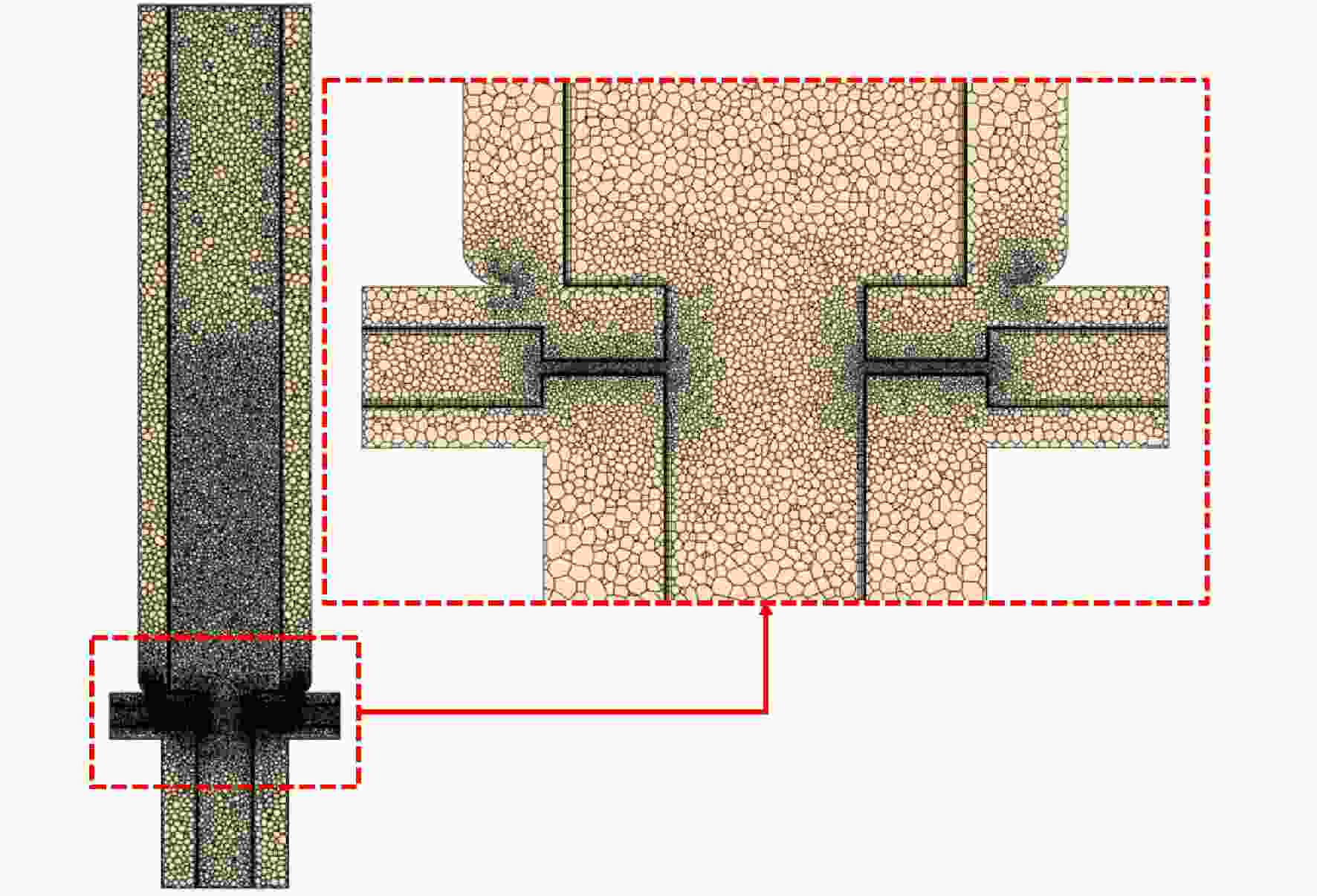
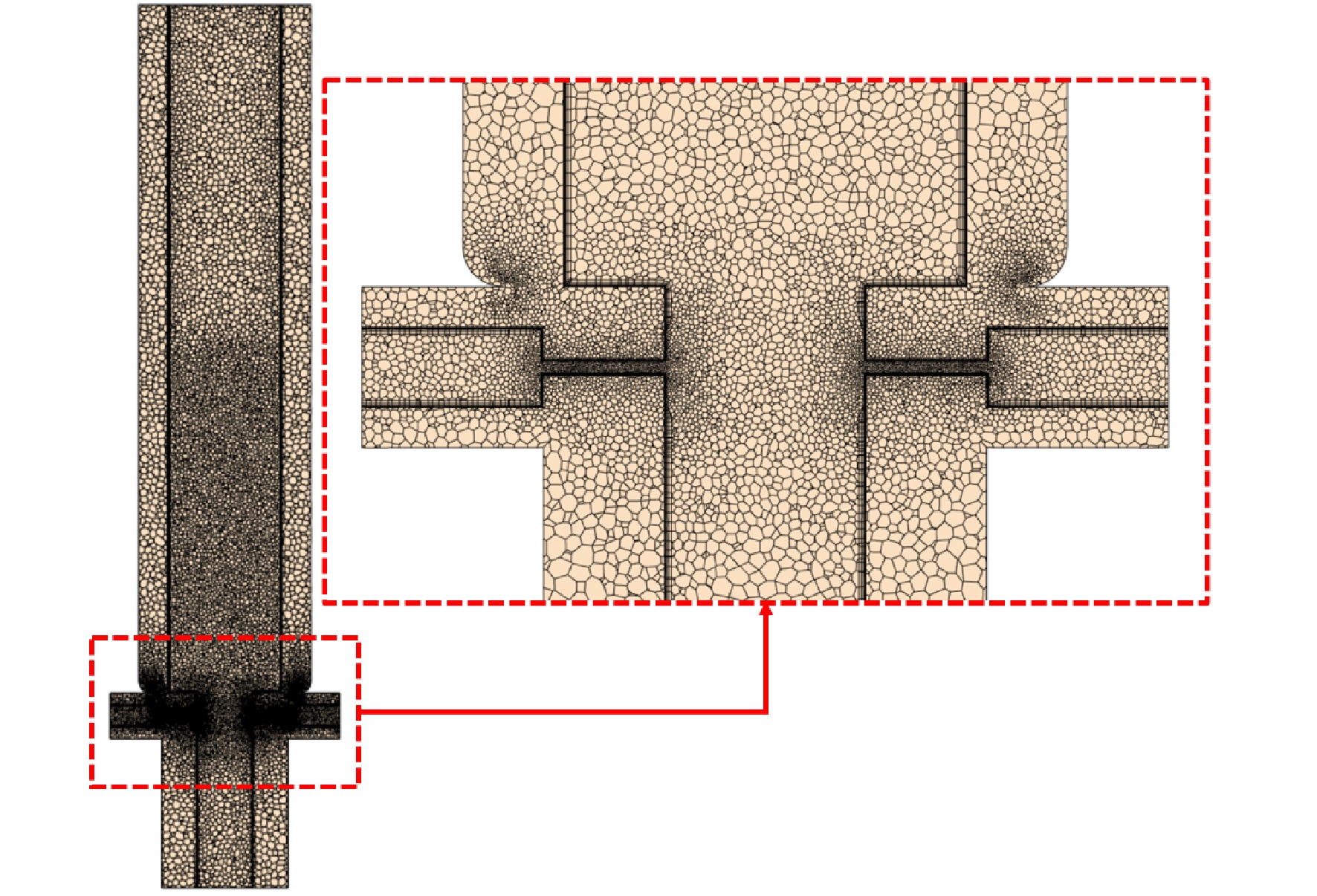
图 4 数值仿真计算域的网格图
Figure 4. Mesh diagram of the numerical simulation computational domain
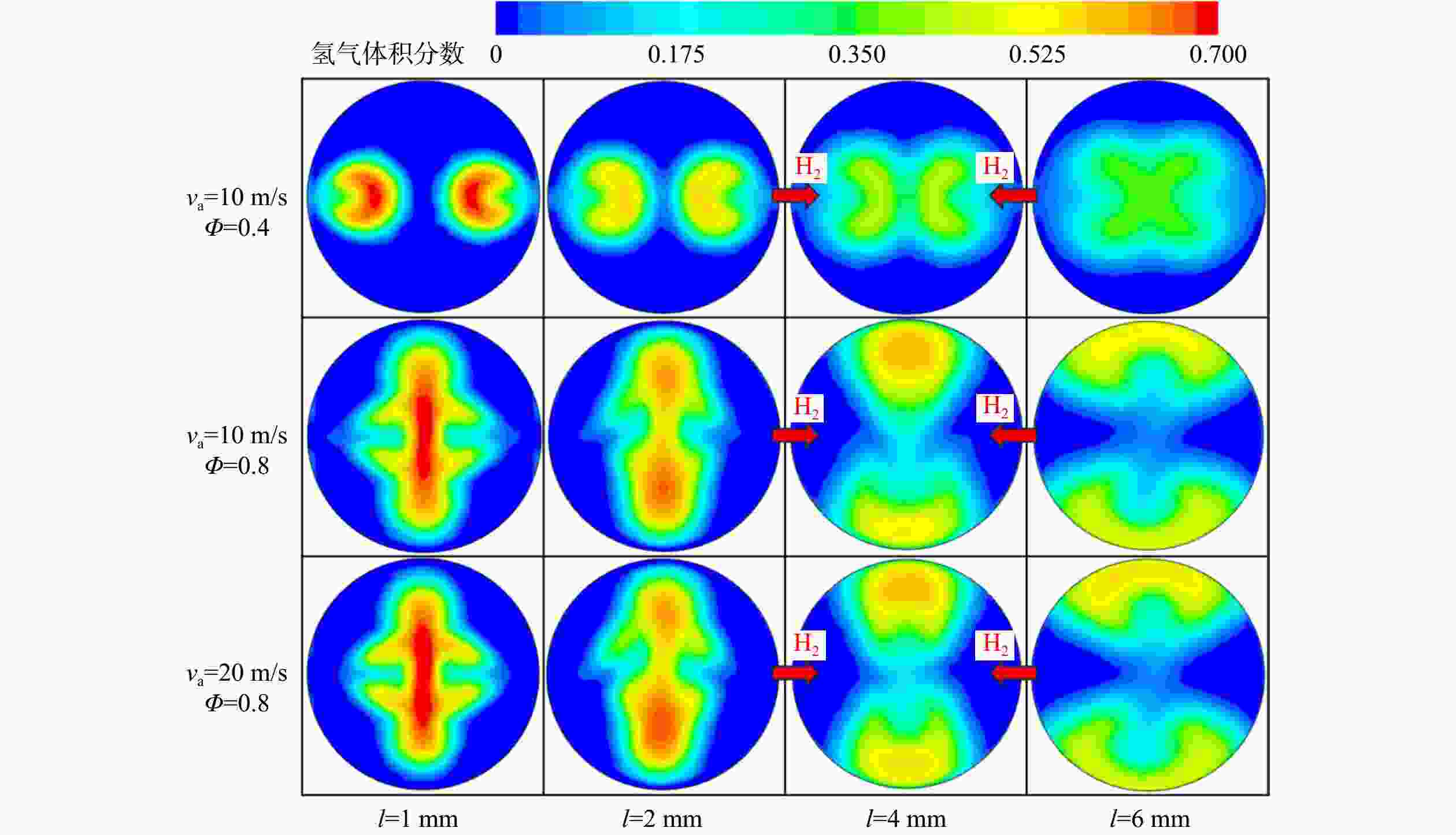
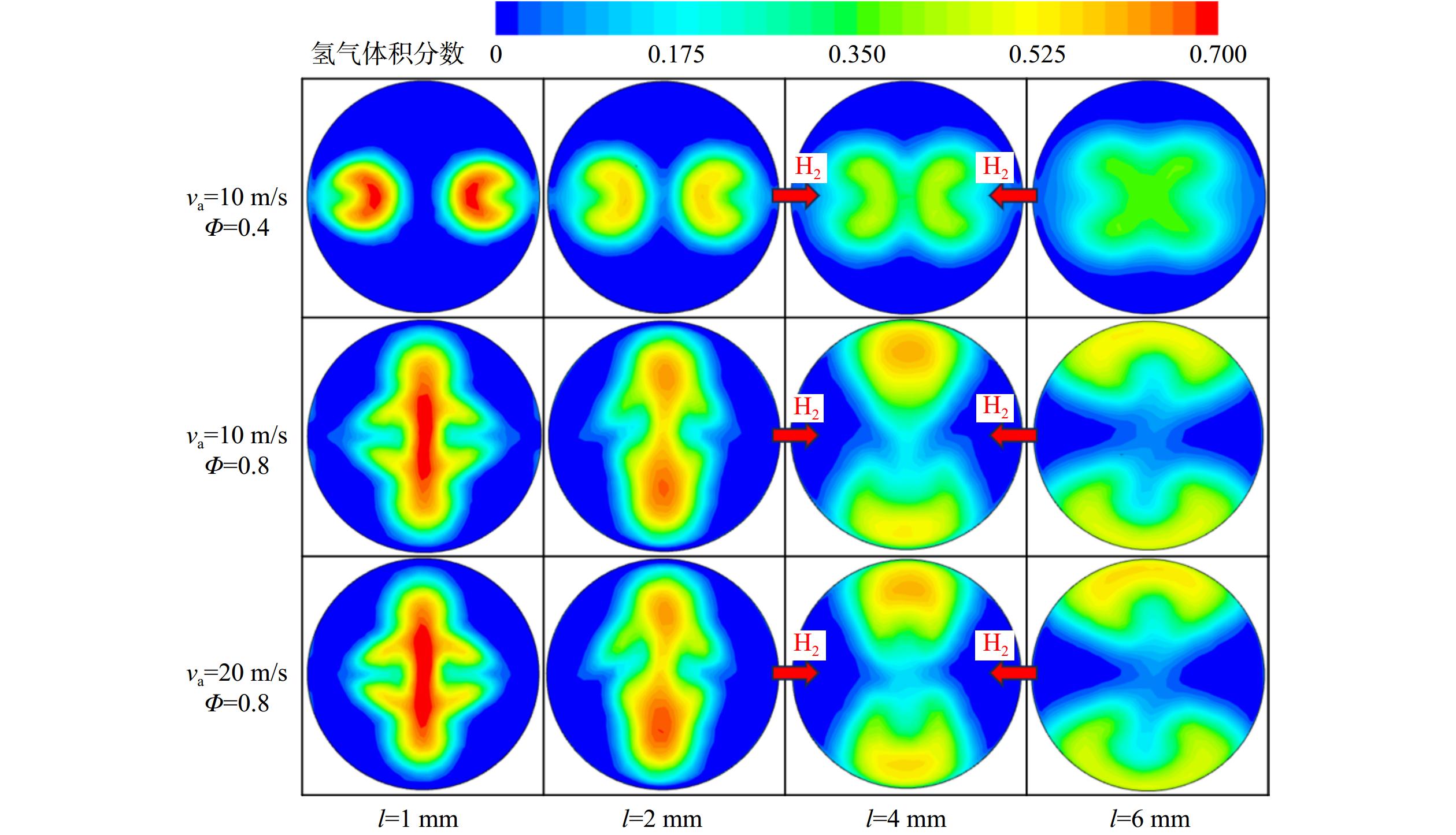
图 8 不同微混段长度的微混单元出口H2分布
Figure 8. Distribution of H2 at the outlet of micro-mixing units with different lengths of blending sections
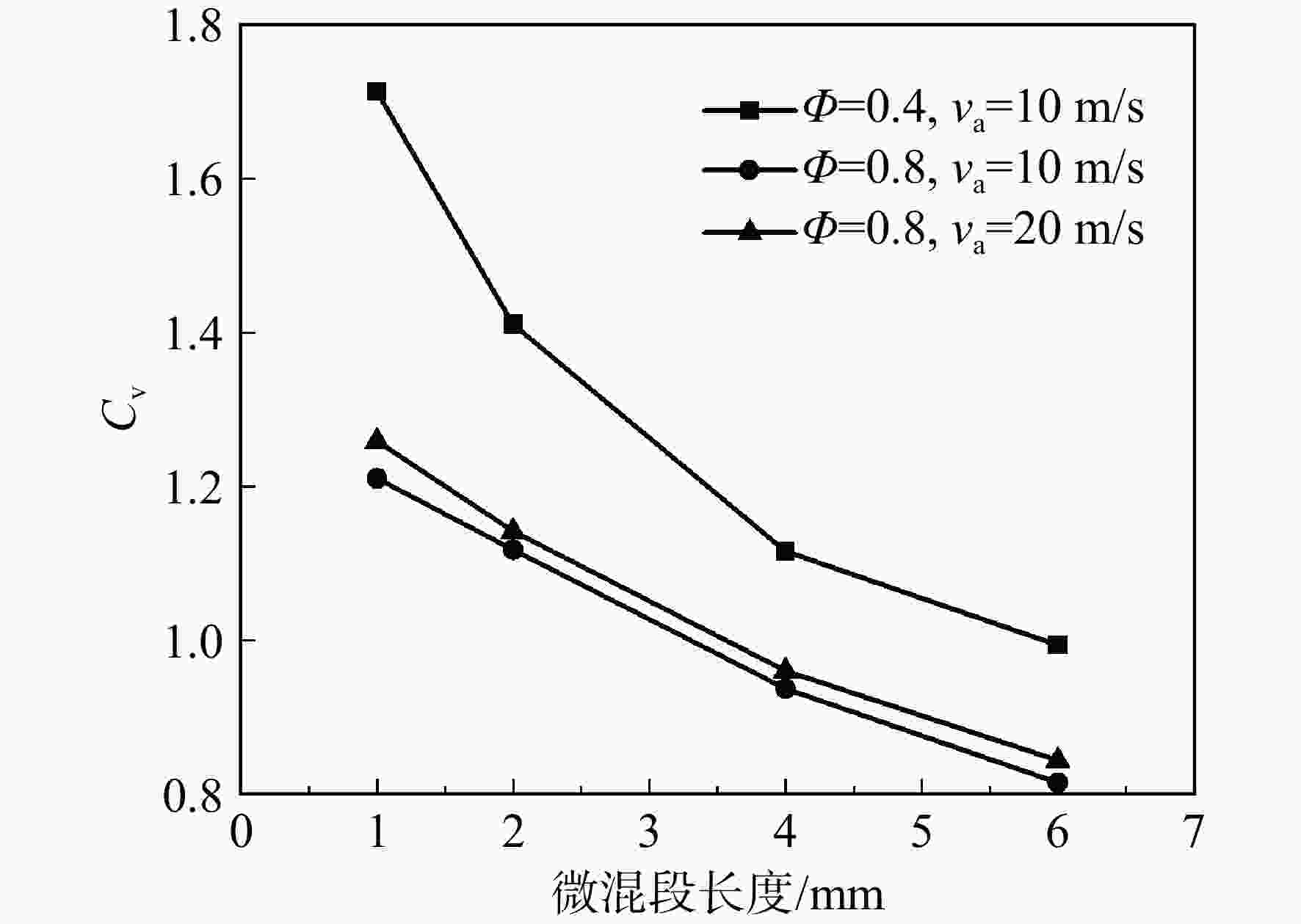
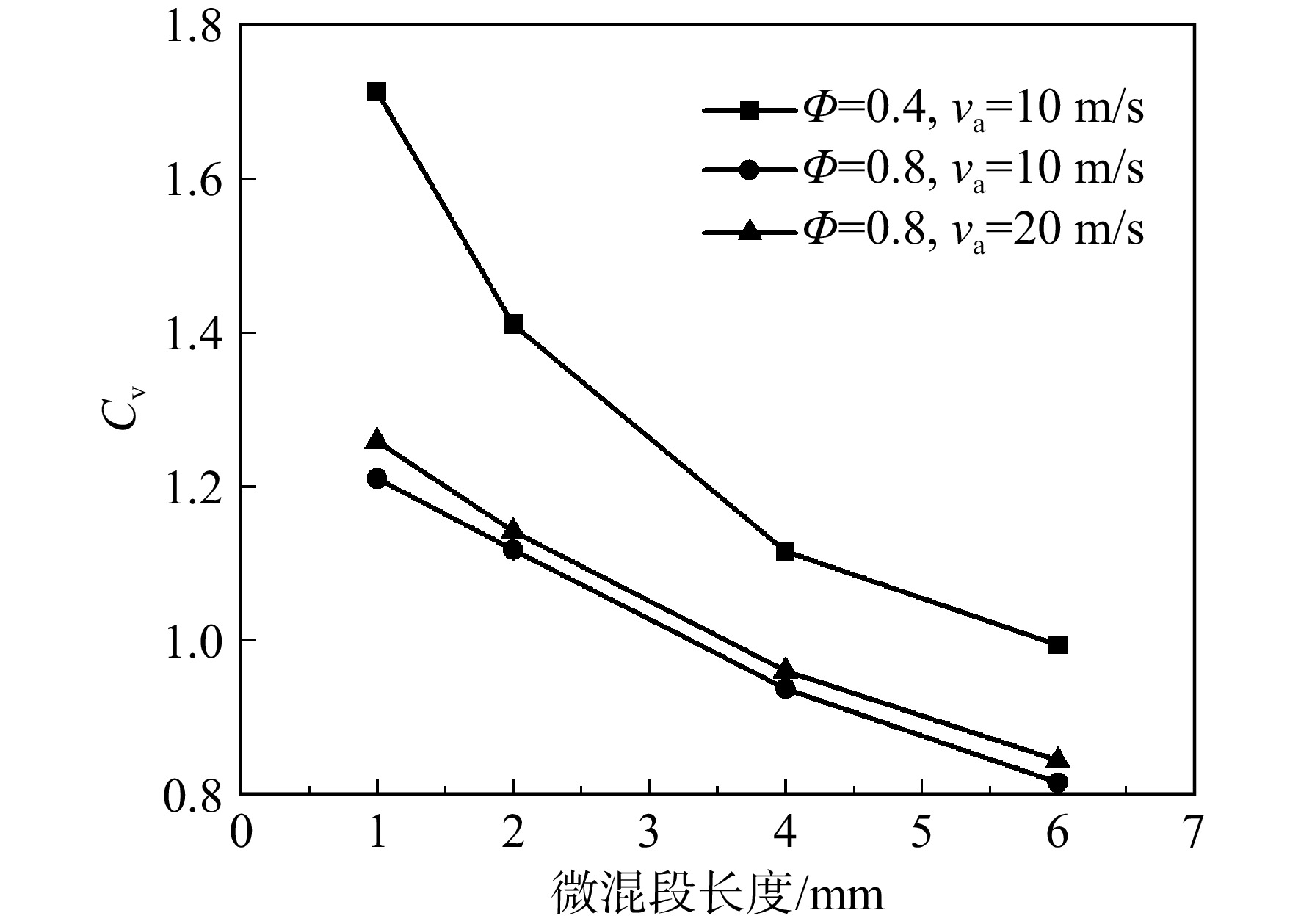
图 9 不同微混段长度的H2掺混效果
Figure 9. H2 blending effects with different lengths of blending sections
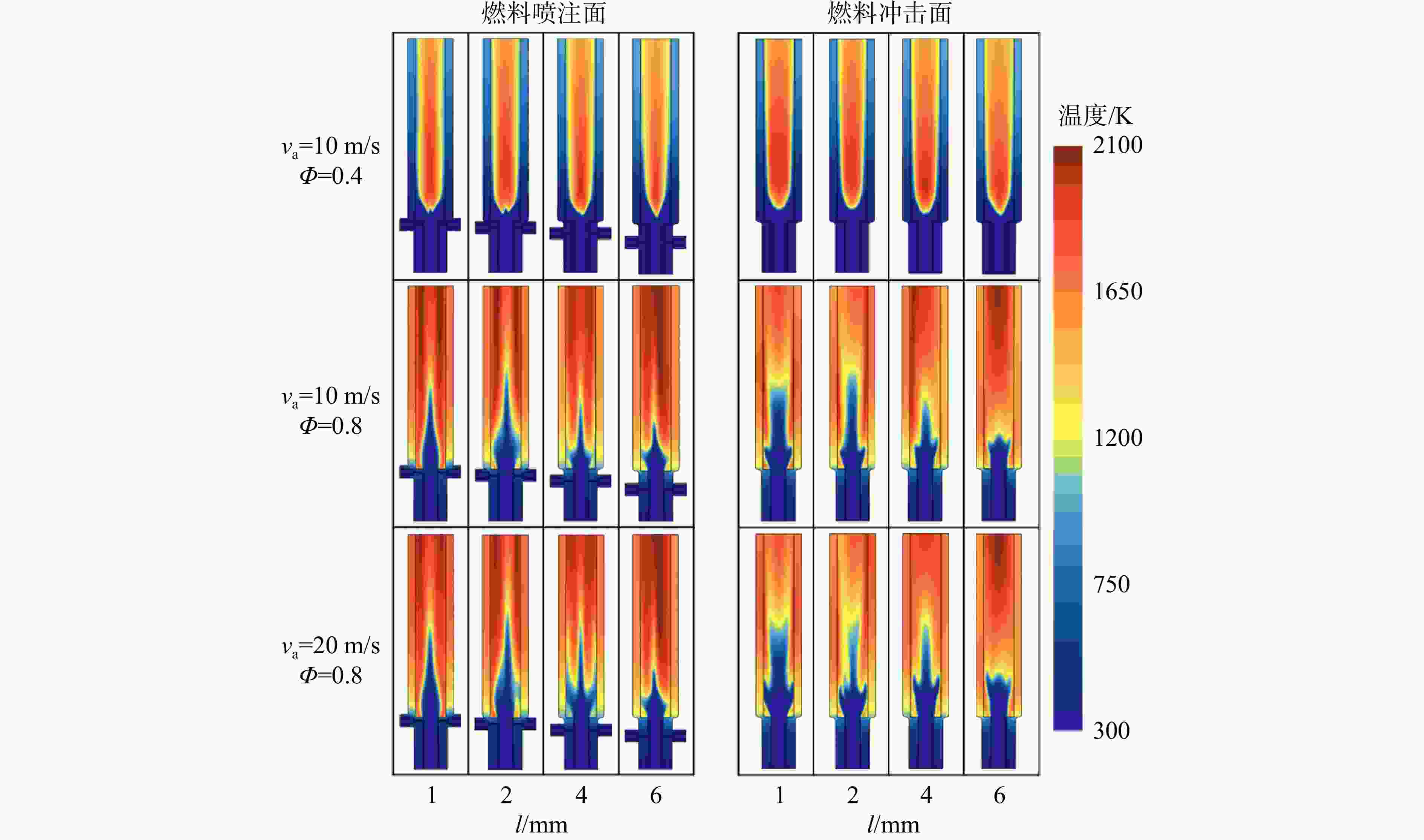
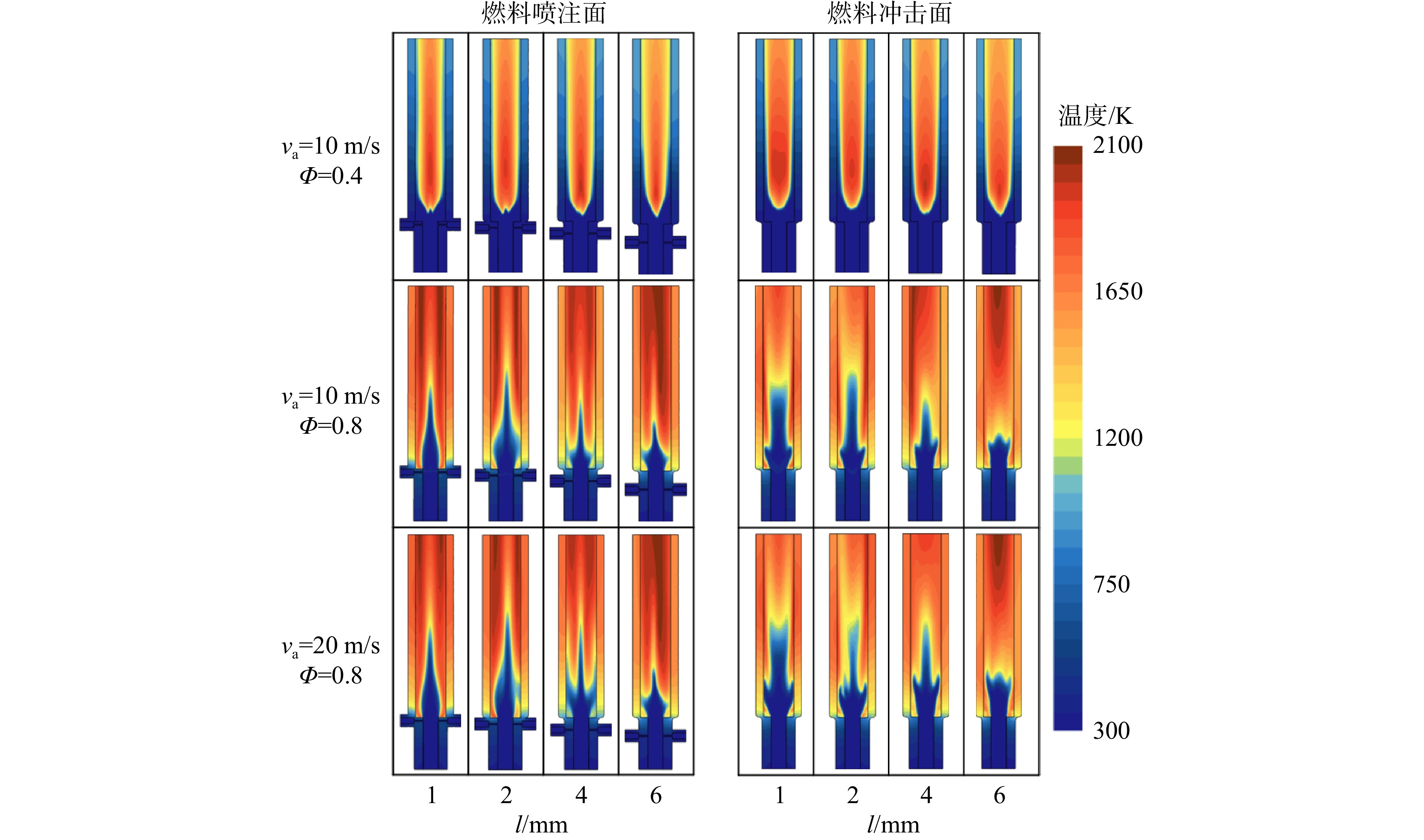
图 10 不同微混段长度的纵向温度分布
Figure 10. Longitudinal temperature distribution with different lengths of blending sections
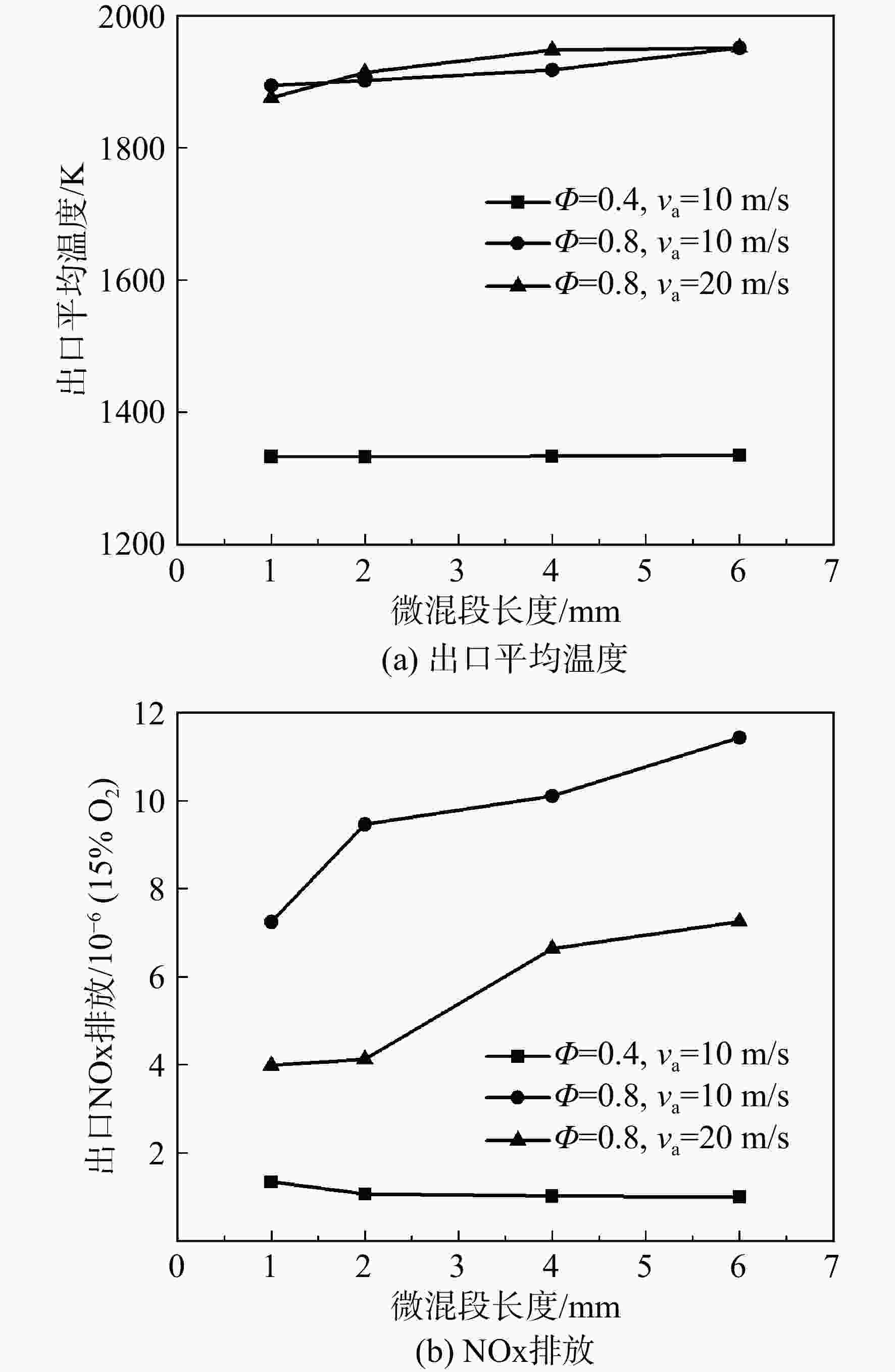
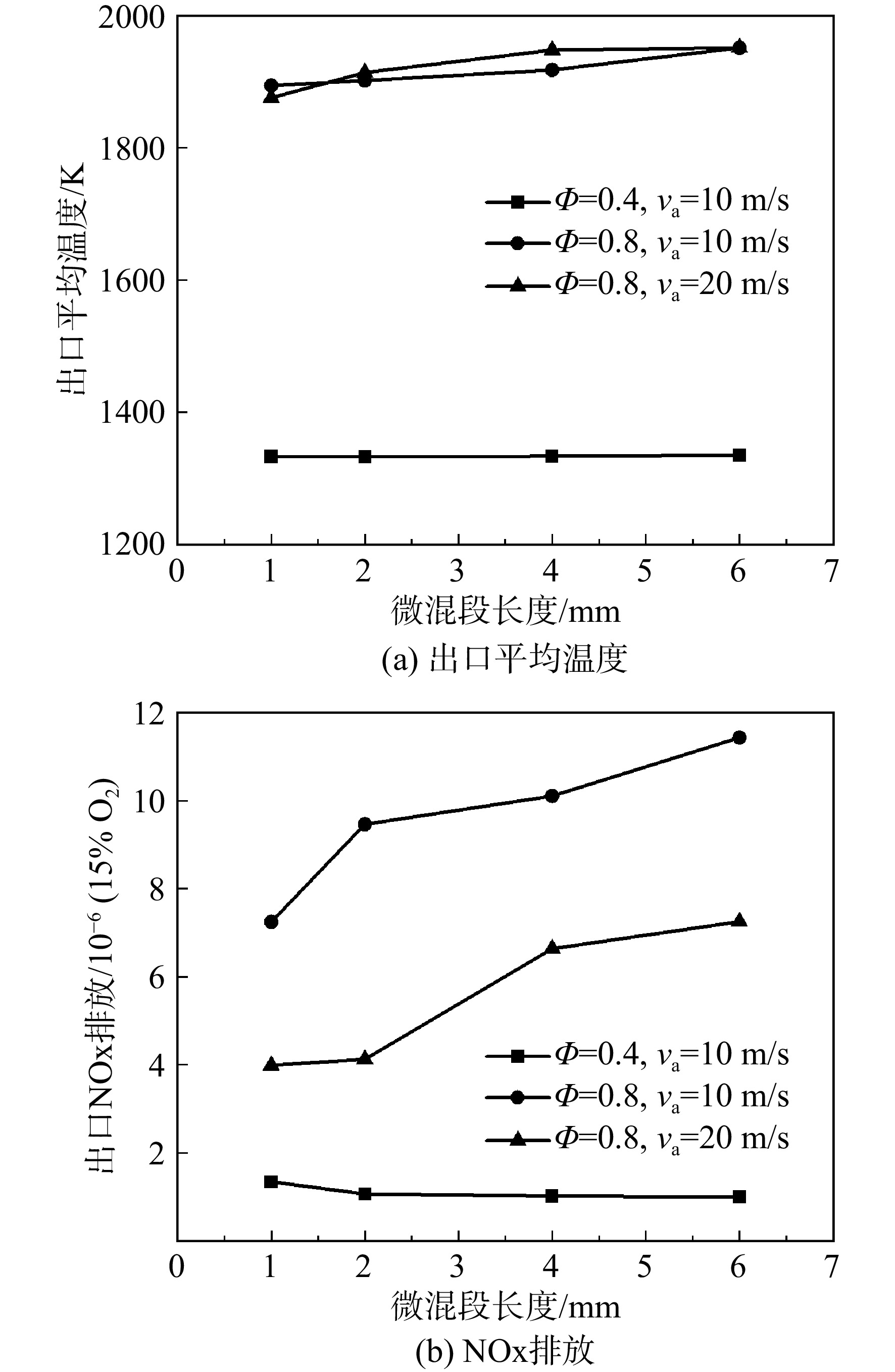
图 11 不同微混段长度的出口平均温度及NOx排放
Figure 11. Average temperatures of outlet and NOx emissions with different lengths of blending sections
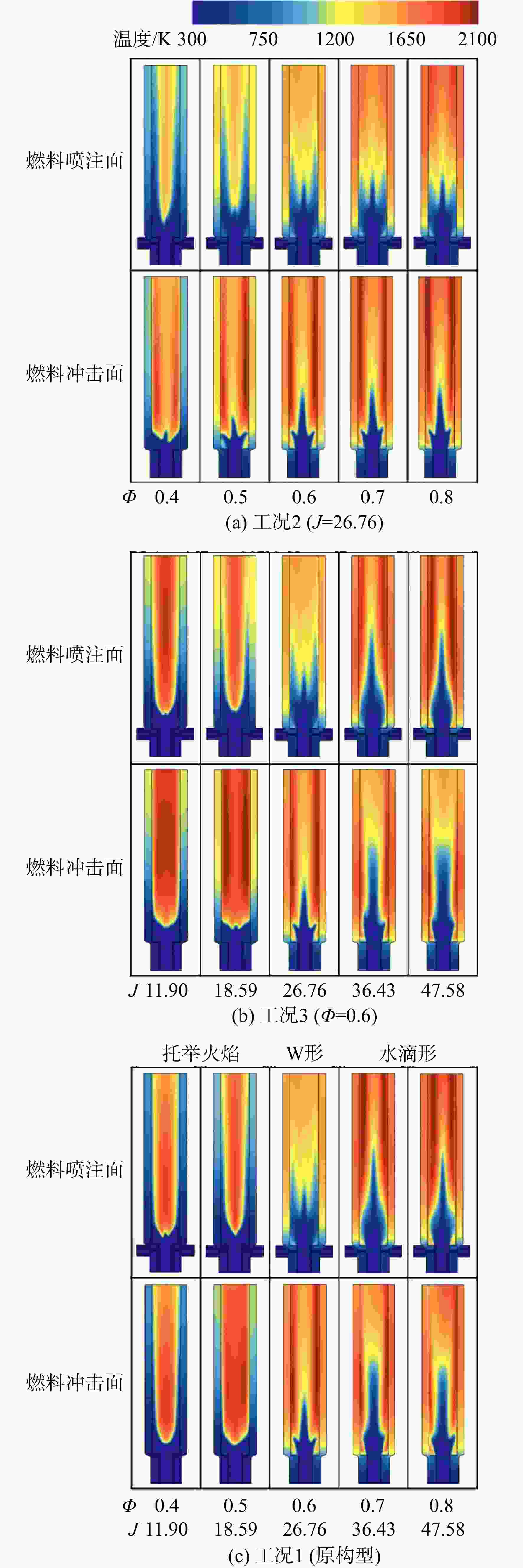
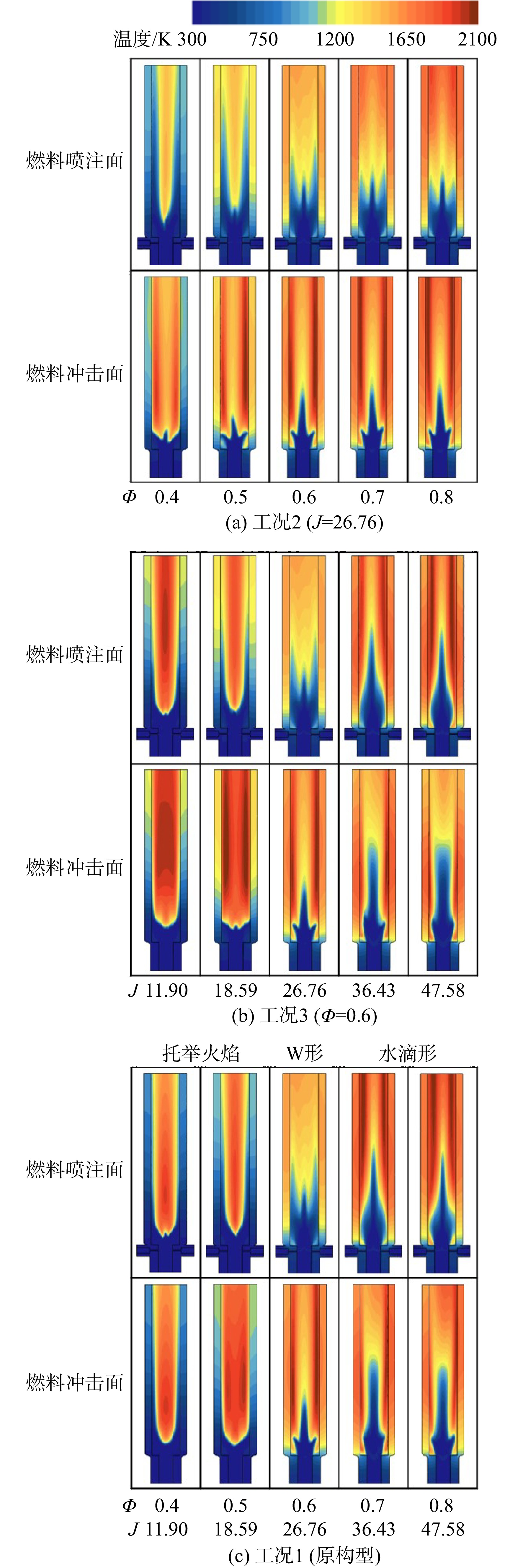
图 12 $ {v}_{\mathrm{a}} $=10 m/s时不同方案的纵向温度分布
Figure 12. Longitudinal temperature distribution of different schemes when $ {v}_{\mathrm{a}}$=10 m/s
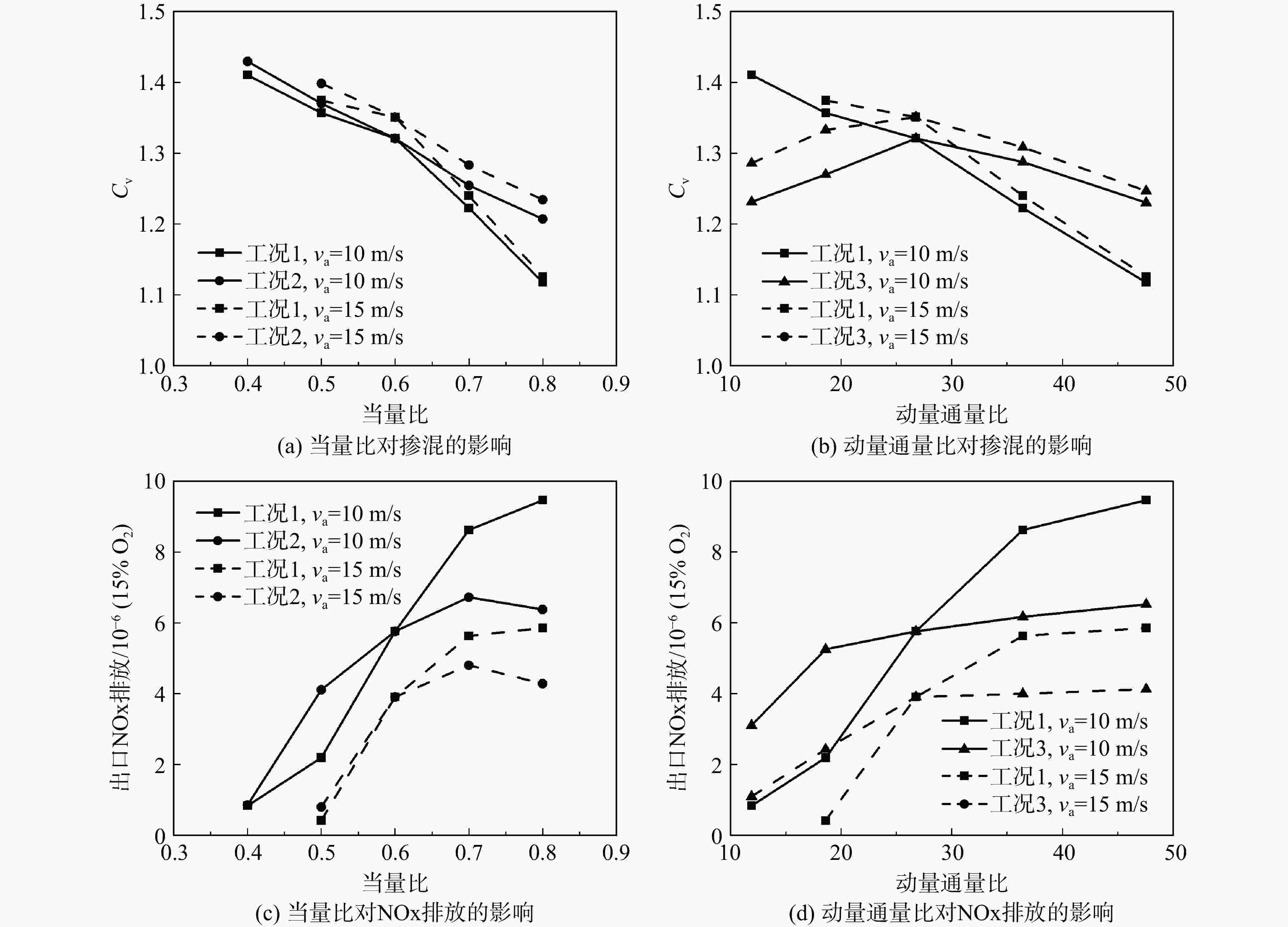
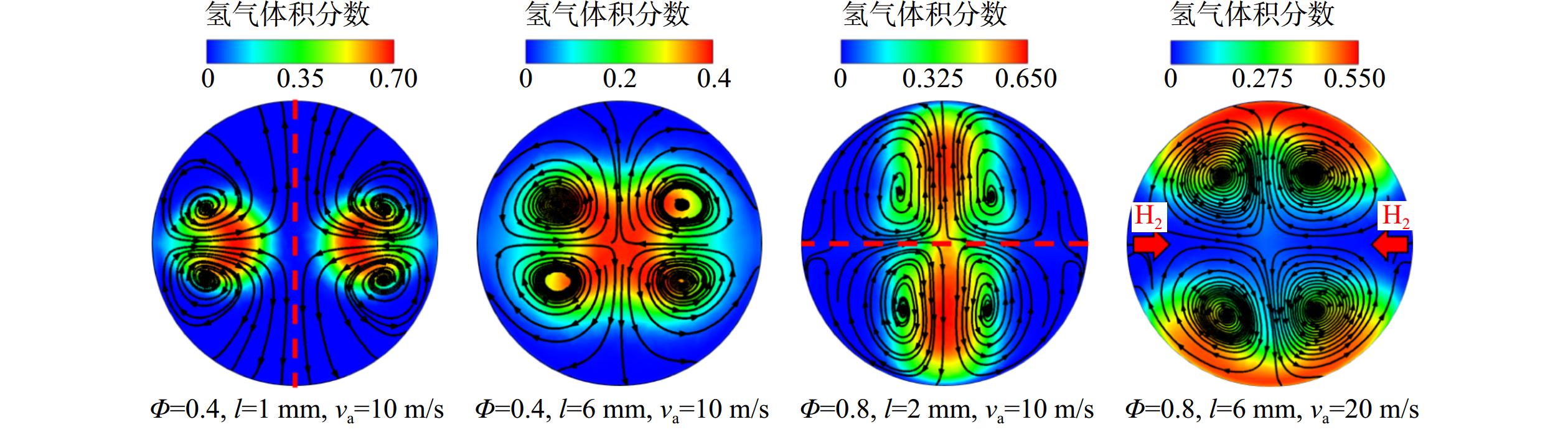
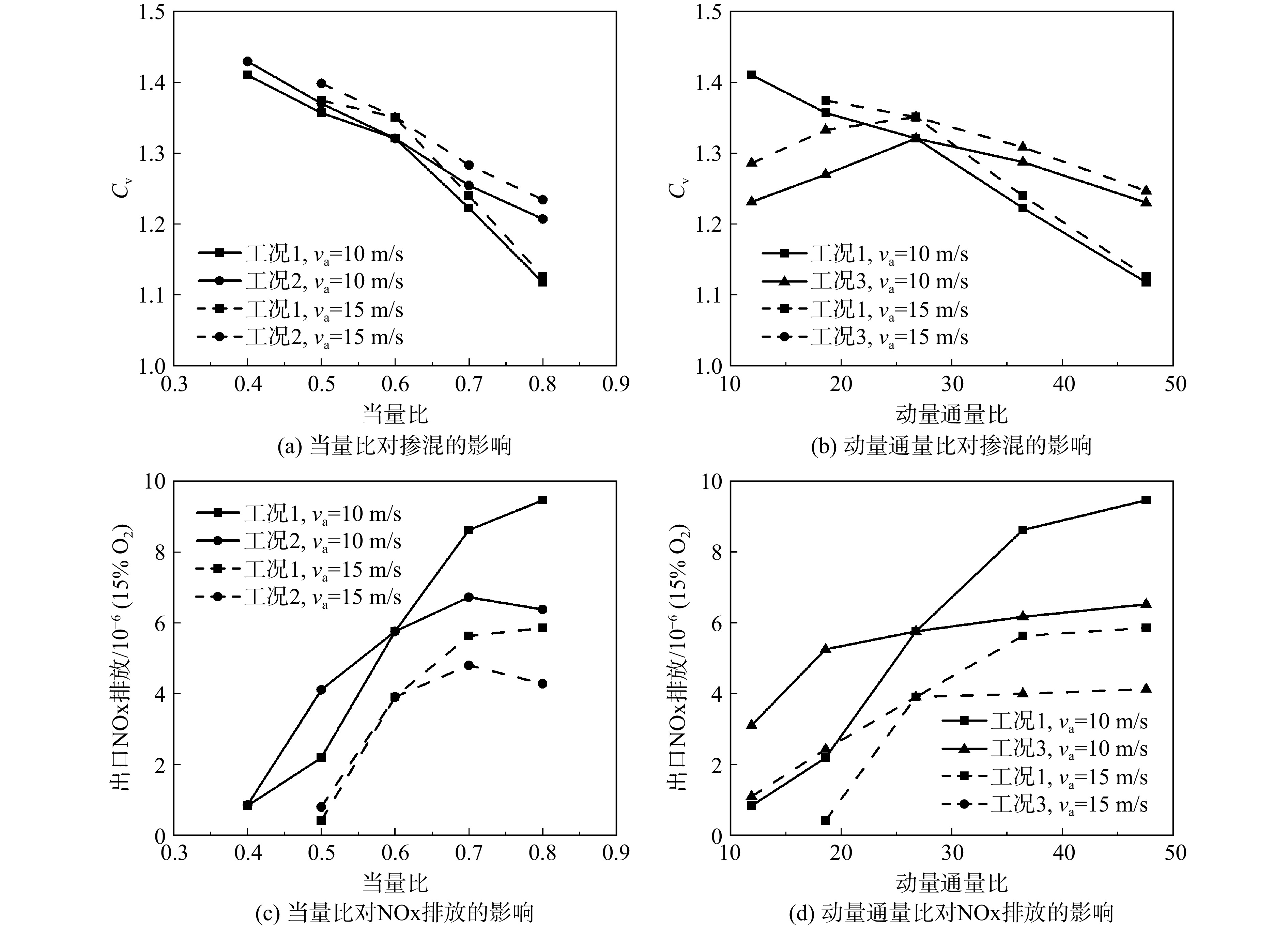
图 13 不同方案的掺混情况及NOx排放
Figure 13. Mixing conditions and NOx emissions of different schemes
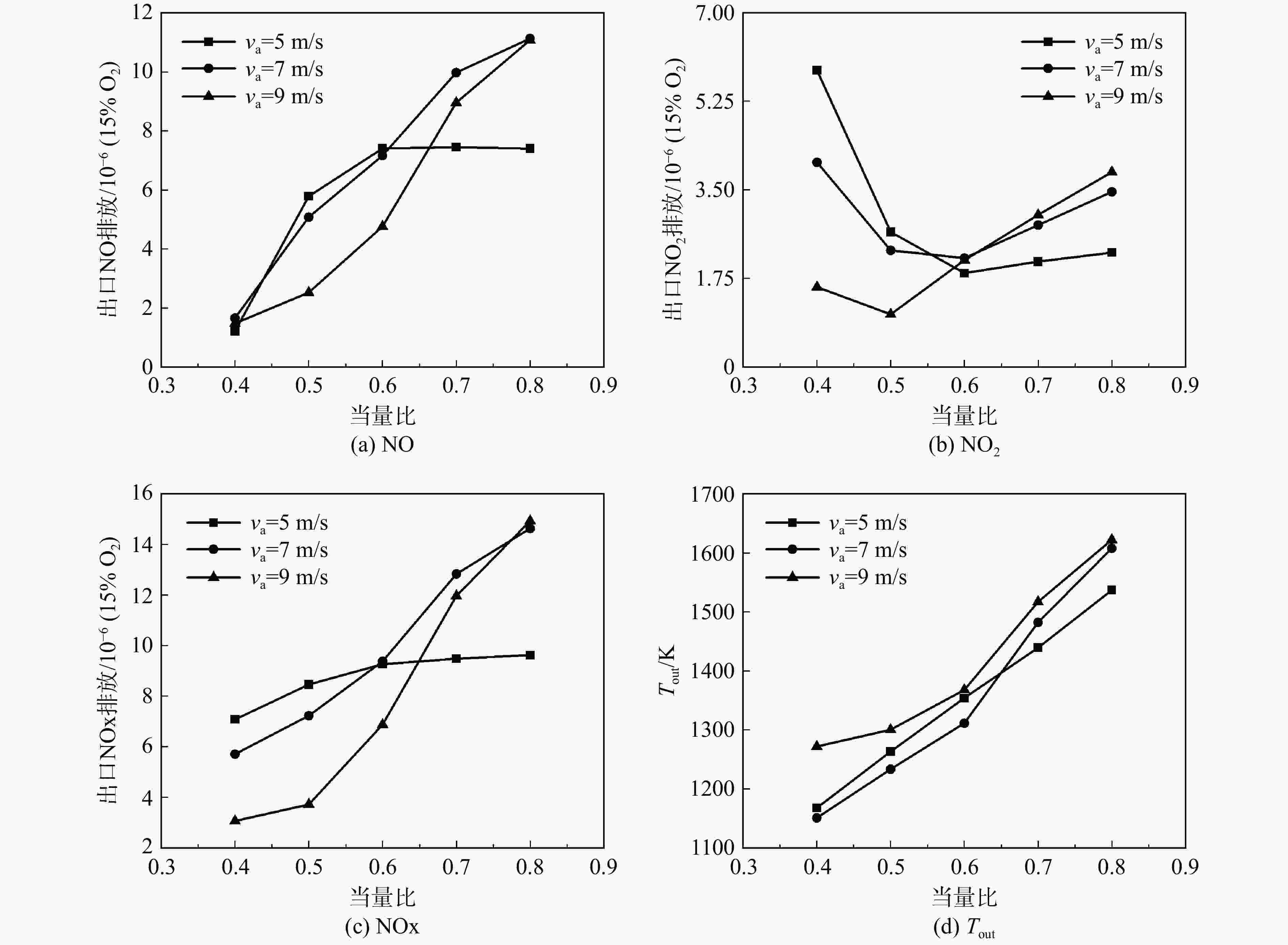
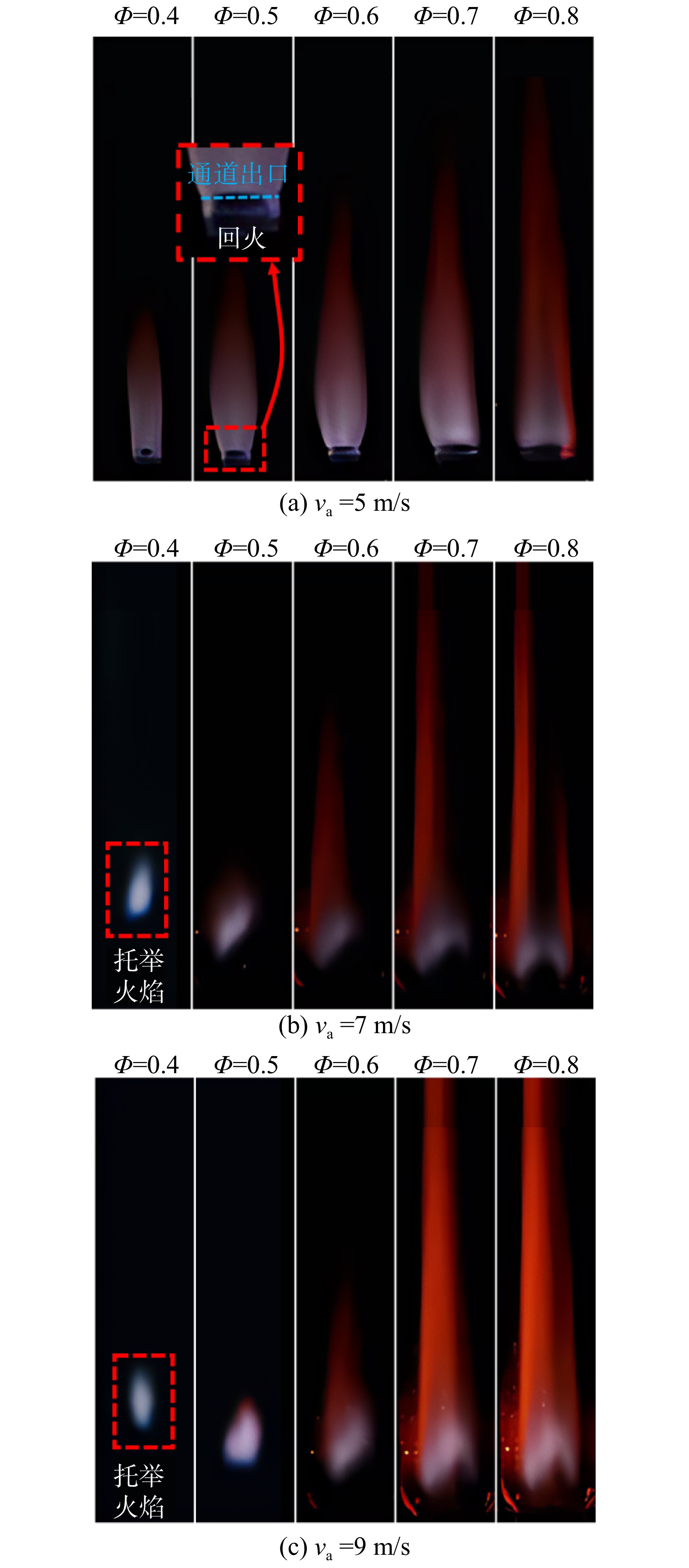
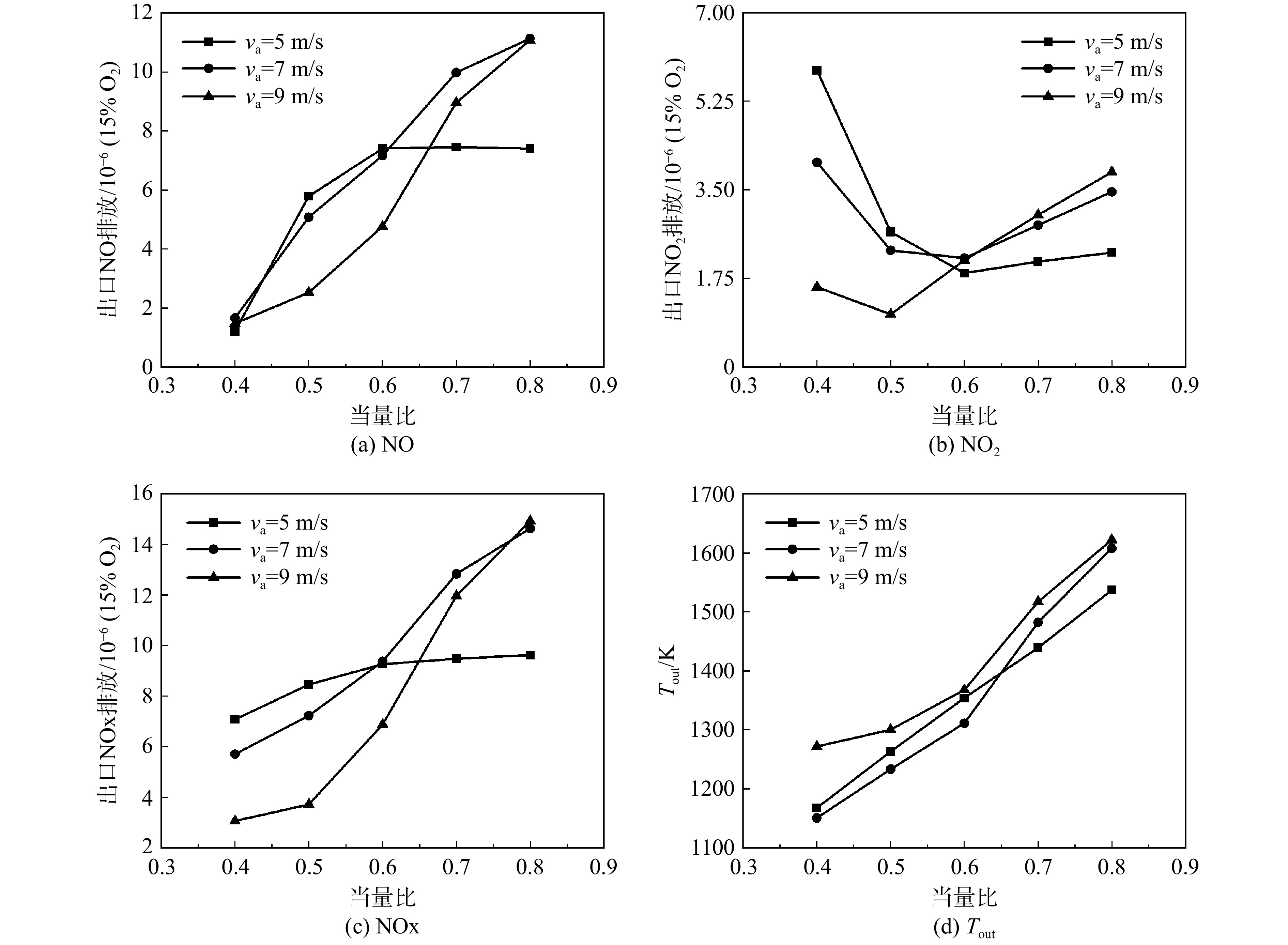
图 15 燃烧实验出口参数测量结果
Figure 15. Measurement results of the outlet parameters of the combustion experiment
表 1 化学反应式
Table 1. Chemical reaction equation
序号 反应式 序号 反应式 1 H2+O2$\rightleftharpoons $HO2+H 18 OH+H2O2$\rightleftharpoons $H2O+HO2 2 H+O2$\rightleftharpoons $OH+O 19 OH+OH+M$\rightleftharpoons $H2O2+M 3 O+H2$\rightleftharpoons $OH+H 20 N+N+M$\rightleftharpoons $N2+M 4 OH+H2$\rightleftharpoons $H2O+H 21 N+O2$\rightleftharpoons $NO+O 5 OH+OH$\rightleftharpoons $H2O+O 22 N+NO$\rightleftharpoons $N2+O 6 H+OH+M$\rightleftharpoons $H2O+M 23 N+OH$\rightleftharpoons $NO+H 7 H+H+M$\rightleftharpoons $H2+M 24 H+NO+M$\rightleftharpoons $HNO+M 8 H+O+M$\rightleftharpoons $OH+M 25 H+HNO$\rightleftharpoons $NO+H2 9 O+O+M$\rightleftharpoons $O2+M 26 O+HNO$\rightleftharpoons $NO+OH 10 H+O2+M$\rightleftharpoons $HO2+M 27 OH+HNO$\rightleftharpoons $NO+H2O 11 HO2+H$\rightleftharpoons $OH+OH 28 HO2+HNO$\rightleftharpoons $NO+H2O2 12 HO2+O$\rightleftharpoons $O2+OH 29 HO2+NO$\rightleftharpoons $NO2+OH 13 HO2+OH$\rightleftharpoons $H2O+O2 30 HO2+NO$\rightleftharpoons $HNO+O2 14 HO2+HO2$\rightleftharpoons $H2O2+O2 31 H+NO2$\rightleftharpoons $NO+OH 15 H+H2O2$\rightleftharpoons $H2+HO2 32 O+NO2$\rightleftharpoons $NO+O2 16 H+H2O2$\rightleftharpoons $OH+H2O 33 M+NO2$\rightleftharpoons $NO+O+M 17 O+H2O2$\rightleftharpoons $OH+HO2  下载: 导出CSV
表 2 试验测量量程与允许误差(满量程)
Table 2. Measurement range and allowable error of experiment (full scale)
测量物理量 量程 允许误差 O2 0%~25% 0.1% NO 0~200×10−6 1% FS NO2 0~100×10−6 1% FS NOx 0~300×10−6 1% FS Tout 273~1 873 K 1.5 K
下载: 导出CSV
表 3 变量方案分组原理
Table 3. Principle of different schemes
方案 $ {d}_{2}/\mathrm{m}\mathrm{m} $ $ \varPhi $ $ J $ 工况1 0.4 0.4~0.8 计算$ {J}_{\mathrm{c}1} $ 工况2 计算$ {d}_{2J} $ 0.4~0.8 26.76 工况3 计算$ {d}_{2\varPhi } $ 0.6 11.90~47.58
下载: 导出CSV
表 4 $ {{\boldsymbol{J}}}_{\bf{c}1} $与$ {{\boldsymbol{d}}}_{{\boldsymbol{2}}{\boldsymbol{J}}}\mathrm{、}{{\boldsymbol{d}}}_{{\boldsymbol{2}}{\boldsymbol{\varPhi}} } $的计算值
Table 4. Calculated values of $ {\boldsymbol{J}}_{\bf{c}1} $, $ {\boldsymbol{d}}_{{\bf{2}}\boldsymbol{J}}\; \mathbf{a}\mathbf{n}\mathbf{d}\; {\boldsymbol{d}}_{{\bf{2}}\boldsymbol{\varPhi }} $
$ \varPhi $ $ {J}_{\mathrm{c}1} $ $ {d}_{2J}/\mathrm{m}\mathrm{m} $ $ {d}_{2\varPhi }/\mathrm{m}\mathrm{m} $ 0.4 11.90 0.3266 0.4899 0.5 18.59 0.3651 0.4382 0.6 26.76 0.4000 0.4000 0.7 36.43 0.432 0.3703 0.8 47.58 0.4619 0.3464
下载: 导出CSV
表 5 试验工况表
Table 5. Experimental operating condition
参数 取值 $ {v}_{\mathrm{a}} $/(m/s) 5、7、9 $ \varPhi $ 0.4、0.5、0.6、0.7、0.8
下载: 导出CSV
-
[1] 莫妲, 林宇震, 韩啸, 等. 氢气微混燃烧技术研究现状和未来展望[J]. 航空学报, 2024, 45(7): 028994. MO Da, LIN Yuzhen, HAN Xiao, et al. Research progress and future prospect of hydrogen micromix combustion technology[J]. Acta Aeronautica et Astronautica Sinica, 2024, 45(7): 028994. (in ChineseMO Da, LIN Yuzhen, HAN Xiao, et al. Research progress and future prospect of hydrogen micromix combustion technology[J]. Acta Aeronautica et Astronautica Sinica, 2024, 45(7): 028994. (in Chinese) [2] CECERE D, GIACOMAZZI E, INGENITO A. A review on hydrogen industrial aerospace applications[J]. International Journal of Hydrogen Energy, 2014, 39(20): 10731-10747. doi: 10.1016/j.ijhydene.2014.04.126 [3] ABBASPOUR P, ALIPOOR A. Numerical study of combustion characteristics and oscillating behaviors of hydrogen-air combustion in converging-diverging microtubes[J]. International Journal of Heat and Mass Transfer, 2020, 159: 120127. doi: 10.1016/j.ijheatmasstransfer.2020.120127 [4] PERS H, ANIELLO A, MORISSEAU F, et al. Autoignition-induced flashback in hydrogen-enriched laminar premixed burners[J]. International Journal of Hydrogen Energy, 2023, 48(27): 10235-10249. doi: 10.1016/j.ijhydene.2022.12.041 [5] FENIMORE C P. Formation of nitric oxide in premixed hydrocarbon flames[J]. Symposium (International) on Combustion, 1971, 13(1): 373-380. doi: 10.1016/S0082-0784(71)80040-1 [6] ZELDVICH Y B. The oxidation of nitrogen in combustion and explosions[J]. Acta Physico-chimica Sinica, 1946, 21: 577-628. [7] 巨翃宇, 梁红侠, 索建秦, 等. 某航改燃机氢燃料燃烧室污染排放特性研究[J]. 推进技术, 2024, 45(3): 2209039. JU Hongyu, LIANG Hongxia, SUO Jianqin, et al. Study on pollution emission characteristics of hydrogen fuel combustion chamber of an aviation to gas turbine[J]. Journal of Propulsion Technology, 2024, 45(3): 2209039. (in ChineseJU Hongyu, LIANG Hongxia, SUO Jianqin, et al. Study on pollution emission characteristics of hydrogen fuel combustion chamber of an aviation to gas turbine[J]. Journal of Propulsion Technology, 2024, 45(3): 2209039. (in Chinese) [8] KIM D, JOO S, YOON Y. Effects of fuel line acoustics on the self-excited combustion instability mode transition with hydrogen-enriched laboratory-scale partially premixed combustor[J]. International Journal of Hydrogen Energy, 2020, 45(38): 19956-19964. doi: 10.1016/j.ijhydene.2020.05.074 [9] 马存祥, 李茂, 李九龙, 等. 氢燃料燃烧室旋流微扩散方案设计及数值仿真分析[J]. 燃气涡轮试验与研究, 2024, 37(5): 1-9. MA Cunxiang, LI Mao, LI Jiulong, et al. Design and numerical simulation analysis of hydrogen combustion chamber rotation micro diffusion scheme[J]. Gas Turbine Experiment and Research, 2024, 37(5): 1-9. (in Chinese doi: 10.3724/j.GTER.20240032MA Cunxiang, LI Mao, LI Jiulong, et al. Design and numerical simulation analysis of hydrogen combustion chamber rotation micro diffusion scheme[J]. Gas Turbine Experiment and Research, 2024, 37(5): 1-9. (in Chinese) doi: 10.3724/j.GTER.20240032 [10] LIU Xiuting, ZHAO Min, FENG Muye, et al. Study on mechanisms of methane/hydrogen blended combustion using reactive molecular dynamics simulation[J]. International Journal of Hydrogen Energy, 2023, 48(4): 1625-1635. doi: 10.1016/j.ijhydene.2022.10.050 [11] MAKARYAN I A, SEDOV I V, SALGANSKY E A, et al. A comprehensive review on the prospects of using hydrogen-methane blends: challenges and opportunities[J]. Energies, 2022, 15(6): 2265. doi: 10.3390/en15062265 [12] MA Mingcheng, LUO Sixiao, PENG Han, et al. Experimental study of flame dynamics and NOx emission characteristics in a NH3-H2 blended non-premixed swirl combustor[J]. International Journal of Hydrogen Energy, 2024, 110: 324-335. doi: 10.1016/j.ijhydene.2025.02.126 [13] CHIONG M C, CHONG C T, NG J H, et al. Advancements of combustion technologies in the ammonia-fuelled engines[J]. Energy Conversion and Management, 2021, 244: 114460. doi: 10.1016/j.enconman.2021.114460 [14] GÖKE S, FÜRI M, BOURQUE G, et al. Influence of steam dilution on the combustion of natural gas and hydrogen in premixed and rich-quench-lean combustors[J]. Fuel Processing Technology, 2013, 107: 14-22. doi: 10.1016/j.fuproc.2012.06.019 [15] WANG Longfei, XIAO Hang, YANG Bin, et al. Steam dilution effect on laminar flame characteristics of hydrogen-enriched oxy-combustion[J]. International Journal of Hydrogen Energy, 2024, 71: 375-386. doi: 10.1016/j.ijhydene.2024.05.244 [16] AKHTAR MARTINEZ C, JARRETT J. Configuration optimization of a hydrogen-kerosene hybrid combustion aircraft retrofit: AIAA-2023-1161 [R]. National Harbor, US: AIAA, 2023. [17] AYED A H, KUSTERER K, FUNKE H H, et al. Experimental and numerical investigations of the dry-low-NOx hydrogen micromix combustion chamber of an industrial gas turbine[J]. Propulsion and Power Research, 2015, 4(3): 123-131. doi: 10.1016/j.jppr.2015.07.005 [18] 贾世琦, 史挺, 刘怡, 等. 不同空气流速对多孔介质微预混燃烧器性能的影响[J]. 燃气涡轮试验与研究, 2024, 37(5): 10-20. JIA Shiqi, SHI Ting, LIU Yi, et al. Impact of different air flow velocities on the performance of porous media micro-premixed burner[J]. Gas Turbine Experiment and Research, 2024, 37(5): 10-20. (in Chinese doi: 10.3724/j.GTER.20240031JIA Shiqi, SHI Ting, LIU Yi, et al. Impact of different air flow velocities on the performance of porous media micro-premixed burner[J]. Gas Turbine Experiment and Research, 2024, 37(5): 10-20. (in Chinese) doi: 10.3724/j.GTER.20240031 [19] BRAND J, SAMPATH S, SHUM F, et al. Potential use of hydrogen in air propulsion: AIAA2003-2879 [R]. Dayton, US: AIAA, 2003. [20] 赵钦新, 王宗一, 邓世丰, 等. 氢气燃烧技术及其进展[J]. 科学技术与工程, 2022, 22(36): 15870-15880. ZHAO Qinxin, WANG Zongyi, DENG Shifeng, et al. Hydrogen combustion technology and progress[J]. Science Technology and Engineering, 2022, 22(36): 15870-15880. (in Chinese doi: 10.3969/j.issn.1671-1815.2022.36.003ZHAO Qinxin, WANG Zongyi, DENG Shifeng, et al. Hydrogen combustion technology and progress[J]. Science Technology and Engineering, 2022, 22(36): 15870-15880. (in Chinese) doi: 10.3969/j.issn.1671-1815.2022.36.003 [21] DAHL G, SUTTROP F. Engine control and low-NOx combustion for hydrogen fuelled aircraft gas turbines[J]. International Journal of Hydrogen Energy, 1998, 23(8): 695-704. doi: 10.1016/S0360-3199(97)00115-8 [22] NOSE M, KAWAKAMI T, ARAKI H, et al. Hydrogen-fired gas turbine targeting realization of CO2-free society[J]. Mitsubishi Heavy Industries Technical Review, 2018, 55(4): 1-7. [23] LEI Huanrong, KHANDELWAL B. Investigation of novel configuration of hydrogen micromix combustor for low NOx emission: AIAA2020-1933 [R]. Orlando, US: AIAA, 2020. [24] SETHI V, SUN Xiaoxiao, NALIANDA D, et al. Enabling cryogenic hydrogen-based CO2-free air transport: meeting the demands of zero carbon aviation[J]. IEEE Electrification Magazine, 2022, 10(2): 69-81. doi: 10.1109/MELE.2022.3165955 [25] 莫妲, 林宇震, 马宏宇, 等. 基于钝体扰流的氢气微混扩散燃烧组织研究[J]. 航空学报, 2024, 45(8): 128928. MO Da, LIN Yuzhen, MA Hongyu, et al. Investigation on hydrogen micromix diffusive combustion organization based on bluff body disturbance[J]. Acta Aeronautica et Astronautica Sinica, 2024, 45(8): 128928. (in ChineseMO Da, LIN Yuzhen, MA Hongyu, et al. Investigation on hydrogen micromix diffusive combustion organization based on bluff body disturbance[J]. Acta Aeronautica et Astronautica Sinica, 2024, 45(8): 128928. (in Chinese) [26] SUN Xiaoxiao, AGARWAL P, CARBONARA F, et al. Numerical investigation into the impact of injector geometrical design parameters on hydrogen micromix combustion characteristics[C]// Proceedings of Turbo Expo: Power for Land, Sea, and Air. New York: ASME, 2020: 15694. [27] SUN Xiaoxiao, ABBOTT D, VIR SINGH A, et al. Numerical investigation of potential cause of instabilities in a hydrogen micromix injector array[C]// Proceedings of Turbo Expo: Power for Land, Sea, and Air. New York: ASME, 2021: 59842. [28] 刘海清. 合成气微混燃烧单喷嘴火焰特性研究[D]. 哈尔滨: 哈尔滨工业大学, 2022. LIU Haiqing. Study on flame characteristics of single nozzle in syngas micro-mixed combustion[D]. Harbin: Harbin Institute of Technology, 2022. (in ChineseLIU Haiqing. Study on flame characteristics of single nozzle in syngas micro-mixed combustion[D]. Harbin: Harbin Institute of Technology, 2022. (in Chinese) [29] WANG Zhiqiang, LIU Xiao, LIU Jiaqi, et al. Study on mixing and combustion performance of hydrogen micro-mixing combustor[J]. International Journal of Hydrogen Energy, 2025, 102: 80-93. doi: 10.1016/j.ijhydene.2024.12.419 [30] CHEN Xuanren, WANG Hui, WANG Chao, et al. Numerical investigation into fuel-air mixing characteristics and cold flow field of single hydrogen-rich Micromix nozzle[J]. Fuel, 2023, 332: 126181. doi: 10.1016/j.fuel.2022.126181 [31] NOZARI H, KARABEYOĞLU A. Numerical study of combustion characteristics of ammonia as a renewable fuel and establishment of reduced reaction mechanisms[J]. Fuel, 2015, 159: 223-233. doi: 10.1016/j.fuel.2015.06.075 [32] OTOMO J, KOSHI M, MITSUMORI T, et al. Chemical kinetic modeling of ammonia oxidation with improved reaction mechanism for ammonia/air and ammonia/hydrogen/air combustion[J]. International Journal of Hydrogen Energy, 2018, 43(5): 3004-3014. doi: 10.1016/j.ijhydene.2017.12.066 [33] OKAFOR E C, NAITO Y, COLSON S, et al. Experimental and numerical study of the laminar burning velocity of CH4-NH3-air premixed flames[J]. Combustion and Flame, 2018, 187: 185-198. doi: 10.1016/j.combustflame.2017.09.002 [34] KONNOV A A, MOHAMMAD A, KISHORE V R, et al. A comprehensive review of measurements and data analysis of laminar burning velocities for various fuel+air mixtures[J]. Progress in Energy and Combustion Science, 2018, 68: 197-267. doi: 10.1016/j.pecs.2018.05.003 [35] SU Yue, LI Jingfa, GUO Wangyi, et al. Prediction of mixing uniformity of hydrogen injection inNatural gas pipeline based on a deep learning model[J]. Energies, 2022, 15(22): 8694. doi: 10.3390/en15228694 -


 点击查看大图

计量
- 文章访问数: 642
- HTML浏览量: 388
- PDF量: 66
- 被引次数: 0