






Study on lift enhancement effectiveness of co-flow jet technology in hybrid wing-body amphibious aircraft
-
摘要:
针对翼身混合(hybrid wing-body,HWB)布局水陆两栖飞机设计了单缝富勒襟翼增升装置,在主翼上表面布设了吹吸气区域,系统验证了协同射流(co-flow jet,CFJ)技术对新型气动布局增升效,并对其气动特性提升效果及改善机制进行了阐释。数值模拟结果表明:襟翼偏角为40°时,增升构型最大升力系数达到2.7;布设CFJ后,上翼面流速提高,负压明显增加,翼面初始流动分离得到了有效调控,最大升力系数提高至3.2,失速攻角拓宽4°,阻力系数降低20%以上,俯仰力矩可用范围增加。此外,CFJ也提升了襟翼表面流速,抑制了较大迎角状态下当地的潜在分离,使前缘负压峰值最大提高30%以上,显著提高了襟翼的增升效率。
Abstract:A single-slotted Fowler flap high-lift device for a hybrid wing-body (HWB) configured amphibious aircraft was designed, incorporating blowing/suction zones on the upper surface of the main wing. It systematically validated the lift-enhancement effectiveness of the co-flow jet (CFJ) technology on this novel aerodynamic configuration and elucidated the mechanisms behind its aerodynamic performance improvements. Numerical simulation results demonstrated that: when the flap deflection angle reached 40°, the maximum lift coefficient of the high-lift configuration attained 2.7; after implementing CFJ, the flow velocity over the upper wing surface increased, accompanied by a significant rise in negative pressure. The initial flow separation on the wing surface was effectively controlled, with the maximum lift coefficient increasing to 3.2, stall angle of attack extended by 4°, drag coefficient reduced by over 20%, and available range of pitching moment expanded. Additionally, CFJ enhanced the surface flow velocity on the flaps and suppressed the potential local separation under high angle-of-attack conditions, increasing the leading-edge negative pressure peak by up to 30% and significantly improving the flap lift-enhancement efficiency.
-
Key words:
- hybrid wing-body /
- amphibious aircraft /
- single-slotted Fowler flap /
- active flow control /
- co-flow jet
-
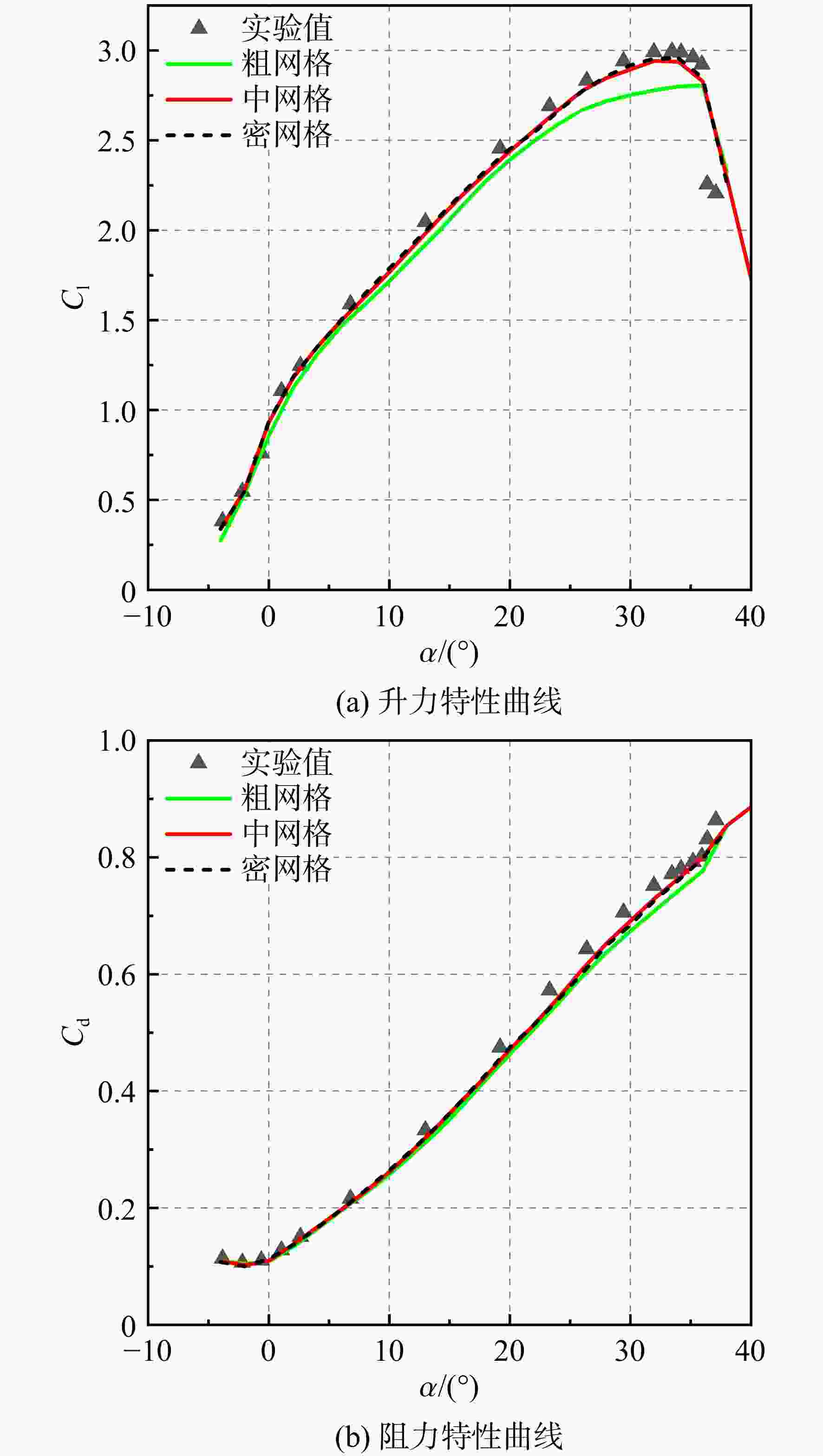
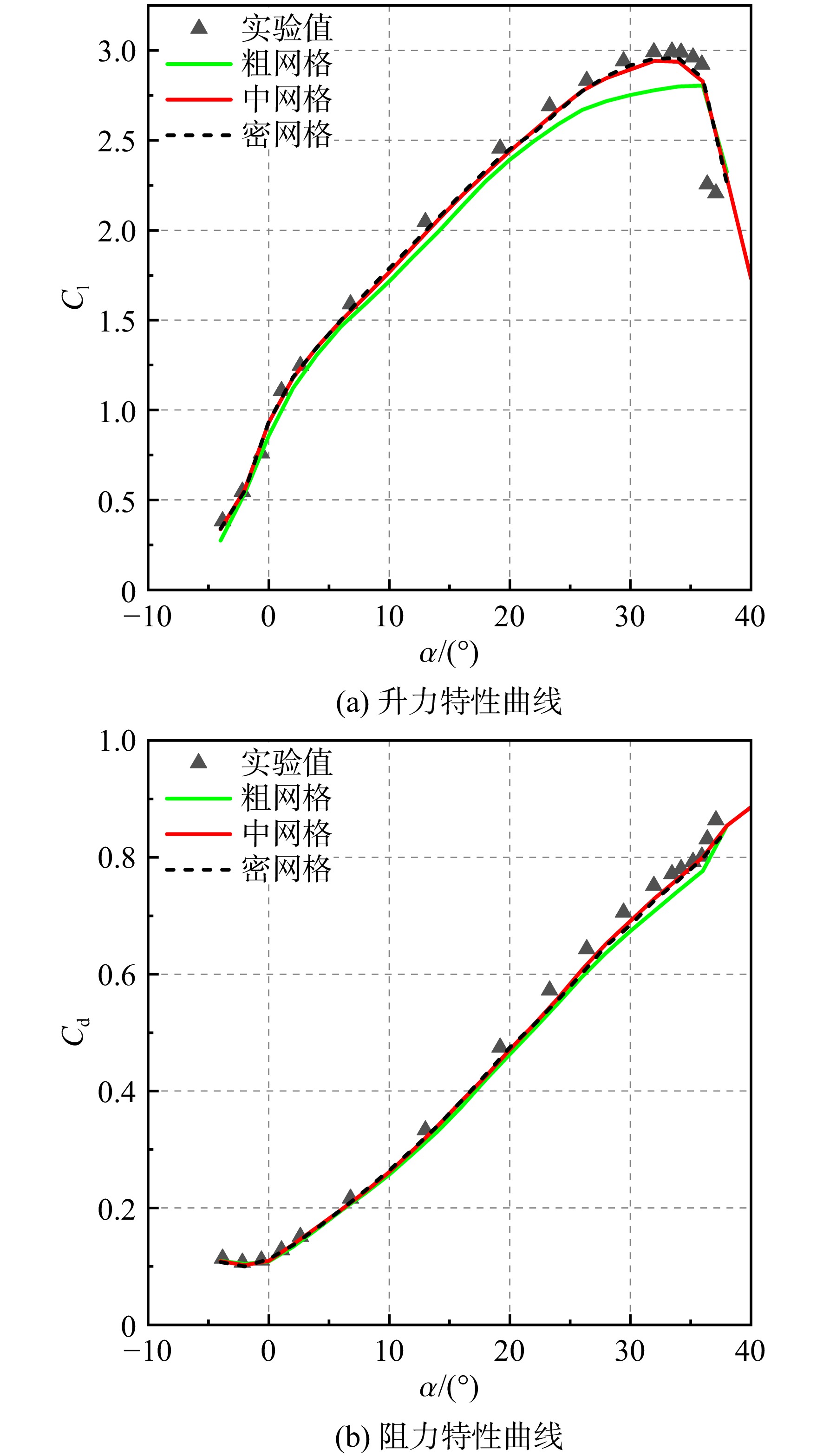
图 2 HiLiftPW-1构型气动力特性曲线计算与实验结果对比
Figure 2. Comparison of calculated and experimental results for aerodynamic characteristics of the HiLiftPW-1 configuration
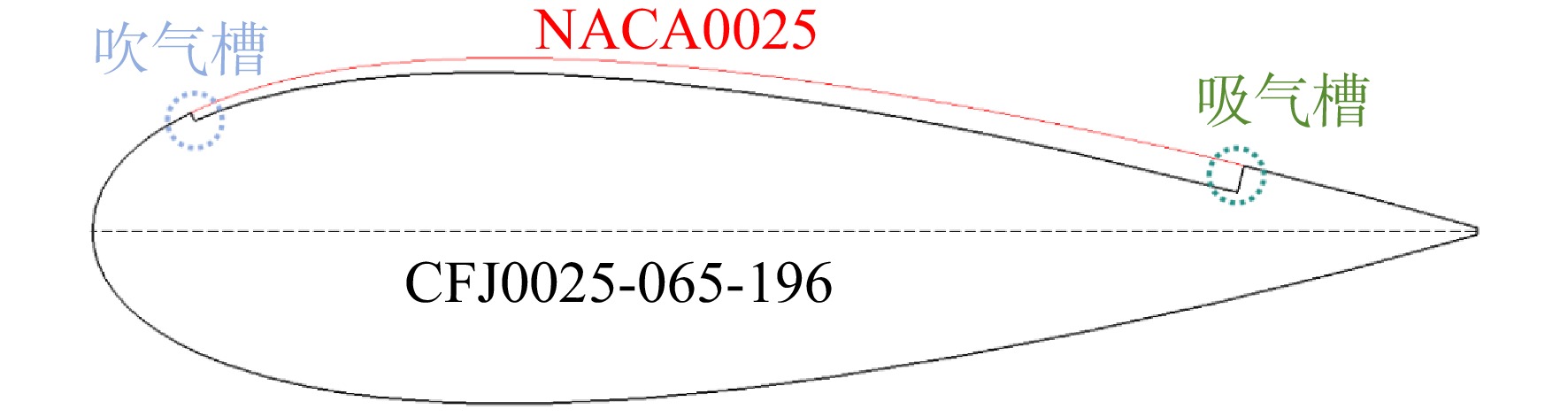
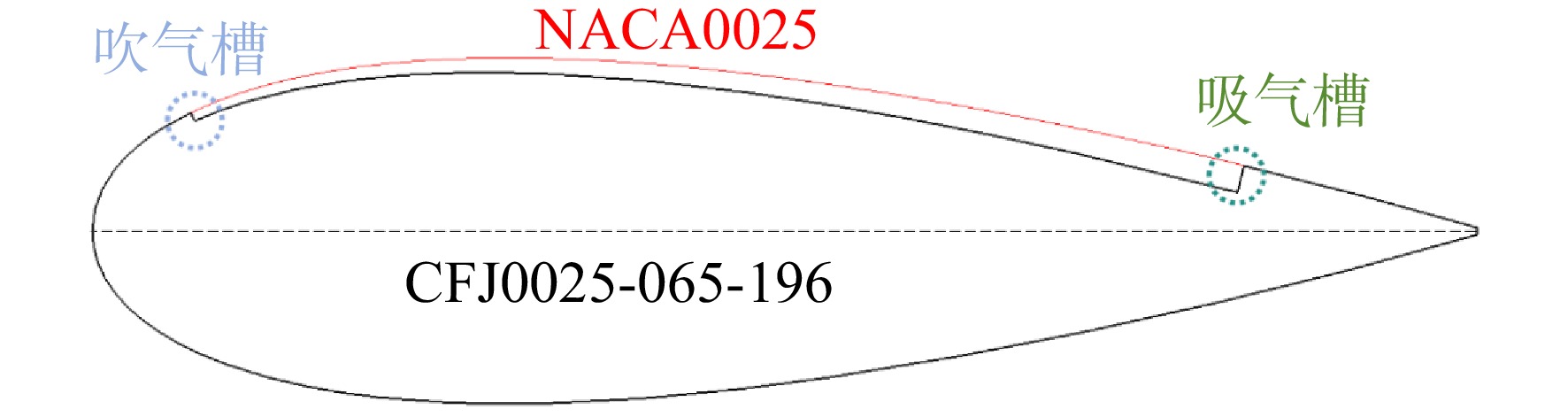
图 3 基于NACA0025的CFJ0025-065-196翼型
Figure 3. CFJ0025-065-196 airfoil based on NACA0025 profile
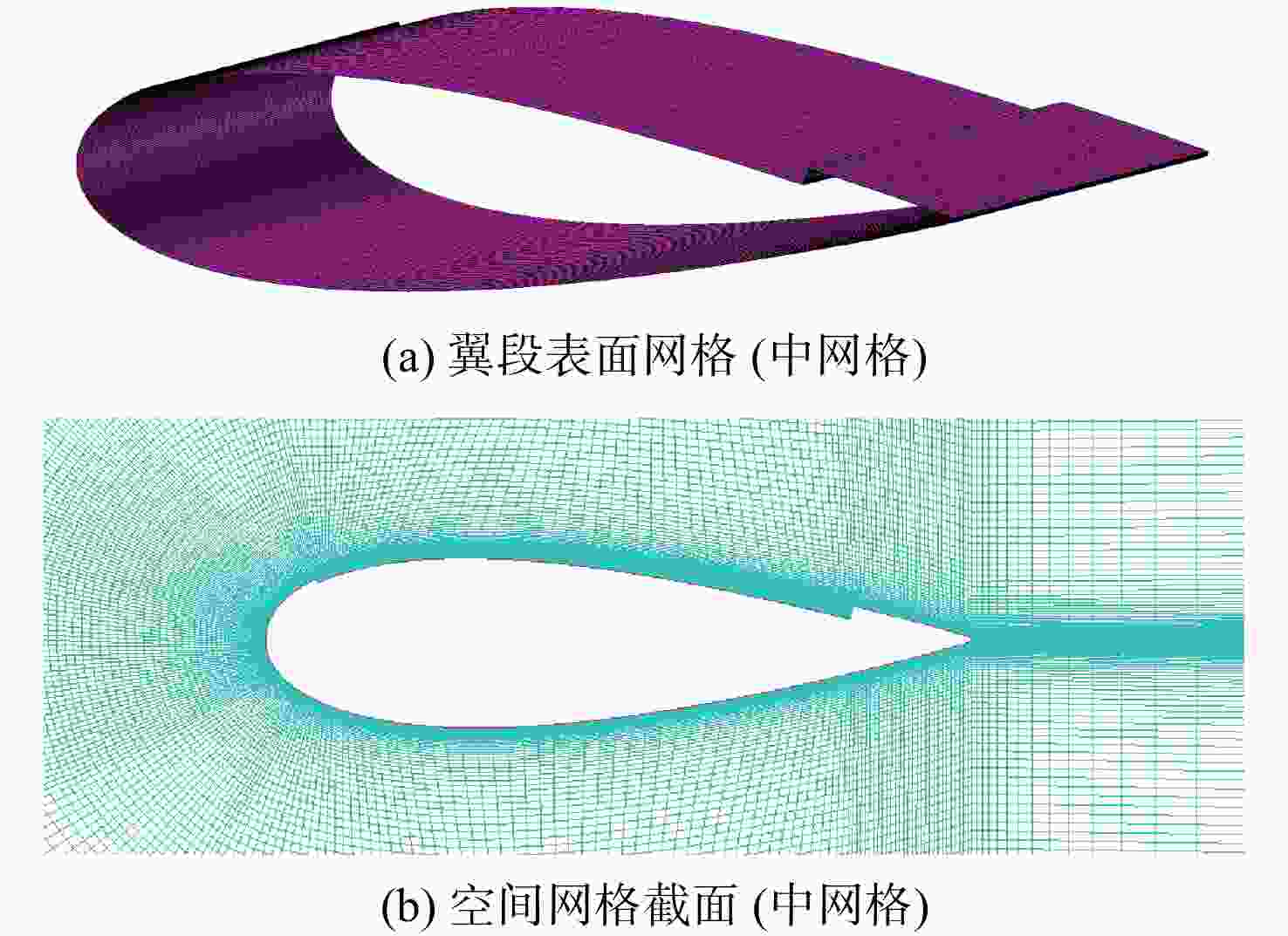
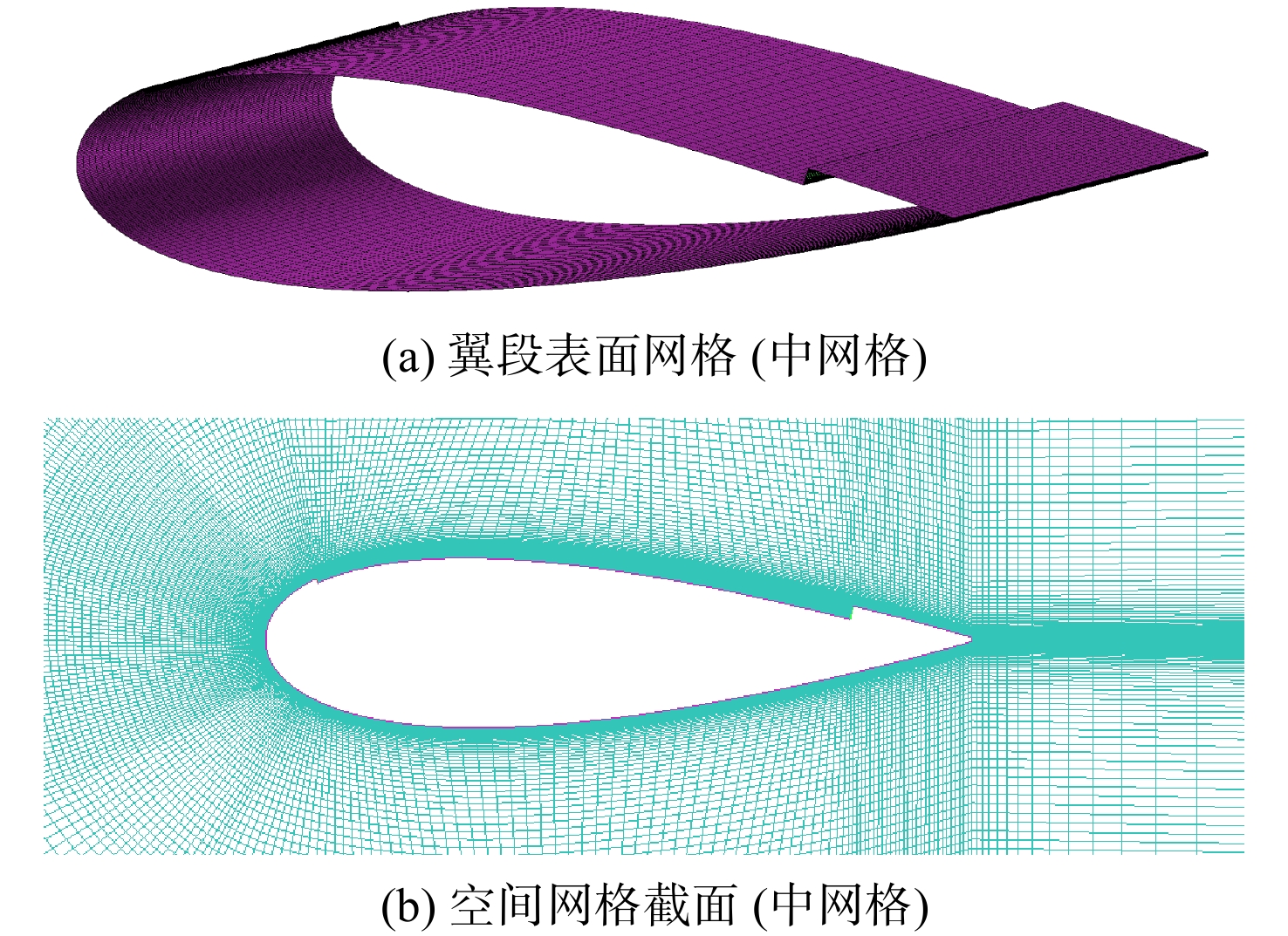
图 4 CFJ0025-065-196翼段表面网格及空间网格截面
Figure 4. Surface mesh and spatial grid cross-section of the CFJ0025-065-196 wing segment
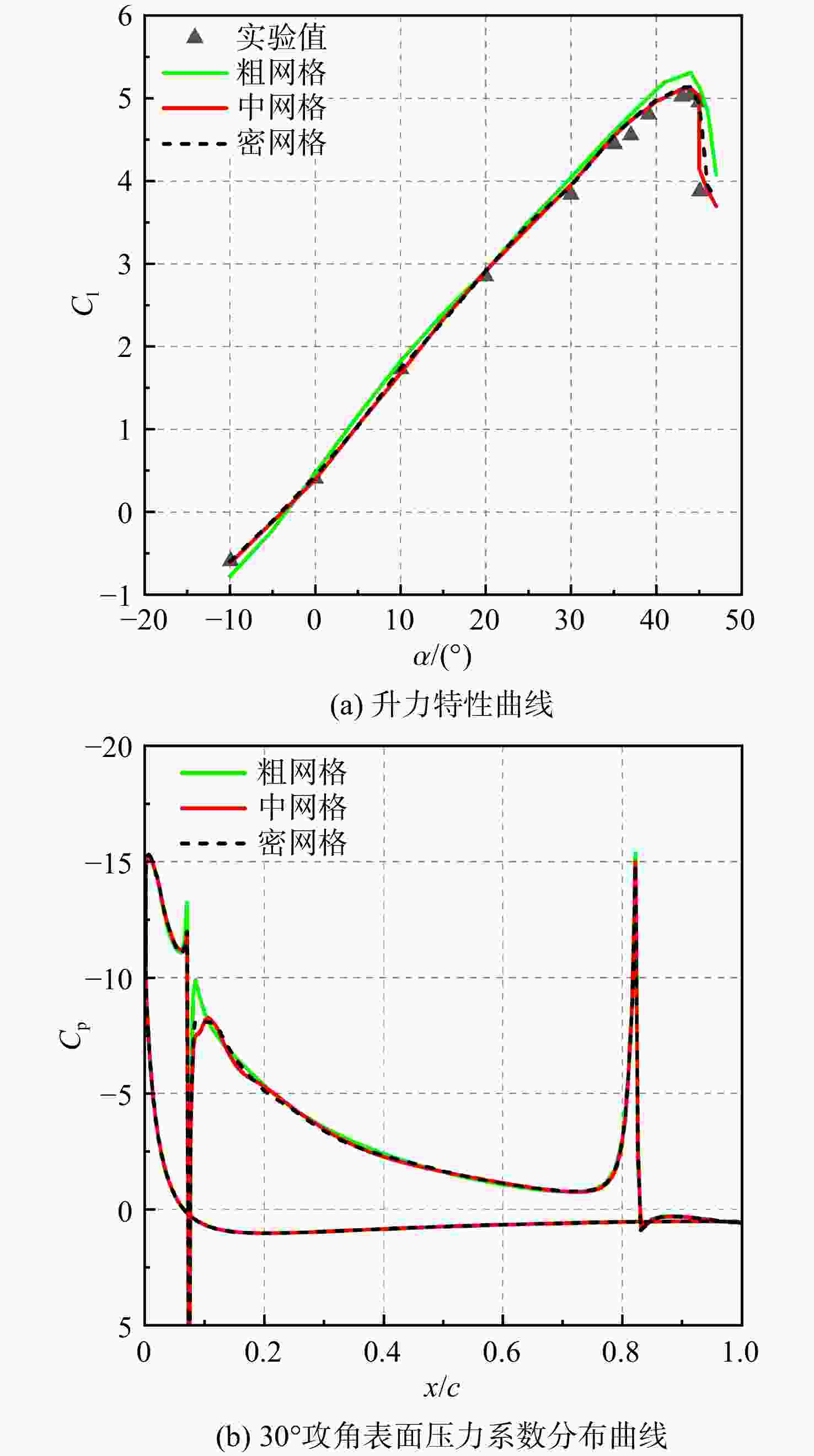
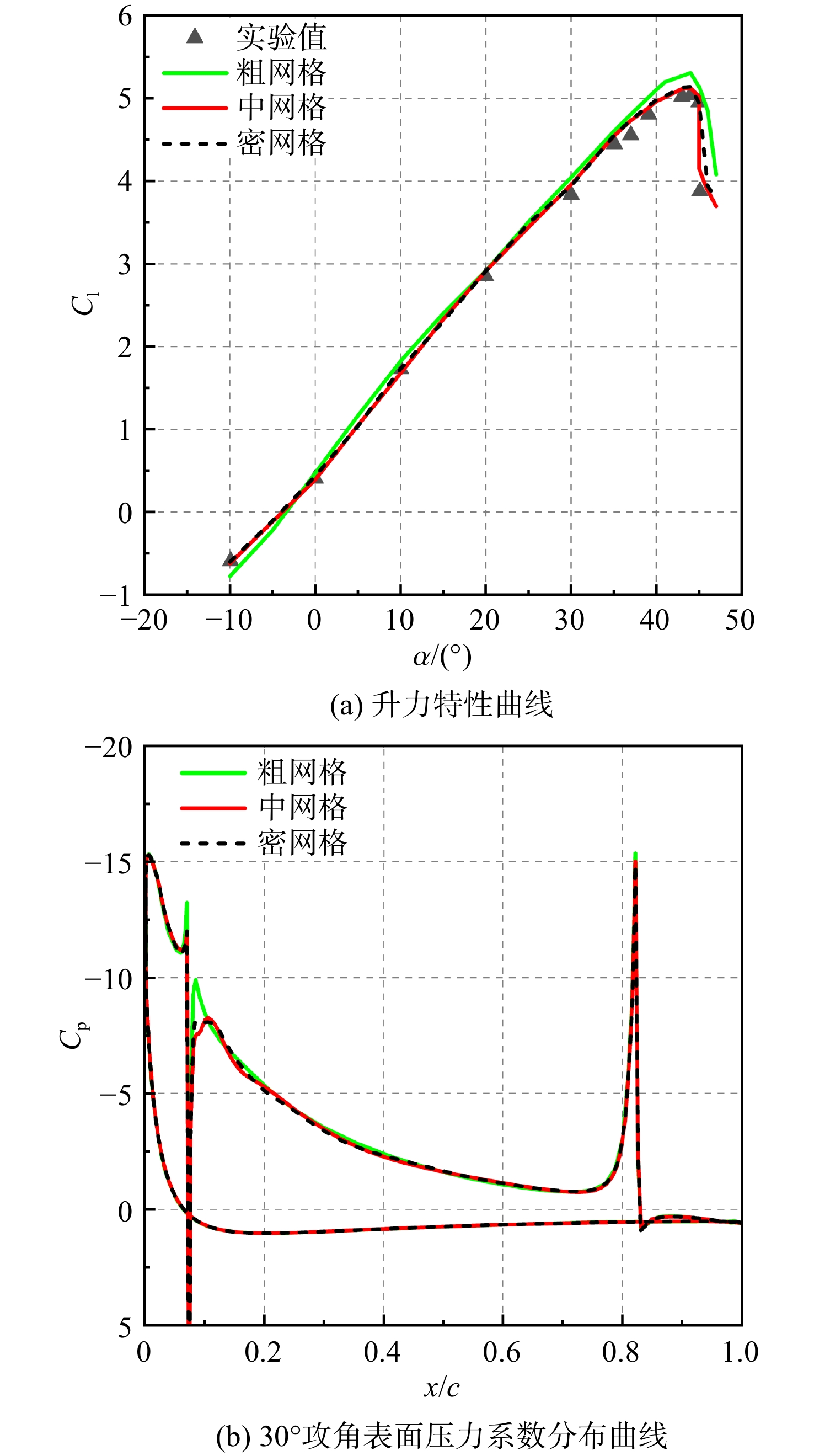
图 5 CFJ0025-065-196升力特性曲线与30°攻角表面压力系数分布
Figure 5. Lift characteristic curve and surface pressure coefficient distribution at 30° angle of attack for CFJ0025-065-196
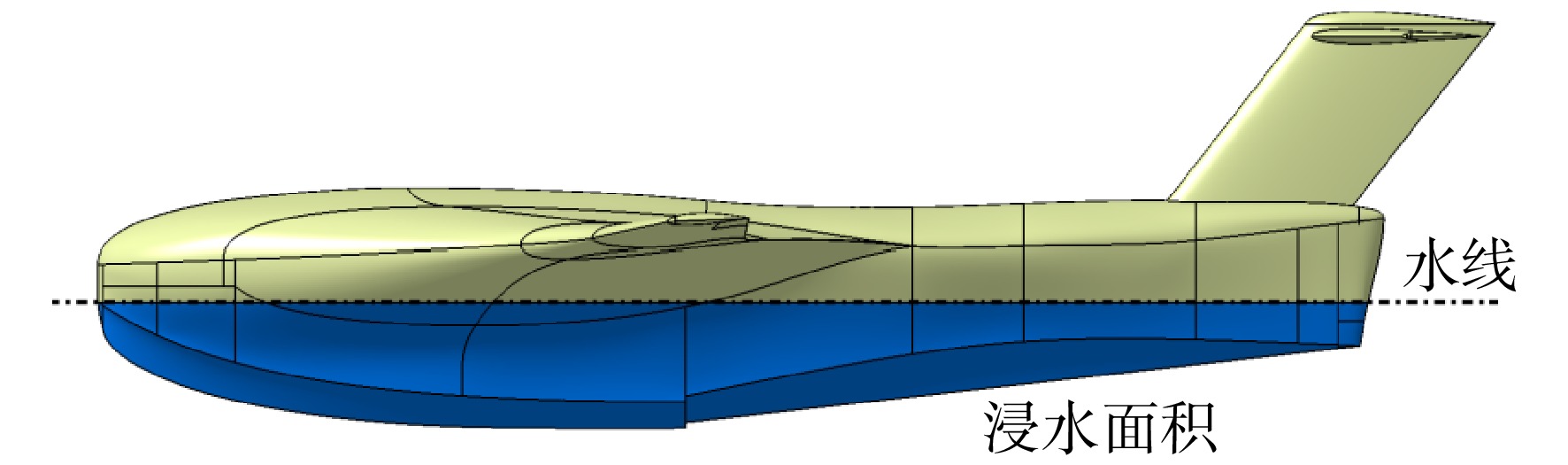
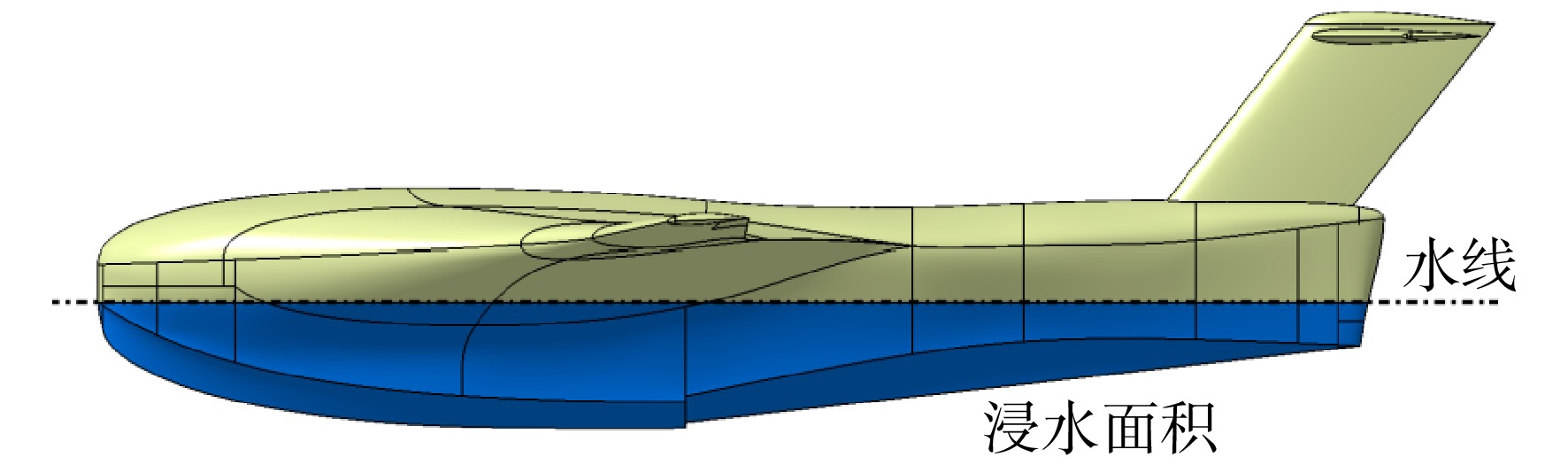
图 7 HWB布局水陆两栖飞机浸水面积示意图
Figure 7. Schematic diagram of wetted area for the HWB amphibious aircraft configuration
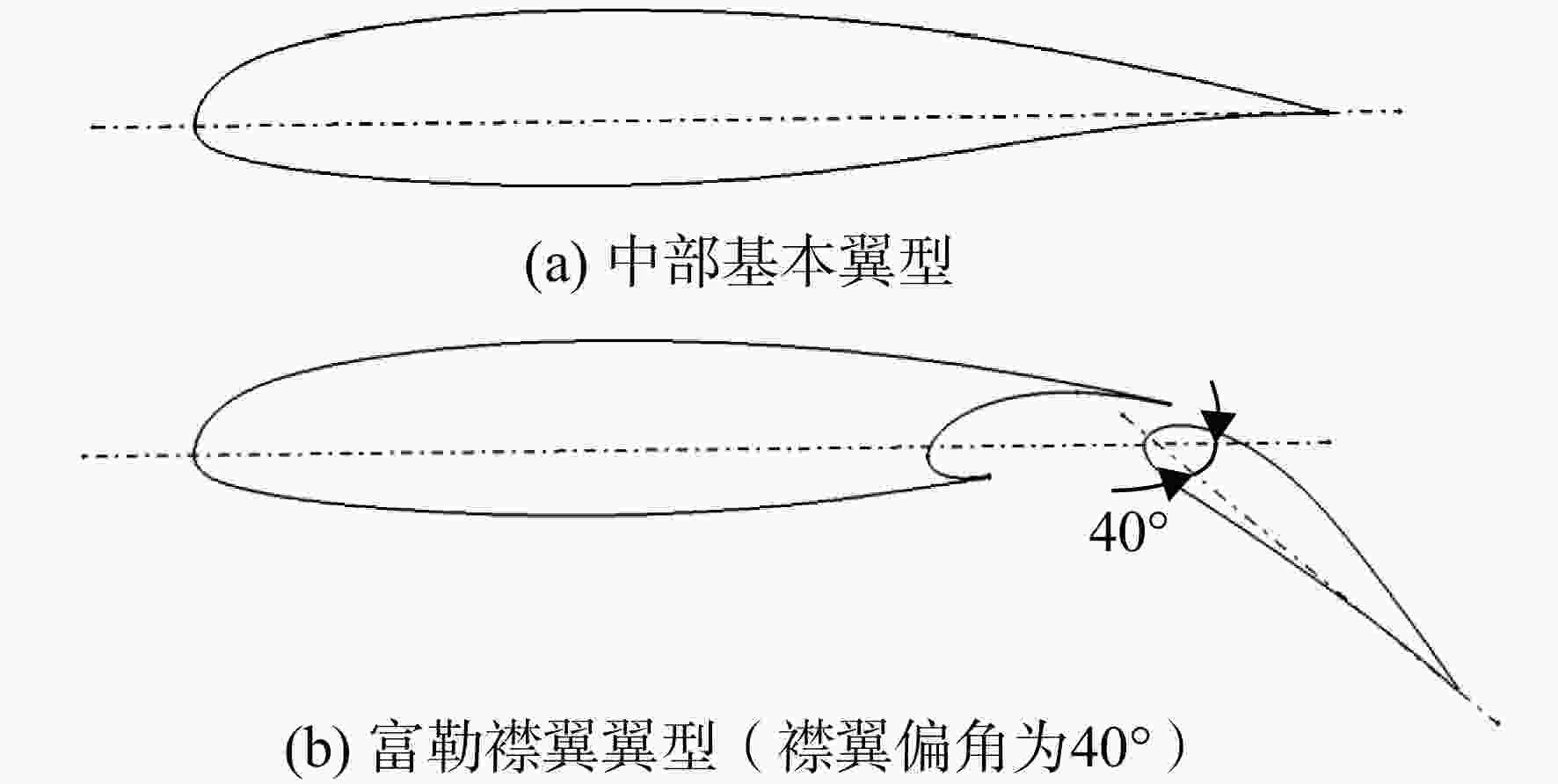
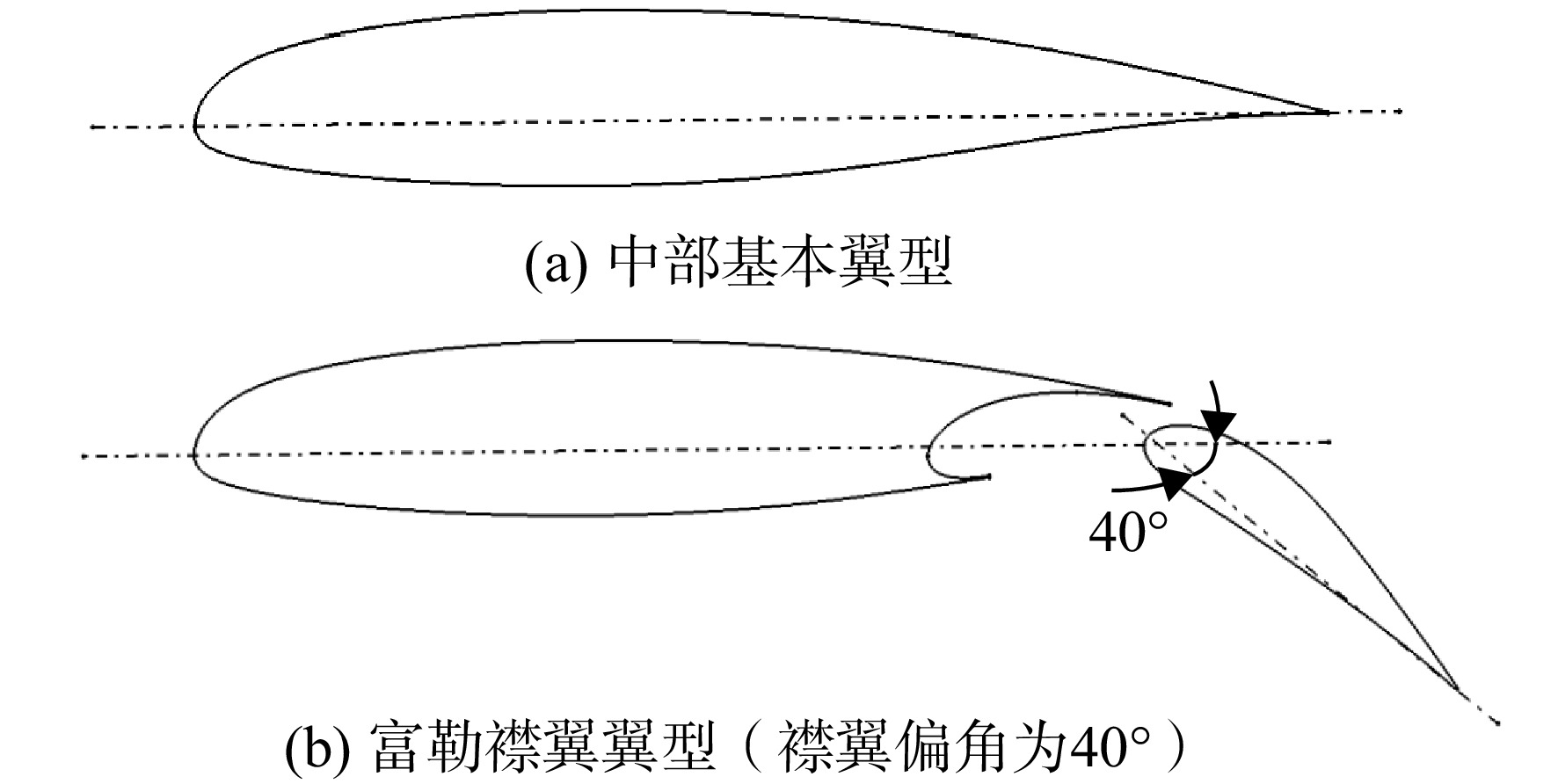
图 9 中部基本翼型及富勒襟翼翼型
Figure 9. Center basic airfoil and Fowler flap airfoil configuration
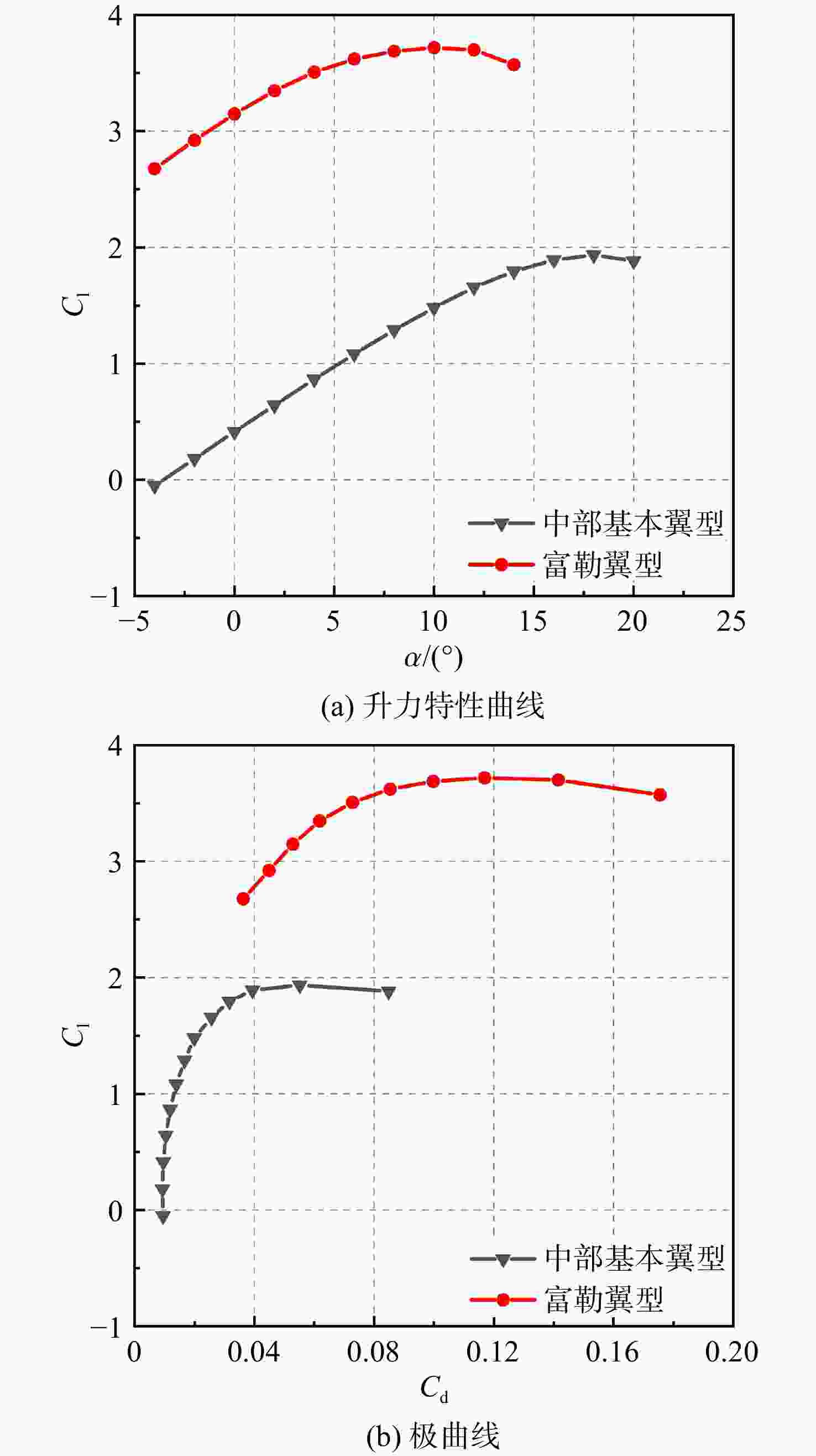
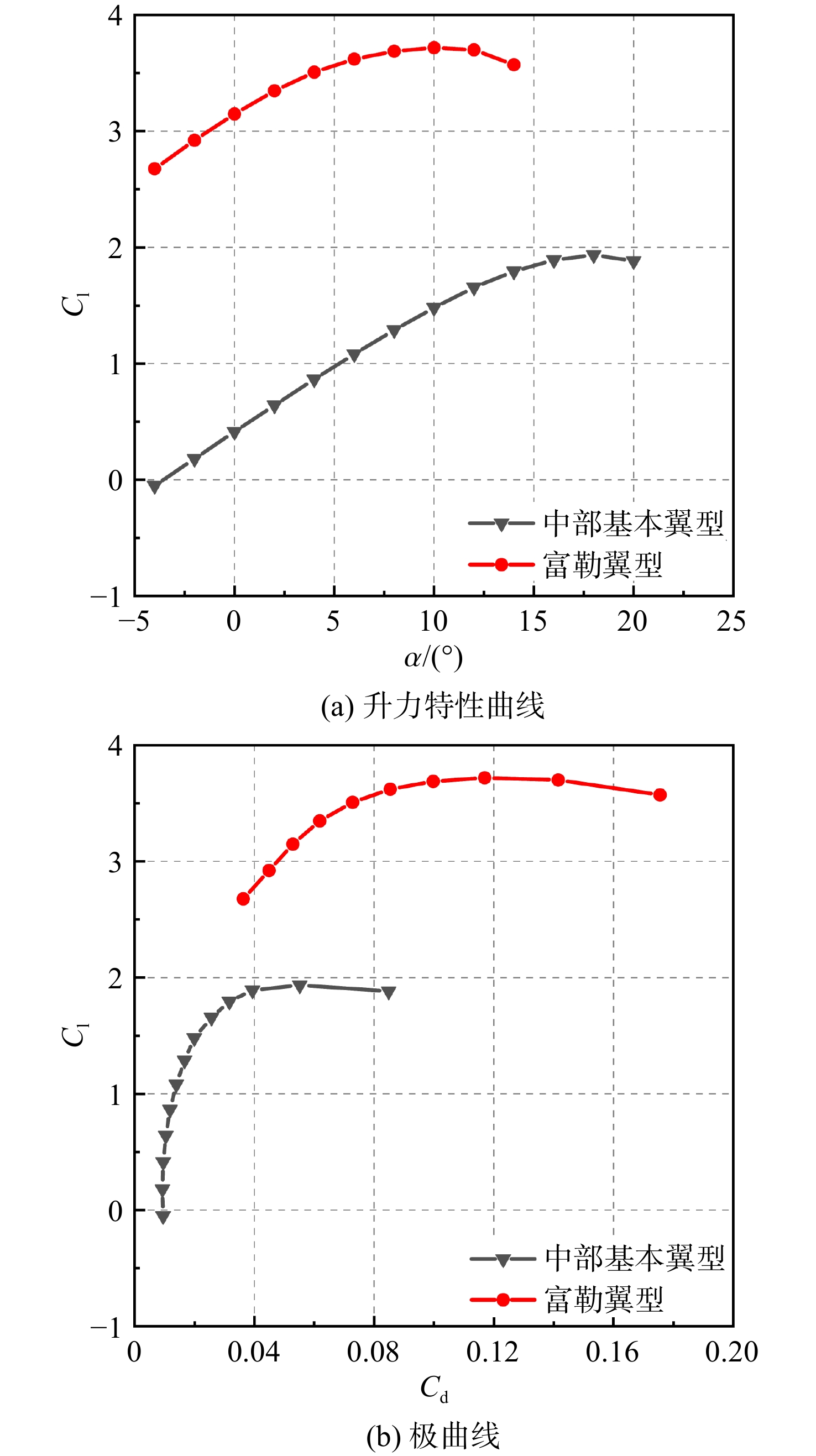
图 10 基本翼型及增升翼型升阻特性
Figure 10. Lift and drag characteristics of baseline and high-lift airfoil configurations
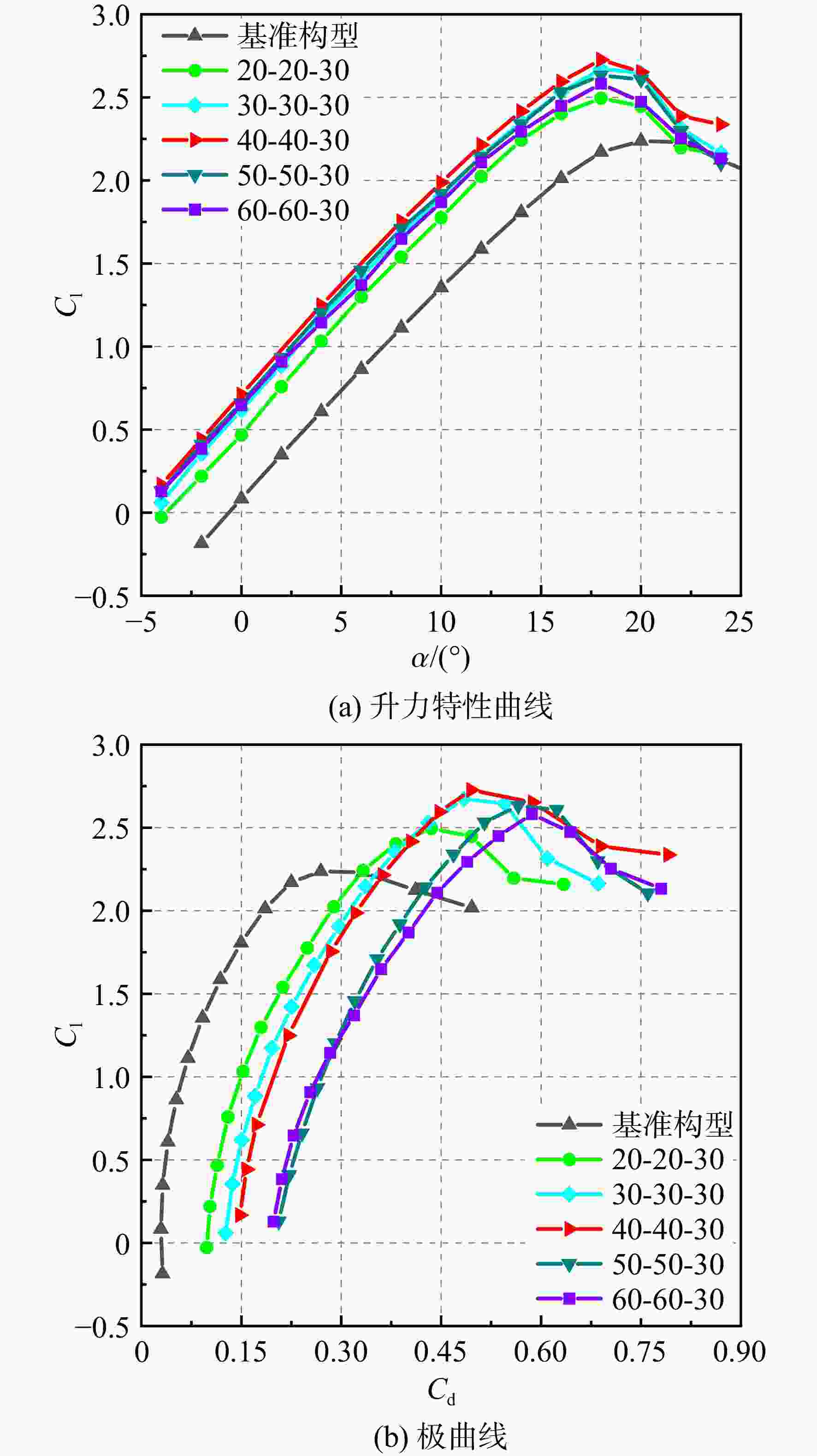
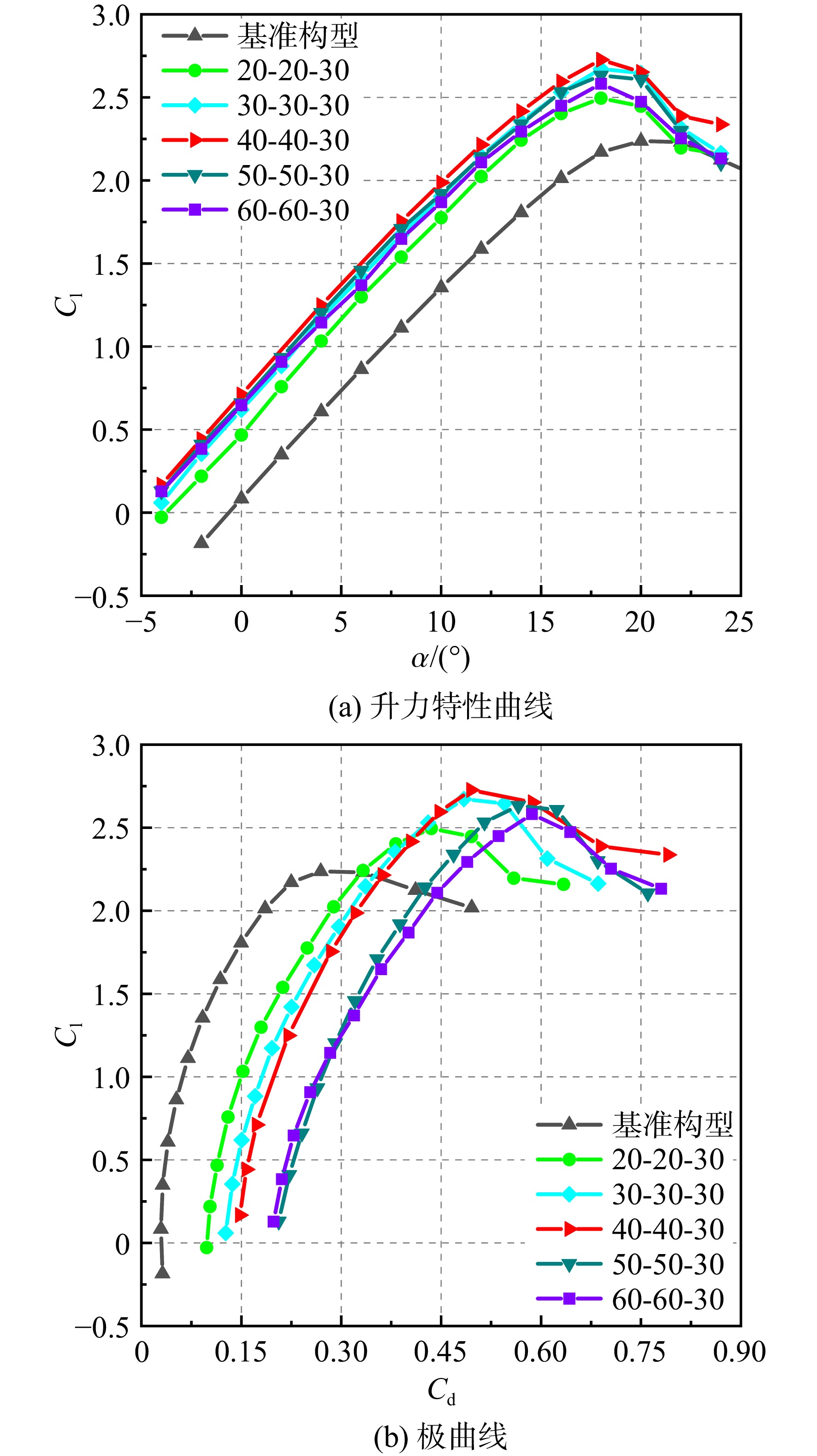
图 12 增升构型升阻特性曲线
Figure 12. Lift and drag characteristic curves of high-lift configuration
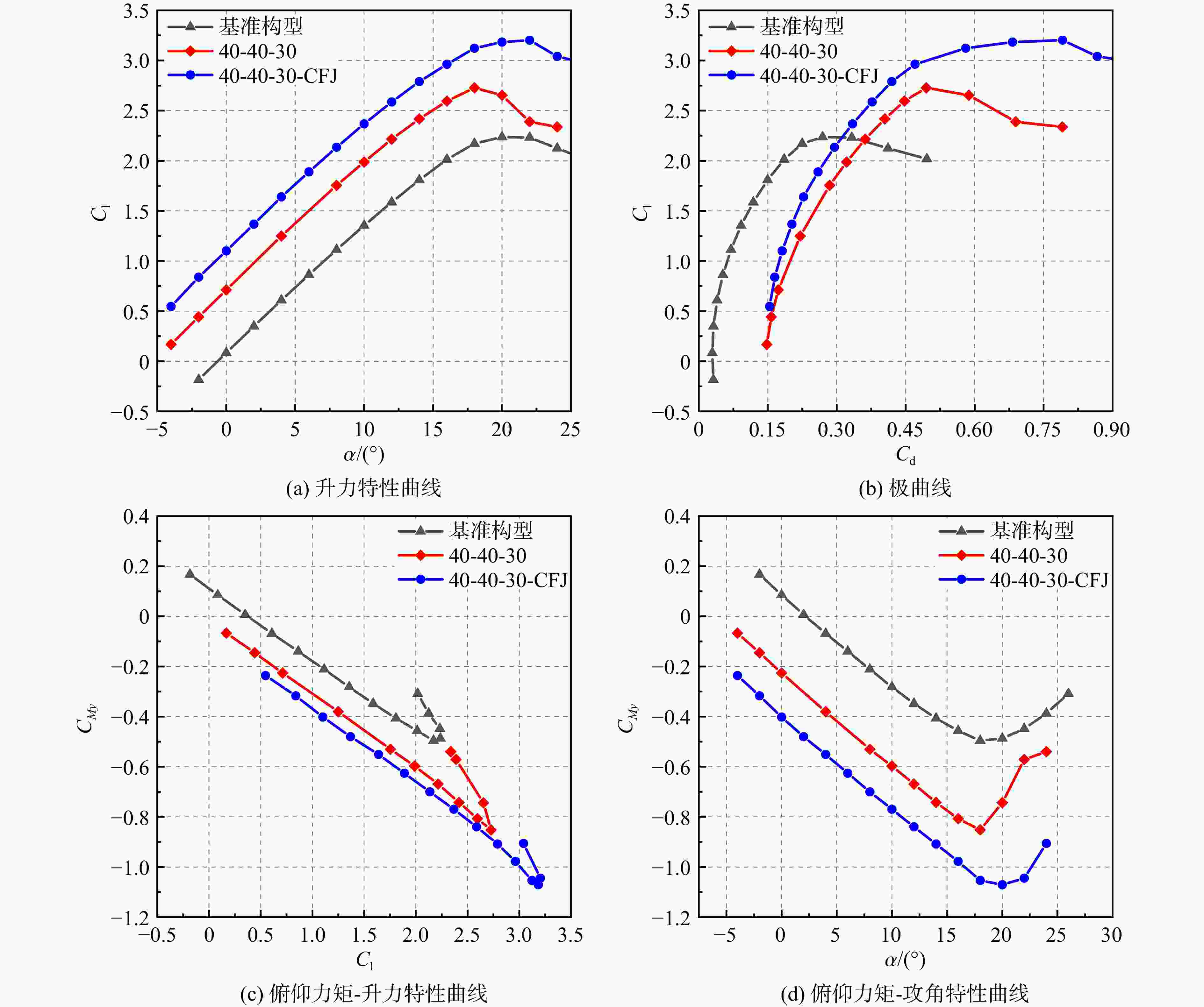
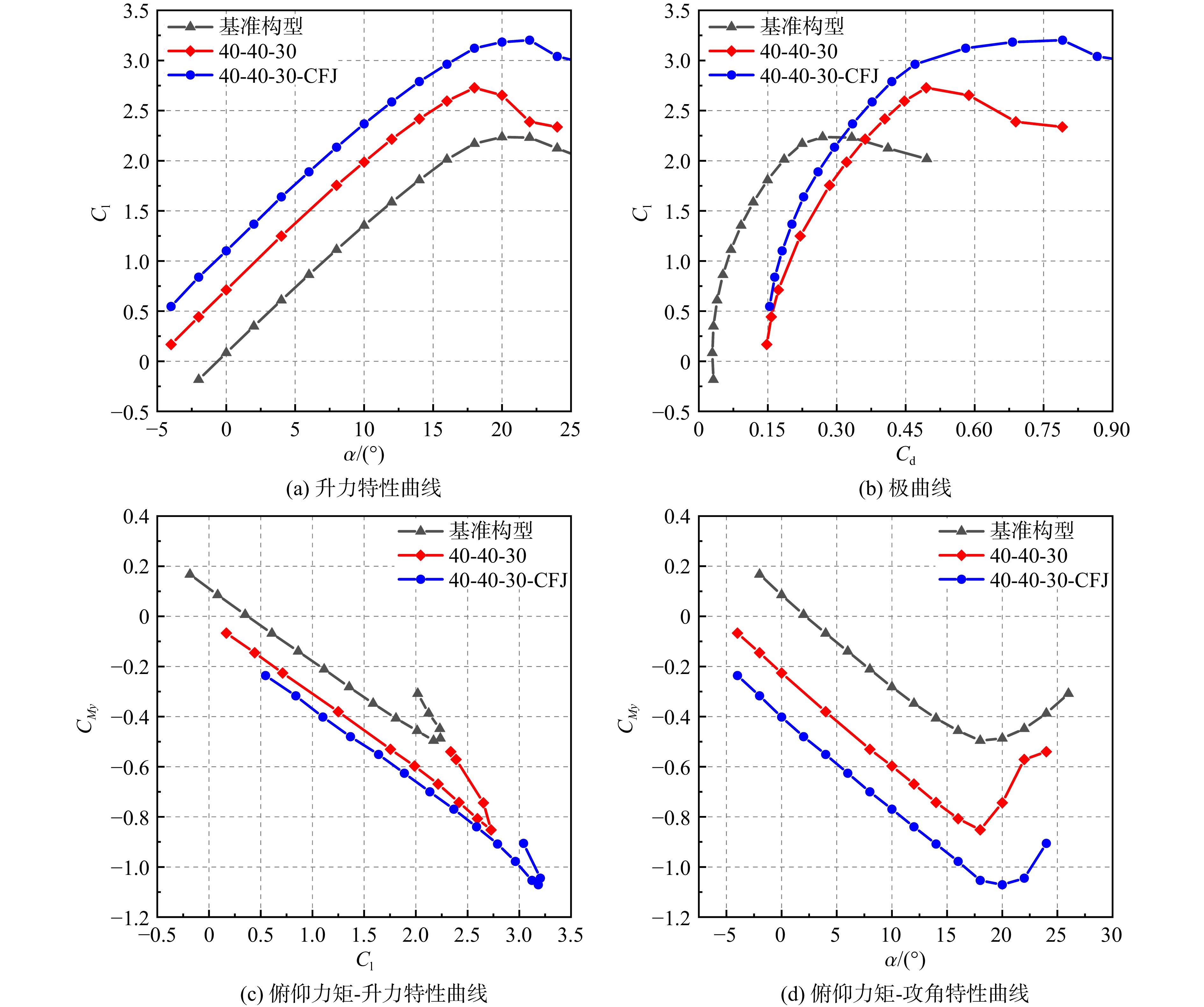
图 15 CFJ构型气动特性曲线
Figure 15. Aerodynamic performance characteristics of the CFJ configuration
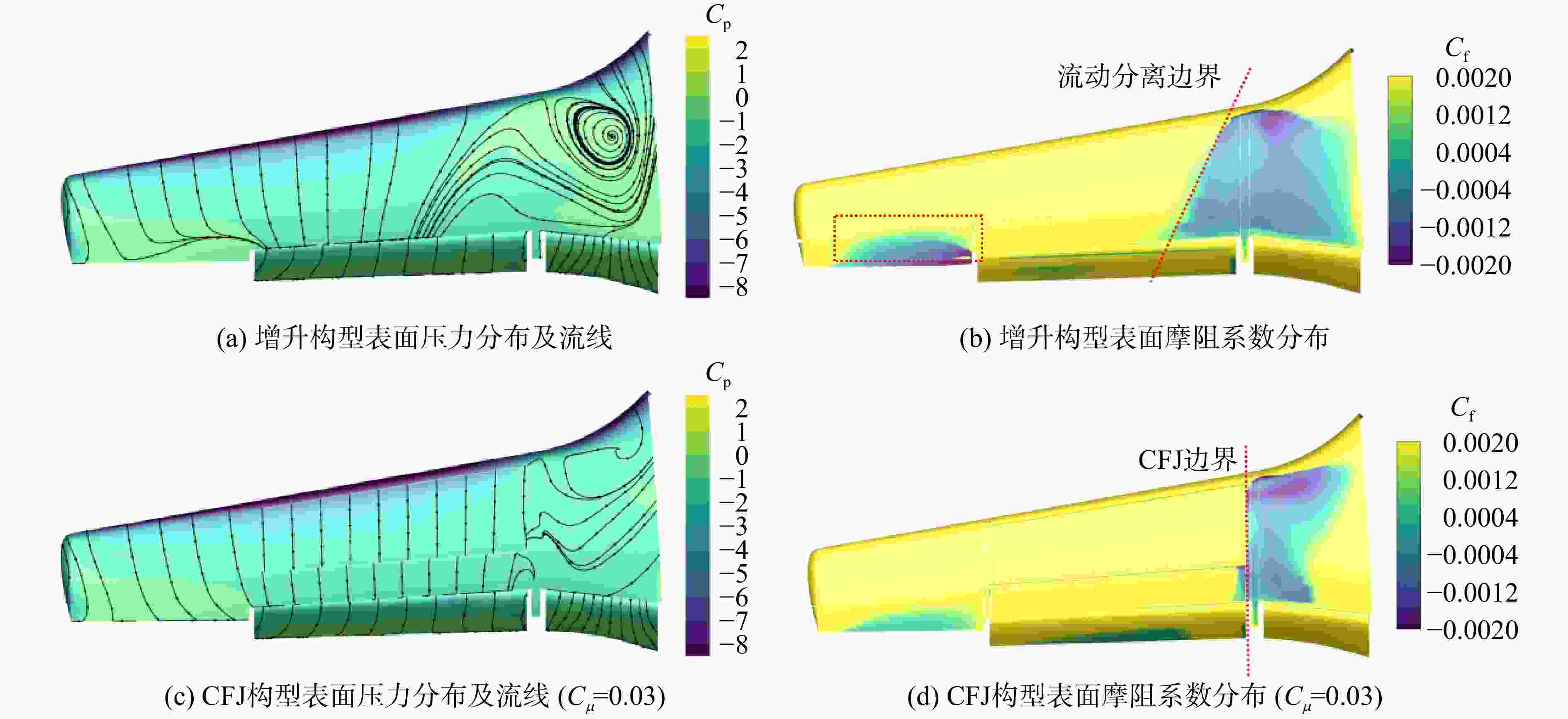
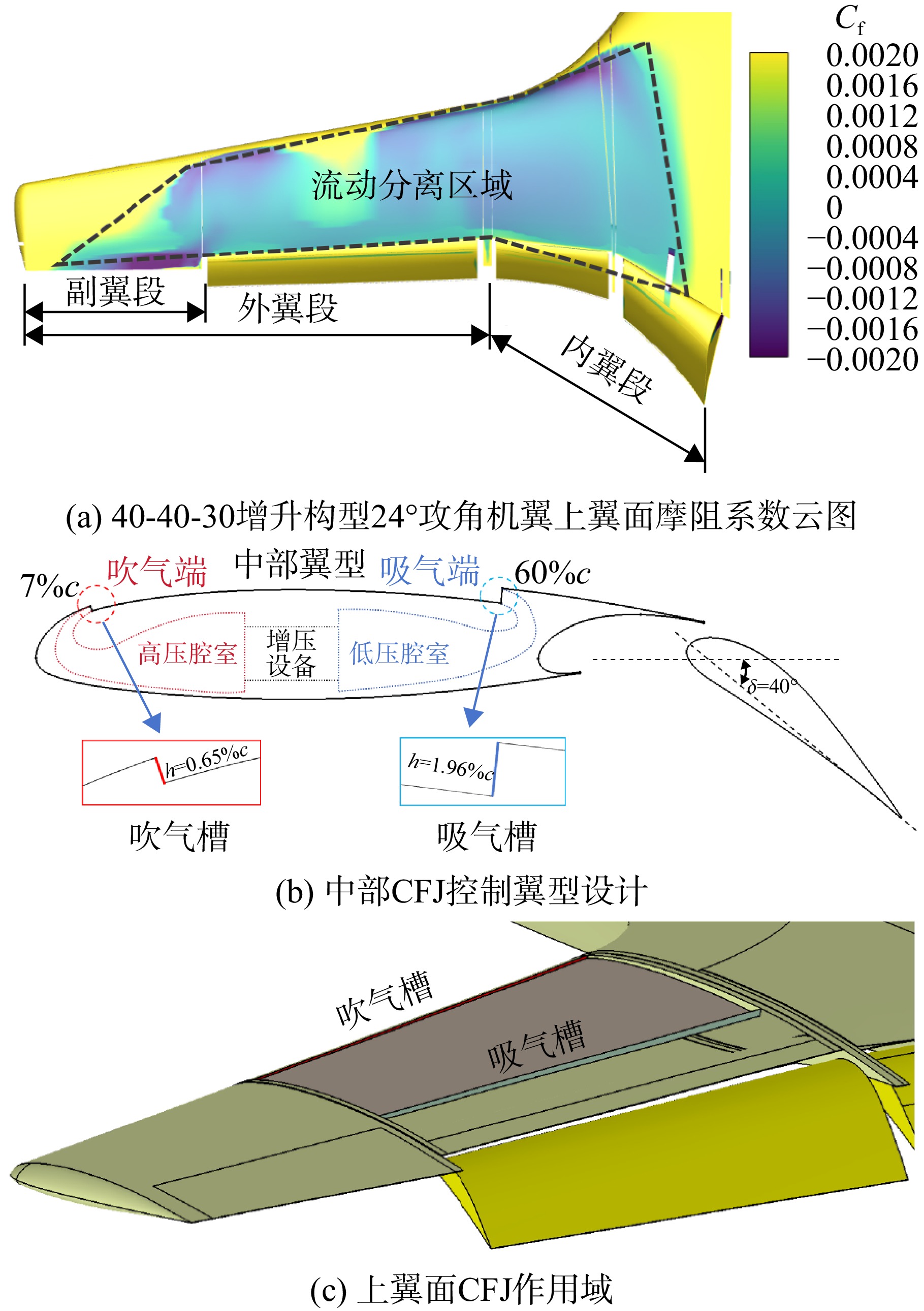
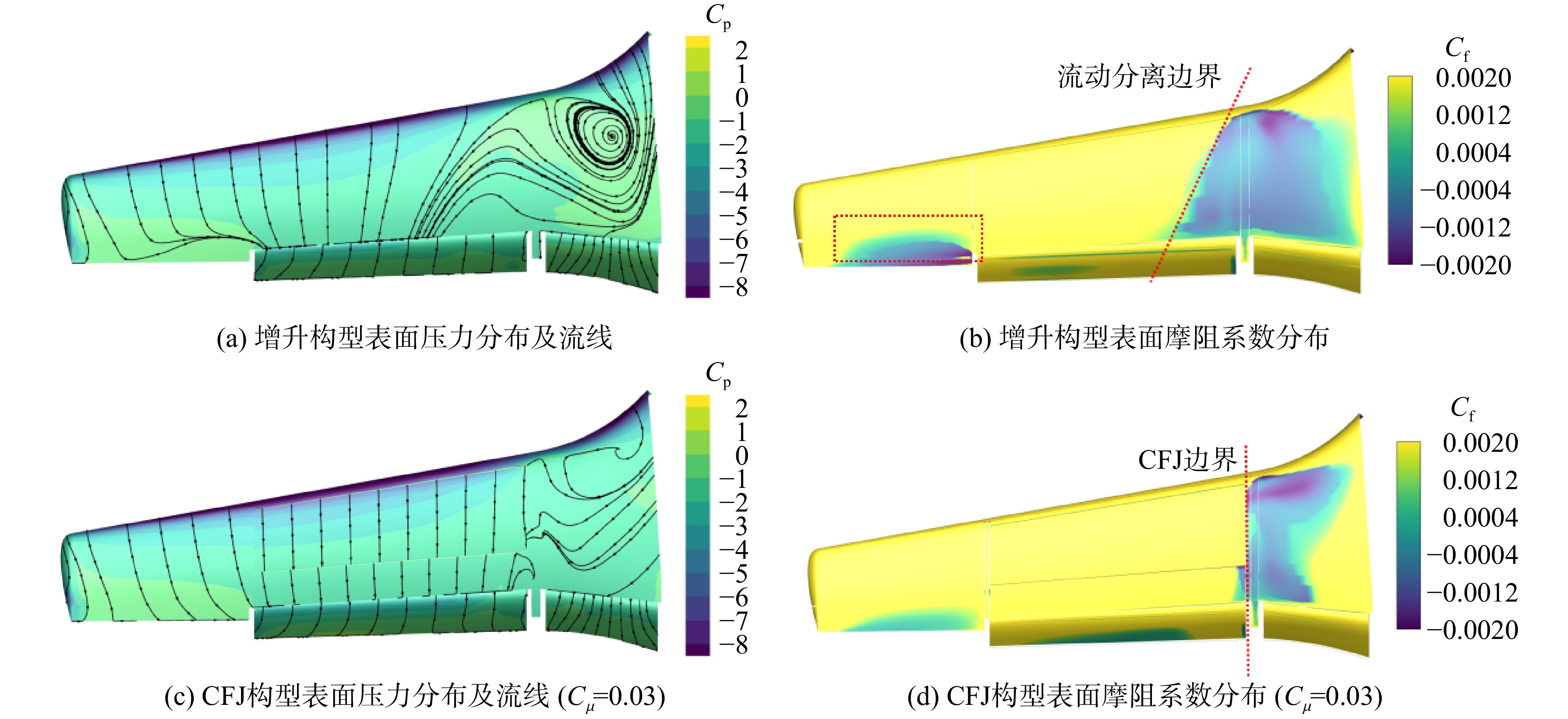
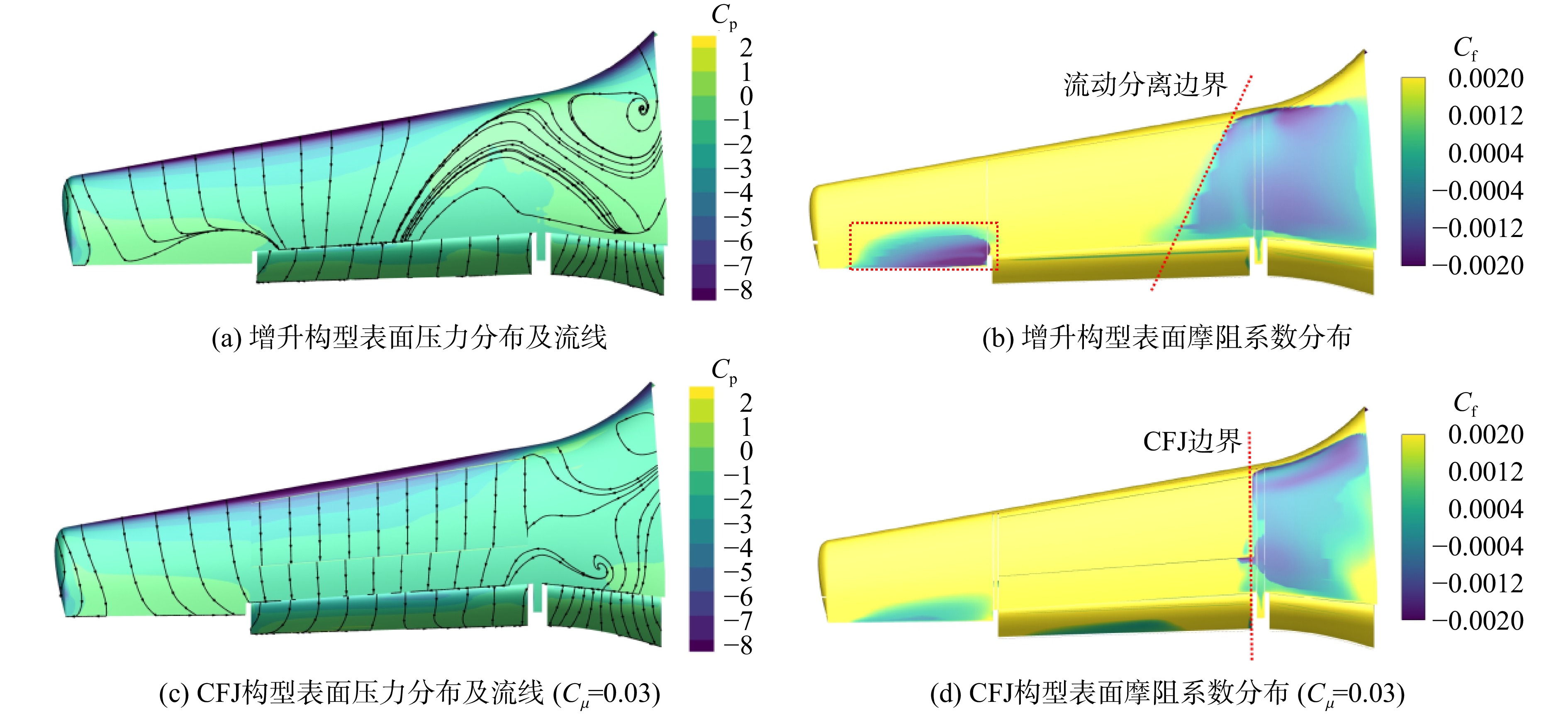
图 16 α=20°增升构型及CFJ构型表面压力系数分布及摩阻系数云图
Figure 16. Surface pressure coefficient distribution and skin friction coefficient contours for high-lift and CFJ configurations at α=20°
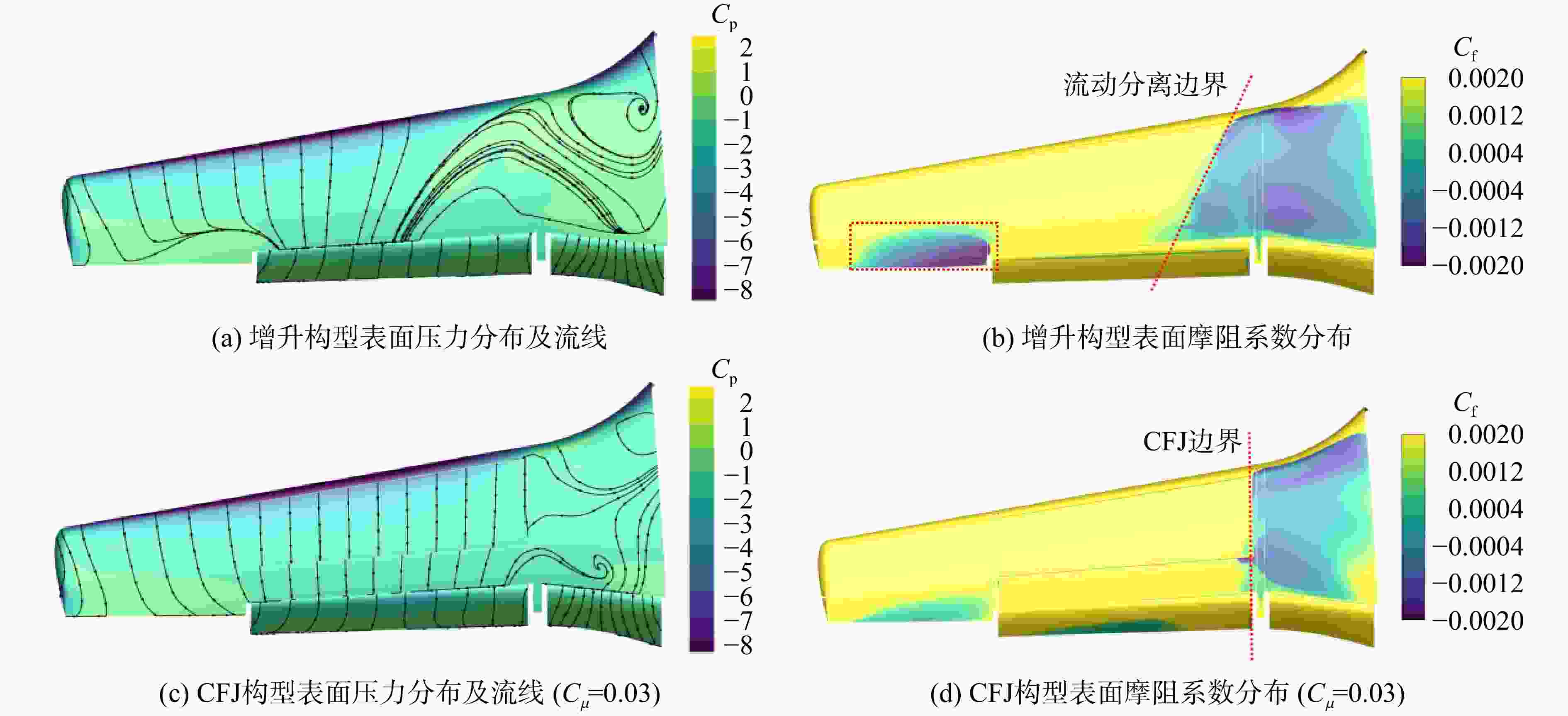
图 17 α=22°增升构型及CFJ构型表面压力系数分布及摩阻系数云图
Figure 17. Surface pressure coefficient distribution and skin friction coefficient contours for high-lift and CFJ configurations at α=22°
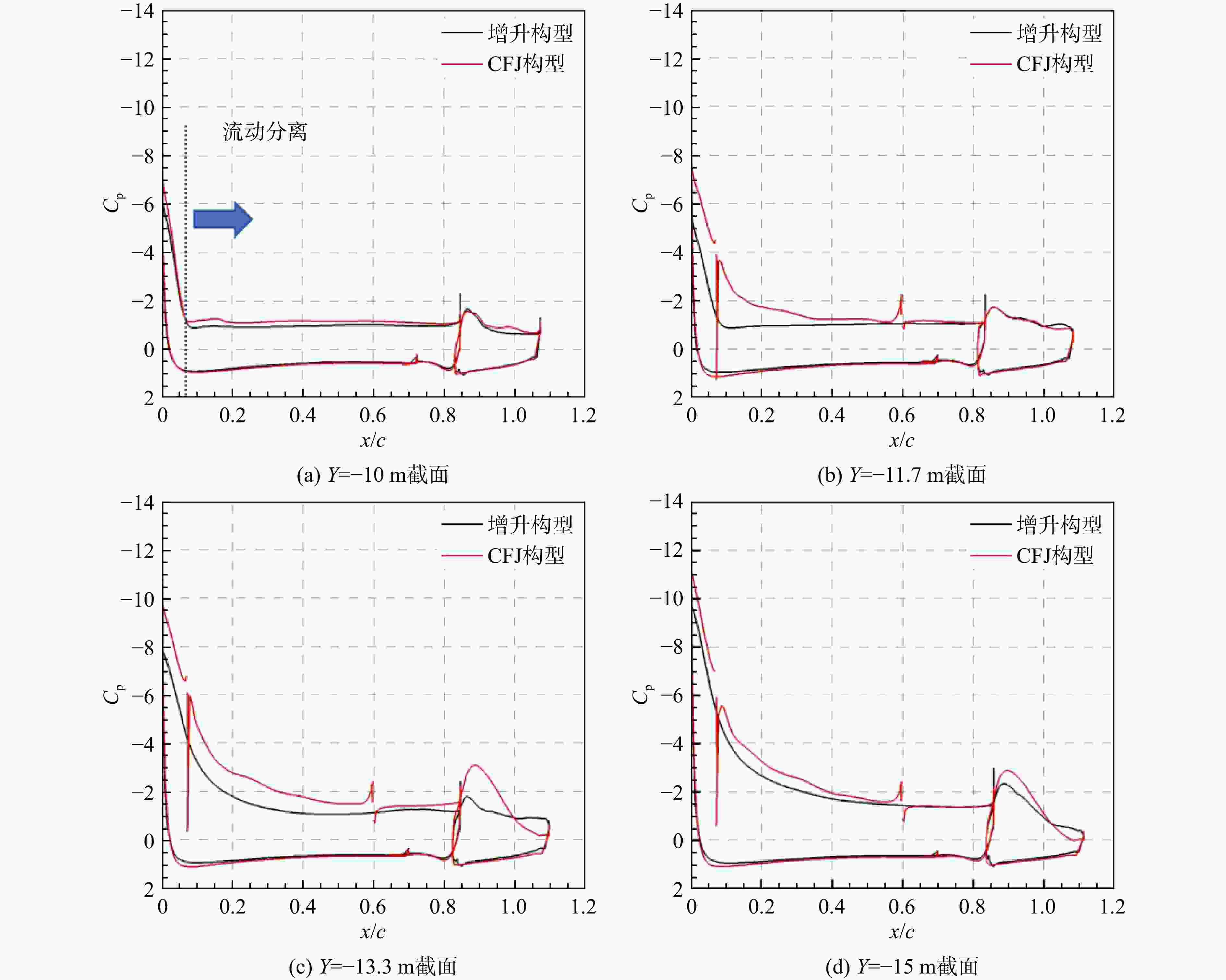
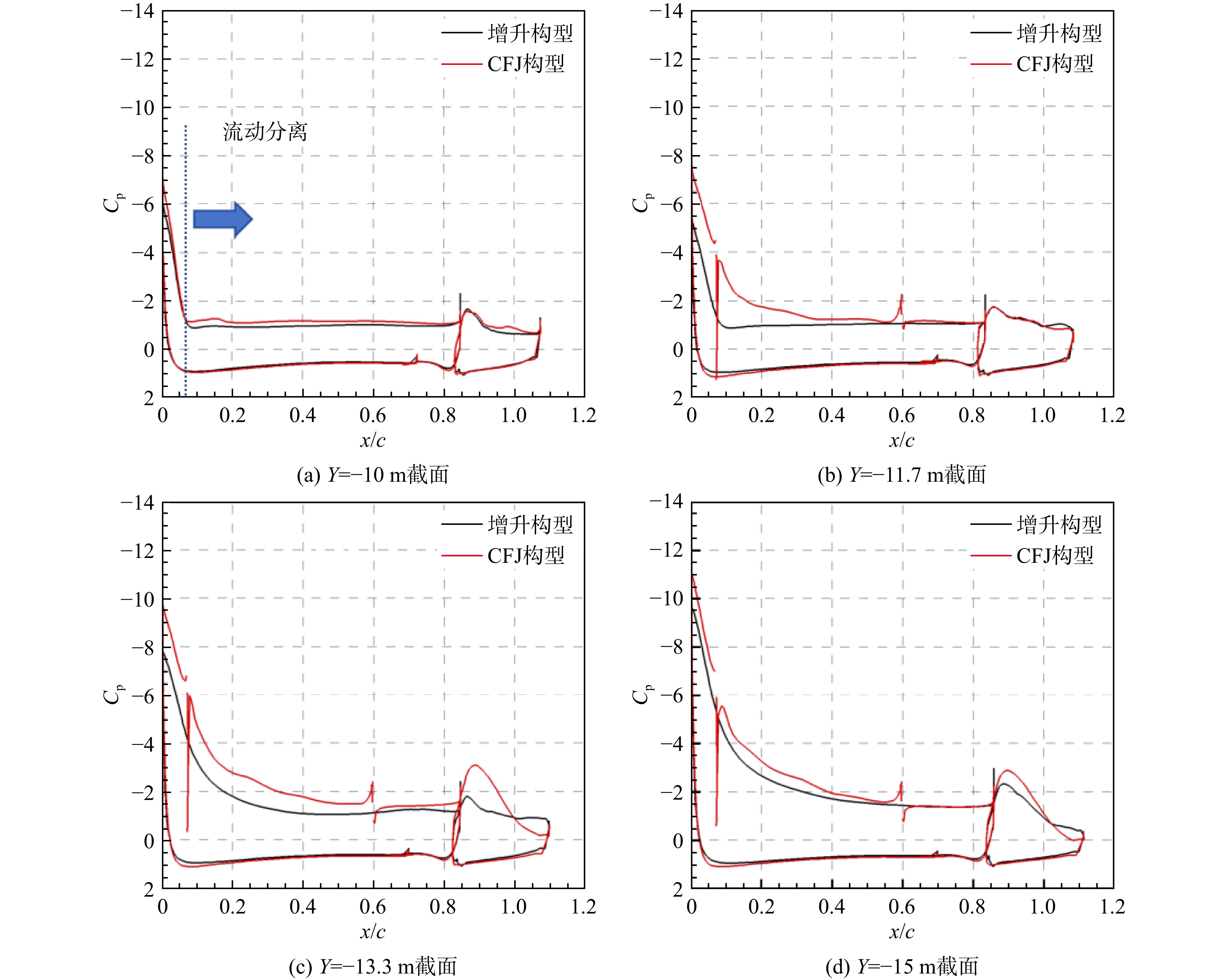
图 19 α=20°机翼截面压力分布曲线
Figure 19. Pressure distribution curves over wing cross-section at α=20°
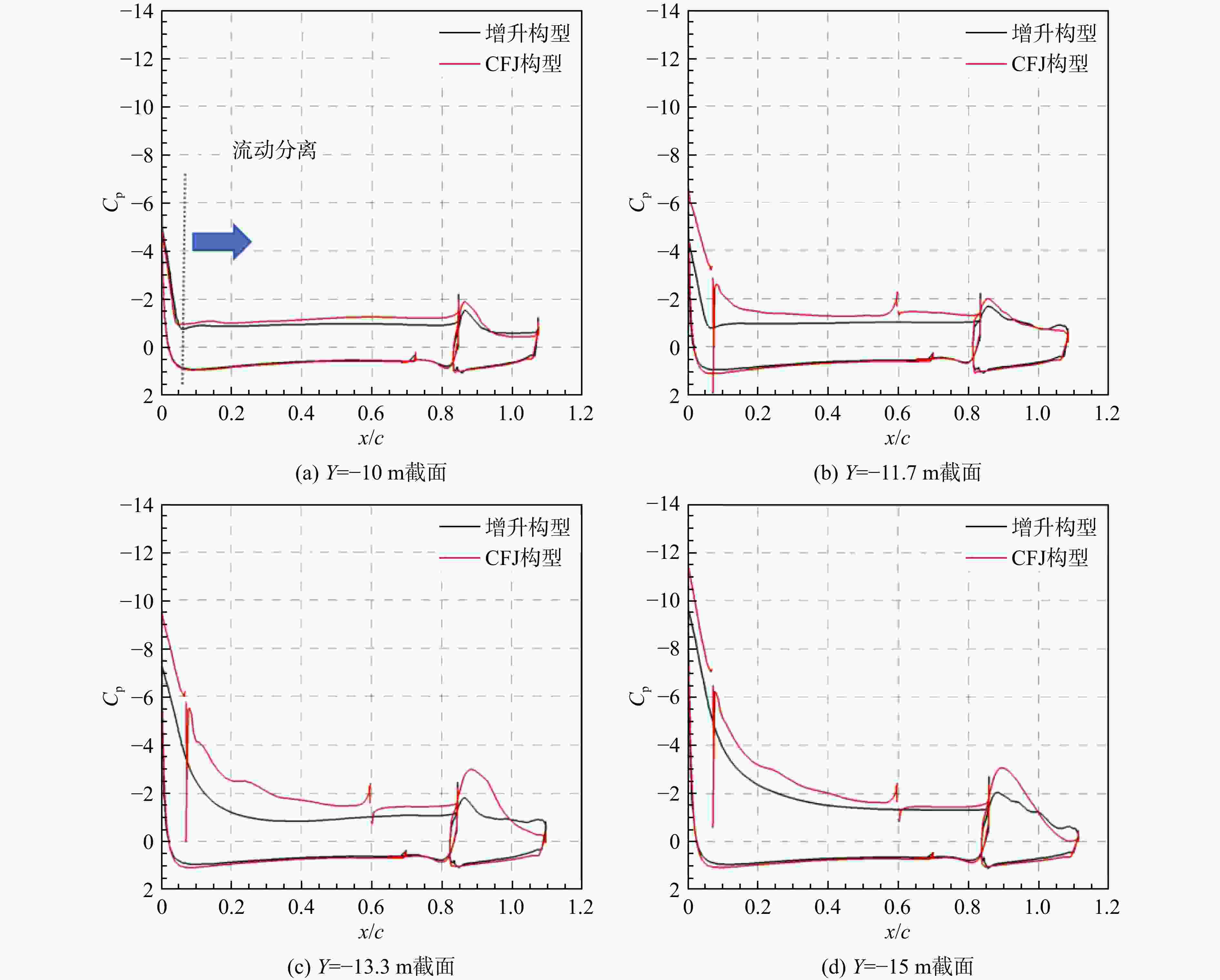
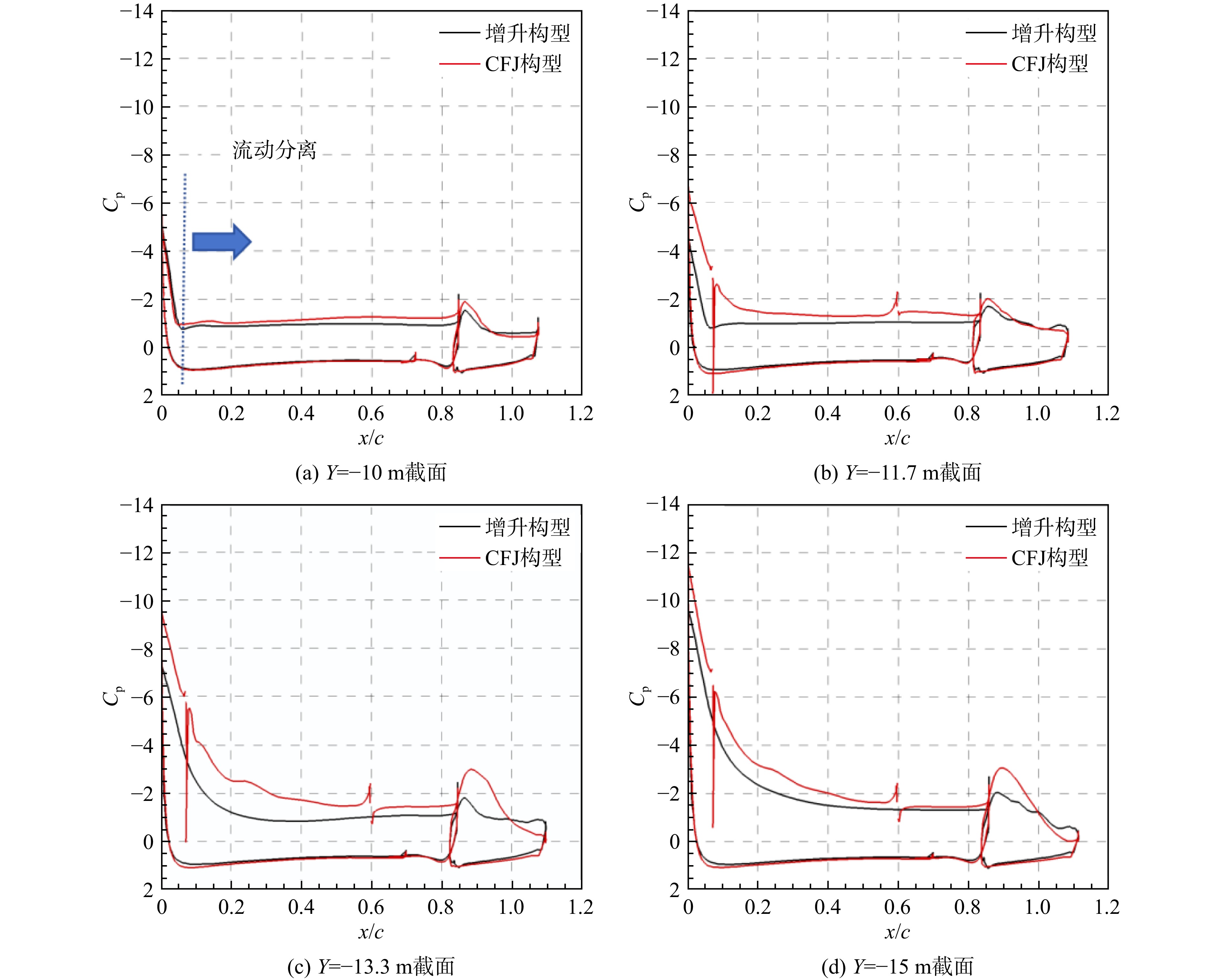
图 20 α=22°机翼截面压力分布曲线
Figure 20. Pressure distribution curves over wing cross-section at α=22°
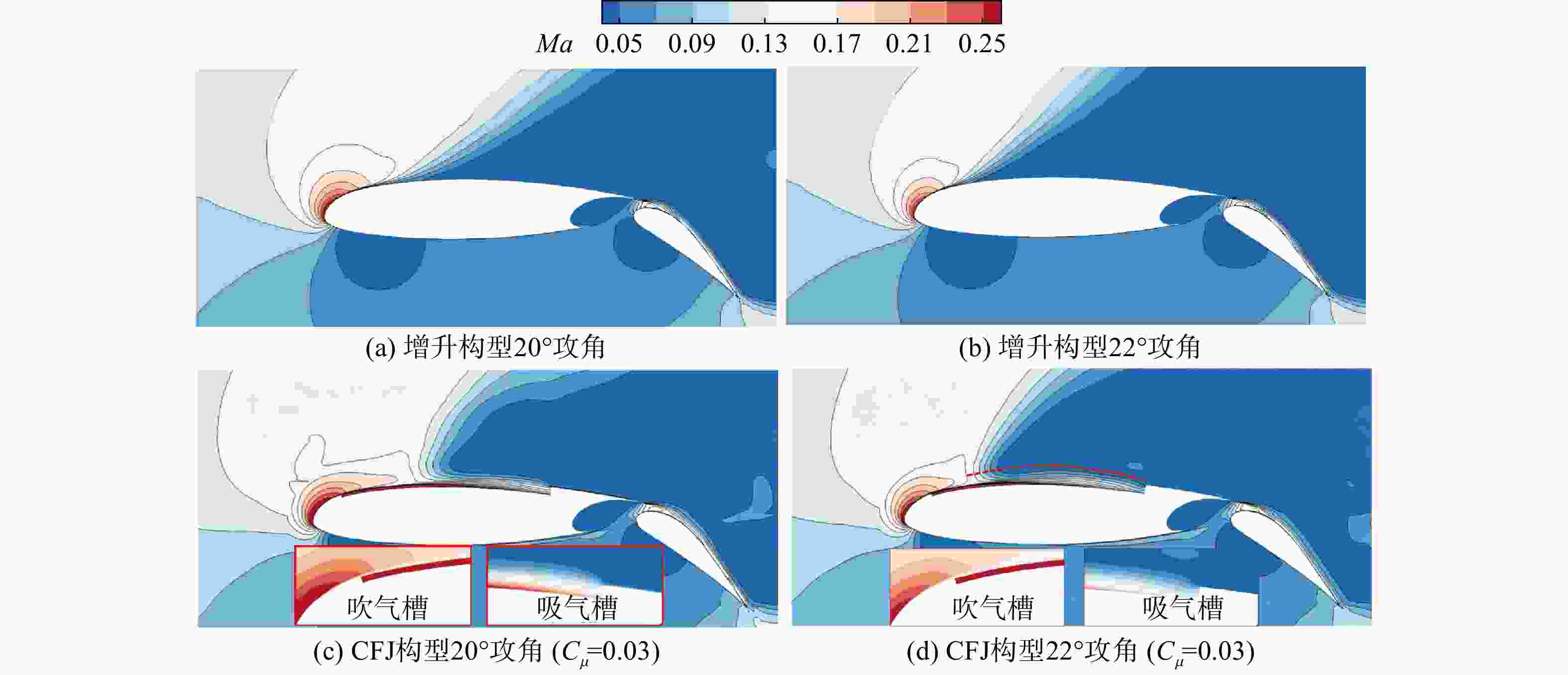
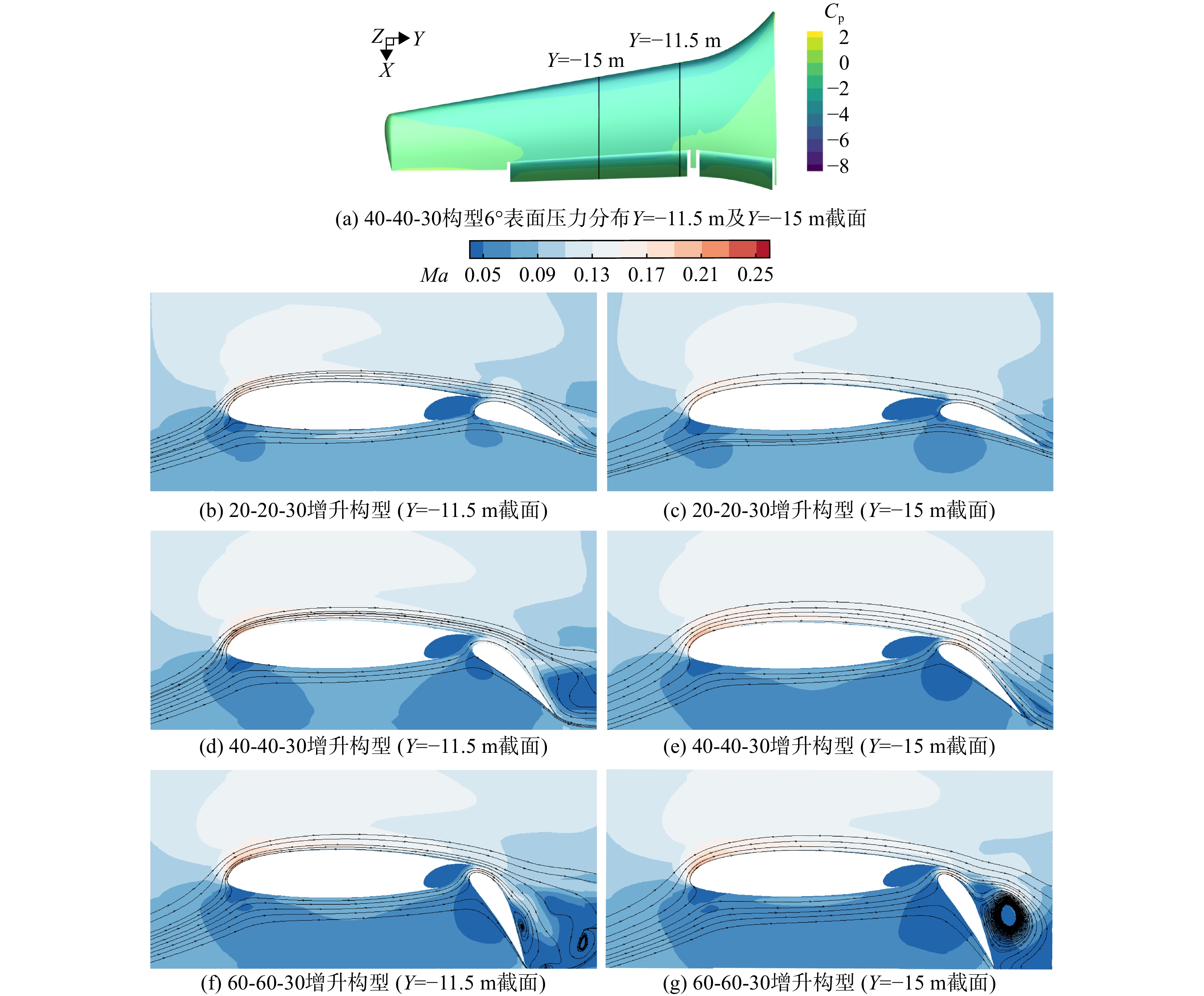
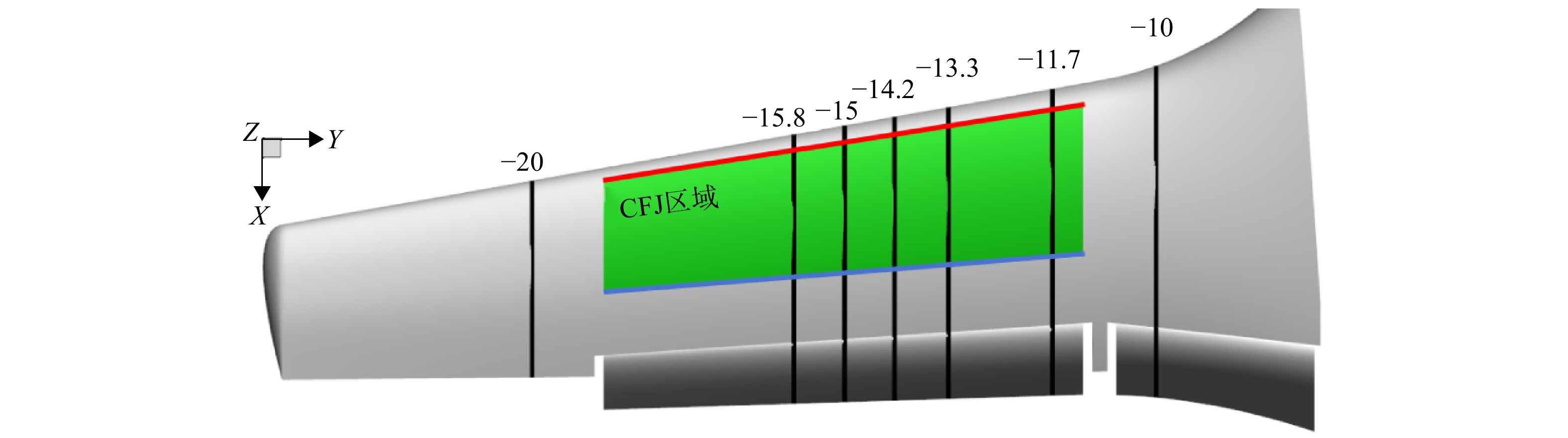
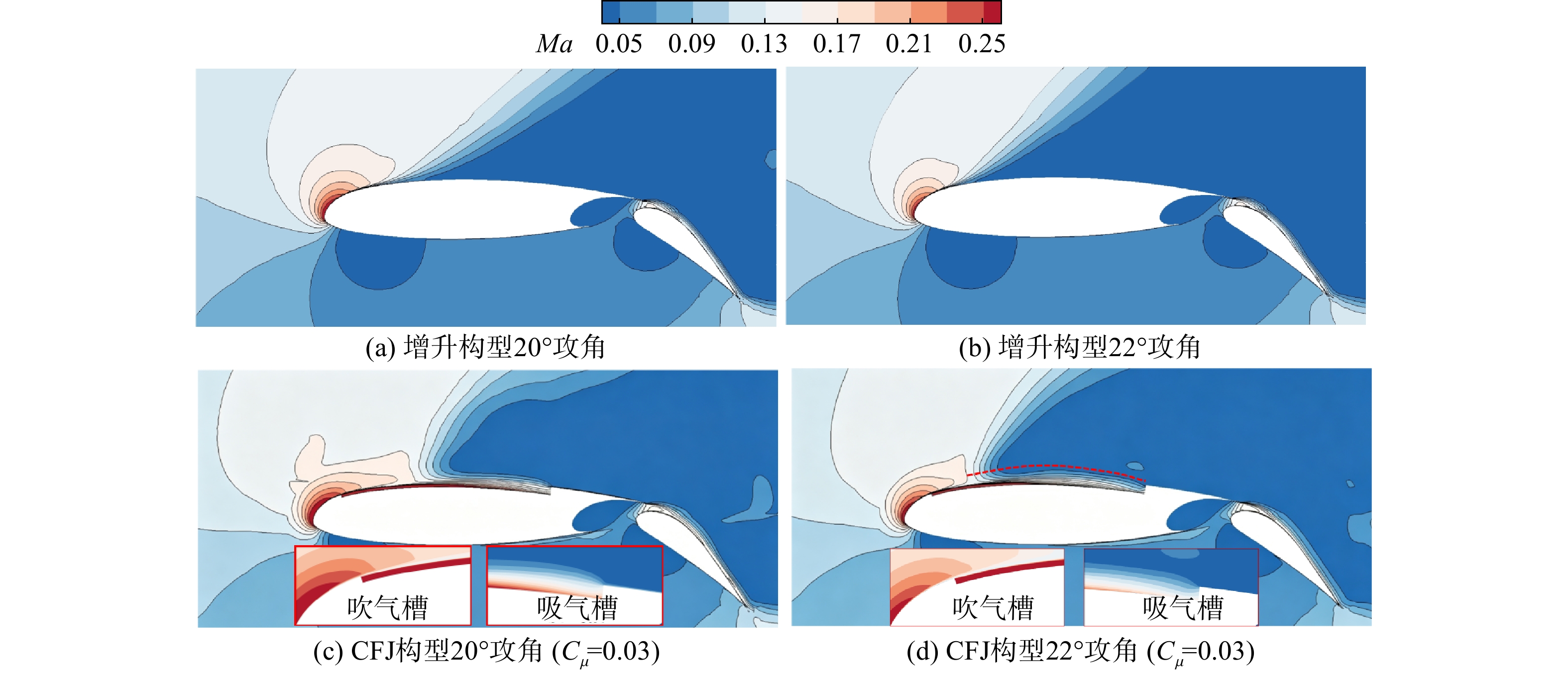
图 21 Y=−11.7 m空间流场截面马赫数分布
Figure 21. Mach number distribution at Y=−11.7 m flow field cross-section
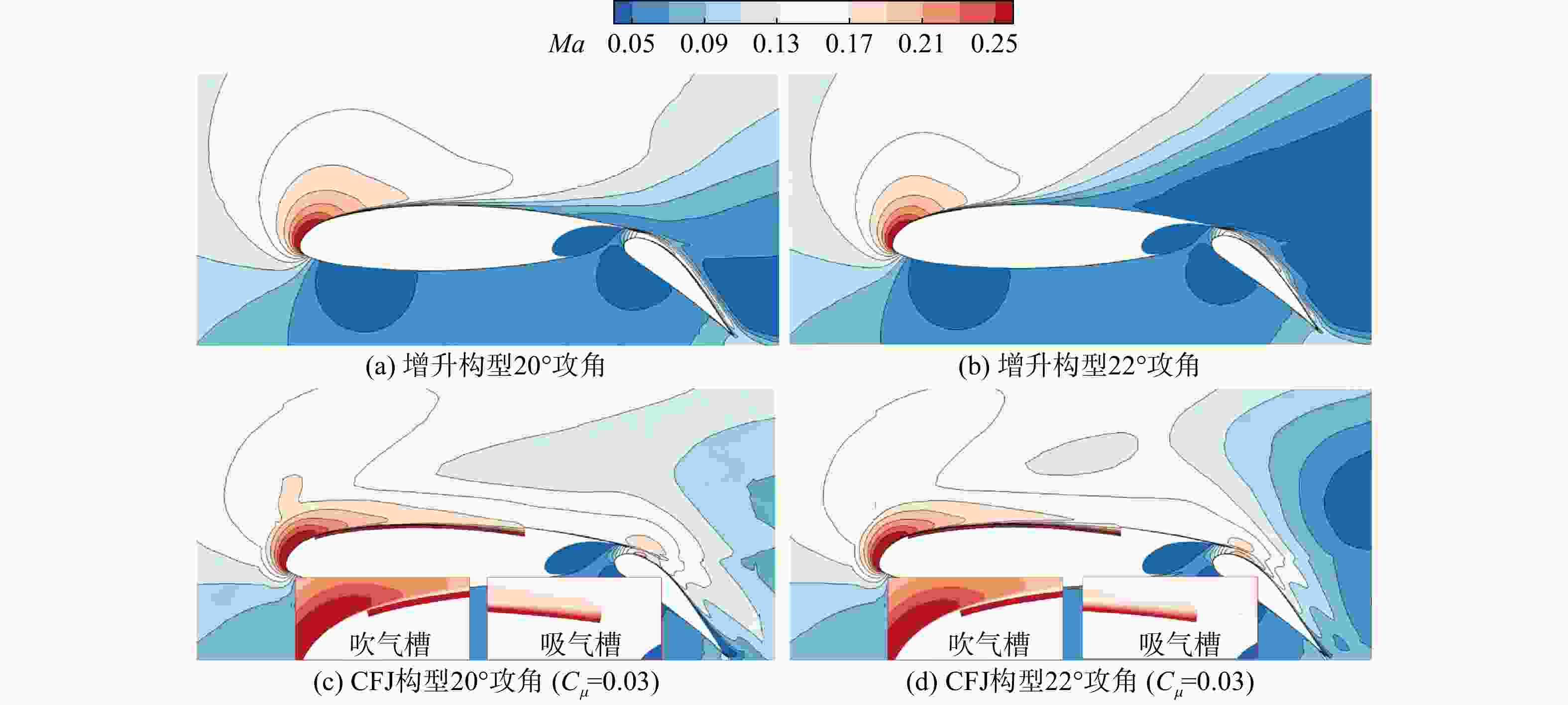
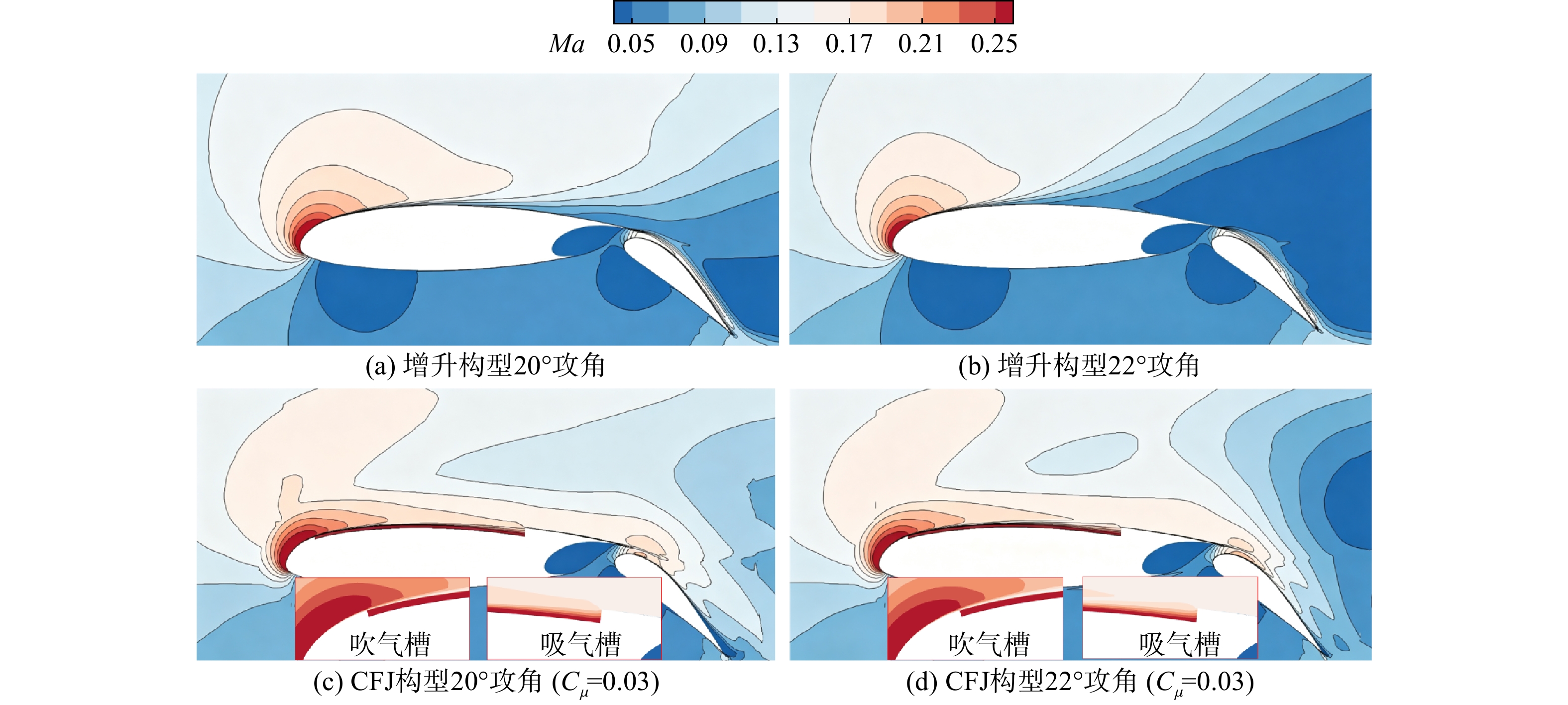
图 22 Y=−13.3 m空间流场截面马赫数分布
Figure 22. Mach number distribution at Y=−13.3 m flow field cross-section
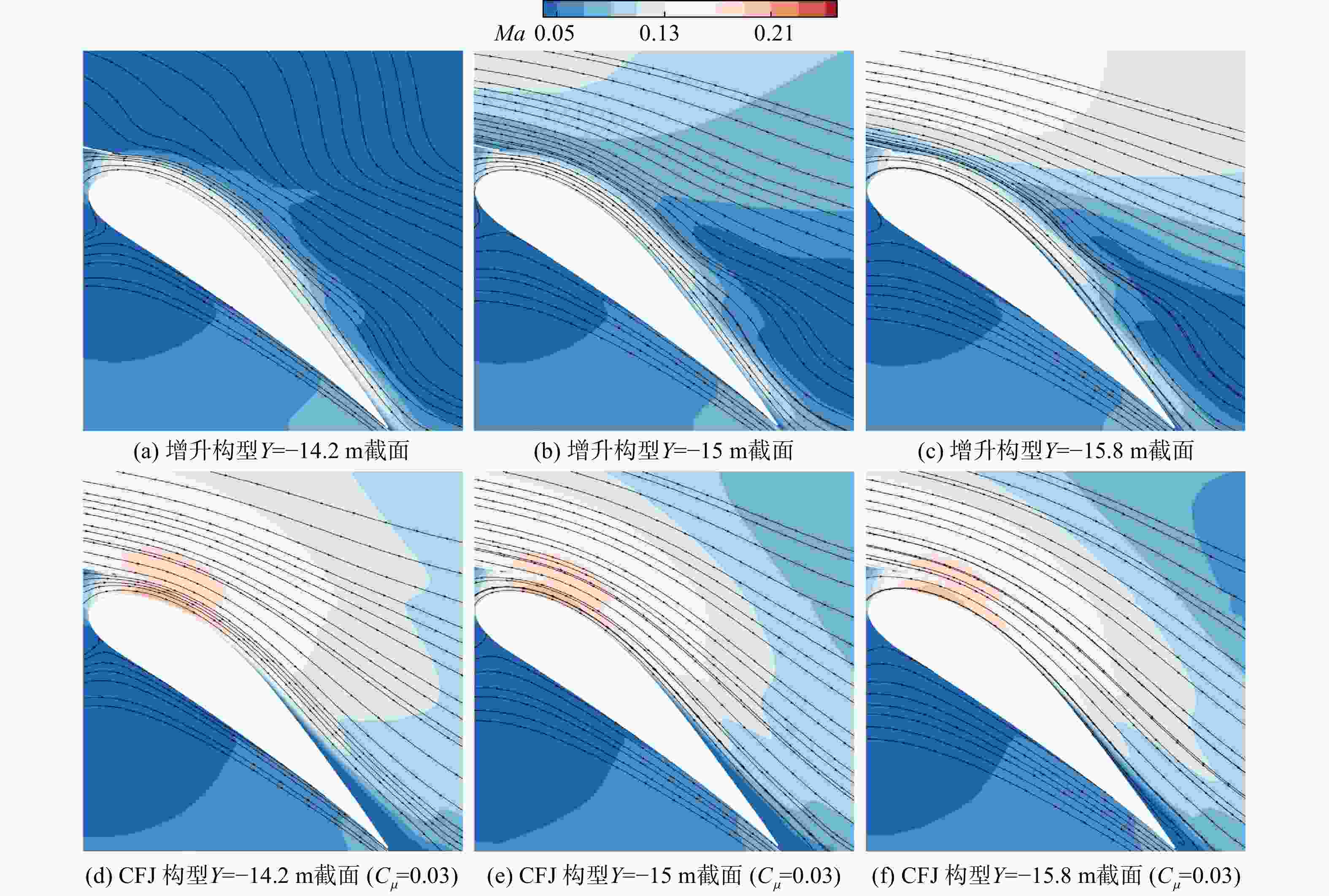
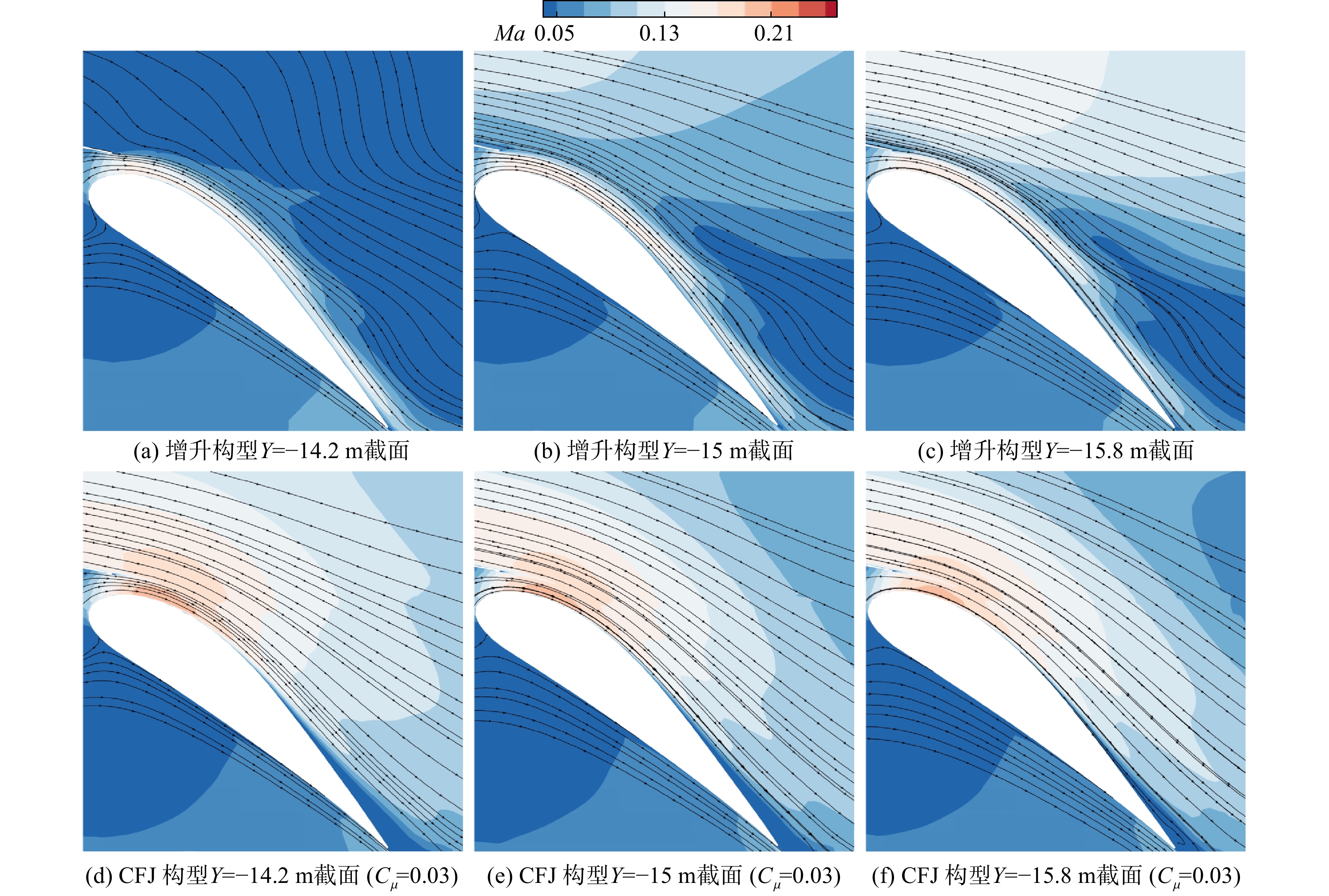
图 23 α=22°襟翼空间流场截面马赫数分布及流线
Figure 23. Mach number distribution and streamlines at flap flow field cross-section at α=22°
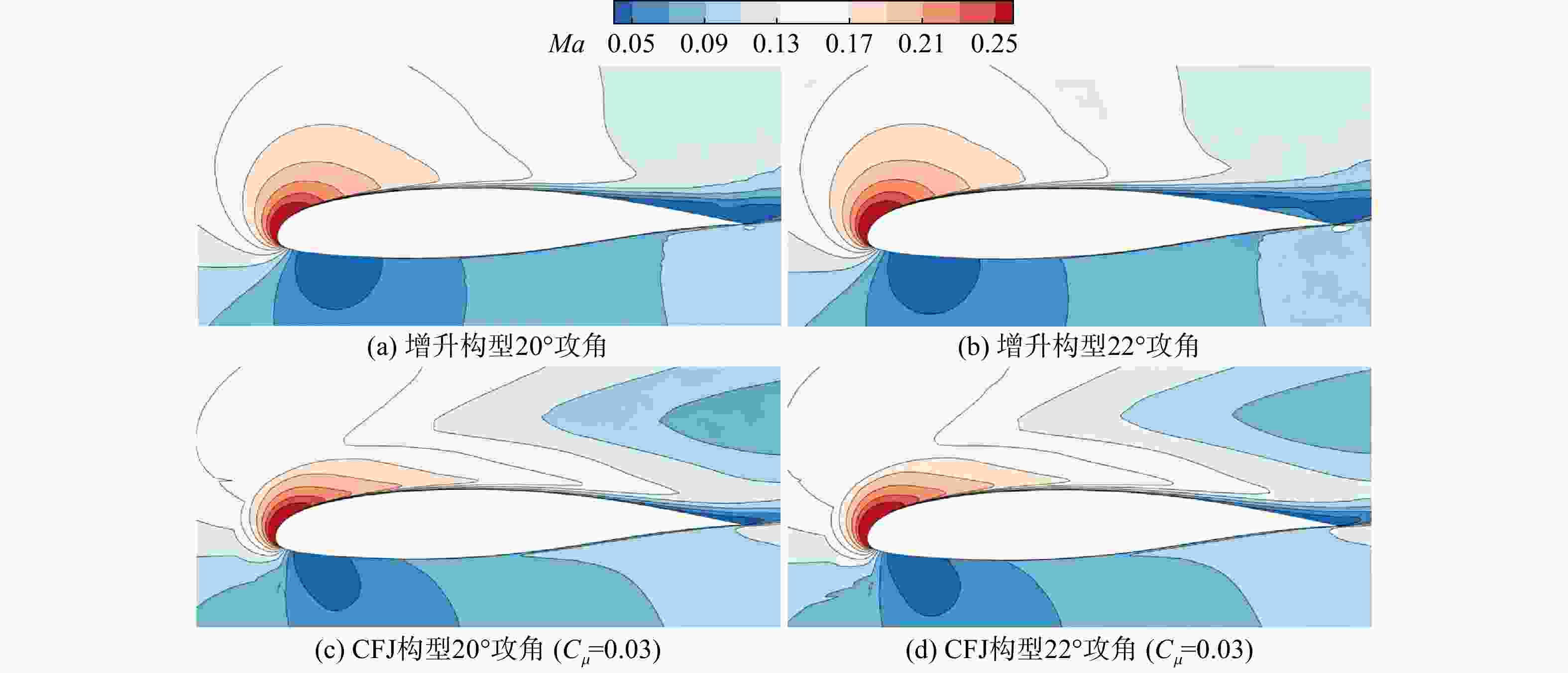
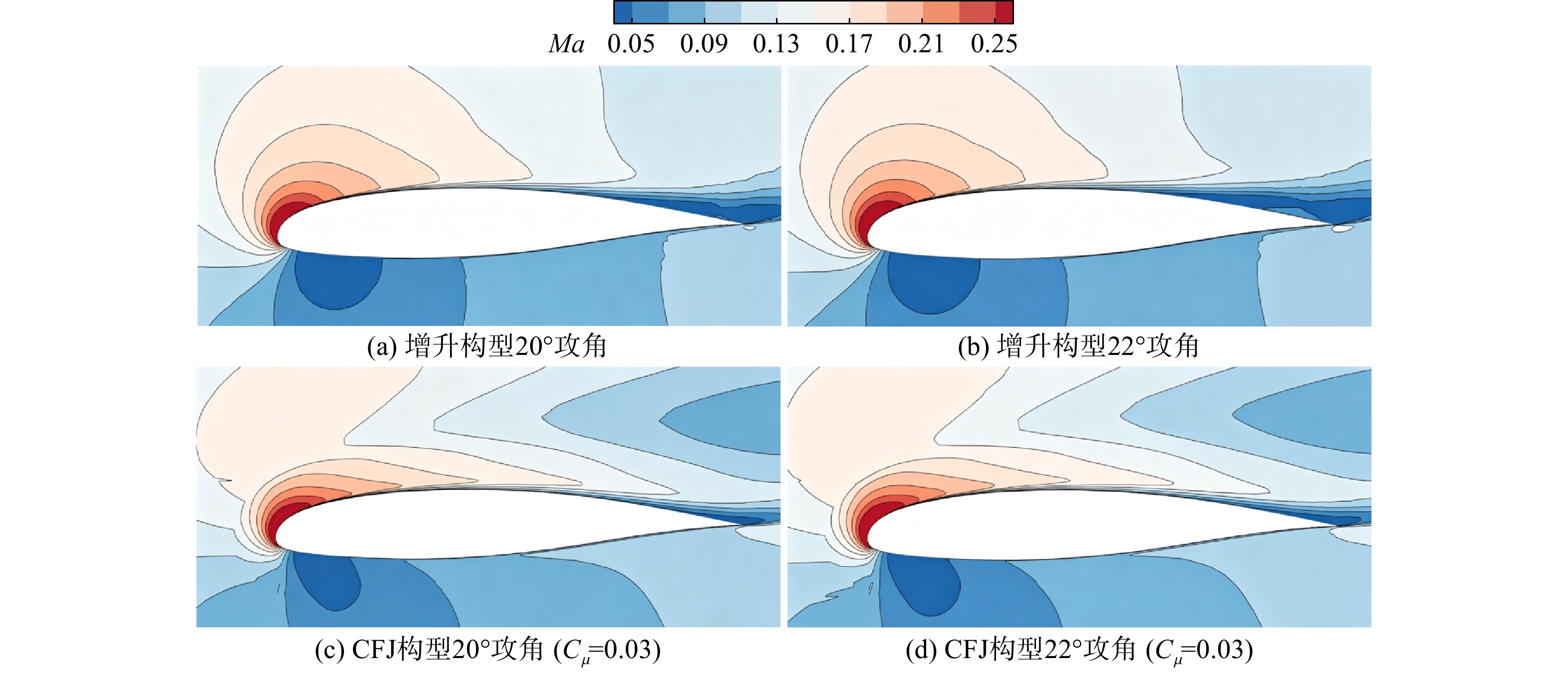
图 24 副翼区Y=−20 m空间流场截面马赫数云图
Figure 24. Mach number contour plot at aileron region flow field cross-section of Y=−20 m
表 1 各网格节点分布及网格量
Table 1. Distribution of grid nodes and grid volume
网格类型 网格量/万 展向节点数 流向节点数 密网格 5800 245 485 中网格 2000 173 341 粗网格 700 121 241  下载: 导出CSV
表 2 吹吸气边界参数
Table 2. Parameters of injection and suction boundary
位置 参数 数值 吹气槽 马赫数Ma 0.26 压比(pt/pref) 1.04 温比(Tt/Tref) 1.011 吸气槽 温比(p/pinf) 0.95
下载: 导出CSV
表 3 水陆两栖飞机模型参数
Table 3. Amphibious aircraft model parameters
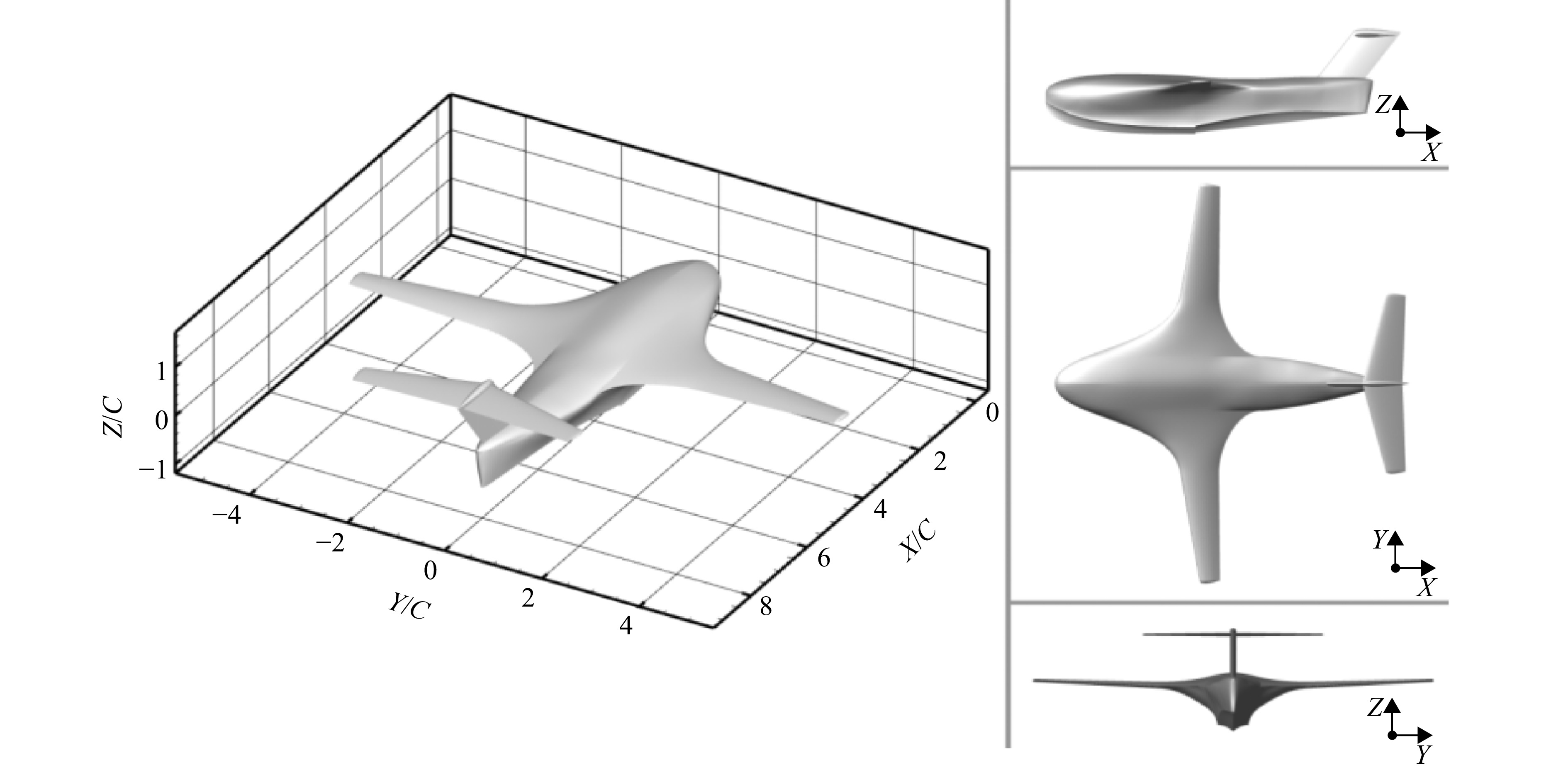
参数 数值 全翼展/m 48 机翼面积/m2 216 平均气动弦长/m 4.84 机长/m 39.5
下载: 导出CSV
-
[1] 黄领才, 雍明培. 水陆两栖飞机的关键技术和产业应用前景[J]. 航空学报, 2019, 40(1): 522708. Huang Lingcai, Yong Mingpei. Key technologies and industrial application prospects of amphibian aircraft[J]. Acta Aeronautica et Astronautica Sinica, 2019, 40(1): 522708. (in ChineseHuang Lingcai, Yong Mingpei. Key technologies and industrial application prospects of amphibian aircraft[J]. Acta Aeronautica et Astronautica Sinica, 2019, 40(1): 522708. (in Chinese) [2] 杨荣, 杨智春, 魏浩格. 大型水陆两栖飞机抗浪需求分析[J]. 航空学报, 2025, 46(10): 331227. Yang Rong, Yang Zhichun, Wei Haoge. Demand analysis of wave resistance for large amphibious aircraft[J]. Acta Aeronautica et Astronautica Sinica, 2025, 46(10): 331227. (in Chinese doi: 10.7527/S1000-6893.2024.31145Yang Rong, Yang Zhichun, Wei Haoge. Demand analysis of wave resistance for large amphibious aircraft[J]. Acta Aeronautica et Astronautica Sinica, 2025, 46(10): 331227. (in Chinese) doi: 10.7527/S1000-6893.2024.31145 [3] Shin Maywa. Performance of the State-of-the-Art US-2[EB/OL]. [2025-04-11]. https://www.shinmaywa.co.jp/english/products/aircraft/amphibian/us2/capability.html. [4] 褚林塘, 叶树林. 水上飞机文集[M]. 北京: 航空工业出版社, 2011. [5] Nickol C, McCullers L. Hybrid wing body configuration system studies[R]. AIAA-2009-0931, 2009. [6] Hooker J R Jr, Wick A T. Design of the hybrid wing body for fuel efficient air mobility operations[R]. AIAA-2014-1285, 2014. [7] Wick A T, Hooker J R, Clark C M, et al. Powered low speed testing of the hybrid wing body[R]. AIAA-2017-0100, 2017. [8] 张庆云, 王峥华, 魏猛, 等. 大型水陆两栖飞机增升装置特殊设计综述[J]. 空气动力学学报, 2019, 37(1): 19-32. Zhang Qingyun, Wang Zhenghua, Wei Meng, et al. Review of high-lift devices design for amphibious aircraft[J]. Acta Aerodynamica Sinica, 2019, 37(1): 19-32. (in Chinese doi: 10.7638/kqdlxxb-2017.0110Zhang Qingyun, Wang Zhenghua, Wei Meng, et al. Review of high-lift devices design for amphibious aircraft[J]. Acta Aerodynamica Sinica, 2019, 37(1): 19-32. (in Chinese) doi: 10.7638/kqdlxxb-2017.0110 [9] Ishizaki T. The livery design for prototype US-2 search and rescue amphibian[J]. Annual Design Review of Japanese Society for the Science of Design, 2005, 10(1): 16-19. [10] 王妙香, 孙卫平, 秦何军. 水陆两栖飞机内吹式襟翼优化设计[J]. 航空学报, 2016, 37(1): 300-309. Wang Miaoxiang, Sun Weiping, Qin Hejun. Optimization design of an internal blown flap used in large amphibian[J]. Acta Aeronautica et Astronautica Sinica, 2016, 37(1): 300-309. (in Chinese doi: 10.7527/S1000-6893.2015.0310Wang Miaoxiang, Sun Weiping, Qin Hejun. Optimization design of an internal blown flap used in large amphibian[J]. Acta Aeronautica et Astronautica Sinica, 2016, 37(1): 300-309. (in Chinese) doi: 10.7527/S1000-6893.2015.0310 [11] Zha Gecheng, Paxton C. A novel airfoil circulation augment flow control method using co-flow jet[R]. AIAA-2004-2208, 2004. [12] 许和勇, 马成宇. 协同射流流动控制方法研究进展综述[J]. 航空工程进展, 2022, 13(6): 1-16. Xu Heyong, Ma Chengyu. Review of the co-flow jet flow control method[J]. Advances in Aeronautical Science and Engineering, 2022, 13(6): 1-16. (in Chinese doi: 10.16615/j.cnki.1674-8190.2022.06.01Xu Heyong, Ma Chengyu. Review of the co-flow jet flow control method[J]. Advances in Aeronautical Science and Engineering, 2022, 13(6): 1-16. (in Chinese) doi: 10.16615/j.cnki.1674-8190.2022.06.01 [13] Zha Gecheng, Gao Wei. Analysis of jet effects on co-flow jet airfoil performance with integrated propulsion system[R]. AIAA-2006-0102, 2006. [14] Zha Gecheng, Gao Wei, Paxton C D. Jet effects on coflow jet airfoil performance[J]. AIAA Journal, 2007, 45(6): 1222-1231. doi: 10.2514/1.23995 [15] Zha Gecheng, Gao Wei, Paxton C, et al. Numerical investigation of co-flow jet airfoil with and without injection[R]. AIAA-2006-1061, 2006. [16] Hossain M A, Uddin M N, Islam M R, et al. Enhancement of aerodynamic properties of an airfoil by co flow jet (CFJ) flow[J]. American Journal of Engineering Research (AJER), 2015, 4(1): 103-112. [17] Zhu Zhenhao, Xiao Tianhang, Zhi Haolin, et al. Aerodynamic characteristics of co-flow jet wing with simple high-lift devices[J]. Chinese Journal of Aeronautics, 2022, 35(10): 67-83. doi: 10.1016/j.cja.2022.03.008 [18] Xu Kewei, Zha Gecheng. High control authority 3D aircraft control surfaces using co-flow jet[R]. AIAA-2019-3168, 2019. [19] Aguirre J, Wang Baoyuan, Zha Gecheng. Conceptual design and study of “engineless” airplane using co-flow jet airfoil[R]. AIAA-2007-4441, 2007. [20] Lefebvre A M, Zha Gecheng. Design of high wing loading compact electric airplane utilizing co-flow jet flow control[R]. AIAA-2015-0772, 2015. [21] Wang Ruochen, Ma Xiaoping, Zhang Guoxin, et al. Numerical investigation of high-speed flying wing based on co-flow jet[J]. Acta Mechanica, 2023, 234(8): 3109-3130. doi: 10.1007/s00707-023-03555-w [22] Spalart P, Allmaras S. A one-equation turbulence model for aerodynamic flows[R]. AIAA-1992-0439, 1992. [23] Slotnick J, Hannon J, Chaffin M. Overview of the 1st AIAA CFD high lift prediction workshop[R]. AIAA-2011-0862, 2011. [24] Long Mike, Mavriplis D. NSU3D results for the first AIAA high-lift prediction WOrkshop[R]. AIAA-2011-0863, 2011. [25] Wiart L, Meunier M. Computational assessment of the HiLiftPW-1 trap-wing model using the elsA CFD software[R]. AIAA-2011-0865, 2011. [26] Wells A J. Experimental investigation of an airfoil with co-flow jet flow control[D]. Gainesville: University of Florida, 2005. [27] 《飞机设计手册》总编委会. 气动设计[M]. 北京: 航空工业出版社, 2002. [28] 钟园, 陈勇, 陈真利, 等. 翼身融合布局低速验证机前缘缝翼设计[J]. 航空学报, 2019, 40(9): 623050. Zhong Yuan, Chen Yong, Chen Zhenli, et al. Design of slat of blended-wing-body low speed testing aircraft[J]. Acta Aeronautica et Astronautica Sinica, 2019, 40(9): 623050. (in ChineseZhong Yuan, Chen Yong, Chen Zhenli, et al. Design of slat of blended-wing-body low speed testing aircraft[J]. Acta Aeronautica et Astronautica Sinica, 2019, 40(9): 623050. (in Chinese) -

 点击查看大图
计量
- 文章访问数: 110
- HTML浏览量: 90
- PDF量: 5
- 被引次数: 0