






Internal heat transfer characteristics in curved double-wall laminate cooling structures
-
摘要:
采用瞬态液晶测量技术,通过实验定量分析了带冲击孔、扰流柱和狭缝的复杂双层壁结构靶面的换热情况与曲率(9°凹面、30°凸面和75°凸面)和冲击雷诺数(
10000 ~40000 )的关系。研究发现,随着曲率增大,双层壁结构内部换热得到增强,在相同冲击雷诺数下,75°凸面的平均表面传热系数比9°凹面高出约20 W/(m2·K)。冲击雷诺数每升高10000 ,3种曲率结构的平均表面传热系数升高约30 W/(m2·K),仅当冲击雷诺数从30000 升高到40000 时,平均表面传热系数的增长变小。表面传热系数在展向上呈多峰分布,当雷诺数达到40000 时,次峰数值超过主峰。表面传热系数沿流向整体呈下降趋势,在流向的不同位置处呈现不同的分布规律。Abstract:This study employed the transient liquid crystal method to experimentally quantify the heat transfer on the target surface of a complex double-wall structure incorporating impingement hole, pin-fins, and slot. The investigation focuses on the effects of curvature (9° concave, 30° convex, and 75° convex) and impingement Reynolds numbers (
10000 —40000 ). The results demonstrate that as curvature increases, internal heat transfer within the double-wall structure is enhanced. At identical impingement Reynolds numbers, the average convective heat transfer coefficient for 75° convex is approximately 20 W/(m2·K) higher than that of 9° concave. For every increase of10000 in the impingement Reynolds number, the area-averaged convective heat transfer coefficient rises by about 30 W/(m2·K) across all three curved structures. The increase in the average convective heat transfer coefficient slows down only when the impingement Reynolds number rises from30000 to40000 . The spanwise distribution of the convective heat transfer coefficient exhibits multiple peaks, with secondary peaks surpassing the primary peak at Reynolds number of40000 . Along the flow direction, the convective heat transfer coefficient generally decreases but displays distinct distribution patterns at different longitudinal positions. -
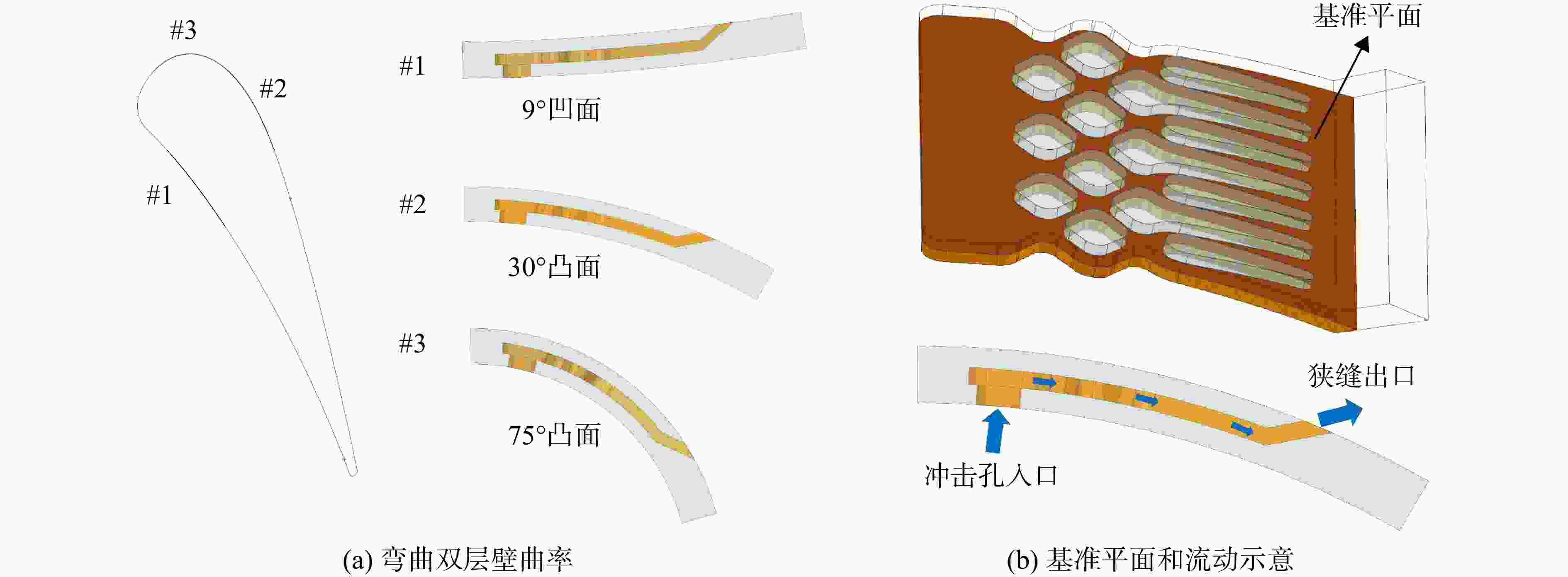
图 2 基于涡轮叶片曲率的弯曲双层壁
Figure 2. Curved double-wall structures based on turbine blade curvature
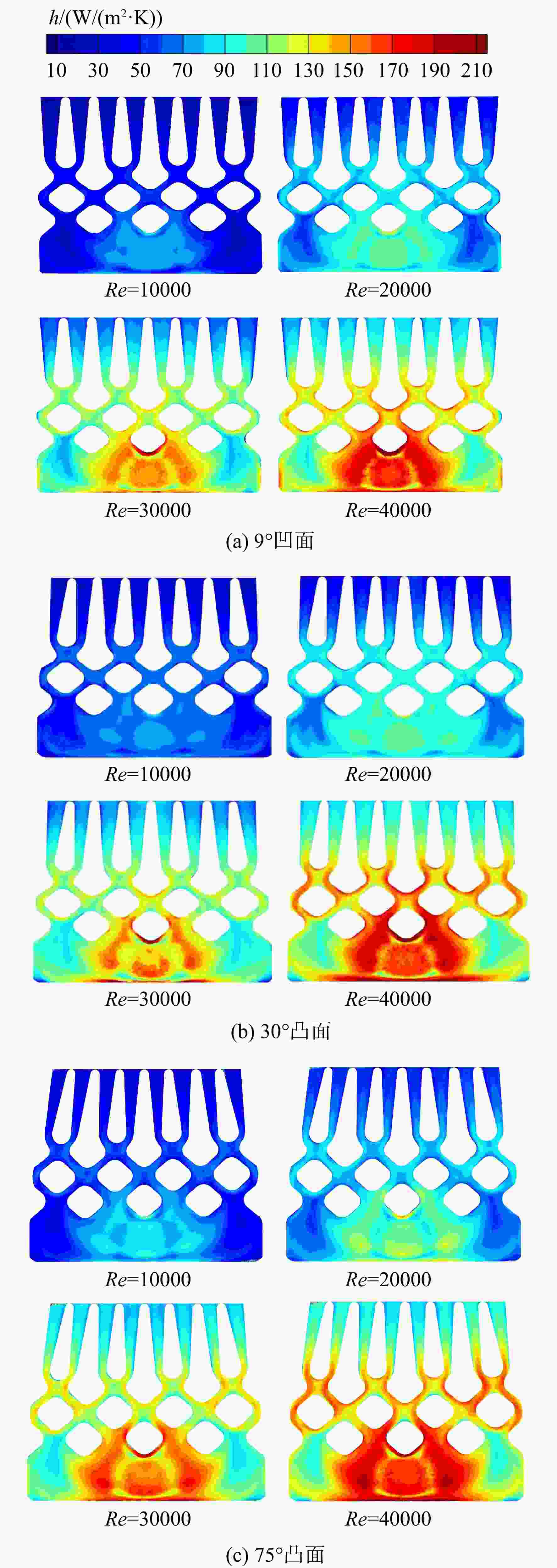
图 6 弯曲双层壁结构靶面表面传热系数分布
Figure 6. Contours of h at target surface of curved double-wall structure
表 1 结构参数设计
Table 1. Configuration of double-wall structure mm
参数 数值 参数 数值 L1 36.34 P 14 L2 11 R1 5 L3 11 R2 3 L4 3 R3 9.68 L5 26 R4 2 L6 5 R5 3 L7 6 R6 5 L8 11 R7 4.5 L9 103.9 R8 2 L10 112 D 13 L11 10 α1/(°) 35 L12 17.46 α2/(°) 95 L13 10.74 S* 5 L14 19.79  下载: 导出CSV
表 2 各参数不确定度表
Table 2. Uncertainty of various parameters
参数 数值 不确定度 T0/K 293.15 ±0.2 Th/K 333.15 ±0.2 Tlc/K 302.46 ±0.2 $ \lambda /\sqrt{\alpha } (\text{W}\sqrt{\text{s}}/ ({\text{m}}^{2}\cdot\text{K}) ) $ 554.96 ±22.3 低换热 t/s 20 ±0.1 h/(W/(m2·K)) 30 8.15% 高换热 t /s 2 ±0.1 h/(W/(m2·K)) 240 12.42%
下载: 导出CSV
-
[1] 刘润洲, 李海旺, 由儒全, 等. 基于双层壁冷却结构的综合冷效数值解耦研究[J]. 航空动力学报, 2024, 39(5): 20220372. Liu Runzhou, Li Haiwang, You Ruquan, et al. Numerical decoupling of overall cooling effectiveness based on double-wall cooling structure[J]. Journal of Aerospace Power, 2024, 39(5): 20220372. (in ChineseLiu Runzhou, Li Haiwang, You Ruquan, et al. Numerical decoupling of overall cooling effectiveness based on double-wall cooling structure[J]. Journal of Aerospace Power, 2024, 39(5): 20220372. (in Chinese) [2] Unnikrishnan U, Yang V. A review of cooling technologies for high temperature rotating components in gas turbine[J]. Propulsion and Power Research, 2022, 11(3): 293-310. doi: 10.1016/j.jppr.2022.07.001 [3] Nealy D A, Reider S B. Evaluation of laminated porous wall materials for combustor liner cooling[J]. Journal of Engineering for Power, 1980, 102(2): 268-276. doi: 10.1115/1.3230247 [4] You Ruquan, Liu Runzhou, Li Haiwang. Experimental study of the couple effects of internal and external cooling on double-wall laminate structure with novel slot and pin-fins[J]. Applied Thermal Engineering, 2025, 260: 124989. doi: 10.1016/j.applthermaleng.2024.124989 [5] Tian Xiaojing, Ye Weiqi, Xu Liang, et al. Optimization research on laminated cooling structure for gas turbines: a review[J]. AIMS Energy, 2025, 13(2): 354-401. doi: 10.3934/energy.2025014 [6] Xu Liang, Sun Zineng, Ruan Qicheng, et al. Development trend of cooling technology for turbine blades at super-high temperature of above 2000 K[J]. Energies, 2023, 16(2): 668. doi: 10.3390/en16020668 [7] Xu Liang, Jin Shenglong, Ye Weiqi, et al. A review of machine learning methods in turbine cooling optimization[J]. Energies, 2024, 17(13): 3177. doi: 10.3390/en17133177 [8] Liu Runzhou, Li Haiwang, You Ruquan, et al. Numerical decoupling of the effect of internal cooling and external film cooling on overall cooling effectiveness[J]. Applied Thermal Engineering, 2023, 222: 119905. doi: 10.1016/j.applthermaleng.2022.119905 [9] Ruan Qicheng, Xu Liang, Xi Lei, et al. Cooling performance of droplet-shaped Kagome truss structure combined with jet array impingement composite cooling structure[J]. Case Studies in Thermal Engineering, 2023, 51: 103558. doi: 10.1016/j.csite.2023.103558 [10] 孙启超. 层板结构内部流动与换热特性研究[D]. 南京: 南京航空航天大学, 2012. Sun Qichao. Investigation on flow and heat transfer of the internal characteristics with lamilloy board[D]. Nanjing: Nanjing University of Aeronautics and Astronautics, 2012. (in ChineseSun Qichao. Investigation on flow and heat transfer of the internal characteristics with lamilloy board[D]. Nanjing: Nanjing University of Aeronautics and Astronautics, 2012. (in Chinese) [11] Liang G. Gas turbine vane with integral cooling system: US 7255534 B2 [P]. 2007-08-14. [12] 全栋梁, 刘松龄, 李江海. 层板冷却结构强化换热机理[J]. 航空动力学报, 2004, 19(6): 860-865. Quan Dongliang, Liu Songling, Li Jianghai. Numerical investigation on mechanism of heat transfer augmentation in lamilloy[J]. Journal of Aerospace Power, 2004, 19(6): 860-865. (in ChineseQuan Dongliang, Liu Songling, Li Jianghai. Numerical investigation on mechanism of heat transfer augmentation in lamilloy[J]. Journal of Aerospace Power, 2004, 19(6): 860-865. (in Chinese) [13] 全栋梁, 刘松龄, 李江海, 等. 层板冷却特性的实验与数值模拟研究[J]. 推进技术, 2004, 25(2): 134-138. Quan Dongliang, Liu Songling, Li Jianghai, et al. Experimental and numerical investigation of the cooling characteristics in a laminate porous plate[J]. Journal of Propulsion Technology, 2004, 25(2): 134-138. (in ChineseQuan Dongliang, Liu Songling, Li Jianghai, et al. Experimental and numerical investigation of the cooling characteristics in a laminate porous plate[J]. Journal of Propulsion Technology, 2004, 25(2): 134-138. (in Chinese) [14] 全栋梁, 郁新华, 刘松龄, 等. 层板冷却结构流阻特性的实验与数值模拟[J]. 推进技术, 2003, 24(5): 425-428. Quan Dongliang, Yu Xinhua, Liu Songling, et al. Experimental and numerical investigation of internal-flow resistance characteristics in laminate porous plates[J]. Journal of Propulsion Technology, 2003, 24(5): 425-428. (in ChineseQuan Dongliang, Yu Xinhua, Liu Songling, et al. Experimental and numerical investigation of internal-flow resistance characteristics in laminate porous plates[J]. Journal of Propulsion Technology, 2003, 24(5): 425-428. (in Chinese) [15] You Ruquan, Liu Runzhou, Li Haiwang. Experiments on heat transfer and film cooling characteristics of double-wall cooling structure with novel slot holes and pin-fins[J]. Applied Thermal Engineering, 2024, 249: 123415. doi: 10.1016/j.applthermaleng.2024.123415 [16] Terzis A, Von Wolfersdorf J, Weigand B, et al. Thermocouple thermal inertia effects on impingement heat transfer experiments using the transient liquid crystal technique[J]. Measurement Science and Technology, 2012, 23(11): 115303. doi: 10.1088/0957-0233/23/11/115303 [17] Jang J H, Chiu H C, Yan W M. Impinging cooling of film hole surface using transient liquid crystal thermograph[J]. International Communications in Heat and Mass Transfer, 2013, 44: 23-30. doi: 10.1016/j.icheatmasstransfer.2013.03.009 [18] Lee J, Ren Zhong, Ligrani P, et al. Crossflows from jet array impingement cooling: Hole spacing, target plate distance, Reynolds number effects[J]. International Journal of Thermal Sciences, 2015, 88: 7-18. doi: 10.1016/j.ijthermalsci.2014.09.003 [19] Xing Yunfei, Spring S, Weigand B. Experimental and numerical investigation of impingement heat transfer on a flat and micro-rib roughened plate with different crossflow schemes[J]. International Journal of Thermal Sciences, 2011, 50(7): 1293-1307. doi: 10.1016/j.ijthermalsci.2010.11.008 [20] Lo Y H, Liu Y H. Heat transfer of impinging jet arrays onto half-smooth, half-rough target surfaces[J]. Applied Thermal Engineering, 2018, 128: 79-91. doi: 10.1016/j.applthermaleng.2017.08.165 [21] Rao Yu, Liu Yuyang, Wan Chaoyi. Multiple-jet impingement heat transfer in double-wall cooling structures with pin fins and effusion holes[J]. International Journal of Thermal Sciences, 2018, 133: 106-119. doi: 10.1016/j.ijthermalsci.2018.07.021 [22] Liu Yuyang, Rao Yu, Yang Li. Numerical simulations of a double-wall cooling with internal jet impingement and external hexagonal arrangement of film cooling holes[J]. International Journal of Thermal Sciences, 2020, 153: 106337. doi: 10.1016/j.ijthermalsci.2020.106337 [23] 饶宇, 刘宇阳, 万超一. 具有气膜出流孔和针肋的双层壁冷却结构内的冲击传热性能[J]. 航空学报, 2018, 39(1): 94-102. Rao Yu, Liu Yuyang, Wan Chaoyi. Jet impingement heat transfer performance in a double-wall cooling structure with film effusion holes and pin fins[J]. Acta Aeronautica et Astronautica Sinica, 2018, 39(1): 94-102. (in ChineseRao Yu, Liu Yuyang, Wan Chaoyi. Jet impingement heat transfer performance in a double-wall cooling structure with film effusion holes and pin fins[J]. Acta Aeronautica et Astronautica Sinica, 2018, 39(1): 94-102. (in Chinese) [24] Funazaki K, Tarukawa Y, Kudo T, et al. Heat transfer characteristics of an integrated cooling configuration for ultra-high temperature turbine blades: experimental and numerical investigations[C]//Volume 3: Heat Transfer; Electric Power; Industrial and Cogeneration. American Society of Mechanical Engineers, 2001: V003T01A031. [25] Funazaki K I, Bin Salleh H. Extensive studies on internal and external heat transfer characteristics of integrated impingement cooling structures for HP turbines[C]//Volume 4: Heat Transfer, Parts A and B. ASMEDC, 2008: 167-176. [26] Bu Shi, Yang Lianfeng, Qiu Hanghai, et al. Effect of sidewall slots and pin fins on the performance of latticework cooling channel for turbine blades[J]. Applied Thermal Engineering, 2017, 117: 275-288. doi: 10.1016/j.applthermaleng.2017.01.110 [27] Axtmann M, Poser R, Von Wolfersdorf J, et al. Endwall heat transfer and pressure loss measurements in staggered arrays of adiabatic pin fins[J]. Applied Thermal Engineering, 2016, 103: 1048-1056. doi: 10.1016/j.applthermaleng.2016.04.066 [28] Schultz D L, Jones T V. Heat-transfer measurements in short-duration hypersonic facilities[J]. agardograph, 1973. [29] Chen Lingling, Brakmann R G, Weigand B, et al. An experimental heat transfer investigation of an impingement jet array with turbulators on both target plate and impingement plate[J]. Applied Thermal Engineering, 2020, 166: 114661. doi: 10.1016/j.applthermaleng.2019.114661 [30] Han J C, Wright L M. Analytical heat transfer[M]. 2nd Ed. Boca Raton: CRC Press, 2022. [31] Whitaker S. Forced convection heat transfer correlations for flow in pipes, past flat plates, single cylinders, single spheres, and for flow in packed beds and tube bundles[J]. AIChE Journal, 1972, 18(2): 361-371. doi: 10.1002/aic.690180219 [32] Yan Youyou, Owen J M. Uncertainties in transient heat transfer measurements with liquid crystal[J]. International Journal of Heat and Fluid Flow, 2002, 23(1): 29-35. doi: 10.1016/S0142-727X(01)00125-4 [33] Owen J M, Newton P J, Lock G D. Transient heat transfer measurements using thermochromic liquid crystal. Part 2: Experimental uncertainties[J]. International Journal of Heat and Fluid Flow, 2003, 24(1): 23-28. doi: 10.1016/S0142-727X(02)00207-2 [34] Schlunder E U, Gnielinski V. Heat and mass transfer between a Surface and an impinging jet[J]. Chemie Ingenieur Technik, 1967, 39(9/10): 578-584. [35] Martin H. Heat and mass transfer between impinging gas jets and solid surfaces[M]//Advances in Heat Transfer Volume 13. Amsterdam: Elsevier, 1977: 1-60. -


 点击查看大图

计量
- 文章访问数: 152
- HTML浏览量: 119
- PDF量: 8
- 被引次数: 0