






Reduced-order modeling method for low-cycle fatigue life prediction of gas turbine rotor blades
-
摘要:
针对数值仿真计算量大、难以直接用于在线运维的局限性,为了满足燃气轮机透平动叶片的在线运维需求,发展了一种面向低周疲劳寿命预测的降阶建模方法,以提高寿命预测的效率和准确性。基于一定工况下透平叶片的流-热-固耦合数值仿真多物理场结果,采用本征正交分解技术,结合数据驱动的回归拟合方法构建降阶模型,实现了温度、应力和应变场的快速精准预测。在此基础上,引入 Manson-Coffin和Smith-Watson-Topper方法,对叶片的低周疲劳寿命进行高效评估。结果表明:所构建的降阶模型平均相对误差在温度场为0.11%,应力场为1.01%,应变场为0.75%。在预测速度上,温度场、应力场和应变场分别耗时为0.005、0.03 s和0.31 s。低周疲劳寿命预测的平均相对误差小于3.5%,为燃气轮机透平动叶片的在线运维监测和寿命评估提供重要的理论和方法支撑。
Abstract:Multi-physics numerical simulations of gas turbine rotor blades are computationally intensive, making it difficult to be directly applied for online condition monitoring and life prediction. In order to address this challenge, a reduced-order modeling method for multi-physics-based low-cycle fatigue life prediction of gas turbine rotor blades was developed, aiming to improve both computational efficiency and prediction accuracy. Based on the multi-physics results of fluid-thermal-solid coupled numerical simulations of turbine blades under representative operating conditions, a reduced-order model was constructed using proper orthogonal decomposition combined with data-driven regression techniques, enabling rapid and accurate prediction of temperature, stress, and strain fields. On this basis, the Manson-Coffin and Smith-Watson-Topper methods were employed for efficient evaluation of the blade’s low-cycle fatigue life. Results showed that the average relative error of the constructed reduced-order model was 0.11% for the temperature field, 1.01% for the stress field, and 0.75% for the strain field. The prediction speed was only 0.005 s for the temperature field, 0.03 s for the stress field, and 0.31 s for the strain field. The average relative error of the low-cycle fatigue life prediction was less than 3.5%, providing important theoretical and methodological support for online condition monitoring and life assessment of gas turbine rotor blades.
-
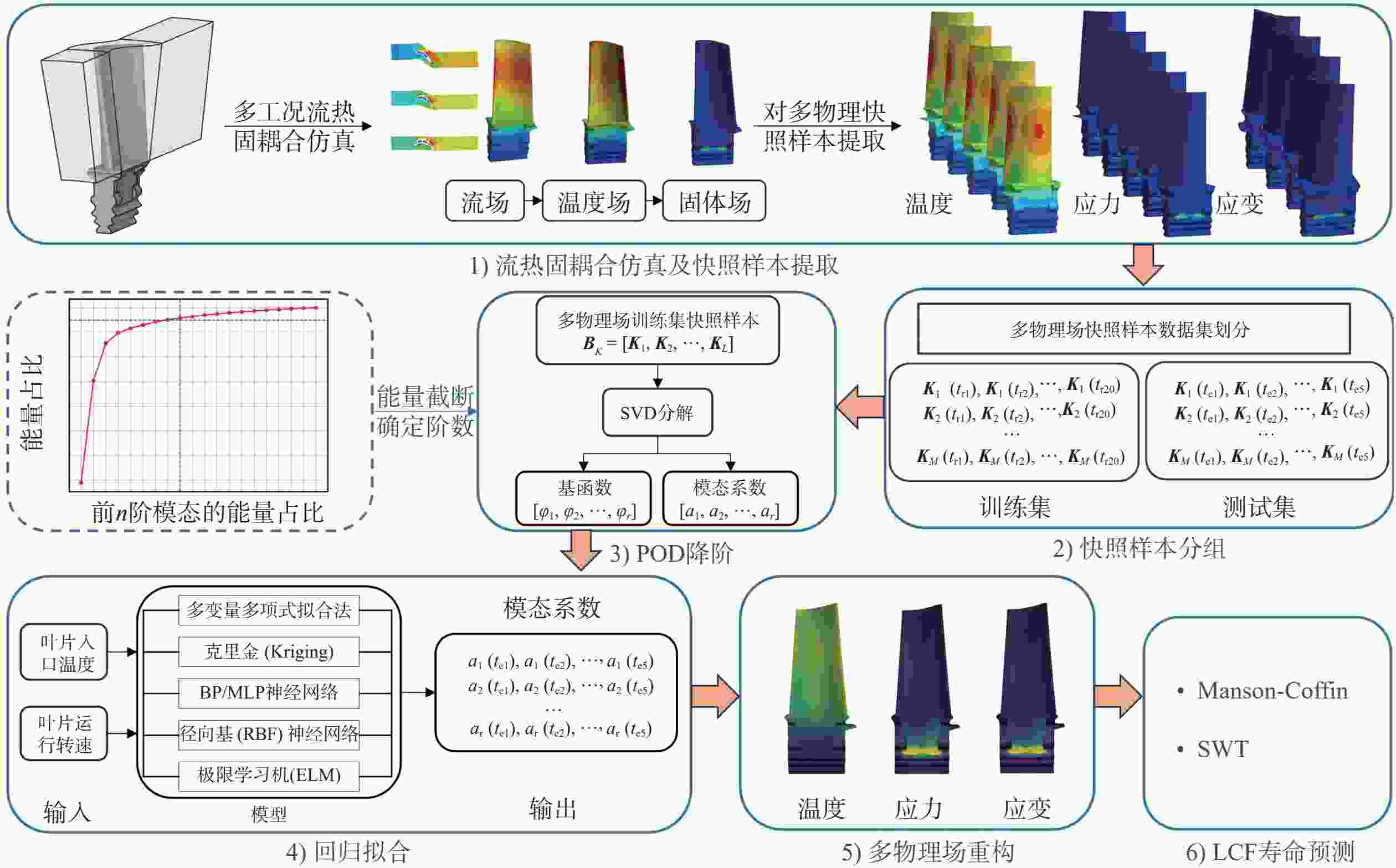
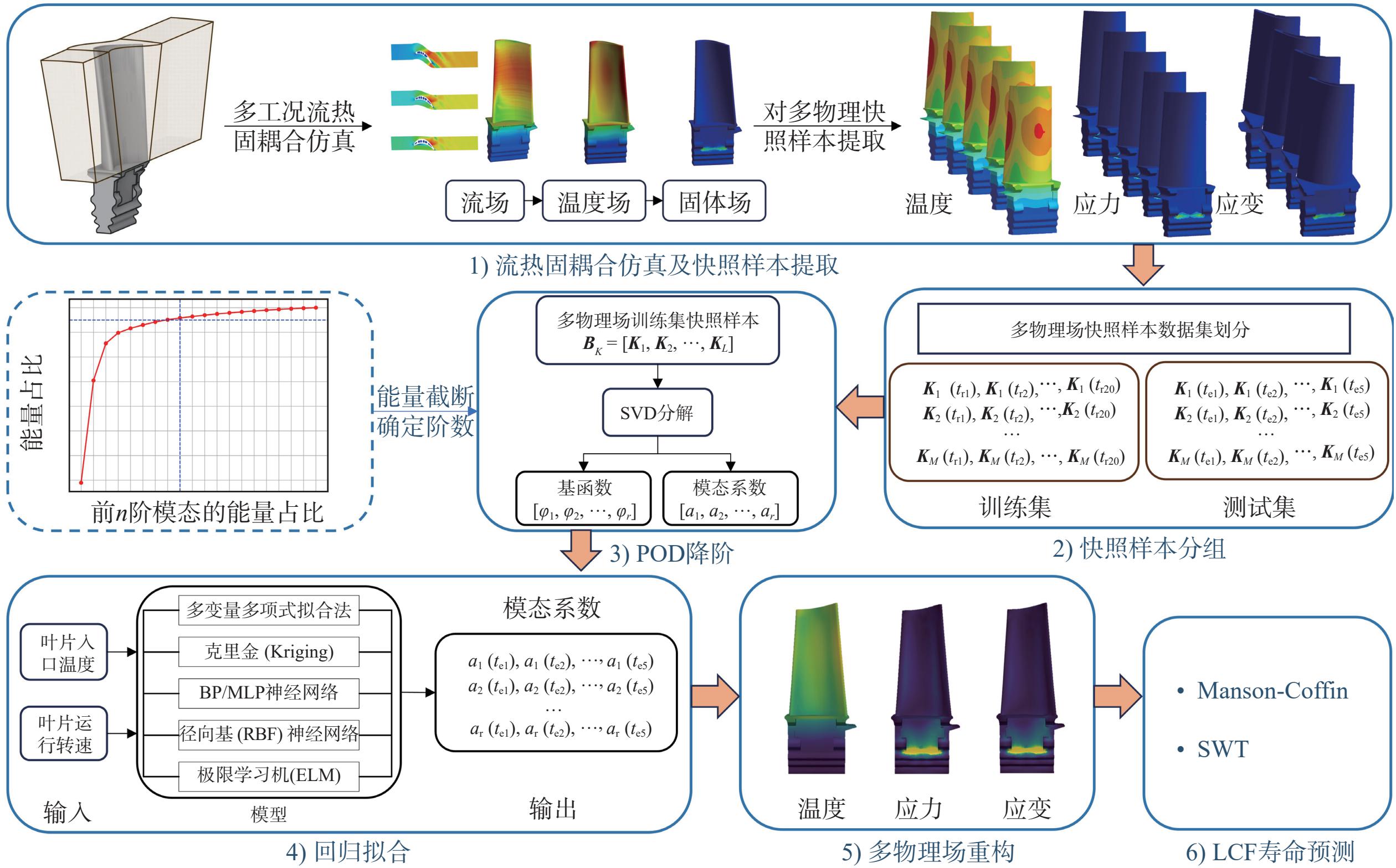
图 5 燃机透平动叶片基于多物理场降阶的LCF寿命预测方法流程
Figure 5. Flowchart for multi-physics reduced-order-based LCF life prediction for gas turbine blades
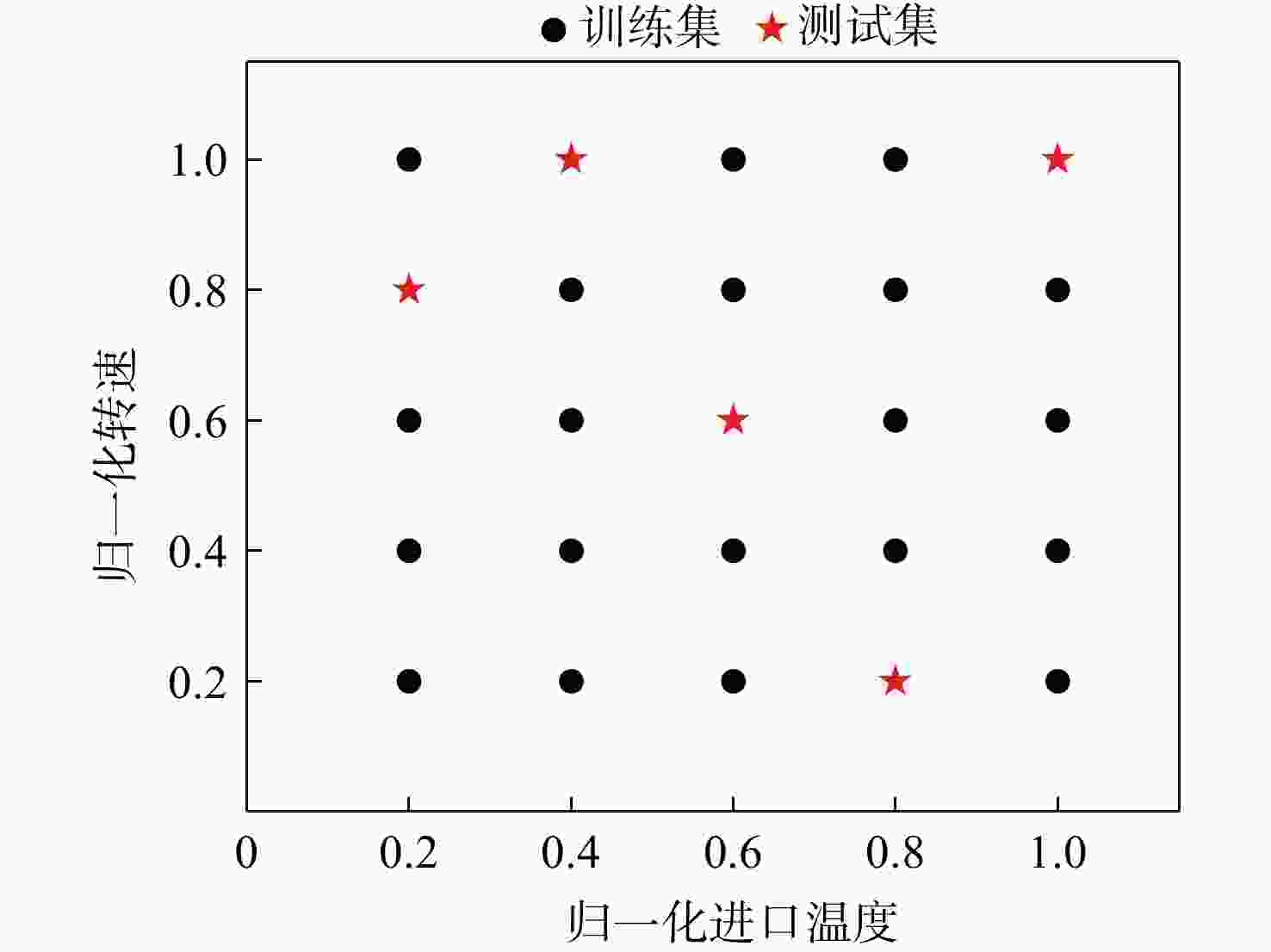
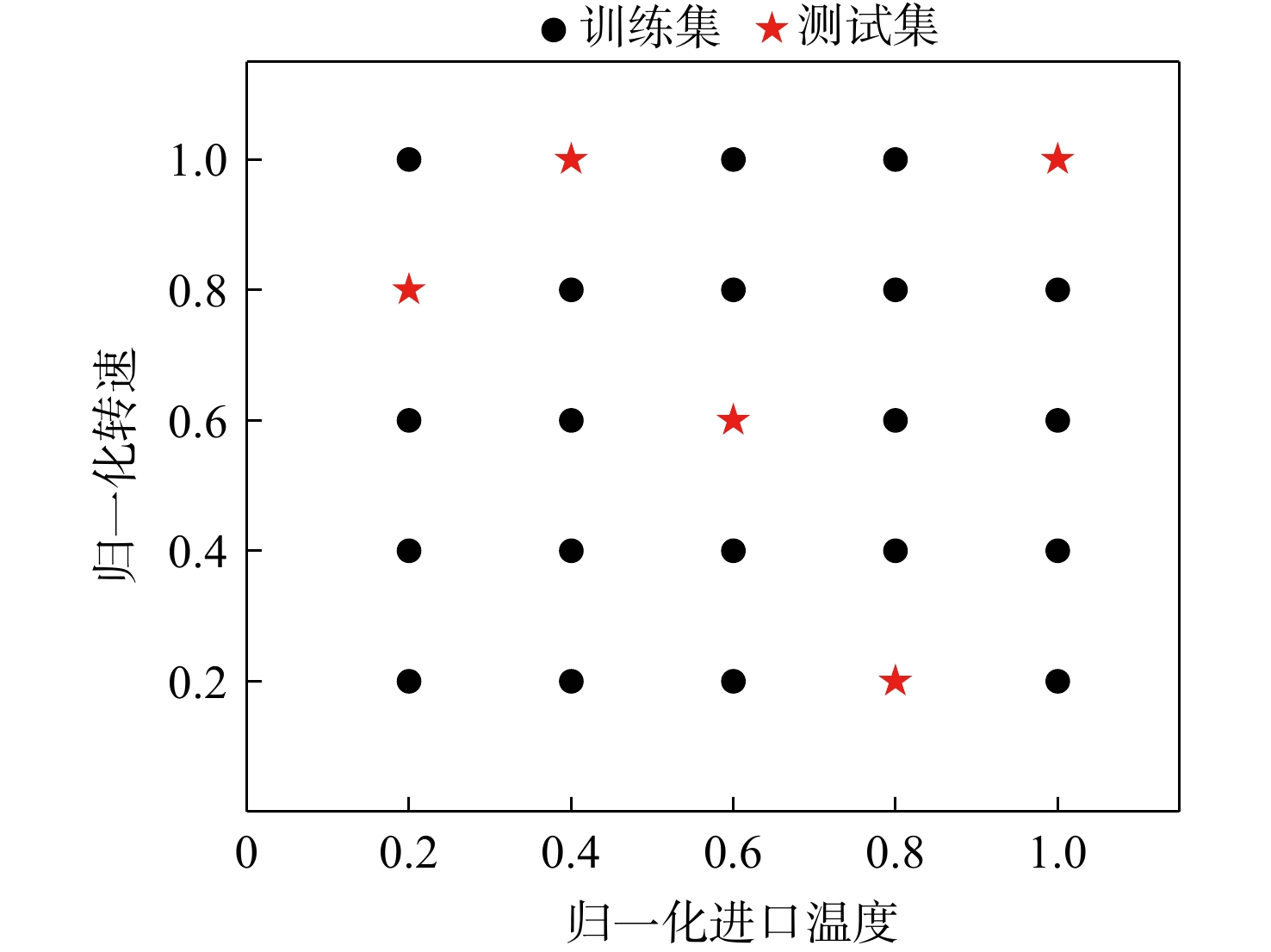
图 6 样本空间中训练集和测试集的分布
Figure 6. Distribution of training and testing samples in the sample space
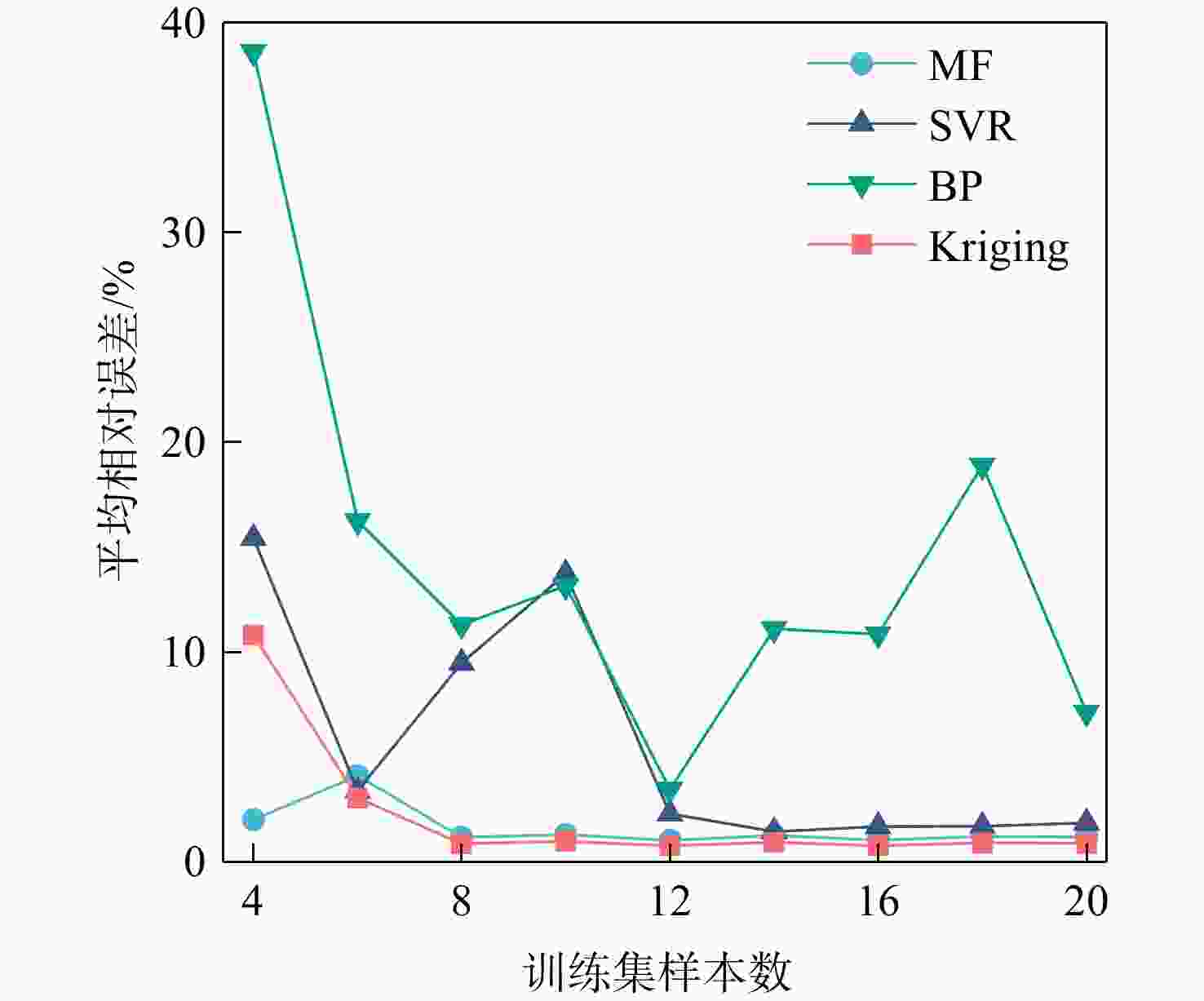
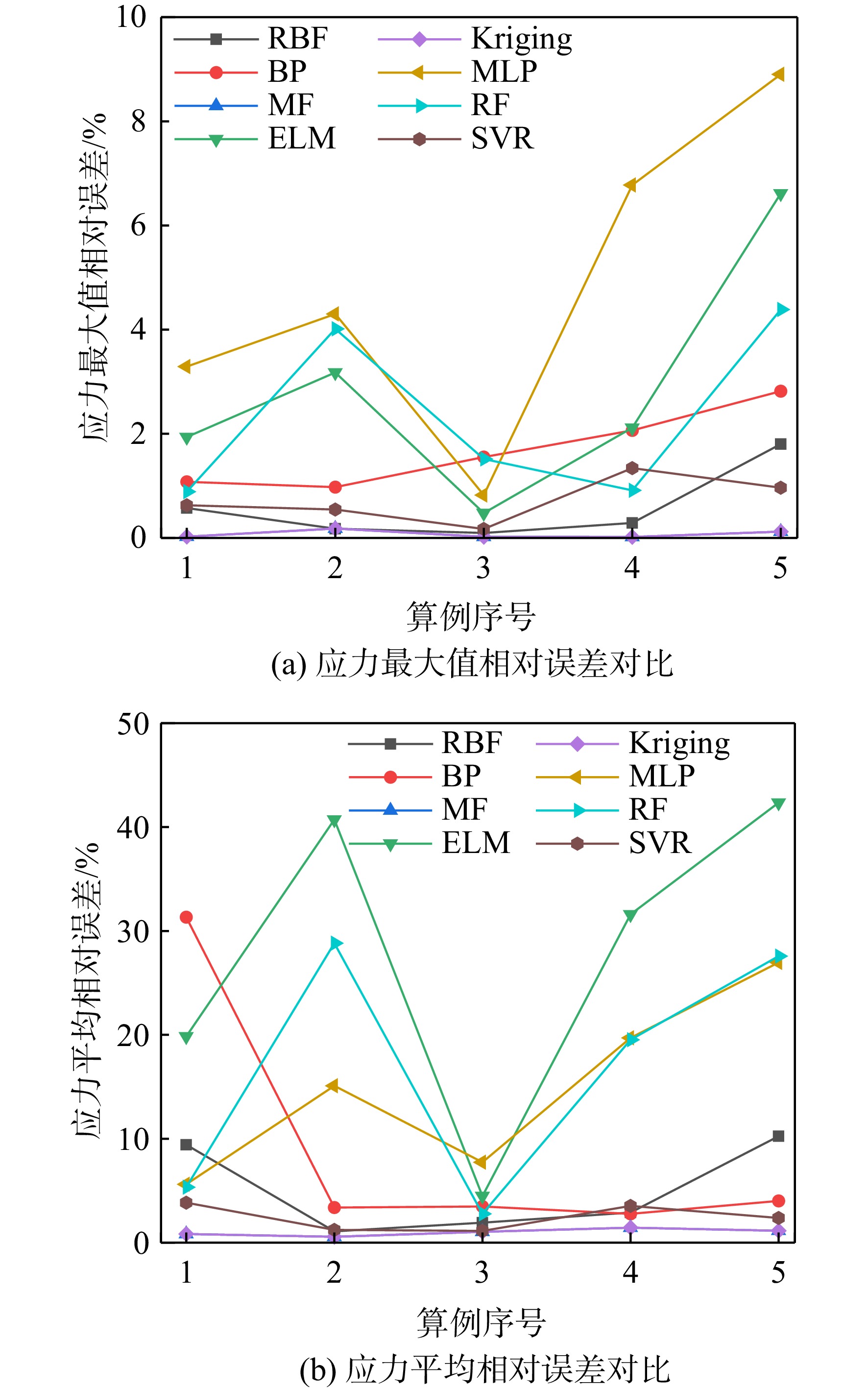
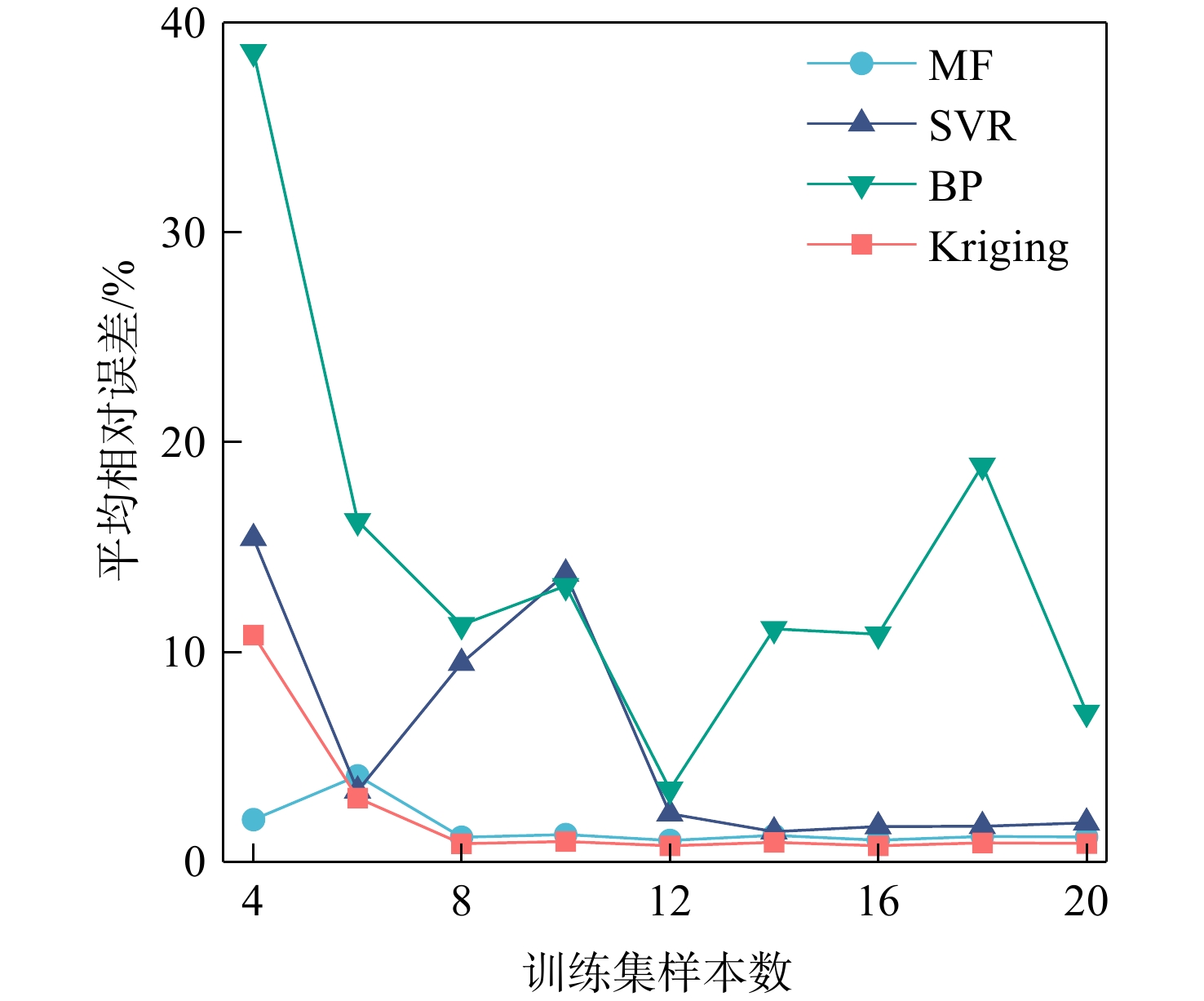
图 20 不同训练样本数下平均相对误差对比
Figure 20. Average relative error under different training sample sizes
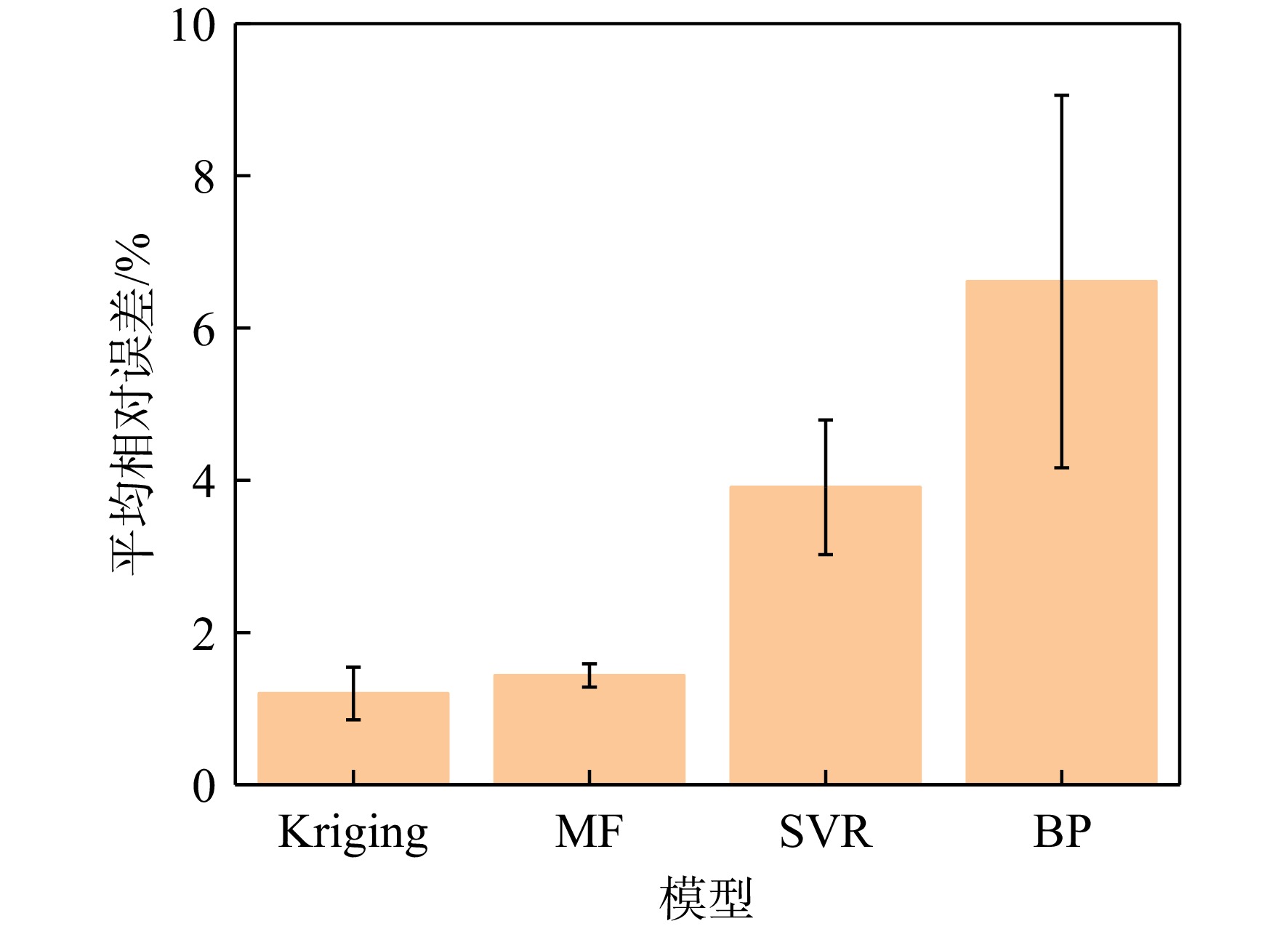
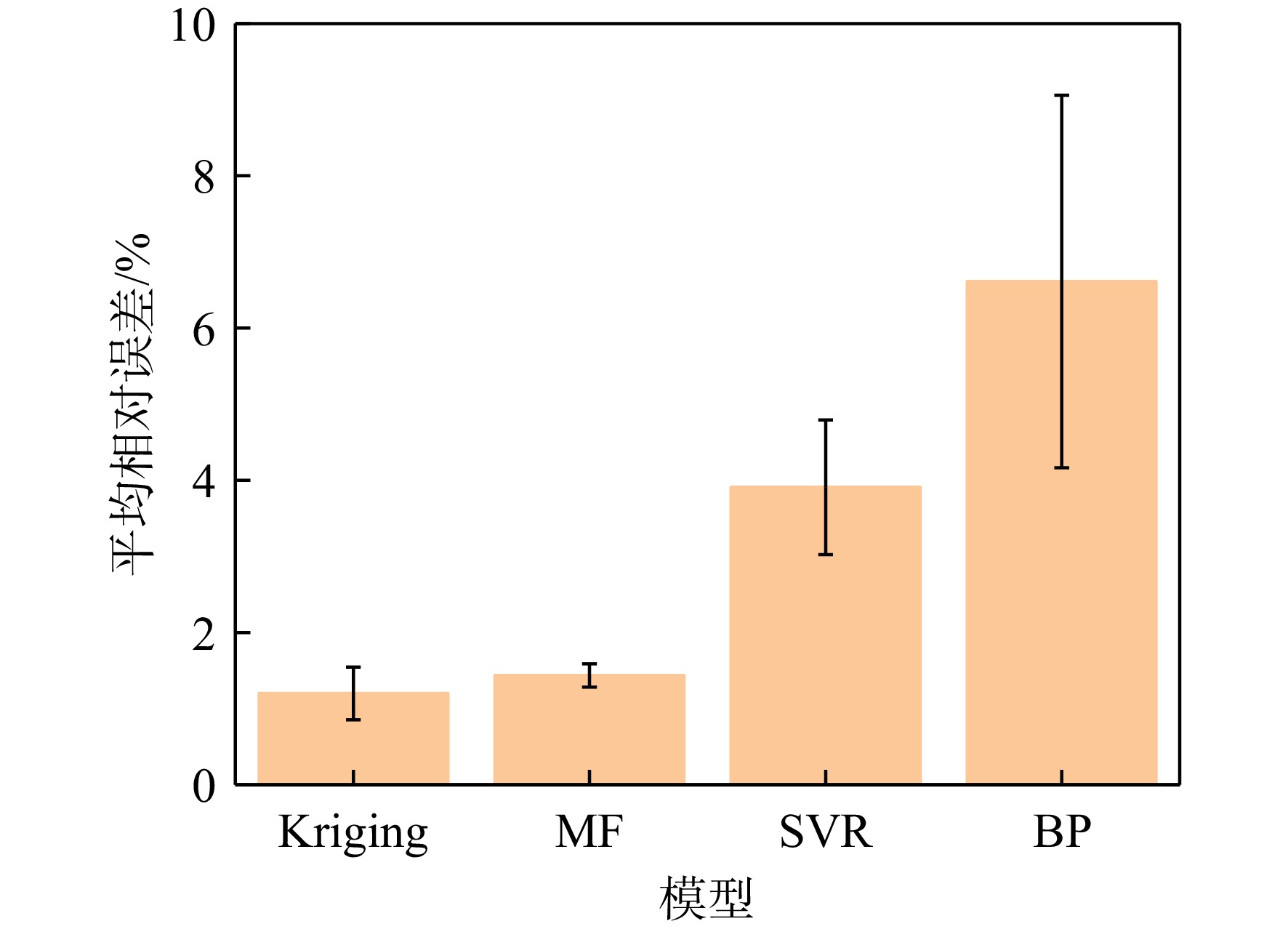
图 21 4种模型在交叉验证下的平均相对误差对比
Figure 21. Comparison of average relative errors of four models under cross-validation
表 1 网格无关性分析
Table 1. Analysis of mesh independence
序号 网格数量/104 进出口压比 叶片温度差值/K 例1 386 0.6681 383 例2 428 0.6687 371 例3 677 0.6676 369 例4 900 0.6676 369 例5 1088 0.6675 370 例6 1440 0.6678 368  下载: 导出CSV
表 2 温度场中不同回归方法的计算时间与误差
Table 2. Computation time and error of different regression methods in temperature field
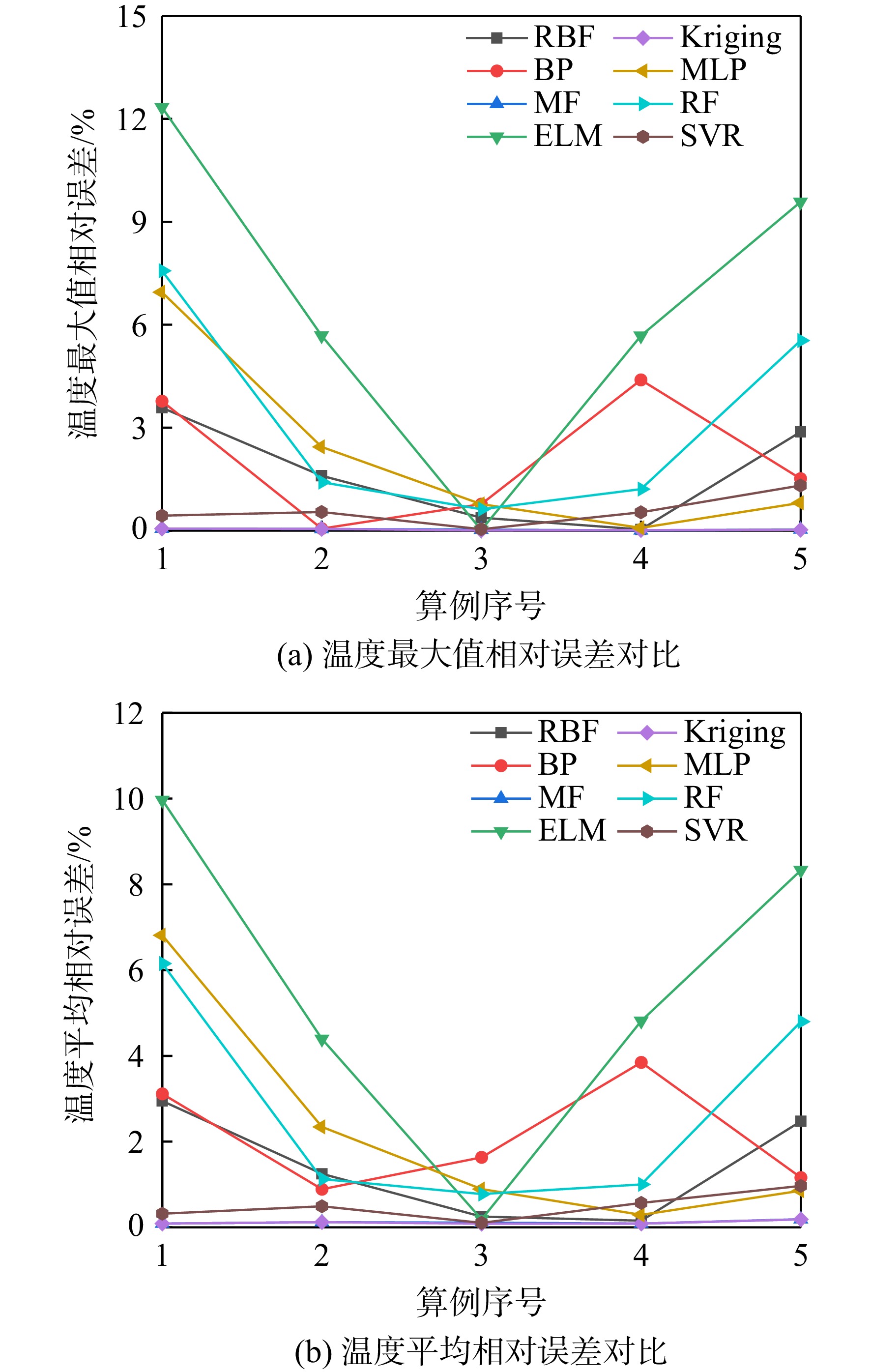
指标 RBF BP MF ELM Kriging MLP RF SVR 有限元 计算时间/s 0.18 0.02 0.005 0.020 0.060 0.020 0.020 0.080 4200 计算效率/104 2.3 21 84 21 7.0 21 21 53 最大值平均相对误差/% 1.695 2.103 0.037 6.658 0.032 2.211 3.271 0.574 平均相对误差/% 1.416 2.129 0.119 5.539 0.114 2.239 2.771 0.491
下载: 导出CSV
表 3 应力场中不同降阶方法的计算时间与误差
Table 3. Computational time and error of different regression methods in stress field
指标 RBF BP MF ELM Kriging MLP RF SVR 有限元 计算时间/s 0.45 0.12 0.03 0.03 0.04 0.27 0.39 0.05 6600 计算效率/103 1.5 5.5 22 22 17 24 17 13 最大值平均相对误差/% 0.587 1.698 0.074 2.866 0.074 4.820 2.345 0.730 平均误差/% 5.118 8.995 1.007 27.799 1.007 15.027 16.807 2.424
下载: 导出CSV
表 4 应变场中不同降阶方法的计算时间与误差
Table 4. Computational time and error of different order reduction methods in strain fields
指标 RBF BP MF ELM Kriging MLP RF SVR 有限元 计算时间/s 0.69 0.12 0.16 0.03 0.31 0.49 0.37 0.04 6600 计算效率/103 0.96 5.5 4.10 22.00 2.10 1.30 1.80 17.00 最大值平均相对误差/% 0.642 3.509 0.137 2.463 0.097 2.267 50.258 0.694 平均误差/% 4.207 5.314 1.132 25.811 0.752 18.734 12.445 1.733
下载: 导出CSV
表 5 危险点物理场预测结果
Table 5. Dangerous point physical field prediction results
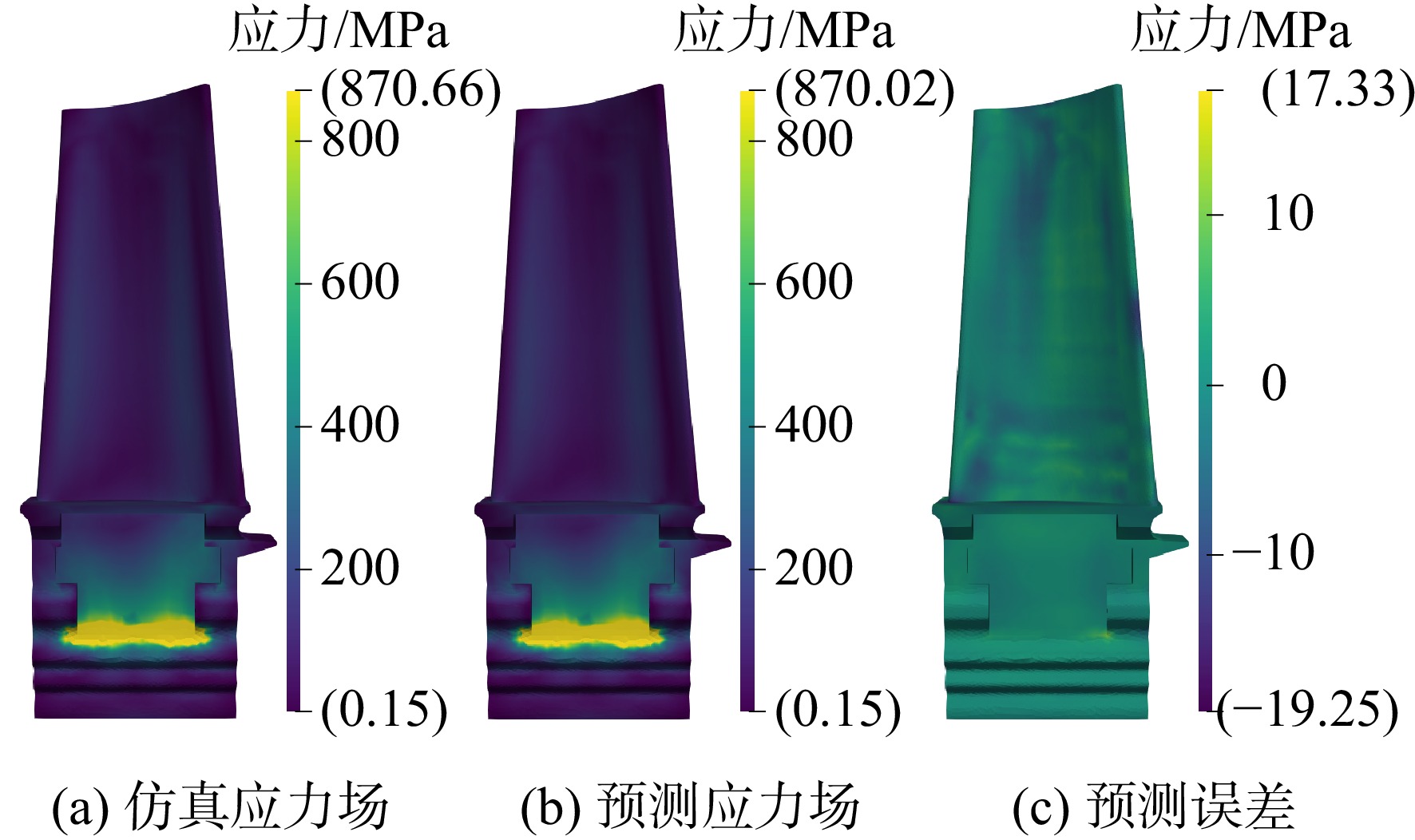
危险节点 预测物理场 预测值 仿真值 相对误差/% 1 温度场/K 813.86 813.04 0.10 应力场/MPa 870.02 870.66 0.07 应变场/10−3 8.28 8.30 0.23 2 温度场/K 955.74 954.57 0.12 应力场/MPa 630.48 632.06 0.25 应变场/10−3 5.82 5.84 0.36 3 温度场/K 773.41 773.79 0.05 应力场/MPa 690.21 691.11 0.13 应变场/10−3 5.16 5.17 0.14
下载: 导出CSV
表 6 LCF寿命预测
Table 6. Low cycle fatigue life prediction
危险
节点方法 预测寿命/
循环周次仿真寿命/
循环周次相对
误差/%1 Manson-Coffin 11331 11103 2.05 SWT 5875 5788 1.50 2 Manson-Coffin 67805 65628 3.32 SWT 23957 23279 2.91 3 Manson-Coffin 214624 211579 1.44 SWT 27663 27301 1.32
下载: 导出CSV
-
[1] Cheng Muwei, Yang Xiaoguang, Fan Yongsheng, et al. A comprehensive computational framework for damage assessment of turbine blades considering multidamage mechanism and service history[J]. Fatigue & Fracture of Engineering Materials & Structures, 2025, 48(8): 3398-3415. doi: 10.1111/ffe.14677 [2] Zhu Shunpeng, Yue Peng, Yu Zhengyong, et al. A combined high and low cycle fatigue model for life prediction of turbine blades[J]. Materials, 2017, 10(7): 698. doi: 10.3390/ma10070698 [3] Yue Peng, Ma Juan, Huang Han, et al. Threshold damage-based fatigue life prediction of turbine blades under combined high and low cycle fatigue[J]. International Journal of Fatigue, 2021, 150: 106323. doi: 10.1016/j.ijfatigue.2021.106323 [4] Rani P, Agrawal A K. Fatigue life evaluation of a low-pressure stage steam turbine blade[J]. Journal of Vibration Engineering & Technologies, 2024, 12(4): 5431-5443. doi: 10.1007/s42417-023-01173-3 [5] Xu Liang, Sun Zineng, Ruan Qicheng, et al. Development trend of cooling technology for turbine blades at super-high temperature of above 2000 K[J]. Energies, 2023, 16(2): 668. doi: 10.3390/en16020668 [6] 段红燕, 王小宏, 张洹榕, 等. 基于热力耦合计算的涡轮叶片疲劳/蠕变寿命预测[J]. 兰州理工大学学报, 2017, 43(4): 59-65. Duan Hongyan, Wang Xiaohong, Zhang Huanrong, et al. Prediction of fatigue/creep life of turbine blade based on thermal-mechanical coupling calculation[J]. Journal of Lanzhou University of Technology, 2017, 43(4): 59-65. (in Chinese doi: 10.3969/j.issn.1673-5196.2017.04.013Duan Hongyan, Wang Xiaohong, Zhang Huanrong, et al. Prediction of fatigue/creep life of turbine blade based on thermal-mechanical coupling calculation[J]. Journal of Lanzhou University of Technology, 2017, 43(4): 59-65. (in Chinese) doi: 10.3969/j.issn.1673-5196.2017.04.013 [7] 穆丽娟. 基于临界面法的涡轮单晶叶片低周疲劳寿命预测方法研究[D]. 北京: 中国科学院大学, 2017. Mu Lijuan. Investigation on low cycle fatigue life prediction method of single crystal turbine blades based on critical plane approach[D]. Beijing: University of Chinese Academy of Sciences, 2017. (in ChineseMu Lijuan. Investigation on low cycle fatigue life prediction method of single crystal turbine blades based on critical plane approach[D]. Beijing: University of Chinese Academy of Sciences, 2017. (in Chinese) [8] Guo Zixu, Huang Dawei, Yan Xiaojun, et al. A damage coupled elastic-plastic constitutive model and its application on low cycle fatigue life prediction of turbine blade[J]. International Journal of Fatigue, 2020, 131: 105298. doi: 10.1016/j.ijfatigue.2019.105298 [9] Vo D T, Mai T D, Kim B, et al. Numerical investigation of crack initiation in high-pressure gas turbine blade subjected to thermal-fluid-mechanical low-cycle fatigue[J]. International Journal of Heat and Mass Transfer, 2023, 202: 123748. doi: 10.1016/j.ijheatmasstransfer.2022.123748 [10] Begiashvili B, Groun N, Garicano-mena J, et al. Data-driven modal decomposition methods as feature detection techniques for flow problems: a critical assessment[J]. Physics of Fluids, 2023, 35(4): 041301. doi: 10.1063/5.0142102 [11] Lu Kuan, Zhang Kangyu, Zhang Haopeng, et al. A review of model order reduction methods for large-scale structure systems[J]. Shock and Vibration, 2021, 2021(1): 6631180. doi: 10.1155/2021/6631180 [12] 魏代同, 陈星, 陈玉刚, 等. 基于本征正交分解的叶片碰摩系统降阶方法[J]. 航空动力学报, 2022, 37(4): 711-720. Wei Daitong, Chen Xing, Chen Yugang, et al. Reduced order method of blade rubbing system based on proper orthogonal decomposition[J]. Journal of Aerospace Power, 2022, 37(4): 711-720. (in Chinese doi: 10.13224/j.cnki.jasp.20210180Wei Daitong, Chen Xing, Chen Yugang, et al. Reduced order method of blade rubbing system based on proper orthogonal decomposition[J]. Journal of Aerospace Power, 2022, 37(4): 711-720. (in Chinese) doi: 10.13224/j.cnki.jasp.20210180 [13] 可钊, 时永鑫, 张鹏, 等. 基于全局POD降阶模型的复杂薄壁结构减振优化[J]. 航空学报, 2023, 44(13): 227900. Ke Zhao, Shi Yongxin, Zhang Peng, et al. Vibration reduction optimization of complex thin-walled structures based on global POD reduced-order model[J]. Acta Aeronautica et Astronautica Sinica, 2023, 44(13): 227900. (in Chinese doi: 10.7527/S1000-6893.2022.27900Ke Zhao, Shi Yongxin, Zhang Peng, et al. Vibration reduction optimization of complex thin-walled structures based on global POD reduced-order model[J]. Acta Aeronautica et Astronautica Sinica, 2023, 44(13): 227900. (in Chinese) doi: 10.7527/S1000-6893.2022.27900 [14] 孙傲, 牛青林, 王晓冰. 基于POD的超声速尾喷焰流场时空降阶模型[J]. 航空动力学报, 2024, 39(7): 20230419. Sun Ao, Niu Qinglin, Wang Xiaobing. Spatiotemporal reduced-order model of supersonic exhaust plume based on POD[J]. Journal of Aerospace Power, 2024, 39(7): 20230419. (in Chinese doi: 10.13224/j.cnki.jasp.20230419Sun Ao, Niu Qinglin, Wang Xiaobing. Spatiotemporal reduced-order model of supersonic exhaust plume based on POD[J]. Journal of Aerospace Power, 2024, 39(7): 20230419. (in Chinese) doi: 10.13224/j.cnki.jasp.20230419 [15] Rao P P. Inverse parameter estimation using compressed sensing and POD-RBF reduced order models[J]. Computer Methods in Applied Mechanics and Engineering, 2024, 422: 116820. doi: 10.1016/j.cma.2024.116820 [16] Du Xiaoqing, Hu Caiyao, Dong Haotian. POD-LSTM model for predicting pressure time series on structures[J]. Journal of Wind Engineering and Industrial Aerodynamics, 2024, 245: 105651. doi: 10.1016/j.jweia.2024.105651 [17] Luo Zhaohui, Wang Longyan, Xu Jian, et al. A reduced order modeling-based machine learning approach for wind turbine wake flow estimation from sparse sensor measurements[J]. Energy, 2024, 294: 130772. doi: 10.1016/j.energy.2024.130772 [18] 《中国航空材料手册》编辑委员会. 中国航空材料手册: 第二卷[M]. 北京: 中国标准出版社, 2002. Editorial Committee of China Aviation Materials Handbook. China aviation materials handbook: Volume 2[M]. Beijing: China Standards Press, 2002. (in ChineseEditorial Committee of China Aviation Materials Handbook. China aviation materials handbook: Volume 2[M]. Beijing: China Standards Press, 2002. (in Chinese) [19] Cai Liuxi, He Yao, Wang Shunsen, et al. Thermal-fluid-solid coupling analysis on the temperature and thermal stress field of a nickel-base superalloy turbine blade[J]. Materials, 2021, 14(12): 3315. doi: 10.3390/ma14123315 [20] Bhattacharyya B. Uncertainty quantification of dynamical systems by a POD-Kriging surrogate model[J]. Journal of Computational Science, 2022, 60: 101602. doi: 10.1016/j.jocs.2022.101602 [21] Wetherill G B, Duncombe P, Kenward M, et al. The analysis of response surface data[M]//Regression Analysis with Applications. Dordrecht: Springer Netherlands, 1986: 249-265. [22] Xiao D, Fang F, Pain C, et al. Non-intrusive reduced-order modelling of the Navier-Stokes equations based on RBF interpolation[J]. International Journal for Numerical Methods in Fluids, 2015, 79(11): 580-595. [23] Yan Feng, Jiao Kaituo, Nie Chaofei, et al. Fast prediction of the temperature field surrounding a hot oil pipe using the POD-BP model[J]. Processes, 2023, 11(9): 2666. doi: 10.3390/pr11092666 [24] Huang Guangbin, Zhu Qinyu, Siew C K. Extreme learning machine: Theory and applications[J]. Neurocomputing, 2006, 70(1/2/3): 489-501. [25] Yuan Qingyang, Yao Peijun, Zhao Wenjun, et al. Optimization of sparse sensor layouts and data-driven reconstruction methods for steady-state and transient thermal field inverse problems[J]. Sensors, 2025, 25(16): 4984. doi: 10.3390/s25164984 [26] Breiman L. Random forests[J]. Machine Learning, 2001, 45(1): 5-32. doi: 10.1023/A:1010933404324 [27] Zhang F, O’Donnell L J. Support vector regression[M]. Machine learning. Academic Press, 2020: 123-140. [28] Gillis P P. Manson-coffin fatigue[J]. Acta Metallurgica, 1966, 14(12): 1673-1676. doi: 10.1016/0001-6160(66)90019-8 [29] Stephens R I, Dindinger P M, Gunger J E. Fatigue damage editing for accelerated durability testing using strain range and SWT parameter criteria[J]. International Journal of fatigue, 1997, 19(8/9): 599-606. doi: 10.1016/s0142-1123(97)00079-0 -

 点击查看大图
计量
- 文章访问数: 296
- HTML浏览量: 198
- PDF量: 16
- 被引次数: 0