






Prediction model of nonlinear multimodal damping characteristics of blade shrouds based on IWOA-ELM
-
摘要:
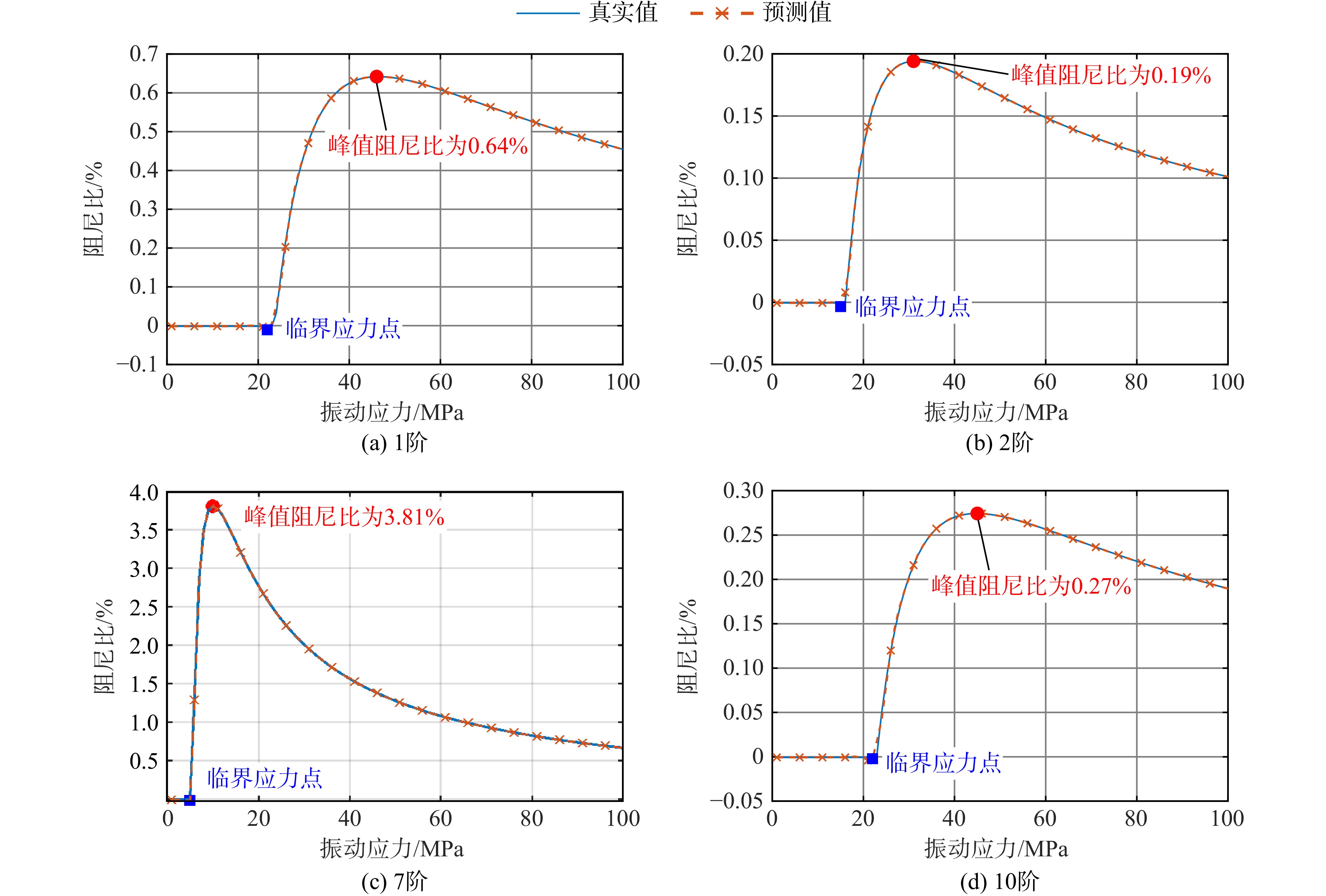
由于叶冠接触面的复杂非线性和多模态阻尼特性分析的巨大计算量,导致传统方法难以全面、高效、准确地求解,因而提出改进鲸鱼优化算法-极限学习机(IWOA-ELM)多模态阻尼特性预测模型,在极短的训练时间与较少的输入数据条件下,实现快速、准确预测输入和输出比例为数量级比例的多模态阻尼特性。通过能量法和有限元模态分析构建轻量训练集。提出带历史记忆机制的分组协同策略与Sobol反向初始化改进WOA得到IWOA,通过CEC2017试验验证IWOA具备卓越的全局性能。通过IWOA优化ELM权值和阈值,实现模型极低输入-极高输出的强大网络性能。采用带冠叶盘结构验证,输入一阶弯曲模态5个振动应力下对应的5个阻尼比,预测振动应力范围为0~100 MPa的前20阶模态的完整阻尼特性曲线(共
2000 个阻尼比)。结果显示:IWOA-ELM模型的方均根误差为0.26×10⁻⁴,相对于ELM模型降低了73%。说明IWOA-ELM具备极高的预测精度。预测时间仅需0.51 s,将计算效率提高近2000 倍,可以实现对数据量巨大的叶冠多模态阻尼特性的快速求解。IWOA-ELM阻尼预测模型使得快速而充分地考虑多个模态的减振特性具备可行性,能够最大程度地降低共振风险,具有工程实用前景。Abstract:Due to the strong nonlinearity of shroud contact interfaces and enormous computational cost associated with multimodal damping analysis, conventional methods fail to achieve comprehensive, efficient, and accurate solutions. To address this challenge, an improved whale optimization algorithm-extreme learning machine (IWOA-ELM) model was proposed for multimodal damping characteristic prediction, enabling fast and highly accurate mapping from extremely limited inputs to massive outputs under very short training times and small datasets. A lightweight training dataset was constructed using the energy method combined with finite-element modal analysis. An improved WOA (IWOA) was developed by incorporating a history-memory-based group collaborative strategy and Sobol reverse initialization, and its superior global optimization capability was verified using the CEC2017 benchmark suite. The IWOA was further employed to optimize the weights and biases of the ELM, yielding a powerful network capable of realizing extremely low-input and ultra-high-output prediction. Experimental validation was conducted on a shrouded bladed-disk structure. The input consisted of damping ratios at five stress points under the first bending mode, while the output corresponded to the complete damping characteristics (
2000 damping values) of the first 20 vibration modes over a stress range of 0—100 MPa. The results showed that the proposed IWOA-ELM achieved a mean squared error of 0.26×10⁻⁴, which was reduced by 73% compared with the conventional ELM, demonstrating its outstanding prediction accuracy. Moreover, the prediction time was only 0.51 s, improving computational efficiency by nearly2000 times, which enabled rapid evaluation of large-scale multimodal shroud damping characteristics. The proposed IWOA-ELM damping prediction model made it possible for fast and comprehensive consideration of multimodal vibration-reduction performance, effectively reducing resonance risks and exhibiting strong potential for practical engineering applications. -
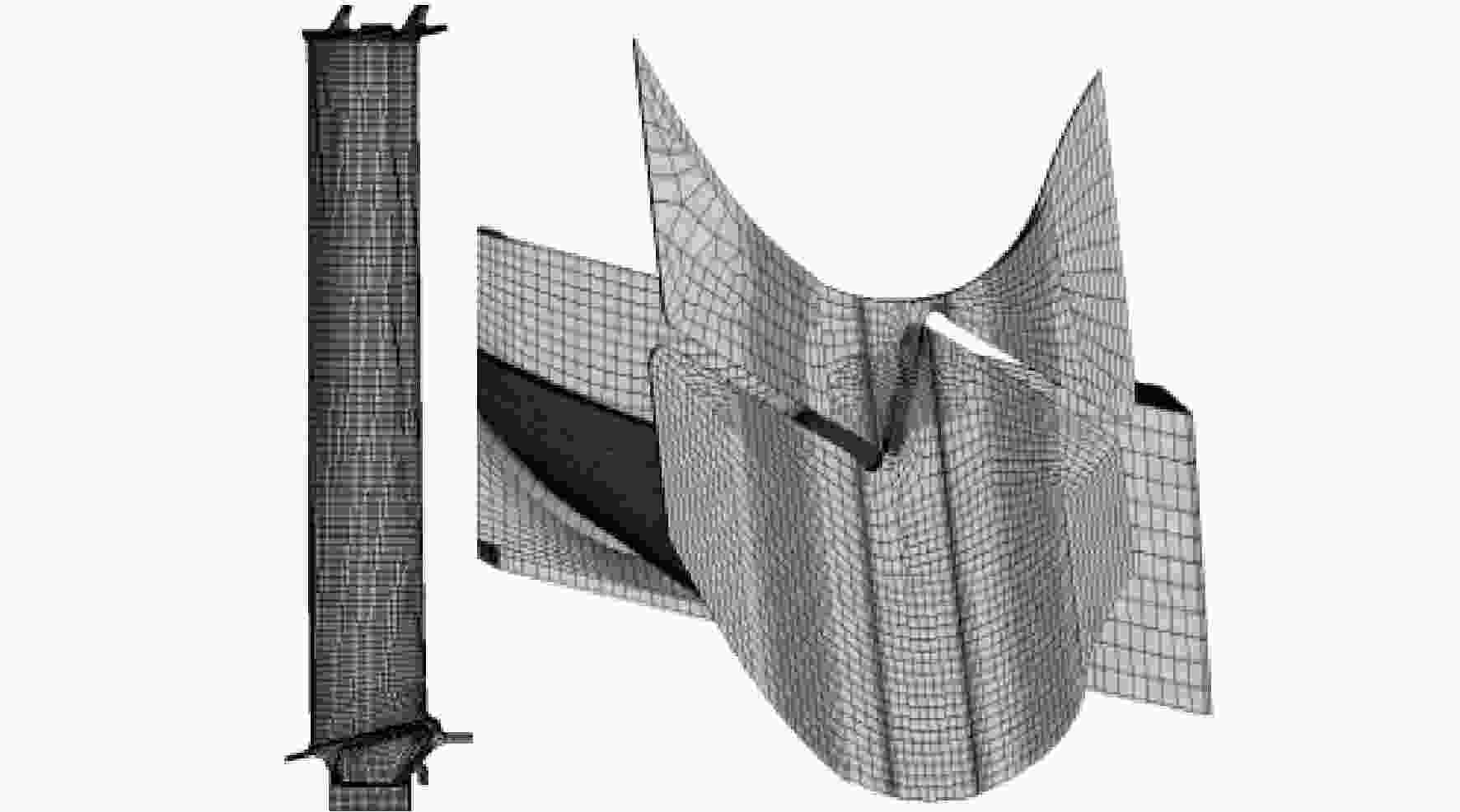
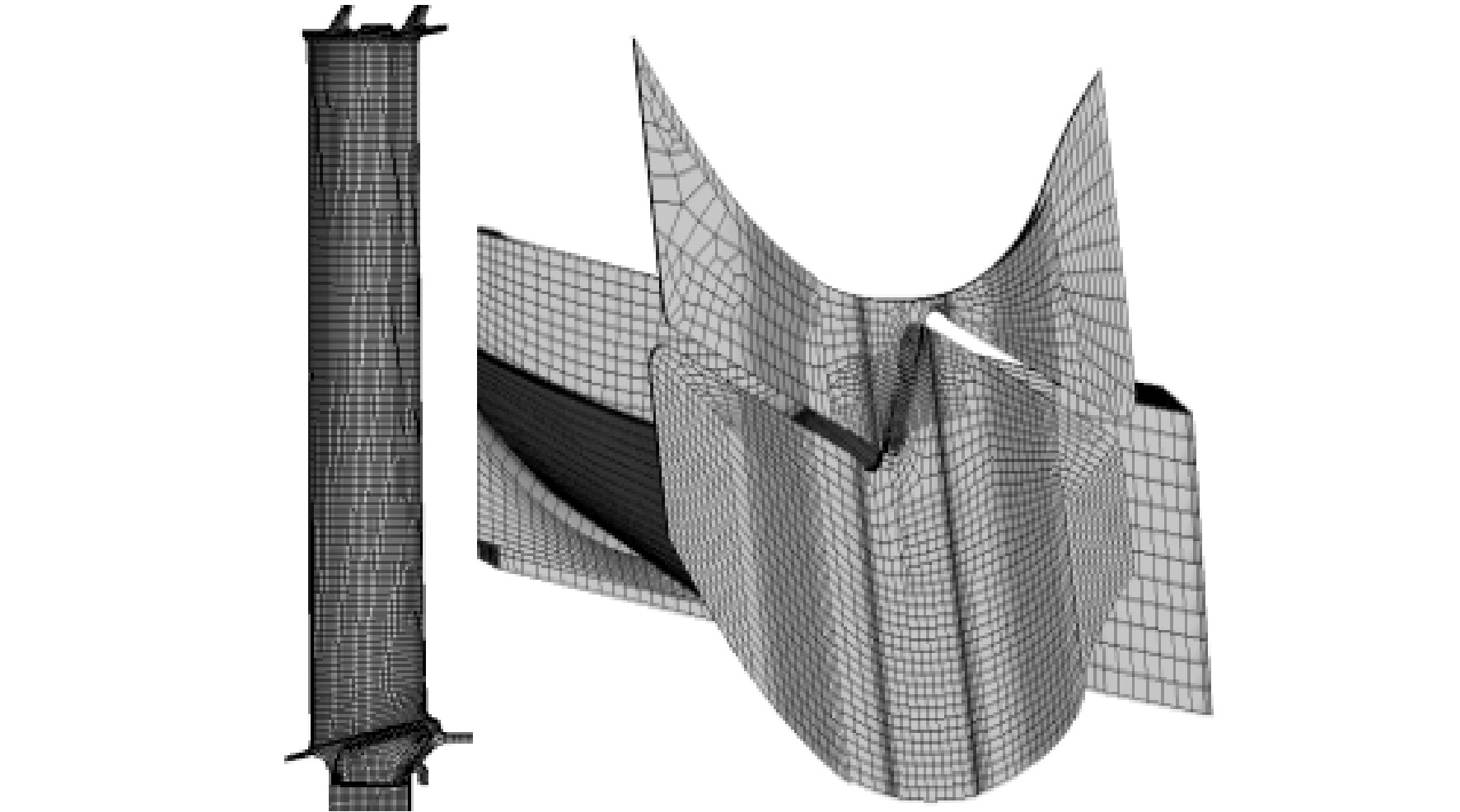
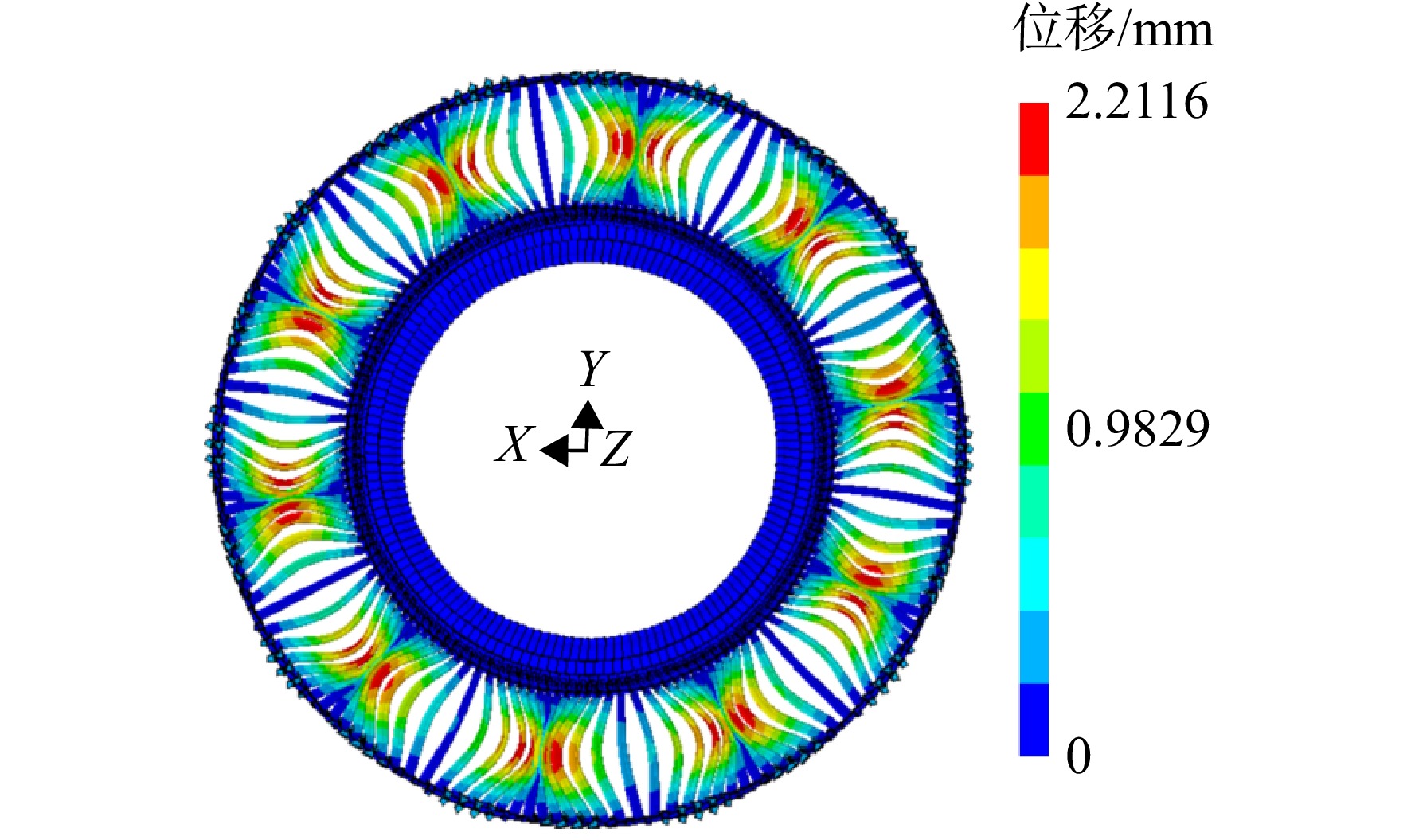
图 7 锯齿冠叶盘局部模型(经变形处理)
Figure 7. Local model of the serrated shroud blade disk (after deformation processing)
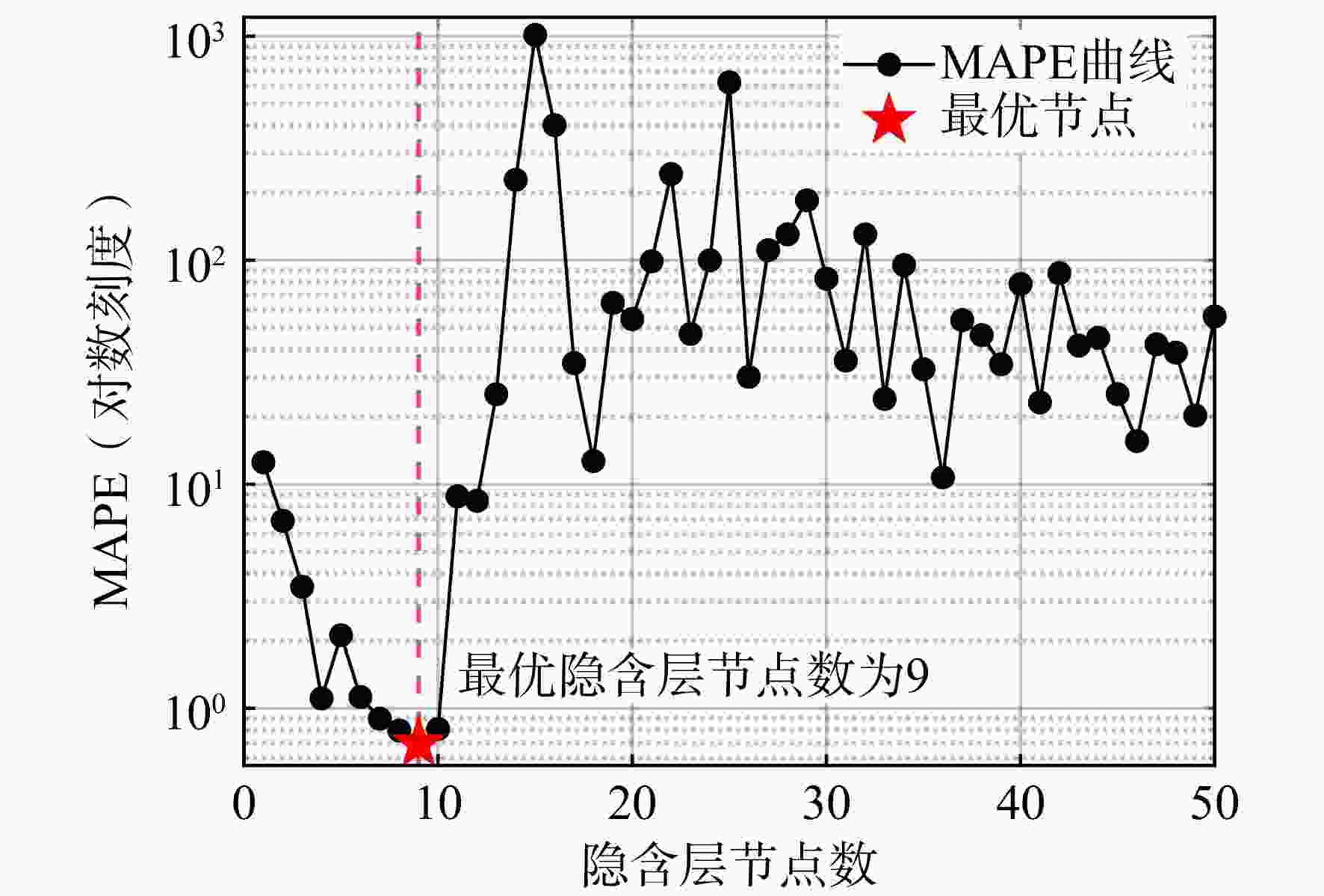
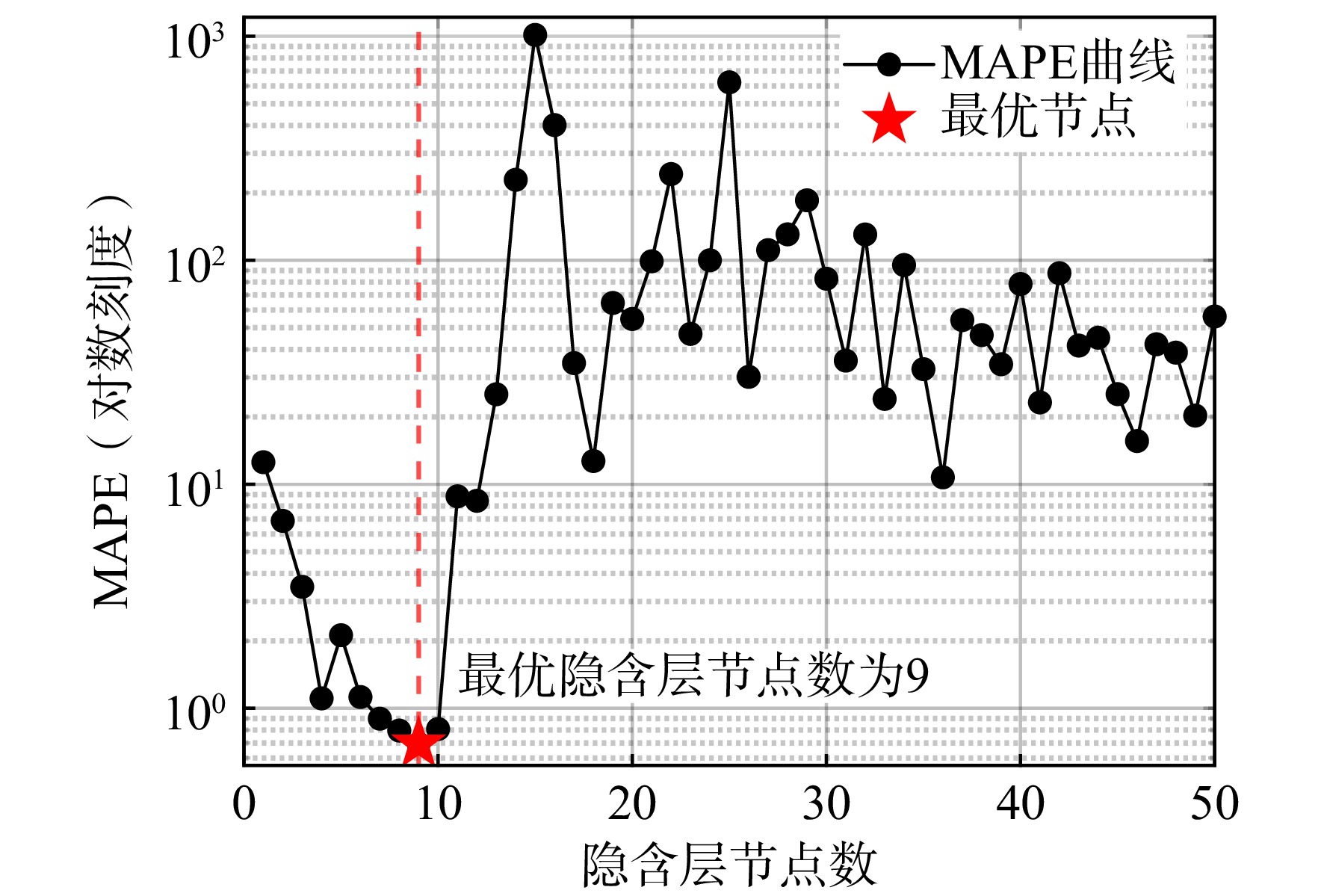
图 9 不同隐含层节点的MAPE曲线
Figure 9. MAPE curves for different numbers of hidden-layer neurons
表 1 实验结果
Table 1. Experimental results
测试
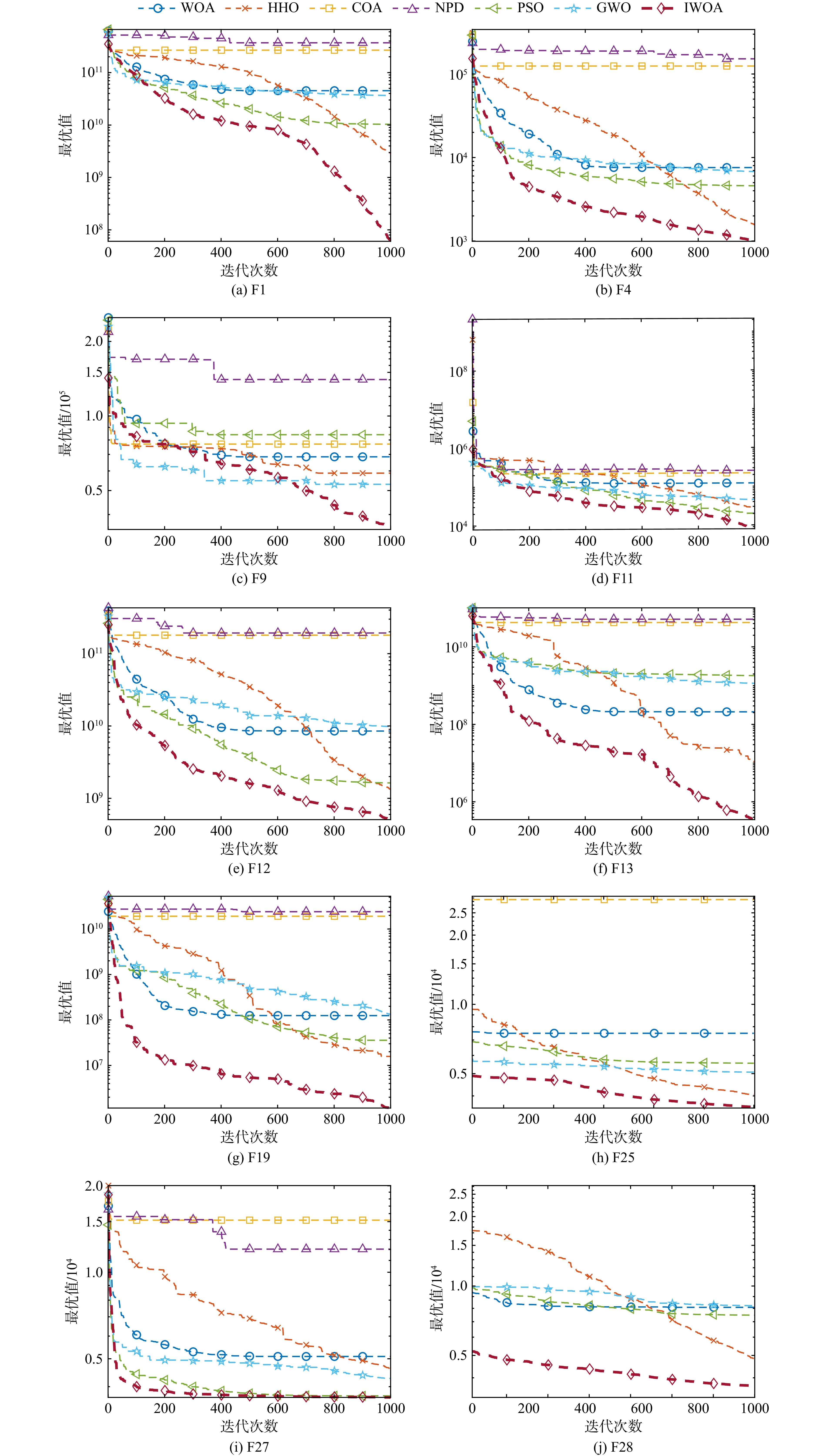
函数参数 标准 IWOA 排名 WOA HHO COA NPD PSO GWO F1 最优值/$ {10}^{7} $ 4510 292 26800 37000 1030 3670 6.05 1 平均值/$ {10}^{10} $ 6.95 10.4 26.8 42.1 3.84 5.62 2.82 1 SD/$ {10}^{10} $ 5.55 8.26 1.10 6.22 5.31 3.71 5.17 1 F4 最优值 7582.09 1567.78 124636.83 152015.81 4591.21 6802.92 1013.54 1 平均值 16325.69 29862.45 124887.12 181482.38 8380.38 10947.97 6435.14 1 标准差 22068.61 31463.16 5503.25 13778.26 13040.52 14593.68 15423.17 1 F9 最优值 68422.21 58783.54 77024.36 140378.28 84034.30 52991.19 34821.72 1 平均值 75748.23 68499.65 77344.69 151457.32 89126.55 59064.61 61776.96 1 标准差 15988.20 9574.80 5065.74 14440.89 12341.84 14750.72 17587.43 1 F11 最优值 121173.38 27311.99 220754.70 256662.73 19343.43 45328.13 7938.64 1 平均值 191368.32 864337.33 250378.49 6781829.68 118383.02 95896.68 67919.27 1 标准差 184846.29 20291659.85 484899.99 118135064.21 193789.10 71841.91 92542.70 1 F19 最优值/$ {10}^{6} $ 125 15.8 19100 24000 35.7 134 1.16 1 平均值/$ {10}^{8} $ 7.39 32.1 192 257 5.59 8.46 2.69 1 标准差/$ {10}^{9} $ 2.47 5.80 6.05 2.35 1.81 2.01 2.09 1 F27 最优值 5094.05 4610.89 15180.69 12038.26 3714.58 4272.31 3669.32 1 平均值 5479.56 7424.07 15190.62 13366.96 4028.11 4878.64 3889.49 1 标准差 1040.65 2453.47 113.54 1632.55 777.53 797.05 868.70 1 F28 最优值 8081.42 4849.25 31002.49 49541.51 7474.77 8215.91 3688.19 1 平均值 10493.06 14195.29 31052.67 50099.37 10045.15 10257.70 6359.01 1 标准差 5692.96 6821.86 1387.00 1541.33 4671.42 3992.08 5093.03 1  下载: 导出CSV
表 2 训练集输入数据
Table 2. Input data of the training set
编号 $ {\zeta }_{\sigma }/\text{MPa} $ 5 10 30 50 100 1 −0.58 −0.58 0.80 0.32 −0.46 2 0.26 0.26 −0.31 0.90 0.43 3 0.79 0.79 −1.00 −0.06 0.86 4 0.05 0.05 0.06 1.00 0.23 5 0.47 0.47 −0.73 0.64 0.61 6 0.58 0.58 −0.96 0.45 0.70 7 1.00 1.00 −1.00 −0.73 1.00 8 −0.26 −0.26 0.50 0.85 −0.10 9 −1.00 −1.00 1.00 −1.00 −1.00 10 −0.89 −0.89 0.97 −0.61 −0.86 11 0.16 0.16 −0.12 0.97 0.33 12 0.68 0.68 −1.00 0.22 0.78 13 −0.79 −0.79 0.93 −0.25 −0.72 14 −0.47 −0.47 0.71 0.54 −0.34 15 0.89 0.89 −1.00 −0.37 0.93
下载: 导出CSV
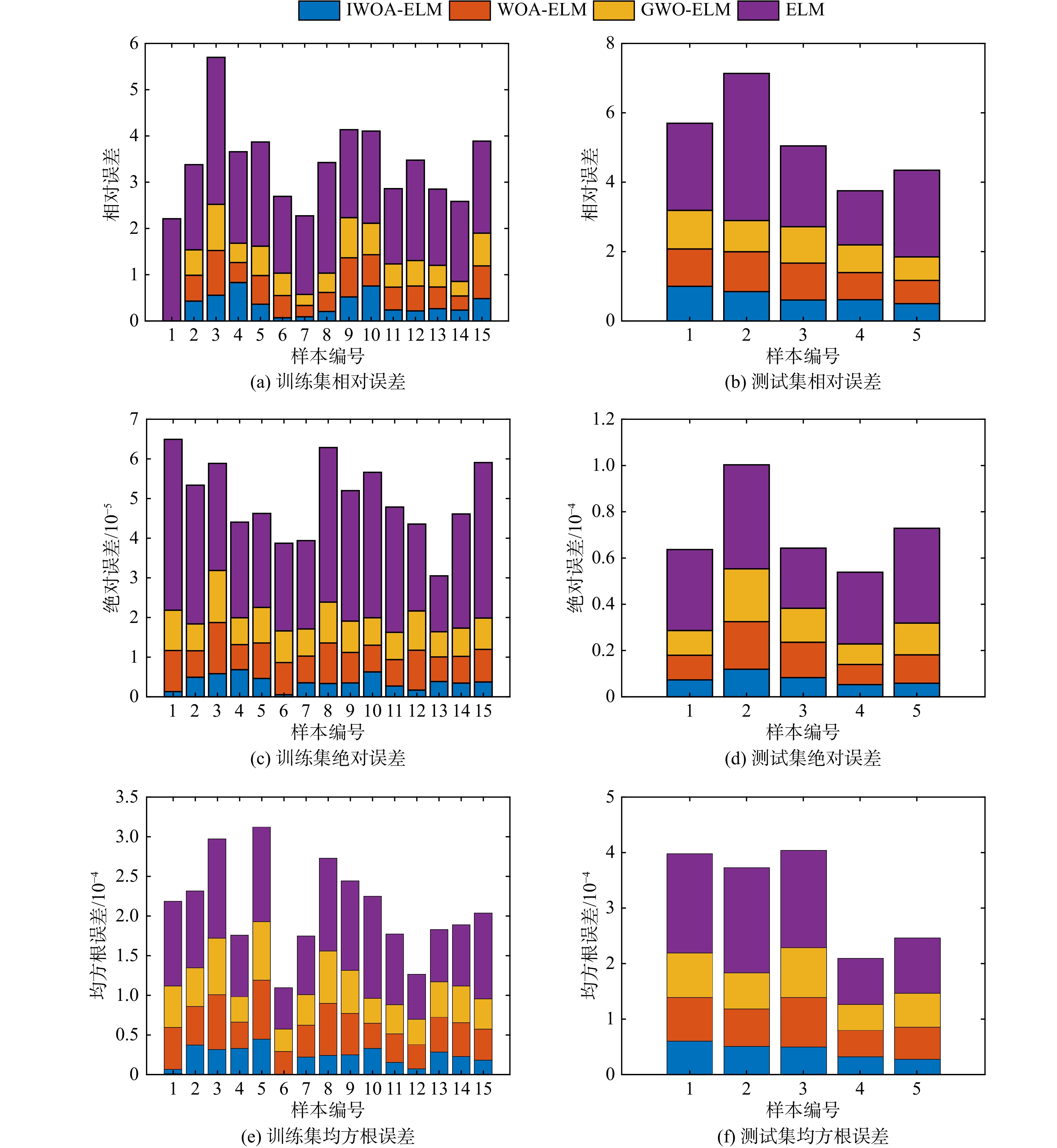
表 3 不同模型的预测精度指标
Table 3. Prediction accuracy metrics of different models
样本 数量 方法 相对误差(MAPE) 绝对误差(MAE)/$ {10}^{-5} $ 方均根误差
(RMSE)/$ 10^{-4} $训练集
15IWOA-ELM $ 0.71 $ $ 0.77 $ $ 0.46 $ WOA-ELM $ 0.95 $ $ 1.35 $ $ 0.69 $ GWO-ELM 0.91 $ 1.42 $ $ 0.70 $ ELM $ 2.61 $ $ 3.55 $ $ 1.52 $ 测试集
5IWOA-ELM $ 0.35 $ $ 0.374 $ $ 0.26 $ WOA-ELM 0.51 $ 0.817 $ $ 0.47 $ GWO-ELM 0.52 $ 0.827 $ $ 0.48 $ ELM 1.11 $ 2.94 $ $ 0.97 $
下载: 导出CSV
-
[1] 陈璐璐, 马艳红, 杨鑫, 等. 带干摩擦阻尼结构叶片振动响应试验[J]. 航空动力学报, 2008, 23(9): 1647-1653. Chen Lulu, Ma Yanhong, Yang Xin, et al. Experiment of vibration and response of blade with dry friction structure[J]. Journal of Aerospace Power, 2008, 23(9): 1647-1653. (in ChineseChen Lulu, Ma Yanhong, Yang Xin, et al. Experiment of vibration and response of blade with dry friction structure[J]. Journal of Aerospace Power, 2008, 23(9): 1647-1653. (in Chinese) [2] 蒋向华, 杨晓光, 王延荣. 某型航空发动机涡轮盘结构可靠度计算[J]. 航空动力学报, 2005, 20(3): 407-412. Jiang Xianghua, Yang Xiaoguang, Wang Yanrong. Structure reliability evaluation of a gas turbine disk[J]. Journal of Aerospace Power, 2005, 20(3): 407-412. (in ChineseJiang Xianghua, Yang Xiaoguang, Wang Yanrong. Structure reliability evaluation of a gas turbine disk[J]. Journal of Aerospace Power, 2005, 20(3): 407-412. (in Chinese) [3] 杜晨鸿, 王延荣, 李迪, 等. 模拟叶片三棱柱式缘板阻尼器减振试验研究[J]. 航空动力学报, 2025, 40(8): 20230739. Du Chenhong, Wang Yanrong, Li Di, et al. Experimental investigation on vibration suppression of a model blade by triangular prism underplatform damper[J]. Journal of Aerospace Power, 2025, 40(8): 20230739. (in Chinese doi: 10.13224/j.cnki.jasp.20230739Du Chenhong, Wang Yanrong, Li Di, et al. Experimental investigation on vibration suppression of a model blade by triangular prism underplatform damper[J]. Journal of Aerospace Power, 2025, 40(8): 20230739. (in Chinese) doi: 10.13224/j.cnki.jasp.20230739 [4] Yang B D, Chen J J, Menq C H. Prediction of resonant response of shrouded blades with three-dimensional shroud constraint[J]. Journal of Engineering for Gas Turbines and Power, 1999, 121(3): 523-529. [5] 李迪, 洪杰, 陈璐璐. 带冠涡轮叶片干摩擦阻尼减振试验研究[J]. 燃气涡轮试验与研究, 2008, 21(4): 22-27. Li Di, Hong Jie, Chen Lulu. Experiment of dry friction damping effect of shrouded turbine blade[J]. Gas Turbine Experiment and Research, 2008, 21(4): 22-27. (in ChineseLi Di, Hong Jie, Chen Lulu. Experiment of dry friction damping effect of shrouded turbine blade[J]. Gas Turbine Experiment and Research, 2008, 21(4): 22-27. (in Chinese) [6] Griffin J H. Friction damping of resonant stresses in gas turbine engine airfoils[J]. Journal of Engineering for Power, 1980, 102(2): 329-333. [7] Cardona A, Lerusse A, Géradin M. Fast Fourier nonlinear vibration analysis[J]. Computational Mechanics, 1998, 22(2): 128-142. [8] Phadke R, Berger E J. Friction damping analysis in turbine blades using a user-programmed function in ANSYS[C]//Proceedings of the 12th International Symposium on Transport Phenomena and Dynamics of Rotating Machinery. Honolulu, US: Pacific Center of Thermal Fluids Engineering, 2008: 20176. [9] Yang B D, Menq C H. Modeling of friction contact and its application to the design of shroud contact[J]. Journal of Engineering for Gas Turbines and Power, 1997, 119(4): 958-963. [10] Szwedowicz J. Cyclic finite element modeling of shrouded turbine blades including frictional contacts[C]//Proceedings of the International Gas Turbine and Aeroengine Congress and Exhibition. New York: American Society of Mechanical Engineers, 1999: 9-14. [11] Kaptan F, Von scheidt L P, Wallaschek J. Numerical and experimental study of shrouded blade dynamics considering variable operating points[C]//Proceedings of the ASME Turbo Expo: Turbomachinery Technical Conference and Exposition. New York: American Society of Mechanical Engineers, 2018: 34-45. [12] Pourkiaee S M, Zucca S. A reduced order model for nonlinear dynamics of mistuned bladed disks with shroud friction contacts[J]. Journal of Engineering for Gas Turbines and Power, 2019, 141: 011031. [13] Voldřich J, Polach P, Lazar J, et al. Use of cyclic symmetry properties in vibration analysis of bladed disks with friction contacts between blades[J]. Procedia Engineering, 2014, 96: 500-509. [14] Mitra M, Zucca S, Epureanu B I. Effects of contact mistuning on shrouded blisk dynamics[C]//Proceedings of the ASME Turbo Expo: Turbomachinery Technical Conference and Exposition. New York: American Society of Mechanical Engineers, 2014: 26-37. [15] Berthillier M, Dupont C, Mondal R, et al. Blades forced response analysis with friction dampers[J]. Journal of Vibration and Acoustics, 1998, 120(2): 468-474. [16] Afzal M, Arteaga I L, Kari L. Numerical analysis of multiple friction contacts in bladed disks[J]. International Journal of Mechanical Sciences, 2018, 137: 224-237. [17] 毛辛男, 王延荣. 一种基于模态的叶片缘板阻尼器减振设计方法[J]. 推进技术, 2018, 39(6): 1361-1368. Mao Xinnan, Wang Yanrong. An efficient design method of an underplatform damper for suppression of blade vibration in a given eigen-mode[J]. Journal of Propulsion Technology, 2018, 39(6): 1361-1368. (in ChineseMao Xinnan, Wang Yanrong. An efficient design method of an underplatform damper for suppression of blade vibration in a given eigen-mode[J]. Journal of Propulsion Technology, 2018, 39(6): 1361-1368. (in Chinese) [18] 高世民, 王延荣, 叶航. 薄壁结构干摩擦阻尼减振设计分析[J]. 航空发动机, 2022, 48(5): 116-123. Gao Shimin, Wang Yanrong, Ye Hang. Design analysis for dry friction damping vibration suppression of thin-walled structures[J]. Aeroengine, 2022, 48(5): 116-123. (in ChineseGao Shimin, Wang Yanrong, Ye Hang. Design analysis for dry friction damping vibration suppression of thin-walled structures[J]. Aeroengine, 2022, 48(5): 116-123. (in Chinese) [19] 徐睿, 梁循, 齐金山, 等. 极限学习机前沿进展与趋势[J]. 计算机学报, 2019, 42(7): 1640-1670. Xu Rui, Liang Xun, Qi Jinshan, et al. Advances and trends in extreme learning machine[J]. Chinese Journal of Computers, 2019, 42(7): 1640-1670. (in ChineseXu Rui, Liang Xun, Qi Jinshan, et al. Advances and trends in extreme learning machine[J]. Chinese Journal of Computers, 2019, 42(7): 1640-1670. (in Chinese) [20] 钟诗胜, 雷达. 一种可用于航空发动机健康状态预测的动态集成极端学习机模型[J]. 航空动力学报, 2014, 29(9): 2085-2090. Zhong Shisheng, Lei Da. A dynamic ensemble extreme learning machine model for aircraft engine health condition prediction[J]. Journal of Aerospace Power, 2014, 29(9): 2085-2090. (in ChineseZhong Shisheng, Lei Da. A dynamic ensemble extreme learning machine model for aircraft engine health condition prediction[J]. Journal of Aerospace Power, 2014, 29(9): 2085-2090. (in Chinese) [21] Xie S, Lei L, Sun J, et al. Research on emotion recognition method based on IWOA-ELM algorithm for electroencephalogram[J]. Journal of Biomedical Engineering, 2024, 41(1): 1-8. [22] 许德刚, 王再庆, 郭奕欣, 等. 鲸鱼优化算法研究综述[J]. 计算机应用研究, 2023, 40(2): 328-336. Xu Degang, Wang Zaiqing, Guo Yixin, et al. Review of whale optimization algorithm[J]. Application Research of Computers, 2023, 40(2): 328-336. (in ChineseXu Degang, Wang Zaiqing, Guo Yixin, et al. Review of whale optimization algorithm[J]. Application Research of Computers, 2023, 40(2): 328-336. (in Chinese) [23] 蒋向华, 杨晓光, 王延荣. 结构可靠度逐步逼近径向基神经网络响应面法[J]. 航空动力学报, 2008, 23(1): 26-31. Jiang Xianghua, Yang Xiaoguang, Wang Yanrong. An iterative RBF ANN response surface method for structural reliability analysis[J]. Journal of Aerospace Power, 2008, 23(1): 26-31. (in ChineseJiang Xianghua, Yang Xiaoguang, Wang Yanrong. An iterative RBF ANN response surface method for structural reliability analysis[J]. Journal of Aerospace Power, 2008, 23(1): 26-31. (in Chinese) [24] Rahebi J. Vector quantization using whale optimization algorithm for digital image compression[J]. Multimedia Tools and Applications, 2022, 81(14): 20077-20103. [25] Mirjalili S, Mirjalili S M, Lewis A. Grey wolf optimizer[J]. Advances in Engineering Software, 2014, 69: 46-61. [26] Shami T M, El-saleh A A, Alswaitti M, et al. Particle swarm optimization: a comprehensive survey[J]. IEEE Access, 2022, 10: 10031-10061. [27] Dehghani M, Montazeri Z, Trojovská E, et al. Coati Optimization Algorithm: a new bio-inspired metaheuristic algorithm for solving optimization problems[J]. Knowledge-Based Systems, 2023, 259: 110011. [28] Ji Junzhong, Wu Tongxuan, Yang Cuicui. Neural population dynamics optimization algorithm: a novel brain-inspired meta-heuristic method[J]. Knowledge-Based Systems, 2024, 300: 112194. [29] Heidari A A, Mirjalili S, Faris H, et al. Harris Hawks optimization: Algorithm and applications[J]. Future Generation Computer Systems, 2019, 97: 849-872. -

 点击查看大图
计量
- 文章访问数: 212
- HTML浏览量: 182
- PDF量: 19
- 被引次数: 0