






Effects of transpiration cooling on flow structure and aerothermal environment of high Mach number compression corner
-
摘要:
针对高马赫数压缩拐角的降热需求,通过数值模拟研究了来流马赫数为11.63条件下气体发汗对15°压缩拐角流动结构和气动热的影响。计算结果表明:气体发汗会显著增大其作用区域及下游区域的边界层厚度,降低边界层内的速度梯度并增大局部压力。当发汗位置位于流动分离区上游或内部时,在发汗作用下压缩拐角的分离区显著扩大,而当发汗位置位于流动分离区下游时,气体发汗对压缩拐角的流动分离特性几乎无影响。压缩拐角流动结构的变化显著影响了其气动热分布,边界层增厚降低了边界层内的温度梯度,从而降低了其作用区域及下游区域的壁面热流。为实现最优降热效果,发汗冷却应覆盖热流峰值附近的高热区域,同时其作用局限于下游区域,以避免分离区扩大,从而稳定热流峰值位置并有效降低峰值热流。
Abstract:In order to meet the thermal reduction requirements of high Mach number compression corners, numerical simulations were carried out to study the effects of gas transpiration on the flow structure and aerothermal environment of a 15° compression corner at a free stream Mach number of 11.63. The results showed that gas transpiration significantly increased the boundary layer thickness in both its active and downstream regions, reduced the velocity gradient within the boundary layer, and augmented the local pressure. When the transpiration location was positioned upstream or within the separation zone, gas transpiration led to a significant enlargement of the separation region. In contrast, when the transpiration location was positioned downstream the separation zone, gas transpiration had a negligible influence on the separation characteristics. Variations in the flow structure were found to significantly influence the wall heat flux distribution. The thickening of the boundary layer reduced the temperature gradient within it, thereby lowering the wall heat flux in both the transpiration region and the downstream region. To achieve optimal thermal reduction, transpiration cooling should cover the high heat flux region near the peak heat flux, while its effect remains confined to the downstream region to prevent the expansion of the separation zone, thereby stabilizing the peak heat flux location and effectively reducing the peak heat flux.
-
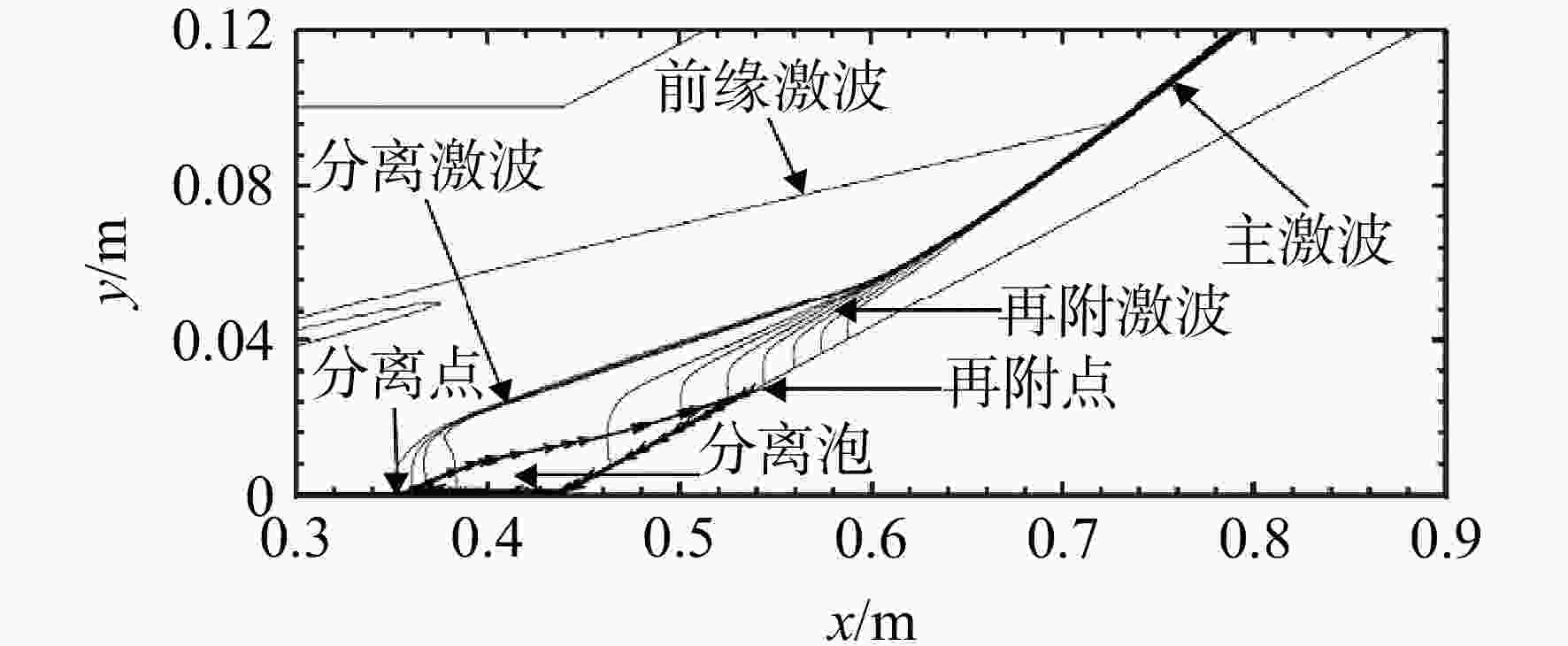
图 2 Ma∞=11.63条件下15°压缩拐角流动结构
Figure 2. Flow structure of 15° compression corner at Ma∞=11.63
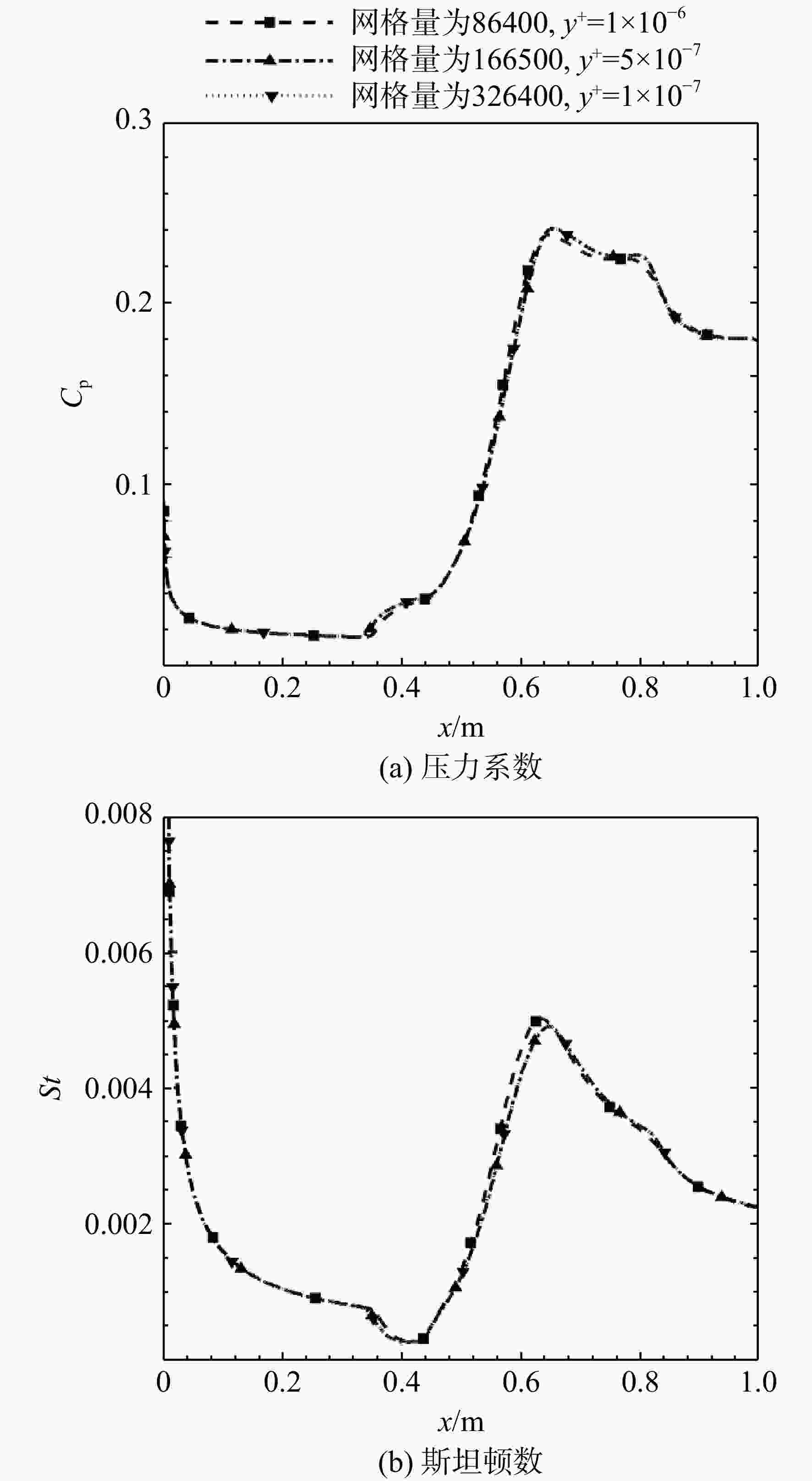
图 5 不同网格条件下的壁面压力和热流分布
Figure 5. Distributions of wall pressure and heat flux under different grids
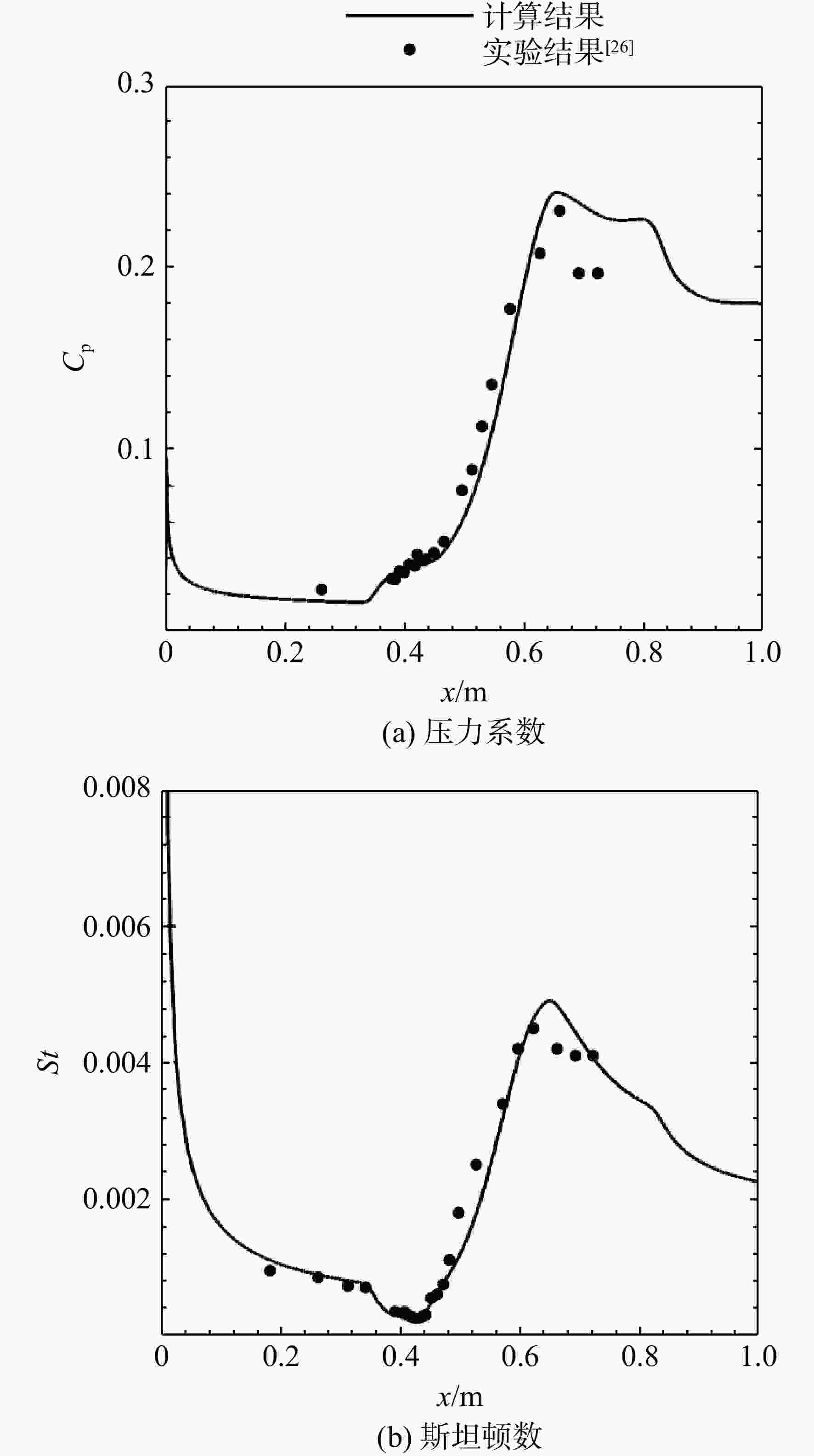
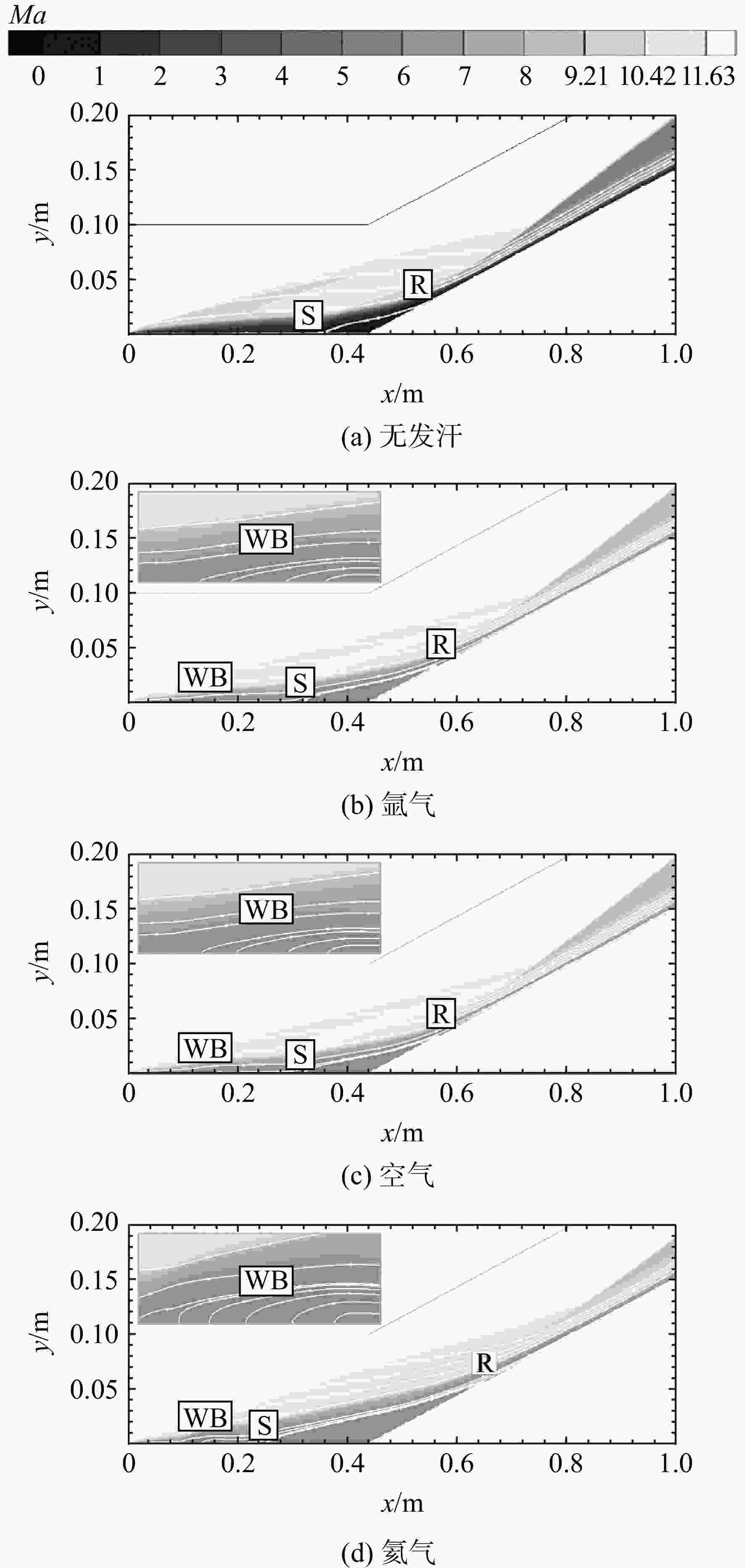
图 7 发汗位置位于x=0.110 m时不同发汗工质的马赫数云图对比
Figure 7. Comparison of Mach number contours under different transpiration coolants with transpiration at x=0.110 m
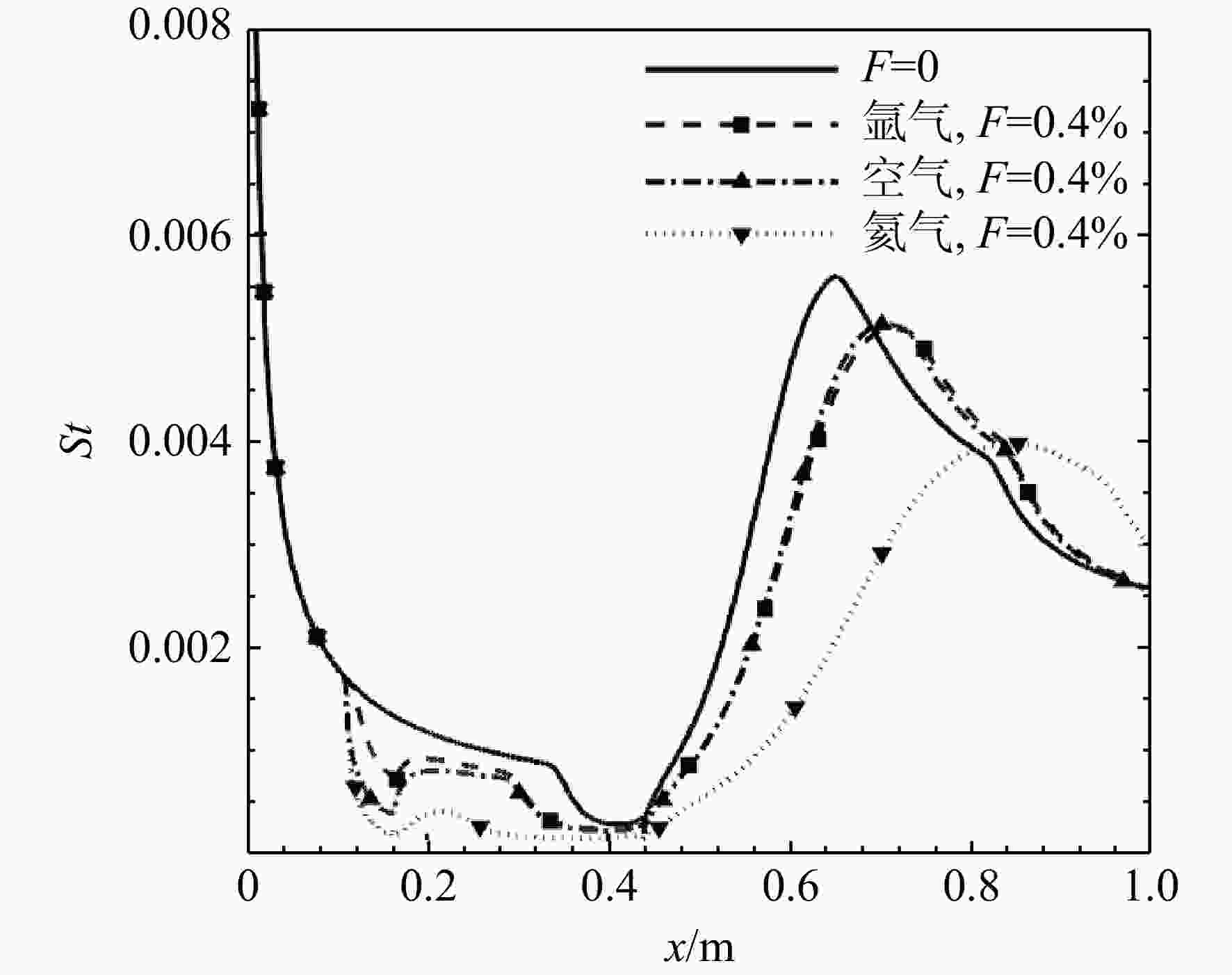
图 8 发汗位置位于x=0.110 m时不同发汗工质的壁面斯坦顿数分布
Figure 8. Distributions of wall Stanton number under different transpiration coolants with transpiration at x=0.110 m
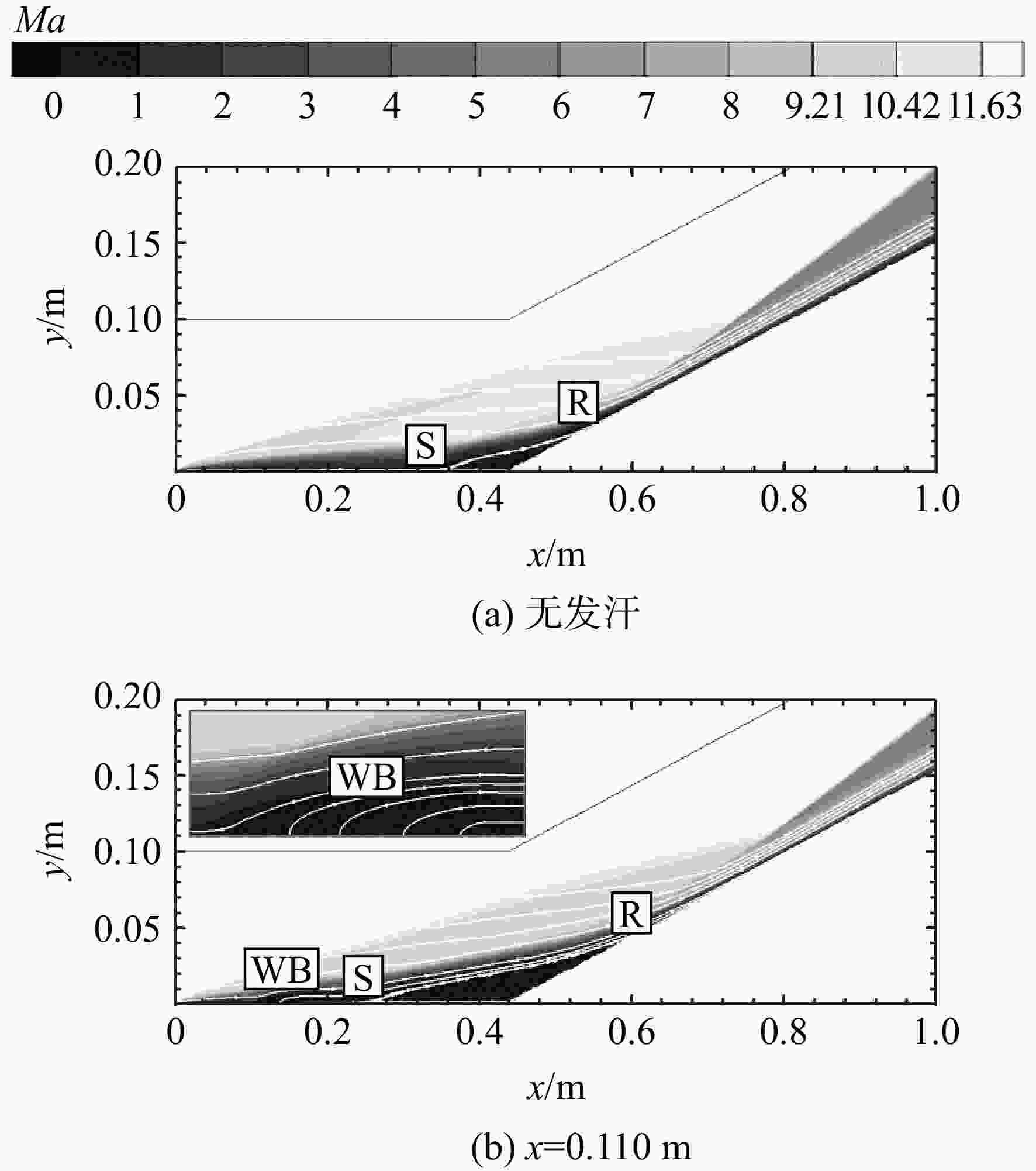
图 9 有无发汗(x=0.110 m,原始分离点上游)条件下的马赫数云图
Figure 9. Mach number contours with and without transpiration at x=0.110 m, upstream of the original separation point
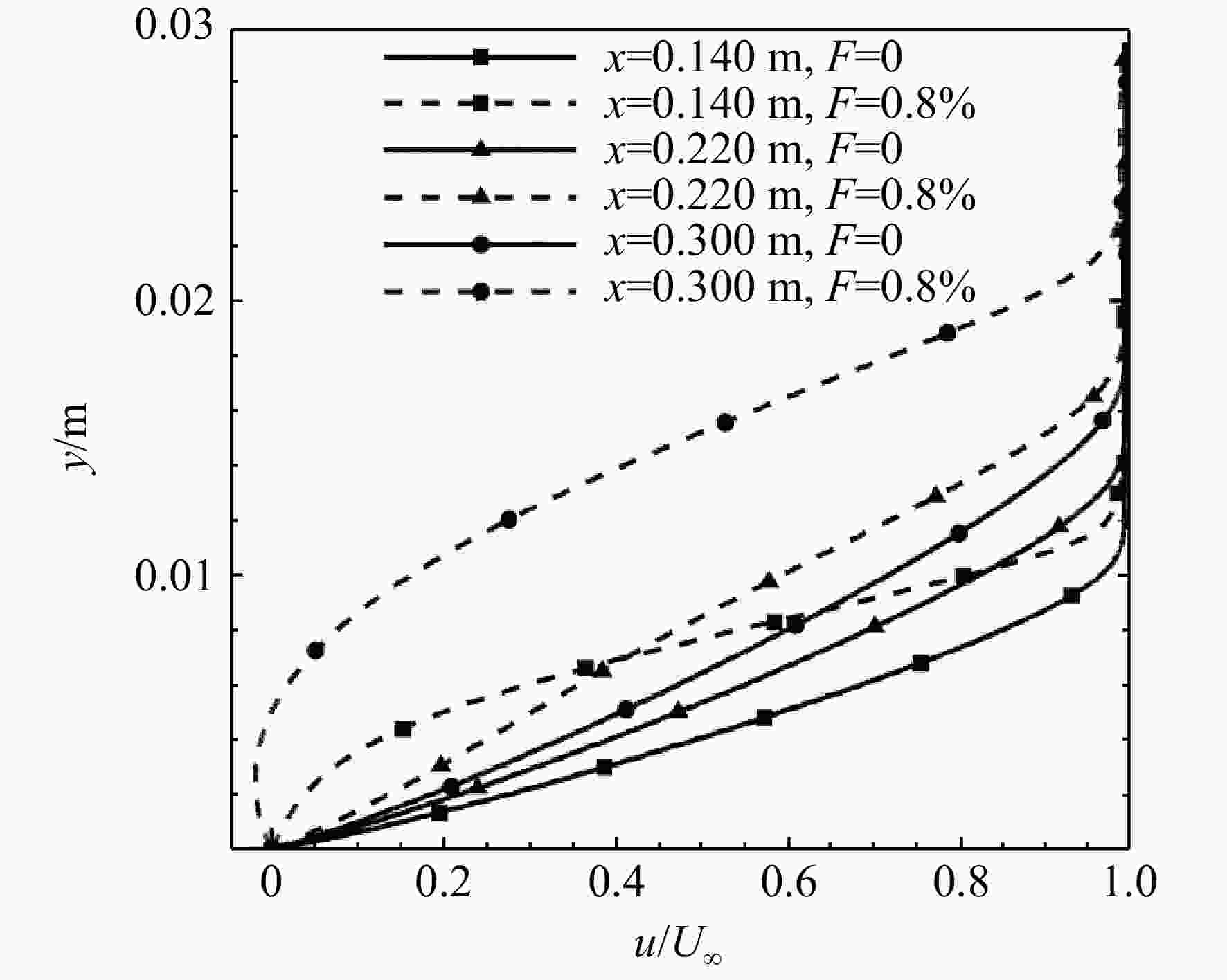
图 10 有无发汗(x=0.110 m,原始分离点上游)条件下不同位置的流向速度沿壁面法向分布
Figure 10. Wall-normal distributions of streamwise velocity at different locations with and without transpiration (x=0.110 m, upstream of the original separation point)

图 11 发汗位置位于x=0.450, 0.600, 0.609 m时的马赫数云图对比
Figure 11. Comparison of Mach number contours under different transpiration location at x=0.450, 0.600, 0.609 m
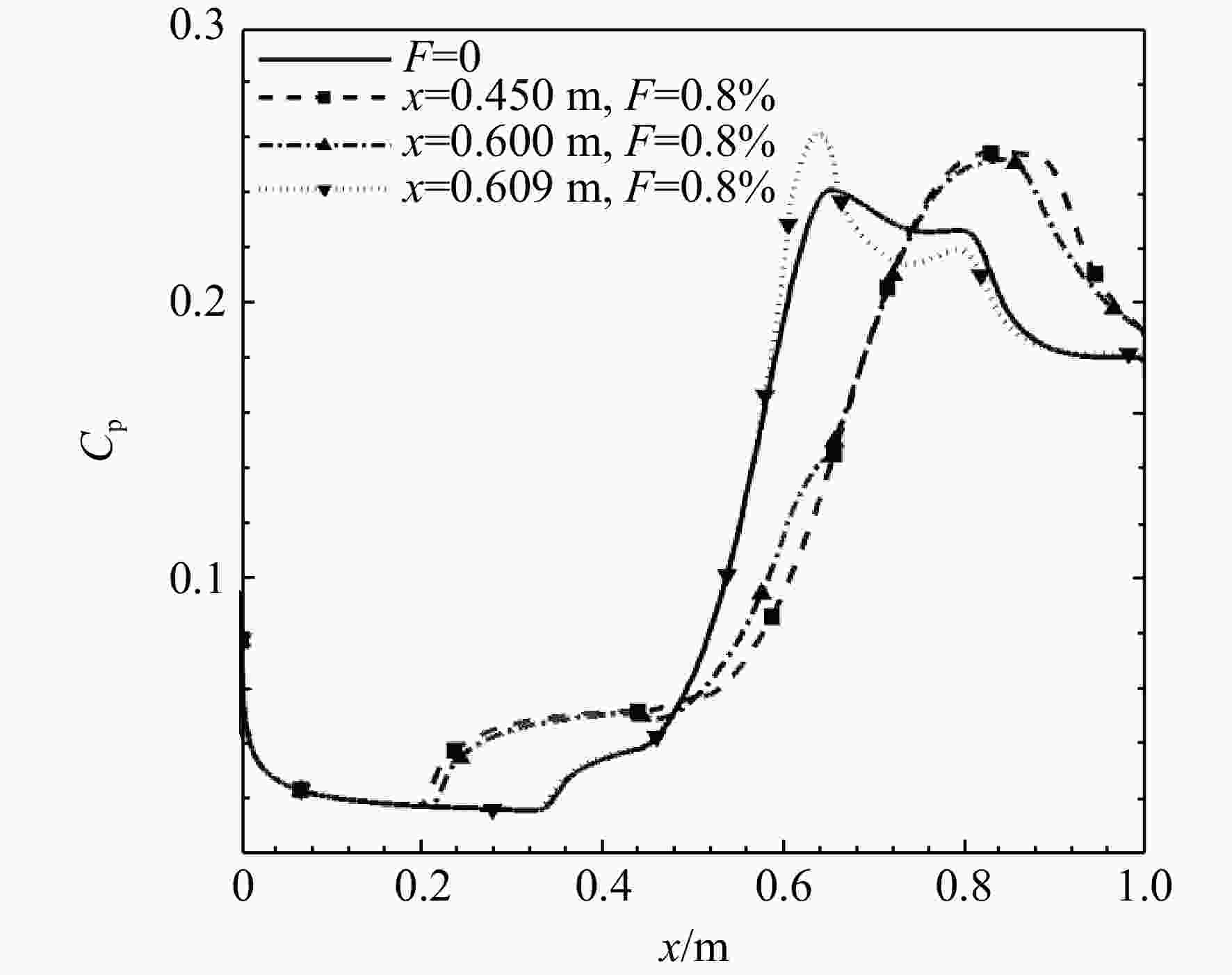
图 12 发汗位置位于x=0.450, 0.600, 0.609 m时的壁面压力系数分布
Figure 12. Distributions of wall pressure coefficient under different transpiration location at x=0.450, 0.600, 0.609 m
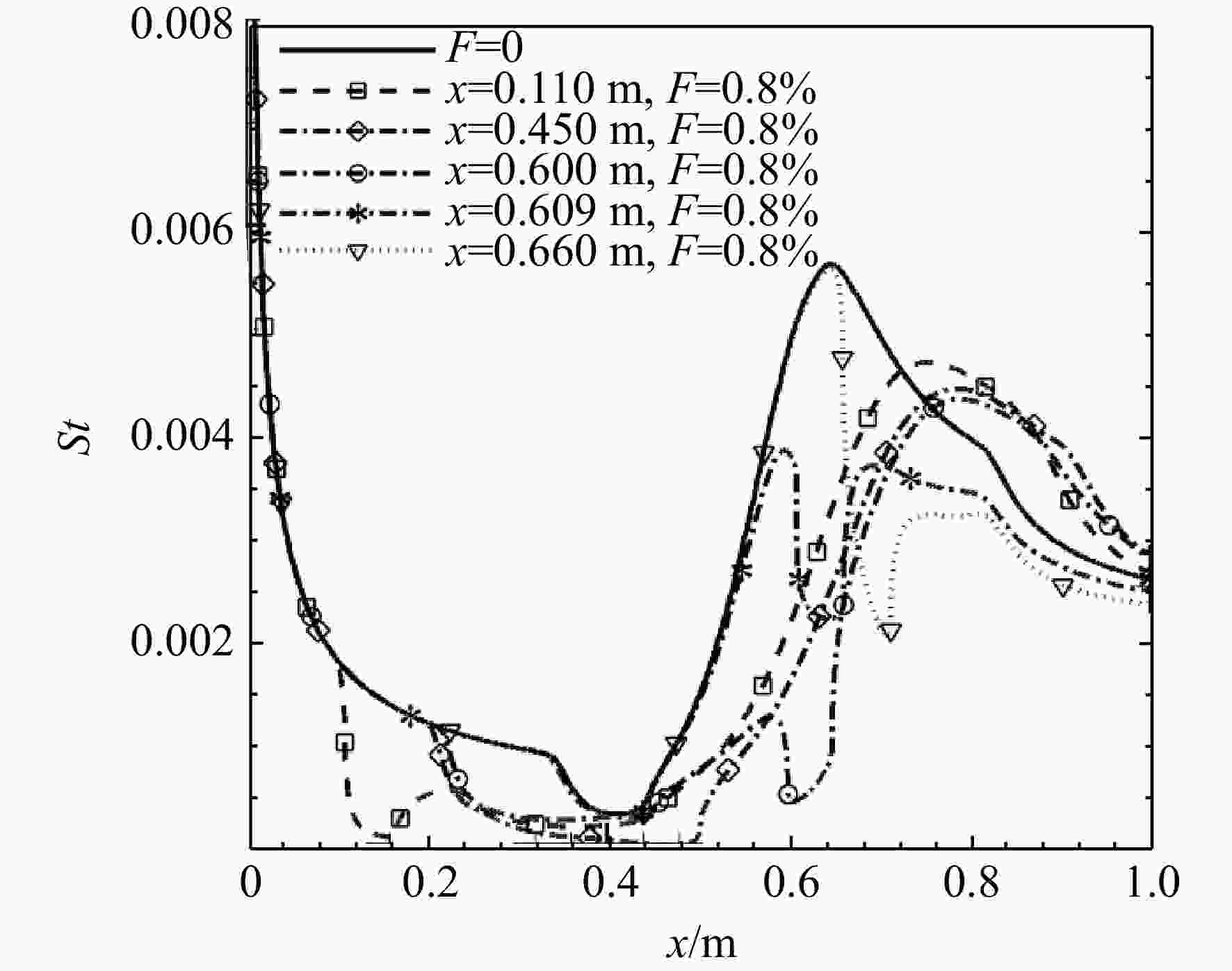
图 13 不同发汗位置条件下的壁面斯坦顿数分布
Figure 13. Distributions of wall Stanton number at different transpiration locations
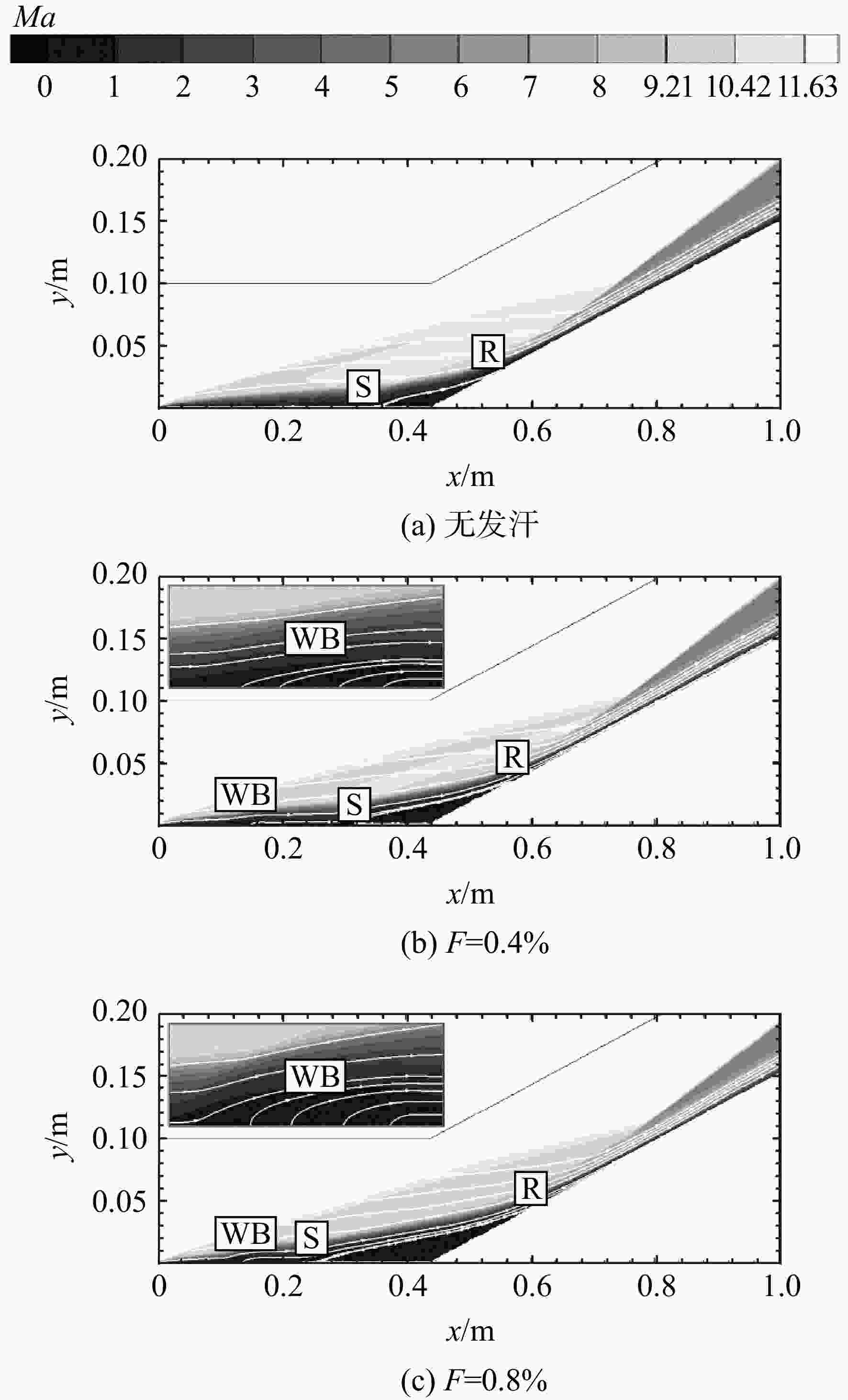
图 14 发汗位置位于x=0.110 m时不同发汗流量的马赫数云图对比
Figure 14. Comparison of Mach number contours under different transpiration flow rates with transpiration at x=0.110 m
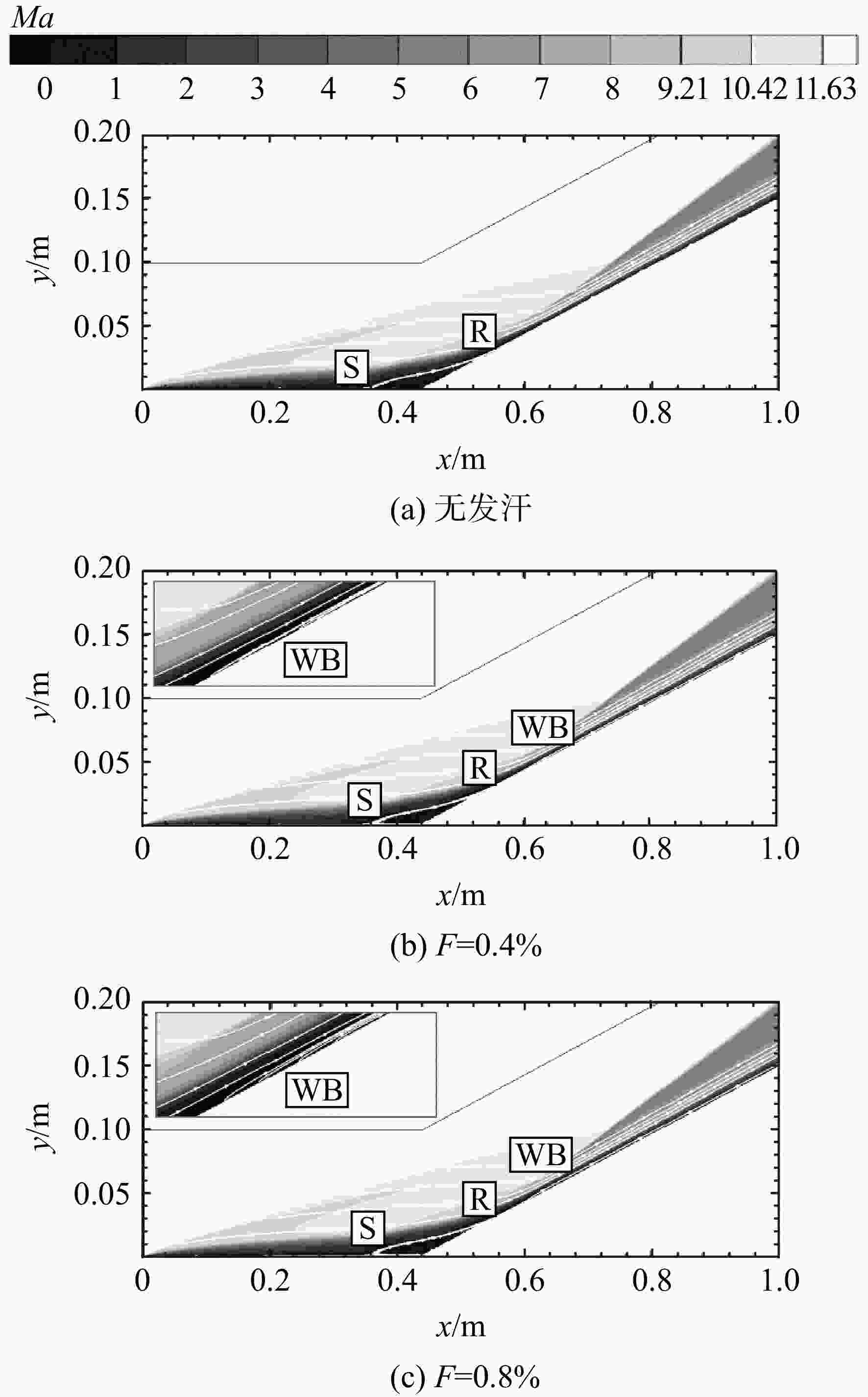
图 15 发汗位置位于x=0.609 m时不同发汗流量的马赫数云图对比
Figure 15. Comparison of Mach number contours under different transpiration flow rates with transpiration at x=0.609 m

图 16 发汗位置位于x=0.110 m和x=0.609 m时不同发汗流量的壁面斯坦顿数分布
Figure 16. Distributions of wall Stanton number under different transpiration flow rates with transpiration at x=0.110 m and x=0.609 m
表 1 发汗冷却计算状态
Table 1. Computation conditions of transpiration cooling
发汗冷却区域起始坐标x/m 发汗分数F/% 发汗工质 发汗冷却区域长度L/m 0.110 0.4,0.8 氩气,空气,氦气 0.055 0.450 0.8 空气 0.055 0.600 0.8 空气 0.055 0.609 0.4,0.8 空气 0.055 0.660 0.8 空气 0.055  下载: 导出CSV
表 2 压缩拐角计算网格参数
Table 2. Grid parameters of compression corner
编号 网格分布 网格量 第1层网格
高度/10−7 mRegrid 1 681×121 86400 10 0.552 2 881×181 166500 5 0.276 3 1321 ×241326400 1 0.055
下载: 导出CSV
表 3 不同发汗位置条件下的分离区参数及气动阻力
Table 3. Parameters of separation zone and drag variation at different transpiration locations
x0/m Ls/m Dp/N $ {\eta }_{ (D\text{p}) } $/% Df/N $ {\eta }_{ (D\text{f}) } $/% 无发汗 0.188 61.00 0 8.00 0 0.110 0.361 59.02 −3.25 5.63 −29.62 0.450 0.430 57.71 −5.39 5.52 −31.01 0.600 0.418 57.79 −5.26 5.18 −35.24 0.609 0.204 60.85 −0.25 6.59 −17.66 0.660 0.188 61.12 0.20 6.95 −13.09
下载: 导出CSV
表 4 不同发汗位置条件下的降热效果
Table 4. Effects of heat reduction at different transpiration locations
发汗冷却区域
起始坐标x/m发汗
分数F/%峰值斯坦顿数/
10−3峰值热流
降热率/%无发汗 0 5.63 0 0.110 0.8 4.68 −16.87 0.450 0.8 4.42 −21.49 0.600 0.8 4.32 −23.27 0.609 0.8 3.82 −32.15 0.660 0.8 5.58 −0.89
下载: 导出CSV
表 5 发汗位置位于x=0.110 m和x=0.609 m时不同发汗流量的降热效果对比
Table 5. Comparison of heat reduction effects under different transpiration flow rates with transpiration at x=0.110 m and x=0.609 m
发汗冷却区域
起始坐标x/m发汗
分数F/%峰值
斯坦顿数/10−3峰值热流
降热率/%无发汗 0 5.63 0 0.110 0.4 5.18 −7.99 0.110 0.8 4.68 −16.87 0.609 0.4 4.61 −18.12 0.609 0.8 3.82 −32.15
下载: 导出CSV
-
[1] HIRAIWA T, KANDA T, KOBAYASHI K, et al. Experiments on a scramjet engine with ramp-compression inlet at Mach 8[J]. Journal of Propulsion and Power, 2006, 22(2): 440-446. doi: 10.2514/1.16769 [2] HELM C, MARTIN M P, DUPONT P. Characterization of the shear layer in a Mach 3 shock/turbulent boundary layer interaction[J]. Journal of Physics: Conference Series, 2014, 506(1): 012013. doi: 10.2514/6.2014-0941 [3] 郭同彪, 张吉, 李新亮. 压缩拐角强激波边界层干扰直接数值模拟研究[J]. 空天防御, 2024, 7(2): 29-35. GUO Tongbiao, ZHANG Ji, LI Xinliang. Direct numerical simulation of strong shock wave and boundary layer interactions in a compression corner[J]. Air & Space Defense, 2024, 7(2): 29-35. (in Chinese doi: 10.3969/j.issn.2096-4641.2024.02.005GUO Tongbiao, ZHANG Ji, LI Xinliang. Direct numerical simulation of strong shock wave and boundary layer interactions in a compression corner[J]. Air & Space Defense, 2024, 7(2): 29-35. (in Chinese) doi: 10.3969/j.issn.2096-4641.2024.02.005 [4] BLEILEBENS M, OLIVIER H. On the influence of elevated surface temperatures on hypersonic shock wave/boundary layer interaction at a heated ramp model[J]. Shock Waves, 2006, 15(5): 301-312. doi: 10.1007/s00193-006-0025-2 [5] 徐东晓, 王亮, 符松, 等. 超声速流向拐角流动稳定性分析[J]. 气动研究与试验, 2024, 2(5): 69-74. XU Dongxiao, WANG Liang, FU Song, et al. Stability analysis on the supersonic streamwise corner flow[J]. Aerodynamic Research & Experiment, 2024, 2(5): 69-74. (in Chinese doi: 10.20118/j.issn2097-258X.2024.05.007XU Dongxiao, WANG Liang, FU Song, et al. Stability analysis on the supersonic streamwise corner flow[J]. Aerodynamic Research & Experiment, 2024, 2(5): 69-74. (in Chinese) doi: 10.20118/j.issn2097-258X.2024.05.007 [6] COLEMAN G T, STOLLERY J L. Heat transfer from hypersonic turbulent flow at a wedge compression corner[J]. Journal of Fluid Mechanics, 1972, 56(4): 741-752. doi: 10.1017/S0022112072002630 [7] 刘亮, 邱波, 曾磊, 等. 壁温对压缩拐角流动影响的数值模拟研究[J]. 空气动力学学报, 2021, 39(2): 117-124. LIU Liang, QIU Bo, ZENG Lei, et al. Numerical simulation of wall temperature effect on compressive corner flow[J]. Acta Aerodynamica Sinica, 2021, 39(2): 117-124. (in Chinese doi: 10.7638/kqdlxxb-2019.0134LIU Liang, QIU Bo, ZENG Lei, et al. Numerical simulation of wall temperature effect on compressive corner flow[J]. Acta Aerodynamica Sinica, 2021, 39(2): 117-124. (in Chinese) doi: 10.7638/kqdlxxb-2019.0134 [8] 沈斌贤, 曾磊, 刘骁, 等. 高超声速飞行器主动质量引射热防护技术研究进展[J]. 空气动力学学报, 2022, 40(6): 1-13. SHEN Binxian, ZENG Lei, LIU Xiao, et al. Research progress of thermal protection technique by activemass injection for hypersonic vehicle[J]. Acta Aerodynamica Sinica, 2022, 40(6): 1-13. (in Chinese doi: 10.7638/kqdlxxb-2021.0185SHEN Binxian, ZENG Lei, LIU Xiao, et al. Research progress of thermal protection technique by activemass injection for hypersonic vehicle[J]. Acta Aerodynamica Sinica, 2022, 40(6): 1-13. (in Chinese) doi: 10.7638/kqdlxxb-2021.0185 [9] 向树红, 商圣飞, 沈自才, 等. 高超声速气膜冷却技术研究进展及发展方向[J]. 宇航材料工艺, 2020, 50(3): 1-10. XIANG Shuhong, SHANG Shengfei, SHEN Zicai, et al. Research progress and development direction of hypersonic film cooling technology[J]. Aerospace Materials & Technology, 2020, 50(3): 1-10. (in Chinese doi: 10.12044/j.issn.1007-2330.2020.03.001XIANG Shuhong, SHANG Shengfei, SHEN Zicai, et al. Research progress and development direction of hypersonic film cooling technology[J]. Aerospace Materials & Technology, 2020, 50(3): 1-10. (in Chinese) doi: 10.12044/j.issn.1007-2330.2020.03.001 [10] 栾芸, 贺菲, 王建华. 临近空间飞行器发汗冷却研究进展[J]. 推进技术, 2023, 44(1): 22010020. LUAN Yun, HE Fei, WANG Jianhua. Review on transpiration cooling for near-space aircraft[J]. Journal of Propulsion Technology, 2023, 44(1): 22010020. (in Chinese doi: 10.13675/j.cnki.tjjs.22010020LUAN Yun, HE Fei, WANG Jianhua. Review on transpiration cooling for near-space aircraft[J]. Journal of Propulsion Technology, 2023, 44(1): 22010020. (in Chinese) doi: 10.13675/j.cnki.tjjs.22010020 [11] 杜晨慧. 高超声速飞行器综合热管理及关键技术研究进展[J]. 装备环境工程, 2023, 20(1): 43-51. DU Chenhui. Research progress on integrated thermal management and key technology of hypersonic vehicles[J]. Equipment Environmental Engineering, 2023, 20(1): 43-51. (in Chinese doi: 10.7643/issn.1672-9242.2023.01.007DU Chenhui. Research progress on integrated thermal management and key technology of hypersonic vehicles[J]. Equipment Environmental Engineering, 2023, 20(1): 43-51. (in Chinese) doi: 10.7643/issn.1672-9242.2023.01.007 [12] 梁伟, 金华, 孟松鹤, 等. 高超声速飞行器新型热防护机制研究进展[J]. 宇航学报, 2021, 42(4): 409-424. LIANG Wei, JIN Hua, MENG Songhe, et al. Research progress on new thermal protection mechanism of hypersonic vehicles[J]. Journal of Astronautics, 2021, 42(4): 409-424. (in Chinese doi: 10.3873/j.issn.1000-1328.2021.04.002LIANG Wei, JIN Hua, MENG Songhe, et al. Research progress on new thermal protection mechanism of hypersonic vehicles[J]. Journal of Astronautics, 2021, 42(4): 409-424. (in Chinese) doi: 10.3873/j.issn.1000-1328.2021.04.002 [13] 朱广生, 姚世勇, 段毅. 高速飞行器减阻降热流动控制技术研究进展及工程应用[J]. 航空学报, 2023, 44(15): 529049. ZHU Guangsheng, YAO Shiyong, DUAN Yi. Research progress and engineering application of flow control technology for drag and heat reduction of high-speed vehicles[J]. Acta Aeronautica et Astronautica Sinica, 2023, 44(15): 529049. (in Chinese doi: 10.7527/S1000-6893.2023.29049ZHU Guangsheng, YAO Shiyong, DUAN Yi. Research progress and engineering application of flow control technology for drag and heat reduction of high-speed vehicles[J]. Acta Aeronautica et Astronautica Sinica, 2023, 44(15): 529049. (in Chinese) doi: 10.7527/S1000-6893.2023.29049 [14] 刘韬略, 吕玉妹, 栾芸, 等. 双层多孔板结构相变发汗冷却的数值模拟研究[J]. 力学学报, 2024, 56(1): 121-129. LIU Taolue, LYU Yumei, LUAN Yun, et al. Numerical investigation on double-layer porous plate of transpiration cooling with phase change[J]. Chinese Journal of Theoretical and Applied Mechanics, 2024, 56(1): 121-129. (in Chinese doi: 10.6052/0459-1879-23-268LIU Taolue, LYU Yumei, LUAN Yun, et al. Numerical investigation on double-layer porous plate of transpiration cooling with phase change[J]. Chinese Journal of Theoretical and Applied Mechanics, 2024, 56(1): 121-129. (in Chinese) doi: 10.6052/0459-1879-23-268 [15] 苑朝凯, 李进平, 陈宏, 等. 高超声速溢流冷却实验研究[J]. 力学学报, 2018, 50(1): 1-8. YUAN Chaokai, LI Jinping, CHEN Hong, et al. Experimental study of hypersonic overflow cooling[J]. Chinese Journal of Theoretical and Applied Mechanics, 2018, 50(1): 1-8. (in Chinese doi: 10.6052/0459-1879-17-289YUAN Chaokai, LI Jinping, CHEN Hong, et al. Experimental study of hypersonic overflow cooling[J]. Chinese Journal of Theoretical and Applied Mechanics, 2018, 50(1): 1-8. (in Chinese) doi: 10.6052/0459-1879-17-289 [16] ECKERT E R G, LIVINGOOD N B. Comparison of effectiveness of convection-transpiration, and film-cooling methods with air as coolant[R]. Washington DC: National Advisory Committee for Aeronautics, 1954. [17] VAN FOREEST A, SIPPEL M, GÜLHAN A, et al. Transpiration cooling using liquid water[J]. Journal of Thermophysics and Heat Transfer, 2009, 23(4): 693-702. doi: 10.2514/1.39070 [18] 荆希泽, 时圣波, 李茂源, 等. 面向变体飞行的仿生相变发汗冷却结构: 热质传递机理及模型[J]. 空气动力学学报, 2025, 43(7): 83-92. JING Xize, SHI Shengbo, LI Maoyuan, et al. Bionic phase-change transpiration cooling structure for morphing flight: heat-mass transfer mechanism and modeling[J]. Acta Aerodynamica Sinica, 2025, 43(7): 83-92. (in Chinese doi: 10.7638/kqdlxxb-2025.0099JING Xize, SHI Shengbo, LI Maoyuan, et al. Bionic phase-change transpiration cooling structure for morphing flight: heat-mass transfer mechanism and modeling[J]. Acta Aerodynamica Sinica, 2025, 43(7): 83-92. (in Chinese) doi: 10.7638/kqdlxxb-2025.0099 [19] IFTI H S, HERMANN T, EWENZ ROCHER M, et al. Laminar transpiration cooling experiments in hypersonic flow[J]. Experiments in Fluids, 2022, 63(6): 102. doi: 10.1007/s00348-022-03446-1 [20] 王丽燕, 檀妹静, 王振峰, 等. 低速引射对高超声速飞行器气动加热影响[J]. 南京航空航天大学学报, 2019, 51(4): 503-511. WANG Liyan, TAN Meijing, WANG Zhenfeng, et al. Impact of low speed ejection on aerodynamic heating of hypersonic aircrafts[J]. Journal of Nanjing University of Aeronautics & Astronautics, 2019, 51(4): 503-511. (in Chinese doi: 10.16356/j.1005-2615.2019.04.010WANG Liyan, TAN Meijing, WANG Zhenfeng, et al. Impact of low speed ejection on aerodynamic heating of hypersonic aircrafts[J]. Journal of Nanjing University of Aeronautics & Astronautics, 2019, 51(4): 503-511. (in Chinese) doi: 10.16356/j.1005-2615.2019.04.010 [21] 胥蕊娜, 李晓阳, 廖致远, 等. 航天飞行器热防护相变发汗冷却研究进展[J]. 清华大学学报(自然科学版), 2021, 61(12): 1341-1352. XU Ruina, LI Xiaoyang, LIAO Zhiyuan, et al. Research progress in transpiration cooling with phase change[J]. Journal of Tsinghua University (Science and Technology), 2021, 61(12): 1341-1352. (in Chinese doi: 10.16511/j.cnki.qhdxxb.2020.25.044XU Ruina, LI Xiaoyang, LIAO Zhiyuan, et al. Research progress in transpiration cooling with phase change[J]. Journal of Tsinghua University (Science and Technology), 2021, 61(12): 1341-1352. (in Chinese) doi: 10.16511/j.cnki.qhdxxb.2020.25.044 [22] KORNILOV V I, BOIKO A V. Efficiency of air micro blowing through microperforated wall for flat plate drag reduction[J]. AIAA Journal, 2012, 50(3): 724-732. doi: 10.2514/1.J051426 [23] 范云涛, 张阳, 叶志贤, 等. 微吹气对湍流平板边界层流动特性的影响及其减阻机理[J]. 航空学报, 2020, 41(10): 146-159. FAN Yuntao, ZHANG Yang, YE Zhixian, et al. Micro-blowing: Effect on flow characteristics in turbulent flat plate boundary layer and drag reduction mechanism[J]. Acta Aeronautica et Astronautica Sinica, 2020, 41(10): 146-159. (in ChineseFAN Yuntao, ZHANG Yang, YE Zhixian, et al. Micro-blowing: Effect on flow characteristics in turbulent flat plate boundary layer and drag reduction mechanism[J]. Acta Aeronautica et Astronautica Sinica, 2020, 41(10): 146-159. (in Chinese) [24] 曾繁宇, 邱云龙, 曹占伟, 等. 超声速湍流边界层阵列式微吹气流动控制与减阻特性[J]. 航空学报, 2023, 44(增刊2): 729396. ZENG Fanyu, QIU Yunlong, CAO Zhanwei, et al. Flow control and drag reduction characteristics of micro-blowing array on supersonic turbulent boundary layer[J]. Acta Aeronautica et Astronautica Sinica, 2023, 44(Suppl.2): 729396. (in ChineseZENG Fanyu, QIU Yunlong, CAO Zhanwei, et al. Flow control and drag reduction characteristics of micro-blowing array on supersonic turbulent boundary layer[J]. Acta Aeronautica et Astronautica Sinica, 2023, 44(Suppl.2): 729396. (in Chinese) [25] 张红军, 康宏琳. 激波干扰对发汗冷却影响的数值模拟研究[J]. 宇航学报, 2021, 42(3): 324-332. ZHANG Hongjun, KANG Honglin. Numerical simulation study on the effects of shock wave interference on transpiration cooling[J]. Journal of Astronautics, 2021, 42(3): 324-332. (in Chinese doi: 10.3873/j.issn.1000-1328.2021.03.007ZHANG Hongjun, KANG Honglin. Numerical simulation study on the effects of shock wave interference on transpiration cooling[J]. Journal of Astronautics, 2021, 42(3): 324-332. (in Chinese) doi: 10.3873/j.issn.1000-1328.2021.03.007 [26] HOLDEN M S. A study of flow separation in regions of shock wave-boundary layer interaction in hypersonic flow: AIAA Paper 78-1169 [R]. Seattle, US: AIAA, 1978. [27] BÖHRK H. Transpiration-cooled hypersonic flight experiment: setup, flight measurement, and reconstruction[J]. Journal of Spacecraft and Rockets, 2015, 52(3): 674-683. doi: 10.2514/1.A33144 -


 点击查看大图

计量
- 文章访问数: 191
- HTML浏览量: 166
- PDF量: 18
- 被引次数: 0