






Research on multi-axis vector control characteristics of supersonic axisymmetric fluidic thrust vectoring nozzle
-
摘要:
无源流体推力矢量技术无须二次流控制气源、结构简单且隐身性好,已成为飞行器矢量控制领域的前沿研究热点。基于无源流体推力矢量技术设计了一种周向均布6个被动二次流通道的超声速轴对称气动推力矢量喷管,通过控制被动二次流通道的启闭组合,构建了两种射流偏转控制策略。采用纹影流动显示技术与空气桥测力技术,研究了喷管在落压比为3.5~5.0范围内的射流偏转控制特性与推力矢量性能。研究结果表明:喷管成功实现了全周向12个方向的推力矢量控制,在主控与次控方向上的最大推力矢量角均可达9.8°,主控方向线性度最高为89.58%,次控方向线性度最高为97.28%,喷管推力矢量效率最高可达13.45°/%。相关结果为无源流体推力矢量技术在导弹、火箭等需要多轴控制力矩平台的进一步工程应用提供实验依据与设计参考。
Abstract:Passive fluidic thrust vectoring technology has emerged as a frontier research hotspot in aircraft thrust vector control due to its advantages of requiring no external gas source, simple structure, and low observability. A supersonic axisymmetric fluidic thrust vectoring nozzle with six passive circumferentially uniform secondary flow channels was designed. By controlling the on/off combinations of these secondary flow channels, two control strategies were established. Utilizing schlieren flow visualization and air-bridge balance force measurement techniques, the jet deflection characteristics and thrust vectoring performance of the nozzle within the nozzle pressure ratio (NPR) range of 3.5 to 5.0 were systematically investigated. Experimental results demonstrated that the nozzle successfully achieved vector control in 12 circumferential directions, with maximum thrust vector angles reaching 9.8° in both the primary and secondary control directions. The highest linearity was 89.58% in the primary control direction and 97.28% in the secondary control direction. The maximum thrust vectoring efficiency of the nozzle reached 13.45°/%. This research could provide experimental evidence and design references for further engineering application of passive fluidic thrust vectoring technology in platforms requiring multi-axis control moments, such as missiles and rockets.
-
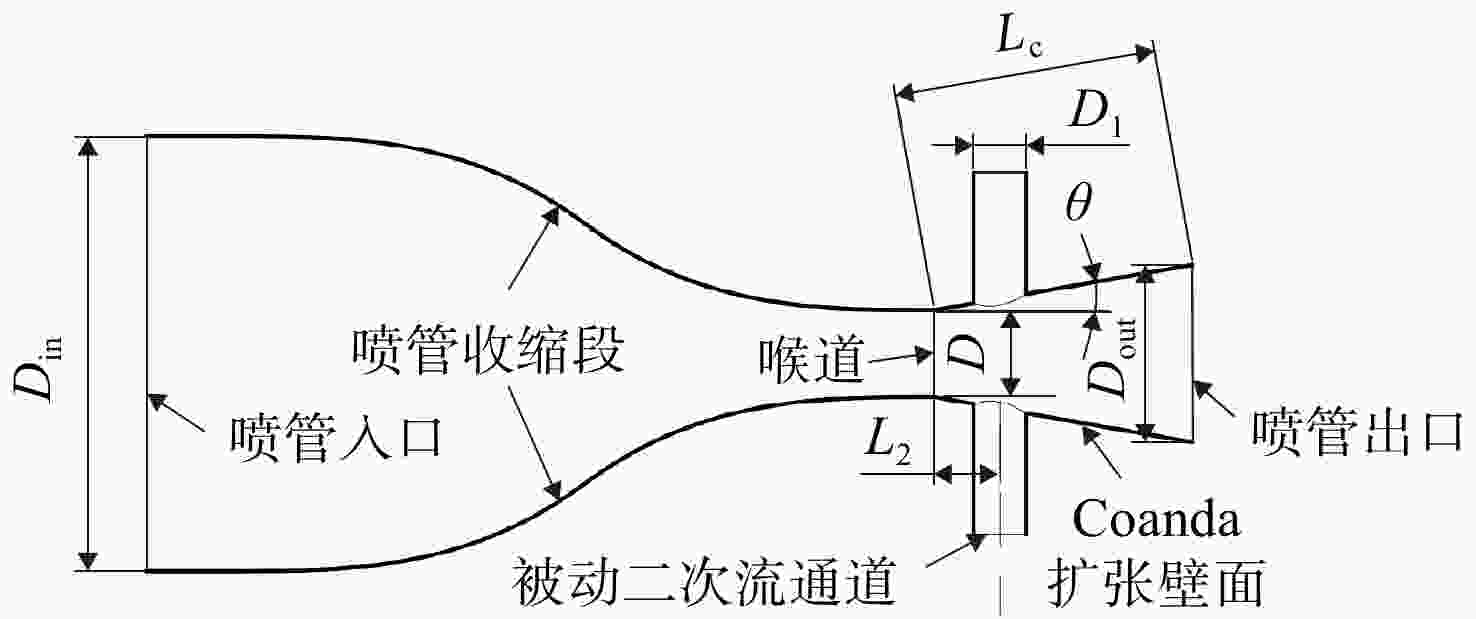
图 1 轴对称气动矢量喷管结构示意图
Figure 1. Schematic diagram of axisymmetric fluidic thrust vectoring nozzle structure
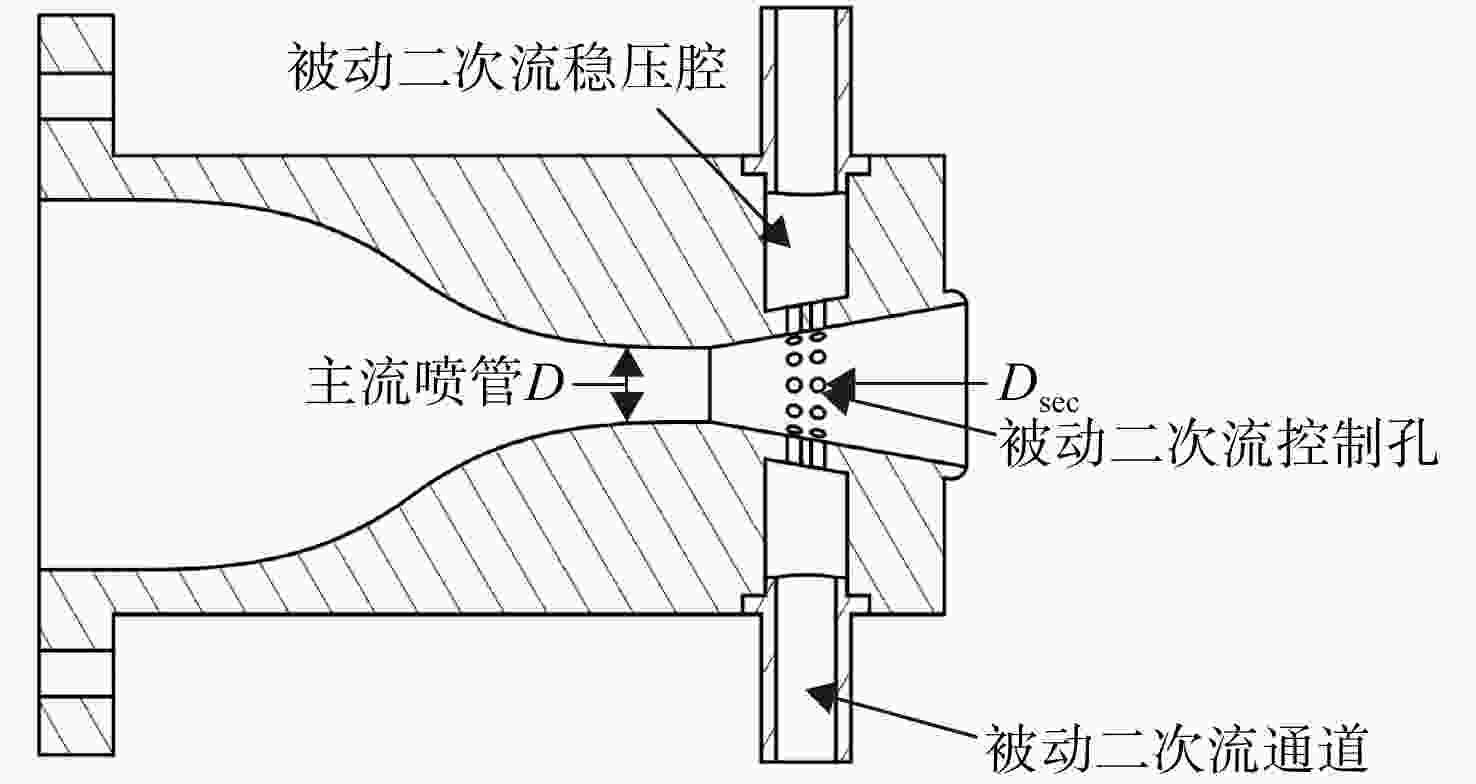
图 2 轴对称气动矢量喷管剖面图
Figure 2. Cross-sectional view of axisymmetric fluidic thrust vectoring nozzle
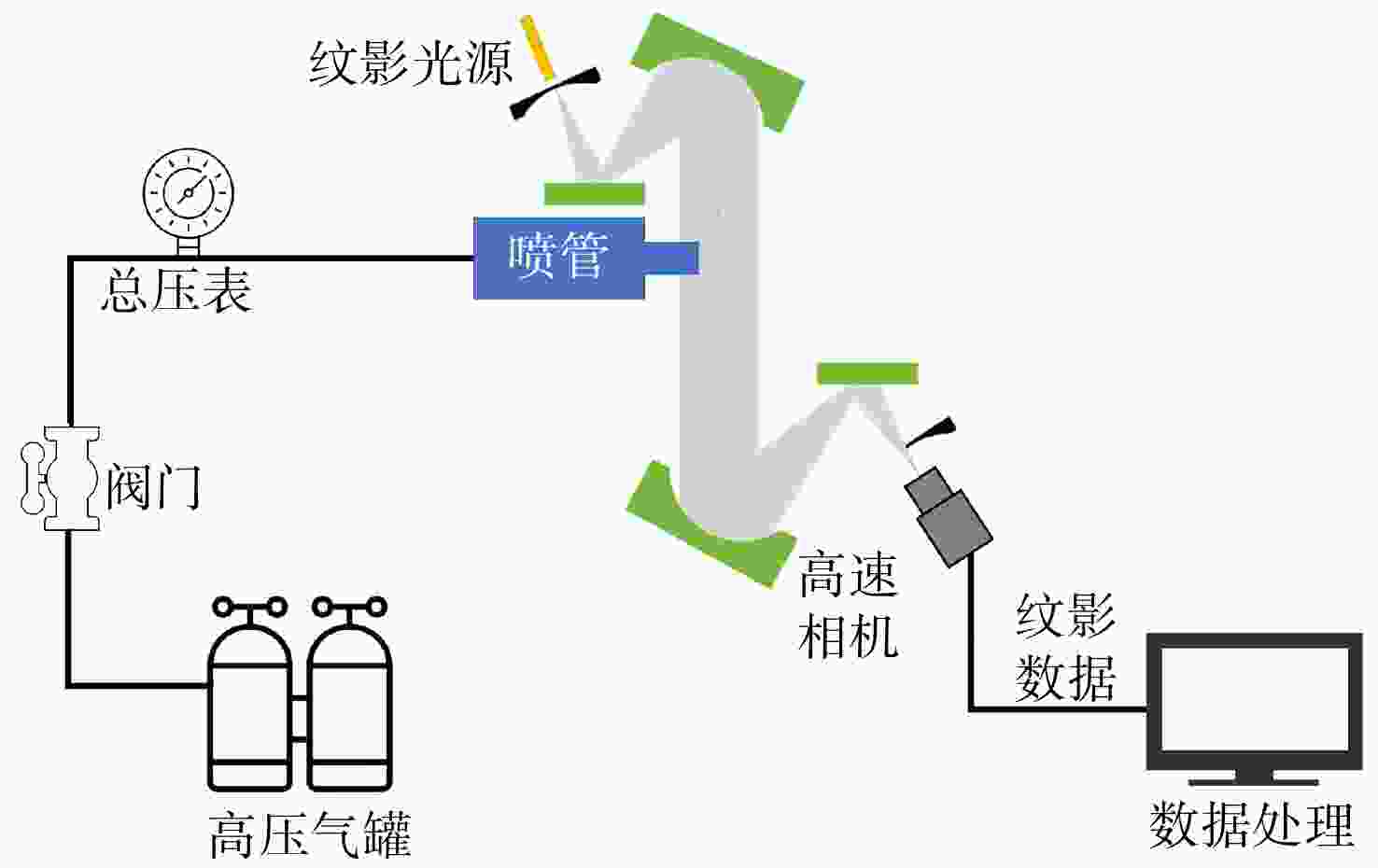
图 3 基于纹影技术的喷管流动显示实验平台
Figure 3. Schlieren-based nozzle flow visualization test platform
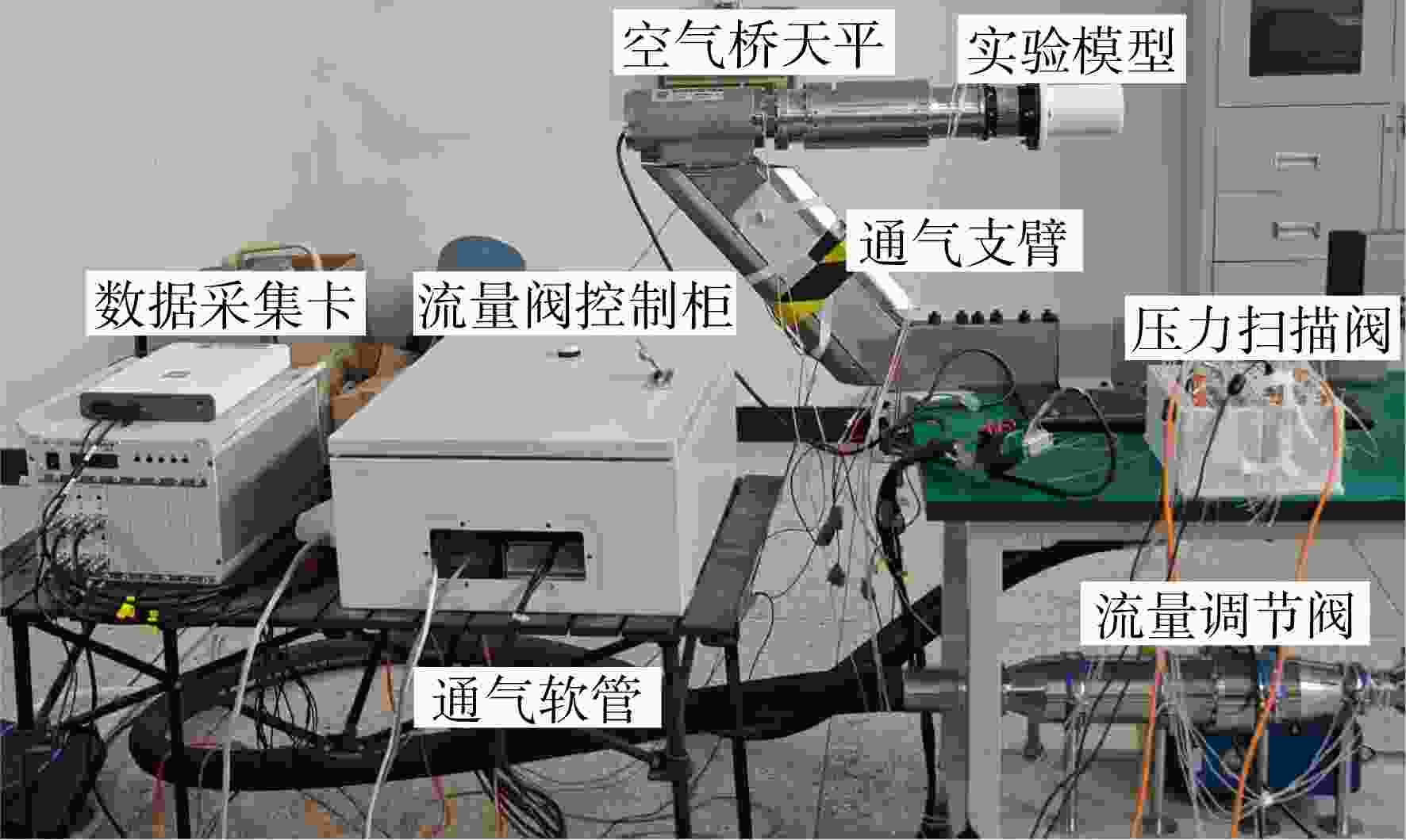
图 4 基于空气桥测力技术的喷管推力矢量实验平台
Figure 4. Nozzle thrust vectoring test platform based on air-bridge force measurement technique
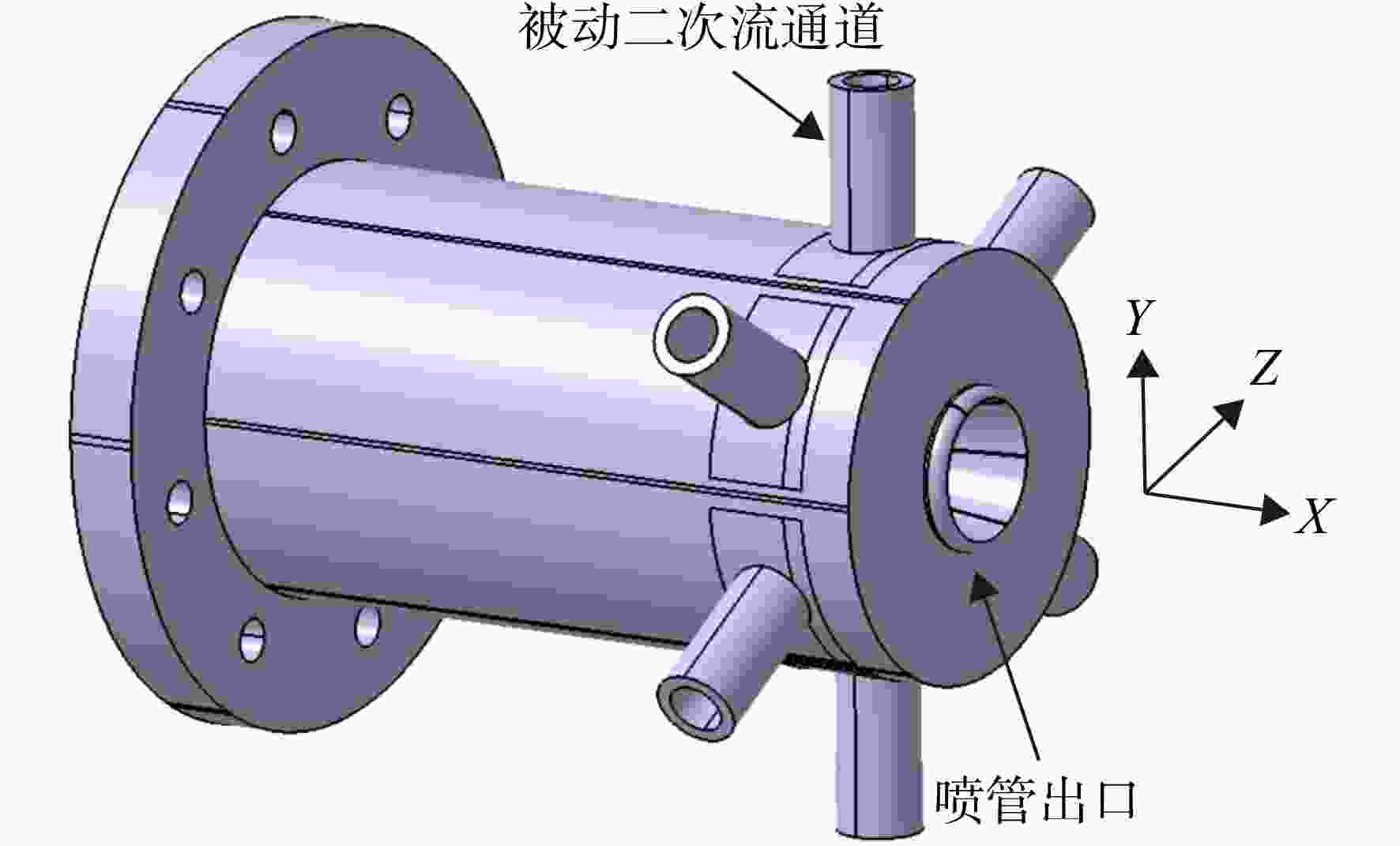
图 5 轴对称气动矢量喷管建模图
Figure 5. Modeling diagram of axisymmetric fluidic thrust vectoring nozzle
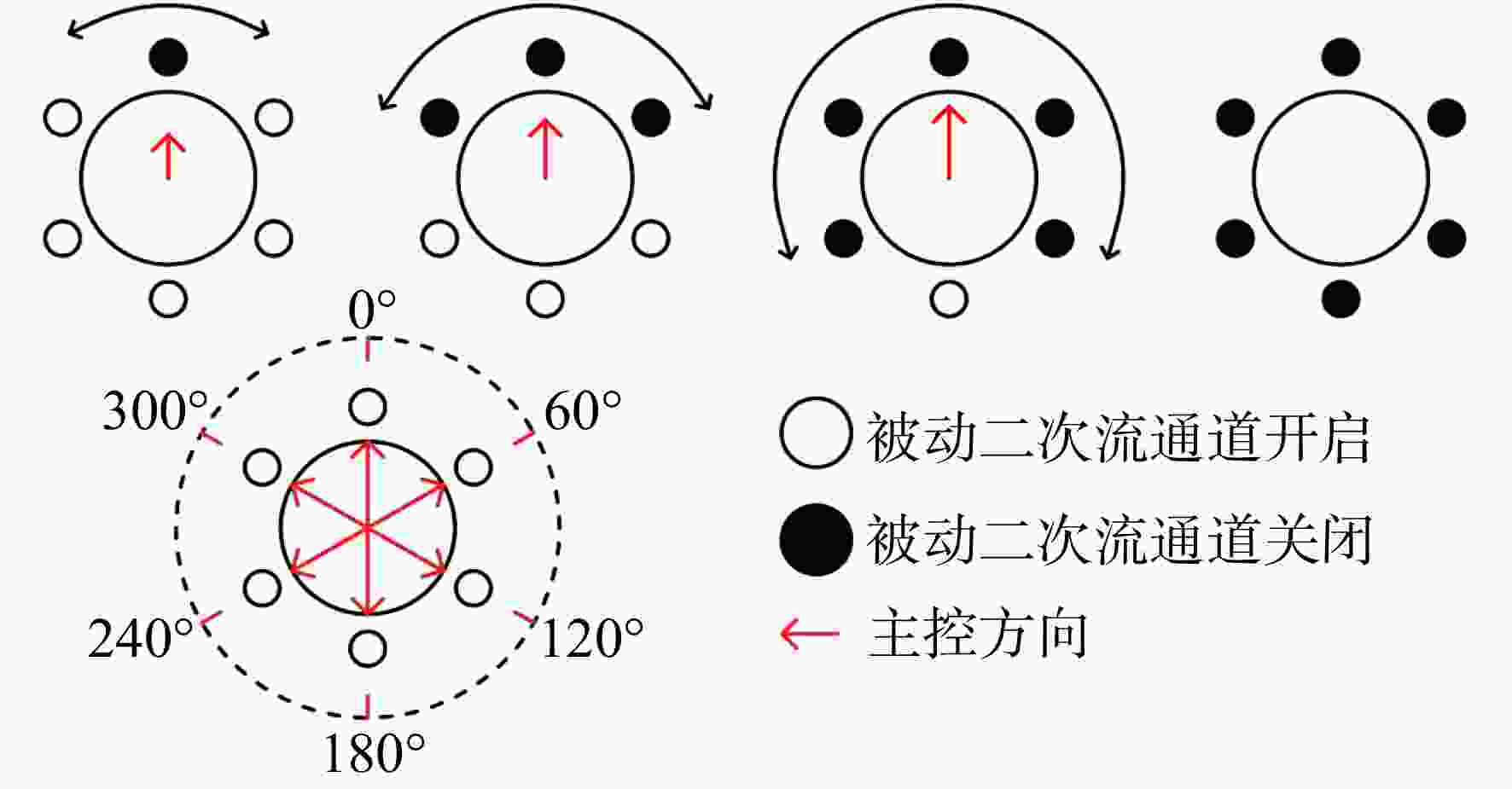
图 7 主控方向控制策略示意图
Figure 7. Schematic diagram of primary control direction control strategy
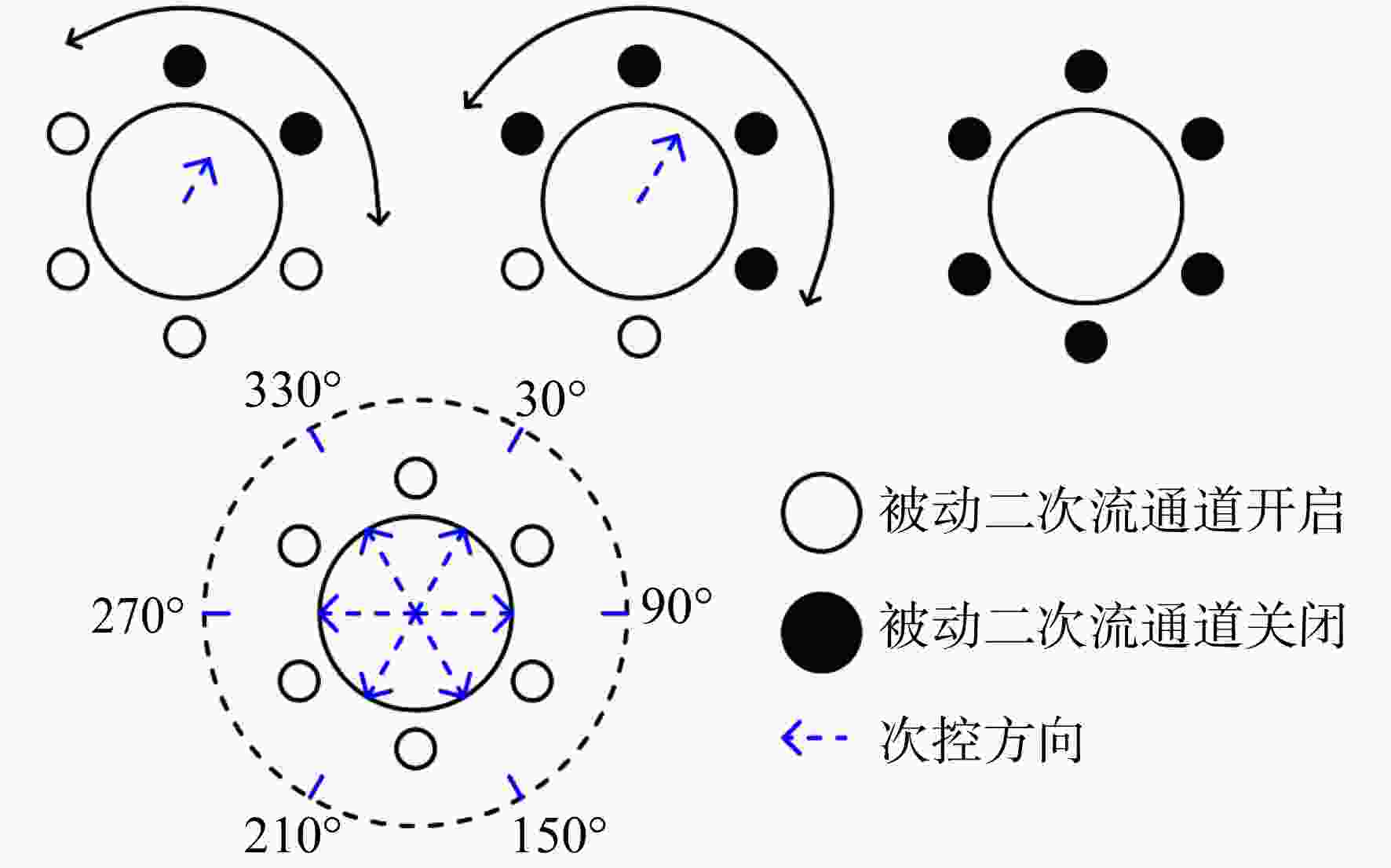
图 8 次控方向控制策略示意图
Figure 8. Schematic diagram of secondary control direction control strategy
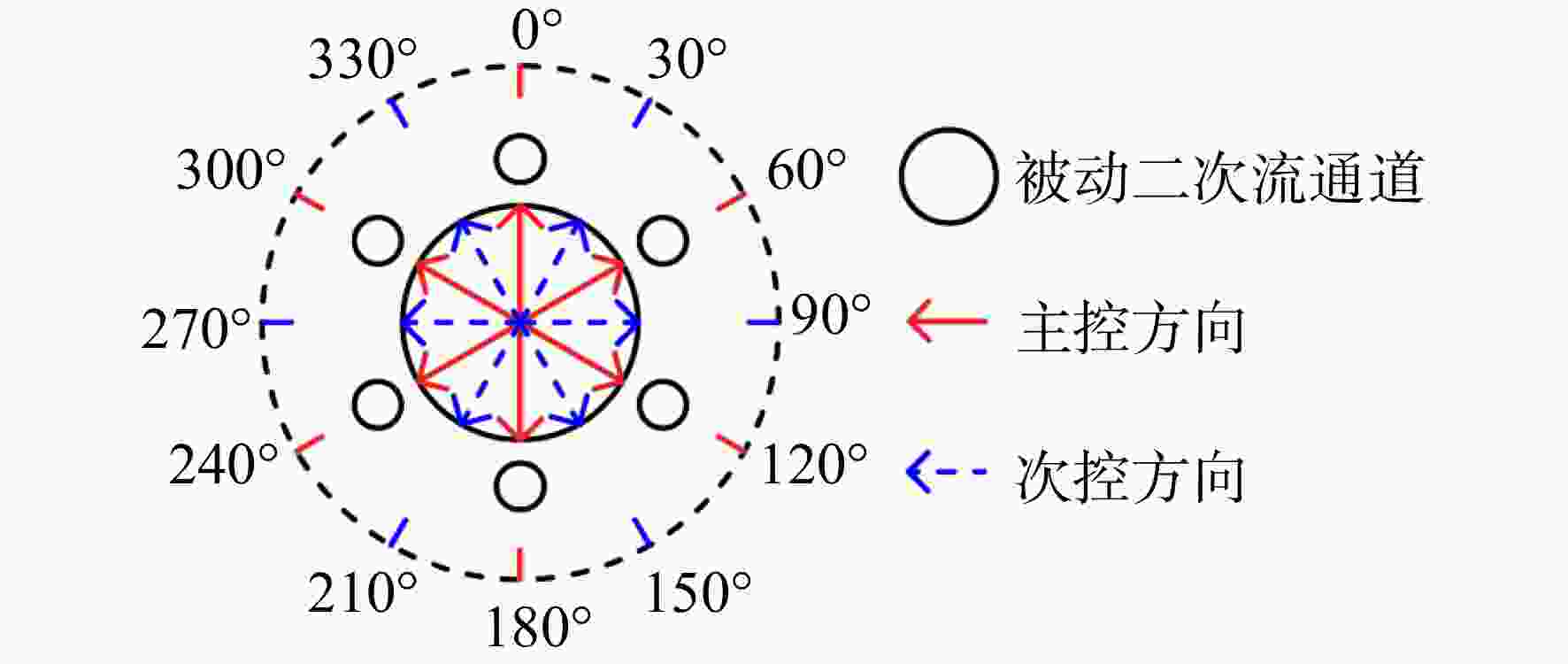
图 9 全周向矢量控制方向示意图
Figure 9. Schematic diagram of circumferential vector control directions
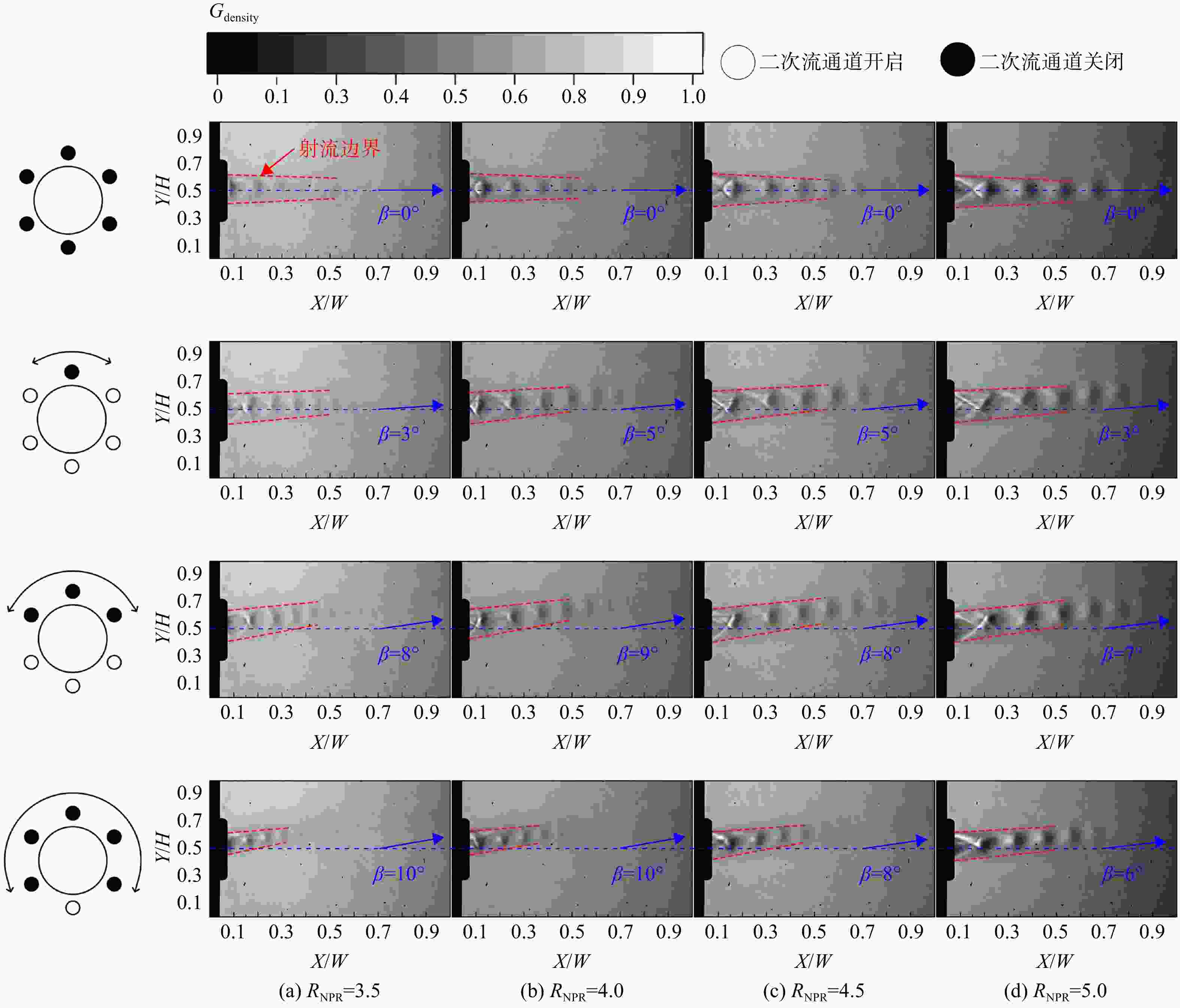
图 10 主控方向喷管纹影结果
Figure 10. Primary control direction nozzle jet deflection schlieren result
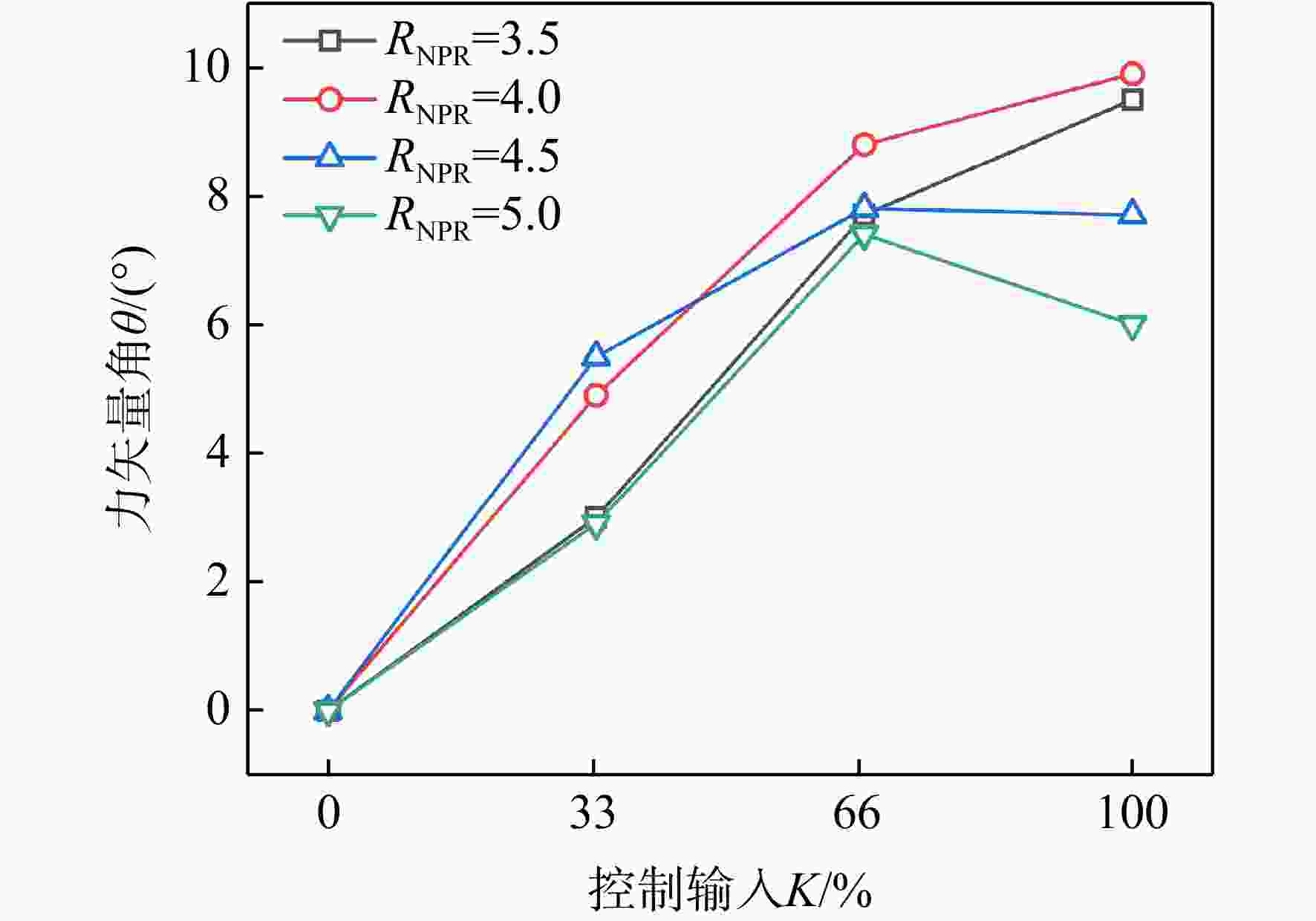
图 11 主控方向力矢量角控制曲线
Figure 11. Control curve of thrust vector angle for primary control direction
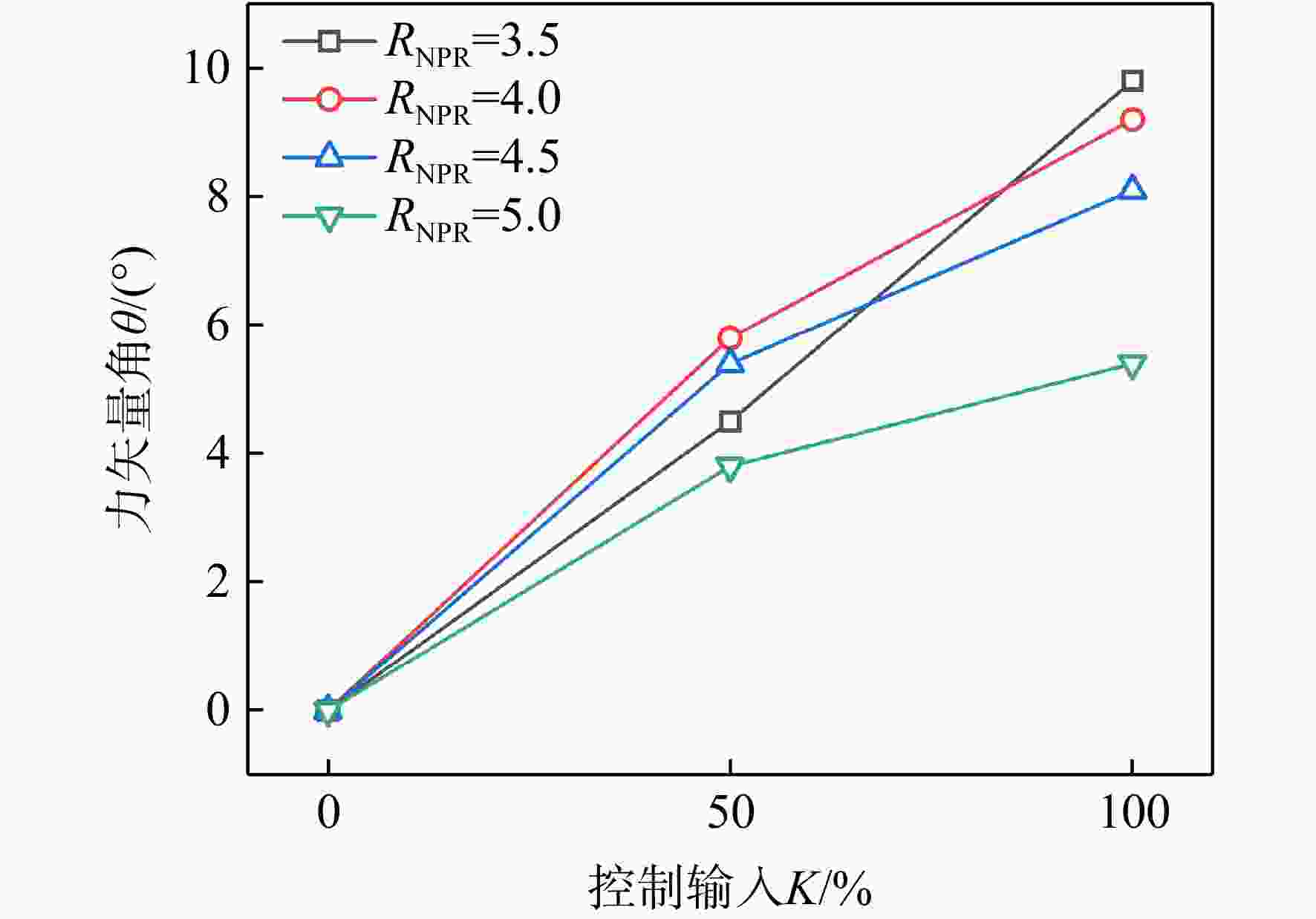
图 13 次控方向力矢量角控制曲线
Figure 13. Control curve of thrust vector angle for secondary control direction
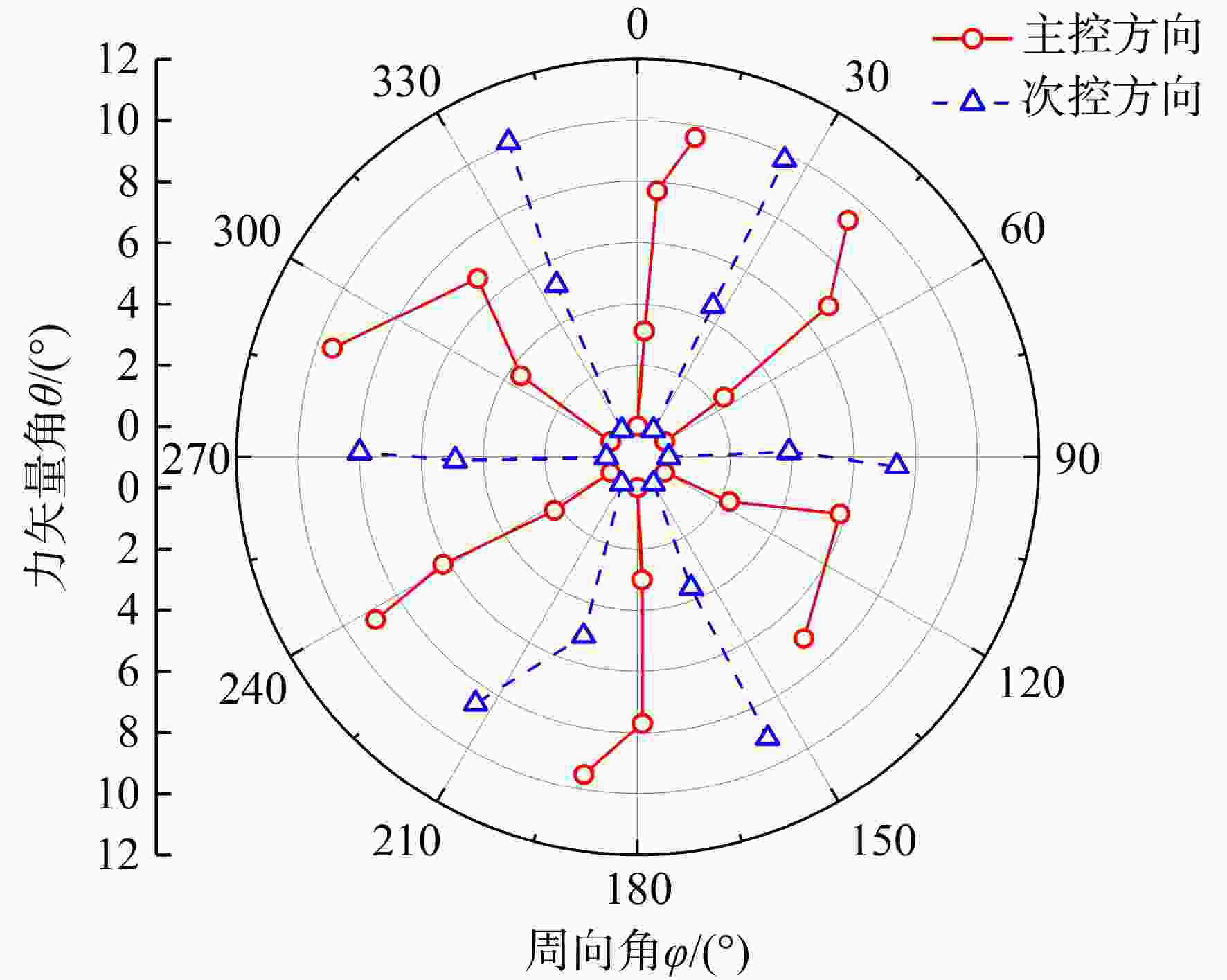
图 14 喷管多轴推力矢量效果(RNPR为3.5)
Figure 14. Multi-axis thrust vectoring effect of the nozzle(RNPR is 3.5)
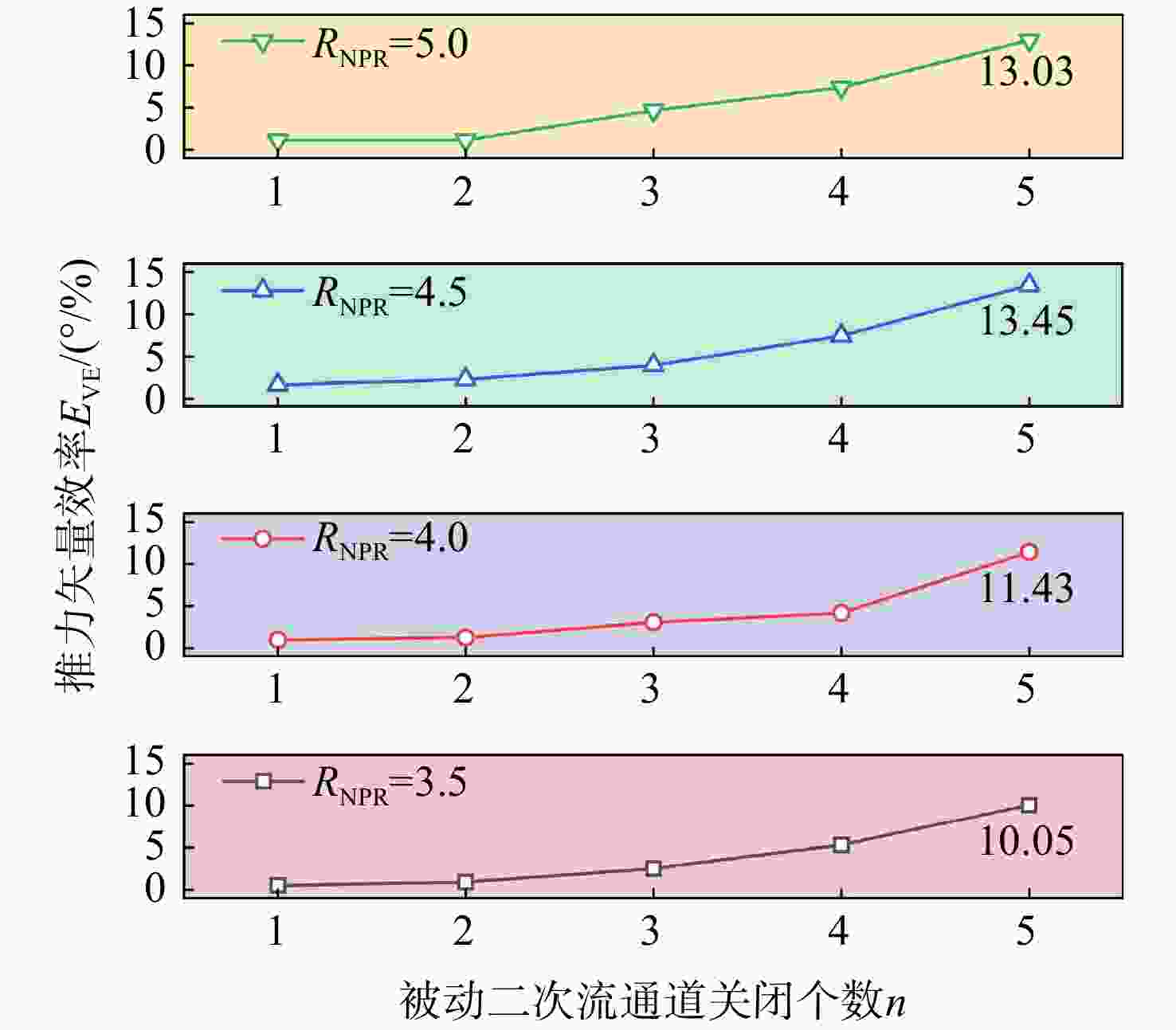
图 18 轴对称气动推力矢量喷管推力效率曲线
Figure 18. Axisymmetric fluidic thrust vectoring nozzle vectoring efficiency curve
表 1 喷管结构参数表
Table 1. Table of the nozzle structure parameter
参数 数值 主喷流喷管入口高度Din/mm 50 主喷流喷管喉道高度D/mm 10 喷管出口高度Dout/mm 20.4 Coanda扩张壁面长度Lc/mm 20 壁面扩张角θ/(°) 10 被动二次流通道直径D1/mm 6 被动二次流通道与喷管喉道间距L2/mm 11.1 被动二次流控制孔直径Dsec/mm 2  下载: 导出CSV
表 2 空气桥系统参数表
Table 2. Table of the air-bridge force measurement system parameter
参数 数值 精度/% FX/N 150 0.5 FY/N 250 0.5 FZ/N 100 0.5 MX/(N·m) 12 0.3 MY/(N·m) 30 0.3 MZ/(N·m) 15 0.3 流量q/(g/s) 500
下载: 导出CSV
表 3 主控方向控制输入表
Table 3. Table of primary control direction control inputs
控制输入K/% 被动二次流通道关闭个数n 0 6 33 1 67 3 100 5
下载: 导出CSV
表 4 次控方向控制输入表
Table 4. Table of secondary control direction control inputs
控制输入K/% 被动二次流通道关闭个数n 0 6 50 2 100 4
下载: 导出CSV
-
[1] 王玉新. 喷气发动机轴对称推力矢量喷管[M]. 北京: 国防工业出版社, 2006. Wang Yuxin. Axisymmetric thrust vector nozzle of jet engine[M]. Beijing: National Defense Industry Press, 2006. (in ChineseWang Yuxin. Axisymmetric thrust vector nozzle of jet engine[M]. Beijing: National Defense Industry Press, 2006. (in Chinese) [2] Farley J. Harrier development from the flight test point of view: AIAA1971-773[R]. Seattle, US. AIAA, 1971. [3] Britton J. Commentary on facilities used in the development of a Sea Harrier all weather operations capability: AIAA1981-2407[R]. Las Vegas, US: AIAA, 1981. [4] Bursey R, Dickinson R. Flight test results of the F-15 SMTD thrust vectoring/thrust reversing exhaust nozzle: AIAA1990-1906[R]. Orlando, US: AIAA, 1990. [5] Young J. X31 VECTOR program summary[C]//Proceedings of AIAA Guidance, Navigation, and Control Conference and Exhibit. Providence: AIAA, 2014: 5026. [6] 高峰, 唐胜景, 师娇. 推力矢量控制技术在导弹上的应用[J]. 飞航导弹, 2010(12): 52-59, 66. Gao Feng, Tang Shengjing, Shi Jiao. Application of thrust vector control technology in missile[J]. Aerodynamic Missile Journal, 2010(12): 52-59, 66. (in Chinese doi: 10.3969/j.issn.1673-9728.2013.04.007Gao Feng, Tang Shengjing, Shi Jiao. Application of thrust vector control technology in missile[J]. Aerodynamic Missile Journal, 2010(12): 52-59, 66. (in Chinese) doi: 10.3969/j.issn.1673-9728.2013.04.007 [7] Capone F, Smereczniak P, Spetnagel D, et al. Comparative investigation of multiplane thrust vectoring nozzles: AIAA1992-3263[R]. Nashville, US: AIAA, 1992. [8] Anna P D, Kidman D S. Flight test results of the F-16 aircraft modified with the axisymmetric vectoring exhaust nozzle[C]//Proceedings of the 4th High Alpha Conference. Edwards: NASA, 1994: 230-235. [9] Strykowski P J, Krothapalli A, Forliti D J. Counterflow thrust vectoring of supersonic jets[J]. AIAA Journal, 1996, 34(11): 2306-2314. doi: 10.2514/3.13395 [10] Flamm J. Experimental study of a nozzle using fluidic counterflow for thrust vectoring: AIAA1998-3255[R]. Cleveland, US: AIAA, 1998. [11] Chiarelli C, Johnsen R, Shieh C, et al. Fluidic scale model multi-plane thrust vector control test results: AIAA1993-2433[R]. Monterey, US AIAA, 1993. [12] Mason M, Crowther W. Fluidic thrust vectoring for low observable air vehicles: AIAA2004-2210[R]. Oregon, Portland: AIAA, 2004. [13] Fitzgerald R E, Kampe R F. Confined jet thrust vector control (CJTVC) nozzle development and cold flow testing program: NWCTP6126[R]. China Lake, US: Naval Weapons Center, 1980. [14] Porzio A J, Franke M E. Experimental study of a confined jet thrust vector control nozzle[J]. Journal of Propulsion and Power, 1989, 5(5): 596-601. doi: 10.2514/3.23195 [15] Mich T. Proportional solid propellant secondary injection thrust vector control study: NASA CR-637[J]. Washington DC: NASA, 1967. [16] Wilson W G, Comparin R A. Analysis of the flow-disturbance and side forces due to gaseous secondary injection into a rocket nozzle[J]. Journal of Spacecraft and Rockets, 1970, 7(5): 539-543. doi: 10.2514/3.29987 [17] Alvi F, Strykowski P, Washington D, et al. Multi-axis fluidic thrust vectoring of supersonic jets via counterflow: AIAA1997-393 [R]. Reno, US: AIAA, 1997. [18] 殷镇权. 基于同向流控制的多轴推力矢量喷管特性研究[D]. 南京: 南京航空航天大学, 2023. Yin Zhenquan. Research on multi-axis thrust vector nozzle based on co-flow control[D]. Nanjing: Nanjing University of Aeronautics and Astronautics, 2023. (in ChineseYin Zhenquan. Research on multi-axis thrust vector nozzle based on co-flow control[D]. Nanjing: Nanjing University of Aeronautics and Astronautics, 2023. (in Chinese) [19] 徐惊雷, 黄帅, 潘睿丰, 等. 气动推力矢量喷管研究近况和发展趋势[J]. 航空学报, 2025, 46(8): 631216. Xu Jinglei, Huang Shuai, Pan Ruifeng, et al. Research on fluidic thrust vectoring nozzle: Recent developments and future trends[J]. Acta Aeronautica et Astronautica Sinica, 2025, 46(8): 631216. (in Chinese doi: 10.7527/S1000-6893.2024.31216Xu Jinglei, Huang Shuai, Pan Ruifeng, et al. Research on fluidic thrust vectoring nozzle: Recent developments and future trends[J]. Acta Aeronautica et Astronautica Sinica, 2025, 46(8): 631216. (in Chinese) doi: 10.7527/S1000-6893.2024.31216 [20] 汪阳生. 新型气动矢量喷管流动机理与智能调节研究[D]. 南京: 南京航空航天大学, 2020. Wang Yangsheng. Research on flow mechanism and intelligent regulation of a novel fluidic thrust vectoring nozzle[D]. Nanjing: Nanjing University of Aeronautics and Astronautics, 2020. (in ChineseWang Yangsheng. Research on flow mechanism and intelligent regulation of a novel fluidic thrust vectoring nozzle[D]. Nanjing: Nanjing University of Aeronautics and Astronautics, 2020. (in Chinese) [21] Wing D J, Giuliano V J. Fluidic thrust vectoring of an axisymmetric exhaust nozzle at static conditions: DWSAM97-3228 [R]. Vancouver, CA: ASME, 1997. [22] 肖中云, 顾蕴松, 江雄, 等. 一种基于引射效应的流体推力矢量新技术[J]. 航空学报, 2012, 33(11): 1967-1974. Xiao Zhongyun, Gu Yunsong, Jiang Xiong, et al. A new fluidic thrust vectoring technique based on ejecting mixing effects[J]. Acta Aeronautica et Astronautica Sinica, 2012, 33(11): 1967-1974. (in ChineseXiao Zhongyun, Gu Yunsong, Jiang Xiong, et al. A new fluidic thrust vectoring technique based on ejecting mixing effects[J]. Acta Aeronautica et Astronautica Sinica, 2012, 33(11): 1967-1974. (in Chinese) [23] Shi Nanxing, Gu Yunsong, Zhou Yuhang, et al. Mechanism of hysteresis and uncontrolled deflection in jet vectoring control based on Coanda effect[J]. Physics of Fluids, 2022, 34(8): 084107. doi: 10.1063/5.0101994 [24] 吴泽民. 多轴无源流体推力矢量研究[D]. 南京: 南京航空航天大学, 2023. Wu Zemin. Research on multi-axis passive fluid thrust vector[D]. Nanjing: Nanjing University of Aeronautics and Astronautics, 2023. (in ChineseWu Zemin. Research on multi-axis passive fluid thrust vector[D]. Nanjing: Nanjing University of Aeronautics and Astronautics, 2023. (in Chinese) [25] Zhou Yuhang, Gu Yunsong, Xue Longsheng, et al. Research on the control of supersonic jet under different boundary conditions[J]. Journal of Visualization, 2024, 27(1): 19-32. doi: 10.1007/s12650-023-00948-w [26] Shakouchi T, Fukushima S. Fluidic thrust, propulsion, vector control of supersonic jets by flow entrainment and the Coanda effect[J]. Energies, 2022, 15(22): 8513. doi: 10.3390/en15228513 [27] Zhou Yuhang, Gu Yunsong, Li Linkai, et al. Research on the proportional control of rectangular supersonic jet deflection based on passive secondary flow[J]. Physics of Fluids, 2025, 37(9): 096127. doi: 10.1063/5.0281677 -


 点击查看大图

计量
- 文章访问数: 173
- HTML浏览量: 151
- PDF量: 6
- 被引次数: 0