






Correction of aero-engine component maps based on DAC-HOM with partitioned collaborative strategy
-
摘要:
针对航空发动机部件特性图修正中的局部适应性与全域一致性难以兼顾的问题,提出一种动态自适应混合优化模型(DAC-HOM)分区协同修正框架。该方法以内嵌的DAC-HOM作为统一修正内核,由“转速-工况分布”双自由度表征的Bernstein基自适应曲面与协方差自适应多臂赌博机增强河马优化算法(CABE-hippo)耦合构成,在确保特性曲面光滑可控的同时,实现自适应寻优与动态边界调节。在此基础上,引入面向双源异构数据的分区协同修正策略,分别针对地面试车工况与基于快速存取记录器(QAR)飞行数据的高空工况实施两步独立修正后进行融合,获得全局一致的特性图。与传统先初修再分区精修的递进修正方法相比,其有效抑制了局部误差向全域传播。算例结果表明:该框架将全域平均误差降至2.61%,排气温度、高压转子转速和燃油流量误差分别降低了83.6%、16.5%和46.8%,显著提升了航空发动机数学模型非设计点性能匹配精度。
Abstract:To address the conflict between local adaptability and global consistency in aero-engine component map correction, a dynamic adaptive correction-hybrid optimization model (DAC-HOM) partition-based collaborative correction framework was proposed. The framework employed an embedded DAC-HOM as the unified correction kernel. By coupling this kernel with a Bernstein-basis adaptive surface characterized by dual degrees of freedom in rotational speed and operating-point distribution and a covariance-adaptive bandit-enhanced hippopotamus optimization algorithm (CABE-hippo), the framework enabled adaptive optimization and dynamic boundary adjustment for smooth characteristic surfaces. Building on this, a partition-based collaborative correction strategy for dual-source heterogeneous data was introduced, in which ground test conditions and high-altitude operating conditions represented by quick access recorder (QAR) flight data were corrected separately and then fused to obtain a globally consistent characteristic map. Compared with traditional progressive correction approaches, the proposed method effectively suppressed the propagation of local errors into the global region. Numerical results showed that the framework reduced the overall mean error to 2.61%, and decreased exhaust gas temperature, high-pressure rotor speed and fuel flow errors by 83.6%, 16.5%, and 46.8%, respectively. The proposed framework significantly improved the performance matching accuracy of aero-engine mathematical models at off-design points.
-
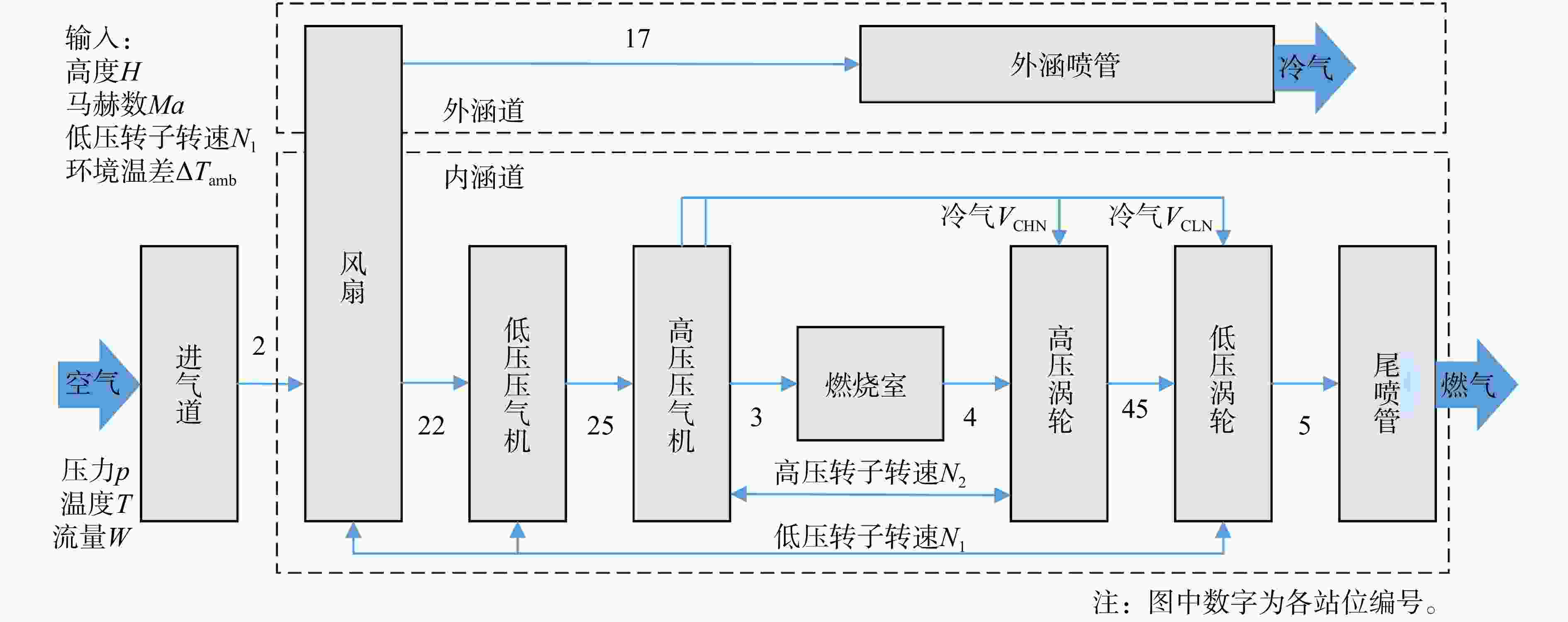
图 7 分排涡扇发动机气路系统结构图
Figure 7. Separate-exhaust turbofan engine gas system structure diagram
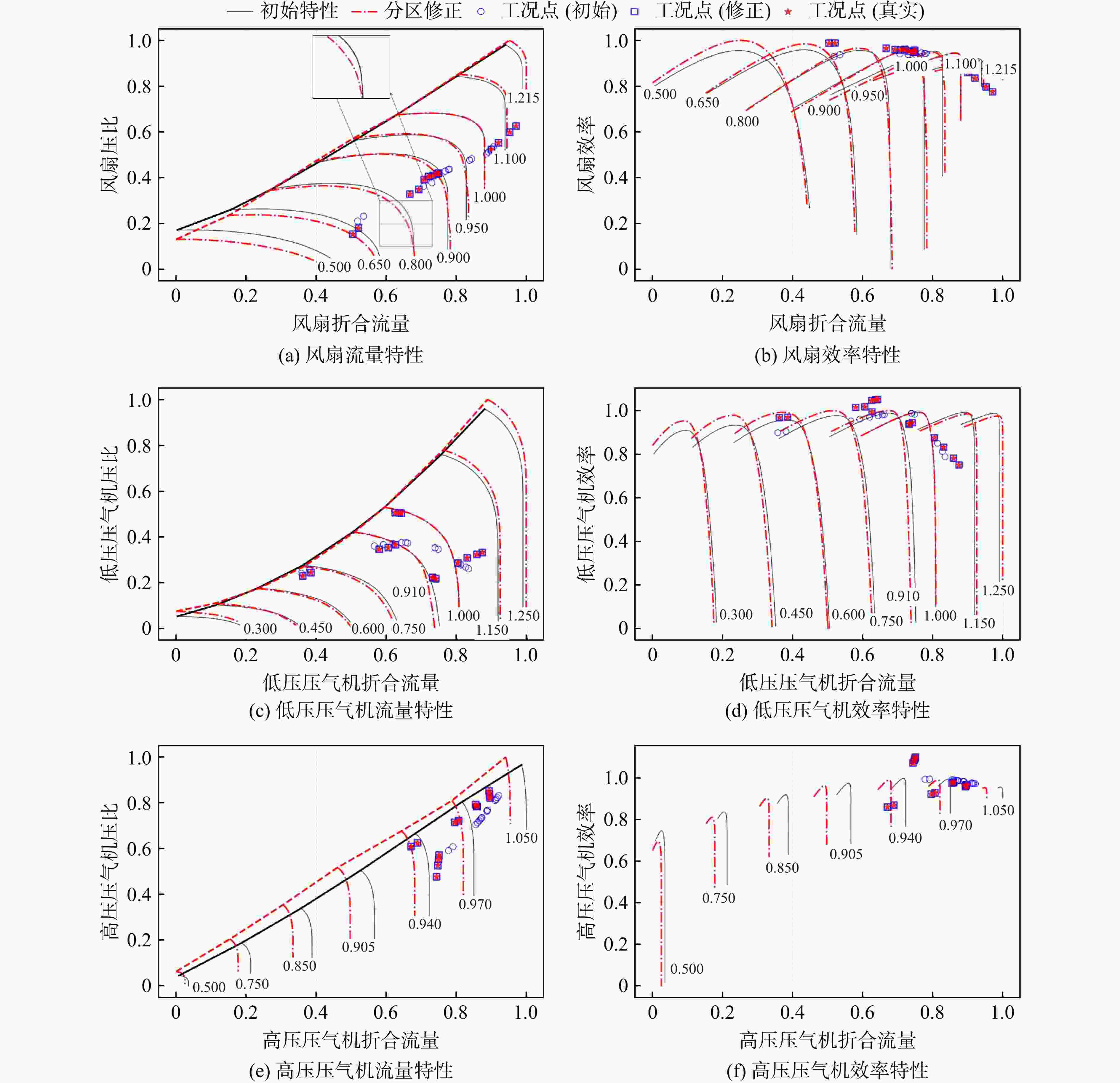
图 14 部件特性图修正前后对比
Figure 14. Comparison of compressor characteristic map before and after correction
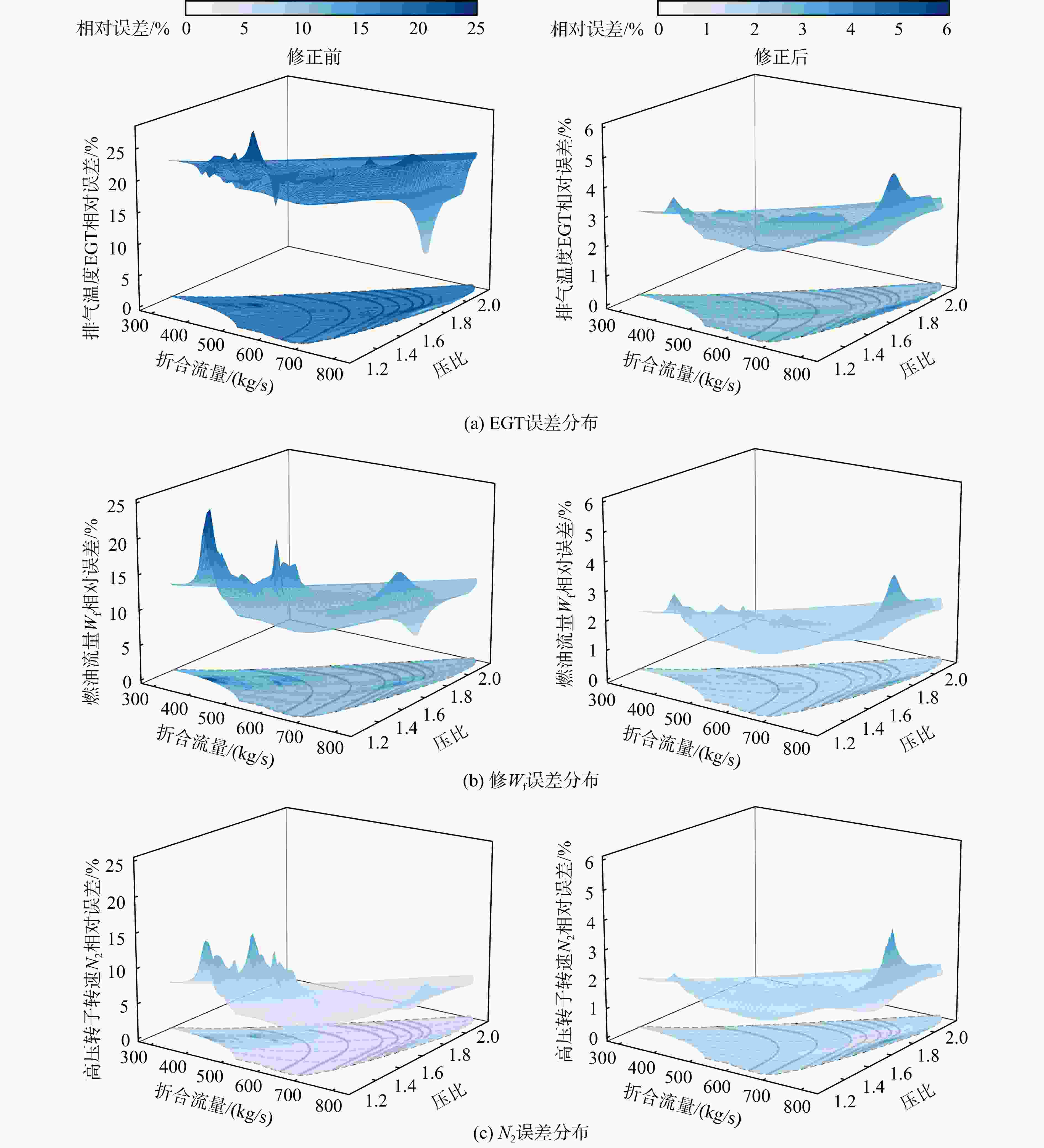
图 15 验证集修正前后误差分布图
Figure 15. Error distributions on the validation set before and after correction
表 1 全域边界
Table 1. Global boundary
部件 系数 W PR η 风扇 u 2.2857 3.43 1.714 u2 1.14 2.286 0.57 v 0.306 0.051 0.102 低压压气机 u 2.28 2.143 1.714 u2 1.53 1.02 0.255 v 0.625 0.3125 0.104 高压压气机 u 0.99 0.48 0.467 u2 0.49 0.25 0.24 v 0.2083 0.05 0.0417  下载: 导出CSV
表 3 设计点参数
Table 3. Design point parameters
参数 数值 高度/m 0 马赫数 0 燃烧室出口温度/K 1639 燃烧室燃烧效率 0.997 高压压气机压比 12 进气道总压恢复系数 0.992 风扇效率 0.89 增压级效率 0.85 涡轮效率 0.88 高压涡轮导向器冷却气比例(VCHN) 0.06 低压涡轮导向器冷却气比例(VCLN) 0.02
下载: 导出CSV
表 4 设计点性能匹配结果
Table 4. Design point performance matching results
参数 目标值 仿真值 误差/% 进口换算流量/(kg/s) 355.17 355.262 0.026 排气温度(EGT)/K 1073 1070 0.270 推力(Fn)/kN 117 117.30 0.250 起飞燃油流量Wf/(kg/s) 1.24 1.243 0.240 低压转子转速N1/(r/min) 5175 5175 0 高压转子转速N2/(r/min) 14460 14460.4 0.10 涵道比(BPR) 5.1 5.107 0.130 油气比(FAR) 0.024 0.02457 0.300 整机压比(p3/p2) 32.8 32.740 0.182
下载: 导出CSV
表 5 试车数据
Table 5. Test rig data
参数 试车工况 1 2 3 4 N1/(r/min) 5191 5148 5010 4909 N2/(r/min) 14599 14565 14457 14387 EGT/K 1117.65 1108.43 1080.40 1059.15 Wf/(kg/s) 1.29 1.26 1.16 1.09 Fn/kN 114.69 113.02 106.31 100.52 p17/kPa 174.62 173.51 169.27 165.44 p25/kPa 241.33 240.28 233.30 225.73 p3/kPa 408.526 407.439 384.172 364.057 p5/kPa 163.29 161.59 155.81 151.53 T25/K 399.35 397.15 392.25 389.65 T3/K 840.05 835.15 821.95 812.25 T5/K 875.15 868.15 848.05 833.05
下载: 导出CSV
表 6 不同优化算法性能对比
Table 6. Performance comparison of different optimization algorithms
对比维度 CABE-hippo PSO GA HBA SAO 收敛速度 最快,10$ \pm $5次迭代 初期快,6次停滞 慢,需30+次迭代 中等,20~30次 较慢 最终适应度值 0.014(全局最优) 0.016(局部最优) 0.019(未完全收敛) 0.015(次优) 0.020(最差) 稳定性(Dstd) 0.0008 0.0025 0.0030 0.0020 0.0056 全局搜索能力 强(后期持续改进) 较弱(早熟收敛) 依赖遗传操作(局部开发弱) 中等(20次后改进放缓) 差(易陷局部极值)
下载: 导出CSV
表 7 CABE-hippo消融试验性能对比
Table 7. Performance comparison of CABE-hlippo in ablation studies
对比维度 CABE-hippo w/o CMA w/o Bandit w/o Cosine 收敛迭代次数(均值) 4 36 21 7 最终适应度值 0.0140 0.0165 0.0201 0.0148 稳定性(Dstd) 0.0008 0.0011 0.0015 0.0024 试车平均误差/% 0.625 0.647 0.758 0.639
下载: 导出CSV
表 8 DBSCAN分区参数
Table 8. DBSCAN partition parameters
参数名称 设置 扰动范围 聚类特征 Nc-Rline 特征归一化方式 Min-Max 归一化 距离度量 欧式距离 邻域半径 0.032 0.029~0.035 核心点最小样本数 10 8~12
下载: 导出CSV
表 9 QAR训练集基准值
Table 9. QAR training set baseline values
工况 N1/% N2/% EGT/% Wf/% p3/% T3/% 区域 1 60.88 84.25 59.18 12.36 25.02 66.67 L1 2 62.87 82.63 56.20 12.85 23.79 67.24 L1 3 81.63 93.13 72.69 29.60 47.54 80.65 L2 4 80.01 92.38 70.92 27.97 45.34 79.66 L2 5 85.38 94.63 76.44 34.32 52.30 82.86 M1 6 84.75 94.25 74.32 33.50 51.43 82.44 M1 7 83.38 93.75 71.61 31.71 49.64 81.64 M1 8 84.75 93.13 73.84 29.11 44.41 81.57 M1 9 86.75 92.88 76.61 25.70 37.49 80.23 M2 10 86.88 93.38 76.89 26.84 39.74 80.43 M2 11 86.75 93.13 77.17 26.35 39.29 80.22 M2 12 87.13 92.38 76.24 26.35 37.54 80.28 M2 13 92.63 96.25 82.20 66.19 85.93 85.42 H1 14 93.38 96.75 82.39 67.98 86.23 85.50 H1 15 96.63 98.63 80.52 52.69 61.26 89.23 H2 16 97.25 99.03 81.17 58.22 65.92 89.42 H2
下载: 导出CSV
表 10 QAR训练集修正误差对比
Table 10. Comparison of QAR training set correction errors
% 方法 N2 EGT Wf p3 T3 $ {E}_{\text{avg}} $ $ {E}_{\text{max}} $ $ {E}_{\text{avg}} $ $ {E}_{\text{max}} $ $ {E}_{\text{avg}} $ $ {E}_{\text{max}} $ $ {E}_{\text{avg}} $ $ {E}_{\text{max}} $ $ {E}_{\text{avg}} $ $ {E}_{\text{max}} $ 1 4.710 6.303 4.210 8.490 7.394 16.457 10.274 21.981 7.518 20.690 2 4.475 5.830 4.180 9.100 6.550 15.176 3.144 12.799 1.282 3.933 3 4.350 8.370 10.900 25.902 10.530 22.130 6.808 24.150 2.077 6.603 4 1.140 3.454 1.290 3.335 2.330 4.530 1.616 3.553 1.078 1.473
下载: 导出CSV
表 11 修正方法综合性能对比分析
Table 11. Comprehensive performance comparative analysis of correction methods
% 方法 M区(重叠域) H区(外推区) 全域性能 Eavg Dstd ERMSE ICEPI Eavg Emax 阈值通过率
(误差阈值小于<5%)鲁棒性(Dstd) 1 6.39 1.28 10.55 9.64 6.83 25.90 65.9 4.77 2 4.93 0.74 7.80 6.97 6.55 15.47 81.2 4.12 3 1.56 0.48 14.88 13.92 10.53 21.98 43.1 7.31 4 1.64 0.25 2.18 2.61 5.70 92.6 1.29
下载: 导出CSV
表 12 目标搜索边界
Table 12. Objective search bounds
部件 系数 W PR $ \eta $ 风扇(FAN) βFAN,0 1.1429 1.7150 0.8570 βFAN,1 0.9143 1.3720 0.5700 βFAN,2 2.2829 4.0010 1.4270 δFAN 0.9804 5.8824 2.9412 低压压气机(LPC) βLPC,0 1.1400 0.8570 1.0715 βLPC,1 0.9120 0.8572 0.6856 βLPC,2 2.670 2.0915 1.1120 δLPC 0.480 0.9600 2.8846 高压压气机(HPC) βHPC,0 1.4402 6.001 7.1942 βHPC,1 0.3960 0.1920 0.1868 βHPC,2 0.9850 0.4900 0.4735 δHPC 0.4950 0.2400 0.2335
下载: 导出CSV
表 13 验证集样本
Table 13. Validation set samples
区域 样本N1
范围/%特性图Nc
分区区间样本Nc
范围样本量 L1 [50.02, 66.75] [0.50, 0.74] [0.60, 0.74] 240 L2 [66.75, 81.83] [0.74, 0.90] [0.74, 0.89] 372 M1 [81.83, 84.20] [0.90, 0.93] [0.91, 0.93] 481 M2 [84.20, 89.75] [0.93, 0.99] [0.93, 0.99] 959 H1 [89.75, 92.60] [0.99, 1.03] [0.99, 1.03] 156 H2 [92.60, 100.25] [1.03, 1.22] [1.03, 1.10] 311
下载: 导出CSV
表 14 验证集误差对比
Table 14. Comparison of validation set error
% 区域 指标 Eavg Emax 修前 修后 修前 修后 L Wf 12.17 3.512 29.94 4.0177 EGT 20.64 4.214 29.92 4.49 N2 7.39 2.76 27.28 3.0167 M Wf 14.10 1.146 23.60 1.61 EGT 23.59 2.046 29.95 2.213 N2 5.57 0.8976 8.465 0.98 H Wf 10.76 3.622 20.95 4.43 EGT 14.2 4.930 29.17 5.24 N2 7.68 4.2490 11.51 6.092
下载: 导出CSV
-
[1] Sun Rongzhuo, Shi Licheng, Yang Xilian, et al. A coupling diagnosis method of sensors faults in gas turbine control system[J]. Energy, 2020, 205: 117999. doi: 10.1016/j.energy.2020.117999 [2] Tahan M, Tsoutsanis E, Muhammad M, et al. Performance-based health monitoring, diagnostics and prognostics for condition-based maintenance of gas turbines: a review[J]. Applied Energy, 2017, 198: 122-144. doi: 10.1016/j.apenergy.2017.04.048 [3] Flack R D. Analysis and matching of gas turbine components[J]. International Journal of Turbo and Jet Engines, 1990, 7(3/4): 217-226. doi: 10.1017/cbo9780511807138.013 [4] Kong C, Ki J, Kang M. A new scaling method for component maps of gas turbine using system identification[J]. Journal of Engineering for Gas Turbines and Power, 2003, 125(4): 979-985. doi: 10.1115/1.1610014 [5] Tsoutsanis E, Li Y G, Pilidis P, et al. Part-load performance of gas turbines: Part I a novel compressor map generation approach suitable for adaptive simulation[C]// Proceedings of ASME Gas Turbine India Conference. New York: ASME, 2013: 733-742. [6] 杨欣毅, 沈伟, 王文, 等. 利用多状态试车数据修正发动机部件特性[J]. 航空动力学报, 2012, 27(8): 1785-1791. Yang Xinyi, Shen Wei, Wang Wen, et al. Aero engine component characteristic map correction using multi state test data[J]. Journal of Aerospace Power, 2012, 27(8): 1785-1791. (in Chinese doi: 10.13224/j.cnki.jasp.2012.08.016Yang Xinyi, Shen Wei, Wang Wen, et al. Aero engine component characteristic map correction using multi state test data[J]. Journal of Aerospace Power, 2012, 27(8): 1785-1791. (in Chinese) doi: 10.13224/j.cnki.jasp.2012.08.016 [7] Stamatis A, Mathioudakis K, Papailiou K D. Adaptive simulation of gas turbine performance[J]. Journal of Engineering for Gas Turbines and Power, 1990, 112(2): 168-175. doi: 10.1115/89-gt-205 [8] Li Y G, Ghafir M F A, Wang L, et al. Nonlinear multiple points gas turbine off-design performance adaptation using a genetic algorithm[J]. Journal of Engineering for Gas Turbines and Power, 2011, 133(7): 071701. doi: 10.1115/1.4002620 [9] Kong C, Ki J. Components map generation of gas turbine engine using genetic algorithms and engine performance deck data[J]. Journal of Engineering for Gas Turbines and Power, 2007, 129(2): 312-317. doi: 10.1115/1.2436561 [10] Jiang Yuxiang, Chen Yuchun. Adaptive simulation of micro-turbojet engine component characteristics[C]//Proceedings of IEEE 10th International Conference on Mechanical and Aerospace Engineering. Piscataway, US: IEEE, 2019: 147-152. [11] Wang Ye, Wang Zepeng, Wang Xizhen, et al. A novel performance adaptation method for aero-engine matching over a wide operating range[J]. Journal of the Global Power and Propulsion Society, 2024, 8: 154-165. doi: 10.33737/jgpps/186055 [12] Li Shaochen, Tang Hailong, Chen Min. A new component maps correction method using variable geometric parameters[J]. Chinese Journal of Aeronautics, 2021, 34(4): 360-374. doi: 10.1016/j.cja.2020.08.021 [13] Li Shiyao, Li Zhenlin, Li Shuying. Improved method for gas-turbine off-design performance adaptation based on field data[J]. Journal of Engineering for Gas Turbines and Power, 2020, 142(4): 041001. doi: 10.1115/1.4044470 [14] 钟文城, 汪勇, 宋劼, 等. 一种面向航空发动机数学模型的新型修正方法[J]. 航空动力学报, 2023, 38(11): 2776-2784. Zhong Wencheng, Wang Yong, Song Jie, et al. A new correction method for aero-engine mathematical model[J]. Journal of Aerospace Power, 2023, 38(11): 2776-2784. (in Chinese doi: 10.13224/j.cnki.jasp.20220114Zhong Wencheng, Wang Yong, Song Jie, et al. A new correction method for aero-engine mathematical model[J]. Journal of Aerospace Power, 2023, 38(11): 2776-2784. (in Chinese) doi: 10.13224/j.cnki.jasp.20220114 [15] 郭庆, 孙正日, 樊俊峰, 等. 面向健康管理的民航发动机气路基准模型建立与验证[J]. 推进技术, 2025, 46(3): 2406058. Guo Qing, Sun Zhengri, Fan Junfeng, et al. Establishment and verification of a civil aircraft engine air path benchmark model for health management[J]. Journal of Propulsion Technology, 2025, 46(3): 2406058. (in ChineseGuo Qing, Sun Zhengri, Fan Junfeng, et al. Establishment and verification of a civil aircraft engine air path benchmark model for health management[J]. Journal of Propulsion Technology, 2025, 46(3): 2406058. (in Chinese) [16] 李明洲, 嵇润民, 黄向华. 基于改进粒子群的航空发动机部件特性修正[J]. 推进技术, 2022, 43(11): 210662. Li Mingzhou, Ji Runmin, Huang Xianghua. Aeroengine component characteristic correction based on improved particle swarm optimization[J]. Journal of Propulsion Technology, 2022, 43(11): 210662. (in Chinese doi: 10.13675/j.cnki.tjjs.210662Li Mingzhou, Ji Runmin, Huang Xianghua. Aeroengine component characteristic correction based on improved particle swarm optimization[J]. Journal of Propulsion Technology, 2022, 43(11): 210662. (in Chinese) doi: 10.13675/j.cnki.tjjs.210662 [17] An Changjiang, Jia Linyuan, Chen Fengping, et al. Study of turbine engine component characterization method[C]//Proceedings of IEEE14th International Conference on Mechanical and Aerospace Engineering. Piscataway, US: IEEE, 2023: 191-195. [18] 王佳雯, 黄向华, 嵇润民. 基于特性数据的燃气涡轮发动机修正方法[J]. 航空发动机, 2024, 50(3): 114-121. Wang Jiawen, Huang Xianghua, Ji Runmin. Correction method of component characteristics for gas turbine based on characteristic data[J]. Aeroengine, 2024, 50(3): 114-121. (in Chinese doi: 10.13477/j.cnki.aeroengine.2024.03.017Wang Jiawen, Huang Xianghua, Ji Runmin. Correction method of component characteristics for gas turbine based on characteristic data[J]. Aeroengine, 2024, 50(3): 114-121. (in Chinese) doi: 10.13477/j.cnki.aeroengine.2024.03.017 [19] 金鹏, 鲁峰, 黄金泉. 涡扇发动机部件特性的滤波自动修正更新方法[J]. 推进技术, 2019, 40(12): 2664-2672. Jin Peng, Lu Feng, Huang Jinquan. Automatic filtering-based modification and updating of component characteristics for turbofan engine[J]. Journal of Propulsion Technology, 2019, 40(12): 2664-2672. (in Chinese doi: 10.13675/j.cnki.tjjs.190083Jin Peng, Lu Feng, Huang Jinquan. Automatic filtering-based modification and updating of component characteristics for turbofan engine[J]. Journal of Propulsion Technology, 2019, 40(12): 2664-2672. (in Chinese) doi: 10.13675/j.cnki.tjjs.190083 [20] 张书博, 郑前钢, 陈铖, 等. 基于分块交叉信赖域法的航空发动机部件级模型精修方法研究[J]. 推进技术, 2025, 46(1): 2312034. Zhang Shubo, Zheng Qiangang, Chen Cheng, et al. Refinement method of aeroengine component level model based on block cross trust region method[J]. Journal of Propulsion Technology, 2025, 46(1): 2312034. (in ChineseZhang Shubo, Zheng Qiangang, Chen Cheng, et al. Refinement method of aeroengine component level model based on block cross trust region method[J]. Journal of Propulsion Technology, 2025, 46(1): 2312034. (in Chinese) [21] 柏兆龙, 刘晓锋. 面向曲面光滑的部件特性修正改进下赶法研究[J/OL]. 航空学报, 2025-11-14. https://link.cnki.net/urlid/11.1929.v.20251113.1057.006 Bai Zhaolong, Liu Xiaofeng. Research on an improved high-to-low method for component characteristics modification towards surface smoothness[J/OL]. Acta Aeronautica et Astronautica Sinica, 2025-11-14. https://link.cnki.net/urlid/11.1929.v.20251113.1057.006. (in ChineseBai Zhaolong, Liu Xiaofeng. Research on an improved high-to-low method for component characteristics modification towards surface smoothness[J/OL]. Acta Aeronautica et Astronautica Sinica, 2025-11-14. https://link.cnki.net/urlid/11.1929.v.20251113.1057.006. (in Chinese) [22] 李春华, 宁顺刚, 杨彩琼, 等. 在翼航空发动机性能数字孪生建模方法[J]. 兵器装备工程学报, 2023, 44(6): 204-212. Li Chunhua, Ning Shungang, Yang Caiqiong, et al. Digital twin modeling method for on-wing aero-engine performance[J]. Journal of Ordnance Equipment Engineering, 2023, 44(6): 204-212. (in Chinese doi: 10.11809/bqzbgcxb2023.06.029Li Chunhua, Ning Shungang, Yang Caiqiong, et al. Digital twin modeling method for on-wing aero-engine performance[J]. Journal of Ordnance Equipment Engineering, 2023, 44(6): 204-212. (in Chinese) doi: 10.11809/bqzbgcxb2023.06.029 [23] Amiri M H, Mehrabi Hashjin N, Montazeri M, et al. Hippopotamus optimization algorithm: a novel nature-inspired optimization algorithm[J]. Scientific Reports, 2024, 14: 5032. doi: 10.1038/s41598-024-54910-3 [24] Hansen N, Ostermeier A. Completely derandomized self-adaptation in evolution strategies[J]. Evolutionary Computation, 2001, 9(2): 159-195. doi: 10.1162/106365601750190398 [25] Meidani K, Mirjalili S, Barati Farimani A. MAB-OS: multi-armed bandits metaheuristic optimizer selection[J]. Applied Soft Computing, 2022, 128: 109452. doi: 10.1016/j.asoc.2022.109452 [26] Draa A, Bouzoubia S, Boukhalfa I. A sinusoidal differential evolution algorithm for numerical optimisation[J]. Applied Soft Computing, 2015, 27: 99-126. doi: 10.1016/j.asoc.2014.11.003 [27] Hashim F A, Houssein E H, Hussain K, et al. Honey Badger Algorithm: New metaheuristic algorithm for solving optimization problems[J]. Mathematics and Computers in Simulation, 2022, 192: 84-110. doi: 10.1016/j.matcom.2021.08.013 -


 点击查看大图

计量
- 文章访问数: 180
- HTML浏览量: 158
- PDF量: 9
- 被引次数: 0