






Flow control technology for diffuser cascades inspired by dragonfly wing corrugation structures
-
摘要:
借鉴蜻蜓翅翼褶皱结构调控气流的仿生设计理念,提出一种沿流向阵列布置的非光滑表面结构,并将其应用于高负荷扩压叶栅。采用经实验验证的数值模拟方法,系统研究了沟槽位置参数与结构参数对叶栅气动性能的影响规律,并从宏观流场特征与近壁流动机理角度揭示其作用机制。结果表明:当沟槽布置于叶片吸力面75% ~100%轴向弦长范围内并采用合理的结构参数组合时,沟槽腔体内可形成稳定的驻留涡结构。该驻留涡通过与主流之间的周期性交换,在近壁区引入受限幅值的小尺度扰动,提高湍流间歇因子而未诱发高能量的大尺度湍动结构;同时,其对回流动量的局部滞留与重新分配作用,使分离区由高能不稳定状态向较为温和的受控湍化状态转变。由此,近尾缘吸力面分离涡结构得到显著削弱,通道堵塞程度降低,吸力面边界层发展状态得到有效改善。基于2倍设计点损失准则,在可用进气角范围内叶栅总压损失最大减小8.66%,且可用进气角右边界向高攻角方向拓展约 0.7°。
Abstract:Inspired by the flow-control capability of corrugated structures on dragonfly wings, a streamwise-arranged non-smooth surface was proposed and applied to a highly loaded diffuser cascade. Using a numerically validated simulation approach, the effects of groove location and structural parameters on the aerodynamic performance of the cascade were systematically investigated, and the underlying mechanisms were elucidated from both macroscopic flow features and near-wall flow physics. The results indicated that when the grooves were arranged within 75%—100% of axial chord length on the suction surface with an appropriate parameter combination, stable trapped vortices were formed inside the groove cavities. Through periodic interaction with the main flow, these trapped vortices introduced small-scale, amplitude-limited disturbances in the near-wall region, leading to an increase in the turbulence intermittency factor without triggering high-energy large-scale turbulent structures. Meanwhile, the local retention and redistribution of reversed-flow momentum promoted a transition of the separated region from a highly unstable, high-energy state to a more moderate and controlled turbulent state. Consequently, the separation vortex near the trailing edge on the suction side was significantly weakened, passage blockage was alleviated, and the development of the suction-side boundary layer was effectively improved. Based on the double design point loss criterion, the total pressure loss was reduced by up to 8.66% within the usable incidence angle range, and the upper boundary of the usable incidence angle was extended by approximately 0.7° toward higher values.
-
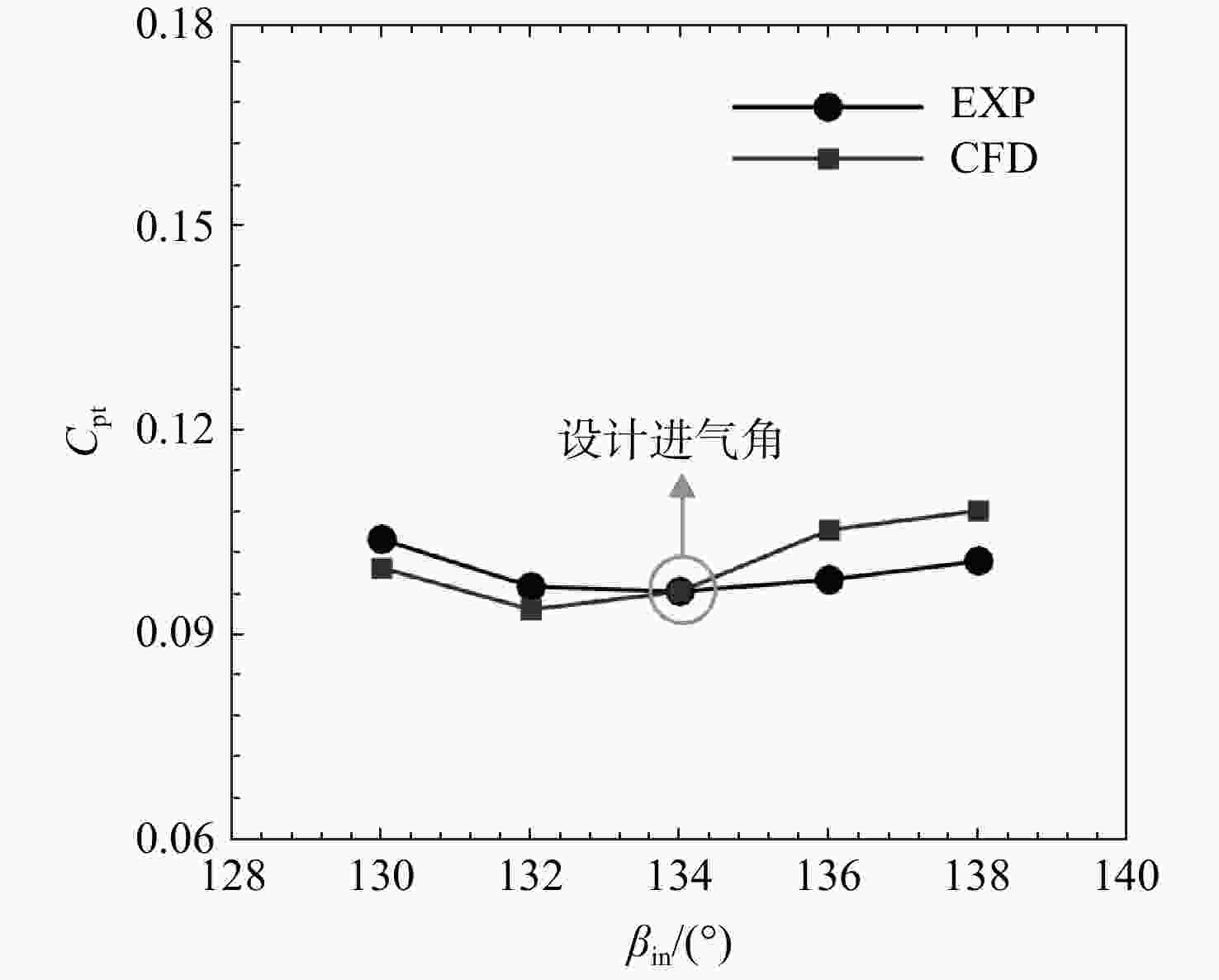
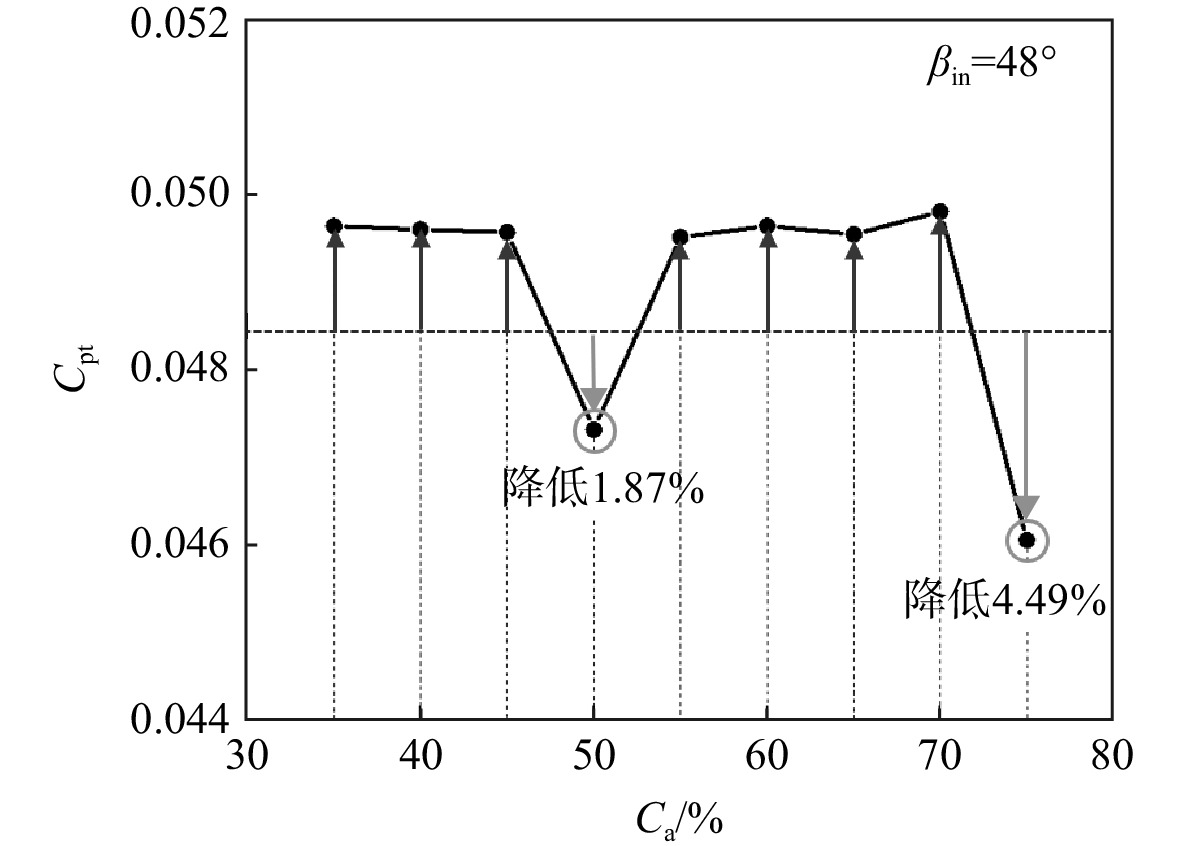
图 12 沟槽流向起始位置对叶栅损失的影响
Figure 12. Effect of groove streamwise starting position on cascade loss
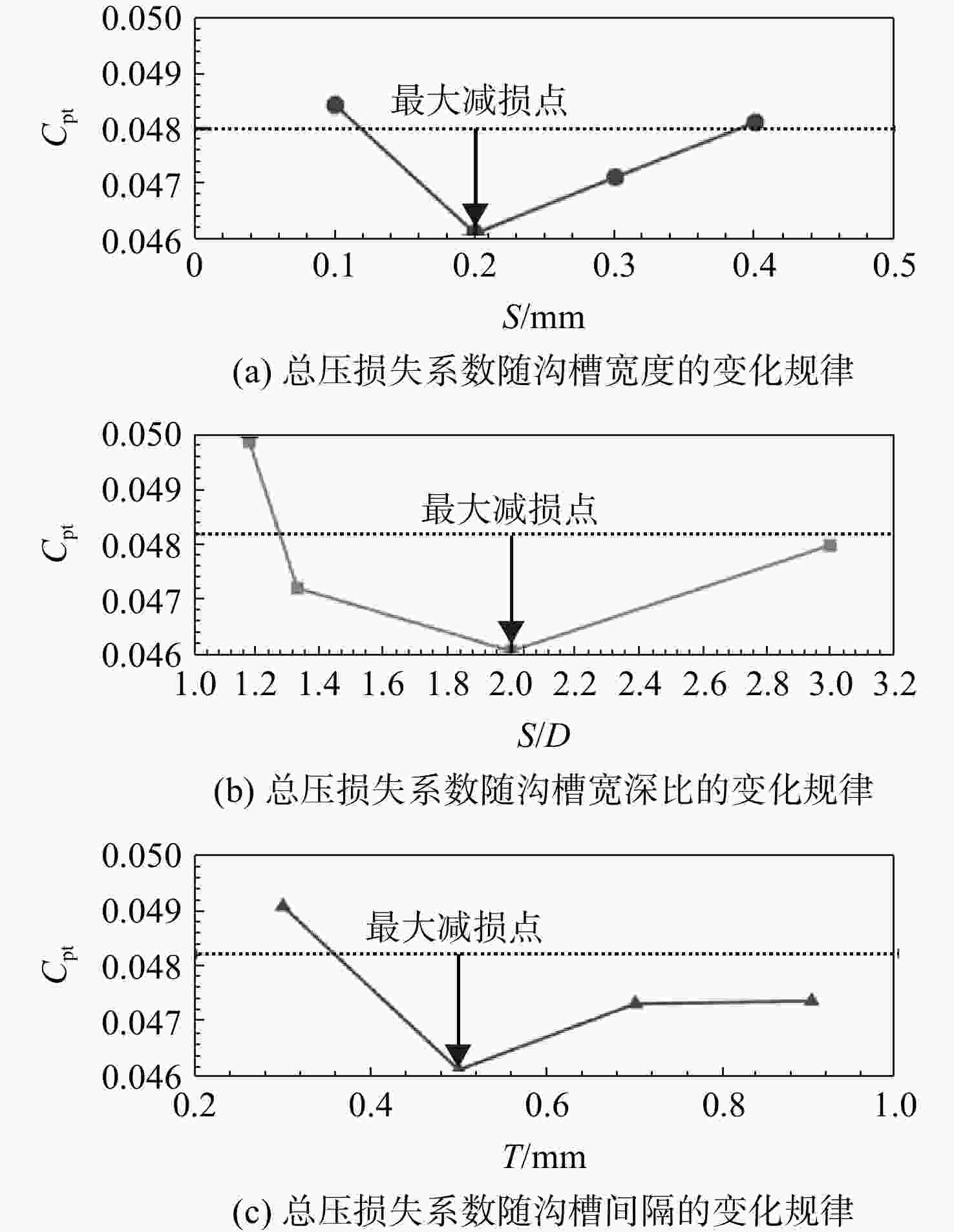
图 13 沟槽结构参数对叶栅损失的影响规律
Figure 13. Influence of groove structure parameters on cascade loss
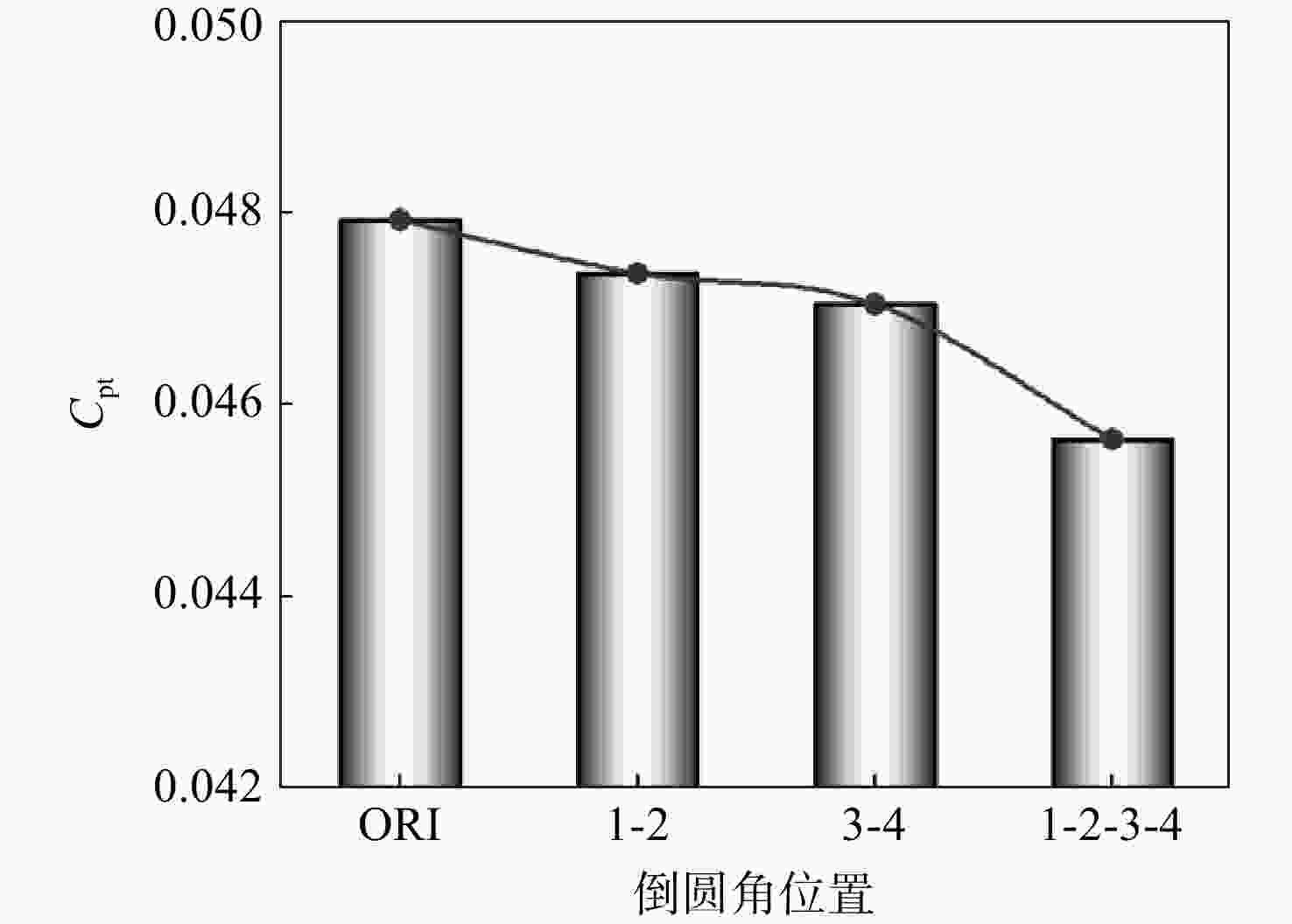
图 14 沟槽倒圆角位置对叶栅性能的影响
Figure 14. Influence of groove fillet position on cascade performance
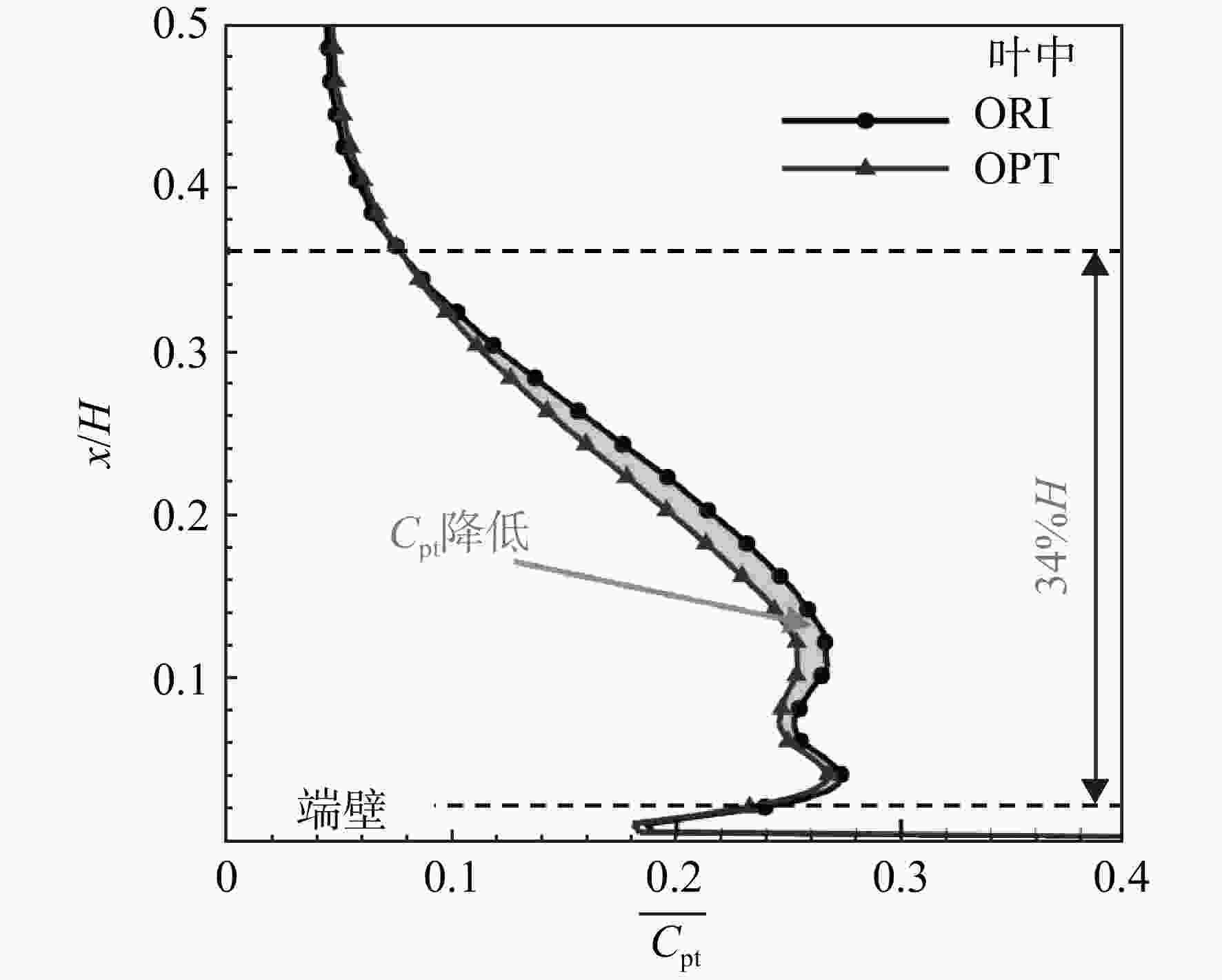
图 17 节距平均总压损失系数的径向分布
Figure 17. Radial distribution of pitch-averaged total pressure loss coefficient
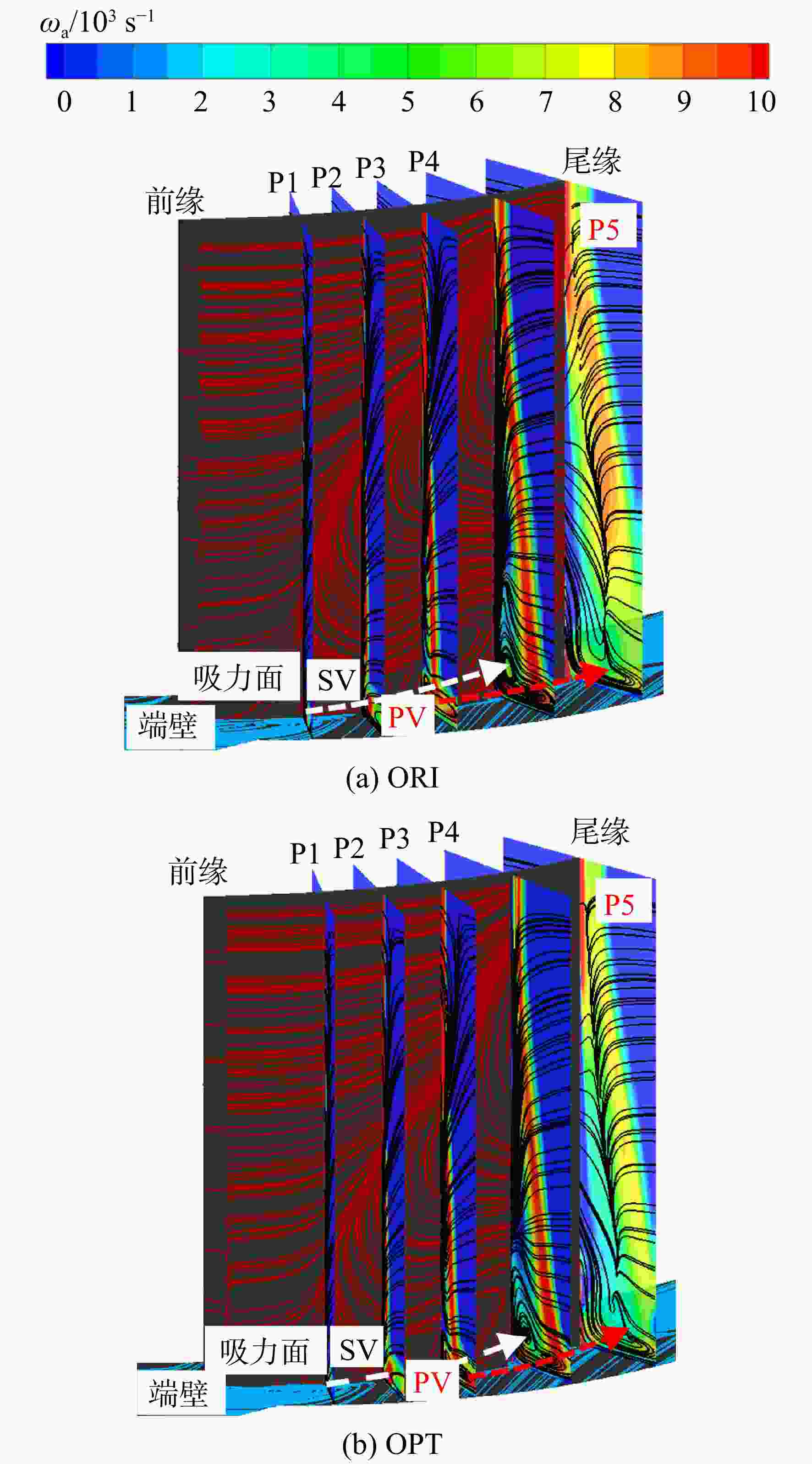
图 18 吸力面、端壁极限流线、通道截面上二维速度流线和轴向涡量云图
Figure 18. Suction surface, endwall limit streamline, and two-dimensional velocity streamline and axial vorticity contour of passage section
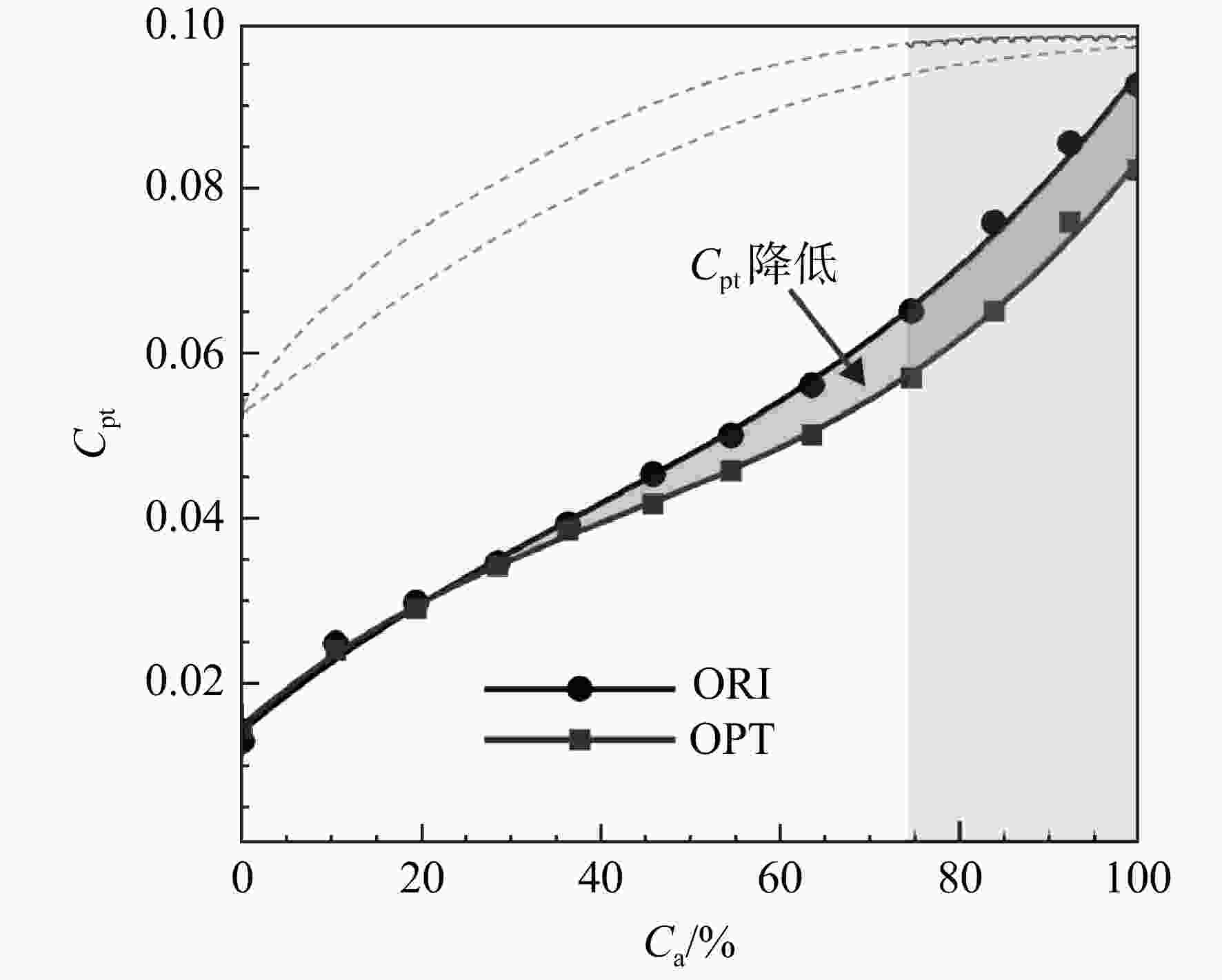
图 19 总压损失系数流向分布规律
Figure 19. Flow distribution curve of total pressure loss coefficient
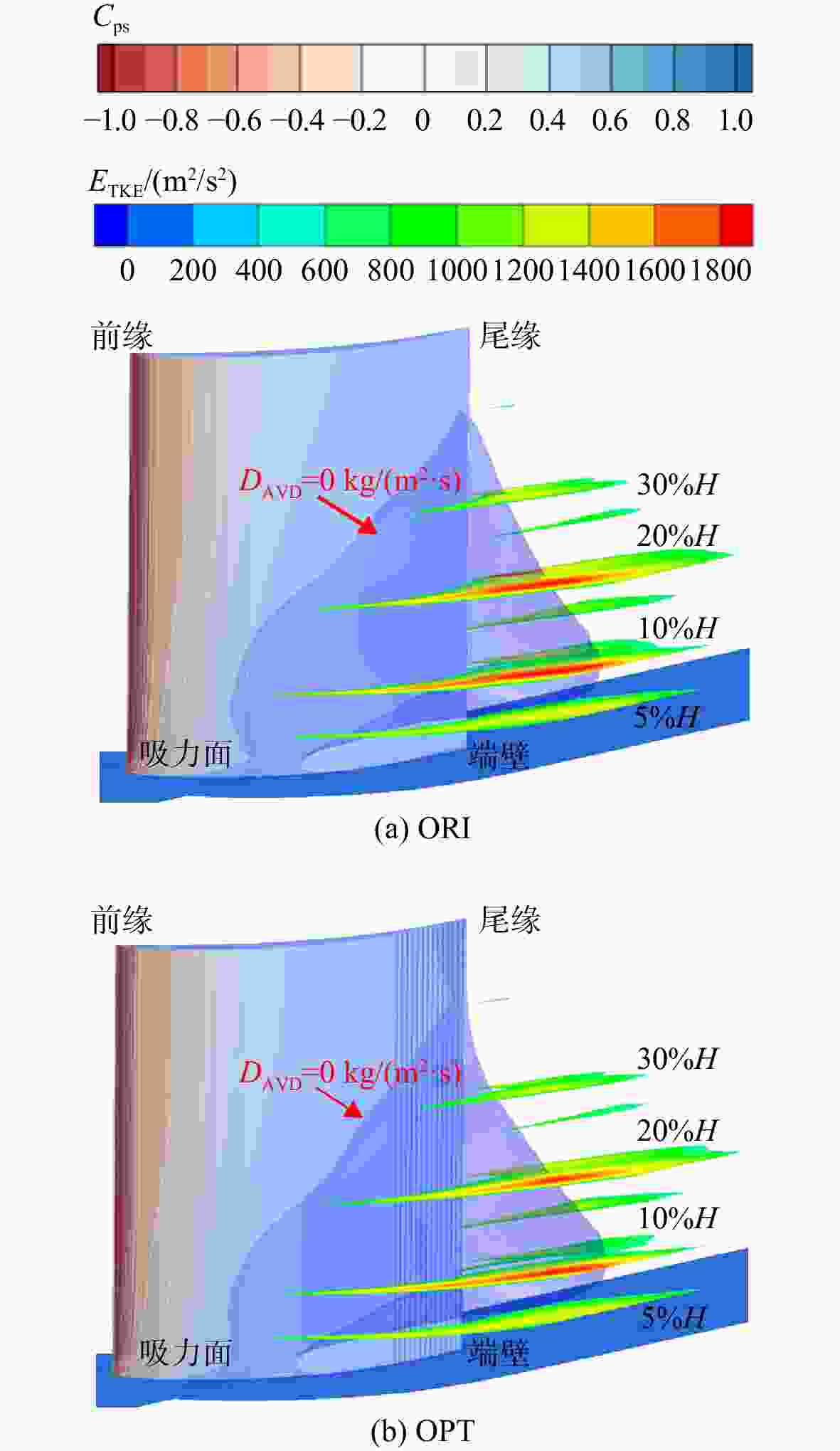
图 20 低能流体团、湍流动能及静压系数分布
Figure 20. Distribution of low-energy fluid regions, turbulent kinetic energy, and static pressure coefficient
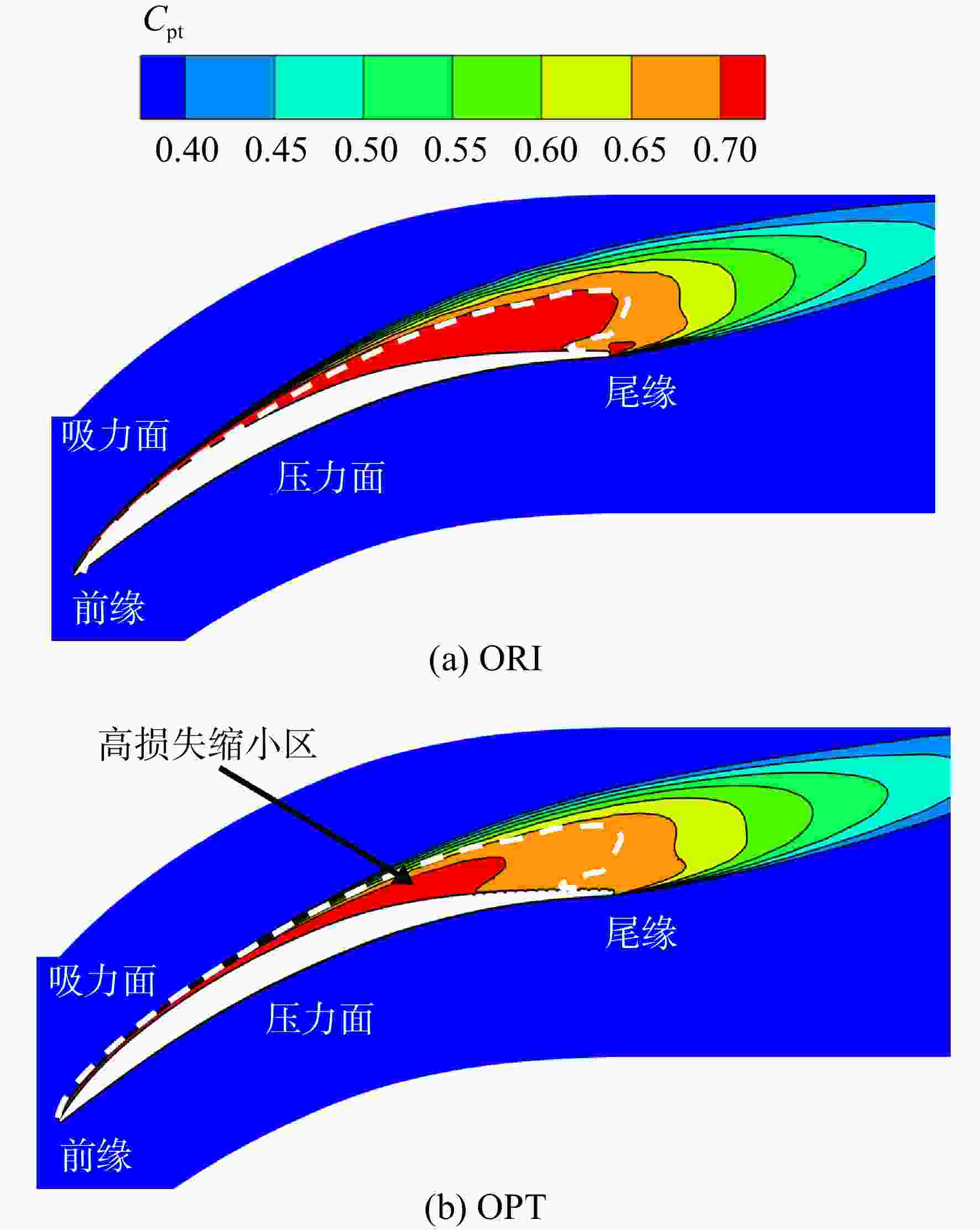
图 21 局部叶高总压损失系数云图
Figure 21. Contour of total pressure loss coefficient at local blade span section
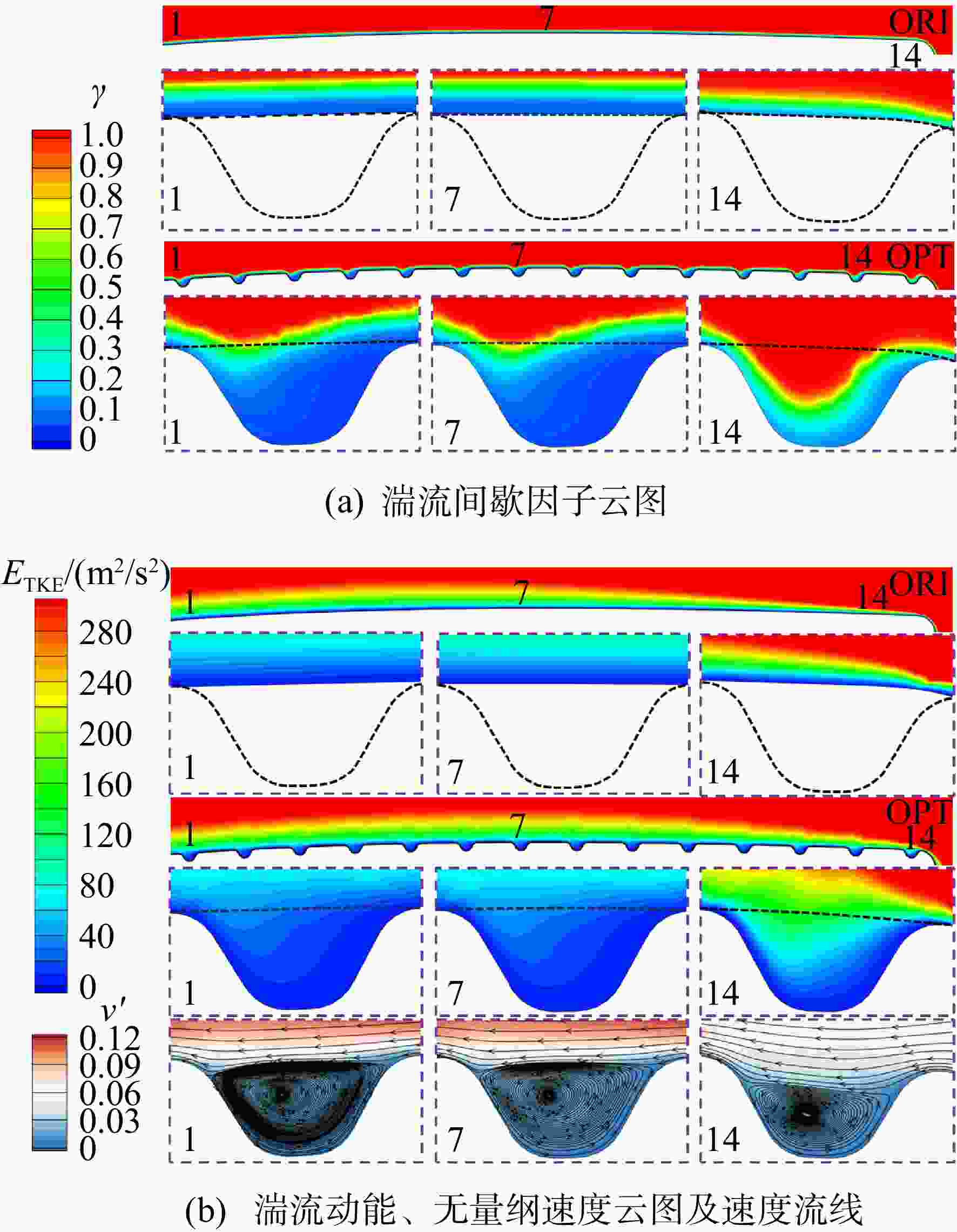
图 24 湍流间歇因子、湍流动能、无量纲速度云图及速度流线
Figure 24. Turbulent intermittent factor, turbulent kinetic energy, dimensionless velocity contour, and velocity streamline
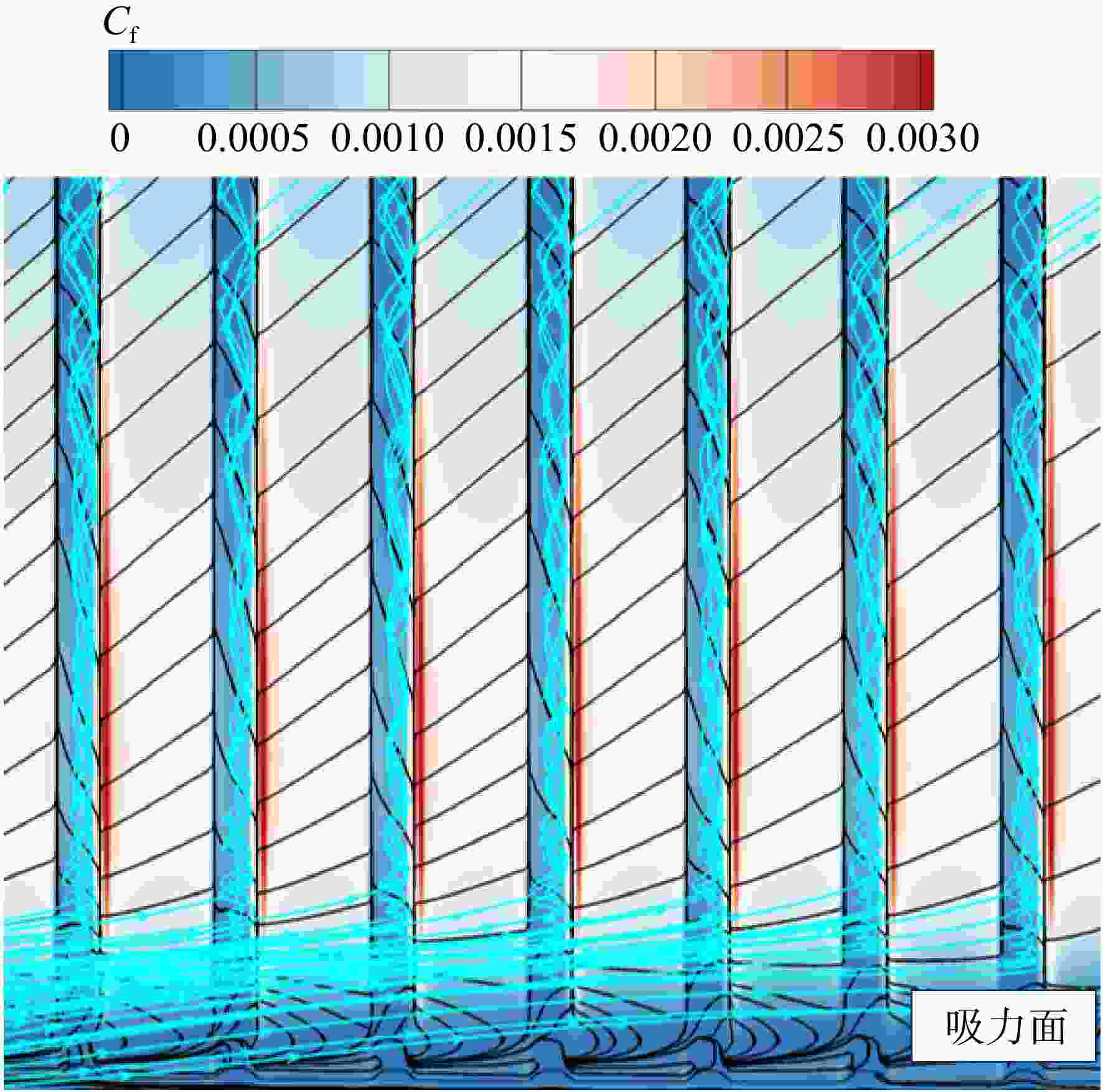
图 27 壁面摩擦因数与沟槽内三维涡结构
Figure 27. Wall friction coefficient and three-dimensional vortex structure inside ribs
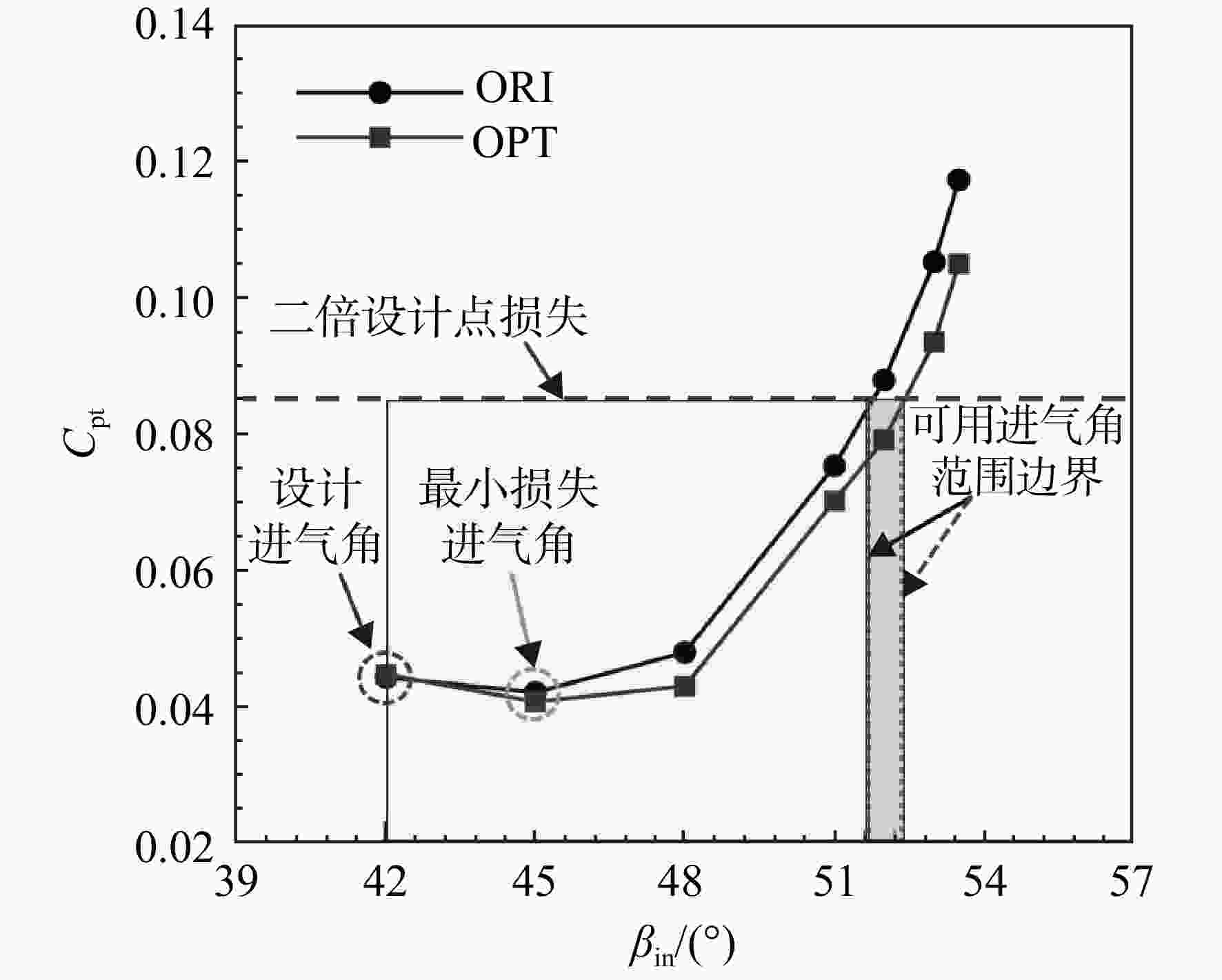
图 28 总压损失系数进气角特性
Figure 28. Total pressure loss coefficient intake angle characteristics
表 1 叶型参数
Table 1. Blade profile parameters
设计参数 数值 弦长 C/mm 40 轴向弦长 Ca/mm 36.95 节距 t/mm 22 进口气流角 βin/(°) 42 出口气流角βout/(°) 90 进口马赫数 Main 0.67 进口雷诺数 Rec 560000  下载: 导出CSV
-
[1] 梁作召, 孙鹏, 李晓东, 等. 端壁自适应射流出口位置对高速扩压叶栅角区分离的影响[J]. 航空动力学报, 2025, 40(3): 20230325. LIANG Zuozhao, SUN Peng, LI Xiaodong, et al. Effects of outlet position on corner separation of high speed compressor cascade with endwall self-adaptive injection[J]. Journal of Aerospace Power, 2025, 40(3): 20230325. (in Chinese doi: 10.13224/j.cnki.jasp.20230325LIANG Zuozhao, SUN Peng, LI Xiaodong, et al. Effects of outlet position on corner separation of high speed compressor cascade with endwall self-adaptive injection[J]. Journal of Aerospace Power, 2025, 40(3): 20230325. (in Chinese) doi: 10.13224/j.cnki.jasp.20230325 [2] WALSH M J. Riblets as a viscous drag reduction technique[J]. AIAA Journal, 1983, 21(4): 485-486. doi: 10.2514/3.60126 [3] WALSH M, LINDEMANN A. Optimization and application of riblets for turbulent drag reduction: AIAA1984-347 [R]. Reno, US: AIAA, 1984. [4] BACHER E, SMITH C. A combined visualization-anemometry study of the turbulent drag reducing mechanisms of triangular micro-groove surface modifications: AIAA1985-548 [R]. Boulder, US: AIAA, 1985. [5] CHOI H, MOIN P, KIM J. Direct numerical simulation of turbulent flow over riblets[J]. Journal of Fluid Mechanics, 1993, 255: 503-539. doi: 10.1017/S0022112093002575 [6] BECHERT D W, BRUSE M, HAGE W, et al. Experiments on drag-reducing surfaces and their optimization with an adjustable geometry[J]. Journal of Fluid Mechanics, 1997, 338: 59-87. doi: 10.1017/s0022112096004673 [7] BOOMSMA A, SOTIROPOULOS F. Direct numerical simulation of sharkskin denticles in turbulent channel flow[J]. Physics of Fluids, 2016, 28(3): 035106. doi: 10.1063/1.4942474 [8] 李育斌, 乔志德, 王志歧. 运七飞机外表面沟纹膜减阻的实验研究[J]. 气动实验与测量控制, 1995(3): 21-26. LI Yubin, QIAO Zhide, WANG Zhiqi. An experimental research of drag reduction using riblets for the Y-7 airplane[J]. Aerodynamic Experiment and Measurement & Control, 1995(3): 21-26. (in ChineseLI Yubin, QIAO Zhide, WANG Zhiqi. An experimental research of drag reduction using riblets for the Y-7 airplane[J]. Aerodynamic Experiment and Measurement & Control, 1995(3): 21-26. (in Chinese) [9] ZHANG Peng, DU Junping, LI Yonghong. Delay of airfoil stall via bio-inspired herringbone groove array[J]. Chinese Journal of Aeronautics, 2025, 38(8): 103527. doi: 10.1016/j.cja.2025.103527 [10] 王春光, 尤军锋, 许桂阳, 等. 环形通道中湍流减阻技术及其机理研究[J]. 导弹与航天运载技术, 2018(6): 30-37. WANG Chunguang, YOU Junfeng, XU Guiyang, et al. Research on turbulent drag reduction and mechanism of annuli[J]. Missiles and Space Vehicles, 2018(6): 30-37. (in Chinese doi: 10.7654/j.issn.1004-7182.20180606WANG Chunguang, YOU Junfeng, XU Guiyang, et al. Research on turbulent drag reduction and mechanism of annuli[J]. Missiles and Space Vehicles, 2018(6): 30-37. (in Chinese) doi: 10.7654/j.issn.1004-7182.20180606 [11] LI Zhihui, DU Juan, ZHANG Hongwu. Physical mechanisms investigation of sharkskin-inspired compressor cascade based on large eddy simulations[J]. Journal of Turbomachinery, 2021, 143(6): 061005. doi: 10.1115/1.4050147 [12] MA Hongwei, WEI Wei. Experimental investigation of effects of distributed riblets on aerodynamic performance of a low-speed compressor[J]. Journal of Thermal Science, 2013, 22(6): 592-599. doi: 10.1007/s11630-013-0667-1 [13] 孙鹏, 孙洁, 傅文广. 基于蜻蜓翅翼仿生结构的流动减阻研究[J]. 航空动力学报, 2025, 40(7): 20230048. SUN Peng, SUN Jie, FU Wenguang. Research on flow drag reduction based on the bionic structure of dragonfly wings[J]. Journal of Aerospace Power, 2025, 40(7): 20230048. (in Chinese doi: 10.13224/j.cnki.jasp.20230048SUN Peng, SUN Jie, FU Wenguang. Research on flow drag reduction based on the bionic structure of dragonfly wings[J]. Journal of Aerospace Power, 2025, 40(7): 20230048. (in Chinese) doi: 10.13224/j.cnki.jasp.20230048 [14] 陈应龙. 蜻蜓翅膀微结构与力学行为的仿生分析研究[D]. 北京: 清华大学, 2012. CHEN Yinglong. BionicResearch on the relation between the multi-scaled structure and mechanical behavior of dragonfly wing[D]. Beijing: Tsinghua University, 2012. (in ChineseCHEN Yinglong. BionicResearch on the relation between the multi-scaled structure and mechanical behavior of dragonfly wing[D]. Beijing: Tsinghua University, 2012. (in Chinese) [15] MA He, GONG Peiyi, TIAN Yuqiang, et al. HiFly-dragon: a dragonfly inspired flapping flying robot with modified, resonant, direct-driven flapping mechanisms[J]. Drones, 2024, 8(4): 126. doi: 10.3390/drones8040126 [16] MASUD M H, FAISAL A K M, ALAM M M, et al. Corrugated airfoils for enhanced low-speed aerodynamics: a bio-inspired review[J]. Physics of Fluids, 2025, 37(8): 085120. doi: 10.1063/5.0278666 [17] WOOTTON R. Functional morphology of insect wings[J]. Annual Review of Entomology, 1992, 37: 113-140. doi: 10.1146/annurev.en.37.010192.000553 [18] BUCKHOLZ R H. The functional role of wing corrugations in living systems[J]. Journal of Fluids Engineering, 1986, 108(1): 93-97. doi: 10.1115/1.3242550 [19] WAKELING J M, ELLINGTON C P. Dragonfly flight: I. gliding flight and steady-state aerodynamic forces[J]. Journal of Experimental Biology, 1997, 200(3): 543-556. doi: 10.1242/jeb.200.3.543 [20] KESEL A B. Aerodynamic characteristics of dragonfly wing sections compared with technical aerofoils[J]. The Journal of Experimental Biology, 2000, 203(20): 3125-3135. doi: 10.1242/jeb.203.20.3125 [21] TAMAI M, WANG Zhijian, RAJAGOPALAN G, et al. Aerodynamic performance of a corrugated dragonfly airfoil compared with smooth airfoils at low Reynolds numbers[C]//Proceedings of the 45th Aerospace Sciences Meeting and Exhibit: Reno, US: AIAA, 2013: 8-11. [22] LIU Huixiang, HE Guoyi, MA Chengyu, et al. A computational study of the aerodynamic performance of a dragonfly forewing in gliding flight[J]. MATEC Web of Conferences, 2018, 151: 03001. doi: 10.1051/matecconf/201815103001 [23] PANNEER S P, JINI R R, PUGHALENDI M. Computational analysis of a corrugated dragonfly airfoil at low Reynolds number[J]. International Journal for Research in Engineering Application & Management, 2021, 6(11): 148-153. doi: 10.61463/ijset.vol.12.issue2.128 [24] 罗云, 何国毅, 王琦, 等. 褶皱结构对蜻蜓后翅的气动特性影响分析[J]. 航空工程进展, 2019, 10(3): 355-362. LUO Yun, HE Guoyi, WANG Qi, et al. Aerodynamic effects of corrugation on dragonfly hindwing[J]. Advances in Aeronautical Science and Engineering, 2019, 10(3): 355-362. (in ChineseLUO Yun, HE Guoyi, WANG Qi, et al. Aerodynamic effects of corrugation on dragonfly hindwing[J]. Advances in Aeronautical Science and Engineering, 2019, 10(3): 355-362. (in Chinese) [25] 徐文峰, 孙鹏, 杨国刚. 机匣仿生顶室对压气机间隙流动影响研究[J]. 工程热物理学报, 2021, 42(9): 2275-2283. XU Wenfeng, SUN Peng, YANG Guogang. Effect of casing with bionic tip chamber on compressor clearance flow[J]. Journal of Engineering Thermophysics, 2021, 42(9): 2275-2283. (in ChineseXU Wenfeng, SUN Peng, YANG Guogang. Effect of casing with bionic tip chamber on compressor clearance flow[J]. Journal of Engineering Thermophysics, 2021, 42(9): 2275-2283. (in Chinese) [26] 徐文峰, 孙鹏, 杨国刚. 仿生翅室对跨声速扩压叶栅角区分离流动影响研究[J]. 推进技术, 2022, 43(5): 200766. XU Wenfeng, SUN Peng, YANG Guogang. Effects of bionic chamber on corner separation flow in a transonic compressor cascade[J]. Journal of Propulsion Technology, 2022, 43(5): 200766. (in ChineseXU Wenfeng, SUN Peng, YANG Guogang. Effects of bionic chamber on corner separation flow in a transonic compressor cascade[J]. Journal of Propulsion Technology, 2022, 43(5): 200766. (in Chinese) [27] XU Wenfeng, SUN Peng, YANG Guogang. Effect of the bionic chamber position on the aerodynamic performance in a transonic compressor cascade[J]. Aerospace Science and Technology, 2021, 119: 107106. doi: 10.1016/j.ast.2021.107106 [28] VARGAS A, MITTAL R, DONG Haibo. A computational study of the aerodynamic performance of a dragonfly wing section in gliding flight[J]. Bioinspiration & Biomimetics, 2008, 3(2): 026004. doi: 10.1088/1748-3182/3/2/026004 [29] CELIK I B, GHIA U, ROACHE P J, et al. Procedure for estimation and reporting of uncertainty due to discretization in CFD applications[J]. Journal of Fluids Engineering, 2008, 130(7): 078001. doi: 10.1115/1.2960953 [30] CHEN Pingping, QIAO Weiyang, LIESNER K, et al. Location effect of boundary layer suction on compressor hub-corner separation: ASME Paper GT2014-25043[R] Düsseldorf, Germany: ASME, 2014. [31] HERGT A, MEYER R, LIESNER K, et al. A new approach for compressor endwall contouring[C] Proceedings of ASME Turbo Expo: Turbine Technical Conference and Exposition. Vancouver, Canada: ASME, 2011: 177-186. [32] HAGE W, MEYER R, PASCHEREIT C. Control of secondary flow in a high loaded compressor stage by means of a groove structure on the sidewalls: AIAA2007-4278[R]. Miami, US: AIAA, 2007. [33] KÖLLER U, MÖNIG R, KÜSTERS B, et al. Development of advanced compressor airfoils for heavy-duty gas turbines: part I design and optimization[J]. Journal of Turbomachinery, 2000, 122(3): 397-405. doi: 10.1115/1.1302296 -


 点击查看大图

计量
- 文章访问数: 262
- HTML浏览量: 178
- PDF量: 11
- 被引次数: 0