






Study on the lower limit of oxygen concentration at inlets and performance analysis of rotating detonation afterburner
-
摘要:
实现低含氧量进气条件下旋转爆震的稳定自持是旋转爆震加力燃烧室设计的关键。通过乙烯/空气非预混旋转爆震流场二维数值模拟,研究贫燃条件下进气温度对旋转爆震起爆临界进气含氧量下限的影响。结果表明,随着加力燃烧室进气温度从875 K增至
1025 K,旋转爆震稳定传播进气氧气质量分数下限从15%变为14%。在进气含氧量降至接近起爆临界下限时,进气温度升高对燃烧室流场平均释热率影响较小,但高温进气可通过增强流场中的缓燃,实现爆震波在速度亏损超过8%下的自持传播,从而拓宽稳定起爆的边界。此外,进气温度升高还会诱导流场出现复杂多波模态,而进气含氧量降低则促使旋转爆震趋于单波模态传播。进一步分析表明,旋转爆震多波模态显著影响加力燃烧室总压损失和比推力,混合模态则主导燃烧室温升比和燃烧效率变化。进气温度升高会使旋转爆震加力燃烧室各项性能参数降低,但在适当的进气温度和含氧量下,旋转爆震加力燃烧可使燃烧室总压损失减小。Abstract:Achieving stable and self-sustained rotating detonation under low-oxygen intake conditions is crucial for the design of rotating detonation afterburners. Through two-dimensional numerical simulations of non-premixed ethylene/air rotating detonation flow fields, this study investigated the influence of intake temperature on the critical lower limit of oxygen concentration required for rotating detonation initiation under fuel-lean conditions. The results showed that as the intake temperature of the afterburner increased from 875 K to
1025 K, the lower limit of oxygen mass fraction for stable propagation of the rotating detonation shifted from 15% to 14%. When the oxygen concentration approached the critical lower limit for initiation, increasing the intake temperature had a minor effect on the average heat release rate in the combustor flow field. However, higher intake temperatures can enhanced deflagration within the flow field, enabling self-sustained propagation of the detonation wave even when the velocity deficit exceeded 8%, thereby broadening the stable initiation boundary. Furthermore, increased intake temperature induced the emergence of complex multi-wave modes in the flow field, while reduced oxygen concentration tended to drive the rotating detonation toward propagation in a single-wave mode. Further analysis indicated that multi-wave modes significantly affected the total pressure loss and specific thrust of the afterburner, while mixed modes dominated variations in the temperature rise ratio and combustion efficiency. Increasing the intake temperature generally degrades the performance parameters of the rotating detonation afterburner; nevertheless, under appropriate intake temperature and oxygen concentration conditions, rotating detonation after burning can achieve lower total pressure loss. -
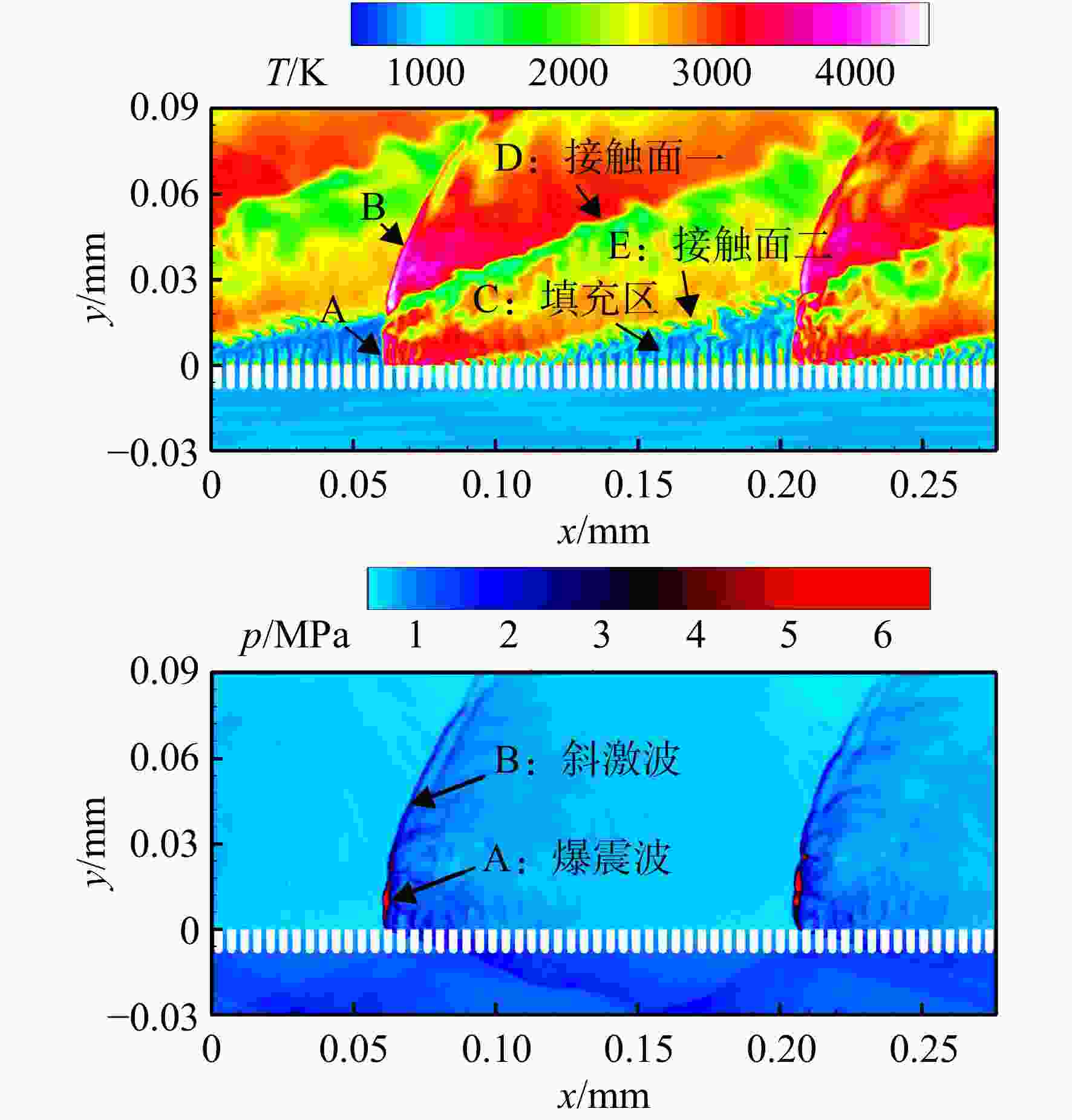
图 3 典型爆震流场温度压力云图
Figure 3. Temperature and pressure contour of detonation in typical flow field
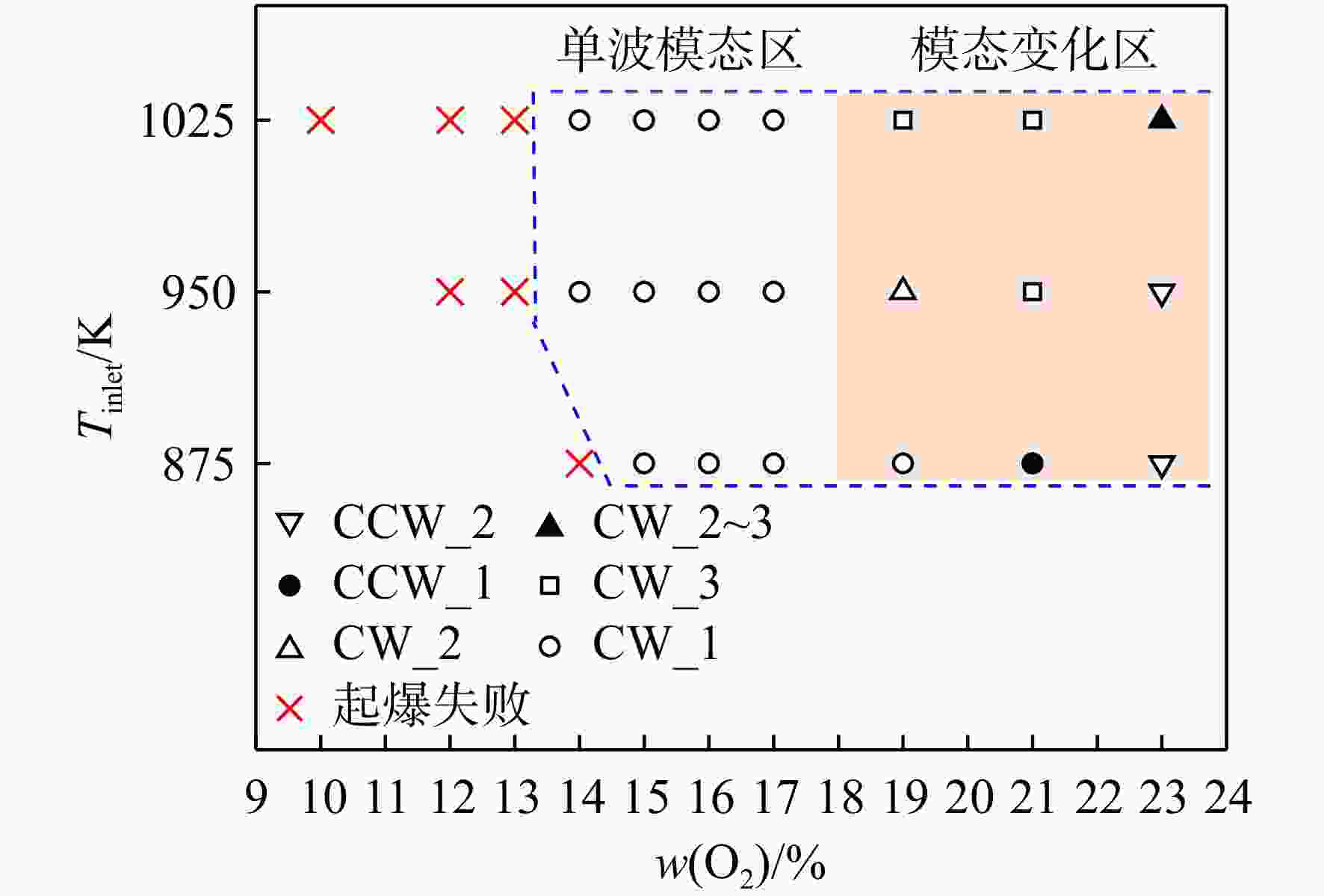
图 4 稳定起爆进气含氧量下限阈值
Figure 4. Lower limit of oxygen concentration in the air for stable detonation initiation
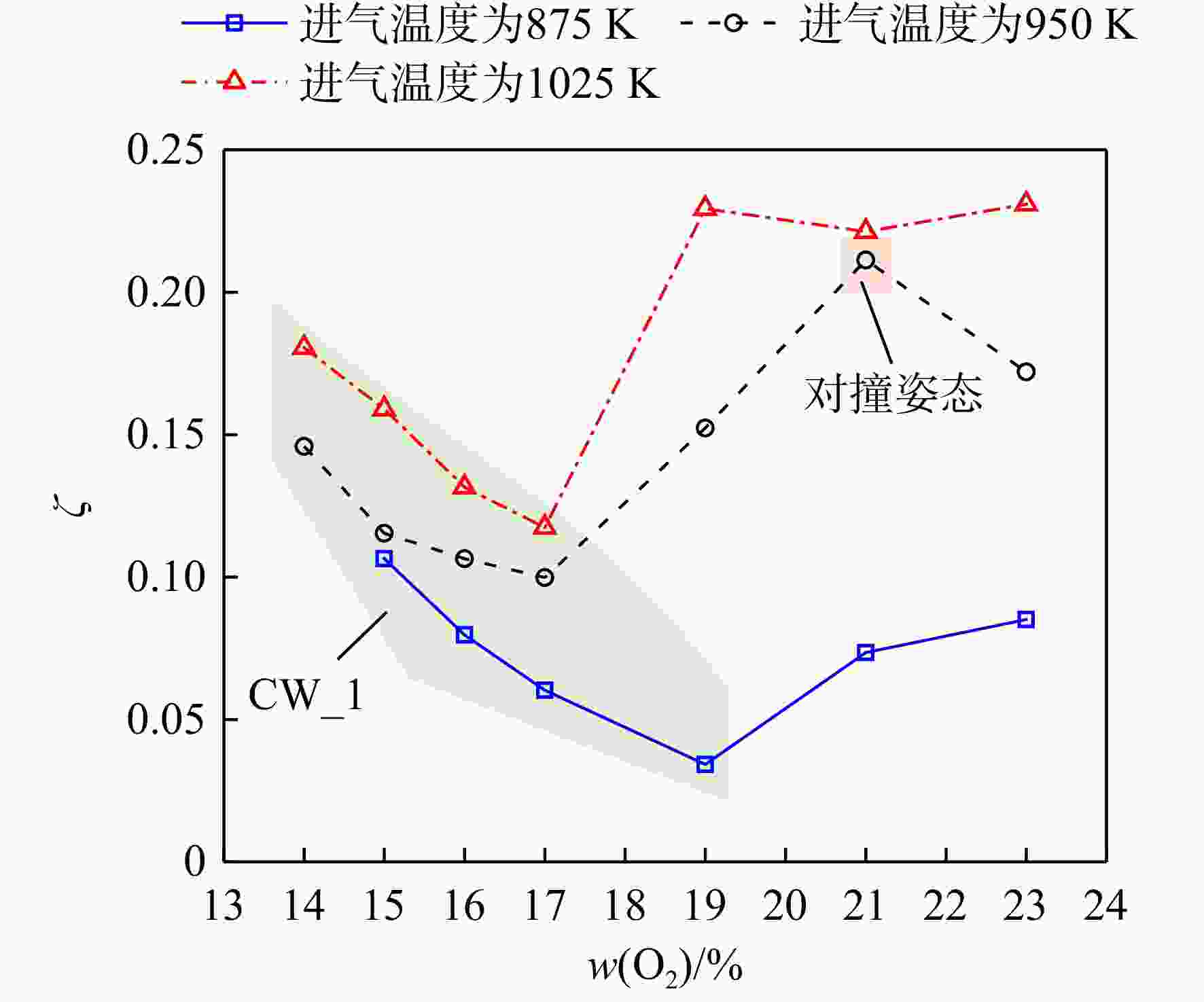
图 12 不同进气温度和含氧量下的总压损失
Figure 12. Pressure loss ratio under different inflow temperatures and oxygen volume fractions
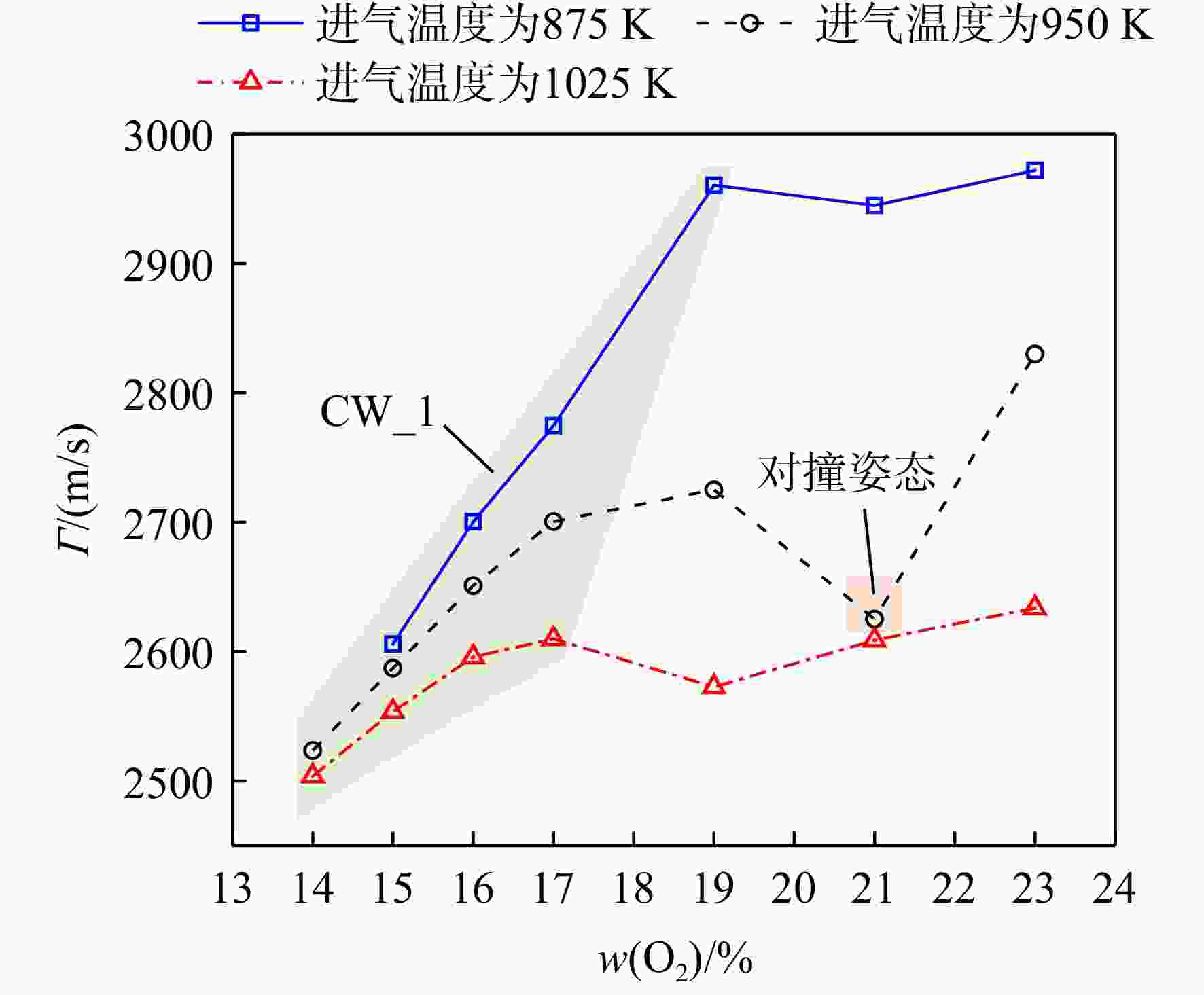
图 13 不同进气温度和含氧量下的比推力
Figure 13. Specific thrust under different inflow temperatures and oxygen volume fractions
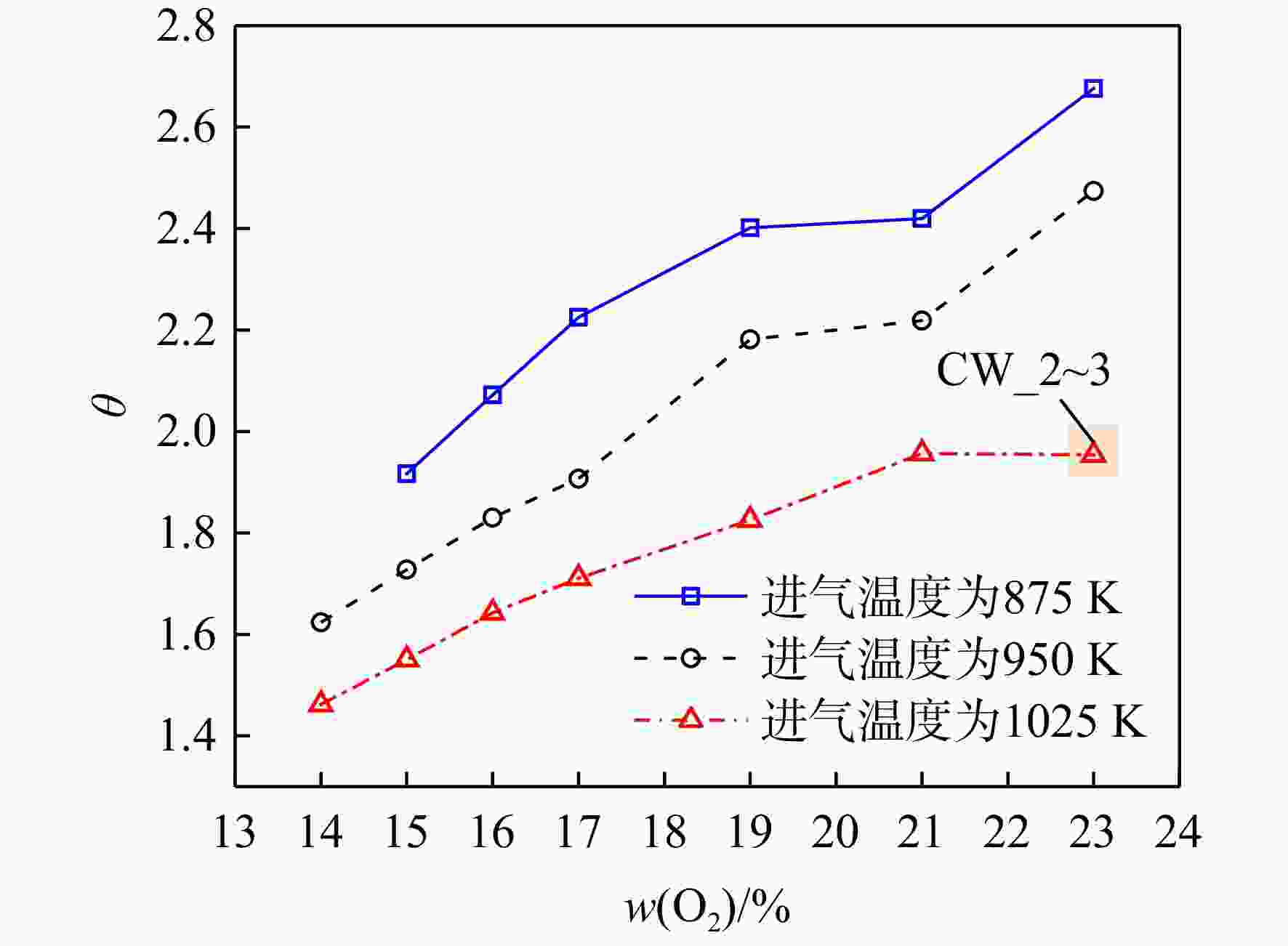
图 14 不同进气温度和含氧量下的温升比
Figure 14. Temperature-rise ratio under different inflow temperatures and oxygen volume fractions
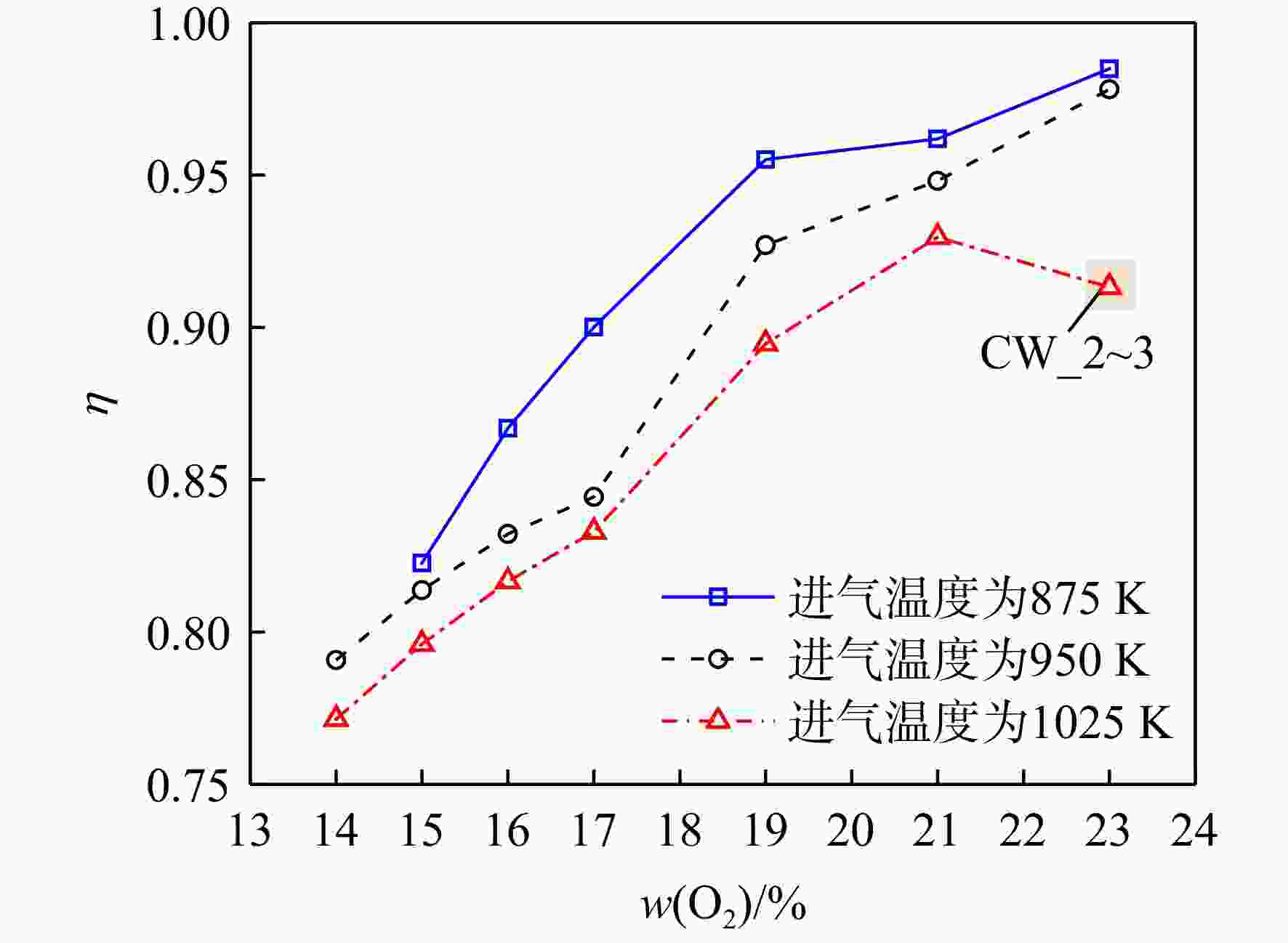
图 15 不同温度和含氧量下的燃烧效率
Figure 15. Combustion efficiency under different inflow temperatures and oxygen volume fractions
表 1 计算条件
Table 1. Calculated operating conditions
参数 变化范围 变化量 ER 0.8 $ T_{\text {inlet}} $/K 875~ 1025 75 w(O2)inlet/% 23~17、17~10 2、1  下载: 导出CSV
-
[1] RAMAN V, PRAKASH S, GAMBA M. Nonidealities in rotating detonation engines[J]. Annual Review of Fluid Mechanics, 2023, 55: 639-674. doi: 10.1146/annurev-fluid-120720-032612 [2] ABDULRAHMAN G A Q, QASEM N A A, IMTEYAZ B, et al. A review of aircraft subsonic and supersonic combustors[J]. Aerospace Science and Technology, 2023, 132: 108067. doi: 10.1016/j.ast.2022.108067 [3] MA J Z, LUAN Mingyi, XIA Zhijie, et al. Recent progress, development trends, and consideration of continuous detonation engines[J]. AIAA Journal, 2020, 58(12): 4976-5035. [4] 孙志鹏, 黄玥, 栾振业, 等. 高温高压进口下甲烷/氧气旋转爆震燃烧室增压特性与流场分析[J]. 推进技术, 2022, 43(11): 281-290. SUN Zhipeng, HUANG Yue, LUAN Zhenye, et al. Pressurization characteristics and flow field analysis of methane/oxygen rotating detonation combustor at high temperature and high pressure inlets[J]. Journal of Propulsion Technology, 2022, 43(11): 281-290. (in Chinese doi: 10.13675/j.cnki.tjjs.210751SUN Zhipeng, HUANG Yue, LUAN Zhenye, et al. Pressurization characteristics and flow field analysis of methane/oxygen rotating detonation combustor at high temperature and high pressure inlets[J]. Journal of Propulsion Technology, 2022, 43(11): 281-290. (in Chinese) doi: 10.13675/j.cnki.tjjs.210751 [5] FROLOV S M, IVANOV V S, SHAMSHIN I O, et al. A detonation afterburner[J]. Doklady Physics, 2020, 65(1): 36-39. doi: 10.1134/S1028335820010061 [6] 吴伟. 旋转爆震加力燃烧室性能分析与模型研究[D]. 南京: 南京航空航天大学, 2022. WU Wei. Performance analysis and model study of rotating detonation afterburner[D]. Nanjing: Nanjing University of Aeronautics and Astronautics, 2022. (in ChineseWU Wei. Performance analysis and model study of rotating detonation afterburner[D]. Nanjing: Nanjing University of Aeronautics and Astronautics, 2022. (in Chinese) [7] 邱华, 陈延波, 熊姹, 等. 带连续爆震加力燃烧室的涡轮发动机循环及推进性能研究[J]. 推进技术, 2022, 43(7): 304-312. QIU Hua, CHEN Yanbo, XIONG Cha, et al. Thermal cycle and propulsive performance of turbine engine with continuous detonation afterburner[J]. Journal of Propulsion Technology, 2022, 43(7): 304-312. (in Chinese doi: 10.13675/j.cnki.tjjs.210079QIU Hua, CHEN Yanbo, XIONG Cha, et al. Thermal cycle and propulsive performance of turbine engine with continuous detonation afterburner[J]. Journal of Propulsion Technology, 2022, 43(7): 304-312. (in Chinese) doi: 10.13675/j.cnki.tjjs.210079 [8] ZHAO Majie, ZHANG Huangwei. Rotating detonative combustion in partially pre-vaporized dilute n-heptane sprays: droplet size and equivalence ratio effects[J]. Fuel, 2021, 304: 121481. doi: 10.1016/j.fuel.2021.121481 [9] ZHENG Quan, MENG Haolong, WENG Chunsheng, et al. Experimental research on the instability propagation characteristics of liquid kerosene rotating detonation wave[J]. Defence Technology, 2020, 16(6): 1106-1115. doi: 10.1016/j.dt.2020.06.028 [10] 王可, 于潇栋, 张禛瑞, 等. 液体碳氢燃料旋转爆震燃烧研究进展[J]. 航空兵器, 2025, 32(1): 1-13. WANG Ke, YU Xiaodong, ZHANG Zhenrui, et al. Research progress on rotating detonations of liquid hydrocarbon fuels[J]. Aero Weaponry, 2025, 32(1): 1-13. (in Chinese doi: 10.12132/ISSN.1673-5048.2025.0026WANG Ke, YU Xiaodong, ZHANG Zhenrui, et al. Research progress on rotating detonations of liquid hydrocarbon fuels[J]. Aero Weaponry, 2025, 32(1): 1-13. (in Chinese) doi: 10.12132/ISSN.1673-5048.2025.0026 [11] ZHAO Minghao, WANG Ke, ZHU Yiyuan, et al. Effects of the exit convergent ratio on the propagation behavior of rotating detonations utilizing liquid kerosene[J]. Acta Astronautica, 2022, 193: 35-43. doi: 10.1016/j.actaastro.2021.12.052 [12] MENG Haolong, ZHENG Quan, WENG Chunsheng, et al. Propagation mode analysis of rotating detonation waves fueled by liquid kerosene[J]. Acta Astronautica, 2021, 187: 248-258. doi: 10.1016/j.actaastro.2021.06.043 [13] WANG Fang, WENG Chunsheng, WU Yuwen, et al. Numerical research on kerosene/air rotating detonation engines under different injection total temperatures[J]. Aerospace Science and Technology, 2020, 103: 105899. doi: 10.1016/j.ast.2020.105899 [14] 宋安家, 黄玥, 彭瀚, 等. 空气进气温度对空桶型燃烧室旋转爆震起爆及传播特性影响实验研究[J]. 推进技术, 2025, 46(9): 171-181. SONG Anjia, HUANG Yue, PENG Han, et al. Experimental research on effects of inlet air temperature on rotating detonation initiation and propagation characteristics in hollow combustor[J]. Journal of Propulsion Technology, 2025, 46(9): 171-181. (in Chinese doi: 10.3724/1001-4055.202409011SONG Anjia, HUANG Yue, PENG Han, et al. Experimental research on effects of inlet air temperature on rotating detonation initiation and propagation characteristics in hollow combustor[J]. Journal of Propulsion Technology, 2025, 46(9): 171-181. (in Chinese) doi: 10.3724/1001-4055.202409011 [15] 谭峻然, 宫继双, 张义宁, 等. 来流温度对凹腔结构燃烧室旋转爆震燃烧影响实验研究[J]. 推进技术, 2025, 46(5): 134-143. TAN Junran, GONG Jishuang, ZHANG Yining, et al. Experimental study on effects of inflow temperature on rotating detonation combustion in a cavity combustor[J]. Journal of Propulsion Technology, 2025, 46(5): 134-143. (in Chinese doi: 10.3724/1001-4055.2407030TAN Junran, GONG Jishuang, ZHANG Yining, et al. Experimental study on effects of inflow temperature on rotating detonation combustion in a cavity combustor[J]. Journal of Propulsion Technology, 2025, 46(5): 134-143. (in Chinese) doi: 10.3724/1001-4055.2407030 [16] ZHOU Jianping, SONG Feilong, WU Yun, et al. Investigation on propagation characteristics and performances of RDE fueled by kerosene under low oxygen mass fraction[J]. Fuel, 2023, 336: 127117. doi: 10.1016/j.fuel.2022.127117 [17] QIU Hua, WANG Xiao, LI Yinggang, et al. Numerical investigation on the working characteristics of continuous detonation afterburner combined with turbine[J]. Applied Thermal Engineering, 2024, 247: 123119. doi: 10.1016/j.applthermaleng.2024.123119 [18] St GEORGE A, DRISCOLL R, ANAND V, et al. Chemical kinetic analysis of detonability-enhancing strategies for ethylene-oxidizer mixtures[J]. Acta Astronautica, 2016, 128: 194-202. doi: 10.1016/j.actaastro.2016.07.015 [19] 刘卫东, 彭皓阳, 刘世杰, 等. 旋转爆震燃烧及应用研究进展[J]. 航空学报, 2023, 44(15): 89-118. LIU Weidong, PENG Haoyang, LIU Shijie, et al. Research Progresses of rotating detonation combustion and its application[J]. Acta Aeronautica et Astronautica Sinica, 2023, 44(15): 89-118. (in Chinese doi: 10.7527/S1000-6893.2023.28875LIU Weidong, PENG Haoyang, LIU Shijie, et al. Research Progresses of rotating detonation combustion and its application[J]. Acta Aeronautica et Astronautica Sinica, 2023, 44(15): 89-118. (in Chinese) doi: 10.7527/S1000-6893.2023.28875 [20] MA Fuhua, CHOI J Y, YANG V. Propulsive performance of airbreathing pulse detonation engines[J]. Journal of Propulsion and Power, 2006, 22(6): 1188-1203. doi: 10.2514/1.21755 [21] 孟庆洋. 非预混旋转爆轰波形成条件与传播特性数值研究[D]. 哈尔滨: 哈尔滨工程大学, 2021. MENG Qingyang. Numerical investigation of formation condition and propagation characteristics for non-premixed rotating detonation wave[D]. Harbin: Harbin Engineering University, 2021. (in ChineseMENG Qingyang. Numerical investigation of formation condition and propagation characteristics for non-premixed rotating detonation wave[D]. Harbin: Harbin Engineering University, 2021. (in Chinese) [22] 戴勇强. 氢气/空气非预混喷注及旋转爆轰燃烧数值模拟研究[D]. 哈尔滨: 哈尔滨工程大学, 2021. DAI Yongqiang. Numerical study of hydrogen/air injection and rotating detonation combustion under non-premixed condition[D]. Harbin: Harbin Engineering University, 2021. (in ChineseDAI Yongqiang. Numerical study of hydrogen/air injection and rotating detonation combustion under non-premixed condition[D]. Harbin: Harbin Engineering University, 2021. (in Chinese) [23] JIAO Zhongtian, WANG Ke, XIAO Qiang, et al. Characteristic velocity analysis of the total pressure gain of rotating detonation combustors[J]. Proceedings of the Combustion Institute, 2024, 40(1/2/3/4): 105626. doi: 10.1016/j.proci.2024.105626 [24] ZHAO Peizhe, WEN Haocheng, WANG Bing. Theoretical analysis of nitrogen oxide generation in hydrogen-air rotating detonation combustors based on Lagrangian parcel tracking method[J]. Aerospace Science and Technology, 2025, 167: 110632. doi: 10.1016/j.ast.2025.110632 [25] ZHAO Majie, CLEARY M J, ZHANG Huangwei. Combustion mode and wave multiplicity in rotating detonative combustion with separate reactant injection[J]. Combustion and Flame, 2021, 225: 291-304. doi: 10.1016/j.combustflame.2020.11.001 [26] MENG Qingyang, ZHAO Ningbo, ZHANG Huangwei. On the distributions of fuel droplets and in situ vapor in rotating detonation combustion with prevaporized n-heptane sprays[J]. Physics of Fluids, 2021, 33(4): 043307. doi: 10.1063/5.0045222 [27] SCHWER D, KAILASANATH K. Feedback into mixture plenums in rotating detonation engines: AIAA-2012-0617[R]. Nashville, US: AIAA, 2012. [28] SHEPHERD J E, KASAHARA J. Analytical models for the thrust of a rotating detonation engine: GALCIT Report FM2017.001[R]. Pasadena, US: California Institute of Technology, 2017. -


 点击查看大图

计量
- 文章访问数: 201
- HTML浏览量: 163
- PDF量: 10
- 被引次数: 0