






Influence of rotational speed on noise reduction effect of nacelle acoustic liners and optimization directions
-
摘要:
在缩尺风扇试验台上完成了大涵道比短舱进气道声衬降噪试验,发现部分频率下声衬的降噪量在转速升高时发生突降的现象,并对该现象进行了分析,从而进一步提出了后续声衬的设计优化方向。试验结果表明,被试声衬在2倍叶片通过频率(BPF)降噪量在转速由88%升至91%时发生显著下降。通过模态分解发现2倍BPF对应的主模态在更高转速下散射出了附近周向占优模态。针对周向占优35、36、37阶模态,计算了声衬在不同频率各周向占优模态的降噪量,获取了模态降噪量随频率变化,结果表明在更高频率时35、36阶周向模态降噪量快速降低,这就意味着由转速变化导致的2倍BPF频率逐渐偏离36阶单占优模态下的最优设计频率,从而导致声衬降噪量降低。综上提出了声衬在设计初期除关注设计目标工况外,还应针对发动机包线范围综合考虑,更大转速范围内的声衬降噪的鲁棒性。
Abstract:Noise reduction tests of acoustic liners for a short nacelle inlet with a large bypass ratio were conducted on a scaled fan test rig. A sudden drop in noise reduction performance at certain frequencies was observed as rotational speed increased, and the underlying cause was analyzed. This led to the proposal of subsequent optimization directions for acoustic liner design. The study revealed that the noise reduction at twice the blade passing frequency (BPF) of the test liner experienced a sharp decline when the rotational speed increased from 88% to 91%. Modal decomposition analysis indicated that the primary mode associated with twice the BPF scattered into adjacent circumferential dominant modes at higher rotational speeds. By calculating the noise reduction differences of the circumferential modes 35, 36, and 37 across various frequencies, simulation results showed that the noise reduction performance of the 36th circumferential mode decreased at higher frequencies. This implied that as rotational speed increased, the twice the BPF frequency shifted beyond the originally optimized frequency range of the 36th circumferential mode, leading to reduced noise attenuation. In conclusion, the study suggests that in the initial design phase, acoustic liners should not only target the design operating conditions but also comprehensively consider the entire engine operating envelope, with enhanced robustness in noise reduction performance across a wider range of rotational speeds.
-
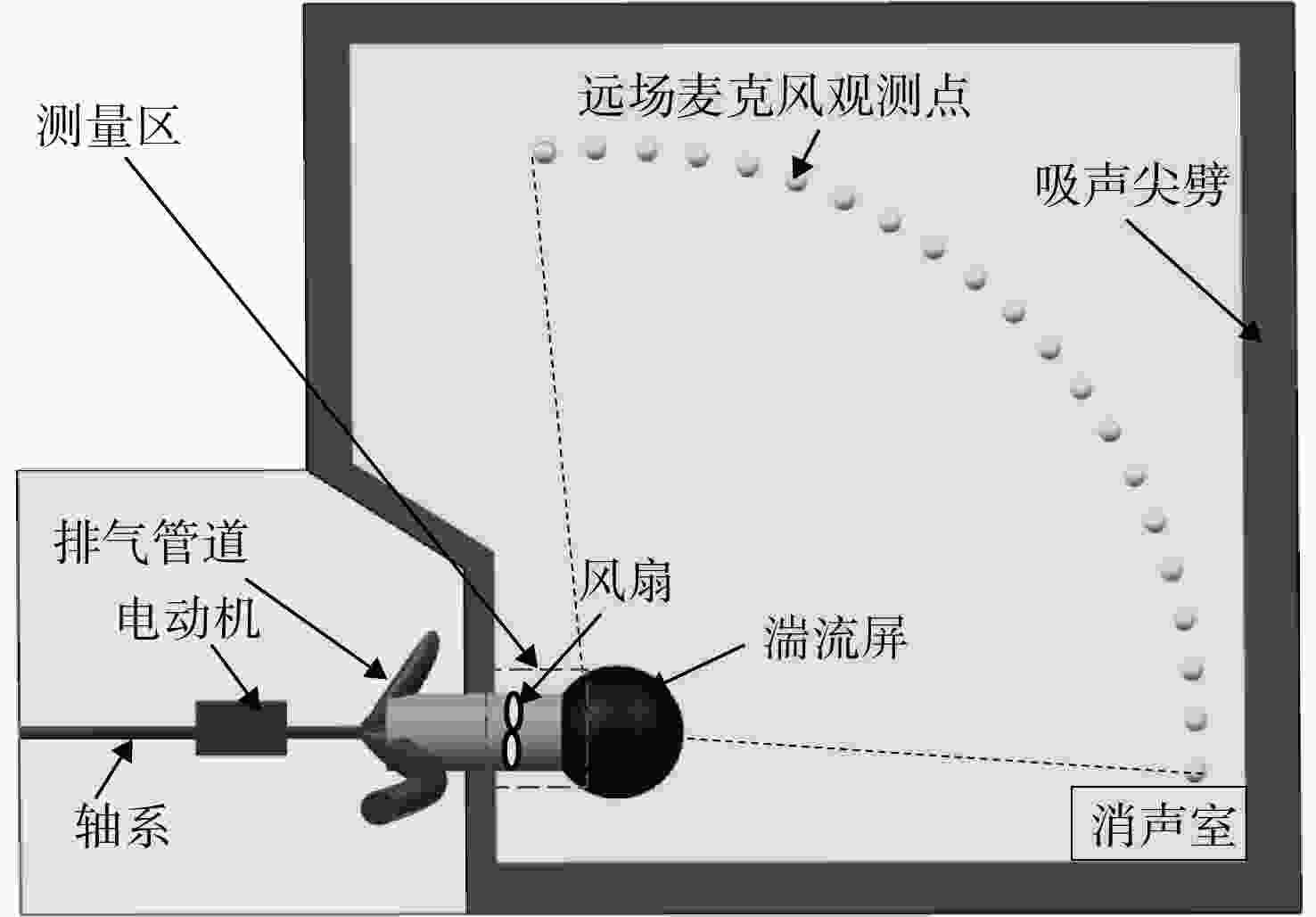
图 1 缩尺风扇降噪试验台示意图
Figure 1. Schematic diagram of the scaled-down fan noise reduction test rig for commercial engine development
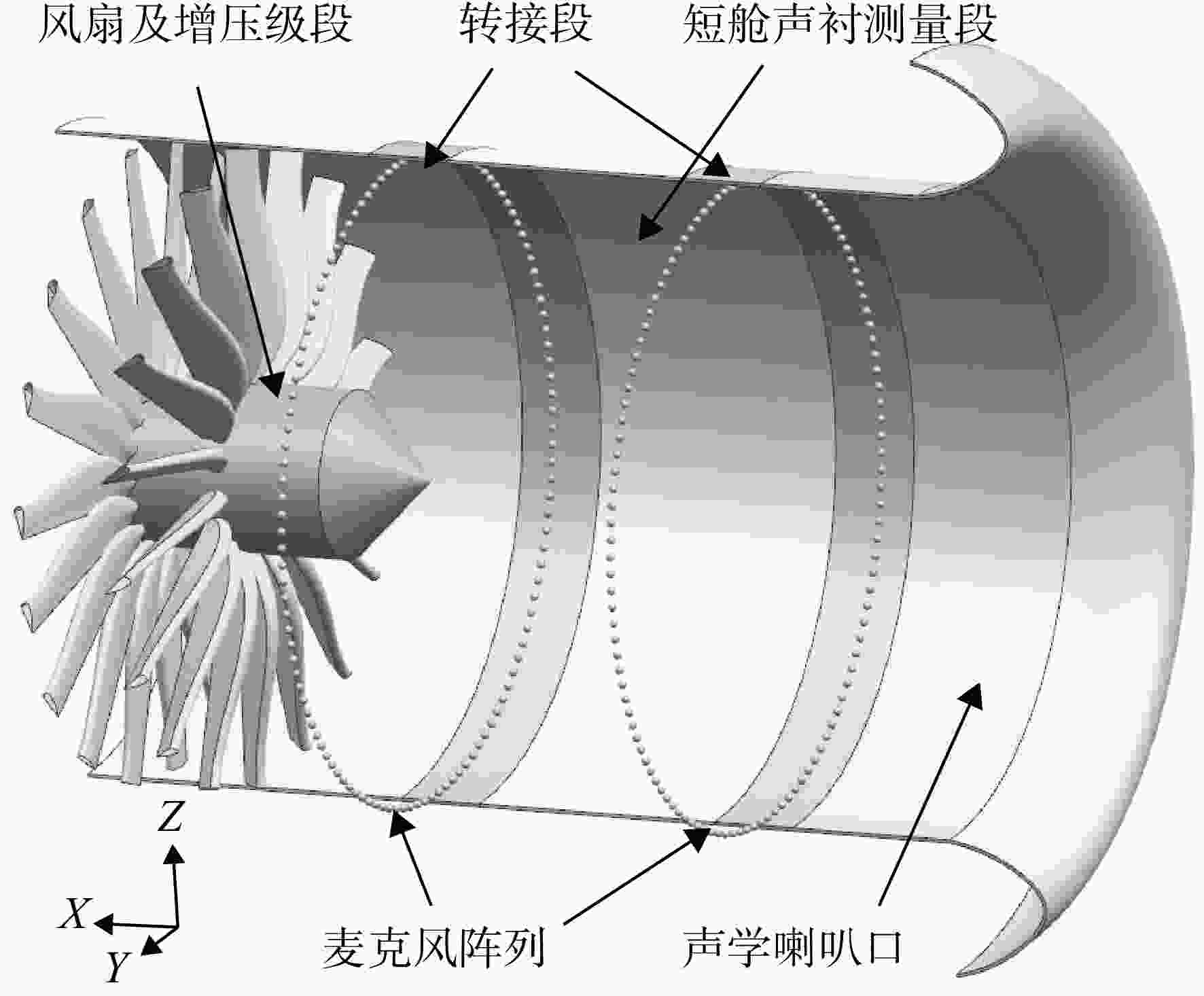
图 2 缩尺风扇短舱降噪试验件示意图
Figure 2. Schematic diagram of a scaled-down fan nacelle noise reduction test article
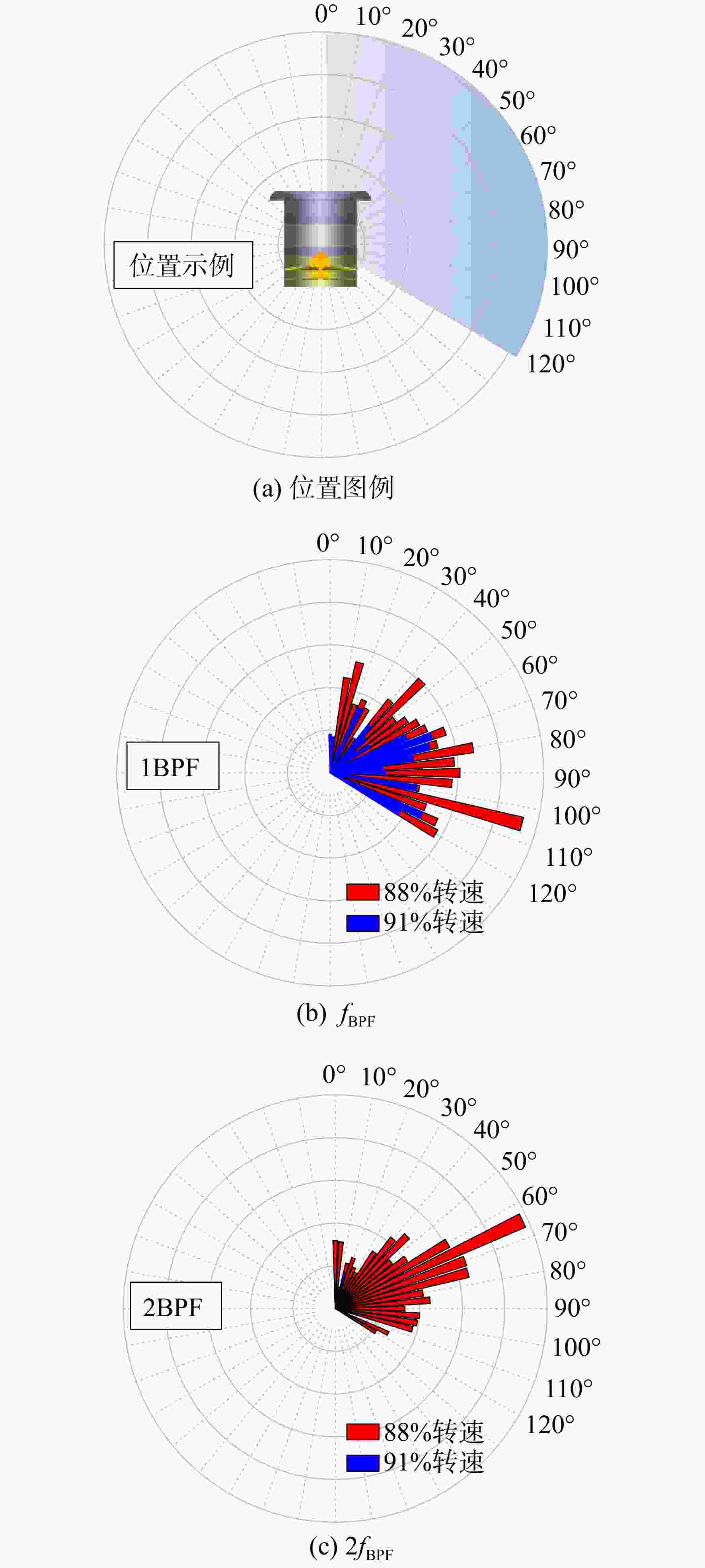
图 3 BPF频率下不同转速下远场降噪量
Figure 3. Far-field noise reduction at different rotational speeds under BPF frequency
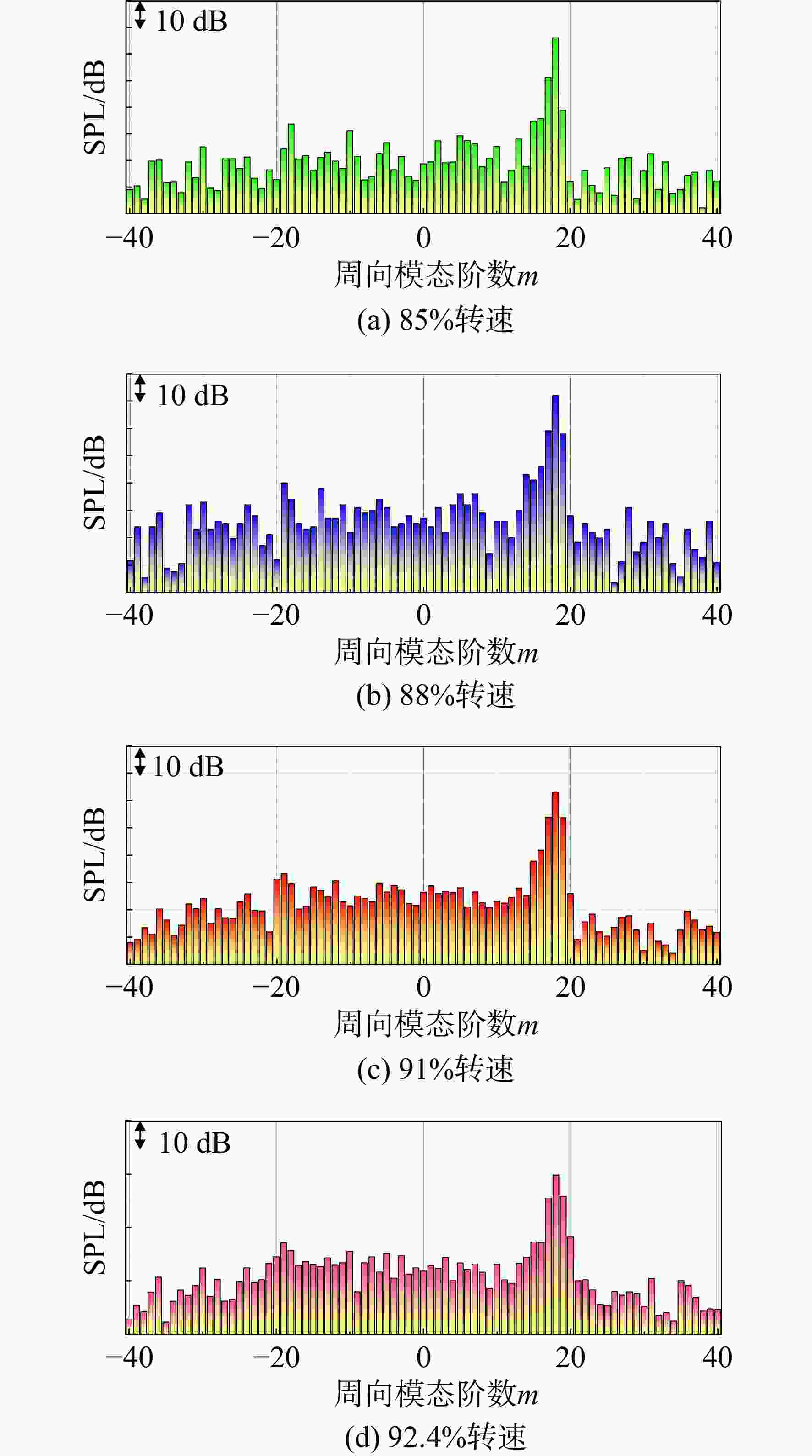
图 4 fBPF下不同转速下管道内声源周向模态
Figure 4. Azimuthal modes of acoustic sources inside a pipe at different rotational speeds under fBPF
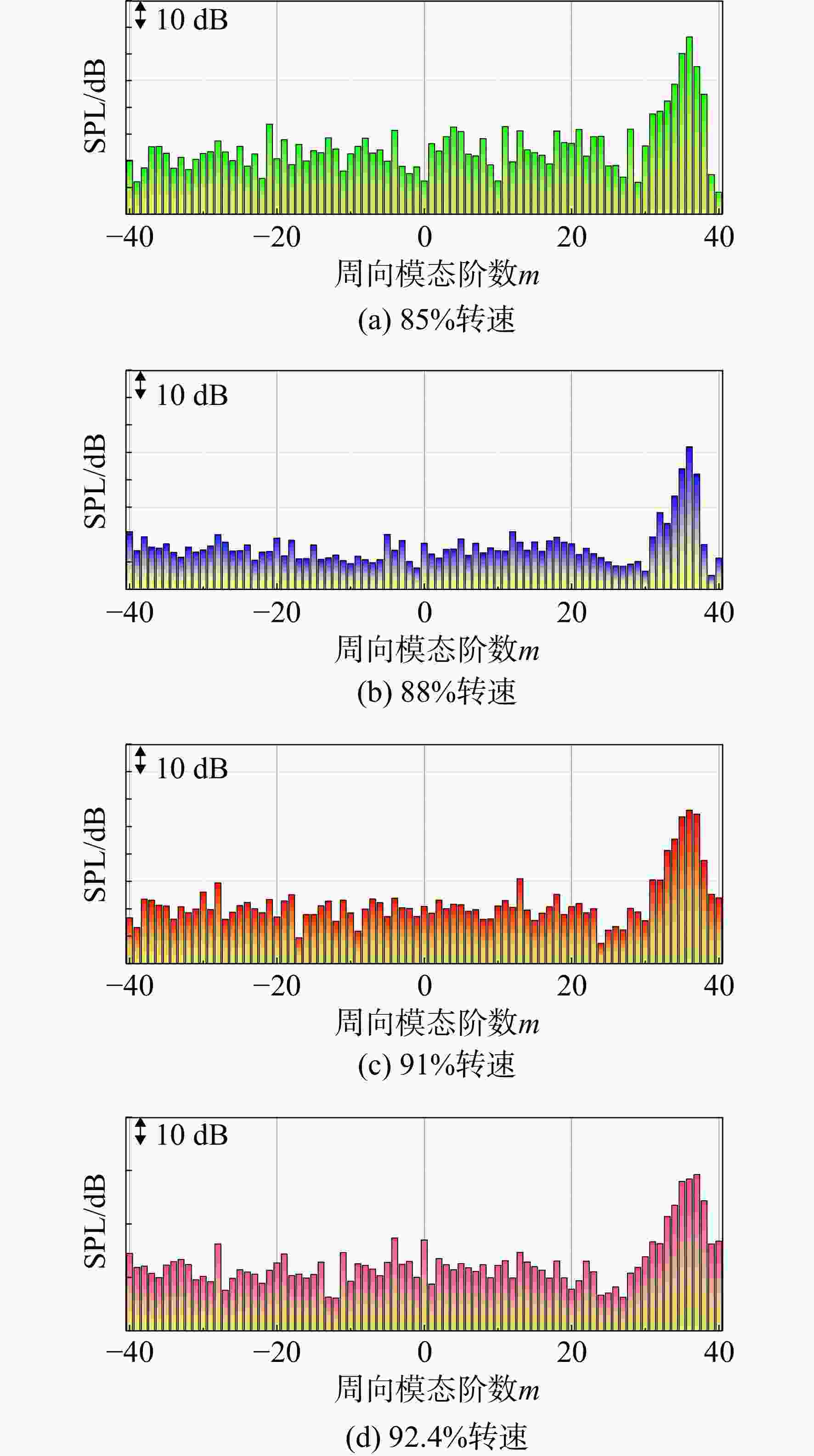
图 5 2fBPF下不同转速下管道内声源周向模态
Figure 5. Azimuthal modes of acoustic sources inside a pipe at different rotational speeds under 2fBPF
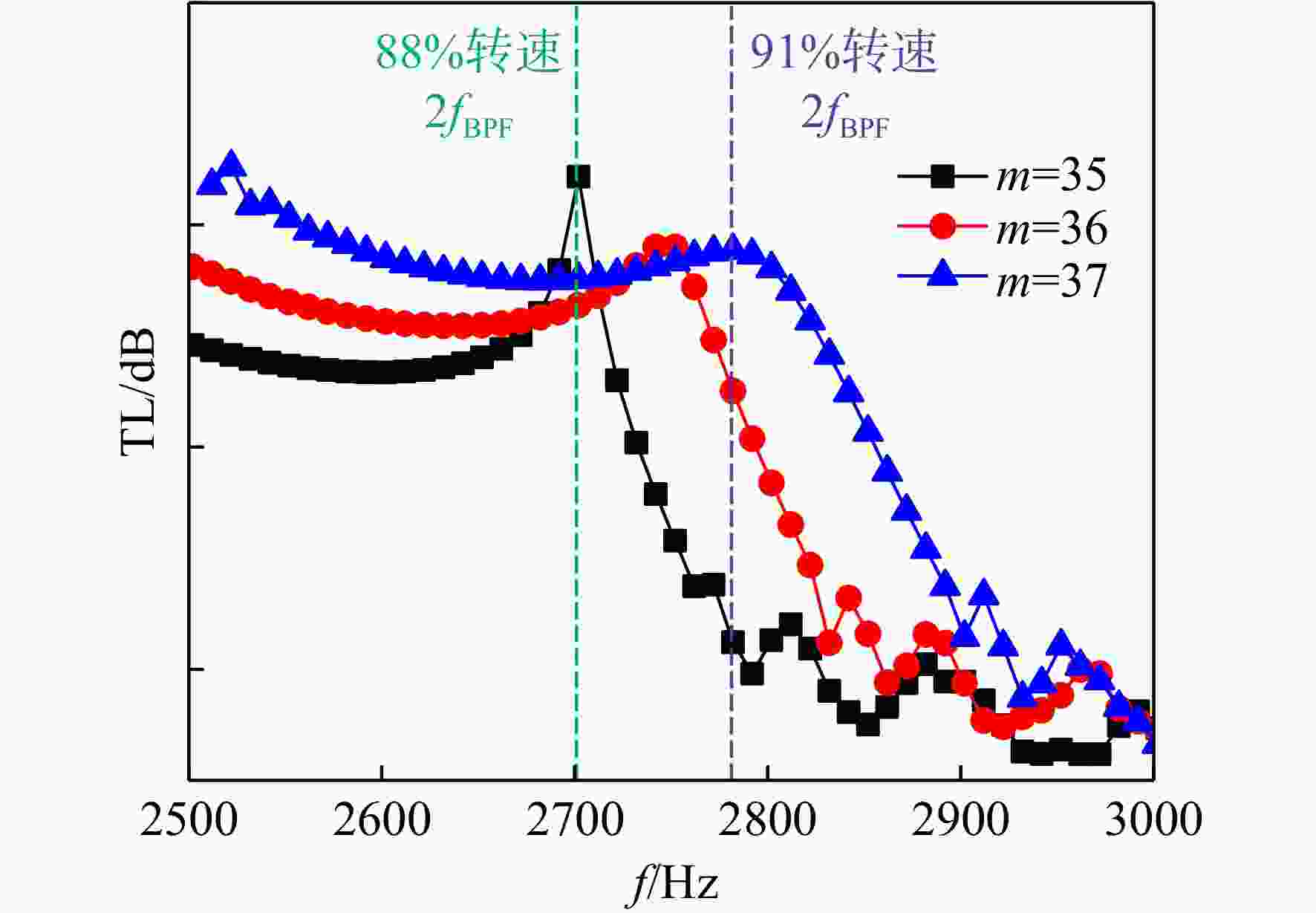
图 6 不同周向模态的远场降噪量
Figure 6. Far field noise reduction with different circumferential modes
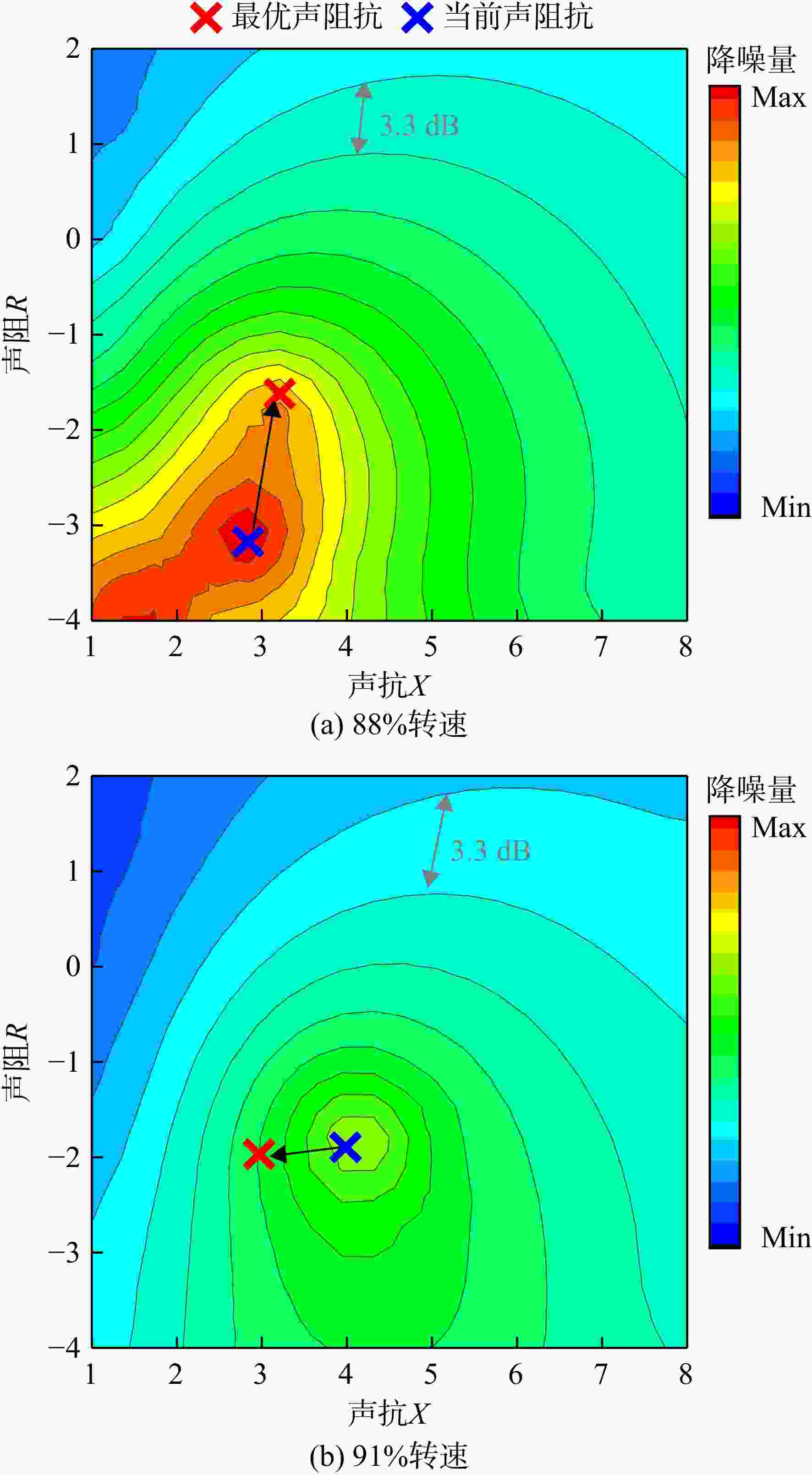
图 7 周向35模态的远场降噪量响应面
Figure 7. Response surface of far-field noise reduction for the 35th circumferential mode
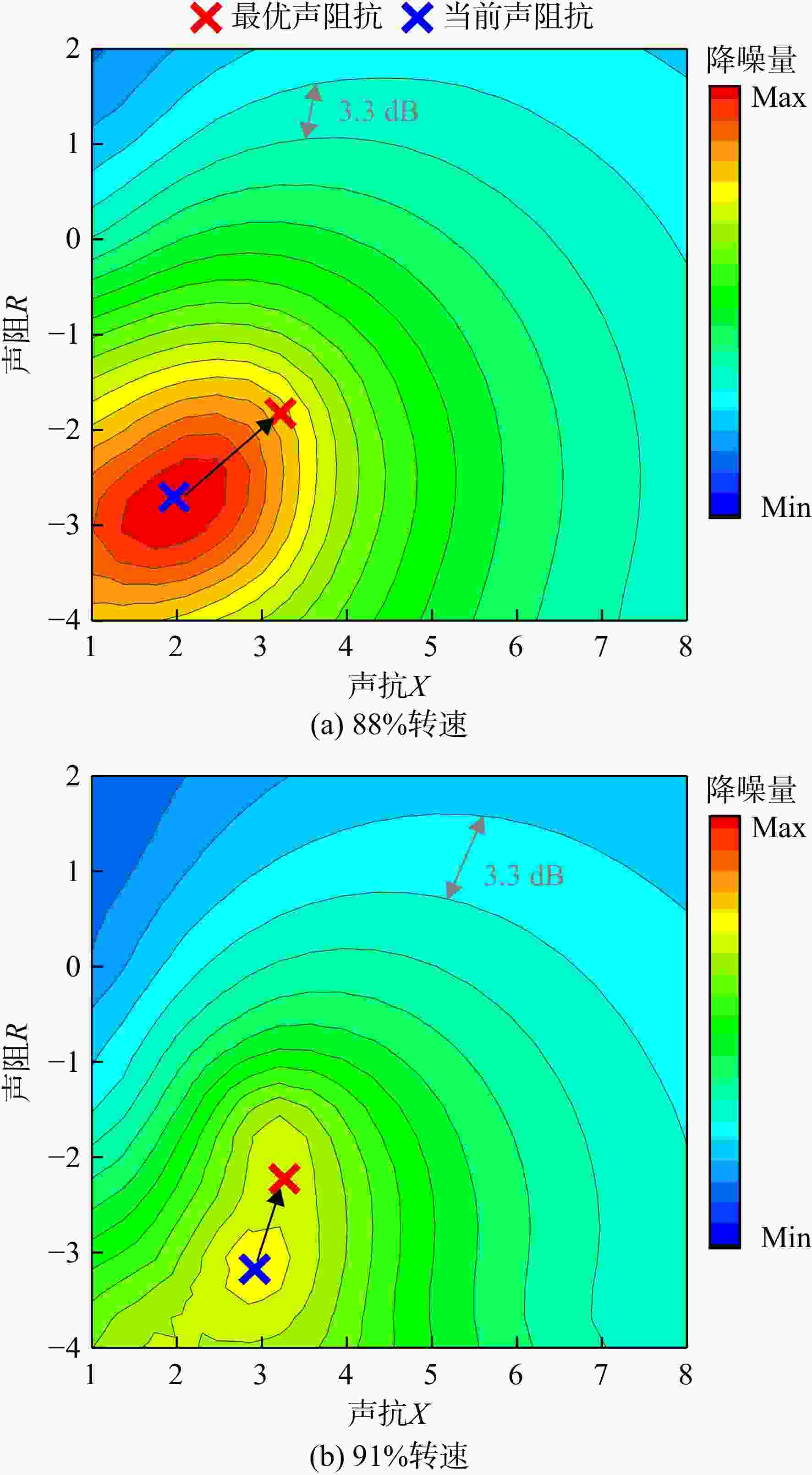
图 8 周向36模态的远场降噪量响应面
Figure 8. Response surface of far-field noise reduction for the 36th circumferential mode
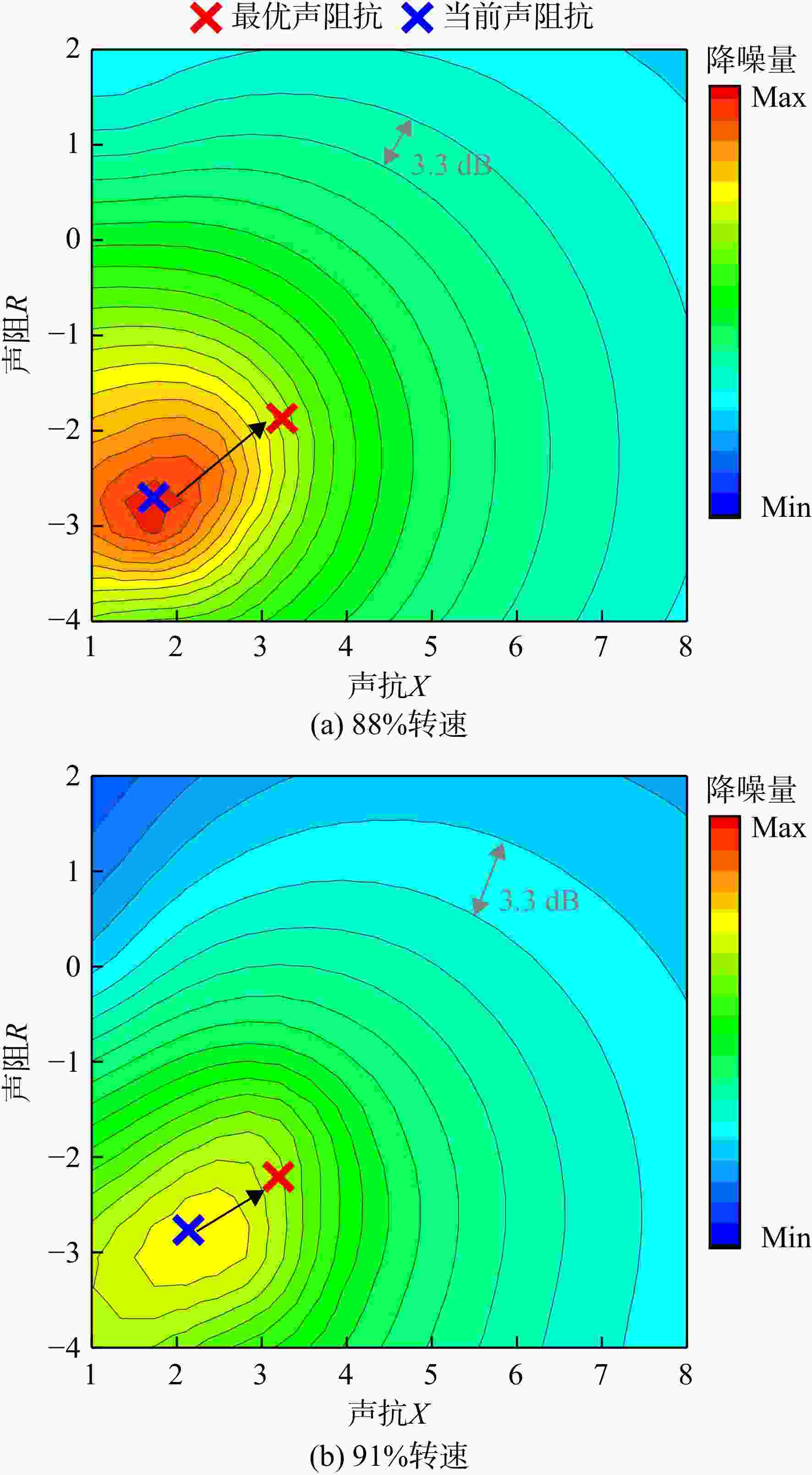
图 9 周向37模态的远场降噪量响应面
Figure 9. Response surface of far-field noise reduction for the 37th circumferential mode
表 1 88%转速下周向35、36、37模态声阻抗偏离状态
Table 1. Acoustic impedance deviation state of the circumferential modes 35, 36, and 37 in 88% rotational speed
周向模态 最优声阻 最优声抗 当前声阻 当前声抗 声阻偏离 声抗偏离 35 2.8 −3.1 3.4 −1.7 0.5 1.3 36 2.1 −2.7 3.4 −1.7 1.3 1.0 37 1.7 −2.7 3.4 −1.7 1.6 1.0  下载: 导出CSV
表 2 91%转速下周向35、36、37模态声阻抗偏离状态
Table 2. Acoustic impedance deviation state of the circumferential modes 35, 36, and 37 in 91% rotational speed
周向模态 最优声阻 最优声抗 当前声阻 当前声抗 声阻偏离 声抗偏离 35 4.3 −1.8 3.3 −2.0 −1.0 −0.2 36 2.8 −3.1 3.3 −2.0 0.5 1.0 37 2.5 −2.7 3.3 −2.0 0.8 0.7
下载: 导出CSV
-
[1] Rienstra S W, Hirschberg A. An Introduction to Acoustics[M]. Eindhoven, Netherlands: Eindhoven University of Technology, 2004. [2] Zevitas C D, Spengler J D, Jones B, et al. Assessment of noise in the airplane cabin environment[J]. Journal of Exposure Science & Environmental Epidemiology, 2018, 28(6): 568-578. doi: 10.1038/s41370-018-0027-z [3] CFR Part 36(Stage 5): Noise standards: aircraft type and airworthiness certification[S]. [4] Palma G, Mao Huina, Burghignoli L, et al. Acoustic metamaterials in aeronautics[J]. Applied Sciences, 2018, 8(6): 971. doi: 10.3390/app8060971 [5] Jones M, Howerton B, Ayle E. Evaluation of parallel-element, variable-impedance, broadband acoustic liner concepts: AIAA2012-2194 [R]. Reston, US: AIAA, 2012. [6] Bielak G W, Premo J W, Hersh A S. Advanced turbofan duct liner concepts: NASA/CR-1999-209002[R]. Hampton, US: NASA Langley Research Center, 1999. [7] ISO 10534-1 1996: Acoustics-determination of sound absorption coefficient and impedance in impedance tubes: Part 1 method using standing wave ratio[S]. [8] ISO 10534-2 1998: Acoustics-determination of sound absorption coefficient and impedance in impedance tubes: Part 2 transfer-function method[S]. [9] Watson W R, Jones M G. A comparative study of four impedance eduction methodologies using several test liners: AIAA2013-2274 [R]. Reston, US: AIAA, 2013. [10] Watson W R, Carpenter M H, Jones M G. Performance of Kumaresan and Tufts algorithm in liner impedance eduction with flow[J]. AIAA Journal, 2015, 53(4): 1091-1102. doi: 10.2514/1.J053705 [11] Jing Xiaodong, Peng Sen, Sun Xiaofeng. A straightforward method for wall impedance eduction in a flow duct[J]. The Journal of the Acoustical Society of America, 2008, 124(1): 227-234. doi: 10.1121/1.2932256 [12] Jing Xiaodong, Peng Sen, Wang Lixun, et al. Investigation of straightforward impedance eduction in the presence of shear flow[J]. Journal of Sound and Vibration, 2015, 335: 89-104. doi: 10.1016/j.jsv.2014.08.031 [13] Bu Huanxian, Han Jun, Xiao Yuqi, et al. A simple method improving acoustic mode identification capability based on genetic algorithms[J]. JASA Express Letters, 2024, 4(7): 072801. doi: 10.1121/10.0026465 [14] Chung J Y, Blaser D A. Transfer function method of measuring in-duct acoustic properties. I. Theory[J]. The Journal of the Acoustical Society of America, 1980, 68(3): 907-913. doi: 10.1121/1.384778 [15] Chung J Y, Blaser D A. Transfer function method of measuring in-duct acoustic properties. II. Experiment[J]. The Journal of the Acoustical Society of America, 1980, 68(3): 914-921. [16] Lewy S. Inverse method predicting spinning modes radiated by a ducted fan from free-field measurements[J]. The Journal of the Acoustical Society of America, 2005, 117(2): 744-750. doi: 10.1121/1.1850208 [17] Lauer J, McAllister J, Loew R, et al. FJ44 turbofan engine test at NASA Glenn research center’s aero-acoustic propulsion laboratory: AIAA2009-620 [R]. Reston, US: AIAA, 2009. [18] Mueller D, Schulz H J, Zitouni G, et al. Europe’s largest aero acoustic test facility for aero engine fans-the development and operation of the AneCom aero test anechoic chamber: AIAA2005-3050 [R]. Reston, US: AIAA, 2005. [19] Sutliff D L. A 20 year retrospective of the advanced noise control fan-contributions to turbofan noise research: AIAA2019-3824[R]. Reston, US: AIAA, 2019. [20] Sutliff D L. Acoustic directivity of the DGEN aero-propulsion research turbofan at multiple far field array locations: AIAA2018-3279 [R]. Reston, US: AIAA, 2018. [21] Mileshin V. A review of new experimental technologies for the development of advanced fans with high bypass ratio[J]. International Journal of Turbomachinery, Propulsion and Power, 2018, 3(3): 21. doi: 10.3390/ijtpp3030021 [22] Salze E, Pereira A, Souchotte P, et al. New modular fan rig for advanced aeroacoustic tests - Acoustic characterization of the facility: AIAA2019-2603[R]. Reston, US: AIAA, 2019. [23] 甘露. 航空发动机风扇声学试验器设计与调试[J]. 噪声与振动控制, 2023, 43(6): 295-299. Gan Lu. Design and qualification of aeroengine fan aeroacoustic test facility[J]. Noise and Vibration Control, 2023, 43(6): 295-299. (in ChineseGan Lu. Design and qualification of aeroengine fan aeroacoustic test facility[J]. Noise and Vibration Control, 2023, 43(6): 295-299. (in Chinese) [24] Rienstra S W. Fundamentals of duct acoustics[M]. Brussels, Belgium: Von Karman Institute for Fluid Dynamics, 2015. [25] 乔渭阳. 航空发动机气动声学[M]. 北京: 北京航空航天大学出版社, 2010. Qiao Weiyang. Aeroacoustics of aero-engine[M]. Beijing: Beijing University of Aeronautics & Astronautics Press, 2010. (in ChineseQiao Weiyang. Aeroacoustics of aero-engine[M]. Beijing: Beijing University of Aeronautics & Astronautics Press, 2010. (in Chinese) [26] Hardin J C, Hussaini M Y. Computational Aeroacoustics[M]. Berlin: Springer-Verlag, 1993. -


 点击查看大图

计量
- 文章访问数: 148
- HTML浏览量: 121
- PDF量: 9
- 被引次数: 0