






Thermal-hydraulic performance assessment and rapid prediction of complex heat-exchanger in combined aero engines
-
摘要:
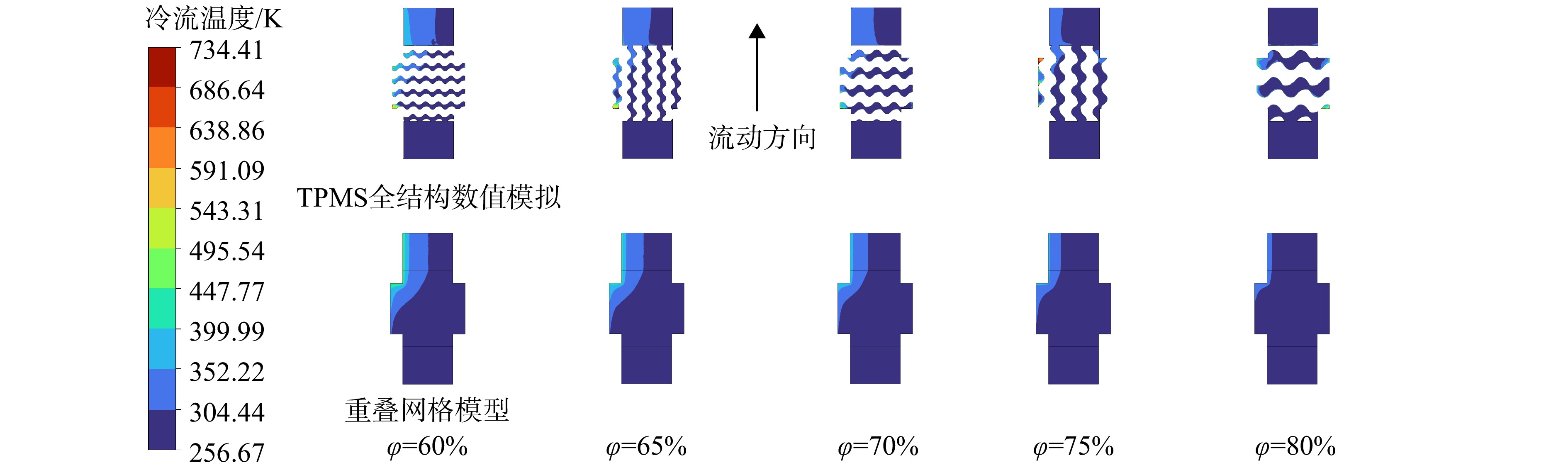
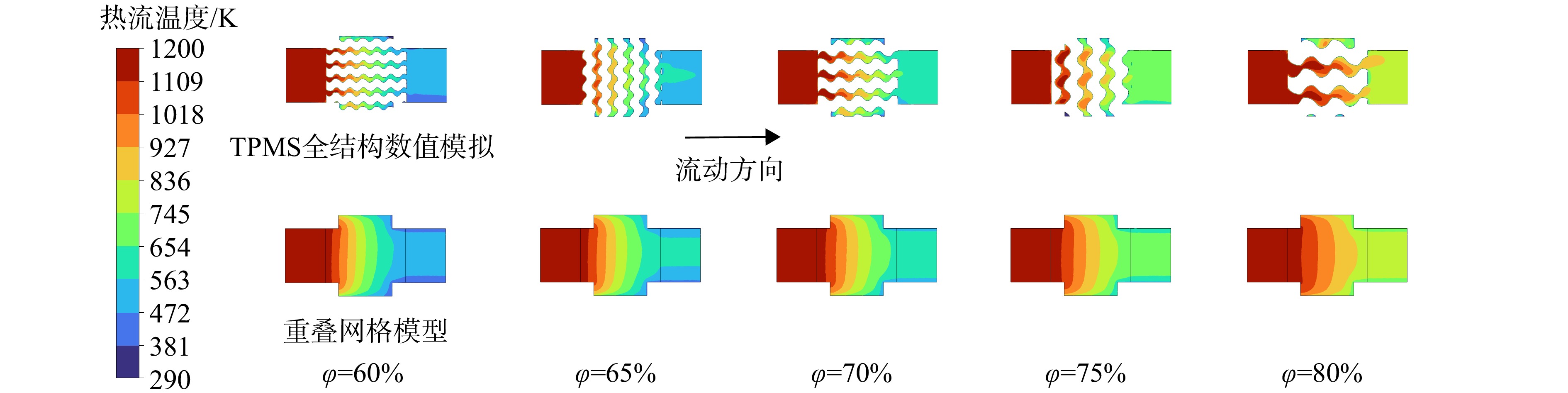
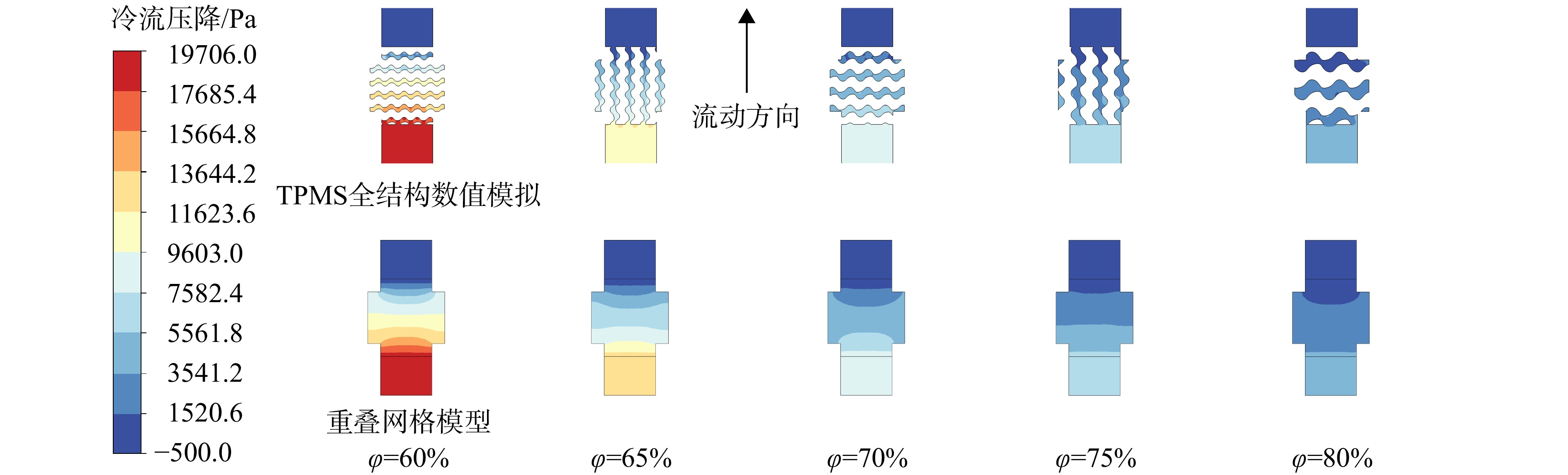
三周期极小曲面(triply periodic minimal surface,TPMS)结构凭借其卓越的热-流耦合传输性能,被视为新一代航空航天推进系统内高性能热交换器技术革新的理想候选结构。TPMS结构固有的几何复杂性显著增加了数值求解的资源消耗,已成为其工程化设计与应用的关键制约。针对孔隙率为60%~80%的TPMS结构开展了全三维数值模拟,系统揭示了不同孔隙率构型在极端工况下的热流性能,进而提出了耦合功质比的性能评价指标(weight-aware performance evaluation criterion,WPEC)。研究结果表明:75%孔隙率的TPMS结构在该指标下展现出最优的综合性能,其WPEC值可达2.5。基于重叠网格法与粒子迹线追踪法,构建了面向TPMS结构的宏观性能-微观流场协同快速预测模型,实现了兼具精度与计算效率的快速性能评估,其计算耗时降低90%以上,针对总换热量、冷流压降、热流压降的平均预测误差分别为3.91%、4.62%、5.42%。
Abstract:The inherent geometric complexity of triply periodic minimal surface (TPMS) significantly increases the computational consumption of numerical simulations, which has become a critical constraint on their engineering design and application. This study conducted full three-dimensional numerical simulations on TPMS structures with porosities ranging from 60% to 80%, systematically revealing the thermal-hydraulic performance of different porosity configurations under extreme operating conditions, and proposed a performance evaluation criterion coupling the power-to-weight ratio (WPEC). The results demonstrated that the TPMS structures with 75% porosity exhibited the optimal comprehensive performance under this criterion, achieving a WPEC value of 2.5. Furthermore, based on the overlapping mesh method and particle trajectory tracking method, a rapid prediction model for TPMS structures that coupled macroscopic performance with microscopic flow fields was constructed, achieving accurate performance evaluation with high computational efficiency. The computational time was reduced by over 90%, while the average prediction errors for total heat transfer, cold-side pressure drop, and hot-side pressure drop were 3.91%, 4.62%, and 5.42%, respectively.
-
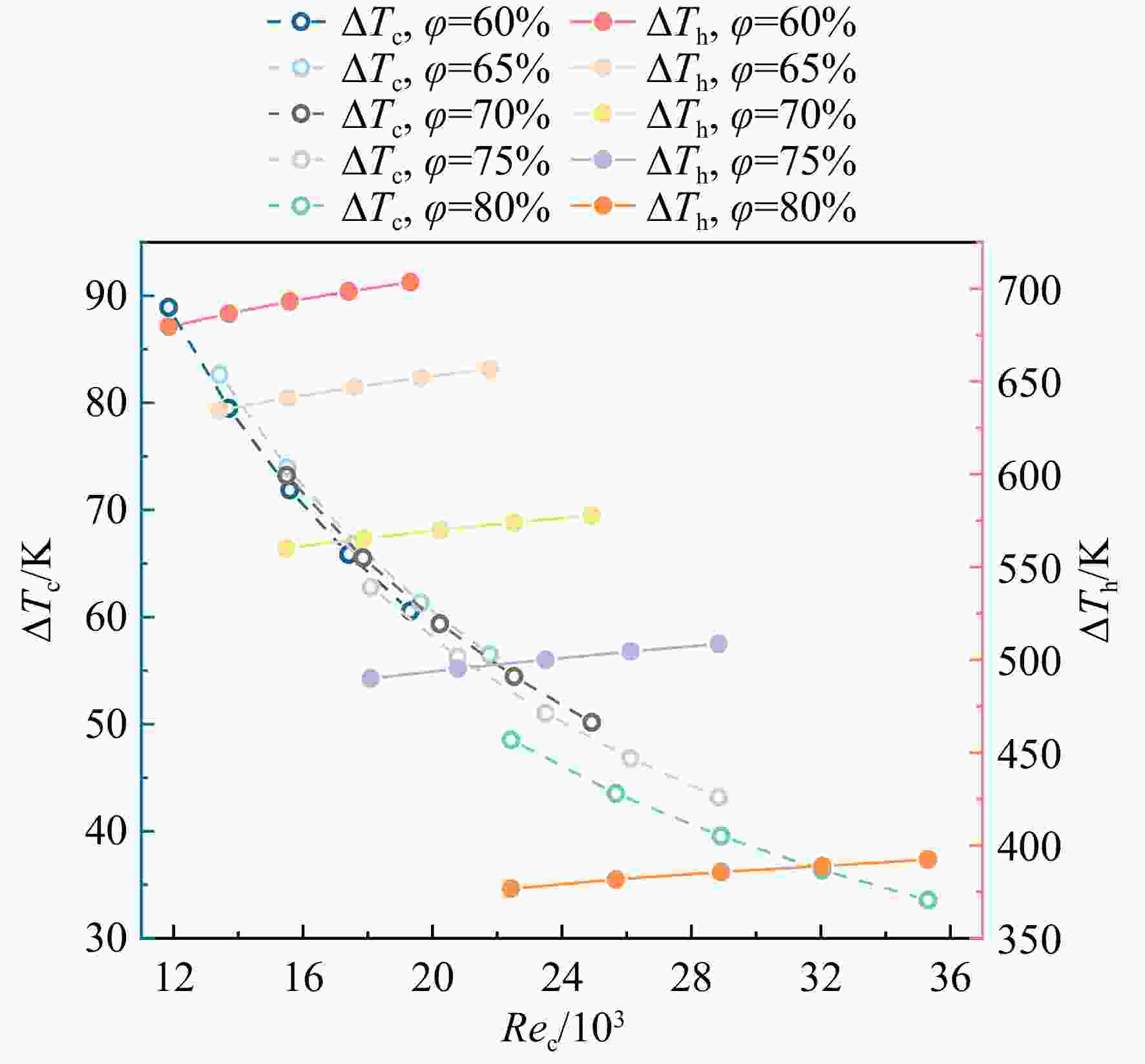
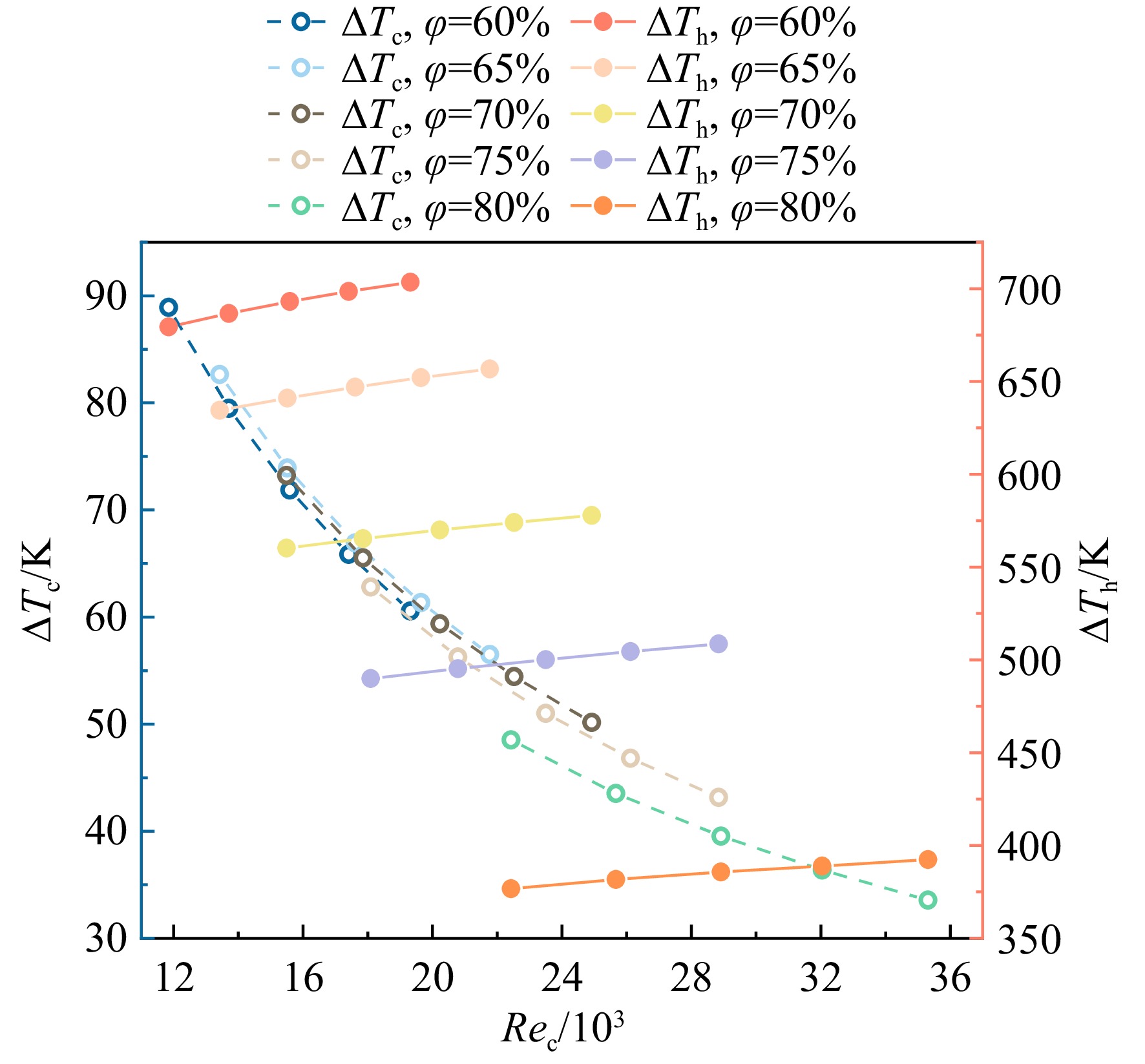
图 7 不同孔隙率结构内Rec与温差分布特性
Figure 7. Distribution characteristics of Rec and temperature difference within structures of varying porosity
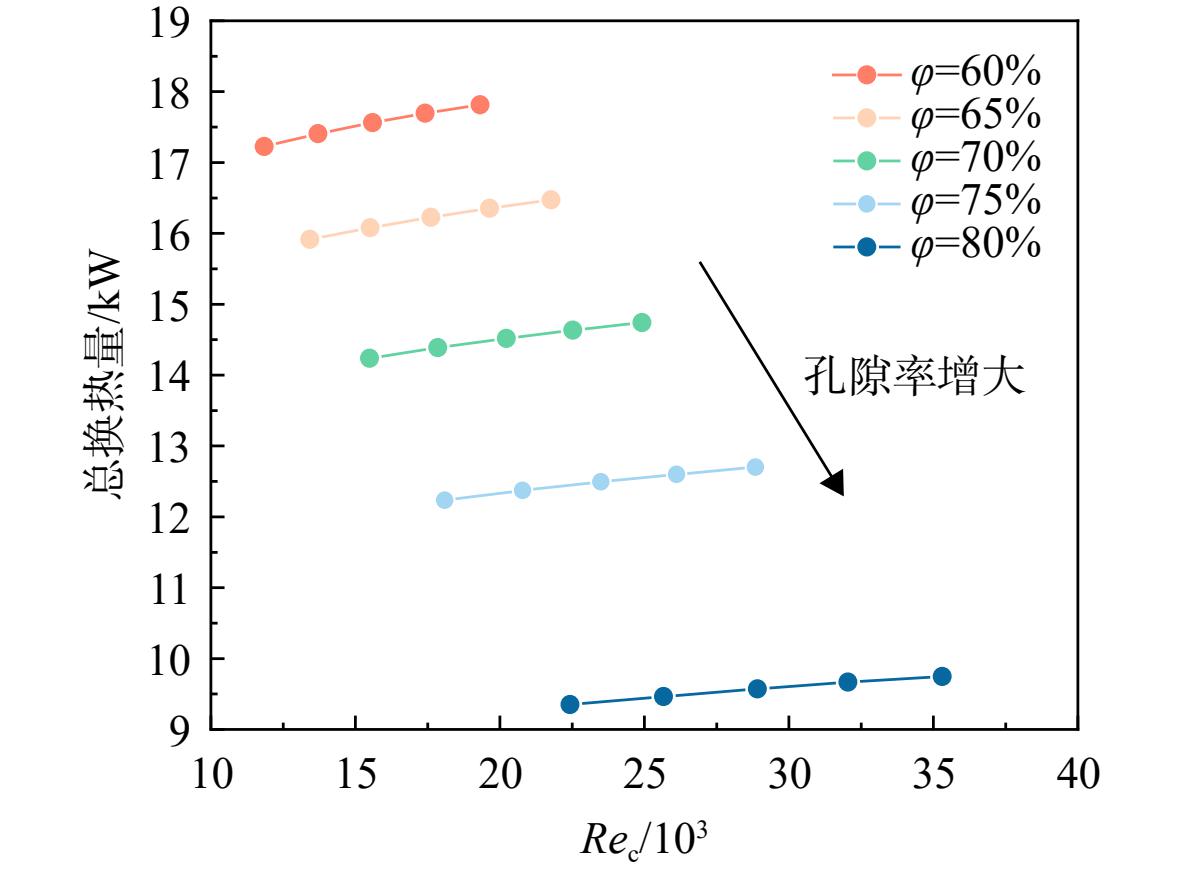
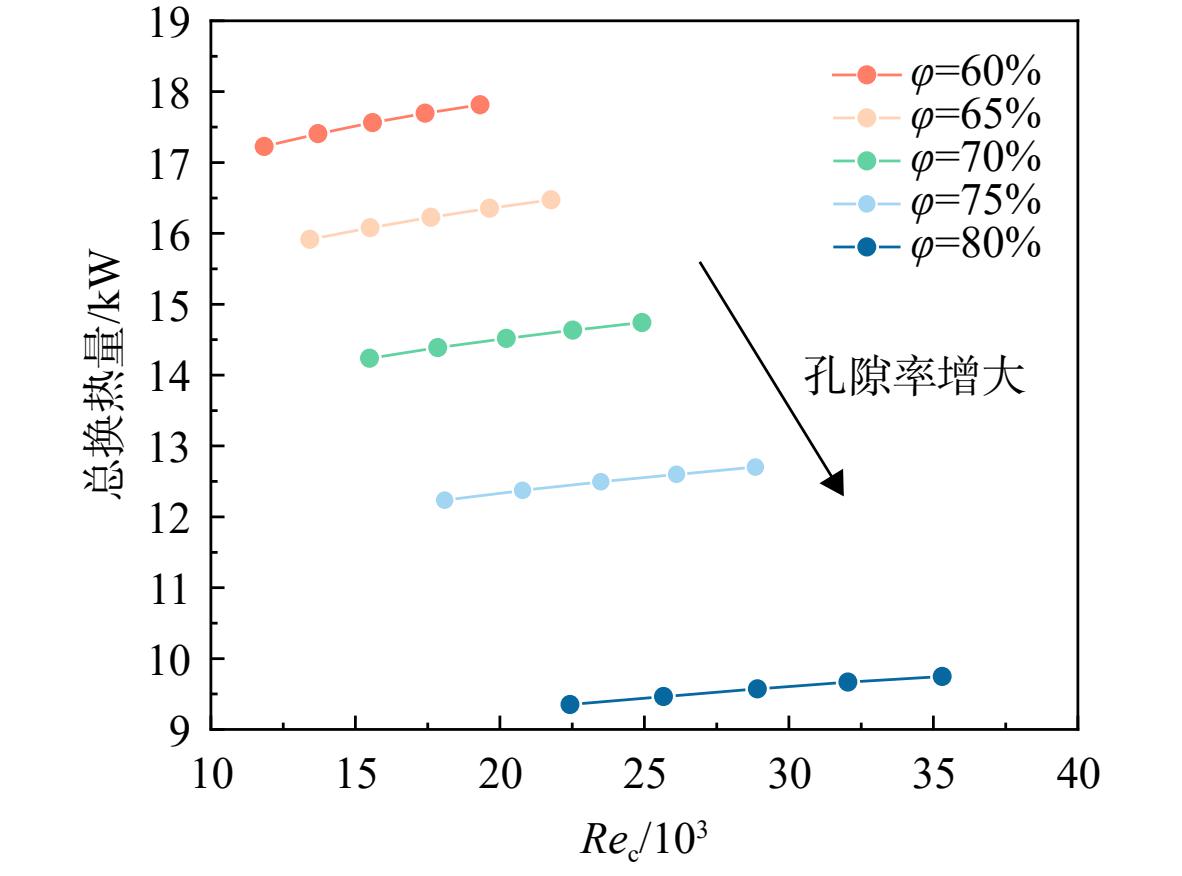
图 8 不同孔隙率结构内总换热量分布特性
Figure 8. Distribution characteristics of total heat transfer within structures of varying porosity
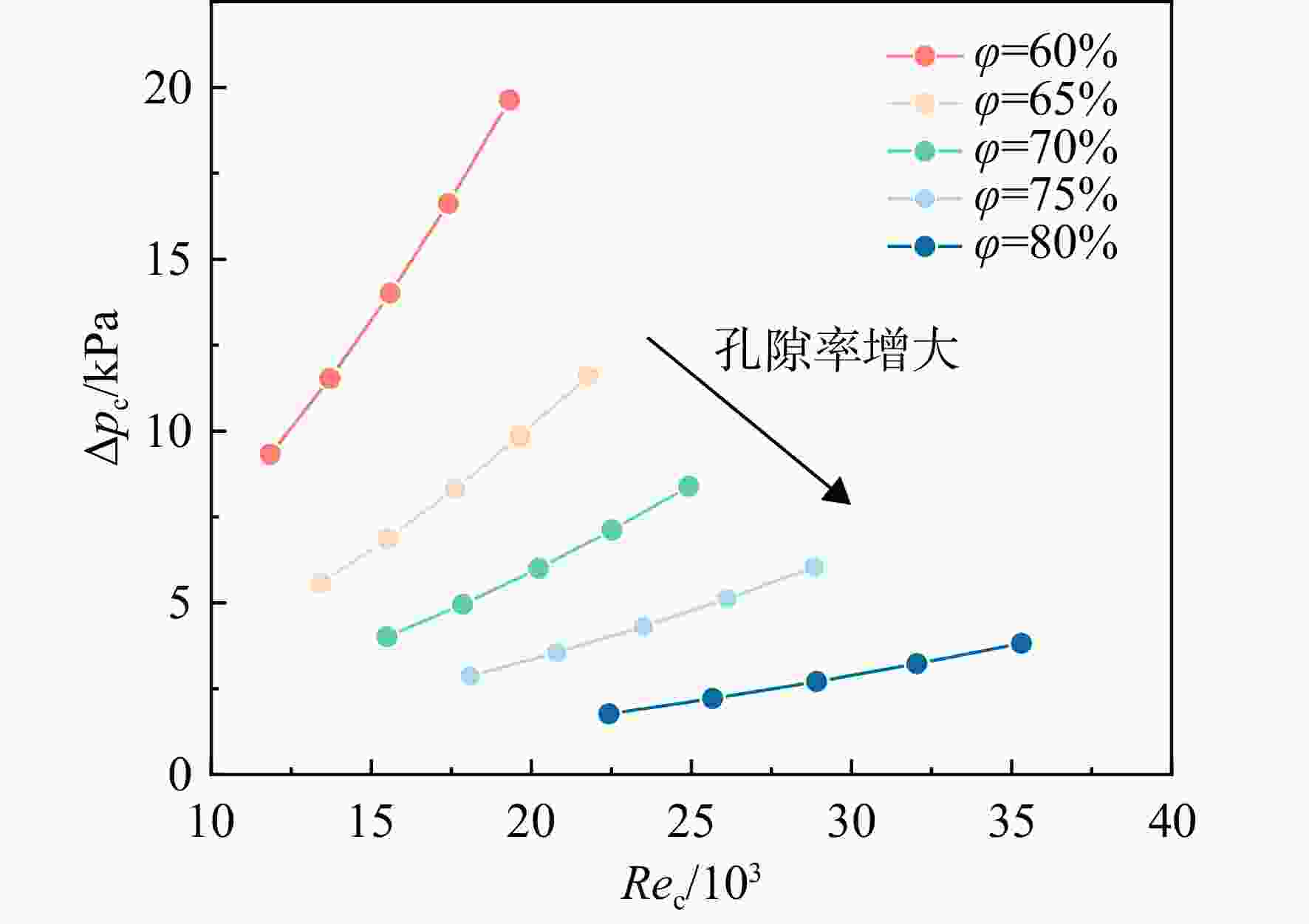
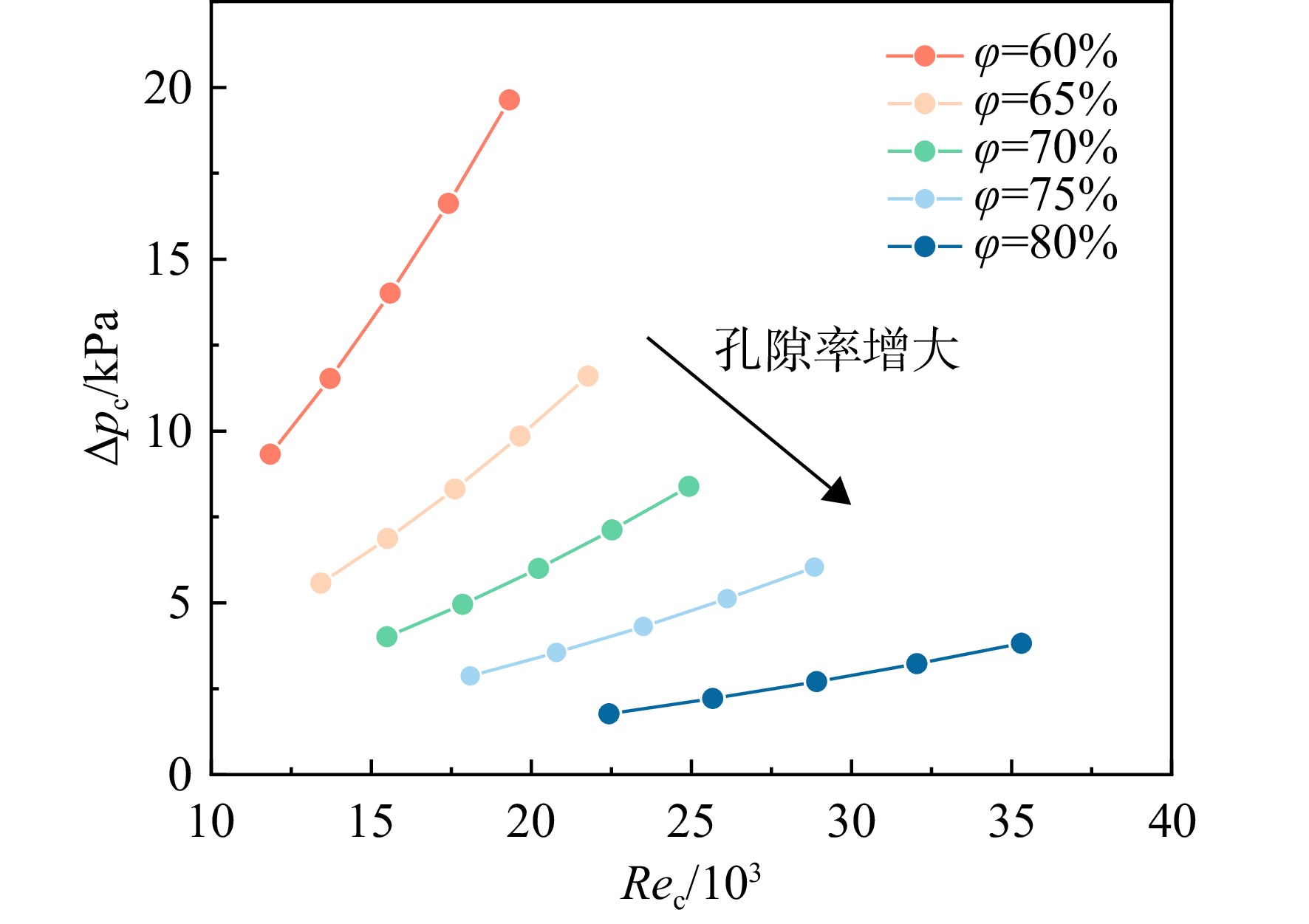
图 9 不同孔隙率结构内冷流压降随Rec变化特性
Figure 9. Characteristics of Rec and pressure drop of cold fluid within structures of varying porosity
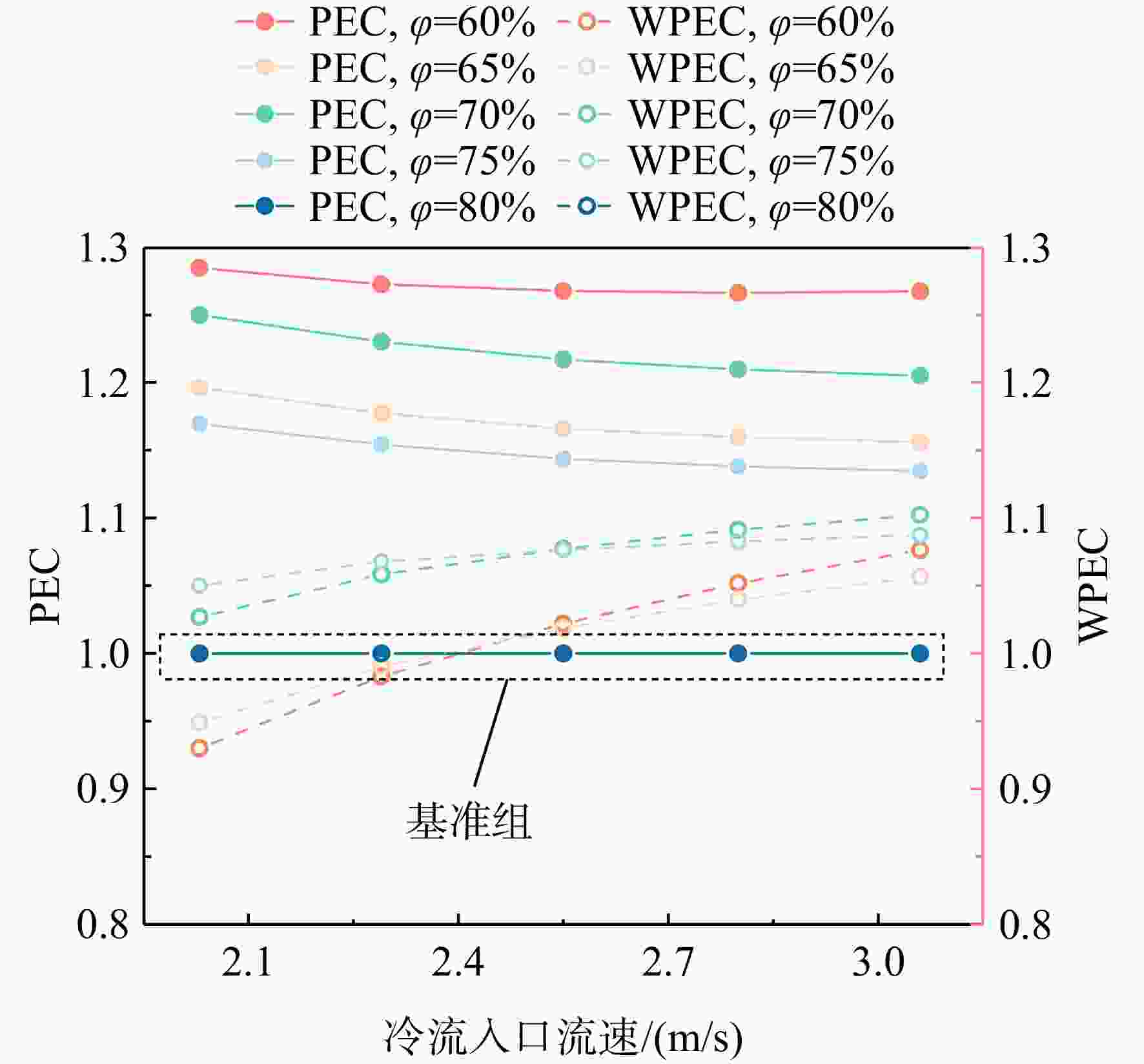
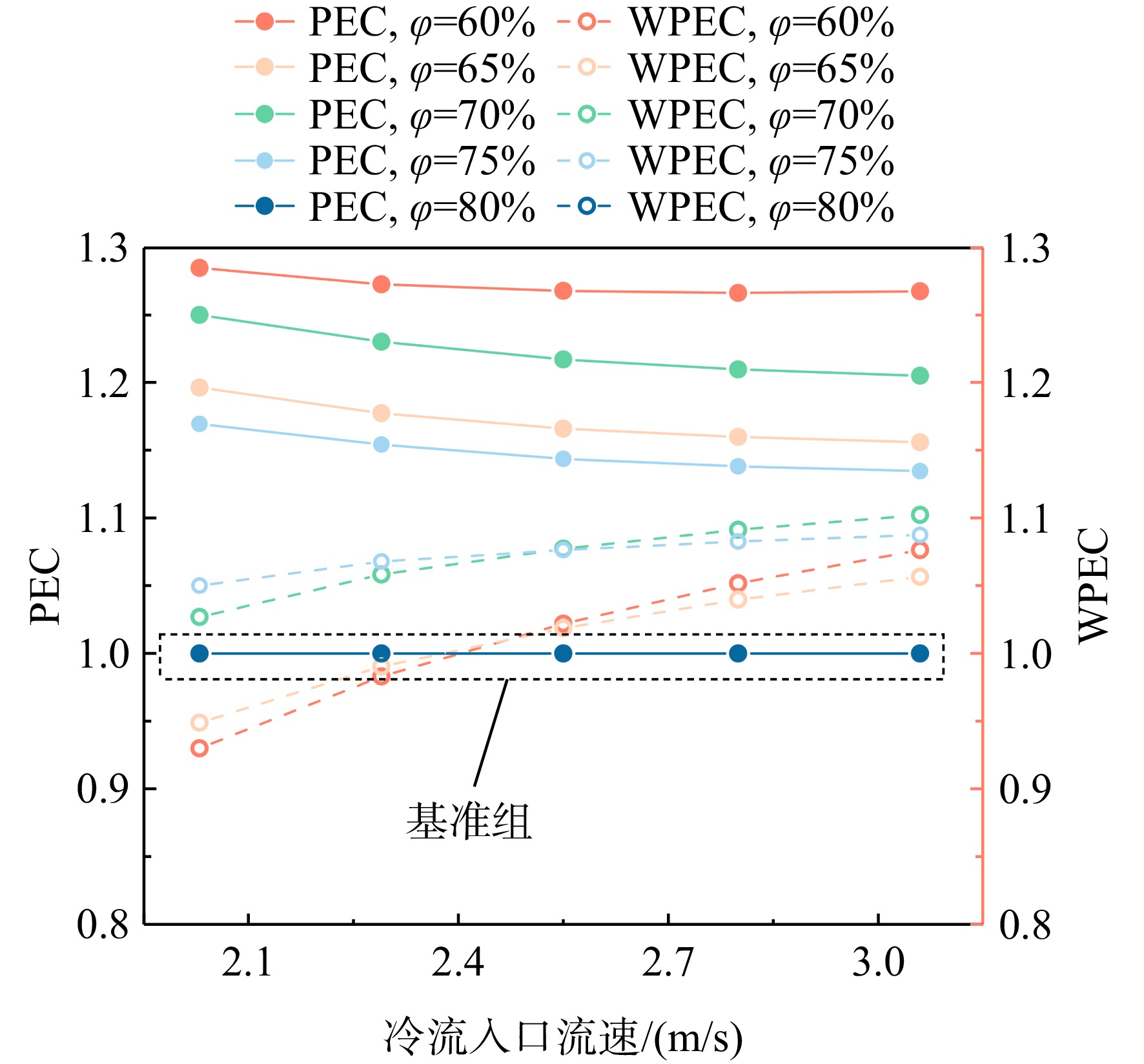
图 10 不同孔隙率结构内PEC与WPEC变化特性
Figure 10. Characteristics of PEC and WPEC within structures of varying porosity
表 1 不同孔隙率下Gyroid晶胞的结构参数
Table 1. Structural parameters of Gyroid unit cell under varying porosity
孔隙率φ/% 晶胞周期长度l/mm 总换热面积Ahtf/mm2 比表面积ε/(1/mm) 水力直径D/mm 60 10.1 40499.2 0.63 3.78 65 11.7 36442.7 0.57 4.57 70 13.8 32418.4 0.51 5.53 75 16.8 28555.0 0.47 6.72 80 21.5 24012.7 0.38 8.54  下载: 导出CSV
表 2 数值模拟计算边界条件
Table 2. Boundary conditions for numerical simulation
流体 温度/K 压力/MPa 流速/(m/s) 氦气 256.68 6.0 2.03 2.29 2.55 2.80 3.06 燃气 1187.35 0.5 2.47 3.71 4.95 6.18 7.42
下载: 导出CSV
表 3 不同质量流量工况对应边界
Table 3. Boundary conditions for different flow rate cases
质量流量工况/% 冷流入口流速/(m/s) 热流入口流速/(m/s) 100 3.06 7.42 92 2.80 6.18 83 2.55 4.95 75 2.29 3.71 67 2.03 2.47
下载: 导出CSV
表 4 重叠网格快速预测模型误差分布
Table 4. Error distribution of the overlap mesh rapid prediction model
% 孔隙率 质量流量
工况总换热量
误差冷流压降
误差热流压降
误差60 100 3.50 4.11 −5.70 92 3.83 3.01 −4.86 83 4.16 1.89 −2.60 75 4.32 0.76 2.20 67 4.01 −0.16 11.69 65 100 5.20 −7.14 3.87 92 5.59 −8.12 3.99 83 5.99 −9.07 5.11 75 6.23 −9.92 8.25 67 5.79 −10.63 14.10 70 100 3.80 1.02 1.74 92 4.43 0.10 2.02 83 5.15 −0.80 3.18 75 5.85 −1.54 6.10 67 5.99 −2.21 12.08 75 100 1.26 −7.48 8.57 92 −2.25 −6.70 7.97 83 3.45 −5.95 6.40 75 −2.25 −6.70 7.97 67 −1.26 −7.48 8.57 80 100 0.82 −6.17 1.68 92 −0.47 −5.15 1.69 83 −2.03 −4.18 1.49 75 −3.88 −3.13 0.49 67 −6.30 −2.09 −3.22
下载: 导出CSV
表 5 快速预测模型性能分析
Table 5. Rapid prediction model performance analysis
指标 孔隙率/% 全结构数值模拟 快速预测模型 网格数量/万 60 472 62 65 405 70 327 75 292 80 223 前处理
耗时/h60 ≈3 ≈0.5 65 ≈3 70 ≈2 75 ≈2 80 ≈1.5 湍流模型 Realizable k-ε 无需计算湍流 计算耗时/h 60 ≈12 ≈0.5 65 ≈10 70 ≈8 75 ≈8 80 ≈7
下载: 导出CSV
-
[1] 罗佳茂, 杨顺华, 母忠强, 等. 预冷型组合循环发动机技术[J]. 空气动力学学报, 2022, 40(1): 190-207. Luo Jiamao, Yang Shunhua, Mu Zhongqiang, et al. Technology analysis of pre-cooled combined-cycle engine[J]. Acta Aerodynamica Sinica, 2022, 40(1): 190-207. (in Chinese doi: 10.7638/kqdlxxb-2021.0294Luo Jiamao, Yang Shunhua, Mu Zhongqiang, et al. Technology analysis of pre-cooled combined-cycle engine[J]. Acta Aerodynamica Sinica, 2022, 40(1): 190-207. (in Chinese) doi: 10.7638/kqdlxxb-2021.0294 [2] 张蒙正, 刘典多, 马海波, 等. PATR发动机关键技术与性能提升途径初探[J]. 推进技术, 2018, 39(9): 1921-1927. Zhang Mengzheng, Liu Dianduo, Ma Haibo, et al. Preliminary analysis on critical technology and performance improvement of PATR engine[J]. Journal of Propulsion Technology, 2018, 39(9): 1921-1927. (in Chinese doi: 10.13675/j.cnki.tjjs.2018.09.001Zhang Mengzheng, Liu Dianduo, Ma Haibo, et al. Preliminary analysis on critical technology and performance improvement of PATR engine[J]. Journal of Propulsion Technology, 2018, 39(9): 1921-1927. (in Chinese) doi: 10.13675/j.cnki.tjjs.2018.09.001 [3] Dong Zeyu, Sun Mingbo, Wang Zhenguo, et al. Survey on key techniques of rocket-based combined-cycle engine in ejector mode[J]. Acta Astronautica, 2019, 164: 51-68. doi: 10.1016/j.actaastro.2019.07.016 [4] Varvill R, Duran I, Kirk A, et al. SABRE technology development: status and update[R]. Madrid, Spain: 8th European Conference for Aeronautics and Space Sciences, 2019. [5] Longstaff R, Bond A. The SKYLON project[R]. AIAA-2011-2244, 2011. [6] Varvill R. Heat exchanger development at reaction engines ltd[J]. Acta Astronautica, 2010, 66(9/10): 1468-1474. doi: 10.1016/j.actaastro.2009.11.010 [7] Wang Zhenguo, Wang Yuan, Zhang Jianqiang, et al. Overview of the key technologies of combined cycle engine precooling systems and the advanced applications of micro-channel heat transfer[J]. Aerospace Science and Technology, 2014, 39: 31-39. doi: 10.1016/j.ast.2014.08.008 [8] 汪元, 王振国. 空气预冷发动机及微小通道流动传热研究综述[J]. 宇航学报, 2016, 37(1): 11-20. Wang Yuan, Wang Zhenguo. Review on precooled combined cycle engine and mini-and micro-channel flow heat transfer[J]. Journal of Astronautics, 2016, 37(1): 11-20. (in Chinese doi: 10.3873/j.issn.1000-1328.2016.01.002Wang Yuan, Wang Zhenguo. Review on precooled combined cycle engine and mini-and micro-channel flow heat transfer[J]. Journal of Astronautics, 2016, 37(1): 11-20. (in Chinese) doi: 10.3873/j.issn.1000-1328.2016.01.002 [9] Dai Jian, Zuo Qiuru. Key technologies for thermodynamic cycle of precooled engines: a review[J]. Acta Astronautica, 2020, 177: 299-312. doi: 10.1016/j.actaastro.2020.07.039 [10] Meng Bao, Wan Min, Zhao Rui, et al. Micromanufacturing technologies of compact heat exchangers for hypersonic precooled airbreathing propulsion: a review[J]. Chinese Journal of Aeronautics, 2021, 34(2): 79-103. doi: 10.1016/j.cja.2020.03.028 [11] Sun Jingyang, Mao Hongwei, Ma Yuan, et al. Thermal-hydraulic performance and heat transfer sensitivity analysis of diamond-type TPMS with mid-surface offsets in cylindrical coordinates under large temperature difference conditions[J]. International Communications in Heat and Mass Transfer, 2026, 170: 109949. doi: 10.1016/j.icheatmasstransfer.2025.109949 [12] Huang W S, Ning H Y, Li Nan, et al. Thermal-hydraulic performance of TPMS-based regenerators in combined cycle aero-engine[J]. Applied Thermal Engineering, 2024, 250: 123510. doi: 10.1016/j.applthermaleng.2024.123510 [13] Huang W S, Ning H Y, Tang G H. Investigation of high-compactness and high-efficiency TPMS precoolers for precooled aero-engine[J]. Energy, 2025, 319: 135014. doi: 10.1016/j.energy.2025.135014 [14] Liu Jian, Cheng D, Oo K, et al. Optimization of triply periodic minimal surface heat exchanger to achieve compactness, high efficiency, and low-pressure drop[J]. Energies, 2024, 17(20): 5141. doi: 10.3390/en17205141 [15] Li Weihong, Yu Guopeng, Yu Zhibin. Bioinspired heat exchangers based on triply periodic minimal surfaces for supercritical CO2 cycles[J]. Applied Thermal Engineering, 2020, 179: 115686. doi: 10.1016/j.applthermaleng.2020.115686 [16] Abueidda D W, Bakir M, Abu Al-rub R K, et al. Mechanical properties of 3D printed polymeric cellular materials with triply periodic minimal surface architectures[J]. Materials & Design, 2017, 122: 255-267. doi: 10.1016/j.matdes.2017.03.018 [17] Cheng Zhilong, Li Xiaoyang, Xu Ruina, et al. Investigations on porous media customized by triply periodic minimal surface: Heat transfer correlations and strength performance[J]. International Communications in Heat and Mass Transfer, 2021, 129: 105713. doi: 10.1016/j.icheatmasstransfer.2021.105713 [18] Feng Jiawei, Fu Jianzhong, Shang Ce, et al. Porous scaffold design by solid T-splines and triply periodic minimal surfaces[J]. Computer Methods in Applied Mechanics and Engineering, 2018, 336: 333-352. doi: 10.1016/j.cma.2018.03.007 [19] Wang Xiaojian, Xu Shanqing, Zhou Shiwei, et al. Topological design and additive manufacturing of porous metals for bone scaffolds and orthopaedic implants: a review[J]. Biomaterials, 2016, 83: 127-141. doi: 10.1016/j.biomaterials.2016.01.012 [20] Yeranee K, Rao Yu. A review of recent investigations on flow and heat transfer enhancement in cooling channels embedded with triply periodic minimal surfaces (TPMS)[J]. Energies, 2022, 15(23): 8994. doi: 10.3390/en15238994 [21] Al-ketan O, Abu Al-rub R K. Multifunctional mechanical metamaterials based on triply periodic minimal surface lattices[J]. Advanced Engineering Materials, 2019, 21(10): 1900524. doi: 10.1002/adem.201900524 [22] Al-ketan O, Ali M, Khalil M, et al. Forced convection computational fluid dynamics analysis of architected and three-dimensional printable heat sinks based on triply periodic minimal surfaces[J]. Journal of Thermal Science and Engineering Applications, 2021, 13(2): 021010. doi: 10.1115/1.4047385 [23] Torquato S, Kim J. Microstructural and transport characteristics of triply periodic bicontinuous materials[J]. Acta Materialia, 2024, 276: 120142. doi: 10.1016/j.actamat.2024.120142 [24] Zimmer A, Pachecoaraújo J D, Andreassen K A, et al. Effect of manufacturing techniques in pressure drop on triple periodical minimal surface packings[J]. Chemie Ingenieur Technik, 2021, 93(6): 967-973. doi: 10.1002/cite.202000237 [25] Wang Jiaxuan, Qian Chenyi, Zhang Fengrui, et al. Experimental and numerical analysis of functionally graded hybrid TPMS heat exchangers for enhanced flow and thermal performance[J]. Applied Thermal Engineering, 2025, 264: 125528. doi: 10.1016/j.applthermaleng.2025.125528 [26] Knödler P, Dreissigacker V. Fluid dynamic assessment and development of nusselt correlations for Fischer Koch S structures[J]. Energies, 2024, 17(3): 688. doi: 10.3390/en17030688 [27] Sun Jingyang, Li Xionghui, Mao Hongwei, et al. Numerical analysis of the mechanism of porosity effect on the thermal-hydraulic performance of Gyroid-type TPMS structures in combined aero engines[J]. Applied Thermal Engineering, 2025, 264: 125453. doi: 10.1016/j.applthermaleng.2025.125453 [28] 魏鑫, 金峰, 刘天依, 等. SABRE空气预冷器流动与换热数值研究[J]. 火箭推进, 2019, 45(5): 8-16. Wei Xin, Jin Feng, Liu Tianyi, et al. Numerical study on flow and heat transfer of air precooler in SABRE[J]. Journal of Rocket Propulsion, 2019, 45(5): 8-16. (in Chinese doi: 10.3969/j.issn.1672-9374.2019.05.002Wei Xin, Jin Feng, Liu Tianyi, et al. Numerical study on flow and heat transfer of air precooler in SABRE[J]. Journal of Rocket Propulsion, 2019, 45(5): 8-16. (in Chinese) doi: 10.3969/j.issn.1672-9374.2019.05.002 [29] Wang Wei, Li Bingrui, Wang Xin, et al. Optimal design of supercritical He–H2 PCHE in SABER system by multi-objective genetic algorithm[J]. International Journal of Thermal Sciences, 2024, 203: 109134. doi: 10.1016/j.ijthermalsci.2024.109134 [30] 马航宇, 张文强, 苏纬仪, 等. 预冷器微细管束流动换热的模态分解与快速预测[J]. 空气动力学学报, 2025, 43(2): 110-120. Ma Hangyu, Zhang Wenqiang, Su Weiyi, et al. Modal decomposition and rapid prediction of flow and heat transfer in microtubes of precooler[J]. Acta Aerodynamica Sinica, 2025, 43(2): 110-120. (in Chinese doi: 10.7638/kqdlxxb-2024.0006Ma Hangyu, Zhang Wenqiang, Su Weiyi, et al. Modal decomposition and rapid prediction of flow and heat transfer in microtubes of precooler[J]. Acta Aerodynamica Sinica, 2025, 43(2): 110-120. (in Chinese) doi: 10.7638/kqdlxxb-2024.0006 [31] 李娜, 严旭, 陈胥衡, 等. 紧凑型换热器传热特性的高效预测方法[J]. 航空动力学报, 2025, 40(6): 20230811. Li Na, Yan Xu, Chen Xuheng, et al. Efficient prediction of heat transfer characteristics of compact heat exchangers[J]. Journal of Aerospace Power, 2025, 40(6): 20230811. (in ChineseLi Na, Yan Xu, Chen Xuheng, et al. Efficient prediction of heat transfer characteristics of compact heat exchangers[J]. Journal of Aerospace Power, 2025, 40(6): 20230811. (in Chinese) [32] 谢丹丹. 基于神经网络的超临界二氧化碳流动换热特性研究[D]. 长沙: 中南大学, 2022. Xie Dandan. Study on flow and heat transfer characteristics of supercritical CO2 based on neural network[D]. Changsha: Central South University, 2022. (in ChineseXie Dandan. Study on flow and heat transfer characteristics of supercritical CO2 based on neural network[D]. Changsha: Central South University, 2022. (in Chinese) [33] Yang Kaichun, Zhang Xingjuan, Yang Han. Performance prediction of plate fin heat exchangers: a CFD and NTU-based approach[J]. International Communications in Heat and Mass Transfer, 2025, 169: 109618. doi: 10.1016/j.icheatmasstransfer.2025.109618 [34] Ramanipriya M, Anitha S. An imperative need for machine learning algorithms in heat transfer application: a review[J]. Journal of Thermal Analysis and Calorimetry, 2025, 150(1): 49-75. doi: 10.1007/s10973-024-13885-z [35] Schoen A H. Infinite periodic minimal surfaces without self-intersections[R]. NASA TN D-5541NASA, 1970. [36] Liu Fei, Mao Zhongfa, Zhang Peng, et al. Functionally graded porous scaffolds in multiple patterns: New design method, physical and mechanical properties[J]. Materials & Design, 2018, 160: 849-860. doi: 10.1016/j.matdes.2018.09.053 [37] Yan Kaixin, Deng Hongwu, Xiao Yewei, et al. Thermo-hydraulic performance evaluation through experiment and simulation of additive manufactured Gyroid-structured heat exchanger[J]. Applied Thermal Engineering, 2024, 241: 122402. doi: 10.1016/j.applthermaleng.2024.122402 [38] 杨世铭, 陶文铨. 传热学[M]. 4版. 北京: 高等教育出版社, 2006. [39] Tucker A S. The LMTD correction factor for single-pass crossflow heat exchangers with both fluids unmixed[J]. Journal of Heat Transfer, 1996, 118(2): 488-490. doi: 10.1115/1.2825873 [40] 黄浩然, 胡峥, 常云龙, 等. 波纹形微通道燃油-滑油换热器强化传热研究[J]. 推进技术, 2025, 46(9): 202411048. Huang Haoran, Hu Zheng, Chang Yunlong, et al. Heat transfer enhancement of wavy microchannel fuel-lube heat exchanger[J]. Journal of Propulsion Technology, 2025, 46(9): 202411048. (in Chinese doi: 10.3724/1001-4055.202411048Huang Haoran, Hu Zheng, Chang Yunlong, et al. Heat transfer enhancement of wavy microchannel fuel-lube heat exchanger[J]. Journal of Propulsion Technology, 2025, 46(9): 202411048. (in Chinese) doi: 10.3724/1001-4055.202411048 [41] Zimparov V. Extended performance evaluation criteria for enhanced heat transfer surfaces: heat transfer through ducts with constant wall temperature[J]. International Journal of Heat and Mass Transfer, 2000, 43(17): 3137-3155. doi: 10.1016/S0017-9310(99)00317-8 -

 点击查看大图

计量
- 文章访问数: 969
- HTML浏览量: 468
- PDF量: 116
- 被引次数: 0