






Dynamic modeling and vibration analysis of spatial fluid-conveying pipe under multi-point base excitations
-
摘要:
航空输流管路系统在多卡箍支撑条件下通常承受多点非一致基础激励,传统的均匀加载模型可能难以准确描述实际的载荷环境。为此,以典型空间输流管路为研究对象,基于传递矩阵法(TMM)开展了多点基础激励下的管路系统动力学建模与振动分析研究。通过引入卡箍约束及空间坐标转换矩阵,将考虑流固耦合(FSI)效应的14方程模型拓展到了多支撑空间输流管路系统;进一步,提出了一种在每一卡箍约束处独立施加基础激励的方法,通过将激励嵌入传递矩阵的链式求解过程,实现了多点基础激励的引入。最后,通过搭建实验系统并结合有限元仿真对创建的模型进行了验证,该模型对前6阶固有频率及第1阶共振响应幅值的预测误差分别在5.30%和7.69%以内,从而证明了建模方法的合理性。在此基础上分析了液压参数和卡箍约束位置对管路系统的影响,结果表明:流体压力主导系统基频下降,且卡箍靠近弯管布置会提升系统刚度从而改变管路系统振动特性。相关结果可为管路系统的减振设计与布局优化提供理论依据。
Abstract:Aviation fluid-conveying piping systems are usually subjected to multi-point non-uniform base excitations under multi-clamp support conditions, making it difficult for traditional uniform loading models to accurately describe the actual load environment. To this end, based on the Transfer Matrix Method (TMM), this study conducts dynamic modeling and vibration analysis of pipeline systems subjected to multi-point base excitations, using typical space flow pipelines as the research subject. By introducing clamp constraints and spatial coordinate transformation matrices, the 14-equation model accounting for fluid-structure interaction (FSI) effects was extended to a multi-support spatial flow pipeline system. A method for independently applying base excitations at each clamp constraint location was proposed. By embedding excitations into the chain-solving process of the transfer matrix, it achieved the simulation of multi-point base excitations. Finally, the created model was validated by constructing an experimental system and combining it with finite element simulation. The model's prediction errors for the first six natural frequencies and the first-order resonance response amplitude were within 5.30% and 7.69%, thereby validating the reasonableness of the modeling approach. Based on this, the effects of hydraulic parameters and clamp constraint positions on the piping system were analyzed. The results indicate that fluid pressure dominates the decrease in the system's fundamental frequency, and the placement of clamps near elbows enhances system stiffness, thereby altering the vibration characteristics of the piping system. The relevant results can provide a theoretical basis for vibration reduction design and layout optimization of piping systems.
-
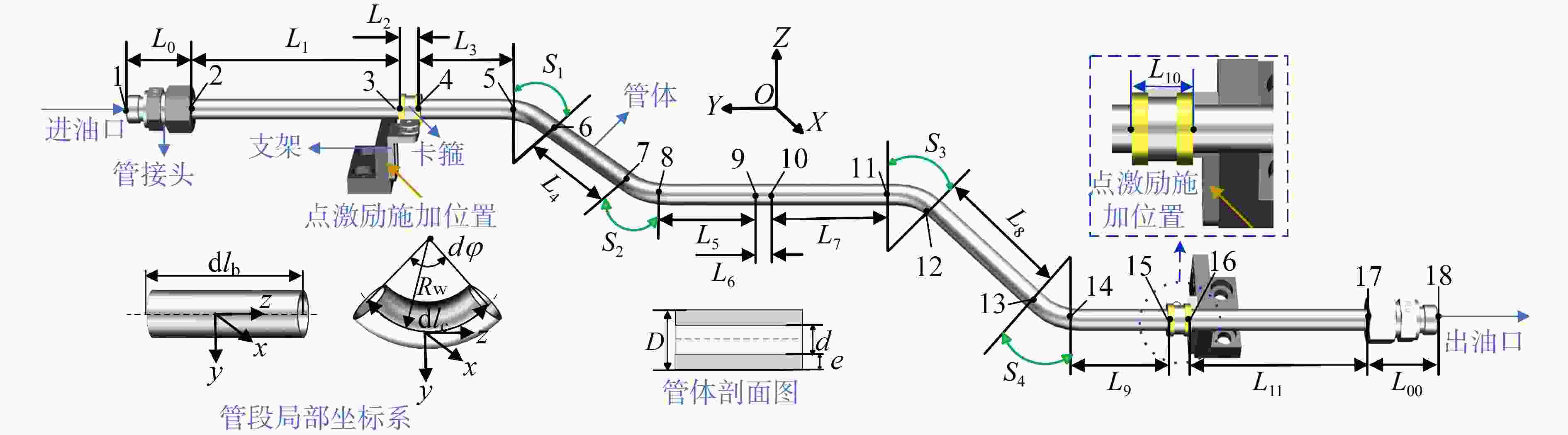
图 1 多点支撑下空间输流管路系统结构示意图
Figure 1. Schematic structure of spatial fluid-conveying piping system under multi-point supports
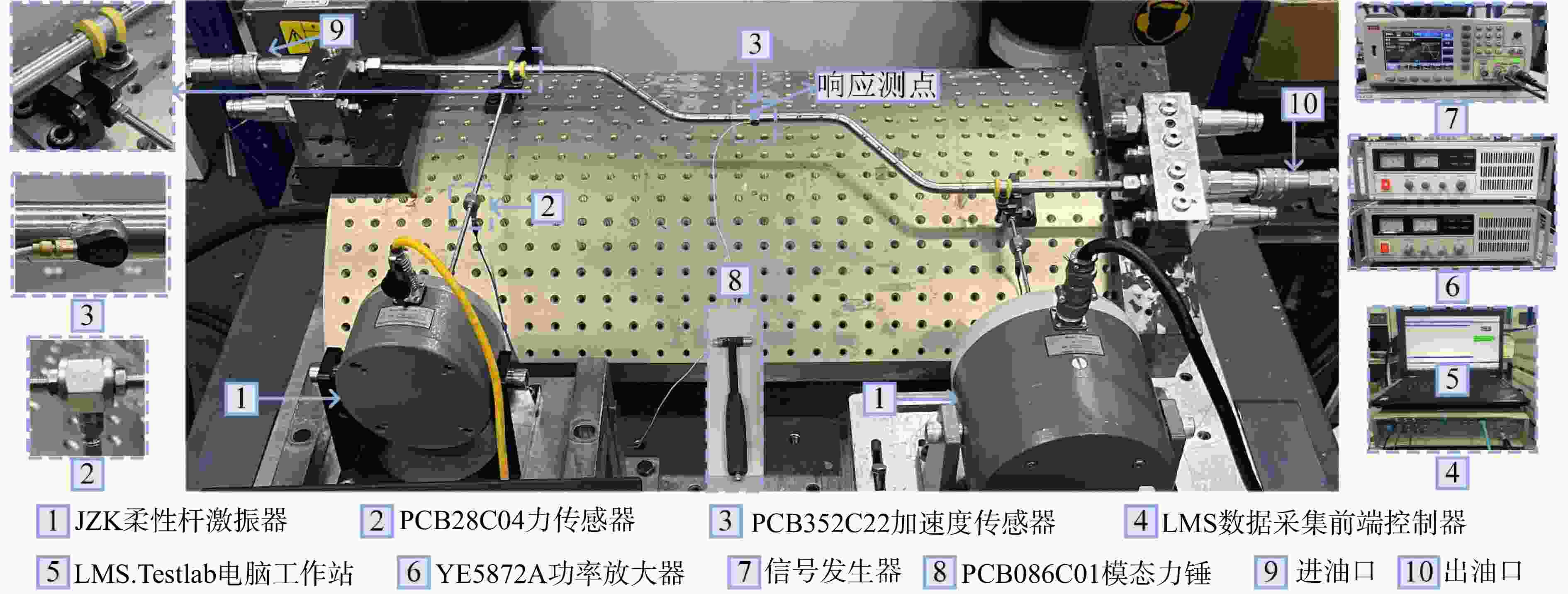
图 5 空间输流管路振动实验系统
Figure 5. Vibration experiment system for spatial fluid-conveying pipeline
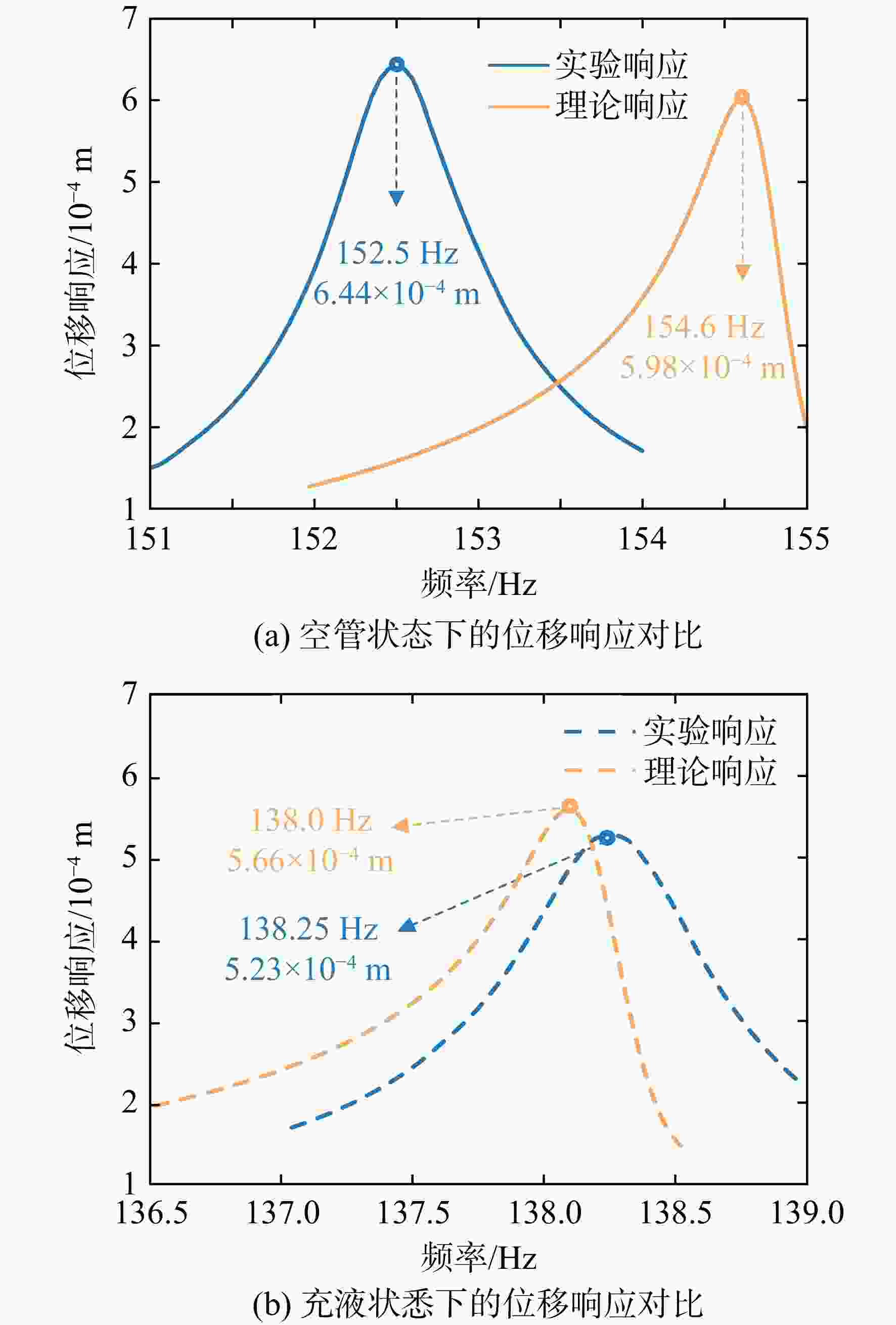
图 6 基于实验和理论模型获得的振动响应
Figure 6. Vibration response obtained by experimental and theoretical models
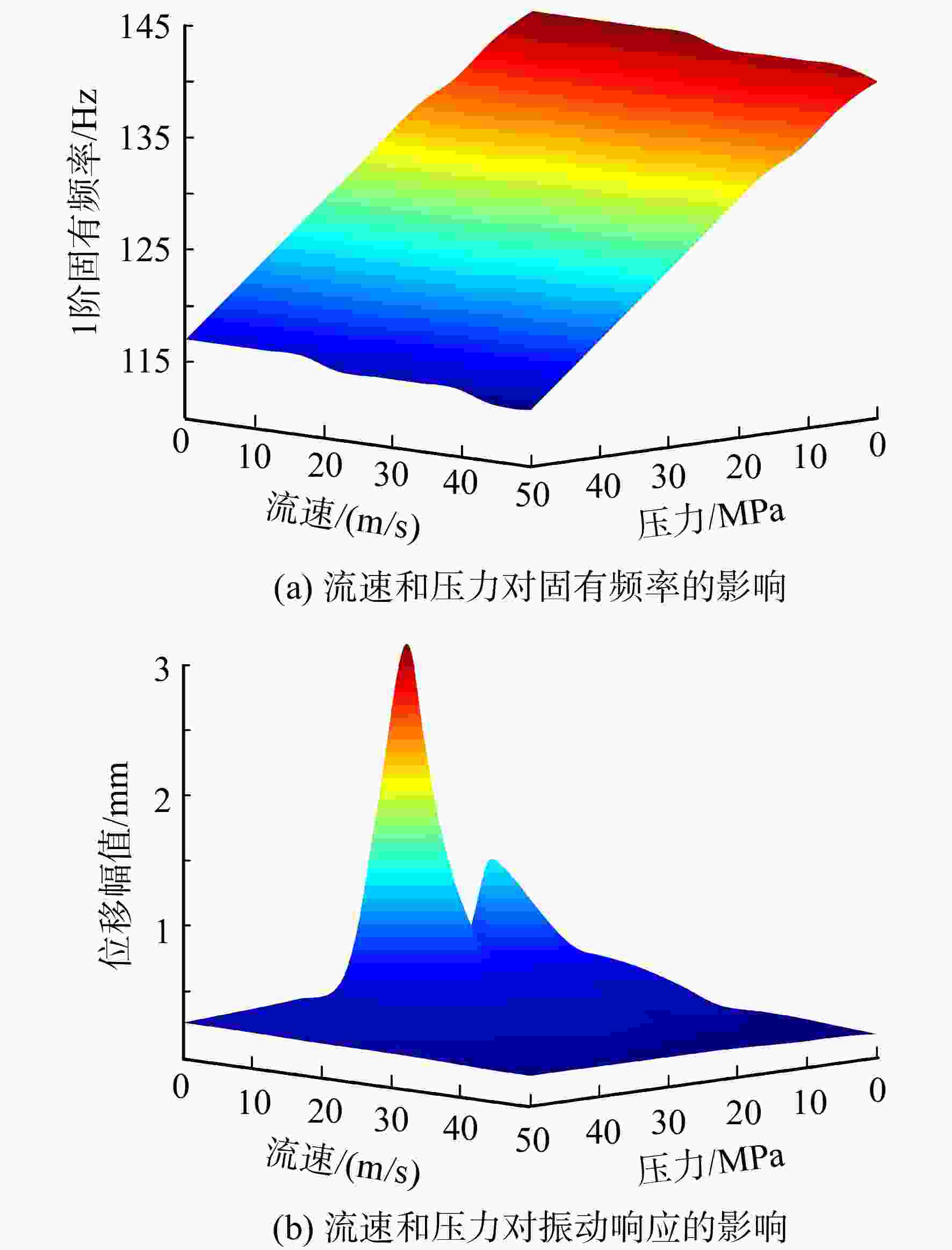
图 7 管内流体对管路系统振动特性的影响
Figure 7. Influence of fluid flow on the vibration characteristics of the piping system
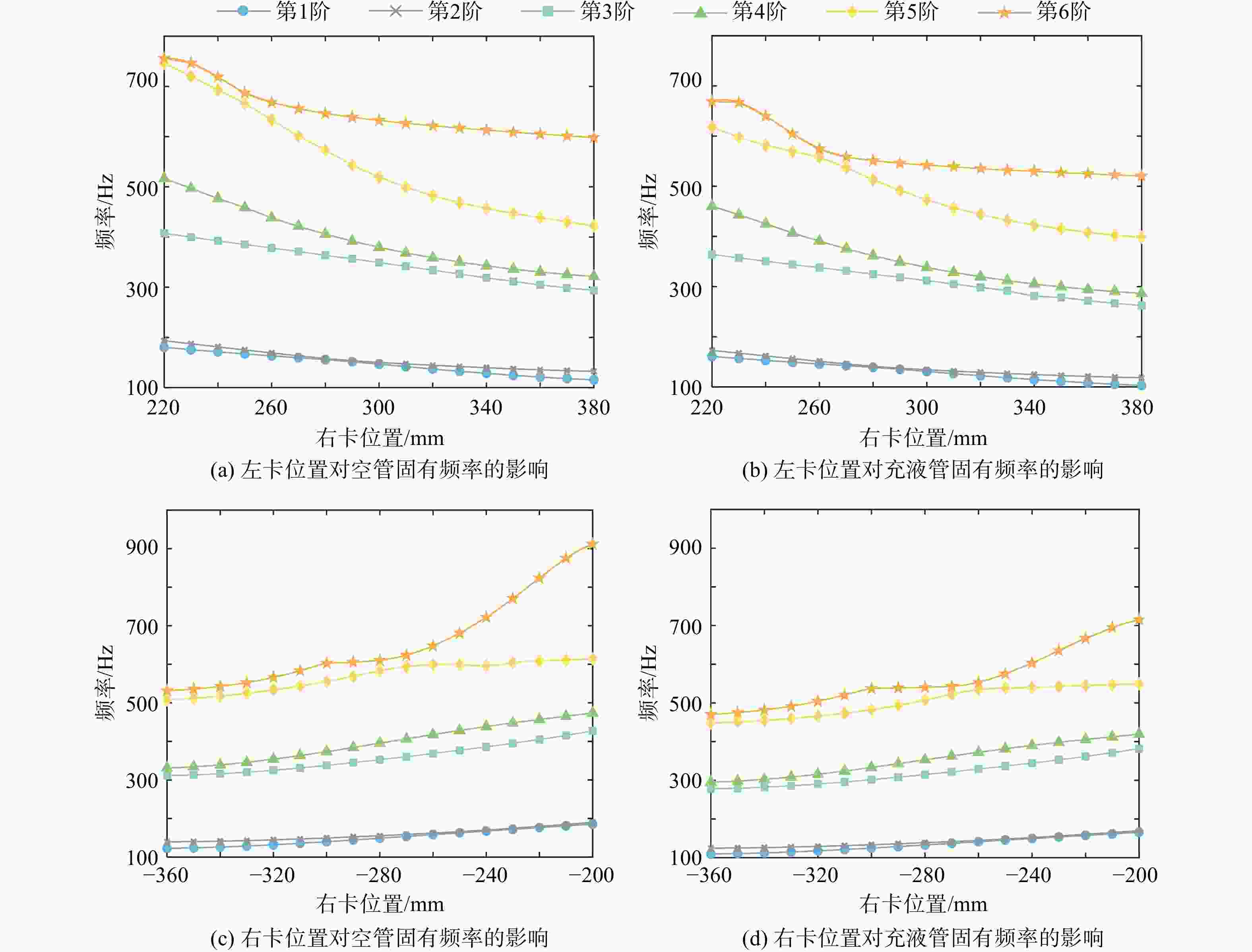
图 9 卡箍位置对管路系统固有频率的影响
Figure 9. The effect of clamp position on the natural frequency of the piping system
表 1 管体和流体的几何及材料参数
Table 1. Geometrical and material parameters of pipe and fluid
参数 数值 参数 数值 $ {\rho }_{\text{p}}/ (\mathrm{kg}/{\mathrm{m}}^{3}) $ 7800 $ {\rho }_{\text{f}}/ (\mathrm{kg}/{\mathrm{m}}^{3}) $ 865 $ {R}_{\text{w}} $/mm 35.00 $ \mu $ 0.29 D/mm 12.00 $ {D}_{\overline{j}} $/mm 24.00 d/mm 10.00 E/GPa 204.0 e/mm 1.00 G/GPa 79.38 L0/mm 27.00 L1/mm 117.0 L2/mm 15.00 L3/mm 64.54 L4/mm 108.6 L5/mm 64.54 L6/mm 15.00 L7/mm 64.82 L8/mm 95.48 L9/mm 64.82 L10/mm 15.00 L11/mm 89.00 S1/mm 29.11 S2/mm 29.11 S3/mm 28.64 S4/mm 28.64  下载: 导出CSV
表 2 辨识得到的卡箍刚度参数
Table 2. Recognized clamp stiffness parameters
参数 数值 参数 数值 $ {K}_{\overline{x}} $/105$ (\mathrm{N}/\mathrm{m}) $ 2.98 $ {K}_{{{\theta }_{\overline{x}}}} $/ $ (\mathrm{N}\cdot \mathrm{m}/\mathrm{rad}) $ 175 $ {K}_{\overline{y}} $/105$ (\mathrm{N}/\mathrm{m}) $ 5.65 $ {K}_{{{\theta }_{\overline{y}}}} $/ $ (\mathrm{N}\cdot \mathrm{m}/\mathrm{rad}) $ 387 $ {K}_{\overline{z}} $/106$ (\mathrm{N}/\mathrm{m}) $ 9.04 $ {K}_{{{\theta }_{\overline{z}}}} $/ $ (\mathrm{N}\cdot \mathrm{m}/\mathrm{rad}) $ 20.6
下载: 导出CSV
表 3 空管状态下管路系统固有频率
Table 3. Natural frequency of the piping system under empty conditions
阶次 理论模型频率/Hz 实验频率/Hz 偏差/% 有限元模型频率/Hz 偏差/% 1 155 152.50 1.61 150.79 2.72 2 159 158.45 0.35 162.88 2.44 3 352 356.40 1.25 360.31 2.36 4 400 413.04 3.26 391.91 2.02 5 603 585.51 2.90 589.58 2.22 6 659 630.72 4.29 670.13 1.60
下载: 导出CSV
表 4 充液状态下管路系统固有频率
Table 4. Natural frequency of the piping system under liquid-filled conditions
阶次 理论模型频率/Hz 实验频率/Hz 偏差/% 有限元模型频率/Hz 偏差/% 1 138 138.16 0.12 133.22 3.46 2 142 144.44 1.72 143.90 1.34 3 315 324.15 2.90 319.07 1.29 4 356 374.88 5.30 347.05 2.51 5 519 538.65 3.79 521.79 0.54 6 586 589.37 0.58 592.40 1.09
下载: 导出CSV
表 5 辨识得到的卡箍阻尼参数
Table 5. Recognized clamp damping parameters
参数 数值 参数 数值 $ {C}_{\overline{x}} $/$ (\mathrm{N}\cdot \mathrm{s}/\mathrm{m}) $ 3.3 $ {C}_{{{\theta }_{\overline{x}}}} $/10−3$ (\mathrm{N}\cdot \mathrm{m}\cdot \mathrm{s}/\mathrm{rad}) $ 3.97 $ {C}_{\overline{y}} $/$ (\mathrm{N}\cdot \mathrm{s}/\mathrm{m}) $ 6.0 $ {C}_{{{\theta }_{\overline{y}}}} $/10−3$ (\mathrm{N}\cdot \mathrm{m}\cdot \mathrm{s}/\mathrm{rad}) $ 8.81 $ {C}_{\overline{z}} $/$ (\mathrm{N}\cdot \mathrm{s}/\mathrm{m}) $ 186.0 $ {C}_{{{\theta }_{\overline{z}}}} $/10−4$ (\mathrm{N}\cdot \mathrm{m}\cdot \mathrm{s}/\mathrm{rad}) $ 4.70
下载: 导出CSV
表 6 左卡位置对管路系统振动特性的影响
Table 6. Effect of left-side clamp position on vibration characteristics of the piping system
Y坐标位置/mm 220 260 300 340 380 1阶共振频率/Hz 161 146 131 115 103 位移响应云图 


 下载: 导出CSV
表 7 右卡位置对管路系统振动特性的影响
Table 7. Effect of right-side clamp position on the vibration characteristics of the piping system
Y坐标位置/mm −200 −240 −280 −320 −360 1阶共振频率/Hz 161 149 133 118 110 位移响应云图 


 下载: 导出CSV
-
[1] Gao Peixin, Yu Tao, Zhang Yuanlin, et al. Vibration analysis and control technologies of hydraulic pipeline system in aircraft: a review[J]. Chinese Journal of Aeronautics, 2021, 34(4): 83-114. [2] 权凌霄, 孔祥东, 俞滨, 等. 液压管路流固耦合振动机理及控制研究现状与发展[J]. 机械工程学报, 2015, 51(18): 175-183. Quan Lingxiao, Kong Xiangdong, Yu Bin, et al. Research status and trends on fluid-structure interaction vibration mechanism and control of hydraulic pipeline[J]. Journal of Mechanical Engineering, 2015, 51(18): 175-183. (in ChineseQuan Lingxiao, Kong Xiangdong, Yu Bin, et al. Research status and trends on fluid-structure interaction vibration mechanism and control of hydraulic pipeline[J]. Journal of Mechanical Engineering, 2015, 51(18): 175-183. (in Chinese) [3] 李晖, 李韶亮, 孙凯华, 等. 面向复杂空间管路的最远传递路径-最小能量损耗判别准则与其减振应用[J]. 航空动力学报, 2025, 40(10): 174-184. Li Hui, Li Shaoliang, Sun Kaihua, et al. The farthest transfer path and minimum energy loss criterion for complex space pipelines and their vibration reduction applications[J]. Journal of Aerospace Power, 2025, 40(10): 174-184. (in ChineseLi Hui, Li Shaoliang, Sun Kaihua, et al. The farthest transfer path and minimum energy loss criterion for complex space pipelines and their vibration reduction applications[J]. Journal of Aerospace Power, 2025, 40(10): 174-184. (in Chinese) [4] Chai Qingdong, Zeng Jin, Ma Hui, et al. A dynamic modeling approach for nonlinear vibration analysis of the L-type pipeline system with clamps[J]. Chinese Journal of Aeronautics, 2020, 33(12): 3253-3265. [5] Wen Hua bin, Yang Yiren, Li Yundong. Study on the stability of multi-span U-shaped pipe conveying fluid with complex constraints[J]. International Journal of Pressure Vessels and Piping, 2023, 203: 104911. [6] Ji Hejiong, Bai Changqing, Han Shengliang. Dynamic finite element modeling and experimental research of the fluid-filled pipeline[J]. Chinese Journal of Applied Mechanics, 2013, 30(3): 422-427. [7] Chen Weijiao, Cao Yiming, Guo Xumin, et al. Semi-analytical dynamic modeling and fluid-structure interaction analysis of L-shaped pipeline[J]. Thin-Walled Structures, 2024, 196: 111485. [8] Ma Hongwei, Ji Wenhao, Zhang Yu, et al. Frequency veering and coupled vibration of fluid-transporting parallel pipeline systems with constrained layer damping[J]. Ocean Engineering, 2025, 321: 120306. [9] Liang Xu, Zha Xing, Jiang Xue, et al. Semi-analytical solution for dynamic behavior of a fluid-conveying pipe with different boundary conditions[J]. Ocean Engineering, 2018, 163: 183-190. [10] Zhao Qianli, Sun Zhili. Flow-induced vibration of curved pipe conveying fluid by a new transfer matrix method[J]. Engineering Applications of Computational Fluid Mechanics, 2018, 12(1): 780-790. [11] Cao Yinhang, Liu Gongmin, Hu Zhi. Vibration calculation of pipeline systems with arbitrary branches by the hybrid energy transfer matrix method[J]. Thin-Walled Structures, 2023, 183: 110442. [12] Gao Haihai, Guo Changhong, Quan Lingxiao. Fluid-structure interaction analysis of aircraft hydraulic pipe with complex constraints based on discrete time transfer matrix method[J]. Applied Sciences, 2021, 11(24): 11918. [13] Ji Wenhao, Sun Wei, Du Dongxu, et al. Dynamics modeling and vibration transmission visualization of fluid-conveying series pipe system based on FEM-TMM[J]. Ocean Engineering, 2023, 280: 114693. [14] 李占营, 王建军, 邱明星. 简谐激励下柔性卡箍支承管路系统响应[J]. 航空动力学报, 2017, 32(11): 2705-2712. Li Zhanying, Wang Jianjun, Qiu Mingxing. Responses of pipe system with flexible clamp under harmonic excitation[J]. Journal of Aerospace Power, 2017, 32(11): 2705-2712. (in ChineseLi Zhanying, Wang Jianjun, Qiu Mingxing. Responses of pipe system with flexible clamp under harmonic excitation[J]. Journal of Aerospace Power, 2017, 32(11): 2705-2712. (in Chinese) [15] 李晖, 谷建霏, 李济楠, 等. 多源激励下航空发动机L型管路动力学建模与验证[J]. 航空学报, 2024, 45(12): 134-145. Li Hui, Gu Jianfei, Li Jinan, et al. Dynamics modeling and validation of L-shaped pipeline in aero-engine under multi-source excitations[J]. Acta Aeronautica et Astronautica Sinica, 2024, 45(12): 134-145. (in ChineseLi Hui, Gu Jianfei, Li Jinan, et al. Dynamics modeling and validation of L-shaped pipeline in aero-engine under multi-source excitations[J]. Acta Aeronautica et Astronautica Sinica, 2024, 45(12): 134-145. (in Chinese)[万方] [16] Li Zhanying, Wang Jianjun, Qiu Mingxing. Dynamic characteristics of fluid-conveying pipes with piecewise linear support[J]. International Journal of Structural Stability and Dynamics, 2016, 16(6): 1550025. [17] Li Zhezhu, Gao Peixin, Zhao Dazhe, et al. Fault diagnosis and location of the aero-engine hydraulic pipeline based on Kalman filter[J]. Advances in Mechanical Engineering, 2017, 9(12): 168781401774281. [18] Zhou K, Ni Q, Dai H L, et al. Nonlinear forced vibrations of supported pipe conveying fluid subjected to an axial base excitation[J]. Journal of Sound and Vibration, 2020, 471: 115189. [19] Zhou K, Ni Q, Wang L, et al. Planar and non-planar vibrations of a fluid-conveying cantilevered pipe subjected to axial base excitation[J]. Nonlinear Dynamics, 2020, 99(4): 2527-2549. [20] Zhou K, Yi H R, Dai H L, et al. Nonlinear analysis of L-shaped pipe conveying fluid with the aid of absolute nodal coordinate formulation[J]. Nonlinear Dynamics, 2022, 107(1): 391-412. [21] Ji Wenhao, Ma Hongwei, Liu Honghao, et al. Spectral element-finite element modeling and dynamic analysis of a fluid-delivering cracked pipe subjected to both pulsation and base excitations[J]. Thin-Walled Structures, 2024, 203: 112242. [22] Fu Guangming, Tuo Yuhang, Su Jian, et al. Nonlinear dynamics of viscoelastic pipe conveying pulsating fluid subjected to base excitation[J]. China Ocean Engineering, 2023, 37(5): 781-793. [23] Guo Xumin, Gu Jianfei, Li Hui, et al. Dynamic modeling and experimental verification of an L-shaped pipeline in aero-engine subjected to base harmonic and random excitations[J]. Applied Mathematical Modelling, 2024, 126: 249-265. [24] Guo Xumin, Gao Peixin, Ma Hui, et al. Vibration characteristics analysis of fluid-conveying pipes concurrently subjected to base excitation and pulsation excitation[J]. Mechanical Systems and Signal Processing, 2023, 189: 110086. [25] Cao Yiming, Ma Hui, Guo Xumin, et al. Experimental study on pressure pulsation and acceleration response of fluid conveying pipeline under multi-excitation[J]. Journal of Pressure Vessel Technology, 2023, 145(5): 051401. [26] Ji Wenhao, Ma Hongwei, Wang Donghai, et al. Reduced-order modeling and vibration transfer analysis of fluid-conveying parallel pipeline system using hybrid FE and extended MSTMM[J]. Mechanical Systems and Signal Processing, 2025, 230: 112633. [27] Ji Wenhao, Sun Wei, Du Dongxu, et al. Dynamics modeling and stress response solution for liquid-filled pipe system considering both fluid velocity and pressure fluctuations[J]. Thin-Walled Structures, 2023, 188: 110831. -


 点击查看大图

计量
- 文章访问数: 252
- HTML浏览量: 153
- PDF量: 17
- 被引次数: 0