






Helicopter flight state recognition method based on temporal attention and state transition constraints
-
摘要:
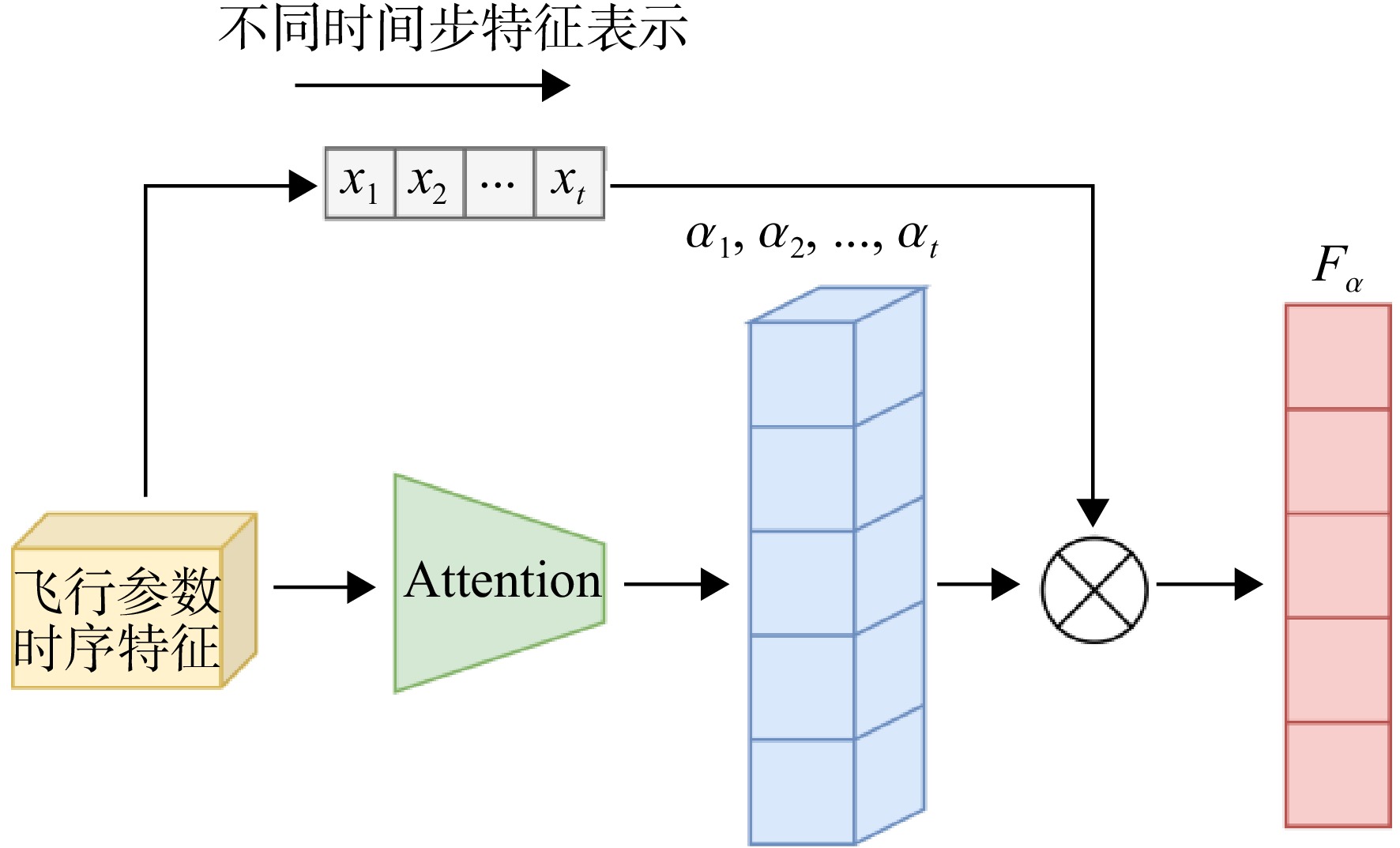
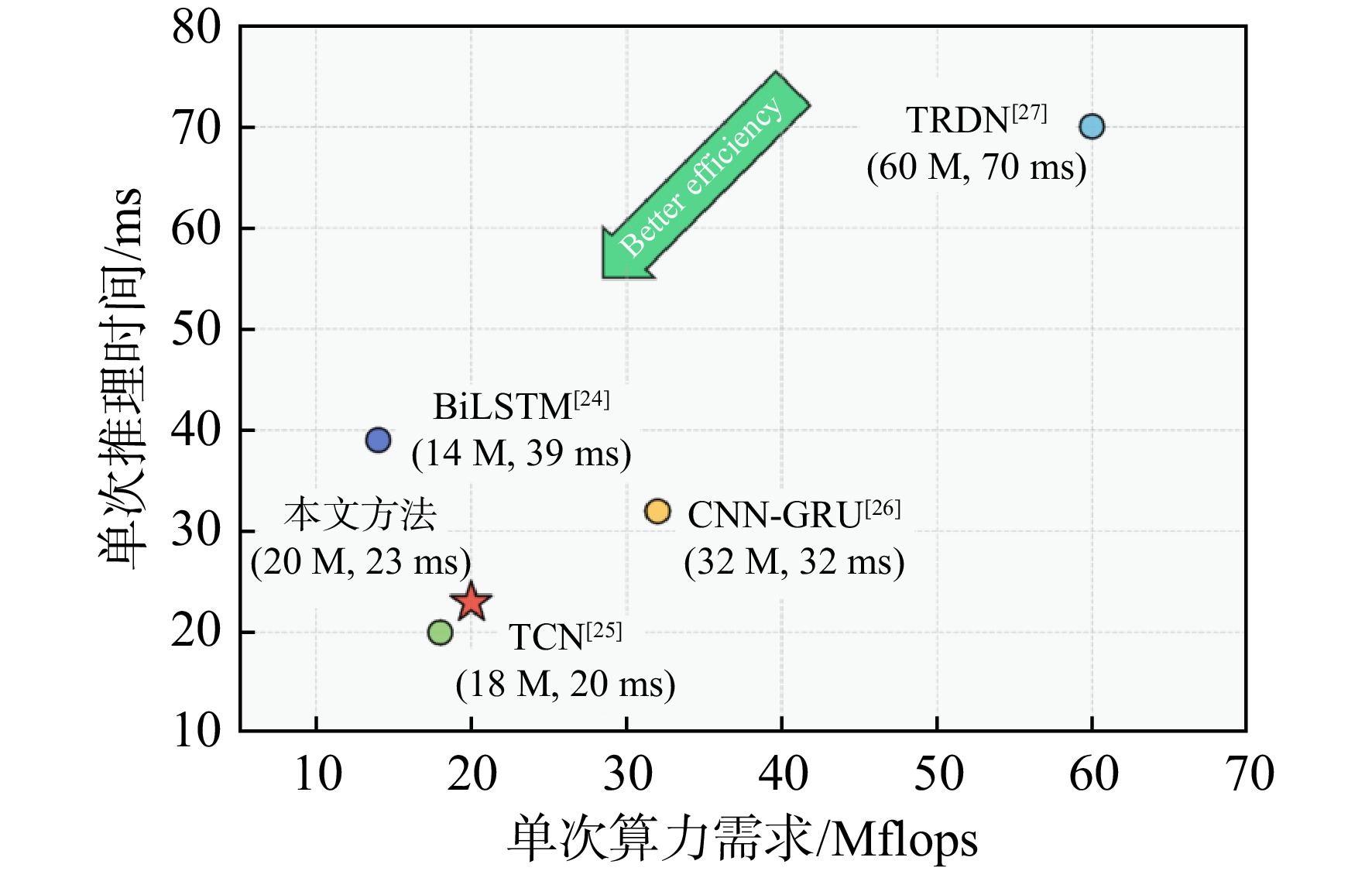
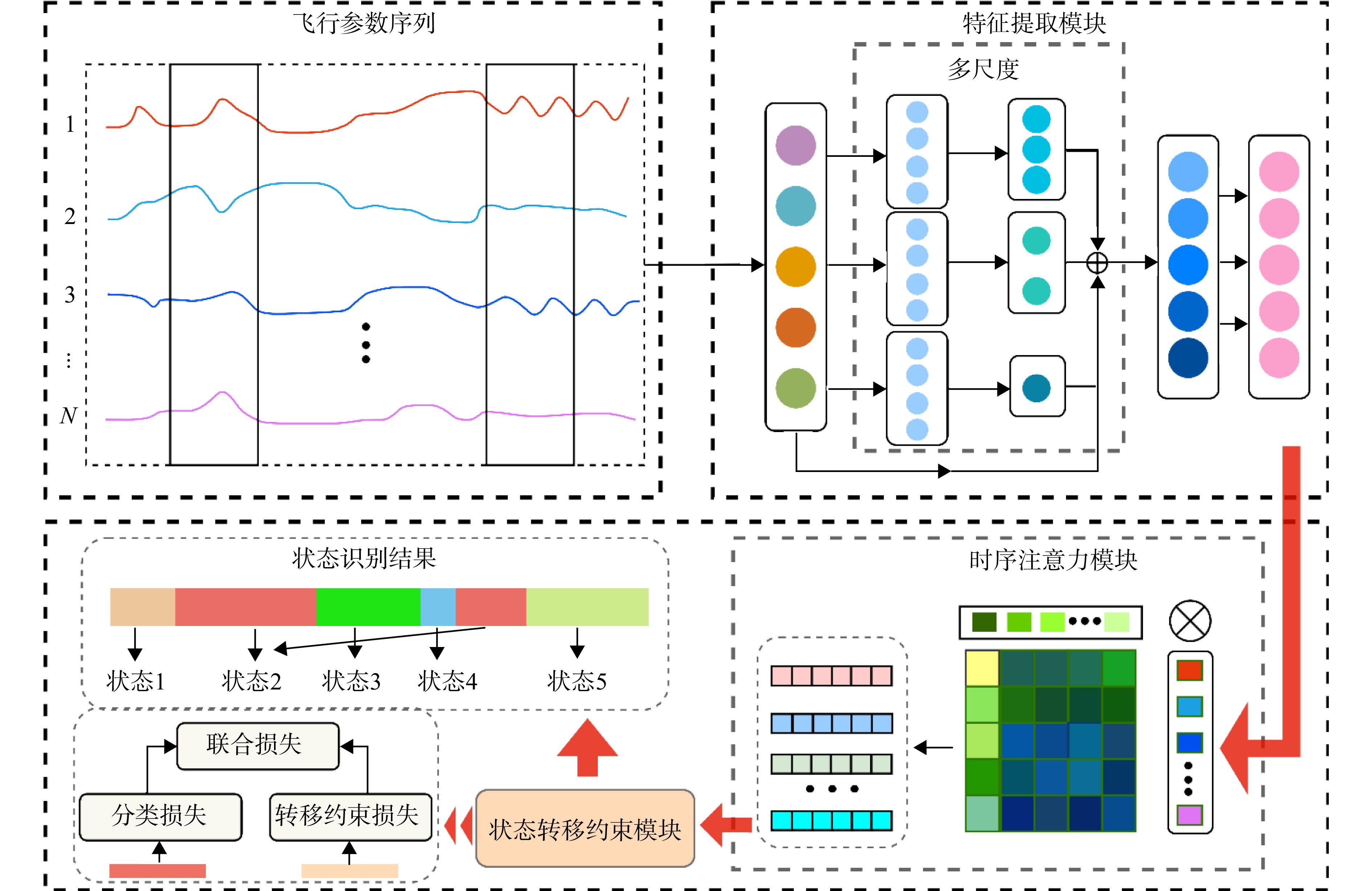
针对现有飞行状态识别方法未考虑到状态的时序性以及飞行的规律性,导致非平稳飞行条件下识别准确率不足的问题,提出一种基于时序注意力与状态转移约束的直升机飞行状态识别方法。引入多路感知残差模块,有效提取飞行参数的关键表征信息;设计时序注意力模块,捕捉飞行参数在时间维度上的关联性;构建马尔可夫状态转移约束模块,结合状态跳转先验,输出连续且符合飞行规律的状态识别结果。在某型直升机实际飞行中采集的飞行参数数据集上的实验表明,所提方法与主流方法相比,在非平稳飞行条件下状态识别的精确率、召回率以及F1分数分别提升2.88%、2.73%和2.81%。模型单次推理时间和计算量为23 ms与20 Mflops,充分说明该方法在保证较高识别精度的同时兼顾了运行效率,具有重要的工程应用价值。
Abstract:To address the issue that existing flight state recognition methods fail to consider the temporal sequence and regularity of flight, resulting in insufficient recognition accuracy under non-stationary flight conditions, a helicopter flight state recognition method based on temporal attention and state transition constraints was proposed. A multi-channel perceptual residual module was introduced to effectively extract key representation information from flight parameters. A temporal attention module was designed to capture the correlation of flight parameters over time. A Markov state transition constraint module was constructed, combining state transition priors to output continuous and flight-regulated state recognition results. Experiments on a flight parameter dataset collected from an actual helicopter flight indicated that, compared with mainstream methods, the proposed method improved the precision, recall, and F1 score of state recognition under non-stationary flight conditions by 2.88%, 2.73%, and 2.81%, respectively. The model achieved a single inference time of 23 ms and a computational cost of 20 Mflops, thus demonstrating significant engineering application value.
-
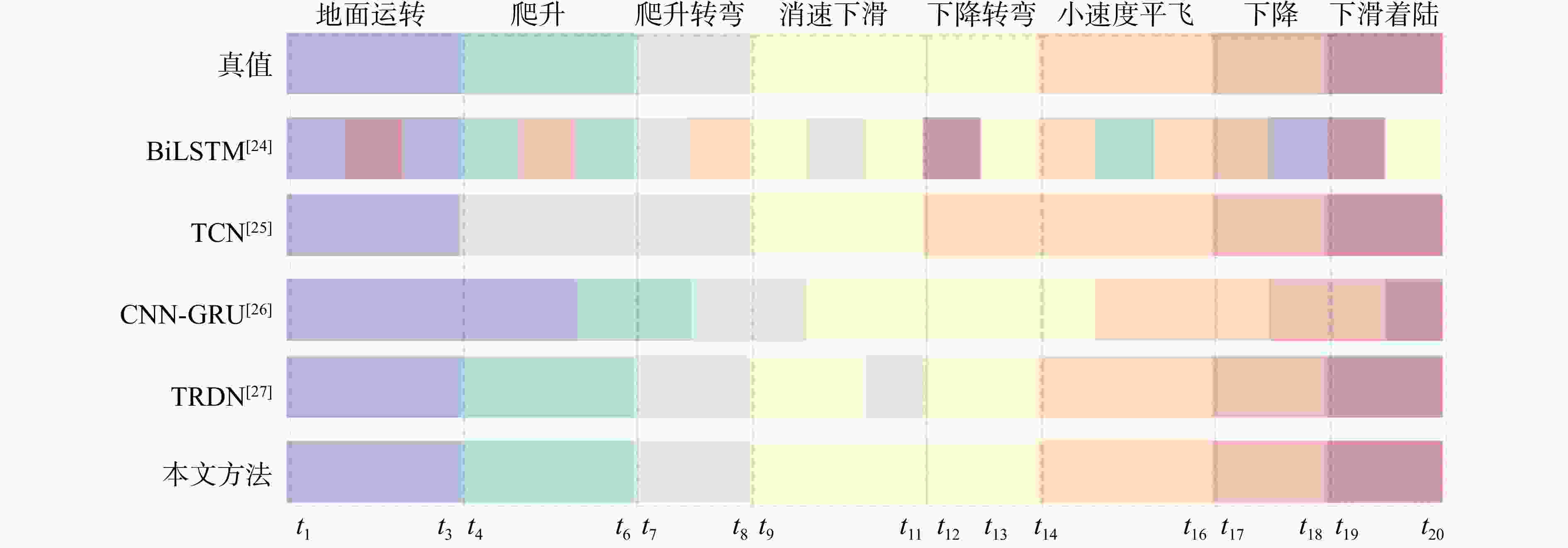
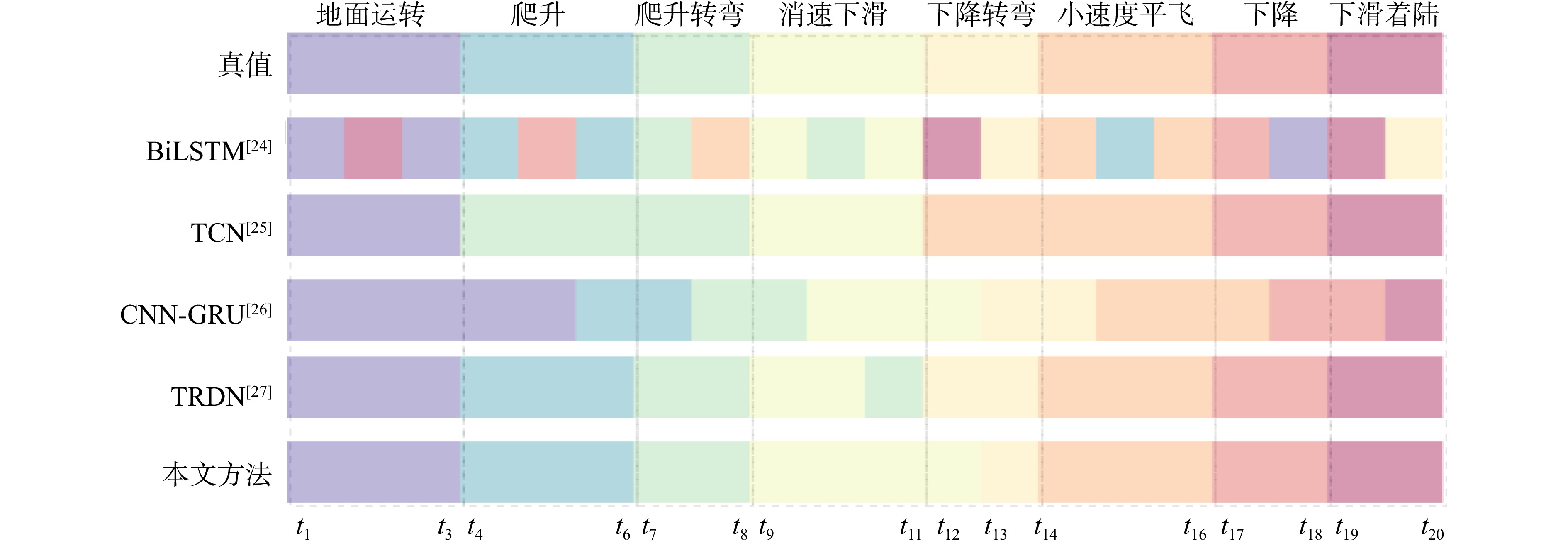
图 4 不同方法在飞行状态识别任务中的定性比较
Figure 4. Qualitative comparison of different methods for flight state recognition
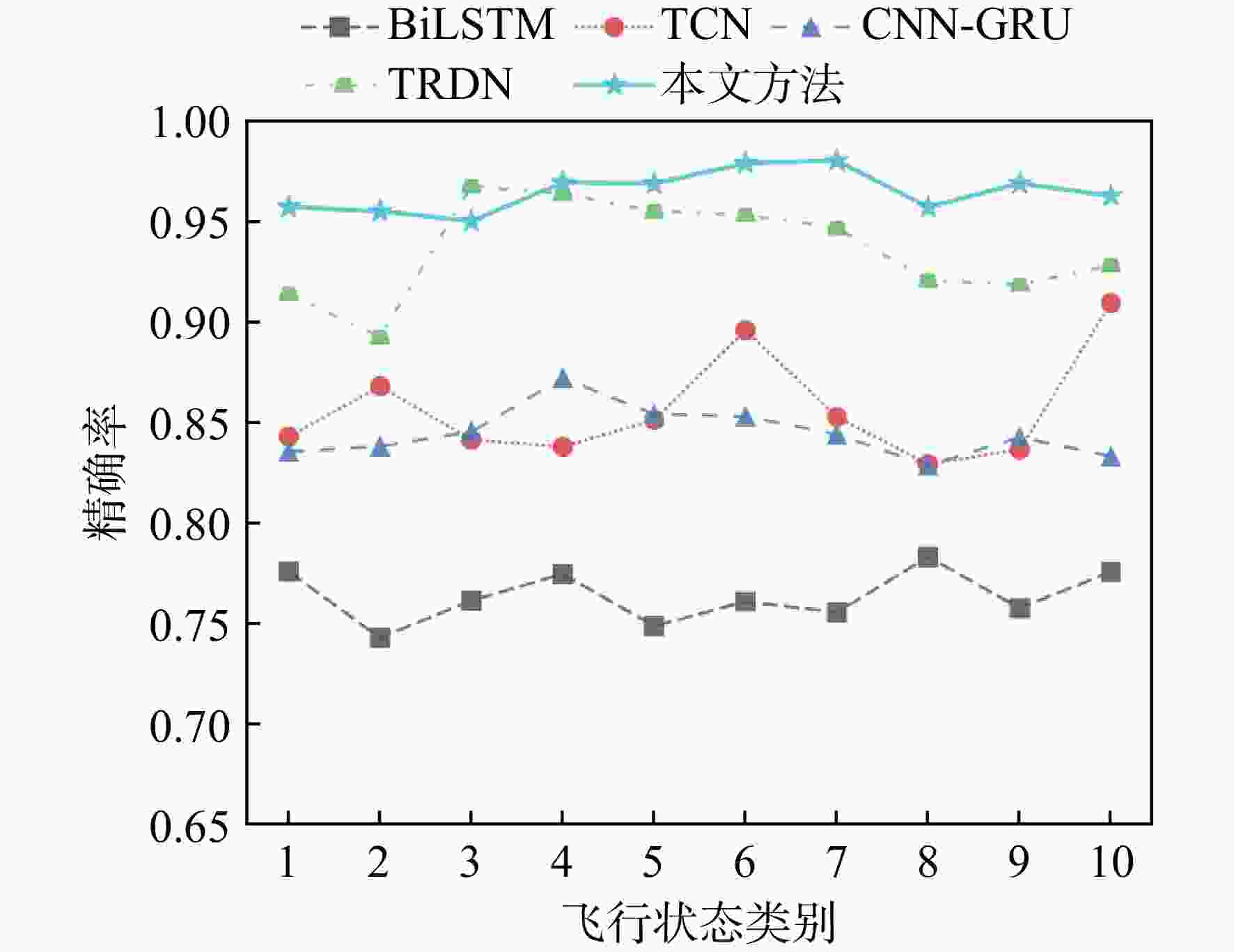
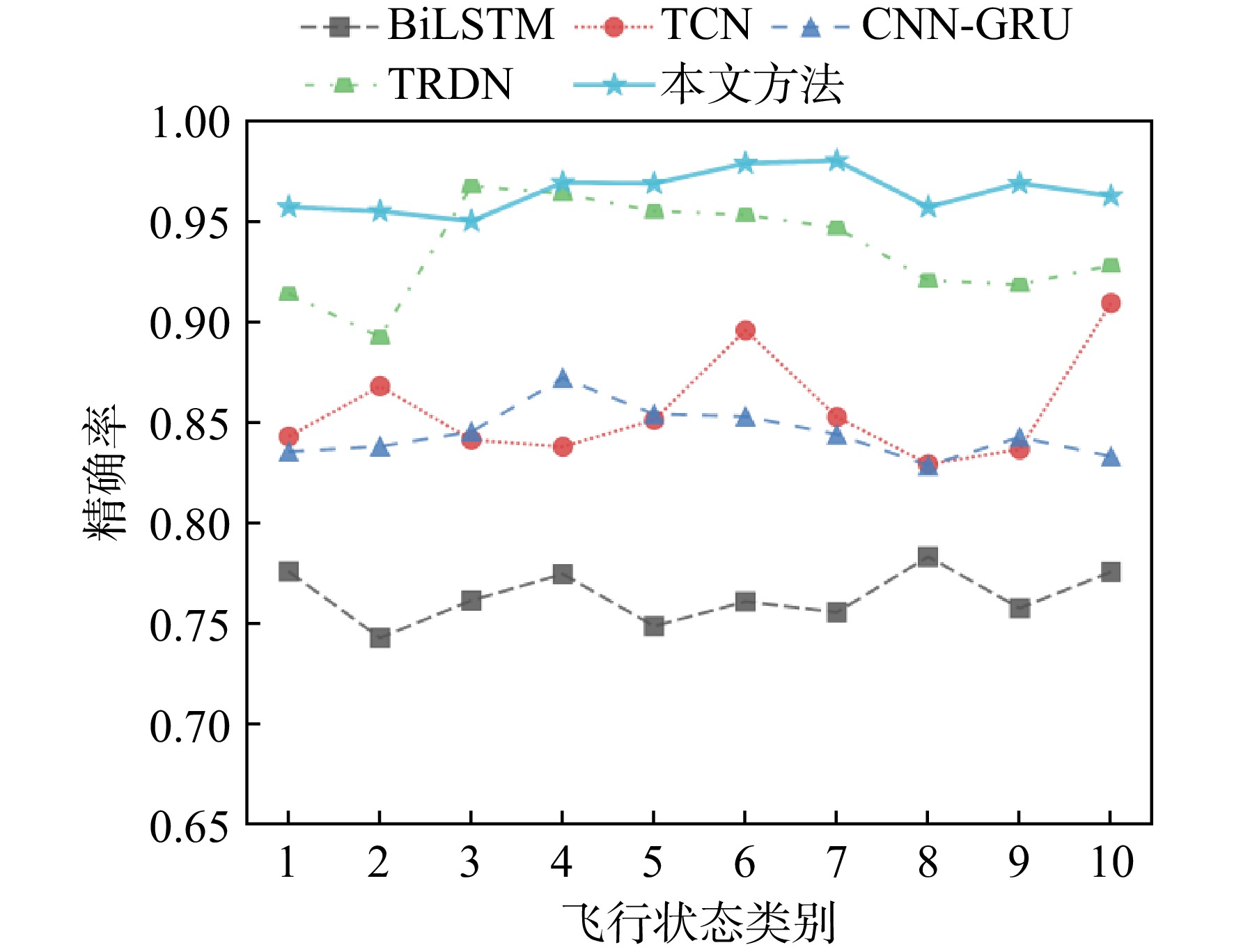
图 5 不同方法部分状态精确率对比
Figure 5. Precision comparison on partial states across different methods
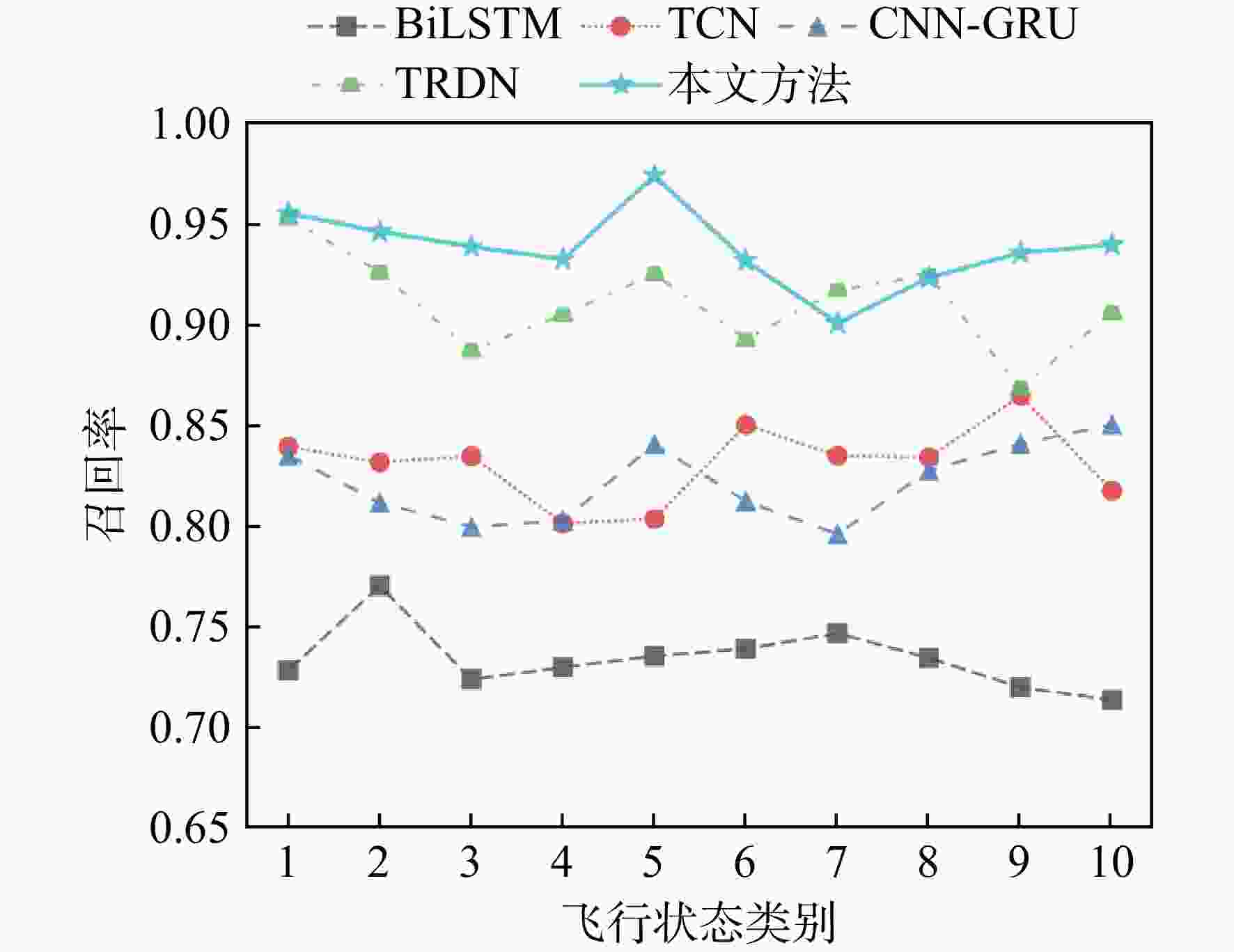
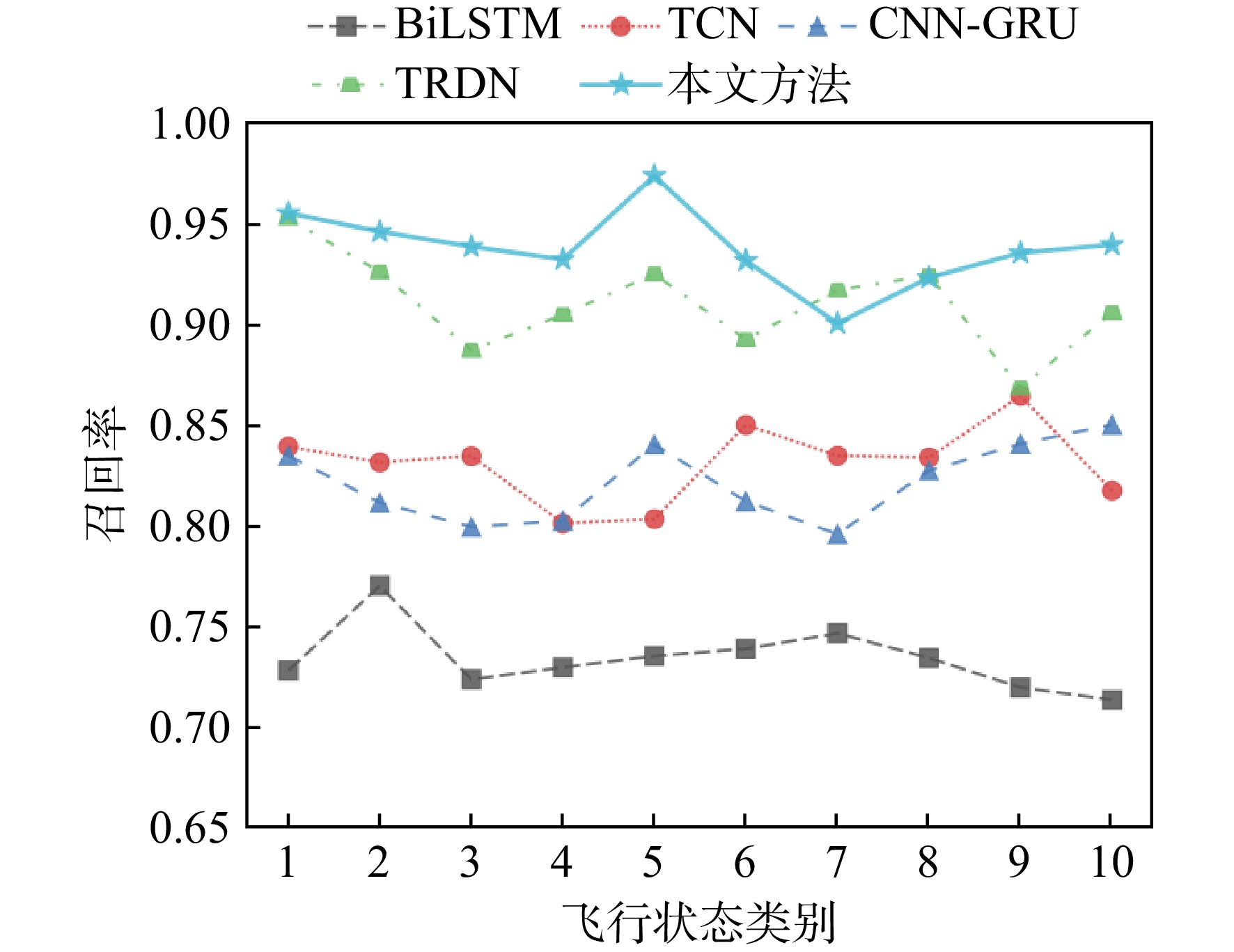
图 6 不同方法部分状态召回率对比
Figure 6. Recall comparison on partial states across different methods
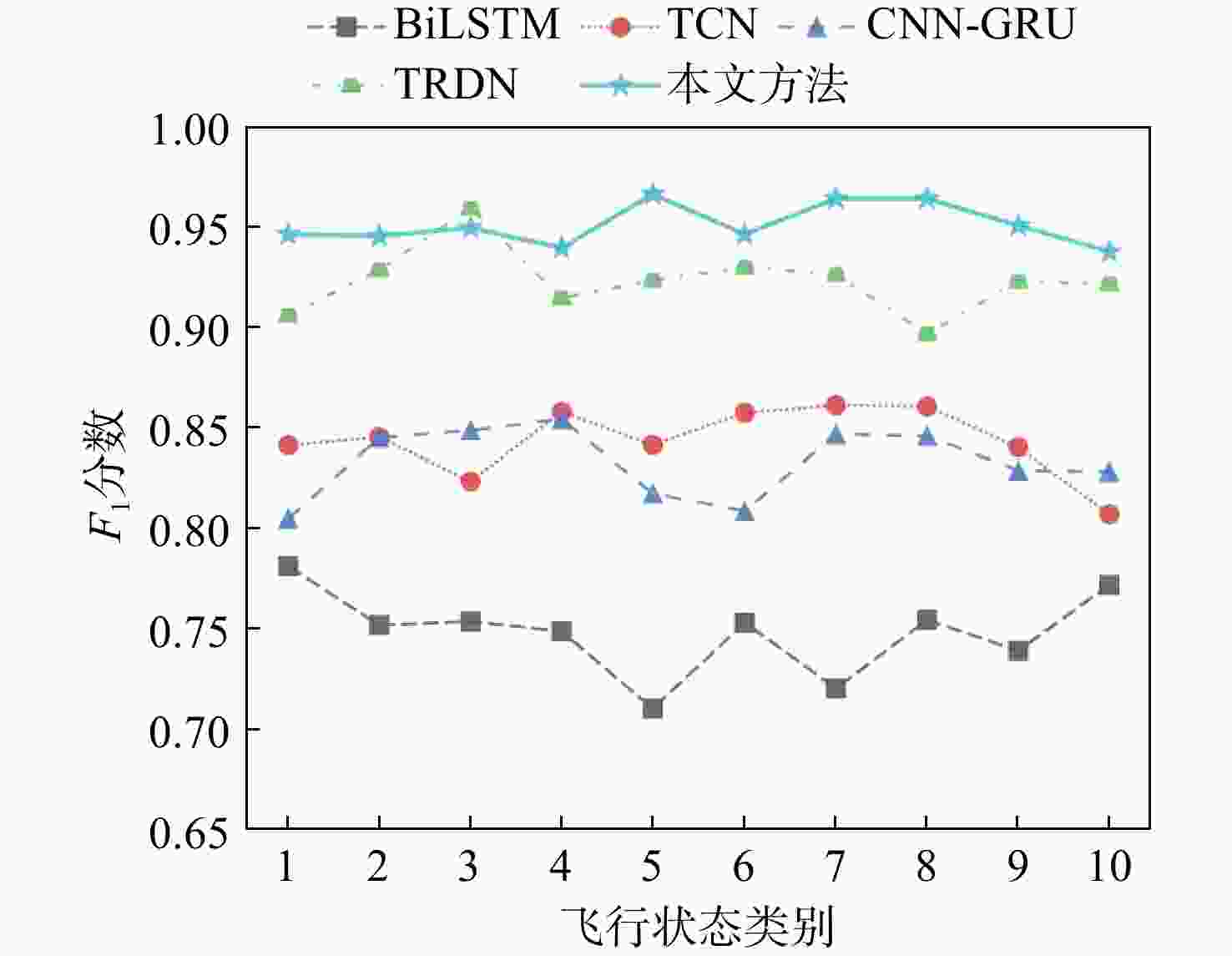
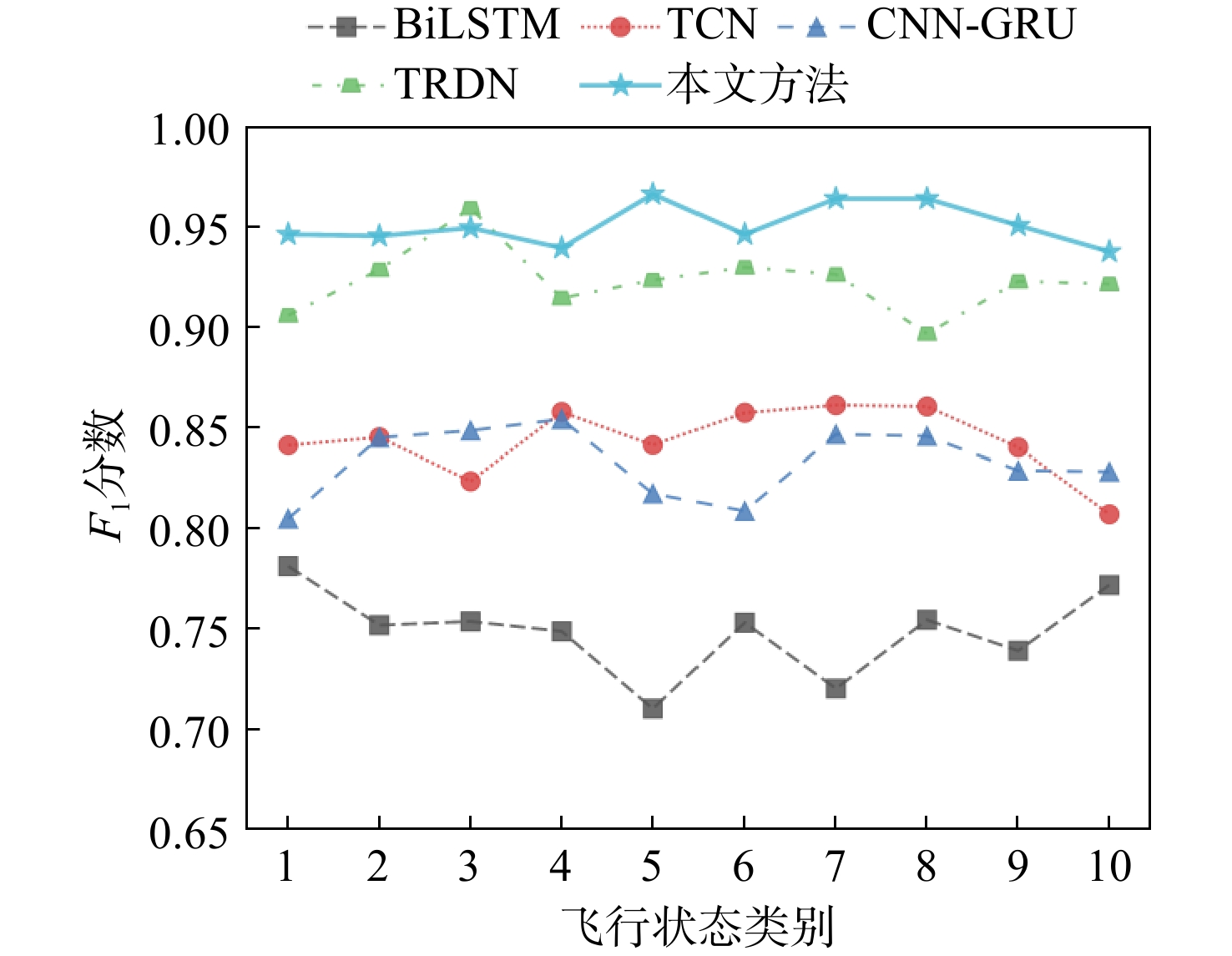
图 7 不同方法部分状态F1分数对比
Figure 7. F1 score comparison on partial states across different methods
表 1 平稳飞行状态判定阈值
Table 1. Thresholds for determining stationary flight states
飞行参数 一阶变化率阈值 东/北向速度/(m/s) 1.5 天向速度/(m/s) 1 俯仰角/(°) 2.5 航向角/(°) 3 法向过载 0.12g 注:法向过载用重力加速度g表示。  下载: 导出CSV
表 2 平稳飞行状态识别结果表
Table 2. Recognition results of stationary flight states
编号 飞行状态名称 精确率/% 召回率/% F1分数/% 1 地面运转 99.85 99.12 99.48 2 有地效悬停 98.85 98.24 98.54 3 无地效悬停 99.12 98.64 98.88 4 下降 99.35 98.84 99.09 5 近地面小速度平飞(v<100 km/h, h<30 m) 98.92 98.34 98.63 6 小速度平飞(v<100 km/h) 99.78 99.02 99.40 7 中速度平飞(v=100~180 km/h) 99.42 98.68 99.05 8 大速度平飞(v>100 km/h) 99.56 98.94 99.25 9 平飞转弯(v=130 km/h) 99.28 99.04 99.16 10 平飞转弯(v=150 km/h) 99.15 98.45 98.80 11 平飞转弯(v=180 km/h) 99.04 98.32 98.68 注:v表示飞行速度;h表示飞行高度。
下载: 导出CSV
表 3 非平稳飞行状态识别结果表
Table 3. Recognition results of non-stationary flight states
编号 飞行状态名称 精确率/% 召回率/% F1分数/% 12 俯冲拉起 95.80 93.20 94.48 13 滑跑起飞 98.00 95.79 96.88 14 垂直起飞 95.45 92.80 94.11 15 悬停左转弯 95.55 92.70 94.10 16 悬停右转弯 95.85 93.85 94.84 17 垂直着陆 98.66 94.62 96.60 18 爬升 96.25 93.80 95.01 19 爬升转弯 96.15 93.90 95.01 20 匀速下滑 96.00 93.15 94.55 21 消速下滑 95.85 93.25 94.53 22 下降转弯 97.99 94.84 96.39 23 下滑着陆 95.90 93.75 94.81 24 小速度段增速飞行(v<140 km/h) 95.95 94.00 94.97 25 大速度段增速飞行(v>140 km/h) 95.80 92.75 94.25 26 增速转弯 97.64 94.81 96.20 27 减速转弯 96.35 93.75 95.03 28 小速度段减速飞行(v<140 km/h) 98.30 94.12 96.16 29 大速度段减速飞行(v>140 km/h) 95.55 92.85 94.18
下载: 导出CSV
表 4 消融实验
Table 4. Ablation study
序号 时序注意力 状态转移约束 精确率/% 召回率/% F1分数/% 实验1 × × 77.18 74.86 75.99 实验2 √ × 87.41 84.53 85.95 实验3 × √ 85.92 83.61 84.75 实验4 √ √ 96.50 93.77 95.12
下载: 导出CSV
-
[1] 方伟, 王玉, 闫文君, 等. 基于神经网络的符号化飞行动作识别[J]. 系统工程与电子技术, 2022, 44(3): 737-745. Fang Wei, Wang Yu, Yan Wenjun, et al. Symbolized flight action recognition based on neural network[J]. Systems Engineering and Electronics, 2022, 44(3): 737-745. (in ChineseFang Wei, Wang Yu, Yan Wenjun, et al. Symbolized flight action recognition based on neural network[J]. Systems Engineering and Electronics, 2022, 44(3): 737-745. (in Chinese) [2] Leoni J, Zinnari F, Villa E, et al. Flight regimes recognition in actual operating conditions: a functional data analysis approach[J]. Engineering Applications of Artificial Intelligence, 2022, 114: 105016. doi: 10.1016/j.engappai.2022.105016 [3] Wang Yongjun, Dong Jiang, Liu Xiaodong, et al. Identification and standardization of maneuvers based upon operational flight data[J]. Chinese Journal of Aeronautics, 2015, 28(1): 133-140. doi: 10.1016/j.cja.2014.12.026 [4] Sun J, Ellerbroek J, Hoekstra J. Large-scale flight phase identification from ADS-B data using machine learning methods[C]//Proceedings of 7th International Conference on Research in Air Transportation. Philadelphia, US: ICRAT, 2016: 1-7. [5] 潘海洋, 杨宇, 郑近德, 等. 基于径向基函数的变量预测模型模式识别方法[J]. 航空动力学报, 2017, 32(2): 500-506. Pan Haiyang, Yang Yu, Zheng Jinde, et al. Variable predictive model based RBF class discriminate method[J]. Journal of Aerospace Power, 2017, 32(2): 500-506. (in ChinesePan Haiyang, Yang Yu, Zheng Jinde, et al. Variable predictive model based RBF class discriminate method[J]. Journal of Aerospace Power, 2017, 32(2): 500-506. (in Chinese) [6] 高健桐. 基于BP神经网络的直升机飞行状态识别[J]. 直升机技术, 2022(1): 25-28, 35. Gao Jiantong. Helicopter flight status recognition based on BP neural network[J]. Helicopter Technique, 2022(1): 25-28, 35. (in ChineseGao Jiantong. Helicopter flight status recognition based on BP neural network[J]. Helicopter Technique, 2022(1): 25-28, 35. (in Chinese) [7] 熊邦书, 刘雨, 莫燕, 等. 基于SVM的直升机飞行状态识别[J]. 应用科学学报, 2016, 34(4): 469-474. Xiong Bangshu, Liu Yu, Mo Yan, et al. Recognition of helicopter flight condition based on support vector machine[J]. Journal of Applied Sciences, 2016, 34(4): 469-474. (in ChineseXiong Bangshu, Liu Yu, Mo Yan, et al. Recognition of helicopter flight condition based on support vector machine[J]. Journal of Applied Sciences, 2016, 34(4): 469-474. (in Chinese) [8] 王锦盛, 熊邦书, 莫燕, 等. 基于随机森林的直升机飞行状态识别方法[J]. 计算机工程与应用, 2017, 53(17): 149-152, 159. Wang Jinsheng, Xiong Bangshu, Mo Yan, et al. Recognition method of helicopter flight condition based on random forest[J]. Computer Engineering and Applications, 2017, 53(17): 149-152, 159. (in ChineseWang Jinsheng, Xiong Bangshu, Mo Yan, et al. Recognition method of helicopter flight condition based on random forest[J]. Computer Engineering and Applications, 2017, 53(17): 149-152, 159. (in Chinese) [9] Wu E Q, Tang Zhiri, Hu Ruihan, et al. Flight situation recognition under different weather conditions[J]. IEEE Transactions on Aerospace and Electronic Systems, 2021, 57(3): 1753-1767. doi: 10.1109/TAES.2020.3048777 [10] 程穆威, 杨晓光, 范永升, 等. 基于LSTM的航空发动机涡轮盘局部服役温度-应力快速预测方法[J]. 航空动力学报, 2025, 40(10): 20240547. Cheng Muwei, Yang Xiaoguang, Fan Yongsheng, et al. Rapid prediction method for local service temperature and stress on aeroengine turbine disks based on LSTM network[J]. Journal of Aerospace Power, 2025, 40(10): 20240547. (in ChineseCheng Muwei, Yang Xiaoguang, Fan Yongsheng, et al. Rapid prediction method for local service temperature and stress on aeroengine turbine disks based on LSTM network[J]. Journal of Aerospace Power, 2025, 40(10): 20240547. (in Chinese) [11] 涂景奇, 董一群, 赵云妹. 基于LSTM深度神经网络的飞行机动识别方法研究[J]. 航空电子技术, 2024, 55(3): 36-41. Tu Jingqi, Dong Yiqun, Zhao Yunmei. Research on flight maneuver recognition method based on LSTM deep neural network[J]. Avionics Technology, 2024, 55(3): 36-41. (in ChineseTu Jingqi, Dong Yiqun, Zhao Yunmei. Research on flight maneuver recognition method based on LSTM deep neural network[J]. Avionics Technology, 2024, 55(3): 36-41. (in Chinese) [12] 赵智伟, 袁伟伟, 关东海. 基于Multivariate BiLSTM-FCNs的机动实时识别方法[J]. 航空计算技术, 2023, 53(2): 65-69. Zhao Zhiwei, Yuan Weiwei, Guan Donghai. A real-time identification method for maneuvers based on multivariate BiLSTM-FCNs[J]. Aeronautical Computing Technique, 2023, 53(2): 65-69. (in ChineseZhao Zhiwei, Yuan Weiwei, Guan Donghai. A real-time identification method for maneuvers based on multivariate BiLSTM-FCNs[J]. Aeronautical Computing Technique, 2023, 53(2): 65-69. (in Chinese) [13] 李超, 张原, 赵文飞, 等. 基于聚焦注意力机制的飞行动作识别方法[J]. 电光与控制, 2023, 30(6): 89-95. Li Chao, Zhang Yuan, Zhao Wenfei, et al. Flight action recognition method based on focus attention mechanism[J]. Electronics Optics & Control, 2023, 30(6): 89-95. (in ChineseLi Chao, Zhang Yuan, Zhao Wenfei, et al. Flight action recognition method based on focus attention mechanism[J]. Electronics Optics & Control, 2023, 30(6): 89-95. (in Chinese) [14] 张君彪, 熊家军, 兰旭辉, 等. 高超声速滑翔飞行器机动状态识别方法研究[J]. 电子与信息学报, 2022, 44(12): 4134-4143. Zhang Junbiao, Xiong Jiajun, Lan Xuhui, et al. Research on maneuvering state recognition method of hypersonic glide vehicle[J]. Journal of Electronics & Information Technology, 2022, 44(12): 4134-4143. (in ChineseZhang Junbiao, Xiong Jiajun, Lan Xuhui, et al. Research on maneuvering state recognition method of hypersonic glide vehicle[J]. Journal of Electronics & Information Technology, 2022, 44(12): 4134-4143. (in Chinese) [15] Yuan Shurong, Shi Lei, Zhai Yutong, et al. An unsupervised classification method of flight states for hypersonic targets based on hyperspectral features[J]. Chinese Journal of Aeronautics, 2023, 36(5): 434-446. doi: 10.1016/j.cja.2022.11.028 [16] Bolton S, Dill R, Grimaila M R, et al. Aircraft classification using flight phase identification[C]//NAECON 2023-IEEE National Aerospace and Electronics Conference. Piscataway, US: IEEE, 2023: 192-197. [17] 王兵, 张颖, 谢华, 等. 一种基于机载数据的民用航空器飞行阶段划分方法[J]. 交通运输工程学报, 2022, 22(1): 216-228. Wang Bing, Zhang Ying, Xie Hua, et al. A flight phase identification method based on airborne data of civil aircraft[J]. Journal of Traffic and Transportation Engineering, 2022, 22(1): 216-228. (in Chinese doi: 10.19818/j.cnki.1671-1637.2022.01.018Wang Bing, Zhang Ying, Xie Hua, et al. A flight phase identification method based on airborne data of civil aircraft[J]. Journal of Traffic and Transportation Engineering, 2022, 22(1): 216-228. (in Chinese) doi: 10.19818/j.cnki.1671-1637.2022.01.018 [18] Wang Shengdong, Liu Zhenbao, Jia Zhen, et al. DFF-Net: an intelligent recognition network with high precision for unbalanced flight regimes of unmanned aerial vehicles[J]. Expert Systems with Applications, 2025, 274: 126929. doi: 10.1016/j.eswa.2025.126929 [19] Wu Jingyao, Hu Chenye, Sun Chuang, et al. Aircraft flight regime recognition with deep temporal segmentation neural network[J]. Engineering Applications of Artificial Intelligence, 2023, 120: 105840. doi: 10.1016/j.engappai.2023.105840 [20] Bektas O. Visualising flight regimes using self-organising maps[J]. The Aeronautical Journal, 2023, 127(1316): 1817-1831. doi: 10.1017/aer.2023.71 [21] Silvestre J, Martínez-prieto M A, Bregon A, et al. A deep learning-based approach for predicting in-flight estimated time of arrival[J]. The Journal of Supercomputing, 2024, 80(12): 17212-17246. doi: 10.1007/s11227-024-06060-6 [22] Xi Zhifei, Kou Yingxin, Li Zhanwu, et al. An air combat maneuver pattern extraction based on time series segmentation and clustering analysis[J]. Defence Technology, 2024, 36: 149-162. doi: 10.1016/j.dt.2023.11.010 [23] Ismail Fawaz H, Lucas B, Forestier G, et al. InceptionTime: Finding AlexNet for time series classification[J]. Data Mining and Knowledge Discovery, 2020, 34(6): 1936-1962. doi: 10.1007/s10618-020-00710-y [24] Zhang Qilei, Mott J H, Johnson M E, et al. Development of a reliable method for general aviation flight phase identification[J]. IEEE Transactions on Intelligent Transportation Systems, 2022, 23(8): 11729-11738. doi: 10.1109/TITS.2021.3106774 [25] Do Cabo C T, Krzywosz A, Ma Meng, et al. Deep temporal convolutional network for multisensory fusion with imbalanced data of flight regime recognition[J]. IEEE Transactions on Aerospace and Electronic Systems, 2025, 61(3): 5520-5526. doi: 10.1109/TAES.2024.3502354 [26] Yuan Ligang, Liu Jing, Chen Haiyan, et al. A CNN-GRU hybrid model for predicting airport departure taxiing time[J]. Aerospace, 2024, 11(4): 261. doi: 10.3390/aerospace11040261 [27] Hu Chenye, Wu Jingyao, Sun Chuang, et al. Intelligent temporal detection network for boundary-sensitive flight regime recognition[J]. Engineering Applications of Artificial Intelligence, 2023, 126: 106949. -


 点击查看大图
计量
- 文章访问数: 166
- HTML浏览量: 85
- PDF量: 5
- 被引次数: 0