






Research on integrated performance assessment framework for propulsion and energy management system based on precooled engine
-
摘要:
水平起降、可重复使用的高马赫数飞行器面临着机体内外的巨大热载荷问题,为了满足飞行器的推力需求和实现对热载荷的高效利用,以带闭式氦循环的预冷发动机为基础,基于不同的热载荷吸收和利用方式,设计了4种不同的推进与能量管理系统热力循环布局,并保证发动机推力相同的前提下,分别以闭式循环的输出功率、比冲和综合性能为目标对热力循环布局设计参数进行优化;提出了一种考虑多属性的推进与能量管理系统综合性能评价指标,采用灰色关联分析法对4种方案进行系统综合性能评价。结果表明:多支路分级冷却循环可以实现最高18.23 MW的输出功率,但系统综合性能并非最优;双支路部分冷却循环各项性能指标均衡,在不同优化目标和应用场景下具有最佳的系统综合性能。研究结果为高马赫数飞行器推进与能量管理系统的多性能指标综合设计提供了一种思路。
Abstract:Thermal loads inside and outside the aircraft pose a non-negligible challenge for horizontal takeoff and landing, reusable high-Mach aircrafts. To meet the thrust requirements of the vehicle and utilize the thermal loads efficiently, four thermodynamic cycle layouts of propulsion and energy management system were proposed based on a precooled engine with a closed helium cycle. These layouts differed in the strategies for heat absorption and utilization. Optimizations were conducted with the power output of closed cycles, specific impulse, and comprehensive performance as the respective objectives, while maintaining the same thrust among the cycle layouts. To comprehensively assess the performance of cycles, a multi-attribute evaluation method for propulsion and energy management systems was proposed, and the Grey Relational Analysis was adapted. The results indicated that the multi-branch staged cooled cycle could achieve a maximum output power of 18.23 MW; however, its system-level performance was not optimal. In contrast, the dual-branch partially cooled cycle exhibited the best comprehensive performance because of its balanced performance under different optimization objectives and application scenarios. The research results provide insights for multi-metric integration design of propulsion and energy management systems in high-Mach vehicles.
-
Key words:
- high-Mach number /
- precooled engine /
- energy management /
- closed cycle /
- integrated assessment index
-
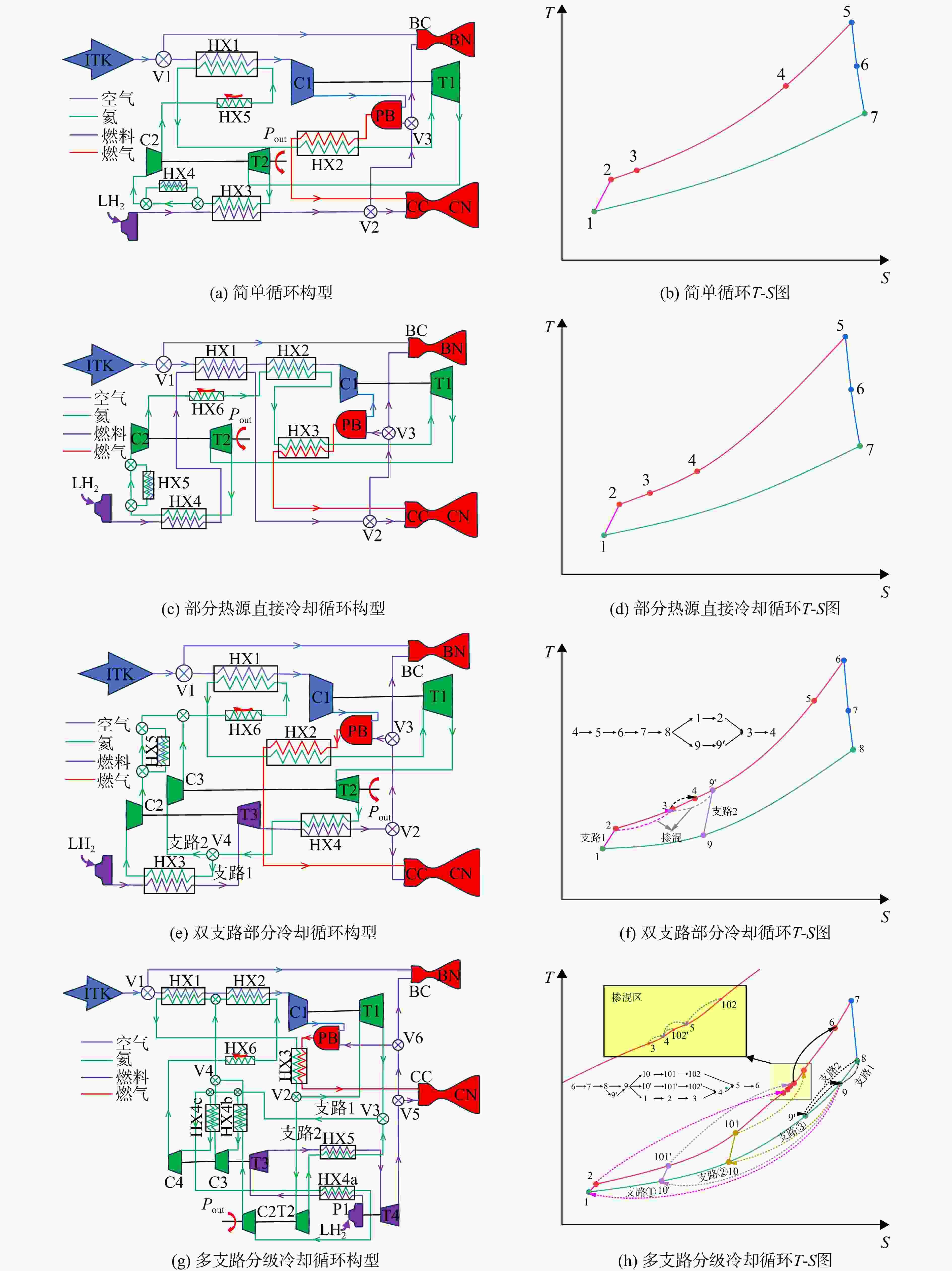
图 2 预冷-压缩系统及发动机热力循环构型
Figure 2. Thermodynamic layouts of precooling-compression system and precooled engine
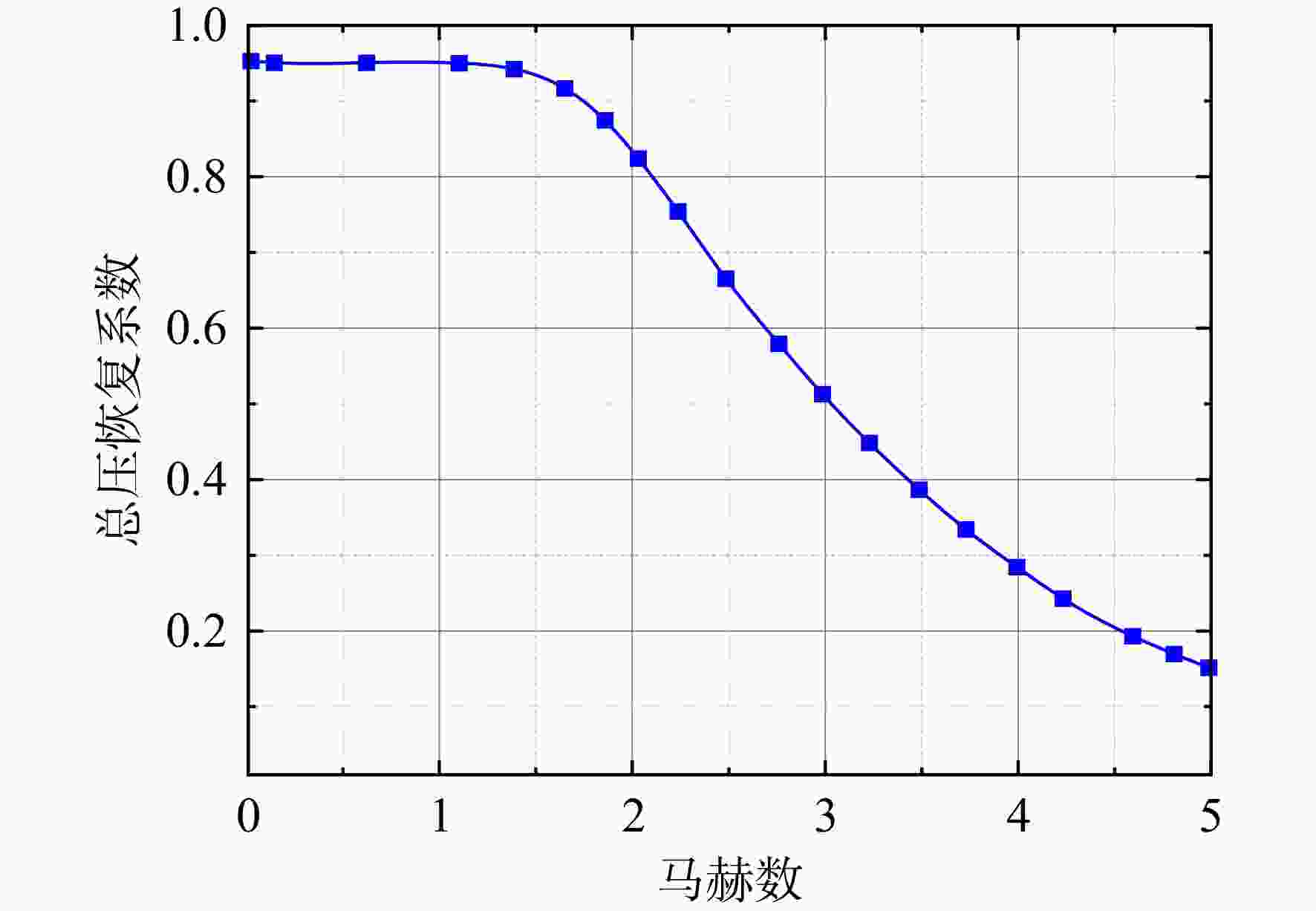
图 3 进气道总压恢复系数与飞行马赫数关系
Figure 3. Variation of intake total pressure recovery coefficient with flight Mach number
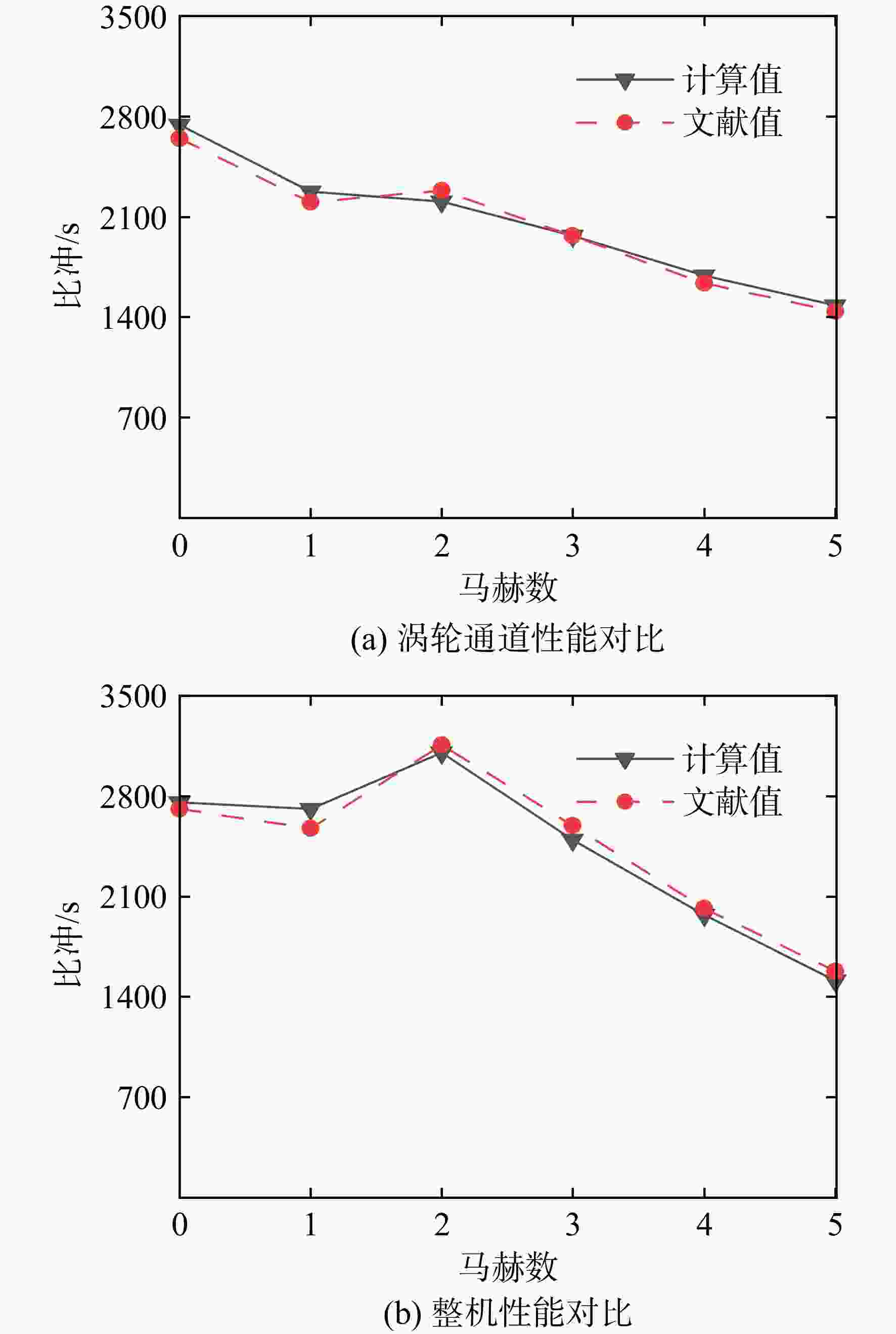
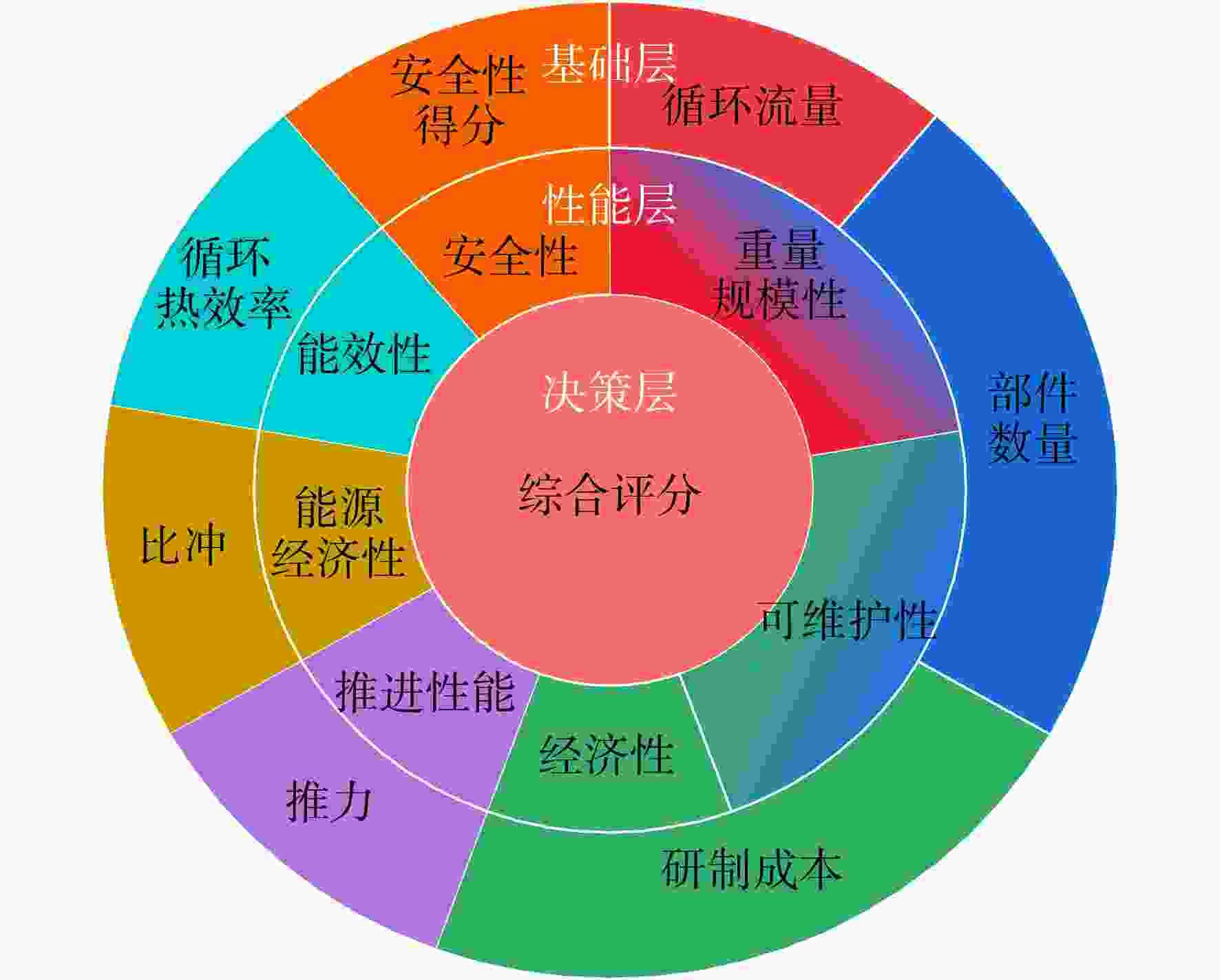
图 7 推进与能量管理系统评价指标
Figure 7. Evaluation index of propulsion and energy management system
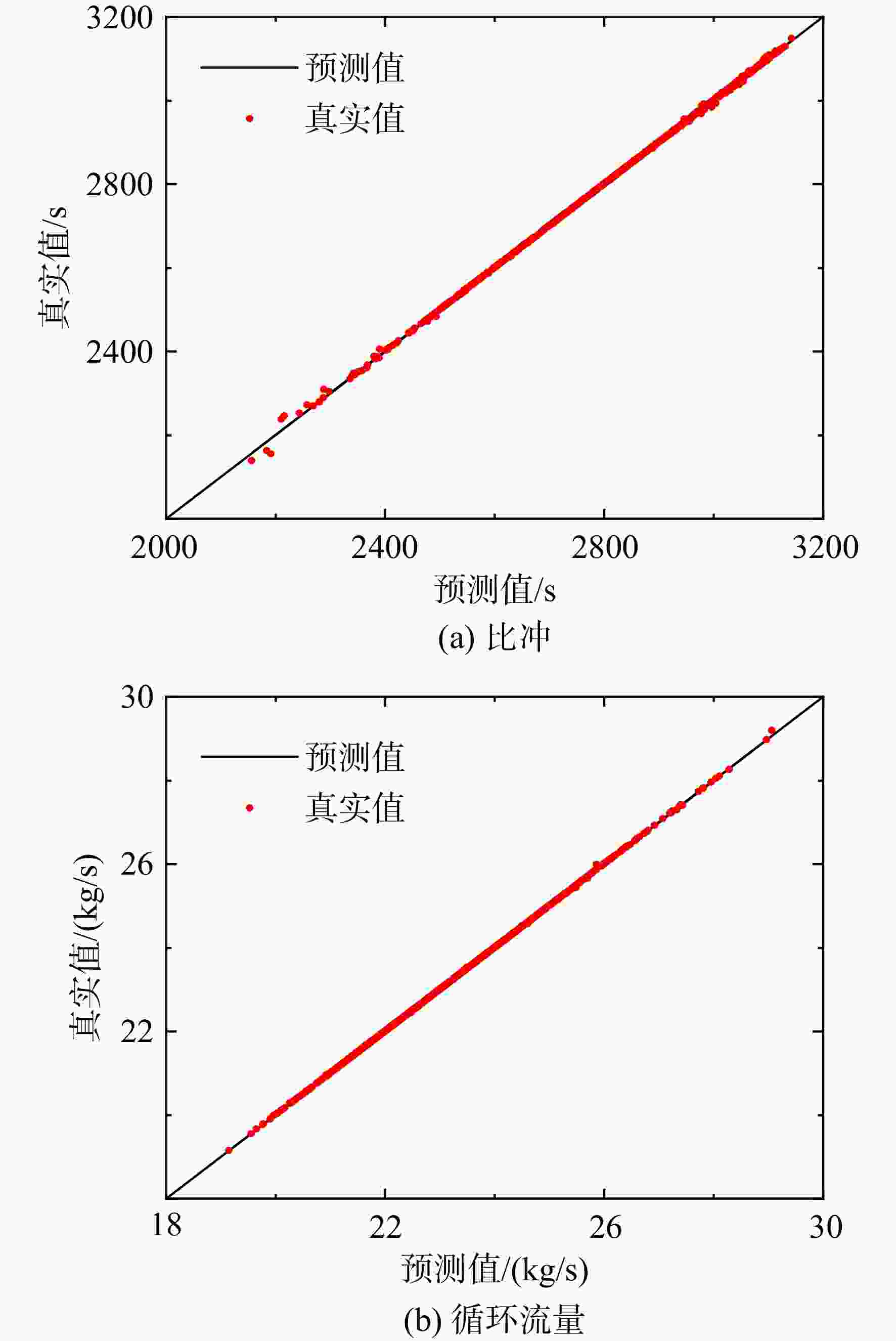
图 9 代理模型预测值与真实值对比
Figure 9. Comparison of predicted values by surrogate model with actual values
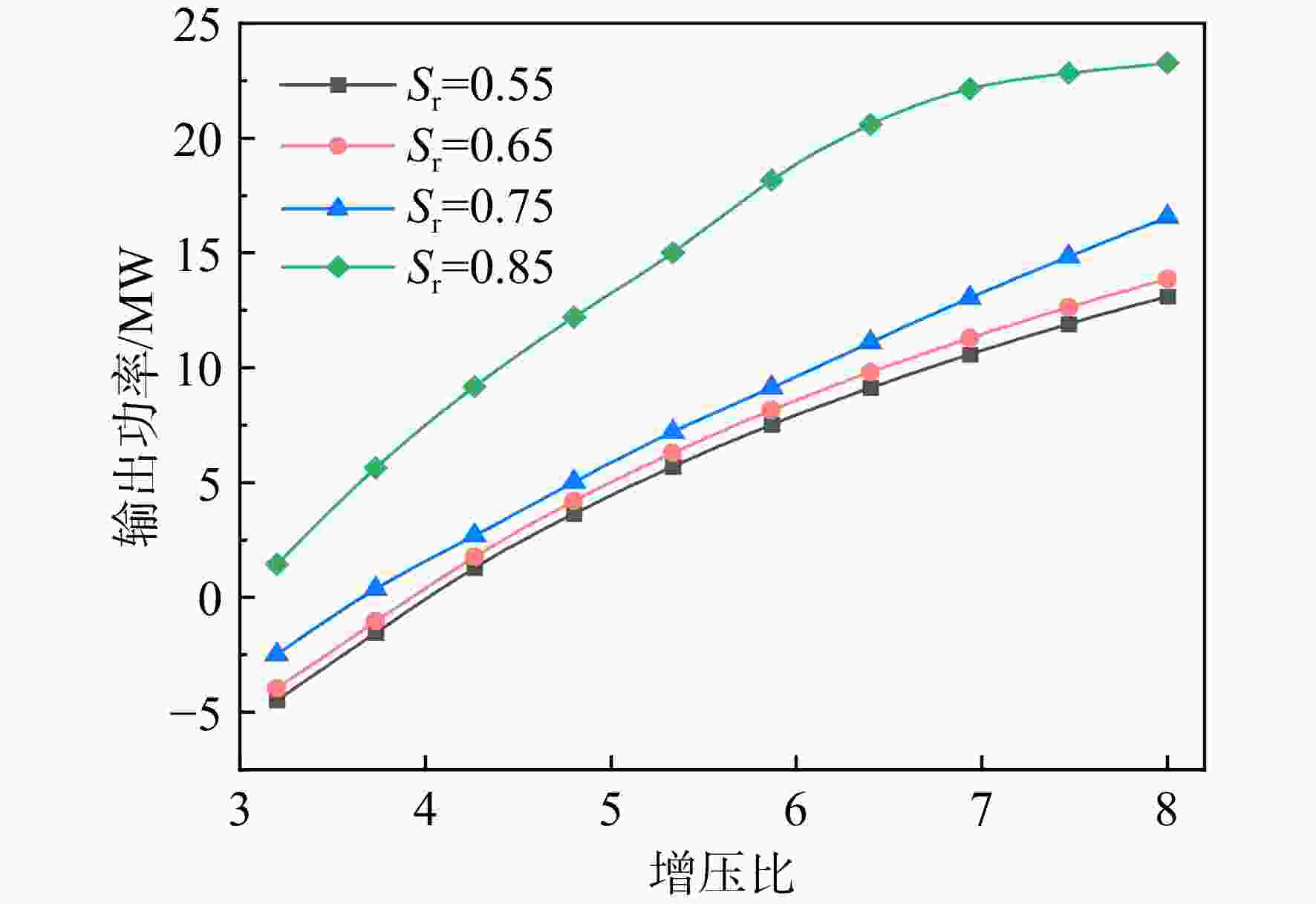
图 13 不同分流比双支路部分冷却循环输出功率
Figure 13. Thermal efficiency of the dual-branch partially cooled cycle under different spilt ratio
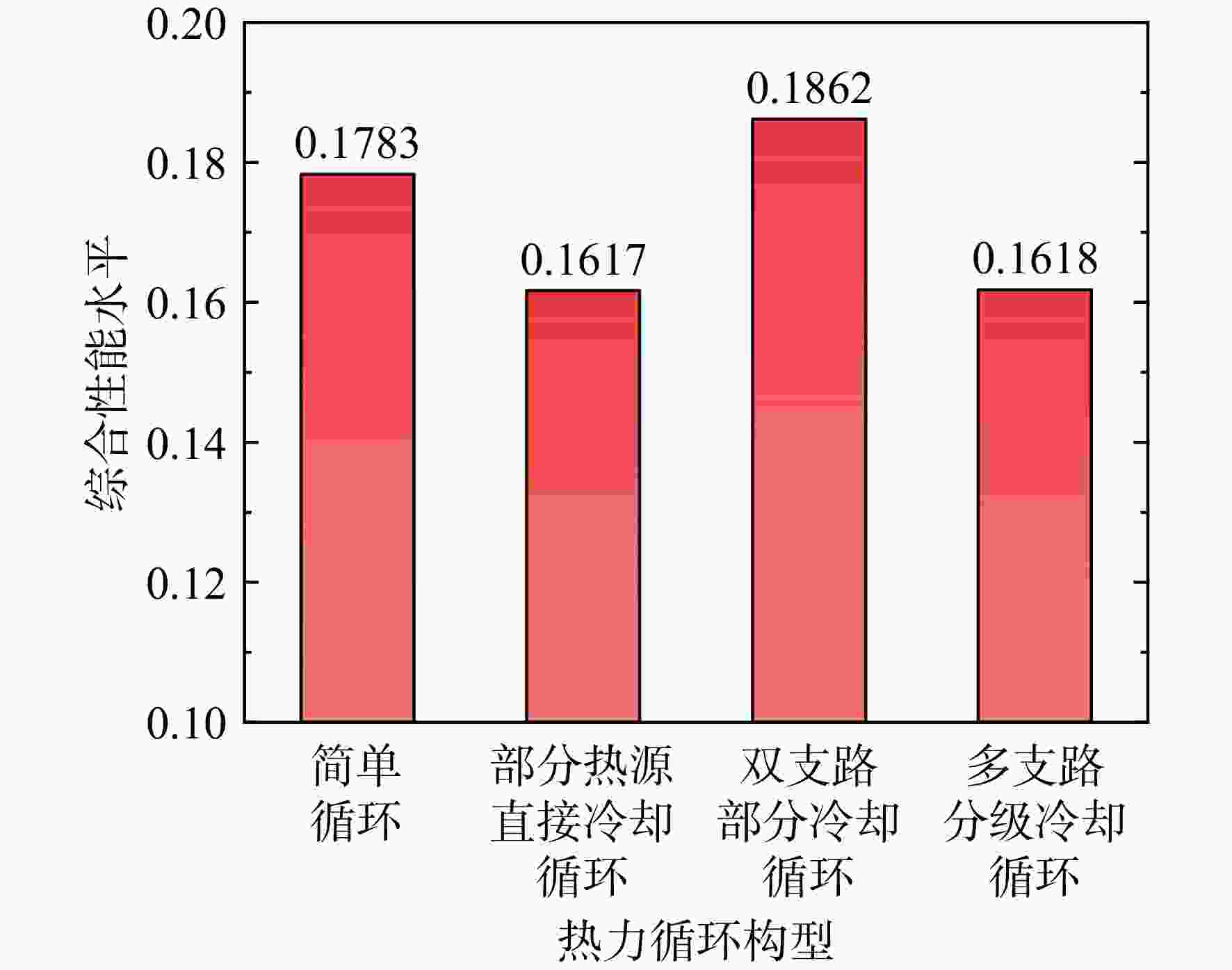
图 16 不同热力循环布局综合性能水平(输出功率最优)
Figure 16. Integrated performance level among different thermodynamic cycles (optimized power output)
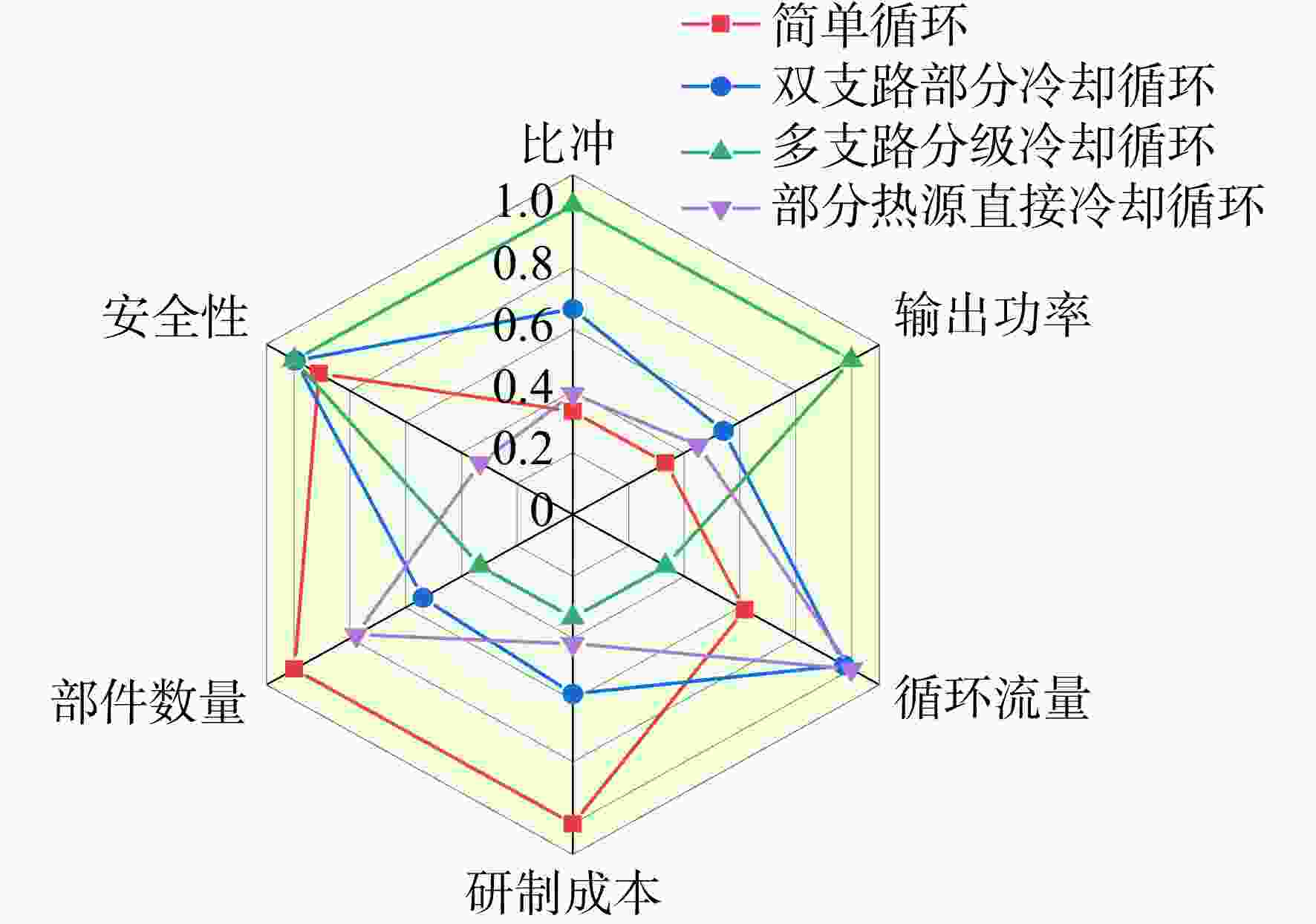
图 17 不同热力循环布局相对性能水平(输出功率最优)
Figure 17. Relative performance among different thermodynamic cycles (optimized power output)
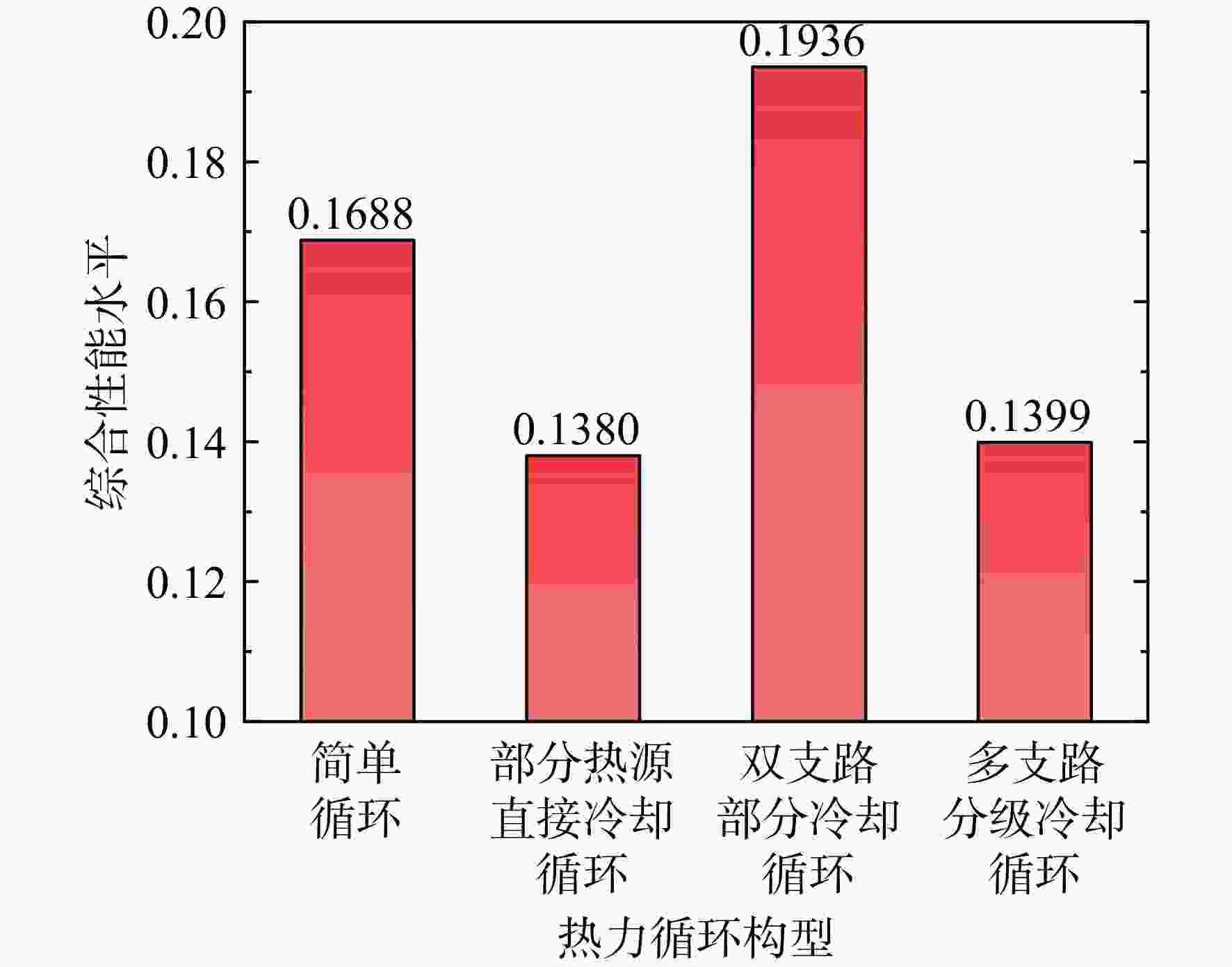
图 18 不同热力循环布局综合性能水平(比冲最优)
Figure 18. Integrated performance level among different thermodynamic cycles (optimized specific impulse)
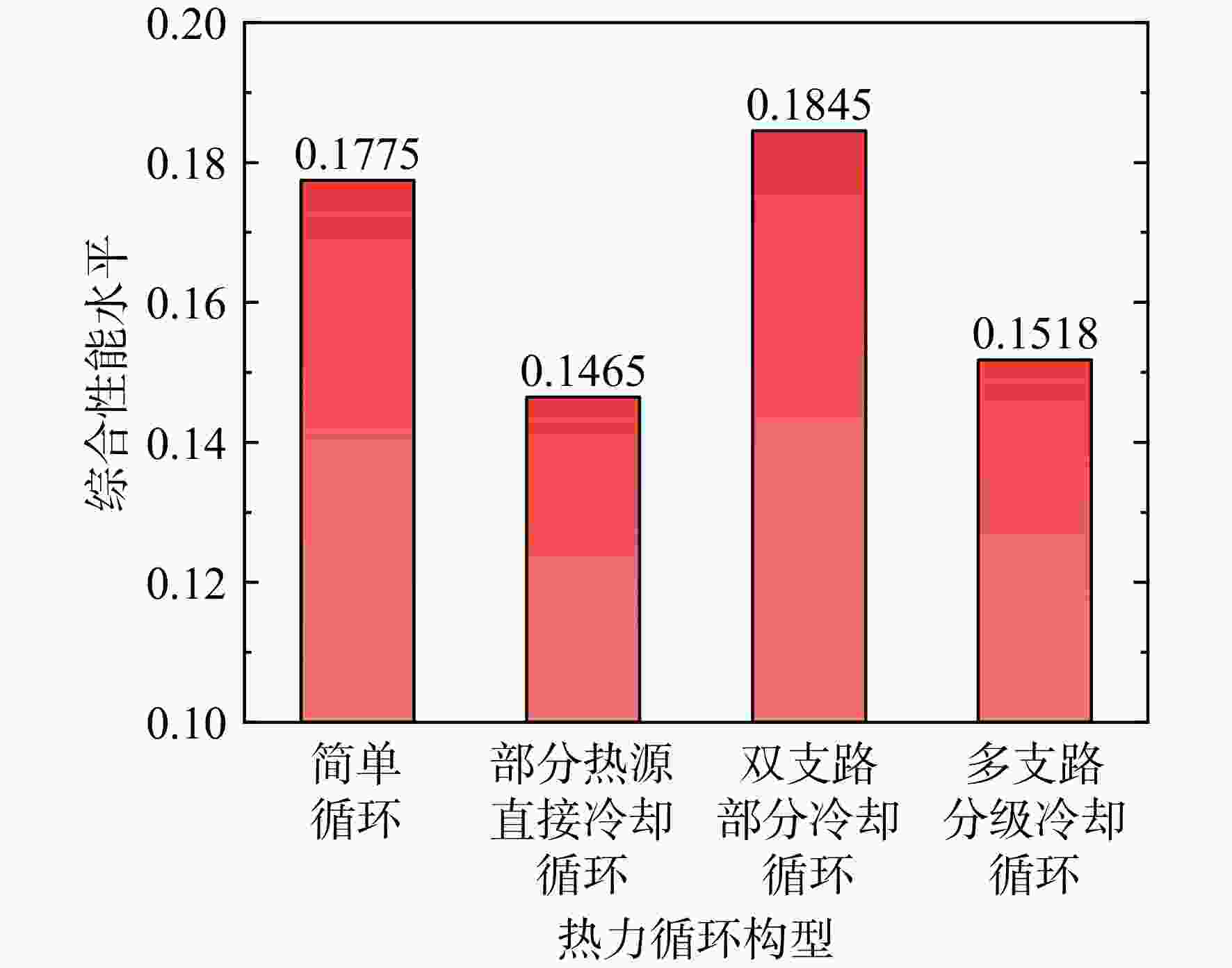
图 19 不同热力循环布局综合性能水平(综合性能最优)
Figure 19. Integrated performance level among different thermodynamic cycles (optimized comprehensive performance)
评价因素 权重系数 系统质量 10 可靠性 4 能源需求 2 毒性 1 火灾危险性 2 设计弹性 1 开发风险性 2 温度控制能力 4  下载: 导出CSV
部件 成本估算公式 压气机 ${c}_{\mathrm{cost,t}}=71.1\cdot{q}_{{m}}\cdot\left[1.0/ (0.92-{\eta}_{\mathrm{c}}) \right]\cdot{\pi}_{\mathrm{c}}\cdot{\mathrm{ln}}\;{\pi}_{\mathrm{c}}$ 燃烧室 ${c}_{\mathrm{cost,b}}=46.08 \cdot{q}_{{m,{\mathrm{a}}}}\cdot\left(\dfrac{1.0}{0.995-{\sigma}_{\mathrm{b}}}\right)\cdot\left[1+{\mathrm{exp}} (0.018\cdot {T}_{3}-26.4) \right]$ 涡轮 $ {c}_{\mathrm {cost,t}}=479.34\cdot {q}_{{m}}\cdot \left(\dfrac{1.0}{0.93-{\eta }_{\mathrm {t}}}\right) \cdot {\mathrm{ln}} ( /1\pi _{\mathrm {t}}) \cdot \left[\mathrm {1+exp (0.036\cdot }{T}_{3}-54.4) \right]$ 预冷器/冷却器 $ {c}_{\mathrm {cost,cooler}}=2\;143\cdot {A}^{0.514} $ 高温换热器 $ {c}_{\mathrm {cost},\mathrm {hx}}=2\;681\cdot {A}^{0.59} $
下载: 导出CSV
表 3 不同热力循环的典型性能
Table 3. Typical performance of different cycles
参数 简单循环 双支路部分冷却循环 多支路分级冷却循环 部分热源直接冷却循环 推力/kN 115.03 114.97 115.03 115.05 比冲/s 1608 2434 2712 1851 输出功率/MW 10.52 14.96 18.23 13.51 循环流量/(kg/s) 24.01 19.41 34.65 19.21 研制成本/$ 1099544 1238626 1483947 1368401 部件数量 8 11 15 9 与燃料接触的热源温度/K 702 676 675 1233
下载: 导出CSV
表 4 基础层指标的主观权重
Table 4. Objective weighting factors of the base performance
指标 相对权重 归一化权重 比冲 5 0.208 输出功率 3 0.125 循环流量 4 0.167 经济成本 3 0.125 部件数量 7 0.292 安全性 2 0.083
下载: 导出CSV
表 5 不同热力循环的典型性能(比冲最优)
Table 5. Typical performance of different cycles (optimized specific impulse)
参数 简单循环 双支路部分冷却循环 多支路分级冷却循环 部分热源直接冷却循环 推力/kN 115.02 115.03 114.96 115.00 比冲/s 2145 3110 2977 2183 输出功率/MW 6.14 5.36 13.18 8.30 循环流量/(kg/s) 17.55 14.04 31.50 16.50 研制成本/$ 1175312 1042320 1406199 1336756 部件数量 8 11 15 9 与燃料接触的热源温度/K 588 662 651 1233
下载: 导出CSV
表 6 不同热力循环的典型性能(综合性能最优)
Table 6. Typical performance of different cycles (optimized comprehensive performance)
参数 简单循环 双支路部分冷却循环 多支路分级冷却循环 部分热源直接冷却循环 推力/kN 115.00 114.95 115.01 114.99 比冲/s 1 906 2809 2857 2091 输出功率/MW 7.45 6.18 15.63 9.28 循环流量/(kg/s) 20.25 15.77 32.97 17.14 研制成本/$ 1069104 1148823 1450911 1302433 部件数量 8 11 15 9 与燃料接触的热源温度/K 670 642 677 1233
下载: 导出CSV
表 7 基础层指标的主观权重(作战场景)
Table 7. Objective weighting factors of the base performance (combat scenario)
指标 相对权重 归一化权重 比冲 7 0.28 输出功率 7 0.28 循环流量 3 012 经济成本 2 0.08 部件数量 4 0.20 安全性 1 0.04
下载: 导出CSV
表 8 不同热力循环布局综合性能水平(作战场景)
Table 8. Integrated performance level among different thermodynamic cycles (combat scenario)
循环构型 综合性能水平 简单循环 0.1618 双支路部分冷却循环 0.1777 多支路分级冷却循环 0.1676 部分热源直接冷却循环 0.1400
下载: 导出CSV
-
[1] 郑建成, 谭贤四, 曲智国, 等. 高超声速飞行器防御特征与趋势[J]. 战术导弹技术, 2022(2): 1-8, 14. Zheng Jiancheng, Tan Xiansi, Qu Zhiguo, et al. Defense characteristic and tendency of hypersonic vehicle[J]. Tactical Missile Technology, 2022(2): 1-8, 14. (in ChineseZheng Jiancheng, Tan Xiansi, Qu Zhiguo, et al. Defense characteristic and tendency of hypersonic vehicle[J]. Tactical Missile Technology, 2022(2): 1-8, 14. (in Chinese) [2] Blanvillain E, Gallic G. HIKARI: paving the way towards high speed air transport: AIAA2015-3676[R]. Glasgow, UK: AIAA, 2015. [3] 梁义强, 范宇, 周建军, 等. 高超声速动力能热管理技术综述[J]. 航空发动机, 2024, 50(2): 11-21. Liang Yiqiang, Fan Yu, Zhou Jianjun, et al. Overview of power and thermal management technology for hypersonic engine[J]. Aeroengine, 2024, 50(2): 11-21. (in Chinese doi: 10.13477/j.cnki.aeroengine.2024.02.002Liang Yiqiang, Fan Yu, Zhou Jianjun, et al. Overview of power and thermal management technology for hypersonic engine[J]. Aeroengine, 2024, 50(2): 11-21. (in Chinese) doi: 10.13477/j.cnki.aeroengine.2024.02.002 [4] 苟建军, 肖爽, 胡嘉欣, 等. 高超声速飞行器气动热耗散、输运及转换技术研究进展[J]. 宇航学报, 2022, 43(8): 983-999. Gou Jianjun, Xiao Shuang, Hu Jiaxin, et al. Research progress of aerodynamic heat dissipation, transport and conversion technologies of hypersonic vehicles[J]. Journal of Astronautics, 2022, 43(8): 983-999. (in Chinese doi: 10.3873/j.issn.1000-1328.2022.08.001Gou Jianjun, Xiao Shuang, Hu Jiaxin, et al. Research progress of aerodynamic heat dissipation, transport and conversion technologies of hypersonic vehicles[J]. Journal of Astronautics, 2022, 43(8): 983-999. (in Chinese) doi: 10.3873/j.issn.1000-1328.2022.08.001 [5] Powell O A, Edwards J T, Norris R B, et al. Development of hydrocarbon-fueled scramjet engines: the hypersonic technology (HyTech) program[J]. Journal of Propulsion and Power, 2001, 17(6): 1170-1176. doi: 10.2514/2.5891 [6] Zhang Duo, Qin Jiang, Feng Yu, et al. Performance evaluation of power generation system with fuel vapor turbine onboard hydrocarbon fueled scramjets[J]. Energy, 2014, 77: 732-741. doi: 10.1016/j.energy.2014.09.046 [7] Qin Jiang, Zhou Weixing, Bao Wen, et al. Thermodynamic analysis and parametric study of a closed Brayton cycle thermal management system for scramjet[J]. International Journal of Hydrogen Energy, 2010, 35(1): 356-364. doi: 10.1016/j.ijhydene.2009.09.025 [8] 姜培学, 张富珍, 胥蕊娜, 等. 高超声速飞行器发动机热防护与发电一体化系统[J]. 航空动力学报, 2021, 36(1): 1-7. Jiang Peixue, Zhang Fuzhen, Xu Ruina, et al. Integrated thermal protection and power generation system of hypersonic vehicle engine[J]. Journal of Aerospace Power, 2021, 36(1): 1-7. (in Chinese doi: 10.13224/j.cnki.jasp.2021.01.001Jiang Peixue, Zhang Fuzhen, Xu Ruina, et al. Integrated thermal protection and power generation system of hypersonic vehicle engine[J]. Journal of Aerospace Power, 2021, 36(1): 1-7. (in Chinese) doi: 10.13224/j.cnki.jasp.2021.01.001 [9] Guo Liang, Pang Liping, Yang Xiaodong, et al. A power and thermal management system for long endurance hypersonic vehicle[J]. Chinese Journal of Aeronautics, 2023, 36(2): 29-40. doi: 10.1016/j.cja.2022.07.012 [10] 马同玲, 张扬军, 王正, 等. 闭式布雷顿循环发电系统热力过程建模及其参数影响研究[J]. 推进技术, 2022, 43(7): 210782. Ma Tongling, Zhang Yangjun, Wang Zheng, et al. Thermodynamic process modeling and parameter influence of closed brayton cycle power generation system[J]. Journal of Propulsion Technology, 2022, 43(7): 210782. (in Chinese doi: 10.13675/j.cnki.tjjs.210782Ma Tongling, Zhang Yangjun, Wang Zheng, et al. Thermodynamic process modeling and parameter influence of closed brayton cycle power generation system[J]. Journal of Propulsion Technology, 2022, 43(7): 210782. (in Chinese) doi: 10.13675/j.cnki.tjjs.210782 [11] 石佳, 张兴娟, 李芳勇, 等. 高超声速飞行器气动热利用方法研究[J]. 战术导弹技术, 2015(1): 31-36. Shi Jia, Zhang Xingjuan, Li Fangyong, et al. Research on the method of aerodynamic heat utilization for hypersonic vehicle[J]. Tactical Missile Technology, 2015(1): 31-36. (in ChineseShi Jia, Zhang Xingjuan, Li Fangyong, et al. Research on the method of aerodynamic heat utilization for hypersonic vehicle[J]. Tactical Missile Technology, 2015(1): 31-36. (in Chinese) [12] Steelant J, Varvill R, Walton C, et al. Achievements obtained for sustained hypersonic flight within the LAPCAT-Ⅱ project: AIAA2015-3677 [R]. Glasgow, UK: AIAA, 2015. [13] Balland S, Villace V F, Steelant J. Thermal and energy management for hypersonic cruise vehicles-cycle analysis: AIAA 2015-3557 [R]. Glasgow, UK: AIAA, 2015. [14] Dai Jian, Zuo Qiuru. Key technologies for thermodynamic cycle of precooled engines: a review[J]. Acta Astronautica, 2020, 177: 299-312. doi: 10.1016/j.actaastro.2020.07.039 [15] Dong Pengcheng, Tang Hailong, Chen Min. Study on multi-cycle coupling mechanism of hypersonic precooled combined cycle engine[J]. Applied Thermal Engineering, 2018, 131: 497-506. doi: 10.1016/j.applthermaleng.2017.12.002 [16] 王一帆, 邹正平, 陈懋章. 高超声速强预冷发动机热力循环研究进展[J]. 航空学报, 2023, 44(21): 529343. Wang Yifan, Zou Zhengping, Chen Maozhang. Progress in thermodynamic cycle research of hypersonic precooled engine[J]. Acta Aeronautica et Astronautica Sinica, 2023, 44(21): 529343. (in Chinese doi: 10.7527/S1000-6893.2023.29343Wang Yifan, Zou Zhengping, Chen Maozhang. Progress in thermodynamic cycle research of hypersonic precooled engine[J]. Acta Aeronautica et Astronautica Sinica, 2023, 44(21): 529343. (in Chinese) doi: 10.7527/S1000-6893.2023.29343 [17] 朱岩, 马元, 张蒙正. 预冷空气涡轮火箭发动机氦循环系统的参数特性[J]. 航空动力学报, 2018, 33(8): 2016-2024. Zhu Yan, Ma Yuan, Zhang Mengzheng. Characteristic of helium cycle system parameters for pre-cooling air turbo rocket engine[J]. Journal of Aerospace Power, 2018, 33(8): 2016-2024. (in Chinese doi: 10.13224/j.cnki.jasp.2018.08.025Zhu Yan, Ma Yuan, Zhang Mengzheng. Characteristic of helium cycle system parameters for pre-cooling air turbo rocket engine[J]. Journal of Aerospace Power, 2018, 33(8): 2016-2024. (in Chinese) doi: 10.13224/j.cnki.jasp.2018.08.025 [18] Zou Zhengping, Wang Yifan, Du Pengcheng, et al. A novel simplified precooled airbreathing engine cycle: Thermodynamic performance and control law[J]. Energy Conversion and Management, 2022, 258: 115472. doi: 10.1016/j.enconman.2022.115472 [19] Zhang Jianqiang, Wang Zhenguo, Li Qinglian. Thermodynamic efficiency analysis and cycle optimization of deeply precooled combined cycle engine in the air-breathing mode[J]. Acta Astronautica, 2017, 138: 394-406. doi: 10.1016/j.actaastro.2017.06.011 [20] 屈原, 徐旭, 杨庆春. 㶲分析在协同吸气式火箭发动机中的应用[J]. 推进技术, 2019, 40(8): 1693-1701. Qu Yuan, Xu Xu, Yang Qingchun. Application of exergy analysis in synergistic air-breathing rocket engine[J]. Journal of Propulsion Technology, 2019, 40(8): 1693-1701. (in Chinese doi: 10.13675/j.cnki.tjjs.180542Qu Yuan, Xu Xu, Yang Qingchun. Application of exergy analysis in synergistic air-breathing rocket engine[J]. Journal of Propulsion Technology, 2019, 40(8): 1693-1701. (in Chinese) doi: 10.13675/j.cnki.tjjs.180542 [21] 李新春. 基于热电转换的超燃冲压发动机主动冷却系统方案研究[D]. 长沙: 国防科技大学, 2017. Li Xinchun. Research of the scramjet active cooling system scheme based on thermoelectric conversion[D]. Changsha: National University of Defense Technology, 2017. (in ChineseLi Xinchun. Research of the scramjet active cooling system scheme based on thermoelectric conversion[D]. Changsha: National University of Defense Technology, 2017. (in Chinese) [22] 玉选斐. 预冷吸气式组合推进系统热力循环及控制规律研究[D]. 哈尔滨: 哈尔滨工业大学, 2020. Yu Xuanfei. Research on thermodynamic cycle and control law of precooled airbreathing propulsion system[D]. Harbin: Harbin Institute of Technology, 2020. (in ChineseYu Xuanfei. Research on thermodynamic cycle and control law of precooled airbreathing propulsion system[D]. Harbin: Harbin Institute of Technology, 2020. (in Chinese) [23] Yu Xuanfei, Wang Cong, Yu Daren. Thermodynamic design and optimization of the multi-branch closed Brayton cycle based precooling-compression system for a novel hypersonic aeroengine[J]. Energy Conversion and Management, 2020, 205: 112412. doi: 10.1016/j.enconman.2019.112412 [24] Fernández-villacé V, Paniagua G. On the exergetic effectiveness of combined-cycle engines for high speed propulsion[J]. Energy, 2013, 51: 382-394. doi: 10.1016/j.energy.2012.11.051 [25] Jivraj F, Bond A, Varvill R, et al. The scimitar precooled Mach 5 engine[C]// Proceedings of 2nd European Conference for Aerospace Sciences. Brussels, Belgium: European Conference for Aerospace Sciences, 2007: 1-10. [26] Yu Xuanfei, Wang Cong, Yu Daren. Minimization of entropy generation of a closed Brayton cycle based precooling-compression system for advanced hypersonic airbreathing engine[J]. Energy Conversion and Management, 2020, 209: 112548. doi: 10.1016/j.enconman.2020.112548 [27] 王一帆. 高超声速预冷发动机数学模型及多构型热力循环性能研究[D]. 北京: 北京航空航天大学, 2022. Wang Yifan. Modeling method and thermodynamic analysis of multi-layout airbreathing precooled engine[D]. Beijing: Beihang University, 2022. (in ChineseWang Yifan. Modeling method and thermodynamic analysis of multi-layout airbreathing precooled engine[D]. Beijing: Beihang University, 2022. (in Chinese) [28] McBride B, Gordon S. Computer program for calculation of complex chemical equilibrium compositions and applications[M]. Cleveland, US: National Aeronautics and Space Administration, 1996. [29] Victor F V. Simulation, design and analysis of air-breathing combined-cycle engines for high speed propulsion[D]. Rhode-Saint-Genèse, Belgium: Von Karman Institute for Fluid Dynamics, 2013. [30] Fernández-Villacé V, Paniagua G. Simulation of a combined cycle for high speed propulsion: AIAA-2010-1125[R]. Orlando, US: AIAA, 2010. [31] Sridhar K I, Arun K T, et al. Thermal management and environment control of hypersonic vehicle[J]. SAE Transactions, 1989, 98: 393-401. [32] Ferro C, Costamagna L. Preliminary design concepts for the active thermal control of a European spaceplane[J]. Journal of Aerospace, 1988, 97(1): 880924. doi: 10.4271/880924 [33] 肖国树. 航空发动机设计手册: 第5册 涡喷及涡扇发动机总体[M]. 北京: 航空工业出版社, 2001: 43. Xiao Guoshu. Aircraft engine design manual: 5th volumes turbojet and turbofan engine overall[M]. Beijing: Aviation Industry Press, 2001: 43. (in ChineseXiao Guoshu. Aircraft engine design manual: 5th volumes turbojet and turbofan engine overall[M]. Beijing: Aviation Industry Press, 2001: 43. (in Chinese) [34] Yu Mingzhe, Yang Fubin, Zhang Hongguang, et al. Thermoeconomic performance of supercritical carbon dioxide Brayton cycle systems for CNG engine waste heat recovery[J]. Energy, 2024, 289: 129972. doi: 10.1016/j.energy.2023.129972 [35] Gargari S G, Rahimi M, Ghaebi H. Energy, exergy, economic and environmental analysis and optimization of a novel biogas-based multigeneration system based on Gas Turbine-Modular Helium Reactor cycle[J]. Energy Conversion and Management, 2019, 185: 816-835. doi: 10.1016/j.enconman.2019.02.029 [36] 张继国, 辛格. 信息熵: 理论与应用[M]. 北京: 中国水利水电出版社, 2012. Zhang Jiguo, Singh V P. Information entropy: theory and application[M]. Beijing: China Water Conservancy and Hydropower Press, 2012. (in ChineseZhang Jiguo, Singh V P. Information entropy: theory and application[M]. Beijing: China Water Conservancy and Hydropower Press, 2012. (in Chinese) [37] Kays W M, London A L. Compact heat exchanger[M]. New York: McGraw-Hill, 1984. [38] Qasem N A A, Zubair S M. Compact and microchannel heat exchangers: a comprehensive review of air-side friction factor and heat transfer correlations[J]. Energy Conversion and Management, 2018, 173: 555-601. doi: 10.1016/j.enconman.2018.06.104 [39] 邓聚龙. 灰预测与灰决策[M]. 修订版. 武汉: 华中科技大学出版社, 2002. Deng Julong. Grey prediction and grey decision-making[M]. Revised ed. Wuhan: Huazhong University of Science and Technology Press, 2002. (in ChineseDeng Julong. Grey prediction and grey decision-making[M]. Revised ed. Wuhan: Huazhong University of Science and Technology Press, 2002. (in Chinese) -


 点击查看大图

计量
- 文章访问数: 179
- HTML浏览量: 175
- PDF量: 23
- 被引次数: 0