






Rapid prediction of anti-icing surface temperature and runback water via point-cloud slice attention network
-
摘要:
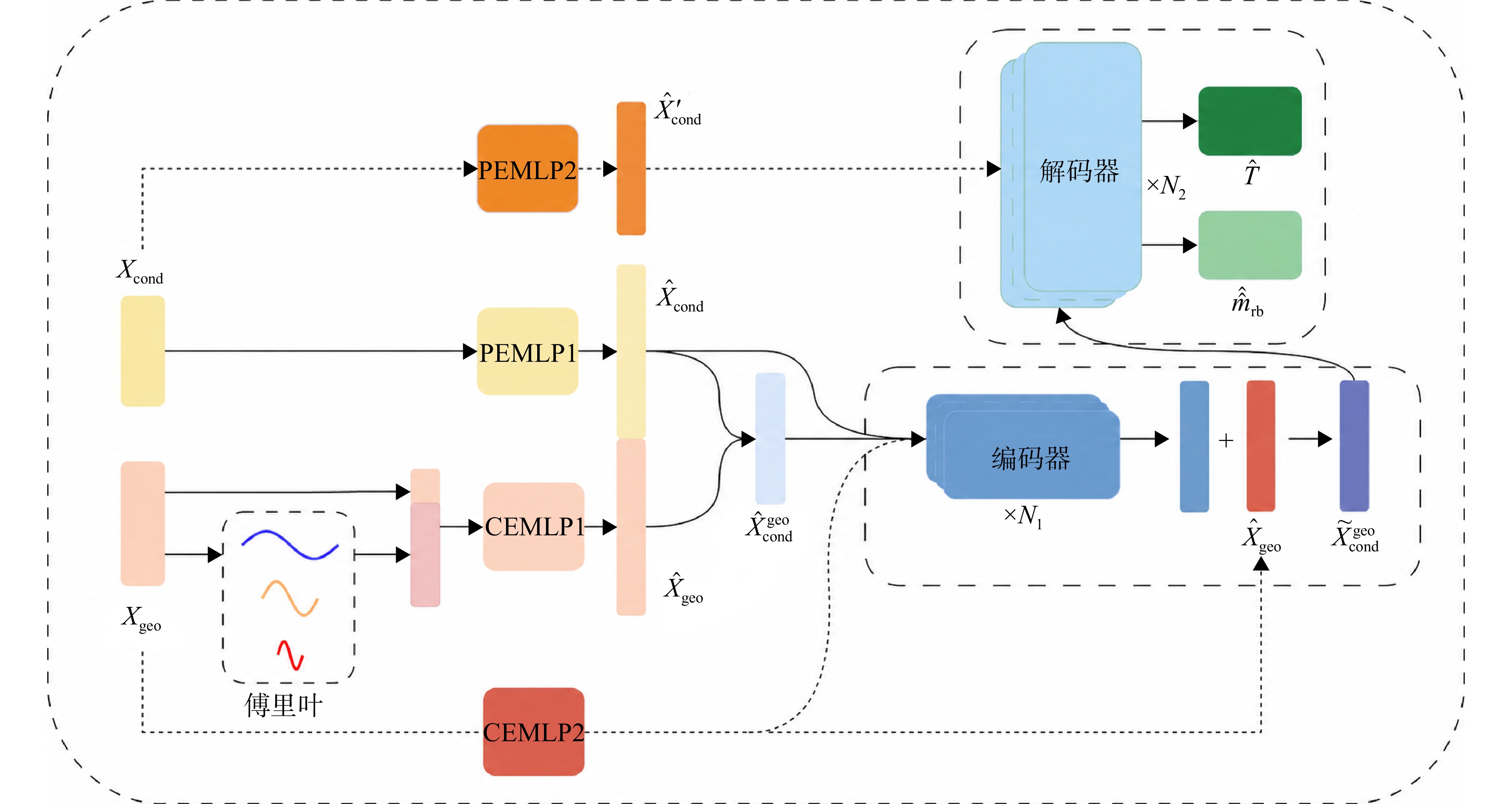
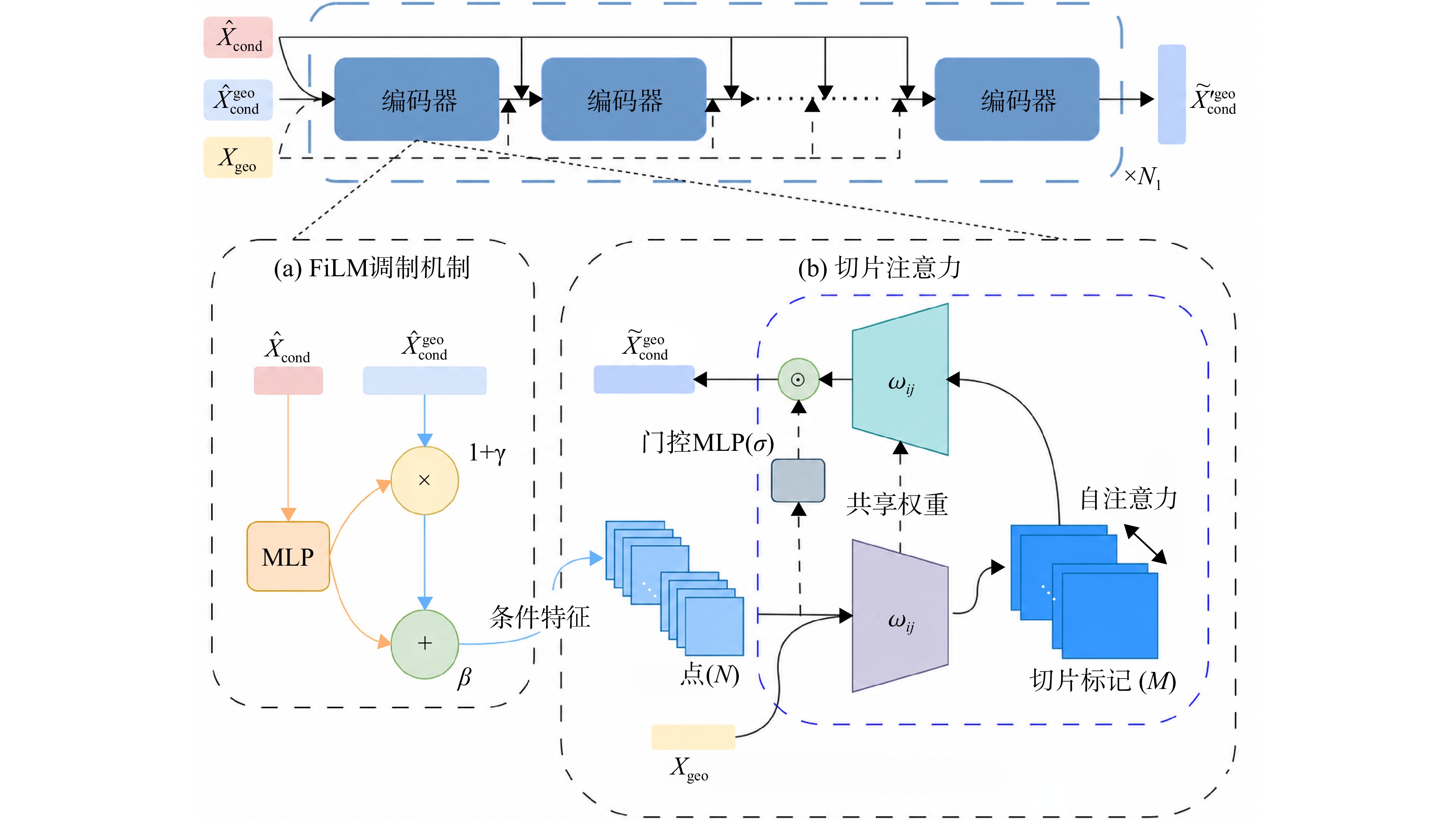
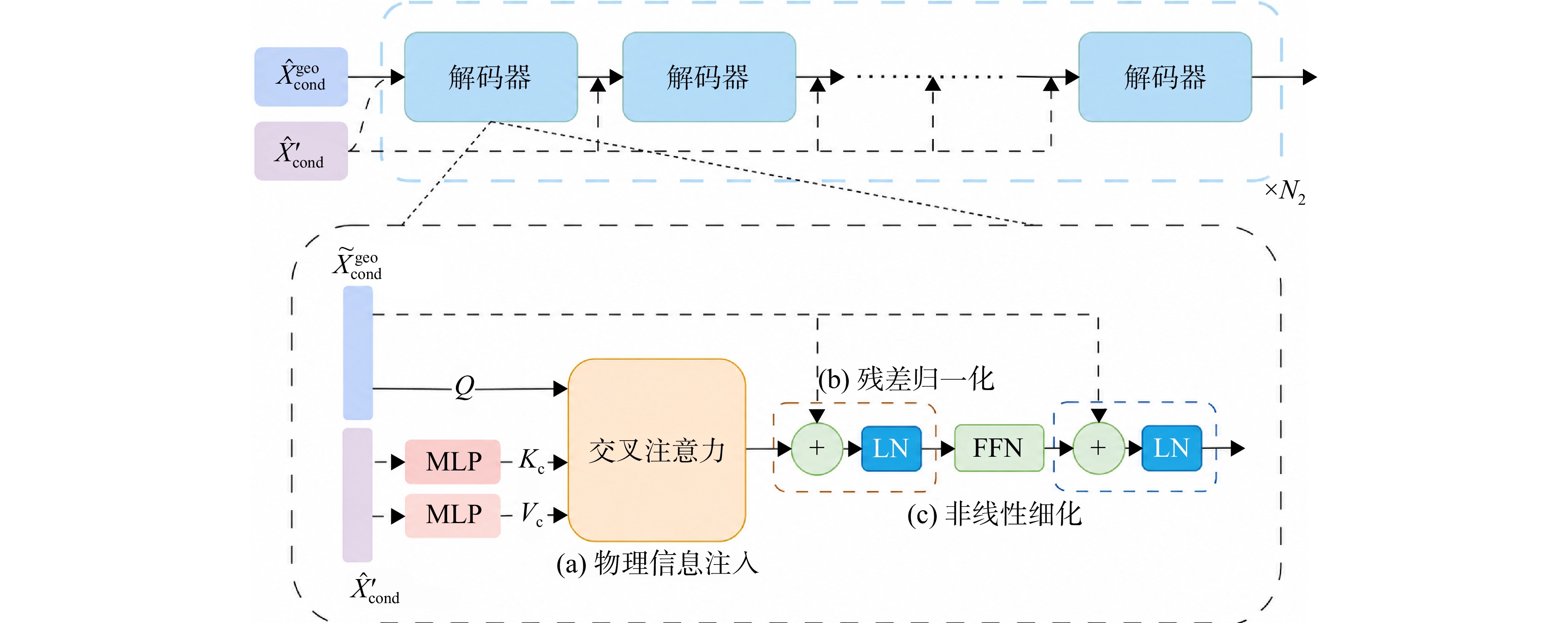
为满足发动机进气道热气防冰系统不同结构设计下的性能评估,构建了一种网格无关的点云切片注意力网络(PSANet),实现了进气道表面温度与溢流水分布的快速逐点预测。该方法将防冰表面表示为点云,以六维度笛形管结构设计参数为输入,引入多频带傅里叶特征映射、条件调制、切片注意力和向量门控重构,并采用多任务学习联合预测温度分布与溢流水质量流量分布。基于自研的防冰数值模拟方法,积累了5 000组不同笛形管结构设计下防冰表面温度与溢流水质量流量数据算例,将算例随机划分为训练集、验证集与测试集,其中每个算例包含23 958个表面点。测试结果表明,在温度预测方面,温度平均绝对误差和温度均方根误差分别为0.503 K和0.841 K;在溢流水质量流量预测方面,溢流水质量流量平均绝对误差和溢流水质量流量均方根误差分别为0.011 mg/s和0.018 mg/s;单个算例预测时间为38.57 ms,相比防冰数值模拟方法速度提高约
6880 倍。综合分析,PSANet方法具有较高的预测精度和计算效率,可用于热气防冰系统结构设计参数的敏感性分析及迭代设计。Abstract:To evaluate the performance of engine inlet hot-air anti-icing systems under different structural designs, a mesh-independent point-cloud slice attention network (PSANet) was developed for rapid pointwise prediction of the surface temperature and runback water distribution over the inlet. In this method, the anti-icing surface was represented as a point cloud, and six-dimensional structural design parameters of the piccolo tube were used as inputs. Multi-band Fourier feature mapping, conditional modulation, slice attention, and vector-gated reconstruction were introduced, and a multi-task learning strategy was adopted to jointly predict the temperature distribution and the mass flow rate distribution of runback water. Based on an in-house numerical simulation method for anti-icing, 5 000 cases of anti-icing surface temperature and runback water mass flow rate under different piccolo-tube structural designs were generated. These cases were randomly divided into training, validation, and test sets, with each case containing 23 958 surface points. The test results show that the mean absolute error and root mean square error for temperature prediction were 0.503 K and 0.841 K, respectively; the mean absolute error and root mean square error for runback water mass flow rate prediction were 0.011 mg/s and 0.018 mg/s, respectively. The prediction time for a single case was 38.57 ms, representing an acceleration of approximately 6, 880 times compared with the anti-icing numerical simulation method. Overall, the PSANet method achieves high prediction accuracy and computational efficiency, and can be applied to sensitivity analysis of structural design parameters and iterative design of hot-air anti-icing systems.
-
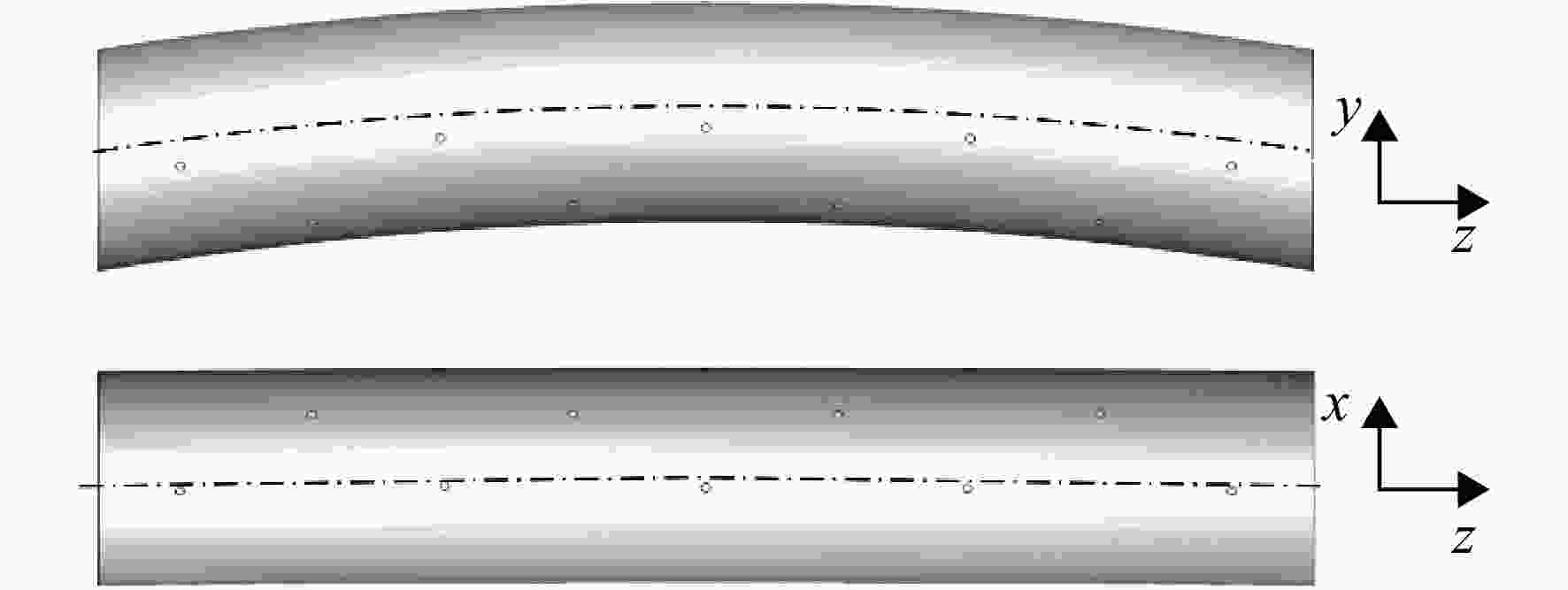
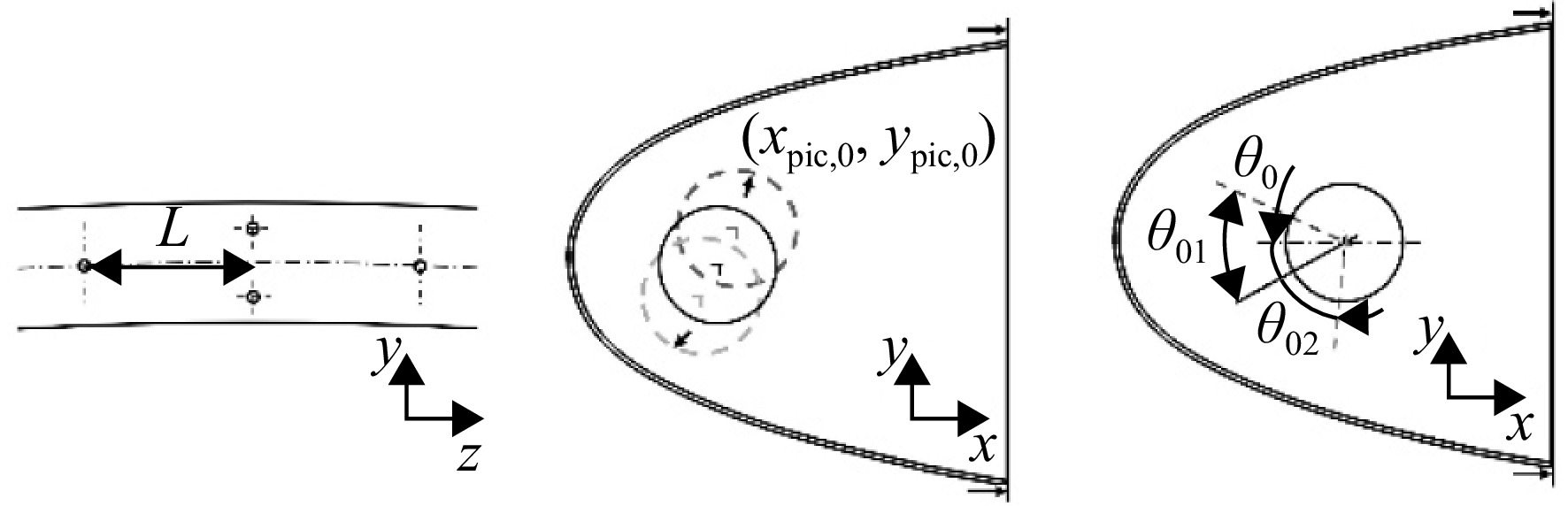
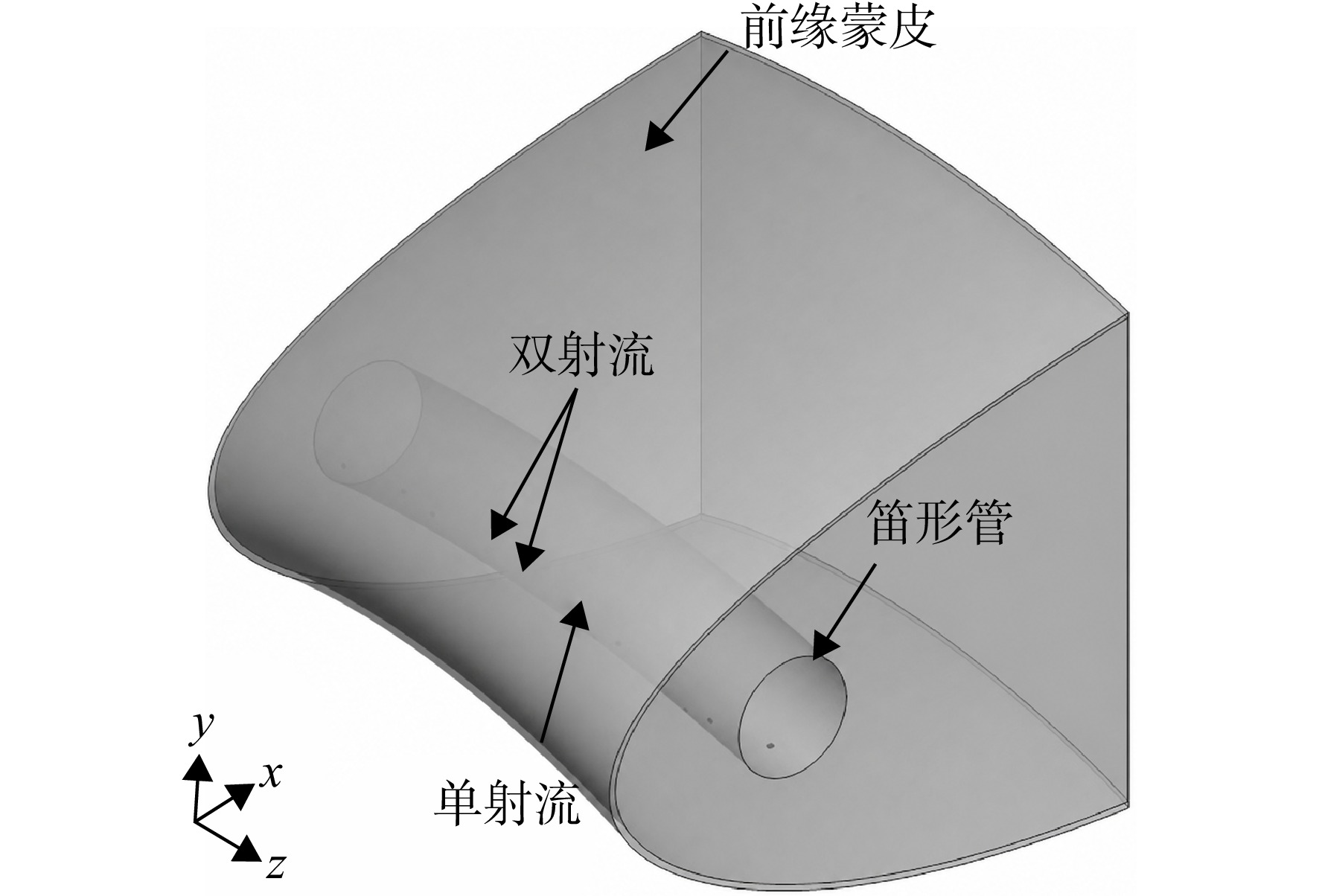
图 2 进气道热气防冰系统局部笛形管区域
Figure 2. Local piccolo-tube of the inlet hot-air anti-icing system
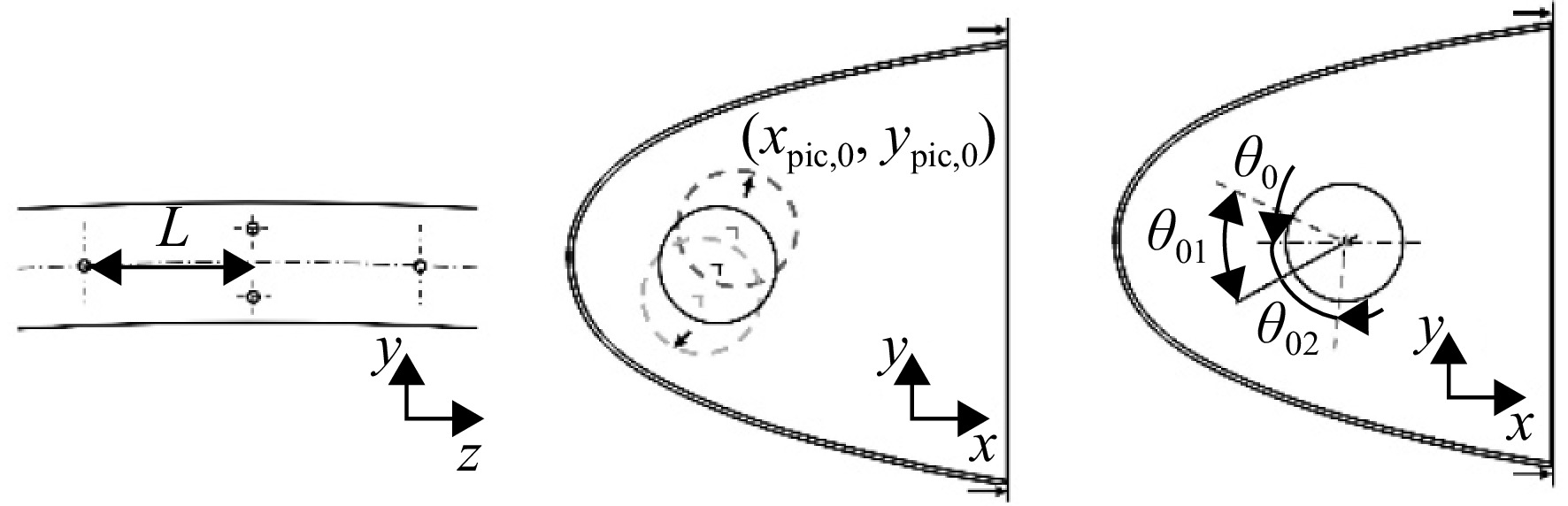
图 3 进气道热气防冰系统优化设计变量
Figure 3. Optimization design variables of the inlet hot-air anti-icing system
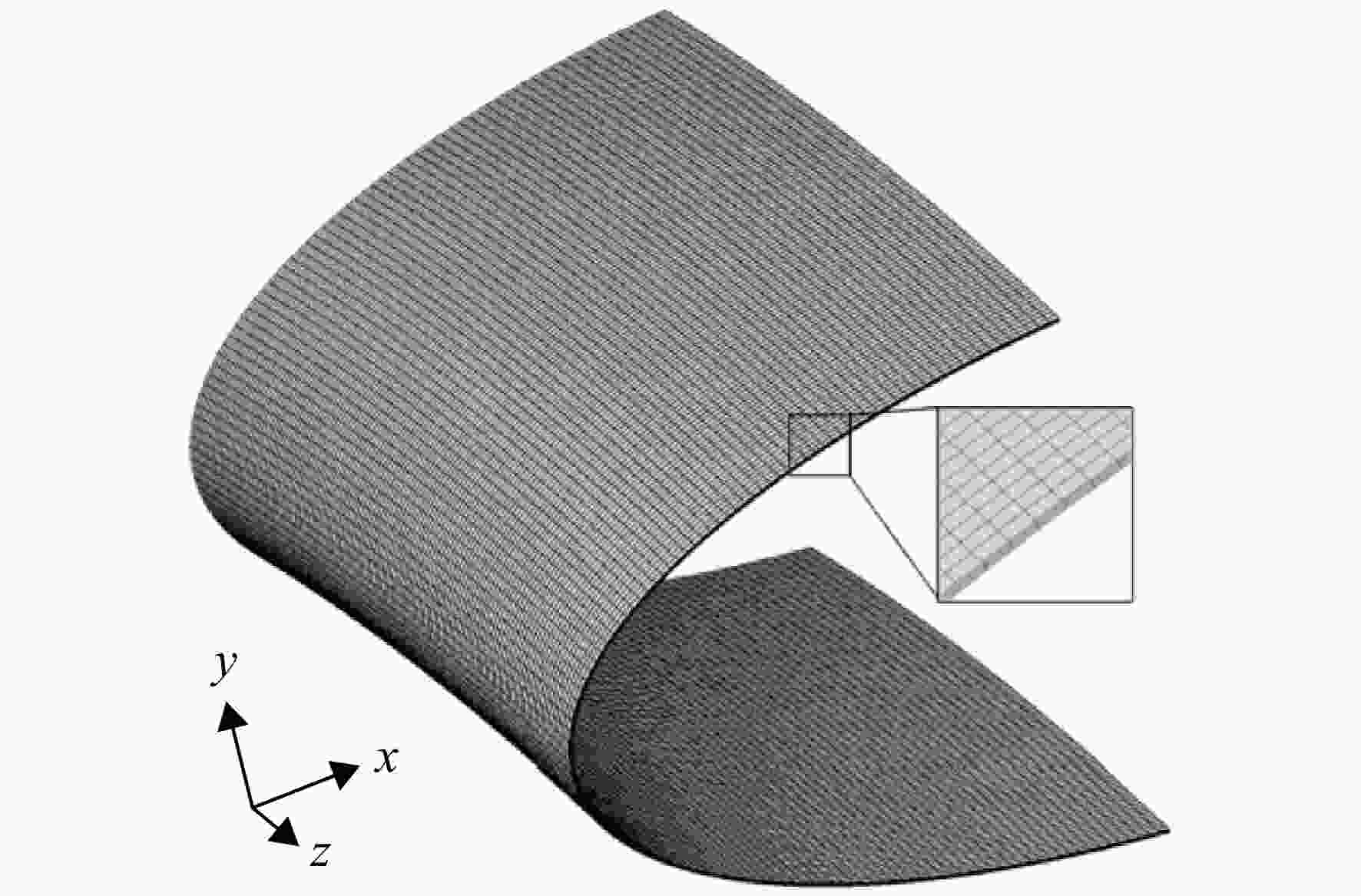
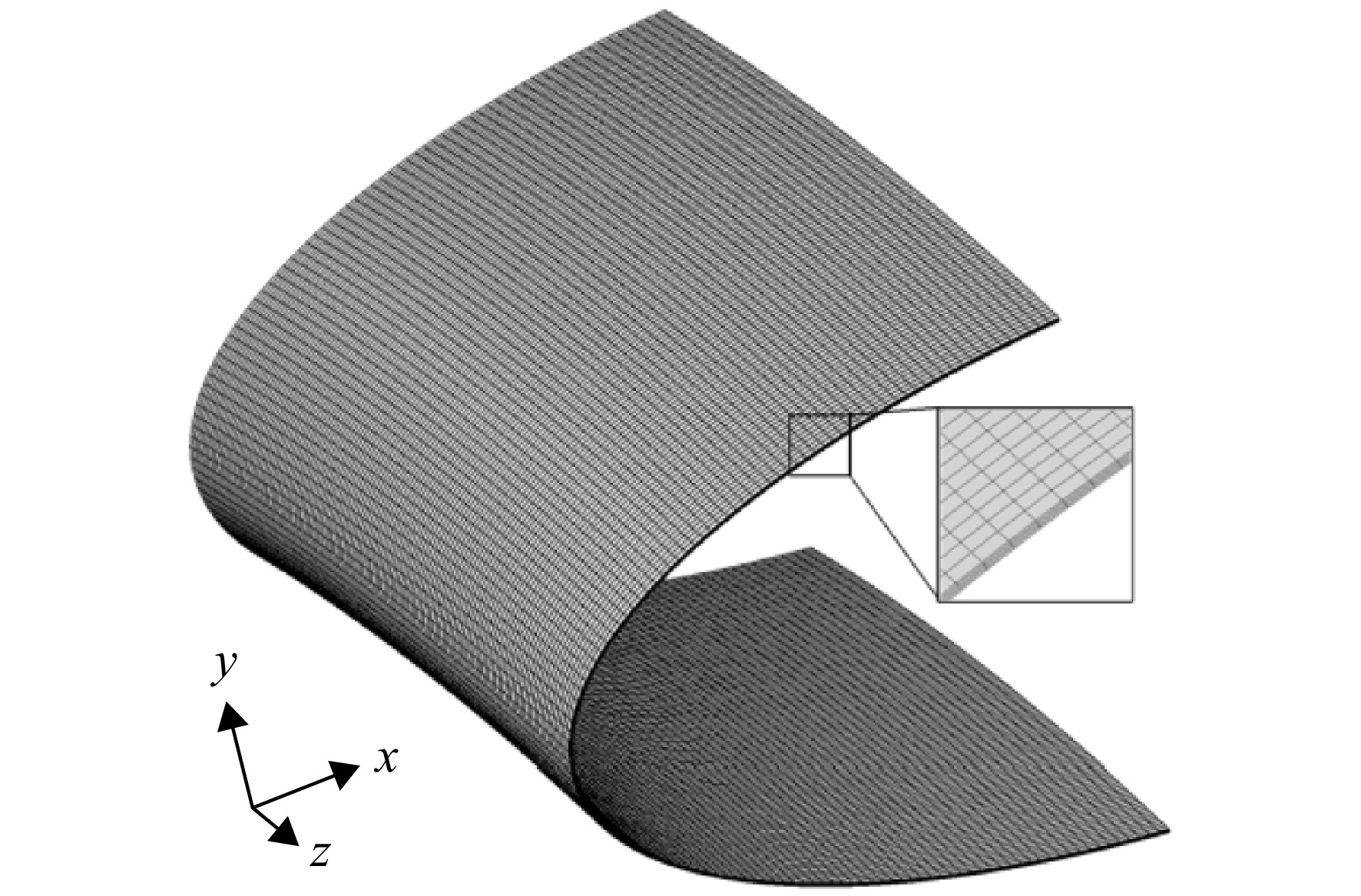
图 4 进气道热气防冰系统蒙皮表面结构化网格
Figure 4. Structured surface mesh of the inlet hot-air anti-icing system skin
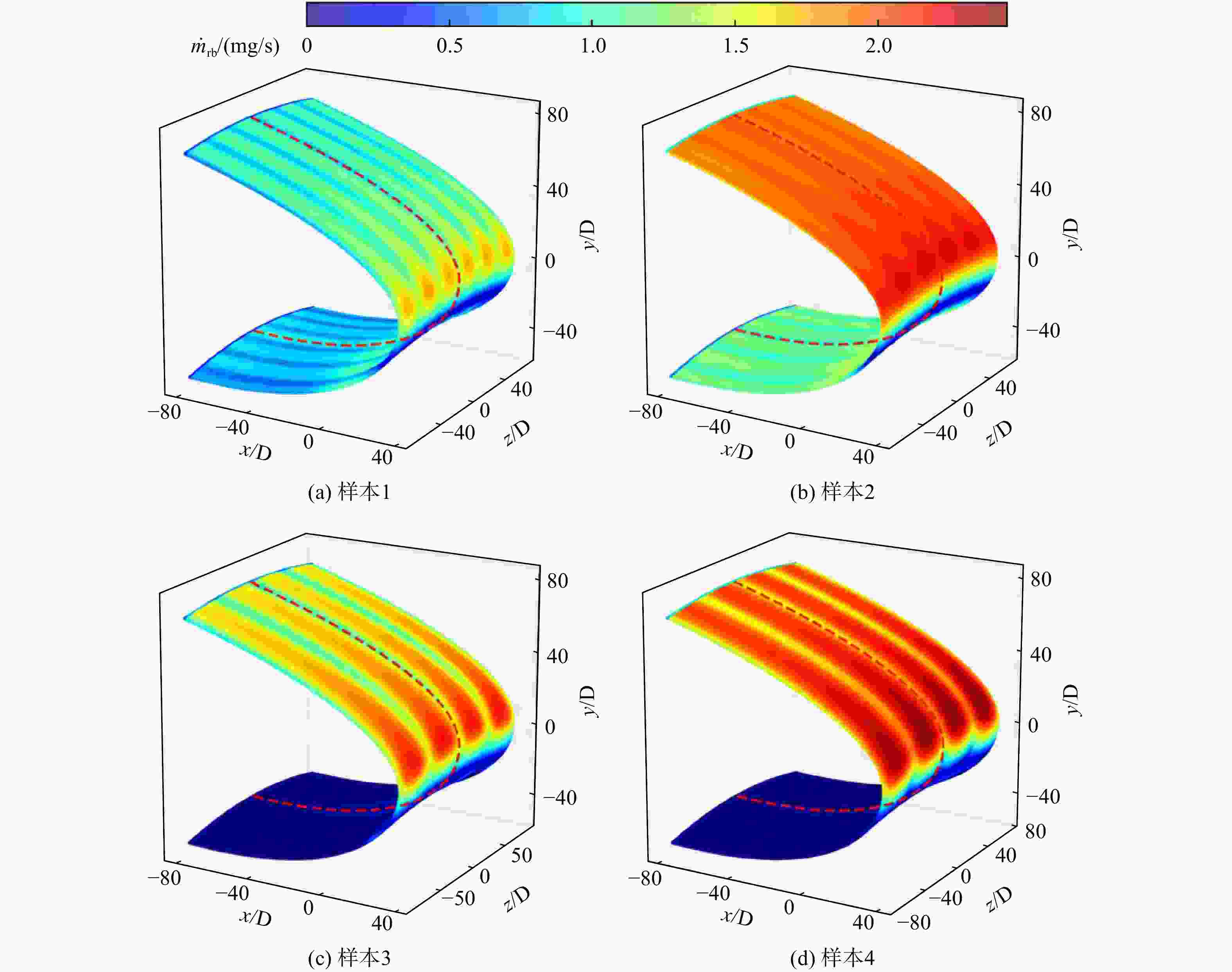
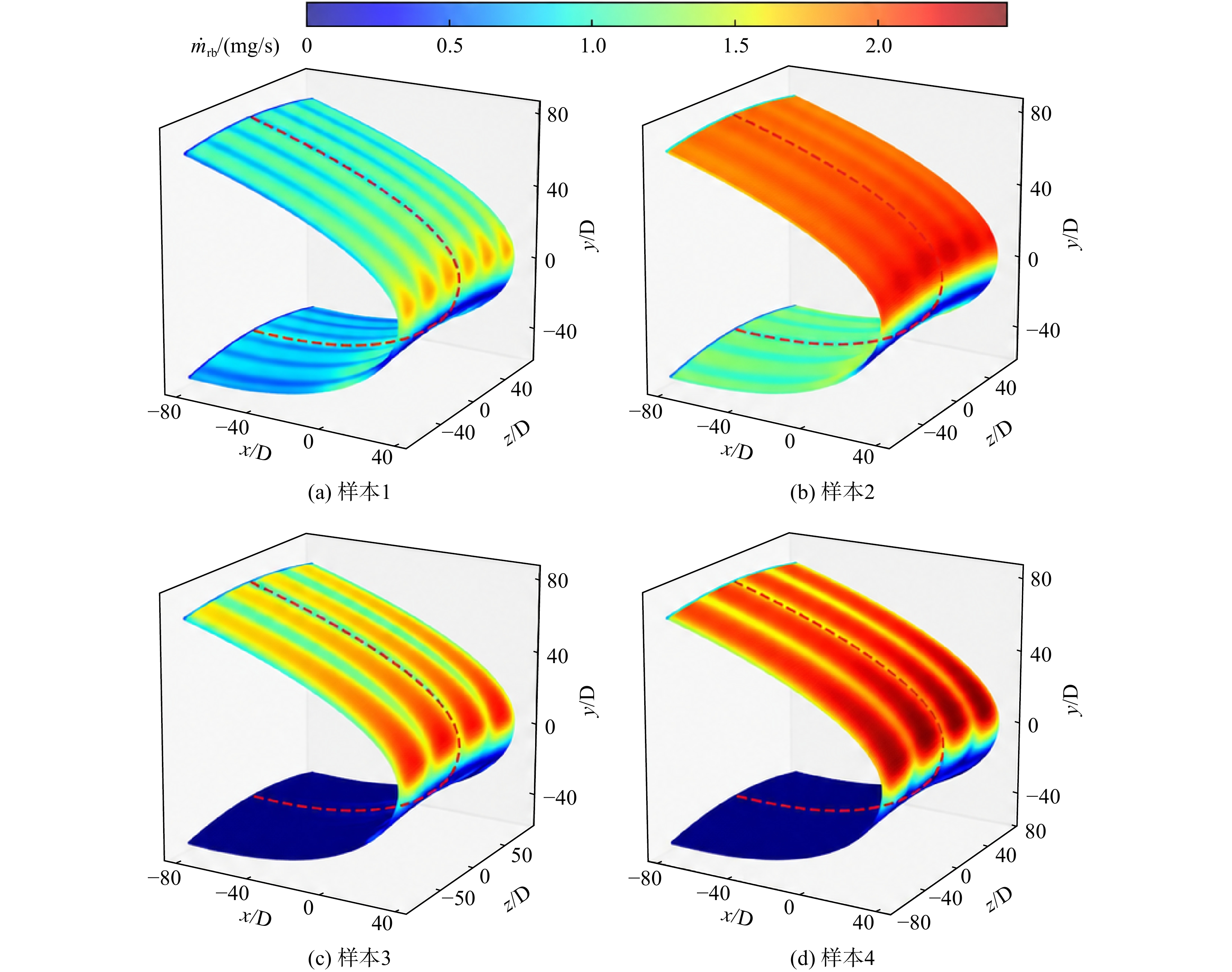
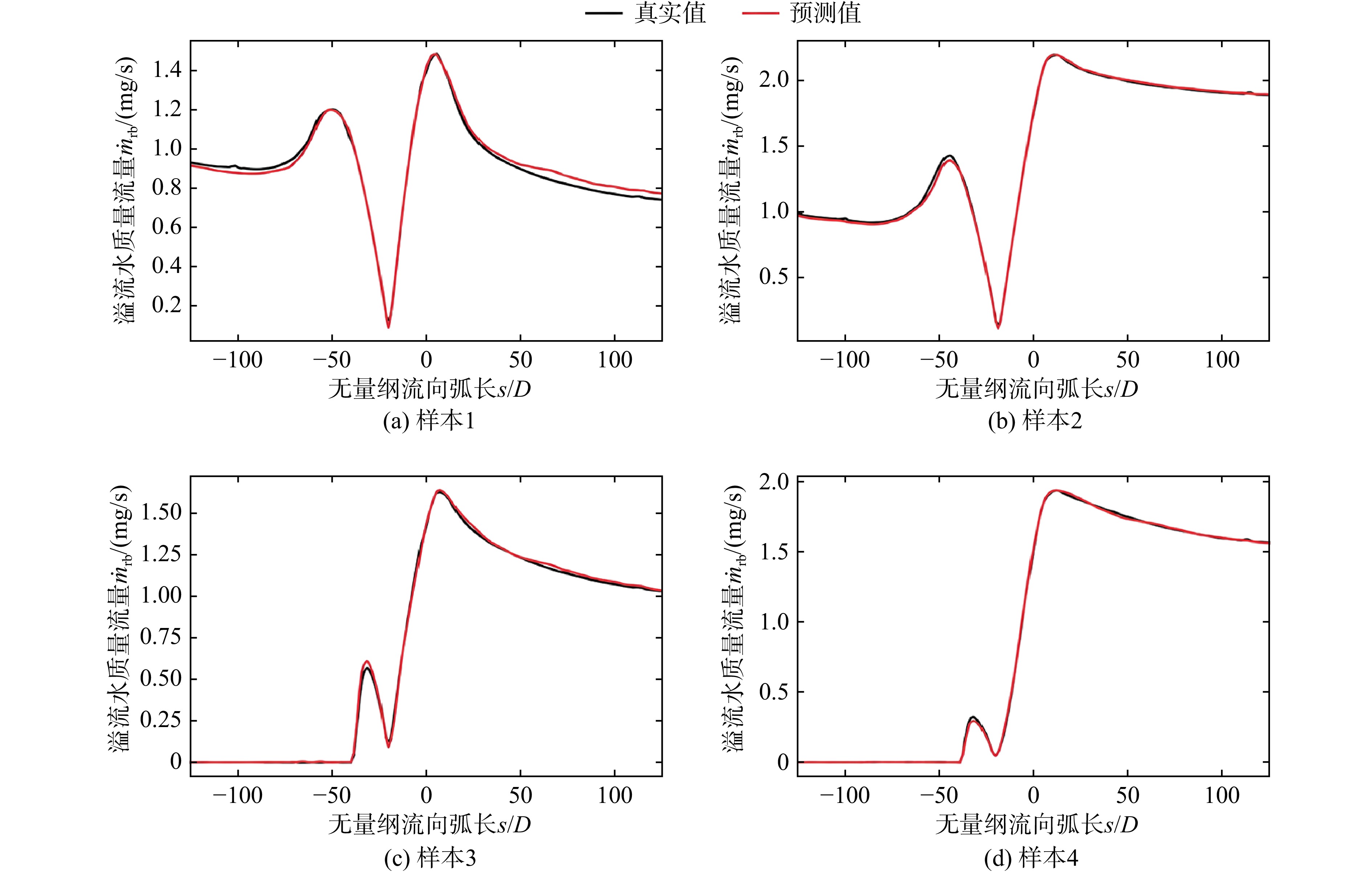
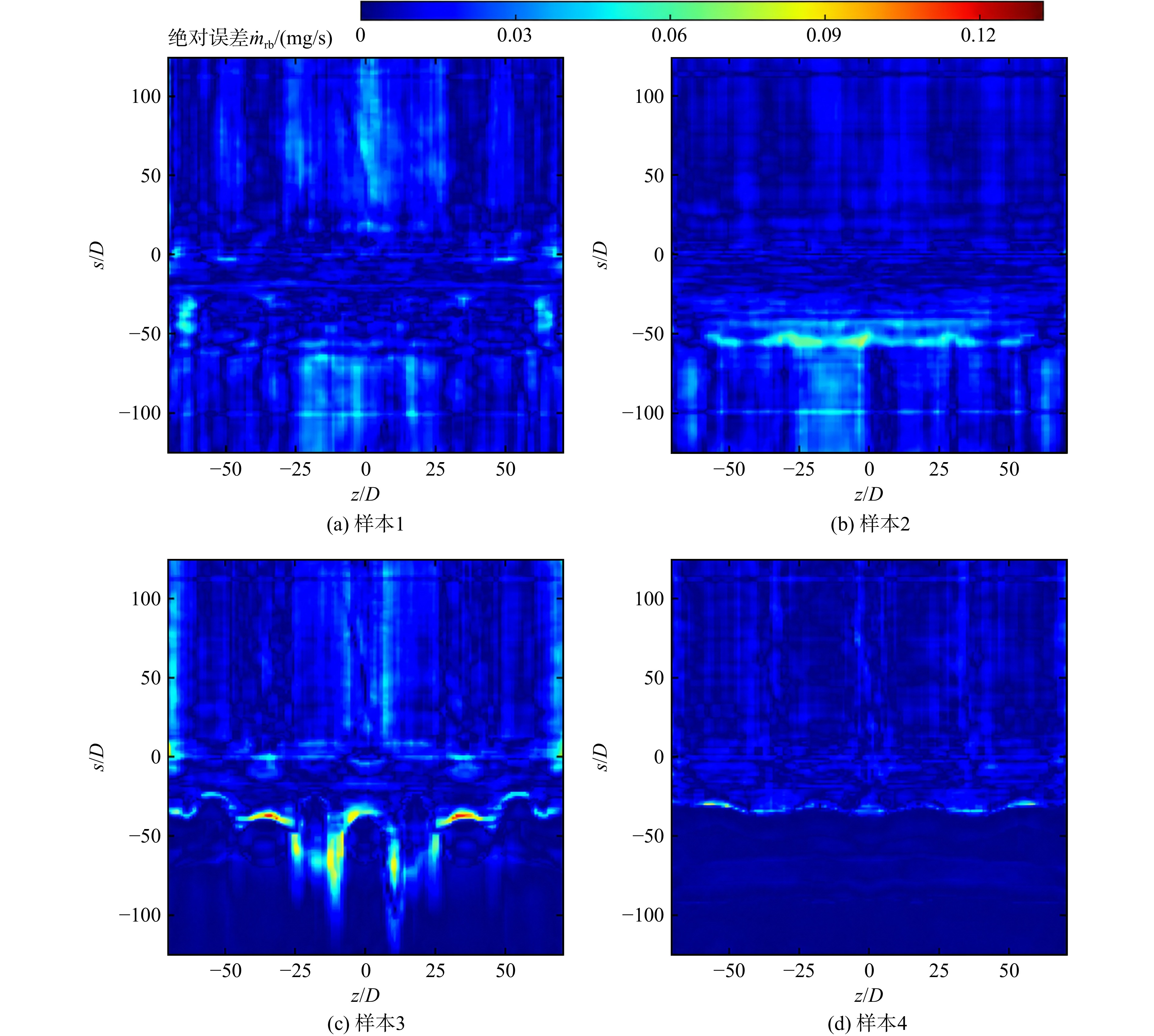
图 8 4个代表性测试算例的CFD计算溢流水质量流量三维表面场
Figure 8. CFD-computed three-dimensional surface fields of runback water mass flow rate for four representative test cases
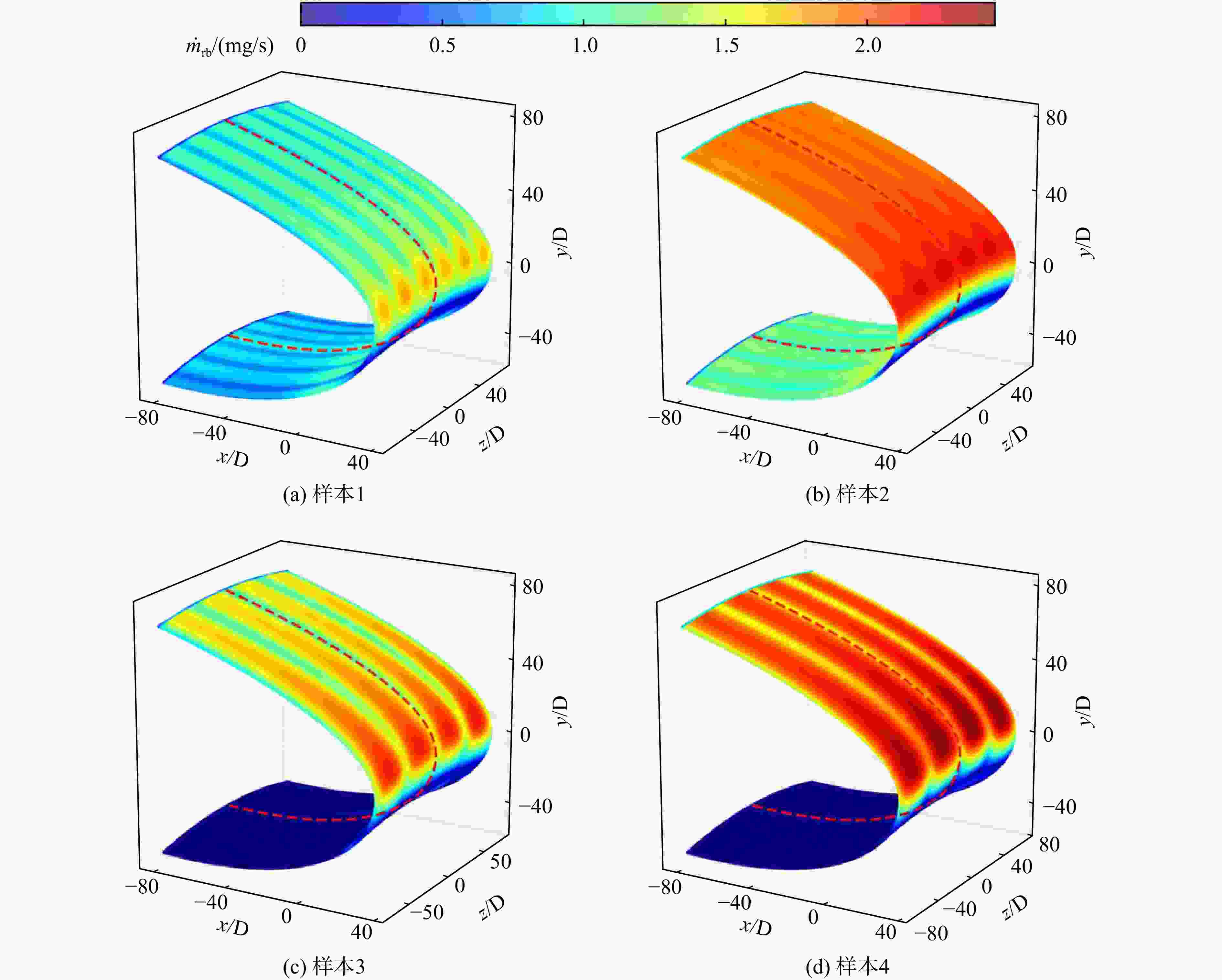
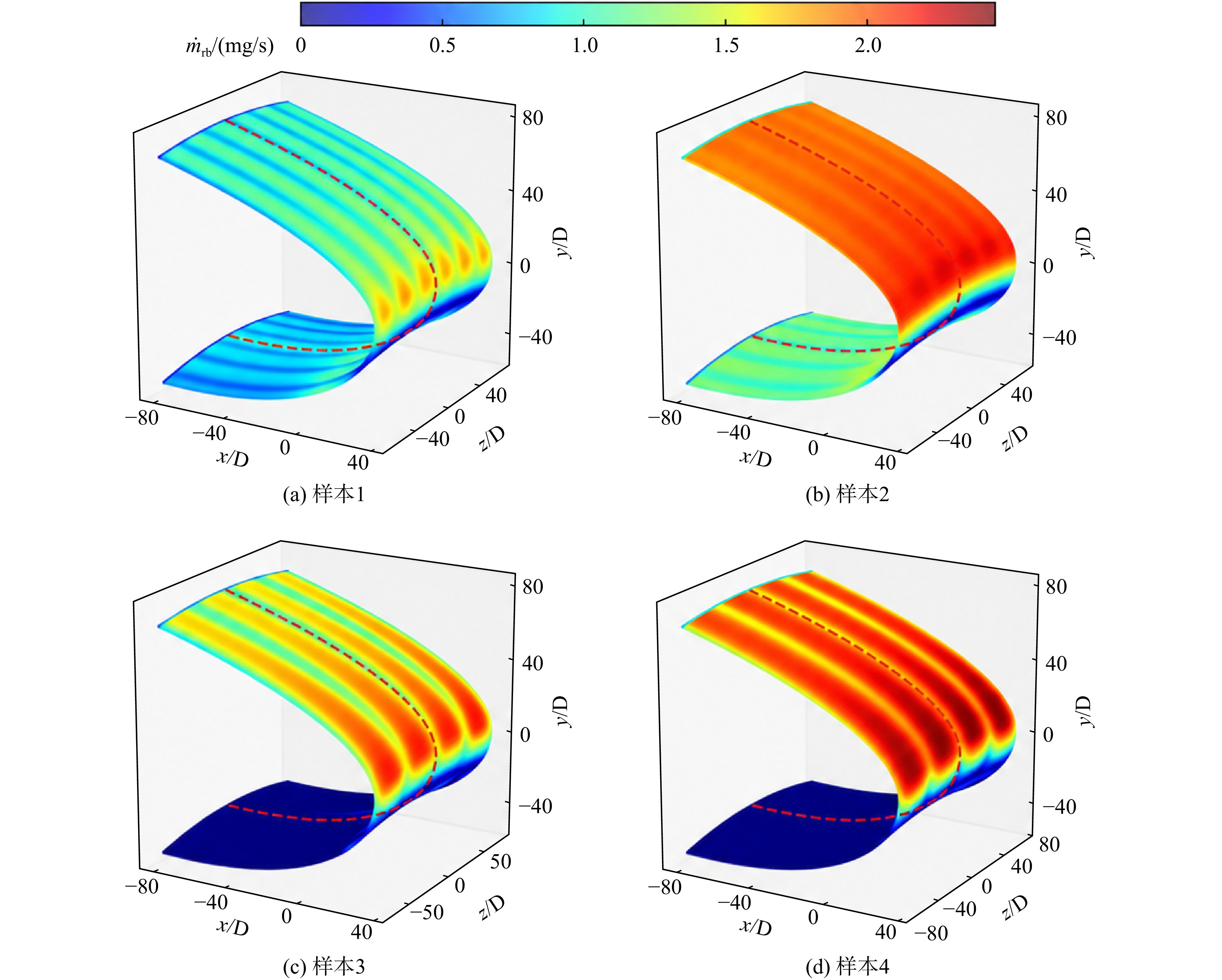
图 9 PSANet预测的溢流水质量流量三维表面场
Figure 9. PSANet-predicted three-dimensional surface fields of runback water mass flow rate
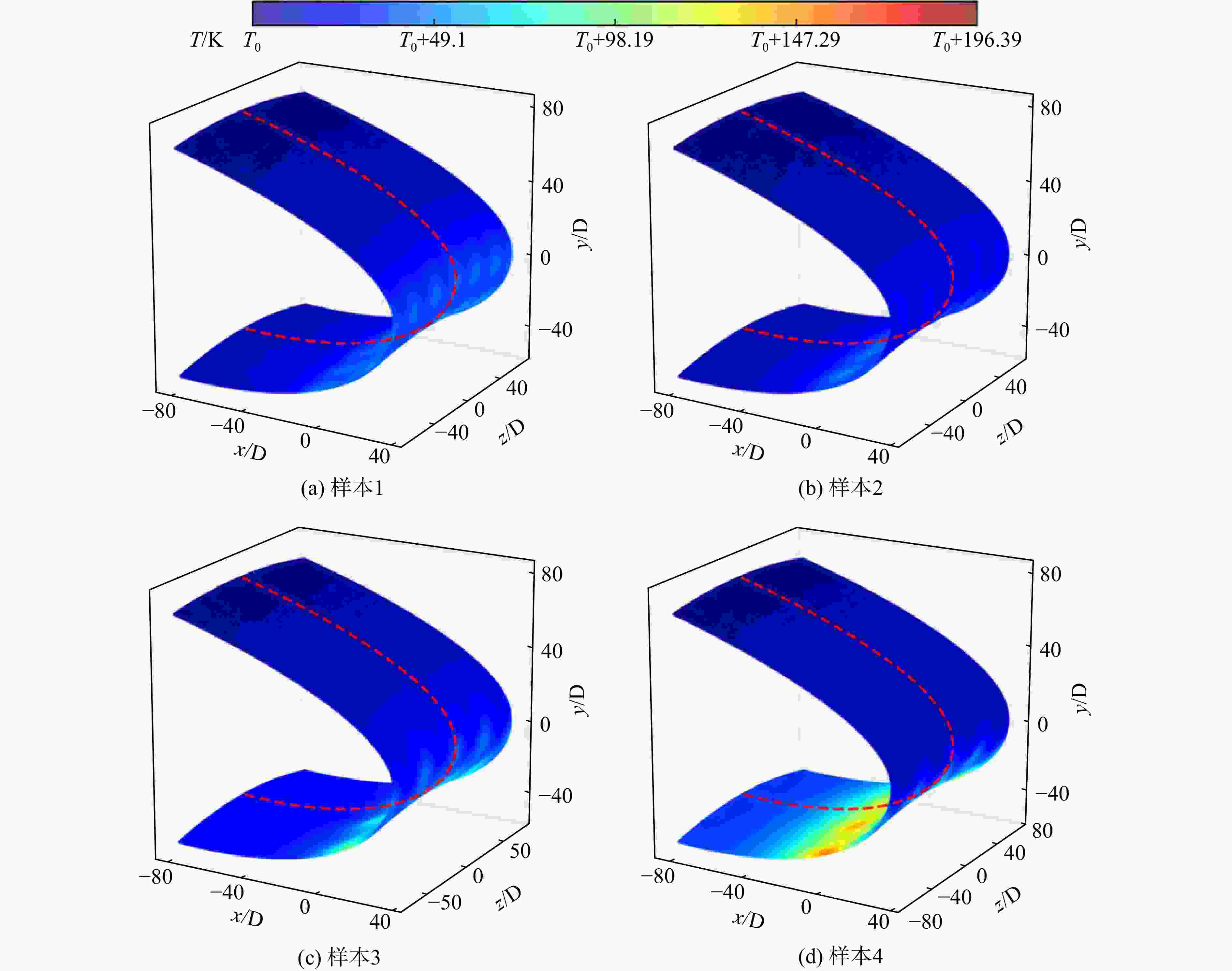
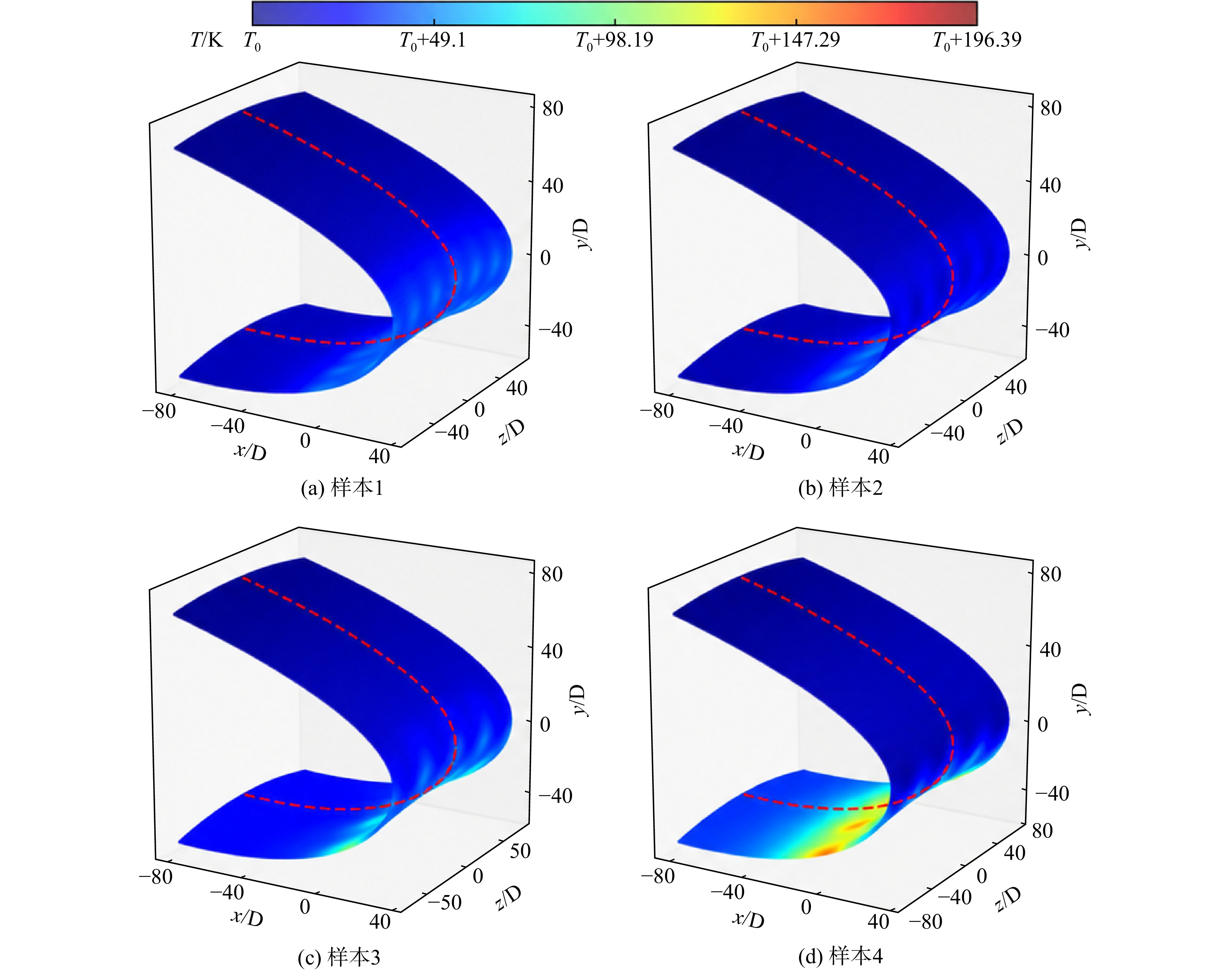
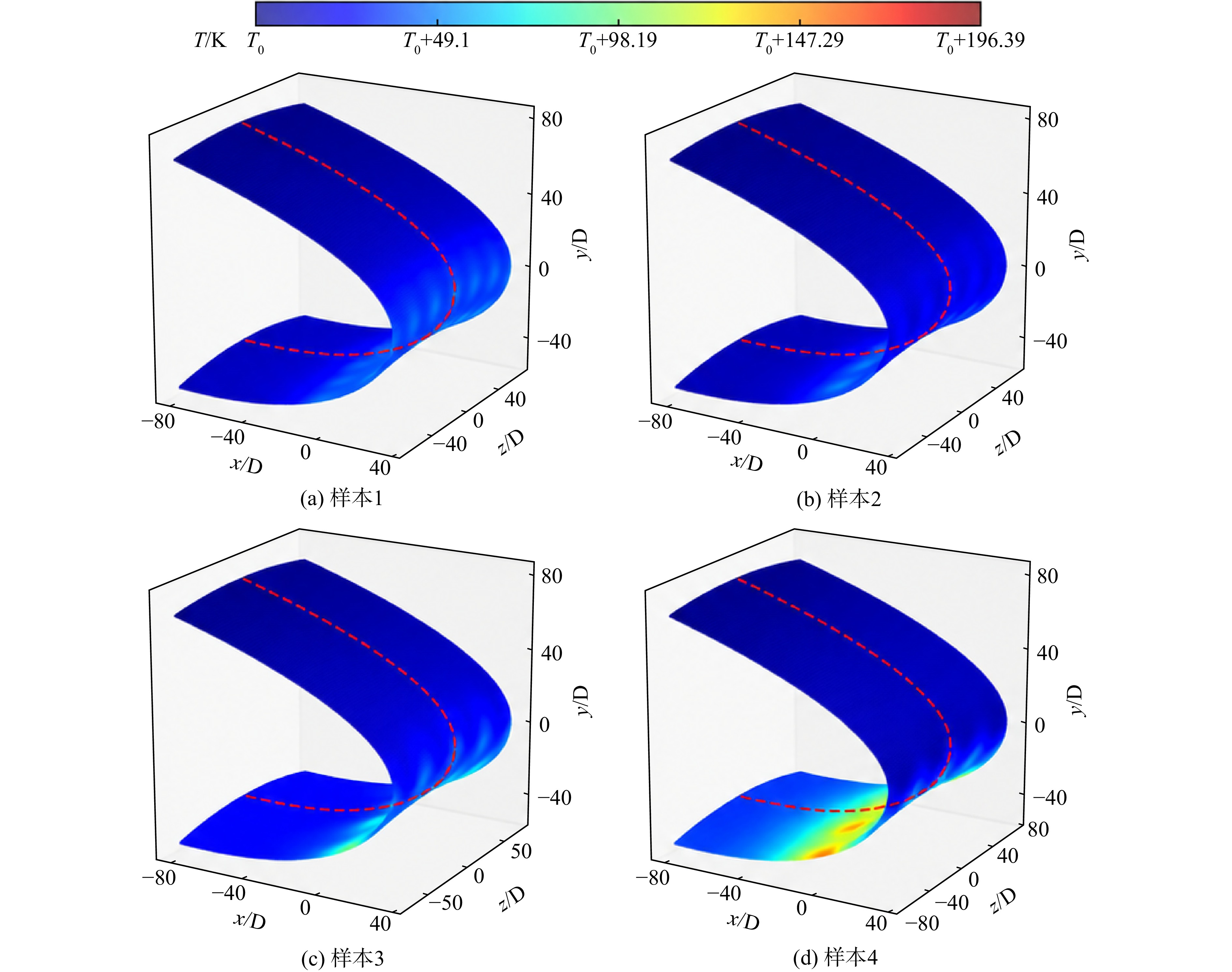
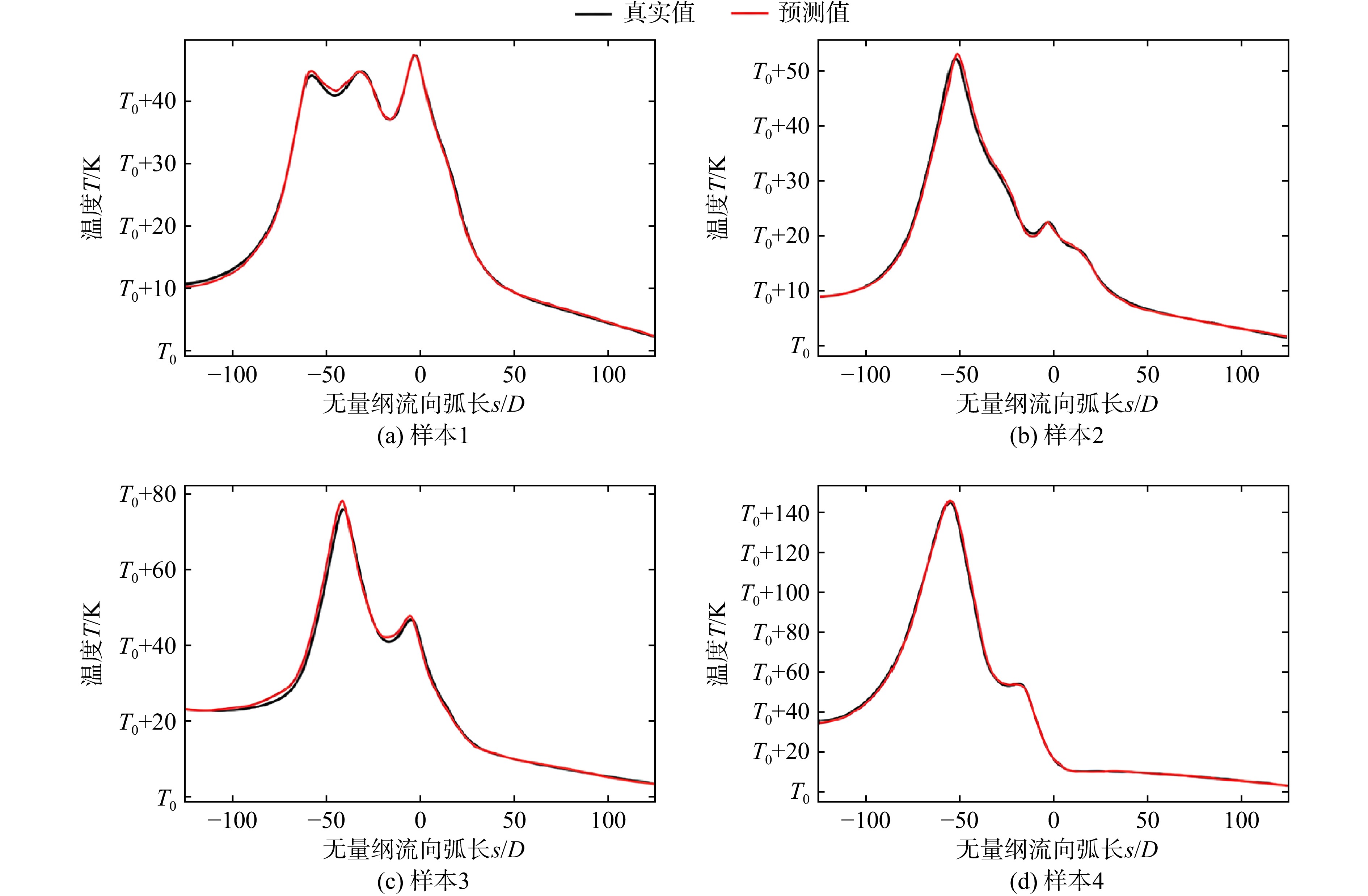
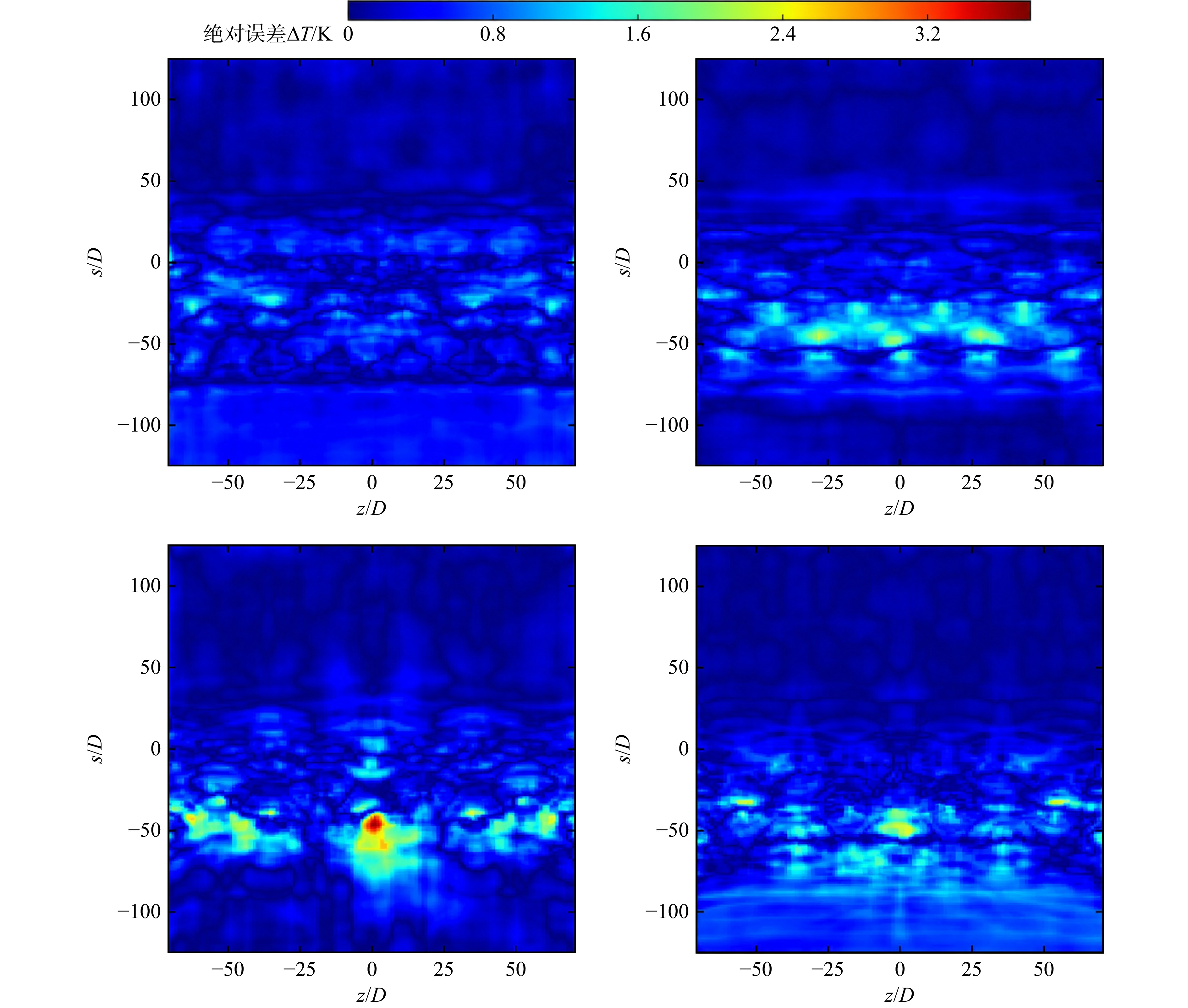
图 10 4个代表性测试算例的CFD计算防冰表面温度三维表面场
Figure 10. CFD-computed three-dimensional anti-icing surface temperature fields for four representative test cases
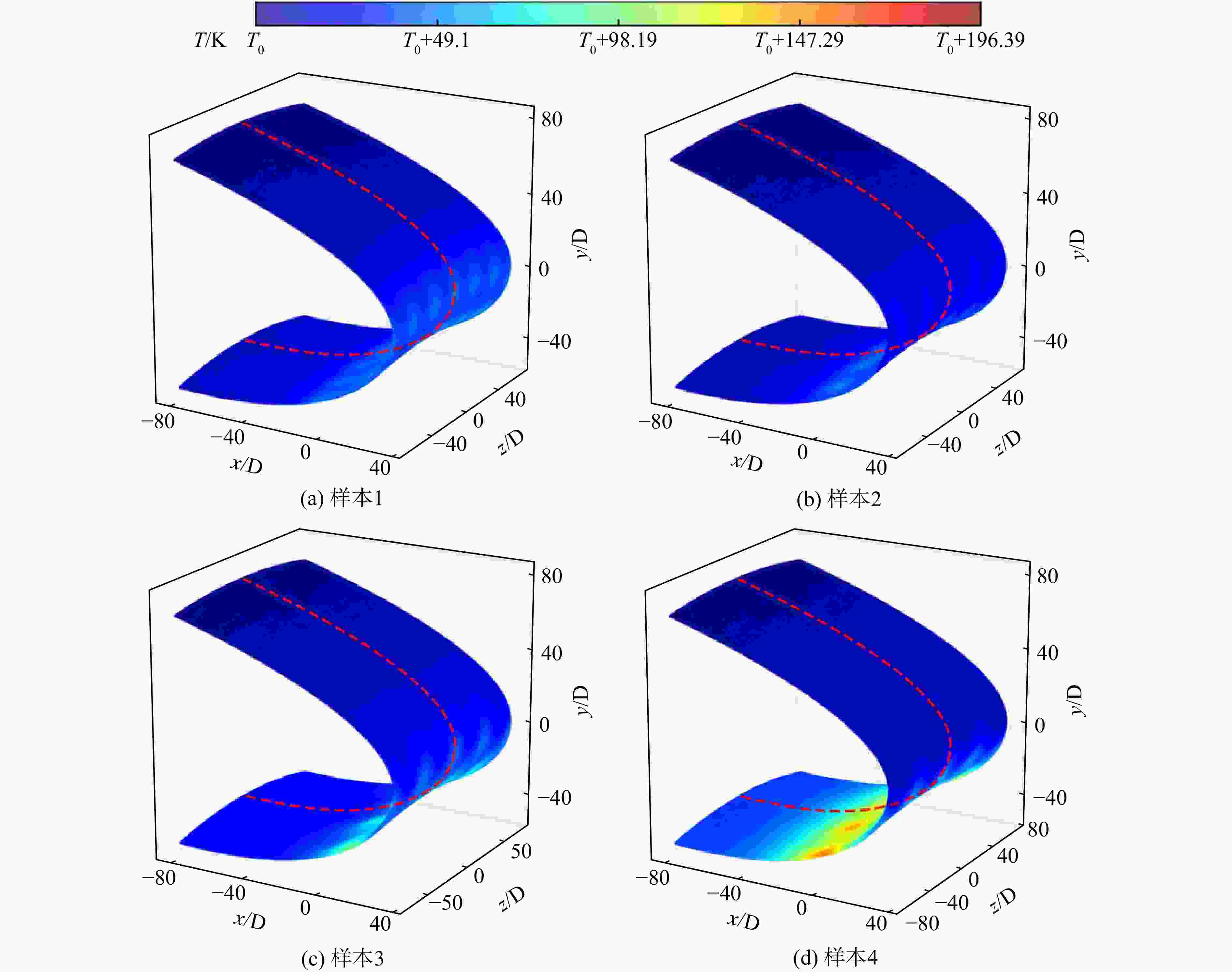
图 11 PSANet 预测的温度三维表面场
Figure 11. PSANet-predicted three-dimensional surface fields of temperature
表 1 设计变量、基准值及允许取值范围
Table 1. Design variables, baseline values, and admissible ranges
设计变量 基准值 取值范围 $ L/D $ 14.6 [10, 20] $ {x}_{{\mathrm{pic}},0}/D $ 0 [−10, 7.5] $ {y}_{{\mathrm{pic}},0}/D $ 0 [−10, 7.5] $ {\theta }_{0}/D $ 1.00 [0.54, 1.07] $ {\theta }_{01}/D $ 0.86 [0.36, 1.07] $ {\theta }_{02}/D $ 0.73 [0.36, 1.07]  下载: 导出CSV
表 2 进气道热气防冰系统设计工况
Table 2. Design conditions for the inlet hot-air anti-icing system
参数 取值 参数 取值 高度$ h $/km 6 液态水含量$ {\rho }_{lwc} $/(g/m3) 0.43 攻角α/(°) 4 气压$ {p}_{{\mathrm{tot}}} $/MPa 0.25 马赫数$ Ma $ 0.427 气温$ {T}_{{\mathrm{tot}}} $/K $ {T}_{0} $+291.85 K 来流温度$ {T}_{\mathrm{\infty }} $/K $ {T}_{0} $ 单孔热气质量流量$ {\dot{m}}_{{\mathrm{single}}} $/(g/s) 1.33 水滴中值体积直径$ MVD $/μm 20
下载: 导出CSV
表 3 数据集规模及划分
Table 3. Dataset size and split
子集 算例数 占比/% 训练集 4000 80 验证集 500 10 测试集 500 10
下载: 导出CSV
表 4 PSANet 实验与训练参数设置
Table 4. Experimental and training configuration used for PSANet
参数 设置 参数 设置 编码器模块数$ {N}_{1} $ 8 最小学习率$ {\eta }_{\min } $ 10−6 解码器模块数$ {N}_{2} $ 4 批大小 4 切片token数$ M $ 64 坐标归s一化 Z-score 傅里叶特征参数 B=8 温度归一化 Z-score 优化器 AdamW 条件归一化 $ [0{,}1] $ 区间 初始学习率 $ {\eta }_{\max } $ 10−4 温度阈值 $ {\tau }_{T} $/K 3.0 权重衰减$ {\lambda }_{wd} $ 10−5 溢流水质量流量阈值$ {\tau }_{\dot{m}} $/(mg/s) 0.05 学习率调度策略 余弦退火 训练轮数$ E $ 200
下载: 导出CSV
表 5 独立测试集上的基线模型对比结果
Table 5. Baseline comparison on the held-out test set
模型 $ e_{{\mathrm{ma}},T} $/
K$ e_{{\mathrm{rms}},T} $/
K$ \text{Max} { (e_{\mathrm{a}}) }_{T} $/
K$ A_{{\mathrm{mp}},T} $ $ e_{{\mathrm{ma}},\text{rb}} $/
(mg/s)$ e_{{\mathrm{rms}},\text{rb}} $/
(mg/s)$ \text{Max} { (e_{\mathrm{a}}) }_{\text{rb}} $/
(mg/s)$ A_{{\mathrm{mp}},\text{rb}} $ 耗时
ms/case$ \Delta e_{{\mathrm{ma}},T} $/
%$ \Delta A_{{\mathrm{mp}},\text{rb}} $/
%$ \Delta latency $/
%PSANet 0.503 0.841 3.320 0.988 0.011 0.018 0.047 0.973 38.57 0.00 0.00 0.00 PointNet 2.774 4.391 7.316 0.701 0.093 0.136 0.227 0.443 4.24 −29.08 −54.48 −89.01 PointNet++ 4.138 6.748 16.802 0.594 0.156 0.213 0.499 0.303 158.35 −39.90 −68.89 310.55 DGCNN 4.062 6.433 13.235 0.592 0.144 0.202 0.533 0.325 155.96 −40.10 −66.60 304.36 PT-v1 0.497 0.862 3.576 0.986 0.011 0.020 0.091 0.967 148.44 −0.18 −0.73 284.86 PT-v2 0.532 0.899 3.121 0.984 0.013 0.022 0.075 0.958 255.39 −0.38 −1.58 562.15 PT-v3 0.529 0.909 3.576 0.985 0.012 0.021 0.077 0.963 157.90 −0.36 −1.14 309.39
下载: 导出CSV
表 6 CFD 与 PSANet 计算耗时对比
Table 6. Computation time comparison between CFD and PSANet
方法 单次耗时/s J个算例总耗时/s CFD 265.36 J×265.36 PSANet 训练 84000 84000 PSANet 推理 0.0386 84000 + J×0.0386
下载: 导出CSV
-
[1] 桑为民, 蔡旸, 鲁天. 变形破碎特性对SLD结冰过程影响[J]. 航空动力学报, 2017, 32(7): 1537-1544. Sang Weimin, Cai Yang, Lu Tian. Effect of deformation and breakup characteristic on supercooled large droplet icing process[J]. Journal of Aerospace Power, 2017, 32(7): 1537-1544. (in Chinese doi: 10.13224/j.cnki.jasp.2017.07.001Sang Weimin, Cai Yang, Lu Tian. Effect of deformation and breakup characteristic on supercooled large droplet icing process[J]. Journal of Aerospace Power, 2017, 32(7): 1537-1544. (in Chinese) doi: 10.13224/j.cnki.jasp.2017.07.001 [2] Tetteh E, Loth E, Neuteboom M O, et al. In-flight gas turbine engine icing: review[J]. AIAA Journal, 2022, 60(10): 5610-5632. doi: 10.2514/1.J061523 [3] Zhang Yue, Narayanasamy K, Sandel W, et al. A three-layer model for ice crystal icing in aircraft engines[C]//SAE Technical Paper Series, 2023, 1: 2023-1-1481. [4] Qi Haifeng, Chang Shinan, Yang Yinglin, et al. Numerical investigations on aero-engine icing characteristics at mixed phase conditions[J]. Applied Thermal Engineering, 2024, 238: 122044. doi: 10.1016/j.applthermaleng.2023.122044 [5] 常士楠, 杨波, 冷梦尧, 等. 飞机热气防冰系统研究[J]. 航空动力学报, 2017, 32(5): 1025-1034. Chang Shinan, Yang Bo, Leng Mengyao, et al. Study on bleed air anti-icing system of aircraft[J]. Journal of Aerospace Power, 2017, 32(5): 1025-1034. (in Chinese doi: 10.13224/j.cnki.jasp.2017.05.001Chang Shinan, Yang Bo, Leng Mengyao, et al. Study on bleed air anti-icing system of aircraft[J]. Journal of Aerospace Power, 2017, 32(5): 1025-1034. (in Chinese) doi: 10.13224/j.cnki.jasp.2017.05.001 [6] 朱永峰, 方玉峰, 封文春. 某型飞机发动机短舱防冰系统设计计算[J]. 航空动力学报, 2012, 27(6): 1326-1331. Zhu Yongfeng, Fang Yufeng, Feng Wenchun. Design and calculation of aircraft nacelle anti-icing system[J]. Journal of Aerospace Power, 2012, 27(6): 1326-1331. (in Chinese doi: 10.13224/j.cnki.jasp.2012.06.029Zhu Yongfeng, Fang Yufeng, Feng Wenchun. Design and calculation of aircraft nacelle anti-icing system[J]. Journal of Aerospace Power, 2012, 27(6): 1326-1331. (in Chinese) doi: 10.13224/j.cnki.jasp.2012.06.029 [7] Jing Shuliang, Hu Yaping, Chen Weijian. Numerical simulation of hot air anti-icing characteristics for intake components of aeronautical engine[J]. Aerospace, 2025, 12(9): 753. doi: 10.3390/aerospace12090753 [8] 冉林, 熊建军, 赵照, 等. 结冰风洞小流量发动机进气部件防冰试验技术[J]. 航空动力学报, 2024, 39(4): 1-7. Ran Lin, Xiong Jianjun, Zhao Zhao, et al. Anti-icing test technology of low-flow engine intake components in icing wind tunnel[J]. Journal of Aerospace Power, 2024, 39(4): 1-7. (in Chinese doi: 10.13224/j.cnki.jasp.20210576Ran Lin, Xiong Jianjun, Zhao Zhao, et al. Anti-icing test technology of low-flow engine intake components in icing wind tunnel[J]. Journal of Aerospace Power, 2024, 39(4): 1-7. (in Chinese) doi: 10.13224/j.cnki.jasp.20210576 [9] 赵照, 熊建军, 冉林, 等. 大型结冰风洞热气供气防除冰试验技术[J]. 航空动力学报, 2024, 39(5): 11-17. Zhao Zhao, Xiong Jianjun, Ran Lin, et al. Hot air supply anti/de-icing test technology in large-scale icing wind tunnel[J]. Journal of Aerospace Power, 2024, 39(5): 11-17. (in Chinese doi: 10.13224/j.cnki.jasp.20210582Zhao Zhao, Xiong Jianjun, Ran Lin, et al. Hot air supply anti/de-icing test technology in large-scale icing wind tunnel[J]. Journal of Aerospace Power, 2024, 39(5): 11-17. (in Chinese) doi: 10.13224/j.cnki.jasp.20210582 [10] Chen Ningli, Yi Xian, Wang Qiang, et al. A literature review on numerical simulation of thermal anti-icing[J]. Aerospace, 2025, 12(2): 83. doi: 10.3390/aerospace12020083 [11] Bidwell C S. Icing analysis of a swept NACA 0012 wing using LEWICE3D version 3.48[R]. AIAA-2014-2200, 2014. [12] Habashi W G, Aubé M, Baruzzi G, et al. FENSAP-ICE: a fully-3D in-flight icing simulation system for aircraft, rotorcraft and UAVs[C]//24th International Congress of the Aeronautical Sciences. Bonn, Germany: International Council of the Aeronautical Sciences, 2004: 1-10. [13] Bu Xueqin, Lin Guiping, Shen Xiaobin, et al. Numerical simulation of aircraft thermal anti-icing system based on a tight-coupling method[J]. International Journal of Heat and Mass Transfer, 2020, 148: 119061. doi: 10.1016/j.ijheatmasstransfer.2019.119061 [14] Yang Qian, Zheng Haoran, Guo Xiaofeng, et al. Experimental validation and tightly coupled numerical simulation of hot air anti-icing system based on an extended mass and heat transfer model[J]. International Journal of Heat and Mass Transfer, 2023, 217: 124645. doi: 10.1016/j.ijheatmasstransfer.2023.124645 [15] Jia Xuyi, Gong Chunlin, Ji Wen, et al. An accuracy-enhanced transonic flow prediction method fusing deep learning and a reduced-order model[J]. Physics of Fluids, 2024, 36(5): 056101. doi: 10.1063/5.0204152 [16] Wang Jincheng, Hu Haiyang, He Ping, et al. A machine learning study to predict wind-driven water runback characteristics[J]. Physics of Fluids, 2023, 35(10): 102104. doi: 10.1063/5.0167545 [17] Wang Jincheng, He Ping, Hu Hui. Predicting interfacial shear stress distributions of wind-driven water runback flows using physics-informed neural networks[R]. AIAA-2024-3932, 2024. [18] 杨倩, 郭晓峰, 李芹, 等. 基于POD和代理模型的热气防冰性能预测方法[J]. 航空学报, 2023, 44(1): 142-156. Yang Qian, Guo Xiaofeng, Li Qin, et al. Hot air anti-icing performance estimation method based on POD and surrogate model[J]. Acta Aeronautica et Astronautica Sinica, 2023, 44(1): 142-156. (in ChineseYang Qian, Guo Xiaofeng, Li Qin, et al. Hot air anti-icing performance estimation method based on POD and surrogate model[J]. Acta Aeronautica et Astronautica Sinica, 2023, 44(1): 142-156. (in Chinese) [19] 楚紫滢, 耿技, 杨倩, 等. 基于神经网络与遗传算法的热气防冰结构优化[J]. 空气动力学学报, 2026, 44(4): 18-28. Chu Ziying, Geng Ji, Yang Qian, et al. Optimization of hot-air anti-icing structures based on neural networks and genetic algorithms[J]. Acta Aerodynamica Sinica, 2026, 44(4): 18-28. (in Chinese doi: 10.7638/kqdlxxb-2024.0211Chu Ziying, Geng Ji, Yang Qian, et al. Optimization of hot-air anti-icing structures based on neural networks and genetic algorithms[J]. Acta Aerodynamica Sinica, 2026, 44(4): 18-28. (in Chinese) doi: 10.7638/kqdlxxb-2024.0211 [20] Sanchez-Gonzalez A, Godwin J, Pfaff T, et al. Learning to simulate complex physics with graph networks[C]//Proceedings of the 37th International Conference on Machine Learning. New York: ACM, 2020: 8459-8468. [21] Pfaff T, Fortunato M, Sanchez-Gonzalez A, et al. Learning mesh-based simulation with graph networks[C]// International Conference on Learning Representations. Virtual: ICLR, 2020. [22] Zhao Hengshuang, Jiang Li, Jia Jiaya, et al. Point transformer[C]//2021 IEEE/CVF International Conference on Computer Vision. Piscataway, US: IEEE, 2021: 16239-16248. [23] VASWANI A, SHAZEER N, PARMAR N, et al. Attention is all you need[C]//Advances in Neural Information Processing Systems. Red Hook, US: Curran Associates Inc, 2017, 30: 5998-6008. [24] Hirose N, Asai K, Ikawa K. Transonic 3-D Euler analysis of flows around fan-jet engine and T. P. S. (Turbine Powered Simulator)[R]. NAL-TR-1045, 1989. [25] Domingos R. Computational methodology for bleed air ice protection system parametric analysis[D]. Wichita, US: Wichita State University, 2010. [26] 杨倩. 飞机结防冰数值模拟及热气防冰优化设计方法研究[D]. 上海: 上海交通大学, 2023. YANG Qian. Research on numerical simulation of aircraft icing and anti-icing and optimization design method of hot-air anti-icing[D]. Shanghai: Shanghai Jiao Tong University, 2023. (in ChineseYANG Qian. Research on numerical simulation of aircraft icing and anti-icing and optimization design method of hot-air anti-icing[D]. Shanghai: Shanghai Jiao Tong University, 2023. (in Chinese) [27] Xu Shengfeng, Dai Yuanjun, Yan Chang, et al. On the preprocessing of physics-informed neural networks: How to better utilize data in fluid mechanics[J]. Journal of Computational Physics, 2025, 528: 113837. doi: 10.1016/j.jcp.2025.113837 [28] Yu Linqi, Yousif M Z, Zhou Dan, et al. Self-supervised learning for effective denoising of flow fields[J]. Physics of Fluids, 2024, 36(10): 105159. doi: 10.1063/5.0231805 [29] Charles R Q, Hao Su, Mo Kaichun, et al. PointNet: deep learning on point sets for 3D classification and segmentation[C]//2017 IEEE Conference on Computer Vision and Pattern Recognition. Piscataway, US: IEEE, 2017: 77-85. [30] Qi C R, Yi Li, Su Hao, et al. PointNet++: deep hierarchical feature learning on point sets in a metric space[C]//Advances in Neural Information Processing Systems. Red Hook, US: Curran Associates Inc, 2017, 30: 5099-5108. [31] Tancik M, Srinivasan P, Mildenhall B, et al. Fourier features let networks learn high frequency functions in low dimensional domains[C]//Advances in Neural Information Processing Systems. Red Hook, US: Curran Associates Inc, 2020: 7537-7547. [32] RAHAMAN N, BARATIN A, ARPIT D, et al. On the spectral bias of neural networks[C]// Proceedings of the 36th International Conference on Machine Learning. Long Beach, US: PMLR, 2019: 5301-5310. [33] Jaegle A, Gimeno F, Brock A, et al. Perceiver: general perception with iterative attention[C]//Proceedings of the 38th International Conference on Machine Learning. Virtual: PMLR, 2021: 4651-4664. [34] Perez E, Strub F, De Vries H, et al. FiLM: visual reasoning with a general conditioning layer[C]//Proceedings of the AAAI Conference on Artificial Intelligence. Palo Alto, US: AAAI Press, 2018: 3942-3951. [35] He Kaiming, Zhang Xiangyu, Ren Shaoqing, et al. Deep residual learning for image recognition[C]//2016 IEEE Conference on Computer Vision and Pattern Recognition. Piscataway, US: IEEE, 2016: 770-778. [36] Deng Zhiwen, Wang Jing, Liu Hongsheng, et al. Prediction of transonic flow over supercritical airfoils using geometric-encoding and deep-learning strategies[J]. Physics of Fluids, 2023, 35(7): 075146. doi: 10.1063/5.0155383 [37] Li Cong, Liang Jichen, Ni Zhou, et al. Wavelet-enhanced attention fusion model for airfoil flow field prediction[J]. Physics of Fluids, 2025, 37(9): 093607. doi: 10.1063/5.0284080 [38] Nemati Taher F, Subaşı A. A fast three-dimensional flow field prediction around bluff bodies using deep learning[J]. Physics of Fluids, 2024, 36(2): 025101. doi: 10.1063/5.0188603 -

 点击查看大图
计量
- 文章访问数: 18
- HTML浏览量: 15
- PDF量: 0
- 被引次数: 0