






Design of a fault-tolerant control system for thrust vectoring fixed-wing aircraft based on switching strategy
-
摘要:
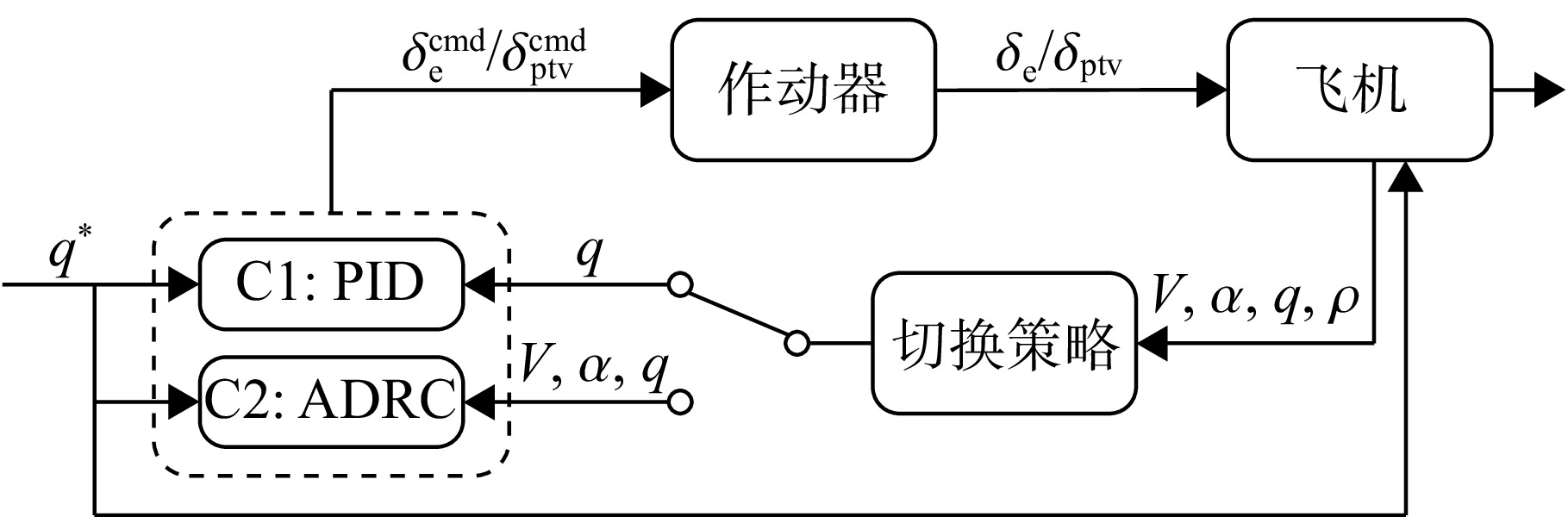
推力矢量技术逐渐成为提升飞机机动性和故障容错能力的重要手段之一,有效整合推力矢量技术与传统控制系统,提升整体控制策略的容错能力是一个亟待解决的研究问题。本文通过构建飞/发一体化被控对象及作动器模型,形成推力矢量控制策略的模型基础,并针对推力矢量固定翼飞机的升降舵失效情况,提出了一种基于切换控制的容错控制策略。该策略结合了传统PID控制与自抗扰控制(ADRC)算法,根据系统状态进行切换:在正常状态下使用PID控制升降舵,在升降舵失效时切换到ADRC控制推力矢量角,从而保证系统的稳定性和控制性能。通过控制系统与飞/发一体化被控对象联试的非线性仿真验证了所提方法的有效性,结果表明:故障状态下所设计的控制器相较于基准控制器的上升时间性能提升约15%,调整时间性能提高约2%,同时在不同故障条件下,该切换控制策略均能够保证系统的稳定性与性能。
-
关键词:
- 推力矢量 /
- 容错控制 /
- 升降舵失效 /
- 自抗扰控制(ADRC) /
- 飞/发一体化
Abstract:Thrust vectoring technology has gradually become one of the important means to enhance aircraft maneuverability and fault tolerance. Effectively integrating thrust vectoring technology with traditional control systems to improve the fault tolerance of overall control strategies is a pressing research issue to be addressed. This paper establishes the model foundation for thrust vectoring control strategies by constructing an integrated aircraft/engine controlled object and actuator model. For the elevator failure scenario in thrust-vectored fixed-wing aircraft, a fault-tolerant control strategy based on switching control is proposed. This strategy combines traditional PID control with active disturbance rejection control (ADRC) algorithms, switching based on system state: PID control is used for the elevator under normal conditions, while switching to ADRC for thrust vectoring angle control during elevator failure, thereby ensuring system stability and control performance. Nonlinear simulation verification through joint testing of the control system and the integrated aircraft/engine controlled object demonstrates the effectiveness of the proposed method. The results show that, compared to the baseline controller, the designed controller improves rise time performance by approximately 15% and settling time performance by about 2% under fault conditions. Moreover, the switching control strategy maintains system stability and performance across various fault scenarios.
-
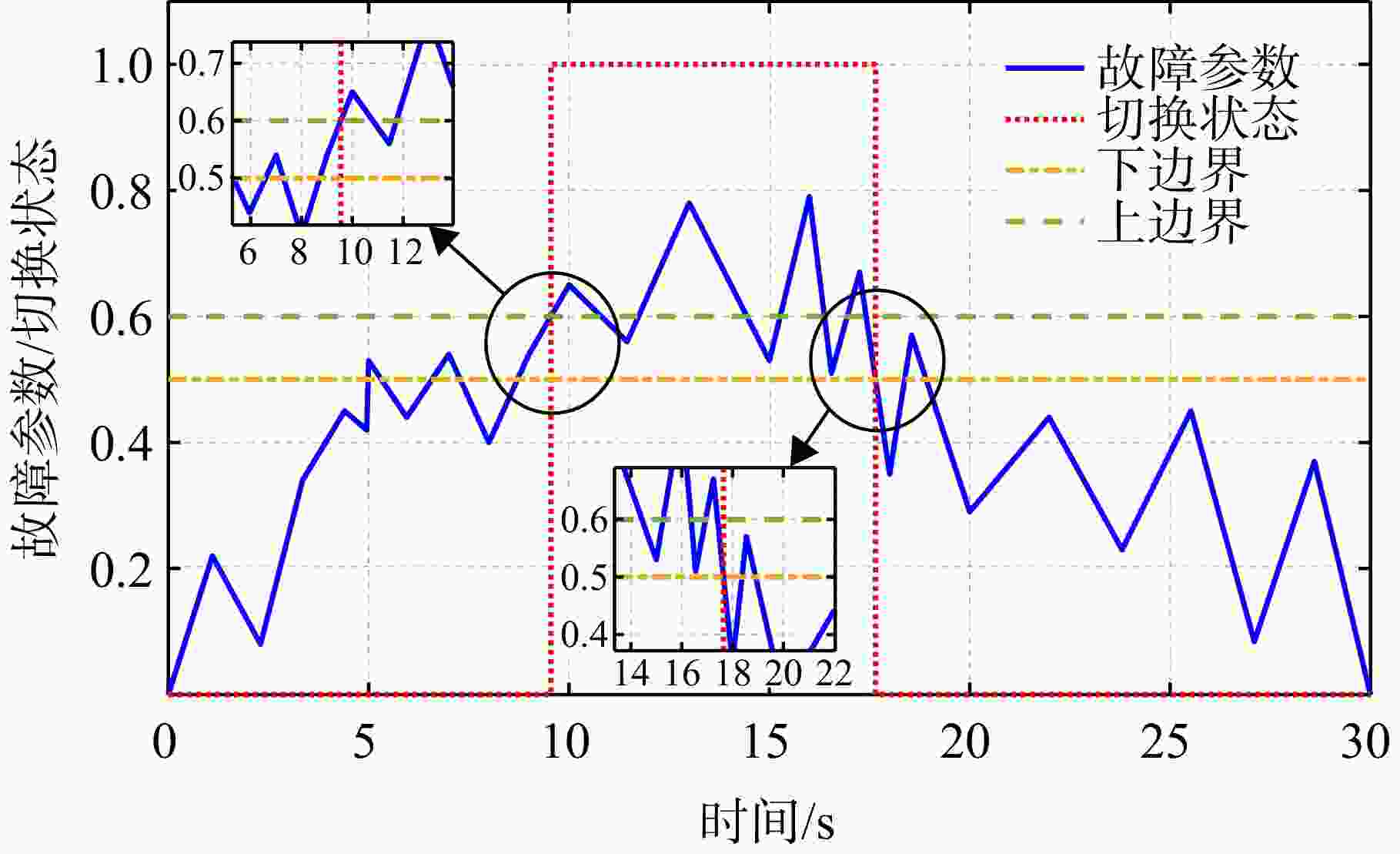
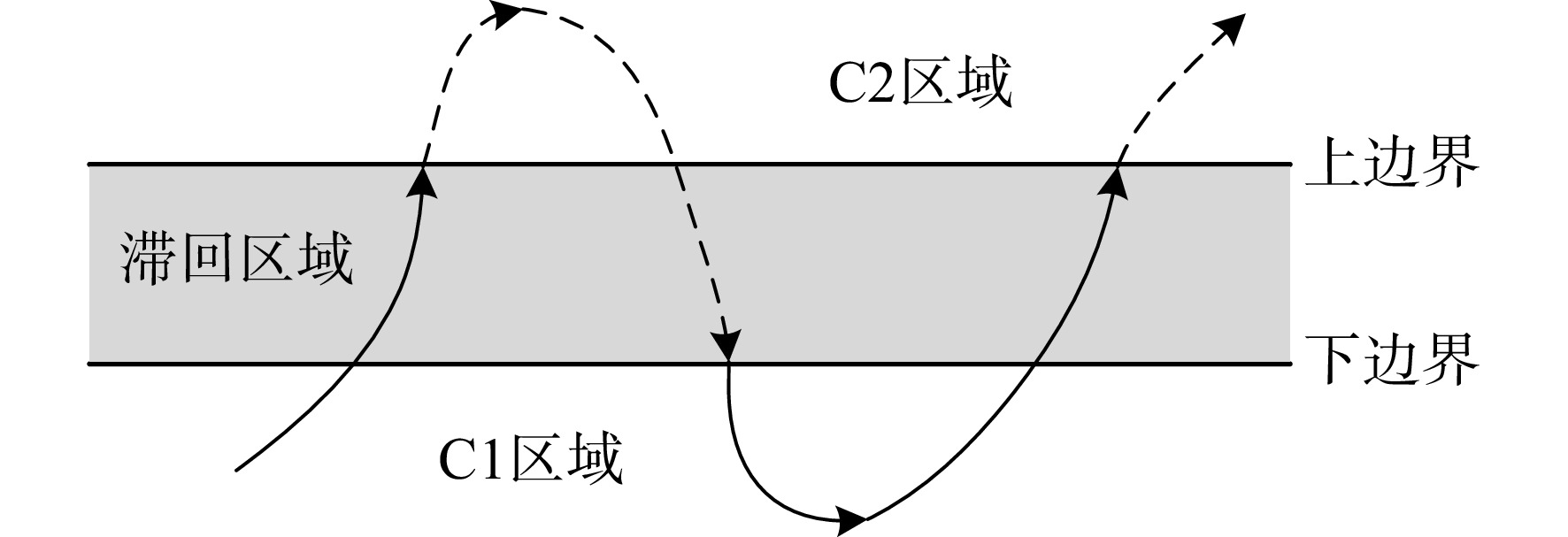
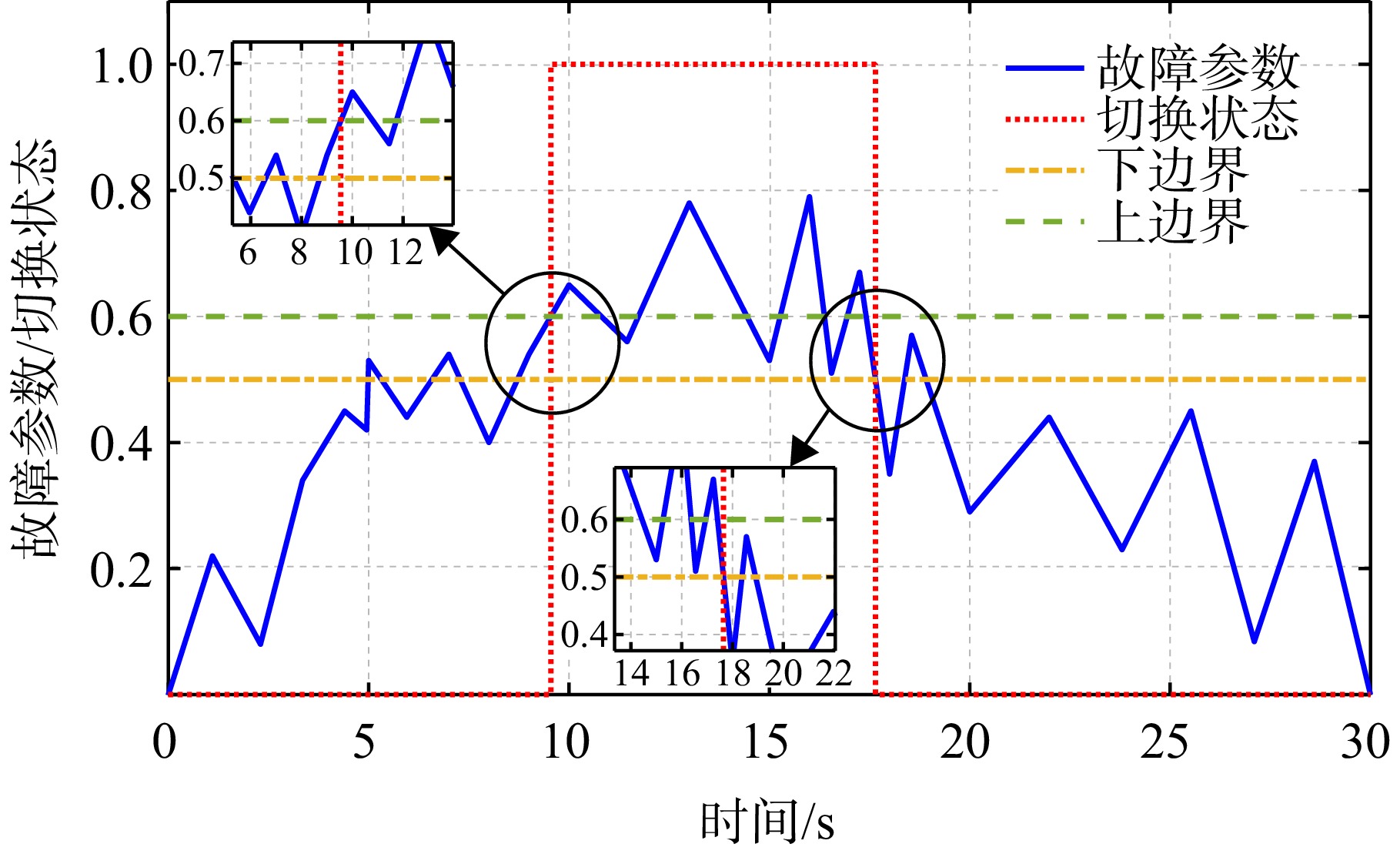
图 4 容错控制滞回切换策略验证
Figure 4. Verification of fault-tolerant control hysteresis switching strategy
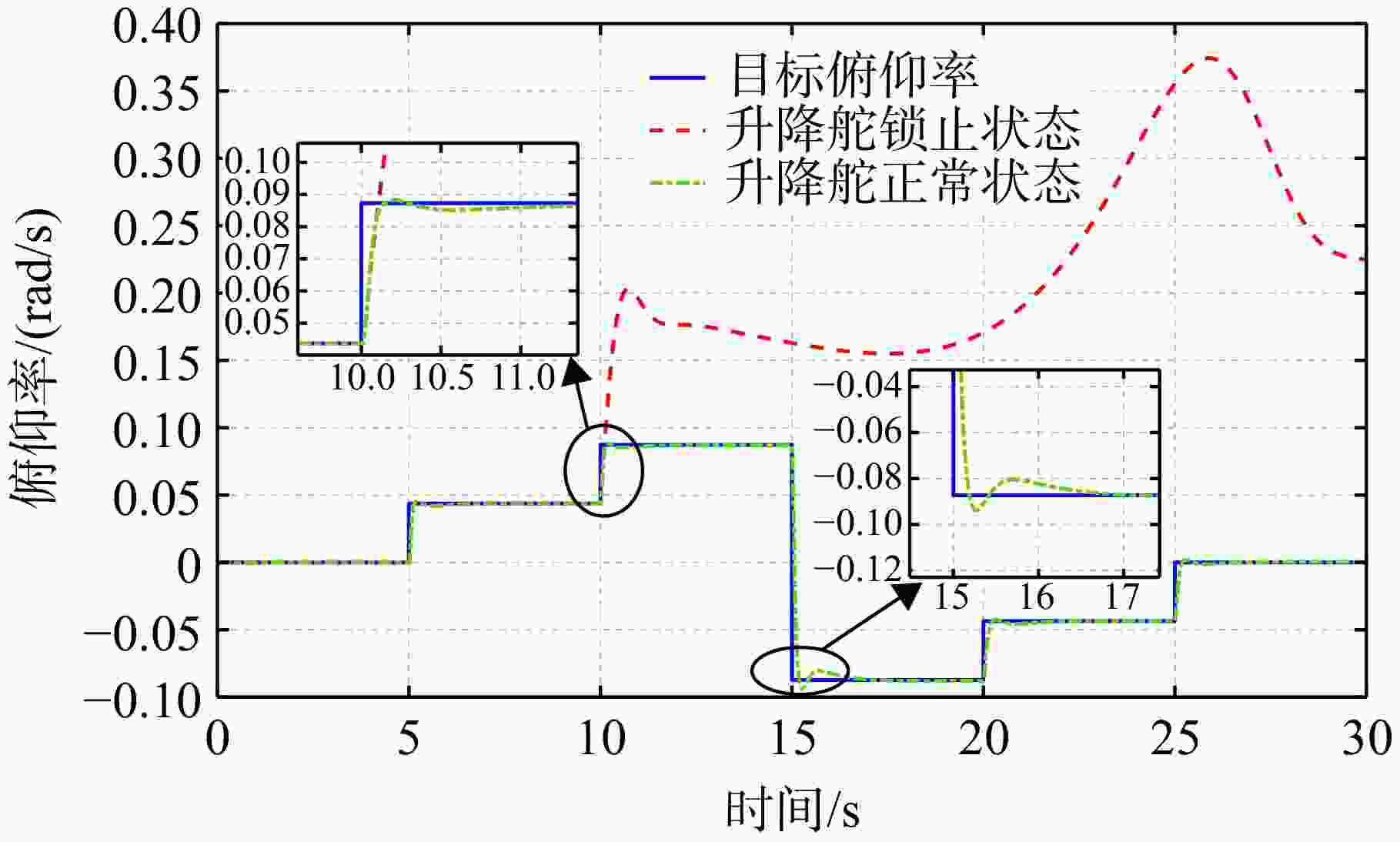
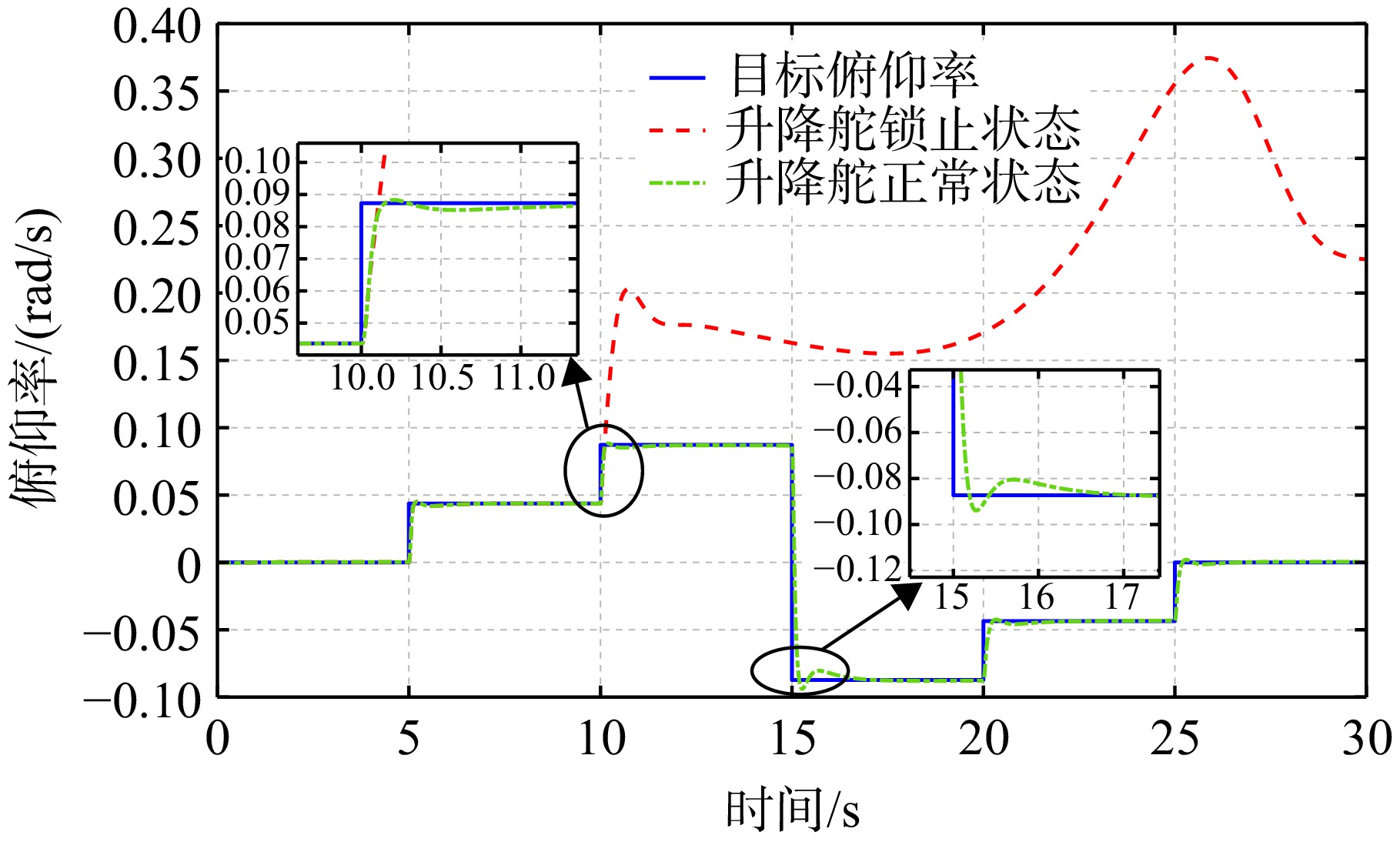
图 5 升降舵控制锁止状态及正常状态性能对比
Figure 5. Comparison of elevator control lock state and normal state performance
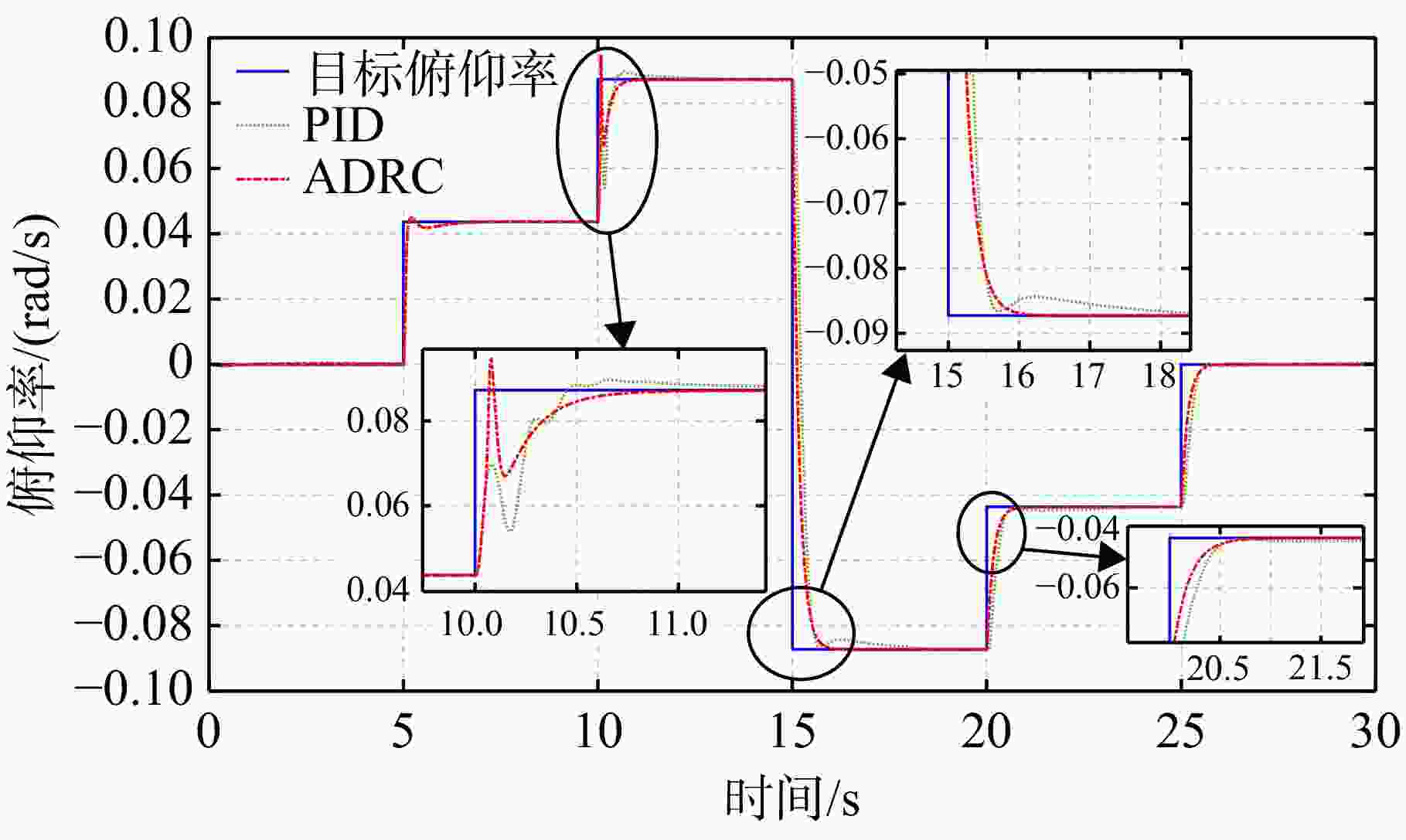
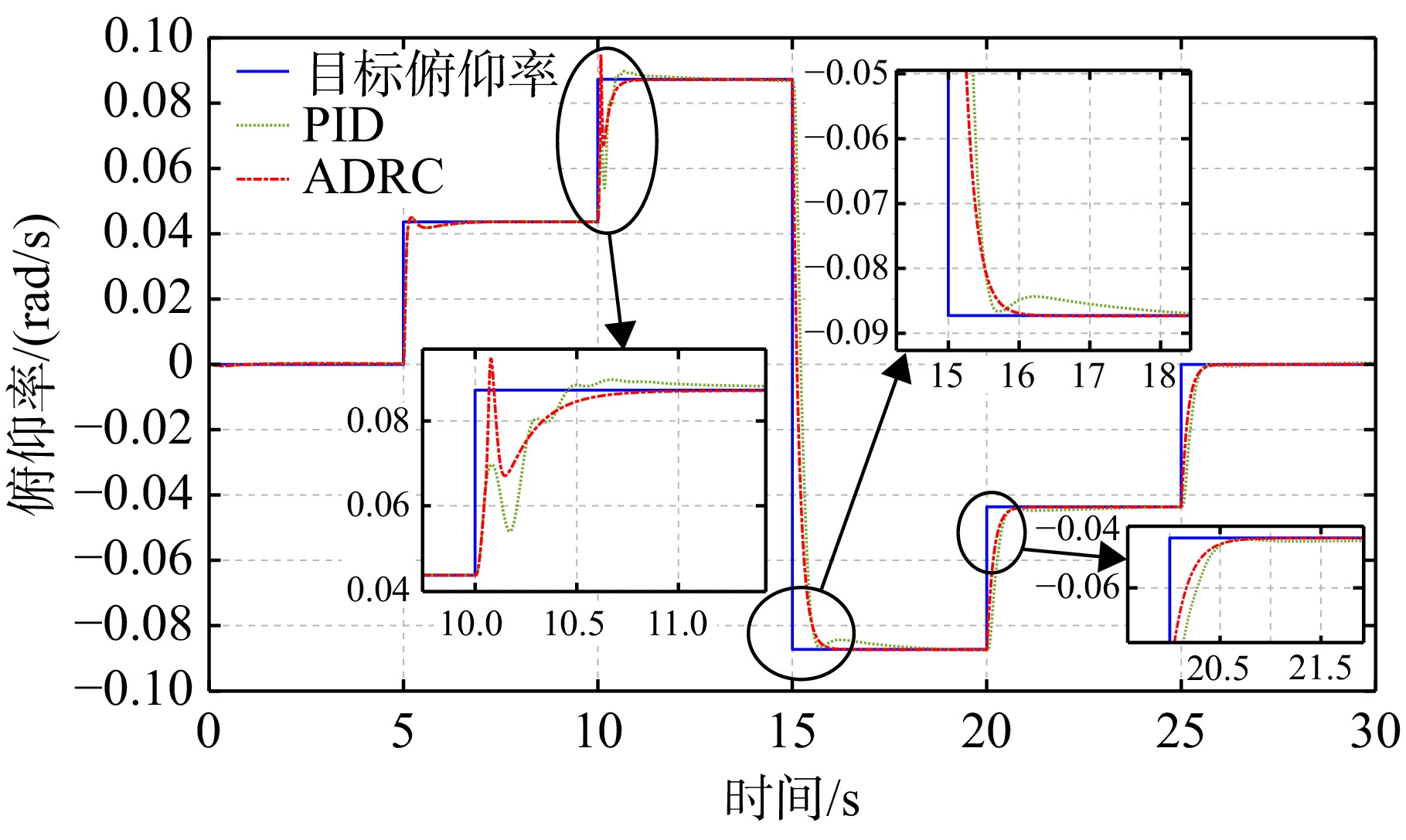
图 6 锁止状态下PID与ADRC控制性能对比
Figure 6. Comparison of PID and ADRC control performance in locked state
表 1 控制性能对比
Table 1. Comparison of control performance
类型 上升时间/s 调整时间/s ISE ITAE PID 0.4473 0.5251 0.9407 16.77 ADRC 0.3781 0.5140 0.4951 10.15  下载: 导出CSV
-
[1] 王海峰. 战斗机推力矢量关键技术及应用展望[J]. 航空学报, 2020, 41(6): 13-36. Wang Haifeng. Key technologies and future applications of thrust vectoring on fighter aircraft[J]. Acta Aeronautica et Astronautica Sinica, 2020, 41(6): 13-36. (in ChineseWang Haifeng. Key technologies and future applications of thrust vectoring on fighter aircraft[J]. Acta Aeronautica et Astronautica Sinica, 2020, 41(6): 13-36. (in Chinese) [2] 张力, 王立新. 推力矢量飞机控制律设计及过失速机动仿真研究[J]. 飞行力学, 2008, 26(4): 1-3, 7. Zhang Li, Wang Lixin. Research on flight control law design of fighter with vectoring thrust and post-stall maneuver simulation[J]. Flight Dynamics, 2008, 26(4): 1-3, 7. (in Chinese doi: 10.13645/j.cnki.f.d.2008.04.002Zhang Li, Wang Lixin. Research on flight control law design of fighter with vectoring thrust and post-stall maneuver simulation[J]. Flight Dynamics, 2008, 26(4): 1-3, 7. (in Chinese) doi: 10.13645/j.cnki.f.d.2008.04.002 [3] 章鸿翔. 推力矢量飞行器容错控制研究[D]. 南京: 南京航空航天大学, 2016. Zhang Hongxiang. Research on fault tolerant control for thrust vector aircraft[D]. Nanjing: Nanjing University of Aeronautics and Astronautics, 2016. (in ChineseZhang Hongxiang. Research on fault tolerant control for thrust vector aircraft[D]. Nanjing: Nanjing University of Aeronautics and Astronautics, 2016. (in Chinese) [4] 崔祚, 汪阳生. 飞行器推力矢量喷管研究综述[J]. 飞航导弹, 2021(12): 158-167. Cui Zuo, Wang Yangsheng. Summary of research on aircraft thrust vector nozzle[J]. Aerodynamic Missile Journal, 2021(12): 158-167. (in Chinese doi: 10.16338/j.issn.1009-1319.20210033Cui Zuo, Wang Yangsheng. Summary of research on aircraft thrust vector nozzle[J]. Aerodynamic Missile Journal, 2021(12): 158-167. (in Chinese) doi: 10.16338/j.issn.1009-1319.20210033 [5] Kikkawa H, Uchiyama K. Attitude control of a fixed-wing UAV using thrust vectoring system[C]//2017 Workshop on Research, Education and Development of Unmanned Aerial Systems. Piscataway, US: IEEE, 2017: 264-269. [6] 李炳乾, 董文瀚, 马小山. 基于滑模观测器的无人推力矢量飞机反步容错控制[J]. 西北工业大学学报, 2018, 36(5): 978-987. Li Bingqian, Dong Wenhan, Ma Xiaoshan. Backstepping fault-tolerant control for unmanned thrust-vectoring aircraft based on sliding-mode observer[J]. Journal of Northwestern Polytechnical University, 2018, 36(5): 978-987. (in Chinese doi: 10.1051/jnwpu/20183650978Li Bingqian, Dong Wenhan, Ma Xiaoshan. Backstepping fault-tolerant control for unmanned thrust-vectoring aircraft based on sliding-mode observer[J]. Journal of Northwestern Polytechnical University, 2018, 36(5): 978-987. (in Chinese) doi: 10.1051/jnwpu/20183650978 [7] Ma Xiaoshan, Dong Wenhan, Li Bingqian. A novel RFDI-FTC system for thrust-vectoring aircraft undergoing control surface damage and actuator faults during supermaneuverable flight[J]. IEEE Access, 2019, 7: 156374-156385. doi: 10.1109/ACCESS.2019.2949061 [8] Chen L, Dong Q, Yan Z R, et al. Actuator fault modeling and fault-tolerant tracking control of multi-vectored propeller aerostat[J]. The Aeronautical Journal, 2022, 126(1306): 1982-1996. doi: 10.1017/aer.2022.36 [9] 陈经纬, 陈康, 尙妮妮, 等. 基于气动力/推力矢量控制的飞行器性能分析[J]. 西北工业大学学报, 2014, 32(6): 877-881. Chen Jingwei, Chen Kang, Shang Nini, et al. Performance analysis of hypersonic vehicles based on aerodynamic/thrust vector control[J]. Journal of Northwestern Polytechnical University, 2014, 32(6): 877-881. (in Chinese doi: 10.3969/j.issn.1000-2758.2014.06.008Chen Jingwei, Chen Kang, Shang Nini, et al. Performance analysis of hypersonic vehicles based on aerodynamic/thrust vector control[J]. Journal of Northwestern Polytechnical University, 2014, 32(6): 877-881. (in Chinese) doi: 10.3969/j.issn.1000-2758.2014.06.008 [10] 杨志强, 黄俊. 推力矢量控制的鸭式布局无人侦察机气动特性研究[J]. 飞机设计, 2013, 33(2): 1-3, 7. Yang Zhiqiang, Huang Jun. Pneumatic research about canard configuration URAV with thrust vector control[J]. Aircraft Design, 2013, 33(2): 1-3, 7. (in ChineseYang Zhiqiang, Huang Jun. Pneumatic research about canard configuration URAV with thrust vector control[J]. Aircraft Design, 2013, 33(2): 1-3, 7. (in Chinese) [11] Li Bingqian, Dong Wenhan, Xiong Chao. Robust actuator-fault-tolerant control system based on sliding-mode observer for thrust-vectoring aircrafts[J]. Asian Journal of Control, 2019, 21(1): 236-247. doi: 10.1002/asjc.1841 [12] Li Bingqian, Dong Wenhan, Ma Xiaoshan. Backstepping fault-tolerant control for unmanned thrust-vectoring aircraft based on sliding-mode observer[J]. Xibei Gongye Daxue Xuebao, 2018, 36(5): 978-987. doi: 10.1051/jnwpu/20183650978 [13] 王博航, 王道波. 矢量推力固定翼无人机控制律设计[J]. 机械与电子, 2019, 37(4): 57-61. Wang Bohang, Wang Daobo. Design of control law for vector thrust fixed wing UAV[J]. Machinery & Electronics, 2019, 37(4): 57-61. (in ChineseWang Bohang, Wang Daobo. Design of control law for vector thrust fixed wing UAV[J]. Machinery & Electronics, 2019, 37(4): 57-61. (in Chinese) [14] Cheng Shuyao, Yang Hao, Jiang Bin. Fault tolerant tracking control for a team of non-minimum phase VTOL aircrafts based on virtual leader structure[C]//Proceedings of the 2015 Chinese Intelligent Systems Conference. Berlin, Heidelberg: Springer, 2016: 233-241. [15] Liu Shiqian, Whidborne J F. Neural network adaptive backstepping fault tolerant control for unmanned airships with multi-vectored thrusters[J]. Proceedings of the Institution of Mechanical Engineers, Part G: Journal of Aerospace Engineering, 2021, 235(11): 1507-1520. doi: 10.1177/0954410020976611 [16] 张哲聪. 推力矢量无人机的重构控制策略[D]. 南京: 南京航空航天大学, 2013. Zhang Zhecong. Reconfigurable control of the unmaned aerial vehicle based on TVC[D]. Nanjing: Nanjing University of Aeronautics and Astronautics, 2013. (in ChineseZhang Zhecong. Reconfigurable control of the unmaned aerial vehicle based on TVC[D]. Nanjing: Nanjing University of Aeronautics and Astronautics, 2013. (in Chinese) [17] Singh R, Prakash O, Joshi S, et al. Development of 3DOF longitudinal dynamic model of generic air-breathing hypersonic vehicle[C]//2022 International Conference for Advancement in Technology. Piscataway, US: IEEE, 2022: 1-5. [18] Jha P. Cessna-172R airplane in cruise and landing configurations: a numerical study of the wing loads and wake[C]//APS Division of Fluid Dynamics Meeting Abstracts. Pittsburgh, US: American Physical Society, 2013: R16.011. [19] Decarlo R A, Branicky M S, Pettersson S, et al. Perspectives and results on the stability and stabilizability of hybrid systems[J]. Proceedings of the IEEE, 2000, 88(7): 1069-1082. doi: 10.1109/5.871309 [20] Ahmed W. System modeling and controller design for lateral and longitudinal motion of F-16[J]. Automation, Control and Intelligent Systems, 2019, 7(1): 39. doi: 10.11648/j.acis.20190701.15 -

 点击查看大图
计量
- 文章访问数: 351
- HTML浏览量: 159
- PDF量: 27
- 被引次数: 0