






Influence of dissolved gases on cavitating flow around a two-dimensional hydrofoil
-
摘要:
由于工质的特殊性及极端的航空条件,溶解性气体是燃油空化中不可忽略的一个重要因素。为揭示溶解性气体对空化过程的独立作用机制,以常温水为工作介质,对二维Clark Y-11.7%水翼的空化流动特性进行研究,重点关注液体水中溶解氧对流扩散作用及溶解/析出过程,深入探究溶解性气体对基础水翼空化的影响机制。在Schnerr-Sauer空化模型框架下,耦合溶解性气体对流扩散作用及溶解/析出过程,从而构建SS-DG空化模型,并以该空化模型对水翼空化进行数值仿真,结合实验结果,详细分析两种攻角(8°和20°)、3种不同浓度溶解氧条件下溶解性气体对水翼空化形态及水动力学特性的影响。结果表明:液体中不同浓度溶解氧会改变水翼前缘附近空泡形态;两种攻角下,不同浓度溶解氧对水翼升阻力系数的平均值影响较小,但会改变其非稳态特性;此外,由于大尺度流动分离现象出现,20°攻角水翼空化区内溶解氧浓度时均值显著高于相同工况下8°攻角下的溶解氧浓度。
Abstract:Due to the particularity of the working fluid and extreme aviation conditions, dissolved gases (DG) are important factors that cannot be ignored in fuel cavitation. To reveal the independent mechanism of DG in the cavitation process, the cavitating flow characteristics around a two-dimensional Clark Y-11.7% hydrofoil in room-temperature water were investigated. Particular attention was paid to the convection-diffusion behavior of dissolved oxygen in liquid water as well as the dissolution/degassing processes. Using the Clark Y-11.7% hydrofoil as the research object, an in-depth exploration of the influence mechanism of DG on the fundamental cavitation of a hydrofoil was performed. Within the framework of the Schnerr-Sauer (SS) cavitation model, the convection-diffusion effect and dissolution/degassing processes of DG were coupled to establish the SS-DG cavitation model. Numerical simulations of hydrofoil cavitation were then conducted using this model. Combined with experimental results, the effects of DG on cavitation structures and hydrodynamic characteristics were analyzed in detail under two angles of attack (8° and 20°) and three different dissolved oxygen concentrations. The results showed that different concentrations of dissolved oxygen in the liquid altered the cavity structure near the leading edge of the hydrofoil. Under both angles of attack, the average lift and drag coefficients were only slightly affected by dissolved oxygen concentration, but its presence modified the unsteady characteristics. In addition, due to large-scale flow separation, the time-averaged dissolved oxygen concentration in the cavitation region at a 20° angle of attack was significantly higher than that at 8° under the same conditions.
-
Key words:
- aviation fuel pump /
- gaseous cavitation /
- dissolved gases /
- cavitation model /
- numerical analysis
-
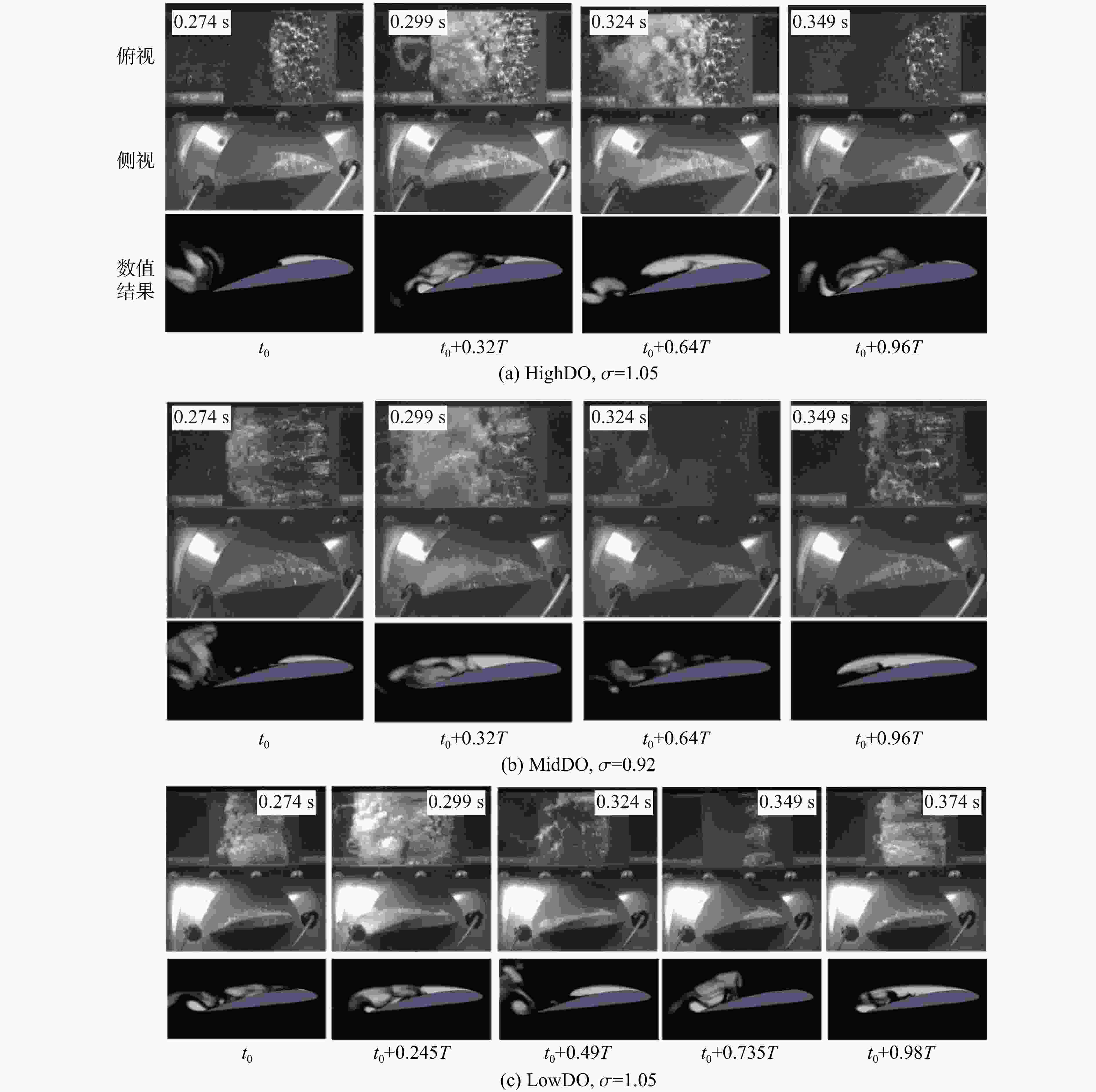
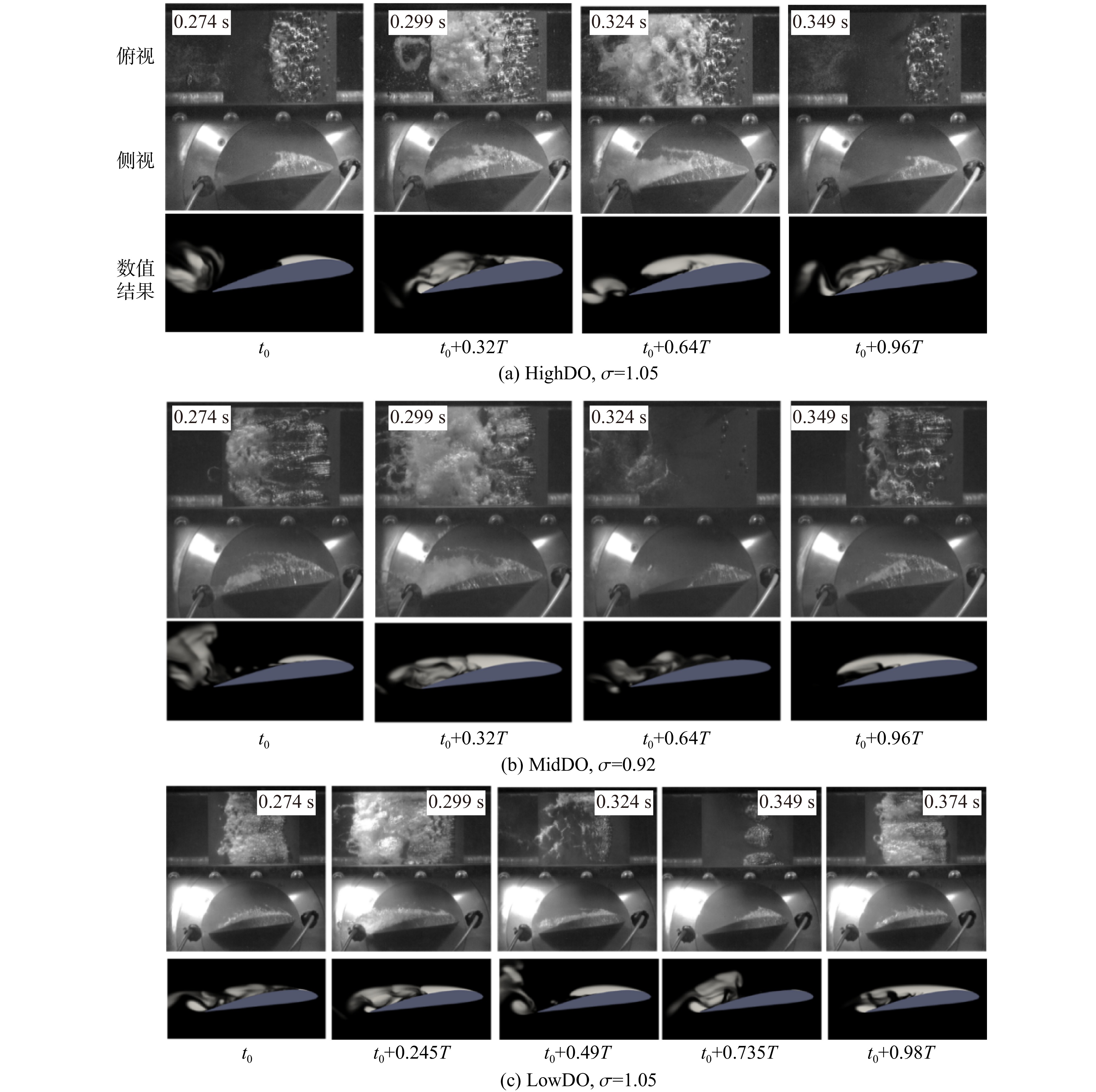
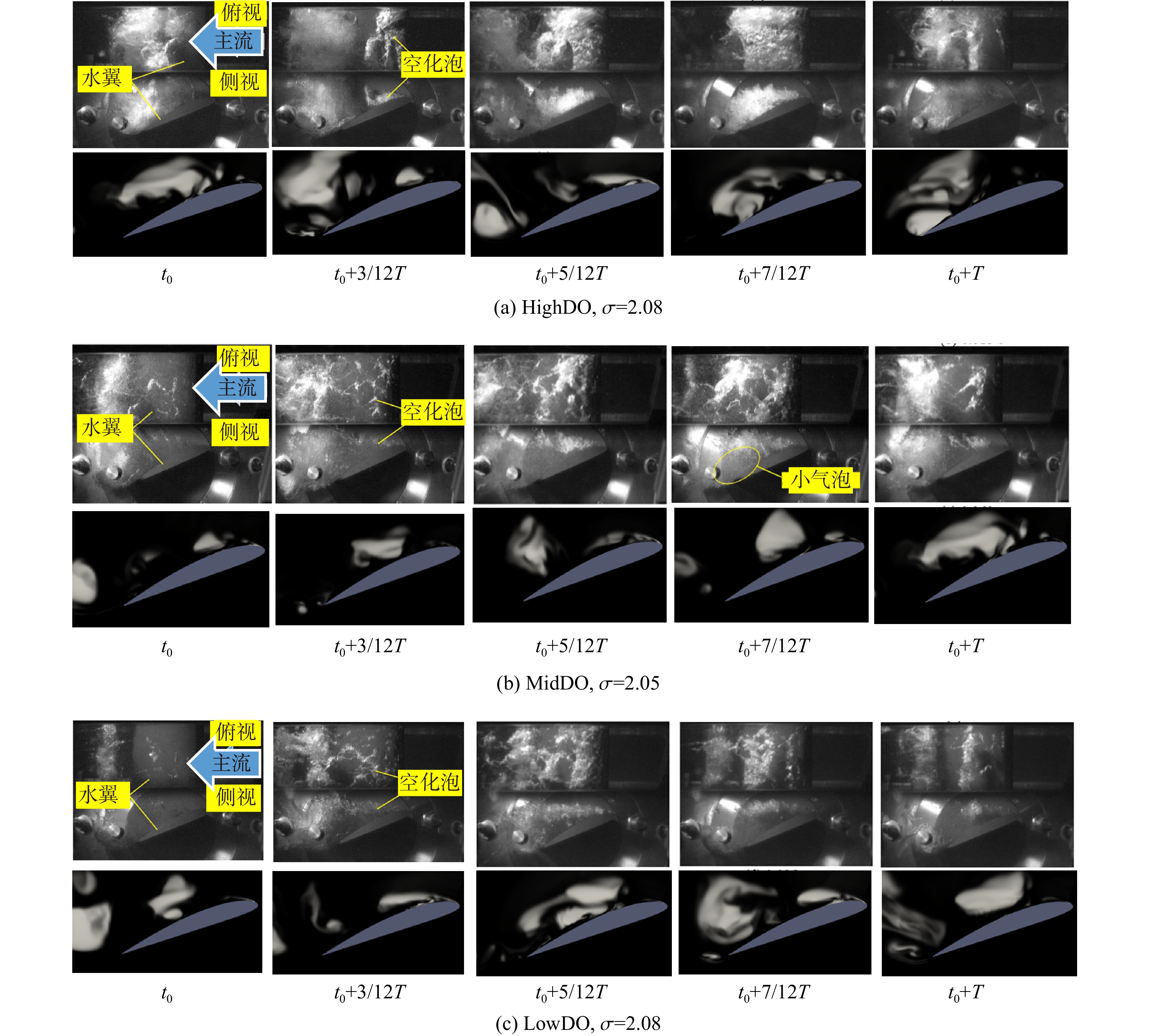
图 3 典型周期内水翼空化的演化(α=8°)
Figure 3. Evolution of hydrofoil cavitation within a typical period (α=8°)
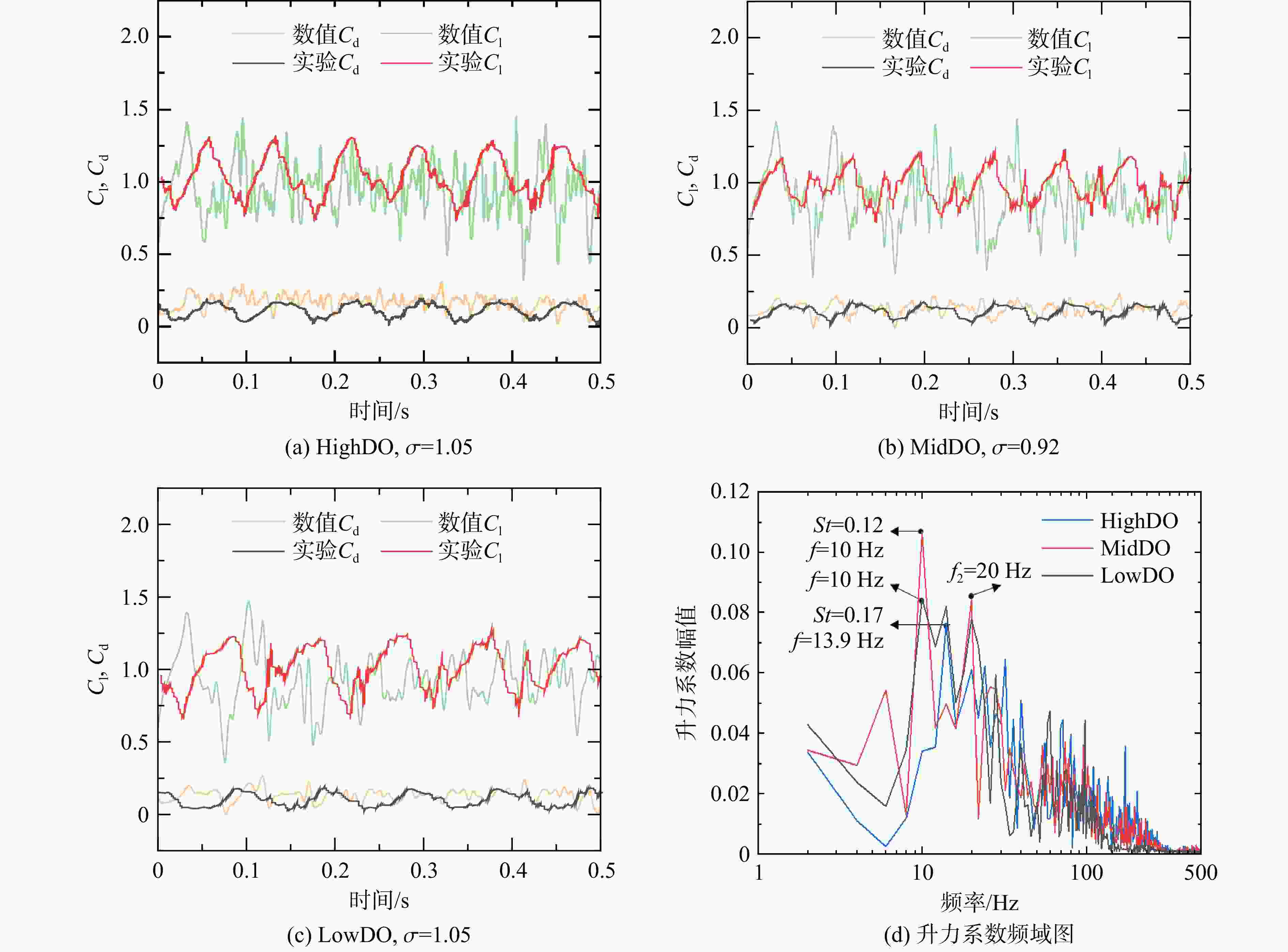
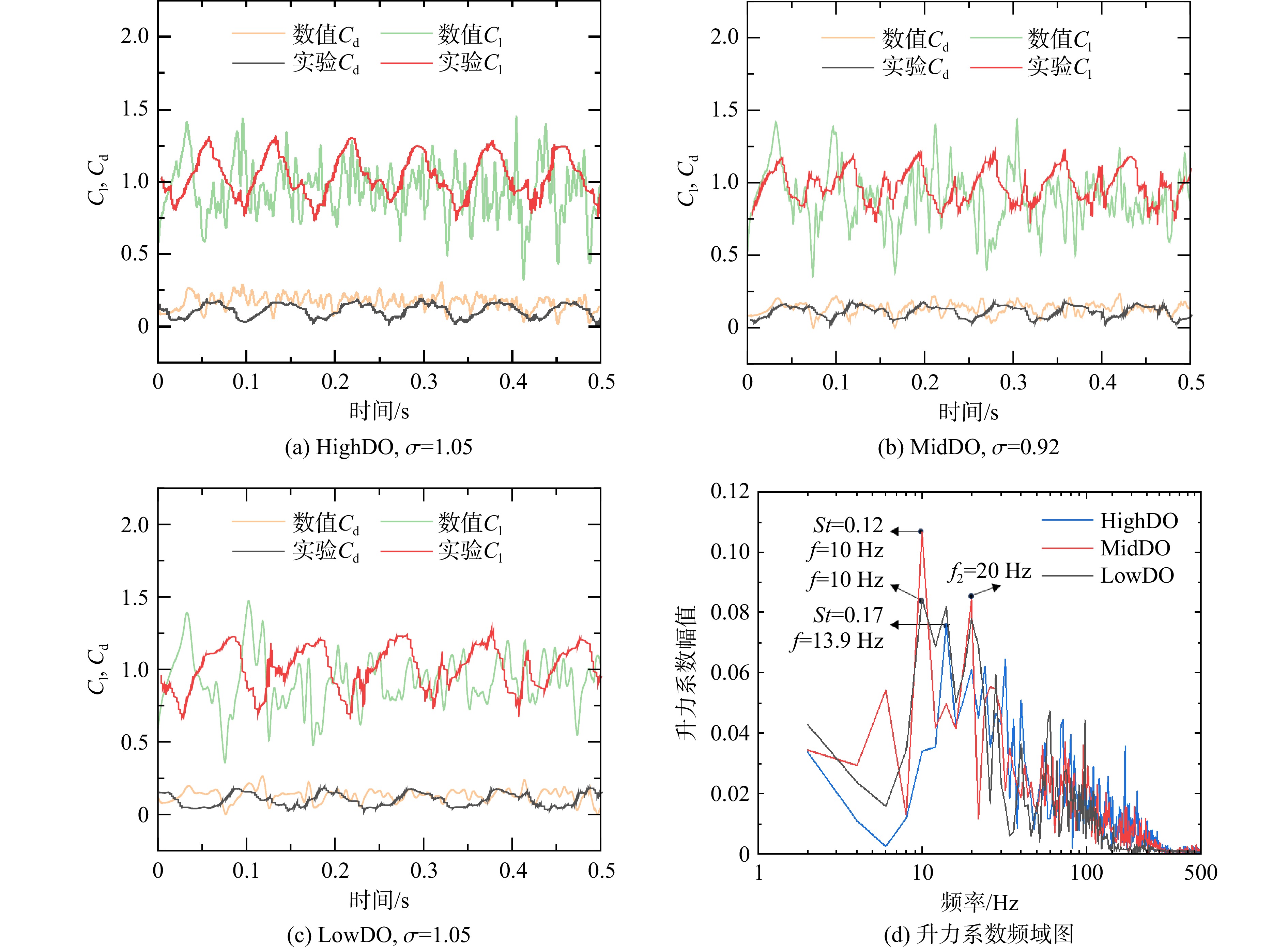
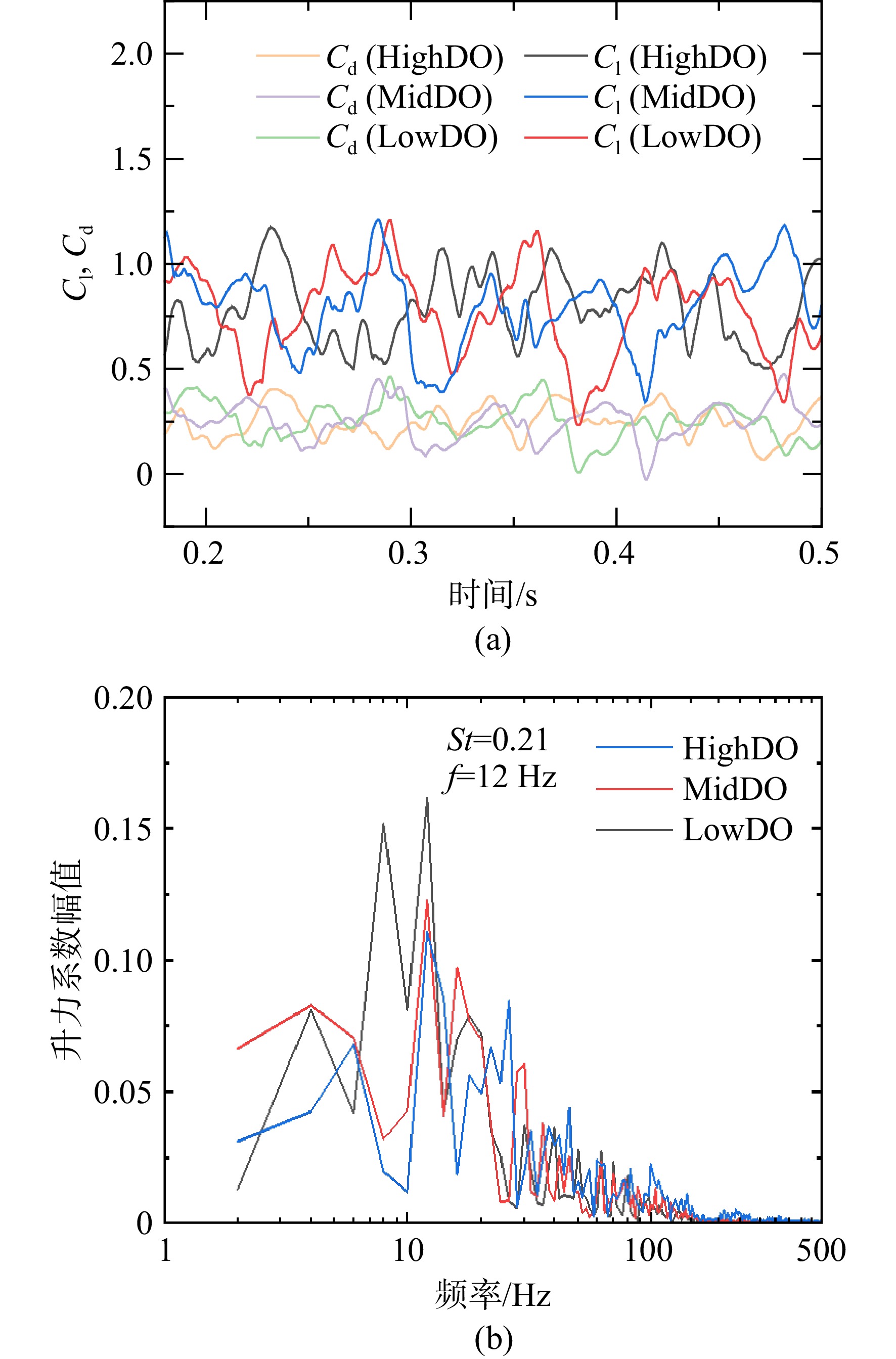
图 4 水翼升阻力系数的时域图及升力系数频域图(α=8°)
Figure 4. Time-domain plots of the hydrofoil’s lift and drag coefficients and the frequency-domain plot of the lift coefficient (α=8°)
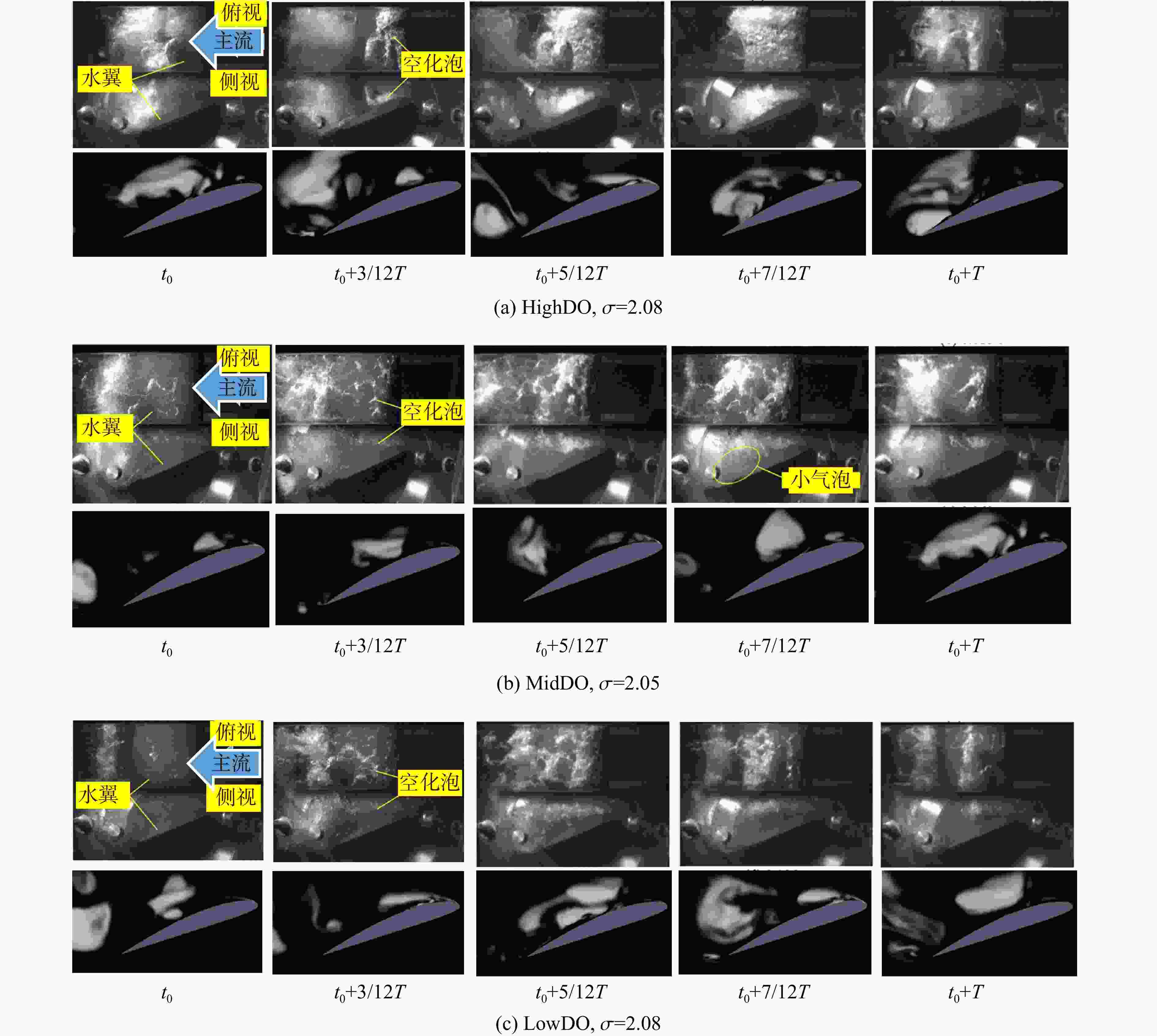
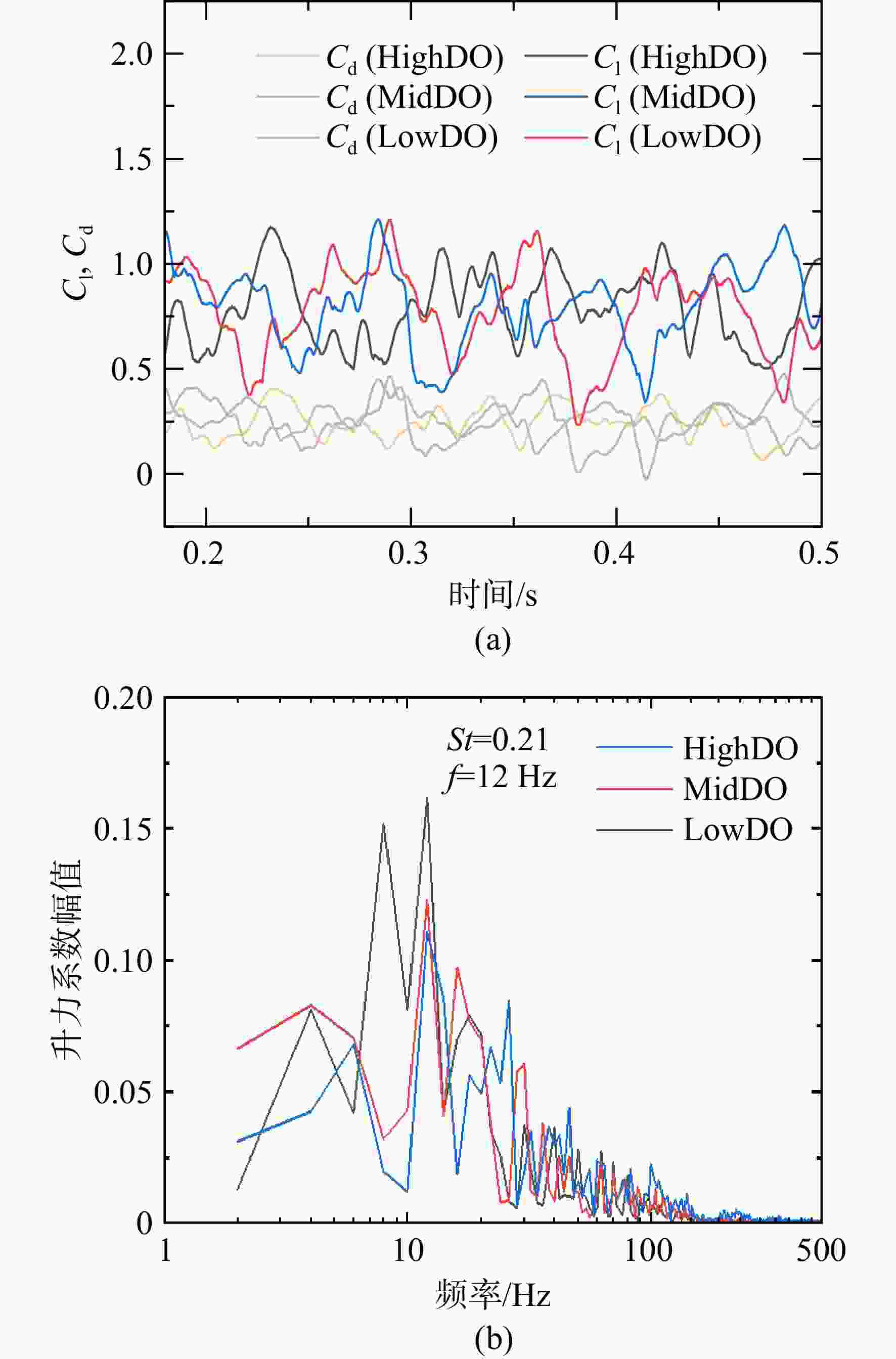
图 6 水翼升阻力系数的时域图及升力系数频域图(α=20°)
Figure 6. Time-domain plots of the hydrofoil’s lift and drag coefficients and the frequency-domain plot of the lift coefficient (α=20°)
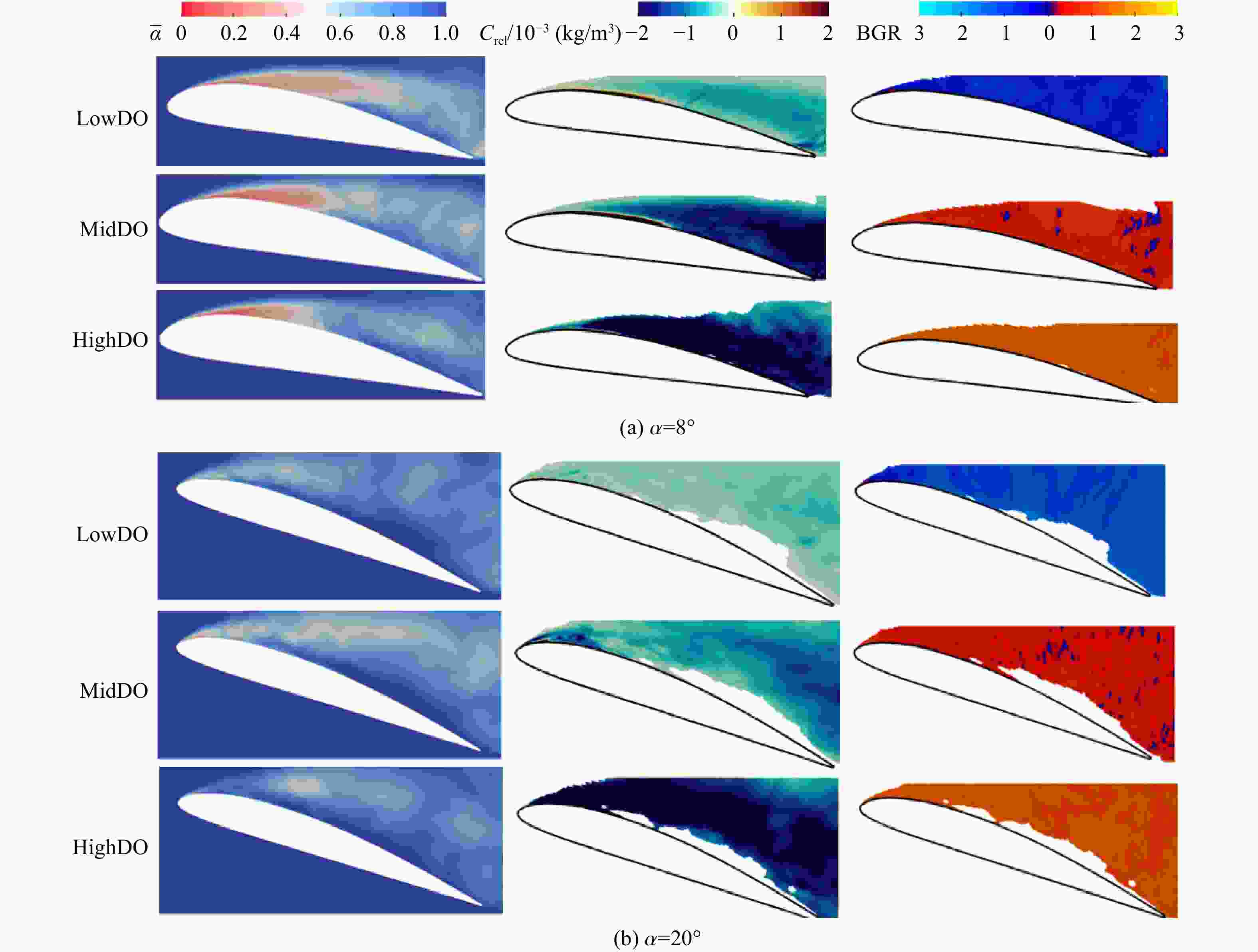
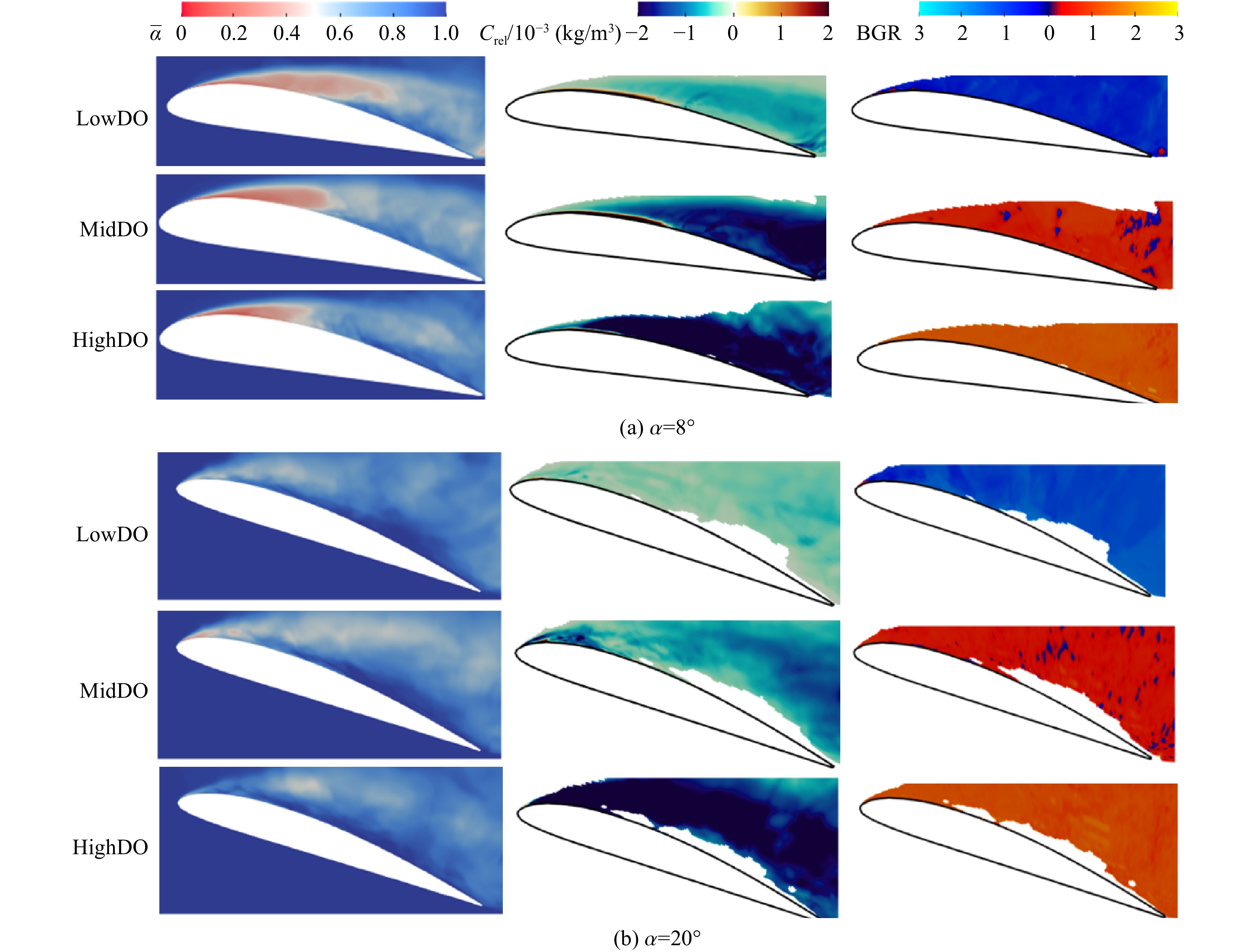
图 7 水翼附近空泡体积分数、相对浓度、空泡生长率的时均场
Figure 7. Time-averaged cavitation volume fraction, relative concentration, and cavitation bubble growth rate near the hydrofoil
表 1 物性参数
Table 1. Physical property parameters
$ {\rho }_{\text{l}} $/(kg/m3) $ {\rho }_{\text{v}} $/(kg/m3) $ {\mu }_{\text{l}} $/10−6 (Pa·s) $ {\mu }_{\text{v}} $/10−4 (Pa·s) pv/Pa 温度/K 气体常数
Rg/(J/(kg·K))亨利常数/109 Pa 摩尔
质量比M998 0.0173 1.006 5.619 2339 293.15 287 4.4 1.78  下载: 导出CSV
表 2 计算条件
Table 2. Calculation conditions
攻角/
(°)入口速度/
(m/s)γO/% σ pref/Pa 8 8.1 20 (lowDO) 1.05 36725 50 (midDO) 0.92 32480 80 (highDO) 1.05 36725 20 5.6 25 (lowDO) 2.08 34888 53 (midDO) 2.05 34420 76 (highDO) 2.08 34888
下载: 导出CSV
表 3 网格无关性检验
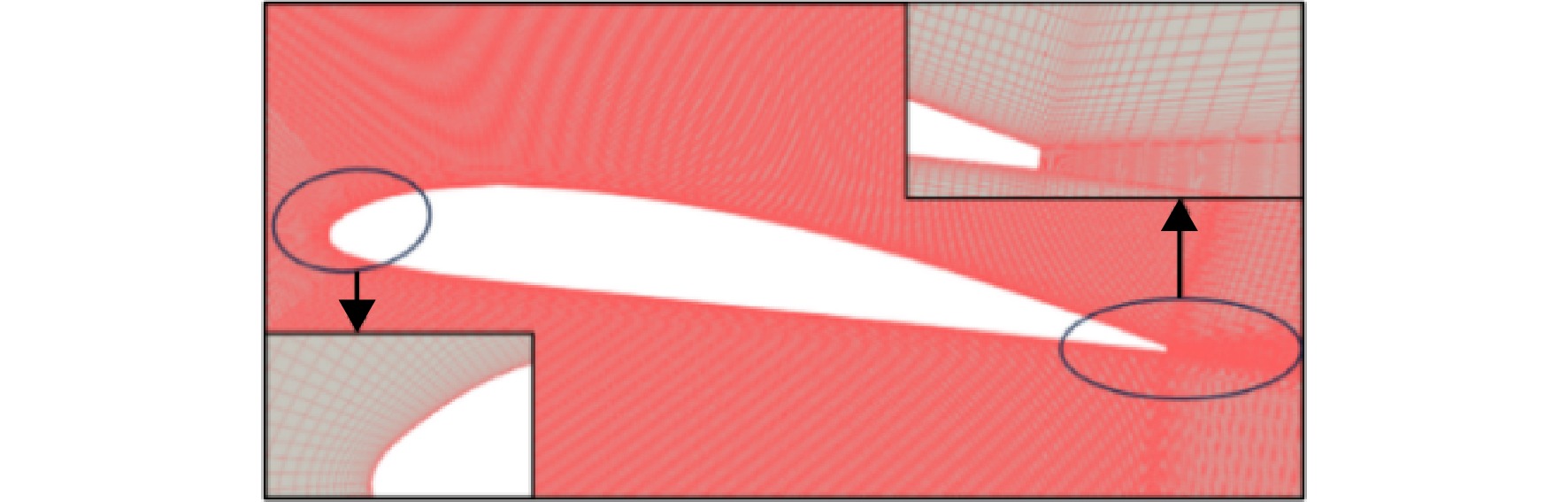
Table 3. Grid independence verification
网格名称 网格数/104 Cl Cd y+(平均值) Mesh 1 8.2 0.882 0.165 1.8 Mesh 2 13.8 0.939 0.169 1.6 Mesh 3 34.2 0.946 0.170 1.2 Mesh 4 62.3 0.948 0.170 1.1
下载: 导出CSV
表 4 8°攻角下升阻力系数平均值及主频
Table 4. Average values of lift and drag coefficients and dominant frequency at an attack angle of 8°
DO浓度 空化主频/Hz 升力系数平均值 阻力系数平均值 实验 数值 实验 数值 实验 数值 HighDO 12.7 13.9 1.05 0.95 0.11 0.17 MidDO 12.7 10.0 0.97 0.89 0.11 0.13 LowDO 9.8 10.0 1.00 0.92 0.10 0.13
下载: 导出CSV
-
[1] Zhao Siwei, Li Yiming, Zhang Ling, et al. Influence of the volute tongue shape on cavitation performance in aviation fuel centrifugal pump[J]. Scanning, 2023, 2023(1): 7189771. doi: 10.1155/2023/7189771 [2] 熊英华. 航空燃油泵空化性能分析及优化[D]. 北京: 北京理工大学, 2016. Xiong Yinghua. Analysis and optimization of cavitation performance of an aviation fuel pump[D]. Beijing: Beijing Institute of Technology, 2016. (in ChineseXiong Yinghua. Analysis and optimization of cavitation performance of an aviation fuel pump[D]. Beijing: Beijing Institute of Technology, 2016. (in Chinese) [3] Zhao Xing’an, Huang Biao, Chen Tairan, et al. Numerical simulations and surrogate-based optimization of cavitation performance for an aviation fuel pump[J]. Journal of Mechanical Science and Technology, 2017, 31(2): 705-716. doi: 10.1007/s12206-017-0122-4 [4] Fu Jiangfeng, Liu Xianwei, Yang Junjie, et al. Optimization of cavitation characteristics of aviation fuel centrifugal pump inducer based on surrogate model[J]. Structural and Multidisciplinary Optimization, 2023, 66(11): 241. [5] Zhou Jianbo, He Dongjing, Zhang Rui, et al. Research on the performance of a centrifugal aviation fuel pump based on response surface methodology[J]. Processes, 2023, 11(11): 3055. [6] 王维军. 离心式航空燃油泵研究现状与展望[J]. 流体机械, 2020, 48(10): 59-63. Wang Weijun. Research status and prospect of centrifugal aviation fuel pump[J]. Fluid Machinery, 2020, 48(10): 59-63. (in ChineseWang Weijun. Research status and prospect of centrifugal aviation fuel pump[J]. Fluid Machinery, 2020, 48(10): 59-63. (in Chinese) [7] Franc J P, Michel J M. Fundamentals of cavitation[M]. Dordrecht: Springer Netherlands, 2005. [8] 季斌, 程怀玉, 黄彪, 等. 空化水动力学非定常特性研究进展及展望[J]. 力学进展, 2019, 49(1): 428-479. JI Bin, Cheng Huaiyu, Huang Biao, et al. Research progresses and prospects of unsteady hydrodynamics characteristics for cavitation[J]. Advances in Mechanics, 2019, 49(1): 428-479. (in ChineseJI Bin, Cheng Huaiyu, Huang Biao, et al. Research progresses and prospects of unsteady hydrodynamics characteristics for cavitation[J]. Advances in Mechanics, 2019, 49(1): 428-479. (in Chinese) [9] 吴钦, 郭一梦, 刘韵晴, 等. 非定常空化流动及其诱导振动特性研究综述[J]. 空气动力学学报, 2020, 38(4): 746-760. Wu Qin, Guo Yimeng, Liu Yunqing, et al. Review on the cavitating flow-induced vibrations[J]. Acta Aerodynamica Sinica, 2020, 38(4): 746-760. (in ChineseWu Qin, Guo Yimeng, Liu Yunqing, et al. Review on the cavitating flow-induced vibrations[J]. Acta Aerodynamica Sinica, 2020, 38(4): 746-760. (in Chinese) [10] Yan Longlong, Gao Bo, Ni Dan, et al. Numerical study of unsteady cavitating flow in an inducer with omega vortex identification[J]. Journal of Fluids Engineering, 2022, 144(9): 091203. [11] Yan Longlong, Gao Bo, Ni Dan, et al. Numerical analysis on the system instability of the cavitating flow around hydrofoil induced by the non-uniform inflow[J]. International Journal of Multiphase Flow, 2022, 152: 104074. [12] Magne T, Paridaens R, Khelladi S, et al. Experimental study of the hydraulic performances of two three-bladed inducers in water, water with dissolved CO2, and jet fuel[J]. Journal of Fluids Engineering, 2020, 142(11): 111210. [13] Henry W. Experiments on the quantity of gases absorbed by water, at different temperatures, and under different pressures[J]. Philosophical Transactions of the Royal Society of London, 1803, 93(1803): 29-42, 274-276. [14] Brennen C E. Cavitation and bubble dynamics[M]. New York: Cambridge University Press, 2014. [15] Van Rijsbergen M. A review of sheet cavitation inception mechanisms[R]. Honolulu, US: 6th International Symposium on Transport Phenomena and Dynamics of Rotating Machinery , 2016. [16] Li Buxuan, Gu Youwei, Chen Min. An experimental study on the cavitation of water with dissolved gases[J]. Experiments in Fluids, 2017, 58(12): 164. [17] Zhou Yusi, Li Buxuan, Gu Youwei, et al. A molecular dynamics simulation study on the cavitation inception of water with dissolved gases[J]. Molecular Physics, 2019, 117(14): 1894-1902. [18] Magne T, Paridaens R, Ravelet F, et al. Effect of gas content on the cavitating and non-cavitating performance of an axial three-bladed inducer[J]. Multiphase Science and Technology, 2020, 32(1): 81-92. [19] Schnerr G H, Sauer J. Physical and numerical modeling of unsteady cavitation dynamics[C]//Proceedings of the Fourth International Conference on Multiphase Flow. New Orleans, US: ICMF, 2001: 1-12. [20] Higa Y, Iida R, Tsuda S I, et al. Numerical investigation of cavitating flow around a hydrofoil considering advection-diffusion and precipitation of dissolved gas in liquid[C]//Proceedings of the 9th Asian Joint Workshop on Thermophysics and Fluid Science, 27-30 November 2022, Utsunomiya, Japan. Singapore: Springer, 2024: 73-81. [21] Tan B H, An Hongjie, Ohl C D. How bulk nanobubbles might survive[J]. Physical Review Letters, 2020, 124(13): 134503. [22] 王巍, 刘明雨, 李智健, 等. 不同射流参数下水翼云空化流动控制研究[J]. 农业机械学报, 2023, 54(4): 161-169. Wang Wei, Liu Mingyu, Li Zhijian, et al. Control of hydrofoil cloud cavitation flow with different jet parameters[J]. Transactions of the Chinese Society for Agricultural Machinery, 2023, 54(4): 161-169. (in ChineseWang Wei, Liu Mingyu, Li Zhijian, et al. Control of hydrofoil cloud cavitation flow with different jet parameters[J]. Transactions of the Chinese Society for Agricultural Machinery, 2023, 54(4): 161-169. (in Chinese) [23] Chebli R, Audebert B, Zhang G, et al. Influence of the turbulence modeling on the simulation of unsteady cavitating flows[J]. Computers & Fluids, 2021, 221: 104898. [24] Zhao M, Wan D, Chen G. Comparison of SST k-ω and Smago-rinsky model in cavitation simulation around NACA0012[C]//ISOPE International Ocean and Polar Engineering Conference. Honolulu: ISOPE, 2019: ISOPE-I-19-019. [25] Zhao Minsheng, Wan Decheng, Gao Yangyang. Comparative study of different turbulence models for cavitational flows around NACA0012 hydrofoil[J]. Journal of Marine Science and Engineering, 2021, 9(7): 742. [26] Matsuura Y, Tsuji D, Watanabe S, et al. Effects of dissolved gas on surface pressure of a hydrofoil under cavitation condition[J]. Journal of Physics: Conference Series, 2022, 2217(1): 012020. -

 点击查看大图
计量
- 文章访问数: 579
- HTML浏览量: 284
- PDF量: 52
- 被引次数: 0