






Comparison on thermal protection performance and mechanisms of low-ablation and non-ablative materials
-
摘要:
轻质热防护材料是当前飞行器大面积热防护系统的重要材料。通过耦合气动传热及热化学过程建立热响应模型,对比研究了纳米孔树脂基低微烧蚀材料和非烧蚀型陶瓷瓦在两种典型热环境下的防隔热性能,揭示了其能量耗散路径及贡献权重。结果表明:相较于陶瓷瓦,低微烧蚀材料通过热阻塞、热沉、热解气体逸散与热解反应的多机制协同作用,实现了10%~15%的综合能量耗散,展现出其多途径散热的优越性。辐射散热是两类材料共有的核心防隔热机制,其贡献随热载荷的加剧而显著增大。此外,低微烧蚀材料凭借其纳米孔结构赋予的低热导率优势,以及更高的比定压热容和密度,在相同条件下能够更有效地将热量阻滞在上层区域,显著抑制热量向内部传递,从而获得比陶瓷瓦更低的背温。研究证实树脂基材料通过动态调节能量耗散机制的配比与厚度方向的热沉分布,实现了宽域热环境下的高效防隔热性能。
Abstract:Lightweight thermal protection materials are a key solution for large-area thermal protection systems in modern aerospace vehicles. A thermal response model coupling aerodynamic heat transfer and thermochemical processes was developed to comparatively investigate the thermal protection performance of nanoporous resin-based low-ablation materials and non-ablative ceramic tiles under two typical of thermal environments. It revealed the energy dissipation pathways and their respective contribution weights. Results showed that, compared with ceramic tiles, low-ablation materials achieved an overall energy dissipation of approximately 10%—15% through a synergistic combination of mechanisms including thermal blockage, heat sink effects, pyrolysis gas release, and pyrolysis reactions, demonstrating superior multi-path heat dissipation capabilities. Radiative heat dissipation was identified as a core mechanism shared by both materials, with its contribution significantly increasing under intensified thermal loads. Moreover, the nanoporous structure of the low-ablation material presented low thermal conductivity, along with higher specific heat capacity and density, enabling more effective heat confinement in the upper layer and significantly reducing heat transfer to the interior, thus resulting in a lower backside temperature compared with ceramic tiles. The study confirmed that resin-based materials can dynamically regulate the proportion of energy dissipation mechanisms and the distribution of heat sinks along the thickness direction, achieving efficient thermal protection across a wide range of thermal environments.
-
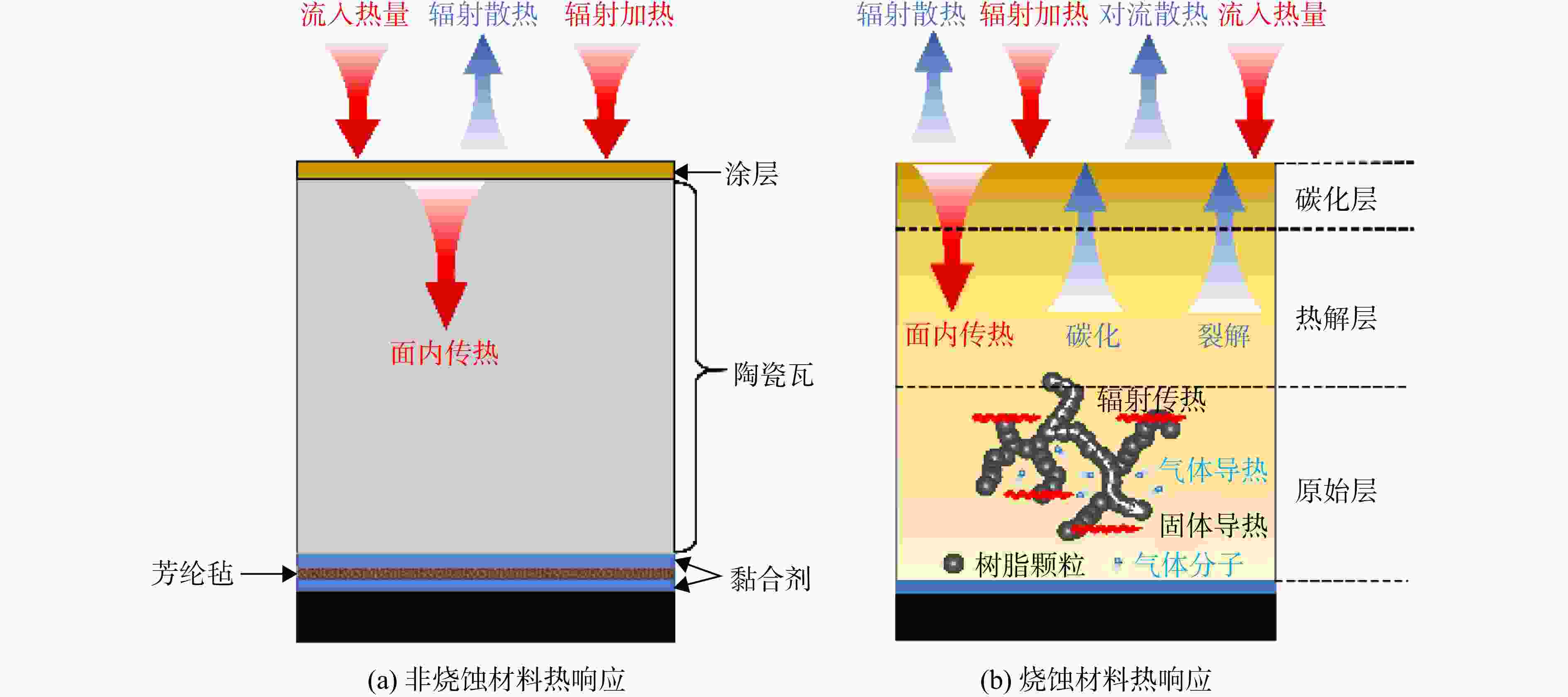
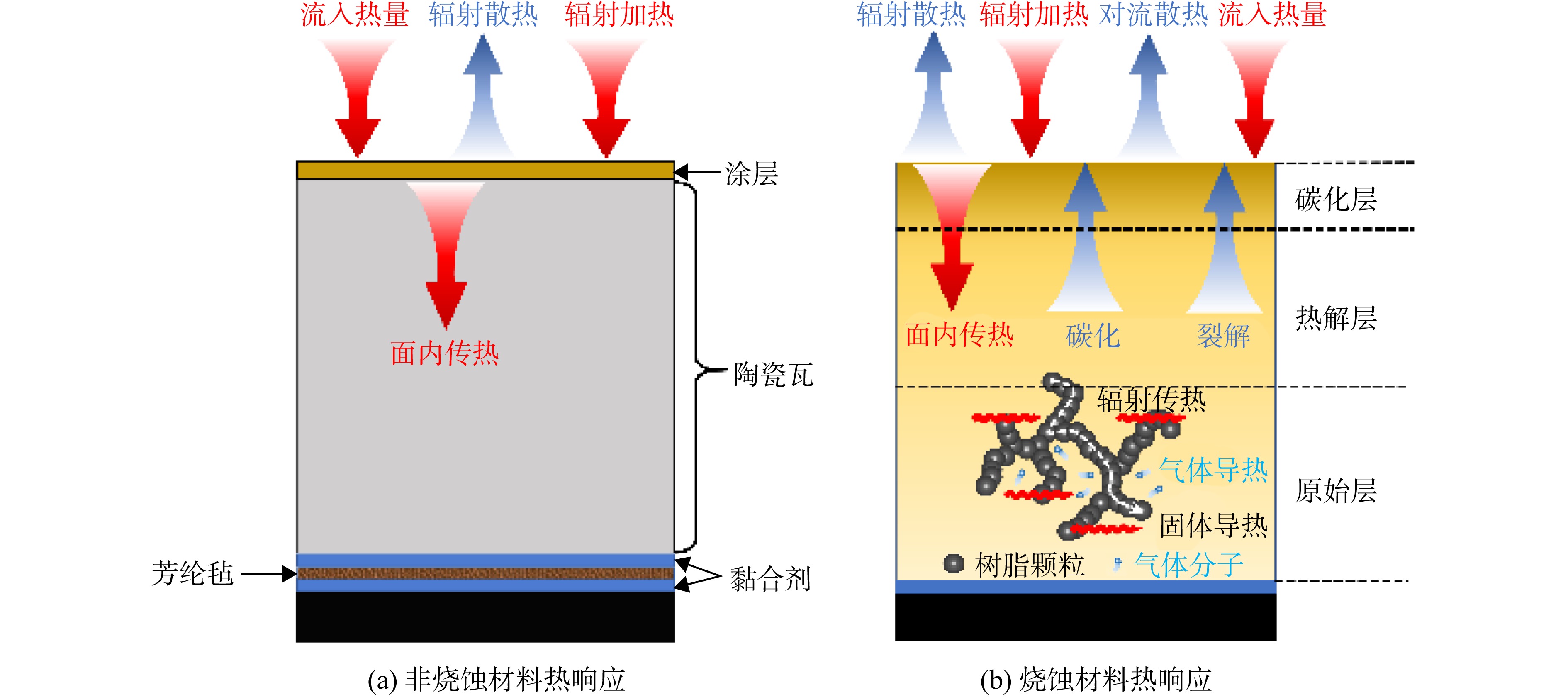
图 1 烧蚀材料和非烧蚀材料的热响应示意图
Figure 1. Schematic thermal response of ablative and non-ablative materials
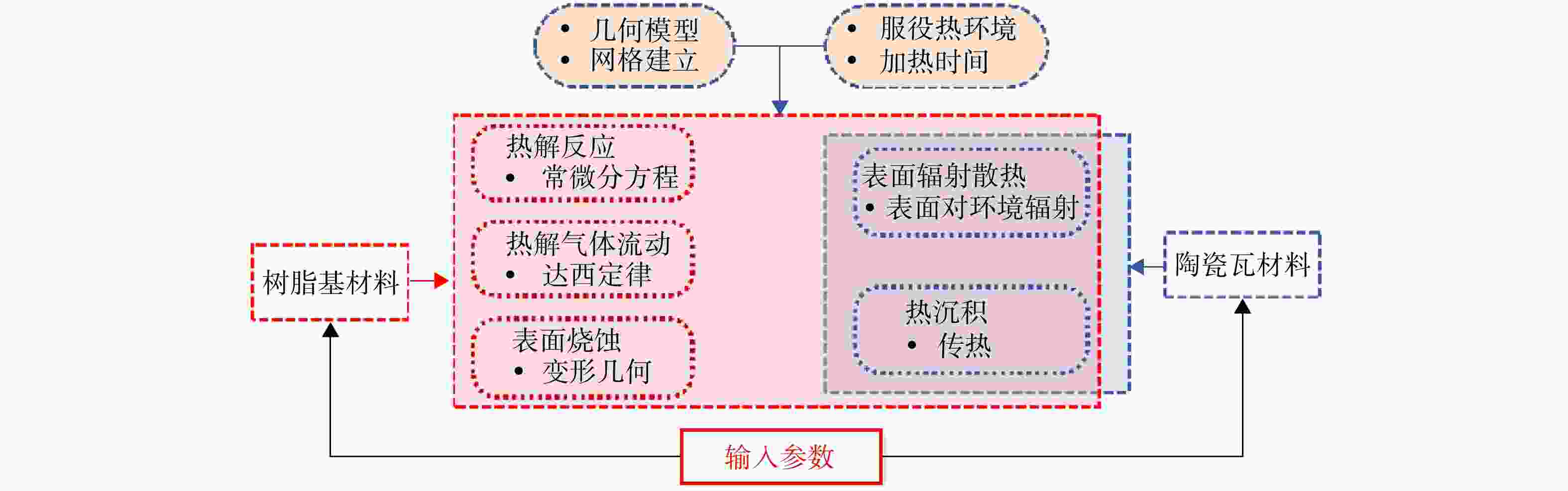
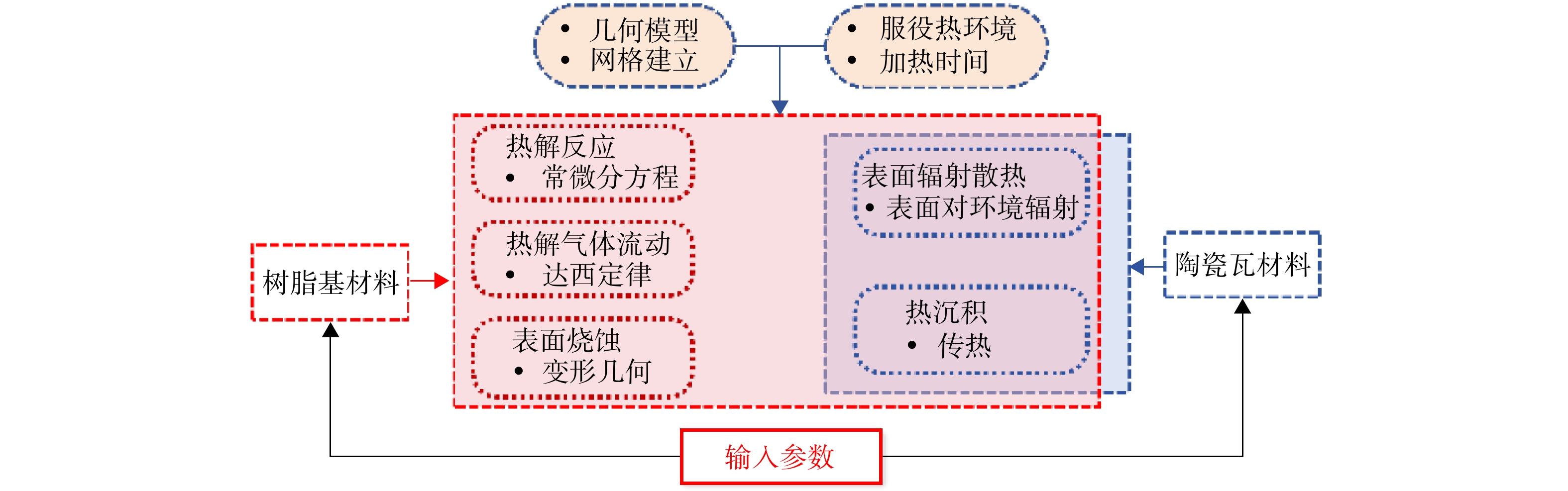
图 2 材料三维热响应的建模流程
Figure 2. Modeling flow of three-dimensional thermal response of materials
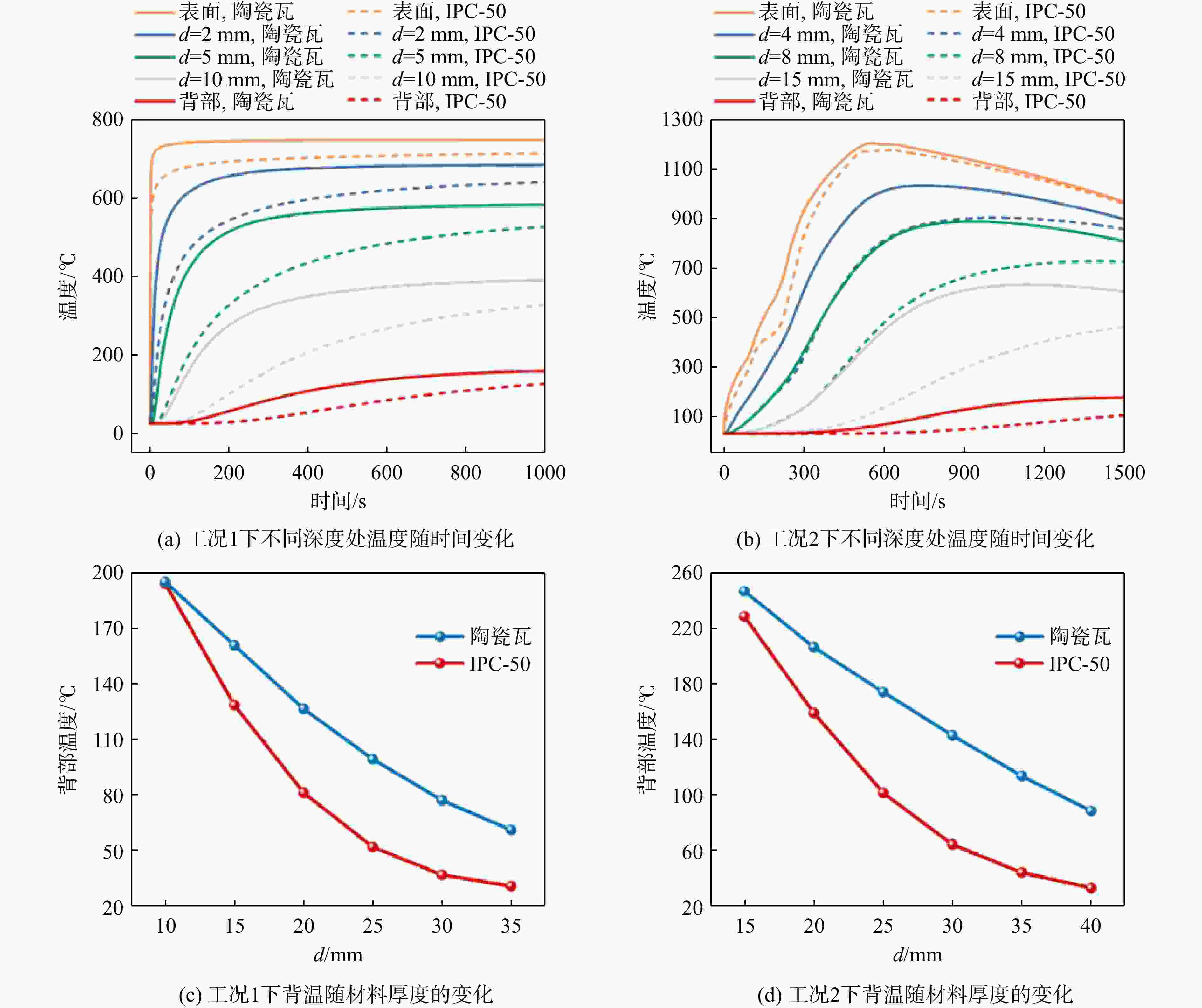
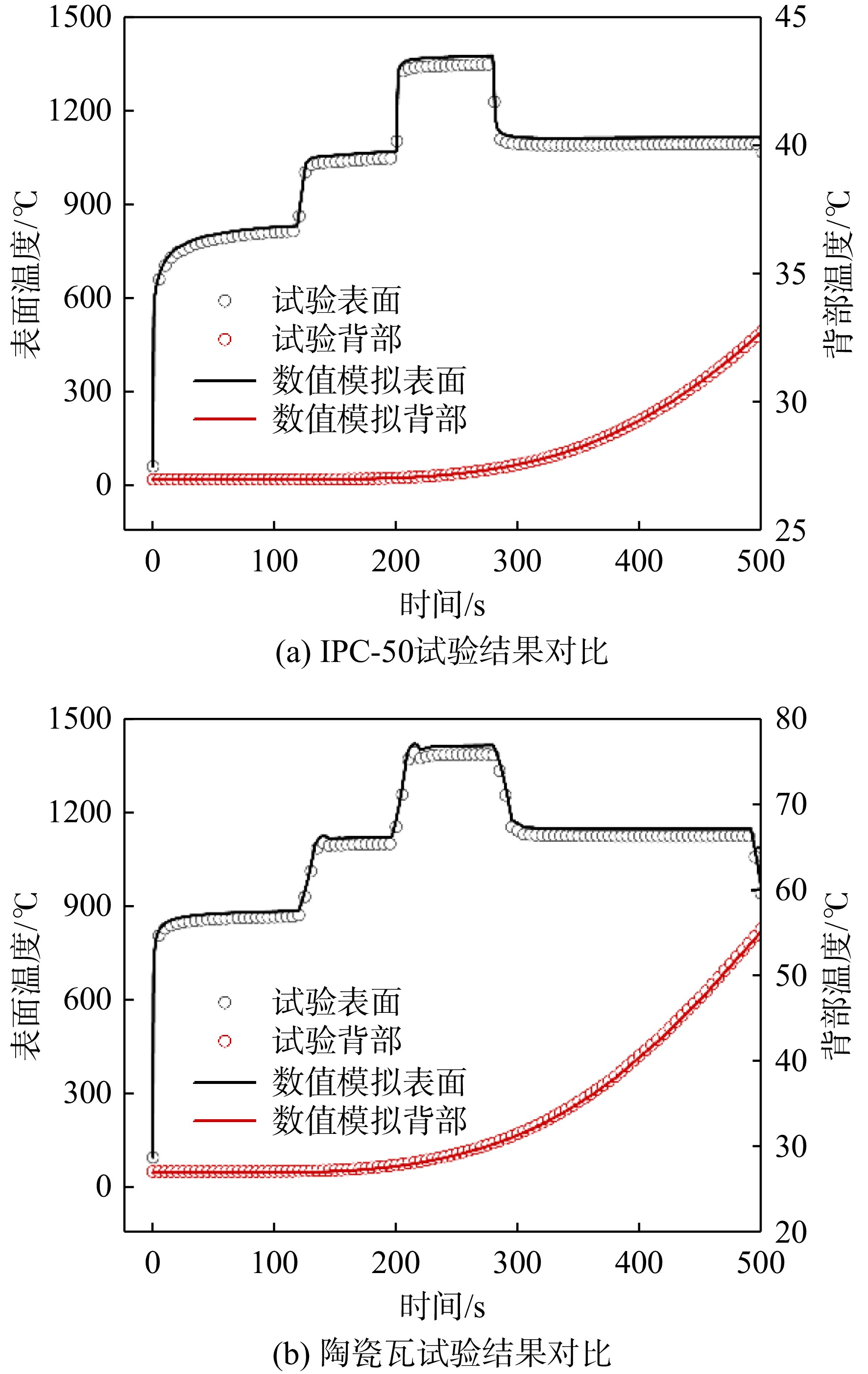
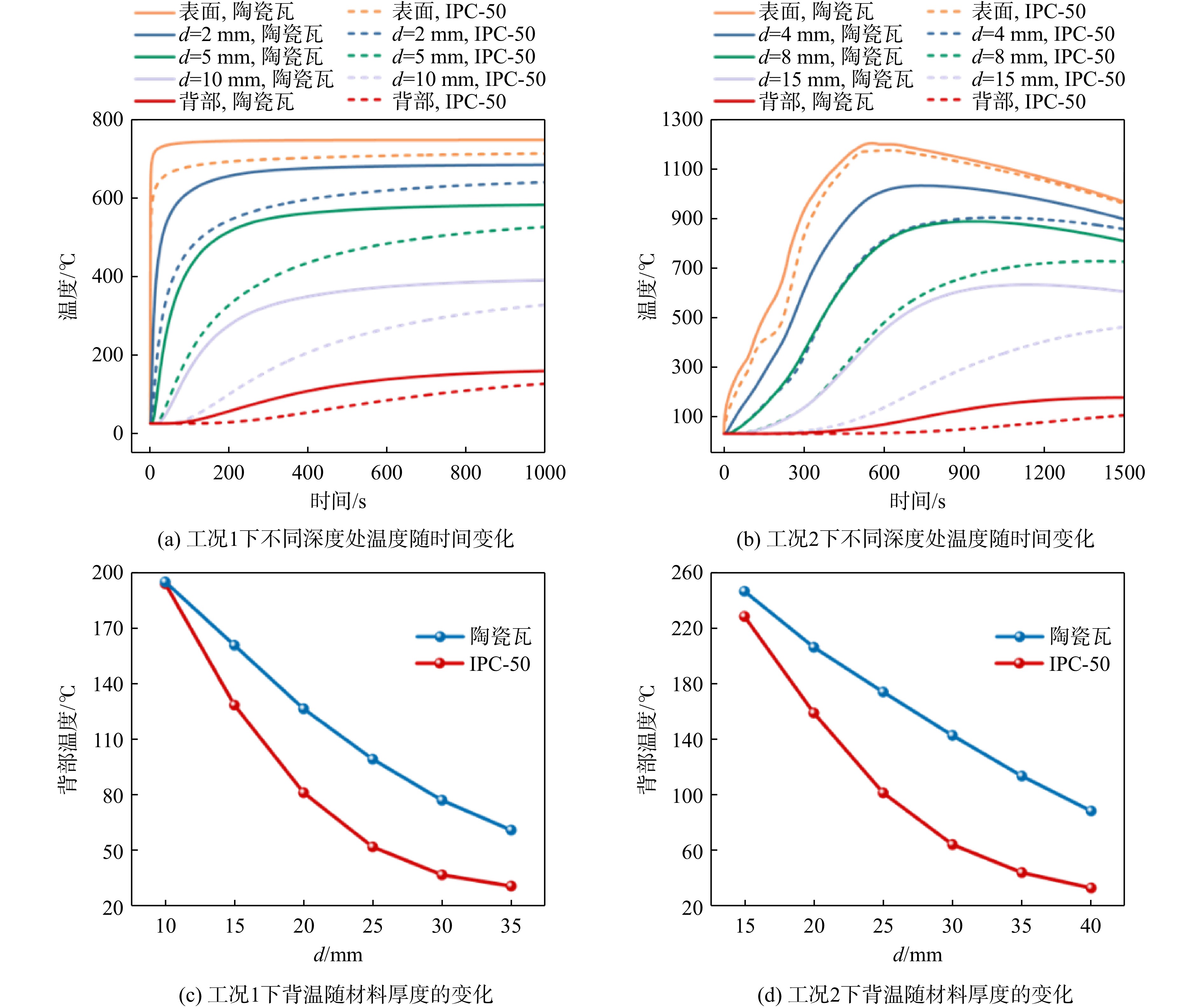
图 5 不同工况下两种材料热响应温度对比图
Figure 5. Comparison of the thermal response temperatures of the two materials under different operating conditions
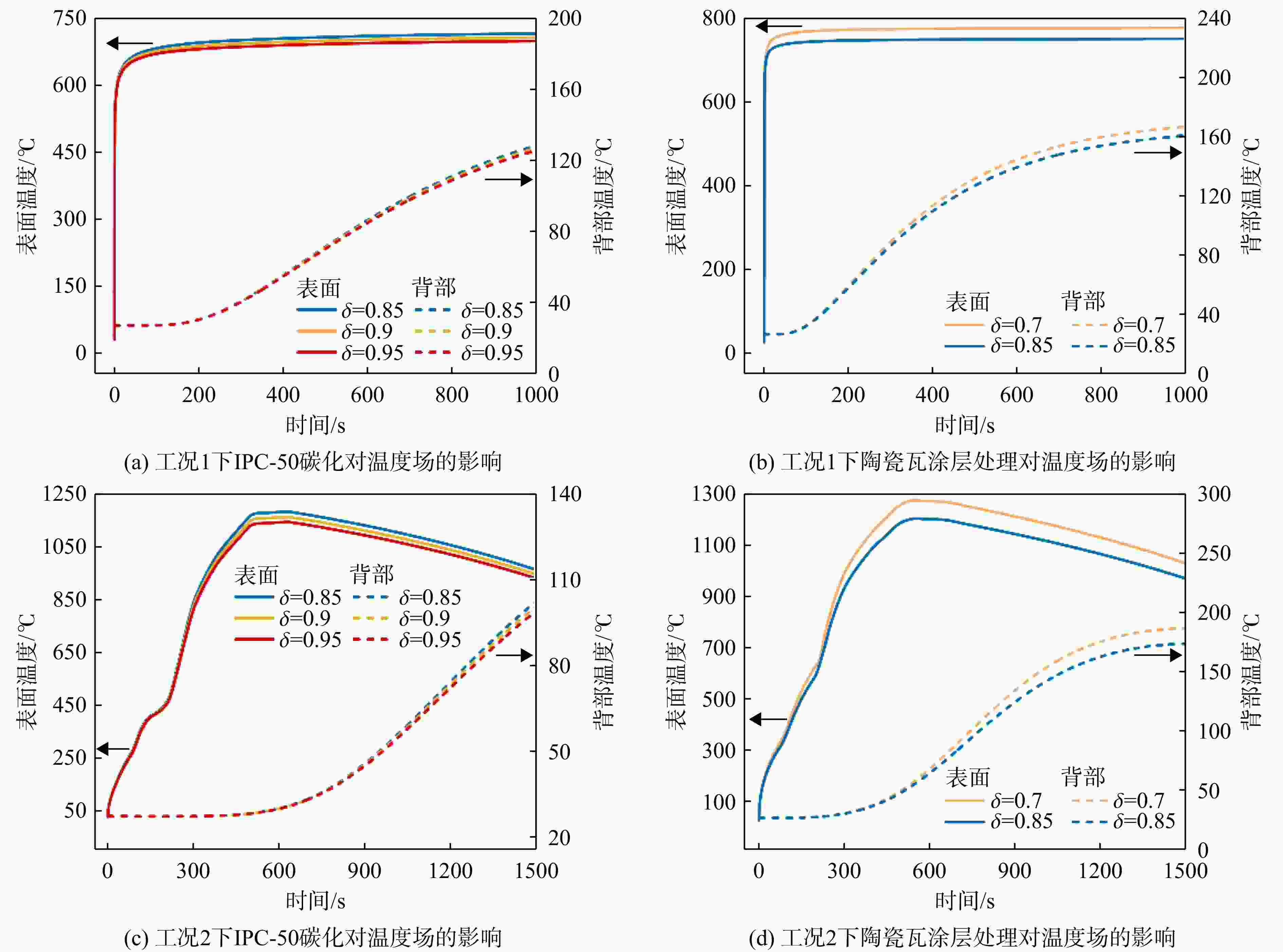
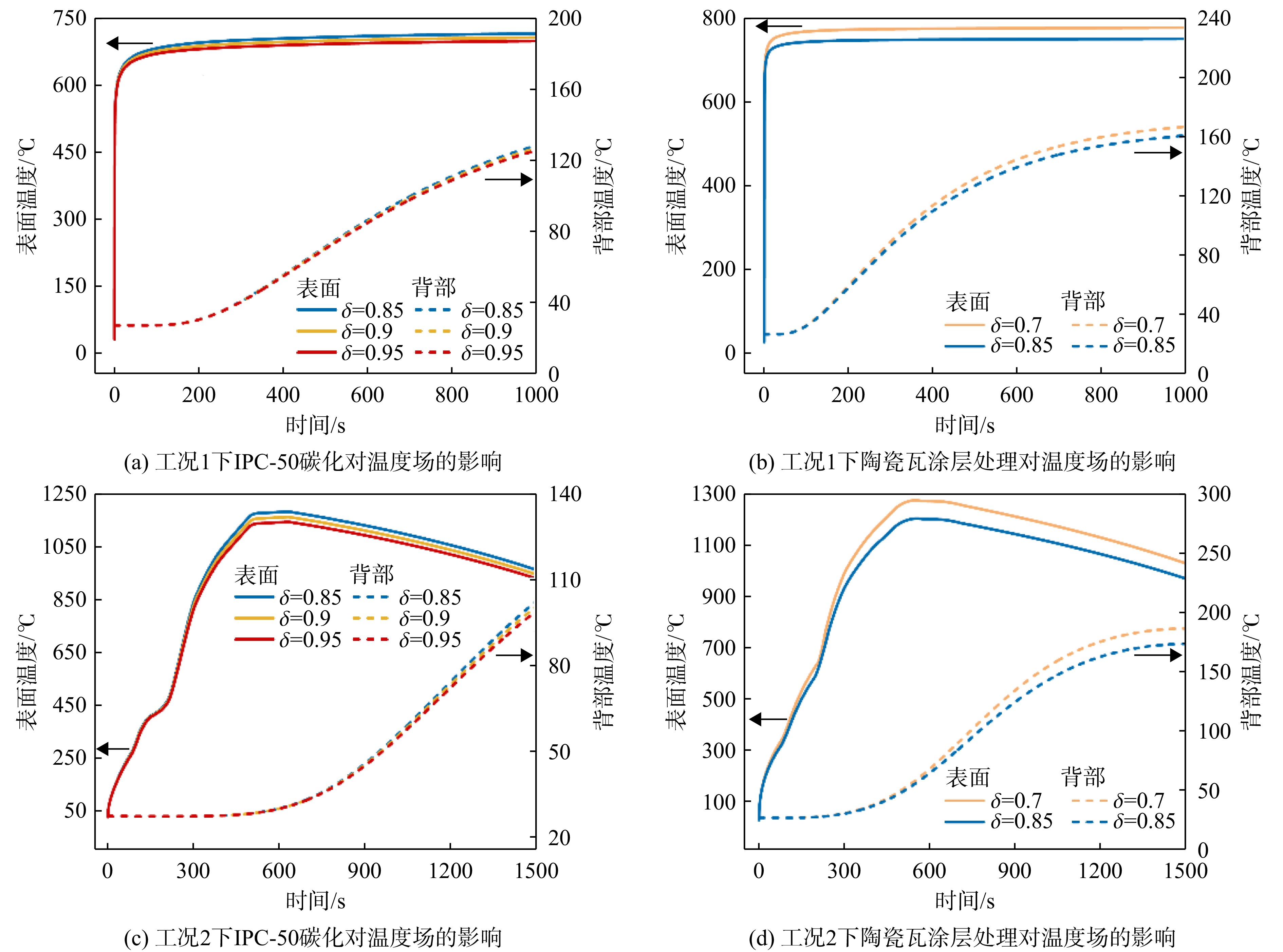
图 6 不同表面辐射率下材料的响应温度随时间的变化趋势
Figure 6. Response temperature trends of materials with time for different surface emissivities
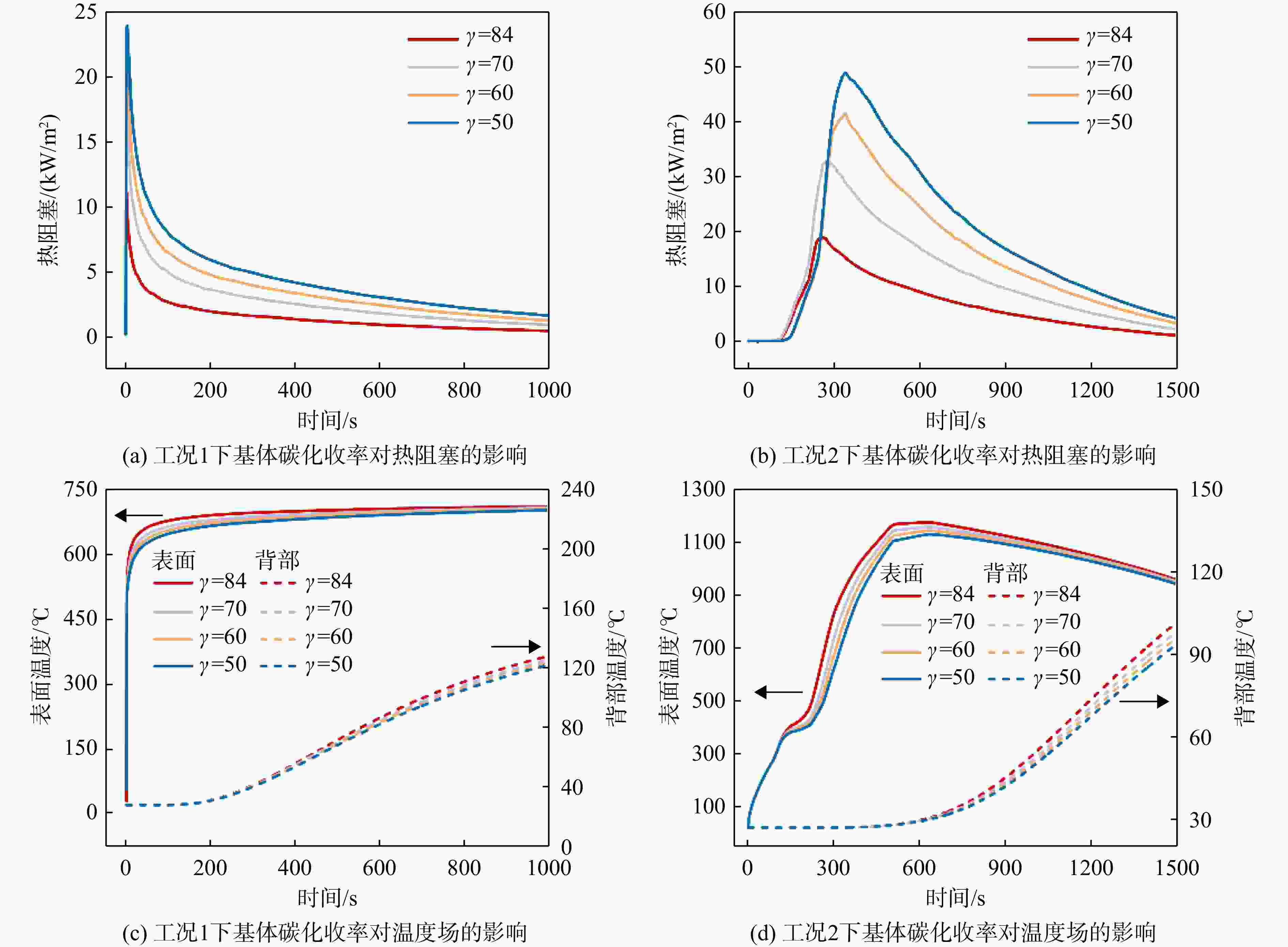
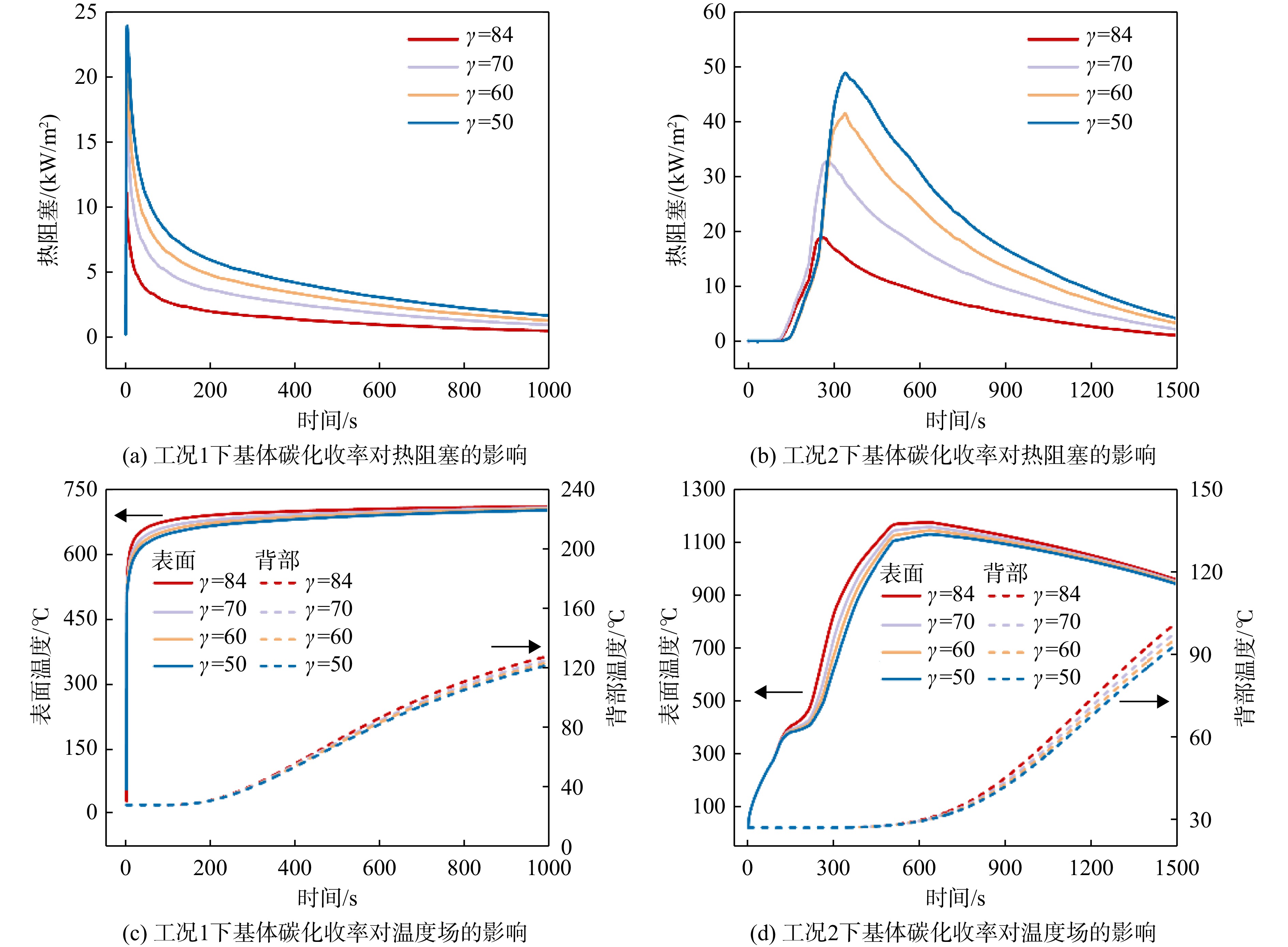
图 7 质量残留率对热阻塞效应的影响
Figure 7. Influence of mass residue rate on thermal blocking effects
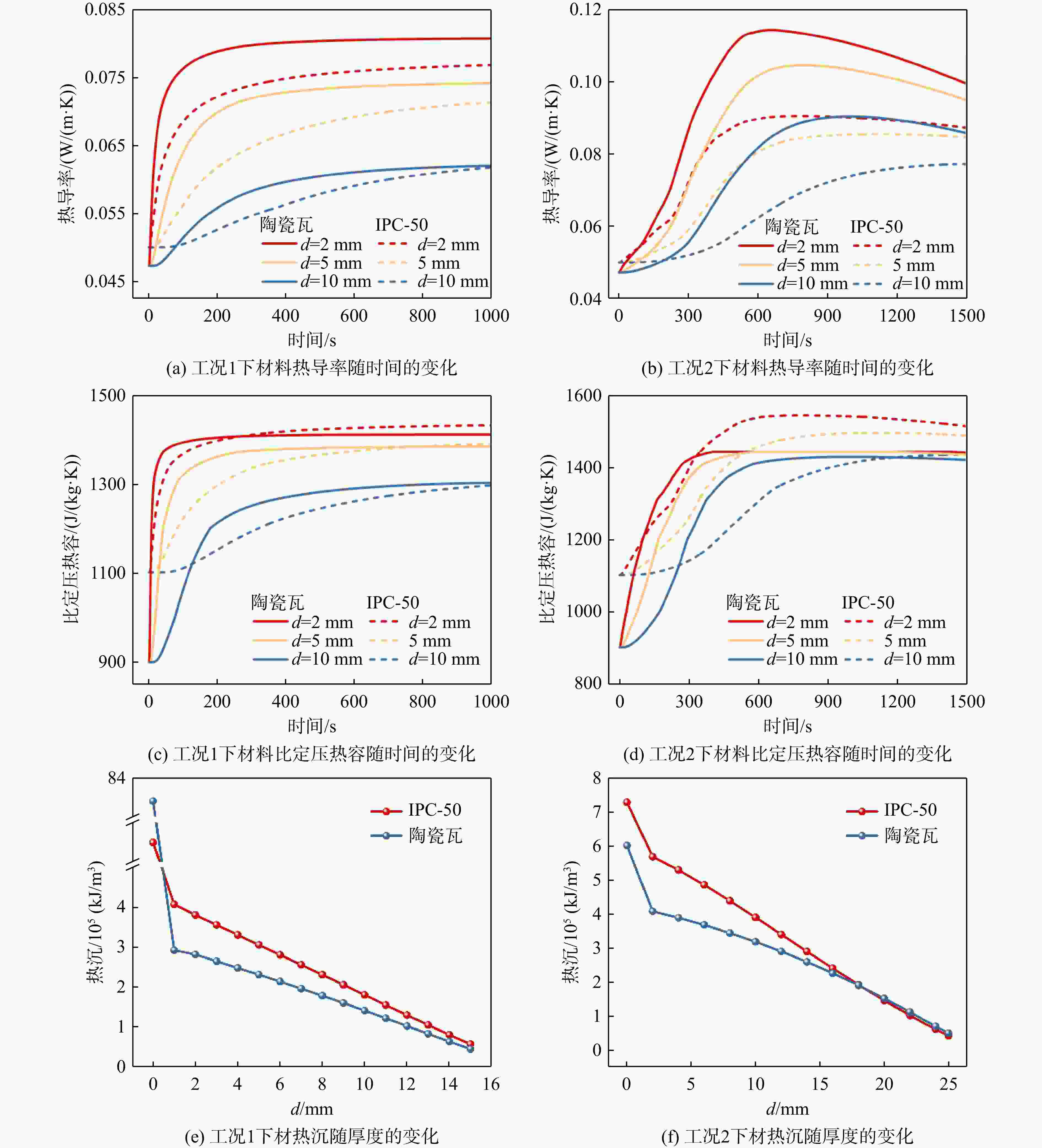
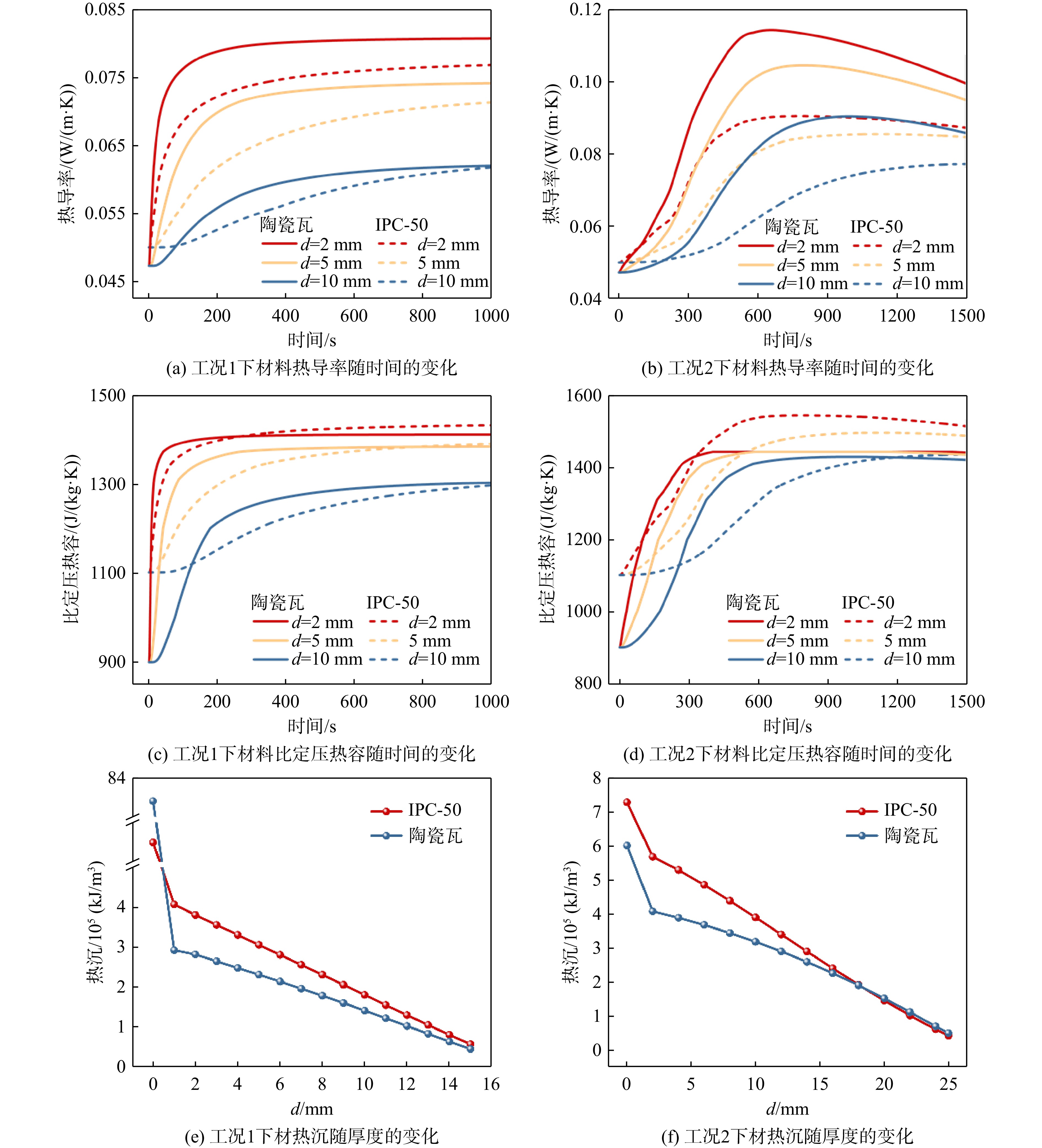
图 8 材料物性变化及热沉的分布图
Figure 8. Plot of material physical property changes and heat of deposition
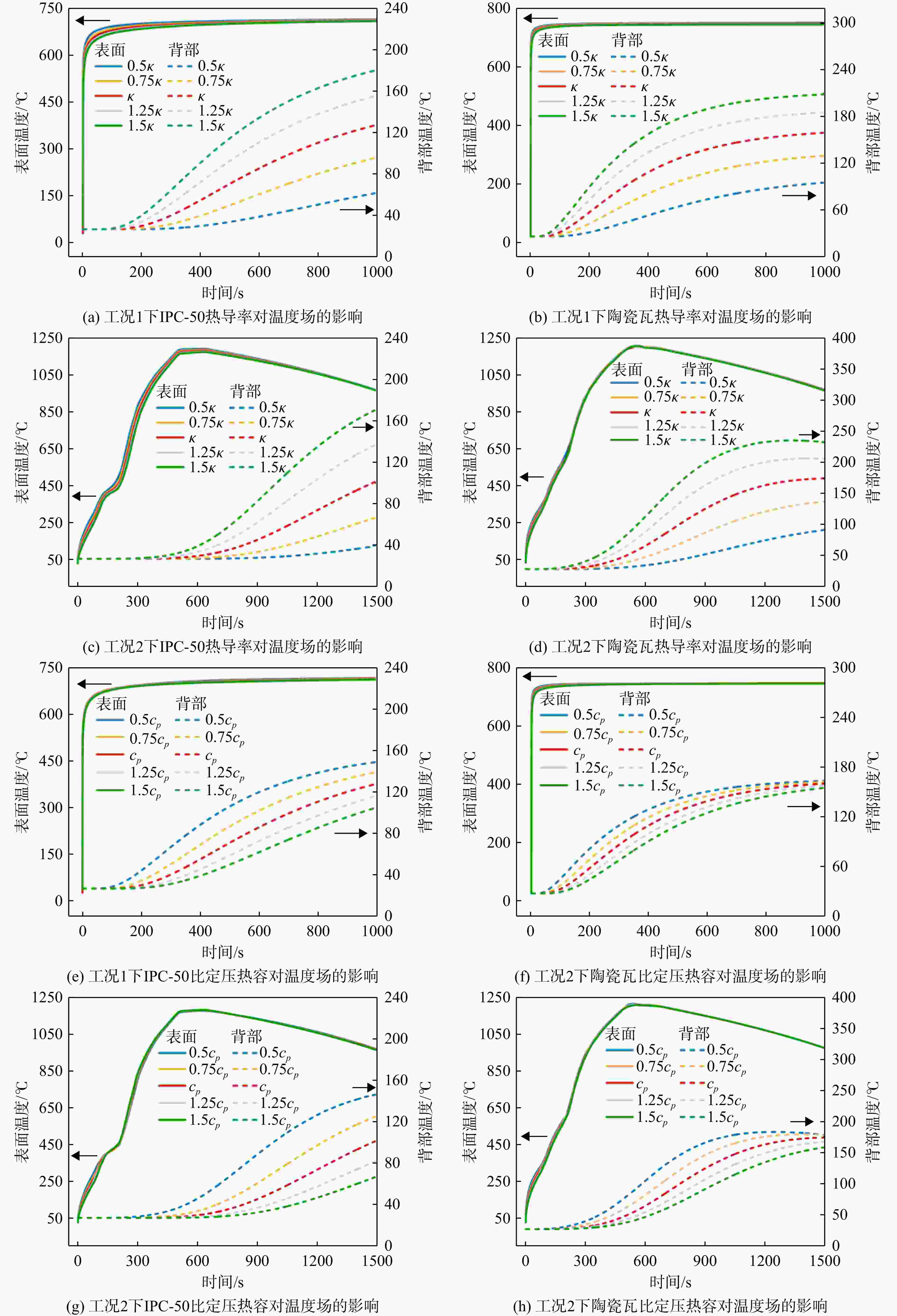
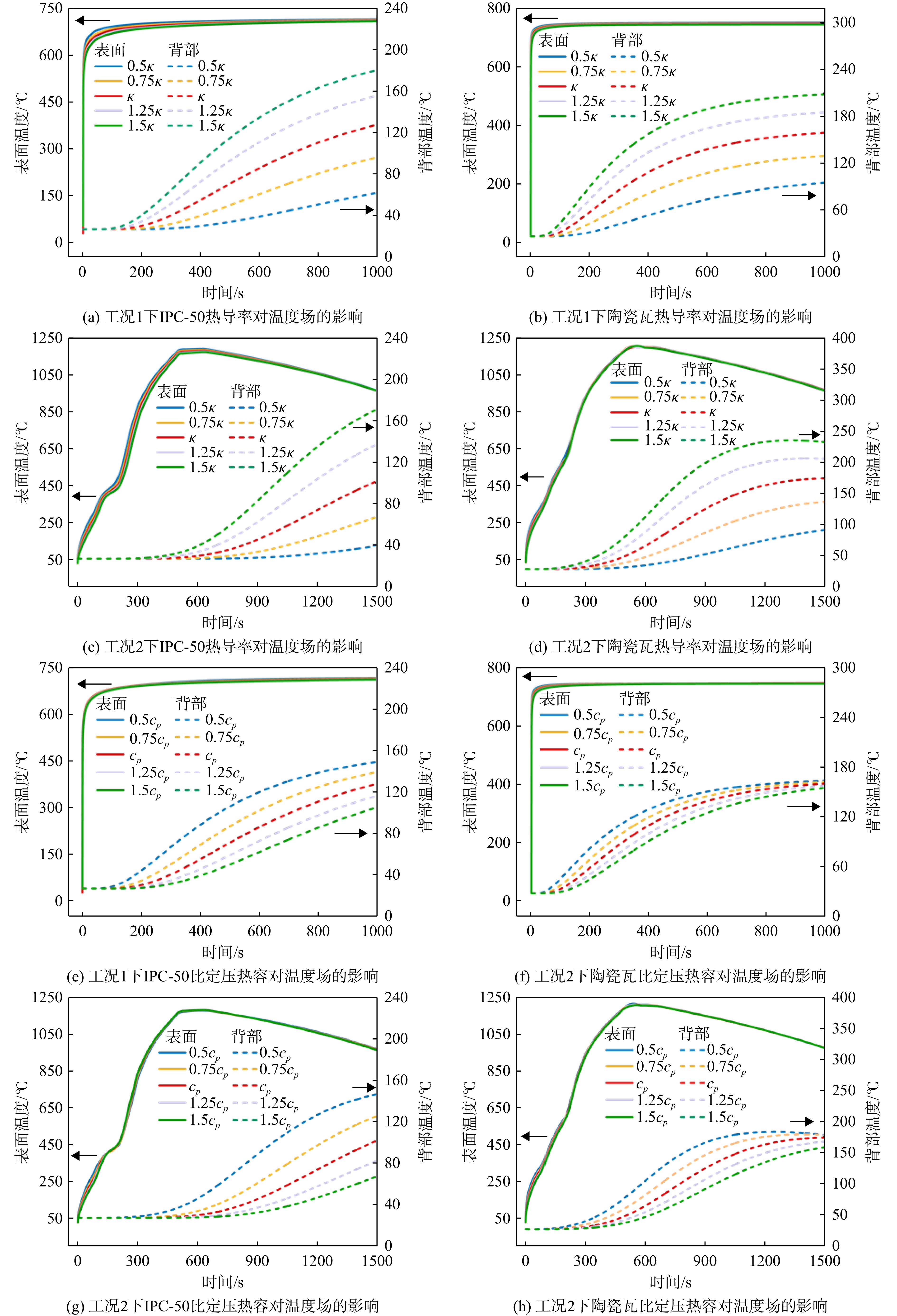
图 9 不同热导率和比定压热容下材料的响应温度随时间的变化趋势
Figure 9. Response temperature trends with time for materials with different thermal conductivities and specific heat capacities
表 1 IPC-50和陶瓷瓦的材料参数
Table 1. Material parameters for IPC-50 and ceramic tiles
物性参数 IPC-50 陶瓷瓦 密度/(g/cm3) 0.5 0.35 基体质量残留率/% 84 热导率/(W/(m·K)) 0.05 0.046 比定压热容/(J/(g·K)) 1.1 0.9 表面辐射率 0.85 0.85  下载: 导出CSV
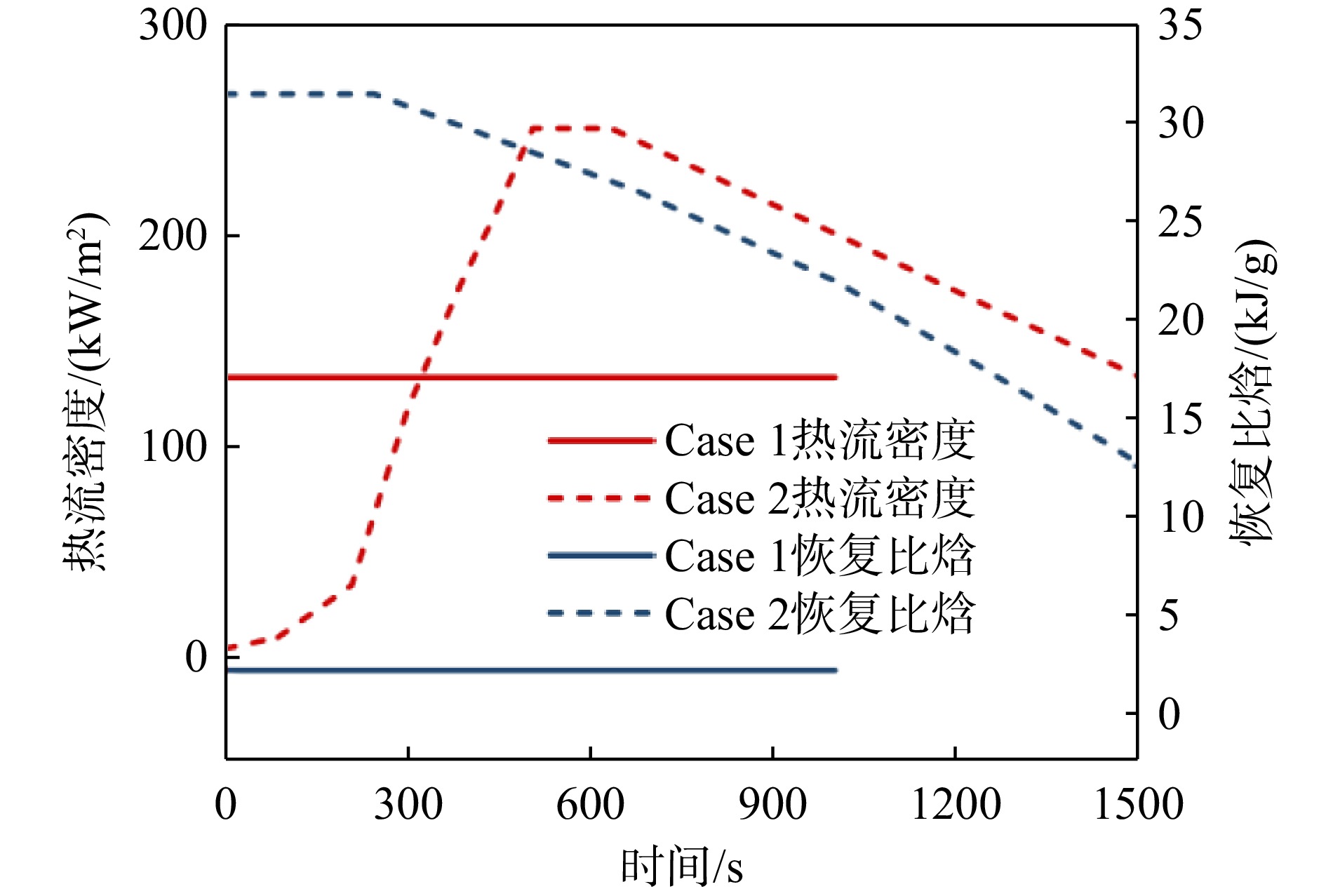
表 2 用于材料防隔热性能分析的两种典型热环境
Table 2. Two typical thermal environments for material thermal insulation analysis
工况 任务 时长/s 1 飞行马赫数为6,27 km高空巡航轨迹 1000 2 航天飞机再入地球大气层[38] 1500
下载: 导出CSV
表 3 陶瓷瓦和IPC-50防隔热机制的贡献权重
Table 3. Contribution weights of ceramic tiles and IPC-50 for thermal insulation mechanisms
防隔热
机制贡献权重/% 工况1 工况2 陶瓷瓦 IPC-50 陶瓷瓦 IPC-50 辐射散热 93.8 85.8 97.6 89.2 热沉 6.2 7.7 2.4 3.8 热阻塞 3.1 4.6 热解气体 2.8 2.1 热解反应 0.6 0.3
下载: 导出CSV
表 4 IPC-50防隔热机制的贡献权重随辐射率的变化
Table 4. Variation of the contribution weights of the IPC-50 thermal insulation mechanism with emissivity
防隔热
机制贡献权重/% 工况1 工况2 δ=0.85 δ=0.95 δ=0.85 δ=0.95 辐射散热 85.8 87.0 89.2 90.3 热沉 7.7 7.0 3.8 3.5 热阻塞 3.1 2.9 4.6 4.2 热解气体 2.8 2.6 2.1 1.8 热解反应 0.6 0.6 0.3 0.2
下载: 导出CSV
表 5 陶瓷瓦防隔热机制的贡献权重
Table 5. Contribution weighting of thermal insulation mechanisms for ceramic tiles
防隔热
机制贡献权重/% 工况1 工况2 δ=0.7 δ=0.85 δ=0.7 δ=0.85 辐射散热 93 93.8 97.4 97.6 热沉 7 6.2 2.6 2.4
下载: 导出CSV
表 6 不同基体质量残留率下IPC-50防隔热机制的贡献权重
Table 6. Contribution weights of IPC-50 thermal insulation mechanisms at different matrix mass retention rate
防隔热
机制贡献权重/% 工况1 工况2 γ=84 γ=70 γ=60 γ=50 γ=84 γ=70 γ=60 γ=50 辐射散热 85.8 81.5 77.8 75.5 89.2 84.9 80.4 78.4 热沉 7.7 7.1 7.0 6.6 3.8 3.4 3.5 3.2 热阻塞 3.1 5.5 7.3 8.7 4.6 7.7 10.7 12.2 热解气体 2.8 4.9 6.4 7.6 2.1 3.5 4.7 5.4 热解反应 0.6 1.1 1.4 1.7 0.3 0.5 0.6 0.7
下载: 导出CSV
-
[1] 邢亚娟, 孙波, 高坤, 等. 航天飞行器热防护系统及防热材料研究现状[J]. 宇航材料工艺, 2018, 48(4): 9-15. Xing Yajuan, Sun Bo, Gao Kun, et al. Research status of thermal protection system and thermal protection materials for aerospace vehicles[J]. Aerospace Materials & Technology, 2018, 48(4): 9-15. (in Chinese doi: 10.12044/j.issn.1007-2330.2018.04.002Xing Yajuan, Sun Bo, Gao Kun, et al. Research status of thermal protection system and thermal protection materials for aerospace vehicles[J]. Aerospace Materials & Technology, 2018, 48(4): 9-15. (in Chinese) doi: 10.12044/j.issn.1007-2330.2018.04.002 [2] Uyanna O, Najafi H. Thermal protection systems for space vehicles: a review on technology development, current challenges and future prospects[J]. Acta Astronautica, 2020, 176: 341-356. doi: 10.1016/j.actaastro.2020.06.047 [3] Squire T H, Marschall J. Material property requirements for analysis and design of UHTC components in hypersonic applications[J]. Journal of the European Ceramic Society, 2010, 30(11): 2239-2251. doi: 10.1016/j.jeurceramsoc.2010.01.026 [4] 李仲平. 防热复合材料发展与展望[J]. 复合材料学报, 2011, 28(2): 1-9. Li Zhongping. Major advancement and development trends of TPS composites[J]. Acta Materiae Compositae Sinica, 2011, 28(2): 1-9. (in Chinese doi: 10.13801/j.cnki.fhclxb.2011.02.018Li Zhongping. Major advancement and development trends of TPS composites[J]. Acta Materiae Compositae Sinica, 2011, 28(2): 1-9. (in Chinese) doi: 10.13801/j.cnki.fhclxb.2011.02.018 [5] 李亮, 任智毅, 王鹏, 等. 轻质树脂基防隔热一体化材料研究进展[J]. 空天防御, 2024, 7(6): 58-75. Li Liang, Ren Zhiyi, Wang Peng, et al. Research progress on lightweight resin-based thermal protection materials[J]. Air & Space Defense, 2024, 7(6): 58-75. (in ChineseLi Liang, Ren Zhiyi, Wang Peng, et al. Research progress on lightweight resin-based thermal protection materials[J]. Air & Space Defense, 2024, 7(6): 58-75. (in Chinese) [6] Chiu S, Pitts W. Reusable surface insulations for reentry spacecraft[R]. AIAA 1991-695, 1991. [7] 周聪, 徐淑琼, 李云芳. 返回式航天器高温隔热材料综述[J]. 科技视界, 2019(18): 168-169, 173. Zhou Cong, Xu Shuqiong, Li Yunfang. Review on high temperature insulation materials of returning spacecraft[J]. Science & Technology Vision, 2019(18): 168-169, 173. (in ChineseZhou Cong, Xu Shuqiong, Li Yunfang. Review on high temperature insulation materials of returning spacecraft[J]. Science & Technology Vision, 2019(18): 168-169, 173. (in Chinese) [8] 王康太, 冯坚, 姜勇刚, 等. 陶瓷纤维刚性隔热瓦研究进展[J]. 材料导报, 2011, 25(23): 35-39. Wang Kangtai, Feng Jian, Jiang Yonggang, et al. Development of ceramic fiber rigid insulation tiles[J]. Materials Review, 2011, 25(23): 35-39. (in ChineseWang Kangtai, Feng Jian, Jiang Yonggang, et al. Development of ceramic fiber rigid insulation tiles[J]. Materials Review, 2011, 25(23): 35-39. (in Chinese) [9] Parmenter K E, Shuman K, Milstein F, et al. Compressive response of lightweight ceramic ablators: silicone impregnated reusable ceramic ablator[J]. Journal of Spacecraft and Rockets, 2002, 39(2): 290-298. doi: 10.2514/2.3811 [10] 孙晶晶, 胡子君, 吴文军, 等. 氧化铝气凝胶复合高温隔热瓦的制备及性能[J]. 宇航材料工艺, 2017, 47(3): 33-36, 41. Sun Jingjing, Hu Zijun, Wu Wenjun, et al. Fabrication and properties of aerogels impregrated high-temperature insulating tiles[J]. Aerospace Materials & Technology, 2017, 47(3): 33-36, 41. (in Chinese doi: 10.12044/j.issn.1007-2330.2017.03.008Sun Jingjing, Hu Zijun, Wu Wenjun, et al. Fabrication and properties of aerogels impregrated high-temperature insulating tiles[J]. Aerospace Materials & Technology, 2017, 47(3): 33-36, 41. (in Chinese) doi: 10.12044/j.issn.1007-2330.2017.03.008 [11] 兰志丹, 任伟敏, 安楠, 等. 陶瓷纤维隔热瓦及其高发射涂层的研究进展[J]. 硅酸盐通报, 2023, 42(12): 4465-4474. Lan Zhidan, Ren Weimin, An Nan, et al. Research progress of ceramic fiber insulation tiles and its high emissivity coating[J]. Bulletin of the Chinese Ceramic Society, 2023, 42(12): 4465-4474. (in Chinese doi: 10.16552/j.cnki.issn1001-1625.2023.12.023Lan Zhidan, Ren Weimin, An Nan, et al. Research progress of ceramic fiber insulation tiles and its high emissivity coating[J]. Bulletin of the Chinese Ceramic Society, 2023, 42(12): 4465-4474. (in Chinese) doi: 10.16552/j.cnki.issn1001-1625.2023.12.023 [12] 李伶, 张文苑, 隋学叶, 等. 陶瓷隔热瓦耐高温高辐射率涂层的制备及表征[J]. 现代技术陶瓷, 2016, 37(2): 131-137. Li Ling, Zhang Wenyuan, Sui Xueye, et al. Preparation and characterization of high temperature resistant and high emissivity multi-component coating for ceramic insulation tile[J]. Advanced Ceramics, 2016, 37(2): 131-137. (in ChineseLi Ling, Zhang Wenyuan, Sui Xueye, et al. Preparation and characterization of high temperature resistant and high emissivity multi-component coating for ceramic insulation tile[J]. Advanced Ceramics, 2016, 37(2): 131-137. (in Chinese) [13] 姚荣迁, 黄雯燕, 郑艺浓, 等. 一种多孔碳化硅高温隔热瓦及其制备方法: CN115894069A[P]. 2023-04-04. [14] Wu Tianyu, Wu Mingming, Luo Yi, et al. Low-density silicone aerogel composites with excellent flexibility, thermal insulation and anti-ablation properties for flexible thermal protection systems[J]. Ceramics International, 2025, 51(20): 30870-30880. doi: 10.1016/j.ceramint.2025.04.279 [15] Krenn A, Youngquist R, Gibson T, et al. Development of a thermal control coating optimized for cryogenic space applications[J]. IOP Conference Series: Materials Science and Engineering, 2022, 1240(1): 012001. doi: 10.1088/1757-899X/1240/1/012001 [16] Zhang X H, Wang Z, Hu P, et al. Mechanical properties and thermal shock resistance of ZrB2–SiC ceramic toughened with graphite flake and SiC whiskers[J]. Scripta Materialia, 2009, 61(8): 809-812. doi: 10.1016/j.scriptamat.2009.07.001 [17] Fahrenholtz W G, Hilmas G E. Ultra-high temperature ceramics: Materials for extreme environments[J]. Scripta Materialia, 2017, 129: 94-99. doi: 10.1016/j.scriptamat.2016.10.018 [18] Lane J, Salmassy O. An evaluation of ablative materials for a lunar transfer vehicle aerobrake[R]. AIAA 1993-2791, 1993. [19] Smith W D. Gemini launch vehicle development[C]//Gemini Midprogram Conference. Houston: Johnson Space Center, 1966: 107-124. [20] Willcockson W H. Stardust sample return capsule design experience[J]. Journal of Spacecraft and Rockets, 1999, 36(3): 470-474. doi: 10.2514/2.3468 [21] Ellerby D, Driber D, Gasch M, et al. Overview of heatshield for extreme entry environment technology (HEEET) project[R]. Boulder: NASA Ames Research Center ARC-E-DAA-TN57451, 2018. [22] Dong Wencai, Bao Chonggao, Lu Wenqi, et al. Fabrication of a continuous carbon fiber-reinforced phenolic resin composites via in situ-curing 3D printing technology[J]. Composites Communications, 2023, 38: 101497. doi: 10.1016/j.coco.2023.101497 [23] 冯志海, 师建军, 孔磊, 等. 航天飞行器热防护系统低密度烧蚀防热材料研究进展[J]. 材料工程, 2020, 48(8): 14-24. Feng Zhihai, Shi Jianjun, Kong Lei, et al. Research progress in low-density ablative materials for thermal protection system of aerospace flight vehicles[J]. Journal of Materials Engineering, 2020, 48(8): 14-24. (in Chinese doi: 10.11868/j.issn.1001-4381.2020.000206Feng Zhihai, Shi Jianjun, Kong Lei, et al. Research progress in low-density ablative materials for thermal protection system of aerospace flight vehicles[J]. Journal of Materials Engineering, 2020, 48(8): 14-24. (in Chinese) doi: 10.11868/j.issn.1001-4381.2020.000206 [24] Cai Hongxiang, Niu Bo, Qian Zhen, et al. Mechanical, thermal insulation, and ablation behaviors of needle-punched fabric reinforced nanoporous phenolic composites: the role of anisotropic microstructure[J]. Composites Science and Technology, 2024, 245: 110325. doi: 10.1016/j.compscitech.2023.110325 [25] Cai Hongxiang, Jiang Zhen, Li Liang, et al. Mechanical failure and strengthening mechanism of nanoporous phenolic composites reinforced with needle-punched fiber preforms of different needle-punched densities[J]. Polymer Composites, 2025, 46(S1): S326-S337. doi: 10.1002/pc.29783 [26] 吴大方, 林鹭劲, 吴文军, 等. 1500℃极端高温环境下高超声速飞行器轻质隔热材料热/振联合试验[J]. 航空学报, 2020, 41(7): 223612. Wu Dafang, Lin Lujin, Wu Wenjun, et al. Thermal/vibration test of lightweight insulation material for hypersonic vehicle under extreme-high-temperature environment up to 1500 ℃[J]. Acta Aeronautica et Astronautica Sinica, 2020, 41(7): 223612. (in ChineseWu Dafang, Lin Lujin, Wu Wenjun, et al. Thermal/vibration test of lightweight insulation material for hypersonic vehicle under extreme-high-temperature environment up to 1500 ℃[J]. Acta Aeronautica et Astronautica Sinica, 2020, 41(7): 223612. (in Chinese) [27] Dotts R, Battley H, Hughes J, et al. Space shuttle orbiter-reusable surface insulation subsystem thermal performance[R]. AIAA 1982-0005, 1982. [28] Lachaud J, Cozmuta I, Mansour N N. Multiscale approach to ablation modeling of phenolic impregnated carbon ablators[J]. Journal of Spacecraft and Rockets, 2010, 47(6): 910-921. doi: 10.2514/1.42681 [29] Ene H I, Sanchez-palencia E. On thermal equation for flow in porous media[J]. International Journal of Engineering Science, 1982, 20(5): 623-630. doi: 10.1016/0020-7225(82)90116-1 [30] Cheng G C, Venkatachari B S, Cozmuta I. Multi-scale simulations of in-depth pyrolysis of charring ablative thermal protection material[J]. Computers & Fluids, 2011, 45(1): 191-196. doi: 10.1016/j.compfluid.2010.10.023 [31] Park C. Calculation of stagnation-point heating rates associated with stardust vehicle[J]. Journal of Spacecraft and Rockets, 2007, 44(1): 24-32. doi: 10.2514/1.15745 [32] Wang Peng, Zhou Xiaoyi, Li Liang, et al. Modeling and validation of ablative thermal response combined with microscopic heat transfer for porous ablative materials[J]. Thermal Science and Engineering Progress, 2024, 47: 102256. doi: 10.1016/j.tsep.2023.102256 [33] Ewing M E, Laker T S, Walker D T. Numerical modeling of ablation heat transfer[J]. Journal of Thermophysics and Heat Transfer, 2013, 27(4): 615-632. doi: 10.2514/1.T4164 [34] Trick K A, Saliba T E, Sandhu S S. A kinetic model of the pyrolysis of phenolic resin in a carbon/phenolic composite[J]. Carbon, 1997, 35(3): 393-401. doi: 10.1016/S0008-6223(97)89610-8 [35] 贾献峰, 刘旭华, 乔文明, 等. 酚醛浸渍碳烧蚀体 (PICA) 的制备、结构及性能[J]. 宇航材料工艺, 2016, 46(1): 77-80, 90. Jia Xianfeng, Liu Xuhua, Qiao Wenming, et al. Preparation and properties of phenolic impregnated carbon ablator[J]. Aerospace Materials and Technology, 2016, 46(1): 77-80, 90.Jia Xianfeng, Liu Xuhua, Qiao Wenming, et al. Preparation and properties of phenolic impregnated carbon ablator[J]. Aerospace Materials and Technology, 2016, 46(1): 77-80, 90. [36] Holden M, Wadhams T, Maclean M, et al. Experimental studies of shock wave/turbulent boundary layer interaction in high Reynolds number supersonic and hypersonic flows to evaluate the performance of cfd codes[R]. AIAA-2010-4468, 2010. [37] Niu Bo, Shen Haochen, Li Tong, et al. 2.5D quartz fabric reinforced nanoporous phenolic composites with weakened heat transfer and optimized mechanical properties[J]. Composites Science and Technology, 2022, 230: 109726. doi: 10.1016/j.compscitech.2022.109726 [38] Arnold A H. Exploratory development of a flexible ablative covering for space shuttle application[EB/OL]. [2025-02-26]. https://ntrs.nasa.gov/citations/19720023301. [39] Guo Jin, Huang Haiming, Xu Xiaoliang. Protective effect of pyrolysis gases combustion against surface ablation under different Mach numbers[J]. Acta Astronautica, 2020, 166: 209-217. doi: 10.1016/j.actaastro.2019.10.032 [40] Smith D S, Alzina A, Bourret J, et al. Thermal conductivity of porous materials[J]. Journal of Materials Research, 2013, 28(17): 2260-2272. doi: 10.1557/jmr.2013.179 [41] Huang Congliang, Qian Xin, Yang Ronggui. Thermal conductivity of polymers and polymer nanocomposites[J]. Materials Science and Engineering: R: Reports, 2018, 132: 1-22. doi: 10.1021/acsmacrolett.1c00703.s001 -

 点击查看大图
计量
- 文章访问数: 556
- HTML浏览量: 295
- PDF量: 51
- 被引次数: 0