






Numerical investigation on energy coupling characteristics of ion cyclotron resonance heating stage in variable specific impulse magnetoplasma rocket
-
摘要:
离子回旋共振(ICRH)单元的高效能量耦合对提升可变比冲磁等离子体发动机(VASIMR)的推进效率具有至关重要影响。为探究ICRH单元的能量耦合特性,本文建立了串联螺旋波等离子体源(HPS)与ICRH单元的多组分流体模型,并利用该模型在不同天线长度与输入频率条件下进行了数值模拟。研究结果表明:ICRH单元中角向离子电流密度与电场出现共振现象,离子持续从电磁场中沉积能量;随ICRH天线增长,离子与电场的共振区增大,离子加热效率升高;ICRH单元的输入频率对离子加热效果有显著影响,随ICRH单元输入频率上升,离子温度逐渐下降,而在离子碰撞过程的影响下ICRH单元的最优输入频率略低于离子回旋频率。
-
关键词:
- 可变比冲磁等离子体发动机(VASIMR) /
- 螺旋波等离子体源 /
- 离子回旋共振加热 /
- 能量耦合 /
- 流体模拟
Abstract:The effective ion heating of the ion cyclotron resonance heating (ICRH) stage is of vital importance for the variable specific impulse magnetoplasma rocket (VASIMR) to become an effective propulsion device. A multi-component fluid model in which the helicon plasma source (HPS) and the ICRH stage are connected in series was developed. The simulation was performed with different antenna length and different input frequency to analyze the ion energy coupling mechanism of the ICRH stage. The numerical results demonstrated that, the azimuthal ion current density resonated with the azimuthal electric field in the ICRH stage and ions can absorb energy from electromagnetic fields continuously due to the resonance. The resonant area got larger as the antenna length of the ICRH stage increased and ions could deposit energy from electromagnetic fields more efficiently. The input frequency of the ICRH stage had a great influence on the ion heating effect. Due to the existence of ion collisions, the optimum input frequency of the ICRH stage was lower than the ion cyclotron frequency and the heating efficiency decreased as the ion temperature increased.
-
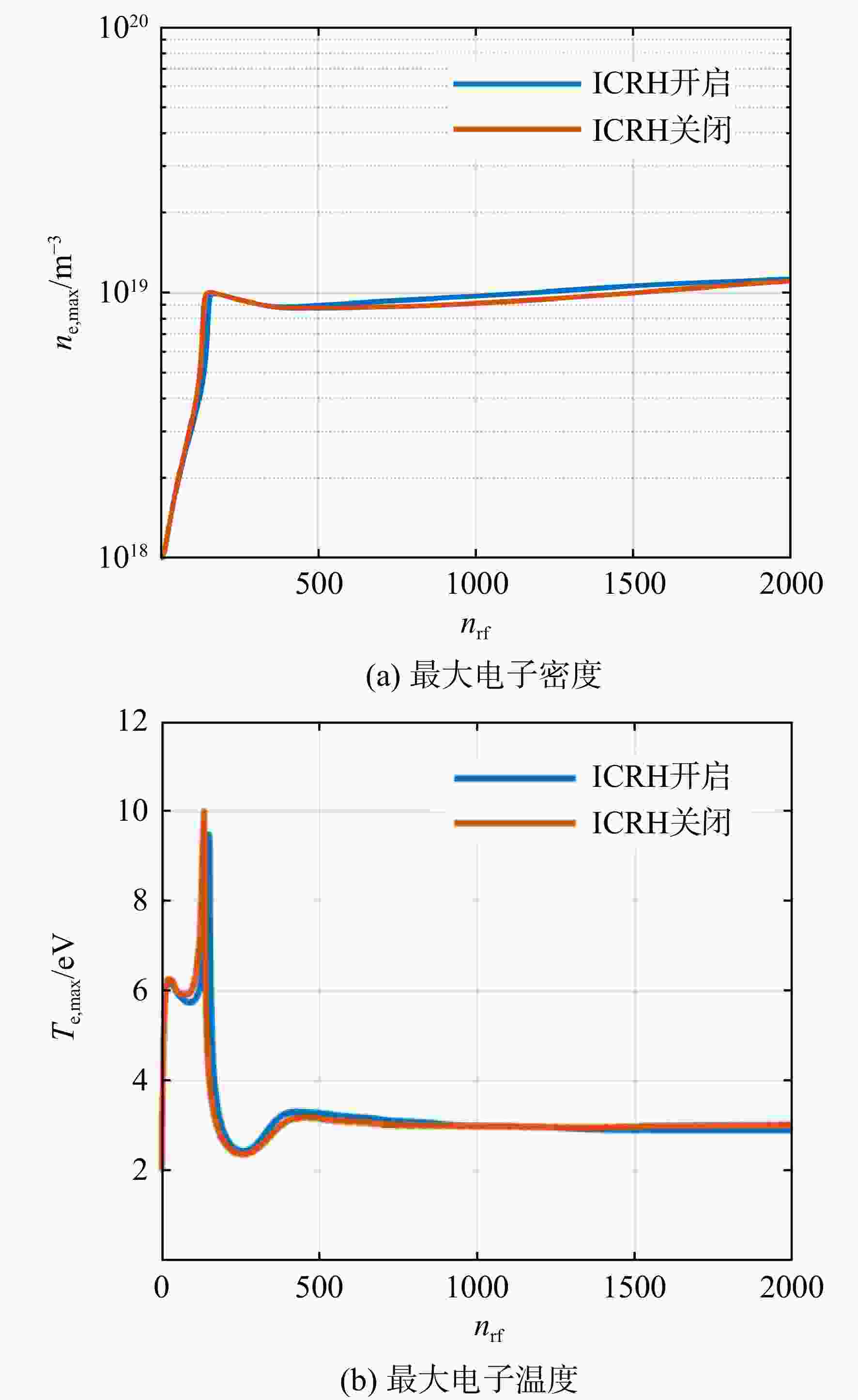
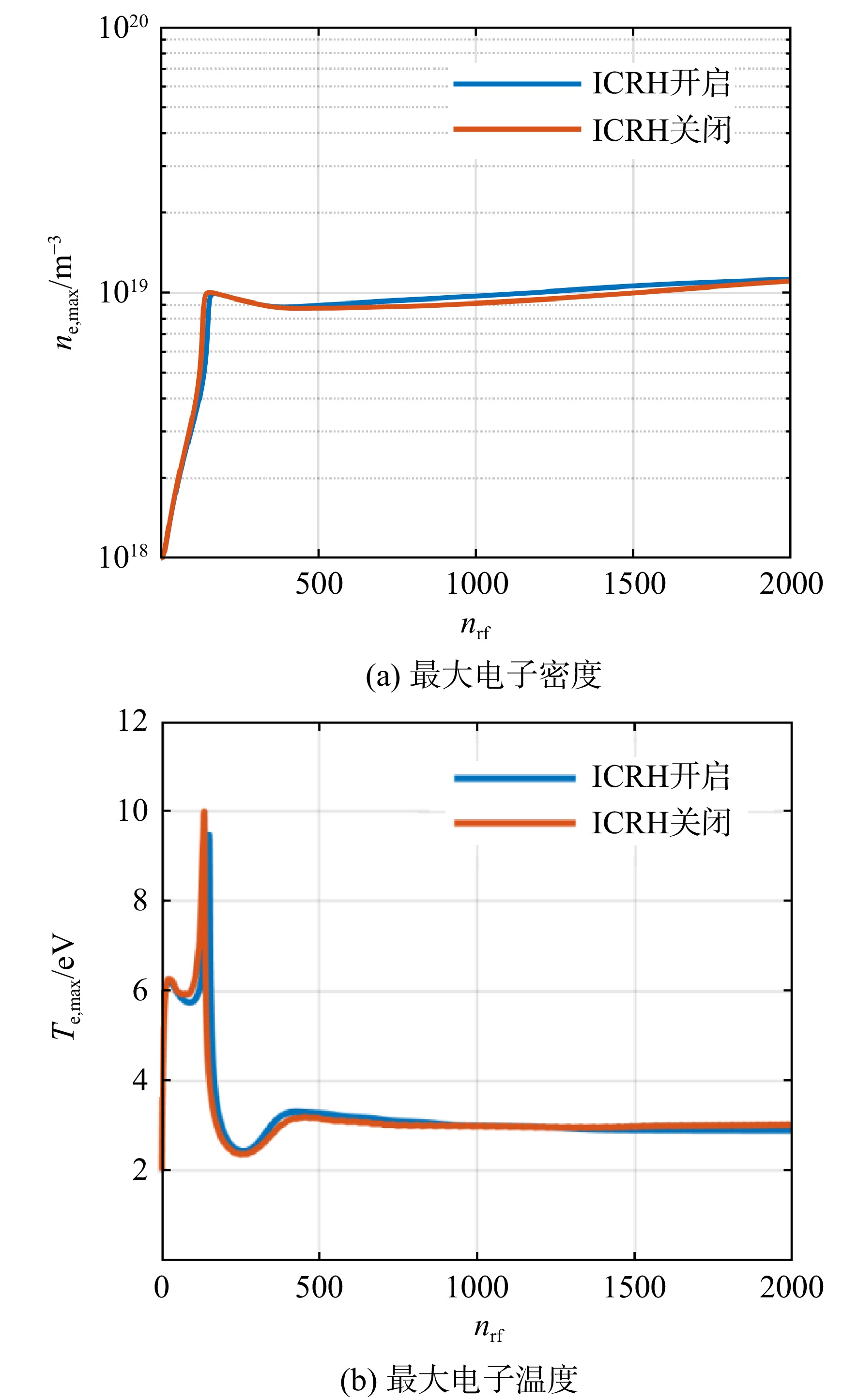
图 5 计算过程中的最大电子密度与电子温度
Figure 5. The maximum electron density and the maximum electron temperature during simulation
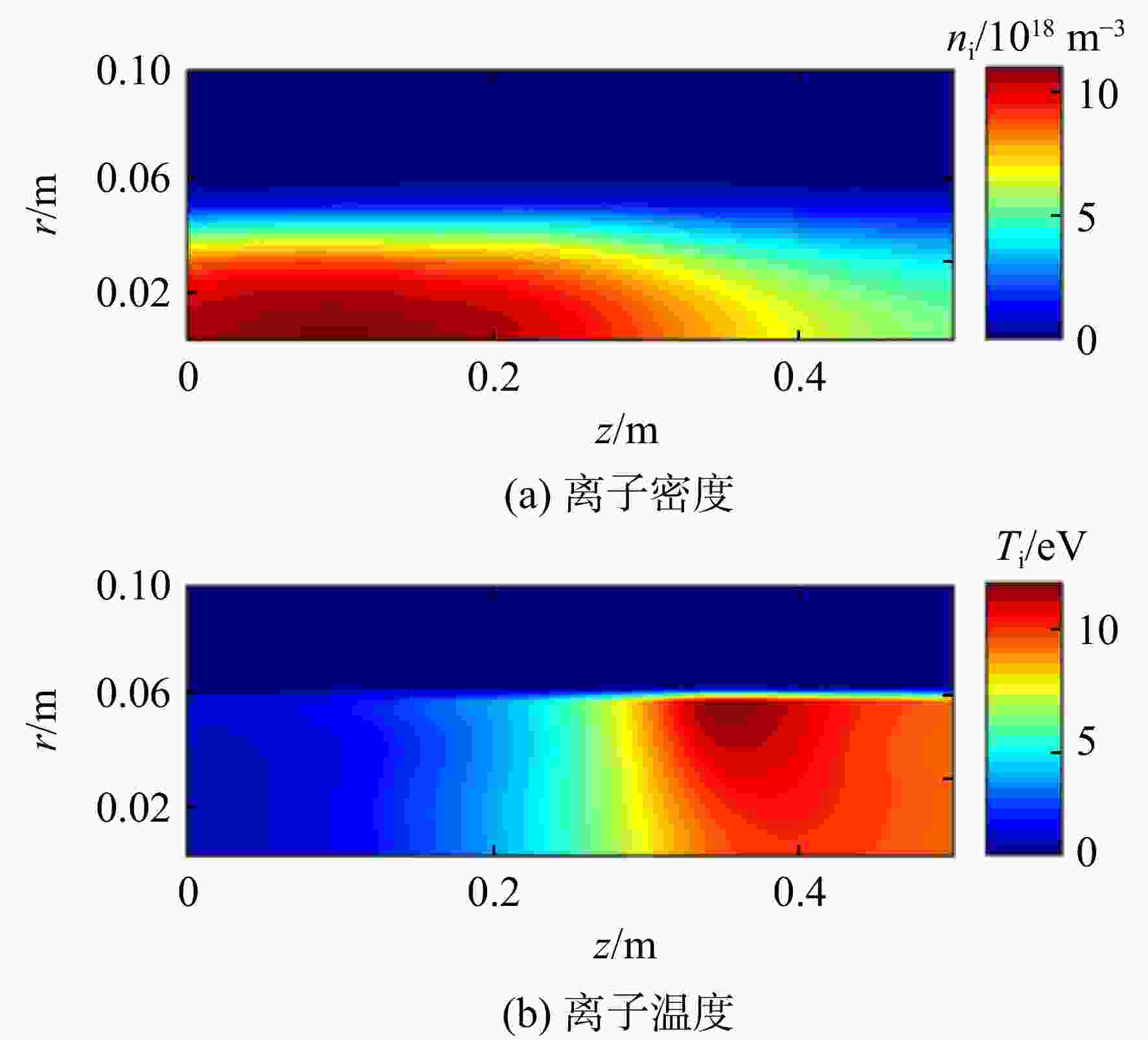
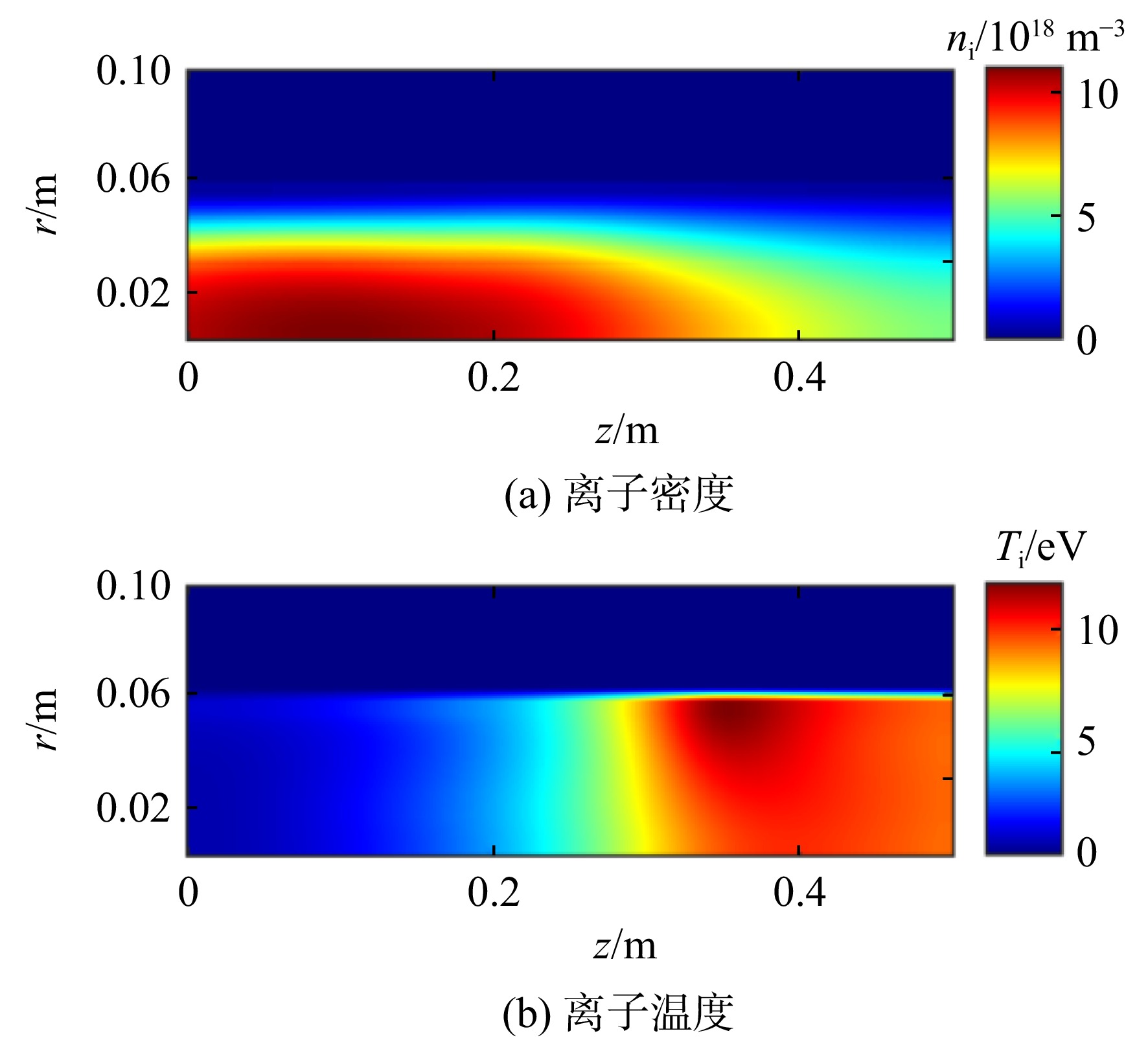
图 7 ICRH输入开启后离子密度与离子温度分布
Figure 7. Distribution of ion density and ion temperature with the ICRH input turned on
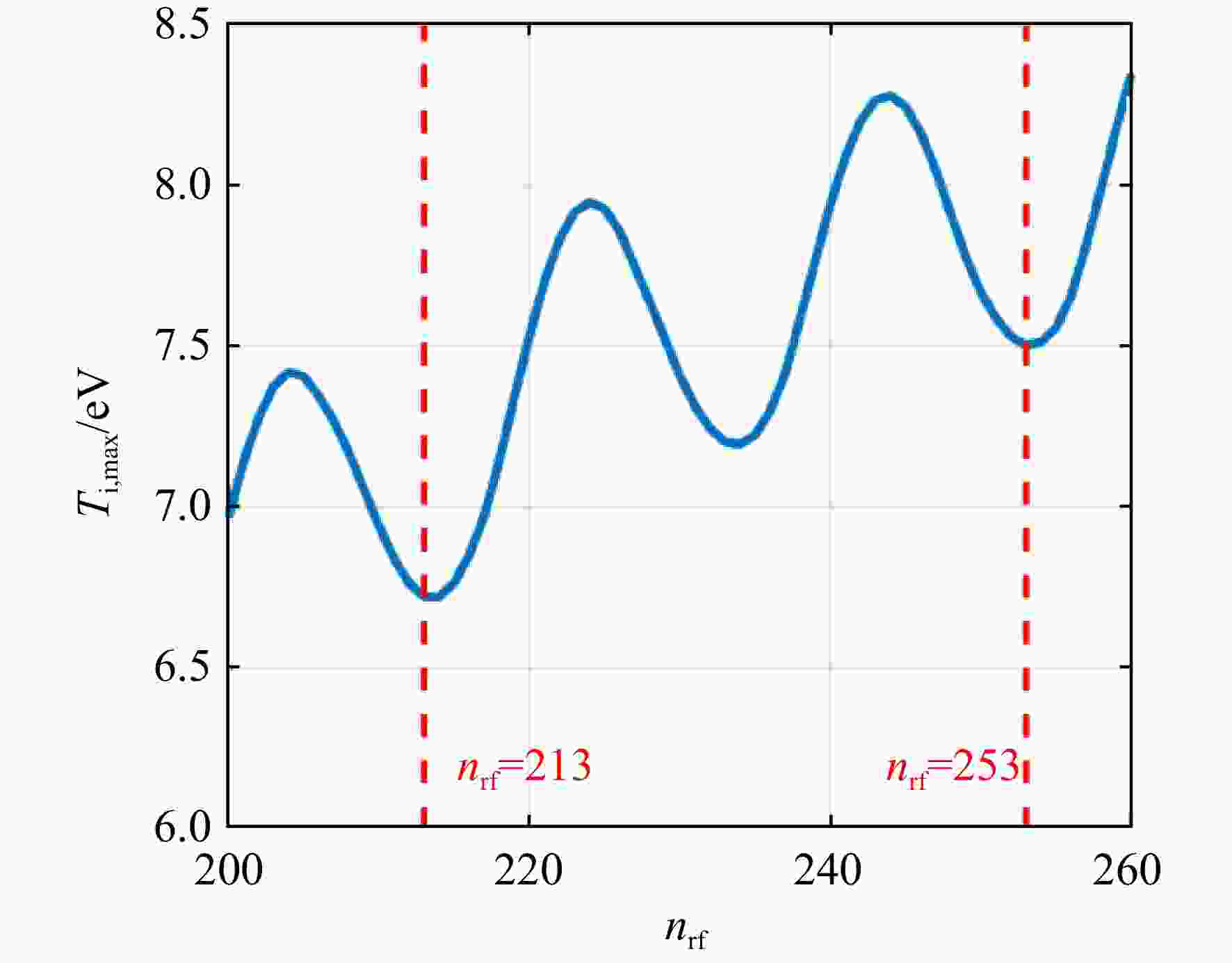
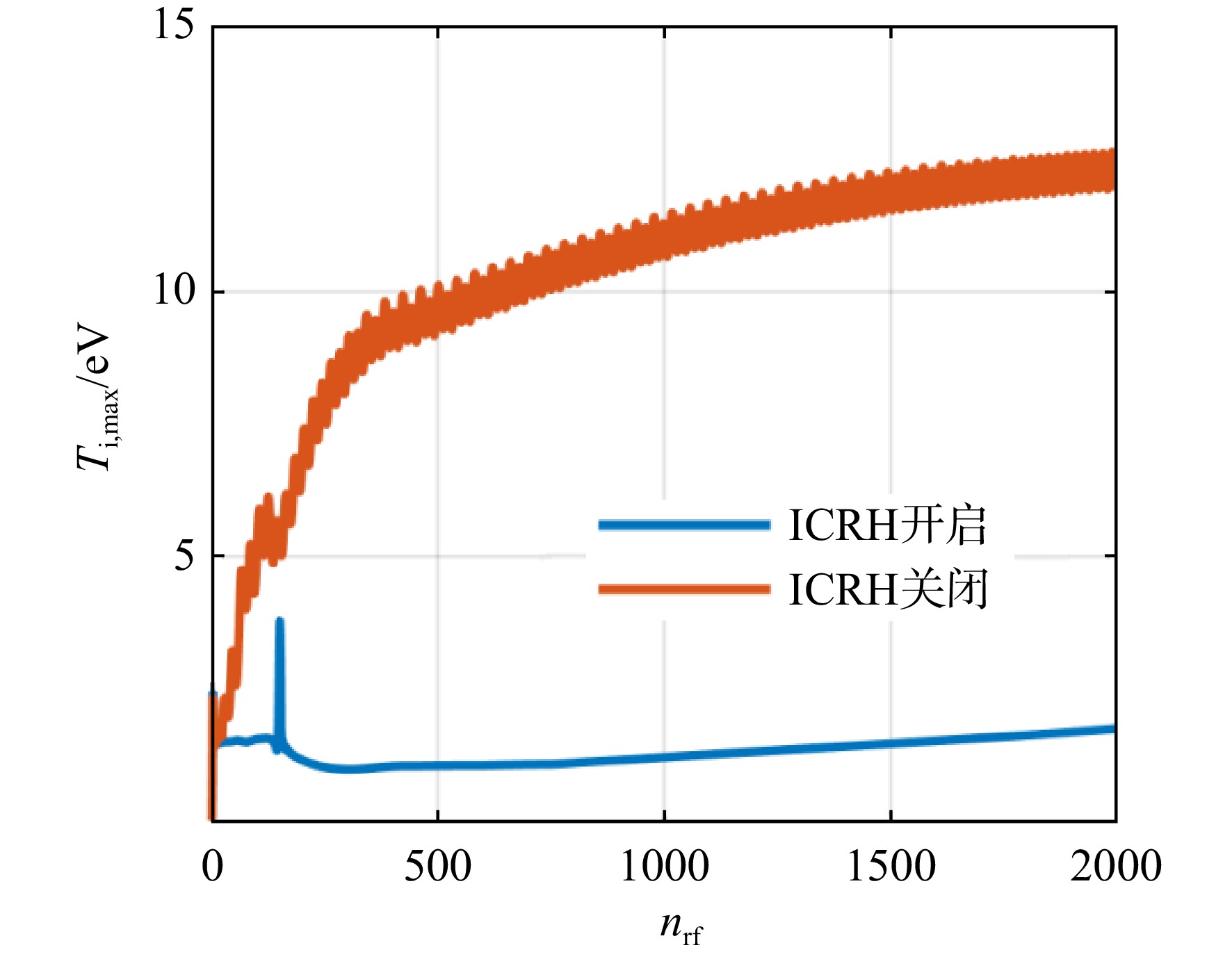
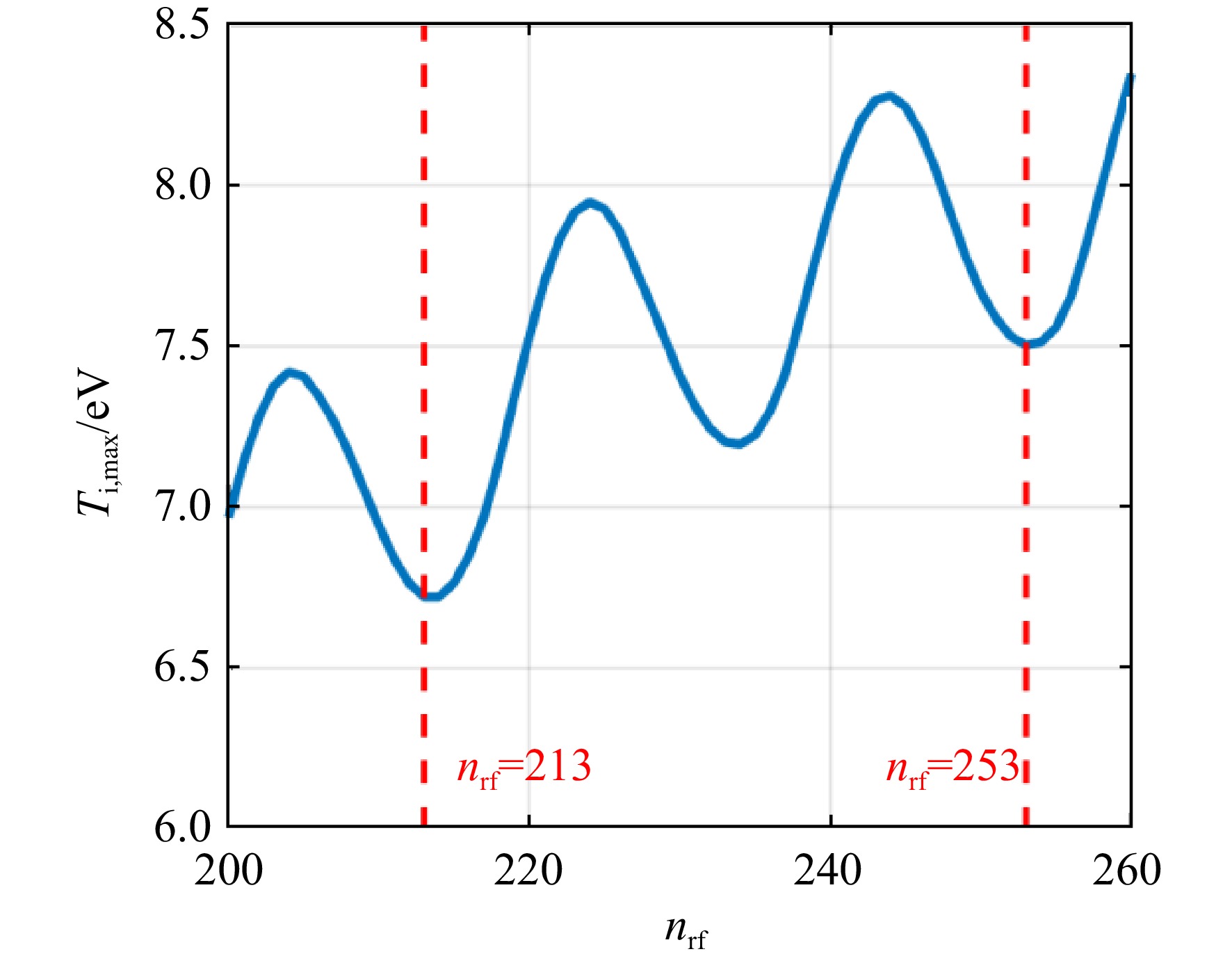
图 8 第200个与第260个射频周期之间的最大离子温度
Figure 8. The maximum ion temperature between the 200th and the 260th RF cycle
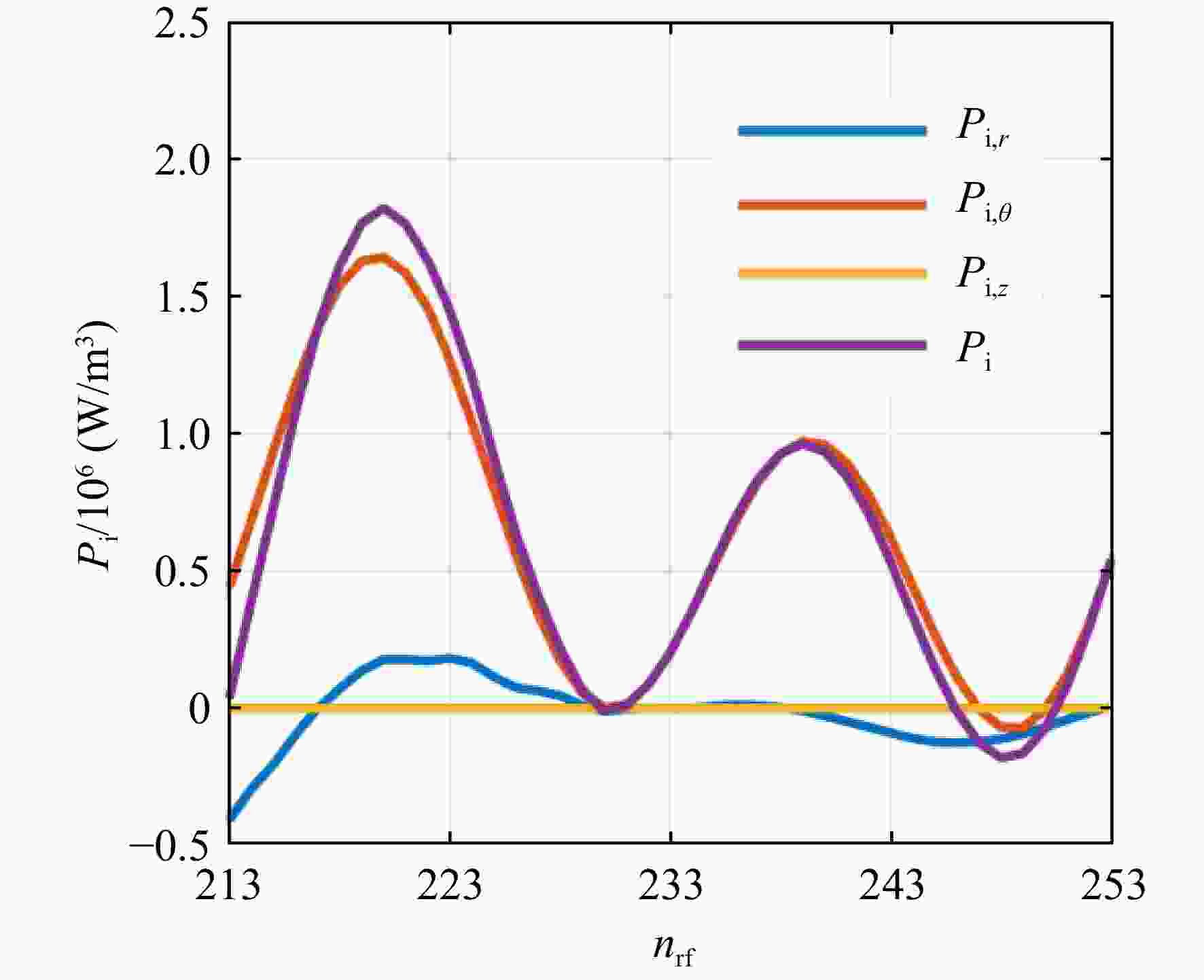
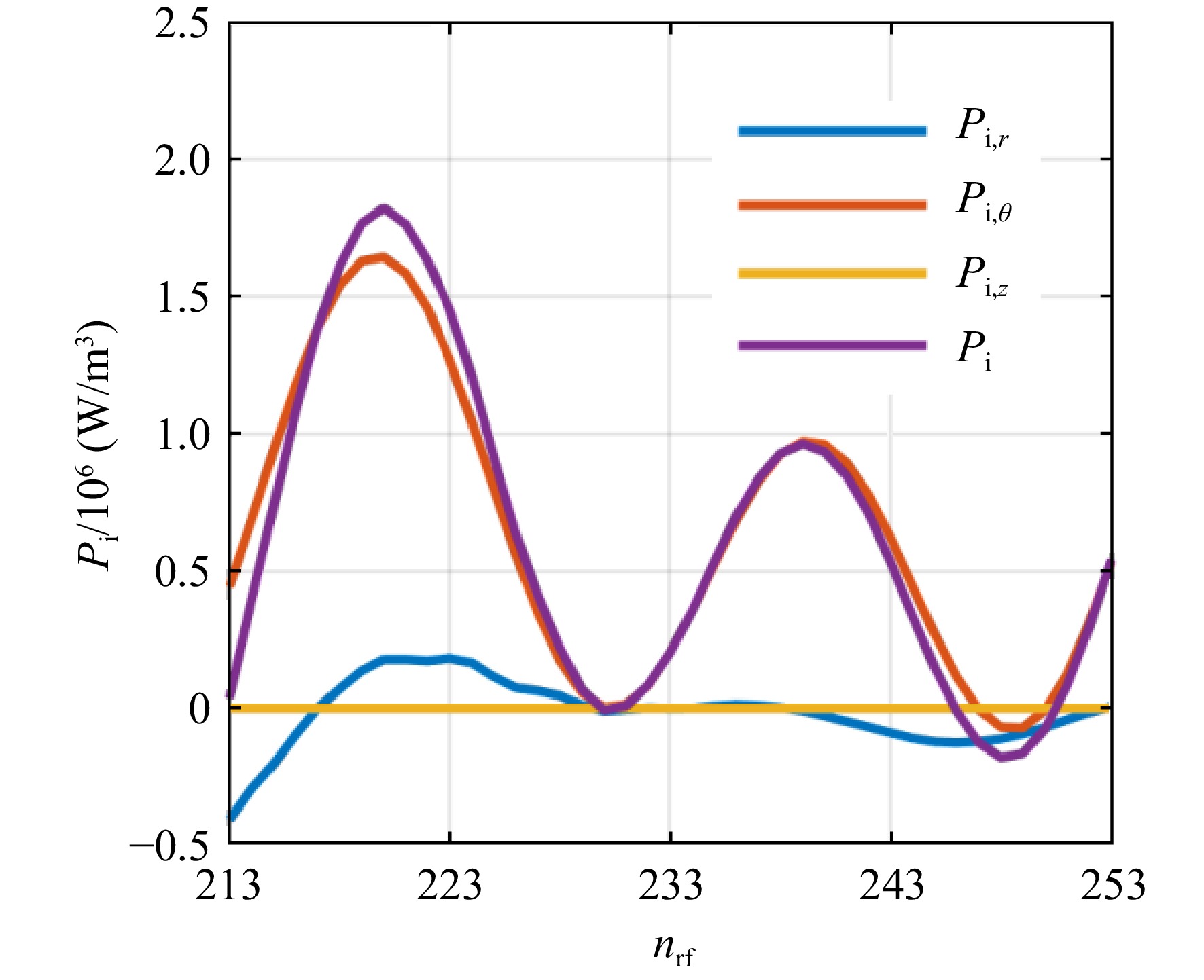
图 9 第213个与第253个射频周期之间(0.35 m, 0.05 m)处的离子沉积功率密度
Figure 9. Ion deposit power density at (0.35 m, 0.05 m) between the 213th and the 253th RF cycle
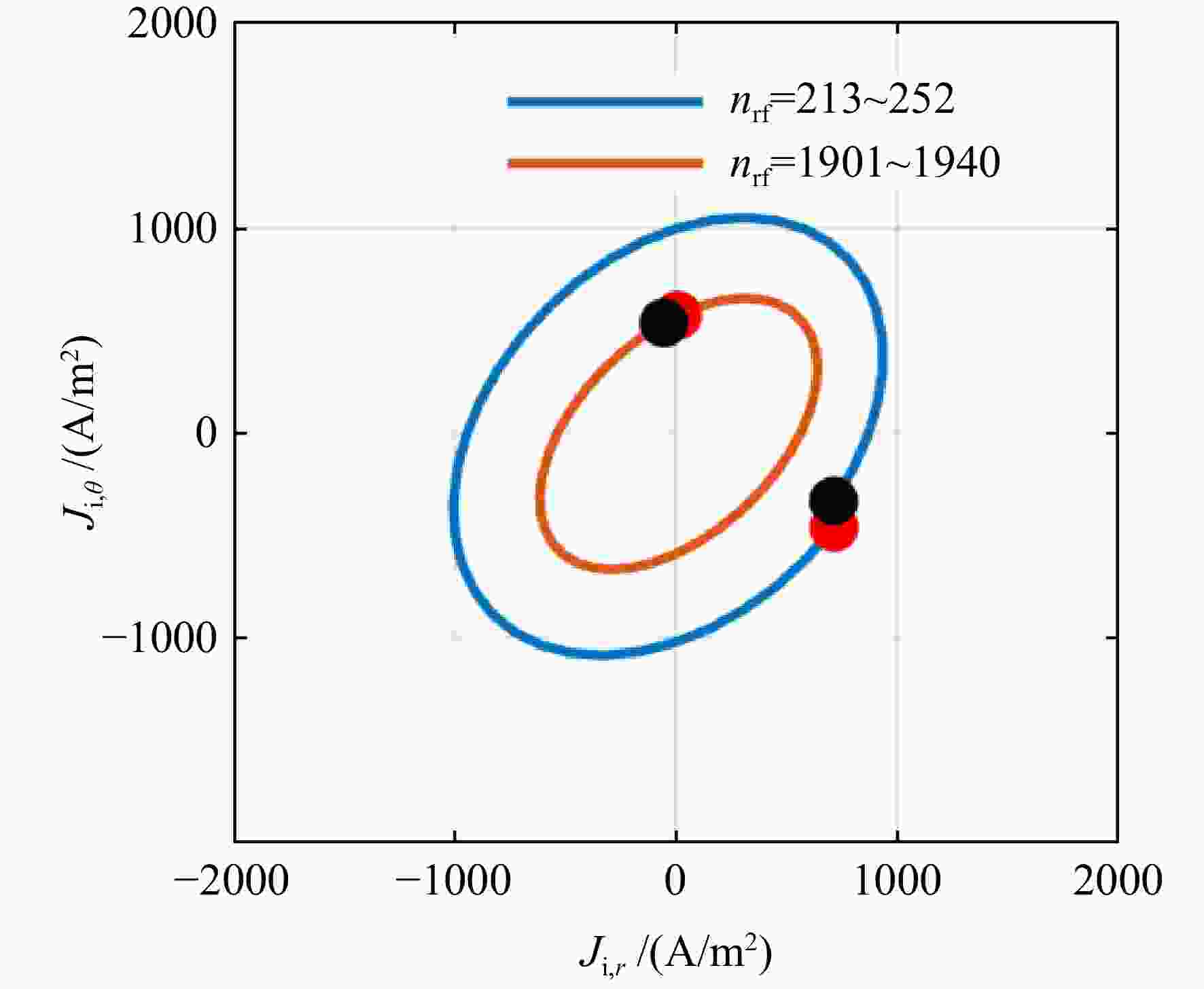
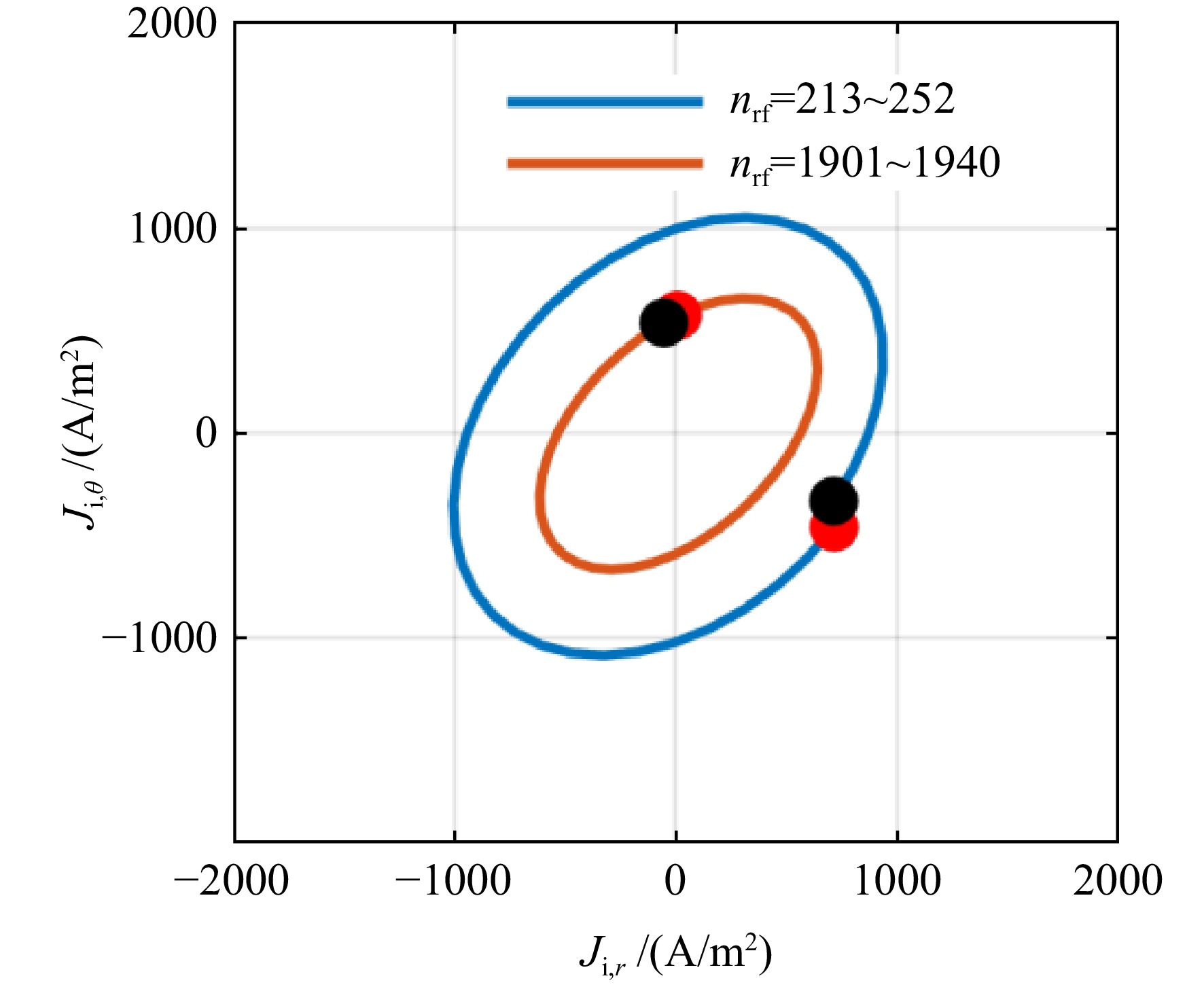
图 10 不同时刻(0.35 m, 0.05 m)处Ji,θ与Eθ的矢量端点图
Figure 10. Vector endpoints of Ji,θ and Eθ at different moments at (0.35 m, 0.05 m)
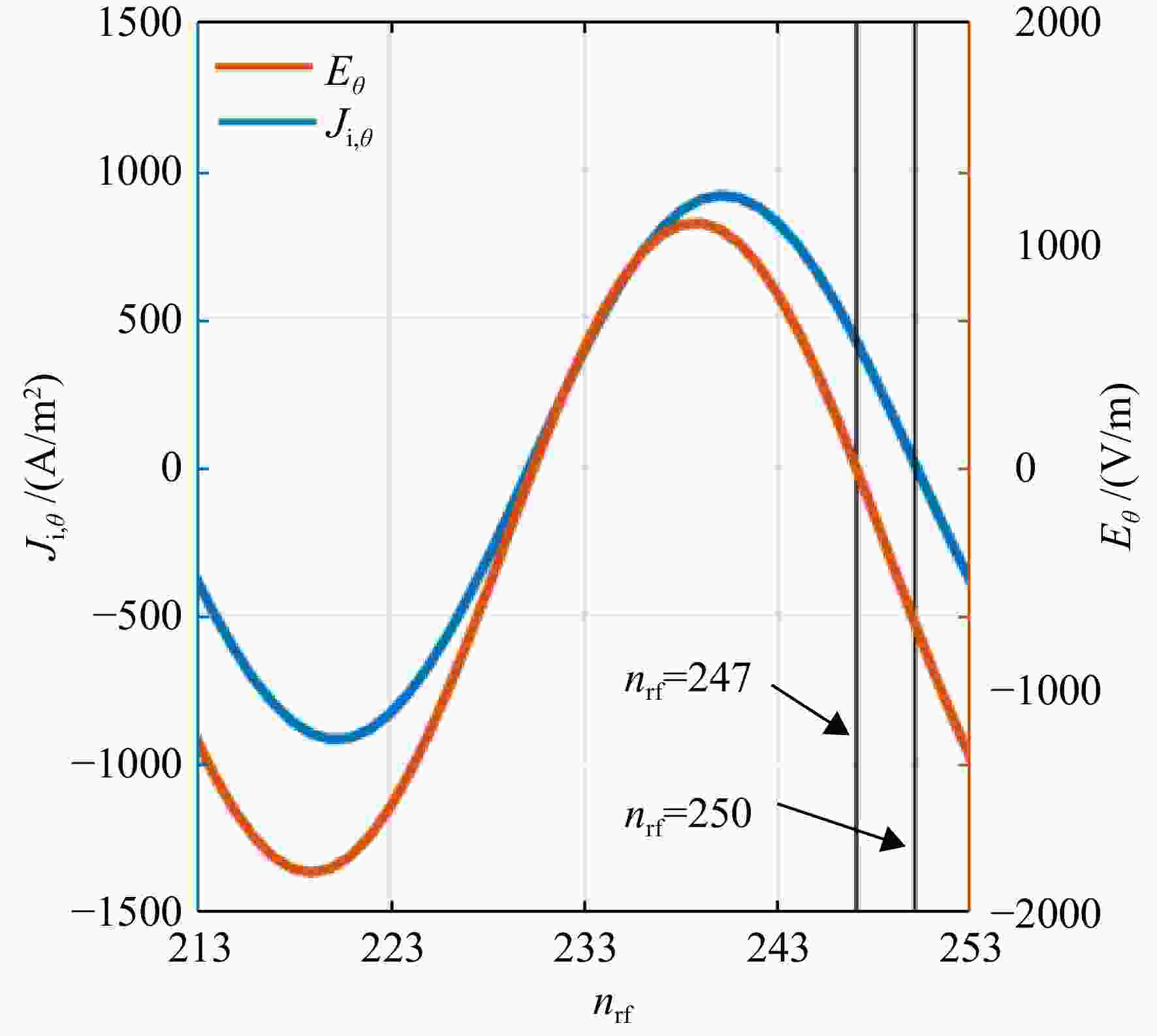
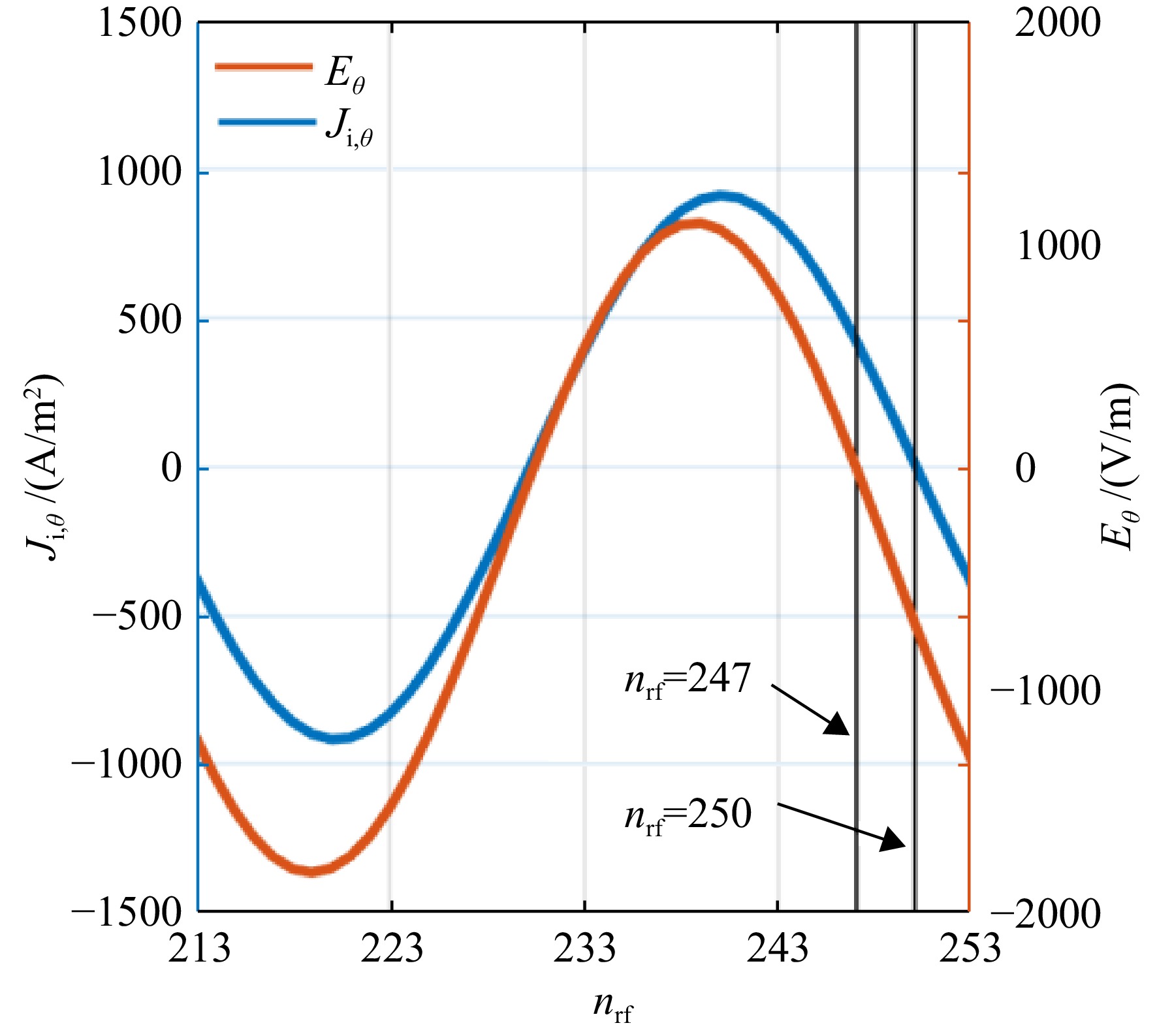
图 11 第213个与第253个射频周期之间(0.35 m, 0.05 m)处的Ji,θ与Eθ
Figure 11. Ji,θ and Eθ between the 213th and the 253th RF cycle at (0.35 m, 0.05 m)
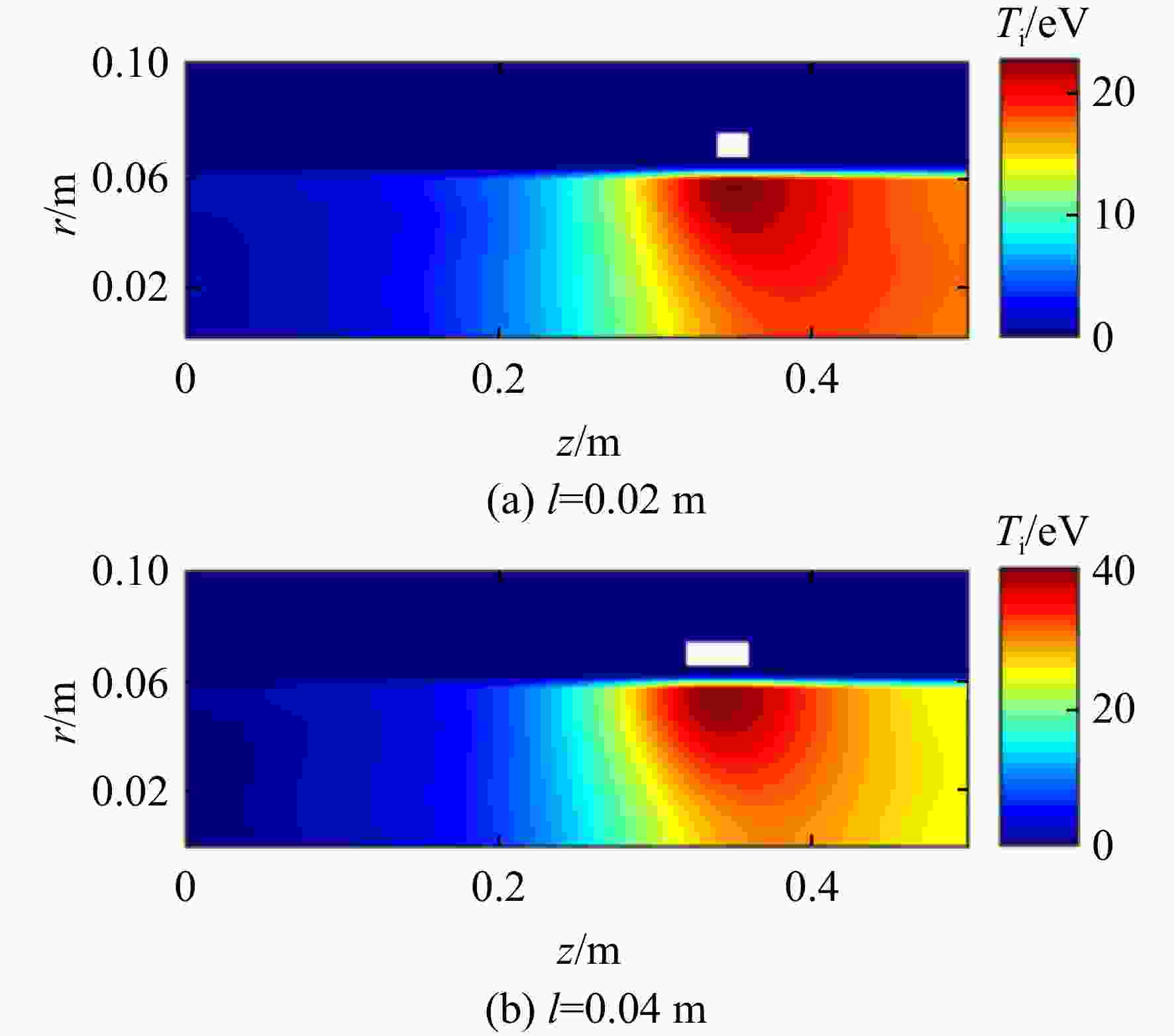
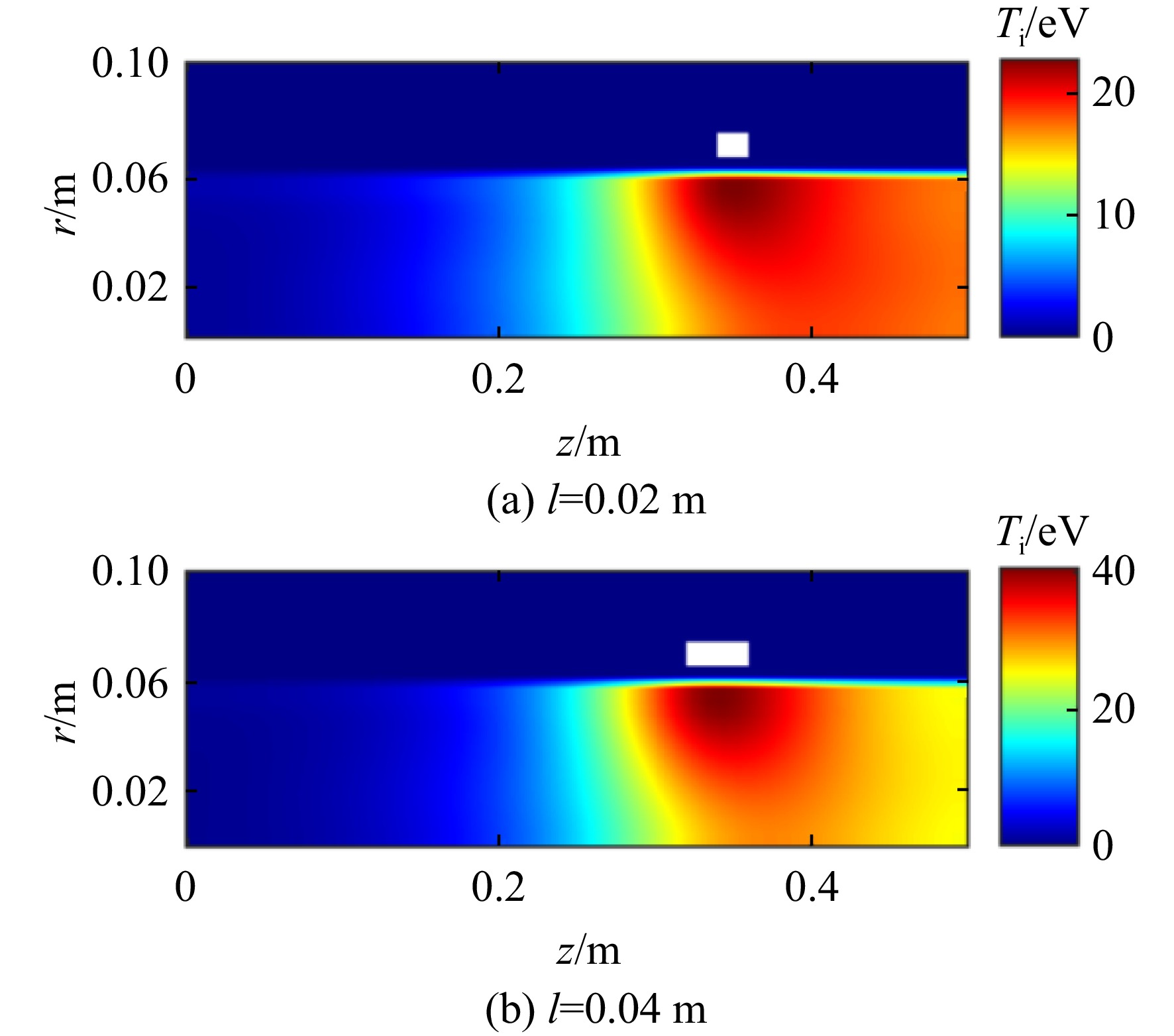
图 12 不同天线长度的离子温度分布
Figure 12. Distribution of ion temperature with different antenna length
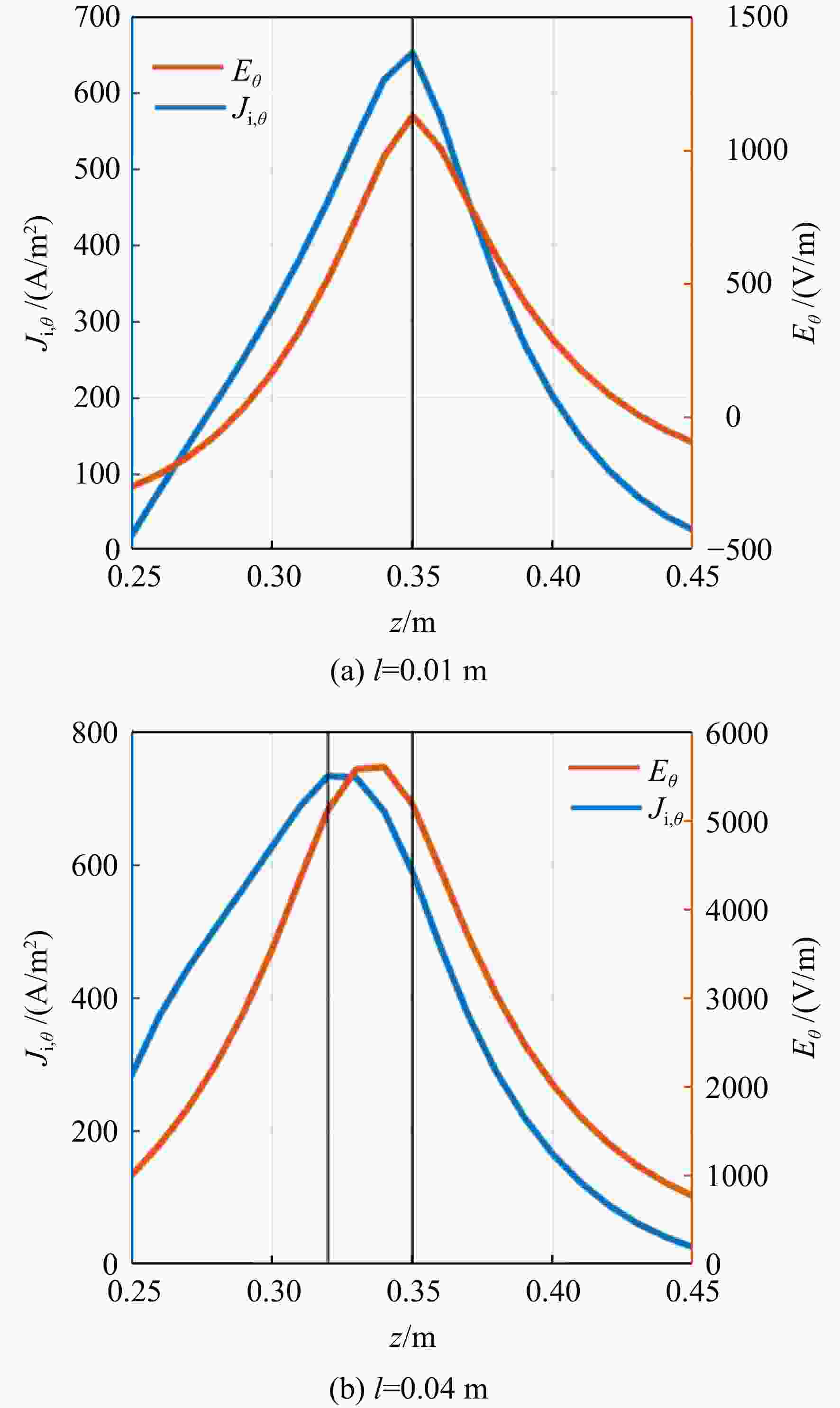
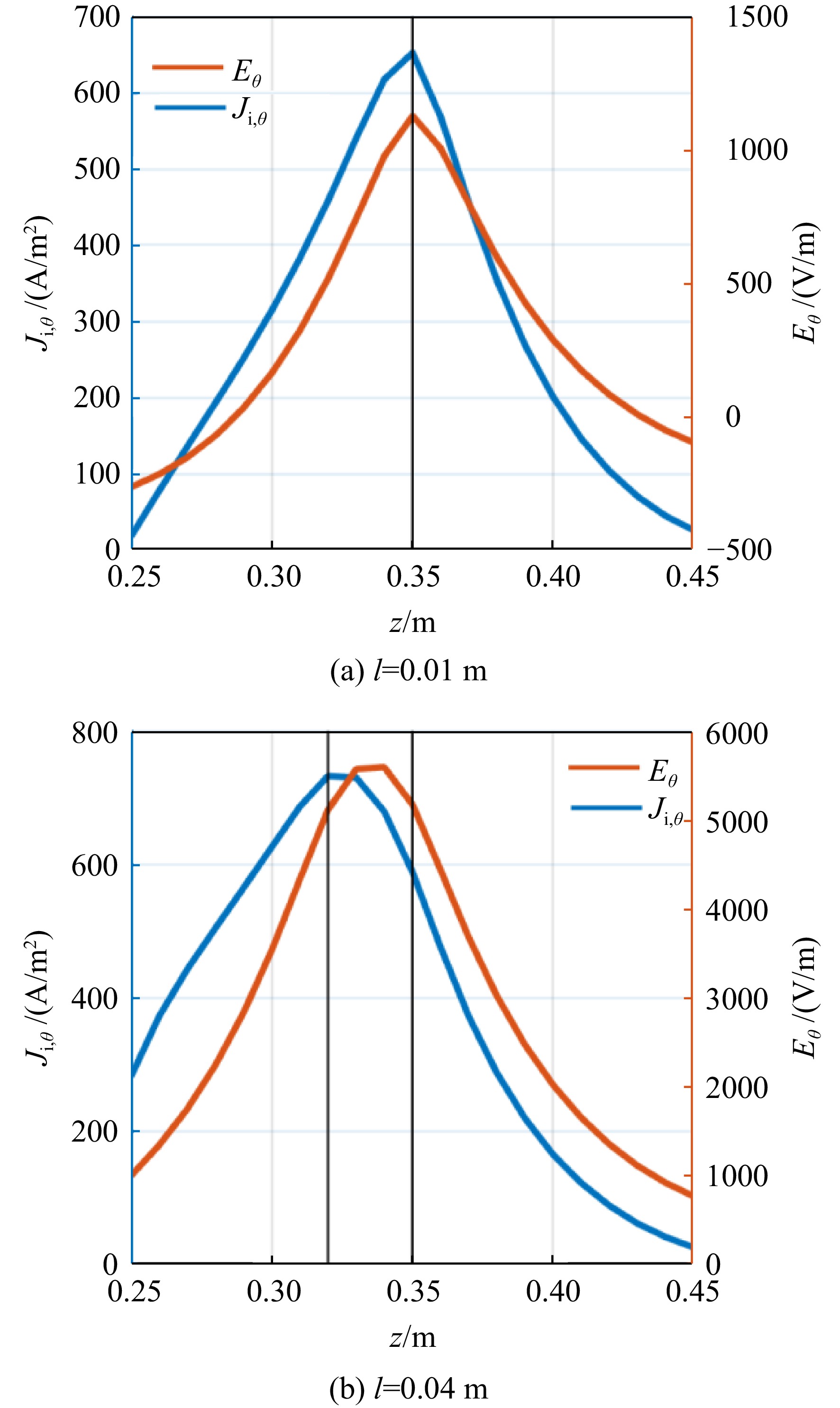
图 13 不同天线长度r=0.05 m直线上的Eθ与Ji,θ
Figure 13. Eθ and Ji,θ on the line of r=0.05 m with different antenna lengths
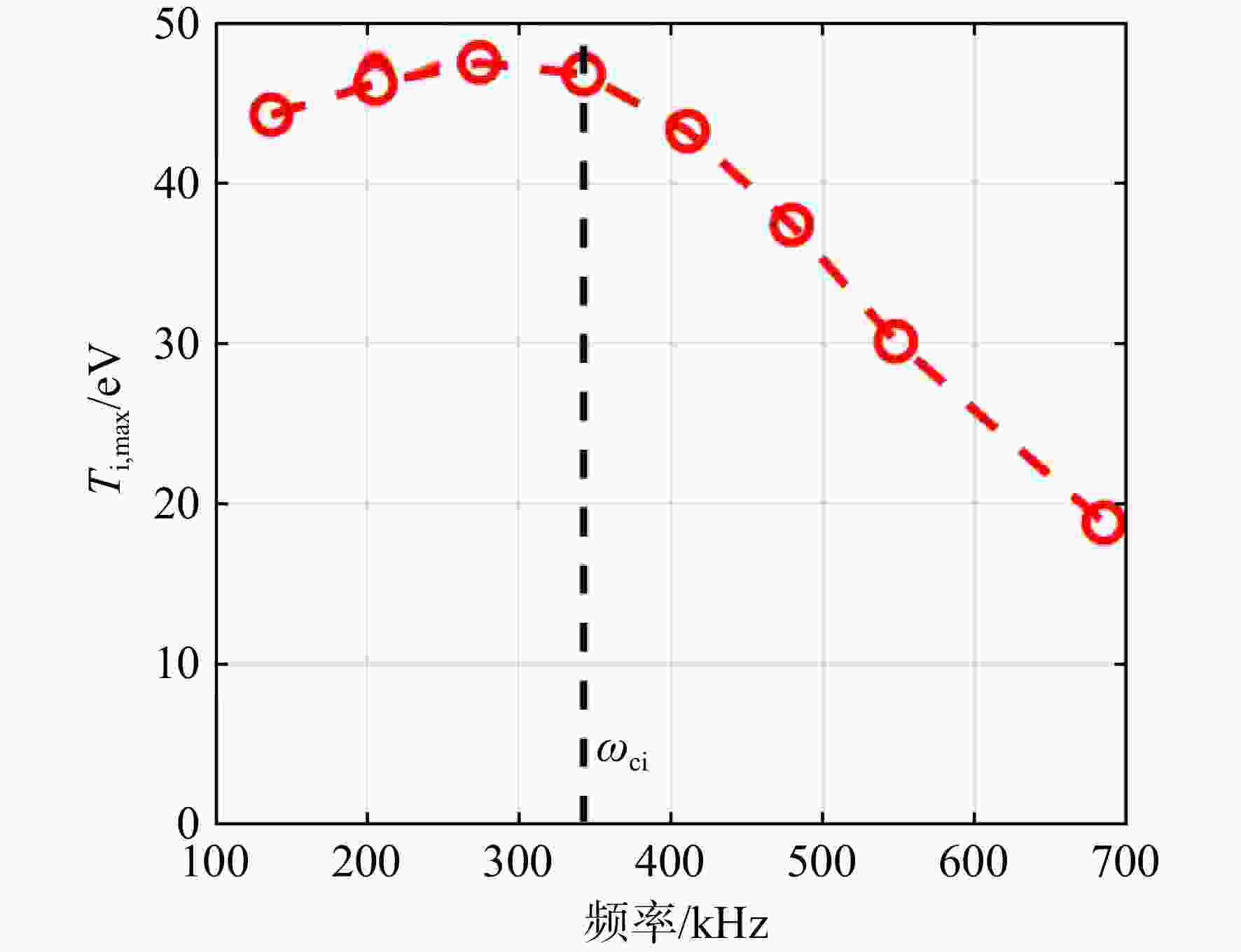
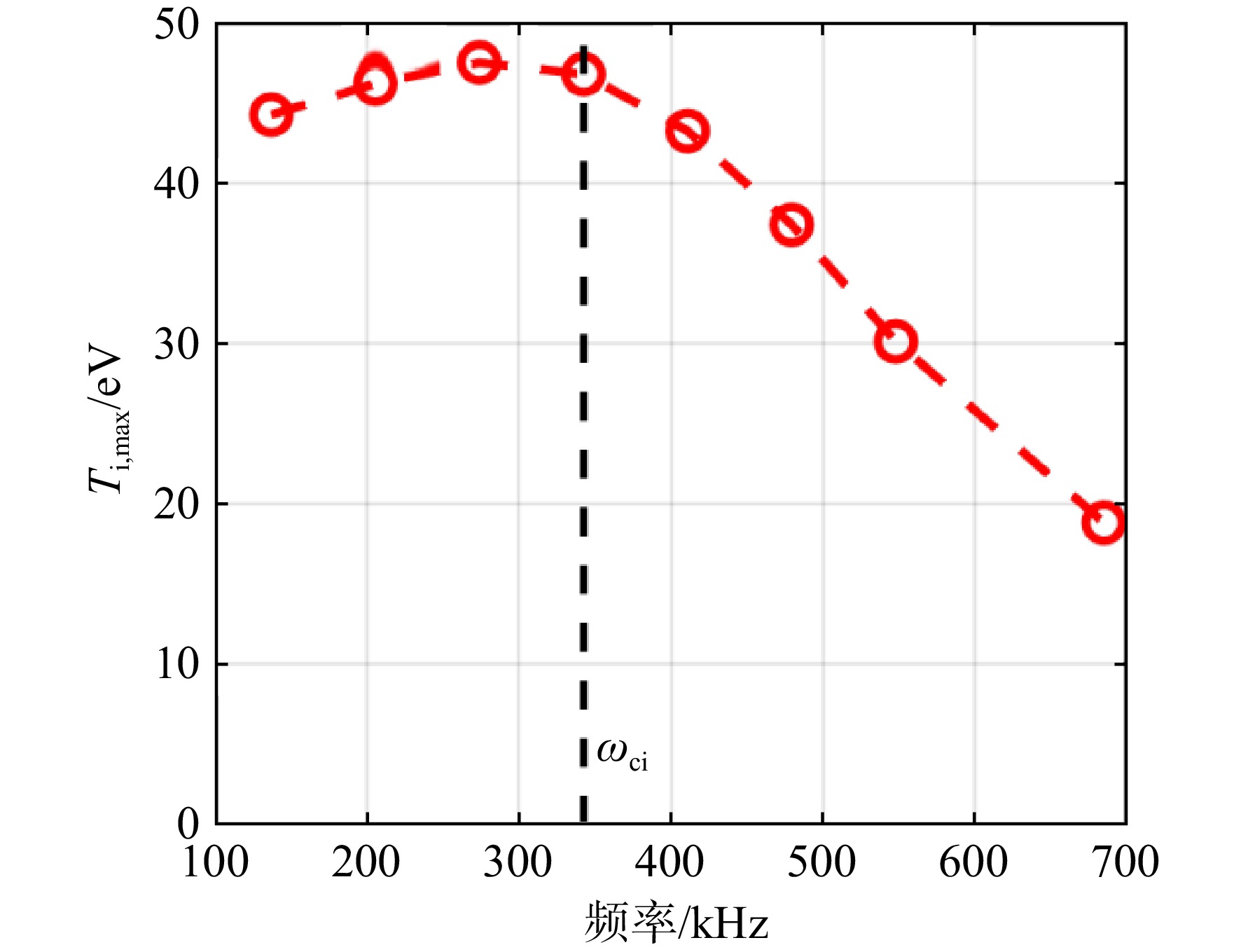
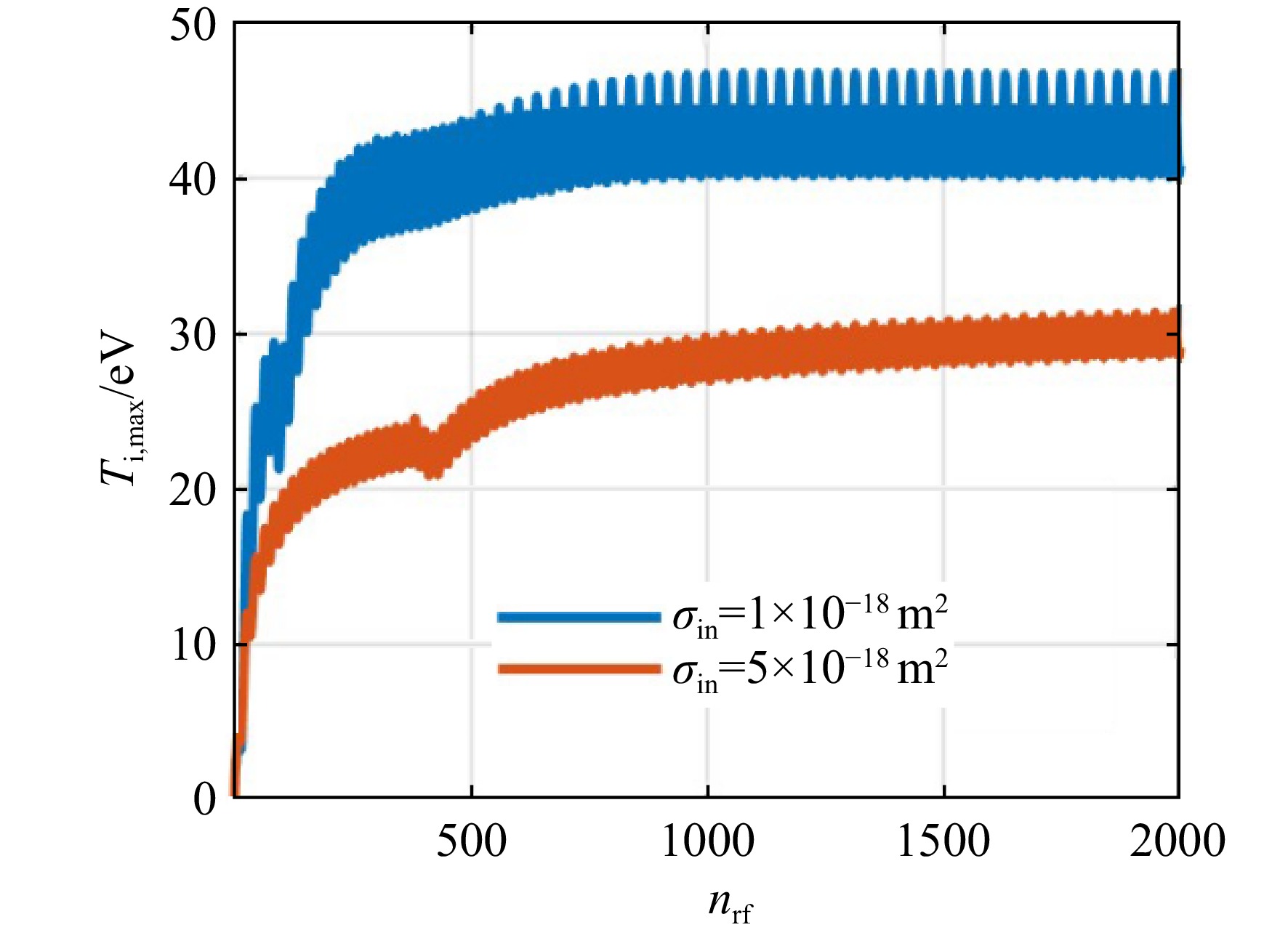
图 14 不同输入频率ICRH单元的最大离子温度
Figure 14. The maximum ion temperature with different input frequency of ICRH stage
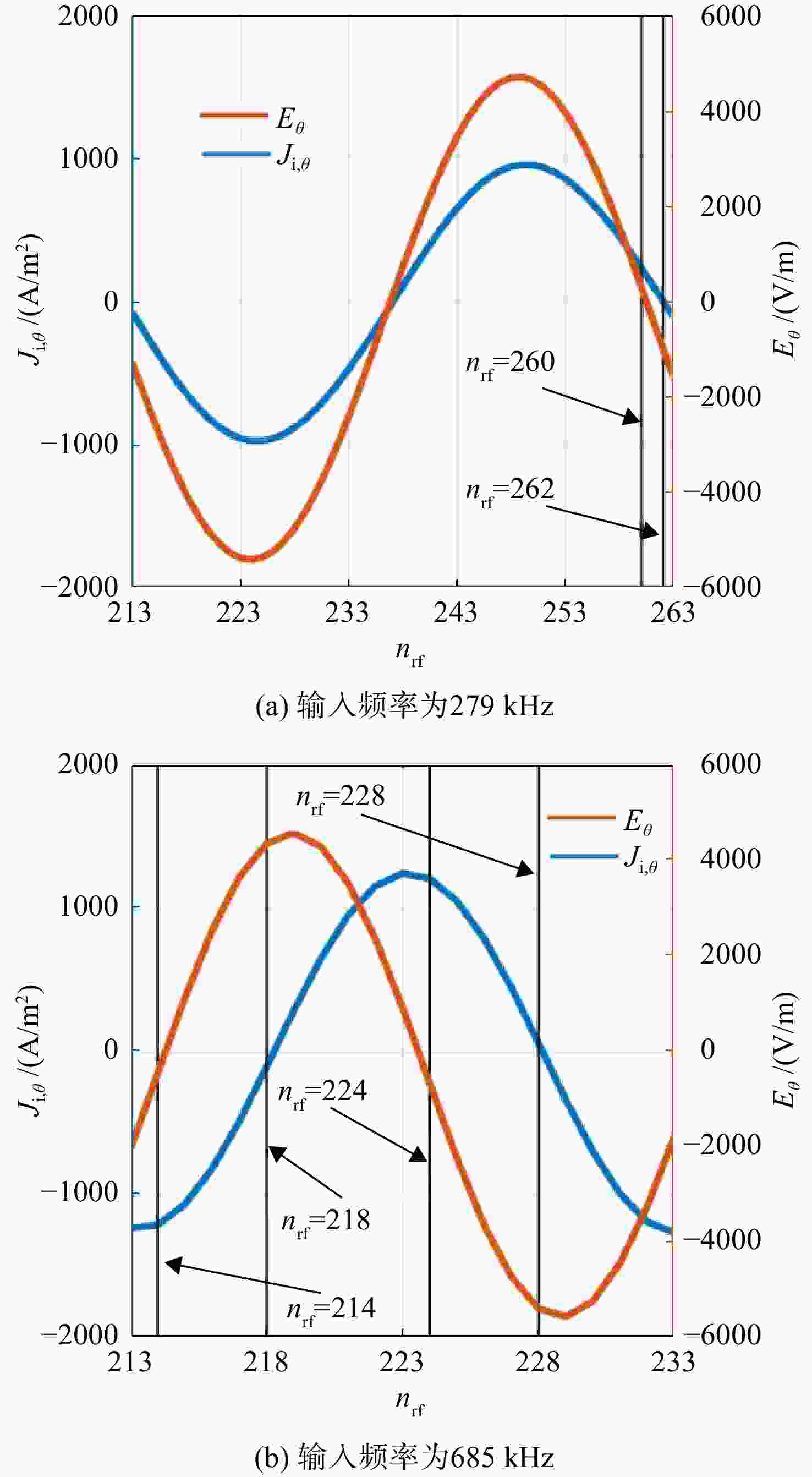
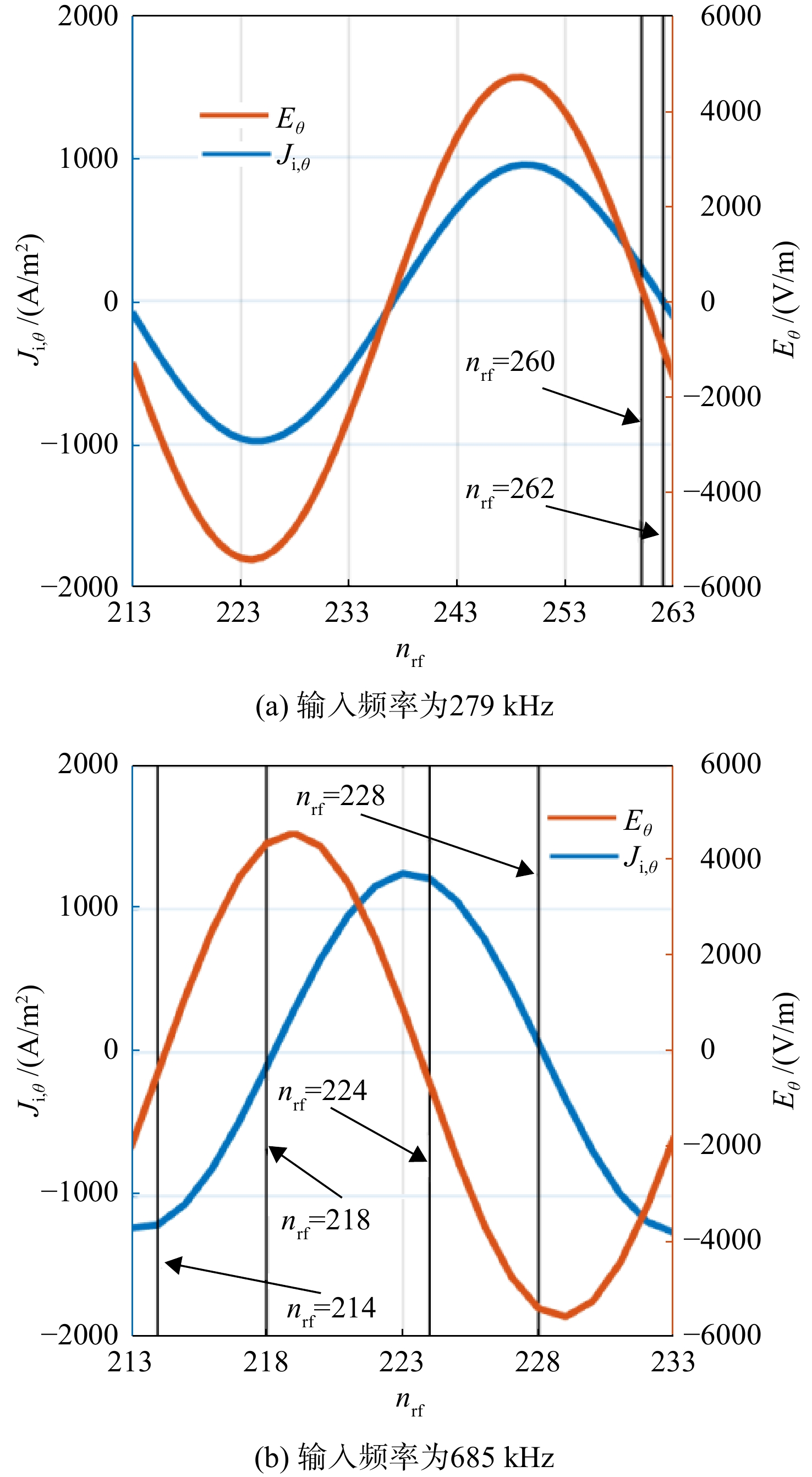
图 15 不同输入频率(0.35 m, 0.05 m)处的Ji,θ与Eθ
Figure 15. Ji,θ and Eθ at (0.35 m, 0.05 m) with different input frequencies
表 1 模型的几何参数
Table 1. Geometric parameters of the model
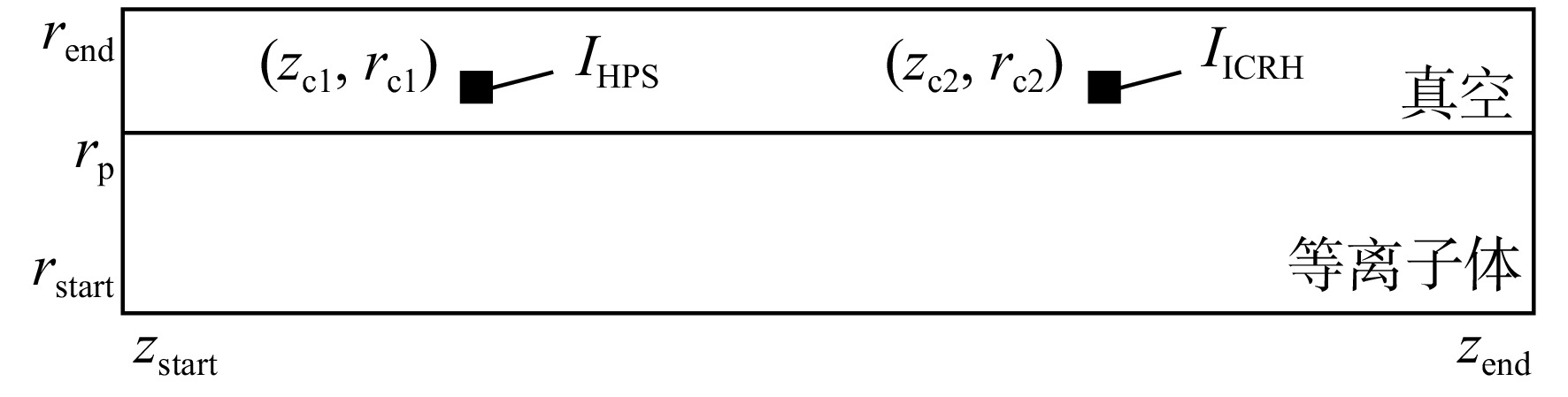
参数 数值 参数 数值 rstart/m 0 rc1/m 0.07 rend/m 0.1 zc2/m 0.35 zstart/m 0 rc2/m 0.07 zend/m 0.51 Δr/m 0.005 rp/m 0.06 Δz/m 0.01 zc1/m 0.15 Δt/10−12 s 2  下载: 导出CSV
表 2 不同ICRH天线长度的等离子体参数
Table 2. Plasma parameters with different ICRH antenna length
L/m ne /1019 m−3 Te/eV Ti/eV 0.01 1.11 3.02 12.09 0.02 1.13 3.20 22.75 0.04 1.21 3.33 40.77
下载: 导出CSV
-
[1] 于达仁, 乔磊, 蒋文嘉, 等. 中国电推进技术发展及展望[J]. 推进技术, 2020, 41(1): 1-11. Yu Daren, Qiao Lei, Jiang Wenjia, et al. Development and prospect of electric propulsion technology in China[J]. Journal of Propulsion Technology, 2020, 41(1): 1-11. (in ChineseYu Daren, Qiao Lei, Jiang Wenjia, et al. Development and prospect of electric propulsion technology in China[J]. Journal of Propulsion Technology, 2020, 41(1): 1-11. (in Chinese) [2] Franklin R C, Jared P S, Mark D C. An overview of the VASIMR engine[C]//Proceedings of AIAA Propulsion and Energy Forum. Cincinnati, US: AIAA, 2018: 4416-4423. [3] Franklin R C, Matthew G, Aidan M H C, et al. Recent progress on the VASIMR engine[C]//Proceedings of the 37th International Electric Propulsion Conference. Boston, US: Massachusetts Institute of Technology, 2022: 525-534. [4] 宋俊. 核聚变空间推进器的初步需求分析[J]. 航空动力学报, 2022, 37(7): 1495-1502. Song Jun. Preliminary analysis on the demand of nuclear fusion space thruster[J]. Journal of Aerospace Power, 2022, 37(7): 1495-1502. (in ChineseSong Jun. Preliminary analysis on the demand of nuclear fusion space thruster[J]. Journal of Aerospace Power, 2022, 37(7): 1495-1502. (in Chinese) [5] 于达仁, 汤尧, 刘辉. 面向空间运输任务的液体/固体工质电推进技术展望[J]. 力学学报, 2023, 55(12): 2857-2875. Yu Daren, Tang Yao, Liu Hui. Prospect of liquid/solid propellant electric propulsion technology for space transport tasks[J]. Chinese Journal of Theoretical and Applied Mechanics, 2023, 55(12): 2857-2875. (in ChineseYu Daren, Tang Yao, Liu Hui. Prospect of liquid/solid propellant electric propulsion technology for space transport tasks[J]. Chinese Journal of Theoretical and Applied Mechanics, 2023, 55(12): 2857-2875. (in Chinese) [6] Du Dan, Gong Xueyu, Yin Lan, et al. Theoretical analysis of triple liquid stub tuner impedance matching for ICRH on Tokamaks[J]. Plasma Science and Technology, 2015, 17(12): 1078. doi: 10.1088/1009-0630/17/12/17 [7] Monakhov I, Jacquet P, Dumortier P, et al. Assessment of the JET ICRH system performance since 2000[J]. Plasma Physics and Controlled Fusion, 2025, 67(1): 015023. doi: 10.1088/1361-6587/ad9e73 [8] Chang F R, Fisher J L. A supersonic gas target for a bundle divertor plasma[J]. Nuclear Fusion, 1982, 22(8): 1003. doi: 10.1088/0029-5515/22/8/001 [9] Breizman B N, Arefiev A V. Single-pass ion cyclotron resonance absorption[J]. Physics of Plasmas, 2001, 8(3): 907-915. doi: 10.1063/1.1348034 [10] Squire J P, Chang-Díaz F R, Glover T W, et al. High power light gas Helicon plasma source for VASIMR[J]. Thin Solid Films, 2006, 506/507: 579-582. [11] Edgar A B, Michael B, Franklin R C, et al. Ion acceleration by single pass ion cyclotron heating in the VASIMR engine[C]//Proceedings of the 29th International Electric Propulsion Conference. Princeton, US: Princeton University, 2005: 93-108. [12] Edgar A B, Michael B, Jared P S, et al. Recent improvements in ionization costs and ion cyclotron heating efficiency in the VASMIR engine: AIAA-2006-0766 [R]. Reno, US: AIAA, 2006. [13] Bering E A, Chang-Díaz F R, Squire J P, et al. Electromagnetic ion cyclotron resonance heating in the VASIMR[J]. Advances in Space Research, 2008, 42(1): 192-205. doi: 10.1016/j.asr.2007.09.034 [14] Bering E A III, Díaz F R C, Squire J P, et al. Observations of single-pass ion cyclotron heating in a trans-sonic flowing plasma[J]. Physics of Plasmas, 2010, 17(4): 043509. doi: 10.1063/1.3389205 [15] Andrew V I, Franklin R C, Jared P S, et al. Plasma heating simulation in the VASIMR system: AIAA-2005-0949[R]. Reno, US: AIAA, 2005. [16] Ilin A V, Chang-Díaz F R, Squire J P, et al. Improved simulation of the ICRF waves in the VASIMR plasma[J]. Computer Physics Communications, 2004, 164(1/2/3): 251-257. [17] Wu Mingyang, Xiao Chijie, Wang Xiaogang, et al. A new configuration for high power propulsion plasmas driven by ion cyclotron resonance energization[J]. Physics of Plasmas, 2022, 29(2): 023508. doi: 10.1063/5.0073439 [18] Sun Changjiang, Sang Chaofeng, Wang Hongyu, et al. Simulation of ion cyclotron resonance heating by using particle-in-cell method in MPS-LD linear plasma device[J]. Plasma Physics and Controlled Fusion, 2023, 65(3): 035003. doi: 10.1088/1361-6587/acb081 [19] Sun Changjiang, Zhang Yanjie, Sang Chaofeng, et al. Experimental and simulation study of helium plasma transport during ion cyclotron resonance heating in MPS-LD[J]. Nuclear Fusion, 2025, 65(5): 056007. doi: 10.1088/1741-4326/adc3a8 [20] 杨雄, 李小康, 郭大伟, 等. 高功率波加热磁等离子体推力器研究现状与展望[J]. 航空学报, 2024, 45(7): 028761. Yang Xiong, Li Xiaokang, Guo Dawei, et al. Research status and prospect of high-power wave-heating magnetoplasma thruster[J]. Acta Aeronautica et Astronautica Sinica, 2024, 45(7): 028761. (in ChineseYang Xiong, Li Xiaokang, Guo Dawei, et al. Research status and prospect of high-power wave-heating magnetoplasma thruster[J]. Acta Aeronautica et Astronautica Sinica, 2024, 45(7): 028761. (in Chinese) [21] Wu Mingyang, Xiao Chijie, Wang Xiaogang, et al. Relationship of mode transitions and standing waves in Helicon plasmas[J]. Plasma Science and Technology, 2022, 24(5): 055002. doi: 10.1088/2058-6272/ac567d [22] 崔云蔚, 任军学, 张广川, 等. 射频离子推力器等离子体特性的流体模拟研究[J]. 航空动力学报, 2025, 40(6): 20240090. Cui Yunwei, Ren Junxue, Zhang Guangchuan, et al. Fluid simulation of plasma characteristics in radio frequency ion thrusters[J]. Journal of Aerospace Power, 2025, 40(6): 20240090. (in ChineseCui Yunwei, Ren Junxue, Zhang Guangchuan, et al. Fluid simulation of plasma characteristics in radio frequency ion thrusters[J]. Journal of Aerospace Power, 2025, 40(6): 20240090. (in Chinese) [23] 杨雄, 程谋森, 王墨戈, 等. 螺旋波等离子体放电三维直接数值模拟[J]. 物理学报, 2017, 66(2): 243-253. Yang Xiong, Cheng Mousen, Wang Moge, et al. Three-dimensional direct numerical simulation of Helicon discharge[J]. Acta Physica Sinica, 2017, 66(2): 243-253. (in ChineseYang Xiong, Cheng Mousen, Wang Moge, et al. Three-dimensional direct numerical simulation of Helicon discharge[J]. Acta Physica Sinica, 2017, 66(2): 243-253. (in Chinese) [24] Ventzek P L G, Hoekstra R J, Kushner M J. Two-dimensional modeling of high plasma density inductively coupled sources for materials processing[J]. Journal of Vacuum Science and Technology: B Microelectronics and Nanometer Structures Processing, Measurement, and Phenomena, 1994, 12(1): 461-477. doi: 10.1116/1.587101 [25] Yang Zhenyu, Fan Wei, Wei Jianguo, et al. Simulation of a Helicon plasma source in a magnetoplasma rocket engine[J]. Plasma Science and Technology, 2022, 24(7): 074006. doi: 10.1088/2058-6272/ac5971 [26] Zhen Fenghua, Chen Zhizhang, Zhang Jiazong. Toward the development of a three-dimensional unconditionally stable finite-difference time-domain method[J]. IEEE Transactions on Microwave Theory and Techniques, 2000, 48(9): 1550-1558. doi: 10.1109/22.869007 [27] Boris J P, Landsberg A, Oran E S, et al. LCPFCT-a flux-corrected transport algorithm for solving generalized continuity equations: NRL-6410-93-7192 [R]. Washington DC: United States Naval Research Laboratory, 1993. [28] Yang Zhenyu, Fan Wei, Han Xianwei, et al. The resonance between the electromagnetic field and electrons in the Helicon plasma source of a magnetoplasma rocket engine[J]. Frontiers in Physics, 2023, 11: 1182960. doi: 10.3389/fphy.2023.1182960 [29] 杨振宇, 范威, 鲁海峰, 等. 磁等离子体发动机中离子回旋共振加热多组分流体模拟[J]. 推进技术, 2023, 44(6): 2208001. Yang Zhenyu, Fan Wei, Lu Haifeng, et al. Multicomponent fluid simulation of ion cyclotron resonance heating in magnetoplasma rocket engine[J]. Journal of Propulsion Technology, 2023, 44(6): 2208001. (in ChineseYang Zhenyu, Fan Wei, Lu Haifeng, et al. Multicomponent fluid simulation of ion cyclotron resonance heating in magnetoplasma rocket engine[J]. Journal of Propulsion Technology, 2023, 44(6): 2208001. (in Chinese) -

 点击查看大图
计量
- 文章访问数: 434
- HTML浏览量: 298
- PDF量: 38
- 被引次数: 0